Active Learning Strategies for Data-Scarce Chemical Problems: A Guide for Efficient Discovery
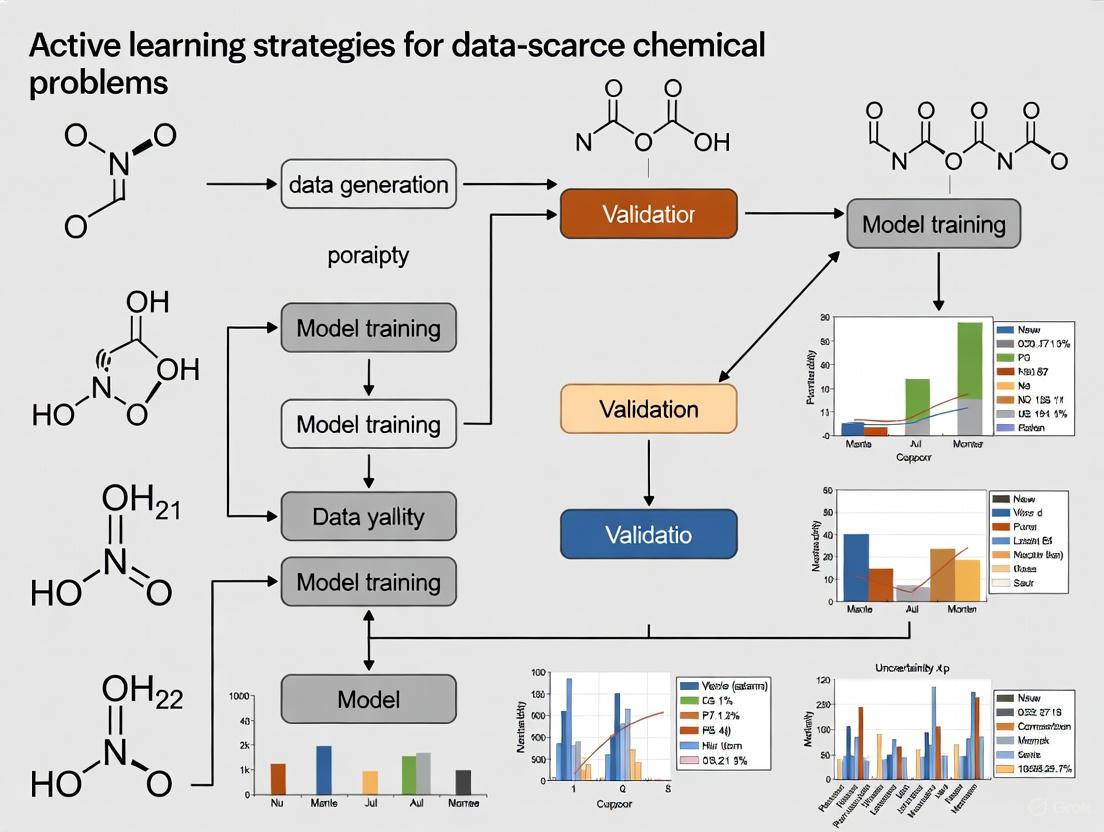
This article provides a comprehensive guide for researchers and drug development professionals on leveraging active learning (AL) to overcome data scarcity in chemical and materials science.
Active Learning Strategies for Data-Scarce Chemical Problems: A Guide for Efficient Discovery
Abstract
This article provides a comprehensive guide for researchers and drug development professionals on leveraging active learning (AL) to overcome data scarcity in chemical and materials science. It covers the foundational principles of AL, detailing how this machine learning paradigm strategically selects the most informative experiments to minimize labeling costs and accelerate discovery. The piece explores key methodological strategies and their successful applications in areas like drug discovery and materials design, while also addressing common challenges such as imbalanced data and computational cost. Finally, it presents a comparative analysis of different AL approaches based on recent benchmark studies, offering evidence-based recommendations for implementing these techniques to optimize ADMET properties, discover novel materials, and enhance predictive modeling in biomedical research.
What is Active Learning and Why is it a Game-Changer for Data-Scarce Chemistry?
Frequently Asked Questions (FAQs)
FAQ 1: What is active learning and why is it critical for data-scarce problems in chemical research? Active learning is a machine learning paradigm where the algorithm strategically selects the most informative data points for experimental testing, rather than relying on passive consumption of large, pre-existing datasets [1]. This is crucial for chemical and drug discovery research because generating experimental data is often costly, time-consuming, and the phenomena of interest—like synergistic drug pairs or successful reaction conditions—can be rare [2] [3]. By guiding experiments toward the most promising areas of chemical space, active learning minimizes resource consumption and accelerates discovery [4] [5].
FAQ 2: How does active learning fundamentally differ from traditional machine learning? Traditional machine learning models are typically trained on static, large-scale datasets and act as passive predictors. In contrast, active learning operates in a closed-loop fashion [5] [3]. It starts with an initial dataset, a model is trained to make predictions and quantify uncertainty, and an acquisition function uses this information to select the next most informative experiments. The results from these targeted experiments are then used to retrain and improve the model, creating an iterative cycle of learning and discovery [4] [6].
FAQ 3: What are the main strategies for selecting experiments in active learning? The selection process is governed by the exploration-exploitation trade-off [4] [2]. The specific strategy is implemented through an acquisition function. Common philosophies include:
- Exploration: Prioritizing experiments in regions of high uncertainty to broaden the model's understanding of the chemical space.
- Exploitation: Prioritizing experiments in regions predicted to have high performance (e.g., high yield, strong synergy) to refine and confirm the best candidates.
- Balanced/Hybrid: Modern frameworks, like the Confidence-Adjusted Surprise (CAS), dynamically balance exploration and exploitation by amplifying surprises in regions where the model is more confident, preventing wasted resources on inherently noisy areas [4].
FAQ 4: My active learning model is stuck and keeps selecting similar, unproductive experiments. How can I escape this local optimum? This is a common challenge. Several strategies can help:
- Adjust the Acquisition Function: If you are using a purely exploitative strategy, switch to one that encourages more exploration or uses a dynamic balance like CA-SMART [4].
- Incorporate Prior Knowledge via Transfer Learning: Use a model pre-trained on a related, larger source dataset (e.g., a public reaction database) to initialize your active learning loop. This "warms up" the model, providing better initial guidance and helping it avoid unproductive regions from the start [7] [6].
- Reduce Batch Size: In batch active learning, using smaller batch sizes has been shown to increase the discovery yield of rare events, as the model can adapt more frequently to new information [2].
- Re-evaluate Feature Space: Ensure your molecular or reaction descriptors are relevant to the problem. For drug synergy, for instance, cellular environment features (e.g., gene expression) can be more critical than the specific molecular encoding [2].
FAQ 5: How do I choose the right machine learning model for my active learning campaign? The choice depends on your data and problem domain:
- Tree-based models (e.g., Random Forest) are often effective for structured reaction condition data, are computationally efficient, and provide a good baseline [5] [6].
- Geometric Graph Neural Networks are powerful for predicting reaction outcomes and regioselectivity, as they naturally incorporate the 3D structure and symmetry of molecules [5].
- Bayesian Optimization (BO) with a Gaussian Process surrogate model is ideal for optimizing continuous variables (e.g., reaction temperature, concentration) and naturally provides uncertainty estimates [4]. The key is to prioritize models that are data-efficient and can provide reliable uncertainty estimates to guide the acquisition function [2].
Troubleshooting Guides
Issue 1: Poor Model Performance Despite Iterative Sampling
Symptoms
- The model's predictive accuracy does not improve with new experimental data.
- The acquisition function selects data points that do not lead to the discovery of high-performing candidates.
Diagnosis and Resolution Steps
| Step | Action | Diagnostic Check | Resolution |
|---|---|---|---|
| 1 | Verify Data Quality & Relevance | Check for consistent experimental protocols and accurate outcome measurement. | Re-standardize experimental procedures; re-evaluate outcome labels (e.g., yield, synergy score thresholds). |
| 2 | Audit Feature Set | Ensure input features (e.g., molecular fingerprints, cellular context) are informative for the task. | Incorporate more relevant descriptors; for drug synergy, confirm inclusion of genomic features from the target cell line [2]. |
| 3 | Analyze Acquisition Function | Determine if the function is over-exploring (high uncertainty) or over-exploiting (low uncertainty). | Switch to a balanced acquisition function like Confidence-Adjusted Surprise (CAS) [4] or adjust the balance parameter. |
| 4 | Implement Transfer Learning | Assess if a model trained on your small target data generalizes poorly. | Pre-train (fine-tune) your model on a larger, related source dataset before starting the active learning cycle [7] [6]. |
Issue 2: Inefficient Resource Use and Slow Discovery
Symptoms
- An excessive number of experimental rounds are needed to find a viable candidate.
- The cost and time of the campaign are prohibitively high.
Diagnosis and Resolution Steps
| Step | Action | Diagnostic Check | Resolution |
|---|---|---|---|
| 1 | Optimize Batch Size | Evaluate the synergy yield per batch. | Reduce the batch size. Smaller batches allow the model to update more frequently, which can significantly increase the discovery rate of rare events [2]. |
| 2 | Simplify the Model | Check if the model is overly complex (e.g., too many parameters). | Use simpler models (e.g., shallow Random Forests). Simple models with limited tree depths can secure better generalizability and performance in low-data regimes [6]. |
| 3 | Leverage Prior Knowledge | Check if you are starting from a random or uninformed initial dataset. | Start the campaign with a source model trained on literature or public database information to make informed first suggestions [7] [6]. |
Experimental Protocols
Protocol 1: General Closed-Loop Active Learning Workflow for Reaction Optimization
This protocol outlines a generalized procedure for using active learning to optimize chemical reactions, such as predicting regioselectivity or reaction yields [5] [6].
1. Initialization Phase
- Objective: Define the goal (e.g., maximize yield, predict regioselectivity).
- Acquire Initial Dataset: Compile a small, relevant set of experimental data (target domain). If available, gather a larger, related dataset (source domain) for transfer learning [7].
- Featurize Data: Convert chemical structures and reaction conditions into numerical descriptors (e.g., molecular fingerprints, geometric graph features) [5].
2. Model Training & Prediction
- Train Model: Train a predictive model (e.g., Geometric Graph Neural Network, Random Forest) on the current dataset. If using transfer learning, pre-train on the source domain first, then fine-tune on the target data [5] [7].
- Predict and Quantify Uncertainty: Use the trained model to predict outcomes for all candidate experiments in the predefined search space. The model should also estimate its uncertainty for each prediction [4].
3. Strategic Experiment Selection
- Apply Acquisition Function: Rank all candidate experiments using an acquisition function (e.g., Upper Confidence Bound, Confidence-Adjusted Surprise) that balances predicted performance and uncertainty [4].
- Select Batch: Choose the top-ranked candidates for experimental testing.
4. Iteration and Model Update
- Conduct Experiments: Perform the selected experiments in the laboratory.
- Update Dataset: Add the new experimental results (both successes and failures) to the training dataset.
- Retrain Model: Update the model with the expanded dataset.
- Loop: Repeat steps 2-4 until the performance goal is met or the experimental budget is exhausted.
Protocol 2: CA-SMART Framework for Material Discovery under Constraints
This protocol details the application of the Confidence-Adjusted Surprise Measure for Active Resourceful Trials (CA-SMART), a Bayesian active learning framework tailored for resource-constrained discovery, such as predicting material fatigue strength [4].
1. Framework Setup
- Define Surrogate Model: Typically, a Gaussian Process (GP) is used as the surrogate model to approximate the underlying black-box function.
- Specify Search Space: Define the high-dimensional design space (e.g., composition, processing parameters).
2. Iterative CA-SMART Cycle
- Model Belief: The GP provides a posterior distribution (mean and variance) over the search space, representing the model's current belief and confidence.
- Evaluate Surprise: For a candidate data point, observe its outcome and compute the Confidence-Adjusted Surprise (CAS). CAS amplifies surprises (divergence between expected and observed outcomes) in regions where the model is more confident, and discounts surprises in highly uncertain regions.
- Update Model: Use the surprising observations to update the GP surrogate model, prioritizing data points that provide high-information gain relative to the model's current confidence.
- Loop: Repeat until convergence to an optimal material candidate with minimal experimental trials.
Quantitative Performance Data
Table 1: Benchmarking Active Learning Performance in Drug Synergy Discovery Data adapted from a study benchmarking active learning for synergistic drug combination screening, showing its high efficiency [2].
| Metric | Random Screening | Active Learning | Performance Gain |
|---|---|---|---|
| Experiments to find 300 synergistic pairs | 8,253 | 1,488 | 82% reduction in experiments |
| Synergistic pairs found (exploring 10% of space) | Not specified | 60% | Highly efficient discovery |
| Impact of Batch Size | N/A | Higher yield with smaller batches | Key parameter for optimization |
Table 2: Transfer Learning Efficacy for Reaction Condition Prediction Data from a study on predicting Pd-catalyzed cross-coupling reaction conditions, demonstrating the value of transfer learning between related nucleophiles [6]. Performance is measured by ROC-AUC, where 1.0 is perfect and 0.5 is random.
| Source Nucleophile | Target Nucleophile | Model Performance (ROC-AUC) | Interpretation |
|---|---|---|---|
| Benzamide | Phenyl Sulfonamide | 0.928 | Excellent transfer (mechanistically similar) |
| Benzamide | Pinacol Boronate Ester | 0.133 | Poor transfer (mechanistically different) |
| Sulfonamide | Benzamide | 0.880 | Excellent transfer (mechanistically similar) |
The Scientist's Toolkit: Essential Research Reagents & Materials
Table 3: Key Components for an Active Learning Drug Discovery Campaign
| Item | Function in Active Learning | Example/Note |
|---|---|---|
| Molecular Descriptors | Numerical representation of chemical compounds for model input. | Morgan Fingerprints, MAP4, MACCS keys, Graph-based representations [2]. |
| Cellular Context Features | Provides biological environment information, critical for accurate predictions in cell-based assays. | Gene expression profiles of target cell lines (e.g., from GDSC database) [2]. |
| Source Domain Dataset | A large, public dataset for pre-training models via transfer learning to boost initial performance. | DrugComb, ChEMBL, or public reaction databases [7] [2]. |
| Acquisition Function | The core algorithm that selects the next experiments based on model predictions. | Upper Confidence Bound (UCB), Expected Improvement (EI), Confidence-Adjusted Surprise (CAS) [4]. |
| High-Throughput Screening Platform | Enables rapid experimental validation of the selected candidate compounds or conditions. | Automated platforms for performing 100s-1000s of experiments in parallel [2]. |
In chemical research and drug development, the acquisition of high-quality experimental data through synthesis and characterization represents a significant bottleneck. The process is hindered by prohibitively high costs, extensive time requirements, and inherent practical limitations. The direct financial burden of data acquisition is substantial; for complex tasks like semantic segmentation of images, annotation costs can range from $0.84 to $3.00 or more per image [8]. Furthermore, the "compliance tax" associated with data privacy in regulated sectors adds millions in overhead, while traditional anonymization techniques can degrade data utility by 30% to 50% [8]. This data scarcity critically impedes the application of data-hungry artificial intelligence (AI) models in chemistry and drug discovery [9]. This technical support center outlines strategies, particularly Active Learning (AL) and data synthesis, to overcome these challenges, providing practical guidance for researchers navigating data-scarce environments.
Frequently Asked Questions (FAQs) on Data Scarcity Solutions
1. What are the primary strategies for dealing with scarce chemical data in AI projects? Several core strategies exist for handling inadequate data in AI-driven chemical research. The most prominent include:
- Active Learning (AL): An iterative process where a model selectively queries an expert to label the most informative data points, maximizing performance with minimal labeling cost [9] [10].
- Data Synthesis (DS): The generation of artificial data that replicates the statistical properties and patterns of real-world experimental data, creating a virtually unlimited supply of training data [9].
- Transfer Learning (TL): A technique that leverages knowledge from a model pre-trained on a large, general dataset (even from a different domain) to jumpstart learning on a small, specific chemical dataset [9].
- Federated Learning (FL): A collaborative method that enables model training across multiple institutions without sharing the raw data itself, thus overcoming data silos and privacy concerns [9].
2. How does synthetic data address the high cost of data acquisition, and what are its limitations? Synthetic data acts as a direct economic solution. It is pre-labeled, eliminating the need for expensive manual annotation, and can be generated in unlimited quantities, drastically reducing both time and monetary costs [11]. It also sidesteps privacy regulations, as it contains no real personally identifiable information [8]. However, its major limitation is a potential lack of realism; it may not fully capture the subtle nuances and complexity of real-world chemical systems, which can reduce model performance in high-stakes applications [11]. The quality of synthetic data is also entirely dependent on the quality and representativeness of the real data used to create the generator model [11].
3. In an Active Learning framework, how does the model decide which data points are most "informative"? The selection is guided by a query strategy. Common strategies include [10]:
- Uncertainty Sampling: Selecting data points for which the model's current prediction is most uncertain.
- Margin Sampling: Choosing points where the difference between the top two predicted probabilities is smallest.
- Entropy Sampling: Selecting points where the probability distribution across all possible labels is highest (most uniform).
4. Can these strategies be combined for greater effect? Yes, hybrid approaches are often most effective. For instance, a stacking ensemble model (which combines multiple base models) can be integrated with strategic data sampling and an AL framework to tackle severe class imbalance and data scarcity simultaneously. This has been shown to achieve high performance while requiring up to 73.3% less labeled data [10].
Troubleshooting Guides for Data-Scarce Chemical Problems
Problem 1: Poor Model Performance Due to Insufficient Training Data
Symptoms:
- Your AI model exhibits high error rates in predicting chemical properties or activities.
- Model performance plateaus quickly despite efforts to tune hyperparameters.
- The model fails to generalize to new, unseen chemical compounds.
Solution Guide:
| Step | Action | Protocol & Methodology |
|---|---|---|
| 1 | Diagnose Data Scarcity | Quantify your dataset size and class distribution. Compare it to the complexity of the problem. Data-hungry deep learning models typically require large datasets [9]. |
| 2 | Evaluate Strategy Feasibility | Assess if you have a large pool of unlabeled data and a domain expert for labeling. If yes, proceed with Active Learning. If not, consider Data Synthesis or Transfer Learning [9]. |
| 3 | Implement Active Learning Cycle | 1. Train Initial Model: Start with a small, randomly selected labeled dataset.2. Predict on Unlabeled Pool: Use the current model to make predictions on the large unlabeled dataset.3. Query for Labels: Apply a selection strategy (e.g., Uncertainty Sampling) to choose the most informative data points.4. Expert Labeling: Have a domain expert label the selected data points.5. Update Model: Retrain the model on the expanded labeled dataset. Repeat from Step 2 [10]. |
| 4 | Validate and Iterate | Continuously evaluate model performance on a held-out test set. Monitor the rate of performance improvement versus the number of new labels acquired. |
Problem 2: High Costs of Experimental Characterization and Labeling
Symptoms:
- Project budgets are exhausted by the costs of analytical instrumentation and technician time.
- Data acquisition is the primary bottleneck, slowing down research cycles.
- Highly paid researchers (e.g., data scientists, senior chemists) are spending significant time on manual data annotation tasks [8].
Solution Guide:
| Step | Action | Protocol & Methodology |
|---|---|---|
| 1 | Quantify Costs | Calculate the Total Cost of Ownership (TCO) for your real-world data, including direct acquisition, labeling, and compliance overhead [8]. |
| 2 | Adopt a Hybrid Data Approach | Use a small amount of high-quality, real experimental data to seed and validate your models. Generate a larger volume of synthetic data for training at scale. This combines real-world fidelity with synthetic scalability [11]. |
| 3 | Generate and Validate Synthetic Data | Methodology: Use generative AI models (e.g., GANs, VAEs) trained on your existing real data to create synthetic datasets. Critical Validation: The synthetic data must be rigorously checked for: - Statistical Fidelity: It must preserve univariate and multivariate distributions of the real data. - Model Utility: A model trained on synthetic data must perform as well as one trained on real data when tested on a real-world holdout set. - Privacy Preservation: The data must be truly anonymous and resistant to re-identification attacks [8]. |
| 4 | Utilize Transfer Learning | Protocol: Select a pre-trained model from a related domain with abundant data (e.g., a general biochemical model). Fine-tune the last few layers of this model using your small, specific dataset. This transfers generalized knowledge to your specific task, reducing the need for vast amounts of new data [9]. |
Workflow Visualization
Diagram 1: Active Learning Cycle for Chemical Data Acquisition
Diagram 2: Synthetic Data Generation and Validation Workflow
The Scientist's Toolkit: Research Reagent Solutions
The following table details key computational and strategic "reagents" essential for implementing the discussed data-scarcity solutions.
| Research Reagent | Function & Explanation |
|---|---|
| Active Learning Query Strategy | The algorithm that decides which unlabeled data points would be most valuable for a model to learn from next, optimizing the labeling budget [10]. |
| Generative Model (e.g., GAN) | The engine for synthetic data generation. It learns the underlying probability distribution of real chemical data and can sample new, artificial data points from it [8] [9]. |
| Pre-trained Foundation Model | A large, general-purpose AI model (e.g., trained on vast public chemical databases) that serves as a starting point for Transfer Learning, providing a robust feature extractor for specific, small-scale tasks [9]. |
| Stacking Ensemble Model | A meta-model that combines predictions from multiple base learning algorithms (e.g., CNN, BiLSTM) to improve overall generalization and performance, particularly effective when integrated with AL [10]. |
| Molecular Fingerprints | Numerical representations of chemical structure that convert molecules into a format suitable for machine learning algorithms, enabling the model to learn structure-activity relationships [10]. |
| Validation Framework | A set of standardized tests and metrics used to ensure that generated synthetic data is statistically sound, useful for model training, and free of privacy violations before deployment [8]. |
What is the fundamental principle behind an Active Learning workflow? Active learning is a supervised machine learning approach that strategically selects the most informative data points for labeling to optimize the learning process. Unlike traditional methods that use a static, pre-defined dataset, active learning iteratively selects data points that are expected to provide the most valuable information, minimizing the amount of labeled data required while maximizing model performance [12].
How does the core Active Learning cycle function? The workflow operates through a repeated cycle of model training, querying, and labeling [12]:
- Initialization: Begin with a small, initially labeled dataset.
- Model Training: Train a machine learning model on the current labeled data.
- Query Strategy: Use a selection strategy (e.g., uncertainty sampling) to identify the most informative unlabeled data points from a pool.
- Human Annotation (Human-in-the-Loop): A human expert (oracle) labels the selected data points.
- Model Update: Incorporate the newly labeled data into the training set and retrain the model. This loop repeats until a performance plateau is reached or labeling resources are exhausted [12].
Query Strategy Selection and Optimization
How do I choose the right query strategy for my chemical data? The optimal query strategy depends on your specific dataset and project goals. The table below summarizes common strategies and their applications, particularly in chemical research.
| Strategy | Core Principle | Best-Suited For | Example Chemical Research Application |
|---|---|---|---|
| Uncertainty Sampling [12] [13] | Selects data points where the model's prediction confidence is lowest. | Rapidly improving model accuracy on ambiguous cases. | Identifying molecules with borderline predicted binding affinity for further free energy calculation [14]. |
| Diversity Sampling [12] | Selects a diverse set of data points to cover the feature space. | Ensuring the model learns from a broad range of chemical structures. | Exploring diverse scaffolds in early-stage drug discovery to avoid local minima [14]. |
| Mixed Strategy [14] | Combines multiple approaches (e.g., first shortlists high-affinity candidates, then picks the most uncertain among them). | Balancing exploration of the chemical space with exploitation of promising leads. | Lead optimization: focusing on the most promising and informative compounds from a large library [14]. |
| Stream-Based Selective Sampling [12] [13] | Evaluates data points one-by-one against a confidence threshold, labeling only those below the threshold. | Scenarios with a continuous, real-time stream of data or where immediate labeling decisions are needed. | Real-time analysis of reaction products or high-throughput screening data streams. |
| Greedy Strategy [14] | Selects only the top predicted binders or performers at every iteration. | Pure exploitation; rapidly finding the highest-scoring candidates when the model is already reliable. | Late-stage lead optimization to refine the most potent compounds [14]. |
We are dealing with a large, multi-parameter chemical space. What advanced strategy can we use? For complex regression tasks common in materials science and chemistry (e.g., predicting binding affinity or material properties), consider Density-Aware Greedy Sampling (DAGS). This advanced Active Learning method integrates uncertainty estimation with data density, ensuring selected points are both informative and representative of the overall data distribution. It has been shown to outperform random sampling and other state-of-the-art techniques in training regression models with limited data points [15].
Practical Implementation and Troubleshooting
We have limited computational budget for our "oracle" (e.g., FEP+ calculations). How can we maximize its impact? Implement a narrowing strategy. Begin with broad exploration using less expensive models (e.g., QSAR, docking) and diverse selection to map the chemical space. After a few iterations, switch to a greedy or mixed strategy that focuses the computationally expensive oracle on the most promising regions identified initially. This approach efficiently navigates large chemical libraries for a fraction of the cost of exhaustive screening [14] [16].
Our model performance has plateaued despite continued labeling. What could be the cause? This is a classic sign of diminishing returns in Active Learning [13]. Possible causes and solutions include:
- Strategy Exhaustion: Your current query strategy may no longer be selecting sufficiently informative data. Consider switching strategies (e.g., from uncertainty to diversity sampling) to "jump" to a new region of the chemical space.
- Oracle Bottleneck: The oracle's accuracy might be limiting the model. Verify the consistency and accuracy of your human annotators or computational oracle.
- Data Drift: The distribution of the incoming, unlabeled data may have shifted from the initial training set. Regularly sample and inspect new data to ensure its representativeness [17] [13].
How do we effectively integrate a human expert (oracle) into the loop for chemical data? The human expert's role is to provide high-quality labels for the queried data. In chemistry, this could involve:
- Curation and Validation: Expert chemists can curate generated structures for synthesizability and validate machine-generated annotations [18].
- Complex Annotation: Interpreting results from complex assays or spectral data that are not easily automated. To minimize fatigue and error, use tools that present the expert with clear, contextualized data and pre-populated labels for quick verification [12] [13].
Application in Data-Scarce Chemical Problems
What are the key "Research Reagent Solutions" or components for setting up an Active Learning experiment in drug discovery?
| Component | Function & Explanation |
|---|---|
| Initial Labeled Set | A small set of molecules with known properties (e.g., binding affinity). This "seeds" the model and should be as representative as possible of the broader chemical space of interest [12] [14]. |
| Large Unlabeled Library | A vast virtual or physical compound library (e.g., Enamine REAL space). This is the chemical "haystack" from which the Active Learning algorithm will selectively sample [14] [16]. |
| Computational Oracle | A high-accuracy, computationally expensive simulation used to generate training labels. Alchemical free energy calculations (e.g., FEP+) or molecular docking (e.g., Glide) are common examples that provide reliable affinity predictions [14] [16]. |
| Ligand Representation | A fixed-size vector encoding a molecule's structural and chemical features. Common examples include PLEC fingerprints (protein-ligand interaction contacts) or 3D voxel grids (e.g., MedusaNet), which inform the model about the molecular context [14]. |
| Active Learning Platform | Software that automates the iterative cycle. Platforms like Schrödinger's Active Learning Applications or custom pipelines manage model training, query selection, and job submission to the oracle [16]. |
Can Active Learning truly accelerate a real-world drug discovery project? Yes. A prospective study searching for Phosphodiesterase 2 (PDE2) inhibitors demonstrated this effectively. An Active Learning protocol that combined alchemical free energy calculations as an oracle with a machine learning model was able to identify high-affinity binders by explicitly evaluating only a small subset of a large chemical library. This provided a robust and efficient protocol for lead optimization [14].
How does Active Learning help with multi-parameter optimization in lead optimization? Active Learning frameworks, such as those combined with FEP+, can explore tens to hundreds of thousands of compounds against multiple hypotheses (e.g., potency against a primary target and selectivity against anti-targets) simultaneously. This allows researchers to quickly identify compounds that maintain or improve primary potency while achieving other critical design objectives [16].
Active Learning Technical Support Center
Troubleshooting Guides
Issue 1: Poor Model Performance with Limited Labeled Data
Problem: Model accuracy remains low despite multiple active learning cycles, particularly with highly imbalanced datasets or high-dimensional optimization spaces.
Diagnosis: This typically occurs when the acquisition function fails to properly balance exploration and exploitation, or when batch selections lack diversity, leading to redundant information.
Solutions:
- Implement GandALF Framework: Combine Gaussian processes with clustering to ensure selection of informative, representative, and diverse experiments. This approach has demonstrated 33% reduction in required experiments for catalytic pyrolysis yield prediction [19].
- Apply DANTE for High-Dimensional Problems: Use Deep Active Optimization with Neural-Surrogate-Guided Tree Exploration for complex systems with up to 2,000 dimensions. This method introduces conditional selection and local backpropagation mechanisms to escape local optima [20].
- Leverage Covariance-Based Batch Selection: For drug discovery applications, use methods that maximize joint entropy by selecting batches with maximal determinant of the epistemic covariance matrix (COVDROP/COVLAP). This ensures both uncertainty and diversity in batch selection [21].
Verification: Monitor model improvement per batch - effective active learning should show steeper learning curves compared to random sampling, with at least 15-20% improvement in fairness metrics while maintaining accuracy for fair learning applications [22].
Issue 2: Inefficient Experimental Design for Chemical Systems
Problem: Traditional Design of Experiments (DoE) methods require excessive experimental iterations to map complex chemical reaction spaces, increasing time and resource costs.
Diagnosis: Standard DoE techniques often rely on fixed models and preliminary process knowledge that may not accurately represent the studied reaction system.
Solutions:
- Adopt Gaussian Process-Based Active Learning: Use GandALF for kinetic modeling of chemical processes where the relationship between variables and output can be represented by Gaussian processes. This requires no preliminary knowledge and uses kernel-based approaches to describe processes with minimal information [19].
- Integrate Deep Neural Surrogates: For critical point calculations of fluid mixtures, employ DNN models trained on various compositions to initialize analytical calculations, reducing required iterations by 50-90% [23].
- Utilize ChemXploreML for Property Prediction: Implement this user-friendly desktop application for predicting molecular properties like boiling points, melting points, and vapor pressure without requiring advanced programming skills [24].
Verification: Compare the information gain per experiment between traditional DoE and active learning approaches. Experiments selected with active learning should be significantly more informative for reaction modeling [19].
Issue 3: Algorithm Convergence to Local Optima
Problem: Active learning cycles stagnate as the algorithm repeatedly selects similar data points from local regions of the search space, missing global optima.
Diagnosis: This occurs when acquisition functions over-emphasize exploitation over exploration, or when the surrogate model cannot adequately capture the global structure of the objective function.
Solutions:
- Enable Conditional Selection in DANTE: Implement mechanisms that compare DUCB (Data-driven Upper Confidence Bound) values between root and leaf nodes, encouraging selection of higher-value nodes and preventing value deterioration [20].
- Apply Local Backpropagation: Update visitation data only between root and selected leaf nodes to prevent irrelevant nodes from influencing decisions, creating local DUCB gradients that help escape local optima [20].
- Incorporate Fair Clustering: Use FAL-CUR approach that combines fair clustering with acquisition functions based on uncertainty and representativeness to ensure diverse sampling across the entire data distribution [22].
Verification: Track the exploration of diverse chemical space regions - effective methods should demonstrate progressive escape from local maxima and coverage of underrepresented regions [20].
Frequently Asked Questions
Q: How does active learning specifically reduce labeling costs in chemical engineering applications? A: Active learning reduces labeling costs by strategically selecting the most informative experiments rather than using random or grid-based approaches. In catalytic pyrolysis of plastic waste, active learning achieved a 33% reduction in required experiments while maintaining model accuracy. For drug discovery applications, active learning methods have shown significant potential savings in the number of experiments needed to reach the same model performance [19] [21].
Q: What are the key differences between active learning and Bayesian optimization? A: Active learning explores the entire reaction space to build an accurate global model, while Bayesian optimization focuses on finding optimal reaction conditions for a particular objective. Active learning aims to model a black-box function as accurately as possible with minimum measurements, whereas Bayesian optimization uses uncertainty-based acquisition to find optimal candidates [19] [20].
Q: How can we ensure fairness in active learning for chemical and drug discovery applications? A: Implement FAL-CUR (Fair Active Learning using fair Clustering, Uncertainty, and Representativeness) which applies fair clustering to group uncertain samples while maintaining fairness constraints, then selects samples based on representativeness and uncertainty scores within these fair clusters. This approach has demonstrated 15-20% improvement in fairness metrics like equalized odds while maintaining stable accuracy [22].
Q: What computational resources are typically required for implementing active learning in chemical research? A: Requirements vary by method. GandALF using Gaussian processes is suitable for moderate-dimensional problems, while DANTE with deep neural surrogates can handle up to 2,000 dimensions but requires more computational resources. For large-scale problems, quantum-inspired algorithms and high-performance computing architectures can be integrated [19] [20] [25].
Q: How do we handle highly imbalanced datasets in active learning for drug discovery? A: For datasets with extreme imbalances (e.g., PPBR dataset), use covariance-based batch selection methods (COVDROP/COVLAP) that maximize joint entropy and ensure diversity. These methods help the model gain insight into underrepresented regions by selectively sampling from these areas while maintaining overall batch diversity [21].
Quantitative Performance Data
Table 1: Active Learning Performance Across Applications
| Application Domain | Method | Performance Improvement | Data Reduction | Key Metric |
|---|---|---|---|---|
| Catalytic Pyrolysis | GandALF | 33% reduction in experiments [19] | 18 experiments vs. traditional DoE [19] | Olefin yield prediction |
| Drug Discovery - Solubility | COVDROP | Faster convergence [21] | Significant batch reduction [21] | RMSE improvement |
| High-Dimensional Optimization | DANTE | 10-20% improvement over SOTA [20] | 500 data points for 2,000 dimensions [20] | Global optimum finding |
| Fair Active Learning | FAL-CUR | 15-20% fairness improvement [22] | Maintains accuracy with fairness [22] | Equalized odds |
| Critical Point Calculations | DNN Initialization | 50-90% iteration reduction [23] | Faster convergence [23] | Computation time |
Table 2: Dataset Characteristics for Active Learning Validation
| Dataset Type | Size | Dimensions/Features | Active Learning Method | Validation Results |
|---|---|---|---|---|
| Hydrocracking Modeling | Virtual data | Multiple process variables | GandALF vs. EMOC/clustering | 33% improvement in data efficiency [19] |
| ADMET Properties | 906-9,982 compounds [21] | Molecular descriptors | COVDROP/COVLAP | Superior to k-means, BAIT, random [21] |
| Synthetic Functions | 20-2,000 dimensions [20] | High-dimensional space | DANTE | 80-100% global optimum success [20] |
| Real-World Fairness | 4 datasets [22] | With sensitive attributes | FAL-CUR | Stable accuracy + fairness [22] |
| Fluid Mixtures | Various compositions [23] | Thermodynamic parameters | DNN initialization | 50-90% iteration reduction [23] |
Experimental Protocols
Protocol 1: GandALF for Catalytic Pyrolysis Yield Prediction
Objective: Predict yield of light olefins (C2-C4) from catalytic pyrolysis of LDPE using minimal experiments.
Materials:
- Tandem reactor system for ex-situ catalytic pyrolysis
- LDPE plastic waste feedstock
- Various catalyst materials
- Temperature control system (variable 400-600°C)
- Space time variation capability
Methodology:
- Define Design Space: Identify variables (temperature, space time, catalyst type) and output (olefin yield)
- Initial Experiments: Perform small set of initial experiments (~5-10% of total budget)
- Train Gaussian Process: Use initial data to train GP surrogate model
- Cluster Uncertain Regions: Apply k-means clustering to uncertain regions identified by GP
- Select Experiments: Choose experiments from largest empty clusters using centroid selection
- Iterate: Repeat steps 3-5 until experimental budget exhausted or target accuracy achieved
Validation: Compare models trained on active learning-selected experiments versus traditional DoE using mean squared error and information gain metrics [19].
Protocol 2: COVDROP for Drug Discovery Applications
Objective: Optimize ADMET properties and affinity predictions using deep batch active learning.
Materials:
- Molecular compound libraries (e.g., ChEMBL, internal datasets)
- Deep neural network architecture (graph neural networks preferred)
- Computational resources for model training
- Batch selection infrastructure
Methodology:
- Model Setup: Initialize deep learning model with appropriate architecture for molecular data
- Uncertainty Quantification: Use Monte Carlo dropout to estimate model uncertainty
- Covariance Calculation: Compute covariance matrix between predictions on unlabeled samples
- Batch Selection: Iteratively select submatrix with maximal determinant to ensure diversity
- Experimental Testing: Submit selected batch for experimental validation
- Model Update: Incorporate new labeled data and retrain model
- Cycle Continuation: Repeat until desired performance achieved [21]
Workflow Diagrams
Active Learning Workflow for Chemical Problems
Troubleshooting Decision Framework
Research Reagent Solutions
Table 3: Essential Computational Tools for Active Learning Implementation
| Tool/Method | Application Context | Key Function | Implementation Requirements |
|---|---|---|---|
| GandALF | Kinetic modeling, catalytic pyrolysis | Combines Gaussian processes with clustering for data-scarce applications | Python, GP libraries, clustering algorithms [19] |
| DANTE | High-dimensional optimization (up to 2,000D) | Neural-surrogate-guided tree exploration for complex systems | Deep learning frameworks, tree search implementation [20] |
| COVDROP/COVLAP | Drug discovery, ADMET optimization | Covariance-based batch selection with uncertainty quantification | Deep neural networks, covariance calculations [21] |
| FAL-CUR | Fair active learning applications | Fair clustering with uncertainty and representativeness | Fair clustering algorithms, fairness metrics [22] |
| ChemXploreML | Molecular property prediction | User-friendly ML without programming expertise | Desktop application, molecular embedders [24] |
| Quantum-Inspired Algorithms | Large-scale optimization problems | Quantum genetic algorithms for complex search spaces | Quantum computing principles, HPC integration [25] |
Core Active Learning Strategies and Their Real-World Chemical Applications
Uncertainty sampling is a core component of active learning, a methodology designed to reduce the amount of labeled data required to train machine learning models. For researchers tackling data-scarce chemical problems, this approach is particularly valuable. It works by prioritizing the labeling of data points about which the current model is most uncertain, thereby maximizing the informational gain from each expensive experimental measurement [26]. By iteratively querying an expert (or "oracle") to label only the most ambiguous instances, active learning can significantly accelerate research in areas like catalyst discovery, electrolyte development, and molecular property prediction, where data is limited and experimental resources are precious [27] [28].
Frequently Asked Questions (FAQs)
Q1: What is the fundamental intuition behind uncertainty sampling? The core idea is that not all data points contribute equally to improving a model's performance. A machine learning algorithm can achieve greater accuracy with fewer training labels if it is allowed to choose the data from which it learns. Uncertainty sampling identifies the examples that the model is most "confused" about, as clarifying these ambiguous cases provides the most information about the underlying class boundaries or function mappings [26].
Q2: In a chemical context, what do "aleatoric" and "epistemic" uncertainty represent? In molecular property prediction, aleatoric uncertainty refers to the inherent noise in the data, often due to experimental measurement errors or the intrinsic stochasticity of a process. It is generally considered irreducible. Epistemic uncertainty, on the other hand, stems from a lack of knowledge in the model, often because the query molecule is structurally different from those in the training data. This type of uncertainty is reducible by collecting more relevant data [29] [30]. For a researcher, a high epistemic uncertainty indicates that the model is venturing into uncharted chemical space.
Q3: My model's uncertainty estimates seem unreliable. How can I evaluate their quality? Evaluating the calibration of uncertainty estimates is crucial. Simple ranking metrics like Spearman's correlation can be sensitive to test set design. A more robust method is error-based calibration, which assesses whether the predicted uncertainties statistically match the observed errors. A well-calibrated model should have the property that, for a subset of predictions with a certain predicted variance, the root mean square error (RMSE) of those predictions is approximately equal to that variance [31].
Q4: How can I implement a basic uncertainty sampling loop for my chemical dataset? A standard pool-based active learning loop involves these steps [26]:
- Initialization: Start with a very small, labeled subset of your data.
- Model Training: Train your initial model on this small labeled set.
- Prediction & Scoring: Use the trained model to predict all unlabeled data points. Calculate an uncertainty score (e.g., entropy, least confidence) for each prediction.
- Querying: Select the top k most uncertain instances and query their labels from an expert (oracle).
- Iteration: Add the newly labeled data to the training set, retrain the model, and repeat from step 3 until a performance goal or labeling budget is reached.
Troubleshooting Common Experimental Issues
Problem: The model gets stuck querying outliers or noisy data.
- Potential Cause: The uncertainty measure is dominated by aleatoric uncertainty (inherent noise) rather than epistemic uncertainty (model ignorance).
- Solution: Employ uncertainty measures that explicitly separate or prioritize epistemic uncertainty. Techniques like evidential deep learning or ensemble-based methods can help achieve this [29] [32]. Furthermore, incorporating diversity sampling can mitigate this by ensuring that the selected batch of queries is both uncertain and representative of the overall unlabeled pool structure [32].
Problem: The model performance is unstable during the early (cold-start) stages of active learning.
- Cause: With a very small initial labeled dataset, the model is poorly initialized, leading to unreliable uncertainty estimates.
- Solution: Utilize self-supervised learning (SSL) or transfer learning to pre-train the model's feature extractor on abundant unlabeled data before starting the active learning cycle. This provides a more stable and informative initial representation, alleviating the cold-start problem [32].
Problem: My uncertainty estimates are poorly calibrated.
- Cause: The model's predicted probabilities do not reflect the true likelihood of correctness.
- Solution: Apply post-hoc calibration techniques. For example, for ensemble models, you can fine-tune the weights of selected layers on a separate validation set to better align the predicted variance with the actual observed errors [30].
Comparison of Popular Uncertainty Measures
The table below summarizes common uncertainty measures used in classification tasks, which can be applied to categorical chemical properties (e.g., catalyst class, reaction outcome).
| Measure Name | Formula | Interpretation | Query Strategy | ||
|---|---|---|---|---|---|
| Least Confidence [26] [33] | `1 - P(ŷ | x)whereŷ` is the most likely class. |
How unsure the model is about its top prediction. | Select instance with highest value. | |
| Classification Margin [26] [33] | `P(ŷ₁ | x) - P(ŷ₂ | x)whereŷ₁andŷ₂` are the top two predictions. |
The difference in confidence between the top two candidates. | Select instance with smallest value. |
| Classification Entropy [26] [33] | -Σ pₖ log(pₖ) across all classes k. |
The overall unpredictability of the class distribution. | Select instance with highest value. |
Experimental Protocol: Implementing an Active Learning Cycle
This protocol outlines the steps for a pool-based active learning experiment, as used in screening electrolyte solvents for anode-free lithium metal batteries [28].
1. Define the Problem and Search Space:
- Objective: Maximize a target property (e.g., normalized discharge capacity at the 20th cycle).
- Search Space: Define the virtual chemical space (e.g., ~1 million solvent candidates filtered from databases like PubChem).
2. Initialize the Training Data:
- Assemble a small, initial labeled dataset (e.g., 58 data points from in-house cycling tests).
3. Select and Configure the Model:
- Choose a model suitable for small data and uncertainty quantification, such as Gaussian Process Regression (GPR) or an Evidential Deep Learning model.
- To combat overfitting with small data, use Bayesian Model Averaging (BMA) to combine predictions from models with different kernels or initializations [28].
4. Execute the Active Learning Loop:
- For each campaign (batch of experiments) within the budget:
- Train the model on the current labeled dataset.
- Use the model to predict the target property and its uncertainty for all candidates in the unlabeled pool.
- Calculate an acquisition function (e.g., an uncertainty measure) for each candidate.
- Select the top
ncandidates (e.g., 10) with the highest acquisition score. - Query the "oracle" (i.e., perform the experiment) to get the true label for these candidates.
- Add the newly labeled data to the training set.
5. Analyze Results and Validate:
- Track the model's performance and the quality of the discovered candidates over successive campaigns.
- Experimentally validate the top-performing candidates identified by the process.
The following diagram illustrates this iterative workflow.
The Scientist's Toolkit: Research Reagent Solutions
The table below lists key computational "reagents" and their roles in building an effective active learning system for data-scarce chemical research.
| Tool / Technique | Function | Application Example |
|---|---|---|
| Gaussian Process Regression (GPR) | A Bayesian non-parametric model that naturally provides uncertainty estimates (standard deviation) alongside predictions. | Ideal for modeling continuous chemical properties when data is scarce [28]. |
| Deep Ensembles | Trains multiple neural networks with different initializations; model variance indicates epistemic uncertainty. | Predicting molecular properties with explainable, atom-attributed uncertainties [30]. |
| Evidential Deep Learning | Modifies the neural network to output parameters of a higher-order distribution, explicitly modeling aleatoric and epistemic uncertainty. | Efficiently generating calibrated predictive uncertainties in low-budget fault diagnosis [32]. |
| Self-Supervised Learning (SSL) | Pre-trains a model on unlabeled data to learn meaningful latent representations without using labels. | Stabilizing model initialization (warm-start) to overcome the cold-start problem in active learning [32]. |
| Bayesian Model Averaging (BMA) | Combines predictions from multiple models, weighted by their posterior model probabilities. | Mitigating the risk of model overfitting and improving prediction robustness on small datasets [28]. |
Frequently Asked Questions (FAQs)
FAQ 1: What is the primary goal of diversity sampling in chemical library design? The main objective is to select a representative and diverse subset of compounds from a larger collection. This ensures that the selected subset broadly spans the entire descriptor space, maximizing the chances of identifying hits with desired biological activities during screening, which is a crucial step in pre-clinical drug discovery and High Throughput Screening (HTS) [34].
FAQ 2: My dataset has descriptor values with very different numerical ranges. How do I prevent this from biasing the diversity calculation? It is recommended to use data normalization, which scales the data using the mean and standard deviation. Without normalization, Euclidean distance calculations can be unfairly biased toward descriptors with large real number values compared to those with ranges between 0 and 1. Many tools, like DivCalc, offer data normalization as a selectable option [34].
FAQ 3: Does a rapid increase in the number of compounds in my library guarantee an increase in its chemical diversity? Not necessarily. Quantitative studies on the time-evolution of chemical libraries show that an increasing number of molecules cannot be directly translated to increased diversity. The chemical diversity must be assessed using specific metrics, as new compounds may populate already well-represented regions of the chemical space rather than exploring new ones [35] [36].
FAQ 4: How can I efficiently visualize the chemical space of a very large library? For large libraries, using chemical satellites and methods like ChemMaps is an efficient approach. This involves selecting a representative subset of compounds (satellites) whose similarities to the rest of the library can be used to generate an approximate yet reliable visualization of the entire chemical space using principal component analysis (PCA), reducing the amount of high-dimensional data that needs to be processed [37].
FAQ 5: What is an efficient way to select diverse compounds when working with a very large dataset? You can use algorithms that identify the most dissimilar compounds. One common method involves:
- Finding the compound farthest from the data centroid.
- Selecting the compound farthest from the first selected compound.
- Iteratively selecting the unselected compound whose minimum distance to any already selected compound is the largest [34]. For even greater efficiency with ultra-large libraries, consider tools with O(N) scaling, such as those using the iSIM framework or the BitBIRCH clustering algorithm [35] [36].
Troubleshooting Guides
Issue 1: Suboptimal Compound Selection for Screening
Problem: The selected diverse subset of compounds does not yield the expected hit rates or coverage of chemical space during screening.
Solution: Verify the diversity sampling protocol.
- Check Descriptor Choice: Ensure the molecular descriptors (e.g., one-, two-, or three-dimensional) are relevant to your property of interest. Diversity analysis often uses one- and two-dimensional descriptors [34].
- Confirm Data Preprocessing: Apply data normalization to prevent descriptors with large numerical ranges from dominating the distance calculations [34].
- Validate Sampling Method: Use a proven algorithm, such as the DISSIM algorithm, which is designed to select maximally dissimilar compounds [34].
- Assess Sample Size: Be aware that as the size of your selected subset increases, the dissimilarity of newly added compounds to those already selected decreases rapidly. There may be an ideal sample size for your specific library [34].
Issue 2: Inefficient Analysis of Large Libraries
Problem: Standard diversity analysis and clustering tools are too slow or run into memory issues with libraries containing hundreds of thousands or millions of compounds.
Solution: Implement advanced frameworks designed for scalability.
- Use Linear-Scaling Tools: Employ methods like the iSIM framework, which calculates the average pairwise Tanimoto similarity for an entire set with O(N) complexity instead of the traditional O(N²), making it feasible for large libraries [35] [36].
- Apply Efficient Clustering: Utilize clustering algorithms like BitBIRCH, which is designed to handle binary fingerprint data and Tanimoto similarity efficiently, enabling the dissection of chemical space in large datasets [35] [36].
- Leverage Complementary Similarity: Use this metric to quickly identify molecules in high-density (medoid) and low-density (outlier) regions of your library's chemical space, facilitating a more granular analysis [37].
Issue 3: Poor Integration of Diversity Sampling with Active Learning
Problem: Difficulty in effectively using diversity sampling to guide an active learning cycle for data-scarce chemical problems.
Solution: Establish a closed-loop computational search.
- Generative Phase: Use a generative chemical model to propose new candidate structures with targeted properties.
- Diversity Sampling Phase: Apply diversity sampling to select the most informative and diverse candidates from the generated set for the subsequent "testing" step.
- Predictive Phase: Characterize the selected compounds using a predictive model (e.g., for a specific bioactivity).
- Iterative Refinement: Use the newly characterized compounds to retrain the predictive and generative models. This active learning loop allows the model to gradually learn the chemistries needed to explore the target regions of chemical space by actively suggesting the data it needs [18] [38].
Experimental Protocols & Data
Table 1: Key Software Tools for Diversity Analysis
| Tool Name | Primary Function | Key Algorithm/Feature | Scalability & Limitations |
|---|---|---|---|
| DivCalc [34] | Selects diverse subsets from a compound library | DISSIM algorithm (Euclidean distance) | Limited to ~25,000 data points; Windows OS. |
| iSIM Framework [35] [36] | Quantifies intrinsic diversity of a library | Calculates average pairwise Tanimoto in O(N) | Efficient for large libraries (linear scaling). |
| BitBIRCH [35] [36] | Clustering of large chemical libraries | Adapted BIRCH algorithm for binary fingerprints | Suitable for clustering large libraries. |
| ChemMaps [37] | Visualization of chemical space | Uses satellite compounds and PCA | Reduces data needed for visualization. |
Table 2: Core Components of a Diversity Sampling Workflow
| Component | Function | Example/Note |
|---|---|---|
| Molecular Descriptors | Numerical representation of chemical structures | 1D, 2D, or 3D descriptors; calculated by software like Dragon [34]. |
| Distance/Similarity Metric | Quantifies the (dis)similarity between two compounds | Euclidean distance; Tanimoto similarity [34] [35]. |
| Sampling Algorithm | Selects the final diverse subset | DISSIM; Medoid/Outlier sampling based on complementary similarity [34] [37]. |
| Data Preprocessing | Prepares data for robust analysis | Data normalization (scaling using mean and standard deviation) [34]. |
Protocol 1: Selecting a Diverse Subset using a Dissimilarity Algorithm
This protocol is based on the DISSIM method implemented in tools like DivCalc [34].
Input: A space-delimited data file containing molecular descriptors for all compounds.
- Data Preprocessing: Load the data. Apply data normalization to all descriptor values to prevent bias.
- Centroid Calculation: Calculate the centroid (average point) of the entire input dataset in the descriptor space.
- Select First Compound: Identify the compound with the maximum Euclidean distance from the centroid. This is your first selected compound.
- Select Second Compound: Identify the unselected compound with the maximum Euclidean distance from the first selected compound.
- Iterative Selection: For all subsequent selections, from the pool of unselected compounds, choose the compound whose minimum distance to any of the already selected compounds is the largest.
- Output: Repeat step 5 until the desired number or percentage of compounds has been selected. The output is a ranked list of compounds from most to least diverse.
Protocol 2: Assessing Library Diversity and Evolution with iSIM
This protocol uses the iSIM framework to analyze the intrinsic diversity of a compound library over time [35] [36].
Input: Molecular fingerprints (e.g., ECFP4) for all compounds in each release of a library.
- Fingerprint Matrix Assembly: For a given library release, arrange all N molecular fingerprints into a matrix.
- Column Sum Calculation: Sum the elements in each column of the fingerprint matrix to produce a vector, K = [k₁, k₂, …, kₘ], where kᵢ is the number of "1"s in the i-th column.
- iT Calculation: Calculate the intrinsic Tanimoto (iT) index, which represents the average of all possible pairwise Tanimoto similarities in the set, using the formula:
- iT = Σ [kᵢ(kᵢ - 1)] / Σ [ kᵢ(kᵢ - 1) + 2kᵢ(N - kᵢ) ]
- A lower iT value indicates a more diverse library.
- Time-Evolution Analysis: Repeat steps 1-3 for each historical release of the library (e.g., subsequent versions of ChEMBL or DrugBank). Plot the iT value against time or release number to assess whether the library's diversity is increasing.
The Scientist's Toolkit: Research Reagent Solutions
Table 3: Essential Materials for Diversity-Oriented Experiments
| Item | Function in Diversity Analysis |
|---|---|
| Descriptor Calculation Software | Generates numerical representations (descriptors) of chemical structures from their molecular structures. Examples include Dragon software [34]. |
| Curated Chemical Database | Provides a source of compounds with associated biological and chemical data for analysis. Examples include ChEMBL, DrugBank, and PubChem [35] [36]. |
| High-Performance Computing (HPC) Cluster | Provides the computational power needed for descriptor calculation, diversity analysis, and clustering of large (10⁷+ compounds) and ultra-large (10⁹+ compounds) libraries [35]. |
| Standardized Natural Product Libraries | Collections of purified natural products or fractions used for screening. These provide biologically relevant chemical diversity and are a historical source of drugs and tool compounds [39]. |
Workflow Diagrams
Diversity Sampling Core Algorithm
Active Learning with Diversity Sampling
Frequently Asked Questions
1. Why is my committee in agreement on most data points, making it hard to find informative queries? This is often a sign of committee collapse, where models become too similar. This can happen if the committee members are of the same type or if the initial training data is not diverse enough.
- Solution: Ensure committee diversity by using different model types (e.g., Random Forest, Support Vector Machines) or the same model type with different initializations or subsets of features [40] [41]. Increasing the initial number of labeled data points can also help establish a more robust version space.
2. My QBC process is computationally expensive and slow. How can I improve its efficiency? The need to maintain and retrain multiple models is inherently costly [41].
- Solution: Consider implementing a batch active learning strategy. Instead of querying one instance at a time, select a batch of the most informative instances simultaneously. This reduces the number of retraining cycles [41]. Additionally, using simpler base learners or employing stochastic sampling methods to approximate the version space can speed up the process [42] [41].
3. What does it mean if the oracle "abstains" from labeling a point, and how should I handle it? In some frameworks, the oracle (e.g., a human expert or a costly experiment) can abstain from providing a label, often for the most uncertain data points [43].
- Solution: Abstention can be a signal that a data point is an outlier or too ambiguous to be labeled reliably. Implement a strategy that queries the most uncertain points but not too uncertain. This avoids wasting resources on outliers that do not follow the underlying data distribution and ensures you select informative samples from representative regions [43].
4. My model's performance is not improving with successive queries. What is wrong? This could be due to poorly calibrated models or a poorly chosen disagreement measure.
- Solution: Verify that your model's confidence scores are well-calibrated. A model that is overconfident in its wrong predictions will misguide the query strategy [44]. Also, experiment with different disagreement measures, such as switching from vote entropy to average KL divergence, to see if it better captures the committee's disagreement for your specific data [45] [41].
Troubleshooting Guide
| Problem | Possible Causes | Recommended Actions |
|---|---|---|
| Low Model Diversity | Committee members are identical in type and initialization. | Use heterogeneous models [40] or enforce diversity via bootstrapping or different feature sets. |
| High Computational Load | Retraining a large committee after every query; large pool of unlabeled data. | Adopt batch querying [41]; use efficient classifiers; implement a dynamic stopping criterion [42]. |
| Poor Performance Gain | Poorly calibrated models; uninformative data pool. | Apply calibration techniques (e.g., Platt scaling) [44]; review and pre-process the unlabeled data pool. |
| Oracle Abstention | Queried points are outliers or too noisy for reliable labeling. | Filter the unlabeled pool to remove suspected outliers; adjust the query strategy to avoid regions of extreme uncertainty [43]. |
Experimental Protocol: Implementing QBC for a Classification Task
This protocol provides a step-by-step methodology for setting up a Query-by-Committee experiment, using a toy dataset as a reference [40].
1. Initial Setup and Data Preparation
- Objective: To actively learn a classification model for the Iris dataset by strategically querying labels for the most informative data points.
- Committee Members: 2
- Base Learner: Random Forest Classifier
- Initial Training Data: 2 randomly selected instances per committee member.
- Disagreement Measure: Vote Entropy [45]
- Software/Packages: Python, scikit-learn, modAL library [40].
2. Required Research Reagents and Materials Table: Essential Components for the QBC Experiment
| Component | Function in the Experiment |
|---|---|
| Iris Dataset | A standard benchmark dataset for multi-class classification tasks [40]. |
| RandomForestClassifier (from scikit-learn) | Serves as the base estimator for each active learner in the committee [40]. |
| Committee (from modAL.models) | The core object that assembles individual active learners and manages the QBC process [40]. |
| PCA (for visualization) | Used to reduce the data to 2 dimensions for visualizing predictions and performance [40]. |
3. Step-by-Step Workflow The following diagram illustrates the core active learning loop in a QBC setup:
QBC Active Learning Loop
Initialize the Committee:
- From the entire dataset (
X_pool,y_pool), randomly selectn_initialinstances (e.g., 2) for each committee member without replacement [40]. - Create an
ActiveLearnerobject for each member, providing the base estimator (RandomForestClassifier()) and its initial training data [40]. - Assemble the learners into a
Committee[40].
- From the entire dataset (
The Active Learning Loop: Repeat for a predefined number of queries or until a stopping criterion is met [42]:
- Query: Use
committee.query()to select the instancexfromX_poolwith the highest disagreement, as measured by vote entropy [40] [45]. The indexiof this instance is returned. - Oracle: Request the true label
yforxfrom the oracle (in this case, from the held-outy_pool). - Teach: Use
committee.teach()to retrain the committee on the new labeled instance(x, y)[40]. - Remove: Delete the newly labeled instance
(x, y)from the unlabeled poolX_poolandy_pool[40]. - Evaluate & Check: Periodically score the committee on a held-out test set and record the performance. Check if a dynamic stopping criterion (e.g., low prediction variance across the committee) is met [42].
- Query: Use
4. Key Quantitative Metrics to Track Table: Performance Metrics for the QBC Experiment
| Metric | Formula/Description | Purpose | ||||
|---|---|---|---|---|---|---|
| Vote Entropy [45] | $ -\frac{1}{\log C} \sum\_i \frac{V(y_i)}{ | C | } \log \left( \frac{V(y_i)}{ | C | } \right) $ | Measures the disagreement among committee members for a given instance. The instance with the highest entropy is selected for querying. |
| Classification Accuracy | $ \frac{\text{Number of correct predictions}}{\text{Total predictions}} $ | Tracks the model's performance improvement on a held-out test set over the active learning cycles [40]. | ||||
| Committee Prediction Variance | Variance in the predictions (or probabilities) made by different committee members. | Can be used to define a dynamic stopping criterion; low variance indicates consensus and reduced model uncertainty [42]. |
In data-scarce chemical research, active learning provides a powerful framework for intelligently selecting the most informative experiments, thereby accelerating discovery while minimizing resource consumption. Among the most effective approaches are hybrid strategies that balance two key principles: uncertainty sampling, which selects data points where the model's predictions are least reliable, and diversity sampling, which ensures exploration of the broad chemical space. This technical support center provides practical guidance for researchers implementing these advanced methodologies in drug development and materials science.
FAQs: Implementing Hybrid Sampling Strategies
What is the fundamental advantage of a hybrid sampling strategy over using either uncertainty or diversity alone?
A hybrid strategy overcomes the individual limitations of pure uncertainty or diversity sampling. Uncertainty-based methods can sometimes lead to selecting outliers that are not truly informative, while diversity-based methods might waste resources on already well-understood regions of chemical space. By combining them, you ensure that experiments are both informative for the model and representative of unexplored territories.
- Synergistic Effect: The hybrid approach leverages the complementarity between different uncertainty quantification methods. For instance, combining distance-based methods (which act as a proxy for distributional uncertainty) with Bayesian approaches (which quantify model and data uncertainty) can provide more robust uncertainty estimates for out-of-distribution samples [46].
- Practical Impact: In anti-cancer drug response prediction, hybrid active learning strategies have been shown to significantly outperform random and greedy sampling methods in the early identification of responsive treatments [47].
How do I choose which uncertainty estimation method to use in my hybrid sampling framework?
The choice depends on your model architecture, computational resources, and the specific nature of your chemical problem. There is no single best method that outperforms others in all scenarios [48].
The table below summarizes common uncertainty quantification (UQ) methods used in active learning for chemical problems:
| Method Category | Key Principle | Typical Use Case in Chemistry | Pros and Cons |
|---|---|---|---|
| Ensemble Methods [48] [49] | Trains multiple models; uncertainty is the variance of their predictions. | Interatomic potential development [49], QSAR modeling [46]. | Pro: High accuracy, theoretically straightforward. Con: Computationally expensive. |
| Monte Carlo Dropout (MCDO) [48] | Approximates Bayesian inference by applying dropout during inference. | Molecular property prediction with graph neural networks. | Pro: Computationally cheaper than ensembles. Con: Can be less accurate than full ensembles. |
| Mean-Variance Estimation (MVE) [46] | Model is trained to predict both the mean and variance of its output. | Quantifying aleatoric (data) uncertainty in QSAR regression tasks [46]. | Pro: Directly models data noise. Con: Requires specialized loss function. |
| Distance-Based Methods [46] [48] | Measures similarity (distance) of a new sample to the training set. | Defining the Applicability Domain (AD) of a QSAR model [46]. | Pro: Intuitive, model-agnostic. Con: Depends on the choice of distance metric and representation. |
My hybrid active learning loop seems to be stuck, failing to discover new high-performance candidates. What could be wrong?
This is a common issue, often referred to as a "feedback trap," where the model reinforces its existing knowledge. Here are key troubleshooting steps:
- Audit Your Diversity Component: Ensure your diversity metric is effective. For molecular data, a latent space distance in a well-trained graph neural network often outperforms simple fingerprint-based distances [46]. If the diversity sampling is too weak, the algorithm will keep sampling from a narrow, already-known region.
- Check for Representation Collapse: In generative active learning frameworks, if the generative model lacks diversity in its outputs, the entire active learning loop will suffer. Monitor the diversity of the candidate compounds generated in each iteration [50].
- Re-calibrate the Exploration-Exploitation Balance: The ranking criterion used to select candidates might be over-prioritizing exploitation (high predicted performance) over exploration (high uncertainty). Adjust the weighting in your acquisition function to favor uncertainty more strongly, especially in early iterations [50].
- Validate on a Held-Out Set: Continuously monitor the model's performance on a fixed, diverse test set. If performance plateaus while the uncertainty on the selected candidates decreases, it's a strong indicator that the loop is stuck [47].
How can I handle highly imbalanced data across different chemical processes or conditions?
This is a key challenge in materials science, where data for a simple process (e.g., gravity casting) may be abundant, while data for a complex one (e.g., hot extrusion) is scarce. A process-synergistic framework can be highly effective.
- Leverage Conditional Models: Use a conditional generative model, like a conditional Wasserstein Autoencoder (c-WAE), which encodes the processing route as a conditional variable. This allows the model to learn a shared latent representation across all processes, leveraging data from abundant processes to improve predictions for data-scarce ones [50].
- Multi-Task Learning: Train a single model to predict properties for multiple processes simultaneously. The shared parameters learn general features of the composition-property relationship, which benefits the predictions for the process with limited data [50].
Experimental Protocols
Protocol 1: Implementing a Simple Hybrid Sampling Strategy for Drug Response Prediction
This protocol is adapted from a comprehensive investigation of active learning for anti-cancer drug response prediction [47].
1. Problem Setup: The goal is to build a drug-specific model to predict the response (e.g., IC50) of various cancer cell lines to a specific drug. You start with a large pool of uncharacterized cell lines.
2. Initialization:
- Train an initial drug response prediction model (e.g., a Graph Neural Network or a descriptor-based model) on a small, randomly selected seed set of cell lines.
- Define your candidate pool as the remaining unlabeled cell lines.
3. Active Learning Loop: Repeat for a predetermined number of iterations or until a performance goal is met.
- Step 1: Prediction and Uncertainty Estimation. Use the current model to predict the response for all cell lines in the candidate pool. Obtain an uncertainty estimate for each prediction using a chosen UQ method (e.g., Ensemble [47]).
- Step 2: Diversity Sampling. Cluster the candidate pool cell lines based on their genomic features (e.g., gene expression profiles) into k clusters.
- Step 3: Hybrid Selection. Within each cluster, select the cell line with the highest uncertainty estimate. This ensures that you pick the most informative sample from each diverse region of the chemical (genomic) space.
- Step 4: Experimental Validation. Send the selected cell lines for experimental testing to obtain the ground-truth drug response.
- Step 5: Model Update. Add the new data to the training set and retrain the predictive model.
4. Evaluation:
- Track the cumulative number of "hits" (responsive treatments) identified over iterations.
- Monitor the model's prediction performance (e.g., R², RMSE) on a held-out test set.
Protocol 2: Uncertainty-Driven Dynamics (UDD) for Conformational Sampling
This advanced protocol uses a bias potential to drive molecular dynamics (MD) simulations towards high-uncertainty regions, efficiently exploring conformational space for interatomic potential development [49].
1. Prerequisites:
- An ensemble of Neural Network (NN) interatomic potentials (e.g., 5-10 models) trained on an initial dataset.
- A starting molecular structure.
2. UDD-AL Simulation Loop:
- Step 1: Define the Biased Potential Energy Surface. During the MD simulation, the total potential energy is modified as: ( E{\text{total}} = E{\text{NN}} + E{\text{bias}}(\sigmaE^2) ) where ( E{\text{NN}} ) is the potential energy predicted by the ensemble average, and ( E{\text{bias}} ) is a bias potential that is a function of the ensemble's disagreement in energy predictions, ( \sigma_E^2 ) [49].
- Step 2: Run Biased MD. Conduct the MD simulation using this modified potential. The bias potential will actively push the simulation towards regions of configuration space where the NN ensemble disagrees, indicating high model uncertainty.
- Step 3: Check Uncertainty Threshold. For sampled configurations, calculate the normalized uncertainty metric, ( \rho ) (e.g., the standard deviation of the ensemble energy predictions normalized by the square root of the number of atoms) [49].
- Step 4: Augment Training Data. If ( \rho ) exceeds a predefined threshold, that configuration is considered meaningfully uncertain. Run a high-fidelity quantum simulation (e.g., DFT) for this configuration and add it to the training data.
- Step 5: Retrain Models. Retrain the ensemble of NN potentials on the augmented dataset.
This method has been shown to efficiently sample transition states and other rare, high-energy configurations that are critical for modeling chemical reactivity but are difficult to capture with standard MD [49].
Workflow Visualization
The following diagram illustrates the core iterative workflow of a hybrid active learning strategy, integrating both uncertainty and diversity components.
Research Reagent Solutions
The table below lists key computational "reagents" or tools essential for building and executing hybrid active learning strategies in chemical research.
| Tool / Resource | Function in Hybrid Sampling | Application Context |
|---|---|---|
| Graph Convolutional Neural Network (GCNN) [46] | Serves as the foundational predictive model for molecular properties. Provides a meaningful latent space for distance-based uncertainty and diversity calculations. | QSAR regression, molecular property prediction. |
| Model Ensemble [46] [49] | A primary method for quantifying model (epistemic) uncertainty. The variance in predictions from multiple models indicates a lack of knowledge. | Interatomic potentials [49], drug response models [47]. |
| Molecular Fingerprints / Descriptors [46] [48] | Provide a numerical representation of molecules. Used as features for models and for calculating diversity via similarity/distance metrics. | Defining the Applicability Domain (AD) in QSAR [46]. |
| Conditional Generative Model (e.g., c-WAE) [50] | Generates novel molecular compositions conditioned on specific processes. Used in the "composition generation" phase of active learning to explore the design space. | Data-efficient design of high-strength Al-Si alloys across multiple processing routes. |
| Earth Mover's Distance (EMD) [51] | A metric for calculating the distributional distance between datasets. Can be incorporated into sampling methods to ensure the selected subset reflects the overall data distribution. | Creating representative training/test splits for model evaluation. |
The discovery of high-performance Organic Light-Emitting Diode (OLED) materials requires the simultaneous optimization of multiple properties, including efficiency, operational stability, and color purity. Traditional empirical approaches, which rely on expert intuition and incremental molecular modifications, struggle to efficiently navigate the vast chemical space, estimated to contain between 10^23 and 10^60 theoretically possible compounds [52]. This challenge is particularly acute in data-scarce environments where experimental data is costly and time-consuming to acquire. Active learning (AL), a machine learning paradigm that iteratively selects the most informative data points for computational or experimental testing, has emerged as a powerful strategy to accelerate materials discovery while minimizing resource consumption [53] [14].
This case study examines the implementation of active learning workflows for multi-parameter optimization in OLED material discovery. By framing the content within a technical support context, we provide researchers with practical troubleshooting guidance and methodological protocols for deploying AL in their own materials research, particularly when dealing with limited data resources.
Experimental Protocols & Workflows
Core Active Learning Protocol for OLED Materials
The fundamental active learning workflow for OLED materials discovery follows an iterative cycle of prediction, selection, and refinement. The protocol below outlines the key experimental stages:
Initialization Phase
- Step 1: Assemble an initial library of candidate molecules. For OLED hole-transporting materials, libraries may contain 9,000+ compounds [53].
- Step 2: Select a small initial training set (e.g., 50 molecules) using weighted random sampling to ensure diversity. Probability of selection should be inversely proportional to the number of similar molecules in the dataset [14].
- Step 3: Obtain target properties for the initial training set using high-fidelity computational methods like Density Functional Theory (DFT) or experimental measurements.
Iterative Active Learning Cycle
- Step 4: Train machine learning models (e.g., Random Forest, XGBoost, or neural networks) on the current labeled dataset.
- Step 5: Use the trained model to predict properties for all remaining unlabeled molecules in the library.
- Step 6: Apply a selection strategy (see Section 2.2) to identify the most valuable candidates for subsequent evaluation.
- Step 7: Obtain target properties for the selected candidates using DFT calculations or experiments.
- Step 8: Add the newly labeled data to the training set and repeat from Step 4 until convergence or resource exhaustion.
In a recent case study applying this protocol to hole-transporting materials, Schrödinger researchers expanded their training set from 50 to 550 molecules over 10 iterations, achieving an 18-fold acceleration compared to traditional high-throughput screening [53].
Molecular Representation Methods
The performance of active learning workflows critically depends on how molecules are represented for machine learning. The following table summarizes common molecular representation schemes used in OLED material discovery:
Table: Molecular Representation Methods for OLED Materials
| Representation Type | Description | Key Features | Applicability |
|---|---|---|---|
| 2D/3D Hybrid Descriptors [14] | Combines constitutional, electrotopological, and molecular surface area descriptors with molecular fingerprints | Comprehensive structural and electronic information | General-purpose OLED property prediction |
| Atom-hot Encoding [14] | Splits binding site into voxels and counts atoms of each element in each voxel | Captures 3D shape and orientation in active site | Protein-ligand interaction studies |
| PLEC Fingerprints [14] | Represents contacts between ligand and each protein residue | Encodes protein-ligand interactions | Drug discovery applications |
| MDenerg Representations [14] | Electrostatic and van der Waals interaction energies between ligand and protein residues | Physics-based interaction energies | Binding affinity prediction |
| CDFT & RDKit Hybrid [54] | Fragment-level constrained DFT descriptors combined with RDKit features | High predictive accuracy for electronic properties | Band gap, HOMO, and LUMO prediction |
Candidate Selection Strategies
The selection strategy determines which molecules are chosen for expensive evaluation at each AL iteration. The choice of strategy balances exploration (sampling uncertain regions) and exploitation (focusing on promising candidates):
Table: Active Learning Selection Strategies
| Strategy | Selection Method | Advantages | Limitations |
|---|---|---|---|
| Uncertainty Sampling [14] [10] | Selects molecules with highest prediction uncertainty | Maximizes information gain, improves model accuracy | May select outliers with poor properties |
| Greedy Selection [14] | Selects top predicted performers | Rapidly identifies high-performance candidates | Can converge to local optima |
| Mixed Strategy [14] | Selects high-performing candidates among uncertain predictions | Balances performance and information gain | Requires tuning of balance parameters |
| Narrowing Strategy [14] | Broad selection in early iterations, switches to greedy later | Combines exploration and exploitation | Complex to implement effectively |
| Random Selection | Selects candidates randomly | Simple baseline, ensures diversity | Inefficient for optimization |
Troubleshooting Guide: Common AL Implementation Challenges
Data Quality and Quantity Issues
FAQ: How can I implement active learning when I have very little initial data?
- Problem: Insufficient initial data for meaningful model training.
- Solution:
- Prevention: Establish a minimum initial dataset size of 50-100 diverse compounds based on successful case studies [53].
FAQ: My ML models show poor performance even after multiple AL iterations. What might be wrong?
- Problem: Models fail to achieve predictive accuracy despite iterative refinement.
- Solution:
- Reevaluate your molecular feature representations; consider hybrid descriptor schemes combining CDFT and RDKit features [54].
- Verify the quality of your oracle data (DFT calculations or experiments); ensure consistent methodology.
- Implement ensemble modeling techniques to improve robustness and reduce variance [10].
- Diagnosis: Check learning curves; if validation performance plateaus rapidly, the feature representation may be inadequate.
Optimization and Convergence Challenges
FAQ: My AL workflow converges too quickly to suboptimal candidates. How can I improve exploration?
- Problem: Premature convergence to local optima in chemical space.
- Solution:
- Shift from purely greedy selection to mixed strategies that balance uncertainty and performance [14].
- Implement a narrowing strategy that explores broadly in early iterations before exploiting in later stages [14].
- Adjust the acquisition function to include diversity metrics alongside uncertainty and performance.
- Prevention: Monitor chemical diversity of selected candidates at each iteration; implement early stopping criteria based on diversity metrics.
FAQ: How do I effectively optimize for multiple OLED parameters simultaneously?
- Problem: Difficulty balancing competing objectives like efficiency, stability, and color purity.
- Solution:
- Implement multi-parameter optimization (MPO) scoring functions that combine key properties into a single objective function [53].
- Utilize Pareto optimization techniques to identify non-dominated solutions across multiple objectives.
- Employ multi-task learning frameworks that simultaneously predict multiple properties from shared representations [9].
- Verification: Validate that identified candidates maintain balanced performance across all target properties, not just excelling in one dimension.
Successful implementation of active learning for OLED discovery requires both computational and experimental resources. The following table details key components of the research toolkit:
Table: Essential Research Resources for AL-Driven OLED Discovery
| Resource Category | Specific Tools/Solutions | Function/Purpose | Implementation Notes |
|---|---|---|---|
| Chemical Libraries | Ladder-type gridarenes (11,224 structures) [54], Custom virtual libraries | Source of candidate molecules for screening | Ensure structural diversity and synthetic accessibility |
| Quantum Chemistry Tools | DFT (B3LYP/6-31G(d)) [54], Fragment-level CDFT | High-fidelity property calculation as AL oracle | Balance accuracy (DFT) with speed (CDFT) for scalability |
| Machine Learning Frameworks | Scikit-learn, PyTorch, XGBoost [54] | Model training and prediction | XGBoost shows high accuracy for electronic property prediction [54] |
| Molecular Representations | RDKit descriptors, PLEC fingerprints, MDenerg [14] | Featurization of molecular structures | Hybrid descriptor schemes often outperform single representations |
| Active Learning Platforms | Schrödinger AL workflow [53], Custom Python implementations | Orchestration of end-to-end AL cycles | Ensure proper integration between ML models and quantum chemistry calculations |
Workflow Visualization
Active Learning Workflow for OLED Material Discovery
Active Learning Candidate Selection Strategies
Quantitative Performance Metrics
The effectiveness of active learning workflows for OLED discovery is demonstrated through significant acceleration in screening efficiency and resource savings:
Table: Performance Metrics from AL Implementation Case Studies
| Performance Metric | Traditional Approach | AL Approach | Improvement |
|---|---|---|---|
| Screening Efficiency [53] | 9,000 DFT calculations | 550 DFT calculations | 18x acceleration |
| Data Utilization [54] | 11,224 full calculations | 3,112 calculations (MAE <0.11 eV) | 72% reduction in computations |
| Timeline Compression [55] | >16 months | <2 months | ~88% reduction |
| Hit Rate Improvement [55] | <5% | >80% | 16x increase |
| Prediction Accuracy [54] | N/A | R²: 0.94 (band gap), 0.92 (HOMO), 0.87 (LUMO) | High-accuracy predictions |
Active learning represents a paradigm shift in OLED materials discovery, effectively addressing the challenges of data-scarce chemical optimization. By implementing the protocols, troubleshooting guides, and resource recommendations outlined in this technical support document, researchers can significantly accelerate their material discovery pipelines while conserving computational and experimental resources. The continued integration of active learning with multi-scale simulation frameworks and experimental validation will further enhance our ability to navigate the vast chemical space of organic optoelectronic materials, ultimately leading to the development of higher-performance, more stable OLED technologies.
The integration of Artificial Intelligence (AI) has begun to disrupt traditional drug discovery paradigms, offering ways to accelerate development timelines and reduce costs. A significant challenge in this field, however, is data scarcity, particularly in the early stages of project development. For many novel biological targets, the amount of high-quality, target-specific data on compound affinity and Absorption, Distribution, Metabolism, Excretion, and Toxicity (ADMET) properties is limited. This directly impacts the accuracy of predictive AI models, which are often data-hungry. Active Learning (AL) has emerged as a powerful strategy to address this dilemma. AL is an iterative feedback process that prioritizes the experimental or computational evaluation of the most informative molecules, thereby maximizing learning and resource efficiency while minimizing the costs associated with data generation [56] [9]. This technical support center is designed within the context of a broader thesis on active learning strategies for data-scarce chemical problems. The following FAQs, troubleshooting guides, and protocols will provide researchers with practical methodologies to optimize ADMET and affinity properties efficiently.
Technical Support Center: FAQs & Troubleshooting Guides
Frequently Asked Questions (FAQs)
Q1: What is Active Learning (AL) in the context of AI-driven drug discovery? A1: Active Learning is a machine learning paradigm designed to operate effectively with limited data. It functions as an iterative cycle where a model selectively identifies the most valuable data points from a pool of unlabeled data. These selected points are then sent for evaluation (e.g., experimental testing or high-fidelity simulation), and the results are used to retrain and improve the model. This creates a feedback loop that optimizes the model's performance with a minimal number of expensive experiments or calculations, making it particularly suited for data-scarce environments [56] [9].
Q2: Why is my generative AI model producing molecules with poor predicted affinity or undesirable ADMET properties? A2: This is a common issue, often stemming from several roots:
- Insufficient Target Engagement: The model may be trained on a dataset that is too small or not specific enough to your target, leading to poor generalization [56].
- Lack of Synthetic Accessibility (SA): Models trained without SA constraints can generate molecules that are difficult or impossible to synthesize [56].
- Inadequate Property Optimization: If the generative process is not iteratively guided by oracles (predictors) for key properties like affinity and ADMET, the output will not reflect those desired characteristics [56]. Integrating these oracles within an AL cycle is a proven strategy to direct the generation toward more drug-like molecules.
Q3: What are the critical ADMET experiments I should prioritize for an early-stage lead compound? A3: The Drug Discovery Guide from MSIP recommends a tiered approach. The table below summarizes high-priority experiments for early lead development [57]:
Table 1: High-Priority ADMET Experiments for Early-Stage Leads
| Information Requested | Importance Score (5=Highest) | Brief Description of Experimental Outcome |
|---|---|---|
| Passive Permeability (e.g., PAMPA, Caco-2) | 5 | Determines compound's ability to passively cross cellular membranes, crucial for oral bioavailability. |
| Metabolic Stability (e.g., Microsomal Stability) | 5 | Measures the compound's half-life in liver microsomes, predicting its in vivo clearance rate. |
| Solubility | 5 | Assesses the compound's solubility in aqueous solution, a key factor for absorption. |
| CYP450 Inhibition | 4 | Identifies if the compound inhibits major cytochrome P450 enzymes, which predicts drug-drug interaction potential. |
| In vitro Toxicity (e.g., hERG assay) | 4 | Screens for potential cardiotoxicity risk associated with hERG channel binding. |
Q4: My TR-FRET assay has no assay window. What are the most common causes? A4: According to ThermoFisher's troubleshooting guide, the two most prevalent causes are:
- Incorrect Instrument Setup: The instrument may not be configured properly for TR-FRET. Always consult instrument setup guides and verify your reader's TR-FRET setup with control reagents before running your assay [58].
- Incorrect Emission Filters: Unlike other fluorescence assays, TR-FRET is highly sensitive to the exact emission filters used. Using filters different from those recommended for your specific instrument will cause assay failure [58].
Troubleshooting Guides
Issue 1: Poor or No Assay Window in a Biochemical Screening Assay
- Step 1: Verify Instrumentation. Confirm that your microplate reader is correctly configured. Use control reagents provided in your kit to test the instrument's performance. Ensure all emission and excitation filters match the manufacturer's specifications exactly [58].
- Step 2: Check Reagent Integrity. Ensure all reagents, especially the detection substrates and enzymes, are fresh and have been stored correctly. Prepare new stock solutions if degradation is suspected [58].
- Step 3: Confirm Assay Protocol. Review your protocol for errors in reagent concentrations, incubation times, or temperatures. Small deviations can significantly impact the assay window.
- Step 4: Isolate the Problem. If the issue persists, perform a development reaction control. For example, in a Z'-LYTE assay, test the 100% phosphopeptide and substrate controls with and without development reagents to isolate whether the problem is with the instrument or the biochemical reaction itself [58].
Issue 2: High Variance in EC50/IC50 Values Between Labs or Replicates
- Step 1: Audit Stock Solution Preparation. The primary reason for differences in EC50/IC50 values is often the preparation of stock solutions, typically at 1 mM. Ensure consistent and accurate weighing, dissolution, and storage of compounds. Use certified analytical balances and high-quality dimethyl sulfoxide (DMSO) [58].
- Step 2: Standardize Data Analysis. Ensure all labs are using the same data analysis method. For TR-FRET assays, using ratiometric data analysis (e.g., acceptor signal/donor signal) is considered best practice as it accounts for pipetting variances and reagent lot-to-lot variability [58].
- Step 3: Check for Compound Instability. If the compound is unstable in solution, it can lead to inconsistent results over time. Prepare fresh stock solutions for each experiment and consider the compound's stability in DMSO and assay buffer.
Experimental Protocols & Methodologies
Protocol 1: Implementing an Active Learning Cycle for Affinity Optimization
This protocol details the nested AL workflow for generating molecules with high predicted affinity, as described by [56].
1. Objective: To iteratively generate and select novel, drug-like molecules with high predicted binding affinity for a specific target (e.g., CDK2, KRAS) under data-scarce conditions.
2. Materials:
- Initial Training Set: A target-specific set of known active and inactive molecules (even if small).
- Generative Model: A Variational Autoencoder (VAE) or other suitable generative model.
- Chemoinformatic Oracle: Software to calculate properties like Quantitative Estimate of Drug-likeness (QED), Synthetic Accessibility (SA) Score, and molecular similarity.
- Affinity Oracle: A physics-based molecular docking program.
- Computing Infrastructure: High-performance computing (HPC) resources for docking simulations.
3. Methodology:
- Step 1: Initial Training. Pre-train the VAE on a large, general molecular dataset (e.g., ChEMBL). Then, fine-tune it on your initial target-specific training set.
- Step 2: Inner AL Cycle (Chemical Property Optimization).
- The fine-tuned VAE generates a new set of molecules.
- The chemoinformatic oracle evaluates these molecules for drug-likeness, SA, and novelty (dissimilarity from the training set).
- Molecules passing predefined thresholds are added to a "temporal-specific set."
- The VAE is fine-tuned on this temporal-specific set.
- Repeat for a set number of iterations to enrich for chemically viable molecules.
- Step 3: Outer AL Cycle (Affinity Optimization).
- After several inner cycles, molecules accumulated in the temporal-specific set are evaluated by the affinity oracle (docking).
- Molecules with favorable docking scores are transferred to a "permanent-specific set."
- The VAE is fine-tuned on this permanent-specific set.
- The workflow returns to Step 2 (Inner AL Cycle), but now chemical similarity is assessed against the permanent-specific set.
- This nested loop continues for a defined number of outer cycles.
- Step 4: Candidate Selection. The final molecules from the permanent-specific set undergo stringent filtration, which may include more advanced molecular modeling like absolute binding free energy (ABFE) calculations, before selection for synthesis and experimental validation [56].
The following diagram visualizes this iterative workflow:
Protocol 2: A Tiered Experimental ADMET Profiling Workflow
This protocol outlines a systematic approach to de-risking lead compounds through iterative ADMET testing, based on the Drug Discovery Guide [57].
1. Objective: To gather critical in vitro and in silico ADMET data on lead compounds to assess their viability as drug candidates and guide medicinal chemistry optimization.
2. Materials:
- Lead compounds (≥95% purity)
- In silico ADMET prediction software
- Equipment for in vitro assays: HPLC, LC-MS/MS, microplate readers
- Assay kits and reagents for metabolic stability, permeability, and cytotoxicity
3. Methodology:
- Tier 1: In silico Profiling.
- Use software to predict key properties: LogP (lipophilicity), topological polar surface area (TPSA), solubility, hERG inhibition, and pan-assay interference compounds (PAINS) alerts.
- Action: Use results to prioritize compounds for synthesis and initial testing. Eliminate compounds with clear structural alerts.
- Tier 2: Primary In vitro Profiling.
- Perform high-priority experiments from Table 1: metabolic stability in liver microsomes, passive permeability (PAMPA or Caco-2), and kinetic solubility.
- Action: Rank leads based on a balance of potency and these early ADMET results. Identify the most promising chemical series for further optimization.
- Tier 3: Secondary In vitro Profiling.
- Conduct more specific assays: CYP450 inhibition profiling, plasma protein binding, and in vitro toxicity assays (e.g., hERG binding, Ames test for mutagenicity).
- Action: Use data to refine the lead series and deselect compounds with high toxicity risk or poor drug-like properties. This data is critical for attracting commercial interest [57].
The logical flow of this tiered strategy is shown below:
The Scientist's Toolkit: Essential Research Reagents & Materials
The following table lists key solutions and materials referenced in the experimental protocols and troubleshooting guides to support your research.
Table 2: Key Research Reagent Solutions for ADMET and Affinity Optimization
| Item / Solution | Function / Application | Example / Notes |
|---|---|---|
| LanthaScreen TR-FRET Assays | Used for high-throughput screening and characterizing kinase inhibitors and other targets. Enables ratiometric data analysis for robust results. | Terbium (Tb) or Europium (Eu) donors with fluorescent acceptors. Critical to use instrument-recommended filters [58]. |
| Z'-LYTE Assay Kits | A biochemical assay platform for measuring kinase activity and inhibition using a fluorescence-based, coupled enzyme system. | Useful for primary screening. Requires careful optimization of development reagent concentration [58]. |
| In vitro ADMET Profiling Services | Contract Research Organizations (CROs) provide efficient, experienced services for generating standardized pharmacokinetic and toxicology data. | Recommended for obtaining high-quality data on metabolic stability, CYP inhibition, and toxicity to de-risk candidates [57]. |
| Molecular Docking Software | Serves as a physics-based affinity oracle in AL cycles to predict protein-ligand binding poses and scores, prioritizing molecules for synthesis. | Programs like AutoDock Vina or GLIDE are used to evaluate generated molecules in silico [56]. |
| VAE-AL GM Software Workflow | A generative AI framework integrated with Active Learning cycles for de novo molecular design targeting specific proteins like CDK2 and KRAS. | Designed to generate novel, synthesizable, high-affinity molecules, especially in data-scarce regimes [56]. |
Overcoming Common Challenges in Active Learning for Chemical Data
Addressing Imbalanced Datasets in Toxicity Prediction with Strategic Sampling
Troubleshooting Guides & FAQs
This technical support center is designed for researchers employing active learning strategies for data-scarce chemical problems, specifically focusing on overcoming the challenge of imbalanced datasets in chemical toxicity prediction.
Frequently Asked Questions
Q1: My model for predicting chemical carcinogenicity has high accuracy (over 95%) but is failing to identify most toxic compounds. What is the root cause?
This is a classic symptom of a class-imbalanced dataset. Your model is biased towards the majority class (non-carcinogenic compounds) because the algorithm may be prioritizing accuracy over correctly identifying the minority class (carcinogenic compounds). In such cases, evaluation metrics like accuracy become misleading [59] [60]. You should switch to metrics that are more sensitive to class imbalance and implement strategic sampling techniques.
Q2: What is the difference between random undersampling and the downsampling & upweighting technique?
Both aim to balance class distribution, but they work differently. Random undersampling involves randomly removing examples from the majority class until the dataset is balanced, which is simple but can lead to significant loss of information [59] [60]. Downsampling and upweighting is a more sophisticated, two-step technique: first, you downsample (remove) majority class examples to create a balanced training set; second, you "upweight" the downsampled majority class examples in the loss function by multiplying the loss for these examples by the factor you downsampled. This teaches the model the true feature-label relationships while also informing it of the true class distribution, leading to better performance and faster convergence [61].
Q3: When using SMOTE, my model's performance on the test set decreased. What might have gone wrong?
The Synthetic Minority Oversampling Technique (SMOTE) generates new synthetic examples for the minority class, which can sometimes introduce unrealistic data points or noise if the generated samples populate regions of the feature space that do not represent real toxic compounds [59] [60]. This is especially problematic in chemistry, where specific molecular structures are tied to toxicity. Consider using advanced variants like BorderlineSMOTE or ADASYN, which focus on generating samples in more critical areas, and always validate whether the synthetic molecular features are chemically plausible [60].
Q4: For a severe class imbalance (e.g., 99% non-toxic, 1% toxic), is it better to use oversampling or undersampling?
For severely imbalanced datasets, a combination of both techniques often yields the best results. Using only random undersampling would discard a vast amount of data from the majority class, while using only oversampling could lead to overfitting on a potentially small number of replicated or synthetic minority samples [60]. A recommended strategy is to first apply SMOTE to increase the number of minority class examples to a moderate level, followed by random undersampling of the majority class to achieve a final balance [60]. This hybrid approach mitigates the drawbacks of each individual method.
Performance Metrics for Imbalanced Toxicity Datasets
When working with imbalanced datasets, moving beyond accuracy is crucial. The following metrics provide a more reliable assessment of your model's performance, especially for the critical minority class (toxic compounds).
| Metric | Formula | Interpretation & Use Case in Toxicity Prediction |
|---|---|---|
| Precision | ( \frac{TP}{TP + FP} ) | Measures the reliability of a positive (toxic) prediction. Use when the cost of a false positive (e.g., incorrectly flagging a safe drug as toxic) is high. |
| Recall (Sensitivity) | ( \frac{TP}{TP + FN} ) | Measures the ability to identify all toxic compounds. Use when the cost of a false negative (e.g., missing a toxic drug) is high [59] [60]. |
| F1-Score | ( 2 \times \frac{Precision \times Recall}{Precision + Recall} ) | The harmonic mean of precision and recall. Provides a single balanced metric when you need to consider both false positives and false negatives [59]. |
| AUC-ROC | Area under the Receiver Operating Characteristic curve | Measures the model's ability to distinguish between toxic and non-toxic classes across all classification thresholds. Insensitive to class imbalance [60]. |
| AUC-PRC | Area under the Precision-Recall curve | More informative than AUC-ROC for severe class imbalance, as it focuses specifically on the performance of the minority (positive) class [62]. |
Comparison of Strategic Sampling Techniques
The table below summarizes the performance of different strategic sampling methods as reported in a study on predicting Thyroid-Disrupting Chemicals (TDCs), a typical imbalanced chemical problem [62].
| Sampling Technique / Model | MCC | AUROC | AUPRC | Key Characteristics |
|---|---|---|---|---|
| Active Stacking-DL with Strategic Sampling | 0.51 | 0.824 | 0.851 | Integrates deep learning, ensemble stacking, and active learning; showed superior stability under severe imbalance and required up to 73.3% less labeled data [62]. |
| Full-Data Stacking Ensemble with Strategic Sampling | Slightly higher | Slightly lower | Slightly lower | Performs well but requires the entire dataset to be labeled, which can be costly and time-consuming for toxicity assays [62]. |
| Standard Deep Neural Network (DNN) | Not specified | Lower | Lower | Performance tends to decrease significantly with data imbalance and limited data, as it lacks mechanisms to handle these issues specifically. |
| Random Oversampling | Varies | Varies | Varies | Simple but can cause overfitting by duplicating minority class examples [59] [60]. |
| Random Undersampling | Varies | Varies | Varies | Simple but risks discarding potentially useful information from the majority class [60]. |
Experimental Protocol: Active Stacking-Deep Learning with Strategic Sampling
This protocol is based on the methodology from Zetta et al. (2025) for predicting thyroid peroxidase inhibition [62].
1. Problem Framing and Data Preparation
- Objective: Build a classification model to identify Thyroid-Disrupting Chemicals (TDCs).
- Data Collection: Assemble a dataset of chemical compounds with known thyroid peroxidase activity. This dataset will inherently be imbalanced, with a small number of active TDCs (minority class) compared to inactive compounds (majority class).
- Data Representation: Convert the SMILES strings of the compounds into a numerical format suitable for deep learning, such as molecular fingerprints or graph representations.
2. Strategic Sampling within an Active Learning Loop The core of the method involves iteratively selecting the most informative data points to label.
- Initialization: Start with a very small, randomly selected subset of labeled data.
- Iteration until a stopping criterion is met (e.g., budget exhaustion or performance plateau):
- Model Training: Train a stacking ensemble model (e.g., combining CNN, BiLSTM) on the current set of labeled data. Strategic sampling (e.g., SMOTE) is applied during this training to balance the classes.
- Querying: Use an uncertainty-based sampling strategy from the pool of unlabeled data. The model selects the compounds it is most uncertain about for the next round of labeling. This efficiently targets the data points that will most improve the model.
- Labeling: The selected compounds are sent for experimental testing (e.g., molecular docking or in vitro assay) to obtain their true labels.
- Expansion: The newly labeled compounds are added to the training set.
3. Model Architecture and Training
- Base Models: A convolutional neural network (CNN) to learn local molecular features, and a bidirectional Long Short-Term Memory (BiLSTM) with an attention mechanism to understand sequential dependencies in the molecular data.
- Stacking Ensemble: The predictions from the base models are used as input features to a meta-learner (a final deep neural network) that learns to optimally combine them.
- Strategic Sampling in Training: During each iteration, techniques like SMOTE are used on the labeled training data to synthetically generate new examples of the minority class (TDCs), ensuring the model does not become biased toward the majority class.
4. Validation and Analysis
- Performance Evaluation: Validate the final model on a held-out test set using the metrics in Table 1, with a strong emphasis on AUC-PRC and MCC.
- Experimental Validation: Use molecular docking simulations to validate the model's predictions, especially for compounds predicted to be highly toxic, to reinforce the reliability of the findings [62].
Workflow Visualization
Strategic Sampling in Active Learning Workflow
Strategic Oversampling with SMOTE
Research Reagent Solutions
The following table details key databases and computational tools essential for research in AI-driven toxicity prediction.
| Resource Name | Type | Function in Toxicity Prediction Research |
|---|---|---|
| TOXRIC | Database | Provides a comprehensive collection of compound toxicity data (acute, chronic, carcinogenicity) for training and validating machine learning models [63]. |
| ChEMBL | Database | A manually curated database of bioactive molecules with drug-like properties, providing bioactivity data and ADMET (Absorption, Distribution, Metabolism, Excretion, Toxicity) properties crucial for model development [63]. |
| PubChem | Database | A massive public repository of chemical substances, containing structural information, biological activities, and toxicity data sourced from scientific literature and assays [63]. |
| FAERS | Database | The FDA Adverse Event Reporting System contains real-world data on adverse drug reactions from the market, useful for building clinical toxicity prediction models [63]. |
| OCHEM | Modeling Platform | An online environment for building QSAR (Quantitative Structure-Activity Relationship) models to predict various toxicity endpoints like mutagenicity and aquatic toxicity [63]. |
| imbalanced-learn | Software Library | A Python library providing a wide range of techniques for handling imbalanced datasets, including multiple implementations of SMOTE, random under/oversampling, and ensemble methods like BalancedBaggingClassifier [59]. |
Managing Computational Overhead in Batch Active Learning for Large Molecular Libraries
Troubleshooting Guide: Common Computational Challenges
Q1: My batch active learning process is taking too long and consuming excessive computational resources. What are the primary strategies to reduce this overhead?
A: High computational overhead typically stems from redundant data sampling, inefficient model retraining, or suboptimal batch selection. Implement the following core strategies:
- Implement Diversity-Aware Batch Selection: Greedily selecting the top-K most uncertain samples often leads to redundant, highly similar data within a batch, wasting computational resources. Instead, use methods that explicitly promote diversity.
- Core-Set Approach: Select a batch of examples that best represents the entire unlabeled dataset by solving a coverage problem. A greedy algorithm that picks the point farthest from the currently labeled set is a common and effective approximation [64].
- Determinantal Point Processes (DPP): These are probabilistic models that provide a mathematically elegant way to select a diverse batch of points. DPPs have been successfully used in batch active learning for reward functions and can be adapted for molecular libraries [65].
- Use a Surrogate Model for Expensive Calculations: In computational chemistry, replacing costly simulations like Density Functional Theory (DFT) with machine-learned interatomic potentials (MLIPs) can drastically reduce overhead. An active learning framework can be used to efficiently build the training set for the MLIP itself. For instance, one study demonstrated a 375-fold reduction in computational cost (from 30 million to 80,000 CPU hours) by using a machine learning model to approximate DFT calculations [66].
- Optimize Hyperparameter Searches: The environmental and computational cost of machine learning can grow rapidly with inefficient hyperparameter screening. Avoid large grid searches and instead leverage more efficient optimization techniques like Bayesian Optimization to minimize the number of training runs required [66].
Q2: I am encountering "out-of-memory" errors during model training on my selected batch. How can I diagnose and resolve this?
A: Out-of-memory (OOM) errors are common when working with large molecular libraries. Follow this diagnostic procedure:
- Scale Back Memory-Intensive Operations: Systematically reduce potential memory bottlenecks. Start by halving your batch size. If the issue persists, investigate the dimensions of any large matrices or feature sets in your model [67].
- Profile Your Code's Memory Usage: Use profiling tools specific to your deep learning framework (e.g.,
torch.profilerfor PyTorch) to identify the specific operations and tensors that consume the most memory. - Enable Gradient Checkpointing: For large neural network models, gradient checkpointing can significantly reduce memory usage at the cost of a slight increase in computation time. This technique trades compute for memory by not storing all activations [67].
- Inspect Tensor Shapes: Use a debugger to step through your model creation and inference. Incorrect tensor shapes can sometimes lead to silent broadcasting and the creation of unexpectedly large tensors, consuming all available memory [67].
Q3: After deploying a new batch selection strategy, my model performance has dropped. How can I determine if the issue is with the batch data or the model itself?
A: A performance drop requires a systematic debugging approach to isolate the root cause.
- Overfit a Single Batch: This is a critical sanity check. Take a single, small batch of data (e.g., 5-10 samples) and try to drive the training error to zero. If the model cannot overfit this small batch, it indicates a fundamental bug in your model architecture, loss function, or data preprocessing [67].
- Compare to a Known Baseline: Establish a simple baseline, such as the performance of a model trained on randomly selected batches. This helps you understand if your new batch strategy is underperforming or if there is a broader issue. Comparing your results to a known implementation on a benchmark dataset can also be invaluable [67].
- Audit Your Data Pipeline: Ensure that the data preprocessing for your newly selected batch is identical to that of your training set. Common issues include incorrect normalization, misaligned labels, or data augmentation that is too aggressive [67].
- Check for Numerical Instability: Look for
inforNaNvalues in your model's outputs or loss. These can be caused by issues like exploding gradients, incorrect activation functions, or problematic operations in the loss function [67].
Performance and Impact Metrics
The table below summarizes quantitative data on computational efficiency and the environmental impact of various computational methods, highlighting the potential benefits of optimization.
Table 1: Computational Cost and Efficiency Metrics
| Method / Strategy | Computational Cost | Performance Outcome / Environmental Impact | Key Takeaway |
|---|---|---|---|
| DFT Calculations (Baseline) | 30,000,000 CPU hours [66] | Reference accuracy for crystal structure prediction [66] | Serves as a benchmark for expensive computational methods. |
| ML Surrogate Model | 80,000 CPU hours [66] | 375-fold cost reduction vs. DFT; ~40 metric tons of CO₂e reduction [66] | Replacing high-fidelity simulations with ML models offers immense savings. |
| GPU vs. CPU for DFT | 8-fold speedup [66] | Potential for increased carbon footprint if hardware is not used efficiently [66] | Hardware acceleration saves time but not always energy. Profile power usage. |
| Model Complexity Trend | 15,000% increase in GHG emissions [66] | 28% decrease in mean absolute error on a prediction task [66] | Illustrates the Jevons Paradox; bigger models have a steep environmental cost. |
Experimental Protocol: Active Learning for IR Spectra Prediction
The following is a detailed methodology for implementing an active learning loop to train a Machine-Learned Interatomic Potential (MLIP) for predicting Infrared (IR) spectra, as demonstrated by the PALIRS framework [68].
Objective: To efficiently generate a high-quality training dataset for an MLIP to enable accurate and computationally cheap IR spectra calculations via molecular dynamics (MD).
Required Tools: PALIRS (or similar active learning code), a DFT code (e.g., FHI-aims), an MLIP architecture (e.g., MACE), and computational resources for MD simulations.
Step-by-Step Workflow:
Initial Data Generation:
- Action: For each molecule in your library, perform a normal mode analysis using DFT to get harmonic frequencies.
- Protocol: Sample molecular geometries along these normal vibrational modes. This creates a small, initial dataset (e.g., ~2000 structures for 24 molecules) that provides foundational coverage of the potential energy surface.
Initial Model Training:
- Action: Train an initial ensemble of MLIPs (e.g., 3 MACE models) on the dataset from Step 1.
- Protocol: Use the ensemble to make predictions. The disagreement between the models' force predictions serves as the uncertainty metric for the active learning loop.
Active Learning Loop:
- Action: Iteratively improve the MLIP by expanding the training set with the most informative data points.
- Protocol: a. MLMD Simulation: Run molecular dynamics simulations using the current MLIP at multiple temperatures (e.g., 300 K, 500 K, 700 K) to explore different regions of the configurational space. b. Uncertainty Quantification: For structures in the MD trajectories, use the MLIP ensemble to predict forces and calculate the uncertainty (e.g., standard deviation across models). c. Batch Selection (Acquisition): Select the molecular configurations with the highest uncertainty in their force predictions. This batch represents the data points where the model is least confident and from which it will learn the most. d. DFT Calculation & Labeling: Perform accurate DFT calculations on the selected batch of structures to obtain ground-truth energies and forces. e. Model Retraining: Add the newly labeled data to the training set and retrain the MLIP ensemble.
- Repeat: Steps 3a-3e for a set number of iterations (e.g., 40) or until performance on a validation set converges.
Dipole Moment Model Training:
- Action: Train a separate ML model (can be based on the same architecture) to predict dipole moments for each atomic structure.
- Protocol: Use the final dataset generated by the active learning loop. Accurate dipole moments are essential for calculating the IR spectrum from the MD trajectory.
Production and Validation:
- Action: Run a final, long MLMD simulation using the refined MLIP (from Step 3) to generate a trajectory.
- Protocol: Use the trained dipole moment model (from Step 4) to predict dipole moments for every structure in the trajectory. Compute the IR spectrum via the Fourier transform of the dipole moment autocorrelation function. Validate against experimental data or reference AIMD spectra.
The workflow for this protocol is visualized in the following diagram.
The Scientist's Toolkit: Research Reagent Solutions
Table 2: Essential Computational Tools for Active Learning in Molecular Problems
| Item | Function in the Workflow | Example / Note |
|---|---|---|
| Active Learning Framework | Manages the iterative loop of model querying, batch selection, and retraining. | PALIRS [68], modAL [69]. |
| Machine-Learned Interatomic Potential (MLIP) | Provides fast, near-quantum-mechanical accuracy for energies and forces during molecular dynamics simulations. | MACE [68], Gaussian Approximation Potentials (GAP) [68]. |
| Uncertainty Quantification Method | Identifies the data points from which the model will learn the most, guiding batch selection. | Ensemble of models [68], predictive entropy [64] [69], adversarial distance (DFAL) [64]. |
| Diversity Sampling Algorithm | Prevents redundancy in a selected batch, ensuring efficient use of the labeling budget. | Core-Set algorithms [64], Determinantal Point Processes (DPP) [65]. |
| High-Fidelity Reference Method | Provides the "ground truth" labels for the selected, informative batches. | Density Functional Theory (DFT) [66] [68], Ab-Initio Molecular Dynamics (AIMD) [68]. |
FAQs on Optimization and Best Practices
Q4: What is the "Jevons Paradox" in the context of computational chemistry, and how can I avoid it?
A: The Jevons Paradox states that technological progress that increases the efficiency of resource use can paradoxically lead to an overall increase in resource consumption. In computational chemistry, this is observed when more efficient algorithms or hardware (like GPUs) lead researchers to run even larger, more complex, and more numerous simulations, ultimately increasing the total computational burden and carbon footprint [66]. To avoid this:
- Set Computational Budgets: Define limits on CPU/GPU hours for projects before starting.
- Prioritize Model Efficiency: Choose simpler models that meet your accuracy requirements rather than always using the largest possible model.
- Report Environmental Metrics: Track and report the energy consumption or CO₂e emissions of your computational work to raise awareness [66].
Q5: How can I effectively balance "exploration" and "exploitation" in my batch active learning strategy?
A: Balancing exploration (selecting data from unknown regions of chemical space) and exploitation (refining the model in currently uncertain regions) is crucial. The PALIRS protocol provides a concrete method: run molecular dynamics simulations at multiple temperatures [68].
- High-Temperature MD (e.g., 700 K): Promotes exploration by allowing the system to overcome energy barriers and sample broader, more diverse configurations.
- Low-Temperature MD (e.g., 300 K): Promotes exploitation by focusing on the most probable and relevant regions of the energy landscape, refining the model's accuracy there. By pooling uncertainties from simulations across a temperature range, you can select a single, balanced batch that addresses both goals [68].
Q6: My model's uncertainty estimates are unreliable. How can I improve them?
A: Unreliable uncertainty quantification will break the active learning loop. Consider these approaches:
- Model Ensembles: Train multiple models with different random initializations on the same data. The disagreement (variance) in their predictions is a robust measure of uncertainty [68].
- Bayesian Neural Networks: Use methods like Monte Carlo Dropout to approximate Bayesian inference, providing a distribution over model outputs and a natural uncertainty measure [64].
- Leverage Adversarial Examples: For deep networks, the distance required to create an adversarial example (an input subtly perturbed to cause a misclassification) can be a proxy for the distance to the decision boundary and thus, uncertainty [64].
Integrating Active Learning with Automated Machine Learning (AutoML) for Robust Model Selection
Frequently Asked Questions (FAQs)
Q1: What are the primary benefits of integrating Active Learning with AutoML for chemical data problems? Integrating Active Learning (AL) with AutoML is particularly beneficial for data-scarce chemical research. The key advantage is significantly improved data efficiency. AL intelligently selects the most informative data points for labeling and experimental measurement, which are often costly and time-consuming in chemical synthesis and characterization. When this curated data is fed into an AutoML framework, the system automatically finds the best-performing model, leading to robust model selection even with very small initial datasets [70]. This synergy reduces both the computational effort in model building and the experimental cost of data acquisition.
Q2: Which Active Learning query strategies are most effective early in an experiment when labeled data is minimal? In the early stages, when the pool of labeled data is very small, uncertainty-driven and diversity-hybrid strategies have been shown to outperform other methods. Specifically, benchmark studies on materials science data, which shares characteristics with chemical formulation datasets, found that the following strategies were highly effective for initial sampling [70]:
- LCMD (a variance-based uncertainty method)
- Tree-based-R (a tree-based uncertainty method)
- RD-GS (a hybrid method combining diversity and representativeness) These strategies are adept at identifying and selecting the most informative samples from the vast unlabeled pool, giving the model a strong start.
Q3: I'm facing "black box" model interpretability issues with my AutoML pipeline. How can I address this? Model interpretability is a common challenge with AutoML. To address this:
- Utilize Explainable AI (XAI) Techniques: Post-hoc interpretation tools like SHAP (SHapley Additive exPlanations) or LIME (Local Interpretable Model-agnostic Explanations) can be applied to the best model selected by AutoML. These tools help explain individual predictions and the overall importance of different molecular descriptors or chemical features [71].
- Leverage Domain Knowledge: Use your chemical expertise to evaluate whether the model's predictions and feature importance align with scientific reasoning. This human-in-the-loop validation is crucial for building trust in the model's outputs [71].
Q4: My AutoML process is computationally very intensive. What can I do to manage resources? The computational intensity of AutoML, especially during hyperparameter optimization, is a known challenge [71]. You can manage this by:
- Using Cloud-Based AutoML Platforms: Services like Google Cloud AutoML and AWS SageMaker provide scalable infrastructure, eliminating the need for hefty upfront investment in local hardware [72].
- Setting Explicit Resource Limits: Define strict time, memory, and computational budgets within your AutoML configuration to prevent the search from running indefinitely.
- Starting with a Subset: For initial experiments, run the pipeline on a representative subset of your data to fine-tune the AutoML and AL settings before scaling up to the full dataset.
Troubleshooting Guides
Issue 1: Poor Model Performance Despite Using Active Learning
Problem Your model's accuracy (e.g., MAE, R²) is not improving as expected through the Active Learning cycles, or performance is worse than random sampling.
Diagnosis Steps
- Verify the Query Strategy: Check if the AL strategy (e.g., uncertainty sampling) is appropriate for your data distribution and model type. Simple uncertainty sampling may not work well with highly imbalanced chemical data.
- Check for Data Drift: Ensure that the chemical data being selected by AL comes from the same underlying distribution as your test set.
- Evaluate the Initial Labeled Set: A very small or non-representative initial labeled set can lead the AL process astray. The performance of the first AutoML model trained on this initial set is a key indicator.
Solutions
- Switch AL Strategies: If a pure uncertainty method (e.g., LCMD) is failing, try a hybrid strategy that also accounts for data diversity (e.g., RD-GS) to ensure a more representative exploration of the chemical space [70].
- Re-examine the Feature Space: The "informativeness" of a sample is calculated from the features. Ensure your chemical descriptors (e.g., molecular weight, polarity, structural fingerprints) are relevant to the target property you are predicting.
- Increase the Initial Batch Size: Start with a slightly larger, randomly selected initial labeled set to provide the AutoML model with a better foundational understanding of the data space.
Issue 2: AutoML and Active Learning Workflow Integration Failures
Problem Technical errors occur when trying to connect the output of the Active Learning module (the newly selected samples) to the input of the AutoML training pipeline.
Diagnosis Steps
- Check Data Schema Consistency: This is a common pitfall. Ensure that the data format, column names, and data types output by the AL step exactly match the schema expected by the AutoML input. Even a single additional column can cause the job to fail [73].
- Review Version Dependencies: Incompatibilities between library versions (e.g.,
scikit-learn,pandas) used in your AL scripts and those required by the AutoML framework can cause import or attribute errors [73]. - Validate Authentication and Data Access: If your data is stored in a cloud repository, ensure that the AutoML service has the correct authentication credentials (e.g., account key, SAS token) to access it [73].
Solutions
- Implement a Schema Validation Step: Before submitting the new batch of data to AutoML, run a script to check and enforce the required schema.
- Create a Standardized Environment: Use a containerized environment (e.g., Docker) or a virtual environment with a locked version of all dependencies to ensure consistency between the AL and AutoML components [73].
- Standardize with a Pipeline Tool: Use a workflow management system (e.g., Apache Airflow, Kubeflow Pipelines) to formally define the data passed between the AL and AutoML steps, reducing manual handling errors.
Issue 3: Active Learning Performance Has Plateaued
Problem After several successful iterations, the model's performance shows diminishing returns and stops improving with new samples.
Diagnosis Steps
- Analyze the Learning Curve: Plot the model's performance (e.g., MAE) against the number of labeled samples. A flattening curve indicates a plateau.
- Audit the Selected Samples: Examine the chemical properties or structures of the most recently selected batches. If they are very similar to already labeled samples, the strategy is no longer exploring new regions of the chemical space.
Solutions
- This is Often Expected Behavior: As the labeled set grows, the performance gap between AL and random sampling naturally narrows, and all methods tend to converge. The major value of AL is gained in the early, data-scarce phase [70].
- Switch from Exploitation to Exploration: If further improvement is critical, change your AL query strategy to one that emphasizes diversity over uncertainty to force exploration of under-sampled areas of the chemical feature space.
- Review the Stopping Criterion: Define a clear stopping criterion for the AL loop beforehand, such as a minimum performance threshold or a maximum number of iterations without significant improvement.
Experimental Protocol: Benchmarking AL Strategies within an AutoML Framework
The following methodology is adapted from a benchmark study on materials science regression tasks, which is directly applicable to data-scarce chemical problems [70].
1. Objective To systematically evaluate and compare the effectiveness of different Active Learning strategies in improving model performance and data efficiency when integrated with an AutoML pipeline for chemical property prediction.
2. Materials (The Researcher's Toolkit)
| Research Reagent / Component | Function in the Experiment |
|---|---|
| Chemical Datasets | Small, tabular datasets derived from chemical formulation design or property prediction. Typically contain high-dimensional feature vectors (e.g., molecular descriptors) and a continuous target variable (e.g., solubility, toxicity, yield). |
| Unlabeled Data Pool (U) | The large collection of chemical compounds for which feature data exists, but the target property value is unknown. |
| Initial Labeled Set (L) | A small, randomly selected subset of compounds from the pool that have been experimentally characterized (labeled). Serves as the starting point for model training. |
| AutoML Platform | The automated machine learning system (e.g., Google Cloud AutoML, Azure AutoML, Auto-sklearn) responsible for model selection, hyperparameter tuning, and validation. |
| Active Learning Library | A code library (e.g., modAL in Python, ALipy) that implements various query strategies for selecting samples from the unlabeled pool. |
| Performance Metrics | Mean Absolute Error (MAE) and Coefficient of Determination (R²) are used to evaluate the regression model's accuracy on a held-out test set. |
3. Workflow Procedure The integrated AL-AutoML workflow follows an iterative, closed-loop process, visualized below.
4. Key Quantitative Findings The benchmark study compared 17 different AL strategies against a random sampling baseline. The following table summarizes the performance of top-performing strategies in the critical early phase of data acquisition [70].
| Active Learning Strategy | Underlying Principle | Early-Stage Performance (Data-Scarce) | Key Characteristic |
|---|---|---|---|
| LCMD | Uncertainty Estimation (Variance-based) | Clearly outperforms random sampling | Selects samples where the model is most uncertain in its predictions. |
| Tree-based-R | Uncertainty Estimation (Tree-based) | Clearly outperforms random sampling | Leverages inherent uncertainty measures from tree-based models. |
| RD-GS | Hybrid (Diversity & Representativeness) | Clearly outperforms random sampling | Balances exploration of new data regions with sample representativeness. |
| Random-Sampling | Baseline (No intelligence) | Serves as a performance baseline | Useful for quantifying the improvement gained by intelligent AL strategies. |
5. Analysis and Interpretation
- Early-Stage Advantage: The primary value of AL is realized when labeled data is most scarce. Uncertainty-driven and hybrid strategies rapidly improve model accuracy by selectively querying the most informative data points [70].
- Performance Convergence: As the size of the labeled set (L) increases, the performance gap between different AL strategies and random sampling diminishes. This indicates diminishing returns from AL under AutoML once a sufficiently large and representative dataset is assembled [70].
- Strategy Selection: For data-scarce chemical problems, starting with a hybrid strategy like RD-GS or an uncertainty-based method like LCMD is recommended. The choice can be fine-tuned based on the specific characteristics of the chemical feature space and the cost of labeling.
Selecting Appropriate Molecular Representations and Features for Effective Query Strategies
Frequently Asked Questions
Q1: What is the most fundamental consideration when selecting a molecular representation for an active learning pipeline?
The most fundamental consideration is model compatibility. Research affirms that uncertainty sampling maintains a competitive edge over other strategies only when paired with a compatible model. Incompatibility between the model used for querying unlabeled examples and the model used for the final learning task significantly degrades performance [74].
Q2: My model performs well on validation SMILES but fails on new data. What could be wrong?
This often indicates a lack of robustness to SMILES variations. A single molecule can have multiple valid SMILES representations (due to different starting atoms, branch arrangements, or ring labeling). If a model has learned superficial text patterns rather than underlying chemistry, its performance will drop when encountering these valid variations. Evaluating with a framework like AMORE (Augmented Molecular Retrieval) can diagnose this issue [75].
Q3: How can I handle datasets where molecular properties are sparsely or unevenly labeled?
This challenge of imperfectly annotated data is common in real-world scenarios like ADMET prediction. A hypergraph approach, which models molecules and properties as different node types in a graph, can systematically capture relationships among molecules, properties, and between them. Frameworks like OmniMol use this structure with a task-routed mixture of experts (t-MoE) to share insights across tasks and achieve state-of-the-art performance even with partial labels [76].
Q4: Why does my active learning process keep selecting samples from the same molecular classes?
Traditional uncertainty sampling often causes this class imbalance by focusing only on prediction uncertainty and ignoring category distribution. Enhance uncertainty sampling by integrating category information. Use a pre-trained model (like VGG16 in computer vision) to extract deep features and calculate cosine similarity to assign class identifiers, ensuring a more balanced and representative sample selection [77].
Q5: How can I make my molecular property predictions more reliable?
Improve reliability by implementing robust Uncertainty Quantification (UQ). Poor accuracy often occurs in regions of steep structure-activity relationships (SAR) or due to a lack of representation in training data. Some UQ methods struggle with the former. A robust UQ method that identifies such challenging regions can significantly upgrade reliability for applications like active learning and property optimization [78].
Troubleshooting Guides
Problem: Poor Model Generalization on New Molecular Scaffolds
Symptoms
- High performance on test sets from the same chemical space as the training data.
- Significant performance drop when predicting properties for molecules with novel core structures (scaffold hopping).
Diagnosis
- Step 1: Perform a scaffold split on your data to evaluate performance on novel core structures.
- Step 2: Use model explanation techniques (e.g., attention mechanisms) to see if the model focuses on meaningful substructures or irrelevant patterns.
- Step 3: Apply the AMORE framework: generate multiple SMILES representations for your test molecules and check if the model's internal embeddings are stable. A lack of stability indicates the model is learning string syntax rather than chemical semantics [75].
Solutions
- Switch to a 3D-aware or geometric representation: Models that incorporate molecular conformation (3D structure) through SE(3)-equivariant encoders often generalize better than those relying solely on 1D (SMILES) or 2D (graph) representations, as they capture underlying physical symmetries [79] [76].
- Adopt a multi-modal framework: Combine different representation types (e.g., graph, sequence, and quantum descriptors) to force the model to learn more robust, cross-domain features [79].
- Utilize hybrid self-supervised learning (SSL): Pre-train your model on large, unlabeled datasets using SSL objectives (e.g., masked atom prediction) to learn general-purpose features that transfer better to novel scaffolds [79] [80].
Problem: Active Learning Cycle Selects Redundant or Non-Informative Samples
Symptoms
- The model's performance plateaus quickly after the initial few rounds of active learning.
- Selected samples come from a narrow region of the chemical space, often with high structural similarity.
Diagnosis
- Step 1: Analyze the diversity of selected samples by clustering their molecular fingerprints (e.g., ECFP4). You will likely find tight clustering.
- Step 2: Check if the query strategy considers only uncertainty without any diversity component.
Solutions
- Implement a hybrid query strategy: Combine uncertainty sampling with a diversity measure. For example, select samples that are both uncertain and diverse from the already labeled set [74].
- Integrate category information: As detailed in [77], enhance uncertainty sampling with category information to prevent over-sampling from dominant classes and mitigate the long-tail effect. The workflow for this approach is detailed in the Experimental Protocols section.
- Use a representative model: If using a pure uncertainty strategy, ensure the model used for querying is compatible with (or the same as) the task-oriented model to avoid selecting samples that are not informative for the target task [74].
Problem: Inconsistent Performance from SMILES-Based Language Models
Symptoms
- A molecule's predicted property changes significantly when a different, chemically identical SMILES string is used as input.
- The model fails to recognize that two different SMILES strings represent the same molecule.
Diagnosis
- Step 1: For a set of test molecules, generate 5-10 different valid SMILES representations using tools like RDKit.
- Step 2: Pass these alternative SMILES through your model and observe the variance in predictions. High variance indicates a robustness problem.
- Step 3: Apply the AMORE framework to quantify the similarity between embeddings of different SMILES representations of the same molecule [75].
Solutions
- Data Augmentation: During training, augment your dataset by including multiple SMILES representations for each molecule. This teaches the model the invariance principle [75].
- Switch to a More Robust Representation: Consider using SELFIES (which is inherently more robust) or graph-based representations (which are canonical by nature) instead of SMILES for the learning task [80].
- Leverage Robust Embedders: Use molecular embedders that are explicitly designed or trained to produce similar vectors for different SMILES of the same molecule [24].
Experimental Protocols
Protocol 1: Enhanced Uncertainty Sampling with Category Information
This protocol details the method from [77] for balancing uncertainty with class representativeness.
Workflow Diagram:
Methodology:
- Feature Extraction: Use a pre-trained deep learning model (e.g., VGG16) without retraining to extract high-level feature vectors from all unlabeled molecular images or structures.
- Category Assignment:
- For each unlabeled sample, compute the cosine similarity between its feature vector and the average feature vector of each known molecular category in the labeled set.
- Assign the category label of the most similar class.
- Uncertainty Calculation: Compute a traditional uncertainty score (e.g., least confidence, margin sampling, or entropy) for each unlabeled sample using a pre-trained predictor.
- Integrated Scoring: Combine the category information and the uncertainty score into a final evaluation score. The exact combination (e.g., weighted sum) can be tuned.
- Sample Selection: Query the samples with the highest integrated scores for expert annotation.
Protocol 2: Benchmarking Uncertainty Sampling with Compatible Models
This protocol, based on [74], ensures a fair and effective evaluation of uncertainty sampling (US) in active learning for tabular molecular data.
Methodology:
- Initial Setup:
- Begin with a small, initially labeled pool (Dl).
- Have a large pool of unlabeled data (Du).
- Define a total query budget (T).
- Model Selection Rule - Compatibility: The key is to use the same model as both the query-oriented model (for selecting uncertain examples from (D_u)) and the task-oriented model (the final model evaluated on the learning task). Do not mix different model types (e.g., using an SVM for querying and a Random Forest for the task).
- Active Learning Execution:
- For round in 1 to (T):
- Train the model on the current (Dl).
- Use this same model to evaluate all examples in (Du) and calculate their uncertainty scores (e.g., using entropy (H(y|x) = -\sum{i} P(yi|x) \log P(yi|x))).
- Select the example (xj) with the highest uncertainty score.
- Query the oracle (e.g., a wet lab experiment) to get the true label (yj) for (xj).
- Update the pools: (Dl \leftarrow Dl \cup {(xj, yj)}), (Du \leftarrow Du \setminus {x_j}).
- For round in 1 to (T):
- Evaluation: Plot the performance of the task-oriented model against the number of queries. A compatible US setting should show competitive or superior learning efficiency compared to other query strategies.
Protocol 3: Evaluating SMILES Robustness with the AMORE Framework
This protocol uses the AMORE framework from [75] to assess the robustness of chemical language models (ChemLMs) to different SMILES representations.
Logical Workflow Diagram:
Methodology:
- Dataset Preparation: Start with a dataset (X = {x1, x2, ..., x_n}) of original molecular SMILES strings.
- SMILES Augmentation: For each original SMILES (xi), generate a set of augmented SMILES (X'i = {x'{i1}, x'{i2}, ...}) using identity transformations (e.g., randomizing atom order, using different aromaticity representations). These augmented strings represent the same underlying molecule.
- Embedding Generation: Use the ChemLM under evaluation to encode all original and augmented SMILES into embedding vectors. Let (e(xi)) be the embedding of the original SMILES and (e(x'{ij})) be the embedding of its j-th augmentation.
- Distance Analysis: For each original molecule (xi), calculate the cosine similarity or Euclidean distance between its original embedding (e(xi)) and the embeddings of all its augmentations (e(x'_{ij})). High similarity (low distance) is desired.
- Ranking and Scoring:
- For a given original molecule's embedding (e(x_i)), find its nearest neighbor from the entire set of augmented embeddings from all molecules.
- A robust model will have the nearest neighbor for (e(xi)) be one of its own augmentations, (e(x'{ij})).
- The AMORE score is the rate at which this occurs across the entire dataset. A higher score indicates better robustness.
Data Presentation
Table 1: Comparison of Molecular Representation Learning Approaches
This table summarizes the key characteristics of different molecular representation methods, helping to guide the selection process.
| Representation Type | Key Features | Ideal for Task Types | Key Considerations |
|---|---|---|---|
| Language Model-based (SMILES/SELFIES) [80] [75] | Treats molecules as sequential text data; uses Transformer-like architectures (e.g., ChemBERTa, T5Chem). | Molecular captioning, property prediction, generation. | Can be fragile to different string representations (non-robust); requires augmentation for stability. |
| Graph-based (GNNs) [79] [76] [81] | Models atoms as nodes and bonds as edges; captures structural topology. | Property prediction (especially regression), structure-activity relationship analysis. | Often provides superior performance on regression tasks [81]; can incorporate 3D geometry. |
| 3D-aware / Geometric [79] [76] | Incorporates spatial, conformational data; uses SE(3)-equivariant models. | Chirality-aware tasks, quantum property prediction, interaction modeling. | Computationally intensive; requires 3D structural data which may be scarce. |
| Multi-modal / Hybrid [79] [76] | Fuses multiple representations (e.g., graph, sequence, quantum descriptors). | Complex, data-scarce tasks where different views complement each other. | Increases model complexity; requires careful design of fusion strategy. |
Table 2: Effectiveness of Uncertainty Sampling Under Different Model Compatibility Settings
Based on the comprehensive benchmark in [74], this table shows how model compatibility is critical for the success of Uncertainty Sampling (US) in active learning. The values are illustrative of the trend reported in the study.
| Task-Oriented Model | Query Model (for US) | Relative Performance (vs. Other Strategies) | Recommendation |
|---|---|---|---|
| Logistic Regression (LR) | Logistic Regression (LR) | Competitive / Superior | Recommended |
| Random Forest (RF) | Random Forest (RF) | Competitive / Superior | Recommended |
| Logistic Regression (LR) | Random Forest (RF) | Substandard | Not Recommended |
| Random Forest (RF) | Support Vector Machine (SVM) | Substandard | Not Recommended |
The Scientist's Toolkit: Research Reagent Solutions
This table details key software tools and frameworks referenced in this guide.
| Item | Function / Application | Reference / Source |
|---|---|---|
| OmniMol | A unified, multi-task molecular representation learning framework based on a hypergraph formulation. Excels with imperfectly annotated data and provides explainability. | [76] |
| ChemXploreML | A user-friendly desktop application that enables researchers to predict molecular properties using machine learning without requiring deep programming expertise. Operates offline. | [24] |
| AMORE Framework | A flexible, zero-shot evaluation framework for Chemical Language Models (ChemLMs). It tests model robustness by measuring embedding similarity between different SMILES representations of the same molecule. | [75] |
| VGG16 (Pre-trained) | A deep learning architecture that can be used as a feature extractor for images (e.g., molecular structures) without retraining, useful for integrating category information into active learning. | [77] |
| Graph Neural Networks (GNNs) | A class of deep learning models that operate directly on graph-structured data. Often the basis for state-of-the-art molecular property predictors. | [79] [81] |
| Task-Routed Mixture of Experts (t-MoE) | A neural network architecture used in OmniMol that dynamically routes information through different expert networks based on the task, allowing for adaptive and efficient multi-task learning. | [76] |
Navigating the Exploration vs. Exploitation Trade-off in Experimental Design
Troubleshooting Guides & FAQs
Frequently Asked Questions
1. What is the exploration-exploitation dilemma in the context of chemical experiments? The exploration-exploitation dilemma describes the challenge of choosing between testing new, unfamiliar experimental conditions to gather more information (exploration) and using known, reliable conditions that currently give the best results (exploitation) [82] [83]. In data-scarce chemical research, this means balancing the effort between discovering potentially superior reaction pathways and reliably producing known outcomes with existing protocols [84].
2. When should my experiment prioritize exploration over exploitation? Prioritize exploration when:
- Initiating a project with limited or no prior data (cold start) [83] [9].
- The current results are unsatisfactory, and you suspect significantly better options exist [83].
- The experimental environment has changed, making past knowledge less reliable (non-stationary problem) [83].
- You have sufficient resources to test new, uncertain possibilities.
3. How can I quantify the trade-off to inform my decisions? While direct quantification can be complex, you can model your experiment using a multi-armed bandit framework [82] [83]. The performance of different strategies is often measured by total expected regret, which is the sum of differences between the reward of the optimal choice and the rewards of your actual choices over time [83]. Strategies that minimize regret quickly are more effective.
4. What are common algorithms to manage this trade-off? Several strategies from machine learning can be adapted for experimental design [82] [83]:
| Algorithm | Brief Description | Best Used When |
|---|---|---|
| ε-Greedy | With a probability ε, explore a random option; otherwise, exploit the best-known option. | You need a simple, easy-to-implement baseline strategy [83]. |
| Upper Confidence Bound (UCB) | Prefer options with high upper confidence bounds, balancing estimated value and uncertainty. | You need a robust method that considers uncertainty in predictions [82]. |
| Thompson Sampling | Choose an option based on the probability that it is optimal, using probabilistic models. | You have a Bayesian model of your experiment and want high performance [83]. |
5. My experimental data is very limited and imbalanced. How can I implement active learning? With limited and imbalanced data, strategic sampling within an Active Learning (AL) framework is key [10]. Start with a small, strategically sampled initial dataset to ensure representation of rare outcomes. Then, iteratively select the most informative data points for experimental validation based on criteria like model uncertainty. This approach has been shown to achieve high performance with up to 73.3% less labeled data [10].
6. What does "suboptimal explore/exploit decision-making" look like in practice? Suboptimal decision-making manifests as two main pitfalls:
- Over-exploitation: Rigidly repeating a suboptimal experimental protocol, missing the chance to discover a far superior one. This is like always using the same catalyst without testing newer, potentially more efficient options [84] [83].
- Over-exploration: Continuously testing new random conditions without converging on and leveraging a good, known protocol, leading to wasted resources and a failure to establish a reliable baseline [84].
Common Experimental Issues & Solutions
Problem: The experimental search space is too large to test thoroughly.
- Solution: Employ a phased strategy. Start with broad, directed exploration (e.g., using a UCB-like method) to identify promising regions of the chemical space. Once promising areas are found, shift towards exploitation with occasional exploration (e.g., Thompson Sampling) to refine and optimize within those regions [82] [18].
Problem: The model seems to get stuck suggesting the same type of experiment.
- Solution: This indicates a lack of exploration. Implement or increase the exploration rate in your strategy. If using an ε-greedy method, increase the value of ε. If using a different method, incorporate a "novelty bonus" that rewards the algorithm for selecting conditions that are under-sampled or distinct from previous experiments [84].
Problem: Experimental rewards are sparse (e.g., only a few conditions produce a desired reaction).
- Solution: Sparse rewards are a known challenge for exploration [82]. Use an intrinsic reward signal, or "exploration bonus," to encourage investigation of uncharted territory. This bonus can be based on the novelty of a condition or the model's prediction error for that condition, guiding the search towards less-understood areas where successes might be found [82].
Problem: Integrating data from multiple sources (computation and experiment) leads to conflicting decisions.
- Solution: Leverage transfer learning. Use large, computationally generated datasets to pre-train a model and then fine-tune it on your scarce experimental data. This transfers fundamental knowledge about structure-property relationships, providing a better starting point for your active learning loop and improving decision-making with limited experimental data [85] [18].
Experimental Protocols & Workflows
Protocol 1: Implementing an ε-Greedy Active Learning Loop
This protocol provides a straightforward method for balancing exploration and exploitation in iterative experimentation [83].
1. Initialize:
- Start with a small, initial set of experimentally validated data points.
2. Train Model:
- Train a machine learning model (e.g., a predictor of reaction yield) on all currently available data.
3. Select Next Experiment:
- With probability ε (e.g., 0.1 or 10%): Explore. Randomly select a new, untested experimental condition from the search space.
- With probability 1-ε (e.g., 0.9 or 90%): Exploit. Select the condition that the model predicts will have the highest yield or best outcome.
4. Run Experiment & Update:
- Perform the wet-lab experiment for the selected condition.
- Measure the outcome (e.g., yield) and add the new {condition, outcome} pair to your dataset.
5. Repeat:
- Go back to Step 2 and iterate until a satisfactory outcome is achieved or resources are depleted.
Workflow Diagram: Active Learning Cycle with Transfer Learning
This diagram illustrates the integration of transfer learning and a closed-loop active learning process for data-scarce scenarios, adapted from methodologies in computational chemistry [9] [18].
The Scientist's Toolkit: Research Reagent Solutions
The following reagents and computational tools are essential for implementing active learning strategies in data-scarce chemical discovery.
| Category | Item / Technique | Function in Experiment |
|---|---|---|
| Computational & Modeling | Multi-armed Bandit Algorithms (ε-Greedy, UCB, Thompson Sampling) | Provides a mathematical framework to strategically choose the next experiment by balancing testing new conditions vs. using known best ones [82] [83]. |
| Transfer Learning | Uses knowledge from large, computationally-generated datasets (e.g., from Density Functional Theory) or related properties to build better initial models for a data-scarce target property, dramatically improving starting point for active learning [9] [18]. | |
| Molecular Featurization Tools | Converts chemical structures (e.g., SMILES) into numerical descriptors (fingerprints) that machine learning models can use to learn structure-property relationships [10]. | |
| Data Handling | Strategic Sampling (k-sampling) | Addresses data imbalance by ensuring the training set has a controlled ratio of active-to-inactive (or high-yield to low-yield) compounds, preventing model bias toward the majority class [10]. |
| Uncertainty Quantification | Measures the model's confidence in its own predictions. Used in active learning to prioritize experiments where the model is most uncertain, maximizing information gain per experiment [10]. | |
| Experimental Execution | High-Throughput Experimentation (HTE) Kits | Allows for the rapid, parallel testing of multiple reaction conditions selected by the active learning algorithm, accelerating the data acquisition cycle [85]. |
| Automated Synthesis & Characterization | Robotic platforms that can perform reactions and analyses with minimal human intervention, enabling the rapid physical validation of computationally selected experiments [85]. |
Benchmarking Active Learning Performance: Evidence from Recent Studies
Comprehensive Benchmarking of 100 Classification Strategies Across 31 Chemical Tasks
Technical Support Center: Active Learning for Data-Scarce Chemical Problems
This support center provides troubleshooting guides and FAQs for researchers implementing active learning strategies in data-scarce chemical domains, particularly within the context of benchmarking numerous classification approaches across diverse chemical tasks.
Troubleshooting Guides
Issue 1: Poor Model Generalization to Unseen Chemical Spaces
Problem: Your trained model performs well on validation data but poorly on new, real-world chemical compounds or mixtures.
Diagnosis and Solutions:
Check Dataset Splitting Strategy: Ensure you are using appropriate data splits that simulate real-world generalization. Standard random splits often overestimate performance.
- Solution: Implement
unseen chemical componentsplits orout-of-distribution contextsplits to rigorously test generalization [86]. - Action: Use the splitting methodologies provided in benchmarks like CheMixHub, which include "unseen chemical component" and "varied mixture size/composition" splits [86].
- Solution: Implement
Verify Applicability Domain (AD):
- Solution: Use software that provides Applicability Domain assessment. Tools like OPERA use methods like leverage and vicinity of query chemicals to identify reliable predictions [87].
- Action: Filter predictions that fall outside the model's applicability domain and treat them as uncertain.
Expand Chemical Space Coverage:
- Solution: Analyze your training set's chemical diversity against a reference space (e.g., industrial chemicals from ECHA, approved drugs from Drug Bank, natural products) using Principal Component Analysis (PCA) on molecular fingerprints [87].
- Action: If your dataset lacks diversity, incorporate more representative chemicals or use data augmentation techniques.
Issue 2: Inefficient Exploration of Vast Chemical Space
Problem: The active learning loop is slow, fails to find promising candidates, or gets stuck exploring unproductive regions.
Diagnosis and Solutions:
Optimize the Acquisition Function:
- Solution: Employ an acquisition strategy that dynamically balances exploration (searching new areas) and exploitation (refining known good areas). Frameworks exist that combine semi-empirical quantum calculations with adaptive screening [88].
- Action: Implement acquisition functions like upper confidence bound or Thompson sampling, which are designed for this balance.
Leverage a Computationally Efficient Proxy Model:
- Solution: Use a fast, less accurate model (e.g., a tree-based ensemble) to guide the active learning loop and select the most informative experiments for the high-cost, accurate model [88].
- Action: An active learning strategy driven by a tree-based ensemble can efficiently prioritize which experiments to run, maximizing the value of each data point [88].
Incorporate Synthetic or Pre-existing Data:
- Solution: Start the active learning process with a pre-trained model on a large, diverse chemical dataset (even if for a different task) to bootstrap feature learning.
- Action: Utilize transfer learning from models trained on large-scale datasets like those in CheMixHub [86].
Issue 3: Reproducibility and Experiment Tracking Failures
Problem: Inability to reproduce your own or others' results, leading to wasted time and unreliable models.
Diagnosis and Solutions:
Implement Consistent Versioning:
- Solution: Version control everything: code, data, and models. Use Git for code and DVC (Data Version Control) for large datasets and model files [89].
- Action: For each experiment, record the exact commit hash of the code and the version of the dataset used.
Log All Experiment Metadata:
Use Clear Naming Conventions:
- Solution: Adopt descriptive experiment names that include key identifiers (e.g.,
RandomForest_IlThermo_viscosity_unseenCompSplit) [89]. - Action: Avoid vague names like
test_model_1. A good name allows you to understand the experiment's purpose at a glance.
- Solution: Adopt descriptive experiment names that include key identifiers (e.g.,
Frequently Asked Questions (FAQs)
Q1: What are the most critical metrics to track when benchmarking classification strategies for chemical data?
Beyond standard metrics like accuracy and F1-score, it is crucial to track:
- Performance under different data splits: Pay special attention to metrics on
unseen componentsplits, as this best reflects real-world predictive power [86]. - Balanced Accuracy: Essential for imbalanced datasets, which are common in chemical property classification [87].
- Performance within the Applicability Domain: The R² or accuracy for predictions that fall within the model's well-characterized chemical space is a key indicator of reliable performance [87].
Q2: How can I assess the chemical space coverage of my dataset?
The standard method involves:
- Standardizing your chemical structures and computing molecular fingerprints (e.g., FCFP4).
- Performing Dimensionality Reduction (e.g., PCA or t-SNE) on these fingerprints for your dataset and a reference set (e.g., DrugBank, ECHA registered substances) [87].
- Visualizing the 2D/3D plot to see if your dataset adequately covers the regions of the reference space that are relevant to your task.
Q3: My dataset is very small. What are the best strategies to get started with active learning?
- Start Simple: Begin with a simple model and a uncertainty-based acquisition function (e.g., predicting the class with the lowest predicted probability).
- Use Public Benchmarks: Leverage existing datasets like CheMixHub to pre-train a model and then fine-tune it on your specific, small dataset [86].
- Prioritize Data Quality: In data-scarce settings, the quality of each data point is paramount. Ensure rigorous experimental data curation to remove outliers and ambiguous values [87].
Q4: How do I handle the prediction of chemical mixture properties, which is inherently more complex than single-component prediction?
- Use Permutation-Invariant Models: Model architectures must respect the fact that mixtures are sets of components without a predefined order. Architectures like DeepSets and SetTransformer are designed for this [86].
- Explicitly Model Interactions: Some models go beyond simple aggregation and incorporate pairwise interaction terms between component molecules, leading to more physically grounded predictions [86].
- Leverage Specialized Benchmarks: Use resources like CheMixHub, which provides curated datasets and benchmarks specifically for mixture property prediction [86].
Standardized Experimental Protocol for Benchmarking
This protocol provides a step-by-step methodology for benchmarking classification strategies on chemical tasks, ensuring reproducibility and robust comparison.
1. Problem Definition and Dataset Curation
- Define the Chemical Property: Clearly specify the classification task (e.g., biodegradable or not, toxic or not).
- Data Collection and Curation:
- Gather data from literature and public databases (e.g., PubChem, CheMixHub) [87] [86].
- Standardize Structures: Convert all structures to a standard format (e.g., isomeric SMILES) using toolkits like RDKit. Remove inorganic/organometallic compounds and neutralize salts [87].
- Handle Duplicates and Outliers: Remove duplicates. Identify and remove intra-dataset and inter-dataset outliers using Z-score analysis (>3) and resolve conflicting property values for the same compound across sources [87].
2. Data Splitting for Robust Validation Implement the following data splits to assess different aspects of model generalization [86]:
- Random Split: (Baseline) Randomly split the entire dataset.
- Unseen Chemical Component Split: Ensure no molecule in the test set is present in the training/validation sets.
- Varied Mixture Size/Composition Split: (For mixtures) Test the model's ability to generalize to mixtures with a different number of components.
- Out-of-Distribution Context Split: Test under different experimental conditions (e.g., temperature).
3. Model Training and Evaluation
- Featureization: Generate molecular features or embeddings (e.g., fingerprints, Graph Neural Network embeddings).
- Model Selection: Train a diverse set of 100+ classifiers (e.g., Logistic Regression, Random Forests, SVMs, GNNs).
- Hyperparameter Tuning: Use cross-validation on the training set only for tuning.
- Evaluation: Calculate all relevant metrics (Accuracy, Precision, Recall, F1, Balanced Accuracy, ROC-AUC) on the held-out test sets from the different splits.
Workflow Visualization
The following diagram illustrates the core active learning and benchmarking workflow for data-scarce chemical problems.
Essential Research Reagents and Computational Tools
The following table details key software, datasets, and resources essential for conducting research in this field.
| Item Name | Type | Primary Function / Application |
|---|---|---|
| RDKit [87] | Software Library | Open-source cheminformatics for standardizing structures, computing descriptors, and fingerprint generation. |
| OPERAv2.9 [87] | QSAR Software | Open-source battery of QSAR models for predicting physicochemical and toxicokinetic properties with Applicability Domain assessment. |
| CheMixHub [86] | Dataset & Benchmark | A holistic benchmark for molecular mixtures, providing ~500k data points across 11 property prediction tasks and robust data splits. |
| Active Learning Framework [88] | Computational Method | A unified workflow integrating semi-empirical calculations with adaptive screening to balance exploration and exploitation in chemical space. |
| Experiment Tracking Tool (e.g., MLflow) [89] | Software | Dedicated platform to log parameters, metrics, and artifacts for all experiments, ensuring reproducibility and collaboration. |
| Geometric Graph Neural Networks [5] [88] | Model Architecture | Symmetry-aware deep learning models (e.g., Graph Neural Networks) for predicting reaction outcomes and molecular properties. |
| DVC (Data Version Control) [89] | Software | Version control system for machine learning projects, handling large datasets and model files alongside code in Git. |
| Tree-based Ensemble [88] | Model Architecture | Computationally efficient models (e.g., Random Forest) useful as proxy models in active learning loops for initial candidate screening. |
Performance of Neural Network and Random Forest-Based Active Learning Algorithms
Frequently Asked Questions (FAQs)
FAQ 1: In data-scarce chemical applications, when should I choose Random Forest over a Neural Network for Active Learning?
Answer: Random Forest (RF) is often preferable in very low-data regimes or when model interpretability is crucial. RF classifiers, specifically "simple models, composed of a small number of decision trees with limited depths," are better for securing generalizability and interpretability when transferring knowledge to new chemical problems, such as predicting reaction conditions for a new type of nucleophile [6]. Neural Networks (NNs), particularly Deep Neural Networks (DNNs), excel when you can leverage their strong feature representation capabilities, but they require a careful active learning criterion to select the most informative data points for labeling due to the high cost of chemical data acquisition [91].
FAQ 2: Why is my Active Learning model not improving, or even performing worse, than random sampling?
Answer: This can occur due to several reasons:
- Model Mismatch: The model's capacity (e.g., a very complex NN) might be too high for the small amount of data available initially, leading to poor uncertainty estimates that misguide the sampling [92].
- Inadequate Initial Data: The initial labeled set might be too small or not representative. A comprehensive benchmark emphasizes that the effectiveness of different AL strategies varies significantly in the early, data-scarce phase [70].
- Faulty Uncertainty Estimation: In regression tasks, estimating uncertainty is inherently more challenging than in classification. If the method for uncertainty estimation (e.g., Monte Carlo Dropout for NNs) is unreliable, the AL strategy will select non-optimal points [70].
FAQ 3: How can I estimate uncertainty for a Random Forest model in a regression task for AL?
Answer: While classification tasks easily use metrics like vote entropy, regression tasks require different approaches. One common method is to use the variance of the predictions from the individual trees in the forest. A point with a high variance in predictions across trees is considered uncertain. Other advanced strategies include leveraging the structure of the trees themselves to measure the potential change in model output, such as Tree-based Reliability (Tree-based-R) strategies [70].
FAQ 4: What is the role of "diversity" in sample selection, and how do I implement it?
Answer: Relying solely on uncertainty can lead to sampling clustered, redundant data points. Diversity ensures that the selected samples cover a broad area of the feature space. This is a core principle in several AL strategies.
- Implementation: You can implement diversity-based sampling by calculating the geometric distance (e.g., Euclidean distance) between unlabeled points and the existing labeled set. Strategies like RD-GS (Diversity-hybrid) explicitly incorporate this principle and have been shown to outperform uncertainty-only methods early in the AL process [70]. This technique helps the model learn from a wider variety of scenarios.
Troubleshooting Guides
Issue 1: Poor Model Performance in Early Active Learning Cycles
Symptoms:
- Model accuracy (e.g., MAE, R²) is significantly lower than a random sampling baseline.
- The model fails to identify any high-performing candidates in a search space.
Diagnosis and Solutions:
| Diagnostic Step | Explanation & Solution |
|---|---|
| Check Initial Data | The initial labeled set is critical. If it is too small or non-representative, the model cannot learn meaningful patterns. |
| Solution: Increase the initial random sample size slightly. Ensure the initial set covers a diverse range of your feature space, if possible. | |
| Review Model Capacity | A model that is too complex for the available data will overfit and provide poor guidance. |
| Solution: For Random Forest, reduce the number and depth of trees [6]. For Neural Networks, use a simpler architecture or stronger regularization. | |
| Verify Uncertainty Metric | An incorrect uncertainty measure will select uninformative points. |
| Solution: For NN Regression, implement Monte Carlo Dropout to estimate predictive variance [70]. For RF, use the variance of predictions across trees. |
Issue 2: Active Learning Strategy Fails to Balance Exploration and Exploitation
Symptoms:
- The algorithm gets stuck in a local optimum, repeatedly sampling similar points.
- The algorithm samples points randomly from unexplored but irrelevant regions.
Diagnosis and Solutions:
| Diagnostic Step | Explanation & Solution |
|---|---|
| Identify Strategy Type | Determine if your current acquisition function is purely exploratory (e.g., maximum uncertainty), purely exploitative (e.g., maximum predicted performance), or a hybrid. |
| Switch to a Hybrid Strategy | Pure strategies often fail in complex chemical landscapes. |
| Solution: Adopt a hybrid AL strategy that combines uncertainty with diversity or expected model change. Benchmark studies show that diversity-hybrid methods like RD-GS are highly effective early on [70]. For Bayesian NN, advanced frameworks like CA-SMART dynamically balance this trade-off using a "surprise" measure adjusted for model confidence [4]. | |
| Implement a Dynamic Strategy | The optimal balance between exploration and exploitation may change as more data is collected. |
| Solution: Design your AL loop to switch strategies after a certain number of iterations. For example, start with a diversity-focused strategy, then transition to a more exploitative one. |
Issue 3: High False Positive Rate in Chemical Fault Diagnosis
Symptoms:
- The model frequently predicts a fault (e.g., failed reaction, system error) when none exists.
Diagnosis and Solutions:
| Diagnostic Step | Explanation & Solution |
|---|---|
| Analyze the AL Criterion | Standard uncertainty sampling may not be sufficient for minimizing false positives. |
| Solution: Implement a specialized active learning criterion tailored for diagnostic accuracy. One effective method is to combine the Best vs. Second Best (BvSB) criterion with a Lowest False Positive (LFP) criterion. This approach has been proven to rank informative sensor data that improves the DNN model's accuracy and reduces the false positive rate in chemical fault diagnosis [91]. | |
| Inspect Class Balance | If the "fault" class is rare, the model may be biased. |
| Solution: Ensure your initial labeled set contains representative fault examples. Consider incorporating techniques like DeepSMOTE to handle class imbalance in deep learning models [93]. |
Quantitative Performance Data
The following table summarizes findings from benchmark studies on AL strategies, including those based on Random Forest and Neural Networks, particularly in data-scarce regression tasks common in scientific fields [70].
Table 1: Benchmark of Active Learning Strategies in AutoML for Regression (e.g., Material Property Prediction)
| AL Strategy Category | Example Strategies | Key Principle | Performance in Early Stages (Data-Scarce) | Performance with Increasing Data |
|---|---|---|---|---|
| Uncertainty-Driven | LCMD, Tree-based-R | Selects points where the model is most uncertain about its prediction. | Clearly outperforms random sampling and geometry-based methods. | Performance gap narrows as labeled set grows. |
| Diversity-Hybrid | RD-GS | Selects points that are both informative and diverse from the current labeled set. | Strong performance, often matching or exceeding pure uncertainty methods. | All methods tend to converge with sufficiently large labeled sets. |
| Geometry-Only | GSx, EGAL | Selects points based only on the feature space geometry (e.g., distance). | Outperformed by uncertainty and hybrid heuristics. | Converges with other methods. |
| Expected Model Change | EMCM | Selects points that are expected to cause the largest change in the model. | Performance is task-dependent. | Varies with application. |
Experimental Protocols
Protocol 1: Benchmarking AL Algorithms for a Chemical Regression Task
This protocol is adapted from a comprehensive benchmark study on AL with AutoML [70].
1. Objective: Systematically evaluate and compare the effectiveness of different AL strategies (e.g., Uncertainty, Diversity) for building a predictive model with minimal data.
2. Research Reagent Solutions (Key Materials):
| Item | Function in Experiment |
|---|---|
| Labeled Dataset (L) | A small initial set of (feature_vector, target_value) pairs used to train the first model. |
| Unlabeled Data Pool (U) | A large collection of feature vectors for which the target value is unknown; the pool from which AL selects samples. |
| AutoML Framework | An automated machine learning system that handles model selection, hyperparameter tuning, and validation (e.g., using 5-fold cross-validation). |
| AL Strategies | The different query algorithms to be tested (e.g., LCMD, RD-GS, Random-Sampling as a baseline). |
3. Methodology:
- Data Preparation: Partition the entire dataset into a hold-out test set (e.g., 20%) and a pool for training/AL (80%). The pool is treated as unlabeled
U. Randomly selectn_initsamples fromUto form the initial labeled setL. - Active Learning Loop:
- Model Training & Validation: Use the AutoML framework to train a model on the current
Land perform cross-validation. - Performance Testing: Evaluate the model on the fixed hold-out test set. Record metrics (e.g., MAE, R²).
- Sample Selection: Using the current model, apply each AL strategy to select the most informative sample
x*from the unlabeled poolU. - "Labeling": Obtain the target value
y*forx*(in a simulation, this value is known). - Update Sets: Add
(x*, y*)toLand removex*fromU.
- Model Training & Validation: Use the AutoML framework to train a model on the current
- Repetition: Repeat the AL loop for a predetermined number of steps or until
Uis exhausted. - Analysis: Plot the model performance (MAE/R²) against the number of labeled samples for each strategy to compare their data efficiency.
Protocol 2: Implementing a Deep Neural Network with Active Learning for Fault Diagnosis
This protocol is based on a study that combined Deep Learning and Active Learning for chemical fault diagnosis using sensor data [91].
1. Objective: Develop a fault diagnosis model that achieves high accuracy with a minimal number of labeled chemical sensor data samples.
2. Research Reagent Solutions (Key Materials):
| Item | Function in Experiment |
|---|---|
| Chemical Sensor Data | Raw time-series or multivariate data from chemical process sensors. |
| Stacked Denoising Autoencoder (SDAE) | An unsupervised deep learning architecture used to learn high-level, robust feature representations from the raw sensor data. |
| Softmax Regression Layer | The final classification layer added on top of the learned features for fault diagnosis. |
| Active Learning Criterion (BvSB + LFP) | A custom criterion to select data points that are both informative for the model and critical for reducing false positives. |
3. Methodology:
- Feature Learning (Unsupervised Pre-training):
- Train a Stacked Denoising Autoencoder (SDAE) on a large amount of unlabeled raw sensor data. This builds a deep neural network that can automatically learn representative features without manual engineering.
- Model Construction (Supervised Fine-tuning):
- Use the learned features from the SDAE to initialize a Deep Neural Network (DNN).
- Add a Softmax regression layer on top for classification.
- Fine-tune the entire network using the initial small set of labeled data.
- Active Fine-tuning (Iterative Labeling):
- Use the combined BvSB and LFP criterion to rank all unlabeled sensor data points.
- Select the top-ranked data points for expert labeling.
- Add the newly labeled data to the training set and fine-tune the DNN.
- Iterate until a desired level of diagnostic accuracy and false positive rate is achieved.
Workflow and Strategy Diagrams
Active Learning Core Loop for Chemical Data
This diagram visualizes the standard iterative workflow for applying active learning to a data-scarce chemical problem.
Comparison of RF vs. NN for Active Learning
This diagram outlines the decision logic for choosing between Random Forest and Neural Networks in a data-scarce chemical active learning project.
Frequently Asked Questions (FAQs)
Q1: My Active Learning model seems to be stuck and is no longer improving its performance, even after several iterations. What could be the cause? This is a common issue often related to the query strategy or model capacity. The sampling method may be selecting redundant or non-informative data points. Furthermore, if the model's architecture is too simple, it may lack the capacity to learn from more complex, selected data.
- Troubleshooting Steps:
- Audit the Query Strategy: Switch from a pure uncertainty-based method to a hybrid approach that also considers diversity. This ensures you are exploring new regions of the chemical space rather than just exploiting known uncertain areas [92] [70].
- Check for Model Mismatch: A model with limited capacity can cause uncertainty-based AL to underperform random sampling. Consider upgrading your model, for example, from a simple regression model to a Random Forest or Neural Network [94] [92].
- Implement a Stopping Criterion: Use deterministic generalization bounds to automatically identify when the AL process has reached a point of diminishing returns and should be stopped [92].
Q2: How can I apply AL to a new chemical dataset with absolutely no initial labeled data? The "cold start" problem is a classic challenge in AL. The process requires an initial model to begin selecting data.
- Troubleshooting Steps:
- Leverage Transfer Learning: Pre-train a model on a large, general chemical dataset (e.g., ChEMBL or PubChem). This provides a robust prior understanding of chemistry, allowing you to start the AL cycle with a much smaller initial target-specific dataset [95].
- Use Diverse Initial Sampling: Instead of random sampling, use a diversity-based method like clustering on the unlabeled pool to select a small but maximally representative initial set of molecules for labeling [96].
- Incorporate Generative AI: Integrate a generative model, like a Variational Autoencoder (VAE), to propose novel, drug-like molecules from scratch. These can then be evaluated by a physics-based oracle (like docking) to create the first batch of labeled data for the AL cycle [56].
Q3: My AL campaign is successfully identifying hits, but they are all structurally very similar. How can I encourage more diverse outcomes? This indicates that your AL strategy is overly focused on exploitation ( refining a single promising area) and lacks sufficient exploration.
- Troubleshooting Steps:
- Adopt a Hybrid Query Strategy: Combine your current uncertainty metric with an explicit diversity metric. Strategies like RD-GS (Representation and Diversity-based Greedy Sampling) have been shown to outperform geometry-only heuristics in early AL stages by ensuring selected samples are both informative and diverse [70].
- Implement a "Nested AL" Workflow: Use an inner AL cycle focused on generating chemically diverse and synthetically accessible molecules. Promising candidates from this cycle can then be passed to an outer AL cycle for rigorous affinity prediction, ensuring diversity is built into the generation process itself [56].
Q4: In drug discovery, how can I trust that the data efficiency of AL translates to real-world performance? Validation through experimental feedback is crucial. Recent studies have successfully closed the loop between AL-driven in-silico design and wet-lab testing.
- Troubleshooting Steps:
- Demand Experimental Validation: Look for and employ strategies that have been experimentally validated. For instance, one AL-guided generative AI workflow for CDK2 inhibitors resulted in the synthesis of 9 molecules, 8 of which showed in vitro activity, including one with nanomolar potency [56].
- Use Robust Benchmarks: Before starting your campaign, test your proposed AL strategy on public benchmarks. Comprehensive studies have evaluated numerous AL strategies across multiple materials and chemistry datasets, providing guidance on top-performing methods like uncertainty-driven (LCMD, Tree-based-R) and diversity-hybrid (RD-GS) strategies [94] [70].
Quantitative Performance of Active Learning Strategies
The following table summarizes key quantitative findings on the data efficiency of Active Learning from recent research, providing benchmarks for your own experiments.
| Application Domain | Reported Data Efficiency | Key Performance Metrics | Top-Performing AL Strategies |
|---|---|---|---|
| Materials Property Prediction [70] | 70-95% less data required to reach performance parity with full-data baselines. | Model accuracy (MAE, R²) on test sets for properties like band gap and phase stability. | Uncertainty-driven (LCMD, Tree-based-R), Diversity-hybrid (RD-GS) |
| Drug Discovery (Virtual Screening) [97] | Significant reduction in the number of compounds needing experimental assay or computational docking. | Hit rate, affinity prediction accuracy, enrichment of active compounds. | Bayesian Active Learning, Query-by-Committee, hybrid uncertainty/diversity methods |
| Chemical & Materials Classification [94] | Highly data-efficient across 31 distinct classification tasks (e.g., synthesizability, toxicity). | Classification accuracy, F1-score, area under the ROC curve. | Neural Network- and Random Forest-based AL algorithms |
| Catalytic Reactivity Modeling [98] | Construction of robust machine learning potentials with only ~1000 DFT calculations per reaction. | Accuracy in predicting reaction energies and free energy barriers (kcal/mol). | Data-Efficient Active Learning (DEAL) based on local environment uncertainty |
Experimental Protocols for Key AL Setups
Protocol 1: Pool-Based Active Learning for Material Property Regression
This protocol is ideal for building predictive models for properties like band gap or catalytic activity when you have a large pool of uncharacterized candidates [70].
- Initialization: Start with a very small labeled dataset (L = {(xi, yi)}{i=1}^l) (e.g., 1-2% of the total pool) obtained via random sampling. The majority of data remains in an unlabeled pool (U = {xi}_{i=l+1}^n).
- Model Training & AutoML: Train an initial predictive model. For optimal performance, use an AutoML framework to automatically select and hyperparameter-tune the best model (e.g., linear regressors, tree-based ensembles, neural networks) on the current labeled set (L).
- Querying: Use the trained model to evaluate all samples in (U). Select the most informative sample (x^*) according to your chosen strategy (e.g., the one with the highest predictive uncertainty for uncertainty sampling).
- Labeling & Expansion: Obtain the target value (y^) for (x^) through simulation or experiment. Add the newly labeled sample ((x^, y^)) to (L) and remove it from (U).
- Iteration: Retrain the AutoML model on the expanded (L) and repeat steps 3-5 until a performance plateau or a predefined budget is reached.
Protocol 2: Nested AL with Generative AI for de Novo Drug Design
This advanced protocol integrates generative AI with AL to create novel, optimized drug candidates, effectively addressing the exploration-exploitation trade-off [56].
- Data Representation & Initial Training: Represent molecules as SMILES strings. Pre-train a Variational Autoencoder (VAE) on a large, general chemical database, then fine-tune it on a small, target-specific set.
- Inner AL Cycle (Cheminformatics Optimization):
- Generate: The VAE decoder produces a batch of new molecules.
- Evaluate: Filter molecules using cheminformatics oracles for drug-likeness (e.g., QED), synthetic accessibility (SA), and dissimilarity from the training set.
- Fine-tune: Use the top-scoring molecules to fine-tune the VAE, pushing it to generate molecules with these desired properties.
- Repeat for a set number of iterations to build a chemically promising "temporal-specific" set.
- Outer AL Cycle (Affinity Optimization):
- Evaluate: Take the accumulated molecules from the inner cycle and evaluate them using a physics-based oracle (e.g., molecular docking scores).
- Fine-tune: Transfer molecules meeting a docking score threshold to a "permanent-specific" set and use this set to fine-tune the VAE.
- This cycle iterates, with nested inner AL cycles, to refine molecules for high predicted affinity.
- Candidate Selection: Apply stringent filtration, including advanced molecular simulations like Absolute Binding Free Energy (ABFE) calculations, to select the most promising candidates for synthesis and experimental testing.
Workflow Diagrams
Diagram 1: Standard Pool-Based Active Learning Loop
Diagram 2: Nested AL for Generative Drug Design
The Scientist's Toolkit: Essential Research Reagents & Solutions
This table details key computational "reagents" and their functions in building effective AL systems for data-scarce chemical problems.
| Research Reagent | Function / Rationale | Example Implementations |
|---|---|---|
| Uncertainty Estimator | Quantifies the model's confidence in its own predictions on unlabeled data, guiding the selection of the most uncertain points. | Monte Carlo Dropout, Bayesian Neural Networks, Ensemble Disagreement [92] [70] |
| Diversity Metric | Ensures selected data points are representative of the overall data distribution, preventing redundancy and improving exploration. | Clustering (k-means), Core-set selection, RD-GS strategy [96] [70] |
| Automated Machine Learning (AutoML) | Automates model selection and hyperparameter tuning, ensuring the surrogate model in the AL loop is always optimized, which is critical for robust performance [70]. | AutoSklearn, TPOT, Deep Learning AutoML frameworks |
| Physics-Based Oracle | Provides a reliable, simulation-based evaluation of molecular properties (e.g., binding affinity) in low-data regimes where data-driven models are unreliable [56]. | Molecular Docking, Absolute Binding Free Energy (ABFE) Calculations |
| Cheminformatics Oracle | Filters generated molecules for critical drug-like properties and synthetic feasibility, ensuring practical relevance [56]. | Quantitative Estimate of Drug-likeness (QED), Synthetic Accessibility (SA) Score, Structural Filters |
Comparative Analysis of Uncertainty-Driven vs. Diversity-Hybrid Strategies in Small-Sample Regression
Frequently Asked Questions & Troubleshooting Guides
This technical support resource addresses common challenges researchers face when implementing active learning (AL) strategies for regression tasks in data-scarce chemical and materials science research.
FAQ 1: Why is my active learning model performing poorly with high-dimensional material descriptors?
Answer: This is a common issue where the feature space dimensionality exceeds the informative capacity of your small initial dataset. Uncertainty-based sampling can struggle in high-dimensional spaces as the query strategy may select outliers rather than informative samples [99].
Troubleshooting Guide:
- Step 1: Check your descriptor dimensionality. Studies show AL tends to outperform random sampling more consistently when descriptor dimensions are small [99].
- Step 2: For high-dimensional descriptors (e.g., Morgan fingerprints with 2048 dimensions), consider implementing feature selection or dimensionality reduction (like PCA) before applying AL.
- Step 3: Switch to a diversity-hybrid strategy like RD-GS, which explicitly balances uncertainty with spatial diversity in the feature space and has demonstrated strong performance in small-sample regimes [100] [70].
- Step 4: Validate by comparing against a random sampling baseline - if the performance gap is small, your dataset might be too challenging for basic uncertainty sampling [99].
FAQ 2: How do I select the optimal AL strategy for my specific chemical dataset?
Answer: The optimal strategy depends on your data characteristics and experimental phase. Benchmarking studies reveal that performance varies significantly across datasets [100] [70] [99].
Troubleshooting Guide:
- For early acquisition phases (very small labeled sets): Prioritize uncertainty-driven (LCMD, Tree-based-R) or diversity-hybrid (RD-GS) strategies, which consistently outperform random sampling and geometry-only methods [100] [70].
- For balanced exploration-exploitation: Implement Expected Model Change Maximization (EMCM) strategies, which query points that would most change the current model.
- When using AutoML frameworks: Choose strategies that remain robust under model drift, as the surrogate model may switch between algorithm families during optimization [70].
- Validation protocol: Always test multiple strategies using a hold-out validation set with diverse output values to ensure balanced performance assessment [99].
FAQ 3: My AL strategy shows diminishing returns - when should I stop data acquisition?
Answer: Diminishing returns are expected in AL as the labeled set grows. Benchmarking shows performance gaps between strategies typically narrow and eventually converge [100] [70].
Troubleshooting Guide:
- Step 1: Monitor performance gains per iteration. When improvement falls below a predetermined threshold (e.g., <1% MAE reduction), consider stopping.
- Step 2: Implement early stopping by tracking performance on a validation set - stop when validation metrics plateau or begin to degrade.
- Step 3: Calculate the performance gap between your strategy and random sampling - when this gap becomes statistically insignificant, additional acquisition provides limited benefit [100].
- Step 4: For resource planning, note that in materials science applications, AL often achieves target accuracy with 30-70% fewer samples than random sampling [70].
FAQ 4: How can I efficiently sample rare events or transition states in molecular simulations?
Answer: Regular molecular dynamics sampling often misses transition states. Implement Uncertainty-Driven Dynamics for Active Learning (UDD-AL), which biases sampling toward high-uncertainty regions [101].
Troubleshooting Guide:
- Step 1: Replace conventional molecular dynamics with UDD-AL, which modifies the potential energy surface using an uncertainty-based bias potential.
- Step 2: Use query-by-committee uncertainty estimation with 5-10 neural network potentials with different initializations [101].
- Step 3: For glycine conformational sampling, UDD-AL has demonstrated superior coverage of both low and high-energy regions compared to high-temperature MD [101].
- Step 4: For proton transfer reactions in acetylacetone, UDD-AL efficiently samples reactive transitions with minimal distortion to other degrees of freedom [101].
Performance Comparison of Active Learning Strategies
Table 1: Benchmark results of AL strategies in small-sample regression for materials science [100] [70]
| Strategy Type | Example Methods | Early-Stage Performance | Late-Stage Performance | Best Use Cases |
|---|---|---|---|---|
| Uncertainty-Driven | LCMD, Tree-based-R | Clearly outperforms random sampling | Converges with other methods | Initial phase acquisition; low-dimensional descriptors |
| Diversity-Hybrid | RD-GS | Superior to geometry-only methods | Maintains strong performance | High-dimensional spaces; diverse sampling needs |
| Geometry-Only | GSx, EGAL | Underperforms uncertainty methods | Converges with other methods | Well-distributed feature spaces |
| Random Sampling | Baseline | Lower accuracy initially | Converges with AL methods | Validation baseline; large budget scenarios |
Table 2: AL performance across different dataset characteristics [99]
| Descriptor Type | Dimensionality | AL Efficiency vs. Random | Recommended Strategy |
|---|---|---|---|
| Composition-based (Matminer) | ~45 dimensions | Often more efficient | Uncertainty-driven or hybrid |
| Molecular (Morgan fingerprint) | 2048 dimensions | Occasionally inefficient | Diversity-hybrid with feature selection |
| Low-dimensional inputs | 2-3 dimensions | Consistently efficient | Any uncertainty-based method |
| Uniformly distributed inputs | Variable | Generally efficient | Uncertainty sampling (f_US) |
Experimental Protocols
Protocol 1: Benchmarking AL Strategies with AutoML
This protocol enables systematic evaluation of AL strategies within automated machine learning frameworks, particularly relevant for materials formulation design [100] [70].
Materials Required:
- Labeled dataset (L = {(xi, yi)} with l samples)
- Unlabeled data pool (U = {x_i})
- AutoML platform with model selection capability
- Validation set with diverse output distribution
Procedure:
- Initialization: Randomly select n_init samples from U to create initial labeled set L.
- Active Learning Cycle:
- Train AutoML model on current L using 5-fold cross-validation.
- Evaluate model performance on validation set using MAE and R².
- For each candidate AL strategy, calculate acquisition function scores for all points in U.
- Select top-scoring sample x* from U, obtain its label y* (via experiment or simulation).
- Augment training set: L = L ∪ {(x, y)}.
- Remove x* from U.
- Iteration: Repeat cycle for predetermined number of steps or until performance plateaus.
- Comparison: Track performance metrics across iterations for all strategies, including random sampling baseline.
Validation: Use temporal hold-out or carefully constructed validation sets that represent the output value distribution [99].
Protocol 2: Uncertainty-Driven Dynamics for Molecular Systems
This protocol implements UDD-AL for efficient sampling of molecular configuration space, particularly valuable for capturing rare events and transition states [101].
Materials Required:
- Initial training set of quantum chemistry calculations
- Ensemble of neural network potentials (5-10 models)
- Molecular dynamics simulation package with bias potential capability
Procedure:
- Ensemble Training: Train ensemble of NN potentials on current training set with different initializations and data splits.
- Uncertainty Quantification: For new configuration, calculate ensemble disagreement using:
- σ²E = 1/2 ∑i^NM (Êi - Ê)² where Ê_i is energy prediction from ensemble member i [101]
- Bias Potential Construction: Apply bias potential Ebias(σ²E) = A exp(-σ²E/(NM N_A B²) - 1) to modify physical energy surface [101].
- Biased Sampling: Run molecular dynamics with modified potential energy surface to drive system toward high-uncertainty regions.
- Query Decision: When uncertainty metric ρ = √(2/NM NA) σ_E exceeds threshold, perform quantum simulation for selected configuration [101].
- Data Augmentation: Add new quantum simulation to training set and retrain ensemble.
Validation: Monitor coverage of configuration space and compare against regular MD sampling for efficiency [101].
Workflow Visualizations
Active Learning Cycle for Small-Sample Regression
Strategy Selection Logic for Data-Scarce Scenarios
Table 3: Key resources for implementing active learning in data-scarce chemical research
| Resource Category | Specific Tools/Methods | Function/Purpose | Application Context |
|---|---|---|---|
| Uncertainty Estimation | Query-by-Committee (QBC) | Ensemble-based uncertainty quantification | Molecular dynamics; materials prediction |
| Uncertainty Estimation | Monte Carlo Dropout | Neural network uncertainty estimation | Regression tasks with deep learning models |
| Acquisition Functions | f_US (Uncertainty Sampling) | Selects points with highest prediction variance | General regression tasks |
| Acquisition Functions | Thompson Sampling | Balances exploration and exploitation | Bayesian optimization integration |
| Automated ML | AutoML frameworks | Automated model selection and hyperparameter tuning | Materials informatics; high-throughput screening |
| Molecular Descriptors | Matminer descriptors | Composition-based feature representation | Inorganic materials informatics |
| Molecular Descriptors | Morgan fingerprints | Structural representation of molecules | Organic molecules; drug discovery |
| Bias Potential Methods | UDD-AL (Uncertainty-Driven Dynamics) | Enhanced sampling of configuration space | Molecular simulation; transition state discovery |
| Validation Methods | Balanced bin sampling | Creates representative validation sets | Performance evaluation in AL cycles |
The pursuit of new therapeutic compounds is being transformed by advanced screening platforms that dramatically accelerate the process of identifying chemical hits. Traditional high-throughput screening, which tests every compound individually in biochemical assays, is a resource-intensive process that can require months of work and complex infrastructure [102]. In response, researchers have developed innovative approaches that leverage artificial intelligence (AI), advanced mass spectrometry, and specialized docking protocols to achieve order-of-magnitude improvements in screening velocity and efficiency.
These accelerated methods are particularly valuable for addressing data-scarce chemical problems, where traditional approaches struggle due to limited experimental data. By employing strategies like active learning, these platforms can efficiently explore chemical space even with minimal starting information, making them ideally suited for early-stage discovery against novel targets or for rare diseases where data is inherently limited [10] [9].
Core Technologies and Methodologies
AI-Accelerated Virtual Screening Platforms
The OpenVS platform represents a state-of-the-art approach to structure-based virtual screening. This open-source platform integrates several key technological innovations to enable rapid screening of multi-billion compound libraries:
- RosettaVS Docking Protocol: Implements two specialized docking modes—Virtual Screening Express (VSX) for rapid initial screening and Virtual Screening High-precision (VSH) for final ranking of top hits [103] [104].
- Active Learning Integration: Employs AI-guided chemical space exploration to selectively screen only the most promising portions of ultra-large libraries, significantly reducing computational requirements [103].
- Receptor Flexibility Modeling: Accommodates flexible side chains and limited backbone movement, which proves critical for targets requiring modeling of induced conformational changes upon ligand binding [104].
This platform has demonstrated the capability to screen billion-compound libraries in less than seven days using a local high-performance computing cluster equipped with 3000 CPUs and one GPU per target [103].
Self-Encoded Mass Spectrometry Screening
Self-Encoded Libraries eliminate a major bottleneck in traditional affinity selection screening by removing the need for DNA barcodes. This approach offers two critical advantages:
- Molecules are screened in completely unmodified form, eliminating potential bias from large encoding tags
- Libraries can undergo any reaction condition compatible with the small molecule itself, enabling a broader range of chemical transformations [102]
The platform uses the molecule's own mass signature for decoding and tandem mass spectrometry (MS/MS) fragmentation to reconstruct molecular structures of selected ligands. The SIRIUS-COMET computational tool manages the complexity of decoding vast, untagged chemical mixtures by predicting fragmentation patterns based on prominent recurring fragmentation rules for each library scaffold [102].
Active Learning for Data-Efficient Screening
Active learning (AL) frameworks address the fundamental challenge of data scarcity by iteratively selecting the most informative data points for experimental testing. This approach is particularly valuable for toxicity prediction and chemical risk assessment where labeled data is limited [10].
The core AL process involves:
- Initial model training with available data
- Selection of the most informative unlabeled compounds for testing
- Iterative model refinement with newly acquired data
- This cyclical process enables effective exploration of chemical space with minimal experimental effort [10] [9]
Quantitative Evidence of Acceleration
Virtual Screening Performance Metrics
Table 1: Performance Metrics of AI-Accelerated Screening Platforms
| Platform/Method | Screening Scale | Time Requirement | Hit Rate | Validation Method |
|---|---|---|---|---|
| OpenVS (RosettaVS) | Multi-billion compounds | <7 days | 14% (KLHDC2), 44% (NaV1.7) | X-ray crystallography |
| Self-Encoded Libraries | 500,000 members/single experiment | <1 week | Nanomolar binders identified | Biochemical validation |
| Active Stacking-Deep Learning | 1,486 compound training set | 73.3% less data required | AUROC: 0.824, AUPRC: 0.851 | Molecular docking |
Benchmark Performance Comparisons
Table 2: Virtual Screening Benchmark Performance on CASF2016 Dataset
| Scoring Method | Top 1% Enrichment Factor (EF1%) | Docking Power | Screening Power |
|---|---|---|---|
| RosettaGenFF-VS | 16.72 | Superior performance | Leading performance |
| Second-best method | 11.9 | Not specified | Not specified |
| Industry standards | Variable | Lower than RosettaVS | Lower than RosettaVS |
The enrichment factor (EF) quantifies a method's ability to identify true binders early in the screening process. RosettaGenFF-VS demonstrates a 40% improvement in early enrichment (EF1% = 16.72) compared to the next best method (EF1% = 11.9), highlighting its exceptional efficiency in prioritizing promising compounds [103] [104].
Experimental Protocols
AI-Accelerated Virtual Screening Workflow
Diagram 1: AI Virtual Screening Workflow
Protocol Steps:
Target Preparation
- Obtain high-resolution protein structure (X-ray crystallography preferred)
- Define binding site coordinates based on known ligand interactions or structural features
- Prepare protein structure using standard molecular preparation protocols [103]
Library Preparation
Virtual Screening Express (VSX) Mode
- Run initial screening with reduced sampling to identify promising regions of chemical space
- Utilize receptor flexibility limited to side chains near binding site
- Process initial compound subset (typically 1-10% of library) [103]
Active Learning Phase
Virtual Screening High-precision (VSH) Mode
Hit Validation
- Select top-ranked compounds for experimental testing
- Validate binding through biochemical assays (TR-FRET, binding assays)
- Confirm binding modes through structural biology (X-ray crystallography) [103]
Self-Encoded Library Screening Protocol
Diagram 2: Self-Encoded Library Screening
Protocol Steps:
Library Synthesis
- Synthesize compound library using standard organic synthesis techniques
- Ensure chemical diversity while maintaining drug-like properties
- Quality control through LC-MS of representative compounds [102]
Affinity Selection
- Immobilize target protein on solid support
- Incubate with compound library (typically 500,000 members per experiment)
- Wash to remove non-binders while retaining protein-ligand complexes [102]
Compound Elution and Preparation
- Elute bound compounds using denaturing conditions (organic solvent, pH shift)
- Concentrate samples for mass spectrometry analysis
- Optional: Fractionate complex samples to reduce complexity [102]
Mass Spectrometry Analysis
- Perform high-resolution LC-MS/MS analysis
- Acquire fragmentation spectra for compound identification
- Use data-dependent acquisition for comprehensive coverage [102]
Computational Decoding with SIRIUS-COMET
- Import library structures as SMILES database
- Apply COMET filter to prioritize likely fragmentation patterns
- Annotate compounds based on predicted vs observed fragmentation
- Generate list of putative binders for validation [102]
Research Reagent Solutions
Table 3: Essential Research Reagents for Accelerated Screening
| Reagent/Resource | Function | Application Examples |
|---|---|---|
| RosettaVS Software | Physics-based virtual screening | Structure-based hit identification [103] [104] |
| SIRIUS-COMET Software | MS/MS spectral annotation | Decoding self-encoded libraries [102] |
| Enamine REAL Space | Ultra-large chemical library | Source of screening compounds [105] |
| RFTA (Riboflavin Tetraacetate) | Photocatalyst | Visible light photocatalytic reactions [106] |
| BioHive-1 Supercomputer | High-performance computing | Large-scale AI-driven screening [107] |
Troubleshooting Guides
FAQ 1: Poor Hit Enrichment in Virtual Screening
Q: My virtual screening campaign is identifying compounds, but experimental validation shows poor binding affinity. What could be causing this?
A: Several factors can contribute to poor hit enrichment:
Insufficient Receptor Flexibility: The RosettaVS platform demonstrated that modeling full receptor flexibility (side chains and limited backbone movement) was critical for success with certain targets. Ensure your docking protocol accommodates necessary protein flexibility [103] [104].
Scoring Function Limitations: Physics-based scoring functions may struggle with certain chemical motifs. Consider using the improved RosettaGenFF-VS, which incorporates both enthalpy (ΔH) and entropy (ΔS) components for more accurate ranking [103].
Binding Site Definition: Incorrect binding site definition can lead to screening against non-productive regions. Verify your binding site coordinates using known ligand interactions or mutational data [103].
Library Bias: Your screening library may lack diversity in critical regions of chemical space. Consider expanding to ultra-large libraries like Enamine REAL Space to access broader chemical diversity [105].
FAQ 2: Managing Data Scarcity in Early-Stage Projects
Q: How can I implement effective screening when I have very little starting data for my target?
A: Active learning frameworks specifically address this challenge:
Strategic Initial Sampling: Begin with diverse but limited initial testing (10-20% of available compounds) to build a baseline model. Research shows this approach can achieve performance comparable to full-data models while using 73.3% less labeled data [10].
Uncertainty-Based Selection: Implement uncertainty sampling to prioritize compounds where the model is least confident. This approach has demonstrated superior stability under severe class imbalance compared to margin or entropy sampling [10].
Multi-Task Learning: Leverage data from related targets or assays to bootstrap predictive models. Transfer learning from well-characterized systems can significantly improve performance on data-scarce targets [9].
Data Augmentation: Apply molecular transformation rules to expand limited datasets while maintaining biochemical relevance. This approach must be used carefully to avoid introducing bias [9].
FAQ 3: Scaling to Ultra-Large Compound Libraries
Q: My screening efforts are computationally limited—how can I efficiently screen billion-compound libraries?
A: Successful scaling requires both computational and strategic optimizations:
Hierarchical Screening: Implement the VSX/VSH two-tier approach used in RosettaVS. The express mode rapidly triages the library, while high-precision mode focuses resources on the most promising candidates [103] [104].
Active Learning Integration: Use AI-guided screening to iteratively focus on productive chemical regions. This approach can achieve similar performance to full-library screening while evaluating only a fraction of compounds [103] [10].
Computational Resource Optimization: Leverage GPU acceleration and high-performance computing clusters. The OpenVS platform achieved 35% improvement in GPU cluster efficiency, capturing $2.8M in annualized net value [107].
Barcode-Free Methods: For experimental screening, consider self-encoded libraries that eliminate DNA barcoding limitations. This approach has successfully screened 500,000 compounds in a single experiment without encoding tags [102].
The quantitative evidence demonstrates that modern screening platforms can achieve dramatic acceleration—reducing screening timelines from months to days while maintaining or improving hit rates. The key enablers of this acceleration include AI-guided screening strategies, advanced computational infrastructure, and innovative experimental approaches that eliminate traditional bottlenecks.
For researchers facing data-scarce chemical problems, active learning frameworks provide a principled approach to efficient resource allocation, enabling effective exploration of chemical space with minimal initial data. As these technologies continue to mature, they promise to further democratize access to efficient screening capabilities, particularly for rare diseases and novel targets where traditional approaches are prohibitively expensive or time-consuming.
Conclusion
Active learning has firmly established itself as a transformative methodology for tackling data-scarce problems in chemical and biomedical research. The foundational principles of iteratively selecting the most informative experiments enable dramatic reductions in data acquisition costs—often by 70% or more—while maintaining or even improving model accuracy. As benchmark studies confirm, strategies combining uncertainty estimation with diversity sampling, particularly when integrated with modern AutoML frameworks, consistently deliver superior data efficiency. For researchers, this means accelerated discovery cycles for novel materials, optimized drug candidates, and reliable toxicity predictions, even when working with severely limited or imbalanced datasets. Future directions will likely involve tighter integration of AL with robotic experimentation for fully autonomous discovery platforms, adaptation to multi-objective optimization challenges, and broader application in clinical biomarker identification and personalized medicine, ultimately pushing the boundaries of what's possible in data-driven scientific discovery.
References
- 1. GitHub - meprateekpaul/ActiveLearning-DrugDiscovery: This repository... [https://github.com/meprateekpaul/ActiveLearning-DrugDiscovery]
- 2. A guide for active learning in synergistic drug discovery [https://www.nature.com/articles/s41598-025-85600-3]
- 3. "Generative, Predictive, and Reactive Models for Data ..." Scarce [https://docs.lib.purdue.edu/dissertations/AAI30505576/]
- 4. A Data-driven Active Learning Framework for Accelerating ... [https://arxiv.org/html/2503.21095v1]
- 5. and geometric deep Active advances learning reaction... chemical [https://chemrxiv.org/engage/chemrxiv/article-details/686bd23dc1cb1ecda08876d2]
- 6. Predicting reaction conditions from limited data through active ... [https://pmc.ncbi.nlm.nih.gov/articles/PMC9172577/]
- 7. Machine Learning for Reaction Development: Toward the... Strategies [https://pmc.ncbi.nlm.nih.gov/articles/PMC11163943/]
- 8. The New Data Economy: A Financial Analysis of Synthetic ... [https://uplatz.com/blog/the-new-data-economy-a-financial-analysis-of-synthetic-datas-impact-on-cost-scale-and-value-creation/]
- 9. Current strategies to address data scarcity in artificial ... [https://www.sciencedirect.com/science/article/abs/pii/S0010482524008199]
- 10. Active Stacking-Deep Learning with Strategic Sampling for ... [https://pmc.ncbi.nlm.nih.gov/articles/PMC12631473/]
- 11. Synthetic Data: From Hype to AI Game-Changer [https://ctomagazine.com/synthetic-data-from-hype-to-ai-game-changer/]
- 12. Active Learning in Machine Learning: Guide & Strategies ... [https://encord.com/blog/active-learning-machine-learning-guide/]
- 13. Active Learning 101: A Complete Guide to Higher Quality ... [https://superb-ai.com/en/resources/blog/active-learning-101-part-1]
- 14. Chemical Space Exploration with Active Learning and ... [https://pmc.ncbi.nlm.nih.gov/articles/PMC9558370/]
- 15. Density-aware active learning for materials discovery [https://pubs.rsc.org/en/content/articlelanding/2025/cp/d5cp02908b]
- 16. Active Learning Applications - Schrödinger [https://www.schrodinger.com/platform/products/active-learning-applications/]
- 17. How to Build a Computer Vision Active Learning Workflow [https://blog.roboflow.com/active-learning-workflow/]
- 18. GENERATIVE, PREDICTIVE, AND REACTIVE MODELS ... [https://hammer.purdue.edu/articles/thesis/GENERATIVE_PREDICTIVE_AND_REACTIVE_MODELS_FOR_DATA_SCARCE_PROBLEMS_IN_CHEMICAL_ENGINEERING/15032139]
- 19. Active learning-based exploration of the catalytic pyrolysis of plastic waste - ScienceDirect [https://www.sciencedirect.com/science/article/abs/pii/S0016236122021755]
- 20. Deep active optimization for complex systems [https://www.nature.com/articles/s43588-025-00858-x]
- 21. Deep Batch Active Learning for Drug Discovery [https://elifesciences.org/reviewed-preprints/89679v1]
- 22. FAL-CUR: Fair Active Learning using Uncertainty and ... [https://arxiv.org/html/2209.12756v2]
- 23. Deep-learning-based acceleration of critical point ... [https://www.sciencedirect.com/science/article/pii/S0009250924006717]
- 24. New machine-learning application to help researchers ... [https://news.mit.edu/2025/chemxploreml-app-helps-predict-chemical-properties-0724]
- 25. Advanced Computational Methods for Large-Scale Optimization ... [https://curate.nd.edu/articles/dataset/Advanced_Computational_Methods_for_Large-Scale_Optimization_Problems/28786112]
- 26. Active Learning Overview: Strategies and Uncertainty ... [https://medium.com/data-science/active-learning-overview-strategies-and-uncertainty-measures-521565e0b0b]
- 27. Catalysis meets machine learning: a guide to data-driven ... [https://pubs.rsc.org/en/content/articlehtml/2025/cc/d5cc05274b]
- 28. Active learning accelerates electrolyte solvent screening ... [https://www.nature.com/articles/s41467-025-63303-7]
- 29. How to measure uncertainty in uncertainty sampling for ... [https://link.springer.com/article/10.1007/s10994-021-06003-9]
- 30. Explainable uncertainty quantifications for deep learning ... [https://jcheminf.biomedcentral.com/articles/10.1186/s13321-023-00682-3]
- 31. Uncertain of uncertainties? A comparison ... [https://pmc.ncbi.nlm.nih.gov/articles/PMC10729461/]
- 32. Towards efficient data-driven fault diagnosis under low ... [https://www.sciencedirect.com/science/article/abs/pii/S0951832025008373]
- 33. Uncertainty sampling — modAL documentation - Read the Docs [https://modal-python.readthedocs.io/en/latest/content/query_strategies/uncertainty_sampling.html]
- 34. DivCalc: A Utility for Diversity Analysis and Compound ... [https://pmc.ncbi.nlm.nih.gov/articles/PMC6146445/]
- 35. Growth vs. Diversity: A Time-Evolution Analysis of the ... [https://pmc.ncbi.nlm.nih.gov/articles/PMC11870478/]
- 36. A Time-Evolution Analysis of the Chemical Space - PubMed [https://pubmed.ncbi.nlm.nih.gov/40027807/]
- 37. Sampling and Mapping Chemical Space with Extended ... [https://www.mdpi.com/1420-3049/28/17/6333?]
- 38. The present state and challenges of active learning in drug ... [https://pubmed.ncbi.nlm.nih.gov/38642700/]
- 39. Molecular Diversity and Screening [https://cnpd3.pharmacy.ufl.edu/activities/discovery/]
- 40. Query by committee — modAL documentation - Read the Docs [https://modal-python.readthedocs.io/en/latest/content/examples/query_by_committee.html]
- 41. Query By Committee and Challenges in Batch Learning [https://www.linkedin.com/pulse/query-committee-challenges-batch-learning-oscar-cassetti]
- 42. Optimizing machine learning yield functions using query-by ... [https://link.springer.com/article/10.1007/s00466-023-02440-6]
- 43. active learning - Query-By-Committee with abstention [https://stats.stackexchange.com/questions/559774/query-by-committee-with-abstention]
- 44. Active Learning for Data Labeling | by Amit Yadav [https://medium.com/biased-algorithms/active-learning-for-data-labeling-1b1d81ae824c]
- 45. Active Learning in Classification — Query Strategies [https://medium.com/@rongqianhui/active-learning-in-classification-query-strategies-69cc9fe70938]
- 46. A hybrid framework for improving uncertainty quantification ... [https://pmc.ncbi.nlm.nih.gov/articles/PMC8454160/]
- 47. A Comprehensive Investigation of Active Learning ... [https://pmc.ncbi.nlm.nih.gov/articles/PMC10854925/]
- 48. Evaluating uncertainty-based active learning for accelerating ... [https://jcheminf.biomedcentral.com/articles/10.1186/s13321-023-00753-5]
- 49. Uncertainty-driven dynamics for active learning of ... [https://www.nature.com/articles/s43588-023-00406-5]
- 50. A process-synergistic active learning framework for high- ... [https://www.nature.com/articles/s41524-025-01721-3]
- 51. An Effective Hybrid Sampling Strategy for Single-Split ... [https://www.mdpi.com/2079-9292/14/14/2876]
- 52. Review Integrating AI into OLED material design [https://www.sciencedirect.com/science/article/abs/pii/S2095927325007212]
- 53. Accelerating the design and optimization of OLED materials ... [https://www.schrodinger.com/materials-science/learn/case-studies/accelerating-design-and-optimization-oled-materials-using-active-learning/]
- 54. Generating a Chemical Database of Organic Nanomers ... [https://www.sciencedirect.com/science/article/abs/pii/S0039914025014304]
- 55. AI Accelerates OLED Material Discovery, Improving Design ... [https://quantumzeitgeist.com/ai-accelerates-oled-material-discovery-improving-design-and-efficiency/]
- 56. Optimizing drug design by merging generative AI with a ... [https://www.nature.com/articles/s42004-025-01635-7]
- 57. Drug Discovery Guide [https://ip.mountsinai.org/drug-discovery-guide/]
- 58. Drug Discovery Assays Support—Troubleshooting [https://www.thermofisher.com/us/en/home/technical-resources/technical-reference-library/drug-discovery-development-support-center/drug-discovery-assays-support/drug-discovery-assays-support-troubleshooting.html]
- 59. Handling Imbalanced Data for Classification [https://www.geeksforgeeks.org/machine-learning/handling-imbalanced-data-for-classification/]
- 60. 5 Effective Ways to Handle Imbalanced Data in Machine ... [https://machinelearningmastery.com/5-effective-ways-to-handle-imbalanced-data-in-machine-learning/]
- 61. Class-imbalanced datasets | Machine Learning [https://developers.google.com/machine-learning/crash-course/overfitting/imbalanced-datasets]
- 62. Active Stacking-Deep Learning with Strategic Sampling ... [https://pubmed.ncbi.nlm.nih.gov/41280803/]
- 63. Artificial Intelligence-Driven Drug Toxicity Prediction [https://pmc.ncbi.nlm.nih.gov/articles/PMC12299075/]
- 64. Batch Active Learning [https://dsgissin.github.io/DiscriminativeActiveLearning/2018/07/05/Batch-AL.html]
- 65. Batch Active Learning of Reward Functions from Human ... [https://arxiv.org/abs/2402.15757]
- 66. Balancing computational chemistry's potential with its ... [https://pubs.rsc.org/en/content/articlehtml/2024/gc/d4gc01745e?page=search]
- 67. Lecture 7: Troubleshooting Deep Neural Networks [https://fullstackdeeplearning.com/spring2021/lecture-7/]
- 68. Leveraging active learning-enhanced machine ... [https://www.nature.com/articles/s41524-025-01827-8]
- 69. Batch-mode active learning: How to select the ... [https://datascience.stackexchange.com/questions/57696/batch-mode-active-learning-how-to-select-the-batch-that-will-bring-the-largest]
- 70. A comprehensive benchmark of active learning strategies ... [https://www.nature.com/articles/s41598-025-24613-4]
- 71. What are the challenges of implementing AutoML? [https://milvus.io/ai-quick-reference/what-are-the-challenges-of-implementing-automl]
- 72. How AutoML is Democratizing Machine Learning? [https://www.techaheadcorp.com/blog/how-automl-is-democratizing-machine-learning/]
- 73. Troubleshoot automated ML experiments - Azure [https://learn.microsoft.com/en-us/AZURE/machine-learning/how-to-troubleshoot-auto-ml?view=azureml-api-1]
- 74. An Expanded Benchmark that Rediscovers and Affirms the ... [https://arxiv.org/html/2306.08954v3]
- 75. Measuring Chemical LLM robustness to molecular ... [https://pmc.ncbi.nlm.nih.gov/articles/PMC12574305/]
- 76. Unified and explainable molecular representation learning ... [https://www.nature.com/articles/s41467-025-63730-6]
- 77. Enhanced uncertainty sampling with category information for ... [https://journals.plos.org/plosone/article?id=10.1371/journal.pone.0327694]
- 78. Upgrading Reliability in Molecular Property Prediction by ... [https://pubmed.ncbi.nlm.nih.gov/41060699/]
- 79. cross-domain foundations and future Frontiers [https://pubs.rsc.org/en/content/articlelanding/2025/dd/d5dd00170f]
- 80. Recent advances in molecular representation methods and ... [https://www.nature.com/articles/s44386-025-00017-2]
- 81. Insight mixed deep neural network architectures for ... [https://www.sciencedirect.com/science/article/pii/S111001682401010X]
- 82. Exploration–exploitation dilemma [https://en.wikipedia.org/wiki/Exploration%E2%80%93exploitation_dilemma]
- 83. The exploration-exploitation trade-off: intuitions and ... [https://medium.com/data-science/the-exploration-exploitation-dilemma-f5622fbe1e82]
- 84. The Explore/Exploit Trade-off: An Ecologically Valid and ... [https://pmc.ncbi.nlm.nih.gov/articles/PMC11093701/]
- 85. Audacity of huge: overcoming challenges of data scarcity ... [https://www.sciencedirect.com/science/article/abs/pii/S2211339821001106]
- 86. CheMixHub: Datasets and Benchmarks for Chemical Mixture Property Prediction [https://arxiv.org/html/2506.12231v1]
- 87. Comprehensive benchmarking of computational tools for predicting toxicokinetic and physicochemical properties of chemicals | Journal of Cheminformatics | Full Text [https://jcheminf.biomedcentral.com/articles/10.1186/s13321-024-00931-z]
- 88. A unified active learning framework for photosensitizer design [https://pubs.rsc.org/en/content/articlelanding/2025/sc/d5sc05749c]
- 89. Machine Learning Experiment Tracking: Your Ultimate Guide [https://dagshub.com/blog/machine-learning-experiment-tracking-your-ultimate-guide/]
- 90. How To Automate and Simplify Your Machine Learning ... [https://towardsdatascience.com/how-to-automate-and-simplify-your-machine-learning-experiment-workflow-2be19f4aaa6/]
- 91. Fault Diagnosis Based on Chemical Sensor Data with an Active Deep Neural Network - PMC [https://pmc.ncbi.nlm.nih.gov/articles/PMC5087483/]
- 92. Active Learning Methods for Efficient Data Utilization and ... [https://arxiv.org/html/2504.16136v1]
- 93. A survey on deep learning tools dealing with data scarcity [https://journalofbigdata.springeropen.com/articles/10.1186/s40537-023-00727-2]
- 94. Data efficiency of classification strategies for chemical and ... [https://pubs.rsc.org/en/content/articlelanding/2025/dd/d4dd00298a]
- 95. Current strategies to address data scarcity in artificial ... [https://pubmed.ncbi.nlm.nih.gov/38964243/]
- 96. Day 61: Active Learning — Labeling Data Efficiently [https://medium.com/@bhatadithya54764118/day-61-active-learning-labeling-data-efficiently-b76ba23bfc41]
- 97. The present state and challenges of active learning in drug ... [https://www.sciencedirect.com/science/article/abs/pii/S1359644624001107]
- 98. Data efficient machine learning potentials for modeling ... [https://www.nature.com/articles/s41524-024-01481-6]
- 99. Performance of uncertainty-based active learning for ... [https://www.nature.com/articles/s41598-024-76800-4]
- 100. A comprehensive benchmark of active learning strategies ... [https://pubmed.ncbi.nlm.nih.gov/41131095/]
- 101. Uncertainty-driven dynamics for active learning of interatomic ... [https://pmc.ncbi.nlm.nih.gov/articles/PMC10766548/]
- 102. Going Barcode-Free: Screening Massive Small Molecule ... [https://bright-giant.com/2025/11/04/barcode-free-screening-for-drug-discovery/]
- 103. An artificial intelligence accelerated virtual screening ... [https://www.nature.com/articles/s41467-024-52061-7]
- 104. An artificial intelligence accelerated virtual screening platform ... [https://pmc.ncbi.nlm.nih.gov/articles/PMC11377542/]
- 105. Expansion of DNA-Encoded Library Hits Using Generative ... [https://pubmed.ncbi.nlm.nih.gov/41256572/]
- 106. Fast colorimetric screening for visible light photocatalytic oxidation and... [https://pubs.rsc.org/en/content/articlelanding/2016/re/c6re00117c]
- 107. Advancing AI-Driven Drug Discovery with Supercomputing ... [https://www.tribe.ai/case-studies/advancing-ai-driven-drug-discovery-with-supercomputing-ml]