Benchmark Datasets for Computational Chemistry: A Guide for Drug Development and AI Model Validation
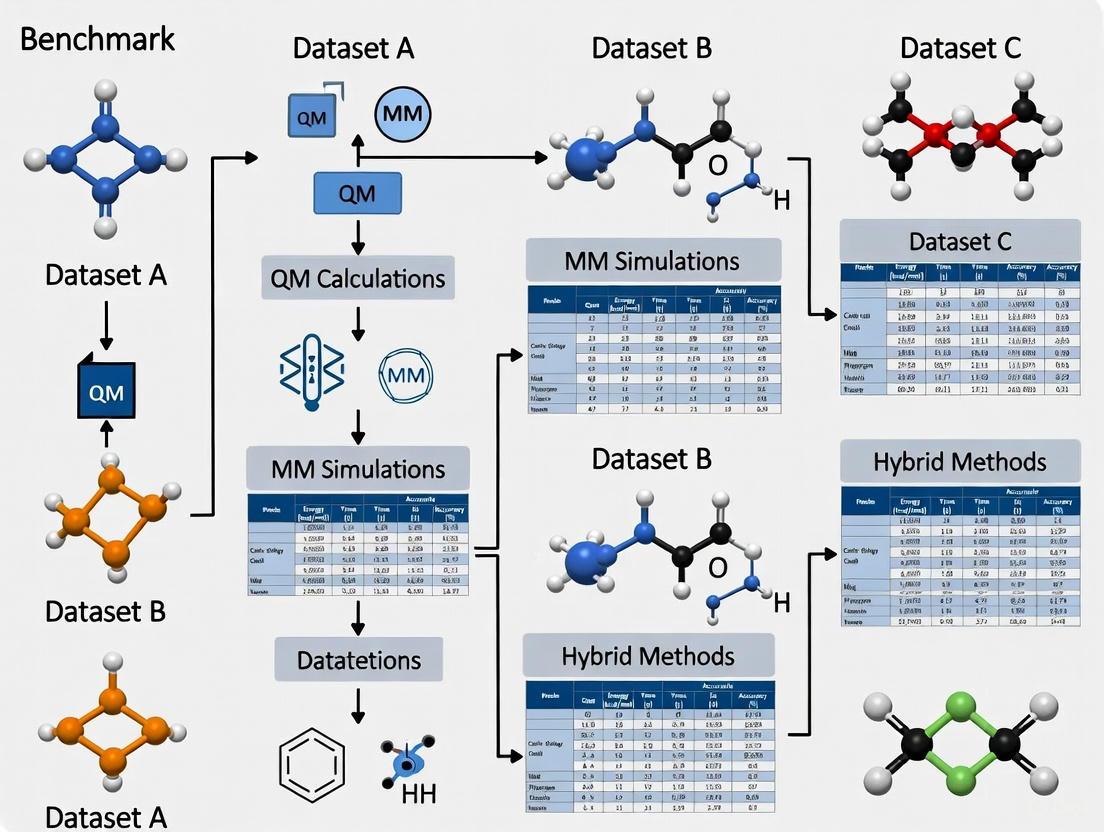
This article provides a comprehensive guide to benchmark datasets for computational chemistry, tailored for researchers and drug development professionals.
Benchmark Datasets for Computational Chemistry: A Guide for Drug Development and AI Model Validation
Abstract
This article provides a comprehensive guide to benchmark datasets for computational chemistry, tailored for researchers and drug development professionals. It explores the foundational role of these datasets in validating quantum chemistry methods and accelerating AI model development. The scope covers key datasets, their applications in force field parameterization and machine learning potential training, common challenges in implementation, and robust frameworks for comparative model evaluation. By synthesizing the latest advancements, this resource aims to equip scientists with the knowledge to select appropriate benchmarks, improve predictive accuracy, and ultimately streamline the discovery of new therapeutics and materials.
The Foundation: Understanding Benchmark Datasets and Their Role in Computational Chemistry
What Are Benchmark Datasets and Why Do They Matter?
In the field of computational chemistry, where new algorithms and artificial intelligence (AI) models are developed at a rapid pace, benchmark datasets are standardized collections of data used to objectively evaluate, compare, and validate the performance of computational methods. They serve as a common ground, ensuring that comparisons between different tools are fair, reproducible, and meaningful [1] [2].
Their importance cannot be overstated. Much like the Critical Assessment of Structure Prediction (CASP) challenge provided a community-driven framework that accelerated progress in protein structure prediction—a feat recognized by a Nobel Prize—benchmarking is now seen as essential for advancing areas like small-molecule drug discovery [1]. They help the scientific community cut through the hype surrounding new AI tools, providing concrete evidence of performance and limitations [2].
Key Benchmark Datasets in Computational Chemistry
The table below summarizes some of the prominent benchmark datasets available to researchers, highlighting their primary focus and scale.
Table 1: Overview of Computational Chemistry Benchmark Datasets
| Dataset Name | Primary Focus | Key Features |
|---|---|---|
| Open Molecules 2025 (OMol25) [3] | Machine Learning Interatomic Potentials (MLIPs) | - Over 100 million 3D molecular snapshots.- DFT-level data on systems up to 350 atoms.- Chemically diverse, including heavy elements and metals. |
| nablaDFT [4] | Neural Network Potentials (NNPs) | - Nearly 2 million drug-like molecules with conformations.- Properties calculated at ωB97X-D/def2-SVP level.- Includes energies, Hamiltonian matrices, and wavefunction files. |
| QCBench [5] | Large Language Models (LLMs) | - 350 quantitative chemistry problems.- Covers 7 chemistry subfields and three difficulty levels.- Designed to test step-by-step numerical reasoning. |
| NIST CCCBDB [6] | Quantum Chemical Methods | - Experimental and ab initio thermochemical data for gas-phase molecules.- A long-standing resource for method comparison. |
| MoleculeNet [7] | General Molecular Machine Learning | - A collection of 16 datasets.- Includes quantum mechanics, physical, and biophysical chemistry tasks. (Note: Known to have some documented flaws). |
Experimental Protocols for Benchmarking
A robust benchmarking study goes beyond simply running software on a dataset. It involves a structured methodology to ensure results are reliable and trustworthy.
Dataset Curation and Validation
The foundation of any benchmark is high-quality data. The process typically involves:
- Data Collection and Standardization: Data is gathered from various sources like literature, patents, or public databases. Chemical structures, often provided as SMILES strings, are standardized using toolkits like RDKit to ensure consistent representation (e.g., neutralizing salts, handling tautomers) [8].
- Curation and Error-Checking: This critical step involves identifying and removing invalid structures (e.g., SMILES that cannot be parsed), correcting charges, and handling stereochemistry. It also involves detecting and resolving duplicate entries and experimental outliers [7] [8]. For example, one analysis found duplicates with conflicting labels in a widely used blood-brain barrier penetration dataset [7].
- Defining Data Splits: The dataset is systematically divided into training, validation, and test sets. To prevent over-optimistic performance, the test set is often constructed using scaffold splitting, which ensures that molecules with core structures not seen during training are used for the final evaluation [7] [4].
Model Training and Evaluation
- Training MLIPs and NNPs: For forcefield models, the process involves training neural networks on high-quality quantum mechanical data, such as Density Functional Theory (DFT) calculations. The model learns to predict system energy and atomic forces for a given molecular configuration with near-DFT accuracy but at a fraction of the computational cost [3] [2].
- Evaluating LLMs: For large language models, benchmarks like QCBench present problems in textual form. The model's reasoning and final answer are assessed, often using verification tools that can handle numerical tolerances common in chemistry [5].
- Performance Metrics: The choice of metric depends on the task. Common metrics include Mean Absolute Error (MAE) for regression tasks (e.g., predicting energy) [4] and accuracy or balanced accuracy for classification tasks (e.g., predicting toxicity) [8]. A crucial aspect is evaluating performance inside the model's Applicability Domain (AD), which gives confidence in predictions for molecules that are structurally similar to those in the training data [8].
The following diagram illustrates the complete workflow for developing and using a benchmark dataset.
The Scientist's Toolkit: Essential Research Reagents
This table lists key computational tools and resources that function as the "research reagents" in the field of computational chemistry benchmarking.
Table 2: Key Reagents for Computational Chemistry Research
| Tool / Resource | Type | Function in Research |
|---|---|---|
| RDKit [8] | Cheminformatics Toolkit | An open-source toolkit for cheminformatics, used for standardizing chemical structures, calculating molecular descriptors, and handling data curation. |
| Density Functional Theory (DFT) [3] | Computational Method | A quantum mechanical method used to generate high-quality training data for electronic properties, energies, and forces. |
| Psi4 [4] | Quantum Chemistry Package | An open-source software used for computing quantum chemical properties on molecules, such as energies and wavefunctions. |
| Graph Neural Networks (GNNs) [2] | Machine Learning Architecture | A type of neural network that operates directly on graph representations of molecules, making them well-suited for predicting molecular properties. |
| Applicability Domain (AD) [8] | Modeling Concept | A defined chemical space where a QSAR model is considered to be reliable; used to identify when a prediction for a new molecule is trustworthy. |
Benchmark datasets are the bedrock of progress in computational chemistry. They transform subjective claims about a model's capability into objective, quantifiable facts. As the field continues to evolve, driven by AI and machine learning, the community's commitment to developing more rigorous, diverse, and carefully curated benchmarks will be paramount. This commitment, as seen in initiatives like OMol25 and the call for ongoing benchmarking in drug discovery, is what will allow researchers to reliably identify the best tools, accelerate scientific discovery, and ultimately design new medicines and materials with greater confidence [3] [1].
In computational chemistry, the accurate prediction of molecular properties is fundamental to advancements in materials science, drug discovery, and catalysis. Among the myriad of electronic structure methods available, the coupled-cluster singles, doubles, and perturbative triples (CCSD(T)) method and Density Functional Theory (DFT) represent two pivotal approaches with complementary strengths and limitations. DFT balances computational efficiency with reasonable accuracy for many systems, while CCSD(T) is often regarded as the "gold standard" of quantum chemistry for its high accuracy, though at a significantly higher computational cost [9]. This guide provides an objective comparison of these methods, framing the discussion within the critical context of benchmark datasets that validate and drive methodological research. For researchers and drug development professionals, understanding this methodological landscape is crucial for selecting appropriate tools for predicting molecular properties, reaction energies, and interaction strengths in complex biological and chemical systems.
The development of reliable benchmark datasets has profoundly shaped modern computational chemistry. These datasets typically comprise highly accurate experimental data or high-level theoretical results against which more approximate methods are validated. For example, the 3dMLBE20 database containing bond energies of 3d transition metal-containing diatomic molecules has been instrumental in testing both CCSD(T) and DFT methods [10]. Similarly, specialized benchmarks for biologically relevant catecholic systems have enabled systematic evaluation of computational methods for pharmaceutical applications [11] [12]. Within this framework of benchmark-driven validation, we explore the technical capabilities, performance, and appropriate applications of both CCSD(T) and DFT.
Theoretical Foundations and Methodologies
Density Functional Theory (DFT)
DFT is a computational quantum mechanical approach that determines the total energy of a molecular system through its electron density distribution (ρ(r)), rather than the more complex many-electron wavefunction [13]. This method is grounded in the Hohenberg-Kohn theorems, which establish that the ground-state energy is uniquely determined by the electron density. The practical implementation of DFT uses the Kohn-Sham scheme, which introduces a system of non-interacting electrons that reproduce the same density as the interacting system. The total energy functional in Kohn-Sham DFT is expressed as:
[E[\rho] = Ts[\rho] + V{ext}[\rho] + J[\rho] + E_{xc}[\rho]]
where (Ts[\rho]) represents the kinetic energy of non-interacting electrons, (V{ext}[\rho]) is the external potential energy, (J[\rho]) is the classical Coulomb energy, and (E{xc}[\rho]) is the exchange-correlation functional that incorporates all quantum many-body effects [13]. The accuracy of DFT calculations critically depends on the approximation used for (E{xc}[\rho]), whose exact form remains unknown.
The development of exchange-correlation functionals has followed an evolutionary path often described as "Jacob's Ladder" or "Charlotte's Web," reflecting the complex interconnectedness of different approaches [13]. These include:
- Local Density Approximation (LDA): Models the electron density as a uniform electron gas, providing simple but limited accuracy.
- Generalized Gradient Approximation (GGA): Incorporates the gradient of the electron density ((\nabla\rho)) to account for inhomogeneities, offering improved accuracy for molecular geometries.
- meta-GGA (mGGA): Includes the kinetic energy density ((\tau(r))) for better energetics.
- Hybrid Functionals: Mix a fraction of Hartree-Fock exchange with DFT exchange to address self-interaction error, significantly improving accuracy.
- Range-Separated Hybrids (RSH): Employ distance-dependent mixing of Hartree-Fock and DFT exchange for better performance with charge-transfer species and excited states [13].
Coupled-Cluster Theory (CCSD(T))
The CCSD(T) method represents a highly accurate wavefunction-based approach to solving the electronic Schrödinger equation. Often called the "gold standard" of quantum chemistry [9], it systematically accounts for electron correlation effects through a sophisticated treatment of electronic excitations. The method includes all single and double excitations (CCSD) exactly, and incorporates an estimate of connected triple excitations ((T)) through perturbation theory. This combination provides exceptional accuracy for molecular energies and properties, typically approaching chemical accuracy (1 kcal/mol) for many systems.
The primary limitation of CCSD(T) is its computational cost, which scales as the seventh power of the system size ((O(N^7))). As MIT Professor Ju Li notes, "If you double the number of electrons in the system, the computations become 100 times more expensive" [9]. This steep scaling has traditionally restricted CCSD(T) applications to molecules with approximately 10 atoms or fewer, though recent advances in machine learning and computational hardware are progressively expanding these limits.
Table 1: Key Characteristics of CCSD(T) and DFT
| Feature | CCSD(T) | DFT |
|---|---|---|
| Theoretical Basis | Wavefunction theory | Electron density |
| Computational Scaling | (O(N^7)) | (O(N^3)) to (O(N^4)) |
| System Size Limit | Traditionally ~10 atoms, expanding with new methods | Hundreds to thousands of atoms |
| Typical Accuracy | 1-5 kcal/mol for thermochemistry | Varies widely (3-20 kcal/mol) depending on functional |
| Treatment of Electron Correlation | Systematic inclusion via excitation hierarchy | Approximated through exchange-correlation functional |
| Cost-Benefit Trade-off | High accuracy, high cost | Variable accuracy, lower cost |
Experimental Protocols and Benchmarking Methodologies
Benchmarking Against Experimental Data
Rigorous evaluation of CCSD(T) and DFT performance requires comparison against reliable experimental data or highly accurate theoretical references. One comprehensive study compared these methods for bond dissociation energies in 3d transition metal-containing diatomic molecules using the 3dMLBE20 database [10]. The protocol involved:
- System Selection: 20 diatomic molecules containing 3d transition metals with high-quality experimental bond energies.
- Method Application: Calculation of bond energies using 42 different exchange-correlation functionals and CCSD(T) with extended basis sets.
- Error Analysis: Computation of mean unsigned deviations (MUD) from experimental values for quantitative accuracy assessment.
- Diagnostic Evaluation: Application of T1, M, and B1 diagnostics to identify systems with potential multi-reference character where single-reference methods might fail [10].
This study revealed that while CCSD(T) generally showed smaller average errors than most functionals, the improvement was less than one standard deviation of the mean unsigned deviation. Surprisingly, nearly half of the tested functionals performed closer to experiment than CCSD(T) for the same molecules with the same basis sets [10].
CCSD(T) as a Theoretical Benchmark
When experimental data is limited or unreliable, CCSD(T) with complete basis set (CBS) extrapolation often serves as the reference method for evaluating DFT performance. A representative study of biologically relevant catecholic systems employed this protocol [11] [12]:
- System Selection: 32 complexes containing catechol, dinitrocatechol, dopamine, and DOPAC with various counter-molecules, representing metal-coordination, hydrogen-bonding, and π-stacking interactions.
- Reference Calculations: Optimization at CCSD/cc-pVDZ or MP2/cc-pVDZ levels, followed by CCSD(T)/CBS calculations for complexation energies.
- DFT Evaluation: Comparison of 21 DFT functionals with triple and quadruple-ζ basis sets against the CCSD(T)/CBS benchmarks.
- Performance Ranking: Identification of top-performing functionals (MN15, M06-2X-D3, ωB97XD, ωB97M-V, and CAM-B3LYP-D3) based on deviation from CCSD(T) references [12].
Similar protocols have been applied to aluminum clusters [14] and zirconocene polymerization catalysts [15], demonstrating the versatility of CCSD(T) benchmarking across diverse chemical systems.
Performance Comparison and Experimental Data
Accuracy Across Chemical Systems
The relative performance of CCSD(T) and DFT varies significantly across different chemical systems and properties. Comprehensive benchmarking reveals several important patterns:
Table 2: Performance Comparison Across Chemical Systems
| System Type | CCSD(T) Performance | Top-Performing DFT Functionals | Key Metrics |
|---|---|---|---|
| 3d Transition Metal Bonds [10] | MUD = ~4.7 kcal/mol | B97-1 (MUD = 4.5 kcal/mol), PW6B95 (MUD = 4.9 kcal/mol) | Bond dissociation energies vs. experiment |
| Biologically Relevant Catechols [12] | Serves as reference standard | MN15, M06-2X-D3, ωB97XD, ωB97M-V, CAM-B3LYP-D3 | Complexation energies vs. CCSD(T)/CBS |
| Aluminum Clusters [14] | Close agreement with experiment for IP/EA | PBE0 (errors 0.14-0.15 eV for IP/EA) | Ionization potentials (IP) and electron affinities (EA) |
| Zirconocene Catalysts [15] | Suggests revision of experimental BDEs | Varies; some functionals accurate for redox potentials | Redox potentials, bond dissociation energies (BDEs) |
For aluminum clusters (Alₙ, n=2-9), CCSD(T) and specific functionals like PBE0 show remarkable accuracy for ionization potentials and electron affinities, with average errors of only 0.11-0.15 eV compared to experimental data [14]. In zirconocene catalysis research, CCSD(T) calculations suggested that experimental bond dissociation enthalpies might require revision, highlighting its role not just in validation but in potentially correcting experimental measurements [15].
Limitations and Systematic Errors
Both methods exhibit specific limitations that researchers must consider:
CCSD(T) Limitations:
- Computational Cost: The steep scaling limits application to large systems, though machine learning approaches are addressing this [9].
- Transition Metal Challenges: For 3d transition metal systems, CCSD(T) does not consistently outperform all DFT functionals, with some studies showing multiple functionals achieving comparable or better accuracy [10].
- Multi-Reference Systems: Single-reference CCSD(T) struggles with systems exhibiting strong static correlation, such as bond dissociation or diradicals.
DFT Limitations:
- Functional Dependence: Accuracy varies dramatically across functionals, with no universal functional optimal for all systems.
- Self-Interaction Error: Pure functionals incorrectly model electron self-repulsion, affecting reaction barriers and charge-transfer states.
- Density-Driven Errors: Approximate functionals can yield inaccurate electron densities, propagating errors to computed properties [16].
- Dispersion Interactions: Standard functionals poorly describe van der Waals forces, requiring empirical corrections (-D3, -D4) for accurate non-covalent interactions.
Recent Advances and Future Directions
Machine Learning Accelerations
Recent breakthroughs in machine learning (ML) are dramatically expanding the applicability of high-accuracy quantum chemical methods. MIT researchers have developed a novel neural network architecture called "Multi-task Electronic Hamiltonian network" (MEHnet) that leverages CCSD(T) calculations as training data [9] [17]. This approach:
- Extends System Size: Enables CCSD(T)-level accuracy for thousands of atoms, far beyond the traditional 10-atom limit.
- Multi-Property Prediction: Uses a single model to evaluate multiple electronic properties simultaneously, including dipole moments, polarizability, and excitation gaps.
- Accelerates Calculations: After training, the neural network performs calculations much faster than conventional CCSD(T) while maintaining high accuracy [9].
This ML framework demonstrates particular strength in predicting excited state properties and infrared absorption spectra, traditionally challenging for computational methods [9]. Similar approaches like DeepH show promise in learning the DFT Hamiltonian to accelerate electronic structure calculations [17].
Functional Development and Density-Corrected DFT
DFT development continues to advance, with researchers addressing fundamental limitations:
- Density-Corrected DFT (DC-DFT): This approach separates errors into functional-driven and density-driven components, often using Hartree-Fock densities instead of self-consistent DFT densities to reduce errors [16].
- Range-Separated Hybrids: Improved treatment of long-range interactions benefits charge-transfer systems and excited states.
- System-Specific Optimization: Benchmarks drive the identification of optimal functionals for specific chemical systems, such as the recommended functionals for catechol-protein interactions [12].
The field continues to debate whether DFT is approaching the limit of general-purpose accuracy [17], though specialized functionals for specific applications continue to emerge.
Computational Toolkit for Researchers
Table 3: Essential Computational Resources and Their Applications
| Tool/Resource | Function/Role | Representative Uses |
|---|---|---|
| Coupled-Cluster Theory | High-accuracy reference calculations | Benchmarking, small system validation [9] |
| Hybrid DFT Functionals | Balance of accuracy and efficiency | Geometry optimization, medium-sized systems [13] |
| Range-Separated Hybrids | Accurate charge-transfer and excited states | Spectroscopy, reaction barriers [13] |
| Empirical Dispersion Corrections | Account for van der Waals interactions | Non-covalent complexes, supramolecular chemistry [12] |
| Local CCSD(T) Methods (e.g., DPLNO) | Reduced computational cost for correlation methods | Larger systems with correlation treatment [12] |
| Machine Learning Potentials | Acceleration of ab initio calculations | Large systems, molecular dynamics [9] [17] |
Selection Guidelines for Computational Studies
Choosing between CCSD(T) and DFT involves careful consideration of multiple factors:
- System Size: For small molecules (<20 atoms) where highest accuracy is critical, CCSD(T) is preferred if computationally feasible. For larger systems, DFT becomes necessary.
- Property Type: Energetics and spectroscopic properties often benefit from CCSD(T) accuracy, while geometries can be well-described by appropriate DFT functionals.
- Chemical System: Transition metals and systems with potential multi-reference character require careful method selection, preferably based on existing benchmarks for similar compounds.
- Resource Constraints: Consider computational resources, with DFT being more accessible for high-throughput screening.
For biological systems involving catecholamines, the recommended functionals (MN15, M06-2X-D3, ωB97XD, ωB97M-V, CAM-B3LYP-D3) provide the best balance of accuracy and efficiency based on CCSD(T) benchmarks [12].
The complementary roles of CCSD(T) and DFT in computational chemistry continue to evolve through rigorous benchmarking and methodological innovations. CCSD(T) remains the uncontested gold standard for accurate thermochemical calculations, particularly for systems where experimental data is limited or questionable. Its role in generating benchmark datasets for functional evaluation is indispensable. Meanwhile, DFT offers remarkable versatility and efficiency for diverse applications across chemistry, biology, and materials science, though with accuracy that varies significantly across functional choices.
Future advancements will likely blur the boundaries between these approaches, with machine learning methods leveraging CCSD(T) accuracy for larger systems [9] and DFT development addressing fundamental limitations like self-interaction error and density-driven inaccuracies [16]. For researchers in drug development and materials design, this evolving landscape offers increasingly reliable tools for molecular property prediction, guided by comprehensive benchmarks that critically evaluate performance across chemical space. The continued synergy between high-accuracy wavefunction methods, efficient density functionals, and emerging machine learning approaches promises to expand the frontiers of computational chemistry, enabling more accurate predictions and novel discoveries across scientific disciplines.
In the rigorous fields of computational chemistry and machine learning, benchmark datasets provide the foundational ground truth for validating new methods, comparing algorithmic performance, and ensuring scientific reproducibility. These repositories move research beyond abstract claims to quantifiable, comparable results. Within computational chemistry, the NIST Computational Chemistry Comparison and Benchmark Database (CCCBDB) has long served as a fundamental resource for validating thermochemical calculations [18]. In the broader ecosystem of graph-based machine learning, the Open Graph Benchmark (OGB) offers a standardized platform for evaluating models on realistic and diverse graph-structured data [19]. This guide provides a detailed comparison of these and other key repositories, framing them within the workflow of a computational chemistry researcher. It presents structured quantitative data, detailed experimental protocols, and visual workflows to assist scientists in selecting the appropriate benchmarks for their specific research and development goals, particularly in drug discovery and materials science.
Detailed Repository Profiles
NIST CCCBDB: Maintained by the National Institute of Standards and Technology, this database is a curated collection of experimental and ab initio thermochemical properties for a selected set of gas-phase molecules [6] [18]. Its primary goal is to provide benchmark data for evaluating computational methods, allowing direct comparison between different ab initio methods and experimental data. It contains data for 580 neutral gas-phase species, focusing on properties such as vibrational frequencies, bond energies, and enthalpies of formation [18]. A key feature includes vibrational scaling factors for calibrating calculated spectra against experimental data [20].
Open Graph Benchmark (OGB): A community-driven initiative providing realistic, large-scale, and diverse benchmark datasets for machine learning on graphs [19]. OGB is not specific to chemistry but provides a flexible framework for benchmarking graph neural networks (GNNs) on tasks such as molecular property prediction, link prediction, and graph classification. It features automated data loaders, standardized dataset splits, and unified evaluators to ensure fair and reproducible model comparison [19].
Meta's Open Molecules 2025 (OMol25): A recent, massive-scale dataset from Meta's FAIR team, comprising over 100 million high-accuracy quantum chemical calculations at the ωB97M-V/def2-TZVPD level of theory [21]. It covers an unprecedented diversity of chemical structures, with special focus on biomolecules, electrolytes, and metal complexes. OMol25 is 10–100 times larger than previous state-of-the-art molecular datasets and is designed to train and benchmark advanced neural network potentials (NNPs) [21].
OGDOS (Open Graph Dataset Organized by Scales): This dataset addresses a specific gap by organizing 470 graphs explicitly by node count (100 to 200,000) and edge-to-node ratio (1 to 10) [22]. It combines scale-aligned real-world and synthetic graphs, providing a versatile resource for evaluating graph algorithms' scalability and computational complexity, which can be pertinent for method development in chemical informatics [22].
Quantitative Comparison of Key Repositories
Table 1: Key Characteristics of Benchmark Repositories for Computational Chemistry
| Repository Name | Primary Focus | Data Type | Data Scale | Key Applications |
|---|---|---|---|---|
| NIST CCCBDB | Thermochemistry & Spectroscopy [18] | Energetic, structural & vibrational properties [20] | ~580 gas-phase molecules [18] | Method validation, vibrational scaling factors [20] |
| OGB | General graph ML benchmarks [19] | Molecular & non-molecular graphs [19] | Multiple large-scale datasets [19] | Benchmarking GNNs on molecular property prediction [19] |
| Meta OMol25 | High-throughput quantum chemistry [21] | Molecular structures & energies [21] | >100 million calculations [21] | Training & benchmarking Neural Network Potentials (NNPs) [21] |
| OGDOS | Graph algorithm scalability [22] | Scale-standardized graphs [22] | 470 pre-defined scale levels [22] | Testing scalability of graph algorithms [22] |
Table 2: Detailed Comparison for Computational Chemistry Applications
| Feature | NIST CCCBDB | OGB | Meta OMol25 |
|---|---|---|---|
| Theoretical Levels | Multiple (e.g., G2, DFT, MP2) [18] | Not Specified (varies by source dataset) | ωB97M-V/def2-TZVPD (uniform) [21] |
| Property Types | Enthalpy, vibration, geometry, energy [20] | Molecular properties, node/link attributes [19] | Molecular energies & forces [21] |
| Evaluation Rigor | High (NIST standard, experimental comparison) [6] | High (unified evaluators, leaderboards) [19] | High (uniform high-level theory) [21] |
| Ease of Use | Web interface, downloadable data [18] | Automated data loaders (PyTorch/DGL) [19] | Pre-trained models, HuggingFace [21] |
Experimental Protocols and Benchmarking Workflows
Protocol 1: Benchmarking a Computational Chemistry Method using NIST CCCBDB
This protocol describes how to use the NIST CCCBDB to validate the accuracy of a quantum chemistry method for predicting molecular enthalpies of formation.
- Step 1: Define the Benchmark Set. Select a relevant set of molecules from the CCCBDB. The selection can be based on molecular size, presence of specific functional groups, or elements of interest to match the intended application domain of the method being tested [18].
- Step 2: Calculate Target Properties. Perform quantum chemical calculations for all molecules in the benchmark set using the method under evaluation. The primary calculation is the molecular energy for each species at its optimized geometry.
- Step 3: Derive Thermodynamic Properties. Convert the calculated electronic energies to the target thermodynamic property, such as the enthalpy of formation at 298K. This often involves calculating vibrational frequencies to determine zero-point energies and thermal corrections, and applying atom equivalents [20].
- Step 4: Compare and Analyze. Retrieve the corresponding experimental and/or high-level theoretical values from the CCCBDB. Calculate error metrics (e.g., Mean Absolute Error, Root Mean Square Error) between the calculated values and the benchmark data to quantify the method's accuracy [18] [20].
Figure 1: Workflow for benchmarking a computational method with NIST CCCBDB.
Protocol 2: Evaluating a Graph Neural Network using OGB
This protocol outlines the process of using the Open Graph Benchmark to evaluate the performance of a Graph Neural Network on a molecular property prediction task.
- Step 1: Select an OGB Dataset. Choose an OGB dataset relevant to the research question, such as
ogbg-molhivorogbg-molpcba, which are designed for predicting molecular properties from graph structure [19]. - Step 2: Utilize Data Loader. Use the OGB data loader to download the dataset and obtain a standardized data split (training, validation, test). The data loader automatically provides the graph data in a format compatible with popular deep learning frameworks like PyTorch Geometric and DGL [19].
- Step 3: Train the Model. Train the GNN model using the training set. Perform model selection and hyperparameter tuning based on the performance on the provided validation set.
- Step 4: Evaluate on Test Set. Use the OGB Evaluator to assess the final model's performance on the held-out test set. The evaluator ensures standardized and comparable metrics (e.g., ROC-AUC), which can be submitted to the public leaderboard [19].
Figure 2: Workflow for evaluating a Graph Neural Network with OGB.
Table 3: Key Tools and Resources for Computational Benchmarking
| Tool/Resource | Function | Application Context |
|---|---|---|
| Quantum Chemistry Code (e.g., Gaussian, GAMESS) | Performs ab initio calculations to compute molecular energies and properties. | Generating data for method validation against CCCBDB or OMol25. |
| Graph Neural Network Library (e.g., DGL, PyTorch Geometric) | Provides building blocks for implementing and training GNNs. | Developing models for molecular property prediction on OGB datasets [19]. |
| OGB Data Loader & Evaluator | Automates dataset access and ensures standardized evaluation. | Guaranteeing fair and reproducible benchmarking on OGB tasks [19]. |
| Neural Network Potential (e.g., eSEN, UMA) | Fast, accurate model for molecular energy surfaces. | Leveraging pre-trained models from OMol25 for molecular dynamics [21]. |
| Vibrational Scaling Factors (from CCCBDB) | Calibrates computed vibrational frequencies to match experiment. | Correcting systematic errors in DFT frequency calculations [20]. |
The landscape of benchmark repositories is evolving to meet the demands of increasingly complex computational methods. Established resources like the NIST CCCBDB remain indispensable for fundamental validation of quantum chemical methods, providing trusted reference data critical for method development [18]. Meanwhile, newer, large-scale initiatives like Meta's OMol25 are shifting the paradigm, providing massive, high-quality datasets that enable the training of powerful AI-driven models, such as neural network potentials, which are poised to dramatically accelerate molecular simulation [21]. Frameworks like the Open Graph Benchmark provide the standardized playground necessary for the rigorous and fair comparison of these emerging machine learning approaches on graph-structured molecular data [19].
The trend is clear: the future of benchmarking in computational chemistry involves a blend of high-accuracy reference data, large-scale diverse datasets for training data-hungry models, and robust, community-adopted evaluation platforms. As these resources mature and become more integrated, they will continue to be the bedrock upon which reliable, reproducible, and impactful computational research in chemistry and drug discovery is built.
This guide provides an objective comparison of three landmark datasets—OMol25, MSR-ACC/TAE25, and nablaDFT—that are shaping the development of computational chemistry methods. For researchers in drug development and materials science, these resources represent critical infrastructure for training and benchmarking machine learning potentials and quantum chemical methods.
The table below summarizes the core attributes of the three datasets, highlighting their distinct design goals and technical specifications.
| Feature | OMol25 (Open Molecules 2025) | MSR-ACC/TAE25 (Microsoft Research) | nablaDFT / ∇²DFT |
|---|---|---|---|
| Primary Content | Molecular energies, forces, and properties for diverse molecular systems [23] [21] | Total Atomization Energies (TAEs) for small molecules [24] [25] | Conformational energies, forces, Hamiltonian matrices, and molecular properties for drug-like molecules [26] [27] |
| Reference Method | ωB97M-V/def2-TZVPD (Density Functional Theory) [21] | CCSD(T)/CBS (Coupled-Cluster) via W1-F12 protocol [24] [25] | ωB97X-D/def2-SVP (Density Functional Theory) [27] |
| Chemical Space Focus | Extreme breadth: biomolecules, electrolytes, metal complexes, 83 elements, systems up to 350 atoms [23] [21] | Broad, fundamental chemical space for elements up to argon [24] [25] | Drug-like molecules [26] [27] |
| Key Differentiator | Unprecedented size and chemical diversity, includes solvation, variable charge/spin states [21] [3] | High-accuracy "sub-chemical accuracy" (±1 kcal/mol) reference data [24] [25] | Includes relaxation trajectories and wavefunction-related properties for a substantial number of molecules [27] |
| Dataset Size | >100 million calculations [23] [21] | 76,879 TAEs [24] [25] | Large-scale; based on and expands the original nablaDFT dataset [26] [27] |
Performance Benchmarking
The utility of a dataset is ultimately proven by the performance of models trained on it. The following table summarizes quantitative benchmarks for models derived from these datasets compared to traditional computational methods.
| Method / Model | Dataset / Theory | Benchmark Task | Performance Metrics | Key Finding |
|---|---|---|---|---|
| eSEN-S, UMA-S, UMA-M [28] | OMol25 | Experimental Reduction Potentials (Organometallic Set) [28] | MAE: 0.262-0.365 V (Best: UMA-S) [28] | As accurate or better than low-cost DFT (B97-3c, MAE: 0.414 V) and SQM (GFN2-xTB, MAE: 0.733 V) for organometallics. [28] |
| eSEN-S, UMA-S, UMA-M [28] | OMol25 | Experimental Reduction Potentials (Main-Group Set) [28] | MAE: 0.261-0.505 V (Best: UMA-S) [28] | Less accurate than low-cost DFT (B97-3c, MAE: 0.260 V) for main-group molecules. [28] |
| OMol25-trained Models [21] | OMol25 | Molecular Energy Accuracy (GMTKN55 WTMAD-2, filtered) [21] | Near-perfect performance [21] | Exceeds previous state-of-the-art neural network potentials and matches high-accuracy DFT. [21] |
| Skala Functional [24] | MSR-ACC (Training) | Atomization Energies (Experimental Accuracy) [24] | Reaches experimental accuracy [24] | Demonstrates use of high-accuracy dataset to develop a machine-learned exchange-correlation functional. [24] |
| nablaDFT-based Models [26] | nablaDFT | Multi-molecule Property Estimation [26] | Significant accuracy drop in multi-molecule vs. single-molecule setting [26] | Highlights the need for diverse datasets and robust benchmarks to test generalization. [26] |
Experimental Protocols for Benchmarking
A typical workflow for benchmarking computational models against experimental data involves several key stages, from data preparation to quantitative analysis. The diagram below illustrates this process for evaluating reduction potentials and electron affinities.
Detailed Methodology:
- Structure Preparation: The process begins with acquiring a curated experimental dataset, such as the one compiled by Neugebauer et al. for reduction potentials, which provides the initial 3D geometries of molecules in their non-reduced and reduced states [28].
- Geometry Optimization: The initial structures are optimized using the computational method being evaluated (e.g., a Neural Network Potential or a DFT functional). This is typically done using energy minimization algorithms to find the lowest-energy conformation [28].
- Single-Point Energy Calculation: A more precise, single-point energy calculation is performed on the optimized geometry. For properties like reduction potential that occur in solvent, an implicit solvation model (e.g., CPCM-X) is applied at this stage to correct the electronic energy for solvent effects [28].
- Property Calculation: The target property is computed from the calculated energies. For electron affinity, this is the gas-phase energy difference between the neutral and anionic species. For reduction potential, it is the difference in solvent-corrected electronic energy between the reduced and non-reduced structures, converted to volts [28].
- Statistical Comparison: The final step involves comparing the computationally predicted values to the experimental data using standard statistical metrics, including Mean Absolute Error (MAE), Root Mean Squared Error (RMSE), and the coefficient of determination (R²) to quantify accuracy and precision [28].
The Scientist's Toolkit: Essential Research Reagents
This table lists key software and computational tools that are essential for working with these benchmark datasets and conducting related research.
| Item Name | Function / Purpose | Relevance to Datasets |
|---|---|---|
| Neural Network Potentials (NNPs) [29] [21] | Machine learning models trained on quantum chemical data to predict molecular energies and forces at a fraction of the cost of full calculations. [29] [21] | Primary models trained on and evaluated with these datasets (e.g., eSEN, UMA models on OMol25). [21] [28] |
| Implicit Solvation Models (e.g., CPCM-X) [28] | A computational method to approximate the effects of a solvent environment on a molecule's energy and properties without explicitly modeling solvent molecules. [28] | Critical for accurately predicting solution-phase properties like reduction potential when benchmarking against experimental data. [28] |
| Geometry Optimization Libraries (e.g., geomeTRIC) [28] | Software libraries that implement algorithms to find molecular geometries that correspond to local energy minima on the potential energy surface. [28] | Used in the standard workflow to relax initial molecular structures before calculating single-point energies for property prediction. [28] |
| Coupled-Cluster Theory (CCSD(T)) [24] [25] | A high-level, computationally expensive quantum chemistry method often considered the "gold standard" for achieving high accuracy, especially for main-group elements. [24] [25] | Serves as the high-accuracy reference method for the MSR-ACC/TAE25 dataset, providing benchmark-quality data. [24] [25] |
| Density Functional Theory (DFT) [24] [21] | A widely used computational method for electronic structure calculations that balances cost and accuracy. Serves as the source of data for OMol25 and nablaDFT. [24] [21] | The source theory for the OMol25 and nablaDFT datasets. Also used as a baseline for comparing the accuracy of new ML models. [21] [28] |
| Dataset Curation Tools (e.g., MEHC-Curation) [30] | Software frameworks designed to automate the process of validating, cleaning, and normalizing molecular datasets (e.g., removing invalid structures and duplicates). [30] | Ensures the high quality of input data for training and benchmarking, which is vital for model reliability and performance. [30] |
The concept of "chemical space"—the theoretical multidimensional space encompassing all possible molecules and compounds—serves as a core principle in cheminformatics and molecular design [31]. For researchers in computational chemistry and drug development, assessing and maximizing the coverage of this vast space is critical for the discovery of novel biologically active small molecules [32]. The structural and functional diversity of a molecular library directly correlates with its potential to modulate a wide range of biological targets, including those traditionally considered "undruggable" [32]. This guide objectively compares contemporary approaches and benchmark datasets used to quantify and expand diversity in elements and molecular systems, providing a foundational resource for methods research in computational chemistry.
Defining and Quantifying Diversity in Chemical Space
Dimensions of Chemical Diversity
The structural diversity of a molecular library is not a monolithic concept but is composed of several distinct components [32]:
- Skeletal (Scaffold) Diversity: The presence of distinct molecular skeletons or core structures. This is considered one of the most crucial factors for functional diversity, as different scaffolds present chemical information in different three-dimensional arrangements.
- Appendage Diversity: Variation in structural moieties or building blocks attached to a common molecular scaffold.
- Functional Group Diversity: Variation in the reactive chemical functional groups present within the molecules.
- Stereochemical Diversity: Variation in the three-dimensional orientation of atoms and potential macromolecule-interacting elements.
- Elemental Diversity: The inclusion of atoms from across the periodic table, which is particularly important for covering inorganic complexes and organometallic species.
Methodologies for Assessing Diversity
Cheminformatic Approaches
Traditional approaches to quantifying molecular diversity often rely on molecular fingerprints and similarity indices. The iSIM framework provides an efficient method for calculating the intrinsic similarity of large compound libraries with O(N) complexity, bypassing the steep O(N²) computational cost of traditional pairwise comparisons [31]. This method calculates the average of all distinct pairwise Tanimoto comparisons (iT), where lower iT values indicate a more diverse collection [31].
Complementary to this global diversity measure, the concept of complementary similarity helps identify regions within the chemical space. Molecules with low complementary similarity are central ("medoid-like") to the library, while those with high values are peripheral outliers [31]. The BitBIRCH clustering algorithm further enables granular analysis of chemical space by efficiently grouping compounds based on structural similarity, adapting the BIRCH algorithm for binary fingerprints and Tanimoto similarity [31].
Linguistic Analysis of Chemical Space
An innovative approach applies computational linguistic analysis to chemistry by treating maximum common substructures (MCS) as "chemical words" [33]. The distribution of these MCS "words" in molecular collections follows Zipfian power laws similar to natural language [33].
Linguistic metrics adapted for chemical analysis include:
- Type-Token Ratio (TTR): The ratio of unique MCS "words" to the total number of MCS "words" in a collection. Natural products show greater TTR (0.2051) than approved drugs (0.1469) or random molecule samples (0.1058), indicating higher linguistic richness [33].
- Moving Window TTR (MWTTR): Addresses TTR's sensitivity to text length by calculating TTR within sliding windows across the "text" of chemical words [33].
- Vocabulary Growth Curves: Plot the accumulation of new MCS "words" as more molecules are added to a collection, following Herdan's law (V_R(n) = Kn^β) [33].
These linguistic measures provide chemically intuitive insights into diversity, as MCS often represent recognizable structural motifs like steroid frameworks or penicillin cores that chemists use for categorization [33].
Comparative Analysis of Diversity-Oriented Strategies
Diversity-Oriented Synthesis (DOS)
Diversity-Oriented Synthesis (DOS) aims to efficiently generate structural diversity, particularly scaffold diversity, through chemical synthesis [32]. Unlike traditional combinatorial chemistry that focuses on appendage diversity around a common core, DOS deliberately incorporates strategies to generate multiple distinct molecular scaffolds. This approach is particularly valuable for exploring underrepresented regions of chemical space and identifying novel bioactive compounds, especially for challenging targets like protein-protein interactions [32].
Combined Computational and Empirical Screening
A hybrid approach combining computational docking with empirical fragment screening demonstrates how to maximize chemotype coverage. In a study against AmpC β-lactamase [34]:
- A 1,281-fragment NMR screen identified 9 inhibitory fragments with high topological novelty (average Tanimoto coefficient 0.21 to known inhibitors).
- Subsequent docking of 290,000 commercially available fragments identified additional inhibitors (KI values 0.03-1.0 mM) that filled "chemotype holes" in the empirical library.
- Crystallography confirmed novel binding modes for the docking-derived fragments, validating this complementary approach.
This strategy addresses the fundamental limitation that even diverse fragment libraries cannot fully represent chemical space; calculations suggest representing the fragment substructures of known biogenic molecules would require a library of over 32,000 fragments [34].
Benchmark Datasets for Chemical Space Coverage
Table 1: Comparative Analysis of Major Molecular Datasets
| Dataset | Size | Element Coverage | Structural Diversity Features | Primary Applications |
|---|---|---|---|---|
| OMol25 [3] [35] | >100 million DFT calculations | 83 elements, including heavy metals | Biomolecules, electrolytes, metal complexes; 2-350 atoms per snapshot; charges -10 to +10 | Training MLIPs for materials science, drug discovery, energy technologies |
| ChEMBL [31] | >20 million bioactivities; >2.4 million compounds | Primarily drug-like organic compounds | Bioactive small molecules with target annotations | Drug discovery, bioactivity prediction, cheminformatics |
| PubChem [31] | Not specified in results | Broad organic coverage | Diverse small molecules with biological properties | Chemical biology, virtual screening |
Performance Comparison of Computational Methods
Table 2: Performance of OMol25-Trained Models on Charge-Related Properties
| Method | Dataset | MAE (V) | RMSE (V) | R² | Key Findings |
|---|---|---|---|---|---|
| B97-3c (DFT) [28] | Main-group (OROP) | 0.260 | 0.366 | 0.943 | Traditional DFT performs well on main-group compounds |
| Organometallic (OMROP) | 0.414 | 0.520 | 0.800 | Reduced accuracy for organometallics | |
| GFN2-xTB (SQM) [28] | Main-group (OROP) | 0.303 | 0.407 | 0.940 | Competitive on main-group systems |
| Organometallic (OMROP) | 0.733 | 0.938 | 0.528 | Poor performance on organometallics | |
| UMA-S (OMol25) [28] | Main-group (OROP) | 0.261 | 0.596 | 0.878 | Comparable to DFT for main-group |
| Organometallic (OMROP) | 0.262 | 0.375 | 0.896 | Superior for organometallics | |
| eSEN-S (OMol25) [28] | Main-group (OROP) | 0.505 | 1.488 | 0.477 | Lower accuracy for main-group |
| Organometallic (OMROP) | 0.312 | 0.446 | 0.845 | Good organometallic performance |
Experimental Protocols for Diversity Assessment
Protocol 1: iSIM Framework for Library Diversity Quantification
Objective: Quantify the intrinsic diversity of large molecular libraries using linear-scaling computational methods [31].
Workflow:
- Molecular Representation: Encode all molecular structures in the library as finite bit-string fingerprints (e.g., ECFP, Morgan fingerprints).
- Matrix Construction: Arrange all fingerprints into a matrix where rows represent compounds and columns represent structural features.
- Column Sum Calculation: For each column (feature) in the fingerprint matrix, calculate the number of "on" bits (k_i).
- iT Calculation: Compute the intrinsic Tanimoto similarity (iT) using the formula:
iT = Σ[k_i(k_i-1)/2] / Σ[k_i(k_i-1)/2 + k_i(N-k_i)]where N is the number of molecules in the library. - Diversity Interpretation: Lower iT values indicate greater library diversity. This global measure can be supplemented with complementary similarity analysis to identify central and outlier regions of the chemical space.
Protocol 2: Linguistic Analysis of Chemical Collections
Objective: Apply computational linguistics methods to quantify the diversity of molecular libraries using maximum common substructures (MCS) as "chemical words" [33].
Workflow:
- Pairwise MCS Calculation: For all molecule pairs in the collection (or a representative sample for large libraries), compute the maximum common substructures using algorithms available in toolkits like RDKit.
- Vocabulary Construction: Compile all unique MCS "words" from the pairwise comparisons, creating the chemical "vocabulary" for the library.
- Frequency-Rank Distribution: Plot the frequency of each MCS word against its popularity rank. Chemically diverse libraries typically show Zipfian power law distributions.
- Type-Token Ratio Calculation: Calculate TTR as the ratio of unique MCS words to total MCS words for the collection. For more robust analysis, use Moving Window TTR (MWTTR) with fixed window sizes.
- Vocabulary Growth Analysis: Plot the accumulation of new MCS words as more molecules are added to the collection, fitting to Herdan's law (V_R(n) = Kn^β) to characterize diversity scaling.
Protocol 3: BitBIRCH Clustering for Chemical Space Navigation
Objective: Efficiently cluster large molecular libraries to identify natural groupings and assess coverage of chemical space [31].
Workflow:
- Fingerprint Generation: Convert all molecular structures to binary fingerprints.
- Tree Construction: Build a clustering tree where each node represents a potential cluster of similar molecules based on fingerprint similarity.
- Incremental Clustering: Process molecules through the tree structure, updating cluster features at each node without requiring all pairwise comparisons.
- Cluster Extraction: From the final tree, extract clusters of molecules with high internal similarity using the Tanimoto coefficient as the distance metric.
- Diversity Assessment: Analyze the distribution of cluster sizes and inter-cluster distances. A more diverse library will typically show more clusters with greater separation between them.
Visualization of Chemical Space Assessment
The following diagram illustrates the integrated workflow for comprehensive chemical space coverage assessment, combining the experimental protocols detailed in this guide:
Table 3: Key Resources for Chemical Space Analysis
| Resource | Type | Primary Function | Application Context |
|---|---|---|---|
| OMol25 Dataset [3] [35] | Computational Dataset | Training machine learning interatomic potentials with DFT-level accuracy | Predicting molecular properties across diverse elements and systems |
| iSIM Framework [31] | Computational Algorithm | O(N) calculation of intrinsic molecular similarity | Diversity quantification of large compound libraries |
| BitBIRCH Algorithm [31] | Clustering Tool | Efficient clustering of large molecular libraries using fingerprints | Identifying natural groupings and gaps in chemical space |
| MCS-based Linguistic Tools [33] | Analytical Framework | Applying natural language processing to chemical structures | Chemically intuitive diversity assessment and library comparison |
| ChEMBL Database [31] | Chemical Database | Manually curated bioactive molecules with target annotations | Drug discovery, bioactivity modeling, focused library design |
| DOS Libraries [32] | Synthetic Compounds | Collections with high scaffold diversity using diversity-oriented synthesis | Targeting underexplored biological targets and protein-protein interactions |
The comprehensive assessment of chemical space coverage requires a multifaceted approach combining diverse methodologies. As evidenced by the comparative data, newer strategies like the OMol25 dataset demonstrate particular strength in modeling complex organometallic systems, while traditional DFT maintains advantages for main-group compounds [28]. The integration of cheminformatic approaches like iSIM and BitBIRCH with innovative linguistic analyses provides robust tools for quantifying library diversity [31] [33]. For researchers pursuing novel biological probes and therapeutics, particularly against challenging targets, strategies that maximize scaffold diversity—such as DOS and combined computational/empirical screening—offer enhanced coverage of bioactive chemical space [34] [32]. The continued development and benchmarking of these approaches against standardized datasets will remain crucial for advancing computational chemistry methods and accelerating drug discovery.
From Data to Discovery: Applying Benchmark Datasets in Method Development and AI Training
Training Machine Learning Potentials (MLPs) for Faster-than-DFT Simulations
Machine Learning Potentials (MLPs) have emerged as a transformative tool in computational chemistry and materials science, offering to replace computationally expensive quantum mechanical methods like Density Functional Theory (DFT) with accelerated simulations while maintaining near-quantum accuracy. The core promise of MLPs lies in their ability to learn the intricate relationship between atomic configurations and potential energy from existing DFT data, then generalize to predict energies and forces for new, unseen structures at a fraction of the computational cost. Recent advances have demonstrated speed improvements of up to 10,000 times compared to conventional DFT calculations while preserving high accuracy, enabling previously infeasible simulations of complex molecular systems and extended timescales [3].
The performance and generalizability of any MLP are fundamentally constrained by the quality, breadth, and chemical diversity of the datasets used for its training. This creates an intrinsic link between benchmark dataset development and progress in the MLP field. Historically, MLP development was hampered by limited datasets covering narrow chemical spaces. The recent release of unprecedented resources like the Open Molecules 2025 (OMol25) dataset, with over 100 million molecular snapshots, represents a paradigm shift, providing the comprehensive data foundation needed to develop truly generalizable MLPs [3]. This guide provides an objective comparison of contemporary MLP approaches, their performance against DFT and experimental benchmarks, and the experimental protocols defining their capabilities within this new data-rich environment.
A Comparative Analysis of Modern Machine Learning Potentials
Taxonomy and Architectural Trade-offs
MLPs can be categorized by their underlying machine learning algorithm and the type of descriptor used to represent atomic environments. The choice of architecture involves significant trade-offs between accuracy, computational efficiency, data requirements, and transferability to unseen chemical spaces [36].
Table 1: Classification and Characteristics of Major MLP Architectures
| Category | Description | Representative Examples | Strengths | Weaknesses |
|---|---|---|---|---|
| KM-GD (Kernel Method with Global Descriptor) | Uses kernel-based learning (e.g., KRR, GPR) with a descriptor representing the entire molecule [36]. | Kernel Ridge Regression (KRR) with Coulomb Matrix (CM) or Bag-of-Bonds (BoB) [36] [37]. | High accuracy for small, rigid molecules; strong performance in data-efficient regimes [38]. | Poor scalability to large systems; limited generalizability due to global representation [36] [37]. |
| KM-fLD (Kernel Method with fixed Local Descriptor) | Employs kernel methods with descriptors that represent the local chemical environment of each atom [36]. | Gaussian Approximation Potential (GAP) with Smooth Overlap of Atomic Positions (SOAP) [37]. | More transferable than KM-GD; better for systems with varying molecular sizes. | Computationally intensive for training on very large datasets. |
| NN-fLD (Neural Network with fixed Local Descriptor) | Uses neural networks with hand-crafted local atomic environment descriptors [36]. | ANI (ANI-1, ANI-2x) [37], Behler-Parrinello Neural Network Potentials. | High accuracy; faster inference than kernel methods for large systems. | Descriptor design can limit physical generality. |
| NN-lLD (Neural Network with learned Local Descriptor) | Employs deep neural networks that automatically learn optimal feature representations from atomic coordinates [36]. | SchNet [37], Deep Potential (DP) [39], Equivariant Networks (eSEN) [28]. | Excellent accuracy and scalability; superior generalizability with sufficient data. | High data requirements; computationally expensive training. |
Performance Benchmarking Against DFT and Experiment
Quantitative benchmarking is essential for evaluating MLP performance. Key metrics include the Mean Absolute Error (MAE) for energies and forces compared to reference DFT calculations, as well as accuracy in predicting experimentally measurable properties.
Table 2: Performance Benchmarks of Select MLPs on Public and Application-Specific Datasets
| MLP Model | Training Dataset | Target System/Property | Reported Accuracy (vs. DFT) | Reported Accuracy (vs. Experiment) |
|---|---|---|---|---|
| SchNet [37] | QM9 (133k small organic molecules) | Internal energy (U_0) of molecules. | MAE = 0.32 kcal/mol (≈ 0.014 eV/atom) [37]. | Not Reported. |
| ANI-nr [39] | Custom dataset for CHNO systems. | Condensed-phase organic reaction energies. | "Excellent agreement" with DFT and traditional quantum methods [39]. | "Excellent agreement" with experimental results [39]. |
| PhysNet [37] | QM9 | Internal energy (U_0) of molecules. | MAE = 0.14 kcal/mol (≈ 0.006 eV/atom) [37]. | Not Reported. |
| EMFF-2025 [39] | Custom dataset via transfer learning. | Energetic Materials (CHNO); Energy and Forces. | Energy MAE < 0.1 eV/atom; Force MAE < 2 eV/Å [39]. | Validated against experimental crystal structures, mechanical properties, and decomposition behaviors of 20 HEMs [39]. |
| OMol25-trained UMA-S [28] | OMol25 (100M+ snapshots) | Reduction Potentials (Organometallics). | Not Reported. | MAE = 0.262 V (outperformed B97-3c/GFN2-xTB DFT) [28]. |
| OMol25-trained eSEN-S [28] | OMol25 | Reduction Potentials (Organometallics). | Not Reported. | MAE = 0.312 V (outperformed GFN2-xTB) [28]. |
The data shows that modern MLPs, particularly NN-lLD models, can achieve chemical accuracy (1 kcal/mol ≈ 0.043 eV/atom) on well-curated datasets like QM9. Furthermore, models trained on extensive datasets like OMol25 demonstrate remarkable performance in predicting complex electronic properties like reduction potentials, sometimes surpassing lower-rung DFT methods [28]. The application-specific potential EMFF-2025 highlights how MLPs can achieve DFT-level accuracy for energy and force predictions while successfully replicating experimental observables for a targeted class of materials [39].
Experimental Protocols for MLP Development and Validation
Workflow for Robust MLP Construction
A standardized workflow is critical for developing reliable MLPs. The process involves dataset curation, model training, validation, and deployment for simulation. The following diagram illustrates a robust, iterative protocol that incorporates active learning.
Diagram 1: Workflow for constructing and validating MLPs, featuring an active learning loop.
Key Methodologies in Practice
Dataset Curation and Initial Sampling: The process begins by defining the target chemical space. Foundational datasets like QM9 (focused on small organic molecules) and the massive OMol25 (spanning biomolecules, electrolytes, and metal complexes) serve as starting points [3] [37]. For specific applications, initial structures are sampled from relevant molecular dynamics (MD) trajectories or crystal structures. A key consideration is chemical diversity; studies show that models trained on combinatorially generated datasets (e.g., QM9) can suffer in generalizability when applied to real-world molecules (e.g., from PubChemQC), underscoring the need for diverse training data [37].
Active Learning and Uncertainty Sampling: This iterative strategy is crucial for efficient model development. A preliminary MLP (often a Gaussian Process Regression model for its native uncertainty quantification) is trained on a small initial DFT set [40]. This model then predicts energies for a vast pool of unsampled configurations, and the structures where the model is most uncertain are selected for subsequent DFT calculations [40]. These new data points are added to the training set, and the model is retrained. This loop continues until model performance converges, ensuring robust coverage of the relevant configurational space with minimal DFT cost.
Validation and Benchmarking Protocols: A final model is validated against a held-out test set of DFT calculations, reporting MAE for energies and forces. The true test is its performance in downstream MD simulations. Key validations include:
- Stability: Running multi-nanosecond MD simulations without unphysical energy drift or bond breaking.
- Property Prediction: Calculating thermodynamic, mechanical, or spectroscopic properties for comparison with experiment (e.g., crystal parameters, elastic moduli, reduction potentials) [39] [28].
- Reaction Modeling: Using methods like Nudged Elastic Band (NEB) with MLP-calculated energies to identify reaction pathways and barriers, as demonstrated in automated workflows for identifying slip pathways in materials [40].
Table 3: Key Computational Tools and Datasets for MLP Research
| Resource Name | Type | Primary Function | Relevance to MLP Development |
|---|---|---|---|
| OMol25 (Open Molecules 2025) [3] | Dataset | Provides over 100 million DFT-calculated 3D molecular snapshots. | A foundational training resource for developing general-purpose MLPs; offers unprecedented chemical diversity. |
| QM9 [37] | Dataset | A benchmark dataset of ~134k small organic molecules with up to 9 heavy atoms (C, N, O, F). | A standard benchmark for initial model testing and comparison due to its homogeneity and widespread use. |
| DP-GEN (Deep Potential Generator) [39] | Software | An automated active learning workflow for generating general-purpose MLPs. | Streamlines the process of sampling configurations, running DFT, and training robust Deep Potential models. |
| MLatom [36] | Software Package | A unified platform for running various MLP models and workflows. | Facilitates benchmarking of different MLP architectures (KM, NN) on a common platform, promoting reproducibility. |
| Nudged Elastic Band (NEB) [40] | Algorithm | A method for finding the minimum energy path (MEP) and transition state between two known stable states. | Critical for using trained MLPs to study reaction mechanisms, such as chemical reactions or material deformation pathways. |
| Gaussian Process Regression (GPR) [40] | ML Algorithm | A non-parametric kernel-based probabilistic model. | Often used in active learning loops due to its inherent ability to quantify prediction uncertainty. |
The field of Machine Learning Potentials is rapidly evolving from specialized tools for narrow chemical domains toward general-purpose solutions, driven significantly by the creation of large-scale, chemically diverse benchmark datasets like OMol25. Performance comparisons consistently show that modern NN-lLD architectures, when trained on sufficient and high-quality data, can achieve accuracy on par with DFT for energy and force predictions while being orders of magnitude faster, enabling previously intractable simulations.
Future development will likely focus on improving the physical fidelity of models, particularly for long-range interactions and explicit charge/spin effects, which remain a challenge [28]. Furthermore, the integration of active learning and automated workflows will make robust MLP development accessible for a broader range of chemical systems. As these tools become more accurate and trustworthy, they are poised to become an indispensable component of the computational researcher's toolkit, accelerating discovery in materials science, catalysis, and drug development.
Parameterizing and Validating Force Fields for Molecular Dynamics
In computational chemistry, force fields form the mathematical foundation for molecular dynamics (MD) simulations, enabling the study of dynamical behaviors and physical properties of molecular systems at an atomic level [41]. The rapid expansion of synthetically accessible chemical space, particularly in drug discovery, necessitates force fields with both broad coverage and high accuracy [41]. The parameterization and validation of these force fields are critically dependent on high-quality, expansive benchmark datasets. These datasets, derived from quantum mechanics (QM) calculations and experimental data, provide the essential reference points for developing force fields that can reliably predict molecular behavior. This guide compares modern data-driven approaches with traditional force fields, providing researchers with a framework for selecting and validating methodologies based on current benchmark datasets and their performance across diverse chemical spaces.
Modern Data-Driven Parameterization Approaches
Traditional force fields often rely on look-up tables for specific chemical motifs, facing significant challenges in covering the vastness of modern chemical space. Data-driven approaches using machine learning (ML) now present a powerful alternative for generating transferable and accurate force field parameters.
Graph Neural Networks for End-to-End Parameterization
The ByteFF force field exemplifies a modern data-driven approach. It employs an edge-augmented, symmetry-preserving molecular graph neural network (GNN) to predict all bonded and non-bonded molecular mechanics parameters simultaneously [41]. This method directly addresses key physical constraints: permutational invariance, chemical symmetry equivalence, and charge conservation [41].
Key Dataset and Methodology for ByteFF:
- Dataset Construction: 2.4 million unique molecular fragments were generated from the ChEMBL and ZINC20 databases, selected for diversity using criteria like aromatic rings, polar surface area, and drug-likeness (QED) [41].
- Quantum Chemistry Level: All data was generated at the B3LYP-D3(BJ)/DZVP level of theory, balancing accuracy and computational cost [41].
- Data Content: The training dataset includes 2.4 million optimized molecular fragment geometries with analytical Hessian matrices and 3.2 million torsion profiles, ensuring comprehensive coverage of conformational space [41].
- Training Strategy: A carefully optimized training strategy incorporates a differentiable partial Hessian loss to improve the accuracy of vibrational parameter predictions.
Universal Models Trained on Massive-Scale Datasets
The recent Open Molecules 2025 (OMol25) dataset marks a significant shift in scale and diversity for training machine learning interatomic potentials (MLIPs). This dataset enables the training of universal models like the Universal Model for Atoms (UMA) and eSEN models.
Key Dataset and Methodology for OMol25:
- Unprecedented Scale: OMol25 contains over 100 million quantum chemical calculations, consuming 6 billion CPU hours, which is over ten times larger than previous state-of-the-art datasets [3] [21].
- High-Quality Electronic Structure: Calculations were performed at the ωB97M-V/def2-TZVPD level of theory, a high-level density functional that avoids pathologies of earlier functionals [21].
- Expansive Chemical Coverage: The dataset specifically focuses on biomolecules (from RCSB PDB and BioLiP2), electrolytes, and metal complexes, and incorporates existing community datasets to ensure broad coverage [21].
- Architectural Innovation (UMA): The Universal Model for Atoms uses a Mixture of Linear Experts (MoLE) architecture, allowing it to be trained effectively on multiple datasets computed with different levels of theory and basis sets, facilitating knowledge transfer across chemical domains [21].
Fusing Simulation and Experimental Data for Enhanced Accuracy
A fused data learning strategy, which incorporates both Density Functional Theory (DFT) data and experimental measurements, can correct for known inaccuracies in DFT functionals and produce ML potentials of higher fidelity.
Key Methodology for Data Fusion:
- Dual Training Pipeline: Training alternates between a DFT trainer (a standard regression loss on energies, forces, and virial stress) and an EXP trainer (which optimizes parameters so that ML-driven simulation trajectories match experimental values) [42].
- Differentiable Trajectory Reweighting (DiffTRe): This technique enables gradient-based optimization against experimental data without backpropagating through the entire MD simulation, making the training process computationally feasible [42].
- Target Experimental Properties: This approach has been successfully used to train a GNN potential for titanium, targeting temperature-dependent elastic constants and lattice parameters, thereby ensuring the model agrees with key thermodynamic observables [42].
The following diagram illustrates the workflow for this fused data learning strategy.
Quantitative Performance Comparison of Force Fields
The following tables summarize key performance metrics and characteristics of modern data-driven force fields and traditional benchmarks, based on recent studies and dataset evaluations.
Table 1: Performance Comparison of Modern Data-Driven Force Fields
| Force Field / Model | Training Dataset | Key Architectural Features | Reported Performance Highlights |
|---|---|---|---|
| ByteFF [41] | 2.4M optimized fragments, 3.2M torsions (B3LYP-D3(BJ)/DZVP) | Edge-augmented, symmetry-preserving GNN | State-of-the-art performance on relaxed geometries, torsional profiles, and conformational energies/forces for drug-like molecules. |
| eSEN (OMol25) [21] | Open Molecules 2025 (100M+ calculations, ωB97M-V) | Transformer-style, equivariant spherical harmonics | Conservative-force models outperform direct-force models. Achieves essentially perfect performance on Wiggle150 and molecular energy benchmarks. |
| UMA (OMol25) [21] | OMol25 + OC20, ODAC23, OMat24 datasets | Mixture of Linear Experts (MoLE) | Outperforms single-task models, demonstrating knowledge transfer across disparate datasets. |
| Fused GNN (Ti) [42] | 5704 DFT samples + Experimental elastic constants & lattice parameters | Graph Neural Network + DiffTRe | Concurrently satisfies DFT and experimental targets. Improves agreement with experiment vs. DFT-only model. |
Table 2: Performance of Traditional Force Fields for Liquid Membrane Simulations (DIPE Example) [43]
| Force Field | Density (kg/m³) at 298 K | Shear Viscosity (mPa·s) at 298 K | Key Strengths & Weaknesses |
|---|---|---|---|
| GAFF | ~712 | ~0.30 | Accurate density and viscosity; recommended for thermodynamic properties of ethers. |
| OPLS-AA/CM1A | ~713 | ~0.29 | Accurate density and viscosity; comparable to GAFF for ether systems. |
| CHARMM36 | ~730 | ~0.20 | Overestimates density, underestimates viscosity; less accurate for transport properties. |
| COMPASS | ~750 | ~0.17 | Significantly overestimates density, underestimates viscosity; poor for DIPE properties. |
Essential Research Reagents and Computational Tools
This section catalogs key datasets, software, and metrics that form the modern toolkit for force field parameterization and validation.
Table 3: Key Benchmark Datasets and Research Reagents
| Resource Name | Type | Key Features | Primary Application in Force Fields |
|---|---|---|---|
| Open Molecules 2025 (OMol25) [3] [21] | Quantum Chemical Dataset | 100M+ calculations, ωB97M-V level, broad coverage (biomolecules, electrolytes, metals) | Training large-scale MLIPs (e.g., UMA, eSEN) for universal chemical space coverage. |
| ByteFF Dataset [41] | Quantum Chemical Dataset | 2.4M optimized geometries, 3.2M torsion profiles (B3LYP-D3(BJ)) for drug-like molecules | Parameterizing specialized, Amber-compatible force fields for drug discovery. |
| DiffTRe [42] | Computational Method | Differentiable Trajectory Reweighting; enables gradient-based optimization vs. experimental data. | Top-down training or fine-tuning of ML potentials to match experimental observables. |
| geomeTRIC [41] | Software Library | Geometry optimization code with internal coordinates and analytical Hessians. | Generating optimized molecular structures and vibrational data for QM datasets. |
Experimental Protocols for Force Field Validation
Robust validation is paramount. Beyond comparing QM energies and forces, force fields must be evaluated against experimentally measurable macroscopic properties.
Protocol for Validating Thermodynamic and Transport Properties
This protocol, derived from a study on diisopropyl ether (DIPE), outlines how to assess force field accuracy for liquid-phase simulations [43].
System Preparation:
- Build the System: Create a cubic unit cell containing a large number of molecules (e.g., 3375 DIPE molecules) to minimize finite-size effects for properties like viscosity [43].
- Equilibration: Perform an initial equilibration run in the NpT (isothermal-isobaric) ensemble at the target temperature and pressure (e.g., 1 bar) to relax the density of the system.
Production Simulation:
- Switch Ensemble: Conduct a production simulation in the NVT (canonical) ensemble, using the average density obtained from the NpT equilibration [43].
- Simulation Length: Ensure the simulation is sufficiently long to achieve convergence for the properties of interest. For viscosity calculations, this typically requires trajectories of tens to hundreds of nanoseconds.
Property Calculation:
- Density: Calculate as the average mass per volume during the NVT production run.
- Shear Viscosity: Compute using the Green-Kubo relation, which relates the viscosity to the time integral of the stress-tensor autocorrelation function sampled during the NVT trajectory [43].
- Other Properties: The same simulation trajectory can be analyzed for other properties like mutual solubility, interfacial tension, and partition coefficients by setting up appropriate system geometries and applying relevant statistical mechanical formulas.
Protocol for Benchmarking Torsional and Conformational Accuracy
This protocol is essential for validating force fields intended for drug discovery, where conformational sampling is critical.
Dataset Curation:
- Select a diverse set of molecules and molecular fragments that represent the chemical space of interest (e.g., drug-like molecules from ChEMBL) [41].
- For each molecule, generate multiple low-energy conformers.
Reference Data Generation:
- Torsion Scans: Perform constrained QM calculations (e.g., at the B3LYP-D3(BJ)/DZVP level) for key dihedral angles, rotating in increments to obtain a torsional energy profile [41].
- Relaxed Geometries & Vibrational Frequencies: Perform full QM geometry optimizations and frequency calculations for each conformer to obtain reference data for bond lengths, angles, and vibrational spectra.
Force Field Evaluation:
- Torsional Profiles: Compare the force field's torsional energy profile directly with the QM reference for each scanned dihedral.
- Conformational Energies: Calculate the relative energies of different conformers using the force field and compare them to relative QM energies.
- Geometries & Hessians: Compare optimized geometries and the vibrational frequencies derived from the force field's Hessian matrix against the QM reference [41].
The parameterization and validation of molecular mechanics force fields are undergoing a transformative shift, driven by large-scale benchmark datasets and machine learning. Traditional force fields like GAFF and OPLS-AA remain useful for specific applications, as evidenced by their good performance for liquid ethers [43]. However, the emergence of datasets like OMol25 [3] [21] and methodologies like those behind ByteFF [41] demonstrate the clear trend towards data-driven, chemically-aware models that offer expansive coverage and high accuracy. For the highest fidelity, particularly for targeting specific experimental properties, fused learning strategies that integrate QM and experimental data present a promising path forward [42]. The choice of force field and parameterization strategy must ultimately align with the target chemical space and the physical properties of greatest interest to the researcher, with robust, multi-faceted validation being the final arbiter of model quality.
Developing and Testing New Density Functionals and Quantum Chemistry Methods
The development of new quantum chemistry methods, particularly density functionals, is an iterative process that relies heavily on comparison against reliable reference data. The accuracy of computational methods is not inherent but is measured and validated through systematic benchmarking against experimental results and high-level theoretical calculations. This process creates a foundation for progress, allowing scientists to identify the strengths and weaknesses of existing approaches and paving the way for more robust and accurate methods. The creation of large, diverse, and high-quality benchmark datasets is therefore a cornerstone of modern computational chemistry research, providing the essential reagents needed to train, test, and refine the next generation of quantum chemical tools.
Theoretical Foundation: The "Charlotte's Web" of Density Functionals
Density-functional theory (DFT) has become a cornerstone of modern computational quantum chemistry due to its favorable balance between computational cost and accuracy [13]. Unlike wavefunction-based methods that explicitly solve for the complex electronic wavefunction, DFT uses the electron density, ρ(r), as its fundamental variable, significantly simplifying the computational problem. The success of DFT hinges entirely on the exchange–correlation functional (E_XC), which encapsulates all quantum many-body effects. Since the exact form of this functional is unknown, a vast "web" of approximations has been developed, each with its own philosophy, ingredients, and applicability [13].
The evolution of density functionals is often conceptually framed as climbing "Jacob's Ladder," where each rung represents a higher level of theory incorporating more physical ingredients and offering potentially greater accuracy [13]. This progression begins with the Local Density Approximation (LDA), which treats the electron density as a uniform gas. LDA is simple but suffers from systematic errors, such as overbinding and predicting bond lengths that are too short [13]. The introduction of the density gradient led to the Generalized Gradient Approximation (GGA), which improved molecular geometries but often performed poorly for energetics. The subsequent inclusion of the kinetic energy density (or the Laplacian of the density) defines the meta-GGA (mGGA) rung, which provides significantly more accurate energetics without a drastic increase in computational cost [13].
A major advancement came with the introduction of Hartree–Fock (HF) exchange. "Pure" density functionals suffer from self-interaction error and incorrect asymptotic behavior, leading to systematically underestimated HOMO–LUMO gaps [13]. Hybrid functionals mix a fraction of HF exchange with DFT exchange to cancel these errors. Global hybrids, like the ubiquitous B3LYP, use a constant HF fraction, while the more sophisticated range-separated hybrids (RSH) use a distance-dependent mixer, enhancing performance for charge-transfer species and excited states [13]. The following diagram illustrates the logical relationships and evolutionary pathways within this complex functional landscape.
Essential Benchmark Datasets and Databases
The reliability of any quantum chemistry method is ultimately determined by its performance on well-curated benchmark datasets. These resources provide the experimental and high-level ab initio data necessary for validation and comparison.
The NIST Computational Chemistry Comparison and Benchmark Database (CCCBDB)
The NIST CCCBDB is a foundational resource that provides a comprehensive collection of experimental and ab initio thermochemical properties for a selected set of gas-phase molecules [6]. Its primary goals are to supply benchmark experimental data for evaluating computational methods and to facilitate direct comparisons between different ab initio approaches for predicting gas-phase thermochemical properties [6]. This database allows researchers to test their chosen functional against a wide array of properties, including bond lengths, reaction energies, and vibrational frequencies, providing a rigorous check on a method's general applicability.
The Open Molecules 2025 (OMol25) Dataset
Representing a quantum leap in scale and scope, the Open Molecules 2025 (OMol25) dataset is an unprecedented collection of over 100 million 3D molecular snapshots with properties calculated using DFT [3]. A collaboration between Meta and Lawrence Berkeley National Laboratory, OMol25 was designed specifically to train machine learning interatomic potentials (MLIPs) that can achieve DFT-level accuracy at a fraction of the computational cost—potentially 10,000 times faster [3]. Key attributes of this dataset include:
- Unprecedented Scale: The dataset consumed six billion CPU hours to generate, over ten times more than any previous molecular dataset [3].
- Chemical Diversity: It includes configurations with up to 350 atoms, spanning most of the periodic table, including challenging heavy elements and metals [3].
- Focus Areas: A significant portion (three-quarters) of the dataset is new content focused on biologically and industrially relevant systems, including biomolecules, electrolytes, and metal complexes [3].
This dataset, along with its associated universal model and public evaluations, is poised to revolutionize the development of AI-driven quantum chemistry tools by providing a massive, chemically diverse, and high-quality training foundation [3].
Comparative Performance of Select Density Functionals
The performance of a density functional is not universal; it varies significantly depending on the chemical property of interest. The tables below provide a comparative overview of selected functionals across different rungs of "Jacob's Ladder" and their general performance on common benchmark tests.
Classification of Select Density Functionals
Table 1: A classification of representative density functionals based on their theoretical ingredients and hybrid character.
| Hybridicity | Local | GGA – ∇ρ | mGGA – τ(r) | mNGA |
|---|---|---|---|---|
| Pure (non-hybrid) | LDA | BLYP, BP86, B97, PBE | TPSS, M06-L, r2SCAN, B97M | MN12-L, MN15-L |
| (Global-) Hybrid | --- | B3LYP, PBE0, B97-3 | TPSSh, M06, M06-2X | MN15 |
| Range-Separated Hybrid (RSH) | --- | CAM-B3LYP, ωB97X | M11, ωB97M | --- |
Source: Adapted from [13].
Typical Performance on Common Benchmark Properties
Table 2: Qualitative performance trends of broad functional classes on key molecular properties.
| Functional Class | Bond Lengths/ Geometries | Atomization Energies | Reaction Barrier Heights | Non-Covalent Interactions | Relative Computational Cost |
|---|---|---|---|---|---|
| LDA | Poor (Too Short) | Poor (Overbound) | Poor | Poor | Very Low |
| GGA (e.g., PBE) | Good | Fair | Fair | Fair | Low |
| mGGA (e.g., SCAN) | Good | Good | Good | Good | Moderate |
| Global Hybrid (e.g., B3LYP) | Very Good | Good | Good | Fair | High |
| RSH (e.g., ωB97X-V) | Very Good | Very Good | Very Good | Excellent | Very High |
Note: Performance is general and can vary significantly between specific functionals within a class and the chemical system under investigation. Based on characteristics described in [13].
Experimental Protocol for Functional Benchmarking
A robust benchmarking study follows a systematic protocol to ensure the results are meaningful and reproducible. The workflow below outlines the key stages, from data selection to analysis, for evaluating the performance of new density functionals.
Detailed Methodological Steps:
- Dataset and Property Selection: The first step involves selecting an appropriate benchmark dataset, such as a subset of the NIST CCCBDB [6] or a specialized set of molecules relevant to the functional's intended application (e.g., drug-like molecules for medicinal chemistry). The target properties (e.g., bond dissociation energies, isomerization energies, ionization potentials, non-covalent interaction energies) must be carefully chosen to probe specific aspects of functional performance.
- Method and Basis Set Selection: Candidate functionals from various rungs of Jacob's Ladder (see Table 1) are selected for comparison. A consistent, well-defined basis set (preferably of polarized triple-zeta quality or better) must be used for all methods to ensure a fair comparison. The use of basis set superposition error (BSSE) corrections is critical for non-covalent interactions.
- Geometry Optimization: All molecular structures in the test set are optimized using each candidate functional. This step ensures that the calculated energies and properties correspond to a stable minimum on the potential energy surface. It is good practice to verify the absence of imaginary frequencies in vibrational frequency calculations to confirm a true minimum.
- Single-Point Energy and Property Calculation: For energy-related properties, single-point energy calculations are typically performed on the optimized geometries. Additional properties, such as NMR chemical shifts or vibrational frequencies, may also be computed at this stage depending on the benchmark's focus.
- Statistical Analysis: The computed values are compared against the reference data. Key statistical metrics include the Mean Absolute Error (MAE), Root-Mean-Square Error (RMSE), and Maximum Error, which provide quantitative measures of accuracy and robustness for each functional.
- Analysis and Identification: The final step involves interpreting the statistical results to identify which functionals perform best for which classes of problems. This analysis helps define the domain of applicability for a new functional and highlights areas where further development is needed.
The Scientist's Toolkit: Essential Research Reagents
The following table details key computational "reagents" and resources that are indispensable for research in developing and testing new quantum chemistry methods.
Table 3: Essential tools, datasets, and resources for quantum chemistry methods development.
| Resource Name | Type | Primary Function | Relevance to Development |
|---|---|---|---|
| NIST CCCBDB [6] | Benchmark Database | Provides curated experimental and ab initio thermochemical data for gas-phase molecules. | Serves as a fundamental source of truth for validating the accuracy of new methods and functionals. |
| Open Molecules 2025 (OMol25) [3] | Training Dataset | A massive dataset of 100M+ DFT molecular snapshots for training machine learning interatomic potentials (MLIPs). | Enables the development of fast, accurate MLIPs and provides a broad benchmark for method performance across diverse chemistry. |
| Basis Sets (e.g., cc-pVXZ, def2-XZVPP) | Computational Tool | Mathematical sets of functions used to represent molecular orbitals. | Essential for all quantum chemical calculations; the choice and quality of basis set must be standardized in benchmarking. |
| Exchange-Correlation Functional [13] | Computational Method | The approximation at the heart of DFT that defines the quantum many-body effects. | The core "reagent" being developed and tested; different forms (LDA, GGA, hybrid) offer different trade-offs between accuracy and cost. |
| Quantum Chemistry Software (e.g., Gaussian, ORCA, Q-Chem) | Computational Platform | Software packages that implement the algorithms for solving the quantum chemical equations. | Provides the computational environment to run calculations, implement new functionals, and perform benchmarking studies. |
This guide provides an objective comparison of specialized datasets used to train machine learning interatomic potentials (MLIPs) in computational drug discovery. For researchers, the choice of dataset directly impacts the accuracy, chemical space coverage, and practical applicability of computational models.
Machine learning interatomic potentials (MLIPs) have emerged as a transformative tool for molecular simulation, offering near-quantum mechanical accuracy at a fraction of the computational cost [3]. The performance of these MLIPs is fundamentally constrained by the quality, breadth, and accuracy of the training data. Recent years have seen the release of increasingly sophisticated datasets, moving from small organic molecules to encompassing biomolecules, electrolytes, and metal complexes critical for pharmaceutical research [21] [44]. This guide compares the capabilities of modern datasets to help researchers select the appropriate foundation for their work.
Comparative Analysis of Key Datasets
The table below summarizes the core specifications and chemical coverage of major datasets relevant to drug discovery.
Table 1: Key Specifications of Specialized Datasets for Drug Discovery
| Dataset Name | Size (Structures) | Level of Theory | Elements Covered | Key Chemical Focus Areas | Included Data |
|---|---|---|---|---|---|
| OMol25 [21] [3] [44] | ~100 million | ωB97M-V/def2-TZVPD | Most of the periodic table, incl. heavy elements & metals [3] | Biomolecules, Electrolytes, Metal Complexes [21] | Energies, Forces |
| QDπ [45] | ~1.6 million | ωB97M-D3(BJ)/def2-TZVPPD | 13 elements [45] | Drug-like molecules, Biopolymer fragments, Conformational energies, Tautomers [45] | Energies, Forces |
| SPICE [46] | ~1.1 million | ωB97M-D3(BJ)/def2-TZVPPD | 15 elements [46] | Drug-like small molecules, Peptides, Protein-ligand interactions [46] | Energies, Forces, Multipole moments, Bond orders |
| QM40 [47] | ~160,000 | B3LYP/6-31G(2df,p) | C, O, N, S, F, Cl [47] | Drug-like molecules (10-40 atoms) [47] | Energies, Optimized coordinates, Mulliken charges, Bond strength data |
| QMProt [48] | 45 molecules | HF/STO-3G | C, H, O, N, S [48] | Amino acids, Protein fragments [48] | Hamiltonians, Ground state energies, Molecular coordinates |
Quantitative Performance Comparison
Benchmarking studies reveal significant differences in the performance of models trained on these datasets. The following table summarizes key quantitative benchmarks.
Table 2: Reported Performance Benchmarks of Models Trained on Datasets
| Benchmark / Evaluation | OMol25-trained Models (e.g., eSEN, UMA) | SPICE-trained Models | Notes on Benchmark Scope |
|---|---|---|---|
| GMTKN55 WTMAD-2 (filtered subset) | Essentially perfect performance [21] | Information Missing | Covers a broad range of main-group chemistry benchmarks [21] |
| Wiggle150 Benchmark | Essentially perfect performance [21] | Information Missing | Tests conformational energy accuracy [21] |
| Force Accuracy vs. DFT | Information Missing | Chemical accuracy achieved across broad chemical space [46] | Mean Absolute Error (MAE) is a common metric [45] |
| Chemical Space Coverage | 10-100x larger and more diverse than SPICE, ANI-2x [21] | Does not cover the full chemical space of ANI datasets [45] | Measured by the diversity of elements and molecular systems |
Independent user feedback indicates that models trained on OMol25, such as Meta's eSEN and UMA, deliver "much better energies than the DFT level of theory I can afford" and enable computations on "huge systems that I previously never even attempted to compute" [21]. In contrast, the QDπ dataset is noted for its high chemical information density, achieving extensive coverage with a relatively compact 1.6 million structures through active learning, which removes redundant information [45].
Experimental and Data Generation Protocols
The reliability of a dataset is intrinsically linked to the rigor of its construction. This section details the methodologies used to generate the data in each dataset.
Data Curation and Active Learning
The QDπ dataset employed a sophisticated query-by-committee active learning strategy to maximize diversity and minimize redundancy [45]. This process involves:
- Cycle Initiation: Training multiple independent MLP models on the current dataset.
- Structure Evaluation: Using the committee of models to predict energies and forces for structures in a source database and calculating the standard deviation between predictions.
- Selection for Labeling: Structures with committee standard deviations above a threshold (e.g., >0.20 eV/Å for forces) are considered informative and selected for costly DFT calculation.
- Dataset Update & Iteration: Selected structures are labeled with DFT and added to the training set, and the cycle repeats [45]. This strategy ensures the final dataset efficiently covers complex chemical spaces like relative conformational energies, intermolecular interactions, and tautomers [45].
Comprehensive Chemical Sampling (OMol25)
The OMol25 dataset was built using a multi-pronged sampling strategy to ensure unparalleled breadth [21]:
- Biomolecules: Structures were sourced from the RCSB PDB and BioLiP2 databases. Extensive sampling included generating random docked poses, different protonation states, tautomers, and running restrained molecular dynamics simulations to sample protein-ligand, protein-nucleic acid, and protein-protein interfaces [21].
- Electrolytes: Molecular dynamics simulations were run for disordered systems like aqueous solutions and ionic liquids. Clusters were extracted from these simulations, and pathways relevant to battery electrolyte degradation were investigated [21].
- Metal Complexes: Combinatorial generation of complexes using different metals, ligands, and spin states was performed. Furthermore, reactive species were generated using the artificial force-induced reaction (AFIR) scheme [21].
Target-Driven Dataset Design (SPICE)
The SPICE dataset was explicitly designed to meet specific requirements for simulating drug-like molecules and their interactions with proteins [46]. Its construction was guided by principles such as covering wide chemical and conformational space, including forces alongside energies, and using the most accurate level of theory practical [46]. It comprises specialized subsets, such as dipeptides for protein covalent interactions and dimers for non-covalent interactions, which are combined to create a broad-scope dataset [46].
The following diagram illustrates the workflow for generating a high-quality, chemically diverse dataset using active learning and targeted sampling strategies.
The Scientist's Toolkit: Key Research Reagents
This section details essential computational tools and data resources that form the foundation for building and applying the datasets discussed in this guide.
Table 3: Essential Computational Tools and Resources
| Tool / Resource | Type | Primary Function in Research |
|---|---|---|
| ωB97M-V/def2-TZVPD [21] | Density Functional Theory (DFT) Method | High-accuracy quantum chemistry calculation; used as the reference method for the OMol25 dataset. |
| ωB97M-D3(BJ)/def2-TZVPPD [45] [46] | Density Functional Theory (DFT) Method | Robust and accurate DFT method; used as the reference for QDπ and SPICE datasets. |
| DP-GEN Software [45] | Active Learning Platform | Implements the query-by-committee active learning strategy to efficiently build datasets. |
| ORCA (v6.0.1) [44] | Quantum Chemistry Program Package | High-performance software used to run the DFT simulations for the OMol25 dataset. |
| B3LYP/6-31G(2df,p) [47] | Density Functional Theory (DFT) Method | Provides a balance of accuracy and efficiency; used for the QM40 dataset for consistency with QM9. |
The landscape of datasets for computational drug discovery is rapidly evolving. The release of OMol25 represents a paradigm shift, offering unprecedented scale and diversity that enables the training of highly accurate, general-purpose MLIPs [21] [3]. For researchers requiring the utmost accuracy and broad coverage across biomolecules and electrolytes, OMol25 and models trained on it, such as UMA, currently set a new standard.
However, smaller, meticulously curated datasets like QDπ and SPICE remain highly valuable. Their strategic design and high information density make them excellent for benchmarking new model architectures or for applications focused specifically on drug-like molecules and proteins [45] [46]. QM40 fills a critical niche by extending the coverage of smaller molecules to better represent the size of real-world drugs [47].
Future development will likely focus on integrating these massive datasets with sophisticated active learning protocols, further expanding into challenging areas like polymer chemistry, and improving the accessibility and ease of use of pre-trained models for the broader scientific community.
The Open Molecules 2025 (OMol25) dataset represents a transformative benchmark in computational chemistry, designed to overcome the historical trade-off between quantum chemical accuracy and computational scalability. Prior molecular datasets were limited by size, chemical diversity, and theoretical consistency, restricting their utility for training generalizable machine learning interatomic potentials (MLIPs) [21]. OMol25 addresses these limitations by providing over 100 million density functional theory (DFT) calculations at a consistent ωB97M-V/def2-TZVPD level of theory, representing 6 billion CPU hours of computation [21] [3]. This dataset covers an unprecedented range of chemical space, including 83 elements, systems of up to 350 atoms, and diverse charge/spin states [49] [35]. For researchers developing ML models for atomistic simulations, OMol25 serves as a new foundational benchmark that enables training of universal models with DFT-level accuracy across previously inaccessible molecular domains.
OMol25 Dataset Architecture and Composition
Technical Specifications and Computational Methodology
OMol25 was constructed using rigorous quantum chemical methodologies to ensure high accuracy and consistency across all calculations. The dataset employs the ωB97M-V functional with the def2-TZVPD basis set, a state-of-the-art range-separated meta-GGA functional that avoids many pathologies associated with previous density functionals [21] [50]. Calculations were performed with a large pruned 99,590 integration grid to accurately capture non-covalent interactions and gradients [21]. This consistent theoretical level across all 100+ million calculations ensures clean, transferable model training without the theoretical inconsistencies that plagued previous composite datasets [51] [50]. The dataset provides comprehensive molecular properties including total energies, per-atom forces, partial atomic charges, orbital energies (HOMO/LUMO), multipole moments, and various electronic descriptors essential for training robust MLIPs [50].
Chemical Domain Coverage and Sampling Strategies
OMol25's revolutionary impact stems from its comprehensive coverage of chemical space, achieved through domain-specific sampling strategies:
Biomolecules: Structures from RCSB PDB and BioLiP2 datasets with extensive sampling of protonation states, tautomers, and docked poses using Schrödinger tools and SMINA [21]. Includes protein-ligand, protein-nucleic acid, and protein-protein interfaces with non-traditional nucleic acid structures [21] [50].
Electrolytes: Diverse systems including aqueous solutions, organic solutions, ionic liquids, and molten salts sampled via molecular dynamics simulations with clusters extracted at gas-solvent interfaces [21]. Includes oxidized/reduced clusters relevant to battery chemistry and degradation pathways [51].
Metal Complexes: Combinatorially generated using Architector package with GFN2-xTB through combinations of different metals, ligands, and spin states [21] [50]. Reactive species generated via artificial force-induced reaction (AFIR) scheme [21].
Community Datasets: Existing datasets including SPICE, Transition-1x, ANI-2x, and OrbNet Denali recalculated at the same theory level to ensure consistency and expand coverage of main-group and biomolecular chemistry [21] [50].
Table: OMol25 Dataset Composition by Chemical Domain
| Domain | Sampling Methods | System Size Range | Key Characteristics |
|---|---|---|---|
| Biomolecules | MD, docking, protonation sampling | Medium to large (≤350 atoms) | Protein-ligand complexes, nucleic acids, interfaces |
| Electrolytes | MD, cluster extraction, RPMD | Small to medium | Ionic liquids, battery materials, solvation effects |
| Metal Complexes | Architector, AFIR, combinatorial | Small to medium | Diverse coordination geometries, spin states, reactivities |
| Community Data | Recomputation at ωB97M-V | Small to medium | Organic molecules, reaction pathways |
The following diagram illustrates the comprehensive workflow for generating the OMol25 dataset, showcasing the integration of various sampling strategies and computational protocols across different chemical domains:
Universal Model for Atoms (UMA) Architecture
Model Design and Training Methodology
The Universal Model for Atoms (UMA) represents a foundational architecture specifically designed to leverage the scale and diversity of OMol25. UMA introduces a novel Mixture of Linear Experts (MoLE) architecture that adapts mixture-of-experts principles to neural network potentials, enabling knowledge transfer across disparate chemical domains without significant inference cost increases [21] [52]. This architecture allows UMA-medium to contain 1.4 billion parameters while activating only approximately 50 million parameters per atomic structure [52]. The training methodology employs a sophisticated two-phase approach: initial training with edge-count limitations followed by conservative force fine-tuning, which accelerates training by 40% compared to from-scratch training [21]. UMA is trained not only on OMol25 but also integrates data from other Meta FAIR datasets including OC20, ODAC23, OMat24, and Open Molecular Crystals 2025, creating a truly universal model spanning molecules, materials, and catalysts [21] [44].
Key Architectural Innovations
UMA's breakthrough performance stems from several architectural innovations:
Multi-Domain Training: Unified training across molecular, materials, and catalyst datasets enables cross-domain knowledge transfer and improved generalization [52].
Scalable Model Capacity: The MoLE architecture increases model capacity without proportional increases in inference time, addressing the scaling limitations of previous architectures [52].
Charge and Spin Awareness: Unlike earlier models, UMA incorporates embeddings for molecular charge and spin states, crucial for modeling redox processes and open-shell systems [50].
The following diagram illustrates UMA's integrative training approach and MoLE architecture that enables cross-domain knowledge transfer:
Performance Benchmarking and Comparative Analysis
Experimental Protocols for Model Evaluation
The OMol25 team established comprehensive evaluation protocols to rigorously assess model performance across diverse chemical tasks. Benchmarks include the Wiggle150 conformer energy ranking dataset, filtered GMTKN55 subsets for organic molecule stability and reactivity, transition state barriers for catalytic reactions, and spin-state energetics in metal complexes [21] [51]. Evaluations employ carefully designed train/validation/test splits with out-of-distribution (OOD) test sets to measure true generalization capability [50]. For charge-related properties, specialized benchmarks assess reduction potentials and electron affinities using experimental data [29]. All metrics emphasize chemical accuracy (∼1 kcal/mol) with comprehensive reporting of energy MAE (meV/atom), force MAE (meV/Å), and property-specific errors to facilitate direct comparison across methods [50].
Quantitative Performance Comparison
Table: Performance Comparison of OMol25-Trained Models vs. Alternative Methods
| Method / Model | Energy MAE (meV/atom) | Force MAE (meV/Å) | Inference Speed vs. DFT | Chemical Domains Covered |
|---|---|---|---|---|
| UMA-Medium | ~1-2 (OOD) [50] | Comparable to energy MAE [50] | 10,000× faster [3] | Molecules, materials, catalysts [52] |
| eSEN-MD | ~1-2 (OOD) [50] | Comparable to energy MAE [50] | 10,000× faster [3] | Molecules, electrolytes [21] |
| Traditional DFT | N/A (reference) | N/A (reference) | 1× (baseline) | Limited by system size [3] |
| Classical Force Fields | >10 (varies widely) [51] | Typically higher [51] | 100-1000× faster [51] | Narrow, force-field specific [51] |
| Previous NNPs (ANI, etc.) | 3-10 (domain dependent) [21] | Higher than OMol25 models [21] | Similar to UMA/eSEN | Limited elements/interactions [21] |
Table: Domain-Specific Accuracy Assessment (Key Benchmarks)
| Chemical Domain | Benchmark Task | OMol25 Model Performance | Comparative Method Performance |
|---|---|---|---|
| Organic Molecules | GMTKN55 (filtered) [21] | Essentially perfect [21] | Previous SOTA: >1 kcal/mol MAE [21] |
| Conformer Energies | Wiggle150 ranking [21] | MAE < 1 kcal/mol [21] [51] | DFT-level accuracy [21] |
| Metal Complexes | Spin-state energetics [51] | Accurate ordering [51] | Comparable to r2SCAN-3c DFT [51] |
| Redox Properties | Experimental reduction potentials [29] | More accurate than low-cost DFT/SQM [29] | Surpasses low-cost computational methods [29] |
| Reaction Barriers | Transition state barriers [51] | DFT-level accuracy [51] | Enables catalytic reaction modeling [51] |
Research Reagent Solutions: Essential Tools for Implementation
Table: Critical Research Reagents for OMol25-Based Research
| Resource | Type | Function | Access Method |
|---|---|---|---|
| OMol25 Dataset | Molecular DFT Dataset | Training foundation for specialized MLIPs | Hugging Face [21] |
| UMA Models | Pre-trained Neural Network Potentials | Out-of-the-box atomistic simulations | Meta FAIR releases [52] [44] |
| eSEN Models | Equivariant Neural Network Potentials | Specialized molecular simulations | Hugging Face [21] |
| ORCA Quantum Chemistry | Computational Chemistry Software | High-level DFT reference calculations | Academic licensing [44] |
| Architector | Metal Complex Generator | Creating diverse coordination compounds | Open-source Python package [21] [50] |
| Rowan Platform | Simulation Platform | Running pre-trained OMol25 models | Web platform (rowansci.com) [21] |
Applications and Limitations in Scientific Workflows
Transformative Applications Across Domains
OMol25-trained models are enabling breakthrough applications across multiple scientific domains:
Drug Discovery: Models accurately predict ligand strain, tautomer energetics, and protonation states, enabling rapid conformer screening and fragment-based design with DFT accuracy [51]. Protein-ligand interaction energies can be computed using the equation:
E_interaction = E_complex - (E_ligand + E_receptor)[50].Catalysis Research: UMA and eSEN models accurately capture metal-centered reactivity, spin-state ordering, and redox mechanisms, reducing multi-day DFT workflows to minutes [51]. This enables high-throughput screening of catalytic pathways previously computationally prohibitive.
Energy Storage Materials: Models capture solvation effects, decomposition pathways, and ionic cluster behavior in electrolytes, supporting the design of next-generation battery materials [21] [3].
Molecular Dynamics: Serving as surrogate force fields, these models enable nanosecond-scale simulations at DFT accuracy, allowing researchers to explore energy landscapes and reaction dynamics at interactive time scales [51].
Current Limitations and Research Frontiers
Despite transformative capabilities, OMol25-trained models have limitations that represent active research frontiers:
Electronic Structure Limitations: Models do not explicitly model electron density or charge/spin physics, potentially limiting accuracy for certain redox properties and open-shell systems [51] [29].
Long-Range Interactions: The use of distance cutoffs (∼6-12 Å) truncates long-range electrostatic and dispersion interactions, challenging modeling of extended systems [51].
Solvation Effects: While OMol25 includes explicit solvation for specific electrolytes, general implicit solvation models are not incorporated, limiting application to complex solvent environments [51].
Uncertainty Quantification: Current models lack built-in uncertainty estimation, limiting their application in risk-sensitive domains where confidence intervals are crucial [51].
The OMol25 dataset and its associated UMA models represent a fundamental shift in capabilities for atomistic machine learning. By providing unprecedented scale, diversity, and consistency in quantum chemical reference data, OMol25 enables training of universal models that achieve DFT-level accuracy across vast regions of chemical space while offering speedups of 10,000× versus traditional DFT [3]. Performance benchmarks demonstrate that these models meet or exceed the accuracy of traditional computational methods while generalizing across domains from biomolecules to battery materials [21] [51] [29].
As with any foundational dataset, OMol25 has limitations in its current form, particularly regarding explicit electronic structure treatment and long-range interactions. However, its comprehensive coverage and rigorous benchmarking establish a new standard for the field that will drive innovation in architectural development, fine-tuning strategies, and hybrid physics-ML approaches [51] [50]. For researchers in drug discovery, materials science, and chemical engineering, OMol25-trained models offer immediate capability to perform high-accuracy simulations on systems previously inaccessible to computational methods, potentially reducing dependency on traditional laboratory experimentation and accelerating the design cycle for new molecules and materials [3] [44].
Navigating Challenges: Data Limitations, Transferability, and Best Practices
In the field of computational chemistry, the development and validation of new methods—from quantum chemistry calculations to machine learning interatomic potentials—increasingly rely on benchmark datasets. These benchmarks are essential for rigorously comparing the performance of different computational tools and providing recommendations to the scientific community [53]. However, the design and implementation of these benchmarking studies are fraught with pitfalls that can compromise their utility and lead to misleading conclusions. Three of the most significant challenges are data bias, overfitting, and the generation of chemically unrealistic results, often termed "chemical nonsense."
This guide examines these common pitfalls within the context of computational chemistry method development, focusing specifically on the benchmarking process. By comparing the performance of various computational approaches using structured experimental data and detailed methodologies, we aim to provide researchers with a framework for conducting more rigorous, reliable, and chemically meaningful evaluations.
The Pitfalls and Their Consequences
Data Bias in Chemical Datasets
Data bias occurs when the information used to train or evaluate computational models does not accurately represent the broader chemical space or real-world application scenarios. In computational chemistry, this can manifest in several ways, each with distinct consequences:
Historical Bias: Existing chemical datasets often overrepresent certain classes of compounds (e.g., drug-like molecules) while underrepresenting others (e.g., organometallics or inorganic compounds) [54] [55]. This limitation was notably addressed by the OMol25 dataset, which intentionally expanded coverage to include biomolecules, electrolytes, and metal complexes across most of the periodic table [3].
Selection Bias: This occurs when dataset curation methods systematically exclude certain types of chemicals. For example, many publicly available compound activity datasets exhibit biased protein exposure, where certain protein families are extensively studied while others have minimal representation [56]. Similarly, the existence of congeneric compounds in lead optimization assays can create aggregated chemical patterns that don't represent the diverse chemical space encountered in virtual screening [56].
Reporting Bias: In chemical databases, this manifests as the overrepresentation of successful experiments or compounds with strong activity, while negative results or failed syntheses are frequently underreported [55].
Table 1: Types of Data Bias in Computational Chemistry
| Bias Type | Description | Impact on Computational Chemistry |
|---|---|---|
| Historical Bias | Reflects past inequalities or focus areas in research | Limits model transferability to underrepresented chemical domains |
| Selection Bias | Non-representative sampling of chemical space | Creates models that perform poorly on novel compound classes |
| Reporting Bias | Selective reporting of successful outcomes | Skews activity predictions and synthetic accessibility assessments |
Overfitting in Chemical Models
Overfitting describes the phenomenon where a model learns patterns from the training data too closely, including noise and random fluctuations, resulting in poor performance on new, unseen data [57] [58]. In computational chemistry, this is particularly problematic given the high-dimensional nature of chemical data (e.g., thousands of molecular descriptors) relative to typically limited dataset sizes.
The core issue revolves around the bias-variance tradeoff. As model complexity increases—whether through more parameters, additional features, or more intricate algorithms—the model's bias decreases but its variance increases. An overly complex model will have low error on training data but high error on test data, indicating overfitting [58].
Example 1 from immunological research demonstrates this phenomenon clearly. When predicting antibody responses using transcriptomics data, a complex XGBoost model (tree depth = 6) achieved nearly perfect training accuracy (AUROC ≈ 1.0) but significantly worse validation AUROC compared to a simpler model (tree depth = 1), which achieved better generalization despite lower training performance [58].
Chemical Nonsense
"Chemical nonsense" refers to model predictions that are mathematically plausible but chemically impossible or unrealistic. This includes molecules with incorrect valence, unstable geometries, or predicted properties that violate physical laws. This pitfall often arises when models are trained without sufficient physical constraints or when they operate outside their applicability domain.
The failure to consider explicit physics, such as charge-based Coulombic interactions, in some neural network potentials exemplifies this challenge. Surprisingly, despite these limitations, certain models like the OMol25-trained neural network potentials have demonstrated accuracy comparable to or better than traditional quantum mechanical methods for predicting some charge-related properties [28].
Benchmarking Computational Methods: A Comparative Analysis
To illustrate these concepts with concrete examples, this section presents experimental data from recent benchmarking studies in computational chemistry.
Benchmarking Neural Network Potentials on Charge-Related Properties
A 2025 study evaluated the performance of OMol25-trained neural network potentials (NNPs) against traditional computational methods for predicting reduction potentials and electron affinities—properties sensitive to charge and spin states [28].
Table 2: Performance Comparison for Reduction Potential Prediction (Mean Absolute Error in V)
| Method | Main-Group Species (OROP) | Organometallic Species (OMROP) |
|---|---|---|
| B97-3c (DFT) | 0.260 | 0.414 |
| GFN2-xTB (SQM) | 0.303 | 0.733 |
| eSEN-S (OMol25 NNP) | 0.505 | 0.312 |
| UMA-S (OMol25 NNP) | 0.261 | 0.262 |
| UMA-M (OMol25 NNP) | 0.407 | 0.365 |
Experimental Protocol: The benchmarking study utilized experimental reduction-potential data from Neugebauer et al., comprising 192 main-group species and 120 organometallic species. For each species, the non-reduced and reduced structures were optimized using each NNP with geomeTRIC 1.0.2. The solvent-corrected electronic energy was then calculated using the Extended Conductor-like Polarizable Continuum Solvation Model (CPCM-X). The reduction potential was derived from the difference in electronic energy between the non-reduced and reduced structures [28].
Key Findings: The OMol25 NNPs showed a reversed accuracy trend compared to traditional methods. While density functional theory (B97-3c) and semiempirical quantum mechanical (GFN2-xTB) methods performed better on main-group species, several NNPs (eSEN-S and UMA-S) demonstrated superior accuracy for organometallic species despite not explicitly considering charge-based physics [28]. This highlights how dataset composition (OMol25 includes diverse charge and spin states) can influence model performance in unexpected ways.
Benchmarking Tools for Toxicokinetic and Physicochemical Properties
A comprehensive 2024 benchmarking study compared twelve software tools implementing QSAR models for predicting 17 toxicokinetic and physicochemical properties [8].
Table 3: Overall Predictive Performance of Computational Tools
| Property Category | Average R² (Regression) | Average Balanced Accuracy (Classification) |
|---|---|---|
| Physicochemical Properties | 0.717 | - |
| Toxicokinetic Properties | 0.639 | 0.780 |
Experimental Protocol: Researchers collected 41 validation datasets from the literature (21 for PC properties, 20 for TK properties). After rigorous curation—including structure standardization, removal of inorganic and organometallic compounds, neutralization of salts, and treatment of duplicates and outliers—these datasets were used to assess the external predictivity of the tools. Particular emphasis was placed on evaluating performance within each model's applicability domain [8].
Key Findings: Models for physicochemical properties generally outperformed those for toxicokinetic properties. Several tools demonstrated consistent performance across multiple properties, making them robust choices for high-throughput chemical assessment. The study also confirmed the validity of these results for relevant chemical categories, including drugs and industrial chemicals, by analyzing their position within a reference chemical space [8].
Methodologies for Robust Benchmarking
Experimental Design Principles
Well-designed benchmarking studies in computational chemistry should adhere to several key principles to minimize pitfalls [53]:
Clearly Defined Purpose and Scope: The benchmark should be explicitly framed as either a neutral comparison or method development evaluation, as this fundamentally guides design choices.
Comprehensive Method Selection: Neutral benchmarks should include all available methods for a specific analysis, with clearly defined, unbiased inclusion criteria.
Appropriate Dataset Selection and Design: Use diverse datasets representing various conditions. Both simulated data (with known ground truth) and real experimental data should be included, with verification that simulations accurately reflect properties of real data.
Data Curation and Preprocessing Protocols
Robust data curation is essential for minimizing bias and ensuring reliable benchmarks. The following protocol, adapted from comprehensive benchmarking studies, provides a systematic approach [8]:
Structure Standardization: Convert all chemical structures to standardized isomeric SMILES using tools like the RDKit Python package. Remove inorganic and organometallic compounds, neutralize salts, and eliminate duplicates at the SMILES level.
Experimental Data Curation: For continuous data, calculate Z-scores and remove data points with Z > 3 (intra-outliers). For compounds appearing in multiple datasets with inconsistent values, calculate the standardized standard deviation (standard deviation/mean) and remove compounds with values > 0.2 (inter-outliers).
Chemical Space Analysis: To understand dataset representativeness, plot validation datasets against a reference chemical space (e.g., ECHA database for industrial chemicals, Drug Bank for approved drugs) using chemical fingerprints and dimensionality reduction techniques like Principal Component Analysis (PCA).
Strategies to Mitigate Overfitting
Multiple techniques exist to detect and prevent overfitting in computational chemistry models [57] [58]:
Regularization: Add a penalty term to the model's loss function to discourage complexity. Common approaches include Lasso (L1), Ridge (L2), and Elastic Net regularization, which encourage simpler models with fewer or smaller coefficients.
Cross-Validation: Implement k-fold cross-validation, where the training set is divided into K subsets. The model is trained on K-1 subsets and validated on the remaining one, with the process repeated K times. This provides a more reliable estimate of model performance on unseen data.
Early Stopping: During iterative model training (e.g., for neural networks or boosted trees), monitor performance on a validation set and halt training when validation performance begins to degrade while training performance continues to improve.
Dimension Reduction: Apply techniques like Principal Component Analysis (PCA) to reduce the number of input features before model training, thereby decreasing model complexity.
Table 4: Key Resources for Computational Chemistry Benchmarking
| Resource | Type | Primary Function | Example Use Case |
|---|---|---|---|
| OMol25 Dataset [3] | Training Data | Provides 100M+ molecular snapshots with DFT-calculated properties for training MLIPs | Benchmarking neural network potentials on charge-related properties |
| ChEMBL [56] | Chemical Database | Provides well-organized compound activity data from literature and patents | Curating benchmark datasets for activity prediction |
| RDKit [8] | Cheminformatics Toolkit | Enables chemical structure standardization and fingerprint generation | Data curation and chemical space analysis |
| OPER [8] | QSAR Tool | Predicts physicochemical and environmental fate parameters | Benchmarking PC property prediction accuracy |
| Cross-Validation [57] [58] | Statistical Method | Estimates model performance on unseen data | Detecting and preventing overfitting |
| Applicability Domain [8] | Assessment Method | Defines the chemical space where a model is reliable | Identifying when predictions become less trustworthy |
Robust benchmarking is fundamental to advancing computational chemistry methods. By understanding and addressing the interrelated pitfalls of data bias, overfitting, and chemical nonsense, researchers can develop more reliable and trustworthy models. The experimental data and methodologies presented here highlight that rigorous benchmark design—incorporating comprehensive dataset curation, appropriate evaluation metrics, and strategies to control model complexity—is not merely a supplementary activity but a critical component of method development and validation. As the field progresses with increasingly complex models and expanding chemical datasets, adhering to these principles will be essential for ensuring that computational predictions translate meaningfully to real-world chemical applications.
A model's performance on a familiar, benchmark dataset is often a poor indicator of its real-world utility. The true test comes from its transferability—its ability to maintain accuracy when applied to new, unseen molecular systems or different computational conditions. This transferability problem represents a significant bottleneck in computational chemistry, hindering the reliable deployment of models for drug discovery and materials design.
This guide objectively compares the performance of various computational approaches, with a specific focus on their documented transferability to new systems.
Why Transferability Fails: The Limits of Static Benchmarks
The traditional approach of validating methods against static benchmark datasets is fraught with often-overlooked pitfalls.
- Non-Transferable Error Estimates: The error of a quantum chemical method is not constant; it can vary dramatically across different regions of chemical space. Consequently, an error estimate derived from one benchmark set may not transfer reliably to a specific molecular system of interest [59].
- Bias from Single Data Points: Statistical analyses of large benchmark sets reveal that the removal of even a single, high-error data point can artificially inflate the perceived accuracy of a method. For a functional like B97M-rV, removing the ten data points with the largest errors can lower the reported overall error (RMSD) by 31% [59]. This demonstrates how conclusions about a method's reliability are highly sensitive to the specific composition of the benchmark.
- Human-Induced Chemical Bias: The curation of training data often relies on human intuition, which can unconsciously introduce chemical biases. Models trained on such data may perform well on similar systems but fail to generalize to a broader, more diverse chemical space [60].
Comparative Performance: Transferability in Action
The tables below summarize experimental data from recent studies, comparing the transferability of different model types and training strategies.
Table 1: Transferability of DFT Acceleration Methods Trained on Small Molecules (≤20 atoms)
| Model Target | Transferability Performance on Larger Systems (≤60 atoms) | Key Strengths | Key Limitations |
|---|---|---|---|
| Electron Density (in auxiliary basis) [61] | ~33.3% SCF step reduction; performance remained nearly constant with increasing system size. | Highly transferable across system sizes, orbital basis sets, and XC functionals; data-efficient; linear scaling. | Requires a procedure to convert predicted density into an initial guess. |
| Hamiltonian Matrix [61] | Performance degraded on molecules larger than those in the training set. | A common and established approach. | Poor numerical stability and transferability; errors are magnified; quadratic scaling. |
| Density Matrix (DM) [61] | Performance varied significantly, particularly with different basis sets. | Directly used to start SCF calculations. | Strong basis-set dependence; numerical range of elements can amplify uncertainties. |
Table 2: Performance of Transfer Learning Guided by Principal Gradient Measurement (PGM) [62]
| Scenario | PGM Guidance | Transfer Learning Outcome |
|---|---|---|
| Selecting a source dataset for a target property | PGM identifies the source dataset with the smallest principal gradient distance to the target. | Leads to improved accuracy on the target task and helps to avoid negative transfer (where performance degrades). |
| No guidance / random selection | Source and target tasks are unrelated or have a large PGM distance. | High risk of negative transfer, resulting in performance worse than training from scratch. |
Table 3: Transferability of Data-Driven Density Functional Approximations (ML-DFAs) [60]
| Training Set Design Principle | Impact on Transferability to Broader Chemistry |
|---|---|
| Simple expansion of training set size and type | Insufficient to improve general transferability. |
| Curation for Transferable Diversity (e.g., T100 set) | A small, carefully designed set (100 processes) could perform as well as a much larger, conventional set (910 processes) on which it was not directly trained. |
Detailed Experimental Protocols
To ensure reproducibility and a deeper understanding of the cited data, here are the detailed methodologies for the key experiments.
1. Protocol: Benchmarking DFT Acceleration Models [61]
- Objective: To evaluate the transferability of different machine-learning targets (electron density, Hamiltonian, density matrix) for accelerating DFT convergence.
- Training Data: Models were trained exclusively on small molecules containing up to 20 atoms.
- Testing Protocol: Trained models were applied to predict initial guesses for SCF calculations on larger molecules (up to 60 atoms). The key metric was the percentage reduction in the number of SCF steps required to reach convergence compared to a baseline method.
- Transferability Tests: The top-performing model (predicting electron density) was further tested for transferability across different exchange-correlation (XC) functionals and orbital basis sets that were not present in the training data.
2. Protocol: Quantifying Transferability with the Transferability Assessment Tool (TAT) [60]
- Objective: To rigorously measure how well a model trained on dataset A performs on a different dataset B.
- Model System: Thousands of data-driven density functional approximations (DFAs) with a controllable number of parameters (1 to 7) were generated.
- Metric Calculation: The core metric is the transferability matrix, ( T{B@A} ), defined as: ( T{B@A} = \frac{\text{MAD}{B@A} + \eta}{\min\limits{\vec{p}}[\text{MAD}{B}(\vec{p})] + \eta} ) where ( \text{MAD}{B@A} ) is the Mean Absolute Deviation on test set B for a model trained on set A, and the denominator is the best achievable MAD on B by any model. A value of 1 indicates perfect transferability, with higher values indicating poorer transferability.
- Analysis: This tool was used to analyze asymmetry in transferability (e.g., training on reaction energies transfers better to barrier heights than the reverse) and to guide the design of better training sets.
3. Protocol: Principal Gradient-based Measurement (PGM) for Transfer Learning [62]
- Objective: To quickly predict the success of transferring a model from a source to a target molecular property prediction task before any fine-tuning.
- Procedure:
- A model is initialized and a small number of gradient steps are taken on both the source and target datasets.
- The principal gradient for each dataset is computed as an average of these gradients.
- The distance between the source and target principal gradients is calculated. A smaller distance predicts higher transferability between the tasks.
- Validation: The PGM distance was correlated with the actual performance of transfer learning across 12 benchmark datasets, confirming it as a reliable and computation-efficient predictor.
Pathways and Workflows
The Scientist's Toolkit: Research Reagent Solutions
Table 4: Essential Datasets and Tools for Transferability Research
| Resource Name | Type | Primary Function in Research |
|---|---|---|
| SCFbench [61] | Dataset | A public benchmark containing electron densities for developing and testing DFT acceleration methods; includes molecules with up to seven elements. |
| GMTKN55 [60] [63] | Dataset | A large collection of >1500 data points for "general main-group thermochemistry, kinetics, and non-covalent interactions"; used for comprehensive testing of quantum chemical methods. |
| Transferability Assessment Tool (TAT) [60] | Methodological Framework | A tool based on a transferability matrix (( T_{B@A} )) to rigorously measure and analyze how well knowledge transfers from a training set A to a test set B. |
| Principal Gradient-based Measurement (PGM) [62] | Methodological Framework | An optimization-free technique to quantify transferability between molecular property prediction tasks by calculating the distance between principal gradients of source and target datasets. |
| Cuby Framework [63] | Software | A computational framework that provides rich functionality for working with benchmark datasets, including many predefined sets and tools for managing large-scale computations. |
Assessing Data Quality and Consistency Across Computational Protocols
Benchmark datasets serve as the foundational bedrock for advancing computational chemistry, enabling the rigorous validation and comparison of theoretical methods. The reliability of any computational study hinges on the quality and consistency of the data fed into these models. As the field progresses towards more complex chemical systems and the integration of machine learning potentials, establishing robust protocols for assessing data quality becomes paramount for generating trustworthy, reproducible scientific insights [3]. This guide objectively compares the performance of various computational approaches, from traditional quantum chemistry methods to modern neural network potentials, by examining their results on standardized benchmark datasets. The evaluation is framed within a broader thesis on the critical role of benchmark data in computational chemistry methods research, providing scientists and drug development professionals with a clear framework for selecting and validating computational protocols.
Core Dimensions of Data Quality in Computational Chemistry
In computational chemistry, data quality is a multidimensional construct. Core dimensions must be carefully evaluated to ensure that datasets and computational methods produce reliable, chemically meaningful results.
Accuracy: This dimension measures how closely computational results align with experimentally observed or highly accurate theoretical reference values. In practice, this is quantified through metrics like mean absolute error (MAE) and root mean squared error (RMSE) when comparing predicted versus actual values for properties such as energy, geometry, or spectroscopic properties [64]. For example, a method predicting reduction potentials with an MAE of 0.26 V demonstrates higher accuracy than one with an MAE of 0.41 V for the same benchmark set [28].
Completeness: A high-quality computational dataset must include all required data points for intended applications. This encompasses comprehensive molecular representations, diverse chemical spaces, multiple electronic states, and relevant molecular properties. Incompleteness in representing key chemical motifs or properties significantly limits model generalizability [3] [65].
Consistency: This ensures uniform representation of chemical information across different systems, software implementations, and research groups. Consistency violations may manifest as incompatible coordinate systems, inconsistent units, or contradictory molecular representations that undermine reliable comparisons [64] [66].
Validity: Data validity requires that molecular structures, properties, and computational parameters conform to chemically reasonable rules and physical constraints. This includes proper valence, reasonable bond lengths and angles, and thermodynamically plausible energies [64].
Additional dimensions particularly relevant to computational chemistry include:
Semantic Integrity: Ensuring precise, unambiguous meaning for all chemical descriptors and annotations, which is crucial for knowledge sharing and reproducibility [67].
Timeliness: Utilizing current computational methods and reference data that reflect the state-of-the-art in the field, as outdated protocols may introduce systematic biases [64].
Uniqueness: Avoiding unnecessary duplication of chemical data points while ensuring adequate coverage of chemical space, which is essential for efficient resource utilization in data-intensive machine learning applications [64].
The following diagram illustrates the relationship between these core dimensions and their role in establishing reliable computational chemistry data:
Benchmark Datasets and Repositories
Standardized benchmark repositories provide essential platforms for comparing computational methods across diverse chemical systems. These resources range from established experimental compilations to cutting-edge computational datasets.
Table 1: Key Benchmark Repositories for Computational Chemistry
| Repository Name | Data Type | Key Features | Primary Application |
|---|---|---|---|
| NIST CCCBDB [6] | Experimental & ab initio | Curated thermochemical properties, gas-phase molecules | Method validation and comparison |
| OMol25 [3] | Computational DFT data | 100M+ molecular snapshots, diverse elements including metals | Training ML interatomic potentials |
| Open Molecules 2025 [3] | Computational | Biomolecules, electrolytes, metal complexes | ML model training and validation |
The NIST Computational Chemistry Comparison and Benchmark Database (CCCBDB) represents a traditional approach to benchmarking, providing carefully curated experimental and ab initio thermochemical properties for gas-phase molecules. This enables direct evaluation of computational methods against reliable experimental references [6].
In contrast, the recently released Open Molecules 2025 (OMol25) dataset exemplifies the modern paradigm of large-scale computational benchmarking. With over 100 million molecular snapshots calculated at the ωB97M-V/def2-TZVPD level of theory, OMol25 provides unprecedented coverage of chemical space, including biologically relevant molecules, electrolytes, and metal complexes previously underrepresented in standard datasets [3].
These repositories address the critical need for representative benchmark data that captures the complexity of real-world chemical systems. As noted in benchmarking literature, datasets must reflect "the entire spectrum of diseases of interest and reflect the diversity of the targeted population and variation in data collection systems and methods" to ensure generalizability of computational approaches [65].
Experimental Comparison of Computational Protocols
Methodology for Performance Assessment
To objectively compare computational protocols, we established a rigorous benchmarking methodology based on established guidelines for computational benchmarking [53]. The assessment evaluates multiple methods against experimental reference data using standardized metrics:
Method Selection: The comparison includes traditional quantum chemistry methods (DFT with various functionals), semiempirical methods (GFN2-xTB), and modern neural network potentials (OMol25-trained models) to represent the spectrum of available computational approaches [28].
Reference Datasets: Two key chemical properties with experimental references were selected:
Computational Procedures:
- Geometry optimizations were performed for both reduced and oxidized states using each method
- Solvent corrections applied using continuum solvation models (CPCM-X for reduction potentials)
- Electronic energy differences calculated to obtain predicted properties
- Statistical metrics (MAE, RMSE, R²) computed against experimental values [28]
Evaluation Metrics: Performance was quantified using:
- Mean Absolute Error (MAE): Primary metric for accuracy assessment
- Root Mean Squared Error (RMSE): Places greater weight on larger errors
- Coefficient of Determination (R²): Measures correlation with experimental trends
The following workflow diagram illustrates this comprehensive benchmarking process:
Quantitative Performance Comparison
The benchmarking results reveal significant differences in method performance across chemical domains and properties. The following tables summarize key quantitative comparisons:
Table 2: Performance Comparison for Reduction Potential Prediction (Volts)
| Method | Main-Group MAE | Main-Group R² | Organometallic MAE | Organometallic R² |
|---|---|---|---|---|
| B97-3c | 0.260 | 0.943 | 0.414 | 0.800 |
| GFN2-xTB | 0.303 | 0.940 | 0.733 | 0.528 |
| UMA-S | 0.261 | 0.878 | 0.262 | 0.896 |
| UMA-M | 0.407 | 0.596 | 0.365 | 0.775 |
| eSEN-S | 0.505 | 0.477 | 0.312 | 0.845 |
Table 3: Performance Comparison for Electron Affinity Prediction (eV)
| Method | Main-Group MAE | Organometallic MAE |
|---|---|---|
| r2SCAN-3c | 0.085 | 0.236 |
| ωB97X-3c | 0.073 | 0.284 |
| g-xTB | 0.121 | 0.199 |
| GFN2-xTB | 0.097 | 0.222 |
| UMA-S | 0.113 | 0.186 |
Analysis of these results reveals several important patterns:
Method Performance is Context-Dependent: No single method outperforms all others across all chemical domains. For instance, while B97-3c excels for main-group reduction potentials (MAE=0.260 V), UMA-S shows superior performance for organometallic systems (MAE=0.262 V) [28].
NNPs Show Promising Transferability: The OMol25-trained neural network potentials, particularly UMA-S, demonstrate remarkable capability in predicting charge-related properties despite not explicitly incorporating Coulombic physics in their architecture. Their strong performance on organometallic systems suggests effective learning of electronic effects from the training data [28].
Traditional DFT Remains Competitive: Well-established density functionals like B97-3c maintain strong performance, particularly for main-group compounds where they outperform more recent machine learning approaches [28].
Semiempirical Methods Show Variable Performance: GFN2-xTB performs reasonably for main-group electron affinities (MAE=0.097 eV) but shows significantly larger errors for organometallic reduction potentials (MAE=0.733 V), highlighting limitations in their parameterization for transition metal systems [28].
Successful computational chemistry research requires both conceptual frameworks and practical tools. The following table details essential components of the computational chemist's toolkit:
Table 4: Essential Computational Research Resources
| Resource Category | Specific Tools | Function and Application |
|---|---|---|
| Benchmark Datasets | NIST CCCBDB, OMol25 | Provide reference data for method validation and training [3] [6] |
| Neural Network Potentials | eSEN, UMA models | Enable rapid molecular simulations with DFT-level accuracy [3] [28] |
| Quantum Chemistry Packages | Psi4, ORCA | Perform traditional quantum chemical calculations [28] |
| Semiempirical Methods | GFN2-xTB, g-xTB | Provide rapid calculations for large systems [28] |
| Continuum Solvation Models | CPCM-X, COSMO | Account for solvent effects in property calculations [28] |
| Geometry Optimization | geomeTRIC | Implement efficient structure optimization algorithms [28] |
| Data Quality Frameworks | ISO 8000, TDQM | Provide standardized dimensions for assessing data quality [67] |
This toolkit enables researchers to implement the complete workflow from data acquisition and method selection to quality assessment and validation. The integration of traditional quantum chemistry packages with modern machine learning potentials represents the current state-of-the-art in computational protocol development.
This comparison guide demonstrates that assessing data quality and consistency across computational protocols requires a multifaceted approach considering both traditional and emerging methodologies. The performance evaluation reveals that while modern neural network potentials show remarkable capabilities, particularly for complex organometallic systems, traditional density functional theory maintains strong performance for many chemical applications, especially main-group compounds.
The critical importance of high-quality benchmark datasets cannot be overstated—they serve as the essential ground truth for method validation and development. As the field advances, researchers must prioritize the core dimensions of data quality throughout their computational workflows, ensuring that the increasing complexity of methods is matched by rigorous attention to data integrity, consistency, and appropriate domain representation.
Future developments in computational chemistry will likely focus on integrating the strengths of various approaches—leveraging the speed of machine learning potentials with the reliability of established quantum chemistry methods—while continuing to expand the scope and diversity of benchmark data to address emerging challenges in drug discovery and materials design.
Computational Costs and Resource Management for Large-Scale Datasets
In computational chemistry, the management of computational costs and resources presents a significant challenge, particularly as researchers increasingly work with large-scale datasets to develop and validate new methods. The field is experiencing a fundamental shift with the emergence of massive, publicly available datasets and the neural network potentials (NNPs) trained on them, which offer the potential to dramatically reduce the cost and time required for complex simulations. This guide objectively compares the performance and resource requirements of these new approaches against traditional computational methods, providing researchers and drug development professionals with critical data for informed resource allocation and methodological selection. The analysis is framed within the broader thesis that benchmark datasets are revolutionizing computational chemistry by enabling more efficient, accurate, and scalable research methodologies while introducing new considerations for computational resource management.
The Rise of Large-Scale Datasets in Computational Chemistry
The creation of large-scale, publicly available datasets represents a pivotal development in computational chemistry, directly addressing historical bottlenecks in data availability and quality that have hampered method development and validation. These datasets provide standardized benchmarks that enable reproducible comparisons across different computational approaches while simultaneously reducing redundant calculations across the research community.
A landmark development in this space is the Open Molecules 2025 (OMol25) dataset, a collaborative effort between Meta's Fundamental AI Research (FAIR) team and the Department of Energy's Lawrence Berkeley National Laboratory [3]. This dataset exemplifies the scale and ambition of modern computational chemistry resources, featuring over 100 million 3D molecular snapshots with properties calculated using density functional theory (DFT) at the ωB97M-V/def2-TZVPD level of theory [21]. The computational investment required to create OMol25 was substantial, consuming approximately six billion CPU hours – a calculation burden that would take roughly 50 years to complete using 1,000 typical laptops [3]. This massive undertaking highlights both the value and substantial upfront computational investment required for creating high-quality benchmark resources.
OMol25 significantly advances beyond previous datasets in several key dimensions. It contains molecular configurations that are approximately ten times larger than previous state-of-the-art collections, with systems containing up to 350 atoms compared to the 20-30 atom averages of earlier datasets [3] [21]. Furthermore, it incorporates substantially greater chemical diversity, encompassing biomolecules, electrolytes, and metal complexes with heavy elements from across the periodic table – elements that are particularly challenging to simulate accurately but are essential for many real-world applications [3]. This expanded scope and scale directly addresses historical limitations in chemical diversity that have constrained the applicability of computational methods developed on narrower datasets.
Comparative Analysis of Computational Approaches
Understanding the performance characteristics and resource requirements of different computational chemistry methods is essential for effective research planning and resource allocation. The table below provides a structured comparison of traditional quantum chemistry methods, neural network potentials, and semiempirical approaches across multiple dimensions relevant to computational cost and accuracy.
Table 1: Performance and Resource Comparison of Computational Chemistry Methods
| Method Category | Representative Methods | Accuracy Range | Computational Speed | Resource Requirements | Ideal Use Cases |
|---|---|---|---|---|---|
| High-Level Quantum Chemistry | ωB97M-V/def2-TZVPD | High (Reference) | 1x (Baseline) | Extreme (6B CPU hours for dataset) | Benchmarking, small system accuracy validation |
| Neural Network Potentials | UMA-S, eSEN, UMA-M | Medium to High (MAE: 0.26-0.51V reduction potential) | ~10,000x faster than DFT [3] | High training cost, low inference cost | Large system screening, molecular dynamics |
| Low-Cost DFT | B97-3c, r2SCAN-3c, ωB97X-3c | Medium (MAE: 0.26-0.41V reduction potential) [28] | 10-100x faster than high-level DFT | Moderate computational resources | Medium-scale screening, method development |
| Semiempirical Methods | GFN2-xTB, g-xTB | Low to Medium (MAE: 0.30-0.94V reduction potential) [28] | 100-1000x faster than high-level DFT | Minimal computational resources | Initial screening, conformational analysis |
The performance data reveals a complex accuracy landscape. For predicting reduction potentials of main-group species (OROP set), traditional DFT methods like B97-3c achieve a mean absolute error (MAE) of 0.260V, outperforming both semiempirical methods (GFN2-xTB MAE: 0.303V) and most OMol25-trained NNPs (UMA-S MAE: 0.261V; eSEN-S MAE: 0.505V) [28]. However, for organometallic species (OMROP set), the UMA-S NNP demonstrates competitive accuracy (MAE: 0.262V) compared to B97-3c (MAE: 0.414V), suggesting that NNPs may offer particular advantages for certain chemical domains despite not explicitly modeling charge-based physics [28].
Quantitative Benchmarking Data
The following table provides detailed quantitative comparisons of different computational methods based on rigorous benchmarking against experimental data, offering researchers concrete performance metrics for method selection.
Table 2: Detailed Benchmarking Metrics Against Experimental Reduction Potentials
| Method | Dataset | Mean Absolute Error (V) | Root Mean Squared Error (V) | R² Coefficient |
|---|---|---|---|---|
| B97-3c | OROP (Main-Group) | 0.260 (0.018) | 0.366 (0.026) | 0.943 (0.009) |
| B97-3c | OMROP (Organometallic) | 0.414 (0.029) | 0.520 (0.033) | 0.800 (0.033) |
| GFN2-xTB | OROP (Main-Group) | 0.303 (0.019) | 0.407 (0.030) | 0.940 (0.007) |
| GFN2-xTB | OMROP (Organometallic) | 0.733 (0.054) | 0.938 (0.061) | 0.528 (0.057) |
| UMA-S | OROP (Main-Group) | 0.261 (0.039) | 0.596 (0.203) | 0.878 (0.071) |
| UMA-S | OMROP (Organometallic) | 0.262 (0.024) | 0.375 (0.048) | 0.896 (0.031) |
| eSEN-S | OROP (Main-Group) | 0.505 (0.100) | 1.488 (0.271) | 0.477 (0.117) |
| eSEN-S | OMROP (Organometallic) | 0.312 (0.029) | 0.446 (0.049) | 0.845 (0.040) |
Standard errors shown in parentheses. Data sourced from experimental benchmarking studies [28].
The benchmarking data reveals several important patterns. First, method performance varies significantly across chemical domains, with some NNPs like UMA-S showing particularly strong performance for organometallic systems compared to traditional DFT. Second, there are substantial differences between different NNP architectures, with UMA-S generally outperforming eSEN-S on the main-group test set. Third, the R² values indicate that all methods capture a substantial portion of the variance in reduction potentials, though with different levels of precision as reflected in the MAE and RMSE values.
Experimental Protocols and Methodologies
To ensure reproducible comparisons across computational methods, researchers must adhere to standardized experimental protocols. The following section outlines key methodological details from recent benchmarking studies that enable meaningful performance evaluations.
Reduction Potential Calculation Protocol
The calculation of reduction potentials follows a multi-step workflow that ensures consistent treatment of molecular structures and solvation effects. For the OROP and OMROP benchmark sets, researchers obtained experimental reduction potential data from curated databases containing 193 main-group species and 120 organometallic species [28]. The computational protocol involves:
Structure Optimization: Initial non-reduced and reduced structures were optimized using each computational method (NNPs, DFT, or semiempirical) with the geomeTRIC 1.0.2 optimization package [28].
Solvent Correction: The optimized structures were processed through the Extended Conductor-like Polarizable Continuum Solvation Model (CPCM-X) to obtain solvent-corrected electronic energies that match experimental conditions [28].
Energy Difference Calculation: Reduction potentials were calculated as the difference between the electronic energy of the non-reduced structure and the reduced structure, converted to volts [28].
Statistical Analysis: Performance metrics including mean absolute error (MAE), root mean squared error (RMSE), and R² coefficients were calculated against experimental values to quantify accuracy [28].
This protocol ensures consistent treatment of molecular geometries and solvation effects across different computational methods, enabling fair comparisons.
Electron Affinity Calculation Protocol
For gas-phase electron affinity calculations, researchers employed a slightly modified protocol:
Structure Preparation: Initial molecular structures were obtained from experimental datasets, including 37 simple main-group organic and inorganic species from Chen and Wentworth and 11 organometallic coordination complexes from Rudshteyn et al. [28].
Geometry Optimization: Structures were optimized using each computational method without implicit solvation models to match gas-phase experimental conditions [28].
Single-Point Energy Calculations: Electronic energies were computed for both neutral and anionic species at the optimized geometries [28].
Energy Difference Calculation: Electron affinities were calculated as the energy difference between neutral and anionic species, with appropriate sign conventions for the oxidized state of coordination complexes [28].
This workflow captures the essential steps for benchmarking computational methods against experimental electron affinity data, providing insights into method performance for charge-related properties in the absence of solvent effects.
Visualization of Computational Workflows
The following diagrams illustrate key experimental workflows and methodological relationships in computational chemistry research, providing visual guidance for researchers designing computational studies.
Dataset Creation and Model Training Workflow
Diagram 1: Creation of OMol25 dataset and model training pipeline, showing progression from data collection to community deployment.
Method Benchmarking Protocol
Diagram 2: Computational method benchmarking workflow, illustrating the standardized protocol for comparing accuracy across different approaches.
Successful computational chemistry research requires access to specialized software tools, datasets, and computational resources. The following table details essential "research reagent solutions" that form the foundation of modern computational chemistry workflows.
Table 3: Essential Research Reagents and Computational Resources
| Resource Category | Specific Tools/Datasets | Primary Function | Key Applications |
|---|---|---|---|
| Reference Datasets | OMol25 (Open Molecules 2025) | Training and benchmarking NNPs with 100M+ DFT calculations [3] [21] | Method validation, transfer learning, model pretraining |
| Neural Network Potentials | UMA (Universal Model for Atoms), eSEN (equivariant Smooth Energy Network) | Molecular energy and force prediction with ~10,000x DFT speed [3] [21] | Large-system molecular dynamics, high-throughput screening |
| Quantum Chemistry Software | Psi4, Gaussian, ORCA | High-accuracy electronic structure calculations | Benchmarking, small-system reference calculations |
| Semiempirical Methods | GFN2-xTB, g-xTB | Rapid molecular structure optimization and property prediction [28] | Conformational searching, initial geometry optimization |
| Solvation Models | CPCM-X, COSMO-RS | Implicit solvation energy calculations [28] | Solution-phase property prediction |
| Geometry Optimization | geomeTRIC | Molecular structure optimization with internal coordinate systems [28] | Energy minimization, transition state location |
| Benchmarking Platforms | Rowan Benchmarks, GMTKN55 | Performance evaluation across diverse chemical problems [28] [21] | Method comparison, accuracy validation |
These resources represent the essential toolkit for researchers working at the intersection of computational chemistry and machine learning. The OMol25 dataset has been described as an "AlphaFold moment" for the field, enabling researchers to perform computations on systems that were previously computationally prohibitive [21]. Similarly, pretrained models like UMA and eSEN provide immediate value to researchers without requiring the substantial computational resources needed for training from scratch.
The landscape of computational costs and resource management for large-scale datasets in chemistry is undergoing a fundamental transformation driven by benchmark datasets like OMol25 and the neural network potentials trained on them. While traditional quantum chemistry methods continue to provide important reference accuracy, NNPs offer compelling performance for specific chemical domains with dramatically reduced computational costs during inference. The benchmarking data reveals a nuanced accuracy landscape where method performance varies significantly across chemical domains, highlighting the importance of domain-specific validation rather than universal method recommendations.
For researchers and drug development professionals, these developments create new opportunities to tackle previously intractable problems while introducing new considerations for resource allocation. The massive upfront computational investment required to create datasets like OMol25 (6 billion CPU hours) is offset by the community-wide benefits of shared resources and pretrained models that dramatically reduce barriers to entry for high-accuracy computational chemistry. As the field continues to evolve, effective resource management will increasingly involve strategic decisions about when to leverage existing pretrained models versus when to invest in custom method development, with the understanding that the optimal approach is highly dependent on specific research goals and chemical domains of interest.
Strategies for Fine-Tuning Models with Limited Domain-Specific Data
In computational chemistry, the development of accurate machine learning (ML) models, such as machine-learned interatomic potentials (MLIPs), is fundamentally constrained by the availability of high-quality, domain-specific reference data [3]. These models enable predictions of molecular properties and simulate chemical reactions at a fraction of the computational cost of traditional ab initio methods like density functional theory (DFT) [68]. However, their performance is intrinsically linked to the quality and breadth of the data on which they are trained. The central challenge for researchers and drug development professionals lies in adapting powerful, general-purpose models to specialized chemical tasks where experimental or high-fidelity computational data is scarce, expensive to produce, or subject to privacy constraints [69].
This guide objectively compares prevalent fine-tuning strategies designed to overcome data limitations, framing the analysis within the critical context of benchmark datasets for computational chemistry methods research. We summarize quantitative performance data, provide detailed experimental protocols, and equip scientists with a practical toolkit for selecting and implementing the most effective strategy for their specific research objectives.
Comparative Analysis of Fine-Tuning Strategies
Fine-tuning adapts a pre-trained model to a specific task or domain by further training it on a smaller, specialized dataset [70]. The core challenge is to achieve high accuracy without overfitting, especially when labeled domain-specific data is limited. The table below compares the primary strategies applicable to computational chemistry.
Table 1: Comparison of Fine-Tuning Strategies for Limited Data Scenarios
| Strategy | Mechanism | Data Requirements | Advantages | Limitations | Ideal Use Cases in Computational Chemistry |
|---|---|---|---|---|---|
| Parameter-Efficient Fine-Tuning (PEFT) [71] [72] | Fine-tunes only a small subset of model parameters (e.g., via LoRA, Adapters). | Low labeled data; relies on quality of pre-trained model. | Reduced resource usage; faster fine-tuning; less prone to catastrophic forgetting. | Performance ceiling depends on the base pre-trained model. | Adapting a general MLIP to a specific class of organic molecules. |
| Continued Pre-training (Domain Adaptation) [73] [74] | Further pre-training a model on in-domain, unlabeled text/corpora using its original objective (e.g., MLM). | In-domain corpora (unlabeled). | Bridges vocabulary and style gaps; leverages abundant unlabeled data. | Computationally intensive; risk of catastrophic forgetting without careful tuning. | Specializing a model on biomedical literature or patent texts. |
| Self-Supervised Fine-Tuning [70] | Leverages unlabeled data via methods like masked language modeling (MLM) or contrastive learning. | Unlabeled data from the target domain. | Utilizes abundant unlabeled data; improves domain understanding. | Requires careful dataset curation to avoid learning biases. | Learning representations of molecular structures from unlabeled 3D conformers. |
| Multi-Task Learning [73] [70] | A single model is trained simultaneously on multiple related tasks. | Large, diverse set of related task data. | Strong generalization to unseen tasks; knowledge sharing across tasks. | High computational and data requirements; complex training setup. | A single model predicting multiple molecular properties (energy, forces, dipole moments). |
Benchmark Datasets for Computational Chemistry
The effectiveness of any fine-tuning strategy is measured against standardized benchmark datasets. These datasets provide the experimental data necessary for objective comparison. Recent large-scale datasets have significantly raised the bar for model training and evaluation.
Table 2: Key Benchmark Datasets for Computational Chemistry Model Development
| Dataset Name | Scale and Content | Key Features and Properties | Primary Application |
|---|---|---|---|
| Open Molecules 2025 (OMol25) [3] | >100 million 3D molecular snapshots calculated with DFT. | Chemically diverse, includes biomolecules, electrolytes, & metal complexes (up to 350 atoms). | Training universal MLIPs for scientifically relevant systems. |
| QCML Dataset [68] | 33.5M DFT and 14.7B semi-empirical calculations. | Systematically covers chemical space with small molecules (up to 8 heavy atoms); includes equilibrium and off-equilibrium structures. | Training and benchmarking foundation models for diverse quantum chemistry tasks. |
| NIST CCCBDB [6] | A curated collection of experimental and ab initio thermochemical properties. | Provides benchmark experimental data for evaluating computational methods. | Benchmarking the accuracy of ab initio and ML methods for thermochemical properties. |
Experimental Protocols for Model Fine-Tuning
This section details the methodologies for implementing two of the most resource-effective strategies: PEFT and Self-Supervised Fine-Tuning.
Protocol: Parameter-Efficient Fine-Tuning (PEFT) with LoRA
LoRA (Low-Rank Adaptation) is a widely used PEFT method that introduces trainable low-rank matrices into the transformer layers, avoiding the need to update all model parameters [71] [72].
Workflow: PEFT with LoRA
- Setup and Model Preparation: Install necessary libraries (
transformers,accelerate,peft). Load a suitable pre-trained model for your task. Freeze all the parameters of the base model to prevent them from being updated during training [71]. - LoRA Configuration: Using the PEFT library, configure the LoRA adapters. Key parameters to set include:
r: The rank of the low-rank matrices (typically 8 or 16).lora_alpha: A scaling parameter.target_modules: The model components to which LoRA should be applied (e.g., query, key, value in attention layers).
- Data Preparation: Format your limited domain-specific dataset. For a text-based model, this could be a single file (TXT, CSV, JSON) where the model learns from the "Text" column or the first column [74]. It is crucial to split the data into training and validation sets to monitor for overfitting.
- Training Execution: Configure the training arguments with a low learning rate (e.g., 2e-5 to 5e-5) and a small batch size (e.g., 4-8) to avoid overfitting on small datasets [71]. The trainer will only update the parameters of the LoRA adapters.
- Evaluation and Deployment: After training, evaluate the model on a held-out test set or a relevant benchmark like a subset of the QCML dataset [68]. For deployment, the LoRA adapters can be merged into the base model, creating a single, efficient inference model.
Protocol: Self-Supervised Fine-Tuning with Masked Language Modeling
This approach is powerful for domains with abundant unlabeled data but scarce labels, making it suitable for adapting models to specialized chemical literature or unlabeled molecular structures [70].
Workflow: Self-Supervised Fine-Tuning
- Data Curation: Collect a large corpus of unlabeled text or data from your target domain (e.g., from scientific papers, patents, or databases like PubChem). Clean and preprocess the data to remove noise and inconsistencies [70].
- Data Collation: Use a data collator for language modeling. This component dynamically masks a random subset of tokens (typically 15%) in the input sequence during training [71].
- Model Training: The model is then trained to predict the original tokens of the masked positions based on their context. This process helps the model internalize domain-specific terminology, syntax, and patterns [70]. The training arguments are similar to PEFT, using low learning rates and monitoring the loss.
- Output: The result is a domain-adapted model that can be used as a more knowledgeable starting point for subsequent supervised fine-tuning on a specific task with limited labeled data, or for feature extraction.
The Scientist's Toolkit: Essential Research Reagents
Table 3: Essential "Research Reagent Solutions" for Fine-Tuning Experiments
| Item / Solution | Function in the Fine-Tuning Workflow | Example Instances |
|---|---|---|
| Benchmark Datasets | Provides standardized, high-quality data for training and, crucially, for the objective evaluation of model performance. | OMol25 [3], QCML [68], NIST CCCBDB [6] |
| Pre-trained Models | Serves as the foundational knowledge base, providing general language or chemical patterns that can be efficiently adapted. | Universal MLIP from Meta FAIR [3], models from Hugging Face [73] |
| Parameter-Efficient Fine-Tuning (PEFT) Libraries | Software tools that implement efficient fine-tuning methods, drastically reducing computational resource requirements. | Hugging Face PEFT library (supports LoRA, Prefix Tuning, Adapters) [71] |
| Training & Experimentation Frameworks | Provides the environment and tools to orchestrate the fine-tuning process, manage computational resources, and track experiments. | Transformers Library [71], AWS SageMaker JumpStart [74], Cuby framework [75] |
| Computational Resources | The hardware required to execute the computationally intensive fine-tuning process. | High-performance GPUs/CPUs (e.g., via cloud computing platforms or local clusters) [3] |
Navigating the challenge of limited domain-specific data in computational chemistry requires a strategic approach to model fine-tuning. As benchmark datasets like OMol25 and QCML grow in scale and quality, they provide an robust foundation for evaluating model performance. The experimental data and protocols detailed in this guide demonstrate that strategies like Parameter-Efficient Fine-Tuning and Self-Supervised Learning offer viable, resource-conscious paths to developing highly accurate models. For researchers in drug development and materials science, the judicious selection of a fine-tuning strategy, informed by the available data and target task, is paramount to leveraging AI for groundbreaking scientific discovery.
Benchmarking in Action: Frameworks for Validating and Comparing Computational Methods
Benchmark datasets are fundamental to the development and validation of computational chemistry methods, providing standardized measures to assess the accuracy and reliability of new models and software. This guide compares three specialized frameworks—QCBench, Cuby, and SciBench—each designed to address distinct challenges in computational chemistry and scientific research. By examining their performance, experimental protocols, and applications, researchers and drug development professionals can make informed decisions about selecting the right tool for their specific needs.
Each framework serves a unique purpose in the computational chemistry landscape, from evaluating AI to automating benchmark calculations.
| Framework | Primary Focus | Domain/Application | Key Strength |
|---|---|---|---|
| QCBench [5] | Evaluating Large Language Models (LLMs) | Quantitative Chemistry | Systematically assesses numerical reasoning in chemistry across 7 subfields and 3 difficulty levels. |
| Cuby [76] [63] | Working with Benchmark Datasets | General Computational Chemistry | Provides a wide array of predefined benchmark sets and tools for automating calculations. |
| SciBench [77] [78] | Evaluating Scientific Problem-Solving | College-Level Science (Math, Chemistry, Physics) | Tests complex, open-ended reasoning and advanced computation skills like calculus. |
QCBench addresses the gap in evaluating the quantitative reasoning abilities of LLMs on chemistry-specific tasks. Its benchmark comprises 350 problems across seven subfields—analytical, bio/organic, general, inorganic, physical, polymer, and quantum chemistry—categorized into basic, intermediate, and expert tiers to diagnose model weaknesses systematically [5].
Cuby is a comprehensive framework designed for computational chemistry method development. It facilitates working with large benchmark datasets, providing numerous predefined data sets and automation for running calculations. It notably includes extensive databases like the Non-Covalent Interactions Atlas (NCIAtlas) and the GMTKN55 collection, which are crucial for benchmarking energies in non-covalent interactions and various reaction energies [76] [63].
SciBench shifts focus from common high-school level benchmarks to evaluating college-level scientific problem-solving. It features carefully curated, open-ended questions from textbooks that demand multi-step reasoning, strong domain knowledge, and capabilities in advanced mathematics like calculus and differential equations [77] [78].
Comparative Performance and Experimental Data
Performance metrics highlight the distinct evaluative roles of these frameworks, particularly in assessing AI models and computational methods.
QCBench's Evaluation of LLMs: Tests on 19 LLMs reveal a consistent performance degradation as task complexity increases. The best-performing models struggle with rigorous computation, highlighting a significant gap between language fluency and scientific accuracy [5]. The table below summarizes a generalized performance trend.
| Difficulty Tier | Description | Representative Model Performance (Accuracy) |
|---|---|---|
| Basic | Fundamental quantitative problems | High (e.g., >80%) |
| Intermediate | More complex numerical reasoning | Medium (e.g., ~50-80%) |
| Expert | Advanced, multi-step computational problems | Low (e.g., <50%) |
Cuby's Benchmarking Utility: While specific model performance data is not provided in the search results, Cuby's value lies in its extensive support for benchmark datasets like S66 (interaction energies in organic noncovalent complexes) and GMTKN55 (a vast collection of 55 benchmark sets), enabling rigorous validation of computational methods against reliable reference data [76].
SciBench's Performance Baseline: Evaluations of representative LLMs on SciBench show that current models fall short, with the best overall score reported at just 48.96% [77] and another source citing 35.80% [78], underscoring the challenge posed by its college-level problems.
Detailed Experimental Protocols
The methodologies behind these benchmarks are crucial for understanding their application and replicating results.
QCBench's Data Preparation and Evaluation Protocol
QCBench is constructed from two primary sources [5]:
- Human Expert Curation: A chemistry Ph.D. student curated and annotated problems from authoritative textbooks (e.g., Atkins' Physical Chemistry). These were verified by senior domain experts. Difficulty levels (basic, intermediate, expert) were assigned based on input length thresholds (150 and 300 tokens) as a proxy for complexity.
- Collection from Existing Benchmarks: To ensure consistency, problems were gathered only from existing single-modality (text-only) benchmarks.
- Evaluation: The framework uses a robust evaluation system, incorporating tools like xVerify for answer checking, and is designed to accommodate tolerance ranges for numerical chemistry answers.
SciBench's Dataset Construction and Error Analysis
SciBench's protocol involves [77] [78]:
- Data Curation: Collecting open-ended, free-response problems from college-level textbooks and exams. A key criterion is the inclusion of detailed, step-by-step solutions to facilitate fine-grained error analysis.
- Multi-modal Elements: Many problems incorporate visual contexts (figures and diagrams), requiring models to interpret both textual and visual information.
- Evaluation Protocol: After an LLM generates a solution, a detailed error analysis is conducted. A "LLM verifier" is used to automatically categorize incorrect answers into ten predefined scientific problem-solving skills, creating an error profile for the model [79].
Cuby's Workflow for Dataset Calculation
Cuby automates the computation of benchmark datasets through a defined protocol [76] [63]:
- Dataset Selection: Users select a predefined dataset (e.g., NCIA_HB375x10 for hydrogen bond dissociation curves).
- Job Automation: The
datasetprotocol in Cuby automatically builds and runs all necessary calculations for the systems in the set. - Parallelization: Calculations for individual items in the dataset can be parallelized for efficiency on high-performance computing (HPC) resources.
- Result Processing & Validation: Cuby processes the outputs and automatically compares them against the provided benchmark reference data to validate the method's accuracy.
The following diagram illustrates the core workflow for running benchmarks with the Cuby framework:
The Scientist's Toolkit: Essential Research Reagents
This section details key computational "reagents"—datasets and tools—provided by these frameworks that are essential for robust research in computational chemistry and scientific AI evaluation.
| Reagent / Resource | Framework | Function in Research |
|---|---|---|
| LLVisionQA Dataset [80] | Q-Bench (Related) | Evaluates low-level visual perception in MLLMs via 2,990 images with questions on distortions and attributes. |
| NCIAtlas Datasets [76] [63] | Cuby | Provides large, curated sets (e.g., NCIA250, NCIA_HB375x10) for benchmarking interaction energies in non-covalent complexes. |
| GMTKN55 Database [76] [63] | Cuby | A comprehensive collection of 55 benchmark sets used for testing and developing general-purpose quantum chemical methods. |
| Expert-Curated Textbook Problems [5] [77] | QCBench, SciBench | Offers high-quality, domain-specific problems with verified solutions, crucial for reliably training and evaluating scientific LLMs. |
| xVerify Tool [5] | QCBench | Aids in robust answer verification for quantitative problems, supporting tolerance ranges for numerical answers in chemistry. |
Choosing the right benchmarking framework depends entirely on the research objective.
- For researchers focused on developing and testing new computational chemistry methods (e.g., DFT functionals, force fields), Cuby is an indispensable tool due to its integrated, extensive benchmark datasets and automation capabilities.
- For teams assessing and improving the scientific reasoning and quantitative problem-solving skills of AI models in chemistry, QCBench offers a specialized, systematic, and domain-specific benchmark.
- For a broader evaluation of AI's capabilities on challenging, college-level STEM problems that require complex reasoning and advanced math, SciBench serves as a rigorous testing ground.
The consistent low scores of even advanced LLMs on SciBench and QCBench underscore a significant challenge. Meanwhile, the continued expansion of benchmark datasets within frameworks like Cuby is vital for driving progress in computational chemistry, enabling more accurate and reliable simulations for drug discovery and materials science.
This guide provides an objective comparison of computational chemistry methods by examining their performance against three key metrics: Mean Absolute Error (MAE) for regression, the Area Under the Receiver Operating Characteristic Curve (ROC-AUC) for classification, and the benchmark of chemical accuracy. Understanding these metrics is fundamental for evaluating machine learning models and force fields in drug discovery and materials science.
Performance Metrics and Benchmarking Data
Evaluating computational methods requires a clear understanding of performance metrics and standardized benchmarks. The table below summarizes core datasets and typical performance targets for molecular property prediction.
Table 1: Key Performance Metrics and Benchmark Targets in Molecular Machine Learning
| Metric | Full Name | Task Type | Interpretation | Common Benchmark Datasets | Typical Performance Target |
|---|---|---|---|---|---|
| MAE | Mean Absolute Error | Regression (Quantum Properties, Solubility, etc.) | Lower is better; average magnitude of errors [81]. | QM9 [81], ZINC [81], FreeSolv [82] [83], ESOL [82], Lipophilicity [82] [83] | Varies by property; ~1 kcal/mol for energy is a common goal for chemical accuracy [9]. |
| ROC-AUC | Area Under the Receiver Operating Characteristic Curve | Classification (Toxicity, Bioactivity, etc.) | 0.5 (random) to 1.0 (perfect); higher is better [84]. | OGB-MolHIV [81], Tox21 [85] [83], BBBP [85] [83], BACE [85] | ≥ 0.8 (Considerable) to ≥ 0.9 (Excellent) clinical utility [84]. |
| Chemical Accuracy | N/A | Quantum Energy Calculations | Target of 1 kcal/mol (∼4.184 kJ/mol) error vs. experiment or high-level theory [9]. | Molecular energy benchmarks (e.g., GMTKN55) [21] | MAE ≤ 1 kcal/mol for energy predictions [9]. |
Comparative Performance of Computational Methods
Different computational architectures excel in specific types of tasks. The following table compares the performance of various contemporary methods across multiple benchmarks.
Table 2: Performance Comparison of Molecular Property Prediction Methods
| Model / Architecture | Reported Performance (MAE) | Reported Performance (ROC-AUC) | Key Strengths and Applications |
|---|---|---|---|
| Graph Neural Networks (GNNs) | |||
| • GIN (Graph Isomorphism Network) [81] | Strong performance on 2D topological data [81] | Effective for bioactivity classification (e.g., on OGB-MolHIV) [81] | Baseline for 2D graph-based learning; captures local molecular substructures well [81]. |
| • EGNN (Equivariant GNN) [81] | Improved accuracy on quantum properties (QM9) by incorporating 3D geometry [81] | N/A | Lightweight model with spatial equivariance; suitable for tasks where 3D structure is critical [81] [9]. |
| Transformer & Hybrid Models | |||
| • Graphormer [81] | Competitive MAE on regression tasks like ZINC [81] | High ROC-AUC on bioactivity classification [81] | Integrates graph topology with global attention mechanisms; powerful for large, diverse datasets [81]. |
| • ImageMol [85] | QM9: MAE = 3.724 [85] | Tox21: 0.847; ClinTox: 0.975; BBBP: 0.952 [85] | Self-supervised image-based pretraining; high accuracy in toxicity and target profiling [85]. |
| High-Accuracy Neural Network Potentials (NNPs) | |||
| • Meta's eSEN/UMA (trained on OMol25) [21] | Achieves chemical accuracy (MAE ~1 kcal/mol) on molecular energy benchmarks [21] | N/A | CCSD(T)-level accuracy at lower cost; applicable to biomolecules, electrolytes, and metal complexes [21]. |
| • MEHnet (MIT) [9] | Accurately predicts multiple electronic properties beyond just energy [9] | N/A | Multi-task approach using E(3)-equivariant GNN; predicts dipole moments, polarizability, and excitation gaps [9]. |
Experimental Protocols for Model Benchmarking
A rigorous and reproducible experimental protocol is essential for fair model comparisons.
Dataset Preparation and Splitting
Standardized benchmarks like MoleculeNet provide curated datasets and recommend specific data splitting methods to prevent data leakage and over-optimistic performance [82]. For molecular data, a scaffold split is often used, where molecules are divided into training, validation, and test sets based on their Bemis-Murcko scaffolds. This ensures that models are tested on structurally distinct molecules, providing a better assessment of their generalizability [85]. For large-scale pretraining, datasets like OMol25 (with over 100 million calculations at the ωB97M-V/def2-TZVPD level of theory) provide high-quality, diverse data for training foundational NNPs [21].
Model Training and Evaluation
The standard workflow involves:
- Featurization: Representing molecules in a format the model can process (e.g., as 2D graphs [81], 3D coordinates [9] [83], or molecular images [85]).
- Training/Validation: Models are trained on the training set, and hyperparameters are tuned based on performance on the validation set.
- Testing and Metric Calculation: The final model is evaluated on the held-out test set. For regression tasks, MAE is calculated as the average absolute difference between predicted and true values [81]. For classification tasks, the ROC curve is plotted by calculating the True Positive Rate (sensitivity) and False Positive Rate (1-specificity) at various threshold settings, and the ROC-AUC is then computed as the area under this curve [84].
Uncertainty Quantification (UE)
For reliable real-world application, estimating the uncertainty of a model's prediction is crucial. Effective UE strategies include:
- Ensemble Methods: Using multiple models and measuring the spread of their predictions [86].
- Molecular Similarity: Assessing the distance between a target molecule and the nearest neighbors in the training set [86].
- Data Clustering: Flagging predictions for molecules that fall into clusters poorly represented in the training data [86].
Visualizing the Benchmarking Workflow
The following diagram illustrates the logical flow and decision points in a standard model benchmarking pipeline.
Figure 1: A standardized workflow for benchmarking computational chemistry methods, highlighting key evaluation metrics for different task types.
The Scientist's Toolkit: Research Reagent Solutions
This section details essential computational tools and datasets that serve as fundamental reagents for research in this field.
Table 3: Essential Research Tools and Datasets for Molecular Machine Learning
| Category | Name | Function and Key Features | Reference |
|---|---|---|---|
| Benchmark Suites | MoleculeNet | A large-scale benchmark suite curating multiple public datasets, established metrics, and data splitting methods for standardized evaluation. | [82] |
| EDBench | A large-scale dataset of electron density (ED) for 3.3 million molecules, enabling benchmark tasks for ED prediction and property retrieval. | [87] | |
| High-Accuracy Datasets | OMol25 (Open Molecules 2025) | A massive dataset of over 100 million high-accuracy (ωB97M-V/def2-TZVPD) calculations on diverse structures, including biomolecules and metal complexes, for training state-of-the-art NNPs. | [21] |
| Software Libraries | DeepChem | An open-source library providing high-quality implementations of molecular featurization methods and deep learning algorithms, integrated with the MoleculeNet benchmark. | [82] |
| Uncertainty Tools | Ensemble & Similarity Methods | Versatile approaches for uncertainty quantification that can be applied to already-trained models, using prediction spread and molecular fingerprint distance. | [86] |
Evaluating Large Language Models on Quantitative Chemistry Tasks
The integration of Large Language Models (LLMs) into computational chemistry represents a paradigm shift, offering the potential to accelerate scientific discovery. However, their ability to perform rigorous, step-by-step quantitative reasoning remains a critical and underexplored challenge [5]. Unlike qualitative understanding or pattern prediction, quantitative chemistry problems require precise numerical computation grounded in formulas, constants, and multi-step derivations [5] [88]. This guide objectively compares the performance of leading LLMs across major quantitative chemistry benchmarks, framing the evaluation within the broader context of dataset development for computational chemistry methods research. We summarize experimental data, detail methodologies, and identify persistent capability gaps to inform researchers and drug development professionals.
Benchmark Landscape for Quantitative Chemistry
The assessment of LLMs in chemistry has evolved from general knowledge questions to specialized benchmarks designed to probe specific reasoning capabilities. The table below summarizes the core quantitative and chemistry-focused benchmarks used for evaluation.
Table 1: Key Benchmarks for Evaluating LLMs in Chemistry and Physics
| Benchmark Name | Domain Focus | Problem Types | Key Differentiators | Dataset Size |
|---|---|---|---|---|
| QCBench [5] | Quantitative Chemistry | Computational problems across 7 subfields (e.g., Analytical, Quantum, Physical Chemistry) | Hierarchical difficulty levels (Basic, Intermediate, Expert); minimizes non-computational shortcuts | 350 problems |
| ChemBench [88] | General Chemical Knowledge & Reasoning | Multiple-choice and open-ended questions requiring knowledge, reasoning, and calculation | Evaluates against human expert performance; includes a representative mini-set (ChemBench-Mini) | >2,700 question-answer pairs |
| CMPhysBench [89] | Condensed Matter Physics | Graduate-level calculation problems | Introduces SEED score for partial credit on "almost correct" answers | >520 problems |
| ScholarChemQA [90] | Chemical Research | Yes/No/Maybe questions derived from research paper titles and abstracts | Focuses on real-world, research-investigated problems from scholarly papers | 40,000 question-answer pairs |
These benchmarks reveal a concerted effort to move beyond simple knowledge recall. QCBench, for instance, is specifically designed to minimize shortcuts and emphasize pure, stepwise numerical reasoning, systematically exposing model weaknesses in mathematical computation [5]. Similarly, CMPhysBench's SEED score acknowledges that scientific problem-solving is not purely binary, offering a more nuanced assessment of model reasoning [89].
Experimental Protocols and Performance Metrics
Core Evaluation Methodologies
The robustness of benchmark results hinges on their experimental design. Below are the methodologies for key benchmarks.
QCBench's Tiered Assessment: This benchmark employs a structured evaluation pipeline. It begins with data curation from authoritative textbooks and existing benchmarks, followed by problem categorization into three tiers of difficulty (Basic, Intermediate, Expert) to systematically probe reasoning depth [5]. Evaluation involves running a wide array of LLMs on the problem set. Finally, answer verification uses tools like xVerify, though it acknowledges the potential need for tolerance ranges in chemical answers, unlike more deterministic fields like mathematics [5].
ChemBench's Real-World Simulation: ChemBench frames its evaluation to reflect real-use scenarios, particularly for tool-augmented systems. It operates on final text completions from LLMs, which is critical for evaluating systems that use external tools like search APIs or code executors [88]. To contextualize model performance, it compares LLM scores against results from a survey of human chemistry experts who answered the same questions, sometimes with tool access [88].
CMPhysBench's Partial-Credit Scoring (SEED): Recognizing that a calculation can be flawed yet conceptually insightful, CMPhysBench introduces the Scalable Expression Edit Distance (SEED) score. This metric uses tree-based representations of mathematical expressions to provide fine-grained, non-binary partial credit, offering a more accurate assessment of the similarity between a model's output and the ground-truth answer [89].
Quantitative Performance Results
Evaluations across these benchmarks consistently reveal significant performance gaps, especially as task complexity increases.
Table 2: Comparative LLM Performance on Key Benchmarks
| Model / Benchmark | QCBench (Overall / by Difficulty) | ChemBench (Overall Accuracy) | CMPhysBench (SEED Score / Accuracy) | ScholarChemQA (Accuracy) |
|---|---|---|---|---|
| GPT-4 / GPT-4o | Outperformed other models; showed consistent degradation with complexity [5] | Among the best-performing models [88] | Information missing | |
| GPT-3.5 | Information missing | Evaluated, but specifics not provided in context [88] | Information missing | 54% [90] |
| Gemini | Information missing | Information missing | Evaluated, details not provided [89] | |
| Claude 3.7 | Information missing | Information missing | Evaluated, details not provided [89] | |
| Grok-4 | Information missing | Information missing | 36 (Avg. SEED) / 28% [89] | |
| Llama 2 (70B) | Information missing | Information missing | Information missing | Lower than GPT-3.5 [90] |
| Human Chemists (Expert) | Not applicable | Outperformed by best models on average [88] | Not applicable | Not applicable |
The data illustrates a clear trend: even the most advanced models struggle with complex quantitative reasoning. In QCBench, a consistent performance degradation is observed as tasks move from Basic to Expert level [5]. On CMPhysBench, the best-performing model, Grok-4, achieved only a 28% accuracy, underscoring a significant capability gap in advanced scientific domains [89]. On ScholarChemQA, which tests comprehension of real research, GPT-3.5's 54% accuracy highlights a substantial room for improvement [90].
Workflow and Logical Relationships in Benchmarking
The process of creating and running a benchmark like QCBench involves several key stages, from initial data curation to the final analysis of model capabilities. The following diagram illustrates this workflow and the logical relationships between its components.
For researchers engaged in evaluating or developing LLMs for chemistry applications, several key resources and tools have become essential.
Table 3: Key Research Reagents and Resources for LLM Evaluation in Chemistry
| Resource Name | Type | Primary Function in Evaluation |
|---|---|---|
| QCBench Dataset [5] | Benchmark Dataset | Provides a curated set of quantitative chemistry problems for fine-grained diagnosis of computational weaknesses in LLMs. |
| ChemBench Framework [88] | Automated Evaluation Framework | Enables automated, scalable evaluation of LLM chemical knowledge and reasoning against human expert performance. |
| SEED Score (from CMPhysBench) [89] | Evaluation Metric | Provides a fine-grained, partial credit scoring system for mathematical expressions, moving beyond binary right/wrong assessment. |
| Specialized Tags (e.g., [START_SMILES]) [88] | Data Preprocessing Standard | Allows models to treat specialized chemical notations (like SMILES strings) differently from natural language, improving input comprehension. |
| xVerify [5] | Answer Verification Tool | Used for initial automated answer checking, though often adapted with tolerance ranges for chemical numerical answers. |
The comprehensive benchmarking of Large Language Models on quantitative chemistry tasks reveals a landscape of both impressive capability and significant limitation. While leading models can outperform human chemists on certain knowledge-based benchmarks [88], they consistently exhibit a performance degradation as tasks require deeper, multi-step mathematical reasoning [5] [89]. This gap is most pronounced in specialized subfields like quantum chemistry and physical chemistry [5], and on graduate-level problems where the best models achieve accuracies as low as 28% [89].
These findings, grounded in robust experimental protocols and standardized metrics, clearly outline the path for future research. The focus must shift towards enhancing the numerical reasoning and step-by-step computational competence of LLMs, moving beyond linguistic fluency and pattern recognition. This will likely be achieved through domain-adaptive fine-tuning on high-quality quantitative data, the development of more sophisticated agentic frameworks that leverage external tools, and the creation of even more challenging and nuanced benchmarks. For researchers and drug development professionals, the current generation of models offers powerful assistive tools, but their application to novel, complex quantitative problems requires careful validation and a clear understanding of their computational limitations.
Public Leaderboards and Competitive Benchmarking (e.g., OGB, QCBench)
The advancement of computational chemistry is increasingly driven by robust, community-wide benchmarking efforts that allow researchers to compare methods fairly and track progress systematically. These benchmarks typically provide standardized datasets, evaluation protocols, and public leaderboards that rank performance across various tasks. In computational chemistry and materials science, benchmarks have evolved to cover diverse domains including molecular property prediction, quantum chemistry calculations, and quantitative reasoning. Initiatives like the Open Graph Benchmark (OGB) provide structured datasets for graph machine learning tasks relevant to molecular science, while specialized benchmarks like QCBench and OMol25 focus specifically on quantitative chemistry problems and molecular simulations respectively. These resources share common goals of providing realistic challenges, standardized evaluation metrics, and transparent leaderboards that drive innovation through friendly competition within the research community. By establishing reproducible experimental settings and fair comparison frameworks, these benchmarks enable researchers to identify strengths and limitations of different computational approaches, ultimately accelerating progress in computational chemistry methods research and drug development.
Comparative Analysis of Major Benchmarks
Table 1: Overview of Major Benchmarking Platforms in Computational Chemistry
| Benchmark Name | Primary Focus | Dataset Scale & Domain | Key Evaluation Metrics | Leaderboard Features |
|---|---|---|---|---|
| Open Graph Benchmark (OGB) [91] [19] [92] | Graph machine learning for molecular and non-molecular data | Multiple scales; biological networks, molecular graphs, academic networks, knowledge graphs [91] | Task-specific: ROC-AUC, accuracy, etc.; Unified evaluation [19] | Tracks state-of-the-art; Standardized dataset splits [19] |
| QCBench [5] | Quantitative chemistry reasoning with LLMs | 350 problems across 7 chemistry subfields; 3 difficulty levels [5] | Accuracy on quantitative problems; Stepwise numerical reasoning [5] | Fine-grained diagnosis across subfields and difficulty levels [5] |
| OMol25 [3] [28] | Molecular simulations and property prediction | 100+ million 3D molecular snapshots; DFT-level accuracy [3] | MAE, RMSE, R² for energy and property prediction [28] | Public rankings on evaluation challenges [3] |
| NIST CCCBDB [6] | Computational method validation | Experimental and ab initio thermochemical properties for gas-phase molecules [6] | Comparison to experimental data; Method-to-method comparison [6] | Database for benchmarking computational methods [6] |
Table 2: Performance Comparison Across Benchmarks (Experimental Data)
| Benchmark | Model/Method | Task/Domain | Reported Performance | Comparative Baseline |
|---|---|---|---|---|
| OMol25 [28] | UMA-S (NNP) | Organometallic Reduction Potential | MAE: 0.262V, R²: 0.896 [28] | B97-3c (DFT): MAE: 0.414V, R²: 0.800 [28] |
| OMol25 [28] | eSEN-S (NNP) | Main-Group Reduction Potential | MAE: 0.505V, R²: 0.477 [28] | GFN2-xTB (SQM): MAE: 0.303V, R²: 0.940 [28] |
| QCBench [5] | Claude Sonnet 4 (LLM) | Overall Quantitative Chemistry | 88% accuracy [5] | Human expert average: 83.3% [5] |
| QCBench [5] | Top LLMs (Avg.) | Quantum Chemistry Questions | Significant performance drop [5] | Stronger performance on established theory [5] |
Detailed Methodologies and Experimental Protocols
OGB Evaluation Framework
The Open Graph Benchmark provides a comprehensive evaluation framework for graph machine learning. The methodology begins with automatic dataset downloading and processing through OGB data loaders that are fully compatible with popular graph deep learning frameworks like PyTorch Geometric and Deep Graph Library (DGL) [19] [92]. Datasets are automatically split into standardized training, validation, and test sets using predefined splits to ensure fair comparison across methods [19]. For model evaluation, OGB provides unified evaluators specific to each dataset and task type. For example, on the molecular graph dataset ogbg-molhiv, the evaluator uses ROC-AUC as the primary metric and provides clear input-output format specifications to ensure consistent evaluation [92]. The benchmark encompasses multiple graph machine learning tasks including node-level, link-level, and graph-level prediction, with datasets spanning diverse domains from biological networks to molecular graphs and knowledge graphs [91]. This multi-faceted approach allows researchers to comprehensively assess model capabilities across different problem types and dataset scales.
QCBench Evaluation Methodology
QCBench employs a rigorous methodology for evaluating large language models on quantitative chemistry problems. The benchmark construction involves systematic problem curation from two primary sources: human expert annotation by chemistry Ph.D. students with verification by senior domain experts, and collection from existing single-modality chemistry benchmarks [5]. Problems are categorized into seven chemistry subfields (analytical, bio/organic, general, inorganic, physical, polymer, and quantum chemistry) and three hierarchically defined difficulty levels (basic, intermediate, and expert) [5]. A key methodological aspect is the robust evaluation framework that distinguishes quantitative tasks from other chemistry problems. Unlike benchmarks that use exact matching for answer verification, QCBench employs xVerify with adaptations for chemistry contexts where answers may involve acceptable ranges or semantic equivalence [5]. The evaluation measures models' multi-step mathematical reasoning capabilities on problems requiring explicit numerical computation, with problems filtered to minimize shortcuts and emphasize genuine quantitative reasoning rather than conceptual understanding or pattern recognition alone [5].
OMol25 Benchmarking Approach
The benchmarking methodology for OMol25-trained models involves rigorous comparison against experimental data and traditional computational methods. In a representative study evaluating reduction potential and electron affinity predictions, researchers implemented a multi-method comparison framework [28]. The experimental protocol began with obtaining experimental reduction-potential data for main-group and organometallic species, including charge and geometry information for both non-reduced and reduced structures [28]. For each species, researchers optimized structures using neural network potentials (NNPs) and calculated electronic energies using the Extended Conductor-like Polarizable Continuum Solvation Model (CPCM-X) to account for solvent effects [28]. The computational workflow involved comparing OMol25-trained NNPs (eSEN-S, UMA-S, UMA-M) against established density functional theory (B97-3c) and semiempirical quantum mechanical methods (GFN2-xTB) using the same experimental dataset [28]. Performance was quantified using mean absolute error (MAE), root mean squared error (RMSE), and coefficient of determination (R²) to enable comprehensive assessment of prediction accuracy across different chemical domains [28].
Workflow and Signaling Pathways
The Scientist's Toolkit: Essential Research Reagents
Table 3: Key Research Resources for Computational Chemistry Benchmarking
| Resource Name | Type | Primary Function | Relevance to Benchmarking |
|---|---|---|---|
| OMol25 Dataset [3] | Molecular Simulation Data | Provides 100+ million 3D molecular snapshots with DFT-level accuracy for training MLIPs [3] | Enables development of ML potentials that predict molecular properties with DFT-level accuracy 10,000x faster [3] |
| OGB Data Loaders [19] [92] | Software Tools | Automate dataset downloading, processing, and standardized splitting for graph ML [19] [92] | Ensures consistent experimental setup and fair comparison across different graph machine learning methods [19] |
| QCBench Problem Set [5] | Curated Question Bank | Provides 350 quantitative chemistry problems across 7 subfields and 3 difficulty levels [5] | Enables systematic evaluation of LLMs' quantitative reasoning capabilities in chemistry [5] |
| NIST CCCBDB [6] | Reference Database | Collection of experimental and ab initio thermochemical properties for gas-phase molecules [6] | Provides benchmark experimental data for validating computational methods across diverse chemical systems [6] |
| DFT Methods (ωB97M-V/def2-TZVPD) [3] [28] | Computational Method | High-level quantum chemical calculations for generating reference data [3] | Serves as accuracy benchmark for evaluating faster computational methods like MLIPs [3] [28] |
| Neural Network Potentials (NNPs) [3] [28] | Machine Learning Models | Machine-learned interatomic potentials trained on DFT data for fast molecular simulations [3] | Key models benchmarked on properties like reduction potential and electron affinity [28] |
In computational chemistry, benchmarking is the systematic process of measuring the performance of different computational methods using well-characterized reference datasets to determine their strengths and weaknesses and provide recommendations for their use [53]. For researchers and drug development professionals, accurately interpreting these benchmark results is crucial for selecting the most appropriate methods. This guide focuses on the proper interpretation of two key statistical concepts in benchmarking: confidence intervals, which quantify the uncertainty of performance estimates, and statistical significance, which determines whether observed differences between methods are real and not due to random chance.
Understanding Confidence Intervals in Benchmarking
A confidence interval (CI) provides a range of values that is likely to contain the true performance of a method with a specified level of confidence [93]. Properly calibrated confidence intervals are essential for reliable uncertainty quantification in computational chemistry benchmarks.
The Calibration Problem
Recent research reveals that computational models, including large language models (LLMs) evaluated on chemical tasks, often demonstrate systematic overconfidence in their predictions. Studies evaluating confidence intervals on Fermi-style estimation questions found that nominal 99% intervals covered the true answer only 65% of the time on average—a significant miscalibration [93]. This overconfidence phenomenon has been explained by the "perception-tunnel theory," where models behave as if reasoning over a truncated slice of their inferred distribution, neglecting the distribution tails [93].
Methods for Confidence Interval Calibration
Several statistical approaches can improve confidence interval calibration:
- Conformal Prediction: This method provides finite-sample coverage guarantees without assumptions about model calibration or distributional form. It calculates nonconformity scores on a held-out calibration set and adjusts intervals accordingly to achieve proper coverage [93].
- Direct Log-Probability Elicitation: This approach queries the model for top-K log probabilities under an integer-only response format, normalizing these probabilities into a discrete distribution representing the model's belief over possible answers [93].
- Temperature Scaling: A post-processing technique that applies temperature scaling to probability distributions, rebuilding confidence sets with improved calibration [93].
Determining Statistical Significance
Establishing whether performance differences between computational methods are statistically significant requires rigorous testing and appropriate metrics. The following table summarizes key statistical measures used in computational chemistry benchmarking:
Table 1: Key Statistical Metrics for Benchmark Interpretation
| Metric | Calculation | Interpretation | Application in Chemistry |
|---|---|---|---|
| Mean Absolute Error (MAE) | Average of absolute differences between predicted and true values | Lower values indicate better accuracy; expressed in original units | Used in reduction potential prediction benchmarks [28] |
| Root Mean Squared Error (RMSE) | Square root of the average of squared differences | Penalizes larger errors more heavily; expressed in original units | Evaluating electron affinity predictions [28] |
| Coefficient of Determination (R²) | Proportion of variance in the dependent variable predictable from independent variables | Values closer to 1.0 indicate better explanatory power | Assessing goodness-of-fit in QSPR models [94] |
| Winkler Interval Score | Evaluates both coverage and width of prediction intervals | Lower scores indicate better-calibrated, sharper intervals | Uncertainty quantification in Fermi estimation [93] |
Experimental Evidence from Computational Chemistry
Recent benchmarking studies illustrate how these statistical measures are applied in practice:
- In benchmarking OMol25-trained neural network potentials (NNPs) against experimental reduction-potential data, researchers reported MAE values of 0.261V for main-group species and 0.262V for organometallic species using the UMA-S model, outperforming other methods on organometallics [28].
- For electron affinity predictions, benchmark studies compare multiple methods (DFT, semiempirical quantum mechanical methods, and NNPs) against experimental data, using MAE and RMSE to identify the most accurate approaches [28].
- The ChemBench framework evaluates LLMs on chemical knowledge and reasoning, using statistical performance metrics to compare models against human expert performance [88].
A Framework for Benchmark Interpretation
Interpreting benchmark results effectively requires a systematic approach that incorporates both statistical measures and practical considerations specific to computational chemistry.
Experimental Protocols for Rigorous Benchmarking
Well-designed benchmarking studies in computational chemistry follow specific methodological standards:
- Purpose and Scope Definition: Clearly define the benchmark's objectives, whether introducing a new method, comparing existing methods, or addressing a community challenge [53].
- Method Selection: Include all relevant methods for a neutral comparison or a representative subset for method development [53].
- Dataset Selection: Use diverse reference datasets, either simulated (with known ground truth) or experimental, that accurately represent real-world applications [53].
- Performance Metrics: Select appropriate quantitative metrics that translate to real-world performance, avoiding over-optimistic estimates [53].
Diagram 1: Workflow for rigorous interpretation of benchmark results, showing the progression from study design through statistical analysis to final interpretation.
Guidelines for Interpreting Statistical Significance
When evaluating whether performance differences are statistically significant:
- Consider Effect Size: A difference may be statistically significant but practically unimportant. Evaluate whether the magnitude of improvement justifies changing methodologies.
- Account for Multiple Comparisons: When comparing many methods, adjust significance levels (e.g., using Bonferroni correction) to avoid false positives.
- Examine Confidence Interval Overlap: If 95% confidence intervals for two methods' performance metrics overlap substantially, the difference may not be statistically significant.
- Evaluate Practical Significance: Consider whether statistically significant differences translate to meaningful improvements in real-world applications, considering computational cost and implementation complexity.
Case Study: Benchmarking Neural Network Potentials
A recent benchmark of OMol25-trained neural network potentials (NNPs) on experimental reduction-potential and electron-affinity data provides a concrete example of proper benchmark interpretation [28]. The study compared NNPs against traditional computational methods including density functional theory (DFT) and semiempirical quantum mechanical (SQM) methods.
Table 2: Performance Comparison of Computational Methods for Reduction Potential Prediction
| Method | Type | MAE - Main Group (V) | MAE - Organometallic (V) | Key Finding |
|---|---|---|---|---|
| B97-3c | DFT | 0.260 | 0.414 | More accurate for main-group species |
| GFN2-xTB | SQM | 0.303 | 0.733 | Poor performance on organometallics |
| eSEN-S | NNP | 0.505 | 0.312 | Better for organometallics than main-group |
| UMA-S | NNP | 0.261 | 0.262 | Most balanced performance |
| UMA-M | NNP | 0.407 | 0.365 | Larger model not always better |
The statistical results revealed that while the OMol25-trained NNPs performed less accurately on main-group reduction-potential prediction than established methods, they showed exceptional performance for organometallic species—a finding with practical significance for researchers working with transition metal complexes [28]. This case study illustrates how proper benchmark interpretation requires both statistical analysis and domain knowledge.
Table 3: Key Benchmarking Resources for Computational Chemistry
| Resource | Type | Function | Access |
|---|---|---|---|
| NIST CCCBDB | Database | Provides experimental and ab initio thermochemical properties for benchmarking computational methods [6] | Public |
| ChemBench | Framework | Automated evaluation of chemical knowledge and reasoning abilities of LLMs [88] | Public |
| OMol25 | Dataset | Over 100 million molecular simulations for training and benchmarking MLIPs [3] | Public |
| FermiEval | Benchmark | Evaluates confidence interval calibration on estimation questions [93] | Public |
| fastprop | Software | DeepQSPR framework for molecular property prediction with state-of-the-art performance [94] | Open Source |
Interpreting benchmark results in computational chemistry requires careful attention to both confidence intervals and statistical significance. Properly calibrated confidence intervals provide reliable uncertainty quantification, while appropriate statistical tests determine whether performance differences reflect true methodological advantages or random variation. By applying the frameworks, metrics, and interpretation guidelines outlined in this guide, researchers can make more informed decisions when selecting computational methods for drug development and other chemical applications. As benchmarking practices continue to evolve, maintaining rigorous statistical standards will ensure that performance claims are both statistically sound and practically meaningful.
Conclusion
Benchmark datasets are the cornerstone of progress in computational chemistry, providing the essential foundation for validating quantum mechanical methods and training the next generation of AI models. The emergence of large-scale, high-quality datasets like OMol25 and MSR-ACC/TAE25 marks a transformative shift, enabling the development of more accurate and transferable machine learning potentials. For biomedical and clinical research, these advancements promise to significantly accelerate drug discovery and materials design by providing reliable, high-throughput in silico predictions. Future progress hinges on expanding chemical space coverage to include more complex systems like polymers, improving the handling of heavy elements, and establishing even more rigorous and domain-specific benchmarking standards. As the field evolves, a critical and informed approach to using these datasets—one that acknowledges their limitations while leveraging their strengths—will be crucial for translating computational predictions into real-world therapeutic breakthroughs.
References
- 1. Activity prediction benchmarking [https://www.desertsci.com/2025/06/27/activity-prediction-benchmarking/]
- 2. A guide to navigating AI chemistry hype [https://cen.acs.org/physical-chemistry/computational-chemistry/guide-navigating-AI-chemistry-hype/103/web/2025/05]
- 3. Unlocked: A Record-Breaking Computational to... Chemistry Dataset [https://newscenter.lbl.gov/2025/05/14/computational-chemistry-unlocked-a-record-breaking-dataset-to-train-ai-models-has-launched/]
- 4. GitHub - AIRI-Institute/nablaDFT: nablaDFT: Large-Scale... [https://github.com/AIRI-Institute/nablaDFT]
- 5. QCBench: Evaluating Large Language Models on Domain-Specific... [https://arxiv.org/html/2508.01670v1]
- 6. NIST Computational Chemistry Comparison and Benchmark ... [https://catalog.data.gov/dataset/nist-computational-chemistry-comparison-and-benchmark-database-srd-101-e19c1]
- 7. We Need Better Benchmarks for Machine Learning in Drug ... [http://practicalcheminformatics.blogspot.com/2023/08/we-need-better-benchmarks-for-machine.html]
- 8. Comprehensive benchmarking of computational tools for ... [https://jcheminf.biomedcentral.com/articles/10.1186/s13321-024-00931-z]
- 9. New computational chemistry techniques accelerate the ... [https://news.mit.edu/2025/new-computational-chemistry-techniques-accelerate-prediction-molecules-materials-0114]
- 10. Do Practical Standard Coupled Cluster Calculations Agree ... [https://pubmed.ncbi.nlm.nih.gov/26574408/]
- 11. Dataset supporting the article 'Benchmark CCSD(T) and ... [https://researchdata.reading.ac.uk/532/]
- 12. Benchmark CCSD(T) and Density Functional Theory ... [https://acs.figshare.com/collections/Benchmark_CCSD_T_and_Density_Functional_Theory_Calculations_of_Biologically_Relevant_Catecholic_Systems/7820679]
- 13. The "Charlotte's Web" of Density-Functional Theory (DFT) [https://rowansci.com/publications/the-charlottes-web-of-dft]
- 14. DFT and CCSD(T) electronic properties and structures of ... [https://www.sciencedirect.com/science/article/pii/S0009261413003187]
- 15. Density functional theory and CCSD(T) evaluation of ... [https://pubmed.ncbi.nlm.nih.gov/35662063/]
- 16. Analyzing density-driven errors: Principles and pitfalls [https://chemrxiv.org/engage/chemrxiv/article-details/68d100fa3e708a764999322a]
- 17. Pushing the frontiers in computational chemistry [https://www.nature.com/articles/s43588-025-00862-1]
- 18. NIST 101. Computational Chemistry Comparison and ... [https://www.nist.gov/publications/nist-101-computational-chemistry-comparison-and-benchmark-database]
- 19. Open Graph Benchmark | A collection of benchmark datasets ... [https://snap-stanford.github.io/ogb-web/]
- 20. NIST CCCBDB – Vibrational Scaling Factors & ThermoChem ... [https://joaquinbarroso.com/2020/07/23/nist-cccbdb-vibrational-scaling-factors-thermochem-data/]
- 21. Exploring Meta's Open Molecules 2025 (OMol25) & Universal ... [https://www.rowansci.com/blog/exploring-open-molecules-2025]
- 22. An Open Graph Dataset Organized by Scales | Scientific Data [https://www.nature.com/articles/s41597-025-05077-7]
- 23. Daily Papers [https://huggingface.co/papers?q=quantum%20chemical%20accuracy]
- 24. Accurate Chemistry Collection: Coupled cluster ... [https://www.microsoft.com/en-us/research/publication/accurate-chemistry-collection-coupled-cluster-atomization-energies-for-broad-chemical-space/]
- 25. Coupled cluster atomization energies for broad chemical ... [https://arxiv.org/abs/2506.14492]
- 26. nablaDFT: Large-Scale Conformational Energy and ... [https://pubs.rsc.org/en/content/articlelanding/2022/cp/d2cp03966d]
- 27. nabla^2$DFT: A Universal Quantum Chemistry Dataset of ... [https://arxiv.org/abs/2406.14347]
- 28. Benchmarking OMol25-Trained Models on Experimental ... [https://rowansci.com/publications/omol25-redox]
- 29. Benchmarking OMol25-Trained Models on Experimental ... [https://chemrxiv.org/engage/chemrxiv/article-details/68b75742728bf9025ede9923]
- 30. MEHC-Curation: A Python Framework for High-Quality ... [https://chemrxiv.org/engage/chemrxiv/article-details/69119f7cef936fb4a266439e]
- 31. Growth vs. Diversity: A Time-Evolution Analysis of the ... [https://pmc.ncbi.nlm.nih.gov/articles/PMC11870478/]
- 32. Diversity-oriented synthesis as a tool for the discovery of ... [https://www.nature.com/articles/ncomms1081]
- 33. Linguistic measures of chemical diversity and the “ ... [https://www.nature.com/articles/s41598-018-25440-6]
- 34. Increasing Chemical Space Coverage by Combining ... [https://pmc.ncbi.nlm.nih.gov/articles/PMC4215856/]
- 35. Introducing Open Molecules 2025: A massive dataset for ... [https://www.linkedin.com/posts/samuel-blau_the-open-molecules-2025-dataset-is-out-with-activity-7328461647461654529-ToOx]
- 36. Choosing the right molecular machine learning potential - PMC [https://pmc.ncbi.nlm.nih.gov/articles/PMC8580106/]
- 37. Dataset's chemical diversity limits the generalizability of ... [https://jcheminf.biomedcentral.com/articles/10.1186/s13321-019-0391-2]
- 38. From descriptors to machine learning interatomic potentials [https://www.oaepublish.com/articles/aiagent.2025.05]
- 39. EMFF-2025: a general neural network potential for ... [https://www.nature.com/articles/s41524-025-01809-w]
- 40. Automatic identification of slip pathways in ductile ... [https://www.nature.com/articles/s41524-025-01531-7]
- 41. Data-driven parametrization of molecular mechanics force ... [https://pubs.rsc.org/en/content/articlehtml/2025/sc/d4sc06640e]
- 42. Accurate machine learning force fields via experimental ... [https://www.nature.com/articles/s41524-024-01251-4]
- 43. Force field comparison for molecular dynamics simulations ... [https://www.sciencedirect.com/science/article/abs/pii/S0167732224024061]
- 44. Sharing new breakthroughs and artifacts supporting ... [https://ai.meta.com/blog/meta-fair-science-new-open-source-releases/]
- 45. The QDπ dataset, training data for drug-like molecules and ... [https://www.nature.com/articles/s41597-025-04972-3]
- 46. SPICE, A Dataset of Drug-like Molecules and Peptides for ... [https://www.nature.com/articles/s41597-022-01882-6]
- 47. QM40, Realistic Quantum Mechanical Dataset for Machine ... [https://www.nature.com/articles/s41597-024-04206-y]
- 48. A Comprehensive Dataset of Quantum Properties for Proteins [https://arxiv.org/html/2505.08956v2]
- 49. [2505.08762] The Open Molecules 2025 (OMol25) Dataset, ... [https://arxiv.org/abs/2505.08762]
- 50. OMol25: High-Precision Molecular DFT Dataset [https://www.emergentmind.com/topics/omol25-dataset]
- 51. Meta's OMol25 and UMA Models: Redefining the Future of ... [https://www.medvolt.ai/blog/meta-omol25-uma-models-molecular-simulation]
- 52. UMA: A Family of Universal Models for Atoms | Research [https://ai.meta.com/research/publications/uma-a-family-of-universal-models-for-atoms/]
- 53. Essential guidelines for computational method benchmarking [https://pmc.ncbi.nlm.nih.gov/articles/PMC6584985/]
- 54. Common Types of Data Bias (With Examples) [https://www.pragmaticinstitute.com/resources/articles/data/5-common-bias-affecting-your-data-analysis/]
- 55. What is Data Bias? [https://www.ibm.com/think/topics/data-bias]
- 56. Benchmarking compound activity prediction for real-world ... [https://www.nature.com/articles/s42004-024-01204-4]
- 57. Overfitting in Machine Learning Explained [https://aws.amazon.com/what-is/overfitting/]
- 58. Predictive overfitting in immunological applications: Pitfalls ... [https://pmc.ncbi.nlm.nih.gov/articles/PMC10498807/]
- 59. The transferability limits of static benchmarks - PMC [https://pmc.ncbi.nlm.nih.gov/articles/PMC9215699/]
- 60. Identifying and embedding transferability in data-driven ... [https://pmc.ncbi.nlm.nih.gov/articles/PMC11253166/]
- 61. Towards A Universally Transferable Acceleration Method for Density... [https://arxiv.org/html/2509.25724v2]
- 62. Fast and effective molecular property prediction with ... [https://www.nature.com/articles/s42004-024-01169-4]
- 63. Working with benchmark datasets in the Cuby framework [https://pubmed.ncbi.nlm.nih.gov/38775240/]
- 64. 8 Core Dimensions of Data Quality: A Guide to ... [https://www.6sigma.us/six-sigma-in-focus/dimensions-of-data-quality/]
- 65. Recommendations for the creation of benchmark datasets for ... [https://pmc.ncbi.nlm.nih.gov/articles/PMC11473745/]
- 66. Data Consistency vs Data Integrity: Similarities and ... [https://www.ibm.com/think/topics/data-consistency-vs-data-integrity]
- 67. A Comparison of Data Quality Frameworks: A Review [https://www.mdpi.com/2504-2289/9/4/93]
- 68. The QCML dataset, Quantum chemistry reference data ... [https://www.nature.com/articles/s41597-025-04720-7]
- 69. Enhanced Fine-Tuning Techniques for Domain-Specific AI ... [https://medium.com/@noel.benji/combatting-ai-improvement-slowdown-part-3-enhanced-fine-tuning-techniques-for-specific-domain-9a87ccdb13e1]
- 70. Advanced Fine-Tuning Techniques for Domain-Specific ... [https://www.digitaldividedata.com/blog/fine-tuning-techniques-for-domain-specific-language-models]
- 71. Fine-Tuning LLMs with Small Data: Guide [https://dialzara.com/blog/fine-tuning-llms-with-small-data-guide]
- 72. Domain-Specific Fine-Tuning Techniques for LLM [https://ubiai.tools/domain-specific-fine-tuning-techniques-for-llm/]
- 73. A Practical Guide to Fine-tuning Language Models with ... [https://arxiv.org/html/2411.09539v1]
- 74. Fine-tune a large language model (LLM) using domain ... [https://docs.aws.amazon.com/sagemaker/latest/dg/jumpstart-foundation-models-fine-tuning-domain-adaptation.html]
- 75. Working with benchmark datasets in the Cuby framework [https://chemrxiv.org/engage/chemrxiv/article-details/65cb497866c1381729885338]
- 76. Non-Covalent Interactions Atlas data sets - Cuby 4 [http://cuby4.molecular.cz/datasets.html]
- 77. SciBench: Evaluating Math Reasoning in Visual Contexts [https://scibench-ucla.github.io/]
- 78. : Evaluating College-Level Scientific... | OpenReview SciBench [https://openreview.net/forum?id=u6jbcaCHqO]
- 79. GitHub - mandyyyyii/ scibench [https://github.com/mandyyyyii/scibench]
- 80. Q-Bench: A Benchmark for General-Purpose Foundation ... [https://arxiv.org/html/2309.14181v3]
- 81. Advancing Molecular Property Prediction for Environmental ... [https://www.sciencedirect.com/science/article/abs/pii/S0169743925002667]
- 82. MoleculeNet: a benchmark for molecular machine learning [https://pmc.ncbi.nlm.nih.gov/articles/PMC5868307/]
- 83. DataLibrary3D [https://weilab.math.msu.edu/DataLibrary/3D/]
- 84. A guide to interpreting the area under the curve value [https://pmc.ncbi.nlm.nih.gov/articles/PMC10664195/]
- 85. Accurate prediction of molecular properties and drug ... [https://www.nature.com/articles/s42256-022-00557-6]
- 86. Uncertainty Quantification and Flagging of Unreliable ... [https://www.mdpi.com/1422-0067/25/23/13077]
- 87. EDBench: Large-Scale Electron Density Data for Molecular ... [https://arxiv.org/html/2505.09262v1]
- 88. A framework for evaluating the chemical knowledge and ... [https://www.nature.com/articles/s41557-025-01815-x]
- 89. Paper page - CMPhysBench: A Benchmark for Evaluating ... [https://huggingface.co/papers/2508.18124]
- 90. Unveiling the power of language models in chemical ... [https://www.nature.com/articles/s42004-024-01394-x]
- 91. OGB Dataset Overview | Open Graph Benchmark [https://snap-stanford.github.io/ogb-web/docs/dataset_overview/]
- 92. snap-stanford/ogb: Benchmark datasets, data loaders, and ... [https://github.com/snap-stanford/ogb]
- 93. Evaluating Confidence Interval Calibration with FermiEval [https://arxiv.org/html/2510.26995v1]
- 94. Generalizable, fast, and accurate DeepQSPR with fastprop [https://jcheminf.biomedcentral.com/articles/10.1186/s13321-025-01013-4]