Density Functional Theory for Catalyst Design: From Fundamentals to AI-Driven Discovery
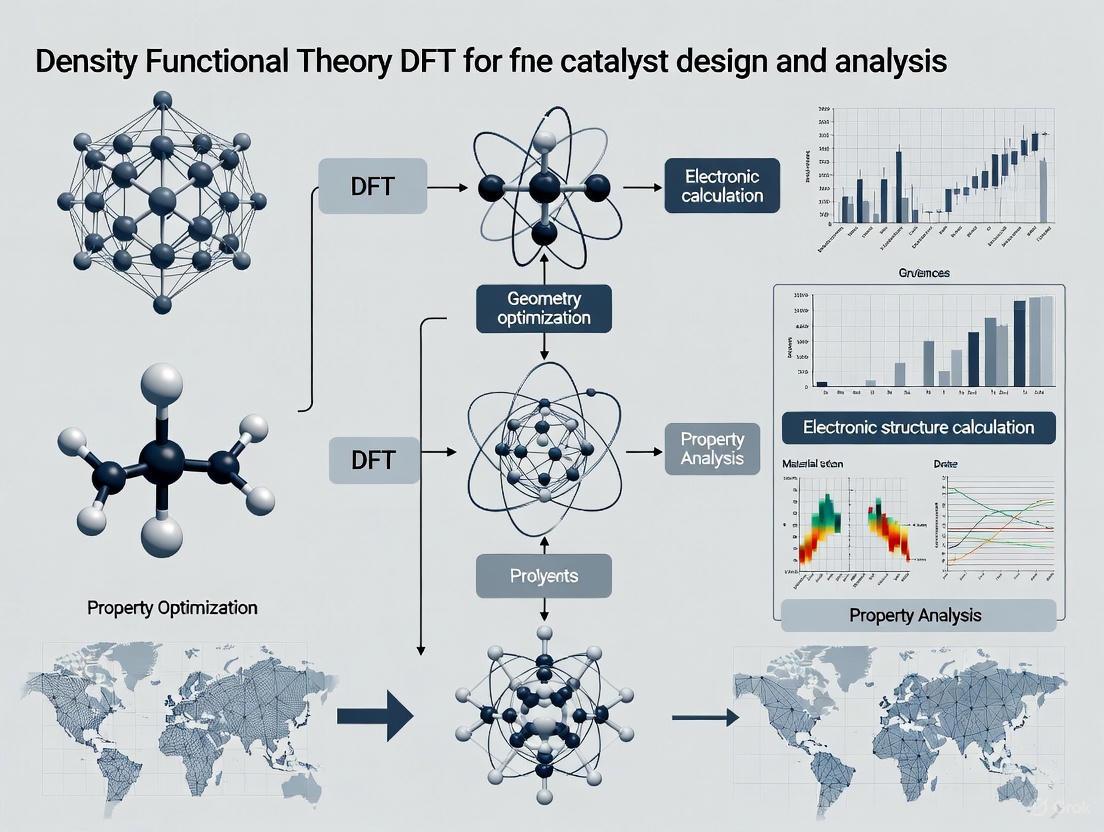
This article provides a comprehensive overview of the application of Density Functional Theory (DFT) in catalyst design and analysis, tailored for researchers and development professionals.
Density Functional Theory for Catalyst Design: From Fundamentals to AI-Driven Discovery
Abstract
This article provides a comprehensive overview of the application of Density Functional Theory (DFT) in catalyst design and analysis, tailored for researchers and development professionals. It explores the foundational principles of DFT for elucidating catalytic mechanisms and electronic structures. The scope extends to advanced methodological applications, including the integration of machine learning and generative models for accelerated discovery. The article also addresses critical challenges in computational efficiency and accuracy, offering troubleshooting and optimization strategies. Finally, it covers validation frameworks that combine theoretical predictions with experimental data, establishing DFT as an indispensable tool for rational catalyst development in energy and biomedical applications.
Understanding the Core: How DFT Reveals Catalytic Mechanisms and Electronic Structures
Theoretical Foundations of Density Functional Theory
Density Functional Theory (DFT) is a powerful first-principles computational method that has firmly established itself as a cornerstone in modern catalytic research due to its optimal balance between accuracy and computational cost [1] [2]. Unlike wavefunction-based theories that depend on 3N variables (where N is the number of electrons), DFT utilizes the electron density, ρ(r), which is a function of only three spatial coordinates, making it computationally feasible for studying large systems relevant to catalysis [2]. The entire field rests on the Hohenberg-Kohn theorems, which state that the ground-state electron density uniquely determines all properties of a system, including energy and wavefunction [2]. The practical implementation of DFT occurs through the Kohn-Sham equations, which map the complex interacting system of electrons onto a fictitious system of non-interacting electrons that generate the same density [1].
In the context of catalysis, DFT's significance stems from its ability to elucidate atomic-scale phenomena that are often difficult or impossible to probe experimentally [3] [2]. Computational modeling provides crucial insights into reaction mechanisms, active site characterization, and electronic structure information, which collectively inform rational catalyst design strategies [4] [5]. For electrocatalytic processes such as the hydrogen evolution reaction (HER), oxygen reduction reaction (ORR), and carbon dioxide reduction reaction (CO2RR), DFT enables the calculation of key descriptors including adsorption energies, activation energy barriers, and d-band centers, which correlate strongly with catalytic activity and selectivity [5] [6].
DFT Computational Protocols for Catalytic Systems
Method Selection and Functional Recommendations
The reliability of DFT results critically depends on the chosen methodological approximations. A best-practice approach involves careful selection of the exchange-correlation functional, basis set, and consideration of system-specific properties [1]. The following table summarizes recommended computational protocols for different catalytic applications:
Table 1: Recommended DFT Protocols for Catalytic Studies
| Application Focus | Recommended Functional | Recommended Basis Set | Key Considerations | Applicable Systems |
|---|---|---|---|---|
| Molecular Catalysis (Structure, Reaction Energies) [1] | B97M-V, r²SCAN-3c | def2-SVPD | Include dispersion corrections (D3); Account for solvation effects | Homogeneous organometallic complexes, reaction mechanisms |
| Surface Adsorption & Reactivity [7] | M06-2X | 6-311+G(3df,2p) | Use for single-point energy calculations on optimized geometries | Adsorption energies, activation barriers on surfaces |
| Initial Geometry Optimization [7] | B3LYP | 6-31+G(d,p) | Often used as initial step in multi-level protocols; Apply counterpoise correction for BSSE | Pre-optimization of catalyst and adsorbate structures |
| Benchmarked LDPE System Protocol [7] | M06-2X/6-311+G(3df,2p)//B3LYP/6-31+G(d,p) | 6-311+G(3df,2p) | Validated against experimental hydrogen abstraction and monomer reactivity | Free radical polymerization, chain transfer agents |
For periodic systems such as extended surfaces, nanoparticles, and two-dimensional materials, plane-wave basis sets are typically employed in conjunction with projector augmented wave (PAW) pseudopotentials [4] [2]. A common setup includes a plane-wave energy cutoff of 400-500 eV and k-point sampling to ensure numerical convergence [4]. It is crucial to avoid outdated default methods such as B3LYP/6-31G*, which lack dispersion corrections and suffer from basis set superposition error, potentially leading to qualitatively incorrect results [1].
Workflow for Catalytic Property Calculation
The process of evaluating catalytic properties involves a structured workflow that ensures reliability and computational efficiency. The diagram below illustrates a generalized DFT calculation protocol for catalysis:
This workflow underpins the calculation of key catalytic descriptors. For instance, the hydrogen adsorption energy (ΔEH), a critical descriptor for HER catalysts, is calculated as ΔEH = Ecatalyst+H - Ecatalyst - ½EH2, where E denotes the DFT-computed total energies [4] [6]. Similarly, activation energy barriers for reaction steps are determined through transition state optimization and validated by frequency analysis to ensure the presence of one imaginary frequency [2].
Advanced Integration: DFT with Machine Learning
The exploration of vast compositional spaces in multimetallic catalysts presents a formidable challenge for conventional DFT due to prohibitive computational costs [4] [8]. Active learning frameworks that synergistically combine DFT with machine learning (ML) have emerged as a transformative solution [4] [6] [9]. In this paradigm, a ML model (e.g., Gaussian Process Regression) is trained on a limited set of DFT calculations and then used to predict properties across a much larger design space, while strategically selecting the most informative data points for subsequent DFT validation [4].
This approach was successfully demonstrated for Pt-Ru-Cu-Ni-Fe multimetallic HER catalysts, where an active learning framework navigating 390,625 possible binding sites required only 600 DFT calculations to identify optimal compositions, which were subsequently experimentally validated [4]. Similarly, for single-atom catalysts (SACs) on graphyne supports, ML models utilizing descriptors such as d-band center, metal binding height, and bond lengths can efficiently predict HER activity, guiding the discovery of candidates surpassing commercial Pt/C catalysts [9].
The integrated DFT-ML catalyst design workflow can be visualized as follows:
Essential Research Reagents and Computational Materials
Table 2: Key Computational "Reagents" and Tools for DFT Catalysis Research
| Research Reagent / Tool | Function in Catalysis Research | Examples / Notes |
|---|---|---|
| Exchange-Correlation Functional [1] [2] | Approximates quantum mechanical electron exchange and correlation effects; Critical for accuracy | M06-2X (metals, kinetics), B97M-V (general purpose), RPBE (surfaces) |
| Atomic Basis Set / Plane Waves [1] [2] | Mathematical functions to represent electron orbitals; Determines computational cost/accuracy balance | def2-series (molecules), Plane-wave + PAW (periodic surfaces) |
| Dispersion Correction [1] | Accounts for van der Waals forces, essential for adsorption phenomena | D3, D3(BJ), VV10 |
| Solvation Model [2] | Mimics solvent effects in electrochemical interfaces and homogeneous catalysis | PCM, SMD, VASPsol |
| Catalytic Descriptor [4] [6] [9] | Quantitative metric correlating with catalytic activity; Enables rapid screening | d-band center, adsorption energy, Bader charge, ICOHP |
Application in Catalyst Design: A Case Study on HER Catalysts
The practical application of DFT protocols is exemplified by the design of multimetallic HER catalysts. The standard computational hydrogen electrode (CHE) model allows for the calculation of hydrogen adsorption free energy (ΔGH) as an activity descriptor, where ΔGH ≈ 0 signifies optimal catalytic activity [4] [6]. Using the active learning framework described in Section 3, researchers identified specific high-performance compositions from a five-element (Pt, Ru, Cu, Ni, Fe) design space [4].
The experimental validation protocol involved synthesizing the predicted alloys via the carbothermal shock method, followed by electrochemical testing to measure HER activity [4]. The consistency between computational predictions and experimental results underscores the predictive power of a well-parameterized DFT protocol. This integrated approach demonstrates a significant reduction in both computational resource requirements and experimental development time, establishing a robust pathway for the rational design of complex catalytic materials.
Probing Reaction Pathways and Key Intermediates
The rational design of high-performance catalysts is a cornerstone of modern sustainable chemistry, crucial for processes ranging from renewable energy storage to greenhouse gas mitigation. A profound understanding of reaction mechanisms—specifically, the probing of reaction pathways and the characterization of key intermediates—is essential for this endeavor. While experimental techniques often struggle to directly observe transient species and transition states, Density Functional Theory (DFT) has emerged as a powerful computational tool that provides atomic-level insights into these elusive aspects of catalytic cycles [2]. By calculating the energy landscape of reactions, DFT allows researchers to identify rate-determining steps, validate reaction mechanisms, and establish structure-activity relationships, thereby accelerating the development of more efficient and selective catalysts [10] [6]. This Application Note provides a detailed protocol for using DFT to probe reaction pathways and key intermediates, framed within the broader context of catalyst design and analysis.
Theoretical Background and Key Concepts
DFT simplifies the many-body Schrödinger equation by using the electron density, ρ(r), as the fundamental variable, making computational studies of complex catalytic systems feasible [2]. The reliability of DFT results, however, depends critically on the chosen approximations and the model system.
In catalysis, a primary objective is mapping the Potential Energy Surface (PES), which describes the system's energy as a function of atomic coordinates. Key points on the PES include:
- Intermediates (IM): Local energy minima representing stable chemical species along the reaction coordinate.
- Transition States (TS): First-order saddle points on the PES that connect two intermediates and represent the highest energy point along the reaction pathway. The energy difference between the reactant and the transition state defines the activation energy barrier.
- Reaction Energy: The total energy change from reactants to products.
The Rate-Determining Step (RDS) is the elementary reaction with the highest activation energy barrier, which dictates the overall kinetics of the catalytic cycle. Identifying the RDS is a key outcome of probing reaction pathways.
Computational Protocols
Protocol 1: Establishing the Catalytic Model and Initial Setup
Objective: To construct a physically realistic and computationally efficient model of the catalytic system for subsequent analysis.
Model Selection: Choose an appropriate model for the active site.
- For homogeneous catalysis or Single-Atom Catalysts (SACs), use a molecular cluster model that adequately represents the coordination environment [2] [11].
- For heterogeneous catalysis, employ a periodic slab model. A supercell with sufficient vacuum space (typically > 10 Å) is required to prevent interactions between periodic images. The choice of crystal facet (e.g., (111), (110)) is critical, as reactivity is often facet-dependent [6].
Geometry Optimization: Optimize the geometry of the clean catalyst model and all isolated reactant molecules to their ground state. This provides a reference energy structure.
Adsorption Configuration Sampling: For each reaction intermediate, systematically explore potential adsorption configurations (e.g., atop, bridge, hollow sites on surfaces) on the catalyst model. Optimize each configuration to find the most stable adsorption geometry.
Protocol 2: Locating Intermediates and Transition States
Objective: To identify and characterize all stable intermediates and the transition states that connect them.
Intermediate Optimization: Using the most stable adsorption configurations from Protocol 1, perform full geometry optimizations to locate the local energy minima for all proposed intermediates (e.g., *HCOO, *COOH, *CO) along the reaction pathway [10].
Transition State Search: Employ specialized methods to locate the first-order saddle points between intermediates.
- Common Methods: The Nudged Elastic Band (NEB) method and its dimer or climbing-image variants are widely used to approximate the reaction path and locate transition states [2].
- Verification: A true transition state must have exactly one imaginary vibrational frequency (confirmed by frequency analysis), and the atomic motion along this imaginary mode must correspond to the bond-breaking/forming process of the elementary step.
Reaction Pathway Verification: Perform Intrinsic Reaction Coordinate (IRC) calculations from the optimized transition state geometry to confirm it correctly connects to the intended reactant and product intermediates [12].
Protocol 3: Energy Calculation and Pathway Analysis
Objective: To calculate accurate reaction energies and activation barriers, and to determine the dominant reaction pathway.
Single-Point Energy Calculations: For all optimized intermediates and transition states, perform a more accurate single-point energy calculation using a higher-level basis set or functional, if necessary.
Energy Profile Construction: Calculate the relative energy of each intermediate and transition state with respect to a chosen reference (e.g., clean catalyst and free reactants). Plot the reaction energy profile.
Rate-Determining Step Identification: Identify the elementary step with the highest activation energy barrier; this is the RDS [10].
Electronic Structure Analysis: To gain deeper insight into the mechanism, analyze the electronic structure.
- Perform Bader charge analysis or use Natural Bond Orbital (NBO) analysis to understand charge transfer during adsorption and reaction [11].
- Calculate the d-band center for transition metal-based catalysts, a known descriptor for adsorption strength and catalytic activity [6] [11].
- Analyze the Projected Density of States (PDOS) to identify orbital interactions between the catalyst and adsorbates [11].
Advanced and High-Throughput Screening
Objective: To efficiently explore vast chemical spaces for novel catalyst materials.
Automated Pathway Exploration: Tools like ARplorer can be employed, which integrate quantum mechanics with rule-based methods and Large Language Model (LLM)-assisted chemical logic to automate the exploration of complex Potential Energy Surfaces (PES) for multi-step reactions [12].
Machine Learning Integration: Train machine learning models, such as Artificial Neural Networks (ANN), on DFT-calculated descriptors (e.g., d-band features, adsorption energies) to rapidly predict catalytic activity (e.g., limiting potential) for thousands of candidate materials, significantly reducing computational cost [11].
Application Example: CO₂ Hydrogenation to Methanol on Cu-Based Catalysts
The following table summarizes the DFT-calculated reaction pathways and energetics for CO₂ hydrogenation on three different copper-based catalysts, demonstrating how the support material dictates the mechanism [10].
Table 1: Dominant Reaction Pathways and Energetics for CO₂ Hydrogenation on Cu-Based Catalysts [10]
| Catalyst | Dominant Pathway | Rate-Determining Step (RDS) | Activation Energy of RDS (eV) | Key Intermediate (Adsorption Energy) |
|---|---|---|---|---|
| Cu/CeO₂ | HCOO (Formate) | HCOO* + H* → HCOOH* | 0.615 | HCOO* |
| Cu/Al₂O₃ | COOH (Carboxyl) | COH* + H* → HCOH* | 0.887 | COOH* |
| Cu/MgO | RWGS + CO-Hydrogenation | CO₂* → CO* + O* | 0.815 | H₂COOH* (-1.875 eV) |
This data illustrates the profound metal-support interaction, where the oxide support alters the electronic structure of the Cu active sites, steering the reaction through different mechanisms and leading to distinct activity descriptors [10].
The Scientist's Toolkit: Essential Research Reagents and Computational Solutions
Table 2: Key Computational Tools and Descriptors for Probing Reaction Pathways
| Item / Descriptor | Function / Significance | Application Notes |
|---|---|---|
| Software (e.g., VASP, Gaussian, Quantum ESPRESSO) | Performs the core DFT calculations, including geometry optimization, transition state search, and electronic structure analysis. | Selection depends on system (periodic vs. molecular) and computational resources. |
| Catalyst Model (Slab, Cluster, SAC) | A physically realistic representation of the catalytic active site. | Accuracy of the entire study hinges on a representative model [2]. |
| Exchange-Correlation Functional (e.g., PBE, RPBE, B3LYP) | Approximates the quantum mechanical exchange and correlation energy in DFT. | The choice of functional is critical and can significantly impact results like adsorption energies and barriers [2]. |
| d-Band Center (εd) | A descriptor for the adsorption strength of intermediates on transition metal surfaces. | A higher d-band center relative to the Fermi level typically correlates with stronger adsorbate binding [11]. |
| Activation Energy (Eₐ) | The energy barrier of an elementary step; the highest Eₐ defines the Rate-Determining Step. | Directly determines the reaction kinetics; used in microkinetic modeling [10]. |
| Adsorption Energy (ΔEₐds) | The strength with which a molecule binds to the catalyst surface. | A key descriptor in catalyst screening; often follows Brønsted-Evans-Polanyi (BEP) relationships [2]. |
| Projected Density of States (PDOS) | Reveals the electronic orbital contributions of the catalyst and adsorbates. | Used to identify orbital hybridization and the nature of the catalyst-adsorbate bond [11]. |
Workflow and Pathway Diagrams
The following diagram illustrates the integrated computational workflow for probing reaction pathways, from initial model setup to final analysis, incorporating both conventional and advanced machine-learning-assisted approaches.
Diagram 1: Workflow for Probing Reaction Pathways
The mechanistic landscape of a reaction like CO₂ hydrogenation can involve multiple competing pathways, as shown below.
Diagram 2: Competing Pathways in CO2 Hydrogenation
The rational design of catalysts requires a deep understanding of how electronic structure governs catalytic activity and selectivity. Within Density Functional Theory (DFT) for catalyst design and analysis, two complementary frameworks are paramount: d-band theory and Frontier Molecular Orbital (FMO) theory. d-band theory has established itself as a powerful model for predicting adsorption properties and reactivity trends on transition metal surfaces by focusing on the electronic states of the catalyst, particularly the energy and occupancy of the d-band center [13]. Simultaneously, FMO theory, a cornerstone of molecular reactivity, is experiencing a renaissance in heterogeneous catalysis, providing a unified model to describe both activity and stability of catalytic sites by examining the interactions between the highest occupied molecular orbital (HOMO) and the lowest unoccupied molecular orbital (LUMO) of the catalyst and reactants [14].
These theories provide the fundamental electronic principles that underpin catalyst performance. For instance, in single-atom catalysts (SACs), the frontier orbital interactions between the metal atom and the support directly determine both the stability of the anchored metal atom and its ability to interact with reactants [14]. This article details the practical application of these theories, providing protocols for computational analysis and experimental validation to guide researcher in catalyst development.
Theoretical Foundations and Computational Protocols
d-Band Theory: Core Principles and Workflow
d-Band theory posits that the reactivity of transition metal surfaces is dominated by the energy and shape of the d-band density of states. The primary descriptor is the d-band center (εd), which is the first moment of the d-band projected density of states (PDOS) relative to the Fermi level. A higher-lying d-band center (closer to the Fermi level) correlates with stronger adsorbate binding due to enhanced coupling between adsorbate states and metal d-states, following the Newns-Anderson chemisorption model.
Table 1: Key Descriptors in d-Band Theory Analysis
| Descriptor | Mathematical Definition | Chemical Interpretation | Common Calculation Method | |||
|---|---|---|---|---|---|---|
| d-Band Center (εd) | ( \epsilond = \frac{\int{-\infty}^{EF} E \cdot nd(E) dE}{\int{-\infty}^{EF} n_d(E) dE} ) | Average energy of d-states; predictor of adsorption strength. | Projected DOS (PDOS) calculation from DFT. | |||
| d-Band Width (Wd) | Second moment of the d-band PDOS. | Measure of covalent interactions between metal atoms. | PDOS analysis. | |||
| Projected Density of States (PDOS) | ( nd(E) = \sumi | \langle \psi_i | \phi_d \rangle | ^2 \delta(E - E_i) ) | Decomposition of electronic states into angular momentum components (s, p, d). | DFT calculation with plane-wave or atomic basis sets. |
The standard protocol for d-band analysis is as follows:
Protocol 1: Calculating the d-Band Center
- Structure Optimization: Relax the catalyst surface (e.g., a slab model) and any adsorbates until the residual forces on atoms are below 0.01 eV/Å.
- Self-Consistent Field (SCF) Calculation: Perform a single-point energy calculation on the optimized structure to obtain the converged electron density. Use a finer k-point grid (e.g., 4x4x1 for surfaces) and a plane-wave cutoff energy of 500 eV or higher.
- Density of States (DOS) Calculation: Run a non-self-consistent calculation using the converged charge density from step 2. A higher k-point density is recommended for accurate DOS sampling.
- Projected DOS (PDOS) Analysis: Project the total DOS onto the d-orbitals of the relevant metal atoms (e.g., surface atoms or nanoparticles).
- d-Band Center Calculation: Calculate the first moment of the d-band PDOS from the Fermi level downwards (typically -10 eV to EF). This can be automated using scripting tools in materials science suites (e.g., VASP, Quantum ESPRESSO) or post-processing codes like p4vasp or VASPKIT.
Frontier Molecular Orbital Theory for Heterogeneous Systems
While d-band theory is powerful, FMO theory offers a complementary, molecule-like perspective for complex systems, including single-atom catalysts and nanoparticles. The core principle is that the interaction between the HOMO and LUMO of the catalyst and adsorbate dictates the reaction pathway. A recent groundbreaking study has successfully applied FMO theory to design single-atom catalysts, demonstrating that the energy gap between the support's LUMO and the metal atom's HOMO governs stability, while the LUMO of the anchored metal atom governs adsorbate interaction and activity [14].
Protocol 2: Frontier Orbital Analysis for Single-Atom Catalysts
- Cluster Model Construction: Create a cluster model of the support (e.g., a nanoscale metal oxide particle like ZnO or CoOx) with the single metal atom (e.g., Pd) anchored at the intended site.
- Geometry Optimization: Optimize the cluster model using DFT with implicit solvation models if needed for electrochemical systems [15].
- Orbital Energy Calculation: Perform an electronic structure calculation to compute the energies of the HOMO and LUMO. For periodic systems, the HOMO and LUMO correspond to the valence band maximum (VBM) and conduction band minimum (CBM), which can be experimentally probed using ultraviolet-visible (UV-Vis) spectroscopy and Mott-Schottky plots [14].
- Descriptor Extraction: Calculate the key FMO descriptors:
- HOMO-LUMO Gap of the support: Related to stability and tunability.
- Energy difference between support LUMO and metal HOMO (ΔE₁): A smaller ΔE₁ promotes stronger orbital hybridization for enhanced stability.
- Energy of the metal atom's LUMO (E₂): A higher-lying LUMO enhances back-donation to adsorbates, boosting activity for reactions like hydrogenation.
The logical workflow for FMO-guided catalyst design is summarized in the diagram below.
Integrated Computational Workflow for Catalyst Screening
Combining d-band and FMO analyses with active learning creates a powerful, high-throughput screening pipeline. This integrated approach was successfully used to discover Cu/Pd and Cu/Ag catalysts for selective acetate production, achieving Faradaic efficiencies of 50% and 47%, vastly superior to pure Cu (21%) [15].
Table 2: Key Reagent Solutions for Computational Catalyst Screening
| Research Reagent / Tool | Function in Catalyst Design | Application Example |
|---|---|---|
| Grand-Canonical DFT (GC-DFT) | Models electrified interfaces under constant potential, crucial for electrochemical reactions. | Calculating potential-dependent reaction barriers for CO electroreduction [15]. |
| Microkinetic Modeling (MKM) | Translates DFT energies into predicted reaction rates and selectivity under operational conditions. | Identifying CH* binding energy as key descriptor for acetate selectivity [15]. |
| Machine Learning Interatomic Potentials (MLIP) | Serves as a surrogate for DFT, enabling rapid evaluation of energies and forces for large systems or long timescales. | Accelerating structure search and reaction mechanism analysis [16]. |
| Active Learning Algorithms | Intelligently selects the most informative candidates for DFT calculation, optimizing the discovery process. | Guiding the search for optimal Cu/Pd and Cu/Ag ratios [15]. |
| Generative Models (e.g., Diffusion, Transformers) | Inverse design of catalyst structures with target properties by learning from large datasets. | Generating novel surface structures and alloy compositions for CO2 reduction [17]. |
The following workflow diagram illustrates how these components are integrated into a cohesive catalyst design pipeline.
Experimental Validation and Case Studies
Computational predictions must be rigorously validated experimentally. Key techniques include operando spectroscopy to monitor electronic states and kinetic measurements to assess activity.
Protocol 3: Operando XPS for Validating Electronic Structure
Objective: To correlate the electronic state of a catalyst under working conditions with computational predictions and measured activity [13].
- Catalyst Preparation: Synthesize the predicted catalyst (e.g., Pd₁/ZnO SAC). Confirm atomic dispersion using aberration-corrected HAADF-STEM.
- Operando AP-XPS Setup: Load the catalyst into an Ambient Pressure XPS system. Introduce reaction gases (e.g., 0.1 mbar CO + 0.3 mbar H₂O for WGS reaction).
- Data Acquisition:
- Acquire survey and high-resolution spectra (e.g., Pt 4f, Ce 3d, or Pd 3d) at increasing temperatures (e.g., from 100°C to 300°C) and during cooling.
- Simultaneously monitor reaction products (e.g., H₂) using a mass spectrometer.
- Data Analysis:
- Deconvolve core-level spectra (e.g., Pt 4f) into components representing different sites: bulk/terrace atoms, low-coordinated atoms, and atomically dispersed ions [13].
- Track the evolution of these species with temperature and correlate their concentration with the onset of catalytic activity.
Case Study: Quantifying Electronic vs. Geometric Effects in Pt/CeO₂ A combined operando XPS and STEM study on Pt/CeO₂ for the water-gas shift reaction revealed that the intrinsic activity of low-coordinated corner Pt atoms on ~1-1.5 nm nanoparticles is three orders of magnitude higher than other sites. This was attributed to an electronic structure effect, specifically a shift in the Pt valence states, rather than a purely geometric effect [13]. This finding underscores the critical importance of electronic structure analysis for explaining dramatic activity enhancements.
Protocol 4: Zero-Gap Electrolyzer Validation for Electrocatalysts
Objective: To test computationally predicted catalysts in realistic electrochemical environments, such as for CO₂/CO electroreduction [15].
- Catalyst Ink Preparation: Disperse the catalyst powder (e.g., predicted Cu/Pd (2:1)) in a mixture of solvent (e.g., isopropanol) and Nafion ionomer, then sonicate.
- Membrane Electrode Assembly (MEA) Fabrication: Spray the catalyst ink onto a gas diffusion layer (GDL) to form the cathode. Assemble it with an anion exchange membrane and an anode.
- Electrochemical Testing: Place the MEA in a zero-gap electrolyzer cell. Feed CO gas to the cathode and an electrolyte (e.g., KOH) to the anode.
- Product Analysis:
- Quantify gaseous products (e.g., C₂H₄, CO) using online gas chromatography (GC).
- Quantify liquid products (e.g., acetate, ethanol) using nuclear magnetic resonance (NMR) spectroscopy or high-performance liquid chromatography (HPLC).
- Performance Metric Calculation: Calculate the Faradaic efficiency (FE) for each product, which represents the selectivity of the catalyst. The experimental confirmation of Cu/Pd (2:1) achieving 50% FE for acetate validated the AI-driven multi-scale simulation framework [15].
The electrochemical transformation of industrial by-products such as nitrogen oxides (NOx) and carbon dioxide (CO2) into value-added chemicals represents a cornerstone of sustainable chemical production. This application note details the integration of Density Functional Theory (DFT) with advanced experimental methodologies to elucidate reaction mechanisms and guide the rational design of electrocatalysts for these critical reactions. The focus is placed on the electroreduction of NOx to ammonia (NH3) and the electrochemical conversion of CO2 to carbon monoxide (CO) and other C1 products, framing these processes within the context of a broader thesis on DFT for catalyst design and analysis. We provide a comprehensive framework that bridges theoretical predictions, utilizing descriptors such as adsorption energies and d-band centers, with practical experimental validation and protocol implementation [18] [2] [19].
Mechanistic Insights from Computational Studies
NOx Electroreduction (NOxRR) to Ammonia
The electrocatalytic reduction of NOx (including nitrate (NO3−), nitrite (NO2−), and nitric oxide (NO)) to ammonia involves complex reaction networks with multiple possible intermediates and competing side reactions, notably the hydrogen evolution reaction (HER) [18].
- Key Intermediates and Descriptors: DFT studies have identified that the adsorption strengths of key nitrogenous intermediates, such as *NO and *NH2, are crucial activity descriptors. The efficiency of the overall process is determined by the catalyst's ability to facilitate the proton-electron transfer steps while suppressing the HER [18] [19].
- The Role of Active Hydrogen: The active hydrogen species (H) generated from water dissociation is a critical participant. Its optimal binding energy is essential for driving the hydrogenation steps in both NOxRR and CO2 reduction reactions. Excess H, however, leads to undesirable HER. Catalyst design strategies, therefore, often aim to control the availability and binding strength of H* [19].
Table 1: Key DFT-Calculated Descriptors for NOxRR and CO2RR Catalysts
| Reaction | Catalyst Material | Key Descriptor | Descriptor Function | Optimal Trend |
|---|---|---|---|---|
| NOx to NH3 | Transition Metal Catalysts | *NO & *NH2 Adsorption Energy | Determines activity & selectivity for NH3 production [18] | Moderate binding strength |
| CO2 to CO | Fe-N-C Single-Atom Catalysts | *COOH & *CO Adsorption Energy | Determines activity & selectivity for CO production [20] [21] | Weak *CO binding to avoid poisoning |
| CO2 to CO | Fe-Dual-Atom Catalysts | H Adsorption on Graphitic Edge | Suppresses competing HER, boosting CO selectivity [20] | Strong H binding on non-metal sites |
| HER | Multimetallic Alloys | H Adsorption Energy (ΔG_H*) | Primary descriptor for HER activity [22] | ΔG_H* ≈ 0 |
CO2 Electroreduction (CO2RR) to C1 Products
The selective reduction of CO2 to CO and other products is a widely studied pathway. For single-atom catalysts like M-N-C (metal-nitrogen-carbon), the local coordination environment profoundly influences the reaction mechanism and selectivity [20] [21].
- Reaction Pathways and Selectivity: On Fe-N-C sites, the CO2RR to CO typically proceeds through the formation of a COOH intermediate, followed by the desorption of *CO. The selectivity between CO production and the competing HER is directly governed by the relative binding strengths of *CO and *H on the active site. DFT and microkinetic modeling have shown that for Fe dual-atom catalysts (Fe-DACs) at graphitic edges, the edge sites themselves can bind H atoms more strongly than the Fe site, effectively sequestering H and breaking the linear scaling relationship between *CO and *H adsorption. This shifts the limiting potential for CO2RR below that of HER, favoring high CO selectivity [20].
- Effect of Coordination Environment: The number of coordinating nitrogen atoms and the identity of the metal center (e.g., Fe, Co, Ni, Cu) in M-N-C catalysts significantly modulate the electronic structure (e.g., d-band center) of the active site. This modulation affects the binding strength of intermediates and the magnitude of the potential-limiting step, thereby influencing the overall activity and product selectivity [21].
Experimental Protocols for Validation
Protocol 1: Fabrication and Testing of a Membrane Electrode Assembly (MEA) Electrolyzer for NOxRR
Principle: This protocol describes the assembly and evaluation of a full-runner MEA electrolyzer (MEA-FR) designed to overcome mass transport limitations at industrial current densities for NOx− reduction to NH3 [23].
Materials:
- Catalyst-Inked Diffusion Layer: Cathode catalyst (e.g., nanostructured porous electrode) dispersed in ink and deposited on a gas diffusion layer (GDL).
- Proton Exchange Membrane (PEM) or Anion Exchange Membrane (AEM).
- Anode Catalyst: Iridium oxide (IrO2) or similar for oxygen evolution reaction (OER).
- Titanium or Graphite Bipolar Plates: Featuring a full-runner flow field design (a streamlined slot) instead of a serpentine pattern.
- Electrolyte: NOx−-containing aqueous solution (e.g., KNO3 or NaNO3).
- Test Station: Potentiostat/Galvanostat, electrolyte pumps, gas collection system, and product quantification setup (e.g., ion chromatography for NH3 and NMR for N2H4).
Procedure:
- MEA Assembly: Sandwhich the PEM/AEM between the catalyst-coated cathode GDL and the anode. Assemble the cell by placing the MEA between two bipolar plates with gaskets to prevent leaks.
- System Setup: Connect the electrolyzer to the test station. Ensure all fluidic and electrical connections are secure.
- Electrolysis Operation:
- Pump the catholyte (NOx− solution) through the full-runner flow field, forcing convective flow through the porous cathode.
- Circulate an anolyte (e.g., dilute acid or alkaline solution) on the anode side.
- Apply a constant current density (e.g., 200-500 mA cm⁻²) using a galvanostat.
- Maintain a constant electrolyte flow rate and temperature.
- Product Analysis:
- Liquid Products: Collect aliquots of the catholyte at regular intervals. Quantify NH3 concentration using the indophenol blue method or ion chromatography. Quantify any by-product N2H4 using Watt and Chrisp method or NMR.
- Gas Products: Use online gas chromatography (GC) to analyze the cathode effluent for H2 and other gases.
- Performance Calculation:
- Faradaic Efficiency (FE): Calculate for NH3 using the formula: ( FE{NH3} (\%) = \frac{z \times F \times n{NH3}}{Q} \times 100 ), where ( z ) is the number of electrons transferred per NH3 molecule (8 for NO3− to NH3), ( F ) is the Faraday constant, ( n{NH3} ) is the moles of NH3 produced, and ( Q ) is the total charge passed.
- Report cell voltage and stability over time (e.g., >200 hours) [23].
Protocol 2: Benchmarking CO2 Reduction Performance for Industrial Implementation
Principle: This protocol outlines key performance metrics and procedures for evaluating CO2RR catalysts and systems under conditions relevant to industrial application [24].
Materials:
- Gas Diffusion Electrode (GDE): Integrated with the catalyst layer.
- Flow Cell or MEA Electrolyzer.
- Bipolar Membrane (BPM) or Cation Exchange Membrane.
- CO2 Source: High-purity CO2 or simulated industrial flue gas.
- Electrolyte: e.g., KHCO3 solution.
- Test Station: Potentiostat, mass flow controllers, gas chromatograph (GC), high-performance liquid chromatography (HPLC).
Procedure:
- Cell Assembly: Integrate the GDE-based cathode, membrane, and anode into a flow cell configuration to enable high current density operation.
- Operational Conditions:
- Apply current densities of >200 mA cm⁻².
- Maintain cell temperature between 60-90 °C for stress-testing.
- Use a stoichiometric excess (λ value) of CO2 to ensure sufficient reactant supply.
- Product Analysis and Key Metrics:
- Gas Products: Use online GC with a TCD and FID to quantify and determine Faradaic Efficiency for CO, C2H4, CH4, etc.
- Liquid Products: Use HPLC or NMR to quantify and determine Faradaic Efficiency for formate, alcohols, etc.
- Single-Pass Conversion (SPC): Calculate the percentage of CO2 converted from the inlet stream in a single pass. For C1 products in BPM-based systems, target SPC >70% [24].
- Stability Testing: Operate the system for extended periods (>1000 hours) and report voltage decay rates (<10 µV/h) and changes in Faradaic Efficiency (ΔFE/Δt < 0.1% per 1000 h).
- Full Cell Voltage: Report the total cell voltage at the target current density, with values <3.0 V at 300 mA cm⁻² being a suggested benchmark [24].
- Reporting: Document all critical parameters, including electrode structure, GDE composition, flow rates, and outlet stream composition, to ensure reproducibility [24].
The Scientist's Toolkit: Essential Research Reagents and Materials
This section details key reagents, materials, and computational tools essential for research in NOxRR and CO2RR, as derived from the cited protocols and studies.
Table 2: Essential Research Reagents and Materials
| Item Name | Function/Application | Key Characteristics & Examples |
|---|---|---|
| M-N-C Single-Atom Catalysts | Active sites for CO2RR to CO; study of coordination environment effects [20] [21] | Fe-, Co-, Ni-, Cu- supported on N-doped graphene; tunable coordination number. |
| Multimetallic Alloy Nanoparticles | Exploration of HER and other electrocatalytic activities with unique binding sites [22] | Pt-, Ru-, Cu-, Ni-, Fe-based alloys; vast compositional space for screening. |
| Gas Diffusion Electrode (GDE) | Enables high current density operation by facilitating CO2 mass transport [24] | Porous carbon-based structure; often coated with catalyst layer. |
| Membrane Electrode Assembly (MEA) | Zero-gap configuration for efficient electrolysis (NOxRR, CO2RR) [23] | Integrates electrodes with a PEM, AEM, or BPM. |
| Full-Runner Flow Field | Electrolyzer component for enhanced mass transport and bubble removal [23] | Replaces serpentine channels with a slot; forces convection through electrode. |
| Density Functional Theory (DFT) | Modeling reaction mechanisms, adsorption energies, and predicting catalyst activity [18] [2] | Uses software like VASP; calculates descriptors (d-band center, ΔG_ads). |
| Active Learning Framework | Accelerates the discovery of optimal multimetallic catalyst compositions [22] | Combines machine learning (Gaussian Process Regressor) with DFT. |
Workflow and System Visualization
Integrated Computational-Experimental Workflow for Catalyst Design
The following diagram illustrates the synergistic cycle between theoretical computation and experimental validation in modern electrocatalyst development.
Integrated Catalyst Design Workflow: This flowchart outlines the iterative process of using DFT calculations to derive activity descriptors and screen potential catalysts, often accelerated by machine learning. Promising candidates are synthesized and experimentally validated, with the resulting performance data feeding back to refine computational models and generate new mechanistic insights [18] [2] [22].
Mass Transport in Electrolyzer Flow Field Designs
The diagram below contrasts mass transport mechanisms in different electrolyzer designs, a critical factor in achieving industrial current densities.
Electrolyzer Flow Field Comparison: This diagram compares the serpentine runner (MEA-SR) and full-runner (MEA-FR) electrolyzer designs. The MEA-SR's flow-by pattern leads to reactant concentration gradients and poor bubble management. In contrast, the MEA-FR's flow-through pattern ensures uniform reactant concentration and generates high shear forces for efficient bubble removal, directly enabling high Faradaic efficiency and stability at industrial current densities [23].
The Role of DFT in Replacing Trial-and-Error Approaches
Density Functional Theory (DFT) has fundamentally transformed the paradigm of catalyst design and analysis, shifting the research methodology from traditional trial-and-error experimental approaches to precise, prediction-driven computational screening. By enabling researchers to determine molecular structures, reaction energies, barrier heights, and spectroscopic properties at the quantum level, DFT provides profound atomic-level insights into catalytic mechanisms and structure-property relationships. This application note details how DFT methodologies, particularly when integrated with machine learning (ML) and high-throughput screening, are revolutionizing the development of catalysts for sustainable energy applications. We present structured protocols, quantitative data comparisons, and visual workflows to guide researchers in implementing DFT-based design strategies for various catalytic systems, including carbon-supported single-atom catalysts (CS-SACs) and electrocatalysts for energy conversion processes.
The traditional approach to catalyst development has relied heavily on experimental synthesis and testing—an often time-consuming and resource-intensive process. Density Functional Theory addresses this challenge by providing a computational framework to explore the atomic and electronic structures of materials, thereby predicting catalytic activity and stability before synthesis is ever attempted. For energy storage and conversion technologies, such as fuel cells and electrolyzers, DFT calculations elucidate critical reaction mechanisms, including the hydrogen evolution reaction (HER), oxygen reduction reaction (ORR), and CO₂ reduction reaction (CO₂RR) [25] [6].
The predictive power of DFT is particularly valuable for designing single-atom catalysts (SACs), which feature isolated metal atoms on solid supports. These catalysts maximize atomic efficiency and exhibit unique electronic properties. For carbon-supported SACs (CS-SACs), DFT studies have been instrumental in guiding atomic-level regulation strategies such as coordination structure control, nonmetaxial elemental doping, and polymetallic active site construction to optimize performance [25]. This targeted approach, guided by computational insights, significantly accelerates the discovery and optimization of next-generation catalytic materials.
Key DFT Application Protocols in Catalyst Design
Best-Practice DFT Calculation Workflow
Adopting standardized protocols is essential for obtaining accurate, reproducible results in computational catalyst design. The following workflow provides a robust framework for typical DFT studies [26] [27]:
- System Preparation: Define the atomic structure of the catalytic system, including the active site and support material. For CS-SACs, this typically involves modeling graphene or other carbon allotropes with single metal atoms anchored at defect sites.
- Functional and Basis Set Selection: Choose an appropriate exchange-correlation functional and atomic orbital basis set based on the system and properties of interest (refer to Table 1 for guidance).
- Convergence Testing: Perform systematic tests to determine the necessary parameters for energy accuracy, including the plane-wave cutoff energy and k-point sampling for periodic systems. Convergence is typically achieved when total energy changes are less than 0.01 eV [28].
- Geometry Optimization: Relax the atomic structure until the forces on all atoms are minimized (typically below 0.01 eV/Å).
- Property Calculation: Compute the target electronic, energetic, or mechanical properties, such as adsorption energies, density of states, or elastic constants.
- Validation: Where possible, compare computational results with available experimental data to validate the methodological choices.
Protocol for Electrocatalytic Reaction Pathway Analysis
A common application of DFT in catalysis is the mechanistic study of electrocatalytic reactions. The following protocol outlines the key steps [6]:
- Model the Electrochemical Interface: Construct a slab model of the catalyst surface in contact with an implicit or explicit solvent environment.
- Identify Possible Reaction Intermediates: Use chemical intuition and literature to propose stable intermediate species adsorbed on the catalyst surface.
- Calculate Free Energies: Optimize the geometry of each intermediate and compute its electronic energy. Apply thermodynamic corrections to obtain Gibbs free energies at the desired temperature and potential.
- Construct the Free Energy Diagram: Plot the free energy of the system as a function of the reaction coordinate. The potential-determining step is identified as the step with the largest positive free energy change.
- Account for Electrode Potential: Use computational hydrogen electrode (CHE) or Grand-Canonical DFT approaches to model the effect of applied potential on the reaction energetics.
The diagram below illustrates the logical workflow for a DFT-based catalyst screening study.
Advanced Protocol: Integrating DFT with Machine Learning
The combination of DFT and machine learning (ML) creates a powerful paradigm for accelerated materials discovery [6] [29].
- DFT Data Generation: Use high-throughput DFT calculations to generate a diverse and reliable dataset of catalytic properties (e.g., adsorption energies, formation energies) for a training set of materials.
- Feature Selection: Identify meaningful descriptors (e.g., d-band center, coordination number, electronegativity, atomic radius) that correlate with the target catalytic properties.
- Model Training: Train ML models (e.g., neural networks, kernel ridge regression) on the DFT dataset to learn the mapping between material descriptors and target properties.
- Predictive Screening: Use the trained ML model to rapidly screen vast chemical spaces (thousands to millions of candidates) and identify promising catalyst candidates.
- DFT Validation: Perform rigorous DFT calculations on the ML-predicted leads to validate their predicted performance before experimental synthesis.
This multi-level approach achieves an optimal balance between computational accuracy and efficiency [26].
Quantitative Comparison of DFT Methods and Performance
The choice of computational methodology significantly impacts the accuracy and predictive power of DFT studies. The tables below summarize key considerations and representative results.
Table 1: Recommended DFT Functional and Basis Set Selection Matrix for Catalysis Research
| Computational Task | Recommended Functional(s) | Recommended Basis Set(s) | Key Considerations |
|---|---|---|---|
| Structure Optimization | PBE, RPBE, BEEF-vdW [6] [28] | Plane-wave (cutoff 60 Ry+) [28], def2-SVP [26] | PBE+U improves structural properties for systems with localized d-electrons [28]. |
| Reaction Energy/Barrier | B3LYP, M06-2X, ωB97X-D [26] | def2-TZVP, def2-QZVP [26] | Hybrid functionals often improve accuracy but increase computational cost. |
| Electronic Properties (Band Gap) | HSE06, PBE0, GW [28] | Plane-wave, localized basis sets | Standard PBE/LDA underestimates band gaps; hybrid functionals or advanced methods are required. |
| Mechanical/Thermal Properties | PBE+U, LDA [28] | Plane-wave (high cutoff) | PBE+U provided results for CdS/CdSe that best aligned with experimental data [28]. |
Table 2: Representative DFT-Predicted Properties for Catalyst Materials and Design Strategies
| Material System | DFT-Investigated Property | Key Finding/Performance | Reference Functional |
|---|---|---|---|
| Zinc-blende CdS | Bulk Modulus (B) | 71.75 GPa (PBE+U) - Higher stiffness than CdSe [28] | PBE+U |
| Zinc-blende CdSe | Bulk Modulus (B) | 53.85 GPa (PBE+U) - Softer lattice [28] | PBE+U |
| CS-SACs (General) | Coordination Environment | Coordination number, non-metallic doping, and axial ligands tune activity [25] | Various |
| CS-SACs for Li-S batteries | Adsorption Energy of LiPS | Regulating coordination structure mitigates polysulfide shuttling [25] | Various |
| CdS / CdSe | Zero Thermal Expansion Point | 113.92 K (CdS) and 61.50 K (CdSe) predicted via QHA [28] | PBE+U |
The Scientist's Toolkit: Essential Research Reagents and Computational Solutions
Successful DFT-based catalyst design relies on a suite of software, computational tools, and conceptual "reagents."
Table 3: Key Research Reagent Solutions for DFT-Based Catalyst Design
| Tool/Reagent | Category | Primary Function in Catalyst Design |
|---|---|---|
| Quantum ESPRESSO [28] | Software Package | Plane-wave pseudopotential DFT code for periodic solid-state systems. |
| Hubbard U Correction [28] | Computational Method | Corrects for self-interaction error in systems with localized d/f electrons, improving band gaps. |
| Projector Augmented-Wave (PAW) [28] | Pseudopotential | Treats core-valence electron interactions efficiently, improving computational accuracy. |
| van der Waals (vdW) Functionals | Computational Method | Accounts for dispersion forces, critical for physisorption and layered materials. |
| Catalytic Descriptor (e.g., d-band center) | Conceptual Tool | Electronic structure proxy for predicting adsorption strength and catalytic activity. |
| Machine Learning Potentials [6] [29] | Software/Method | Accelerates screening and dynamics simulations by learning from DFT data. |
Integrated Workflow: From DFT Prediction to Catalyst Design
The most significant advantage of DFT lies in its integration into a holistic design loop, which effectively replaces linear trial-and-error cycles. This integration is exemplified in the synergistic DFT-ML workflow, which dramatically accelerates the discovery process for materials such as carbon-supported single-atom catalysts [6] [29]. In this paradigm, DFT provides the fundamental, high-quality data on energies and electronic structures, while ML models rapidly extrapolate these relationships across vast compositional and structural spaces. This allows researchers to pre-screen thousands of candidate materials in silico before committing to synthesis.
The following diagram visualizes this integrated, cyclical approach to rational catalyst design.
This workflow has been successfully applied to optimize CS-SACs for reactions like the oxygen reduction reaction (ORR) and CO₂ reduction reaction (CO₂RR), where DFT simulations guide the atomic-level engineering of the metal center's coordination environment (e.g., M-N-C moieties) to enhance activity and selectivity [25]. Furthermore, for compound semiconductors like CdS and CdSe, DFT-guided design predicts not only electronic structure but also crucial mechanical and thermal properties (e.g., elastic constants, thermal expansion), ensuring functional stability under operating conditions [28].
Density Functional Theory has unequivocally established itself as a cornerstone technology in modern catalyst research, enabling a rational, principles-driven design framework that systematically displaces inefficient trial-and-error methodologies. By providing deep insights into reaction mechanisms, electronic structure, and structure-property relationships, DFT guides the atomic-level engineering of advanced materials such as carbon-supported single-atom catalysts and semiconductor compounds. The ongoing integration of DFT with machine learning and high-throughput computational screening is poised to further accelerate the discovery timeline, creating a powerful engine for innovation in sustainable energy technologies. Adherence to best-practice protocols for functional selection, convergence testing, and workflow design, as outlined in this application note, is critical for leveraging the full potential of DFT in the quest for next-generation catalysts.
Computational Workflows and Emerging AI Synergies in Catalyst Design
Density Functional Theory (DFT) serves as the fundamental computational framework for modern catalyst design and analysis, enabling researchers to predict atomic-scale properties that govern catalytic performance. The accuracy of these predictions hinges critically on the choice of exchange-correlation (XC) functional, which approximates the complex quantum mechanical interactions between electrons. The scientific community has progressively developed increasingly sophisticated XC functionals, often conceptualized through "Jacob's Ladder," which ascends from simpler to more theoretically complete approximations. For researchers in catalysis, navigating this landscape—from Generalized Gradient Approximations (GGAs) to hybrid functionals like HSE06 and beyond—is essential for obtaining reliable data on catalytic surfaces, reaction pathways, and intermediate adsorption energies.
The limitations of standard GGA functionals, such as Perdew-Burke-Ernzerhof (PBE), are particularly pronounced in catalytic systems involving transition metals, rare-earth elements, and oxides, where strongly correlated electrons and localized d- and f- orbitals play a decisive role in reactivity. These functionals suffer from self-interaction error (SIE) and systematically underestimate electronic band gaps, leading to inaccurate predictions of electronic structure, surface reactivity, and phase stability [30] [31]. Hybrid functionals, which incorporate a portion of exact Hartree-Fock exchange, offer a path to greater accuracy, making them indispensable for predictive catalyst design. This application note provides a structured comparison of these methodologies and detailed protocols for their application in catalytic materials research.
Functional Performance: A Quantitative Comparison
The selection of an appropriate XC functional requires a clear understanding of its performance characteristics for different material properties. The table below summarizes key benchmarks for functionals relevant to catalytic materials.
Table 1: Performance Benchmarks of Common DFT Functionals for Catalytic Materials
| Functional | Rung on Jacob's Ladder | Typical MAE in Formation Energy (eV/atom) | Typical MAE in Band Gap (eV) | Computational Cost (Relative to GGA) | Recommended for Catalytic Properties |
|---|---|---|---|---|---|
| PBE | GGA | ~0.1 - 0.2 | ~1.3 - 1.5 [30] | 1x | Preliminary structural screening, metals |
| PBEsol | GGA | Similar to PBE [30] | Similar to PBE [30] | ~1x | Accurate lattice constants of solids [30] |
| SCAN/r2SCAN | meta-GGA | Lower than GGA [31] | ~0.6 - 0.8 [31] | ~2-5x | Balanced accuracy/cost for REOs & oxides [31] |
| HSE06 | Hybrid | ~0.15 vs. PBEsol [30] | ~0.6 vs. experiment [30] | ~10-50x | Band gaps, electronic structure, defect chemistry [30] [32] |
| HSE06+U | Hybrid+U | System-dependent | System-dependent | >HSE06 | Systems with highly localized electrons (e.g., REO 4f states) [31] |
The quantitative data reveals a clear trade-off between accuracy and computational cost. For instance, while HSE06 reduces the mean absolute error (MAE) in band gaps by over 50% compared to PBE (from 1.35 eV to 0.62 eV for a set of 121 binary materials), it requires an order of magnitude more computational resources [30]. This makes HSE06 particularly valuable for properties sensitive to electronic structure, such as photocatalytic activity or the energy levels of active sites. The r2SCAN functional emerges as a promising compromise, offering meta-GGA accuracy for structural and energetic properties at a fraction of the cost of hybrid calculations [31].
Table 2: Functional-Specific Recommendations for Catalyst Systems
| Catalyst Type | Key Challenges | Recommended Functional(s) | Critical Considerations |
|---|---|---|---|
| Transition Metal Oxides | Accurate band gaps, localized d-electrons, magnetic ordering | HSE06, SCAN/r2SCAN | HSE06 is superior for electronic properties; meta-GGAs offer good cost-accuracy balance [30] [31]. |
| Rare-Earth Oxides (REOs) | Strong correlation in 4f electrons, spin-orbit coupling | HSE06, r2SCAN+U, r2SCAN+U+SOC | +U and Spin-Orbit Coupling (SOC) corrections are often critical for qualitative accuracy [31]. |
| Carbon-Based (e.g., g-C3N4) | Defect engineering, adsorption strength, charge transfer | HSE06 (for band structure), PBE/HSE06 (for adsorption) | HSE06 validates band structure; GGA can screen defects, but adsorption may need hybrid verification [32]. |
| Binuclear TM Complexes | Magnetic exchange coupling | Range-separated hybrids (e.g., HSE06) | Functionals with moderate short-range HF exchange perform well for J-coupling constants [33]. |
Experimental and Computational Protocols
Protocol 1: High-Throughput Workflow for Oxide Catalyst Stability Screening
This protocol, adapted from large-scale database construction efforts, is designed for assessing the thermodynamic and electrochemical stability of oxide catalysts [30].
Initial Structure Curation:
- Source: Query candidate crystal structures from the Inorganic Crystal Structure Database (ICSD).
- Filtering: For compositions with multiple entries (polymorphs), select the structure with the lowest energy per atom according to a reference database (e.g., Materials Project). If no reference data exists, select the ICSD entry with the smallest unit cell.
Geometry Optimization:
- Software: All-electron code FHI-aims (can be adapted to VASP with PAW pseudopotentials).
- Functional: Use the PBEsol functional.
- Basis Set: In FHI-aims, use "light" numerical atom-centered orbital (NAO) basis sets for a favorable accuracy/efficiency trade-off.
- Convergence: Set force convergence criteria to at least 10⁻³ eV/Å.
- Spin: Employ spin-polarized calculations for all structures containing transition metals (e.g., Fe, Co, Ni) or those flagged as magnetic in reference databases.
Single-Point Energy & Electronic Structure Calculation:
- Functional: Use the HSE06 hybrid functional on the PBEsol-optimized structures.
- Settings: Use the same "light" basis sets and k-point grid as the optimization step. For systems with challenging convergence (e.g., those with 3d/4f elements), a denser k-point mesh may be required.
- Outputs: Compute the total energy, electronic density of states (DOS), band structure, and Hirshfeld charges.
Data Analysis for Catalysis:
- Formation Energy: Calculate using elemental solid phases as references, except for oxygen, where the O₂ molecule is used.
- Stability Assessment: Construct convex hull phase diagrams (CPDs) from the computed formation energies. Phases on the hull are thermodynamically stable; those above it are metastable or unstable, with the decomposition energy (ΔHd) quantifying their stability.
- Electronic Properties: Analyze the DOS and band structure to determine the band gap and character (direct/indirect), which are critical for photocatalytic applications.
Protocol 2: Defect Engineering Analysis in Carbon Nitride Photocatalysts
This protocol details a combined DFT and experimental validation workflow for designing defective carbon nitride catalysts, as demonstrated in recent research [32].
Model Construction:
- Build a monolayer model of tri-s-triazine-based g-C₃N₄.
- Generate defective models by creating atomic vacancies (e.g., carbon or nitrogen vacancies) or introducing other symmetry-breaking defects.
Computational Property Prediction:
- Geometry Optimization: Perform using a GGA functional (e.g., PBE) in VASP to relax the atomic coordinates and cell parameters.
- Electronic Structure: Calculate the accurate band structure using the HSE06 hybrid functional on the optimized geometry.
- Adsorption Energy Calculation: Compute the adsorption energy (E_ads) of key reaction intermediates (e.g., O₂ for H₂O₂ production) using:
E_ads = E_(catalyst+adsorbate) - E_catalyst - E_adsorbate. The functional used (PBE or HSE06) should be consistent and chosen based on the required accuracy.
Experimental Synthesis & Validation:
- Synthesis: Synthesize the modeled defective carbon nitride (DCN) samples via thermal polycondensation of precursors (e.g., melamine, urea) with controlled process conditions to induce the desired defects.
- Characterization: Use techniques like X-ray diffraction (XRD), X-ray photoelectron spectroscopy (XPS), and electron paramagnetic resonance (EPR) to confirm the successful introduction of defects.
- Performance Testing: Evaluate photocatalytic performance in representative reactions such as organic pollutant degradation and hydrogen peroxide (H₂O₂) production under visible light.
Theory-Experiment Correlation:
- Compare the computationally predicted trends in band gaps, charge transfer resistance, and adsorbate binding strengths with the experimentally measured photocatalytic activity rates to validate the models.
Workflow Visualization
The following diagram illustrates the logical workflow for a hybrid computational-experimental study in catalyst design, integrating the protocols described above.
The Scientist's Toolkit: Essential Research Reagents and Computational Solutions
Table 3: Essential Computational Tools for Catalyst DFT Studies
| Item / Software | Function / Description | Application Note |
|---|---|---|
| VASP | A widely used plane-wave DFT code with PAW pseudopotentials. | Industry standard for periodic systems; supports GGA to hybrid functionals. [31] [32] |
| FHI-aims | An all-electron DFT code with numeric atom-centered orbitals. | Provides high accuracy without pseudopotentials; efficient for hybrid functionals. [30] |
| HSE06 Functional | A range-separated hybrid functional. | Critical for accurate band gaps and electronic structure; use for final single-point calculations. [30] [32] |
| PBEsol Functional | A GGA functional optimized for solids. | Excellent for initial geometry optimization, providing accurate lattice constants. [30] |
| r2SCAN Functional | A regularized meta-GGA functional. | Modern functional offering a good balance of accuracy and cost for challenging systems. [31] |
| Hubbard U Parameter | An empirical correction for localized electrons. | Essential for treating strong correlation in transition metal and rare-earth oxide 4f electrons. [31] |
| Spin-Orbit Coupling (SOC) | A relativistic correction for heavy elements. | Necessary for quantitatively accurate electronic structure of rare-earth elements. [31] |
| Taskblaster Framework | A workflow automation tool. | Manages high-throughput calculation sequences and data curation. [30] |
Within the framework of Density Functional Theory (DFT) for catalyst design and analysis, the efficient screening of catalyst libraries is a critical step in accelerating the development of new materials for energy conversion, sustainable chemistry, and drug development. DFT calculations provide a powerful means to understand catalytic mechanisms at the electronic level, which are often difficult to probe experimentally [3]. The core of this computational screening approach relies on identifying activity descriptors—computationally accessible properties that correlate with catalytic performance—which allow researchers to predict the efficacy of new catalysts without resorting to labor-intensive synthesis and testing [3] [34]. Among these descriptors, adsorption energies of key reaction intermediates are paramount, as they often dictate the catalytic activity according to the Sabatier principle [35] [2]. This Application Note provides detailed protocols for using adsorption energies and other key descriptors in the high-throughput screening of catalyst libraries, integrating computational DFT approaches with experimental validation strategies to create a robust pipeline for catalyst discovery.
Theoretical Foundation: Key Descriptors in Catalyst Screening
The Role of Adsorption Energy
The adsorption energy ((E{ad})) of a molecule to a catalyst surface is a fundamental determinant in heterogeneous catalysis, governing the formation and breaking of chemical bonds during catalytic cycles [35]. Accurate prediction of (E{ad}) enables the computational screening of large material libraries by serving as a proxy for catalytic activity. According to the Brønsted-Evans-Polanyi (BEP) relation, the energy barriers of chemical reactions scale approximately linearly with the adsorption energies of molecules [2]. This linear scaling allows for the prediction of reaction kinetics from thermodynamic adsorption data, forming the basis for high-throughput catalyst screening.
Established Electronic and Geometric Descriptors
Several descriptors derived from DFT calculations have been established to predict adsorption strengths and catalytic activities:
- d-Band Center: For transition metal catalysts, the d-band center model has been particularly successful in elucidating trends in adsorption at surfaces. The d-band center (( \epsilon_d )) represents the average energy of electronic d-states projected onto a surface atom, which correlates with adsorption energy trends [35] [2].
- Generalized Coordination Number (( \overline{CN} )): This geometric descriptor accounts for the local environment of surface atoms. It is defined as the sum of the coordination numbers of the nearest neighbors of a surface atom, divided by the bulk coordination number. ( \overline{CN} ) effectively describes the geometric effect of pure metals for adsorption and catalysis [35].
- Valence and Electronegativity Descriptor (( \psi )): A combined electronic descriptor has been proposed that incorporates both the valence ((Sv)) and electronegativity ((\chi)) of surface atoms: ( \psi = Sv^2 \chi^\beta ), where (\beta) is an index determined by the role of d- and s-orbitals. This descriptor shows linear relationships with adsorption energies across various adsorbates [35].
Emerging Descriptors for Complex Systems
Recent advances have identified additional descriptors crucial for specific catalytic contexts:
Full Density of States (DOS) Similarity: For bimetallic catalysts, the similarity in electronic DOS patterns between an alloy and a known reference catalyst (e.g., Pd) can serve as an effective screening descriptor. The difference between two DOS patterns can be quantified using the equation:
[ \Delta DOS{2-1} = \left{ \int \left[ DOS2(E) - DOS_1(E) \right]^2 g(E;\sigma) dE \right}^{1/2} ]
where (g(E;\sigma)) is a Gaussian distribution function centered at the Fermi energy [34].
- Potential of Zero Charge (PZC): In electrocatalysis, the PZC has emerged as a critical descriptor that accounts for electric double layer effects. The PZC influences how surface charge density (( \sigma )) changes with applied potential ((U)): ( \sigma = C{gap} \cdot (U - U^{PZC}) ), where (C{gap}) is the Helmholtz capacitance. This descriptor is particularly important for electrochemical CO₂ reduction, where it affects intermediate stability and product selectivity [36].
Table 1: Key Descriptors for Catalyst Screening and Their Applications
| Descriptor | Definition | Catalytic Applications | Advantages |
|---|---|---|---|
| Adsorption Energy ((E_{ad})) | Energy released when a molecule adsorbs on a surface | Universal descriptor for catalytic activity | Direct relation to Sabatier principle |
| d-Band Center (( \epsilon_d )) | Average energy of d-states relative to Fermi level | Transition metal surface reactions | Successful trend predictions for late TMs |
| Generalized Coordination Number (( \overline{CN} )) | Weighted sum of neighbors' coordination numbers | Structure-sensitive reactions | Accounts for local geometric effects |
| DOS Similarity (( \Delta DOS )) | Quantitative comparison of electronic structures | Bimetallic catalyst discovery | Enables replacement of precious metals |
| Potential of Zero Charge (PZC) | Electrode potential where surface charge is zero | Electrocatalysis | Accounts for electric double layer effects |
Computational-Experimental Screening Protocol
The following protocol outlines an integrated workflow for screening bimetallic catalysts, adapted from a successful demonstration that discovered Pd-substituting catalysts from 4350 candidate structures [34].
Diagram 1: High-throughput screening workflow for bimetallic catalyst discovery.
Protocol Steps
Step 1: Library Definition and Thermodynamic Screening
- Objective: Identify thermodynamically stable catalyst candidates from a large initial library.
- Procedure:
- Define the compositional space (e.g., 435 binary systems from 30 transition metals at 1:1 composition).
- Generate multiple ordered phases for each composition (e.g., 10 crystal structures per system: B1, B2, B3, etc.).
- Calculate formation energy (( \Delta Ef )) for each structure using DFT.
- Apply thermodynamic stability filter (( \Delta Ef < 0.1 ) eV) to identify feasible candidates.
- Outcome: In the referenced study, this step reduced the candidate pool from 4350 to 249 structures [34].
Step 2: Electronic Structure Analysis
- Objective: Calculate electronic properties to identify promising candidates with desired catalytic features.
- Procedure:
- For thermodynamically stable candidates, calculate the projected density of states (DOS) on close-packed surfaces.
- Include both d-states and sp-states in the analysis, as sp-states can play significant roles in adsorption processes.
- Compute DOS similarity (( \Delta DOS )) to a reference catalyst (e.g., Pd(111)) using the integral difference metric.
- Select candidates with lowest ( \Delta DOS ) values (e.g., < 2.0) for experimental validation.
- Notes: The inclusion of sp-states is crucial, as they significantly contribute to adsorption interactions in certain systems, such as O₂ adsorption on Ni₅₀Pt₅₀(111) [34].
Step 3: Experimental Validation
- Objective: Synthesize and test computationally predicted candidates.
- Procedure:
- Synthesize top candidates (e.g., 8 candidates from screening).
- Evaluate catalytic performance for target reaction (e.g., H₂O₂ direct synthesis).
- Compare performance metrics to reference catalyst (e.g., Pd).
- Identify hits with comparable or superior performance to reference.
- Outcome: In the referenced study, 4 of 8 candidates showed performance comparable to Pd, with Ni₆₁Pt₃₉ exhibiting 9.5-fold enhancement in cost-normalized productivity [34].
Advanced Descriptor Implementation
For electrochemical systems, the protocol must be modified to account for the electrochemical interface. The adsorption energy in electrocatalysis should be calculated as [36]:
[ \Deltai \Omega(U,pH) = \Deltai E(\sigma(U)) + \Delta_i E^{T,S,ZPE,\circ} + eU + 0.0592 \cdot pH ]
where ( \sigma(U) = C{gap} \cdot (U - U^{PZC}) ), and ( \Deltai E(\sigma(U)) ) is the surface-charge dependent adsorption energy from DFT.
Table 2: Adsorption Energy Components in Electrocatalysis
| Term | Description | Calculation Method |
|---|---|---|
| ( \Delta_i E(\sigma(U)) ) | Surface-charge dependent adsorption energy | DFT with implicit solvation |
| ( \Delta_i E^{T,S,ZPE,\circ} ) | Zero-point energy and finite temperature correction | DFT frequency calculations |
| ( eU ) | Applied potential contribution | Computational Hydrogen Electrode (CHE) |
| ( 0.0592 \cdot pH ) | pH-dependent term | Nernstian relationship |
Case Study: Bimetallic Catalyst Discovery for H₂O₂ Synthesis
Screening Implementation
A successful implementation of the screening protocol discovered bimetallic catalysts to replace Pd in H₂O₂ direct synthesis [34]:
- Initial Library: 4350 bimetallic alloy structures (435 binary systems × 10 crystal structures)
- Stability Screening: 249 alloys passed the thermodynamic stability filter (( \Delta E_f < 0.1 ) eV)
- DOS Similarity Screening: 17 candidates with ( \Delta DOS < 2.0 ) identified
- Synthetic Feasibility Evaluation: 8 candidates selected for experimental validation
- Experimental Results: 4 candidates confirmed with catalytic performance comparable to Pd
Performance Results
Table 3: Experimentally Validated Bimetallic Catalysts for H₂O₂ Synthesis
| Catalyst | DOS Similarity (( \Delta DOS )) | Performance vs. Pd | Cost-Normalized Productivity |
|---|---|---|---|
| Ni₆₁Pt₃₉ | 1.72 | Superior | 9.5× enhancement |
| Au₅₁Pd₄₉ | 1.45 | Comparable | Similar to Pd |
| Pt₅₂Pd₄₈ | 1.38 | Comparable | Similar to Pd |
| Pd₅₂Ni₄₈ | 1.61 | Comparable | Similar to Pd |
The Scientist's Toolkit: Research Reagent Solutions
Table 4: Essential Computational and Experimental Resources for Catalyst Screening
| Resource Category | Specific Tools/Solutions | Function in Screening |
|---|---|---|
| DFT Software | VASP, Quantum ESPRESSO, Gaussian | Electronic structure calculation of descriptors |
| Catalyst Libraries | Transition metal sets (30 elements), Bimetallic combinations | Source of candidate materials for screening |
| Descriptor Analysis | d-band center, DOS similarity, ( \overline{CN} ) calculators | Quantification of structure-activity relationships |
| Experimental Validation | Flow reactors, SPR biosensors, Characterization (TEM, XPS) | Synthesis and performance testing of predicted candidates |
| Machine Learning | Message Passing Neural Networks (MPNN) | Accelerated prediction of descriptors (e.g., BEO) |
Analysis Techniques and Data Interpretation
Descriptor-Activity Relationships
The relationship between descriptors and catalytic activity is often visualized using volcano plots, which illustrate the Sabatier principle. The following diagram shows how multiple descriptors contribute to the overall catalyst screening and optimization process:
Diagram 2: Descriptor-activity relationship framework for catalyst screening.
Machine Learning Integration
Recent advances have integrated machine learning with DFT to accelerate descriptor evaluation. For example, message passing neural networks (MPNN) can predict oxygen binding energies (BEO) on doped Mo₂C surfaces with a mean absolute error of 0.176 eV compared to DFT, while dramatically reducing computational cost [37]. This approach is particularly valuable for screening large material spaces where full DFT calculations would be prohibitively expensive.
The integration of DFT-derived adsorption energies and activity descriptors with experimental validation provides a powerful framework for efficient catalyst screening. The protocols outlined in this Application Note demonstrate how descriptor-based approaches can significantly accelerate the discovery of novel catalysts, from bimetallic alloys for chemical synthesis to electrocatalysts for energy conversion. As computational methods continue to advance, particularly through integration with machine learning, the efficiency and accuracy of catalyst screening protocols will further improve, enabling more rapid development of high-performance catalytic materials for sustainable technology and pharmaceutical applications.
Rational Design of Alloys, Chalcogenides, and High-Entropy Alloys (HEAs)
The relentless pursuit of advanced materials for catalysis and energy applications is increasingly shifting from serendipitous discovery to rational design. Central to this paradigm shift is Density Functional Theory (DFT), a computational approach that provides atomic- and electronic-level insights into material behavior, thereby accelerating the development of catalysts and functional materials [3]. DFT calculations have become indispensable for elucidating reaction mechanisms, predicting catalytic activity, and understanding the influence of electronic structures on performance, effectively addressing the limitations of traditional trial-and-error methodologies [6].
This application note details protocols for the rational design of three key material classes—alloys, chalcogenides, and high-entropy alloys (HEAs)—within the overarching framework of DFT-guided catalyst design. We present structured data, standardized computational and experimental procedures, and visualization tools to equip researchers with practical methodologies for advancing materials discovery.
Application Note: High-Entropy Alloys (HEAs) for Electrocatalysis
Fundamental Concepts and Core Effects
High-entropy alloys are characterized by their multi-principal element composition, typically comprising five or more elements in near-equiatomic proportions. This configuration leads to a high mixing entropy that can stabilize solid solution phases [38] [39]. The defining properties of HEAs emerge from four core effects:
- High Entropy Effect: The significantly enhanced configurational entropy (ΔS~conf~ ≥ 1.6R for 5-element systems) dominates the Gibbs free energy, favoring the formation of simple solid solutions over intermetallic compounds [38] [39].
- Severe Lattice Distortion: The atomic size mismatch among constituent elements creates severe lattice strain, which hinders dislocation movement and modifies the electronic structure at the surface, thereby influencing catalytic activity [38] [39].
- Sluggish Diffusion Effect: The fluctuating lattice potential energy between different atomic sites creates diffusion barriers, leading to enhanced thermal stability and resistance to coarsening [39].
- Cocktail Effect: The synergistic interactions between multiple elements can yield superior and often unexpected properties that are not merely the average of the constituent elements [39].
Quantitative Performance Data for HEA Electrocatalysts
Table 1: Performance Metrics of Selected High-Entropy Alloy Electrocatalysts.
| Material Composition | Electrochemical Reaction | Key Performance Metric | Notable Property |
|---|---|---|---|
| CrMnFeCoNi (Cantor Alloy) [39] | General electrocatalysis | Forms single-phase FCC solid solution | Benchmark HEA; excellent fracture resistance and ductility |
| Pt-Au-Pd-Rh-Ni | Hydrogen Evolution (HER) | Low overpotential | Precious-metal based; high activity and stability |
| FeCoNiCrMn [38] | Oxygen Evolution (OER) | Superior stability in alkaline media | Enhanced corrosion resistance |
| Senary/Septenary Alloys [38] | CO₂ Reduction | High selectivity for C₁ products | Lattice distortion creates unique active sites |
Experimental Protocol: Wet-Chemistry Synthesis of HEA Nanoparticles
Title: Synthesis of HEA Nanoparticles via Mild Wet-Chemistry Route. Primary Source: [38] Objective: To synthesize nanoscale High-Entropy Alloy nanoparticles under mild conditions for electrocatalytic applications.
Materials:
- Metal Precursors: Chlorides or nitrates of five or more selected transition metals (e.g., Fe, Co, Ni, Cr, Mn).
- Reducing Agent: Sodium borohydride (NaBH₄) or similar strong reductant.
- Stabilizing Agent: Polyvinylpyrrolidone (PVP) or carbon support.
- Solvent: Deionized water or ethylene glycol.
- Inert Atmosphere: Nitrogen or Argon gas.
Procedure:
- Solution Preparation: Dissolve equimolar ratios (e.g., 0.02 mmol each) of the selected metal precursors in 50 mL of solvent within a three-neck flask.
- Stabilizer Addition: Add 0.5 g of PVP to the solution to prevent nanoparticle aggregation.
- Deaeration: Purge the solution with an inert gas (N₂ or Ar) for 30 minutes to remove dissolved oxygen.
- Reduction: Under vigorous stirring and inert atmosphere, rapidly inject 10 mL of a freshly prepared NaBH₄ solution (0.1 M) into the reaction mixture.
- Reaction: Maintain the reaction at 80°C for 2 hours to ensure complete reduction and alloy formation.
- Work-up: Cool the mixture to room temperature. Recover the nanoparticles by centrifugation, and wash thoroughly with ethanol and water to remove excess PVP and ions.
- Drying: Dry the collected HEA nanoparticles under vacuum at 60°C overnight.
Characterization:
- Structural: X-ray Diffraction (XRD) to confirm single-phase solid solution formation.
- Morphological: Transmission Electron Microscopy (TEM) for size and distribution analysis.
- Compositional: Energy-Dispersive X-ray Spectroscopy (EDS) for elemental mapping.
Application Note: Chalcogenides for Energy and Memory Applications
Chalcogenides, materials containing S, Se, or Te, exhibit a wide range of tunable electronic and optical properties. They are prominent in applications such as quantum dot sensitized solar cells (QDSSCs) and phase-change memory (PCM) devices [40] [41] [42]. Their properties can be engineered through:
- Quantum Confinement: In QDSSCs, the bandgap can be tuned by varying the quantum dot size, enabling broad-spectrum light harvesting [41].
- Phase Engineering: In PCMs, the rapid, reversible switch between amorphous and crystalline states enables non-volatile memory with high resistance contrast [42] [43].
- Interface Control: Van der Waals heterostructures allow for the creation of dangling-bond-free interfaces, which are critical for high-performance optoelectronics and spintronics [40].
Quantitative Data for Chalcogenide-Based Devices
Table 2: Performance of Chalcogenide Materials in Energy and Memory Applications.
| Material/System | Application | Key Performance Metric | Remarks |
|---|---|---|---|
| CdS/CdSe QDs on TiO₂ [41] | Quantum Dot Solar Cell (QDSSC) | PCE: 4.92% - 13% [41] | Mature system; good energy level matching with TiO₂. |
| ZClSe (ZnCuInSe) QDs [41] | Quantum Dot Solar Cell (QDSSC) | PCE: ~11.61% - 13% | Broad absorption up to 1000 nm. |
| GeSbTe (GST) Alloys [42] [43] | Phase-Change Memory (PCM) | High resistance contrast; rapid switching | Industry-standard; used in optical discs and PCRAM. |
| Doped Chalcogenides [43] | Embedded PCM (ePCM) | High thermal stability | Doping (e.g., with N, C) suppresses unwanted crystallization at high temperatures. |
Computational Protocol: DFT Screening of Chalcogenide Sensitizers
Title: First-Principles Screening of Chalcogenide Quantum Dot Sensitizers. Primary Source: [41] Objective: To computationally screen and design chalcogenide quantum dots (QDs) for efficient sensitization of TiO₂ photoanodes in QDSSCs.
Computational Model:
- Surface Model: A periodic slab model of the TiO₂ (001) surface.
- Quantum Dot Model: A cubic (MA)₄ nanocluster (e.g., CdS, ZnS, CdSe) or mixed clusters (M₄A₃B, M₄A₂B₂).
- Heterojunction: The QD is adsorbed onto the TiO₂ surface to form a heterojunction interface.
DFT Calculation Procedure:
- Geometry Optimization: Optimize the atomic structure of the isolated QD, TiO₂ slab, and the combined QD/TiO₂ heterojunction. This minimizes the total energy and finds the stable adsorption configuration.
- Adsorption Energy Calculation: Calculate the adsorption energy (E~ads~) to assess the stability of the heterojunction.
- E~ads~ = E~(QD/TiO₂)~ - (E~(QD)~ + E~(TiO₂)~)
- A more negative E~ads~ indicates a more stable interface.
- Electronic Structure Analysis:
- Compute the density of states (DOS) and projected DOS (PDOS) for the heterojunction.
- Determine the HOMO-LUMO gap of the QD and the band alignment with TiO₂. A type-II alignment is typically desired for efficient electron injection.
- Optical Property Prediction: Use time-dependent DFT (TD-DFT) or other methods to compute the optical absorption spectrum of the heterojunction and evaluate its light-harvesting capability.
Key Analysis:
- Compare E~ads~ across different QDs; sulfides/selenides generally show weaker adsorption than oxides but better light absorption [41].
- Propose mixed QDs (e.g., M₄A₃B) to balance adsorption stability and photoelectric conversion capability [41].
The Scientist's Toolkit: Essential Research Reagents & Materials
Table 3: Key Reagents and Materials for Rational Material Design.
| Item Name | Function/Application | Specific Example |
|---|---|---|
| Metal Salt Precursors | Providing metal cations for the synthesis of alloys and chalcogenides. | Chlorides, nitrates, or acetylacetonates of Fe, Co, Ni, Cu, Zn, etc. [38] |
| Chalcogen Sources | Reacting with metals to form chalcogenides. | Thiourea (for S), Selenourea (for Se), Tellurium powder [41] |
| Strong Reducing Agents | Facilitating the co-reduction of multiple metal ions to form HEAs. | Sodium Borohydride (NaBH₄), Ethylene Glycol [38] |
| Stabilizing/Capping Agents | Controlling nanoparticle growth and preventing agglomeration. | Polyvinylpyrrolidone (PVP), Citrate, Oleylamine [38] |
| Wide-Bandgap Oxide Substrates | Serving as photoanode or support material for sensitizers. | TiO₂ (Anatase/Rutile), SnO₂, WO₃ [41] |
| Phase-Change Material Targets | Thin-film deposition for memory device fabrication. | GeSbTe (GST) sputtering targets [43] |
Workflow Visualization for Rational Material Design
HEA Catalyst Design Workflow
Core Effects in High-Entropy Alloys
Integrating Machine Learning for Property Prediction and Inverse Design
The integration of Machine Learning (ML) with Density Functional Theory (DFT) has ushered in a transformative paradigm for catalyst design and analysis, shifting the research workflow from traditional trial-and-error to a targeted, rational approach. This paradigm leverages ML's capability to navigate complex, high-dimensional material spaces, enabling the rapid prediction of catalytic properties and the inverse design of novel catalyst structures tailored for specific reactions. This document provides detailed application notes and protocols for researchers and scientists engaged in deploying these advanced computational methods, with a specific focus on catalyst development.
Core Machine Learning Strategies in Catalyst Design
ML applications in catalyst design can be broadly categorized into forward prediction and inverse design, each employing distinct models and algorithms to accelerate discovery. The table below summarizes the predominant ML strategies and their applications as evidenced by recent research.
Table 1: Overview of Machine Learning Strategies in Catalyst Design
| Strategy Category | Key ML Models/Techniques | Primary Application in Catalyst Design | Representative Examples from Literature |
|---|---|---|---|
| Forward Prediction | Graph Neural Networks (GNNs), Residual Networks (ResNet), Equiformer_V2 (ML Force Fields) | Predicting adsorption energies, catalytic activity (yield), and other properties from catalyst structure. [44] [45] [46] | Predicting *OH adsorption energy on high-entropy alloys; Predicting catalyst performance for VOC oxidation. [44] [47] |
| Inverse Design | Variational Autoencoders (VAEs), Diffusion Models, Generative Adversarial Networks (GANs) | Generating novel catalyst compositions or active site structures with target properties. [44] [48] [49] | Inverse design of catalytic active sites via PGH-VAEs; d-band center-guided crystal structure generation with dBandDiff. [44] [49] |
| Descriptor Engineering | Topological Descriptors (e.g., Persistent GLMY Homology), Composition Vectors, Adsorption Energy Distributions (AEDs) | Creating high-resolution, interpretable representations of catalyst structures for model input. [44] [45] [48] | Using PGH for 3D active site characterization; Using AEDs to fingerprint catalyst nanoparticles. [44] [45] |
| Hybrid & Transfer Learning | Semi-supervised Learning, Pre-trained Models with Fine-tuning | Leveraging small labeled DFT datasets and large unlabeled datasets or general reaction databases. [44] [46] | Pre-training on the Open Reaction Database (ORD) and fine-tuning for specific catalytic activities. [46] |
Application Notes & Detailed Protocols
Protocol 1: Inverse Design of Catalytic Active Sites Using a Topology-Based VAE
This protocol details the methodology for the interpretable inverse design of catalytic active sites on High-Entropy Alloys (HEAs), as demonstrated in the PGH-VAEs study. [44]
3.1.1 Research Reagent Solutions & Computational Tools
Table 2: Essential Tools for Topology-Based Active Site Inverse Design
| Item Name | Function/Description | Application Context |
|---|---|---|
| DFT Software (e.g., VASP) | Performs first-principles calculations to obtain accurate adsorption energies and electronic structures for a limited set of structures. | Generating a labeled dataset for model training. |
| Persistent GLMY Homology (PGH) | An advanced topological algebraic tool that quantifies the three-dimensional structural sensitivity of active sites, capturing coordination and ligand effects. | Creating refined, quantitative descriptors of active site microenvironments. |
| Multi-channel PGH-VAE | A deep generative model with separate modules to encode coordination and ligand effects. It learns a latent space from which new active site structures can be decoded. | Core model for inverse design, mapping target properties (e.g., adsorption energy) to active site structures. |
| Semi-supervised Learning Framework | A workflow that uses a small labeled DFT dataset to train a predictor, which then labels a larger, randomly generated set of unlabeled active site structures. | Augments the training data for the VAE, improving model performance with limited DFT data. |
3.1.2 Step-by-Step Workflow
Active Site Identification and Dataset Generation:
- Select relevant Miller index surfaces (e.g., (111), (100), (211)) for the catalyst system (e.g., IrPdPtRhRu HEA).
- Identify unique adsorption sites (e.g., bridge sites) on these surfaces. The active site is defined as the adsorption site and its first and second-nearest neighbors.
- Use DFT to calculate the target property (e.g., *OH adsorption energy) for a subset of these sites to create a labeled dataset.
Topological Representation of Active Sites:
- Convert the atomic structure of each active site into a colored point cloud, where "color" represents elemental properties (group, period, atomic radius).
- Apply Persistent GLMY Homology (PGH) to this point cloud. This involves:
- Establishing paths between points based on bonding and element property differences.
- Converting the atomic structure into a path complex.
- Performing a filtration process across spatial scales to generate a topological fingerprint (the DPGH fingerprint). This fingerprint discretizes the filtration parameter and counts topological invariants (Betti numbers) at each step to create a consistent feature vector. [44]
Model Training with Semi-supervised Learning:
- Train a fast and accurate ML model (e.g., a lightweight GNN) on the labeled DFT dataset to predict adsorption energies.
- Use this trained predictor to calculate the adsorption energies for a large number of newly generated, unlabeled active site structures, creating an augmented dataset.
- Train the multi-channel VAE on this complete dataset. The model learns to encode the topological fingerprint of an active site into a latent vector and decode it back, while the predictor branch learns to estimate the property from the latent space.
Inverse Design and Validation:
- To generate new candidates, sample the VAE's latent space near regions corresponding to a desired target property (e.g., optimal adsorption energy).
- Decode the sampled latent vectors to obtain the topological descriptors of new active sites.
- Reconstruct the atomic-level configuration from the topological output.
- Validate the top-generated candidates using explicit DFT calculations to confirm their predicted properties and stability.
Figure 1: Workflow for inverse design of catalytic active sites using a topology-based VAE.
Protocol 2: Forward Prediction of Catalytic Performance using Machine-Learned Force Fields
This protocol outlines a high-throughput workflow for screening catalyst materials by predicting their performance using ML force fields, as applied in the design of catalysts for CO₂ to methanol conversion. [45]
3.2.1 Research Reagent Solutions & Computational Tools
Table 3: Essential Tools for High-Throughput Catalyst Screening
| Item Name | Function/Description | Application Context |
|---|---|---|
| Materials Project Database | A repository of known and computationally predicted crystal structures and their properties. | Source for initial candidate catalyst structures. |
| Open Catalyst Project (OCP) & MLFFs (e.g., Equiformer_V2) | Pre-trained Machine-Learned Force Fields that provide quantum-mechanical accuracy at a fraction of the computational cost of DFT. | High-throughput relaxation of catalyst surfaces and calculation of adsorption energies. |
| Adsorption Energy Distribution (AED) Descriptor | A histogram that aggregates the binding energies of key reaction intermediates across various facets and binding sites of a catalyst nanoparticle. | Versatile descriptor that fingerprints the catalytic property landscape of a complex material. |
| Unsupervised Learning & Similarity Analysis | Algorithms like hierarchical clustering with metrics such as the Wasserstein distance to compare probability distributions. | Groups catalysts with similar AED profiles and compares new candidates to known high-performing catalysts. |
3.2.2 Step-by-Step Workflow
Search Space Selection and Surface Generation:
- Define a search space by selecting metallic elements relevant to the reaction (e.g., for CO₂ to methanol: Cu, Zn, Pt, Rh) that are also present in the OCP database.
- Extract stable crystal structures for these elements and their bimetallic alloys from the Materials Project database.
- Generate multiple surface terminations for these materials across a range of Miller indices (e.g., from -2 to 2) using a tool like fairchem from OCP. [45] Select the most stable termination for each facet.
Adsorbate Configuration and Energy Calculation:
- Identify key reaction intermediates from the literature (e.g., for CO₂ to methanol: *H, *OH, *OCHO, *OCH₃). [45]
- Engineer surface-adsorbate configurations for the most stable surface terminations.
- Use the OCP MLFF (e.g., EquiformerV2) to relax these configurations and calculate the adsorption energy for each adsorbate on each site. The adsorption energy (Eads) is calculated as: Eads = E(surface+adsorbate) - Esurface - Eadsorbate.
Descriptor Construction and Validation:
- For each catalyst material, construct its Adsorption Energy Distribution (AED) by collecting the calculated adsorption energies for a specific adsorbate across all sampled facets and sites, and representing them as a histogram or probability distribution.
- Implement a validation step. Benchmark the MLFF-predicted adsorption energies against explicit DFT calculations for a few selected materials (e.g., Pt, Zn) to ensure reliability. The mean absolute error (MAE) should be within an acceptable range (e.g., ~0.16 eV). [45]
Candidate Screening and Ranking:
- Compare the AEDs of candidate materials to that of a known benchmark catalyst (e.g., Cu/ZnO/Al₂O₃ for methanol synthesis) using a distribution similarity metric like the Wasserstein distance.
- Perform hierarchical clustering on the AEDs of all candidates to group materials with similar catalytic property landscapes.
- Propose candidates that are in the same cluster as the benchmark or have a small Wasserstein distance to it for further experimental or detailed computational investigation.
Figure 2: Workflow for high-throughput catalyst screening using ML force fields and AED descriptors.
Protocol 3: Inverse Design of Bulk Catalysts via d-Band Center Conditioned Generation
This protocol describes the use of a conditional diffusion model to generate novel bulk crystal structures with a target d-band center, a key electronic descriptor for adsorption strength. [49]
3.3.1 Research Reagent Solutions & Computational Tools
Table 4: Essential Tools for d-Band Center Conditioned Inverse Design
| Item Name | Function/Description | Application Context |
|---|---|---|
| Materials Project Database | Source for transition metal-containing structures and their projected density of states (PDOS) for model training. | Curating a dataset of crystal structures and their calculated d-band centers. |
| Diffusion Generative Model (dBandDiff) | A deep learning model that generates crystal structures by iteratively denoising random noise, conditioned on a target d-band center and space group symmetry. | Core model for generating novel crystal structures with desired electronic properties. |
| Periodic Feature-Enhanced GNN | A Graph Neural Network that operates on crystal graphs, respecting periodic boundary conditions. Used as the denoiser in the diffusion model. | Understands and predicts atomic interactions within crystalline materials. |
| Wyckoff Position Constraints | Crystallographic constraints applied during the generation process to ensure the output structures are physically plausible and adhere to the target space group. | Enforces high structural fidelity and symmetry in generated crystals. |
3.3.2 Step-by-Step Workflow
Dataset Curation and Preprocessing:
- Collect a dataset of crystal structures containing transition metals and their corresponding PDOS from the Materials Project database.
- Calculate the d-band center for each structure from its PDOS using the standard formula: εd = ∫ nd(ε) ε dε / ∫ n_d(ε) dε, where the integral is taken from the bottom of the d-band to the Fermi level. [49]
Model Training and Conditioning:
- Train the dBandDiff model on the curated dataset. The model learns the distribution of crystal structures and their relationship to the d-band center.
- Condition the model on two key inputs: the target d-band center value (a continuous variable) and the space group symmetry (a categorical variable). This ensures the generated structures aim for the desired electronic property while being crystallographically reasonable.
Structure Generation and Fidelity Check:
- Run the trained model to generate new crystal structures by sampling random noise and denoising it under the guidance of the specified d-band center and space group.
- Apply Wyckoff position constraints during the denoising process to enforce space group symmetry.
- Perform an initial fidelity check to verify that the generated structures conform to the target space group. Models like dBandDiff have demonstrated >98% conformance rates. [49]
High-Throughput DFT Validation:
- Subject all generated structures that pass the initial fidelity check to high-throughput DFT calculations.
- The DFT calculations serve two purposes: a. Structural Reasonableness: Verify that the generated structure is at a local energy minimum and is geometrically stable. b. Property Verification: Calculate the actual d-band center of the generated material and check its deviation from the target value.
- Select candidates that are structurally reasonable and have a low error in the d-band center (e.g., within ±0.25 eV of the target) for further investigation, such as surface adsorption energy calculations and stability verification.
Generative Models and Variational Autoencoders for Novel Catalyst Discovery
The discovery and optimization of catalysts are pivotal for advancing chemical industries, pharmaceutical development, and clean energy technologies. Traditional methods, heavily reliant on trial-and-error experimentation or computationally intensive Density Functional Theory (DFT) calculations, are often slow and resource-heavy [3]. DFT, while a cornerstone for providing mechanistic insights and calculating critical properties like adsorption energies, faces scalability challenges for screening vast chemical spaces [25] [50]. The emergence of artificial intelligence, particularly deep generative models, offers a transformative approach by enabling the inverse design of catalysts—generating candidate structures with desired properties. This document details the application of generative models, with a focus on Variational Autoencoders (VAEs), for novel catalyst discovery, framing them within a DFT-validated research workflow essential for modern computational researchers and scientists.
State-of-the-Art Generative Models in Catalyst Design
Generative models learn the underlying probability distribution of existing data and can produce novel, similar data samples. In catalyst design, they are trained on databases of known catalysts, molecules, and reaction outcomes to generate new, valid, and high-performing catalyst candidates.
Table 1: Key Generative Model Architectures in Catalysis Research
| Model Architecture | Modeling Principle | Typical Applications in Catalysis | Key Advantages |
|---|---|---|---|
| Variational Autoencoder (VAE) | Learns a compressed latent space of catalyst structures; new candidates are generated by sampling from this space and decoding [17]. | Molecular catalyst generation [51], conditional catalyst design for specific reactions [46]. | Stable training, interpretable latent space, enables efficient property-guided optimization [17]. |
| Generative Adversarial Network (GAN) | Uses two competing networks (generator and discriminator) to produce realistic data [17]. | Ammonia synthesis catalyst discovery [17]. | Capable of high-resolution structure generation. |
| Diffusion Model | Generates data by iteratively denoising from a random noise state, guided by a learned reverse process [17]. | Surface structure and adsorbate configuration generation [17]. | Strong exploration capability and high generation accuracy. |
| Transformer | Uses attention mechanisms to model sequences (e.g., text-based molecule representations) and predict next elements [17]. | Conditional catalyst generation for 2-electron oxygen reduction reaction (2e- ORR) [17]. | Excellent for conditional and multi-modal generation from text or other inputs. |
Among these, VAEs have demonstrated significant promise due to their ability to create a structured, continuous latent space. This space allows for intuitive navigation and optimization; for instance, moving in the direction of increasing predicted catalyst performance.
Quantitative Performance of VAE-Based Frameworks
Recent studies have established benchmarks for VAE performance in catalyst discovery, quantifying their capabilities in both property prediction and molecule generation.
Table 2: Performance Metrics of Representative VAE-Based Catalyst Models
| Model / Framework | Primary Task | Key Performance Metrics | Application Context |
|---|---|---|---|
| CatDRX [46] | Yield & Catalytic Activity Prediction | Competitive RMSE and MAE across multiple reaction datasets (e.g., BH, SM, UM, AH) in yield prediction. | Pre-trained on the broad Open Reaction Database (ORD) and fine-tuned for downstream reactions. |
| CatDRX [46] | Catalyst Generation | Effective generation of novel catalysts given reaction conditions, validated via case studies. | Inverse design for chemical and pharmaceutical industries. |
| Suzuki Cross-Coupling VAE [51] | Binding Energy Prediction | Mean Absolute Error (MAE) of 2.42 kcal mol⁻¹ on computed binding energies. | Catalyst-ligand design for Suzuki cross-coupling reactions. |
| Suzuki Cross-Coupling VAE [51] | Catalyst Generation | 84% of generated candidates were valid and novel molecules. | Discovery of new catalyst ligands from a computational data-driven approach. |
Application Notes & Experimental Protocols
This section provides a detailed methodology for implementing a VAE-driven catalyst discovery pipeline, integrated with DFT for validation—a workflow mirroring state-of-the-art research.
Protocol 1: Implementing a Reaction-Conditioned VAE for Catalyst Design
This protocol is based on the CatDRX framework [46].
1. Objective: To train a generative model that can produce novel catalyst structures conditioned on specific reaction components (reactants, reagents, products).
2. Research Reagent Solutions (Software & Data):
Table 3: Essential Research Reagents for a Catalyst VAE Pipeline
| Item Name | Function / Description | Example Sources / Libraries |
|---|---|---|
| Reaction Database | Provides structured data on chemical reactions, including catalysts, reactants, products, and yields for training. | Open Reaction Database (ORD) [46] |
| Cheminformatics Toolkit | Handles molecule representation conversion (e.g., to SMILES), fingerprint generation, and validity checks. | RDKit, Open Babel |
| Deep Learning Framework | Provides building blocks for constructing and training encoder/decoder neural networks. | PyTorch, TensorFlow, JAX |
| Geometric Optimization Code | Performs DFT calculations to validate generated catalysts by optimizing geometry and calculating energies. | VASP, Gaussian, ORCA |
| Hamiltonian Simulation Tool | Models electronic structure properties for quantum-level catalyst analysis where needed. | PennyLane [52], Variational Quantum Eigensolver (VQE) algorithms [53] |
3. Step-by-Step Procedure:
Step 1: Data Curation and Preprocessing
- Source a large and diverse dataset of catalytic reactions, such as the Open Reaction Database (ORD) [46].
- Extract the relevant reaction components: catalyst (as a SMILES string), reactants, reagents, products, and the reaction outcome (e.g., yield).
- Clean the data by removing duplicates and reactions with incomplete information.
- Apply standardization to the molecular representations (e.g., canonical SMILES).
Step 2: Molecular and Condition Featurization
- Catalyst Embedding: Represent the catalyst molecule as a graph (atoms as nodes, bonds as edges) or a SMILES string. Convert this representation into a numerical tensor using a graph neural network (GNN) or a string embedding layer [46].
- Condition Embedding: Encode the other reaction components (reactants, reagents, products) into a separate numerical vector. This can be done by concatenating their individual fingerprint vectors or using a separate neural network module [46].
Step 3: VAE Model Architecture and Training
- Encoder: The encoder network (
q_θ(z|x)) takes the concatenated catalyst and condition embeddings and maps them to a latent vectorz, parameterizing a mean and log-variance of a Gaussian distribution. - Latent Space Sampling: A latent vector
zis sampled from the distribution:z ~ N(μ, σ²). - Decoder: The decoder network (
p_φ(x|z, c)) takes the sampled latent vectorzand the condition embeddingcand reconstructs the original catalyst molecule. - Joint Training: The model is trained to minimize a combined loss function:
L = L_reconstruction + β * L_KL, whereL_reconstructionpenalizes incorrect catalyst reconstruction, andL_KL(the Kullback-Leibler divergence) regularizes the latent space to be close to a standard normal distribution. A predictor head can be added to the latent space to simultaneously predict reaction yield [46].
- Encoder: The encoder network (
Step 4: Catalyst Generation and Optimization
- To generate new catalysts for a target reaction, first embed the reaction conditions (
c_target). - Sample a latent vector
zfrom the prior distribution or from a region of the latent space associated with high predicted yield (guided by the predictor). - Pass
zandc_targetto the decoder to generate a new catalyst structure.
- To generate new catalysts for a target reaction, first embed the reaction conditions (
The workflow for this protocol, from data preparation to candidate validation, is summarized in the diagram below.
Protocol 2: DFT Validation of Generated Catalyst Candidates
1. Objective: To computationally validate the stability and activity of AI-generated catalyst candidates using Density Functional Theory.
2. Research Reagent Solutions (Computational): * DFT Software: VASP, Gaussian, ORCA, CP2K. * Computational Functional: The choice of functional is critical. For example, the PBE functional has shown high accuracy in predicting geometries and redox potentials for [FeFe]-hydrogenase-inspired molecular catalysts [50]. * Computational Resources: High-Performance Computing (HPC) cluster.
3. Step-by-Step Procedure:
Step 1: Structure Optimization
- Build a 3D model of the generated catalyst molecule or surface.
- Perform geometry optimization using DFT to find the most stable ground-state structure. This involves iteratively updating the atomic coordinates until the forces on all atoms are minimized below a threshold (e.g., 0.01 eV/Å).
Step 2: Electronic Property Analysis
- Calculate the electronic structure of the optimized catalyst, including the density of states (DOS) and frontier molecular orbitals (HOMO/LUMO).
- Analyze the HOMO-LUMO gap as a proxy for catalytic activity and stability [50].
Step 3: Reaction Energy Profile Calculation
- Model the key reaction steps, including the adsorption of reactant molecules onto the catalyst's active site.
- Compute the adsorption energy (
E_ads = E_(catalyst+adsorbate) - E_catalyst - E_adsorbate). - Locate transition states and calculate activation barriers for the reaction.
- Construct the reaction free energy profile (at relevant temperature and pressure) to identify the potential-determining step and theoretically predict catalytic activity [25] [17].
Step 4: Catalyst Performance Prediction
- Use the calculated energies to predict activity descriptors (e.g., overpotential for electrocatalysts) or scaling relationships.
- Compare the DFT-predicted performance of the AI-generated catalysts with that of known benchmark catalysts.
The DFT validation process is a critical feedback loop that confirms the quality of the generative model's predictions and can be used to further refine the model.
The Scientist's Toolkit: Integrated Discovery Workflow
A modern catalyst discovery pipeline does not rely on a single tool but integrates generative AI with robust simulation and validation methods. The following diagram illustrates this synergistic, closed-loop workflow.
Generative models, particularly Variational Autoencoders, represent a paradigm shift in catalyst discovery. By moving beyond slow, sequential screening to a targeted, inverse-design approach, they dramatically accelerate the identification of promising candidates. The integration of these AI models with the rigorous, quantum-mechanical validation provided by Density Functional Theory creates a powerful, synergistic pipeline. This combined strategy leverages the speed and creativity of deep learning with the physical accuracy of computational chemistry, establishing a robust and efficient framework for developing next-generation catalysts for the chemical and pharmaceutical industries.
Overcoming Computational Hurdles: Accuracy, Cost, and Scalability
Density Functional Theory (DFT) serves as the cornerstone of modern computational materials science and catalyst design, enabling researchers to predict material properties and reaction mechanisms from first principles. However, its widespread application is hampered by a fundamental limitation: the systematic error in predicting electronic band gaps. Standard semilocal exchange-correlation (XC) functionals, particularly those within the generalized gradient approximation (GGA) such as Perdew-Burke-Ernzerhof (PBE), significantly underestimate band gaps across most semiconductor classes [54] [55]. This deficiency stems from the inherent inability of these approximate functionals to properly account for the derivative discontinuity of the exchange-correlation energy, leading to an inaccurate description of electron excitation energies critical for understanding catalytic and optoelectronic properties [54] [55].
For researchers engaged in catalyst design, accurate band gap predictions are indispensable as this property governs light absorption, charge transfer, and surface reactivity—factors that directly influence catalytic performance in processes such as water splitting and oxygen evolution reactions [56]. This Application Note provides a structured framework for selecting XC functionals to achieve quantitatively correct band gaps while balancing computational cost and methodological rigor, with particular emphasis on catalytic materials.
Classifying Exchange-Correlation Functionals
XC functionals are systematically categorized using Perdew's "Jacob's Ladder" metaphor, which arranges approximations in ascending order of sophistication, theoretical rigor, and computational cost [31] [55]. Table 1 summarizes the key rungs relevant to band gap calculations.
Table 1: Classification of Exchange-Correlation Functionals by Rung on Jacob's Ladder
| Rung | Functional Type | Dependence | Representative Examples | Typical Band Gap Error | Computational Cost |
|---|---|---|---|---|---|
| 2nd | Generalized Gradient Approximation (GGA) | Electron density (ρ) and its gradient (∇ρ) | PBE, PBEsol | Severe underestimation (∼50-100%) | Low |
| 3rd | meta-GGA | ρ, ∇ρ, and kinetic energy density (τ) | SCAN, r²SCAN, mBJ, TASK | Moderate underestimation to slight overestimation | Low to Moderate |
| 4th | Hybrid | ρ, ∇ρ, τ, and exact Hartree-Fock exchange | HSE06, B3LYP, PBE0 | Good accuracy (∼10-20% error) | High |
| 5th | Double Hybrids & Beyond | Additional correlation perturbations | - | - | Very High |
Performance Benchmarking of XC Functionals
Quantitative Accuracy Across Material Classes
Large-scale benchmarks involving hundreds of semiconductors and insulators provide critical guidance for functional selection. A comprehensive assessment of 21 XC functionals revealed that the meta-GGA modified Becke-Johnson (mBJ) potential, the GGA high-local exchange (HLE16), and the hybrid HSE06 functional deliver the highest accuracy for band gap prediction [55]. Table 2 summarizes the performance of key functionals.
Table 2: Benchmarking the Performance of Select XC Functionals for Band Gap Prediction
| Functional | Type | Reported RMSE (eV) | Systemic Trend vs. Experiment | Recommended for Catalyst Systems |
|---|---|---|---|---|
| PBE | GGA | ∼1.0 eV (Large error) [57] | Severe underestimation | Initial screening only |
| mBJ | meta-GGA | Low [55] | Slight overestimation | Yes (metals, oxides) |
| HSE06 | Hybrid | Low [58] [55] | Slight underestimation | Yes (high-accuracy studies) |
| SCAN/r²SCAN | meta-GGA | Moderate [31] | Varies | Yes (balanced accuracy/cost) |
| G₀W₀@PBE | Many-Body Perturbation Theory | ∼0.25 eV [57] | Slight underestimation | Benchmarking, not high-throughput |
Functional-Specific Strengths and Limitations
- mBJ Functional: The mBJ potential excels at reproducing band gaps of a broad range of semiconductors at a computational cost significantly lower than hybrid functionals, making it suitable for high-throughput screening of catalytic materials [55]. However, as a potential-only functional, it is not suitable for geometry optimizations, necessitating a dual-calculation approach.
- HSE06 Hybrid Functional: HSE06 incorporates a fraction of exact Hartree-Fock exchange (typically 25%) with screened Coulomb interaction to accurately describe electronic structures. It remains a gold standard for band gap prediction in catalysts, providing excellent accuracy for metal oxides like TiO₂, ZnO, and CeO₂ [59] [31]. Its primary limitation is computational expense, which can be 10-100 times higher than GGA calculations.
- SCAN and r²SCAN Meta-GGAs: The SCAN (Strongly Constrained and Appropriately Normed) functional and its restored regularized version r²SCAN satisfy more physical constraints than GGAs. They offer improved accuracy for structural, energetic, and electronic properties of complex materials, including rare-earth oxides used in catalysis, with only a moderate increase in computational cost [31]. r²SCAN offers improved numerical stability compared to SCAN.
- System-Specific Considerations: Recent research reveals that band gap errors exhibit dependency on the underlying orbital character of the band edges. For traditional p→s type semiconductors (e.g., CdTe), PBE consistently underestimates the gap, whereas for s→p type semiconductors (e.g., GeTe), PBE can produce slight overestimations. This error persists even as the fundamental band gap approaches zero, unlike in metallic systems [54].
A Practical Framework for Functional Selection
Selecting the optimal functional requires balancing accuracy, computational cost, and material-specific considerations. The decision workflow in Figure 1 provides a systematic selection pathway.
Figure 1. Decision workflow for selecting XC functionals for band gap prediction. This chart guides researchers through key questions to identify the most appropriate method based on system size, electronic structure, and accuracy requirements.
Special Considerations for Catalytic Materials
Strongly Correlated Systems: Catalysts often incorporate transition metals or rare-earth elements with localized d or f electrons (e.g., CeO₂, NiO, Fe₂O₃). Standard semilocal functionals fail dramatically for these systems. The DFT+U approach provides a practical correction by adding an on-site Coulomb repulsion term, but requires careful parameterization [59] [31]. For oxide catalysts, applying Hubbard U corrections to both metal d/f orbitals (Uₚ) and oxygen p orbitals (Uₚ) significantly improves accuracy for both band gaps and lattice parameters [59].
Oxide Catalysts: For metal oxides like TiO₂, ZnO, and CeO₂, optimal (Uₚ, U_d/f) pairs have been identified through systematic benchmarking. For instance, rutile TiO₂ performs best with (8 eV, 8 eV), while c-CeO₂ requires (7 eV, 12 eV) [59]. The Table 3 provides recommended U parameters for common catalytic oxides.
Table 3: Recommended Hubbard U Parameters (Ud/f, Up) for Selected Metal Oxide Catalysts
| Material | Crystal Structure | Recommended Ud/f (eV) | Recommended Up (eV) | Key Application |
|---|---|---|---|---|
| TiO₂ (Rutile) | Tetragonal | 8 (Ti 3d) | 8 (O 2p) | Photocatalysis |
| TiO₂ (Anatase) | Tetragonal | 6 (Ti 3d) | 3 (O 2p) | Photocatalysis |
| c-ZnO | Cubic | 12 (Zn 3d) | 6 (O 2p) | Transparent Conductors |
| c-CeO₂ | Cubic Fluorite | 12 (Ce 4f) | 7 (O 2p) | Oxidation Catalysis |
| c-ZrO₂ | Cubic Fluorite | 5 (Zr 4d) | 9 (O 2p) | Fuel Cell Electrolytes |
Advanced Methods and Emerging Protocols
Beyond Standard DFT: Many-Body Perturbation Theory
For ultimate accuracy, particularly when experimental references are ambiguous, many-body perturbation theory within the GW approximation provides a more fundamental approach to quasiparticle excitation energies [58] [55]. Different GW flavors offer accuracy-cost tradeoffs:
- G₀W₀@PBE: The one-shot approach using PBE starting point offers good accuracy (RMSE ∼0.25 eV) but retains some starting-point dependence [58] [57].
- Quasiparticle Self-Consistent GW (QSGW): Eliminates starting-point dependence but systematically overestimates gaps by ∼15% [58].
- QSGŴ: Incorporates vertex corrections in the screened Coulomb interaction, delivering the highest accuracy and even flagging questionable experimental measurements [58].
Machine Learning Correction Schemes
Machine learning (ML) models now enable efficient correction of PBE band gaps to GW accuracy at minimal computational cost. Gaussian Process Regression (GPR) models using only five key features (PBE band gap, average atomic distance, oxidation states, electronegativity, and minimum electronegativity difference) achieve remarkable accuracy (RMSE = 0.25 eV) compared to explicit GW calculations [57]. This approach is particularly valuable for high-throughput screening in catalyst discovery.
Figure 2 illustrates the workflow for applying machine learning to correct DFT-predicted band gaps.
Figure 2. Workflow for machine learning correction of PBE band gaps. This protocol uses a minimal set of features to achieve GW-level accuracy at a fraction of the computational cost.
Experimental Protocols
Protocol 1: Band Gap Calculation with HSE06 Functional
Application: High-accuracy band gap prediction for catalyst validation studies.
Workflow:
- Geometry Optimization: Pre-optimize the crystal structure using the PBE functional until forces on atoms are < 0.01 eV/Å.
- Single-Point Energy Calculation: Perform a single-point electronic structure calculation with the HSE06 functional using the optimized geometry.
- Convergence Parameters:
- Plane-wave cutoff energy: At least 500 eV
- k-point spacing: ≤ 0.02 Å⁻¹
- Electronic minimization: Gaussian smearing with width of 0.05 eV
- Convergence criteria: Energy change < 10⁻⁶ eV between steps
- Band Structure Analysis: Extract the fundamental band gap as the difference between valence band maximum and conduction band minimum from the electronic density of states.
Protocol 2: DFT+U for Transition Metal Oxides
Application: Accurate electronic structure prediction for strongly correlated oxide catalysts.
Workflow:
- U Parameter Selection: Consult literature or perform linear response calculations to determine appropriate U values for both metal d/f orbitals and oxygen p orbitals (see Table 3).
- Simulation Cell Setup: Use a symmetric crystal structure with appropriate lattice parameters.
- DFT+U Calculation:
- Apply the selected U parameters using the Dudarev implementation
- Use PBE or PBEsol as the base functional
- Set appropriate magnetic ordering for transition metal atoms
- Validation: Compare predicted band gaps and lattice parameters with experimental values to verify U parameter selection.
Protocol 3: Machine Learning Correction of PBE Gaps
Application: High-throughput screening of catalyst materials with accurate band gaps.
Workflow:
- Standard PBE Calculation: Perform conventional PBE calculation to obtain the initial band gap and structure.
- Feature Extraction: Compute the five key features:
- PBE band gap (from calculation)
- Average atomic distance (from crystal structure)
- Average oxidation state (from composition)
- Average electronegativity (from atomic tables)
- Minimum electronegativity difference (from atomic tables)
- ML Prediction: Apply the pretrained Gaussian Process Regression model to predict the corrected G₀W₀-level band gap.
- Uncertainty Quantification: Utilize the GPR model's inherent uncertainty estimation to assess prediction reliability.
The Scientist's Toolkit: Essential Computational Reagents
Table 4: Key Research Reagent Solutions for Band Gap Calculations
| Tool/Software | Type | Primary Function | Application Note |
|---|---|---|---|
| VASP | DFT Code | Plane-wave basis with PAW pseudopotentials | Industry standard for solid-state systems; supports all XC functionals discussed [59] [31] |
| Quantum ESPRESSO | DFT Code | Plane-wave basis with ultrasoft pseudopotentials | Open-source alternative; compatible with Yambo for GW calculations [58] |
| LIBXC Library | Functional Library | Provides >500 XC functionals | Facilitates functional testing and development [55] |
| HSE06 Functional | Hybrid XC Functional | Accurate band gaps for solids | Recommended for final validation; computationally expensive [58] [55] |
| mBJ Potential | meta-GGA Potential | Band gap accuracy near hybrids | Potential-only; use on pre-optimized structures [55] |
| DFT+U | Electronic Correction | Treats strongly correlated electrons | Essential for transition metal and rare-earth oxides [59] [31] |
| ACBN0 Pseudo-Hybrid | Ab Initio U Calculator | Computes U parameters self-consistently | Automated, system-specific U parameter determination [59] |
Accurate band gap prediction in catalytic materials requires careful selection of exchange-correlation functionals beyond standard GGA approximations. For high-throughput screening, mBJ and SCAN/r²SCAN meta-GGAs offer an excellent balance of accuracy and computational efficiency. For final validation of promising catalyst candidates, HSE06 hybrid functional provides benchmark quality. For systems with strong electron correlations, DFT+U with properly parameterized U values for both metal and oxygen orbitals is essential. Emerging approaches, particularly machine learning correction schemes, enable researchers to achieve GW-level accuracy from PBE calculations, dramatically accelerating the discovery of catalysts with optimized electronic properties for targeted applications.
Strategies for Modeling Complex Surfaces and Liquid-Solid Interfaces
The rational design of advanced catalysts hinges on a fundamental understanding of processes occurring at complex surfaces and liquid-solid interfaces. Density Functional Theory (DFT) has emerged as a powerful computational tool that provides atomic-scale insights into catalytic mechanisms, electronic structures, and surface phenomena that are often challenging to probe experimentally [3] [2]. The application of DFT in catalysis has grown substantially in recent decades due to both increased computational resources and the development of more efficient approximations and approaches [2]. This document provides a comprehensive framework for employing DFT in modeling complex surfaces and liquid-solid interfaces, with specific protocols tailored for catalytic system design and analysis.
DFT enables researchers to bridge the "materials gap" between idealized theoretical models and realistic catalytic environments by simulating surface structure, reaction mechanisms, and underlying reactivity trends [60]. For liquid-solid interfaces—which are ubiquitous in biological, chemical, and energy conversion processes—DFT offers unparalleled ability to manipulate charge at the atomic scale and drive controlled chemical transformations [61]. The complexity of these interfaces, where even their spatial extent remains an open question, makes it critical to quantify atomic-scale structure and dynamics [61].
Theoretical Foundations of DFT for Interface Modeling
Density Functional Theory is fundamentally a theory of electronic ground state structures based on the electron density, ρ(r), rather than the many-electron wave function, Ψ(r, r2,…,rN) [2]. This foundation makes DFT computationally feasible for large systems because the density depends on only three spatial coordinates compared to the 3N coordinates of the wavefunction [2]. The entire field of DFT rests on two fundamental mathematical theorems proved by Kohn and Hohenberg:
- The first Hohenberg-Kohn theorem establishes that the ground-state electron density uniquely determines all properties, including energy and wavefunction, of the ground state [2].
- The second theorem provides the energy variational principle for the density.
The electron density at a particular position in space can be expressed as: [ \rho(\mathbf{r}) = 2 \sumi |\phii(\mathbf{r})|^2 ] where the summation proceeds over all individual electron wavefunctions, and the factor 2 accounts for electron spin [2].
For catalytic applications, DFT's utility stems from its optimal compromise between accuracy and computational cost compared to semi-empirical methods (less accurate but faster) and wavefunction-theory-based approaches like coupled-cluster (more accurate but significantly slower) [2]. This balance enables researchers to investigate a wide range of catalytic features and properties, including adsorption energies, activation energy barriers, and electronic structure information [2].
Computational Approaches for Complex Surface Modeling
Metal/Oxide Interfaces and Bifunctional Systems
Bifunctional metal/oxide systems are quintessential in heterogeneous catalysis applications and sometimes exhibit synergistic enhancement in rates greater than the sum of individual rates on the metal or oxide in isolation [60]. This bifunctionality often stems from modified properties at the nanoscale interface between metal and oxide support. Modeling these systems requires careful consideration of several factors:
Surface Hydroxylation: Under realistic reaction conditions, surface hydroxylation of the oxide significantly influences reaction kinetics and must be incorporated into models [60]. The thermodynamics of surface hydroxylation under reaction conditions dramatically affects WGS kinetics, as demonstrated through microkinetic analysis of Au/ZnO systems [60].
Electronic Structure Perturbation: Systematic perturbation of electronic structure at the interface through substitutional doping of the oxide can be analyzed through vacancy formation energies, adsorption energies of intermediates, and scaling properties [60]. New scaling relationships with properties different from those observed on extended surfaces have been identified at these interfaces [60].
Support Effects: Both geometric and electronic support effects must be considered, wherein the oxide influences the geometry of supported metals [60]. This includes segregation properties of bimetallic alloys on oxides and wetting behavior of heterodimers, representing structural evolution of supported catalysts under reaction conditions [60].
Table 1: DFT Computational Parameters for Metal/Oxide Interface Studies
| Parameter Category | Specific Considerations | Recommended Approaches |
|---|---|---|
| Model Geometry | Interface structure, lattice mismatch | Coherent interface models with strain optimization |
| Surface Coverage | Hydroxylation, adsorbate density | Thermodynamic analysis of surface species under reaction conditions |
| Electronic Structure | Charge transfer, band alignment | Bader charge analysis, projected density of states (PDOS) |
| Doping Effects | Dopant valence, concentration | Supercell models with varying dopant types and positions |
Single-Atom Catalysts (SACs) and Hybrid Systems
Single-atom catalysts, where metal atoms are anchored to a support and act as active centers, represent a frontier in catalysis that bridges homogeneous and heterogeneous systems [2]. These systems benefit from high tunability of activity while maintaining stability and electron transport often found in heterogeneous catalyst systems [2]. DFT modeling of SACs requires:
Accurate Description of Metal-Support Interactions: The anchoring mechanism and charge transfer between single metal atoms and the support must be precisely calculated.
Coordination Environment: The local coordination chemistry of the single atom site significantly influences catalytic activity and selectivity.
Stability Assessment: Calculation of diffusion barriers for metal atoms on supports to evaluate sintering resistance.
Electrochemical Interfaces
Electrochemical interfaces present unique challenges for DFT modeling due to the presence of applied potentials, electrolytes, and complex charge transfer processes [6]. Advanced approaches include:
Grand-Canonical DFT: Models systems with controlled electrochemical potential [6].
Poisson Equation Integration: Accounts for band bending in semiconductor catalysts [6].
Explicit Solvation Models: Incorporates solvent effects through explicit water molecules or implicit solvation models.
d-Band Center Analysis: The d-band center serves as a promising descriptor for rationalizing electrocatalytic activity [2].
Methodologies for Liquid-Solid Interface Modeling
Liquid-Based Confined Interface Materials (LCIMs)
Liquid-solid composites represent a significant paradigm shift from traditional solid composite materials, leveraging dynamic interfaces and fluidic nature of liquids [62]. These systems are characterized by defect-free, molecularly smooth surfaces and adaptive features [62]. LCIMs integrate confined liquids within solid frameworks at mesoscopic scales, offering functionalities like anti-fouling, multiphase flow control, and drag reduction [62].
The key to developing LCIMs is collaborative and complementary design of liquid and solid materials [62]. Liquid materials provide dynamism, fluidity, amorphousness, transparency, and ultra-smoothness, while solid materials offer stability, durability, processability, mechanical strength, and framework properties [62]. When combined, the solid materials serve as frameworks, networks, pores, and channels that confine the liquid materials [62].
Table 2: Research Reagents and Materials for Liquid-Solid Interface Studies
| Material Category | Specific Examples | Function in Interface Studies |
|---|---|---|
| Solid Frameworks | Boron nitride nanosheets, borophene, graphene | Provide structural support and electronic properties |
| Liquid Components | Ionic liquids, water, organic solvents | Create dynamic, self-healing interfaces |
| Nanoparticles | SiO₂, MoS₂, metal nanoparticles | Enhance catalytic activity and interfacial interactions |
| Surface Modifiers | Thiols, silanes, phosphonic acids | Tune surface energy and wetting behavior |
Thermodynamic Stability Considerations
The thermodynamic stability of liquid-solid interfaces is critical for creating functional materials and is affected by several factors [62]:
- Solubility Parameters: Mutual solubility of confined liquids and transport fluids
- Interface Energy: Wettability between liquids and solids must be optimized
- Surface Roughness: Nanoscale topography of solid surfaces influences liquid behavior
When the transport fluid and confined liquid are immiscible, and the interface energy between the confined liquid and solid is lower than between the transport fluid and solid, it effectively ensures material stability [62].
Experimental Protocols for DFT Studies of Catalytic Interfaces
Protocol 1: Metal/Oxide Interface Analysis for Thermocatalysis
Application: Water-gas shift (WGS) reaction on Au/oxide interfaces [60]
Step-by-Step Methodology:
Interface Model Construction:
- Select dominant surface facets for metal nanoparticles and oxide supports
- Create coherent interface models with periodic boundary conditions
- Optimize lattice mismatch using strain optimization algorithms
Surface Hydroxylation Assessment:
- Calculate free energy of hydroxylation under reaction conditions
- Determine stable hydroxyl coverage using ab initio thermodynamics
- Incorporate stable hydroxylated surfaces into reaction mechanism analysis
Reaction Mechanism Mapping:
- Identify possible reaction pathways for WGS (redox, associative, etc.)
- Calculate adsorption energies for all intermediates (COOH, CO, H, OH, etc.)
- Determine activation barriers for elementary steps using nudged elastic band (NEB) or dimer methods
Microkinetic Analysis:
- Develop microkinetic model incorporating coverage effects
- Calculate turnover frequencies (TOFs) under experimental conditions
- Identify rate-determining steps and surface coverages under operation
Electronic Structure Analysis:
- Perform Bader charge analysis to quantify charge transfer across interface
- Calculate projected density of states (PDOS) for interface atoms
- Correlate electronic structure features with catalytic activity
Protocol 2: Electrochemical Interface Analysis for Electrocatalysis
Application: Hydrogen peroxide production, hydrogen evolution, or CO₂ reduction reactions [6]
Step-by-Step Methodology:
Surface Model Development:
- Select dominant surface facets with appropriate symmetry
- Construct slab models with sufficient vacuum layer (≥15 Å)
- Implement dipole corrections along surface normal
Solvation Environment:
- Incorporate explicit solvent molecules (water) for inner solvation shell
- Use implicit solvation models for bulk solvent effects
- Validate solvation model against experimental references
Applied Potential Modeling:
- Implement Grand-Canonical DFT for potential control
- Use computational hydrogen electrode (CHE) for proton-coupled electron transfer
- Calculate reaction free energies at relevant potentials
Reaction Pathway Analysis:
- Identify possible reaction mechanisms and intermediates
- Calculate Gibbs free energies for all elementary steps
- Determine potential-dependent activation barriers
Electronic Descriptor Identification:
- Calculate d-band center for transition metal catalysts
- Identify correlations between electronic structure and activity/selectivity
- Establish predictive models for catalyst screening
Protocol 3: Liquid-Solid Composite Interface Characterization
Application: Liquid gating systems, anti-fouling surfaces, multiphase flow control [62]
Step-by-Step Methodology:
Solid Framework Modeling:
- Construct porous framework structures with appropriate chemistry
- Model surface roughness and chemical heterogeneity
- Calculate surface energies for different terminations
Liquid-Solid Interaction Analysis:
- Calculate adhesion energies between liquids and solid frameworks
- Determine work of adhesion and interfacial tension
- Model liquid confinement effects in nanopores
Multiphase Transport Simulation:
- Model multiphase fluids interacting with confined liquids
- Calculate capillary forces and pressure thresholds
- Simulate fluid displacement processes
Dynamic Behavior Assessment:
- Evaluate molecular smoothness and self-healing capabilities
- Calculate diffusion coefficients in confined environments
- Model response to external stimuli (voltage, pressure, temperature)
Performance Optimization:
- Identify structure-property relationships for material design
- Optimize pore size, surface chemistry, and liquid selection
- Predict long-term stability and fouling resistance
Advanced Integration with Machine Learning
The synergy between DFT and machine learning is revolutionizing catalyst discovery through high-throughput screening and accelerated optimization of novel materials [6]. This integration enables researchers to navigate vast chemical spaces and establish structure-property relationships with unprecedented efficiency [6]. Key approaches include:
High-Throughput Screening: Automated DFT calculations combined with machine learning classification to identify promising catalyst candidates.
Descriptor Identification: ML algorithms to identify complex descriptors beyond simple geometric or electronic parameters.
Interatomic Potentials: Machine-learned potentials trained on DFT data for molecular dynamics simulations bridging time and length scales [61].
Inverse Design: Generative models that propose new catalyst structures with desired properties.
Data Analysis and Interpretation
Key Computational Descriptors for Catalytic Activity
Table 3: Key DFT-Calculated Descriptors for Catalytic Interface Analysis
| Descriptor Category | Specific Parameters | Catalytic Relevance |
|---|---|---|
| Energetic Descriptors | Adsorption energies, reaction barriers, scaling relationships | Directly related to activity and selectivity via Brønsted-Evans-Polanyi relations |
| Electronic Descriptors | d-band center, Bader charges, density of states, work function | Determine adsorbate-surface interaction strength |
| Structural Descriptors | Coordination numbers, bond lengths, surface energies | Influence active site availability and stability |
| Solvation Descriptors | Solvation free energies, interfacial potential drops | Critical for electrochemical and liquid-phase processes |
Addressing Coverage Effects in Scaling Relationships
A pressing challenge in realistic catalytic modeling involves incorporating coverage effects into scaling relationships [60]. While linear scaling relationships are valid for low adsorbate coverages, deviations from linearity are common at higher, catalytically relevant coverages [60]. This can be addressed through:
Pairwise Interaction Models: Systematic capture of changes in reaction energies due to coverage effects through models where adsorption energy changes are a direct function of the number of neighbors and interaction parameters determined through DFT [60].
Mathematical Correspondence: Establishing mathematical relationships between scaling relations at high coverage and those at low coverage [60].
Modeling complex surfaces and liquid-solid interfaces requires carefully designed computational strategies that balance accuracy with computational feasibility. The protocols outlined here provide a framework for employing DFT to gain meaningful insights into catalytic processes at these complex interfaces. As computational power increases and methodologies advance, the integration of DFT with machine learning and multiscale modeling approaches will further enhance our ability to design novel catalytic materials with tailored properties for energy and environmental applications.
Future advances will depend on continued interdisciplinary collaboration, combining expertise in computational chemistry, materials science, and artificial intelligence to design highly efficient and stable catalytic systems that address pressing environmental and energy challenges [6]. Bridging the gap between idealized DFT models and realistic catalytic environments remains a crucial frontier in computational catalysis research [60].
Accelerating Workflows with Neural Network Potentials (NNPs) and Descriptors
Density Functional Theory (DFT) has long been a cornerstone of computational catalysis and materials design, providing essential insights into electronic structures and reaction mechanisms [63]. However, its formidable computational cost severely restricts applications to small system sizes (~10³ atoms) and short timescales (~10¹ ps), creating a significant bottleneck for high-throughput screening and molecular dynamics simulations of complex catalytic processes [64] [63].
The emergence of machine learning (ML) offers a transformative solution through neural network potentials (NNPs), which serve as accurate and computationally efficient surrogates for quantum mechanical (QM) calculations [65]. By training on first-principles data, NNPs can achieve quantum-level accuracy while dramatically accelerating simulations, enabling previously inaccessible studies of multiscale phenomena in catalysis and materials design [64] [65]. This application note details practical protocols for integrating NNPs and ML-predicted descriptors into catalyst design workflows, providing researchers with actionable methodologies to accelerate their computational research.
Key Applications and Performance Benchmarks
State-of-the-Art NNP Performance
Recent advancements in equivariant neural network architectures have yielded NNPs with exceptional accuracy across diverse chemical systems. The table below summarizes the performance of AlphaNet, a local-frame-based equivariant model, across multiple benchmark datasets relevant to catalysis and materials science [64].
Table 1: Performance Benchmarks of AlphaNet Across Various Material Systems
| Dataset | System Type | Force MAE (meV/Å) | Energy MAE (meV/atom) | Key Achievement |
|---|---|---|---|---|
| Formate Decomposition | Catalytic surface reaction (Cu 〈110〉) | 42.5 | 0.23 | Models metallic/covalent bonding & charge transfer |
| Defected Graphene | Layered materials | 19.4 | 1.2 | Captures subtle interlayer forces & sliding effects |
| Zeolite Dataset | 16 zeolite types (800k configurations) | ~20% improvement over other equivariant models | - | Best performance on 13/16 systems |
| OC20 (OC2M subset) | Surface catalysis | Energy: 0.24 eV | - | Par with larger-scale models (EquiformerV2, EScAIP) |
| Matbench Discovery | Materials discovery | - | - | F1 = 0.808, DAF = 4.915 (4.5M parameters) |
AlphaNet achieves this performance through innovative learnable geometric transitions and contractions through spatial and temporal domains, enhancing representational capacity of atomic environments while maintaining computational efficiency [64]. For catalytic applications, its accurate modeling of surface reactions like formate decomposition (HCOO* → H* + CO₂) demonstrates particular value for heterogeneous catalysis research [64].
Descriptor Prediction for High-Throughput Screening
Beyond full potential energy surfaces, ML-predicted DFT-level descriptors enable rapid characterization of molecular properties essential for catalyst design. Recent work on carboxylic acids and alkyl amines—ubiquitous in medicinal chemistry and amide coupling reactions—demonstrates how graph neural networks (GNNs) can predict conformationally-dependent descriptors without additional DFT calculations [66].
Table 2: DFT-Level Descriptor Libraries for Catalytically Relevant Functional Groups
| Descriptor Library | Compounds | Conformers | Descriptor Types | Application Examples |
|---|---|---|---|---|
| Carboxylic Acids | 8,528 | 71,324 | 275 ensemble-based descriptors | Amide coupling rate prediction |
| Primary Alkyl Amines | 4,272 | 41,452 | 170 descriptors | Substrate selection for reaction optimization |
| Secondary Alkyl Amines | 3,849 | 39,207 | 145 descriptors | Mechanistic studies & selectivity prediction |
These libraries capture molecular, bond-, and atom-level properties including frontier molecular orbital energies, NBO natural population analysis partial charges, NMR chemical shifts, buried volumes, and Sterimol values [66]. For each conformational ensemble, descriptors include minimum, maximum, lowest-energy conformer, and Boltzmann-weighted average values, providing comprehensive characterization of conformational flexibility [66].
Experimental Protocols
Protocol 1: High-Entropy Alloy Screening Using Local Surface Energy Descriptors
This protocol enables rapid prediction of molecular adsorption energies on complex multi-element surfaces using data from monometallic systems, dramatically accelerating high-entropy alloy (HEA) catalyst screening [67].
Research Reagent Solutions:
- Software: Pre-trained universal NNP (M3GNet)
- Descriptor: Local Surface Energy (LSE) = Esurfatom - Ebulkatom
- Structures: Truncated octahedron nanoparticles (201 atoms, fcc)
- Elements: Ir, Pd, Pt, Rh, Ru (or other HEA combinations)
Methodology:
- Generate Monometallic Reference Data:
- Calculate CO adsorption energies on irreducible sites of monometallic nanoparticles (M₂₀₁) using DFT or NNP
- Compute local surface energy (LSE) descriptors using NNP-derived atomic energies
Establish Correlation Model:
- Perform linear regression between adsorption energies (E_ad) and LSE values for monometallic systems
- Validate model accuracy against DFT calculations for known systems
Predict HEA Adsorption Properties:
- Generate HEA nanoparticle structures with uniform composition and random atomic arrangement
- Calculate LSE values for all surface sites using NNP
- Apply correlation model to predict adsorption energies directly from LSE descriptors
Validation and Application:
- Compare predicted adsorption energy distributions with full NNP calculations for subset of systems
- Identify promising HEA catalysts with optimal adsorption properties for target reactions
This approach reduces computation time from hundreds of days (with full NNP) to days for screening 1000 quinary nanoparticles, enabling exploration of exponentially vast HEA chemical space [67].
Figure 1: HEA screening workflow using local surface energy descriptors [67]
Protocol 2: Conformationally-Aware Descriptor Prediction Using GNNs
This protocol enables rapid prediction of DFT-level descriptors for new chemical structures without additional quantum calculations, focusing on carboxylic acids and alkyl amines for amide coupling applications [66].
Research Reagent Solutions:
- Software: Gaussian 16, Schrodinger Maestro, Get Properties notebook
- Methods: M06-2X/def2-TZVP-SDD//B3LYP-D3(BJ)/6-31G(d,p)-LANL2DZ
- Descriptors: HOMO/LUMO energies, NBO charges, Sterimol parameters, IR frequencies
Methodology:
- Conformational Ensemble Generation:
- Perform automated conformational searching using Maestro's macromodel tool
- Cluster conformers and select representatives within 5 kcal/mol energy window
- Optimize geometries at DFT level (M06-2X/def2-TZVP-SDD for heavy atoms, appropriate basis sets for others)
Descriptor Calculation and Processing:
- Calculate electronic properties (NBO, NMR, FMO energies) at DFT level
- Compute steric parameters (buried volume, Sterimol values)
- Process calculations using Get Properties notebook to extract molecular, bond-, and atom-level descriptors
- Calculate condensed ensemble descriptors (min, max, Boltzmann-weighted averages)
GNN Model Training and Validation:
- Divide library into training/validation/test sets (80/10/10 split)
- Train 2D and 3D graph neural networks on descriptor libraries
- Validate models on external medicinal chemistry sets (Enamine building blocks, Drug Repurposing Hub compounds)
- Evaluate prediction accuracy across descriptor types and molecular scaffolds
Descriptor Prediction and Application:
- Input SMILES strings of new compounds into trained GNN models
- Predict full suite of DFT-level descriptors within seconds
- Use predicted descriptors for reaction optimization, substrate selection, or mechanistic studies
This approach reduces descriptor calculation time from days/weeks to seconds while maintaining DFT-level accuracy, enabling rapid screening of novel hypothetical structures [66].
Figure 2: GNN-based descriptor prediction workflow [66]
Implementation Considerations
Data Requirements and Model Selection
Successful implementation of NNPs requires careful consideration of training data and model architecture. For catalytic applications, the Open Catalyst Project datasets (OC20, OC22) provide extensive DFT relaxations across diverse materials and adsorbates [65]. The Materials Project offers bulk material data, while molecular systems can leverage QM-9 or ANI datasets [65].
When selecting NNP architectures, consider the trade-off between computational efficiency and accuracy. Frame-based models like AlphaNet offer excellent performance for molecular dynamics, while higher-order message passing architectures may provide superior accuracy for complex electronic properties [64]. For descriptor prediction, 3D-GNNs generally outperform 2D architectures for conformationally-dependent properties but require more computational resources [66].
Validation and Uncertainty Quantification
Robust validation is essential before deploying ML-accelerated workflows in production research environments. For NNPs, validate against held-out DFT calculations for energy, forces, and relevant properties like adsorption energies or band gaps [64]. For descriptor prediction models, assess accuracy across diverse molecular scaffolds and against experimental measurements where available [66].
Implement uncertainty quantification to identify when models encounter out-of-distribution structures. Bayesian neural networks or ensemble methods can provide confidence estimates for predictions, helping researchers identify when fallback to traditional DFT calculations is necessary.
Neural network potentials and ML-predicted descriptors represent a paradigm shift in computational catalysis research, dramatically accelerating workflows while maintaining quantum-mechanical accuracy. The protocols outlined herein provide researchers with practical methodologies to integrate these tools into catalyst design pipelines, enabling exploration of chemical spaces previously considered computationally intractable.
As these technologies continue evolving, their integration with automated experimentation and active learning strategies promises to further accelerate the discovery and optimization of novel catalytic materials and reactions. By adopting these accelerated computational workflows, researchers can bridge the gap between electronic-scale simulations and practical catalyst design, advancing the development of sustainable energy solutions and efficient chemical synthesis pathways.
Tackling the Combinatorial Explosion in Multi-element Catalyst Screening
The discovery of high-performance, multi-element catalysts is central to advancing sustainable energy and chemical processes. However, the compositional space for such catalysts is astronomically vast; for instance, combining just 10 elements from a pool of 60 relevant metals results in over 38 million possible quinary combinations [68]. This combinatorial explosion presents a fundamental bottleneck for traditional, hypothesis-driven experimental methods, which are labor-intensive, time-consuming, and often biased by prior knowledge [69] [68]. The integration of Density Functional Theory (DFT) with robust computational frameworks and high-throughput experimentation (HTE) has emerged as a powerful paradigm to navigate this vast complexity. This document outlines application notes and protocols for leveraging these integrated approaches to efficiently screen and discover novel multi-element catalysts, moving beyond reliance on serendipity and intuition.
Computational Screening & AI-Guided Design
Computational methods, particularly DFT, provide a foundational understanding of reaction mechanisms at the atomic level. When coupled with machine learning (ML) and active learning, they form a powerful pipeline for rational catalyst design.
Descriptor Identification and Microkinetic Modeling
A critical first step is identifying key activity descriptors—specific physicochemical properties that govern catalytic activity and selectivity. Grand-canonical DFT (GC-DFT) calculations, which explicitly account for the potential and electrolyte effects at electrocatalytic interfaces, are essential for obtaining accurate energetics in electrochemical reactions [15].
- Protocol: Identifying Descriptors via Multi-scale Simulation
- System Setup: Model the catalyst surface and relevant adsorbates. For electrochemical systems, employ implicit solvation models to simulate the electrolyte [15].
- GC-DFT Calculations: Calculate the free energies of all possible reaction intermediates and transition states along proposed reaction pathways.
- Microkinetic Modeling (MKM): Incorporate the DFT-derived energetics into a microkinetic model to simulate the overall reaction rate and product distribution under realistic conditions [15].
- Degree of Rate Control (DRC) Analysis: Perform DRC analysis to identify the transition state or intermediate that most strongly controls the overall reaction rate [15]. The binding energy of this species is a prime candidate for the key descriptor.
Application Note: In a study on the electrochemical CO reduction reaction (CORR) to acetate, this protocol revealed that the CH* binding energy was the key descriptor governing acetate selectivity [15]. This finding directed the search for catalyst compositions that optimize this specific property.
Active Learning for Closed-Loop Discovery
Active learning is an iterative framework that intelligently selects the most informative experiments or calculations to perform next, dramatically accelerating the exploration of compositional space.
The workflow below illustrates the active learning cycle, which integrates AI and high-throughput experimentation for efficient catalyst discovery [70].
- Protocol: Active Learning Cycle for Catalyst Discovery
- Initialization: Start with a small, initial dataset of catalyst compositions and their performances [70].
- Automatic Feature Engineering (AFE): Generate a vast pool of candidate descriptors by applying mathematical operations to a library of fundamental elemental properties. Use feature selection to identify the most relevant subset for the target catalysis without prior knowledge [70].
- Model Training & Query: Train a machine learning model (e.g., Huber regression) on the current dataset. The model then prioritizes the next candidates for testing, often by:
- Farthest Point Sampling (FPS): Selecting compositions that are most dissimilar to those already in the dataset to expand the explored space [70].
- Uncertainty Sampling: Selecting compositions where the model's prediction is most uncertain.
- High-Throughput Validation: Synthesize and test the top-priority candidates using high-throughput experimental methods.
- Iteration: Add the new data to the training set and repeat steps 2-4 until a performance target is met or the budget is exhausted.
Application Note: This active learning strategy, combining AFE and HTE, was successfully applied to the oxidative coupling of methane (OCM). Over four iterative cycles, the model efficiently acquired precise design rules, guiding the exploration towards high-performance catalysts [70].
Generative Models for Inverse Design
Generative models represent a paradigm shift from forward screening to inverse design, where catalysts with desired properties are generated directly.
- Protocol: Surface Structure Generation with Diffusion Models
- Dataset Curation: Assemble a dataset of stable and metastable surface structures, potentially through global structure searches [17].
- Model Training: Train a diffusion model to learn the underlying probability distribution of the stable surface structures in the dataset. This model learns to iteratively denoise random atomic coordinates into realistic structures [17].
- Property-Guided Generation: Use the trained model to generate new candidate surfaces. The generation process can be conditioned or guided by property predictions (e.g., from a surrogate ML model) to bias the output toward structures with high predicted activity.
Application Note: A diffusion model trained on a dataset of surface structures demonstrated the ability to generate diverse and stable thin-film structures, outperforming random searches in discovering complex domain boundaries that could serve as active sites [17].
High-Throughput Experimental Validation
Computational predictions require experimental validation at scale. High-throughput experimentation (HTE) enables the rapid synthesis and testing of large catalyst libraries.
Unbiased Exploration and Dataset Creation
Conventional catalyst development follows a biased path through compositional space. Unbiased HTE aims to create a foundational dataset for machine learning by exploring a wide range of elements and combinations.
- Protocol: Constructing an Unbiased HTE Dataset
- Elemental Library Definition: Select a broad range of elements from the periodic table (e.g., 61 elements) to define the potential search space [68].
- Library Design & Synthesis: Use combinatorial techniques, such as microscale precursor printing, to prepare a large array of multi-element compositions (e.g., 256 catalysts) with randomly or systematically varied combinations [71] [68]. Pulse high-temperature synthesis can be used to alloy the elements in a single step [71].
- High-Throughput Screening: Employ techniques like scanning electrochemical cell microscopy (SECCM) to rapidly characterize the activity of thousands of individual catalyst spots in a library for electrocatalytic reactions [71]. For thermal catalysis, parallel reactor systems are used.
- Data Analysis: Statistically analyze the resulting dataset to identify promising element combinations and derive initial design heuristics [68].
Application Note: An unbiased HTE study on dry reforming of methane (DRM) at 500°C tested 256 γ-Al₂O₃-supported catalysts with random quinary combinations. This approach revealed that careful combinations of elements, including rarely reported promoters like Li, Al, and Nb, were crucial for high activity, rather than the simple presence of known active elements like Ni [68].
Integrated Workflow: From Prediction to Catalyst
The most powerful strategies integrate computational and experimental approaches into a seamless workflow. The table below summarizes key reagents and computational tools that form the core of this integrated approach.
Table 1: Essential Research Reagent Solutions and Computational Tools
| Category | Item / Technique | Function / Description |
|---|---|---|
| Computational Tools | Grand-Canonical DFT (GC-DFT) | Models electrocatalytic interfaces under controlled potential, incorporating electrolyte effects [15]. |
| Microkinetic Modeling (MKM) | Simulates the net reaction rate from DFT energetics; identifies rate-controlling steps [15]. | |
| Automatic Feature Engineering (AFE) | Automatically generates and selects physically meaningful catalyst descriptors from elemental properties, eliminating need for prior knowledge [70]. | |
| Generative Models (e.g., Diffusion) | Generates novel, stable catalyst surface structures by learning from existing data, enabling inverse design [17]. | |
| Experimental Techniques | Scanning Electrochemical Cell Microscopy (SECCM) | A high-throughput technique for electrochemical characterization of large catalyst libraries at the microscale [71]. |
| Microscale Precursor Printing | Enables precise, parallel synthesis of catalyst libraries with diverse compositions on a single substrate [71]. | |
| Pulse High-Temperature Synthesis | Rapidly alloys multiple elements to form complex, high-entropy catalysts in a single step [71]. |
The following diagram synthesizes the computational and experimental protocols into a single, integrated workflow for catalyst discovery, from initial computational prediction to final experimental validation.
The challenge of combinatorial explosion in multi-element catalyst screening is being systematically addressed by a new paradigm that tightly integrates theory, computation, and experiment. Density Functional Theory provides the fundamental understanding of mechanisms and descriptors, while machine learning—particularly through active learning and generative models—dramatically accelerates the intelligent navigation of compositional space. These computational predictions are efficiently validated and iteratively refined through high-throughput experimental methodologies. This integrated, data-driven approach marks a significant departure from traditional trial-and-error methods, paving the way for the rapid and discovery of next-generation catalysts for energy and sustainability applications.
Optimizing for Stability, Selectivity, and Industrial Processing Conditions
In the realm of industrial catalysis, the properties of activity, selectivity, and stability collectively determine the effectiveness and economic viability of catalytic processes [72]. While activity refers to the catalyst's ability to accelerate reactions, selectivity is the catalyst's capability to direct chemical reactions toward desired products while minimizing unwanted byproducts, which crucially determines atomic economy and reduces energy consumption for subsequent separation processes [73]. Stability denotes the catalyst's ability to maintain its activity and selectivity over time under operational conditions, resisting deactivation mechanisms such as poisoning, sintering, or leaching [72]. These three properties are deeply interconnected; enhancing one often impacts the others, necessitating a balanced approach in catalyst design [72].
Density Functional Theory (DFT) has emerged as a powerful computational approach that provides fundamental understanding of catalysis at the electronic level, enabling researchers to probe reaction intermediates and mechanisms that are often difficult to investigate through experimental techniques alone [3]. DFT calculations allow for the identification of subtle differences between catalysts at the microscopic level, revealing how factors such as catalyst supports—once considered merely physical carriers—actively influence chemical states of active metals through electronic metal-support interactions [3]. This atomic-level insight is invaluable for optimizing the triad of stability, selectivity, and industrial processing conditions without relying solely on labor-intensive trial-and-error approaches [3].
Key Concepts and Theoretical Framework
Fundamental Principles of Selectivity Control
Selectivity in heterogeneous catalysis is governed by the interplay of adsorption, surface reaction, and desorption processes [73]. In complex reaction networks, three types of reaction sequences must be considered: consecutive reactions, concurrent reactions, and consecutive-concurrent reactions [73]. Successful catalyst design strategies often involve the coupling, decoupling, or confinement of adsorption sites and active sites to tune diffusion barriers and activation energy barriers in different reaction routes [73].
The selective nature of a catalyst is significantly influenced by its structure and composition [72]. By carefully designing active sites and modifying the catalyst environment, chemists can tailor catalysts to favor specific pathways while suppressing undesirable side reactions [72]. For electrocatalytic processes such as hydrogen peroxide production, selectivity hinges on favoring the 2e⁻ oxygen reduction reaction (ORR) pathway over the 4e⁻ pathway that produces water [74]. This selectivity is primarily determined by the adsorption mode of O₂ molecules on the catalyst surface and the stability of the *OOH intermediate [74].
Stability and Deactivation Mechanisms
Catalyst stability is a critical consideration for industrial applications, as deactivation leads to increased costs and process downtime [72]. Common deactivation mechanisms include:
- Poisoning: Strong chemisorption of species on active sites
- Sintering: Loss of active surface area due to particle growth
- Leaching: Loss of active components through dissolution
Strategies to improve catalyst stability include developing robust catalyst supports, utilizing additives that prevent deactivation, and designing catalysts that withstand harsh operational conditions [72]. DFT investigations have proven particularly valuable in understanding and mitigating deactivation mechanisms by modeling catalyst behavior under various process conditions and identifying structural modifications that enhance durability [3].
Computational Protocols for DFT Studies
DFT Calculation Workflow for Catalyst Optimization
The following workflow outlines a standardized protocol for employing DFT in catalyst design studies focused on stability and selectivity optimization:
Detailed Methodological Specifications
Model Construction Protocol:
- For surface catalysis: Build slab models with appropriate periodic boundary conditions
- Ensure sufficient vacuum thickness (typically ≥15 Å) to prevent spurious interactions
- For single-atom catalysts: Construct coordination environment based on experimental characterization
- Incorporate solvent effects through implicit solvation models when relevant
Functional Selection and Validation:
- Assess multiple functionals (PBE, B3LYP, PBE0, TPSS, etc.) for system-specific accuracy [50]
- Validate against experimental data for geometry and redox potentials
- Note: PBE functional has demonstrated strong performance for [FeFe]-hydrogenases-inspired molecular catalysts, showing R² of 0.95 for redox potential calculation [50]
Geometry Optimization Parameters:
- Energy convergence: 10⁻⁵ eV/atom
- Force convergence: 0.01 eV/Å
- Stress convergence: 0.1 GPa
- k-point sampling: Monkhorst-Pack grid with spacing ≤0.04 Å⁻¹
Reaction Pathway Analysis:
- Locate transition states using climbing-image nudged elastic band (CI-NEB) method
- Confirm transition states with single imaginary frequency
- Calculate reaction energies and activation barriers
- Determine selectivity descriptors (e.g., *OOH binding energy for H₂O₂ production) [74]
Advanced Methodologies for Complex Systems
For electrochemical systems, additional considerations are necessary:
- Grand-Canonical DFT: Accounts for potential-dependent reaction energetics [6]
- Poisson Equation Integration: Models band bending at semiconductor-electrolyte interfaces [6]
- Explicit Solvent Models: Include specific water molecules for proton-coupled electron transfer
- Potential-Dependent Activation Barriers: Calculate using the computational hydrogen electrode approach
Table 1: DFT Functionals and Their Applications in Catalyst Design
| Functional | Type | Strengths | Recommended Applications |
|---|---|---|---|
| PBE [50] | GGA | Accurate geometries, good redox potential prediction | Molecular catalysts, [FeFe]-hydrogenase analogs |
| PBE0 [6] | Hybrid | Improved electronic structure description | Band gap prediction, semiconductor catalysts |
| B3LYP [50] | Hybrid | Widely benchmarked for molecular systems | Organic molecules, cluster models |
| TPSS [50] | Meta-GGA | Good performance for transition metals | Single-atom catalysts, metal-support interactions |
Research Reagent Solutions and Computational Tools
Table 2: Essential Computational Tools for DFT-Based Catalyst Design
| Tool Category | Specific Software/Package | Primary Function | Application Context |
|---|---|---|---|
| DFT Codes | VASP, Quantum ESPRESSO, Gaussian | Electronic structure calculations | Periodic systems, molecular clusters |
| Transition State Search | ASE, CASTEP, NWChem | Locating and validating transition states | Reaction barrier calculations |
| Catalyst Descriptors | CatMAP, pCat | High-throughput screening | Structure-property relationships |
| Machine Learning Integration | Amp, SchNet | Accelerated catalyst optimization | Predicting catalytic properties [6] |
| Visualization | VESTA, JMOL | Structural and electronic analysis | Charge density, orbital visualization |
Case Studies and Applications
Selective H₂O₂ Production via Carbon-Based Electrocatalysts
The electrochemical production of hydrogen peroxide represents a valuable case study in selectivity optimization [74]. DFT calculations have been instrumental in identifying the key descriptor for selective H₂O₂ production: the binding energy of the *OOH intermediate [74]. When *OOH binding is too weak, the initial reduction of O₂ is hindered; when too strong, further reduction to H₂O is favored over H₂O₂ release [74].
DFT-guided design strategies for carbon-based electrocatalysts include:
- Coordination structure control: Engineering the coordination environment of metal centers in single-atom catalysts
- Nonmetallic elemental doping: Introducing B, N, P, or S dopants to modify carbon electronic structure
- Axial coordination design: Modifying the axial ligand field in metalloenzyme-inspired catalysts
- Polymetallic active site construction: Creating dual-atom sites with synergistic effects [25]
These strategies enable precise tuning of the *OOH binding energy to the optimal range for selective H₂O₂ production, demonstrating how DFT insights directly guide experimental catalyst design [74].
Industrial Catalysis: Styrene Production
The side-chain alkylation of toluene with methanol to produce styrene exemplifies selectivity challenges in industrial catalysis [73]. Conventional styrene production is energy-intensive, consuming up to 10 times as much energy as average monomer production [73]. DFT calculations have helped identify catalyst formulations that promote the desired reaction pathway while suppressing parallel and sequential side reactions.
The reaction network involves:
- Desired pathway: Toluene + methanol → styrene + water
- Competing reactions: Xylene formation, hydrocarbon cracking, coke formation
DFT-guided optimization has revealed how the coupling of basic sites (for methanol activation) and acidic sites (for toluene activation) enables high styrene selectivity while minimizing deactivation through coking [73].
Data Presentation and Analysis Framework
Quantitative Descriptors for Catalyst Optimization
Table 3: Key DFT-Calculated Descriptors for Predicting Catalyst Properties
| Target Property | Computational Descriptor | Calculation Method | Optimal Range |
|---|---|---|---|
| Selectivity | Reaction energy barriers (ΔEₐ) | NEB calculations | Higher barrier for undesired pathways |
| Selectivity | Adsorption energy difference (ΔEₐdₛ) | Structure optimization | >0.2 eV between competing intermediates |
| Selectivity | *OOH binding energy (H₂O₂ production) [74] | Adsorption calculation | 2.0-3.5 eV (material-dependent) |
| Stability | Metal-cluster binding energy | Embedding schemes | Stronger binding enhances stability |
| Stability | Diffusion barriers for sintering | NEB calculations | >1.0 eV to inhibit migration |
| Stability | Poisoning species adsorption energy | Structure optimization | Weaker binding resists poisoning |
Machine Learning Integration for Accelerated Discovery
The integration of DFT with machine learning (ML) is revolutionizing catalyst discovery by enabling high-throughput screening and establishing structure-property relationships with unprecedented efficiency [6]. ML approaches can:
- Predict catalytic properties across vast chemical spaces without explicit DFT calculations for all candidates
- Identify complex, non-linear relationships between catalyst features and performance metrics
- Guide DFT calculations toward promising regions of chemical space
- Reduce computational costs by orders of magnitude while maintaining accuracy
This synergistic approach is particularly valuable for optimizing the multi-dimensional parameter space governing stability, selectivity, and industrial processing conditions [6].
DFT has transformed from a specialized computational tool to an essential component of catalyst design, providing fundamental insights into the atomic-scale mechanisms governing stability and selectivity [3]. By enabling researchers to probe electronic structures and reaction intermediates that are difficult to characterize experimentally, DFT calculations facilitate targeted optimization of catalytic systems for industrial processing conditions [3].
Future advances will likely focus on several key areas:
- Improved modeling of electrochemical interfaces and potential-dependent phenomena
- Tighter integration with machine learning for accelerated catalyst discovery
- Enhanced accuracy for complex systems such as semiconductor catalysts and liquid-solid interfaces
- Development of multi-scale models connecting electronic structure to reactor performance
As these methodologies continue to mature, DFT-guided catalyst design will play an increasingly central role in developing sustainable chemical processes with optimized stability, selectivity, and efficiency.
Bridging Theory and Experiment: Validating and Benchmarking DFT Predictions
Cross-Validation with Experimental Catalytic Performance and Characterization
The rational design of high-performance catalysts is a pivotal goal in advancing sustainable energy and chemical processes. Traditional development, often reliant on trial-and-error, is inefficient in time and cost [3]. Density Functional Theory (DFT) has emerged as a powerful computational tool to address this challenge, providing fundamental understanding of catalytic mechanisms at the electronic level and enabling the prediction of catalyst performance [3] [2]. However, the true predictive power of computational screening is only realized through a rigorous cross-validation framework that integrates theoretical calculations with experimental synthesis, characterization, and performance testing. This application note outlines detailed protocols for establishing such a framework, ensuring that computational designs for new catalysts are accurately validated and reliably translated into practical applications.
The Scientist's Toolkit: Essential Reagents and Materials
Successful cross-validation requires a suite of specialized computational and experimental tools. The table below details key research reagent solutions and their primary functions in catalyst design and validation.
Table 1: Essential Research Reagent Solutions for Catalyst Cross-Validation
| Category | Item | Primary Function |
|---|---|---|
| Computational Software | DFT Simulation Packages | Modeling electronic structures, calculating adsorption energies, and mapping reaction pathways [3] [2]. |
| Catalyst Precursors | Metal Salts & Complexes | Source of active metal components (e.g., for Single-Atom Catalysts - SACs) during synthesis [75]. |
| Support Materials | ZnO, Carbonaceous Materials, Metal-Organic Frameworks (MOFs) | High-surface-area carriers that stabilize active sites and influence catalytic activity via metal-support interactions [3] [76]. |
| Defect Engineering Agents | Dopants, Etchants | Chemicals used to create vacancies or introduce heteroatoms, tailoring the local coordination environment of active sites [75]. |
| Characterization Standards | Reference Samples (e.g., for XAS, XRD) | Calibrating instrumentation to ensure accurate identification of chemical states and crystal structures [75] [77]. |
| Reaction Feed Gases | CO, CO₂, H₂, O₂, CH₄ | High-purity gases used as reactants in performance tests (e.g., CO oxidation, CO₂ reduction, dry reforming of methane) [75] [78]. |
Computational Design and Descriptor Identification
The first protocol in the cross-validation workflow involves using DFT to model catalysts and identify key performance descriptors.
Application Notes
DFT calculations allow for the understanding of crucial catalytic aspects that are difficult to access by experiments, such as adsorption energies, activation energy barriers, and electronic structure information [2]. These properties can be used as descriptors—simple proxies for catalytic performance. A common approach is the "volcano plot" paradigm, where the binding strength of a key adsorbate (e.g., N, *C, *O) is correlated with catalytic activity, revealing an optimal "not too strong, not too weak" binding energy [77]. For instance, the *d-band center is a proven descriptor for rationalizing electrocatalytic activity on metal surfaces [2].
Step-by-Step Protocol: DFT Workflow for Descriptor Calculation
- Model Construction: Build atomic-scale models of candidate catalyst surfaces. For periodic systems, use a slab model with sufficient vacuum layers to avoid spurious interactions. For single-atom catalysts (SACs), model the local coordination environment, including the support and any defects [75] [2].
- Geometry Optimization: Relax all atomic coordinates until the forces on each atom are below a predefined threshold (typically 0.01-0.05 eV/Å) to find the ground-state structure [2].
- Descriptor Calculation:
- Adsorption Energy (Eads): Calculate the energy of key reaction intermediates (e.g., CO, *OH) using the formula: ( E{ads} = E{adsorbate/slab} - E{slab} - E{adsorbate} ) [2] [77].
- d-Band Center (εd): From the projected density of states (PDOS) of the metal d-orbitals, compute the first moment (center of mass) of the d-band [2].
- Activation Energy Barrier (Ea): Locate the transition state (TS) using methods like the Nudged Elastic Band (NEB) or Dimer method. The barrier is ( Ea = E{TS} - E{initial~state} ) [2].
- Performance Prediction: Plot descriptors (e.g., E_ads) against a performance metric (e.g., turnover frequency) to construct a volcano relationship and identify top-performing candidate materials [77].
Experimental Synthesis and Advanced Characterization
Computational predictions must be verified through controlled synthesis and meticulous characterization to confirm that the intended catalyst structure has been achieved.
Application Notes
The precise synthesis of defect-engineered SACs is a critical challenge, as isolated metal atoms are prone to migration and aggregation [75]. Advanced synthesis strategies like ball milling, hydrothermal methods, and deposition–precipitation are employed to achieve atomic dispersion on supports such as ZnO [76]. Subsequently, a suite of characterization techniques is required to confirm the atomic structure, chemical state, and coordination environment of the active sites.
Step-by-Step Protocol: Catalyst Synthesis and Characterization
- Synthesis of Defect-Engineered SACs:
- Ball Milling Method: Mix metal precursor and support powder in a ball mill. Process for several hours to achieve mechanical alloying and atomic dispersion [76].
- Wet Impregnation/Deposition-Precipitation: Incubate the support in a solution containing the metal precursor. Control pH and temperature to achieve uniform anchoring of metal atoms, followed by calcination and/or reduction [75].
- Structural and Chemical Characterization:
- Aberration-Corrected HAADF-STEM: Directly image isolated metal atoms on the support due to the Z-contrast mechanism. This is a primary technique for confirming single-atom dispersion [75].
- Synchrotron-Based X-ray Absorption Spectroscopy (XAS): Collect XANES and EXAFS data.
- X-ray Photoelectron Spectroscopy (XPS): Analyze surface chemical composition and elemental oxidation states [3].
Diagram 1: Integrated cross-validation workflow for catalyst design, showing the iterative feedback loop between computation and experiment.
Performance Testing and Data Integration
The final validation step involves testing the catalytic performance under relevant conditions and integrating all data to establish a robust structure-activity relationship.
Application Notes
Experimental performance testing provides the critical data for validating computational predictions. Key reactions for evaluating new catalysts include the oxygen reduction reaction (ORR), carbon dioxide reduction reaction (CO₂RR), and dry reforming of methane (DRM) [75] [78]. The integration of machine learning (ML) with experimental data can further enhance the interpretability and predictive power of the design framework [78].
Step-by-Step Protocol: Catalytic Testing and Data Analysis
- Catalytic Reactor Setup:
- Load the synthesized catalyst into a fixed-bed or other suitable reactor system.
- Introduce reactant feed gases (e.g., CO₂/CH₄ for DRM, O₂ for ORR) at controlled flow rates and compositions.
- Set the reaction temperature and pressure to the desired conditions [78].
- Performance Metric Measurement:
- Use online gas chromatography (GC) or mass spectrometry (MS) to analyze the effluent stream from the reactor.
- Calculate key performance indicators:
- Conversion (%): ( \frac{\text{[Reactant]}{in} - \text{[Reactant]}{out}}{\text{[Reactant]}_{in}} \times 100 )
- Selectivity (%): ( \frac{\text{[Desired Product]}}{\text{Total Products}} \times 100 )
- Turnover Frequency (TOF): Number of reaction events per active site per unit time.
- Data Integration and Cross-Validation:
- Compare experimental conversion/activity with DFT-predicted descriptors (e.g., activation energy, adsorption energy). A strong correlation validates the computational model.
- Use interpretable ML tools like SHAP (Shapley Additive exPlanations) to analyze the feature importance of various characterization and computational descriptors in determining catalyst performance [78].
- Establish a final structure-activity relationship by correlating characterization-confirmed active site structures (from HAADF-STEM, XAS) with the measured performance metrics.
Table 2: Cross-Validation of Computational Predictions with Experimental Results for Catalytic Reactions
| Target Reaction | Computational Descriptor | Predicted Top Candidate | Experimentally Validated Performance | Key Characterization Technique |
|---|---|---|---|---|
| Ammonia Electrooxidation [77] | N adsorption energy on {100} sites | Pt₃Ru₁/₂Co₁/₂ | Superior mass activity vs. Pt, Pt₃Ir | HAADF-STEM, XRD |
| Propane Dehydrogenation [77] | Transition state energy for C-H scission | Rh₁Cu Single-Atom Alloy | Higher activity and stability than Pt/Al₂O₃ | Surface Science, Reactor Tests |
| Dry Reforming of Methane (DRM) [78] | ML model using elemental properties | Ni-based catalyst (specific composition withheld) | High CH₄ conversion, R² = 0.96 for predicted vs. actual performance | Various, combined with ML interpretation |
| Oxygen Reduction Reaction (ORR) [75] | Electronic structure modulation via defect engineering | Defect-engineered SACs | Enhanced activity and selectivity | HAADF-STEM, XAS |
Troubleshooting and Best Practices
- DFT Functional Selection: The widely used B3LYP functional is known to perform poorly for reaction energies and over-stabilize high-spin states in transition metal complexes [80]. Always test multiple, modern functionals (e.g., ωB97X-D, PBEsol) and apply dispersion corrections (e.g., D3(BJ)) for more reliable results [80] [2].
- Addressing Material Instability: If characterization reveals aggregation of single atoms into nanoparticles after testing, strengthen the metal-support interaction during synthesis by optimizing the calcination temperature or introducing anchoring sites (e.g., defects, specific functional groups) on the support [75].
- Bridging the "Materials Gap": If experimental performance does not match prediction, ensure the computational model accurately reflects the true active site under reaction conditions. Use operando characterization techniques (e.g., operando XAS, Raman) to probe the catalyst's state during operation and refine the model accordingly [75] [79].
Benchmarking Different DFT Functionals Against Experimental Data
Density Functional Theory (DFT) serves as a cornerstone for computational analysis in modern catalyst design and materials science. Its utility lies in predicting key electronic and thermodynamic properties that govern catalytic activity and selectivity. However, the accuracy of these predictions is inherently tied to the selection of the exchange-correlation functional, an unavoidable approximation within DFT. For research aimed at the rational design of catalysts, benchmarking DFT functionals against reliable experimental data is not merely a best practice but a fundamental prerequisite for ensuring predictive reliability. This application note provides a structured protocol for this essential benchmarking process, contextualized for catalysis research.
The critical need for benchmarking stems from the fact that different functionals and computational setups produce a spread in results for the same physical quantity, constituting a method-related uncertainty that must be characterized [81]. Without a systematic benchmarking procedure, computational predictions of catalytic properties may be quantitatively inaccurate or even qualitatively misleading, potentially derailing experimental validation efforts.
Quantitative Benchmarking Data for Catalytic Properties
Selecting an appropriate DFT functional requires comparing their performance against experimental data for properties relevant to the intended catalytic application. The tables below summarize the accuracy of various methods for predicting key properties.
Table 1: Benchmarking DFT Methods for Bond Dissociation Enthalpies (BDEs) [82]
This data is crucial for understanding and predicting reaction pathways in catalytic cycles, particularly those involving radical intermediates.
| Method | Class | Basis Set | RMSE (kcal·mol⁻¹) | Speed Relative to r2SCAN-D4/def2-TZVPPD |
|---|---|---|---|---|
| r2SCAN-D4 | mGGA DFT | def2-TZVPPD | 3.6 | 1.0x (Baseline) |
| ωB97M-D3BJ | RSH-mGGA DFT | def2-TZVPPD | 3.7 | ~2x Faster |
| B3LYP-D4 | Hybrid DFT | def2-TZVPPD | 4.1 | ~2x Faster |
| r2SCAN-3c | mGGA DFT | mTZVPP (composite) | 4.2 | ~2.5x Faster |
| ωB97M-D3BJ | RSH-mGGA DFT | vDZP | 4.5 | ~4x Faster |
| B3LYP-D4 | Hybrid DFT | vDZP | 5.3 | ~4x Faster |
Table 2: Benchmarking Methods for Solid-State Band Gaps [58] [30]
Accurate band gap prediction is essential for designing photocatalysts and semiconducting heterogeneous catalysts.
| Method | Class | MAE (eV) | Cost Relative to DFT | Notes |
|---|---|---|---|---|
| QSGWĜ | MBPT | ~0.1 (est.) | Very High | Highest accuracy; flags questionable experiments |
| QPG₀W₀ | MBPT | ~0.2 (est.) | High | Full-frequency integration, no plasmon-pole approx. |
| HSE06 | Hybrid DFT | 0.62 [30] | High | Significant improvement over GGA |
| G₀W₀-PPA | MBPT | ~0.6 (est.) | High | Marginal gain over best DFT, lower cost than QPG₀W₀ |
| mBJ | meta-GGA DFT | ~0.7 (est.) | Medium | Best performing non-hybrid functional for band gaps |
| PBE | GGA DFT | 1.35 [30] | Low | Systematic underestimation |
Table 3: Insights from Thermodynamic Property Benchmarking (Alkane Combustion) [83]
Benchmarking thermodynamic properties like reaction enthalpy is vital for assessing catalytic process feasibility.
| Finding | Implication for Catalysis Research |
|---|---|
| LSDA and dispersion-corrected methods showed closer agreement with experiment. | Highlights the importance of van der Waals interactions in certain systems. |
| Higher-rung functionals (PBE, TPSS) exhibited significant errors with a split-valence basis set. | Functional choice alone is insufficient; basis set selection is critical. |
| Convergence issues observed for larger molecules (e.g., n-hexane). | System size and electronic structure complexity can preclude certain functional/basis set combinations. |
| A linear relationship was found between the number of carbon atoms and reaction parameters. | Enables extrapolation for homologous series, reducing computational cost. |
Detailed Experimental Protocols
This section provides a step-by-step guide for benchmarking DFT functionals against experimental data, adaptable for various catalytic properties.
Protocol 1: Benchmarking for Molecular Properties (e.g., BDEs)
This protocol is suitable for benchmarking properties of molecular species, such as bond dissociation enthalpies, reaction energies, and adsorption energies on cluster models [82].
Workflow Overview:
Step-by-Step Procedure:
- Define Benchmark Set: Compile a set of molecules with reliable experimental data. For BDEs, the ExpBDE54 set offers 54 curated carbon-hydrogen and carbon-halogen BDEs [82]. Ensure the set is relevant to your catalytic system.
- Input Structure Generation: Generate initial 3D molecular structures from SMILES strings or other chemical identifiers. For the ExpBDE54 benchmark, initial structures were optimized with the semiempirical GFN2-xTB method to provide a reasonable starting geometry [82].
- Geometry Optimization: Optimize the molecular geometry using the target DFT functional and basis set.
- Single-Point Energy Calculation: On the optimized geometry, perform a more accurate single-point energy calculation. This step may use a larger basis set or a higher-level theory, though in many workflows, the optimization and final energy use the same method.
- Property Calculation: Calculate the target property. For a BDE, this involves homolytically cleaving the bond of interest, optimizing the resulting radical fragments, and calculating the electronic Bond Dissociation Energy (eBDE) as the energy difference between the molecule and its fragments [82].
- Linear Regression and Error Analysis: Plot the calculated eBDEs against the experimental BDEs. Fit a linear regression to correct for systematic deviations arising from missing zero-point energy, enthalpy, and relativistic effects. The root-mean-square error (RMSE) of the corrected values against experiment is the key metric for ranking functional accuracy [82].
Protocol 2: Benchmarking for Solid-State Catalytic Properties (e.g., Band Gaps, Formation Energies)
This protocol is designed for benchmarking properties of periodic systems, such as bulk catalysts, surfaces, and supported single-atom catalysts.
Workflow Overview:
Step-by-Step Procedure:
- Acquire Crystal Structures: Obtain initial crystal structures from databases like the Inorganic Crystal Structure Database (ICSD). For high-throughput studies, structures can be filtered from larger databases like the Materials Project based on energy/atom criteria [30].
- Structure Relaxation: Perform a full geometry optimization (unit cell and atomic positions) of the crystal structure.
- Software: Common plane-wave codes include VASP and Quantum ESPRESSO; all-electron codes include FHI-aims.
- Functional for Relaxation: A functional like PBEsol is often chosen for its good agreement with experimental lattice constants [30]. Convergence criteria for forces should be set to ~10⁻³ eV/Å [30].
- Property Calculation: Using the relaxed structure, compute the target properties.
- Electronic Properties: For band gaps and density of states, hybrid functionals (HSE06) or many-body perturbation theory (GW) are used for higher accuracy [58] [30].
- Formation Energy: Calculate the energy of the compound relative to its constituent elements in their reference states (e.g., O₂ gas for oxygen) [30].
- Data Curation and Comparison: Compare the computed properties directly with curated experimental data. For band gaps, the benchmark set of 472 non-magnetic materials by Borlido et al. is an excellent reference [58]. Calculate the Mean Absolute Error (MAE) to quantify accuracy.
- Advanced Validation (Phase Stability): For a more rigorous test, construct convex hull phase diagrams for key chemical systems (e.g., Li-Al, Co-Pt-O) using the computed formation energies. The stability of phases and their decomposition energies (ΔHd) can be compared between functionals and against experimental knowledge [30].
The Scientist's Toolkit: Essential Research Reagents & Computational Solutions
Table 4: Key Computational Tools for DFT Benchmarking
| Tool / Resource | Type | Function in Benchmarking | Example/Citation |
|---|---|---|---|
| ExpBDE54 | Benchmark Dataset | Provides experimental BDEs for validating methods on molecular bond strengths. | [82] |
| Borlido et al. Dataset | Benchmark Dataset | Provides experimental band gaps for hundreds of solids for electronic structure validation. | [58] [30] |
| Hybrid Functional Database | Materials Database | Offers high-fidelity HSE06 data for training AI models or validating lower-level methods. | [30] |
| Neural Network Potentials (NNPs) | Machine Learning Model | Provides rapid, near-DFT accuracy energy predictions for large-scale screening. | OMol25's eSEN model [84] [82] |
| GFN2-xTB | Semiempirical Method | Enables fast geometry pre-optimization, reducing cost of subsequent DFT steps. | [82] |
| Dispersion Corrections (D3, D4) | Computational Correction | Accounts for van der Waals forces, critical for adsorption energies and molecular crystals. | [82] [83] |
| r²SCAN-3c | Composite DFT Method | Offers a favorable speed/accuracy trade-off for molecular properties with built-in corrections. | [82] |
| HSE06 | Hybrid DFT Functional | Improves band gap and electronic property predictions over GGA for solid-state systems. | [58] [30] |
A systematic approach to benchmarking DFT functionals is indispensable for credible computational research in catalyst design. The protocols and data presented here demonstrate that the choice of functional, basis set, and computational approach must be guided by the specific property and material system under investigation. While modern meta-GGA and hybrid functionals offer significant improvements, their performance is not universal. The emerging integration of machine learning potentials presents a promising path for accelerating accurate simulations. By adhering to rigorous benchmarking practices, researchers can build a solid foundation for the predictive computational discovery and optimization of novel catalytic materials.
The rational design of catalysts is pivotal for advancing sustainable chemical processes, from polymer synthesis to energy technologies. Density Functional Theory (DFT) has emerged as a transformative tool, moving catalyst development beyond traditional trial-and-error approaches by providing atomic-level insights into reaction mechanisms and electronic properties. This case study explores integrated DFT and experimental approaches in two key areas: the synthesis of high-transmittance polyethylene terephthalate (PET) for display technologies and the development of electrocatalysts for plastic waste upcycling. We present quantitative performance data, detailed experimental protocols, and visual workflows to guide researchers in leveraging computational methods for accelerated catalyst discovery and optimization.
DFT-Driven Innovation in PET Synthesis for Optical Films
DFT-Guided Catalyst Screening and Performance
The pursuit of high-performance optical PET films for displays requires catalysts that enable high transmittance and luminosity. A recent study employed DFT calculations to systematically screen and design a composite catalyst, demonstrating the power of computational prediction in materials science [85].
Table 1: DFT-Calculated Orbital Energies and Performance of PET Catalysts [85]
| Catalyst | LUMO Energy (eV) | HOMO Energy (eV) | Polycondensation Time (min) | PET Film Transmittance (%) |
|---|---|---|---|---|
| Magnesium(II) Acetate Tetrahydrate | -0.58 | -7.31 | 128 | 88.15 |
| Zinc(II) Acetate | -0.96 | -7.24 | 115 | 88.92 |
| Tetra(n-butoxy)titanium(IV) | -1.78 | -8.86 | 98 | 87.45 |
| Antimony(III) Tris(2-hydroxyethyl) Oxide | -1.92 | -7.95 | 85 | 89.21 |
| Manganese(II) Acetate Tetrahydrate | -0.73 | -6.97 | 121 | 87.68 |
| Germanium(IV) Oxide | -2.15 | -8.12 | 75 | 90.55 |
| Cobalt(II) Acetate Tetrahydrate | -1.05 | -6.89 | 105 | 89.74 |
| Composite Catalyst (Co/Ge 40:60) | N/A | N/A | 70 | 91.43 |
The study established a quantitative correlation between the calculated LUMO (Lowest Unoccupied Molecular Orbital) energy of catalysts and their catalytic efficiency. Catalysts with lower LUMO energy levels, such as Germanium(IV) Oxide (-2.15 eV), demonstrated superior capability to promote nucleophilic attack during polycondensation, resulting in faster reaction times [85]. This DFT-driven understanding enabled the rational design of a cobalt/germanium composite catalyst (40:60 ratio), which achieved a PET film transmittance of 91.43% and luminosity of 92.82%, significantly outperforming conventional antimony-based catalysts [85].
Experimental Protocol: DFT-Guided PET Synthesis with Composite Catalyst
Protocol Title: Synthesis of High-Transmittance PET Films Using DFT-Designed Composite Catalyst
Principle: This protocol describes a two-stage process for PET synthesis: esterification of purified terephthalic acid (PTA) with ethylene glycol (EG), followed by melt polycondensation catalyzed by a cobalt(II) acetate/germanium(IV) oxide composite catalyst. The catalyst formulation was optimized based on DFT-calculated LUMO energies to enhance catalytic efficiency and optical properties [85].
Materials:
- Purified terephthalic acid (PTA, 99.9%)
- Ethylene glycol (EG, 99.8%)
- Cobalt(II) acetate tetrahydrate (Co(OAc)₂·4H₂O)
- Germanium(IV) oxide (GeO₂)
- Nitrogen gas (high purity)
Equipment:
- 500 mL stainless steel autoclave reactor with stirrer
- Temperature control system
- Vacuum system
- FTIR spectrometer
- UV-Vis spectrophotometer
- Haze meter
Procedure:
Catalyst Preparation:
- Weigh 0.4 mmol cobalt(II) acetate tetrahydrate and 0.6 mmol germanium(IV) oxide per 100 g of theoretical PET yield.
- Dissolve metal precursors in ethylene glycol at 80°C with stirring to form a homogeneous catalyst solution.
Esterification Stage:
- Charge the autoclave with PTA (166 g, 1.0 mol) and ethylene glycol (124 g, 2.0 mol).
- Add the prepared catalyst solution to the reaction mixture.
- Purge the reactor three times with nitrogen, then maintain under nitrogen atmosphere (0.3 MPa).
- Heat the mixture to 240°C with constant stirring (200 rpm) over 2 hours.
- Maintain at 240°C until the theoretical amount of water is collected (approximately 2 hours).
- Cool the resulting bis(2-hydroxyethyl) terephthalate (BHET) prepolymer to 180°C.
Polycondensation Stage:
- Gradually reduce pressure to 100 Pa over 30 minutes while maintaining temperature at 280°C.
- Continue polycondensation under vacuum (≤100 Pa) at 280°C with stirring (100 rpm) for 70 minutes.
- Monitor torque increase as an indicator of molecular weight build-up.
- Pressurize the reactor with nitrogen and extrude the molten PET through a die.
- Quench the strand in cold water and pelletize.
Film Preparation and Characterization:
- Dry PET pellets at 150°C under vacuum for 6 hours.
- Process pellets into biaxially oriented PET (BOPET) films using standard extrusion and stretching protocols.
- Measure light transmittance at 550 nm using UV-Vis spectrophotometer according to ASTM D1003.
- Determine luminosity and chromaticity values using colorimetric analysis.
Safety Considerations:
- Perform polycondensation under appropriate engineering controls due to high temperature and vacuum conditions.
- Use personal protective equipment including heat-resistant gloves and face protection when handling molten polymer.
- Ensure adequate ventilation when handling fine powder catalysts.
Electrocatalytic Upcycling of PET Waste
Integrated Process for PET Upcycling to Value-Added Products
Electrocatalysis has emerged as a promising strategy for sustainable waste valorization, converting plastic waste into valuable chemicals and fuels. Researchers have developed an integrated process for electrocatalytic upcycling of PET to commodity chemicals and hydrogen fuel [86].
Table 2: Performance Metrics for Electrocatalytic PET Upcycling [86]
| Parameter | CoNi₀.₂₅P/NF Electrocatalyst | Conventional Approaches |
|---|---|---|
| Current Density | 500 mA cm⁻² at 1.8 V | <100 mA cm⁻² |
| Faradaic Efficiency to Formate | >80% | Variable |
| Selectivity to Formate | >80% | <50% (Photoreforming) |
| Product Suite | KDF, PTA, H₂ | Monomers only |
| Temperature | Mild (25-80°C) | Elevated (180-300°C) |
| Preliminary TEA | ~$350 revenue per tonne PET | Often not profitable |
The process utilizes a bifunctional nickel-modified cobalt phosphide (CoNi₀.₂₅P) electrocatalyst that enables simultaneous hydrogen evolution at the cathode and selective oxidation of ethylene glycol (from PET hydrolysis) to formate at the anode [86]. This integrated system achieves a current density of 500 mA cm⁻² at 1.8 V in a membrane-electrode assembly reactor, meeting targets for commercial viability as identified through techno-economic analysis [86].
Experimental Protocol: Electrocatalytic Upcycling of PET
Protocol Title: Electrocatalytic Conversion of PET to Commodity Chemicals and Hydrogen Fuel
Principle: This protocol describes an integrated process for PET upcycling involving alkaline hydrolysis to monomers followed by electrocatalytic conversion in a membrane-electrode assembly (MEA) reactor. The bifunctional CoNi₀.₂₅P electrocatalyst selectively oxidizes ethylene glycol to formate while producing hydrogen, with subsequent recovery of terephthalic acid and potassium diformate as valuable products [86].
Materials:
- Post-consumer PET waste (flakes or pellets)
- Potassium hydroxide (KOH, reagent grade)
- Nickel foam (NF) substrate (1×2 cm)
- Cobalt chloride hexahydrate (CoCl₂·6H₂O)
- Nickel chloride hexahydrate (NiCl₂·6H₂O)
- Sodium hypophosphite (NaH₂PO₂)
- Formic acid (HCOOH, 85%)
- Deionized water
- Nafion membrane (N-115)
Equipment:
- Membrane-electrode assembly (MEA) reactor
- Potentiostat/Galvanostat with high-current capability
- High-pressure hydrolysis reactor (for alkaline hydrolysis)
- Filtration apparatus
- Rotary evaporator
- X-ray diffractometer (XRD)
- Gas chromatography system (for H₂ quantification)
- High-performance liquid chromatography (HPLC, for organic products)
Procedure:
PET Hydrolysis:
- Prepare 2M KOH solution in deionized water.
- Add PET flakes (10 g) to KOH solution (200 mL) in a high-pressure reactor.
- Heat the mixture to 120°C with stirring for 4 hours to complete hydrolysis to terephthalic acid salt and ethylene glycol.
- Cool the resulting hydrolysate to room temperature.
Electrocatalyst Synthesis:
- Clean nickel foam (1×2 cm) with 3M HCl, acetone, and deionized water in an ultrasonic bath.
- Prepare electrodeposition solution containing 0.1M CoCl₂, 0.025M NiCl₂, and 0.1M NaH₂PO₂ in deionized water.
- Perform electrodeposition at -1.0 V vs. Ag/AgCl for 900 seconds at 60°C.
- Rinse the deposited electrode with deionized water and dry at 60°C overnight.
- Anneal the electrode at 350°C for 2 hours under nitrogen atmosphere to form crystalline CoNi₀.₂₅P.
Electroreforming in MEA Reactor:
- Assemble the MEA reactor with CoNi₀.₂₅P/NF as both anode and cathode, separated by Nafion membrane.
- Use the PET hydrolysate (diluted to 1M KOH) as anolyte and 1M KOH as catholyte.
- Apply constant current density of 100-500 mA cm⁻² using potentiostat.
- Maintain temperature at 60°C with circulating water bath.
- Monitor cell voltage and record gas evolution.
Product Separation and Recovery:
- After electrolysis, acidify the anolyte with formic acid to pH 2-3 to precipitate terephthalic acid.
- Filter to recover pure terephthalic acid, washing with deionized water.
- Concentrate the filtrate using rotary evaporation to crystallize potassium diformate (KDF).
- Collect hydrogen gas from cathode compartment for quantification by gas chromatography.
Analysis and Characterization:
- Quantify formate concentration in anolyte by HPLC using UV detection.
- Calculate Faradaic efficiency based on charge passed and products formed.
- Characterize catalyst morphology and composition before and after reaction using SEM/EDS and XRD.
- Determine hydrogen production rate by water displacement or gas chromatography.
Safety Considerations:
- Use appropriate personal protective equipment when handling concentrated KOH solutions.
- Ensure adequate ventilation when working with hydrogen gas.
- Follow electrical safety protocols when operating high-current potentiostats.
- Implement proper pressure relief systems for closed reactor configurations.
The Scientist's Toolkit: Essential Research Reagents and Materials
Table 3: Key Research Reagents for DFT-Guided Catalyst Development
| Reagent/Material | Function | Application Example | Key Characteristics |
|---|---|---|---|
| Germanium(IV) Oxide | Polycondensation catalyst for PET synthesis | High-transmittance optical films [85] | Low LUMO energy (-2.15 eV), high catalytic efficiency |
| Cobalt(II) Acetate Tetrahydrate | Catalyst component and color toner | Composite catalyst for optical PET [85] | Moderate LUMO energy (-1.05 eV), cost-effective |
| Cobalt-Nickel Phosphide (CoNi₀.₂₅P) | Bifunctional electrocatalyst | PET upcycling to chemicals and H₂ [86] | Core-shell structure, in-situ transformation to active oxy(hydroxide) |
| Calcium-Based Catalysts | Sustainable glycolysis catalysts | PET depolymerization to BHET [87] | Derived from waste sources (eggshells), DFT-mechanism elucidated |
| Sodium Hydroxide | Hydrolysis agent and electrolyte | PET depolymerization [86] [88] | Alkaline hydrolysis of ester bonds, electrolyte for electroreforming |
| Nickel Foam | Catalyst support | 3D substrate for electrocatalysts [86] | High surface area, excellent electrical conductivity |
| B3LYP/6-311++G | DFT functional and basis set | Quantum chemical calculations [85] [87] | Accounts for dispersion, suitable for transition metal systems |
DFT Methodology for Catalyst Design
The successful application of DFT in catalyst design relies on appropriate computational methodologies. The B3LYP functional with the 6-311++G basis set has been widely employed for studying PET-related catalysts, providing accurate predictions of molecular orbital energies and reaction pathways [85] [87].
Key DFT Applications in Catalyst Design:
Reaction Mechanism Elucidation: DFT calculations at the B3LYP/6-31++G(D,P) level have revealed that calcium catalysts in PET glycolysis function by forming coordination complexes with carbonyl oxygen atoms, lowering the energy barrier for nucleophilic attack [87].
Descriptor Identification: The LUMO energy has been established as a powerful descriptor for predicting polycondensation catalyst efficiency, with lower LUMO energies correlating with enhanced catalytic activity [85].
Machine Learning Integration: Emerging approaches combine DFT with machine learning for high-throughput screening of catalyst materials, enabling rapid identification of promising candidates from vast chemical spaces [6] [89].
Electrochemical Interface Modeling: Advanced DFT methodologies incorporating Poisson equations and Grand-Canonical frameworks enable more accurate modeling of electrochemical interfaces relevant to electrocatalytic processes [6].
This case study demonstrates the transformative impact of DFT-guided design in catalyst development for PET synthesis and upcycling. The integration of computational and experimental approaches has enabled rational catalyst optimization, moving beyond traditional trial-and-error methods. From composite catalysts for high-transmittance optical films to bifunctional electrocatalysts for plastic waste valorization, DFT-driven insights have accelerated the development of efficient, sustainable catalytic technologies. As computational methodologies continue to advance, particularly through integration with machine learning and improved electrochemical modeling, DFT will play an increasingly pivotal role in addressing complex challenges in polymer science and sustainable energy.
Establishing Predictive Power for Yield, Selectivity, and Stability
The rational design of high-performance catalysts is a cornerstone of developing efficient chemical processes and clean energy technologies. Within this pursuit, Density Functional Theory (DFT) has established itself as a fundamental computational tool for elucidating reaction mechanisms and catalyst properties at the atomic scale. The core challenge has evolved from simple explanation to robust prediction of three critical performance metrics: reaction yield, product selectivity, and catalytic stability. This application note details how the integration of DFT with advanced machine learning (ML) and selective experimental validation is creating a new paradigm for predictive catalyst design, moving beyond traditional trial-and-error approaches. We frame these methodologies within the context of a comprehensive research workflow, providing detailed protocols to empower researchers in the field.
Integrated Workflow for Predictive Catalyst Design
The establishment of predictive power requires a synergistic cycle of computational modeling and experimental validation. The integrated workflow, detailed in the diagram below, outlines this systematic approach.
Figure 1: Integrated workflow for predictive catalyst design, combining computational and experimental approaches.
Quantitative Predictive Performance of Combined DFT-ML Approaches
The predictive accuracy of models linking atomic-scale descriptors to macroscopic catalytic performance is the foundation of reliable design. The following table summarizes the performance of various modern approaches as reported in recent literature.
Table 1: Predictive Performance of DFT and ML Models for Catalytic Properties
| Target Property | Computational Method | Key Descriptor(s) | Prediction Performance | Application Example |
|---|---|---|---|---|
| Binding Energies | Equivariant GNN [90] | Atomic structure graph | MAE < 0.09 eV across complex interfaces | Adsorbates on high-entropy alloys, nanoparticles [90] |
| Site-Selectivity | Multitask GNN [91] | Mechanism-informed reaction graph (Fukui indices, charges) | 93.4% accuracy | Ru-catalyzed C-H functionalization of arenes [91] |
| Reaction Yield | CatDRX (VAE) [92] | Catalyst & reaction condition embeddings | Competitive RMSE/MAE vs. baselines | Broad organic catalysis reactions [92] |
| Mass Activity | Random Forest Regression [93] | Adsorption energy (*CO, *OH), elemental composition | Identified PdCuNi alloy with 2.7 A mg⁻¹ activity | Formic Acid Oxidation Reaction (FOR) [93] |
| Catalytic Stability | DFT + Thermodynamics [93] | Formation Energy | Formation energy < 0 eV indicates thermodynamic stability | Screening stable ternary alloy aerogels [93] |
Detailed Experimental and Computational Protocols
Protocol: Predicting Binding Energies using an Equivariant Graph Neural Network
Purpose: To accurately predict the binding energies of intermediates on complex catalyst surfaces, a key descriptor for activity and selectivity, using a robust ML model [90].
Materials & Software:
- Hardware: High-performance computing cluster with GPUs.
- Software: Python, PyTorch or TensorFlow, ASE (Atomic Simulation Environment).
- Input Data: A dataset of catalyst-adsorbate structures (e.g., as POSCAR files) and their corresponding DFT-calculated binding energies.
Procedure:
- Data Preparation: Compile a diverse dataset of relaxed adsorbate-surface structures. Calculate binding energies using a consistent DFT protocol (see Protocol 4.3).
- Featurization: Convert each atomic structure into a graph representation where nodes are atoms (featurized with atomic number, coordination number) and edges represent bonds or atomic distances [90].
- Model Training: Implement an equivariant Graph Neural Network (equivGNN) architecture. The model uses message-passing layers to incorporate geometric information and preserve rotational symmetry.
- Validation: Perform k-fold cross-validation (e.g., 5-fold) to assess model performance and ensure it is not overfitting. Use a held-out test set for final evaluation.
Notes: The equivariant model is crucial for resolving chemical-motif similarity in highly complex systems like high-entropy alloys, where conventional descriptors fail [90].
Protocol: Forecasting Site-Selectivity with a Mechanism-Informed Multitask GNN
Purpose: To predict the site-selectivity of catalytic reactions (e.g., C-H functionalization) by integrating mechanistic knowledge into a multitask learning framework [91].
Materials & Software:
- Software: RDKit, standard ML libraries (scikit-learn), deep learning framework.
- Input Data: A curated dataset of reactions, including substrates, reagents, catalysts, conditions, and the experimentally observed site-selectivity outcome.
Procedure:
- Reaction Graph Construction: Represent the entire reaction as a graph. Create subgraphs for each component (arene, electrophile, catalyst, etc.). Embed prior mechanistic knowledge into the node features of the substrate graphs, such as condensed Fukui indices (f⁰, f⁻, f⁺) and atomic charges (Qc) [91].
- Multitask Architecture Setup: Design a model with parallel learning tasks.
- Main Task: Site-selectivity classification (e.g., ortho vs. meta vs. para).
- Auxiliary Tasks: Regression of molecular properties for substrates and electrophiles (e.g., electron affinity, HOMO/LUMO energies) to provide electronic structure context [91].
- Model Training and Interpretation: Train the model with a shared loss function. Use attention mechanisms to identify which parts of the reaction graph most influence the prediction, offering interpretable insights that can be validated with further DFT calculations.
Notes: This approach demonstrated high extrapolative ability, successfully predicting selectivity for unseen heterocyclic substrates [91].
Protocol: High-Throughput DFT Workflow for Descriptor Calculation
Purpose: To generate a consistent and reliable dataset of catalytic descriptors (e.g., adsorption energies) for training machine learning models or constructing volcano relationships [6] [93].
Materials & Software:
- Software: DFT code (e.g., VASP, Quantum ESPRESSO, Abinit [94]), computational thermodynamics software.
- Input Data: Catalyst surface models (e.g., slab models) and molecular structures of relevant reaction intermediates.
Procedure:
- Surface Model Construction: Create slab models of relevant catalyst surfaces, ensuring sufficient vacuum thickness and slab depth. Define the surface Brillouin zone k-point sampling.
- DFT Calculation Parameters: Select a consistent exchange-correlation functional (e.g., PBE, RPBE) and plane-wave cutoff energy. Use DFT+U for systems with localized d or f electrons. Include van der Waals corrections if necessary.
- Adsorption Energy Calculation: For each intermediate (*A), calculate the adsorption energy using:
E_ads(*) = E(slab+*) - E(slab) - E(gas_phase_molecule)Ensure all energies are consistently calculated with the same computational parameters.
- Free Energy Correction: Calculate vibrational frequencies for adsorbed species and gas-phase molecules to convert electronic energies into Gibbs free energies at the relevant temperature.
- Stability Assessment: Calculate the formation energy of alloy catalysts to assess thermodynamic stability. Candidates with formation energies < 0 eV are typically considered stable [93].
Notes: This foundational protocol provides the high-quality data required for all subsequent ML and generative modeling steps. The integration of Poisson equations and Grand-Canonical DFT can improve the modeling of electrochemical interfaces [6].
The Scientist's Toolkit: Essential Research Reagent Solutions
This section catalogs key computational tools and descriptors that function as essential "reagents" in the modern catalyst design pipeline.
Table 2: Key Research Reagent Solutions for Predictive Catalyst Design
| Tool / Descriptor | Type | Function in Catalyst Design |
|---|---|---|
| Adsorption Energy (Eₐds) | DFT-derived descriptor | Primary descriptor for catalytic activity; used to construct activity volcanoes and scaling relationships [6] [93]. |
| d-Band Center (εd) | Electronic descriptor | Correlates with adsorbate binding strength; guides the electronic tuning of metal-based catalysts [93]. |
| Formation Energy | Thermodynamic descriptor | Predicts the thermodynamic stability of proposed catalyst materials, filtering for synthesizable candidates [93]. |
| Condensed Fukui Indices | Reactivity descriptor | Quantifies local electrophilic/nucleophilic character on molecules; informs site-selectivity predictions in organic catalysis [91]. |
| Graph Neural Network (GNN) | Machine Learning Model | Learns complex structure-property relationships from atomic-level graphs of molecules and surfaces [90] [91]. |
| Variational Autoencoder (VAE) | Generative Model | Generates novel catalyst structures in the latent space conditioned on desired reaction outcomes and properties [92] [17]. |
| DRIFTS | Experimental Spectroscopy | Provides real-time, in-situ monitoring of reaction intermediates on catalyst surfaces, validating proposed mechanisms [95]. |
The predictive power of DFT in catalyst design has been profoundly augmented through its integration with machine learning and targeted experimentation. By implementing the detailed protocols for predicting binding energies, site-selectivity, and stability, researchers can systematically navigate vast chemical spaces. The use of mechanism-informed models and generative AI shifts the paradigm from passive simulation to active, rational design. This integrated approach, leveraging the "toolkit" of modern computational descriptors and methods, provides a robust framework for accelerating the discovery of catalysts with precisely tailored yield, selectivity, and stability.
The Synergy of DFT, Machine Learning, and High-Throughput Experimentation
The discovery and development of advanced materials, particularly catalysts, are being revolutionized by a powerful synergy between Density Functional Theory (DFT), Machine Learning (ML), and High-Throughput Experimentation (HTE). This paradigm shift addresses the critical limitations of traditional, sequential research and development, which is often slow, costly, and limited in scope. DFT calculations provide a fundamental, quantum-mechanical understanding of material properties at the atomic level but can be computationally expensive. Machine learning leverages the data generated by DFT to create predictive models that can rapidly screen vast compositional spaces, identifying the most promising candidates for further investigation. Finally, high-throughput experimentation validates these computational predictions through automated, parallelized synthesis and testing, creating a closed-loop system that continuously refines the models and accelerates the path from discovery to application [96] [97]. This integrated approach is exceptionally potent in catalyst design, where the goal is to optimize complex properties like activity, selectivity, and stability. By framing this discussion within the context of catalyst design and analysis, this document provides detailed application notes and protocols to guide researchers in implementing these synergistic methodologies effectively.
Application Notes: Key Principles and Case Studies
Core Principles of Integration
The effectiveness of the DFT-ML-HTE triad hinges on several core principles. First, the selection of accurate and efficient DFT protocols is paramount. Automated protocols, such as the Standard Solid-State Protocols (SSSP), have been developed to rigorously assess parameters like smearing and k-point sampling, ensuring that DFT calculations deliver numerical precision without unnecessary computational cost [98]. Second, the creation of meaningful descriptors forms the critical bridge between DFT calculations and ML models. These descriptors can range from simple electronic structure features like the d-band center to more complex representations, including the full electronic Density of States (DOS) pattern, which captures comprehensive information about a material's surface reactivity [34]. Finally, the entire process must be designed as an iterative, closed-loop system. Data from high-throughput experiments are fed back to improve the accuracy of the ML models and to validate the DFT predictions, creating a cycle of continuous learning and refinement that drastically accelerates materials discovery [97].
Case Studies in Catalyst Design
Case Study 1: Discovery of Bimetallic Catalysts for H₂O₂ Synthesis A landmark study demonstrated a high-throughput screening protocol for discovering bimetallic catalysts to replace palladium (Pd) in the direct synthesis of hydrogen peroxide (H₂O₂). The workflow began with DFT calculations of 4,350 bimetallic alloy structures. The electronic Density of States (DOS) similarity to Pd(111) was used as the primary screening descriptor. This process identified eight promising candidates. Subsequent high-throughput experimental synthesis and testing confirmed that four of these alloys, including the previously unreported Ni₆₁Pt₃₉, exhibited catalytic performance comparable to Pd. Notably, Ni₆₁Pt₃₉ showed a 9.5-fold enhancement in cost-normalized productivity, highlighting the practical economic benefit of this integrated approach [34].
Case Study 2: Machine Learning-Guided Design of Dual-Atom Catalysts for C–C Coupling In the quest for efficient electrocatalysts to convert CO₂ into multi-carbon products, a "classification-regression" ML framework was combined with DFT to screen 435 dual-atom catalysts on nitrogen-doped graphene (M₁M₂@Gr). The initial high-throughput DFT calculations provided data to train an XGBoost model, which achieved a classification accuracy of 0.911 for identifying promising catalysts. SHAP analysis identified the M₁–C bond length as a critical descriptor for activity. This ML-DFT screening identified 37 candidate structures, and detailed DFT validation revealed that FeCo, FeIr, and Rh_Re@Gr exhibited ultralow rate-determining barriers below 0.5 eV, making them top performers for C–C coupling [99].
Case Study 3: Rational Design of High-Entropy Alloy Catalysts The integration of high-throughput DFT and ML was also successfully applied to design AuAgPdHgCu high-entropy alloy (HEA) catalysts for the two-electron oxygen reduction reaction (ORR). The study revealed that a negative shift in the d-band center of specific elements (Hg/Cu) optimized the adsorption free energy of the OOH intermediate (ΔGOOH), thereby enhancing the 2e⁻ ORR activity. The structure-activity analysis guided by these computational methods identified an optimal surface configuration with 0.97 ideal active sites, demonstrating the power of this synergy in navigating the vast design space of complex HEAs [100].
Table 1: Performance Metrics from Integrated Workflow Case Studies
| Case Study | Primary Screening Method | Key Descriptor | Number Screened | Key Outcome / Identified Catalyst | Performance Metric |
|---|---|---|---|---|---|
| Bimetallic for H₂O₂ [34] | High-Throughput DFT | DOS Similarity to Pd | 4,350 alloys | Ni₆₁Pt₃₉ | 9.5x cost-normalized productivity vs. Pd |
| Dual-Atom for C–C Coupling [99] | ML (XGBoost) & DFT | M₁–C Bond Length | 435 catalysts | FeCo, FeIr, Rh_Re@Gr | Ultralow barrier (<0.5 eV) for rate-determining step |
| High-Entropy Alloy (ORR) [100] | High-Throughput DFT & ML | d-band center | AuAgPdHgCu HEA | Optimal Hg/Cu surface configuration | Optimized ΔG*OOH for enhanced 2e⁻ ORR |
Experimental Protocols
A Generalized Integrated Workflow for Catalyst Discovery
The following protocol outlines a standardized, iterative workflow for catalyst discovery that synergistically combines DFT, ML, and HTE.
Workflow: Integrated Catalyst Discovery
Protocol 1: High-Throughput DFT Screening and Descriptor Calculation
This protocol details the computational steps for generating a robust dataset for machine learning.
Objective: To computationally screen a large space of candidate materials and calculate key electronic and structural descriptors that correlate with catalytic activity.
Materials/Software:
- DFT Software: Vienna Ab initio Simulation Package (VASP) [99] or Quantum ESPRESSO [28].
- Computational Resources: High-performance computing (HPC) cluster.
- Post-Processing Tools: Scripts for calculating descriptors (e.g., d-band center, Bader charges, DOS).
Procedure:
- Define the Candidate Space: Identify the compositional space to be explored (e.g., 435 binary systems for bimetallic catalysts [34] or 90 single-atom catalysts on graphyne [9]).
- Structure Generation: Generate initial crystal structure files for all candidates. For ordered alloys, consider multiple possible phases (e.g., B2, L1₀) [34].
- Convergence Tests: Perform convergence tests for each distinct type of material system to determine the appropriate plane-wave energy cutoff and k-point mesh for Brillouin zone sampling. Automated protocols like the Standard Solid-State Protocols (SSSP) can be employed here to ensure precision and efficiency [98].
- Geometry Optimization: Relax all atomic structures until the forces on each atom are below a predefined threshold (e.g., 0.01 eV/Å) and the stress tensor components are near zero.
- Property Calculation: For the optimized structures, calculate:
- Formation Energy: To assess thermodynamic stability. ∆Ef = Etotal - Σ(ni * Ei), where ni and Ei are the number and energy of isolated constituent atoms, respectively. Candidates with ∆E_f > 0.1 eV/atom may be filtered out [34].
- Electronic Structure: Compute the projected density of states (PDOS) on relevant surface atoms.
- Descriptor Extraction: Calculate key descriptors from the electronic structure, such as:
- Adsorption Energies: For a subset of key intermediates (e.g., *CO, *OOH), calculate adsorption energies on candidate surfaces to build a training set for ML models.
Validation & Quality Control:
- Compare calculated bulk properties (e.g., lattice constants, bulk modulus) of known materials with experimental values to validate the chosen DFT functional (LDA, PBE, PBE+U, etc.) [28].
- Use the Hubbard U parameter for systems with strongly correlated electrons (e.g., Cd 4d orbitals in chalcogenides) to correct for self-interaction error and improve accuracy [28].
Protocol 2: Machine Learning Model Training and Predictive Screening
This protocol uses the DFT-generated dataset to build predictive models for accelerated screening.
Objective: To train machine learning models that can accurately predict material stability and catalytic activity, enabling rapid screening of vast chemical spaces.
Materials/Software:
- Programming Environment: Python with libraries such as scikit-learn, XGBoost, and SHAP.
- Input Data: The curated dataset from Protocol 1, containing material compositions, structures, and calculated properties/descriptors.
Procedure:
- Data Curation: Compile the DFT-calculated properties and descriptors into a structured database. Clean the data by handling missing values and outliers.
- Feature Engineering: Select and pre-process the most relevant features (descriptors). This may include electronic structure descriptors, elemental properties, and structural features.
- Model Training:
- Classification Model: Train a model (e.g., XGBoost) to classify candidates as "promising" or "not promising" based on stability and activity criteria [99]. A typical performance target is an accuracy >0.9 and AUC >0.85 [99].
- Regression Model: Train a separate model to predict continuous properties, such as the formation energy or the adsorption energy of key intermediates [99].
- Model Interpretation: Use interpretability tools like SHAP (SHapley Additive exPlanations) to identify the most important descriptors governing catalytic activity (e.g., M₁–C bond length in dual-atom catalysts [99]).
- Predictive Screening: Deploy the trained and validated models to screen a much larger, virtual library of candidate materials. The model will output a ranked list of the most promising candidates for experimental verification.
Validation & Quality Control:
- Split the DFT dataset into training and test sets (e.g., 80/20 split) to evaluate model performance on unseen data.
- Use k-fold cross-validation to ensure model robustness.
- Validate ML predictions by performing full DFT calculations on a randomly selected subset of the top ML-predicted candidates.
Protocol 3: High-Throughput Experimental Validation
This protocol outlines the experimental steps for validating computationally predicted catalysts.
Objective: To synthesize, characterize, and test the performance of ML/DFT-predicted catalyst candidates in an automated, high-throughput manner.
Materials/Software:
- Synthesis: Automated synthesis platforms (e.g., liquid handling robots, multi-reactor systems).
- Characterization: High-throughput characterization tools (e.g., automated XRD, XPS, SEM/EDS).
- Testing: Parallelized electrochemical reactors or catalytic test stations.
Procedure:
- High-Throughput Synthesis:
- Library Design: Fabricate sample libraries based on the ranked list from the ML screening. The library design should accommodate different compositions and processing routes [97].
- Automated Fabrication: Use techniques such as inkjet printing, combinatorial sputtering, or automated wet-chemistry synthesis to prepare hundreds of sample compositions in a single library [96] [97].
- High-Throughput Characterization:
- Perform rapid structural and chemical analysis on all library members to confirm phase purity, composition, and morphology. This step verifies that the synthesized materials match the intended computational designs [97].
- High-Throughput Performance Testing:
- Test the catalytic activity (e.g., current density for electrocatalysis), selectivity (e.g., Faradaic efficiency for specific products), and stability (e.g., durability over time) of all samples in the library under relevant reaction conditions [96].
- Data Integration and Feedback:
- Collect all experimental data and integrate it into the central database.
- This new experimental data is used to validate the initial computational predictions and is fed back to improve the accuracy of the ML models in the next iteration of the discovery cycle [97].
Validation & Quality Control:
- Include known standard catalysts (e.g., Pt/C for HER) in each experimental batch as internal benchmarks to ensure the reliability of the testing platform.
- Replicate tests for a subset of samples to assess experimental reproducibility.
The Scientist's Toolkit: Essential Research Reagents and Materials
Table 2: Key Research Reagents and Computational Tools for Integrated Workflows
| Category | Item / Software | Primary Function | Application Note |
|---|---|---|---|
| Computational Software | VASP [99], Quantum ESPRESSO [28] | Performs first-principles DFT calculations to compute electronic structure, energies, and forces. | The choice of exchange-correlation functional (PBE, PBE+U) is critical for accuracy [28]. |
| ML Libraries | XGBoost [99], scikit-learn [9] | Provides algorithms for building classification and regression models to predict material properties. | XGBoost has proven effective for catalyst classification tasks with high accuracy [99]. |
| Descriptor | d-band center [34] | An electronic descriptor that correlates with adsorbate binding energy and catalytic activity. | Useful for transition metal catalysts; sp-band and full DOS patterns provide complementary info [34]. |
| Descriptor | M–C Bond Length [99] | A structural descriptor identified via SHAP analysis as critical for activity in dual-atom catalysts. | Demonstrates how ML can uncover non-intuitive, key structure-activity relationships. |
| Research Material | Nitrogen-doped Graphene (M₁M₂@Gr) [99] | A common support for anchoring single and dual-atom catalysts, providing high surface area and conductivity. | The N-doping sites help stabilize metal atoms and modulate their electronic structure [99]. |
| Automation Framework | High-Throughput Rapid Experimental Alloy Development (HT-READ) [97] | A general framework unifying computational screening, automated fabrication, and high-throughput testing. | Prevents institutional knowledge loss by making data and samples persistent and accessible [97]. |
The integration of Density Functional Theory, Machine Learning, and High-Throughput Experimentation is not merely a sequential process but a deeply synergistic feedback loop that is transforming catalyst design. DFT provides the foundational physical insights and initial data, ML rapidly extrapolates these insights to vast chemical spaces and identifies critical descriptors, and HTE grounds the discoveries in experimental reality while generating new data to feed back into the cycle. This powerful combination, as demonstrated by the successful discovery of novel bimetallic, dual-atom, and high-entropy alloy catalysts, significantly accelerates the materials discovery pipeline, reduces costs, and enhances our fundamental understanding of catalytic action. As these protocols and tools continue to mature and become more accessible, they promise to usher in a new era of rational and efficient catalyst design for a sustainable energy future.
Conclusion
Density Functional Theory has fundamentally transformed catalyst design from an empirical art into a predictive science. By elucidating reaction mechanisms at the electronic level, DFT provides the foundational understanding necessary for rational catalyst development. The integration of machine learning, particularly through generative models and neural network potentials, is now dramatically accelerating the exploration of vast chemical spaces and overcoming traditional computational bottlenecks. This powerful synergy enables the inverse design of catalysts with tailored properties for specific reactions. Future progress hinges on closing the loop between high-fidelity simulation, AI-driven discovery, and experimental validation. This integrated approach promises to rapidly advance sustainable catalytic processes for pharmaceutical synthesis, clean energy conversion, and the realization of a circular economy, ultimately reducing development time and cost while improving catalyst performance.
References
- 1. Best‐Practice DFT Protocols for Basic Molecular ... [https://pmc.ncbi.nlm.nih.gov/articles/PMC9826355/]
- 2. Density functional theory methods applied to ... [https://pubs.rsc.org/en/content/articlehtml/2024/cp/d4cp00266k]
- 3. Density functional theory for catalyst development and ... [https://www.nature.com/articles/s44359-025-00087-5]
- 4. DFT-active learning-guided design of multimetallic ... [https://www.sciencedirect.com/science/article/abs/pii/S1385894725055299]
- 5. Mechanistic insights and rational catalyst design in NO x ... [https://pubs.rsc.org/en/content/articlehtml/2025/nr/d5nr01682g]
- 6. Advancing electrocatalysis through density functional theory [https://www.sciencedirect.com/science/article/pii/S2212982025001763]
- 7. Accurate density functional theory (DFT) protocol for ... [https://pubs.rsc.org/en/content/articlelanding/2018/me/c7me00087a]
- 8. Applications of density functional theory and machine ... [https://www.sciencedirect.com/science/article/pii/S2949822825002011]
- 9. Synergizing Machine Learning with High-Throughput DFT ... [https://pubmed.ncbi.nlm.nih.gov/40798910/]
- 10. Regulatory study on reaction pathways and rate ... [https://www.sciencedirect.com/science/article/abs/pii/S0016236125023890]
- 11. High-throughput screening and DFT characterization of ... [https://pubs.rsc.org/en/content/articlehtml/2025/cp/d5cp01094b]
- 12. Large language model guided automated reaction pathway ... [https://pmc.ncbi.nlm.nih.gov/articles/PMC12375046/]
- 13. Quantifying electronic and geometric effects on the activity ... [https://www.nature.com/articles/s41467-025-61895-8]
- 14. USTC Proposes Frontier Molecular Orbital Theory ... [https://en.ustc.edu.cn/info/1007/5039.htm]
- 15. Active learning-guided catalyst design for selective acetate ... [https://www.nature.com/articles/s41467-025-66493-2]
- 16. Big data-driven machine learning transformation for atomic ... [https://www.sciencedirect.com/science/article/abs/pii/S0009250925005639]
- 17. Heterogeneous catalyst design by generative models [https://www.oaepublish.com/articles/jmi.2025.38]
- 18. Mechanistic insights and rational catalyst design in NOx ... [https://pubs.rsc.org/en/content/articlelanding/2025/nr/d5nr01682g]
- 19. Active hydrogen-controlled CO 2 /N 2 /NO x electroreduction ... [https://www.the-innovation.org/article/doi/10.59717/j.xinn-mater.2024.100058]
- 20. Selectivity of CO2 reduction reaction to CO on the graphitic ... [https://www.sciencedirect.com/science/article/pii/S2588913323000406]
- 21. DFT Study on Effect of Metal Type and Coordination ... [https://pubmed.ncbi.nlm.nih.gov/38718299/]
- 22. DFT-active learning-guided design of multimetallic ... [https://www.sciencedirect.com/science/article/pii/S1385894725055299]
- 23. Full runner electrolyzer stack for industrial-current-density ... [https://www.nature.com/articles/s41467-025-61069-6]
- 24. Accelerating CO2 electrochemical conversion towards ... [https://www.nature.com/articles/s41467-023-43762-6]
- 25. Recent progress of density functional theory studies on ... [https://pubs.rsc.org/en/content/articlelanding/2025/cc/d4cc05900j]
- 26. Best-Practice DFT Protocols for Basic Molecular ... [https://pubmed.ncbi.nlm.nih.gov/36103607/]
- 27. Best Practice DFT Protocols for Basic Molecular ... [https://chemistry.coe.edu/piper/posts/best-practice-dft-protocols/]
- 28. Density functional theory study of mechanical, thermal, and ... [https://www.nature.com/articles/s41598-025-26168-w]
- 29. DFT and Machine Learning Applications in Chemistry ... [https://www.lidsen.com/journals/rpse/rpse-special-issues/dft-machine-learning-applications]
- 30. Materials Database from All-electron Hybrid Functional ... [https://www.nature.com/articles/s41597-025-05867-z]
- 31. Performance of exchange-correlation approximations to ... [https://www.sciencedirect.com/science/article/abs/pii/S0927025625001806]
- 32. Aqueous-phase photocatalytic performance of defective ... [https://www.sciencedirect.com/science/article/abs/pii/S0021951725005329]
- 33. The performance and efficiency of twelve range-separated ... [https://www.sciencedirect.com/science/article/pii/S2210271X2400080X]
- 34. High-throughput computational-experimental screening ... [https://www.nature.com/articles/s41524-021-00605-6]
- 35. Determining the adsorption energies of small molecules with ... [https://pmc.ncbi.nlm.nih.gov/articles/PMC7058040/]
- 36. The importance of a charge transfer descriptor for ... [https://www.nature.com/articles/s41467-023-37929-4]
- 37. Accelerating the evaluation of crucial descriptors for ... [https://pubs.rsc.org/en/content/articlelanding/2023/dd/d2dd00088a]
- 38. Synthesis of high-entropy alloys for electrocatalysis [https://pubs.rsc.org/en/content/articlehtml/2025/nr/d5nr02183a?page=search]
- 39. High-entropy alloy [https://en.wikipedia.org/wiki/High-entropy_alloy]
- 40. Next-generation electronics by co-design with ... [https://www.nature.com/articles/s44306-025-00106-y]
- 41. Theoretical prediction and design for chalcogenide ... [https://pmc.ncbi.nlm.nih.gov/articles/PMC9557743/]
- 42. unveiling new horizons with big data and machine learning [https://pubs.rsc.org/en/content/articlelanding/2025/tc/d5tc01074h]
- 43. High thermal stability chalcogenide phase-change ... [https://www.sciencedirect.com/science/article/pii/S3050913025000154]
- 44. Inverse design of catalytic active sites via interpretable ... [https://www.nature.com/articles/s41524-025-01649-8]
- 45. Machine learning accelerated descriptor design for catalyst ... [https://www.nature.com/articles/s41524-025-01664-9]
- 46. Reaction-conditioned generative model for catalyst design ... [https://pmc.ncbi.nlm.nih.gov/articles/PMC12550025/]
- 47. Machine learning-guided catalyst design: optimization by ... [https://link.springer.com/article/10.1007/s44344-025-00027-2]
- 48. Inverse design for materials discovery from the ... [https://pubs.rsc.org/en/content/articlehtml/2024/ta/d3ta06491c]
- 49. d-band center-guided high-fidelity generative model for ... [https://www.sciencedirect.com/science/article/abs/pii/S1385894725107614]
- 50. hydrogenases-inspired molecular catalysts [https://www.sciencedirect.com/science/article/abs/pii/S0009261424007474]
- 51. Designing catalysts with deep generative models and ... [https://pubs.rsc.org/en/content/articlelanding/2023/dd/d2dd00125j]
- 52. How to quantum just-in-time compile VQE with Catalyst [https://pennylane.ai/qml/demos/tutorial_how_to_quantum_just_in_time_compile_vqe_catalyst]
- 53. Variational Quantum Eigensolver (VQE) [https://www.classiq.io/insights/variational-quantum-eigensolver-vqe]
- 54. CdTe and GeTe as representative cases of two band ... [https://www.sciencedirect.com/science/article/abs/pii/S0927025624001770]
- 55. Exchange-correlation functionals for band gaps of solids [https://www.nature.com/articles/s41524-020-00360-0]
- 56. Electrode selection framework for oxygen evolution reaction ... [https://pubs.rsc.org/en/content/articlehtml/2025/ra/d5ra04486c?page=search]
- 57. DFT-PBE band gap correction using machine learning with ... [https://www.sciencedirect.com/science/article/abs/pii/S0927025624003744]
- 58. A systematic benchmark for band gaps of solids [https://arxiv.org/html/2508.05247v1]
- 59. Integrating density functional theory with machine learning ... [https://pubs.rsc.org/en/content/articlehtml/2025/cp/d4cp03397c]
- 60. Density Functional Theory Investigations of Metal/Oxide ... [https://hammer.purdue.edu/articles/thesis/Density_Functional_Theory_Investigations_of_Metal_Oxide_Interfaces_and_Transition_Metal_Catalysts/7499480]
- 61. Solid-Liquid Interfaces: Atomic-Scale Structure and Dynamics [https://publishing.aip.org/publications/journals/special-topics/jap/solid-liquid-interfaces-atomic-scale-structure-and-dynamics/]
- 62. Liquid–solid composites with confined interface behaviors [https://pmc.ncbi.nlm.nih.gov/articles/PMC11737405/]
- 63. A deep learning framework to emulate density functional ... [https://www.nature.com/articles/s41524-023-01115-3]
- 64. AlphaNet: scaling up local-frame-based neural network ... [https://www.nature.com/articles/s41524-025-01817-w]
- 65. An Introduction to Neural Network Potentials - Rowan Scientific [https://rowansci.com/publications/introduction-to-nnps]
- 66. Rapid prediction of conformationally-dependent DFT-level ... [https://pubs.rsc.org/en/content/articlehtml/2025/dd/d4dd00284a]
- 67. accelerating high-entropy alloy catalysts screening using local ... [https://pubs.rsc.org/en/content/articlehtml/2025/dd/d4dd00303a]
- 68. Unbiased dataset for methane dry reforming and catalyst ... [https://www.sciencedirect.com/science/article/abs/pii/S0021951724006432]
- 69. Combinatorial high throughput methodologies: the potentials ... [https://bnrc.springeropen.com/articles/10.1186/s42269-024-01180-8]
- 70. Automatic feature engineering for catalyst design using ... [https://www.nature.com/articles/s42004-023-01086-y]
- 71. High-Throughput Screening of Element Combinations in Pt ... [https://pubmed.ncbi.nlm.nih.gov/38934207/]
- 72. Catalyst properties explained: Activity, selectivity, stability [https://eureka.patsnap.com/article/catalyst-properties-explained-activity-selectivity-stability]
- 73. Industrial catalysis: Strategies to enhance selectivity [https://www.sciencedirect.com/science/article/abs/pii/S1872206720635781]
- 74. Innovative engineering strategies and mechanistic insights for ... [https://pubs.rsc.org/en/content/articlehtml/2025/mh/d5mh00221d]
- 75. Synthesis strategies, characterization techniques, and ... [https://www.sciencedirect.com/science/article/abs/pii/S0016236125031102]
- 76. Frontier advances in synthesis strategies and catalytic ... [https://pubs.rsc.org/en/content/articlelanding/2025/cy/d5cy00254k]
- 77. Computational Design of Catalysts with Experimental ... [https://pmc.ncbi.nlm.nih.gov/articles/PMC11533209/]
- 78. Interpretable machine learning framework for catalyst ... [https://www.sciencedirect.com/science/article/pii/S0926337323010974]
- 79. Pushing catalysis frontiers with advanced material ... [https://www.oaepublish.com/articles/cs.2025.02]
- 80. What does B3LYP do well? What does it do badly? [https://mattermodeling.stackexchange.com/questions/4873/what-does-b3lyp-do-well-what-does-it-do-badly]
- 81. DFT Benchmarking | NIST [https://www.nist.gov/programs-projects/dft-benchmarking]
- 82. ExpBDE54: A Slim Experimental Benchmark for Exploring the ... [https://www.rowansci.com/publications/expbde54]
- 83. Benchmarking of Density Functional Theories for ... [https://chemrxiv.org/engage/chemrxiv/article-details/6797b6766dde43c908998d0f]
- 84. Benchmarking OMol25-Trained Models on Experimental ... [https://chemrxiv.org/engage/chemrxiv/article-details/68b75742728bf9025ede9923]
- 85. Screening of catalysts based on DFT and preparation ... [https://www.sciencedirect.com/science/article/abs/pii/S0014305725005129]
- 86. Electrocatalytic upcycling of polyethylene terephthalate to ... [https://www.nature.com/articles/s41467-021-25048-x]
- 87. DFT study on the depolymerization of PET by Ca-catalyzed ... [https://pmc.ncbi.nlm.nih.gov/articles/PMC11320157/]
- 88. New Method Uses Collisions to Break Down Plastic ... [https://news.gatech.edu/news/2025/10/10/new-method-uses-collisions-break-down-plastic-sustainable-recycling]
- 89. DFT-assisted low-dimensional carbon-based ... [https://pmc.ncbi.nlm.nih.gov/articles/PMC10619919/]
- 90. Resolving chemical-motif similarity with enhanced atomic ... [https://www.nature.com/articles/s41467-025-63860-x]
- 91. Integrating a multitask graph neural network with DFT ... [https://www.nature.com/articles/s44160-025-00770-2]
- 92. Reaction-conditioned generative model for catalyst design ... [https://www.nature.com/articles/s42004-025-01732-7]
- 93. Historical experimental data and theoretical volcano map ... [https://pubs.rsc.org/en/content/articlehtml/2025/ey/d5ey00149h]
- 94. Abinit 2025: New Capabilities for the Predictive Modeling ... [https://arxiv.org/html/2507.08578v1]
- 95. Enhancing CO₂ Conversion with DRIFTS-Guided Catalyst ... [https://www.spectroscopyonline.com/view/enhancing-co-conversion-with-drifts-guided-catalyst-design]
- 96. High throughput computational and experimental methods ... [https://pubs.rsc.org/en/content/articlelanding/2025/ta/d5ta00331h]
- 97. High-throughput rapid experimental alloy development (HT ... [https://www.sciencedirect.com/science/article/pii/S135964542100731X]
- 98. Accurate and efficient protocols for high-throughput first ... [https://arxiv.org/abs/2504.03962]
- 99. Machine learning-guided high-throughput screening of ... [https://www.sciencedirect.com/science/article/abs/pii/S0009250925012369]
- 100. Machine learning driven rational design of AuAgPdHgCu ... [https://pubs.rsc.org/en/content/articlelanding/2025/cc/d5cc03076e]