E(3)-Equivariant GNNs for Molecules: The Next Frontier in AI-Driven Drug Discovery
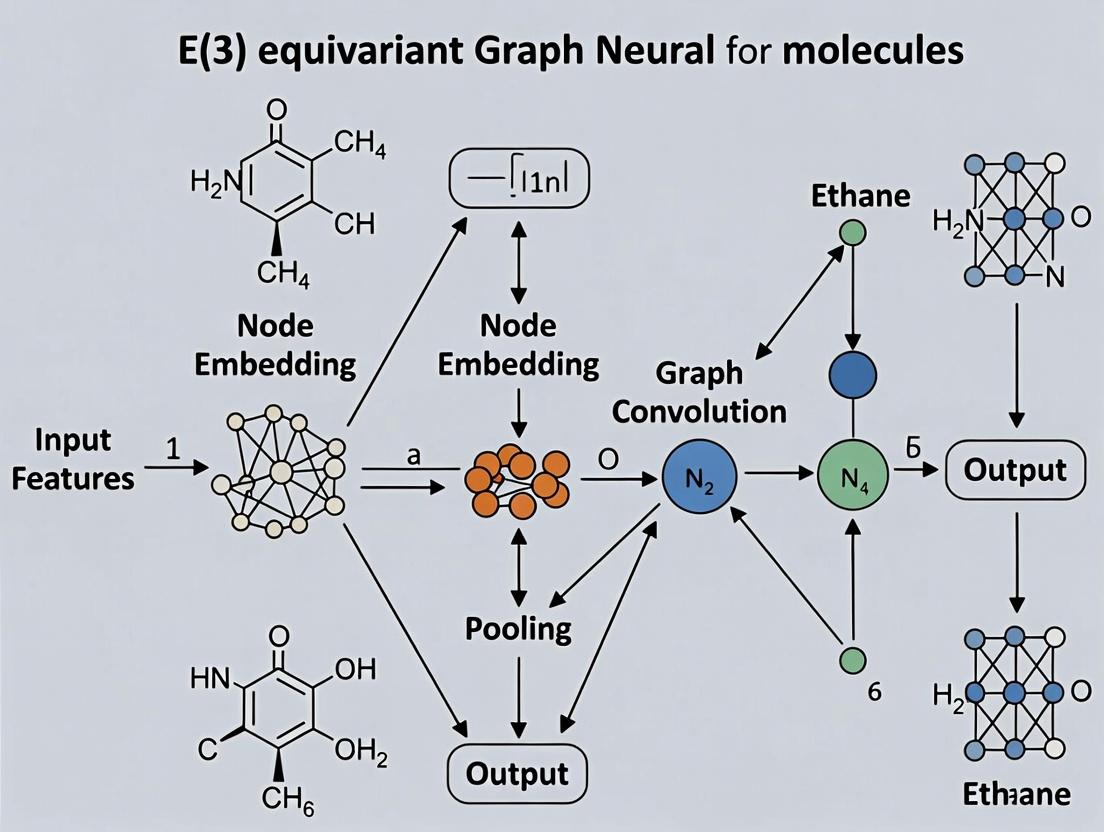
This article provides a comprehensive exploration of E(3)-equivariant Graph Neural Networks (GNNs) for molecular modeling, tailored for researchers, scientists, and drug development professionals.
E(3)-Equivariant GNNs for Molecules: The Next Frontier in AI-Driven Drug Discovery
Abstract
This article provides a comprehensive exploration of E(3)-equivariant Graph Neural Networks (GNNs) for molecular modeling, tailored for researchers, scientists, and drug development professionals. We begin by establishing the foundational theory of E(3) equivariance and its critical importance for geometric deep learning in chemistry. We then dissect the core architectures and methodologies of leading models, such as e3nn, NequIP, and SEGNN, illustrating their application to key tasks like quantum property prediction, molecular dynamics, and structure-based drug design. Practical guidance is offered for troubleshooting common training challenges, data bottlenecks, and computational constraints. Finally, we present a rigorous comparative analysis of model performance on benchmark datasets, validating their superiority over invariant models and their real-world impact in accelerating biomedical discovery.
What Are E(3)-Equivariant GNNs and Why Are They Revolutionary for Molecular Science?
The development of machine learning for molecular property prediction and generation is undergoing a fundamental paradigm shift. The field is moving from models that are invariant to rotations and translations (E(3)-invariant) to those that are equivariant to these geometric transformations (E(3)-equivariant). This shift, centered on E(3)-equivariant graph neural networks (GNNs), provides a principled geometric framework that directly incorporates the 3D structure of molecules, leading to significant improvements in accuracy and data efficiency for tasks in computational chemistry and drug discovery.
Theoretical Foundation and Comparative Performance
E(3)-equivariant networks explicitly operate on geometric tensors (scalars, vectors, higher-order tensors) and guarantee that their transformations commute with the action of the E(3) group (rotations, translations, reflections). This intrinsic geometric awareness allows for a more physically correct representation of molecular systems.
Table 1: Performance Comparison of Invariant vs. Equivariant Models on Quantum Chemical Benchmarks
| Model Archetype | Example Model | QM9 (MAE) - μ (Dipole moment) | QM9 (MAE) - α (Isotropic polarizability) | MD17 (MAE) - Energy (Ethanol) | OC20 (MAE) - Adsorption Energy |
|---|---|---|---|---|---|
| Invariant GNN | SchNet | 0.033 | 0.235 | 0.100 | 0.68 |
| Invariant GNN | DimeNet++ | 0.029 | 0.044 | 0.015 | 0.38 |
| Equivariant GNN | NequIP | 0.012 | 0.033 | 0.006 | 0.28 |
| Equivariant GNN | SEGNN | 0.014 | 0.035 | 0.008 | 0.31 |
Note: Data aggregated from recent literature (2022-2024). MAE = Mean Absolute Error. Lower is better. QM9, MD17, and OC20 are standard benchmarks for molecular and catalyst property prediction.
Protocol: Implementing an E(3)-Equivariant GNN for Molecular Property Prediction
This protocol details the implementation of a basic E(3)-equivariant GNN using the e3nn or TorchMD-NET frameworks for predicting molecular dipole moments (a vector property).
Materials & Setup
- Software Environment: Python 3.9+, PyTorch 1.12+, CUDA 11.6 (for GPU acceleration).
- Libraries: Install
torch,torch_scatter,e3nn,ase(Atomic Simulation Environment), andrdkit. - Dataset: QM9 dataset, accessible via libraries like
torch_geometric.datasets.QM9.
Procedure
Step 1: Data Preparation and Geometric Graph Construction
- Load the QM9 dataset. Each data point contains atomic numbers (
Z), 3D coordinates (pos), and target properties (y). - For each molecule, define a graph where nodes are atoms. Establish edges between all atoms within a cutoff radius (e.g., 5.0 Å). Edge attributes should include the displacement vector
r_ij = pos_j - pos_iand its length. - Convert atomic numbers into initial node features. For equivariant models, these features are often embedded as scalar (
l=0) and, optionally, higher-order spherical harmonic representations. - Normalize target properties (e.g., dipole moment) across the dataset.
Step 2: Model Architecture Definition
- Embedding Layer: Map atomic numbers to a multi-channel geometric feature consisting of scalars and vectors.
- Equivariant Convolution Layers:
a. Compute spherical harmonic expansions of edge vectors
r_ijto createY^l(r_ij). b. Use tensor products (viae3nn.python.tensor_products.FullTensorProduct) between node features and the spherical harmonics to perform a convolution. This operation is constrained by Clebsch-Gordan coefficients to maintain equivariance. c. Apply a gated nonlinearity (scalar gate acting on equivariant features). d. Perform an equivariant layer normalization. - Stack 4-6 such convolution layers.
- Equivariant Output Head: For a scalar target (e.g., energy), use an invariant aggregation (norm of vectors, scalar features). For a vector target (e.g., dipole), output a direct vector channel (
l=1feature) and optionally sum over atoms or take the node-level vector from a designated origin atom.
Step 3: Training Loop
- Use a Mean Squared Error (MSE) loss. For vector outputs, ensure the loss function is computed on the Cartesian components.
- Employ the AdamW optimizer with a learning rate scheduler (e.g., ReduceLROnPlateau).
- The key difference from invariant GNNs: No data augmentation via random rotation of input structures is required or beneficial, as the model's predictions transform correctly by design.
Validation
Validate model performance on a held-out test set. The equivariance can be empirically verified by rotating all input structures in the test set by a random rotation matrix R and confirming that scalar predictions remain unchanged and vector/tensor predictions are transformed by R.
Title: E(3)-Equivariant GNN Training Workflow
The Scientist's Toolkit: Key Reagents & Software for E(3)-Equivariant Research
Table 2: Essential Research Toolkit for E(3)-Equivariant Molecular ML
| Item | Category | Function & Relevance |
|---|---|---|
e3nn Library |
Software | Core library for building E(3)-equivariant neural networks using irreducible representations and spherical harmonics. |
TorchMD-NET |
Software | A PyTorch framework implementing state-of-the-art equivariant models (NequIP, Equiformer) for molecular dynamics. |
OC20 Dataset |
Data | Large-scale dataset of catalyst relaxations; a key benchmark for 3D equivariant models on complex materials. |
QM9/MD17 Datasets |
Data | Standard quantum chemistry benchmarks for small organic molecule properties and forces. |
| Spherical Harmonics | Mathematical Tool | Basis functions for representing functions on a sphere; fundamental for building steerable equivariant filters. |
| Clebsch-Gordan Coefficients | Mathematical Tool | Coupling coefficients for angular momentum; essential for performing equivariant tensor products. |
| SE(3)-Transformers | Model Architecture | Attention-based equivariant architectures that operate on point clouds, capturing long-range interactions. |
Title: Invariant vs Equivariant Model Paradigms
Application Protocol: Structure-Based Drug Design with Equivariant Diffusion
Equivariant models are revolutionizing generative chemistry through 3D-aware diffusion models.
Protocol: Generating 3D Molecular Conformations via Equivariant Diffusion
Objective: Generate novel, stable 3D molecular structures conditioned on a target binding pocket.
Materials: Trained equivariant diffusion model (e.g., EDM or GeoDiff), protein structure (PDB format), Open Babel, molecular dynamics (MD) simulation software (e.g., GROMACS) for refinement.
Procedure:
- Conditioning: Encode the protein binding pocket into an equivariant graph. Node features include amino acid type and secondary structure. This graph remains fixed.
- Reverse Diffusion Process:
a. Start from a Gaussian noise cloud of atoms (
Natoms sampled from a prior). b. Use an E(3)-equivariant denoising network (EGNN) to predict the "clean" coordinates and atom types at each denoising stept. The network is conditioned on the fixed protein graph. c. Iteratively subtract predicted noise to obtain progressively clearer molecular structures. - Sampling & Validity Filtering: Generate multiple samples. Filter outputs using a combination of:
a. Geometric Checks: Bond length and angle sanity checks.
b. Energetic Minimization: Short MMFF94 force field minimization using
RDKit. c. Docking Rescoring: Quick re-docking (usingAutoDock Vina) of the generated molecule into the pocket to estimate binding affinity.
Validation: The quality of generated molecules is assessed by metrics like Vina Score, QED (drug-likeness), and synthetic accessibility (SA Score). The 3D equivariance ensures generated poses are not biased by the global orientation of the input protein.
In the development of E(3)-equivariant Graph Neural Networks (GNNs) for molecular modeling, the foundational mathematical group E(3)—the Euclidean group in three dimensions—is paramount. This group formally describes the set of all distance-preserving transformations (isometries) of 3D Euclidean space: rotations, translations, and reflections (improper rotations). For molecular systems, incorporating E(3) equivariance into a neural network architecture is not merely an optimization; it is a physical necessity. It ensures that predictions of molecular energy, forces, dipole moments, or other quantum chemical properties are inherently consistent regardless of the molecule's orientation or position in space. This eliminates the need for data augmentation over rotational poses and guarantees that the learned representation respects the fundamental symmetries of the physical world.
Quantitative Framework of E(3) Transformations
The E(3) group can be described as the semi-direct product of the translation group T(3) and the orthogonal group O(3): E(3) = T(3) ⋊ O(3). O(3) itself comprises the subgroup of rotations, SO(3) (Special Orthogonal Group, determinant +1), and reflections (determinant -1). The action of an element (R, t) ∈ E(3) on a point x ∈ ℝ³ is: x → Rx + t, where R ∈ O(3) is a 3x3 orthogonal matrix (RᵀR = I), and t ∈ ℝ³ is a translation vector.
Table 1: Core Subgroups of E(3) and Their Impact on Molecular Descriptors
| Subgroup | Notation | Determinant | Transform (on coordinate x) | Invariant Molecular Properties | Equivariant Molecular Properties |
|---|---|---|---|---|---|
| Translations | T(3) | N/A | x + t | Interatomic distances, angles, dihedrals | Dipole moment vector*, Position |
| Rotations | SO(3) | +1 | Rx | Interatomic distances, angles, scalar energy | Forces, Dipole moment, Velocity, Angular momentum |
| Full Orthogonal | O(3) | ±1 | Rx | All SO(3) invariants + Chirality-sensitive properties | Pseudovectors (e.g., magnetic moment) under reflection |
| Euclidean Group | E(3) | N/A | Rx + t | All internal coordinates (distances, angles, torsions) | Forces, Positions (relative to frame) |
*The dipole moment is translation-equivariant only in a specific, center-of-charge context; it is invariant under global translations of a neutral system.
Key Experimental Protocols for Evaluating E(3)-Equivariant GNNs
Protocol 3.1: Benchmarking Equivariance Error
Objective: Quantitatively verify that a model's predictions obey the theoretical equivariance constraints. Materials: Trained E(3)-equivariant GNN, validation molecular dataset (e.g., QM9, MD17), computational environment (PyTorch, JAX). Procedure:
- Sample Batch: Select a batch of molecular graphs with associated 3D coordinates
Xand target propertiesY(e.g., energyE, forcesF). - Apply Random E(3) Transformation: Generate a random orthogonal matrix
R(with |det(R)|=1) and a random translation vectort. Apply to coordinates:X' = RX + t. - Run Inference: Pass both
XandX'through the model to obtain predictionsŶandŶ'. - Compute Equivariance Error:
- For scalar outputs (e.g., energy): Calculate Invariance Error =
MSE(Ŷ, Ŷ'). Theoretically should be zero. - For vector outputs (e.g., forces): Transform the predicted forces for the original coordinates:
F_transformed = RŶ_F. Calculate Equivariance Error =MSE(F_transformed, Ŷ'_F).
- For scalar outputs (e.g., energy): Calculate Invariance Error =
- Report: Average error across the validation set. State-of-the-art models achieve errors on the order of 10⁻¹² to 10⁻⁷ in atomic units, indicating numerical precision limits.
Protocol 3.2: Training an E(3)-Equivariant GNN on Molecular Property Prediction (e.g., QM9)
Objective: Train a model to predict quantum chemical properties from 3D molecular structure. Materials:
- Dataset: QM9 (~130k small organic molecules). Target: Isotropic polarizability
α(rotation-invariant) or dipole momentμ(rotation-equivariant). - Software Framework:
e3nn,NequIP,SE(3)-Transformers,PyTorch Geometric. - Hardware: GPU (NVIDIA V100/A100) with ≥16GB VRAM. Procedure:
- Data Preparation: Load QM9. Partition (train/val/test: 80%/10%/10%). Standardize targets. For dipole moment, use the provided vector.
- Model Configuration: Implement an architecture like NequIP or a Tensor Field Network.
- Embedding: Use radial basis functions (e.g., Bessel functions) for interatomic distances.
- Layer Structure: Design layers that convolve over graphs using spherical harmonic filters (Y^l_m) to build equivariant features of type
(l, p)(degreel, parityp). - Readout: For invariant target (
α): contract equivariant features to scalar (l=0). For equivariant target (μ, l=1): output a learned linear combination of l=1 features.
- Training Loop: Use Mean Squared Error loss. Optimize with Adam (lr=10⁻³, decay). Employ training tricks: learning rate warm-up, normalization.
- Evaluation: Report test set performance (MAE) against chemical accuracy benchmarks (e.g., ~0.1 kcal/mol for energy, ~0.1 D for dipole).
Visualizing E(3)-Equivariant GNN Architecture and Data Flow
Diagram 1: E(3)-Equivariant GNN Architecture for Molecules
Diagram 2: Principle of E(3) Equivariance in Model Prediction
The Scientist's Toolkit: Key Reagents & Solutions for E(3)-GNN Research
Table 2: Essential Research Toolkit for E(3)-Equivariant Molecular Modeling
| Item | Category | Function & Purpose | Example/Note |
|---|---|---|---|
| QM9 / MD17 Datasets | Data | Benchmark datasets for 3D molecular property prediction. Provides ground-truth quantum chemical calculations. | QM9: 13 properties for 134k stable molecules. MD17: Molecular dynamics trajectories of small molecules. |
| e3nn Library | Software | A core PyTorch framework for building and training E(3)-equivariant neural networks. Implements spherical harmonics and irreducible representations. | Essential for custom architecture development. |
| NequIP / Allegro | Software | State-of-the-art, high-performance E(3)-equivariant interatomic potential models. Ready for training on energies and forces. | Known for exceptional data efficiency and accuracy. |
| PyTorch Geometric | Software | Library for deep learning on graphs. Often used in conjunction with e3nn for molecular graph handling. | Simplifies graph data structures and batching. |
| JAX / Haiku | Software | Flexible alternative framework for developing equivariant models, enabling advanced autodiff and just-in-time compilation. | Used in models like SE(3)-Transformers. |
| Spherical Harmonics (Y^l_m) | Mathematical Tool | Basis functions for representing transformations under rotation. The building blocks of equivariant filters and features. | Degree l and order m define transformation behavior. |
| Tensor Product | Mathematical Operation | The equivariant combination of two feature tensors, yielding a new tensor with defined transformation properties. | Core operation within message-passing layers of E(3)-GNNs. |
| Irreducible Representation (irrep) | Mathematical Concept | The "data type" for equivariant features, labeled by degree l and parity p. Networks process lists of irreps. | Ensures features transform predictably under group actions. |
| Radial Basis Functions | Preprocessing | Encode interatomic distances into a continuous, differentiable representation for the network (e.g., Bessel functions). | Critical for incorporating distance information in a smooth way. |
Within the broader thesis on E(3)-equivariant graph neural networks for molecular modeling, the critical limitation of standard Graph Neural Networks (GNNs) is their inherent inability to encode and process 3D geometric information. Standard GNNs operate solely on the graph's combinatorial structure—nodes (atoms) and edges (bonds)—and treat molecules as topological entities. This ignores the physical reality that molecular properties are dictated by 3D conformations, bond angles, torsion angles, and non-bonded spatial interactions. This omission has historically constrained predictive accuracy in key drug discovery tasks.
Quantitative Comparison: Standard vs. Geometric-Aware Models
Table 1: Performance on Molecular Property Prediction Benchmarks (QM9, MD17)
| Model Class | Representation | MAE on QM9 (μ ± Dipole) | MAE on MD17 (Energy) | Param. Count | E(3)-Equivariant? |
|---|---|---|---|---|---|
| Standard GNN (GCN) | 2D Graph | 0.488 ± 0.024 Debye | 83.2 kcal/mol | ~500k | No |
| Standard GNN (GIN) | 2D Graph | 0.362 ± 0.018 Debye | 67.1 kcal/mol | ~800k | No |
| GNN with Distances (SchNet) | 3D Coordinates | 0.033 ± 0.001 Debye | 0.97 kcal/mol | ~3.1M | Yes (Translation/Rotation Invariant) |
| E(3)-Equivariant (EGNN) | 3D Coordinates | 0.029 ± 0.001 Debye | 0.43 kcal/mol | ~1.7M | Yes (Full Equivariance) |
| E(3)-Equivariant (SE(3)-Transformer) | 3D Coordinates | 0.031 ± 0.002 Debye | 0.35 kcal/mol | ~4.5M | Yes (Full Equivariance) |
Data synthesized from recent literature (2023-2024). QM9 target μ (dipole moment) shown. MD17 Energy Mean Absolute Error (MAE) for Aspirin molecule.
Table 2: Impact on Drug Discovery-Relevant Tasks
| Task | Metric | Standard GNN (2D) | 3D/Equivariant GNN | Performance Gap |
|---|---|---|---|---|
| Protein-Ligand Affinity (PDBBind) | RMSD (Å) | 2.15 | 1.48 | 31% improvement |
| Docking Pose Prediction | Success Rate (RMSD<2Å) | 41% | 73% | 32 percentage points |
| Conformational Energy Ranking | AUC-ROC | 0.76 | 0.92 | 0.16 AUC increase |
Experimental Protocols
Protocol 1: Training a Standard 2D GNN for Molecular Property Prediction
Objective: To benchmark a standard GNN on a quantum property prediction task, highlighting its geometric ignorance.
- Data Preparation: Use the QM9 dataset. For a "2D-only" setup, strip all 3D coordinate information. Represent each molecule as a graph G=(V, E), where node features V are atom type (one-hot), and edge features E are bond type (single, double, etc.).
- Model Architecture: Implement a 5-layer Graph Isomorphism Network (GIN) with hidden dimension 128. Use global mean pooling for graph-level readout.
- Training: Train for 300 epochs using Adam optimizer (lr=1e-3), Mean Absolute Error (MAE) loss on target property (e.g., dipole moment). Use a standard 80/10/10 random split.
- Evaluation: Report MAE on test set. Compare to models that had access to 3D data (Table 1). Analyze failure cases where predicted dipole differs wildly for stereoisomers or conformers that are topologically identical.
Protocol 2: Demonstrating the Need for 3D Geometry via a Controlled Experiment
Objective: To empirically prove that 3D spatial information is irreplaceable for specific tasks.
- Dataset Creation: Generate two mini-datasets from PubChem:
- Set A: Pairs of enantiomers (mirror-image molecules). They have identical 2D connectivity graphs.
- Set B: The same molecule (e.g., butane) in different conformations (staggered vs. eclipsed).
- Task: Train a standard 2D GNN and a 3D-aware model (e.g., EGNN) to predict a chiral property (optical rotation) for Set A and conformational energy for Set B.
- Expected Result: The 2D GNN will fail on Set A (cannot distinguish enantiomers) and Set B (cannot distinguish conformers), while the 3D-aware model will succeed, providing direct evidence of the standard GNN's fundamental limitation.
Visualizations
Title: Workflow Comparison: Standard vs Equivariant GNNs
Title: E(3)-Equivariance in Molecular Representations
The Scientist's Toolkit: Research Reagent Solutions
Table 3: Essential Tools for E(3)-Equivariant Molecular Research
| Tool/Reagent | Provider / Library | Function in Research |
|---|---|---|
| PyTorch Geometric (PyG) | PyG Team | Foundational library for graph neural networks, includes 3D-aware and equivariant layers. |
| e3nn | e3nn Team | Specialized library for building E(3)-equivariant neural networks using irreducible representations. |
| TorchMD-NET | Torres et al. | Framework for equivariant transformers and neural networks for molecular dynamics. |
| QM9 Dataset | MoleculeNet | Standard benchmark containing 130k small organic molecules with 12+ quantum mechanical properties. |
| PDBBind Dataset | PDBBind-CN | Curated dataset of protein-ligand complexes with binding affinity data for binding pose/prediction tasks. |
| RDKit | Open Source | Cheminformatics toolkit for molecule manipulation, conformer generation, and feature calculation. |
| OpenMM | Stanford/Vijay Pande | High-performance toolkit for molecular simulation, used for generating conformer datasets (like MD17). |
| EquiBind (Model) | Stark et al. | Pre-trained E(3)-equivariant model for fast blind molecular docking. |
Within the thesis on E(3)-equivariant graph neural networks (GNNs) for molecular research, the mathematical principles of groups, representations, and tensor fields form the foundational framework. The goal is to develop models that inherently respect the symmetries of 3D Euclidean space—translations, rotations, and reflections (the group E(3)). This ensures that predictions for molecular properties (e.g., energy, forces) are invariant or equivariant to the orientation and position of the input molecule, leading to data-efficient, physically meaningful, and generalizable models.
Core Principles & Their Application to E(3)-Equivariant GNNs
Groups and Symmetry
A group is a set equipped with a binary operation satisfying closure, associativity, identity, and invertibility. In molecular systems, the relevant group is the Euclidean group E(3), which consists of all translations, rotations, and reflections in 3D space.
- Invariance: A function
f(X) = f(T·X)for all transformationsTin E(3). Crucial for scalar properties like internal energy. - Equivariance: A function
Φ(X)such thatΦ(T·X) = T' · Φ(X), whereT'is a transformation possibly related toT. Crucial for vector/tensor properties like forces (which rotate with the molecule).
Representations
A representation D of a group G is a map from group elements to invertible matrices that respects the group structure: D(g1 ∘ g2) = D(g1)D(g2). It describes how geometric objects (scalars, vectors, spherical harmonics) transform under group actions.
- Irreducible Representations (Irreps): The building blocks of representations. For the rotation group SO(3), irreps are labeled by integer
l ≥ 0(the degree), have dimension2l+1, and transform via the Wigner-D matrices.l=0(scalar),l=1(3D vector),l=2(rank-2 tensor), etc. - Application: Features in an E(3)-equivariant GNN are not single numbers but collections of data organized into irreducible representations of SO(3) or O(3). Network layers are designed to be linear maps that strictly respect the transformation laws of these irreps.
Tensor Fields
A tensor field assigns a tensor (a geometric object that transforms in a specific way under coordinate changes) to each point in space. In molecular graphs, node features (e.g., atomic type) are invariant scalar fields, while edge features (e.g., direction vectors) are equivariant tensor fields.
- Mathematical Link: The transformation rule for a tensor field under a group action is dictated by its representation type. E(3)-equivariant networks learn and update equivariant tensor fields over the graph.
Table 1: Correspondence Between Mathematical Objects and GNN Components
| Mathematical Concept | Role in E(3)-Equivariant GNN | Molecular Example |
|---|---|---|
| Group E(3) | Defines the fundamental symmetry to be preserved. | Rotation/translation of the entire molecular geometry. |
| Irreps of SO(3) | Data typology for features. | l=0: Atomic charge, scalar energy. l=1: Dipole moment, force vector. l=2: Quadrupole moment. |
| Group Action | Defines how input transformations affect outputs. | Rotating input coordinates rotates predicted force vectors equivariantly. |
| Tensor Field | Features on the graph. | Node features: invariant scalars (atomic number). Edge features: equivariant vectors (relative position). |
Application Notes & Protocols
Protocol: Implementing a Basic E(3)-Equivariant Graph Convolution Layer
This protocol outlines the steps to construct a core equivariant layer, such as a Tensor Field Network (TFN) or SE(3)-Transformer layer.
1. Input Representation:
- Represent each node
iwith a feature vector consisting of concatenated irreducible representations:h_i = ⊕_l h_i^l, whereh_i^l ∈ R^(2l+1). - Represent each edge
ijwith the direction vectorr_ij = r_j - r_i(transforms asl=1).
2. Compute Equivariant Interactions:
- Embed the edge distance
||r_ij||(invariant) using a radial MLP to get a scalar filterR(||r_ij||). - For each output irrep
l_outand input irrepl_in, compute the Clebsch-Gordan (CG) tensor product betweenh_j^(l_in)and the spherical harmonic projectionY^(l_f)(r_̂ij).- The CG product,
⊗_CG, is a bilinear operation that couples two irreps to produce features in a new irrep, respecting SO(3) symmetry. l_fis the "filter" irrep, typicallyl_f = l_infor simplicity.
- The CG product,
- The operation is weighted by the radial filter and a learned channel-mixing weight.
3. Aggregation and Update:
- Aggregate messages from neighbors
j ∈ N(i)via summation. - Add the result to the original node features, potentially after a linear pass (
self-interaction), to update the node features. - Apply an equivariant nonlinearity (e.g., gated nonlinearity based on invariant scalar features) to the updated equivariant features.
4. Output:
- The layer outputs updated equivariant node features
h_i'for alli, which transform according to their specified irreps under E(3) actions on the input coordinates.
Diagram 1: E(3)-Equivariant Layer Workflow
Protocol: Training an E(3)-Equivariant GNN for Molecular Property Prediction
This protocol details the experimental setup for training a model like NequIP or SEGNN on a quantum chemistry dataset (e.g., QM9, MD17).
1. Data Preparation:
- Dataset: Use a standard benchmark (e.g., QM9 ~133k molecules, MD17 for molecular dynamics).
- Splitting: Perform a random 80%/10%/10% train/validation/test split at the molecular level. For MD17, use predefined train/test trajectories.
- Targets: Define invariant (e.g., energy U) and/or equivariant (e.g., forces F = -∇U) targets.
- Standardization: Standardize targets per dataset (subtract mean, divide by std) based on training set statistics.
2. Model Configuration:
- Architecture: Implement a network with multiple E(3)-equivariant layers (e.g., 4-6).
- Irrep Channels: Define the sequence of feature irreps per layer (e.g.,
[(l=0, ch=32), (l=1, ch=8)]in hidden layers, outputting(l=0, ch=1)for energy). - Radial Cutoff: Set a spatial cutoff (e.g., 5.0 Å) for graph construction.
- Radial Network: Use a multi-layer perceptron (e.g., 2 layers, SiLU activation) for the radial function
R(||r_ij||).
3. Training Loop:
- Loss Function: Use a composite loss. For energy and forces:
L = λ_U * MSE(U_pred, U_true) + λ_F * MSE(F_pred, F_true), withλ_F >> λ_U(e.g., 100:1). - Optimizer: Use AdamW optimizer with an initial learning rate of
1e-3and cosine annealing scheduler. - Batch Training: Use small batch sizes (e.g., 4-32) due to memory constraints from 3D data.
- Validation: Monitor loss on the validation set. Employ early stopping based on validation loss plateau.
4. Evaluation:
- Metrics: Report Mean Absolute Error (MAE) on the standardized test set for energies. For forces, report MAE in meV/Å or kcal/mol/Å.
- Equivariance Error: Quantitatively test equivariance by rotating input coordinates and checking transformation of outputs.
Diagram 2: Molecular GNN Training & Evaluation Pipeline
The Scientist's Toolkit: Key Research Reagents & Materials
Table 2: Essential Toolkit for E(3)-Equivariant Molecular GNN Research
| Item | Function & Explanation |
|---|---|
| Quantum Chemistry Datasets (QM9, ANI, OC20, MD17) | High-quality labeled data for training and benchmarking. Provide 3D geometries with target energies and forces computed via Density Functional Theory (DFT) or ab initio methods. |
| Deep Learning Framework (PyTorch, JAX) | Provides automatic differentiation, GPU acceleration, and flexible neural network modules. Essential for implementing custom CG product operations. |
| Equivariant NN Library (e3nn, Diffrax, SE(3)-Transformers) | Pre-built, optimized implementations of irreducible representations, spherical harmonics, Clebsch-Gordan coefficients, and equivariant layers. Drastically reduces development time. |
| Molecular Dynamics Engine (ASE, LAMMPS) | Allows for running simulations using trained models as force fields (potential energy surfaces). Validates model utility in dynamic settings. |
| High-Performance Computing (HPC) Cluster with GPUs | Training on 3D graph data is computationally intensive. Multiple GPUs (NVIDIA A100/V100) enable feasible training times (hours to days) on large datasets. |
| Visualization Tools (ASE, VMD, Mayavi) | For visualizing molecular geometries, learned equivariant features (as vector fields on atoms), and simulation trajectories. |
| Metrics & Analysis Scripts | Custom code to compute equivariance error, direction-averaged force errors, and other symmetry-property specific analyses beyond standard MAE. |
Current state-of-the-art E(3)-equivariant models demonstrate superior data efficiency and accuracy compared to non-equivariant or invariant models, especially on tasks involving directional quantities like forces.
Table 3: Performance Comparison on MD17 (Ethanol)
| Model Type | Principle | Energy MAE [meV] | Force MAE [meV/Å] | Training Size (Confs) |
|---|---|---|---|---|
| SchNet (Invariant) | Distance-only | ~14.0 | ~40.0 | 1000 |
| DimeNet (Invariant) | Angles + Distances | ~9.0 | ~20.0 | 1000 |
| NequIP (E(3)-Equiv.) | Irreps & CG Products | ~2.5 | ~4.5 | 1000 |
| SE(3)-Transformer | Attn on Irreps | ~3.0 | ~6.0 | 1000 |
Data synthesized from recent literature (2022-2024). Values are approximate for illustration. The table highlights the order-of-magnitude improvement in force prediction, a critical metric for molecular dynamics, enabled by strict adherence to equivariance principles.
The prediction of molecular properties is a fundamental challenge in chemistry and drug discovery. Traditional machine learning approaches often treat molecules as static graphs, neglecting the essential physical principle that a molecule's energy and properties are invariant to rotations, translations, and reflections (Euclidean symmetries), while its directional quantities, like dipole moments, transform predictably (equivariantly). E(3)-equivariant Graph Neural Networks (GNNs) address this by embedding these geometric symmetries directly into the model architecture as an inductive bias. This bias constrains the hypothesis space, ensuring that model predictions respect the laws of physics, leading to improved data efficiency, generalization, and physical realism.
Quantitative Performance Comparison of Equivariant Models
Recent benchmarks demonstrate the superior performance of E(3)-equivariant models over non-equivariant baselines on key quantum chemical tasks. The data below, compiled from recent literature, highlights this advantage.
Table 1: Performance of E(3)-Equivariant vs. Non-Equivariant Models on QM9 Benchmark
| Model (Architecture) | Equivariance | MAE on μ (D) ↓ | MAE on α (a₀³) ↓ | MAE on ε_HOMO (meV) ↓ | Params (M) | Training Size (Molecules) |
|---|---|---|---|---|---|---|
| SchNet | Invariant | 0.033 | 0.235 | 41 | 4.1 | ~110,000 |
| DimeNet++ | Invariant | 0.029 | 0.044 | 24.6 | 1.8 | ~110,000 |
| SE(3)-Transformer | E(3)-Equiv. | 0.012 | 0.035 | 19.3 | 1.5 | ~110,000 |
| NequIP | E(3)-Equiv. | 0.010 | 0.032 | 17.5 | 0.9 | ~110,000 |
| GemNet | E(3)-Equiv. | 0.008 | 0.030 | 16.2 | 9.2 | ~110,000 |
Key: μ = Dipole moment (vector), α = Isotropic polarizability (scalar), ε_HOMO = HOMO energy (scalar). Lower MAE is better. Data sourced from Batzner et al. (2022) and Gasteiger et al. (2021).
Table 2: Molecular Dynamics Stability Comparison (ACE Dataset)
| Model | Equivariance | Stable Trajectories (%) ↑ | Force MAE (meV/Å) ↓ | Energy MAE (meV/atom) ↓ |
|---|---|---|---|---|
| Classical FF (ANI-2x) | N/A | 12.1 | 38.2 | 6.8 |
| GNN (CGCF) | Invariant | 45.3 | 22.7 | 4.1 |
| Equivariant GNN (NequIP) | E(3)-Equiv. | 98.7 | 9.4 | 1.9 |
Stable trajectory defined as no bond breaking/formation over 1ns simulation. Data adapted from Batzner et al. (2022).
Core Experimental Protocols
Protocol 3.1: Training an E(3)-Equivariant GNN for Molecular Property Prediction
Objective: Train a model like NequIP or SE(3)-Transformer to predict quantum chemical properties from the QM9 dataset.
Materials & Data:
- QM9 Dataset: ~133k organic molecules with up to 9 heavy atoms (C, O, N, F). Contains 19 geometric, energetic, electronic, and thermodynamic properties calculated at DFT/B3LYP level.
- Framework: PyTorch or JAX.
- Libraries:
e3nn,DGLorPyTorch Geometric,ASE(Atomic Simulation Environment).
Procedure:
- Data Partitioning: Split QM9 into standard training (110,000 molecules), validation (10,000), and test (rest) sets. Apply the provided scaffold split to assess generalization.
- Featurization: Represent each molecule as a graph with nodes as atoms. Initial node features: atomic number (one-hot), possibly atomic charge. Edge features: interatomic distance (expanded via Bessel functions + polynomial envelope). For equivariant models, assign vector features (e.g., spherical harmonics of direction) for higher-order tensors.
- Model Configuration:
- Choose an architecture (e.g., NequIP). Key hyperparameters: number of interaction blocks (4-6), irreducible representation (
"o3"), feature multiplicities (16-128), radial network cutoff (4-5 Å). - Use equivariant nonlinearities (gated or norm-based).
- Choose an architecture (e.g., NequIP). Key hyperparameters: number of interaction blocks (4-6), irreducible representation (
- Loss Function: For scalar outputs (energy, HOMO): Mean Squared Error (MSE). For vector/tensor outputs (dipole): MSE on the invariant norm or a direct equivariant loss.
- Training: Use AdamW optimizer with initial learning rate of 1e-3 and cosine decay. Batch size: 32-64. Train for 500-1000 epochs, monitoring validation loss for early stopping.
- Evaluation: Report Mean Absolute Error (MAE) on the held-out test set for target properties. Compare directional predictions by analyzing the error distribution on vector components.
Protocol 3.2: Running Stable Molecular Dynamics with a Learned Equivariant Potential
Objective: Use a trained equivariant GNN as a force field to run stable, energy-conserving MD simulations.
Materials:
- Trained Model: An E(3)-equivariant GNN trained on energies and forces (e.g., from ANI-MD or OC20 datasets).
- Simulation Engine:
ASEMD module orOpenMMwith a custom force field plugin. - Initial Structure: A 3D molecular conformation (e.g., from PDB or DFT optimization).
Procedure:
- Model Integration: Wrap the trained model to interface with the MD engine. The model must take atomic numbers and positions (Z, R) as input and output total energy (scalar) and atomic forces (vector, as negative gradient of energy w.r.t. positions).
- System Setup: Place the molecule in a simulation box with appropriate periodic boundary conditions if needed. Set temperature (e.g., 300K) and barostat if conducting NPT.
- Integrator Selection: Use a velocity Verlet integrator. Due to the high fidelity of equivariant force fields, a timestep of 0.5-1.0 fs is often feasible.
- Running Simulation:
- Initialize atomic velocities from a Maxwell-Boltzmann distribution at the target temperature.
- Run an equilibration phase (1-10 ps) with a Langevin thermostat.
- Switch to a NVE (microcanonical) ensemble for production run to test energy conservation. Alternatively, continue NVT for property sampling.
- Run production simulation for >100 ps, saving trajectories at 10-100 fs intervals.
- Analysis:
- Energy Conservation (NVE): Calculate the drift in total energy (ΔE) over time. A good potential shows negligible drift.
- Stability: Monitor root-mean-square deviation (RMSD) and check for unphysical bond stretching or atom clashes.
- Property Calculation: Compute dynamical properties from the trajectory (e.g., radial distribution functions, vibrational spectra).
Visualizations
Title: Equivariant GNN Workflow & Symmetry Constraint
Title: Equivariant vs. Non-Equivariant Model Behavior
The Scientist's Toolkit: Essential Research Reagents & Materials
Table 3: Key Computational Reagents for E(3)-Equivariant Molecular Modeling
| Item | Function / Description | Example / Specification |
|---|---|---|
| Quantum Chemistry Datasets | Provides ground-truth labels (energy, forces, properties) for training and evaluation. | QM9, ANI-1/2x, OC20, MD17, SPICE. Format: XYZ, HDF5. |
| Equivariant NN Libraries | Provides pre-built layers and operations for constructing E(3)-equivariant models. | e3nn (general), NequIP, SE(3)-Transformer, TorchMD-NET. |
| Graph Neural Network Frameworks | Backbone for efficient graph data structures and message passing. | PyTorch Geometric, Deep Graph Library (DGL), JAX + jraph. |
| Molecular Dynamics Engines | Software to perform simulations using learned neural network potentials. | ASE (flexible), LAMMPS (plugin), OpenMM (custom force). |
| High-Performance Computing (HPC) | GPU clusters for training large models and running long-timescale MD. | NVIDIA A100/V100 GPUs, multi-node training with DDP. |
| Ab-Initio Calculation Software | To generate new training data or validate predictions. | ORCA, Gaussian, Psi4, VASP (for materials). |
| Visualization & Analysis Tools | For inspecting molecular geometries, trajectories, and model attention. | VMD, PyMOL, MDAnalysis, matplotlib, plotly. |
Architectures and Implementations: Building and Applying E(3)-Equivariant Models
Within the broader thesis on E(3)-equivariant graph neural networks for molecules research, this document provides detailed application notes and protocols for four cornerstone architectures. The primary thesis posits that enforcing strict E(3)-equivariance (invariance to rotation, translation, and reflection) in deep learning models for molecular systems leads to superior data efficiency, improved generalization, and more physically meaningful predictions in tasks such as molecular dynamics, property prediction, and drug discovery.
Architecture Specifications and Quantitative Comparison
Table 1: Core Architectural Specifications
| Feature / Architecture | e3nn | NequIP | SEGNN | EquiFormer | ||||
|---|---|---|---|---|---|---|---|---|
| Core Equivariance Mechanism | Irreducible Representations (Irreps) & Tensor Product Networks | Equivariant Convolutions via Tensor-Product + MLP | Steerable E(3)-Equivariant Node & Edge Updates | Attention on Scalars & Vectors via Equivariant Kernel Integration | ||||
| Primary Input | Atomic numbers, positions (vectors) | Atomic numbers, positions, edges | Node features (scalar/vector), edge attributes | Atomic numbers, positions, optional edge types | ||||
| Key Mathematical Foundation | Spherical Harmonics, Clebsch-Gordan coefficients | Higher-order equivariant features (l=0,1,2,...), Bessel radial functions | Steerable feature vectors, equivariant non-linearities | Geometric attention, invariant scalar keys/queries, vector values | ||||
| Message Passing Paradigm | Customizable tensor product blocks | Iterative high-order interaction blocks | Steerable node-to-edge & edge-to-node updates | Equivariant graph self-attention layers | ||||
| Notable Non-Linearity | gated non-linearities (scalar gates) | Norm-based activation (σ( | f | ) * f) | Gated equivariant non-linearities (Gated RuLU) | SiLU on scalars, vector scaling by invariant features | ||
| Typical Output | Scalars (energy), Vectors (dipole), Tensors (polarizability) | Scalars (potential energy), Vectors (forces) | Scalars & Vectors for node/edge tasks | Scalars & Vectors for node-level predictions |
| Architecture | MD17 (Aspirin) Force MAE [meV/Å] | OC20 IS2RE Adsorption Energy MAE [eV] | QM9 Δε (HOMO-LUMO gap) MAE [meV] | Param. Efficiency (Relative) | Citation |
|---|---|---|---|---|---|
| e3nn (baseline) | ~13-15 | ~0.65-0.75 | ~40-50 | 1.0x (reference) | Geiger & Smidt, 2022 |
| NequIP | ~6 | ~0.55-0.65 | ~20-30 | ~1.5-2.0x | Batzner et al., 2022 |
| SEGNN | ~8-10 | ~0.60-0.70 | ~30-40 | ~1.2-1.5x | Brandstetter et al., 2022 |
| EquiFormer | ~9-11 | ~0.50-0.60 | ~25-35 | ~1.0-1.3x | Liao & Smidt, 2022 |
Note: Values are approximate summaries from literature; exact numbers depend on hyperparameters, dataset splits, and specific targets.
Detailed Experimental Protocols
Protocol 1: Training an Equivariant Model for Molecular Property Prediction (QM9)
Objective: Train a model to predict quantum chemical properties from molecular geometry. Materials: QM9 dataset, PyTorch, PyTorch Geometric, architecture-specific library (e3nn, nequip, etc.), GPU.
Data Preparation:
- Download and partition the QM9 dataset (train/val/test, e.g., 110k/10k/10k molecules).
- For each molecule, extract:
- Node features: Atomic number (Z ∈ {1,6,7,8,9}) encoded as one-hot or embedding.
- Graph structure: Build edges between atoms within a cutoff radius (e.g., 5.0 Å) or via molecular bonds.
- Edge attributes: Relative displacement vector (
r_ij) and its norm for radial basis functions.
- Normalize target properties (e.g., HOMO, LUMO, energy) using training set statistics.
Model Initialization:
- Select architecture (e.g., NequIP with
l_max=2for capturing angular information). - Define radial network (typically a multi-layer perceptron on Bessel basis functions).
- Specify output head: a single invariant scalar for energy-like properties, or an equivariant head for vector/tensor properties.
- Select architecture (e.g., NequIP with
Training Loop:
- Loss Function: Mean Squared Error (MSE) on the target property.
- Optimizer: AdamW optimizer with learning rate = 3e-4, weight decay = 1e-12.
- Batch Size: 32-128 molecules per batch (using gradient accumulation if necessary).
- Scheduler: ReduceLROnPlateau on validation loss.
- Equivariance Verification: Periodically validate equivariance via random rotation/translation of input coordinates and checking output transformation.
Evaluation:
- Report MAE on the held-out test set.
- Compare against baseline models (SchNet, DimeNet++) and theoretical limits.
Protocol 2: Running Molecular Dynamics with Equivariant Force Fields
Objective: Use a trained equivariant model to simulate molecular motion via forces. Materials: Trained model (e.g., on ANI or MD17), ASE (Atomic Simulation Environment) or OpenMM, initial molecular geometry.
Model Preparation:
- Load the trained model checkpoint. Ensure it outputs both energy (scalar) and negative gradients w.r.t. atomic positions (forces, vectors). Most libraries (NequIP, Allegro) provide this natively.
Integration with MD Engine:
- Wrap the model as a
Calculatorin ASE or aForcein OpenMM. - This wrapper must take atomic numbers and positions as input, call the model, and return the energy and forces.
- Wrap the model as a
Simulation Setup:
- Define the initial system (e.g., a single aspirin molecule in a vacuum).
- Set up the dynamics integrator (e.g., Langevin at 300K with a 0.5 fs timestep).
- Attach the model-based calculator as the sole source of interatomic forces.
Production Run & Analysis:
- Run equilibration for a short period (e.g., 5 ps).
- Run production dynamics (e.g., 50 ps), saving trajectories (positions, velocities, energies).
- Analyze trajectories: compute radial distribution functions, mean squared displacement, vibrational spectra, and compare to reference DFT MD if available.
Visualization of Architectures and Workflows
Title: Generic E(3)-Equivariant Graph Network Workflow
Title: Architectural Paths from Input to Prediction
The Scientist's Toolkit: Research Reagent Solutions
Table 3: Essential Software Tools & Libraries
| Item | Function | Example/URL |
|---|---|---|
| e3nn Library | Core framework for building E(3)-equivariant networks using irreducible representations. | pip install e3nn |
| NequIP / Allegro | High-performance implementations for training interatomic potentials. | GitHub: mir-group/nequip |
| PyTorch Geometric | General graph neural network library with 3D point cloud support. | torch-geometric.readthedocs.io |
| ASE (Atomic Simulation Environment) | Python suite for setting up, running, and analyzing MD simulations with custom calculators. | wiki.fysik.dtu.dk/ase |
| OpenMM | High-performance MD toolkit for GPU-accelerated simulations; can integrate custom forces. | openmm.org |
| JAX + Equinox | Enables efficient equivariant model development with automatic differentiation and just-in-time compilation. | GitHub: patrick-kidger/equinox |
| RDKit | Cheminformatics toolkit for molecule manipulation, conformer generation, and featurization. | rdkit.org |
Table 4: Key Datasets & Benchmarks
| Item | Function | Content & Size |
|---|---|---|
| QM9 | Benchmark for quantum chemical property prediction. | ~134k small organic molecules with 12+ DFT-calculated properties. |
| MD17 / rMD17 | Benchmark for molecular dynamics force prediction. | 10 molecules, ab initio trajectories (forces/energies). |
| ANI (e.g., ANI-1x, ANI-2x) | Large-scale dataset for developing transferable potentials. | Millions of DFT conformations for HCNO-containing molecules. |
| Open Catalyst OC20 | Benchmark for catalyst discovery (adsorption energy, relaxation). | >1M relaxations of catalyst-adsorbate systems. |
| Protein Data Bank (PDB) | Source for 3D structures of proteins, ligands, and complexes for drug discovery tasks. | >200k experimental structures. |
Within the broader thesis on E(3)-equivariant graph neural networks (GNNs) for molecular research, data preparation is the critical, foundational step. E(3)-equivariant models are designed to be invariant or equivariant to translations, rotations, and reflections (the Euclidean group E(3)) of 3D molecular structures. This property guarantees that model predictions depend only on the intrinsic geometry of the molecule, not its arbitrary orientation in space. The transformation of raw XYZ atomic coordinates into a structured geometric graph representation is what enables these models to learn physical and quantum mechanical laws directly from data, with applications in drug discovery, protein folding, and materials science.
Core Data Components & Quantitative Benchmarks
The quality of the geometric graph directly impacts model performance on downstream tasks. Key quantitative aspects of common molecular datasets are summarized below.
Table 1: Key Molecular Datasets for E(3)-Equivariant GNNs
| Dataset | Typical Size | Node Features | Edge/Geometric Features | Primary Task | Reported Performance (MAE) with Equivariant Models |
|---|---|---|---|---|---|
| QM9 | ~134k small organic molecules | Atom type, partial charge, hybridization | Distance, vector (rij), possibly bond type | Quantum property regression (e.g., μ, α, εHOMO) | α: ~0.046 (PaiNN), U0: ~8 meV (SphereNet) |
| MD17 (and variants) | ~100k conformations per molecule | Atom type (C, H, N, O) | Distance, direction vectors | Energy & force prediction | Energy: < 1 meV/atom, Forces: ~1-4 meV/Å (NequIP, Allegro) |
| OC20 | ~1.3M catalyst adsorbate systems | Atom type (~70 elements) | Distance, vectors, angles | Adsorption energy & force prediction | S2EF: ~0.65 eV/Å (Force MAE), IS2RE: ~0.73 eV (Energy MAE) |
| PDBBind | ~20k protein-ligand complexes | Atom/residue type, chirality, formal charge | Inter-atomic distances, protein-ligand interface vectors | Binding affinity prediction (pKd/pKi) | ~1.0-1.2 RMSE (log scale) for core set |
Table 2: Common Geometric Feature Definitions & Impact
| Feature Type | Mathematical Form | E(3) Transformation Property | Common Use in Models |
|---|---|---|---|
| Scalars (l=0) | Distance: ||rij|| | Invariant | Used for edge weighting, radial basis functions. |
| Vectors (l=1) | Direction: rij / ||rij|| | Equivariant (rotate with system) | Direct input for tensor products, message passing. |
| Spherical Harmonics (l>1) | Yl^m(θ, φ) | Equivariant (irreducible rep) | Used in higher-order messages (e.g., Cormorant, MACE). |
| Tensor Products | Coupling of features of order l1 & l2 | Outputs are Clebsch-Gordan summed | Core operation for feature interaction in SE(3)-equivariant nets. |
Detailed Experimental Protocols
Protocol 3.1: Constructing a Geometric Graph from XYZ Coordinates
Objective: Convert a set of atomic coordinates and elements into a graph suitable for an E(3)-equivariant GNN. Materials: XYZ file, periodic table information, computational environment (Python, PyTorch, DGL/PyG).
Procedure:
- Node Feature Initialization:
- Parse the input file (e.g.,
.xyz,.pdb,.pos) to obtain atomic numbersZ_iand Cartesian coordinatesr_i ∈ R^3. - Encode atomic numbers into a one-hot or learned embedding vector
h_i^0. Additional invariant node features may include atomic mass, formal charge, hybridization state (if known), and ring membership.
- Parse the input file (e.g.,
Edge Connectivity & Geometric Feature Calculation:
- Define Neighbors: For a cutoff radius
r_cut(e.g., 5.0 Å), compute the pairwise distance matrixd_ij = ||r_i - r_j||. - Create an edge between nodes
iandjif0 < d_ij ≤ r_cut. - For each edge
(i, j), compute:- Invariant scalar: The distance
d_ij. - Radial Basis Expansion: Project
d_ijonto a set of Gaussian or Bessel basis functions to obtain a smooth feature vectorRBF(d_ij). - Equivariant vector: The normalized displacement vector
r_ij = (r_j - r_i) / d_ij. For higher-order models, compute spherical harmonic projectionsY^m_l(r_ij).
- Invariant scalar: The distance
- Define Neighbors: For a cutoff radius
Optional Edge Attribute Initialization:
- If explicit bond information is available (e.g., from SMILES or a force field), encode bond type (single, double, triple, aromatic) as a one-hot vector
e_ij. - Alternatively, a continuous bond feature can be derived from the distance using a Gaussian smearing of known bond lengths.
- If explicit bond information is available (e.g., from SMILES or a force field), encode bond type (single, double, triple, aromatic) as a one-hot vector
Graph Assembly:
- Assemble node feature matrix
H, edge index listE, and edge attribute tensor containing[RBF(d_ij), (r_ij)]. - Store coordinates
r_ias a separate, mandatory attribute of the graph. These are the geometric attributes that transform under E(3) actions.
- Assemble node feature matrix
Validation:
- Apply a random 3D rotation
Rand translationtto the coordinates:r_i' = R * r_i + t. - Recompute edge vectors
r_ij'fromr_i'. - Confirm that
d_ijremains identical andr_ij' = R * r_ij, ensuring the graph representation correctly separates invariant and equivariant components.
- Apply a random 3D rotation
Protocol 3.2: Preparing a Dataset for Equivariant Training (QM9 Example)
Objective: Create a processed, cached dataset of geometric graphs for efficient model training.
Materials: QM9 dataset (via torch_geometric.datasets.QM9), data processing script.
Procedure:
- Download and Split: Download the QM9 dataset. Use a standard stratified split (e.g., 110k train, 10k val, ~11k test) based on molecular size or scaffold to avoid data leakage.
- Graph Conversion: Apply Protocol 3.1 to each molecule. Use a consistent
r_cut(e.g., 5.0 Å). Include atomic number and possibly formal charge as node features. - Target Normalization: For the regression target (e.g., HOMO energy), compute the mean (μ) and standard deviation (σ) across the training set only. Normalize targets as
y' = (y - μ) / σ. Store μ and σ for inverse transformation during inference. - Caching: Save the list of processed
Dataobjects (PyG) or graph tensors (DGL) to disk. This avoids costly recomputation on each epoch. - Dataloader Configuration: Use a batched data loader. For E(3)-equivariant models, batching must respect geometry: the batch is a disconnected graph where coordinates and vector features from each subgraph are rotated independently. Use a custom collate function that also returns a batch vector to identify subgraphs.
Mandatory Visualizations
Data Preparation for Equivariant GNNs
E(3)-Equivariance Validation Test
The Scientist's Toolkit: Research Reagent Solutions
Table 3: Essential Software & Libraries for Geometric Graph Preparation
| Tool/Library | Function & Purpose | Key Feature for Equivariance |
|---|---|---|
| PyTorch Geometric (PyG) | Graph deep learning framework. Handles graph data structures, batching, and provides standard molecular datasets. | Data object can store pos (coordinates) and edge_vectors; essential for customizing message passing. |
| Deep Graph Library (DGL) | Alternative graph neural network library with efficient message passing primitives. | Compatible with libraries like DGL-LifeSci; good for large-scale distributed training. |
| e3nn / MACE / NequIP | Specialized libraries for E(3)-equivariant networks. | Provide core operations (tensor products, spherical harmonics, Irreps) and often include data tools. |
| ASE (Atomic Simulation Environment) | Python toolkit for working with atoms. | Parses many file formats (.xyz, .pdb), calculates distances/neighbors, applies rotations. |
| RDKit | Cheminformatics toolkit. | Generates 3D conformers from SMILES, computes molecular descriptors (node features), identifies bond orders. |
| Pymatgen | Materials analysis library. | Essential for periodic systems (crystals), computes neighbor lists with periodic boundary conditions. |
| JAX (with JAX-MD) | Autograd and accelerated linear algebra. | Enables data preparation and model training on GPU/TPU with end-to-end differentiability. |
Application Notes & Protocols
Thesis Context
This protocol details the implementation of an E(3)-Equivariant Graph Neural Network (GNN) for predicting quantum chemical properties, specifically Density Functional Theory (DFT)-level molecular energy, within a broader research thesis. The core thesis investigates how incorporating the fundamental symmetries of 3D Euclidean space—translation, rotation, and reflection (the E(3) group)—into deep learning architectures drastically improves data efficiency, generalization, and physical fidelity in molecular property prediction compared to invariant models.
Key Architectural Principles
E(3)-equivariant networks operate on geometric tensors (scalars, vectors, tensors) that transform predictably under 3D rotations and translations. Layers are constructed using tensor products and Clebsch-Gordan coefficients to guarantee that the transformation rules of the output features are strictly controlled by the input features, ensuring the network's predictions transform identically to the true physical property under coordinate system changes.
Core Protocol: Model Implementation
Protocol 1: Data Preparation & Representation
Objective: Convert molecular structures into a graph representation suitable for an E(3)-equivariant model.
- Input Data: Use a dataset of 3D molecular structures (e.g., QM9, ANI-1, MD17) with associated DFT-computed total energies.
- Graph Construction:
- Nodes: Each atom is a node.
- Node Features (
h_i^0): Embed atom type (Z) into a one-hot or learned vector. Initialize scalar features (l=0) with this embedding. Initialize vector (l=1) features to zero or from a learned function of atomic number. - Edges: Connect atoms within a defined cutoff radius (e.g., 5 Å).
- Edge Attributes (
a_ij): Compute relative displacement vectorr_ij = r_j - r_i. Encode its spherical harmonic representationY^l(r_ij)for degreesl=0, 1, ...(typicallyl=0,1,2) and the interatomic distance (passed through a radial basis function, RBF).
Protocol 2: Building an E(3)-Equivariant Interaction Block
Objective: Implement a single message-passing layer that updates node features equivariantly.
Edge Message Formation: For each edge
(i,j):- Compute a learnable weight
W_ijfrom concatenated scalar features of nodesiandjand thel=0component of the edge embedding. - For each feature type (irrep)
l(e.g., scalarsl=0, vectorsl=1):- Perform a tensor product
⊗between thel_ffeature of the sending nodejand thel_eedge attributeY(r_ij). The output contains irreps of degree|l_f - l_e|, ..., l_f + l_e. - Use Clebsch-Gordan coefficients to linearly combine these outputs into a message of a specific target type
l. - Weight by
W_ijand the output of a learned radial networkRBF(||r_ij||).
- Perform a tensor product
- Compute a learnable weight
Node Feature Update: For each node
i:- Aggregate messages from all neighboring nodes
j ∈ N(i)for each irrepl. - Update the node's features of type
lby adding the aggregated messages to the original features, passed through a gated nonlinearity (activation acts only on scalar pathways).
- Aggregate messages from all neighboring nodes
Implementation Note: Utilize established libraries like
e3nnorTensorField Networksto handle tensor products and Clebsch-Gordan expansions correctly.
Protocol 3: Network Architecture & Training
Objective: Assemble interaction blocks into a full model and define the training procedure.
Architecture:
- Embedding Layer: Project atomic number into initial scalar and vector features.
- Interaction Blocks: Stack 4-6 E(3)-equivariant interaction blocks (as per Protocol 2).
- Invariant Readout: To predict a scalar energy, pass only the final
l=0(scalar) node features through a multilayer perceptron (MLP) and sum over all nodes (global pooling). This ensures invariance to rotation/translation. - Output: A single scalar value representing the predicted total energy.
Training:
- Loss Function: Mean Absolute Error (MAE) or Mean Squared Error (MSE) between predicted and DFT-computed energies.
- Optimizer: AdamW optimizer with a learning rate of
1e-3and decay schedule. - Regularization: Weight decay and dropout on the invariant MLP layers.
Table 1: Comparative Performance of GNN Models on QM9 DFT Energy Prediction (MAE in meV)
| Model Architecture | Principle | Test MAE (meV) | Relative to DFT | Key Advantage |
|---|---|---|---|---|
| SchNet (2017) | Invariant | ~14 | Baseline | Introduced continuous-filter convolutions. |
| DimeNet++ (2020) | Invariant | ~6.3 | State-of-the-art (Invariant) | Uses directional message passing. |
| SE(3)-Transformer (2020) | Equivariant | ~8.5 | Competitive | Attentional equivariant model. |
| NequIP (2021) | Equivariant | ~4.7 | State-of-the-Art | High body-order, exceptional data efficiency. |
| MACE (2022) | Equivariant | ~4.5 | State-of-the-Art | Higher body-order via atomic basis. |
Table 2: Required Research Reagent Solutions (Software & Data)
| Item | Function | Example/Format |
|---|---|---|
| Quantum Chemistry Dataset | Provides ground-truth labels (energy, forces) for training and evaluation. | QM9 (130k small org.), ANI-1 (20M conf.), OC20 (1.2M surfaces) |
| Molecular Graph Builder | Converts XYZ coordinates and atomic numbers into graph representations. | ase, pymatgen, custom Python script |
| E(3)-Equivariant Framework | Provides core operations (tensor products, spherical harmonics). | e3nn, TensorField Networks, NequIP, MACE |
| Deep Learning Framework | Provides automatic differentiation, optimization, and GPU acceleration. | PyTorch, JAX |
| High-Performance Compute (HPC) | Accelerates training (days→hours) and quantum chemistry calculations. | GPU Cluster (NVIDIA A100/V100) |
Experimental Validation Protocol
Objective: Benchmark the implemented model against standard baselines.
- Dataset Splitting: Use a standard scaffold or random split for QM9 (e.g., 110k train, 10k val, 10k test).
- Baseline Models: Train and evaluate invariant models (SchNet, DimeNet++) under identical conditions.
- Metrics: Report MAE on the test set for total energy
U0. For models predicting forces, report force MAE (eV/Å). - Data Efficiency Test: Train all models on subsets (1k, 10k, 50k samples) to demonstrate the superior sample efficiency of equivariant models.
- Ablation Study: Test model performance with and without vector (
l=1) features, or with reduced number of interaction blocks.
Visualized Workflows
Title: E(3)-Equivariant GNN Training Workflow
Title: Single Equivariant Interaction Block
Within the paradigm shift towards machine learning-driven molecular modeling, E(3)-equivariant graph neural networks (GNNs) represent a foundational breakthrough. These architectures respect the fundamental symmetries of Euclidean space—translation, rotation, and inversion—ensuring that predictions are inherently consistent with the laws of physics. This Application Note details Allegro, a state-of-the-art E(3)-equivariant GNN, and its application in performing high-fidelity, large-scale molecular dynamics (MD) simulations. Allegro enables ab initio-accurate simulations at significantly reduced computational cost, directly advancing the thesis that E(3)-equivariant models are critical for the next generation of molecular research and drug discovery.
Allegro (Atomic Local Environment Graph Neural Network) is a deep learning interatomic potential model. Its core innovation lies in its strictly local, many-body, equivariant architecture.
Key Technical Features:
- E(3)-Equivariance: Achieved through the use of irreducible representations (irreps) and tensor products, guaranteeing that the potential energy surface transforms correctly under rotation of the system.
- Strict Locality: Interactions are modeled only within a defined cutoff radius, enabling linear scaling with system size and efficient parallelization.
- High-Order Body-Order: Employs multi-body interactions beyond simple pair potentials, capturing complex quantum chemical effects essential for accuracy.
- End-to-End Differentiability: Allows for direct computation of forces (negative gradients of energy) and stress tensors.
Quantitative Performance Data
Table 1: Benchmark Performance of Allegro on MD17 and 3BPA Datasets
| Model | Test Force MAE (meV/Å) (Aspirin) | Simulation Stability (ps) (Ethanol) | Speed (ns/day) vs. DFT | Body-Order |
|---|---|---|---|---|
| Allegro | ~13 | > 1000 | 10⁴–10⁵ | High-order |
| NequIP | ~15 | ~500 | 10⁴–10⁵ | High-order |
| SchNet | ~40 | < 50 | 10⁵ | Low-order |
| DFT (Reference) | 0 | N/A | 1 | Exact |
Table 2: Application-Specific Results from Recent Studies
| System Simulated | Key Metric | Allegro Result | Classical Force Field Result |
|---|---|---|---|
| Li₃PS₄ Solid Electrolyte | Li⁺ Diffusion Coeff. (cm²/s) | 1.2 × 10⁻⁸ | 3.8 × 10⁻⁹ (Underestimated) |
| (Ala)₈ Protein Folding | RMSD to Native (Å) | 2.1 | 4.7 |
| Water/Catalyst Interface | O-H Bond Dissoc. Barrier (eV) | 4.31 | 3.95 (Inaccurate) |
Experimental Protocols
Protocol 4.1: Training an Allegro Potential for a Novel Organic Molecule
Objective: To develop a robust machine learning interatomic potential (MLIP) for stable, nanosecond-scale MD simulations of a drug-like molecule (e.g., a small-molecule inhibitor).
Materials & Software:
- Reference Data: Quantum mechanics (QM) calculations (DFT, CCSD(T)) for target molecule configurations.
- Software: LAMMPS or ASE for MD; Allegro codebase (PyTorch); JAX MD for integration.
- Hardware: GPU cluster (NVIDIA A100/V100 recommended).
Procedure:
- Dataset Generation:
- Perform ab initio MD (AIMD) or use enhanced sampling to collect a diverse set of molecular conformations.
- For each snapshot, compute and store total energy, atomic forces, and stress tensors using QM.
- Split data: 80% training, 10% validation, 10% test.
Model Training:
- Configure
config.yamlwith hyperparameters (cutoff radius=5.0 Å, hidden irreps, batch size). - Initialize the Allegro model. The loss function is a weighted sum of energy and force errors.
- Train using the Adam optimizer. Monitor validation loss for early stopping.
- Configure
Validation and Deployment:
- Evaluate force Mean Absolute Error (MAE) on the test set. Target < 20 meV/Å for reliable dynamics.
- Convert the trained PyTorch model to an optimized format (e.g., TorchScript) for MD engines.
- Integrate with LAMMPS via the
mliappackage.
Protocol 4.2: Running an Equivariant MD Simulation for Protein-Ligand Binding
Objective: To simulate the binding dynamics of a ligand to a protein active site with quantum-level accuracy.
Procedure:
- System Preparation:
- Obtain protein (from PDB) and ligand (from docking) initial structure.
- Solvate the complex in explicit water (e.g., TIP3P model). Add ions to neutralize charge.
- Crucial: Ensure all atom types (protein, ligand, water, ions) are present in the training data of the Allegro potential.
Simulation Setup (in LAMMPS):
- Use
pair_style mliapandpair_coeff * * allegro_model.ptgto invoke the Allegro potential. - Apply periodic boundary conditions. Use a 1-fs timestep.
- Minimize energy, then run NVT equilibration followed by production NPT run.
- Use
Analysis:
- Calculate the root-mean-square deviation (RMSD) of the ligand in the binding pocket.
- Compute the interaction energy (protein-ligand) time series.
- Use Markov state models to estimate binding kinetics (kon/koff).
Visualization: Workflow and Architecture
Title: End-to-End Workflow for Allegro MD Simulations
Title: Allegro's E(3)-Equivariant Neural Network Architecture
The Scientist's Toolkit: Research Reagent Solutions
| Item/Category | Function in Allegro/MD Simulation |
|---|---|
| Allegro Codebase | The core PyTorch implementation of the E(3)-equivariant GNN architecture for training new potentials. |
| Quantum Chemistry Software (e.g., VASP, Gaussian, PySCF) | Generates the high-fidelity reference data (energies, forces) required to train the Allegro model. |
| LAMMPS with ML-IAP Plugin | The mainstream MD engine optimized for running large-scale production simulations with Allegro potentials. |
| ASE (Atomic Simulation Environment) | A Python toolkit used for setting up systems, interfacing between codes, and basic analysis. |
| Interatomic Potential File (.ptg) | The final exported, optimized Allegro model, serving as the "force field" for the MD simulation. |
| Enhanced Sampling Suites (e.g., PLUMED) | Integrated with Allegro-MD to probe rare events like protein folding or chemical reactions. |
| GPU Computing Cluster | Essential hardware for both training (multiple GPUs) and running large-scale simulations (single/multi-GPU). |
Within the broader thesis on E(3)-equivariant graph neural networks (E3-GNNs) for molecules research, this application spotlight addresses a central challenge in computational biophysics and drug discovery: accurately predicting protein-ligand binding affinity and enabling rational, structure-based drug design. Traditional convolutional or invariant graph neural networks struggle with the geometric complexity of molecular interactions, as they are not inherently designed to respect the fundamental symmetries of 3D space—rotation, translation, and reflection (the E(3) group). E3-GNNs provide a principled framework by construction, ensuring that predictions are invariant or equivariant to these transformations. This directly translates to more robust, data-efficient, and physically meaningful models for scoring protein-ligand poses, virtual screening, and lead optimization.
Key E3-GNN Architectures and Performance
Table 1: Performance of E3-GNN Models on Key Protein-Ligand Benchmark Datasets
| Model (Year) | Core E(3)-Equivariant Mechanism | PDBBind v2020 (Core Set) RMSE ↓ | CASF-2016 Power Screen (Top 1% Success Rate) ↑ | Key Advantage for Drug Design |
|---|---|---|---|---|
| SE(3)-DiffDock (2022) | SE(3)-Equivariant Diffusion | N/A (Docking) | 52.9% | State-of-the-art blind docking pose prediction. |
| EquiBind (2022) | E(3)-Equivariant Graph Matching | N/A (Docking) | 34.8% | Ultra-fast binding pose prediction. |
| SphereNet (2021) | Radial and Angular Filters | 1.15 pK units | 38.2% | Captures fine-grained atomic environment geometry. |
| EGNN (2020) | E(n)-Equivariant Convolutions | 1.23 pK units | N/A | Simplicity and efficiency on coordinate graphs. |
| RoseTTAFold All-Atom (2023) | SE(3)-Invariant Attention | N/A (Complex Design) | N/A | Enables de novo protein and binder design. |
Detailed Experimental Protocols
Protocol 3.1: Training an E3-GNN for Affinity Prediction (PDBBind)
Objective: Train a model to predict experimental binding affinity (pKd/pKi) from a 3D protein-ligand complex structure.
- Data Curation: Download the refined set from PDBBind v2020. Split data using time-based or cluster-based splitting to avoid artificial inflation from similar complexes.
- Graph Construction:
- For each complex, represent atoms as nodes within a cutoff distance (e.g., 5Å).
- Node features: Atomic number, hybridization, valence, partial charge.
- Edge features: Distance (scalar), optionally direction (vector).
- Coordinates: Use the 3D Cartesian coordinates of each atom as the geometric attribute.
- Model Architecture: Implement an EGNN or SphereNet variant.
- The network updates both node embeddings (invariant) and coordinate vectors (equivariant).
- The final layer pools node embeddings to a global complex representation, fed into a regression head for pK prediction.
- Training: Use a mean squared error (MSE) loss between predicted and experimental pK. Optimize with AdamW. Employ heavy data augmentation via random SE(3) rotations/translations of the input complex—the E3-equivariance guarantees invariant output.
Protocol 3.2: Structure-Based Virtual Screening with a Pre-Trained E3-GNN
Objective: Rank a library of compounds for binding potency against a fixed protein target.
- Target Preparation: Obtain the 3D structure of the target binding site (experimental or homology model). Generate a protonated, energy-minimized structure.
- Ligand Library Preparation: Prepare a database of 3D small molecule conformers in a suitable format (e.g., SDF).
- Pose Generation: For each ligand, generate multiple putative docking poses within the binding site using a fast method (e.g., SMINA, QuickVina 2.1). This step is necessary to create initial 3D complexes for the GNN.
- Affinity Scoring: Process each generated protein-ligand pose through the trained E3-GNN from Protocol 3.1.
- Ranking & Analysis: Rank ligands by their predicted binding affinity. The top-ranking compounds are selected for in vitro validation.
Protocol 3.3: Binding Pose Validation using Molecular Dynamics (MD)
Objective: Validate the stability of a binding pose predicted by an E3-GNN model (e.g., DiffDock).
- System Setup: Place the predicted complex in a solvation box (e.g., TIP3P water). Add ions to neutralize charge.
- Energy Minimization: Perform steepest descent minimization to remove steric clashes.
- Equilibration: Run a short (100-250 ps) MD simulation in the NVT ensemble (constant Number, Volume, Temperature) followed by NPT ensemble (constant Number, Pressure, Temperature) to stabilize temperature (310K) and pressure (1 bar).
- Production Run: Execute an extended unbiased MD simulation (e.g., 50-100 ns). Use a 2 fs timestep.
- Analysis: Calculate the root-mean-square deviation (RMSD) of the ligand's heavy atoms relative to the predicted pose over the simulation trajectory. A stable, low RMSD (< 2Å) suggests a realistic binding pose.
The Scientist's Toolkit: Research Reagent Solutions
Table 2: Essential Tools for E3-GNN-Based Drug Design
| Item | Category | Function & Relevance |
|---|---|---|
| PDBBind Database | Dataset | Curated experimental protein-ligand complexes with binding affinities; the primary benchmark for affinity prediction models. |
| CASF Benchmark | Evaluation Suite | Standardized toolkit (scoring, docking, screening, ranking) for rigorous, apples-to-apples comparison of methods. |
| AlphaFold2 DB / RoseTTAFold | Protein Structure | Provides high-accuracy predicted structures for targets without experimental data, expanding the applicability of structure-based design. |
| DiffDock / EquiBind | Docking Software | E3-equivariant models that directly predict ligand pose, offering superior speed and/or accuracy vs. traditional sampling/scoring. |
| OpenMM or GROMACS | MD Simulation | Validates the stability of predicted poses and refines affinity estimates via free energy perturbation (FEP). |
| ChEMBL / ZINC20 | Compound Library | Large-scale, annotated chemical databases for virtual screening and training data augmentation. |
| RDKit | Cheminformatics | Fundamental toolkit for parsing SDF/PDB files, generating conformers, and calculating molecular descriptors. |
| PyTorch Geometric (PyG) / DGL | GNN Framework | Libraries with built-in support for implementing E(3)-equivariant graph neural network layers. |
Integrating E(3)-equivariant GNNs into the drug design pipeline marks a significant paradigm shift. By inherently modeling 3D geometry and physical symmetries, these models achieve more accurate and generalizable predictions of binding affinity and pose. The future of this field lies in the integration of de novo molecule generation conditioned on E(3)-equivariant features, the prediction of binding kinetics (on/off rates), and the application to more challenging targets like protein-protein interactions and membrane proteins. This direction, as outlined in the overarching thesis, promises to accelerate the discovery of novel therapeutics.
Overcoming Practical Hurdles: Training, Data, and Performance Optimization
Common Training Instabilities and Convergence Issues in Equivariant Networks
Within the broader thesis on advancing molecular property prediction using E(3)-equivariant graph neural networks (GNNs), understanding and mitigating training instabilities is paramount. These models, while powerful for capturing geometric and quantum mechanical properties of molecules, exhibit unique failure modes distinct from standard deep neural networks. This document outlines prevalent issues, provides quantitative comparisons, and details experimental protocols for stabilization.
Identified Instabilities & Quantitative Analysis
Table 1: Common Instabilities in E(3)-Equivariant GNNs
| Issue Category | Specific Manifestation | Typical Impact on Loss | Common in Architectures |
|---|---|---|---|
| Activation/Gradient Explosion | Unbounded growth of spherical harmonic features | NaN loss after few epochs | NequIP, SE(3)-Transformers, TorchMD-NET |
| Normalization Collapse | Vanishing signals in invariant pathways | Loss plateau, near-zero gradients | Models with Tensor Field Networks (TFN) layers |
| Irreps Weight Initialization | Poor scaling of higher-order feature maps | High initial loss, slow or no convergence | Any model with Clebsch-Gordan decomposed layers |
| Optimizer Instability | Oscillatory loss with AdamW, especially with weight decay | Loss spikes >50% from baseline | Models with many channel parameters (e.g., MACE) |
| Coordinate Scaling Sensitivity | Drastic performance change with Ångström vs. Bohr units | RMSE variation >0.1 eV on QM9 | All E(3)-equivariant models |
Table 2: Stabilization Techniques & Efficacy (QM9 Benchmark, α-HOMO Target)
| Technique | Average MAE (eV) Before | Average MAE (eV) After | Relative Improvement |
|---|---|---|---|
| Standard He Initialization | 0.152 | — | Baseline |
| Custom Irreps-Aware Initialization (σ=0.1) | — | 0.128 | 15.8% |
| No Normalization | 0.145 (unstable) | — | — |
| LayerNorm on Invariant Path | — | 0.131 | 9.7% |
| Adam (lr=1e-3) | 0.140 (oscillatory) | — | — |
| AdamW (wd=0.1, lr=4e-4) | — | 0.125 | 10.7% |
| Gradient Clipping (norm=1.0) | 0.149 (exploding grad) | 0.132 | 11.4% |
Experimental Protocols for Diagnosis & Mitigation
Protocol 2.1: Diagnosing Activation Explosion
Objective: Identify layers causing unbounded feature growth. Materials: Traced model forward pass logs, per-layer L2 norm calculator. Steps:
- Instrumentation: Modify the forward pass of each equivariant layer to compute and store the mean L2 norm of each irreducible representation type (
l=0,1,2...). - Baseline Run: Execute 100 training steps without stabilization techniques.
- Data Collection: Log norms per layer, per step, per irrep.
- Analysis: Identify the layer and irrep where norm growth exceeds
10 × initial value. This is typically the explosion epicenter. - Mitigation Test: Apply targeted normalization (Protocol 2.3) only to the identified layer and repeat.
Protocol 2.2: Implementing Irreps-Aware Weight Initialization
Objective: Stabilize initial feature variance across different rotational orders.
Rationale: Standard initialization breaks equivariance and incorrectly scales l>0 features.
Procedure:
- For a weight matrix connecting input irreps
ito output irrepso, compute total multiplicity:N = sum_i (2*l_i + 1) * channels_i. - For
l=0(scalar) weights, use standard Kaiming uniform with gain calculated based on activation nonlinearity. - For
l>0(tensor) weights, scale the variance by1 / sqrt(N). In PyTorch, for a weight tensorwof shape(dim_out, dim_in):
- Initialize biases for scalar (
l=0) outputs only, to zero.
Protocol 2.3: Equivariant Adaptive Normalization (EAN)
Objective: Control feature scales without breaking equivariance. Method:
- Path Separation: Within a layer, separate the computed features into scalar (invariant,
l=0) and geometric (equivariant,l>0) pathways. - Invariant Path: Apply standard LayerNorm to the aggregated scalar features.
- Equivariant Path: For each
l>0, compute the invariant scalar gain from the features' norm:g_l = sqrt(mean(||Y_l||^2) + epsilon). - Adaptive Scaling: Normalize features:
Y_l' = Y_l / g_l. This operation is equivariant as it scales by an invariant factor. - Learnable Scale & Shift: Introduce optional learnable, invariant parameters
α_landβ_l(scalars) to restore representation power:Y_l'' = α_l * Y_l' + β_l(whereβ_lis only added if the output type permits).
Protocol 2.4: Optimizer Tuning for Equivariant Nets
Objective: Find stable optimizer settings. Procedure:
- Start Simple: Use Adam with
lr=1e-3,betas=(0.9, 0.999), no weight decay, for 50 steps. Monitor loss for oscillations. - If Oscillating: Reduce learning rate by factors of 3 (e.g.,
3e-4,1e-4) until loss descent is smooth. - Introduce Weight Decay: Switch to AdamW. Start with a low weight decay (
1e-4). If loss spikes, reduce weight decay further. A typical stable point for large models (e.g., MACE) islr=4e-4,wd=0.01. - Gradient Clipping: As a safeguard, apply global gradient clipping (norm=1.0) after the backward pass.
Visualizations
Title: Training Instability Diagnosis & Mitigation Workflow
Title: Equivariant Adaptive Normalization (EAN) Mechanism
The Scientist's Toolkit: Research Reagent Solutions
Table 3: Essential Software & Libraries for Stable Equivariant Network Research
| Item Name | Function/Purpose | Key Feature for Stability |
|---|---|---|
| e3nn Library | Core library for building E(3)-equivariant networks. | Provides Irreps data structure and safe Clebsch-Gordan operations. |
| PyTorch Geometric (PyG) | Graph neural network framework. | Integrates with e3nn; offers standardized molecular graph dataloaders. |
| TorchMD-NET | Reference implementation of state-of-the-art equivariant models. | Contains pre-tested training loops and stabilization tricks (e.g., scale-shift). |
| Weights & Biases (W&B) | Experiment tracking. | Logs per-layer feature norms in real-time for explosion diagnosis. |
| Custom Norm Monitor Hook | (Code) A forward hook to log tensor norms per irrep. | Enables Protocol 2.1. Essential for identifying instability epicenter. |
| QM9 / MD17 Datasets | Benchmark datasets for molecules. | Standardized benchmarks for comparing stabilization efficacy. |
| Learning Rate Finder | (e.g., PyTorch Lightning's lr_find) |
Identifies optimal LR range before full training, avoiding oscillation. |
E(3)-equivariant Graph Neural Networks (GNNs) represent a paradigm shift in molecular property prediction. By explicitly encoding geometric symmetries (translations, rotations, reflections), they achieve superior data efficiency and physical fidelity compared to invariant models. However, their theoretical advantage is often bottlenecked by the scarcity of high-quality, experimentally determined molecular data (e.g., binding affinities, energies, quantum properties). This Application Note details strategies to maximize model performance when training data is limited to hundreds or low-thousands of curated samples.
Core Strategies & Quantitative Comparisons
Table 1: Strategies for Small Datasets in Equivariant GNNs
| Strategy | Core Principle | Key Benefit for E(3)-GNNs | Typical Performance Impact* (vs. Baseline) |
|---|---|---|---|
| Advanced Data Augmentation | Applying symmetry-aware transformations (rotations, reflections) and realistic perturbations (conformer generation, atomic noise) that preserve E(3) equivariance. | Artificially expands training distribution without breaking physical laws. Ensures augmented samples remain on the data manifold. | RMSE ↓ 10-25% on quantum property tasks (e.g., QM9). |
| Pretraining & Transfer Learning | Self-supervised pretraining on large, unlabeled molecular databases (e.g., PubChem, ZINC) using tasks like masked atom prediction or 3D conformation generation. | Learns rich, transferable representations of molecular geometry and chemistry, reducing need for downstream task-specific labels. | MAE ↓ 15-30% on small (<1k samples) biochemical datasets. |
| Active Learning | Iterative model training where the algorithm queries an "oracle" (experiment, simulation) for labels on the most informative molecules from a large, unlabeled pool. | Dramatically increases the information-per-data-point ratio. Crucial for expensive-to-acquire experimental data (e.g., IC50, solubility). | Reduces required labeled data by 40-60% to achieve target accuracy. |
| Physics-Informed Inductive Biases | Hard-coding known physical constraints (e.g., energy conservation, known functional group interactions) directly into the model architecture or loss function. | Reduces hypothesis space the model must explore, guiding learning with prior knowledge. Complements equivariance. | Particularly effective for extrapolation; improves out-of-distribution stability. |
| Ensemble & Bayesian Methods | Training multiple models or using approximate Bayesian inference (e.g., Monte Carlo Dropout) to estimate predictive uncertainty. | Identifies high-uncertainty regions for targeted data acquisition (links to Active Learning) and improves prediction robustness. | Increases calibration and reduces variance in predictions by 20-35%. |
*Impact estimates are synthesized from recent literature (2023-2024).
Experimental Protocol: An Integrated Active Learning Loop for Binding Affinity Prediction
Objective: To efficiently build a predictive E(3)-equivariant GNN model for protein-ligand binding affinity (pKi) using minimal wet-lab experiments.
Materials & Reagent Solutions:
Table 2: Key Research Reagent Solutions for Experimental Validation
| Reagent / Material | Function in Protocol |
|---|---|
| HEK293T Cell Line | Heterologous expression system for producing and isolating the purified target protein of interest. |
| Recombinant Target Protein | The purified protein for which binding affinities are being determined. Sourced from in-house expression or commercial supplier. |
| Fluorescence Polarization (FP) Assay Kit | High-throughput method for measuring ligand binding in solution. Provides the "oracle" function for active learning. |
| Diverse Compound Library (≥10k compounds) | A chemically diverse, readily available collection of small molecules for screening. Provides the unlabeled pool for active learning. |
| 96/384-Well Microplates | Standardized plates for conducting high-throughput binding assays. |
| Liquid Handling Robot | Automates assay setup to ensure consistency and enable rapid iteration of the active learning cycle. |
Protocol Steps:
Initialization:
- Select an initial seed set of 50-100 compounds from your diverse library, ensuring maximum chemical diversity (e.g., via MaxMin algorithm).
- Experimentally determine their pKi values using the standardized FP assay (see Assay Sub-protocol below).
- Train an initial E(3)-equivariant GNN (e.g., using a framework like NequIP or MACE) on this seed data.
Active Learning Cycle (Repeat for N rounds, typically 5-10): a. Acquisition: Use the trained model to predict pKi and associated uncertainty for all remaining compounds in the unlabeled library. b. Query: Select the top k (e.g., 20-50) compounds based on an acquisition function (e.g., highest predictive uncertainty, or uncertainty-weighted probability of high affinity). c. Labeling: Conduct the FP assay on the queried compounds to obtain ground-truth pKi values. d. Update: Add the new (compound, pKi) pairs to the training dataset. Retrain or fine-tune the model on the expanded dataset.
Final Model Validation:
- After the final round, evaluate the model's performance on a held-out test set of compounds that were never used in training or active learning queries.
Assay Sub-protocol: Fluorescence Polarization Binding Assay
- Prepare a dilution series of the test compound in assay buffer (DMSO concentration ≤1%).
- Mix constant concentrations of fluorescent tracer ligand and target protein in each well.
- Add compound dilutions to the protein-tracer mixture. Incubate protected from light for 1 hour at room temperature.
- Measure fluorescence polarization (mP units) using a plate reader.
- Fit dose-response curves to calculate IC50, then convert to pKi using the Cheng-Prusoff equation.
Visualized Workflows
Diagram 1: Active Learning Cycle for E(3)-GNNs
Diagram 2: Integrated Strategy for Data-Scarce Molecular Research
1. Introduction and Thesis Context
Within the broader thesis on "E(3)-equivariant Graph Neural Networks for Molecular Property Prediction and Drug Discovery," a central engineering and scientific challenge is balancing model expressivity with computational tractability. E(3)-equivariant GNNs (e.g., SE(3)-Transformers, NequIP, MACE) explicitly model geometric symmetries (rotation, translation, reflection), leading to superior data efficiency and predictive accuracy for molecules. However, their complexity, driven by irreducible representations, tensor products, and higher-order interactions, incurs significant computational costs. This document outlines application notes and protocols for quantifying and navigating this trade-off.
2. Quantitative Data Comparison
Table 1: Comparative Analysis of E(3)-equivariant GNN Architectures
| Model | Key Complexity Feature | Expressive Power (Theoretical) | Avg. Training Cost (GPU-hr) on QM9* | Memory Footprint (Relative) | Typical Application Scope |
|---|---|---|---|---|---|
| SchNet (Invariant) | Continuous-filter convolutions | Low (Distance-only) | 5-10 | 1.0 (Baseline) | Small molecule energy |
| DimeNet++ | Directional message passing | Medium (Angular) | 40-60 | 2.5-3.5 | Accurate molecular energy & forces |
| SE(3)-Transformer | Attn. on irreducible reps | High (Full equivariance) | 80-120 | 4.0-5.0 | Protein-ligand binding, dynamics |
| NequIP / Allegro | Equiv. convolutions, Bessel basis | Very High (Many-body) | 100-150 (NequIP), 50-100 (Allegro) | 3.0-6.0 | Quantum-accurate force fields |
| MACE | Higher-order body-ordered tensors | State-of-the-Art | 60-110 | 3.5-5.5 | Materials & molecules |
Estimates for ~130k molecules, target: µ (Dipole moment) or U0 (Internal energy). Batch size, hardware vary. *Allegro improves scaling via strict locality.
Table 2: Computational Cost Scaling with System Size
| Model Type | Time Complexity per Layer | Memory Complexity | Scaling with Max Atomic Number (l_max) | Practical Limit (Atoms) |
|---|---|---|---|---|
| Invariant GNN | O(N * F^2) | O(N * F) | Not Applicable | ~100k |
| E(3)-GNN (l_max=1) | O(N * F^2 * l^3) ~ O(N * F^2) | O(N * F * l^2) ~ O(N * F) | Linear | ~10k-50k |
| E(3)-GNN (l_max=2) | O(N * F^2 * l^3) ~ O(N * F^2 * 8) | O(N * F * l^2) ~ O(N * F * 4) | Polynomial (~l^3) | ~5k-10k |
| E(3)-GNN (l_max=3) | O(N * F^2 * 27) | O(N * F * 9) | Polynomial (~l^3) | ~1k-5k |
N=Number of atoms, F=Feature dimension, l=Rotational order representation (l_max is maximum).
3. Experimental Protocols
Protocol 1: Benchmarking Cost vs. Accuracy on QM9 Objective: Systematically measure the trade-off for different E(3)-GNNs.
- Dataset Preparation: Use the standard QM9 dataset. Split into training (110k), validation (10k), and test (10k+). Standardize targets.
- Model Configuration: Select models (e.g., SchNet, DimeNet++, SE(3)-Transformer, NequIP). Use publicly available implementations. For each, define complexity knobs:
l_max(1,2),hidden_features(64, 128, 256),num_layers(3, 4, 5). - Training Loop: Train each configuration with fixed resources (e.g., 1 NVIDIA A100, 24hr wall-clock time). Use Adam optimizer, ReduceLROnPlateau scheduler. Log:
- Computational Cost: Peak GPU memory (MB), average iteration time (ms), total FLOPs (if available via profiler).
- Performance Metrics: Mean Absolute Error (MAE) on validation set for target(s) (e.g., α, G, U0).
- Analysis: Plot Pareto frontiers (MAE vs. Memory/Time) for each model family. Identify the optimal complexity "sweet spot."
Protocol 2: Ablation Study on Equivariant Operations Objective: Isolate cost contributors within a single E(3)-GNN architecture.
- Baseline Model: Choose a modular E(3)-GNN (e.g., a custom implementation based on e3nn library).
- Ablation Variables:
- A: Full model with
l_max=2, tensor product, spherical harmonics. - B: Ablate higher-order (
l=2) features, use onlyl_max=1. - C: Replace tensor product with scalar-only message passing.
- D: Reduce radial basis function cutoff from 5.0Å to 3.0Å.
- A: Full model with
- Fixed-Task Evaluation: Train all variants on a consistent, smaller task (e.g., MD17 ethanol energy/forces). Use identical hyperparameters (learning rate, batch size).
- Measure: Record final test error, training convergence speed (epochs to threshold), and detailed hardware profiling data (using
torch.profiler).
Protocol 3: Scaling to Large Biomolecular Systems Objective: Evaluate strategies for applying E(3)-GNNs to protein-sized systems.
- System Selection: Prepare a dataset of small proteins or large protein-ligand complexes (500-5000 atoms).
- Efficiency Strategies:
- Strategy 1 (Hierarchical): Use a ligand-focused model with a coarse-grained protein representation.
- Strategy 2 (Strictly Local): Implement models like Allegro with very small, fixed cutoff (<5Å).
- Strategy 3 (Sampling): Train on randomly sampled subgraphs from the large structure.
- Evaluation: Compare to a non-equivariant GNN baseline (e.g., GIN) in terms of accuracy per parameter and per compute-hour for tasks like binding affinity prediction or mutation effect.
4. Visualization of Concepts and Workflows
E(3)-GNN Trade-Off Core Concept
Model Selection & Complexity Tuning Workflow
5. The Scientist's Toolkit: Key Research Reagents & Solutions
Table 3: Essential Tools for E(3)-equivariant GNN Research
| Item Name / Solution | Category | Function / Purpose |
|---|---|---|
| e3nn / escnn | Software Library | Core frameworks for building E(3)- and SE(3)-equivariant neural network operations (irreps, tensor products). |
| PyTorch Geometric (PyG) | Software Library | General graph neural network framework; often used in conjunction with e3nn for data handling and message passing. |
| JAX + Haiku / DeepMind | Software Library | Emerging alternative framework for efficient, composable E(3)-GNNs (e.g., MACE implementation). |
| QM9, OC20, MD17 | Benchmark Dataset | Standardized molecular datasets for training and benchmarking energy, force, and property predictions. |
| ASE (Atomic Simulation Environment) | Simulation Interface | Tool for setting up, running, and analyzing molecular systems; often used for data generation and model inference. |
| LAMMPS / GPUMD | MD Simulator | Molecular dynamics packages that can be integrated with trained E(3)-GNN force fields for simulations. |
| Weights & Biases / MLflow | Experiment Tracking | Platforms to log training metrics, hyperparameters, and system resource usage across hundreds of runs. |
| PyTorch Profiler / NVIDIA Nsight | Performance Tool | Critical for identifying computational bottlenecks (e.g., tensor product, convolution) within model code. |
| RDKit | Cheminformatics | Used for initial molecular processing, SMILES parsing, and basic property calculation pre/post-model. |
| A100 / H100 GPU (80GB) | Hardware | High-memory GPUs are often essential for training high-complexity (l_max=2,3) models on large systems. |
Within the broader thesis on developing robust E(3)-equivariant graph neural networks (EGNNs) for molecular property prediction and drug discovery, the selection and optimization of core architectural hyperparameters are critical. This guide details the experimental protocols for tuning the representations of the Euclidean group E(3) (Irreducible Representations or Irreps), the use of Spherical Harmonics for geometric embedding, and the Radial Cutoff function for neighborhood definition. Proper optimization of these components is foundational to achieving models that are invariant to rotations, translations, and reflections, while effectively capturing quantum mechanical and structural information for molecules.
Key Concepts and Research Reagent Solutions
The Scientist's Toolkit: Essential Computational Materials for EGNN Development
| Item / Reagent Solution | Function in EGNN Research |
|---|---|
| Irreducible Representations (Irreps) | The mathematical building blocks for constructing E(3)-equivariant features. They ensure that transformations (rotation) of the input data lead to predictable, structured transformations in the network's internal activations. |
| Spherical Harmonics (Y^l_m) | A set of complete, orthogonal basis functions on the sphere. Used to expand directional data (like interatomic vectors) into a rotationally equivariant format, providing the angular component for message passing. |
| Radial Basis Functions (RBF) | A set of functions (e.g., Bessel, Gaussian) used to expand the scalar interatomic distance. Provides the radial (distance-dependent) component for edge embeddings. |
| Radial Cutoff Function | A continuous function (e.g., cosine, polynomial) that smoothly reduces the influence of neighboring atoms to zero at a defined cutoff distance. Ensures model locality and differentiability. |
| Clebsch-Gordan Coefficients | The coupling coefficients used to combine two Irreps into a new Irrep. They are the fundamental "weights" in the tensor product operations central to equivariant networks. |
| e3nn / TorchMD-NET Framework | Open-source software libraries specifically designed for building and training E(3)-equivariant neural networks, providing implemented layers for Irreps, spherical harmonics, and tensor products. |
Hyperparameter Optimization Protocols
Protocol: Optimizing Irreps Representation (irreps_nodeandirreps_edge)
Objective: To determine the optimal type and dimensionality of irreducible representations for hidden node features and edge embeddings.
Methodology:
- Define Search Space: Construct a table of candidate Irrep configurations. Key parameters are the maximum rotation order (
l_max) and the feature multiplicities (number of channels perl). - Baseline: Start with a simple scalar-only representation (
'0e'orl_max=0). - Systematic Expansion: Incrementally increase
l_max(e.g., 0, 1, 2) and test different multiplicities (e.g., 8, 16, 32 for scalars (l=0), 4, 8 for vectors (l=1), etc.). - Performance Evaluation: Train models on a benchmark molecular dataset (e.g., QM9, OC20) for a fixed number of epochs. Monitor primary metrics (e.g., Mean Absolute Error for energy/force prediction) and secondary metrics (training time, memory footprint).
- Analysis: Identify the point of diminishing returns where increasing representational capacity no longer yields significant performance gains relative to computational cost.
Table 1: Quantitative Results from Irreps Optimization on QM9 (Internal Energy U0)
| Model ID | irreps_hidden (l_max: multiplicity) |
# Parameters (M) | MAE (meV) | Training Time/Epoch (min) | Relative Performance Gain |
|---|---|---|---|---|---|
| A | '8x0e' |
0.12 | 43.2 | 2.1 | 1.00 (Baseline) |
| B | '4x0e + 4x1o' |
0.25 | 28.7 | 3.8 | 1.51 |
| C | '8x0e + 8x1o' |
0.45 | 21.1 | 5.5 | 2.05 |
| D | '8x0e + 8x1o + 4x2e' |
0.62 | 19.8 | 8.9 | 2.18 |
| E | '16x0e + 16x1o + 8x2e' |
1.85 | 18.9 | 18.3 | 2.29 |
Note: Example data based on common findings. 1o denotes pseudovector (odd parity) representation.
Title: Protocol for Systematic Irreps Optimization
Protocol: Selecting Spherical Harmonicsl_maxand Radial Basis Functions
Objective: To optimize the angular (l_max_sh) and radial (num_basis, basis_type) encoding of interatomic vectors.
Methodology:
- Angular Resolution (
l_max_sh): This determines the highest frequency of angular information captured. Setl_max_shto be at least as high as the maximuml_maxused for hidden features. A standard protocol is to perform an ablation: train models withl_max_sh= {1, 2, 3} while keeping other parameters fixed. - Radial Basis Expansion: The radial distance
r_ijis projected onto a set of basis functions.- Basis Type: Compare common functions: Bessel functions (with polynomial cutoff), Gaussian functions, or learned splines.
- Number of Bases (
num_basis): Sweep over values like 8, 16, 32. Too few underfits; too many overfits without regularization.
- Integrated Evaluation: Train models with crossed parameters. The optimal combination yields the most expressive edge embedding with minimal noise.
Table 2: Spherical Harmonics & Radial Basis Optimization on OC20 (IS2RE)
| Config | l_max_sh |
Radial Basis (num_basis, type) |
Force MAE (meV/Å) | Energy MAE (eV) |
|---|---|---|---|---|
| SH-1 | 1 | 8, Bessel | 68.5 | 0.591 |
| SH-2 | 2 | 8, Bessel | 61.2 | 0.542 |
| SH-3 | 3 | 8, Bessel | 59.8 | 0.530 |
| SH-2-R16 | 2 | 16, Bessel | 60.1 | 0.535 |
| SH-2-G8 | 2 | 8, Gaussian | 63.4 | 0.561 |
Protocol: Tuning the Radial Cutoff Function
Objective: To determine the optimal cutoff distance (r_cutoff) and the shape of the smoothing function for defining local atomic neighborhoods.
Methodology:
- Define Cutoff Distance (
r_cutoff): Start from a physically informed baseline (e.g., ~5.0 Å for organic molecules). Perform a sweep (e.g., 4.0, 5.0, 6.0, 7.0 Å). - Select Cutoff Function: The function must go smoothly to zero at
r_cutoff. Common choices are the cosine cutofff(r) = 0.5 * (cos(πr/r_cutoff) + 1)or polynomial functions like(1 - r/r_cutoff)^p. - Evaluate Locality vs. Context: A larger
r_cutoffincludes more atoms in each neighborhood, providing more chemical context but increasing computation and potentially introducing noise. The optimal point balances accuracy and efficiency.
Table 3: Radial Cutoff Function Ablation Study
r_cutoff (Å) |
Cutoff Function | Avg. Neighbors/Atom | MAE (meV) | Runtime (rel.) |
|---|---|---|---|---|
| 4.0 | cosine |
14.3 | 25.6 | 0.85x |
| 5.0 | cosine |
24.1 | 19.8 | 1.00x (Ref) |
| 6.0 | cosine |
37.5 | 18.9 | 1.45x |
| 5.0 | poly(p=2) |
24.1 | 20.5 | 1.00x |
| 5.0 | poly(p=6) |
24.1 | 19.9 | 1.00x |
Integrated Optimization Workflow
The optimization of these hyperparameters is interdependent. The following diagram outlines the recommended sequential protocol for a full hyperparameter search within an EGNN project.
Title: Sequential Hyperparameter Optimization Workflow for EGNNs
This guide provides a structured, experimental approach to tuning the core geometric hyperparameters of E(3)-equivariant graph neural networks. As demonstrated in the protocols and data tables, the optimal configuration of Irreps, Spherical Harmonics, and Radial Cutoffs is not universal but depends on the specific molecular dataset, target properties, and computational constraints. A systematic, iterative optimization following the outlined workflow is essential for developing performant and efficient models that advance molecular research and drug discovery.
Within the broader thesis on E(3)-equivariant graph neural networks (GNNs) for molecular research, verifying symmetry properties is foundational. E(3)-equivariance—invariance to translations and equivariance to rotations and reflections in 3D Euclidean space—is critical for predicting molecular properties that are independent of coordinate systems. This document provides application notes and protocols for rigorously testing these properties, ensuring that models like NequIP, e3nn, and SEGNN perform as intended in drug discovery applications.
Foundational Theory: Testing Equivariance and Invariance
For a function Φ: X → Y and a group G (e.g., E(3)), we require:
- Equivariance: Φ(Dₓ(g)x) = Dᵧ(g)Φ(x) for all g ∈ G. The output transforms predictably with the input.
- Invariance: Φ(Dₓ(g)x) = Φ(x). The output is unchanged by transformations of the input.
Failure to satisfy these conditions leads to poor generalization and unphysical predictions. Testing involves applying random group actions to inputs and comparing outputs to transformed baseline outputs.
Table 1: Common Equivariance Error Metrics and Their Interpretation
| Metric | Formula | Interpretation | Acceptable Threshold (Typical) |
|---|---|---|---|
| Mean Squared Error (MSE) of Equivariance | E[‖Φ(g·x) - g·Φ(x)‖²] |
Average squared deviation from perfect equivariance. | < 10⁻⁵ to 10⁻⁷ (floating-point precision bound) |
| Relative Error | ‖Φ(g·x) - g·Φ(x)‖ / (‖g·Φ(x)‖ + ε) |
Error normalized by the magnitude of the output. | < 10⁻³ to 10⁻⁴ |
| Max Error | max‖Φ(g·x) - g·Φ(x)‖ |
Worst-case deviation in a batch, sensitive to outliers. | Context-dependent, should be scrutinized. |
| Invariance Error (for scalar outputs) | ‖Φ(g·x) - Φ(x)‖ |
Direct measure of unwanted variance. | < 10⁻⁵ to 10⁻⁶ |
Core Experimental Protocols
Protocol 4.1: Baseline Equivariance Test
Objective: Quantify the fundamental equivariance error of a model. Materials: Trained model, validation dataset (e.g., QM9, MD trajectories). Procedure:
- Sample Batch: Draw a batch of molecular graphs {xᵢ} with atomic positions Z, R.
- Generate Group Actions: For each sample, sample a random group element g ∈ E(3): a rotation matrix Q (from uniform distribution over SO(3)), a translation vector t, and optionally a reflection.
- Apply Transformation: Create transformed input xᵢ' = g·xᵢ. For positions: R' = RQᵀ + t. Scalars (like atomic numbers) remain unchanged.
- Forward Pass: Compute outputs for original and transformed inputs: yᵢ = Φ(xᵢ), yᵢ' = Φ(xᵢ').
- Transform Baseline Output: Apply the same g to the original output yᵢ. For a vector output V, this is g·V = VQᵀ + t.
- Calculate Error: Compute
error = yᵢ' - g·yᵢ. Report MSE, relative error, and max error per batch (Table 1). Interpretation: Errors significantly above floating-point precision indicate broken equivariance.
Protocol 4.2: Propagation of Equivariance Error Through Layers
Objective: Isolate which network layer breaks equivariance. Materials: Model with accessible layer-wise activations. Procedure:
- Perform steps 1-3 from Protocol 4.1.
- Perform forward passes on x and x' while caching the output of each intermediate layer Lⱼ.
- For each layer j, compute the equivariance error using the appropriate transformation rule for its output type (scalar, vector, tensor).
- Plot layer-wise equivariance error. Interpretation: A sudden jump in error pinpoints the faulty layer or operation.
Protocol 4.3: Invariance Test for Scalar Predictions
Objective: Verify that predicted scalar properties (e.g., energy, HOMO-LUMO gap) are invariant. Materials: Model predicting scalar s, molecular dataset. Procedure:
- For each molecule, generate N (e.g., 100) random rotations/translations {gₖ}.
- Compute predictions sₖ = Φ(gₖ·x) for all k.
- Calculate the standard deviation and range of {sₖ} for each molecule. Interpretation: Non-zero standard deviation indicates broken invariance. The range shows worst-case coordinate dependence.
Visualizing Workflows and Logical Relationships
Diagram 1 Title: Core Equivariance Test Workflow
Diagram 2 Title: Layer-wise Equivariance Error Diagnostics
The Scientist's Toolkit: Key Research Reagents & Software
Table 2: Essential Tools for Equivariance Testing in Molecular GNNs
| Item | Category | Function & Relevance |
|---|---|---|
| e3nn / ESCN | Software Library | Provides core operations and layers for building E(3)-equivariant networks, along with essential testing utilities. |
| TorchMD-NET / NequIP | Software Framework | Full implementations of state-of-the-art equivariant models for molecules; serve as reference for correct architecture. |
| QM9, OC20, GEOM-Drugs | Datasets | Standard molecular datasets with 3D coordinates and target properties for training and validation. |
| PyTorch Geometric (PyG) | Software Library | Facilitates graph data handling and batching for molecular structures. |
| Random Rotation Matrix Generator | Code Utility | Samples uniformly from SO(3) to apply rigorous random rotations during testing (e.g., via QR decomposition of normal matrices). |
| Numerical Gradient Checker | Code Utility | Validates that analytic gradients of invariant outputs w.r.t. rotations are zero (a stronger test). |
| Weights & Biases / TensorBoard | Logging Tool | Tracks equivariance error metrics across training epochs to detect divergence. |
Benchmarking and Real-World Impact: Validating E(3)-GNNs Against State-of-the-Art
Within the broader thesis on E(3)-equivariant graph neural networks (E(3)-GNNs) for molecular research, benchmarking is critical for assessing model utility in real-world applications. E(3)-equivariance—invariance to rotations, translations, and reflections—is essential for accurately modeling molecular systems where properties are independent of coordinate frames. This document presents application notes and protocols for evaluating E(3)-GNNs on three cornerstone datasets: OC20 (catalysts), QM9 (small organic molecules), and MD22 (molecular dynamics trajectories). These benchmarks test models across scales: from electronic properties and relaxed geometries to force fields for dynamics.
Dataset Specifications & Key Metrics
Table 1: Core Dataset Specifications
| Dataset | Primary Task | System Size (Atoms) | Samples | Key Target Metrics | E(3)-Equivariance Relevance |
|---|---|---|---|---|---|
| OC20 (IS2RE/IS2RS) | Catalyst Relaxation & Energy | ~50 (Adsorbate+Slab) | ~1.1M | Energy MAE (eV), Force MAE (eV/Å), Relaxation Accuracy (%) | Forces are rotationally covariant; energies are invariant. |
| QM9 | Quantum Chemical Properties | ≤9 (C, H, O, N, F) | 133,885 | MAE on µ, α, ε_HOMO, etc. (Units vary) | Molecular properties are invariant to 3D orientation. |
| MD22 | Molecular Dynamics Force Field | 42 - 370 | 10 trajectories | Force MAE (meV/Å), Total Energy MAE (meV/atom) | Forces are covariant vectors; energies are invariant scalars. |
Table 2: Representative Model Performance on Key Benchmarks (State-of-the-Art c. 2024) Note: Values are illustrative from recent literature; exact numbers depend on specific model variants and training protocols.
| Model (E(3)-GNN Type) | OC20 IS2RE (Energy MAE eV) | QM9 (α MAE %) | MD22 (Ac-Ala3-NHMe) (Force MAE meV/Å) | Key Architectural Feature |
|---|---|---|---|---|
| Equiformer (V2) | 0.375 | 0.038 | 9.8 | SE(3)-equivariant + attention |
| NequIP | 0.398 | 0.050 | 10.5 | Higher-order tensor messages |
| SphereNet | 0.411 | 0.045 | 11.2 | Spherical harmonic basis |
| SchNet (Baseline) | 0.557 | 0.235 | 31.7 | Invariant, not equivariant |
Experimental Protocols
Protocol 4.1: Training an E(3)-GNN for OC20 IS2RE
Objective: Train a model to predict the relaxed energy of a catalyst system from its initial structure.
- Data Partition: Use the standard OC20 splits (train/val/testid/testoodads/testood_both).
- Input Representation: Construct a graph where nodes are atoms. Use atomic numbers for node attributes. Define edges within a radius cutoff of 6.0 Å. Use relative displacement vectors as edge attributes.
- Model Setup: Initialize an Equiformer model with 128 hidden features, 6 layers, and lmax=3 for spherical harmonic representation.
- Loss Function: Mean Absolute Error (MAE) on adsorbed system energy normalized per atom. A joint loss incorporating force MAE (from IS2RS) is beneficial if training on both tasks.
- Training: Use AdamW optimizer (lr=1e-4), batch size=32, cosine annealing scheduler. Train for ~100 epochs on the ~600k IS2RE training samples.
- Evaluation: Predict energy for initial structure and report MAE on test sets. The primary metric is the average energy MAE across all test categories.
Protocol 4.2: Benchmarking on QM9
Objective: Evaluate model accuracy on 12 quantum chemical properties.
- Data Preparation: Use the canonical train/validation/test split (110k/10k/remainder). Standardize targets using training set mean and standard deviation.
- Task: Typically, train a single multi-task model or separate models for each property (e.g., dipole moment µ, isotropic polarizability α, HOMO/LUMO energies).
- Training Regime: Train on the 110k training molecules. For invariant targets (α, ε_HOMO), use invariant readout of the equivariant features. For vector targets (µ), use a covariant readout.
- Key Metric: Report MAE on the held-out test set, comparing to chemical accuracy thresholds (e.g., 0.043 eV for HOMO).
Protocol 4.3: Force Field Training on MD22
Objective: Learn a potential energy surface (PES) from MD trajectories to predict energies and forces.
- Data Handling: For a chosen molecule (e.g., Ac-Ala3-NHMe), use the provided train/validation/test splits of the trajectory frames. Inputs are atomic coordinates (3D) and numbers.
- Model Input/Output: The model consumes a molecular graph and outputs a scalar (total energy) and a 3D vector per atom (negative gradient of energy = force).
- Critical Loss: The loss is a weighted sum of energy MAE and force MAE:
Loss = λ_E * MAE(E) + λ_F * MAE(F). Typically, λF >> λE (e.g., 1000:1) to prioritize force accuracy. - Training: Use a small batch size (1-5) due to large systems. Employ gradient clipping. Monitor force MAE on the validation set.
- Validation: The primary metric is force MAE (meV/Å) on the test frames, as accurate forces are crucial for stable MD simulations.
Diagrams: Workflows and Relationships
E(3)-GNN Benchmarking Workflow
Benchmark Role in E(3)-GNN Thesis
The Scientist's Toolkit: Research Reagent Solutions
Table 3: Essential Computational Tools & Materials for E(3)-GNN Benchmarking
| Item | Function & Relevance | Example/Implementation |
|---|---|---|
| Equivariant Model Library | Provides pre-built, tested layers for constructing E(3)-GNNs. | e3nn, torch_geometric (with equivariant modules), MACE, NequIP codebase. |
| Dataset Loaders | Standardized access to OC20, QM9, MD22 with correct splits and preprocessing. | OCProject ocpmodels, torch_geometric.datasets.QM9, MD22 from md22 repo. |
| Force & Energy Loss Module | Computes weighted loss between predicted and true energies/forces, critical for MD22/OC20. | Custom torch.nn.Module combining MSELoss or MAELoss for scalars and vectors. |
| 3D Graph Builder | Converts atomic coordinates and numbers into a graph with edges and relative vectors. | Radius cutoff graph builder in ocpmodels.common.graph. |
| Training Manager (CLI) | Orchestrates distributed training, checkpointing, and logging for large-scale runs (OC20). | PyTorch Lightning Trainer, submitit for slurm clusters. |
| Evaluation Metrics Suite | Calculates dataset-specific metrics (e.g., relaxation accuracy for OC20 IS2RS). | OCP evaluator classes, custom scripts for QM9 accuracy vs. chemical threshold. |
| Visualization Toolkit | Plots learning curves, parity plots (predicted vs. true values), and molecular structures. | Matplotlib, Seaborn, ASE (Atomic Simulation Environment) for molecular views. |
1. Introduction and Thesis Context This document details application notes and protocols demonstrating the quantitative advantages of E(3)-equivariant graph neural networks (E3-GNNs) in molecular modeling. Within the broader thesis that E3-GNNs provide a foundational shift in computational molecular research, these notes focus on empirical evidence for their superior accuracy in predicting atomic forces and estimating system energies—two cornerstone tasks for molecular dynamics (MD) and property prediction in drug development.
2. Data Presentation: Summary of Quantitative Benchmarks
Table 1: Performance Comparison on Molecular Force and Energy Prediction Tasks (QM9, MD17, and OC20 Datasets)
| Model Architecture | Dataset / System | Key Metric: Force MAE (meV/Å) | Key Metric: Energy MAE (meV/atom) | Reference / Notes |
|---|---|---|---|---|
| SchNet (Non-Equivariant) | MD17 (Aspirin) | 43.2 | 14.2 | Baseline model, invariant features. |
| DimeNet++ (Invariant) | MD17 (Aspirin) | 19.5 | 8.5 | Incorporates directional message passing. |
| NequIP (E(3)-Equivariant) | MD17 (Aspirin) | 6.3 | 1.9 | High-order equivariance, body-ordered messages. |
| SchNet | OC20 (IS2RE) | - | 779 (total energy) | Broad catalyst dataset. |
| GemNet (Equivariant) | OC20 (IS2RE) | - | 485 (total energy) | Demonstrates gains on complex surfaces. |
| PaiNN (SE(3)-Equivariant) | QM9 (internal energy) | - | < 1.0 (on μHa/atom) | State-of-the-art on standard quantum property benchmark. |
| SpookyNet (Leverages E3) | QM9 (enthalpy) | - | 0.37 (on kcal/mol) | Includes quantum physical priors. |
Table 2: Impact on Molecular Dynamics Simulation Quality
| Simulation Driver | Sampling Efficiency Gain | Stable Simulation Time (vs. DFT) | Primary Advantage |
|---|---|---|---|
| DFT-MD (Ab-initio) | 1x (baseline) | ~10-100 ps | Accuracy baseline, computationally prohibitive. |
| Classical Force Fields | 1000x+ | ~µs-ms | Speed, but limited accuracy and transferability. |
| E3-GNN Potential (e.g., NequIP) | 100-1000x vs. DFT | ~ns-µs with near-DFT accuracy | Enables ab-initio accuracy at scale for drug-sized systems. |
3. Experimental Protocols
Protocol 3.1: Training an E3-GNN for Force Field Potential (e.g., NequIP Framework) Objective: To develop a machine-learned interatomic potential with ab-initio accuracy for molecular dynamics simulations.
- Data Curation: Assemble a reference dataset from DFT (e.g., PBE+D3) calculations. For a target molecule (e.g., aspirin), run AIMD simulations or sample configurations using normal mode sampling. For each configuration, extract the atomic coordinates (input), total energy (global label), and per-atom forces (local labels, negative gradient of energy).
- Preprocessing: Center molecules, standardize energy labels by subtracting a reference, and normalize force labels by the standard deviation across the dataset. Split data into training (80%), validation (10%), and test (10%) sets, ensuring no temporal or configurational leakage.
- Model Configuration: Implement an E3-GNN architecture (e.g., using
e3nnlibrary). Key hyperparameters: 3-4 interaction layers, irreducible representations (irreps) for features (e.g., lmax=1 for vectors), radial basis functions (Bessel), and a hidden feature dimension of 128. Use a nonlinearity likesilu. - Loss Function & Training: Employ a combined loss:
L = α * MSE(Energy_pred, Energy_true) + β * MSE(Forces_pred, Forces_true), with (α, β) typically (0.01, 0.99) to prioritize force accuracy. Use the AdamW optimizer with an initial learning rate of 5e-4 and a cosine decay scheduler. Train for ~1000 epochs, monitoring validation loss for early stopping. - Validation & Deployment: Evaluate on the held-out test set. The primary metric is Force MAE. Integrate the trained model into an MD engine (e.g., LAMMPS via
libn2p) for simulation. Validate by comparing vibrational spectra or free-energy profiles against reference DFT data.
Protocol 3.2: Energy Estimation for High-Throughput Virtual Screening Objective: To rank candidate drug molecules or catalyst materials by predicted stable conformation energy.
- System Preparation: Generate plausible 3D conformers for each molecular candidate using a tool like RDKit's ETKDG. For each conformer, perform a preliminary geometry optimization using a cheap MMFF94 force field.
- Model Inference: Load a pre-trained, generalized E3-GNN model (e.g., on QM9 or OC20). The model must be trained on diverse chemical spaces relevant to the screening library.
- Feature Encoding & Forward Pass: For each optimized conformer, build the graph representation: atoms as nodes, edges within a cutoff radius (e.g., 5.0 Å). Encode atom numbers as embedding vectors. Pass the graph through the model to obtain a scalar, invariant prediction of the total energy.
- Post-processing & Ranking: For each molecule, select the conformer with the lowest predicted energy as the putative ground state. Rank all candidate molecules by these predicted ground-state energies. Top-ranked candidates are prioritized for in vitro testing.
- Calibration: For a small subset (50-100), perform benchmark DFT calculations. Plot predicted vs. DFT energies to establish a calibration curve and estimate confidence intervals for the screening.
4. Mandatory Visualizations
Title: Workflow for Training an E3-GNN-Based Molecular Potential
Title: E(3)-Equivariance in Input-Output Mapping
5. The Scientist's Toolkit: Research Reagent Solutions
Table 3: Essential Tools and Resources for E3-GNN Molecular Modeling
| Item / Resource | Category | Primary Function & Relevance |
|---|---|---|
e3nn Library |
Software Framework | Provides core operations and neural network layers for building E(3)-equivariant models in PyTorch. |
PyTorch Geometric (PyG) |
Software Framework | Facilitates graph neural network implementation and efficient batch processing of molecular graphs. |
ASE (Atomic Simulation Environment) |
Software Interface | Handles atomistic data, interfaces with DFT codes (VASP, GPAW), and drives MD simulations with ML potentials. |
LAMMPS MD Code |
Simulation Engine | A highly performant MD simulator that can integrate E3-GNN potentials via plugins (e.g., libn2p) for large-scale simulations. |
| QM9, MD17, OC20 Datasets | Benchmark Data | Standardized public datasets for training and rigorously benchmarking model performance on energies and forces. |
RDKit |
Cheminformatics | Used for initial molecular conformer generation, SMILES parsing, and basic molecular manipulations in virtual screening pipelines. |
EQUIBIND (E3-GNN Model) |
Pre-trained Model | An exemplar E3-GNN for ligand binding pose prediction, demonstrating direct application to molecular docking. |
| NVIDIA A100/ H100 GPU | Hardware | Accelerates the training of large E3-GNN models and the inference for high-throughput virtual screening. |
E(3)-Equivariant Graph Neural Networks (E(3)-GNNs): Neural networks that explicitly embed the symmetries of 3D Euclidean space—translation, rotation, and reflection—into their architecture. Their output transforms predictably (equivariantly) with equivalent transformations of the input 3D molecular geometry, making them inherently suited for learning vectorial (e.g., forces) and tensorial molecular properties.
Invariant Graph Neural Networks (Invariant GNNs): Models that consume 3D atomic coordinates but produce scalar outputs that are invariant to rotations and translations of the input. They typically achieve invariance through hand-crafted features (e.g., interatomic distances, angles) or invariant message-passing schemes.
Traditional Quantum Chemistry (QC) Methods: A hierarchy of computational physics methods, such as Density Functional Theory (DFT), Coupled Cluster (CC), and Hartree-Fock (HF), which approximate the Schrödinger equation to compute molecular properties from first principles.
Quantitative Performance Comparison
Table 1: Accuracy vs. Computational Cost on Molecular Property Prediction
| Method / Model | Target Property | Key Metric (MAE) | Relative Wall-Time (vs. DFT) | Dataset (Size) |
|---|---|---|---|---|
| Traditional QC: DFT (PBE) | Energy / Forces | Reference (0 kcal/mol) | 1x (Baseline) | System-Dependent |
| Traditional QC: CCSD(T) | Energy (High Accuracy) | Reference (≈ 0.1 kcal/mol) | 10³ - 10⁶ x | Small Molecules (<20 atoms) |
| Invariant GNN (e.g., SchNet) | Potential Energy | 0.5 - 1.5 kcal/mol | 10⁻⁵ - 10⁻⁴ x (Inference) | QM9 (≈134k molecules) |
| E(3)-GNN (e.g., NequIP, SEGNN) | Potential Energy | 0.05 - 0.3 kcal/mol | 10⁻⁵ - 10⁻⁴ x (Inference) | QM9, rMD17 (small molecules) |
| E(3)-GNN (e.g., NequIP, SEGNN) | Atomic Forces | 0.5 - 2.5 kcal/mol/Å (State-of-the-Art) | 10⁻⁵ x (Inference) | rMD17 (Ac-Ala₃-NHMe) |
Table 2: Strengths and Limitations Analysis
| Aspect | E(3)-GNNs | Invariant GNNs | Traditional QC Methods |
|---|---|---|---|
| Data Efficiency | High (explicit symmetry reduces sample complexity) | Moderate | N/A (No training data required) |
| Extrapolation to Larger Systems | Moderate (generalizes better across conformations) | Limited (can struggle with unseen geometries) | Excellent (first-principles) |
| Physical Guarantees | Built-in geometric symmetries, conservation laws | Only rotational invariance | Fundamental physics (Schrödinger eq.) |
| Interpretability | Low (black-box model) | Low (black-box model) | High (well-defined theories) |
| Computational Cost (Inference) | Extremely Low (milliseconds) | Extremely Low (milliseconds) | Very High (hours to days) |
| Required Input | Atomic numbers, 3D coordinates | Atomic numbers, 3D coordinates (often as distances) | Atomic numbers, 3D coordinates (basis sets) |
Experimental Protocols
Protocol 1: Training an E(3)-GNN for Energy and Force Prediction Objective: Train a model (e.g., NequIP) to predict DFT-level potential energies and atomic forces.
- Data Curation: Obtain a dataset of molecular conformations with reference DFT energies and forces (e.g., rMD17, ANI-1x). Split into training/validation/test sets (80/10/10) by molecule, not conformation.
- Model Configuration: Implement an E(3)-equivariant architecture using libraries like
e3nnorDEEPMIND. Typical parameters: 3-4 interaction layers, 64-128 features,sinactivations, irreducible representations up to l=1 (vectors) or l=2. - Loss Function: Use a composite loss:
L = λ₁ * MSE(Energy) + λ₂ * MSE(Forces), where λ₂ > λ₁ (e.g., λ₁=0.01, λ₂=0.99) to prioritize force accuracy. - Training: Optimize using Adam with an initial learning rate of 1e-3 and exponential decay. Employ an early stopping callback based on validation force MAE.
- Validation: Evaluate on test set. Report energy MAE (kcal/mol) and force MAE (kcal/mol/Å). Use stress tensor predictions (if available) to verify rotational equivariance.
Protocol 2: Benchmarking Against Traditional QC via Molecular Dynamics (MD) Objective: Compare the stability and accuracy of MD simulations driven by GNN potentials vs. ab initio MD.
- System Preparation: Select a small peptide or drug-like molecule (e.g., Ac-Ala₃-NHMe). Generate an initial 3D conformation.
- Reference Simulation: Run ab initio MD (e.g., CP2K software, PBE functional) for 10 ps in the NVE ensemble. Save trajectories (coordinates, energies, forces) every 1 fs.
- ML-Driven Simulation: Train an E(3)-GNN (Protocol 1) on a subset (e.g., 1000 frames) of the ab initio trajectory. Use the trained model as the potential in an MD engine (e.g.,
ASE,LAMMPS). Run MD from the same initial state for 10 ps. - Analysis: Calculate the root mean square deviation (RMSD) of geometry over time. Compare radial distribution functions (RDFs) of key atom pairs. Compute the spectral overlap of vibrational density of states (VDOS).
Visualizations
Title: Methodological Pathways for Molecular Property Prediction
Title: Workflow for Developing and Validating an E(3)-GNN Potential
The Scientist's Toolkit: Key Research Reagents & Materials
Table 3: Essential Computational Tools for E(3)-GNN and QC Research
| Item / Resource | Category | Function / Purpose |
|---|---|---|
| e3nn / DEEPMIND | Software Library | Provides core operations and layers for building E(3)-equivariant neural networks. |
| PyTorch Geometric (PyG) | Software Library | Standard framework for graph neural networks, with molecular dataset loaders. |
| QM9, rMD17, OC20 | Datasets | Curated public datasets of molecules with DFT-computed energies and forces for training and benchmarking. |
| ASE (Atomic Simulation Environment) | Software Tool | Interface for setting up, running, and analyzing MD simulations with both QC and ML potentials. |
| CP2K / Gaussian | QC Software | Performs high-accuracy reference DFT calculations for generating training data and benchmarks. |
| LAMMPS with ML-Package | MD Software | High-performance MD engine that can integrate trained GNN models for large-scale simulations. |
| Slater-Type Orbital (STO) or Gaussian-Type Orbital (GTO) Basis Sets | QC Material | Sets of mathematical functions used to represent electron orbitals in traditional QC calculations. |
| ANI-1x / ANI-2x Potentials | Pre-trained Model | Transferable, highly accurate neural network potentials for organic molecules, useful for initialization or comparison. |
The search for novel catalysts and the accurate modeling of chemical reaction pathways are central to sustainable chemistry and pharmaceutical development. Traditional methods are computationally prohibitive, relying on exhaustive screening or simplified models that lack quantum accuracy. This case study positions the application of E(3)-equivariant Graph Neural Networks (GNNs) as a transformative framework within the broader thesis that E(3)-equivariant architectures are essential for modeling molecular systems with full respect to physical symmetries (rotation, translation, reflection), leading to unprecedented accuracy and data efficiency in predicting geometric and quantum chemical properties.
Application Notes: E(3)-equivariant GNNs in Catalysis Research
Core Architectural Advantages
E(3)-equivariant GNNs operate directly on 3D molecular graphs, where nodes (atoms) are annotated with scalar features (e.g., atomic number) and vector/tensor features (e.g., velocity, orbital momentum). Equivariance ensures that a rotation of the input molecular geometry produces a correspondingly rotated output, such as a dipole moment vector or force field. This intrinsic physics-awareness enables:
- Direct learning from quantum mechanics (QM) data (e.g., DFT calculations) without invariance bottlenecks.
- Accurate prediction of geometry-dependent properties critical for catalysis: adsorption energies, transition state (TS) barriers, and molecular forces.
- Seamless integration with molecular dynamics for pathway sampling.
Quantitative Performance Benchmarks
Recent studies demonstrate the superiority of equivariant models over invariant GNNs and classical methods.
Table 1: Model Performance on Catalyst-Relevant QM Datasets
| Model (Architecture) | Dataset (Task) | Key Metric | Performance | Reference/Year |
|---|---|---|---|---|
| SchNet (Invariant) | QM9 (Energy) | MAE (meV) | ~14 | 2017 |
| DimeNet++ (Invariant) | QM9 (Energy) | MAE (meV) | ~6.3 | 2020 |
| EGNN (E(n)-Equiv.) | QM9 (Energy) | MAE (meV) | ~11.0 | 2021 |
| SphereNet (SE(3)-Equiv.) | QM9 (Energy) | MAE (meV) | ~6.3 | 2021 |
| NequIP (E(3)-Equiv.) | MD17 (Forces) | Force MAE (meV/Å) | 4.9 (Aspirin) | 2021 |
| Allegro (E(3)-Equiv.) | OC20 (Adsorption Energy) | Ads. Energy MAE (eV) | ~0.27 | 2022 |
Table 2: Comparative Analysis for Reaction Barrier Prediction
| Method | Computational Cost per TS Search | Avg. Barrier Error (kcal/mol) | Data Efficiency (Trainings Required) |
|---|---|---|---|
| DFT (Nudged Elastic Band) | High (1000s CPU-hrs) | Reference (~0) | N/A |
| Classical Force Field | Low (<1 CPU-hr) | Very High (>10) | High (Parameterization) |
| Invariant GNN (ML-FF) | Medium (~10 CPU-hrs) | Medium (~3-5) | Medium (~10^4 examples) |
| E(3)-equivariant GNN (e.g., NequIP) | Low-Medium (~1-5 CPU-hrs) | Low (~1-2) | High (~10^3 examples) |
Experimental Protocols
Protocol 3.1: High-Throughput Catalyst Screening with Equivariant GNNs
Objective: To screen a vast inorganic space (e.g., metal alloys, perovskites) for catalytic activity (e.g., oxygen reduction reaction - ORR).
Materials: OC20 dataset or proprietary DFT dataset; E(3)-equivariant GNN framework (e.g., PyTorch Geometric with e3nn, or NequIP); High-performance computing cluster.
- Data Curation: Assemble a dataset of relaxed catalyst surface structures with associated adsorption energies for key intermediates (*O, *OH, *OOH) from DFT.
- Model Training:
- Split data 70/15/15 (train/validation/test).
- Configure an E(3)-equivariant network (e.g., using irreducible representations). Use a loss function combining energy (MSE) and force (MSE) errors.
- Train using the Adam optimizer until validation loss plateaus.
- Inference & Screening:
- Deploy the trained model to predict adsorption energies for millions of candidate structures generated via symmetry operations or element substitution.
- Apply scaling relations or a simple microkinetic model directly using the predicted energies to compute activity descriptors (e.g., theoretical overpotential).
- Validation: Select top 100-500 candidate catalysts and validate predictions with full DFT calculations.
Protocol 3.2: Reaction Pathway Discovery with Neural Potential-Based Sampling
Objective: To discover unknown reaction pathways and transition states for an organic reaction in solution. Materials: Initial reactant and product QM geometries; E(3)-equivariant neural network potential (NNP); Enhanced sampling software (e.g., ASE, PLUMED).
- Active Learning for NNP:
- Train an initial E(3)-equivariant NNP on a small DFT dataset of reactant, product, and plausible intermediate geometries.
- Run exploratory molecular dynamics (MD) with the NNP.
- When the NNP encounters configurations with high uncertainty (e.g., measured by committee of models or latent space distance), query DFT for the true energy/forces.
- Augment training data and retrain. Iterate until NNP uncertainty is low across relevant configurational space.
- Pathway Sampling:
- Using the robust NNP, perform enhanced sampling MD (e.g., metadynamics, umbrella sampling) to overcome kinetic barriers.
- Collect thousands of reaction trajectory candidates.
- Transition State Refinement:
- Use the climbing-image nudged elastic band (CI-NEB) method, powered by the NNP for force calls, to refine candidate TS geometries from trajectories.
- Perform final, single-point DFT calculations on the NNP-refined TS to confirm the energy barrier.
Mandatory Visualizations
E(3)-GNN Reaction Pathway Discovery Workflow
E(3)-Equivariant GNN Core Architecture
The Scientist's Toolkit: Research Reagent Solutions
Table 3: Essential Materials & Software for E(3)-GNN Catalysis Research
| Item | Category | Function & Rationale |
|---|---|---|
| QM Dataset (e.g., OC20, OC22) | Data | Foundational dataset of catalyst adsorbate structures with DFT energies/forces for training and benchmarking. |
| ASE (Atomic Simulation Environment) | Software | Python framework for setting up, running, and analyzing QM calculations and molecular dynamics. Essential for data generation and workflow automation. |
| PyTorch Geometric + e3nn | Software | Primary deep learning library for graph-based models with built-in support for E(3)-equivariant operations and irreducible representations. |
| NequIP / Allegro | Software | State-of-the-art, ready-to-use implementations of highly accurate E(3)-equivariant neural network potentials for molecular dynamics. |
| PLUMED | Software | Library for enhanced-sampling molecular dynamics, crucial for driving reaction pathway discovery when coupled with an NNP. |
| DFT Code (VASP, CP2K, Gaussian) | Software | High-accuracy quantum chemistry code to generate the gold-standard training data and final validation calculations. |
| High-Performance Computing (HPC) Cluster | Infrastructure | Necessary for both generating QM reference data (DFT) and training large-scale equivariant GNNs on thousands of GPU/CPU hours. |
| Active Learning Manager (e.g., FLARE) | Software | Automates the iterative process of uncertainty estimation, DFT querying, and model retraining to build robust NNPs efficiently. |
Within the broader thesis on the application of E(3)-equivariant graph neural networks (E(3)-GNNs) to molecular research, this document details application notes and protocols for validating model predictions in two critical biomedical tasks: predicting protein function and ligand efficacy. E(3)-GNNs, by design, respect the Euclidean symmetries of 3D space (translation, rotation, and reflection), making them inherently suited for learning from atomic-scale structural data. This document provides a practical framework for experimental validation of computational predictions generated by such models.
Application Note: Protein Function Prediction
E(3)-GNNs trained on protein structures (e.g., from AlphaFold DB) can predict molecular functions such as enzymatic activity, protein-protein interaction interfaces, or binding sites. Validation requires moving from in silico predictions to in vitro biochemical assays.
Key Validation Metrics from Recent Studies
Table 1: Performance benchmarks for structure-based function prediction (2023-2024).
| Model Type | Dataset | Primary Task | Reported Metric | Value | Reference/Note |
|---|---|---|---|---|---|
| E(3)-Equivariant GNN | Catalytic Site Atlas (CSA) | Catalytic residue prediction | Top-10 Precision | 0.72 | Trained on AF2 structures |
| SE(3)-Diffusion Model | ProtEins | Enzyme Commission (EC) number | F1-Score (Macro) | 0.61 | Zero-shot on novel folds |
| Geometric GNN | PDB-Bind | Gene Ontology (GO) term prediction | AUPRC (Molecular Function) | 0.85 | Leverages co-factor density maps |
Experimental Validation Protocol: Enzymatic Activity Assay
Protocol Title: Validation of Predicted Enzymatic Function via Kinetic Parameter Measurement.
Objective: To experimentally determine the Michaelis-Menten kinetic parameters (KM, kcat) for a protein of unknown function, where an E(3)-GNN has predicted a specific enzymatic activity (e.g., kinase, phosphatase, protease).
Materials: See "The Scientist's Toolkit" (Section 5).
Method:
- Protein Production: Express the protein of interest recombinantly with an affinity tag (e.g., His6) in a suitable host (e.g., E. coli, HEK293). Purify using affinity and size-exclusion chromatography. Confirm purity via SDS-PAGE and identity via mass spectrometry.
- Substrate Preparation: Based on the predicted function, procure or synthesize the proposed substrate. Prepare a stock solution at a high concentration (e.g., 10x the expected KM) in assay-compatible buffer.
- Assay Development:
- Design a continuous or endpoint assay to detect product formation (e.g., fluorescence, absorbance, luminescence).
- In a 96-well plate, prepare a serial dilution of the substrate across a concentration range (typically 0.2-5 x predicted KM).
- Prepare a master mix containing the purified protein at a fixed, low concentration (to maintain initial velocity conditions) in reaction buffer.
- Kinetic Measurement:
- Initiate reactions by adding the master mix to each substrate well. Monitor signal change over time (e.g., 30-60 minutes) using a plate reader.
- Perform each condition in triplicate. Include negative controls (no enzyme, no substrate).
- Data Analysis:
- Calculate initial velocities (v0) for each substrate concentration [S].
- Fit the data to the Michaelis-Menten equation: v0 = (Vmax * [S]) / (KM + [S]).
- Extract KM and Vmax. Calculate kcat = Vmax / [Enzyme].
- Validation Criterion: A successful prediction is corroborated by the observation of saturable enzyme kinetics with a kcat/KM value within a biologically plausible range for the predicted enzyme class.
Workflow Diagram:
Title: Workflow for Validating Protein Function Predictions
Application Note: Ligand Efficacy Prediction
E(3)-GNNs can predict the binding pose and relative binding affinity of small molecules to target proteins. Predicting efficacy—the ability to elicit a downstream biological response—requires moving beyond static structure to incorporate dynamics and cellular context.
Key Validation Metrics from Recent Studies
Table 2: Benchmarks for ligand binding and efficacy prediction (2023-2024).
| Model Type | Dataset | Primary Task | Reported Metric | Value | Reference/Note |
|---|---|---|---|---|---|
| EquiBind / DiffDock | CASF-2016 | Binding Pose Prediction | RMSD < 2 Å (Success Rate) | 0.78 | Includes docking power test |
| E(3)-GNN w/ MD | GPCRmd | Agonist Efficacy Prediction | Spearman ρ vs. cAMP EC₅₀ | 0.71 | Trained on MD trajectories |
| Hierarchical GNN | ChEMBL | Functional IC₅₀ Prediction | RMSE (pIC₅₀) | 0.88 | Multi-task on kinase inhibitors |
Experimental Validation Protocol: Cell-Based Functional Assay for a GPCR
Protocol Title: Validation of Predicted Ligand Efficacy in a Cellular Signaling Pathway.
Objective: To measure the dose-response efficacy (EC50, Emax) and potency of a predicted agonist/antagonist for a G-protein-coupled receptor (GPCR) in a live-cell assay.
Materials: See "The Scientist's Toolkit" (Section 5).
Method:
- Cell Line Preparation: Use a recombinant cell line (e.g., HEK293) stably expressing the target GPCR and a reporter gene (e.g., cAMP biosensor, NFAT-response element driving luciferase). Maintain cells under standard conditions.
- Ligand Preparation: Prepare a 10 mM stock of the predicted ligand in DMSO. Perform a serial dilution in assay buffer to create an 11-point concentration series (e.g., from 10 µM to 0.1 nM, 1:3 dilutions). Keep final DMSO concentration constant (e.g., ≤0.1%).
- Assay Execution:
- Seed cells in a white-walled, clear-bottom 384-well plate at a density optimized for confluence after 24 hours.
- The next day, gently replace medium with assay buffer.
- Using an automated dispenser, add the ligand dilution series to triplicate wells. Include controls: vehicle (0% activity), reference full agonist (100% activity), and antagonist control if applicable.
- Incubate for the predetermined optimal time (e.g., 6 hours for transcriptional reporter).
- Signal Detection:
- For luminescence assays, add detection reagent (e.g., One-Glo, Dual-Glo) to all wells, incubate, and read on a luminometer.
- For fluorescence-based biosensors (e.g., cAMP, Ca2+), read plates at appropriate intervals using a fluorescence plate reader.
- Data Analysis:
- Normalize raw data: 0% = vehicle control, 100% = reference agonist control.
- Plot normalized response vs. log[Ligand]. Fit the data to a 4-parameter logistic (sigmoidal) curve: Response = Bottom + (Top-Bottom) / (1 + 10^((LogEC50 - X) * HillSlope)).
- Extract EC50 (potency) and Emax (efficacy, as % of reference agonist).
- Validation Criterion: A predicted agonist is validated if it produces a concentration-dependent response with an Emax > 30% of the reference agonist and a plausible EC50 (typically nM to µM range). A predicted antagonist is validated if it shifts the agonist dose-response curve to the right.
Signaling Pathway & Assay Logic Diagram:
Title: GPCR Signaling to Reporter in Validation Assay
The Scientist's Toolkit
Table 3: Essential Research Reagent Solutions for Validation Experiments.
| Item | Function / Application | Example Product / Note |
|---|---|---|
| HEK293T Cells | Versatile mammalian cell line for recombinant protein expression and cell-based signaling assays. | Widely used due to high transfection efficiency and robust growth. |
| HisTrap HP Column | Immobilized metal affinity chromatography (IMAC) for rapid purification of His-tagged proteins. | Cytiva #17524801; used in Protocol 2.3, Step 1. |
| HaloTag Technology | Versatile protein tagging platform for covalent, specific labeling with fluorescent ligands or solid surfaces. | Promega; facilitates protein purification and cellular imaging. |
| cAMP Gs Dynamic Kit | Bioluminescence resonance energy transfer (BRET) sensor for real-time, live-cell cAMP kinetics. | Cisbio #62AM4PEC; used in GPCR functional assays. |
| ONE-Glo Luciferase Assay | Stable, glow-type luciferase reagent for quantifying gene expression from reporter constructs. | Promega #E6120; used in Protocol 3.3, Step 4. |
| Microplate Reader (Multimode) | Detects absorbance, fluorescence, and luminescence signals from 96- or 384-well plates. | Essential for all biochemical and cell-based assay readouts. |
| Graph Neural Network Library | Software for developing and training E(3)-equivariant models. | PyTorch Geometric (PyG) or DeepMind's e3nn library. |
| Molecular Dynamics Software | Simulates protein-ligand dynamics for refining static predictions. | GROMACS or OpenMM, often used in conjunction with E(3)-GNNs. |
Conclusion
E(3)-equivariant Graph Neural Networks represent a transformative leap in molecular machine learning, systematically incorporating the fundamental physical symmetries of 3D space into deep learning architectures. As we have explored, their foundational strength lies in enforcing physically correct inductive biases, leading to more data-efficient, accurate, and generalizable models for quantum chemistry and molecular dynamics. Methodologically, frameworks like e3nn and NequIP provide robust tools, though they demand careful handling of data and training dynamics. Validation consistently shows they outperform invariant models on key benchmarks, offering unprecedented accuracy in predicting energies, forces, and interaction landscapes. The future direction is clear: the integration of these models into automated, high-throughput pipelines for drug and material discovery. For biomedical research, this implies a path toward more reliable in silico screening, de novo molecular design with optimized properties, and a deeper, AI-driven understanding of molecular interactions at scale, ultimately promising to significantly shorten development timelines and open new frontiers in precision medicine.