From Quantum Calculations to Complex Systems: How the 1998 and 2013 Nobel Prizes Revolutionized Computational Chemistry
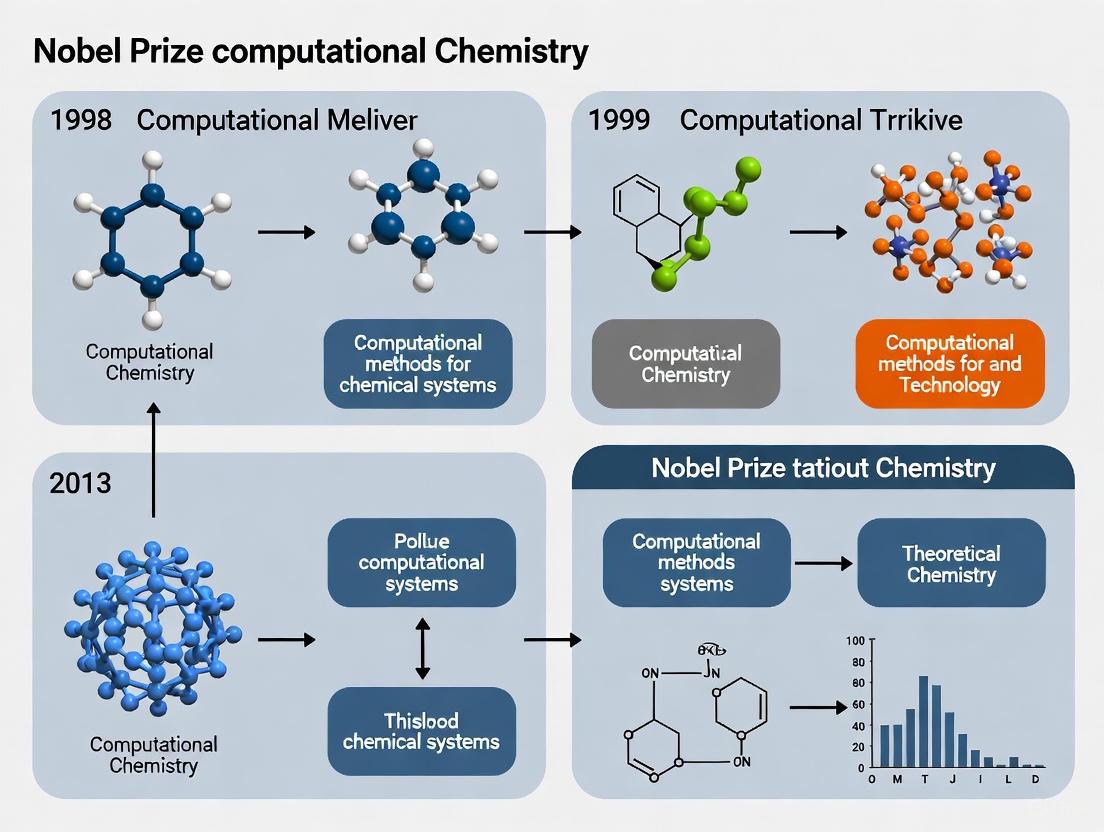
This article explores the foundational breakthroughs of the 1998 and 2013 Nobel Prizes in Chemistry, which established computational methods as a cornerstone of modern chemical research.
From Quantum Calculations to Complex Systems: How the 1998 and 2013 Nobel Prizes Revolutionized Computational Chemistry
Abstract
This article explores the foundational breakthroughs of the 1998 and 2013 Nobel Prizes in Chemistry, which established computational methods as a cornerstone of modern chemical research. We delve into the development of Density Functional Theory (DFT) by Walter Kohn and the computational methodology of John Pople, followed by the multiscale models for complex chemical systems by Karplus, Levitt, and Warshel. Tailored for researchers, scientists, and drug development professionals, the content examines the core methodologies, their transformative applications across biology and materials science, the challenges in their optimization, and their enduring validation and impact on fields like drug discovery and protein design.
The Pioneering Foundations: DFT and Quantum Chemistry Programs
In 1929, physicist Paul Dirac made a profound declaration that would both define the ambition and expose the central challenge of theoretical chemistry for decades to come: "The fundamental laws necessary for the mathematical treatment of large parts of physics and the whole of chemistry are thus fully known, and the difficulty lies only in the fact that application of these laws leads to equations that are too complex to be solved" [1]. This statement captured the essential paradox of quantum chemistry—the laws of quantum mechanics, as formulated by Schrödinger and others, theoretically provided a complete description of molecular behavior, yet the mathematical complexity of these equations rendered them practically unsolvable for any but the simplest systems [2]. The gap between theoretical possibility and practical computation would remain the central challenge of quantum chemistry for nearly half a century.
Dirac's own contribution, the Dirac equation published in 1928, represented a monumental achievement by successfully incorporating special relativity into quantum mechanics [2]. This equation provided the first complete theoretical description of electron behavior, naturally incorporated electron spin, and predicted the existence of antimatter [2]. However, the Dirac equation introduced additional mathematical complexity through its use of four-component wavefunctions (bispinors), creating what became known as the "pre-computational challenge"—the fundamental gap between theoretical understanding and practical calculational capability that would persist until the advent of powerful computational methods and equipment [2] [1].
Theoretical Foundation: Dirac's Equation and Its Implications
Mathematical Formulation of the Dirac Equation
The Dirac equation can be written in its fundamental form as [3]:
where G is the Dirac operator, m is the mass of the Dirac particle (fermion), and Ψ is a complex-valued 4-vector called the wave function, or spinor. The Dirac operator G takes the form [3]:
where G^j as well as B are 4 × 4 matrices, and the Dirac matrices G^j are related to the Lorentzian metric g^jk by [3]:
where {G^j,G^k} is the anticommutator G^jG^k + G^kG^j. This mathematical structure ensured consistency with both quantum mechanics and special relativity, representing a significant advancement over the earlier Klein-Gordon equation [2].
Key Theoretical Advances
The Dirac equation introduced several conceptual breakthroughs that were essential for the future development of computational chemistry:
Relativistic Consistency: The equation was consistent with both the principles of quantum mechanics and the theory of special relativity, representing the first theory to fully account for special relativity in the context of quantum mechanics [2]
Electron Spin Description: Unlike the Schrödinger equation, the Dirac equation naturally incorporated electron spin as a consequence of the union of quantum mechanics and relativity, without requiring ad hoc additions [2]
Antimatter Prediction: The equation implied the existence of a new form of matter—antimatter—which was experimentally confirmed several years later [2]
Four-Component Wavefunctions: Solutions to the Dirac equation are vectors of four complex numbers (known as bispinors), in contrast to the single complex value wavefunctions of the Schrödinger equation [2]
Despite these theoretical advances, the practical application of the Dirac equation to chemical systems remained limited by computational intractability. The equation presented immense mathematical challenges for describing many-electron systems, creating the central problem that would occupy quantum chemists for decades [1].
The Computational Breakthrough: Nobel Prize Recognized Advances
The 1998 Nobel Prize in Chemistry: Density-Functional Theory and Computational Methods
The Nobel Prize in Chemistry 1998 was awarded jointly to Walter Kohn for his development of the density-functional theory and John A. Pople for his development of computational methods in quantum chemistry [4] [1]. Their work provided the crucial breakthroughs that began to resolve the pre-computational challenge identified by Dirac.
Table 1: 1998 Nobel Prize Laureates and Contributions
| Laureate | Institution | Contribution | Impact |
|---|---|---|---|
| Walter Kohn | University of California, Santa Barbara | Development of density-functional theory (DFT) | Simplified mathematical description of atomic bonding |
| John A. Pople | Northwestern University | Development of computational quantum chemistry methods and Gaussian program | Made computational techniques accessible to researchers worldwide |
Kohn's revolutionary insight was that it is not necessary to consider the motion of each individual electron in a system—instead, it suffices to know the average number of electrons located at any one point in space [1]. This led to the development of density-functional theory (DFT), which calculates the total energy of a system based on the electron density rather than individual electron wavefunctions. The simplicity of this method made it possible to study very large molecules, opening new possibilities for computational chemistry [1].
Pople's contribution was the development of comprehensive computational methods and the GAUSSIAN computer program, first published in 1970 [1]. His approach focused on creating methods that provided known accuracy levels while being practical in terms of computational resources. The GAUSSIAN program quickly became the standard tool for quantum chemical computations, used by thousands of chemists worldwide [1].
Table 2: Key Developments in Quantum Chemistry Methods
| Time Period | Theoretical Foundation | Computational Capability | System Complexity |
|---|---|---|---|
| 1920s-1950s | Dirac Equation, Schrödinger Equation | Analytical solutions, limited numerical methods | Atoms, diatomic molecules |
| 1960s-1970s | Density-Functional Theory, Ab Initio Methods | Early computers, Gaussian program | Small polyatomic molecules |
| 1980s-2000s | Refined DFT functionals, Hybrid methods | Workstations, parallel computing | Medium-sized molecules, enzymes |
| 2000s-Present | Multiscale models, Machine learning | High-performance computing, cloud resources | Proteins, complex materials, drug discovery |
The 2013 Nobel Prize in Chemistry: Multiscale Models for Complex Chemical Systems
The Nobel Prize in Chemistry 2013 was awarded to Martin Karplus, Michael Levitt, and Arieh Warshel "for the development of multiscale models for complex chemical systems" [5] [6]. Their work built upon the foundations laid by Kohn and Pople, addressing the challenge of modeling truly complex biological systems.
The laureates' groundbreaking achievement was making Newton's classical physics work side-by-side with quantum physics in chemical modeling [6]. Prior to their work, chemists had to choose between two approaches: classical physics with simple calculations capable of modeling large molecules but unable to simulate chemical reactions, or quantum physics that could simulate reactions but required enormous computing power and was limited to small molecules [6].
Their multiscale approach allowed for sophisticated modeling of complex systems like proteins. For example, in simulations of drug binding to target proteins, the computer performs quantum theoretical calculations on the atoms directly involved in the interaction while simulating the rest of the large protein using less demanding classical physics [6]. This hybrid approach dramatically expanded the scope and accuracy of computational chemistry.
Methodologies and Experimental Protocols
Density-Functional Theory Methodology
The core methodology of DFT, as developed by Kohn, involves calculating the total energy of a system through the following protocol [1]:
Electron Density Calculation: Determine the electron density ρ(r) of the system, representing the probability of finding an electron at point r
Kohn-Sham Equations: Solve the Kohn-Sham equations to obtain the exact single-particle kinetic energy and the exact exchange-correlation energy of the system
Energy Functional: Express the total energy as a functional of the electron density: E[ρ] = T[ρ] + Vne[ρ] + Vee[ρ]
Variational Principle: Apply the variational principle to find the ground-state energy and electron density
The key advantage of this approach is that it reduces the problem of solving for a 3N-dimensional wavefunction (where N is the number of electrons) to solving for a 3-dimensional electron density [1].
Multiscale Modeling Methodology
The multiscale approach developed by Karplus, Levitt, and Warshel follows this experimental protocol [6]:
System Partitioning: Divide the molecular system into two regions:
- Quantum Mechanics (QM) Region: Contains the chemically active site (e.g., enzyme active site, drug binding site)
- Molecular Mechanics (MM) Region: Includes the remainder of the system (e.g., protein scaffold, solvent)
Simultaneous Calculation:
- Apply quantum mechanics to the QM region to accurately model bond breaking/formation and electronic redistribution
- Apply molecular mechanics to the MM region to efficiently handle the large number of atoms
Interaction Handling: Properly account for interactions between the QM and MM regions, ensuring energy and force continuity across the boundary
Dynamics Simulation: Perform molecular dynamics simulations using the combined QM/MM potential to model the time evolution of the system
Diagram 1: Computational Drug Discovery Workflow (61 characters)
Advanced Computational Methods
Recent advances in computational chemistry have introduced more sophisticated methodologies:
Multiconfiguration Pair-Density Functional Theory (MC-PDFT) This approach, developed by Gagliardi and Truhlar, calculates the total energy by splitting it into two parts [7]:
- Classical Energy: Kinetic energy, nuclear attraction, and Coulomb energy obtained from multiconfigurational wave function
- Nonclassical Energy: Exchange-correlation energy approximated using density functional based on electron density and on-top pair density
The MC23 functional represents a recent improvement that incorporates kinetic energy density for more accurate description of electron correlation, particularly for transition metal complexes, bond-breaking processes, and molecules with near-degenerate electronic states [7].
Modern Applications in Drug Discovery and Materials Science
Streamlining Drug Discovery
Computational approaches have revolutionized drug discovery, dramatically streamlining the process:
Ultra-Large Virtual Screening: Modern methods enable screening of gigascale chemical spaces containing billions of compounds [8]. For example, researchers have reported screening over 11 billion compounds using synthon-based approaches [8]
Reduced Development Time: Computational methods have significantly compressed discovery timelines. One study reported identifying a lead candidate in just 21 days using generative AI combined with synthesis and testing [8]
Improved Success Rates: Computational approaches help address the high failure rates in drug development, where approximately 90% of clinical drug development fails [8]
Table 3: Impact of Computational Methods on Drug Discovery
| Parameter | Traditional Approach | Computational Approach | Improvement Factor |
|---|---|---|---|
| Library Size | Thousands to millions | Billions of compounds | 100-1000x |
| Screening Time | Months | Days to weeks | 4-12x faster |
| Compounds Synthesized | Hundreds to thousands | Dozens to hundreds | 10x reduction |
| Development Timeline | 3-6 years for lead optimization | Months to 1-2 years | 3-6x acceleration |
The Scientist's Toolkit: Computational Research Reagents
Table 4: Essential Computational Tools in Modern Drug Discovery
| Tool Category | Examples | Primary Function | Application in Drug Discovery |
|---|---|---|---|
| Quantum Chemistry Packages | Gaussian, Jaguar | Ab initio quantum mechanical calculations | Electronic property prediction, reaction mechanism analysis |
| Molecular Dynamics | Desmond, AMBER | Simulation of molecular motion over time | Protein flexibility, binding pathway analysis |
| Docking Software | Glide, AutoDock | Prediction of ligand binding poses and affinity | Virtual screening, binding mode prediction |
| QSAR Tools | AutoQSAR | Quantitative Structure-Activity Relationship modeling | Activity prediction, compound optimization |
| Visualization Platforms | PyMOL, Maestro | 3D molecular visualization and analysis | Structure analysis, result interpretation |
| ADMET Prediction | QikProp | Absorption, Distribution, Metabolism, Excretion, Toxicity | Compound prioritization, property optimization |
Emerging Applications: Dirac Materials
The Dirac equation has found remarkable applications in the field of materials science through the emergence of Dirac materials—systems where low-energy excitations behave as massless Dirac fermions [3]. These include:
Graphene: A single layer of carbon atoms arranged in a honeycomb lattice where charge carriers mimic relativistic particles with nearly zero rest mass [3]
Silicene: Synthetic 2D silicon allotrope with buckled honeycomb structure that hosts Dirac fermions similar to graphene [3]
Topological Insulators: Materials that are insulating in their bulk but conduct electricity on their surface via protected edge states [3]
These materials exhibit extraordinary electronic properties including high carrier mobility and potential applications in spintronics and quantum computing [3].
Diagram 2: Theoretical Evolution to Applications (52 characters)
The journey from Dirac's 1929 statement about the fundamental intractability of chemical equations to today's sophisticated computational chemistry represents one of the most significant transformations in modern science. The pre-computational challenge that Dirac identified has been largely addressed through the pioneering work of Nobel laureates in chemistry—Kohn and Pople in 1998, followed by Karplus, Levitt, and Warshel in 2013.
What began as fundamental theoretical work on the Dirac equation has evolved into practical computational tools that are now integral to chemical research and drug discovery. The computer has become "just as important a tool for chemists as the test tube" [6], enabling simulations that are sufficiently realistic to predict the outcome of traditional experiments.
The resolution of Dirac's pre-computational challenge has not only transformed how chemistry is practiced but has also opened new frontiers in materials science and drug discovery. As computational methods continue to advance, incorporating machine learning and artificial intelligence, the legacy of Dirac's equation and the work it inspired continues to shape the future of chemical research, demonstrating how theoretical insights can eventually yield profound practical applications despite initial computational barriers.
The 1998 Nobel Prize in Chemistry, awarded to Walter Kohn for his development of density-functional theory (DFT) and to John A. Pople for his development of computational methods in quantum chemistry, marked a pivotal turning point in computational chemistry [4]. This recognition highlighted a fundamental paradigm shift in how scientists approach the quantum mechanical description of matter—a shift from the computationally intractable many-body wavefunction to the practically manageable electron density as the central variable for calculating material properties. Kohn's work provided the theoretical foundation that would eventually make accurate quantum mechanical calculations possible for complex systems ranging from simple molecules to biological macromolecules and solid-state materials.
This revolution did not occur in isolation. The 2013 Nobel Prize in Chemistry, awarded to Martin Karplus, Michael Levitt, and Arieh Warshel "for the development of multiscale models for complex chemical systems," represents the natural evolution and practical application of these foundational theories [5] [9]. The methodologies recognized in 2013, which combine quantum mechanical accuracy with classical mechanical efficiency, often rely on DFT as the quantum component in hybrid QM/MM (quantum mechanics/molecular mechanics) schemes. Together, these Nobel awards bookend a transformative period where computational approaches became indispensable tools across chemical disciplines, enabling researchers to probe systems and phenomena beyond the reach of experimental observation alone.
The Theoretical Framework: From Wavefunctions to Electron Density
The Fundamental Challenge in Many-Body Quantum Mechanics
The fundamental goal of quantum chemistry is to solve the Schrödinger equation for systems of interacting electrons and atomic nuclei. For a system with N electrons, the many-body wavefunction Ψ(r₁, r₂, ..., r_N) depends on 3N spatial coordinates, making exact solutions computationally prohibitive for all but the simplest systems [10]. Traditional wavefunction-based methods, such as Hartree-Fock and post-Hartree-Fock approaches, struggle with computational costs that scale steeply with system size, severely limiting their application to large molecules or complex materials [11].
Table: Comparison of Quantum Chemical Approaches
| Method | Fundamental Variable | Computational Scaling | Key Limitations |
|---|---|---|---|
| Wavefunction-Based Methods | Many-body Wavefunction (3N variables) | High (N⁴ to N!) | Computationally prohibitive for large systems |
| Hartree-Fock Theory | Wavefunction | N⁴ | Neglects electron correlation |
| Density Functional Theory | Electron Density (3 variables) | N³ | Approximate exchange-correlation functional |
The Hohenberg-Kohn Theorems: DFT's Mathematical Foundation
The theoretical bedrock of DFT rests on two groundbreaking theorems proved by Walter Kohn and Pierre Hohenberg in 1964 [11]:
The First Hohenberg-Kohn Theorem establishes that the ground-state electron density n(r) uniquely determines the external potential V(r) acting on the electrons, and consequently, all properties of the ground state, including the many-body wavefunction [11]. This represents a profound simplification, reducing the problem from 3N variables to just three spatial coordinates.
The Second Hohenberg-Kohn Theorem provides the variational principle for DFT. It states that there exists a universal functional of the electron density, F[n], such that the ground-state energy is minimized by the true ground-state density n₀(r) [11]. The total energy functional can be written as: E[n] = F[n] + ∫Vₑₓₜ(r)n(r)d³r where F[n] = T[n] + Eₑₑ[n] contains the kinetic energy of the electrons and the electron-electron interaction energy.
The Kohn-Sham Equations: Making DFT Practical
While the Hohenberg-Kohn theorems established the theoretical possibility of using electron density, they did not provide a practical computational scheme. This was achieved through the revolutionary approach of Kohn and Lu Jeu Sham in 1965 [12] [11]. The Kohn-Sham scheme maps the interacting system of electrons onto a fictitious system of non-interacting electrons that generate exactly the same density.
The Kohn-Sham approach decomposes the total energy functional into components: E[n] = Tₛ[n] + Eₑₓₜ[n] + Eₕ[n] + Eₓ꜀[n]
where:
- Tₛ[n] is the kinetic energy of the non-interacting Kohn-Sham system
- Eₑₓₜ[n] is the external potential energy (electron-nuclei interactions)
- Eₕ[n] is the Hartree energy (classical electron-electron repulsion)
- Eₓ꜀[n] is the exchange-correlation energy, which contains all the many-body effects
The corresponding Kohn-Sham equations take the form of single-particle Schrödinger-like equations: [-½∇² + Vₑ꜀(r)]φᵢ(r) = εᵢφᵢ(r)
where Vₑ꜀(r) = Vₑₓₜ(r) + Vₕ(r) + Vₓ꜀(r) is the effective potential, and the electron density is constructed from the Kohn-Sham orbitals: n(r) = Σᵢ|φᵢ(r)|².
Table: Components of the Kohn-Sham Energy Functional
| Energy Component | Physical Meaning | Treatment in KS-DFT |
|---|---|---|
| Kinetic Energy (Tₛ) | Energy due to electron motion | Exact for non-interacting system |
| External Potential (Eₑₓₜ) | Electron-nuclei interactions | Exact treatment |
| Hartree Energy (Eₕ) | Classical electron repulsion | Exact treatment |
| Exchange-Correlation (Eₓ꜀) | Quantum many-body effects | Requires approximation |
Key Approximations and Computational Methodology
The Exchange-Correlation Functional: DFT's Crucial Approximation
The accuracy of DFT calculations hinges entirely on the approximation used for the exchange-correlation functional Eₓ꜀[n]. Several classes of approximations have been developed, each with specific strengths and limitations:
Local Density Approximation (LDA) LDA approximates the exchange-correlation energy at each point in space using the value for a uniform electron gas with the same density: Eₓ꜀ᴸᴰᴬ[n] = ∫n(r)εₓ꜀(n(r))d³r [10]. While surprisingly accurate for systems with slowly varying densities, LDA tends to overbind molecules and solids, predicting shorter bond lengths and larger binding energies than experimentally observed.
Generalized Gradient Approximation (GGA) GGA functionals incorporate information about both the local density and its gradient: Eₓ꜀ᴳᴳᴰ[n] = ∫n(r)εₓ꜀(n(r), |∇n(r)|)d³r [10]. This improvement often yields better molecular geometries and energies than LDA. Popular GGA functionals include PBE and BLYP.
Meta-GGA and Hybrid Functionals More sophisticated functionals include the kinetic energy density (meta-GGA) or incorporate exact exchange from Hartree-Fock theory (hybrid functionals). The widely used B3LYP functional has been particularly successful in quantum chemical applications.
Computational Implementation and Workflow
Modern DFT calculations follow a systematic workflow that can be visualized as follows:
The core of the DFT algorithm is the self-consistent field (SCF) procedure, where the Kohn-Sham equations are solved iteratively until the electron density and effective potential become consistent with each other. Upon convergence, various properties can be calculated, including:
- Total energies and binding energies
- Atomic forces for geometry optimization
- Electronic band structures and densities of states
- Vibrational frequencies
- Electronic excitation energies (via time-dependent DFT)
DFT Software Packages for Materials and Drug Discovery
Table: Essential Computational Tools for DFT Calculations
| Software Package | Primary Application Domain | Key Strengths | Typical Use Cases |
|---|---|---|---|
| VASP | Materials Science, Surface Chemistry | High accuracy, efficiency for periodic systems | Catalysis, battery materials, semiconductors |
| Quantum ESPRESSO | Solid-State Physics, Nanomaterials | Open-source, plane-wave basis set | Electronic structure, spectroscopic properties |
| Gaussian | Molecular Chemistry, Drug Discovery | Extensive functional library, molecular properties | Reaction mechanisms, molecular spectroscopy |
| CP2K | Biomolecular Systems, Interfaces | Hybrid QM/MM capabilities, linear scaling | Enzymatic reactions, solvation effects |
| SIESTA | Large-Scale Systems, Nanostructures | Numerical atomic orbitals, O(N) methods | Nanotubes, molecular electronics, proteins |
Basis Sets and Pseudopotentials: Technical Essentials
The practical implementation of DFT requires two crucial technical components:
Basis Sets represent the mathematical functions used to expand the Kohn-Sham orbitals. Common choices include:
- Plane waves: Preferred for periodic systems (solids, surfaces)
- Localized atomic orbitals: Suitable for molecular systems
- Gaussian-type orbitals: Common in quantum chemistry codes
Pseudopotentials (or projector augmented-wave methods) describe the interaction between valence electrons and atomic cores, reducing computational cost by eliminating core electrons from explicit calculation.
Connection to 2013 Nobel Prize: Multiscale Modeling
The development of multiscale models recognized by the 2013 Nobel Prize in Chemistry built directly upon the foundation laid by DFT [5] [9]. The laureates—Karplus, Levitt, and Warshel—created methods that seamlessly combine:
- Quantum mechanical (QM) regions: Typically treated with DFT for electronic structure accuracy
- Molecular mechanical (MM) regions: Treated with classical force fields for computational efficiency
This QM/MM approach enables realistic simulation of chemical processes in complex environments, such as:
- Enzymatic catalysis in drug targets
- Electrochemical processes at electrode interfaces
- Photochemical reactions in solvated systems
The relationship between these Nobel-recognized achievements can be visualized as:
Applications in Pharmaceutical Research and Materials Design
Drug Discovery Applications
DFT has become an indispensable tool in modern drug development, providing:
- Binding energy calculations for protein-ligand interactions
- Reaction mechanism elucidation for drug metabolism
- Electronic property prediction for optimizing drug-receptor interactions
- Solvation effects modeling using implicit or explicit solvation models
Materials Science and Nanotechnology
The impact of DFT extends deeply into materials research:
- Catalyst design by modeling surface reactions and activation barriers
- Battery material development through ion migration and intercalation studies
- Semiconductor device optimization via band structure engineering
- Nanomaterial characterization for quantum dots, nanotubes, and 2D materials
Limitations and Future Directions
Despite its remarkable success, DFT faces several fundamental challenges:
- Band gap problem: Systematic underestimation of semiconductor band gaps
- Van der Waals interactions: Difficulty describing dispersion forces with standard functionals
- Strongly correlated systems: Limited accuracy for materials with localized d or f electrons
- Charge transfer excitations: Challenges in describing excited states with TDDFT
Ongoing research addresses these limitations through:
- Non-local functionals specifically designed for dispersion interactions
- Hybrid approaches combining DFT with wavefunction methods
- Machine learning techniques to develop more accurate functionals
- Advanced time-dependent DFT methods for excited states
Walter Kohn's development of density-functional theory represents a genuine paradigm shift in computational chemistry that continues to reshape scientific inquiry nearly three decades after its Nobel recognition. By establishing that the complex many-body wavefunction could be replaced with the conceptually simpler and computationally tractable electron density, Kohn opened the door to quantum mechanical calculations of previously unimaginable systems. This theoretical breakthrough, combined with the multiscale modeling approaches recognized in 2013, has created an powerful computational framework that spans from the quantum world to biological systems. As DFT continues to evolve through improved functionals and computational methodologies, its role as an essential tool for drug discovery, materials design, and fundamental scientific exploration seems destined to grow even further, cementing Kohn's legacy as an architect of modern computational science.
The 1998 Nobel Prize in Chemistry awarded to John A. Pople "for his development of computational methods in quantum chemistry" marked a pivotal recognition of computational chemistry's transformative role in the chemical sciences [1]. This award, shared with Walter Kohn (developer of density-functional theory), signified a paradigm shift from purely experimental inquiry to integrated theoretical and experimental approaches for understanding molecular behavior. Pople's work, particularly his development of the GAUSSIAN computer program, provided the practical methodology that enabled this transformation. By creating a computational toolkit accessible to chemists rather than solely to theoretical specialists, Pople fundamentally changed how chemical research is conducted across academia and industry [1].
The legacy of Pople's Gaussian framework extends beyond his 1998 recognition, establishing the foundation for subsequent Nobel Prize-winning computational advances. The 2013 Nobel Prize in Chemistry awarded to Martin Karplus, Michael Levitt, and Arieh Warshel "for the development of multiscale models for complex chemical systems" represents a direct evolution of Pople's computational vision [5] [13]. Their hybrid Quantum Mechanics/Molecular Mechanics (QM/MM) methods, which allow accurate modeling of enormous biological systems, built upon the computational infrastructure and methodological approaches that Pople pioneered [13]. This progression from modeling small molecules with Gaussian to simulating complex biochemical processes with QM/MM illustrates how computational chemistry has matured into an indispensable tool for modern chemical research, particularly in pharmaceutical development where understanding molecular interactions at atomic resolution is critical.
The Genesis and Evolution of Gaussian
From Semi-Empirical Methods to Ab Initio Quantum Chemistry
John Pople's journey toward developing Gaussian began with his groundbreaking work on semi-empirical quantum chemistry methods in the 1960s. He was a major contributor to the Pariser-Parr-Pople (PPP) method for predicting electronic spectra of organic molecules, followed by his development of the Complete Neglect of Differential Overlap (CNDO) and Intermediate Neglect of Differential Overlap (INDO) methods with his students [14] [15]. These approaches used approximations and empirical parameters to make quantum mechanical calculations feasible for larger molecules, but they represented a compromise between accuracy and computational practicality.
A pivotal moment occurred at the 1968 Gordon Research Conference on Theoretical Chemistry, where Pople shocked the scientific community by announcing his transition from semi-empirical methods to ab initio electronic structure theory [14]. This "jumping ship," as described by contemporaries, represented a fundamental shift in strategy. While most ab initio theorists were pursuing increasingly sophisticated methods for small systems, Pople took a contrarian approach—he chose minimum basis sets and restricted himself to the Hartree-Fock method, which many considered too naïve for meaningful chemical predictions [14]. Astonishingly, his optimized molecular structures for a wide range of molecules proved remarkably close to experimental results, with only a few exceptions like FOOF (dioxygen difluoride) that remained challenging even for more sophisticated methods [14]. This demonstration of practical utility for ab initio calculations on chemically relevant systems laid the philosophical foundation for Gaussian.
The Gaussian Computer Program: Bridging Theory and Application
The first version of the Gaussian program, Gaussian-70, published in 1970, represented a watershed moment in computational chemistry [1] [15]. Pople's key insight was that for theoretical methods to gain significance within chemistry, researchers needed to know the accuracy of results in any given case, and the methods had to be accessible and not overly demanding of computational resources [1]. Gaussian-70 addressed these requirements through several innovative design principles:
Integrated Workflow: Unlike previous computational approaches that required multiple specialized programs, Gaussian integrated all necessary calculations into a single program with user-friendly input and controllable execution options [16].
Systematic Methodology: Pople introduced the concept of a "model chemistry"—a well-defined theoretical procedure applicable to diverse chemical systems with predictable accuracy [15] [1]. This allowed chemists to apply computational methods without needing to become experts in the underlying mathematics.
Continual Refinement: Throughout the 1970s and 1980s, Pople steadily improved the methodology, incorporating more sophisticated correlation methods and larger basis sets while maintaining the program's usability [1].
A significant philosophical underpinning of Gaussian was Pople's recognition that accessibility was as important as capability. By designing the program to be usable by experimental chemists rather than just theoretical specialists, he ensured that computational chemistry could become a standard tool rather than an esoteric specialty [1]. This vision was realized through careful attention to user experience, documentation, and the development of standardized procedures that delivered reliable results without requiring deep theoretical expertise from the user.
Table: Evolution of Key Gaussian Program Versions
| Version | Release Year | Key Innovations and Impact |
|---|---|---|
| Gaussian-70 | 1970 | First integrated quantum chemistry program; combined Hartree-Fock and configuration interaction calculations in single package [16] |
| Gaussian-86 | 1986 | Incorporated improved electron correlation methods and larger basis sets; documented in "Ab Initio Molecular Orbital Theory" [15] |
| Gaussian-92 | 1992 | Integrated density functional theory (DFT) based on Kohn's work; included BLYP functionals [14] |
| Gaussian 16 | 2016 | Expanded range of molecules and chemical problems modelable; continues legacy under Gaussian, Inc. [17] |
Technical Architecture and Methodological Framework
Core Computational Methodologies in Gaussian
The Gaussian program integrated multiple quantum chemical methodologies into a unified computational framework, allowing researchers to select the appropriate level of theory for their specific chemical problem.
Fundamental Ab Initio Methods
The foundation of Gaussian's capabilities rested on ab initio molecular orbital theory, which calculates molecular properties directly from fundamental physical principles without empirical parameters [15]. Key methodological components included:
Hartree-Fock (HF) Method: The starting point for most ab initio calculations, HF uses the self-consistent field approach to approximate electron correlation. While limited in accuracy due to its neglect of electron correlation effects, it provides reasonable molecular structures and serves as the reference for more advanced methods [16].
Møller-Plesset Perturbation Theory: This approach adds electron correlation corrections to the HF method. Gaussian implemented multiple orders including MP2, MP3, MP4, and even MP6 in research settings [16]. MP2 became particularly valuable for its favorable balance of accuracy and computational cost.
Configuration Interaction (CI) Methods: These approaches generate multi-electron wavefunctions by combining different electronic configurations. Gaussian included CISD (configuration interaction with singles and doubles) but faced challenges with size-extensivity [16].
Coupled Cluster (CC) Methods: Recognizing the limitations of CI methods, Pople collaborated with Krishnan Raghavachari to develop coupled cluster methods, particularly the CCSD(T) approach that remains a gold standard for computational accuracy [14].
Density Functional Theory Integration
A crucial development in Gaussian's evolution was the incorporation of density functional theory (DFT) in the early 1990s. Pople's recognition of DFT's potential came from his study of Robert Parr's book "Density Functional Theory of Atoms and Molecules" [14]. This led to the landmark 1992 Chemical Physics Letters paper with Peter Gill, Benny Johnson, and Mike Frisch that introduced the BLYP functionals [14]. DFT represented a fundamentally different approach from wavefunction-based methods, using electron density rather than molecular orbitals as the central variable. This methodological diversification significantly expanded Gaussian's applicability to larger systems while maintaining computational feasibility, ultimately contributing to Pople's Nobel Prize [14].
Composite Methods: Gaussian-n Theories
One of Pople's most significant contributions was the development of systematic composite methods (Gaussian-n theories) that achieved high accuracy through a series of coordinated calculations [18]. These methods combined different levels of theory with various basis sets in a carefully designed sequence to approximate the results of extremely high-level calculations at a fraction of the computational cost.
Table: Gaussian-n Composite Thermochemical Methods
| Method | Key Components | Target Accuracy | Applications |
|---|---|---|---|
| Gaussian-1 (G1) | Initial systematic model chemistry; basis set: 6-311G(d); QCISD(T) reference [18] | ~1-2 kcal/mol | Enthalpies of formation, atomization energies [18] |
| Gaussian-2 (G2) | 7 calculations: MP2/6-31G(d) geometry; QCISD(T)/6-311G(d) energy; larger basis set corrections; higher level correction [18] | Chemical accuracy (1 kcal/mol) | Thermochemistry for first- and second-row compounds [18] |
| Gaussian-3 (G3) | Improved basis sets (6-31G); G3large basis for MP2; core correlation; modified HLC parameters [18] | Improved for larger systems | Extended thermochemical predictions [18] |
| G4 | CCSD(T) instead of QCISD(T); B3LYP geometries; extrapolation to HF limit; additional polarization [18] | ~0.2-0.3 kcal/mol RMS error | Main group elements up to third row [18] |
The fundamental insight behind Gaussian-n theories was that carefully calibrated sequences of calculations could systematically eliminate errors from various sources (basis set truncation, incomplete electron correlation, etc.). For example, the G2 method used a specific protocol:
- Geometry Optimization: Molecular structure determined at MP2/6-31G(d) level with all electrons included in the perturbation [18].
- Reference Energy Calculation: Highest level theory (QCISD(T)) with 6-311G(d) basis set [18].
- Polarization Function Correction: MP4/6-311G(2df,p) calculation to assess effect of additional polarization functions [18].
- Diffuse Function Correction: MP4/6-311+G(d,p) calculation to assess effect of diffuse functions [18].
- Large Basis Set Correction: MP2/6-311+G(3df,2p) calculation with the largest basis set [18].
- Zero-Point Vibrational Energy: Scaled (0.8929) ZPVE from HF/6-31G(d) frequency calculation [18].
- Higher Level Correction (HLC): Empirical correction based on electron count (-0.00481 × valence electrons - 0.00019 × unpaired electrons) [18].
The composite energy was then calculated as: E[QCISD(T)] + ΔE(polarization) + ΔE(diffuse) + ΔE(large basis) + ZPVE + HLC [18]. This systematic approach allowed Gaussian to achieve chemical accuracy (within 1 kcal/mol of experimental values) for a wide range of molecular systems, making computational predictions reliably useful for experimental planning and interpretation.
Table: Key Research Reagent Solutions in Computational Quantum Chemistry
| Tool/Resource | Function/Purpose | Application Context |
|---|---|---|
| Basis Sets e.g., 6-31G(d), 6-311+G(d,p), cc-pVnZ | Mathematical functions representing atomic orbitals; determine accuracy/cost balance [18] [16] | Molecular structure prediction, energy calculations, property evaluation |
| Electron Correlation Methods HF, MP2, MP4, CCSD(T), QCISD(T) | Account for electron-electron interactions beyond mean-field approximation [16] [18] | Accurate thermochemical calculations, reaction barrier prediction |
| Density Functionals BLYP, B3LYP | Approximate electron exchange-correlation energy using electron density [14] | Larger molecules, transition metal complexes, periodic systems |
| Geometry Optimization Algorithms Berny algorithm, GEDIIS | Find minimum energy molecular structures through iterative coordinate adjustment [16] | Equilibrium structure prediction, conformational analysis |
| Frequency Calculation Modules | Compute vibrational frequencies from second derivatives of energy [18] | Thermodynamic property prediction, vibrational spectroscopy interpretation |
| Solvation Models PCM, COSMO | Incorporate solvent effects through continuum dielectric representation [1] | Solution-phase chemistry, biochemical applications |
Experimental Protocols: Methodologies for Key Applications
Molecular Structure Determination Protocol
The determination of molecular geometry represents one of the most fundamental applications of Gaussian. The standard protocol involves:
Initial Geometry Construction: Build molecular structure using chemical intuition or molecular mechanics. For the amino acid cysteine, this would involve creating a structure with carbon bound to hydrogen, amino group (NH₂), thiolatomethyl group (CH₂SH), and carboxyl group (COOH) [1].
Geometry Optimization: Execute optimization at an appropriate theoretical level (e.g., B3LYP/6-31G(d) for balance of accuracy and efficiency). The calculation iteratively adjusts nuclear coordinates until the energy gradient falls below a convergence threshold [16].
Frequency Calculation: Perform vibrational frequency analysis at the optimized geometry to confirm a true minimum (no imaginary frequencies) and obtain thermodynamic corrections [18].
Higher-Level Refinement: For increased accuracy, perform single-point energy calculations at higher levels of theory (e.g., CCSD(T) with larger basis sets) on the optimized geometry [18].
This protocol enables prediction of bond distances, angles, and dihedral angles with accuracy often exceeding 0.01 Å and 1° compared to experimental values [14] [16].
Thermochemical Property Prediction Using Composite Methods
For accurate prediction of enthalpies of formation, atomization energies, and other thermochemical properties:
Initial Geometry: Optimize molecular structure at MP2/6-31G(d) level or using density functional theory (e.g., B3LYP/6-31G(2df,p)) [18].
Composite Energy Calculation: Execute the sequence of calculations specified by the chosen Gaussian-n theory (G2, G3, or G4). For G2 theory, this involves seven separate energy calculations with different method/basis set combinations [18].
Zero-Point Energy Correction: Calculate vibrational frequencies at HF/6-31G(d) level and scale ZPVE by 0.8929 before addition to electronic energy [18].
Higher-Level Correction: Apply empirical correction based on number of valence electrons and unpaired electrons [18].
Thermochemical Analysis: Combine composite energy with appropriate thermodynamic cycles to derive enthalpies of formation at 298K [18].
This methodology typically achieves chemical accuracy (within 1 kcal/mol) for a wide range of main-group compounds, enabling reliable prediction of reaction energies and thermodynamic stability [18].
Gaussian-2 Composite Method Workflow: This diagram illustrates the sequential calculations and energy combination strategy used in G2 theory to achieve high-accuracy thermochemical predictions [18].
Impact and Legacy: From Academic Tool to Industrial Necessity
Transformative Applications Across Chemical Disciplines
Gaussian's accessibility and reliability enabled its application across diverse chemical domains, revolutionizing how researchers approach molecular design and analysis:
Pharmaceutical Development: Gaussian calculations predict drug-receptor interactions, protein-ligand binding affinities, and spectroscopic properties of pharmaceutical compounds. The ability to model enzymatic reactions and predict transition state geometries has become invaluable for rational drug design [1].
Materials Science: Computational screening of molecular candidates for electronic materials, polymers, and nanomaterials accelerates development cycles. Gaussian's ability to predict electronic spectra, nonlinear optical properties, and charge transport characteristics guides experimental synthesis efforts [1].
Atmospheric Chemistry: Gaussian calculations elucidated the mechanism of ozone depletion by chlorofluorocarbons (CFCs), modeling how freon molecules are destroyed by ultraviolet light to form chlorine atoms that catalytically destroy ozone [1]. This provided atomic-level understanding of environmental processes difficult to observe directly.
Astrochemistry: Quantum chemical calculations identify interstellar molecules by predicting their rotational spectra, which can be directly compared to radio telescope observations. This approach has identified numerous molecules in space that cannot be easily studied in terrestrial laboratories [1].
The Bridge to 2013 Nobel Prize: Multiscale Modeling of Biological Systems
The methodological framework established by Pople with Gaussian directly enabled the work recognized by the 2013 Nobel Prize in Chemistry awarded to Karplus, Levitt, and Warshel [5] [13]. Their development of multiscale models for complex chemical systems addressed the fundamental challenge of applying quantum mechanics to biological macromolecules:
QM/MM Methodology: Karplus, Levitt, and Warshel realized that simulating entire enzymes or other biological macromolecules at the quantum mechanical level was computationally prohibitive. Their hybrid Quantum Mechanics/Molecular Mechanics (QM/MM) approach treated the chemically active region (e.g., enzyme active site) with quantum mechanics while modeling the surrounding protein environment with molecular mechanics [13].
Computational Requirements: These multiscale calculations demanded advanced computational resources. The laureates utilized NSF supercomputers and later the eXtreme Science and Engineering Discovery Environment (XSEDE) to perform large-scale computations that would have been impossible on conventional computers [13].
Biological Applications: The QM/MM approach enabled accurate simulation of biochemical processes such as enzyme catalysis, protein folding, and molecular motor function. For example, Warshel used Gordon supercomputer resources to study phosphate hydrolysis—"arguably the most important biological reaction"—resolving longstanding mechanistic controversies [13].
The through-line from Pople's Gaussian to the 2013 laureates' work illustrates how computational chemistry evolved from studying small molecules in vacuum to modeling complex biochemical processes in realistic environments. This progression was made possible by both algorithmic advances and the exponential growth of computational power, with Pople's work providing the foundational methodology and philosophical approach that made computational chemistry accessible to the broader chemical community.
Computational Chemistry Nobel Evolution: This diagram illustrates the methodological connections between the 1998 and 2013 Nobel Prizes, showing how Pople's work provided essential foundation for later advances in multiscale modeling [14] [1] [13].
John Pople's Gaussian program fundamentally transformed quantum chemistry from an esoteric mathematical specialty into an accessible tool for the broader chemical community. By developing standardized methodologies, creating user-friendly software interfaces, and demonstrating the practical utility of computational approaches for real chemical problems, Pople enabled what might be termed the "democratization of quantum chemistry." His insight that computational methods must be both accurate and accessible to have meaningful impact on chemical research guided the development of Gaussian from its inception through its continuous evolution.
The recognition of Pople's contributions with the 1998 Nobel Prize, followed by the 2013 award for multiscale modeling approaches that built upon his foundational work, illustrates how computational chemistry has matured into an indispensable component of modern chemical research. For drug development professionals and research scientists, Gaussian and its methodological descendants provide powerful tools for molecular design, reaction analysis, and property prediction that complement and extend experimental capabilities. As computational resources continue to grow and algorithms become increasingly sophisticated, the vision pioneered by Pople—that computers could become "laboratories for theoretical chemistry"—continues to expand the frontiers of what is possible in molecular science.
The fields of physics and chemistry, while deeply intertwined in their study of atomic and molecular systems, have historically been separated by methodological approaches. Physics contributed the fundamental laws of quantum mechanics, and chemistry focused on the experimental behavior of atoms and molecules. The development of the Kohn-Sham equations in 1965 created an essential bridge between these disciplines, providing a computationally tractable method to apply quantum physics to complex chemical problems [19]. This theoretical framework, which earned Walter Kohn the Nobel Prize in Chemistry in 1998, revolutionized computational chemistry by simplifying the intractable many-electron problem into a solvable form [1] [4]. The significance of this achievement is underscored by the Nobel Committee's recognition that Kohn's work "has formed the basis for simplifying the mathematics in descriptions of the bonding of atoms, a prerequisite for many of today's calculations" [1].
The 1998 Nobel Prize honored two complementary approaches: Kohn's density-functional theory and John Pople's development of computational methods and the GAUSSIAN program [1] [4]. This pairing highlighted the essential synergy between theoretical framework and practical implementation that propelled computational chemistry forward. By 2013, the field had advanced further, with the Nobel Prize awarded to Karplus, Levitt, and Warshel for developing multiscale models that built upon the foundation laid by Kohn and Sham [5] [13]. These multiscale approaches, particularly QM/MM (quantum mechanics/molecular mechanics), represented an evolutionary step in modeling complex chemical systems by strategically applying accurate but computationally expensive quantum methods only where necessary [13] [20].
This whitepaper examines the technical foundation of the Kohn-Sham equations, their relationship to subsequent Nobel-winning computational methodologies, and their practical applications in modern chemical research, particularly in drug discovery where these methods now play indispensable roles.
Theoretical Foundation: The Kohn-Sham Equations
Mathematical Formulation
The Kohn-Sham equations represent a clever reformulation of the quantum many-body problem that makes computational solutions feasible. At their core, these equations replace the intractable interacting system with a fictitious system of non-interacting particles that generate the same electron density as the real system [19]. The central eigenvalue equation is expressed as:
$$\left(-\frac{\hbar^{2}}{2m}\nabla^{2}+v{\text{eff}}(\mathbf{r})\right)\varphi{i}(\mathbf{r})=\varepsilon{i}\varphi{i}(\mathbf{r})$$
where:
- $\varphi_{i}$ are the Kohn-Sham orbitals
- $\varepsilon_{i}$ are the Kohn-Sham orbital energies
- $v_{\text{eff}}$ is the effective potential [19]
The electron density is constructed from these orbitals:
$$\rho(\mathbf{r})=\sum{i}^{N}|\varphi{i}(\mathbf{r})|^{2}$$
This formulation bypasses the need to compute the complex many-electron wavefunction, instead focusing on the electron density as the fundamental variable, a massive simplification that reduces the computational complexity from exponential to polynomial scale [19] [21].
The Kohn-Sham Potential
The effectiveness of the Kohn-Sham approach hinges on the Kohn-Sham potential $v_{\text{eff}}$, which encapsulates all electron interactions. This potential is composed of several distinct components:
$$v{\text{eff}}(\mathbf{r})=v{\text{ext}}(\mathbf{r})+e^{2}\int{\frac{\rho(\mathbf{r}')}{|\mathbf{r}-\mathbf{r}'|}}d\mathbf{r}'+\frac{\delta E_{\text{xc}}[\rho]}{\delta\rho(\mathbf{r})}$$
where:
- $v_{\text{ext}}$ is the external potential (typically electron-nuclei interactions)
- The second term represents the Hartree (Coulomb) potential
- The final term $v_{\text{xc}}$ is the exchange-correlation potential [19]
The exchange-correlation potential contains all the quantum mechanical many-body effects and represents the only unknown component in the theory. The development of accurate approximations for this term has been the focus of intensive research since the method's introduction [19] [22].
Total Energy Expression
Within the Kohn-Sham framework, the total energy of the system is expressed as a functional of the electron density:
$$E[\rho]=T{s}[\rho]+\int dr v{\text{ext}}(\mathbf{r})\rho(\mathbf{r})+E{\text{H}}[\rho]+E{\text{xc}}[\rho]$$
where:
- $T_{s}[\rho]$ is the kinetic energy of the non-interacting reference system
- The second term represents the electron-nuclear attraction
- $E_{\text{H}}[\rho]$ is the Hartree (Coulomb) energy
- $E_{\text{xc}}[\rho]$ is the exchange-correlation energy [19] [22]
The Kohn-Sham equations are derived by applying the variational principle to this energy expression, requiring self-consistent solution as the potential depends on the density which in turn depends on the orbitals [19].
Table 1: Components of the Kohn-Sham Total Energy Functional
| Energy Component | Mathematical Expression | Physical Significance | ||
|---|---|---|---|---|
| Kinetic Energy ($T_s$) | $\sum{i=1}^{N}\int d\mathbf{r}\,\varphi{i}^{*}(\mathbf{r})\left(-\frac{\hbar^{2}}{2m}\nabla^{2}\right)\varphi_{i}(\mathbf{r})$ | Kinetic energy of non-interacting electrons | ||
| External Potential Energy | $\int d\mathbf{r}\,v_{\text{ext}}(\mathbf{r})\rho(\mathbf{r})$ | Electron-nucleus interactions | ||
| Hartree Energy ($E_H$) | $\frac{e^{2}}{2}\int d\mathbf{r}\int d\mathbf{r}'\,{\frac{\rho(\mathbf{r})\rho(\mathbf{r}')}{ | \mathbf{r}-\mathbf{r}' | }}$ | Classical electron-electron repulsion |
| Exchange-Correlation Energy ($E_{xc}$) | $\int f[\rho(\mathbf{r}),\nabla\rho(\mathbf{r}),\ldots]\rho(\mathbf{r})d\mathbf{r}$ | Quantum mechanical many-body effects |
Methodological Workflow: Solving the Kohn-Sham Equations
The solution of the Kohn-Sham equations follows a self-consistent field (SCF) procedure that iteratively refines the electron density and potential until convergence is achieved. This process can be visualized through the following computational workflow:
Diagram 1: Kohn-Sham Self-Consistent Field Procedure
The SCF process begins with an initial guess for the electron density, which is often constructed from atomic orbitals or previous calculations. The Kohn-Sham equations are then solved to obtain the orbitals and eigenvalues, from which a new electron density is constructed. This new density is used to update the effective potential, and the process repeats until the density and energy converge within a specified threshold [19] [22].
The 1998 Nobel Prize: Recognition of Computational Revolution
Historical Context and Theoretical Breakthrough
The 1998 Nobel Prize in Chemistry recognized two complementary contributions that transformed computational chemistry: Walter Kohn's development of density-functional theory and John Pople's creation of computational methodologies and the GAUSSIAN program [1] [4]. This recognition highlighted the growing importance of computational approaches in chemical research, with the Nobel Committee noting that "computer-based calculations are now used generally to supplement experimental techniques" [1].
Prior to Kohn's work, the quantum chemical description of molecules relied on wavefunction-based methods that became computationally prohibitive for large systems. The fundamental breakthrough of density-functional theory was proving that all ground-state properties of a quantum system are uniquely determined by its electron density [21]. This represented a massive simplification, as the electron density depends on only three spatial coordinates rather than the 3N coordinates required for an N-electron wavefunction [19] [21].
The Kohn-Sham Approach
While the Hohenberg-Kohn theorems established the theoretical foundation, the Kohn-Sham equations provided a practical computational methodology [21]. The key insight was introducing a fictitious system of non-interacting electrons that could reproduce the same density as the real interacting system [19]. This approach cleverly addressed the most challenging aspect of orbital-free DFT – accurately describing the kinetic energy – by computing it exactly for the non-interacting reference system [22].
The impact of this formulation was profound. Kieron Burke of Rutgers University captured this significance by describing DFT as "one of the greatest free lunches ever" because it saves computer time while requiring only a single, approximate density functional [21]. This efficiency enabled the study of larger molecules than was previously possible with wavefunction-based methods.
Integration with Computational Chemistry
Pople's contribution was the development and distribution of the GAUSSIAN program, which implemented various quantum chemical methods including Hartree-Fock, post-Hartree-Fock methods, and eventually DFT [1] [21]. The integration of Kohn's theoretical framework into Pople's widely accessible software package was crucial for the widespread adoption of DFT in chemistry. As noted in the Nobel press release, "The simplicity of the method makes it possible to study very large molecules" [1].
This combination of theoretical innovation and practical implementation fundamentally changed how chemists work. The Nobel Committee emphasized that "computer-based calculations are now used generally to supplement experimental techniques" and that "today the computer is just as important a tool for chemists as the test tube" [1].
Evolution to Multiscale Modeling: The 2013 Nobel Prize
Bridging Scales with QM/MM Methods
The 2013 Nobel Prize in Chemistry, awarded to Martin Karplus, Michael Levitt, and Arieh Warshel, recognized the next evolutionary step in computational chemistry: the development of multiscale models for complex chemical systems [5] [13]. These researchers addressed the fundamental challenge of modeling chemical processes in very large systems like enzymes, where applying high-level quantum mechanics to the entire system remains computationally prohibitive.
The key innovation was the QM/MM (quantum mechanics/molecular mechanics) approach, which partitions the system into two regions: a small region where chemical bonds are formed or broken treated with quantum mechanical methods (such as DFT), and the remainder treated with computationally efficient molecular mechanics [13]. This hybrid approach allowed for accurate modeling of chemical reactions in biologically relevant environments [13] [20].
Methodological Framework and Implementation
The QM/MM methodology can be visualized as follows:
Diagram 2: QM/MM Multiscale Modeling Approach
The implementation of QM/MM methods requires careful attention to the boundary between quantum and classical regions, particularly how the electrostatic interactions between regions are handled [13]. The QM region, typically treated with DFT, provides accuracy for bond-breaking and formation, while the MM region allows efficient treatment of the large environmental effects [23] [13].
Connecting 1998 and 2013 Methodologies
The methodological evolution from the pure Kohn-Sham DFT of 1998 to the QM/MM approaches of 2013 represents a natural progression in computational chemistry. DFT provided the accurate yet efficient quantum mechanical method that made QM/MM approaches feasible for chemically interesting systems [13] [20]. As noted in commentary on the 2013 prize, "computations are our treasured tool; they are not our aim" [20] – highlighting that the field had matured to focus on solving chemical problems rather than developing methods for their own sake.
The National Science Foundation noted that the work of the 2013 laureates "laid the foundation for much of the current research underlying our ability to quantitatively understand the dynamics and functions of biological molecules" [13], building directly upon the foundation established by Kohn and Pople.
Applications in Drug Discovery and Chemical Research
Quantum Methods in Modern Drug Development
The Kohn-Sham equations and their multiscale descendants have become indispensable tools in modern drug discovery, providing precise molecular insights unattainable with purely classical methods [23]. Quantum mechanical approaches, particularly DFT, are now routinely applied to model electronic structures, binding affinities, and reaction mechanisms in pharmaceutically relevant systems [23].
Table 2: Quantum Mechanical Methods in Drug Discovery
| Method | Strengths | Limitations | Typical Applications in Drug Discovery |
|---|---|---|---|
| Density Functional Theory (DFT) | High accuracy for ground states; handles electron correlation; wide applicability | Expensive for large systems; functional dependence | Binding energies, electronic properties, reaction mechanisms, transition states [23] |
| Hartree-Fock (HF) | Fast convergence; reliable baseline; well-established theory | No electron correlation; poor for weak interactions | Initial geometries, charge distributions, force field parameterization [23] |
| QM/MM | Combines QM accuracy with MM efficiency; handles large biomolecules | Complex boundary definitions; method-dependent accuracy | Enzyme catalysis, protein-ligand interactions, large biomolecular systems [23] |
| Fragment Molecular Orbital (FMO) | Scalable to large systems; detailed interaction analysis | Fragmentation complexity approximates long-range effects | Protein-ligand binding decomposition, large biomolecules [23] |
Specific Pharmaceutical Applications
DFT calculations have found diverse applications across the drug discovery pipeline:
- Kinase Inhibitor Design: DFT provides accurate molecular orbitals and electronic properties for optimizing small-molecule kinase inhibitors [23]
- Metalloenzyme Inhibitors: Modeling transition states in enzymatic reactions involving metal centers, guiding inhibitor development [23]
- Covalent Inhibitors: Studying reaction mechanisms and bonding interactions for targeted covalent inhibitors [23]
- Fragment-Based Drug Design: Evaluating fragment binding and optimizing fragment-based leads, as demonstrated in HIV screening applications [23]
The pharmaceutical industry has embraced these methods, with companies like SophosQM and Pfizer-XtalPi leveraging DFT for drug discovery applications [23].
Spectroscopic Property Prediction
Beyond direct drug design, Kohn-Sham DFT plays a crucial role in predicting spectroscopic properties (NMR, IR) that are essential for characterizing drug molecules and understanding their interactions [23]. These calculations help interpret experimental data and provide insights into molecular structure and behavior that guide medicinal chemistry optimization.
Table 3: Computational Tools for Kohn-Sham and Multiscale Simulations
| Tool/Resource | Type | Key Function | Applications |
|---|---|---|---|
| GAUSSIAN | Software Package | Quantum chemical calculations including DFT | Molecular properties, reaction mechanisms, spectroscopy [1] [23] |
| QM/MM | Methodology | Multiscale simulations of biomolecules | Enzyme catalysis, protein-ligand binding [23] [13] |
| XSEDE | Computing Infrastructure | High-performance computing environment | Large-scale biomolecular simulations [13] |
| Exchange-Correlation Functionals | Mathematical Approximations | Define the exchange-correlation energy in DFT | LDA, GGA, and hybrid functionals for different accuracy/speed tradeoffs [19] [23] |
Emerging Trends and Quantum Computing
The evolution of computational methods continues beyond the traditional Kohn-Sham approach. Quantum computing is emerging as the next potential breakthrough, with noisy intermediate-scale quantum (NISQ) devices showing promise for accelerating quantum mechanical calculations [24]. Researchers project that quantum computing may revolutionize generative chemistry and molecular design by 2030-2035, potentially addressing currently "undruggable" targets [24].
Quantum generative models theoretically outperform classical ones and may soon be integrated into established generative AI platforms for drug discovery [24]. This represents a natural extension of the computational principles established by Kohn and Sham, leveraging new computational paradigms to solve increasingly complex chemical problems.
Challenges and Limitations
Despite their successes, Kohn-Sham DFT and multiscale methods face ongoing challenges:
- Exchange-Correlation Functional Accuracy: The unknown exact functional remains the fundamental limitation of DFT, requiring careful selection of approximations for different chemical systems [19] [23]
- Computational Cost: While more efficient than wavefunction methods, DFT remains computationally demanding for very large systems or long timescales [23]
- System Preparation and Expertise: Successful application requires significant expertise in model preparation, method selection, and results interpretation [23]
The Kohn-Sham equations have served as a crucial bridge between physics and chemistry, transforming quantum mechanical principles from abstract theory into practical tools for chemical discovery. Their development, recognized by the 1998 Nobel Prize, enabled the accurate computational study of molecular systems that underpinned subsequent advances like the multiscale methods honored in 2013.
As computational power increases and methods evolve, the core insight of Kohn and Sham – that clever reformulations can make the quantum many-body problem tractable – continues to guide new developments. From drug design to materials science, the legacy of their work persists in the ever-expanding ability to understand and predict molecular behavior through computation, fulfilling Kohn's vision of a practical density-functional theory that brings the power of quantum mechanics to chemistry.
From Theory to Practice: Methodologies and Real-World Impact in Biomedicine
The integration of Quantum Mechanics (QM) and Molecular Mechanics (MM), known as QM/MM, represents a cornerstone of modern computational chemistry. This multiscale approach allows researchers to simulate chemical processes in complex systems, such as proteins and solvents, with a compelling balance of accuracy and computational feasibility. Its profound significance was recognized by the Nobel Committee on two pivotal occasions. The 1998 Nobel Prize in Chemistry was awarded to Walter Kohn for his development of the density-functional theory (DFT) and to John A. Pople for his development of computational methods in quantum chemistry [4] [1]. These contributions provided the essential quantum-mechanical foundation. Then, in 2013, the Nobel Prize was awarded to Martin Karplus, Michael Levitt, and Arieh Warshel "for the development of multiscale models for complex chemical systems," specifically for pioneering the QM/MM methodology itself [5] [13] [25]. This whitepaper provides an in-depth technical guide to the QM/MM framework, detailing its core principles, methodologies, and applications, framed within the context of these revolutionary Nobel Prize-winning achievements.
Historical Foundation: The 1998 and 2013 Nobel Prizes
The 1998 and 2013 Nobel Prizes in Chemistry bookend a critical period of development that made powerful computational modeling a reality.
The 1998 Prize: Enabling Quantum Calculations
The 1998 prize honored the work that made quantum chemical calculations practical for chemists.
- Walter Kohn's Density-Functional Theory (DFT) demonstrated that the total energy of a quantum system could be determined from the electron density, rather than the complex many-electron wavefunction [1]. This breakthrough dramatically simplified the mathematics, moving from a function of 3N variables (for N electrons) to just 3 spatial coordinates, paving the way for the study of large molecules [1] [25].
- John A. Pople's Computational Methodology was realized through the GAUSSIAN computer program, first published in 1970 [1]. This program package made quantum-chemical calculations accessible to a wide community of researchers, allowing them to theoretically study molecules, their properties, and their behavior in chemical reactions.
The 2013 Prize: The Birth of Multiscale Modeling
The 2013 prize recognized the conceptual leap of combining two disparate descriptions of matter into a single, powerful model.
- The Core Innovation: Karplus, Levitt, and Warshel laid the foundation for the QM/MM approach in a seminal 1976 paper, which was first applied to an enzymatic reaction [26] [25]. They realized that to simulate chemical reactions, the electronic motion must be treated with quantum mechanics, but the surrounding environment could be treated efficiently with classical Newtonian mechanics [13].
- Overcoming a Fundamental Impasse: Before their work, chemists faced a difficult choice: use quantum mechanics for accuracy but be restricted to very small systems, or use molecular mechanics for large molecules but be unable to simulate chemical reactions where bonds break and form [25]. The QM/MM theory solved this impasse, creating a hybrid that leverages the strengths of both approaches.
Theoretical Framework of QM/MM
The QM/MM approach partitions the molecular system into distinct regions treated at different levels of theory.
System Partitioning and Coupling
The entire system is divided into a QM region (e.g., an enzyme's active site or a solute molecule) and an MM region (e.g., the protein scaffold or solvent). The total energy of the system is calculated as [26] [25]:
E_total = E_QM + E_MM + E_QM/MM
The E_QM/MM interaction term is the most critical and is typically divided into:
- Bonded interactions: Covalent bonds that cross the QM/MM boundary.
- Non-bonded interactions: Electrostatic and van der Waals (vdW) forces.
Table 1: Summary of QM/MM Embedding Schemes
| Embedding Scheme | Description | Advantages | Limitations |
|---|---|---|---|
| Mechanical Embedding (ME) | QM/MM interaction is calculated purely at the MM level. [26] | Computationally cheap, simple. | Neglects polarization of QM region by the MM environment. |
| Electrostatic Embedding (EE) | MM atoms are provided as point charges to the QM Hamiltonian, polarizing the QM region. [26] | Includes electronic polarization of QM region by MM environment. More physically realistic for polar systems. | Higher computational cost than ME. Can lead to over-polarization. |
| Polarizable Embedding (PE) | The MM environment is modeled with a polarizable force field, allowing for mutual polarization between QM and MM regions. [26] | Most physically accurate description of electrostatic interactions. | Significantly more computationally expensive and complex to parameterize. |
The following diagram illustrates the logical workflow of a QM/MM simulation, from system setup to energy computation:
Diagram 1: QM/MM Simulation Workflow
Handling the QM/MM Boundary
A key challenge arises when a covalent bond is cut by the QM/MM partition. The most common solution is the link atom scheme [26]. In this approach, saturator atoms (typically hydrogen atoms) are added to the QM region to cap the dangling bonds created by the partition. The forces on these link atoms are then distributed to the adjacent atoms to maintain consistency.
Methodologies and Experimental Protocols
Implementing a QM/MM study requires careful selection of methods and a systematic protocol.
Quantum Mechanical Methods
A range of QM methods can be employed within the QM region, offering a trade-off between accuracy and computational cost.
- Density Functional Theory (DFT): As recognized by the 1998 Nobel Prize, DFT is a widely used method that calculates the total energy from the electron density [1] [25]. Its accuracy depends on the chosen exchange-correlation functional. Popular functionals include:
- Semiempirical Methods: These methods use approximations and parameterizations based on experimental data to significantly speed up calculations, making them suitable for larger QM regions or longer timescale simulations [26] [25].
Molecular Mechanics Force Fields
The MM region is described by a classical force field, which uses simple mathematical functions to represent the potential energy. The energy typically includes terms for bond stretching, angle bending, torsional rotations, and non-bonded (electrostatic and van der Waals) interactions.
Detailed Protocol for a QM/MM Simulation
The following workflow details the steps for a typical QM/MM investigation of an enzymatic reaction, building upon the methodologies recognized by the 2013 Nobel Prize.
Diagram 2: QM/MM Enzyme Reaction Study Protocol
- System Preparation: An initial structure, often from a protein data bank (PDB) file, is prepared by adding hydrogen atoms, solvating it in a water box, and adding ions to achieve physiological concentration and neutrality [26].
- Classical Equilibration: The fully atomistic system undergoes energy minimization to remove bad contacts, followed by molecular dynamics (MD) simulation to equilibrate the solvent and protein at the desired temperature and pressure [13].
- QM/MM Partitioning: The chemically active region (e.g., substrate and catalytic residues involved in bond breaking/forming) is designated as the QM region. The remainder of the protein and solvent constitutes the MM region [26] [25].
- Methodology Selection: A QM method (e.g., DFT), an MM force field, and an embedding scheme (typically Electrostatic Embedding for enzymatic systems) are selected.
- QM/MM Optimization and Sampling: The hybrid system is subjected to geometry optimization to locate stable intermediates and transition states. For free energy calculations, QM/MM MD simulations are performed to sample configurations [26] [27].
- Reaction Pathway Analysis: The reaction mechanism is explored by defining a collective variable (CV) and calculating the Potential of Mean Force (PMF). For example, an SN2 reaction can be described by the difference between two forming/breaking bond lengths [27].
- Validation: Computational results, such as reaction barriers and intermediate structures, are compared with experimental data (e.g., kinetic isotope effects, mutagenesis studies) for validation.
The Scientist's Toolkit: Essential Research Reagents
Table 2: Key Software and Tools for QM/MM Simulations
| Tool Name | Type | Primary Function | Relevance to QM/MM |
|---|---|---|---|
| GROMOS [26] | Software Package | Molecular Dynamics Simulation | Specializes in force-field MD and provides a versatile QM/MM interface with links to external QM programs. |
| Gaussian [1] | QM Software | Quantum Chemical Calculations | Pioneered by Nobel laureate John Pople; widely used for QM calculations in QM/MM. |
| TURBOMOLE [26] | QM Software | Quantum Chemical Calculations | One of the external QM programs that can be interfaced with GROMOS for QM/MM. |
| ORCA [26] | QM Software | Quantum Chemical Calculations | An external QM program with an interface implemented in the updated GROMOS package. |
| DFTB+ [26] | QM Software | Semiempirical Quantum Chemistry | Efficient semiempirical method often used for large QM regions in QM/MM. |
| xtb [26] | QM Software | Semiempirical Quantum Chemistry | Computationally efficient, often linked via a direct C API library for high performance. |
| GROMACS | Software Package | Molecular Dynamics Simulation | A widely used MD package that supports QM/MM simulations (mentioned in broader context). |
| XSEDE [13] | Cyberinfrastructure | High-Performance Computing | Provides the supercomputing resources essential for running computationally demanding QM/MM simulations. |
Advanced Applications and Recent Developments
QM/MM methodologies have become a standard tool for investigating complex chemical and biochemical processes.
Exemplary Application: Nitrogenase Enzyme
A prominent application is the study of nitrogenase, the enzyme that catalyzes the conversion of atmospheric nitrogen (N₂) into ammonia (NH₃), a process known as nitrogen fixation [25]. The active site of this enzyme, the FeMo-cofactor (FeMoco), is a complex metal-sulfur cluster. QM/MM simulations are crucial for elucidating the reaction mechanism and the role of this cluster, a task that is extremely challenging for experimental methods alone [25].
Beyond Traditional QM/MM: Emerging Frontiers
The field continues to evolve, addressing the computational cost of QM/MM.
- QM/CG-MM: To further accelerate sampling, the MM environment can be coarse-grained (CG), where groups of atoms are represented by a single "bead" [27]. This reduces the number of degrees of freedom, leading to a smoother energy landscape and faster dynamics. Recent work has developed a complete theory for handling electrostatic coupling in polar CG environments [27].
- ML/MM: A cutting-edge evolution replaces the QM description with Machine-Learned Interatomic Potentials (ML/MM). These neural network potentials are trained on QM data and can achieve near-QM/MM accuracy at a fraction of the computational cost, enabling routine simulation of reactions in complex environments [28].
Table 3: Comparison of Multiscale Simulation Methods
| Method | Description | Computational Cost | Typical Applications |
|---|---|---|---|
| Ab Initio MD | Entire system treated with QM. | Very High | Small systems, benchmark studies. |
| QM/MM | Chemically active region treated with QM; environment with MM. | High | Enzyme catalysis, reaction mechanisms in solution. |
| QM/CG-MM | QM region embedded in a coarse-grained environment. | Medium | Accelerated sampling of slow processes in large systems. |
| ML/MM | ML potentials replace QM for the active region; environment with MM. | Low to Medium | High-throughput screening, long-timescale reactive simulations. |
The QM/MM paradigm, built upon the Nobel Prize-winning work of Kohn, Pople, Karplus, Levitt, and Warshel, has fundamentally transformed computational chemistry and biology. By seamlessly integrating the accuracy of quantum mechanics for describing electronic processes with the efficiency of molecular mechanics for modeling large molecular environments, QM/MM has enabled the realistic simulation of chemical reactions in biological systems like enzymes and in complex solvents. As the field advances with new techniques like QM/CG-MM and ML/MM, the core principles established by these laureates continue to provide the foundational framework for exploring and understanding the molecular processes that underpin life and matter.
Simulating Enzymatic Catalysis and Drug-Target Interactions
The field of computational chemistry has been fundamentally shaped by Nobel Prize-winning achievements, which have provided the theoretical and methodological foundation for modern simulations of enzymatic catalysis and drug-target interactions. The 1998 Nobel Prize in Chemistry awarded to Walter Kohn for his development of density-functional theory and John A. Pople for his development of computational methods in quantum chemistry revolutionized our ability to describe the bonding of atoms and calculate molecular properties [1]. Kohn demonstrated that it was unnecessary to track the motion of each individual electron—instead, knowing the average electron density at any point in space sufficed, dramatically simplifying quantum mechanical calculations for complex molecular systems [1].
This foundation was expanded by the 2013 Nobel Laureates—Martin Karplus, Michael Levitt, and Arieh Warshel—who pioneered multiscale models that bridged quantum and classical mechanics [5]. Their development of hybrid quantum mechanics/molecular mechanics (QM/MM) methods enabled researchers to simulate chemical reactions in biological systems with unprecedented accuracy [13]. By treating the reactive region quantum mechanically while handling the surrounding protein environment classically, QM/MM overcame previous computational barriers and opened the door to realistic simulations of enzymatic catalysis [29]. These Nobel-winning breakthroughs form the essential underpinnings of today's computational protocols for studying enzyme mechanisms and drug interactions.
Computational Methodologies for Studying Enzymatic Systems
Molecular Dynamics Simulations
Molecular dynamics (MD) simulations serve as a powerful computational tool for investigating the dynamic behavior of biomolecules at atomic resolution over time [30]. Based on Newtonian mechanics, MD simulations compute interatomic forces and track atomic movements, providing detailed insights into conformational changes and molecular dynamics that are difficult to capture through experimental methods alone [30]. In the context of enzyme catalysis, MD simulations are particularly valuable for capturing allosteric regulation—the process of modulating enzyme activity through conformational changes induced by effector binding at sites distal to the active site [30].
The strength of MD lies in its ability to reveal transitions occurring on sub-nanosecond to millisecond timescales, enabling researchers to identify cryptic allosteric sites that govern enzyme activity and signal transduction [30]. For example, in studies of branched-chain α-ketoacid dehydrogenase kinase, static X-ray crystallography failed to reveal certain allosteric sites, while MD simulations successfully captured their conformational changes, allowing researchers to map potential druggable allosteric sites using algorithms like MDpocket combined with statistical coupling analysis [30].
Table 1: Key Molecular Dynamics Techniques for Studying Enzymatic Systems
| Technique | Key Principle | Application in Enzyme Studies |
|---|---|---|
| Conventional MD | Newton's equations of motion applied to all atoms | Sampling conformational ensembles, identifying flexible regions |
| Enhanced Sampling Methods | Accelerated exploration of conformational space | Identifying hidden allosteric sites, calculating free energies |
| Steered MD (SMD) | Application of external forces along predefined pathways | Probing force-dependent processes, exploring binding/unbinding pathways |
| Replica Exchange MD (REMD) | Multiple simulations at different temperatures with exchanges | Overcoming energy barriers, improving conformational sampling |
Enhanced Sampling Techniques
Standard MD simulations often struggle to capture rare events critical to enzymatic function due to limitations in timescale. Enhanced sampling techniques address this challenge by accelerating the exploration of conformational space [30]. These include:
Metadynamics (MetaD): Introduces bias potentials to accelerate sampling along specific collective variables (CVs), enabling the system to escape local energy minima and reveal new conformational states where potential allosteric sites may emerge [30].
Umbrella Sampling: Employs harmonic potentials to guide sampling toward regions where allosteric sites are likely to form, facilitating convergence of free energy calculations and uncovering hidden conformations associated with allosteric regulation [30].
Accelerated MD (aMD): Modifies the potential energy surface by introducing a boost potential, allowing the system to cross high energy barriers and explore broader conformational space, effectively revealing transient allosteric pockets [30].
These advanced sampling methods have proven particularly valuable in studying allosteric regulation of membrane-associated proteins like K-Ras4B, where researchers have identified key sites that regulate GTP-binding activity and interactions with downstream effectors [30].
Quantum Mechanics/Molecular Mechanics (QM/MM)
The QM/MM approach represents the culmination of the methodologies recognized by the 2013 Nobel Prize, enabling accurate simulation of chemical reactions in enzymatic environments [13]. This hybrid method treats the reactive region (e.g., active site with substrates) using quantum mechanics while handling the surrounding protein and solvent environment with molecular mechanics [29].
A exemplary application of QM/MM appears in studies of histone lysine methyltransferase SET7/9, where researchers employed ab initio QM/MM molecular dynamics simulations with umbrella sampling to determine free energy profiles for the methyl-transfer reaction [29]. The simulations utilized a 23 Å solvent water sphere centered on the active site, with the QM region treated at the HF(6-31G*/3-21G) level and the MM region described with the Amber force field [29]. These calculations successfully yielded an activation free energy barrier of 22.5 kcal/mol for the enzyme-catalyzed reaction, agreeing well with the experimental value of 20.9 kcal/mol, and demonstrated that SET7/9 significantly lowers the barrier compared to the uncatalyzed solution reaction (30.9 kcal/mol) by providing a pre-organized electrostatic environment [29].
Quantitative Structure-Activity Relationship (QSAR) Modeling
QSAR modeling establishes mathematical relationships between chemical structures and biological activities, enabling predictive design of enzyme inhibitors [31] [32]. This approach typically involves:
Dataset Curation: Compiling compounds with known biological activities against the target enzyme. For example, in a study targeting HCoV SARS 3CLpro, researchers assembled 37 structurally diverse molecules with known EC50 values [31].
Descriptor Calculation: Computing physicochemical properties that potentially influence activity.
Model Development: Using statistical methods like genetic algorithm multilinear regression to build predictive models. A robust QSAR model for SmHDAC8 inhibitors demonstrated strong predictive capability with R² of 0.793 and Q²cv of 0.692 [32].
Virtual Screening: Applying the validated model to identify novel hit compounds from chemical libraries [31].
QSAR models have been successfully integrated with molecular docking and dynamics simulations to create comprehensive workflows for hit identification and optimization, substantially reducing the time and resources required for experimental screening [31] [32].
Experimental Protocols: Detailed Methodologies
Protocol 1: Molecular Dynamics Simulation of Enzyme Allostery
Objective: To identify and characterize allosteric sites in enzymes using MD simulations [30].
Workflow:
System Preparation:
- Obtain the experimental three-dimensional structure from databases like PDB.
- Add missing hydrogen atoms and perform energy minimization.
- Solvate the enzyme in an appropriate water model (e.g., TIP3P).
- Add ions to neutralize the system and achieve physiological salt concentration.
Equilibration:
- Gradually heat the system from 0K to the target temperature (e.g., 310K) over 100-500 ps.
- Apply position restraints on protein heavy atoms initially, then gradually release them.
- Conduct equilibrium simulation until system properties (temperature, pressure, energy) stabilize.
Production Simulation:
- Run unrestrained MD simulation for timescales relevant to the biological process (typically 100 ns to 1 μs).
- Employ enhanced sampling techniques like metadynamics or aMD if rare events are of interest.
- Save trajectories at appropriate intervals (e.g., every 100 ps) for analysis.
Analysis:
- Calculate root mean square deviation (RMSD) to assess structural stability.
- Identify flexible regions through root mean square fluctuation (RMSF) analysis.
- Detect allosteric pockets using tools like MDpocket.
- Analyze communication networks through correlation analysis and community structure identification.
Diagram 1: MD Simulation Workflow
Protocol 2: Ab Initio QM/MM Simulation of Enzymatic Catalysis
Objective: To determine the free energy profile and mechanism of an enzyme-catalyzed reaction [29].
Workflow:
System Setup:
- Prepare the enzyme-substrate complex based on crystal structure.
- Define QM and MM regions strategically, including the reactive center and key surrounding residues in the QM region.
- Solvate the system with a water sphere or periodic box.
QM/MM Parameters:
- Select appropriate QM method (e.g., HF, DFT) and basis set (e.g., 6-31G, 3-21G).
- Choose MM force field (e.g., Amber, CHARMM) compatible with the QM method.
- Treat QM/MM boundary with pseudobond approaches if necessary.
Equilibration:
- Perform classical MM minimization and equilibration before QM/MM simulations.
- Gradually relax positional restraints on the system.
Reaction Path Sampling:
- Identify a suitable reaction coordinate (e.g., bond length difference, bond order).
- Employ umbrella sampling with harmonic biasing potentials along the reaction coordinate.
- Run multiple independent windows (typically 20-50) covering the reaction path.
- For each window, conduct QM/MM MD simulations with constrained reaction coordinate.
Free Energy Analysis:
- Combine probability distributions from all windows using the Weighted Histogram Analysis Method.
- Calculate the potential of mean force along the reaction coordinate.
- Validate the reaction barrier with experimental kinetics data where available.
Table 2: QM/MM Setup for SET7/9 Methyltransferase Study [29]
| Parameter | Specification |
|---|---|
| System Size | 7017 atoms (enzyme), 4988 atoms (solution) |
| QM Region | 34 atoms (HF/6-31G*/3-21G) |
| MM Region | Amber force field, TIP3P water |
| Sampling Method | Umbrella sampling (42 windows for enzyme) |
| Reaction Coordinate | Rc = r(Sδ–Cε) - r(Cε–Nζ) |
| Simulation Time | 1.26 ns (enzyme), 1.17 ns (solution) |
| Free Energy Method | WHAM analysis |
Protocol 3: QSAR-Based Virtual Screening for Enzyme Inhibitors
Objective: To identify novel enzyme inhibitors through computational screening [31] [32].
Workflow:
Dataset Preparation:
- Collect known inhibitors with measured activity values (e.g., IC50, EC50).
- Curate structures: remove duplicates, standardize tautomers, check stereochemistry.
- Divide dataset into training and test sets using rational selection methods.
Descriptor Calculation and Selection:
- Compute molecular descriptors (topological, electronic, geometric, etc.).
- Apply feature selection methods (e.g., genetic algorithm) to identify relevant descriptors.
- Check for descriptor correlation to avoid multicollinearity.
Model Development:
- Build QSAR model using regression methods (e.g., GA-MLR, PLS).
- Validate model using internal (cross-validation) and external test sets.
- Ensure adherence to OECD principles for QSAR validation.
Virtual Screening:
- Apply validated QSAR model to screen compound libraries.
- Select top-ranked compounds for further analysis.
- Validate hits with molecular docking and MD simulations.
Experimental Verification:
- Synthesize or procure predicted active compounds.
- Test in vitro activity against target enzyme.
- Iteratively refine model based on new experimental data.
Table 3: Essential Computational Tools for Simulating Enzymatic Catalysis
| Tool Category | Specific Tools/Software | Key Function |
|---|---|---|
| MD Simulation Packages | GROMACS, AMBER, NAMD, OpenMM | Running molecular dynamics simulations |
| QM/MM Software | Gaussian, Q-Chem, CP2K, Terachem | Performing quantum mechanical calculations |
| Enhanced Sampling | PLUMED, COLVARS | Implementing advanced sampling algorithms |
| Analysis Tools | MDTraj, MDAnalysis, VMD, PyMOL | Trajectory analysis and visualization |
| QSAR Modeling | DRAGON, PaDEL, KNIME, Orange | Descriptor calculation and model building |
| Docking & Virtual Screening | AutoDock, Glide, FRED, SwissDock | Predicting binding poses and affinities |
| Free Energy Methods | WHAM, MBAR, MM-PBSA, MM-GBSA | Calculating binding free energies and profiles |
Case Studies in Drug Discovery
Allosteric Inhibitor Discovery for MEK and SIRT6
Advanced computational methodologies have enabled successful identification of allosteric modulators for challenging drug targets. Case studies on enzymes such as Sirtuin 6 (SIRT6) and MAPK/ERK kinase (MEK) demonstrate the practical application of these approaches in drug discovery [30]. For these targets, researchers employed integrated strategies combining MD simulations to capture dynamic allosteric mechanisms, evolutionary conservation analysis to identify functionally important regions, and machine learning approaches to predict allosteric sites [30].
Tools like PASSer, AlloReverse, and AlphaFold have significantly enhanced the understanding of allosteric mechanisms and facilitated the design of selective allosteric modulators [30]. These approaches are particularly valuable for targeting proteins that have proven difficult to drug with conventional orthosteric approaches, offering enhanced specificity and reduced off-target effects due to the typically lower conservation of allosteric sites across protein families [30].
SARS-CoV-2 3CLpro Inhibitor Identification
During the COVID-19 pandemic, computational methods played a crucial role in rapid drug discovery efforts. Researchers employed a QSAR-based virtual screening approach to identify novel inhibitors of the SARS-CoV-2 3C-like protease, an essential enzyme for viral replication [31]. The study developed a four-parametric GA-MLR QSAR model with strong statistical parameters (R²: 0.84, R²adj: 0.82, Q²loo: 0.78) using a dataset of 37 structurally diverse molecules [31].
The virtual screening successfully identified a hit molecule with improved predicted EC50 value from 5.88 to 6.08, which was subsequently validated through molecular docking and MD simulations [31]. These simulations revealed key interactions with amino acid residues in the S1 and S2 pockets, including Ile164, Pro188, Leu190, Thr25, His41, and Asn141 [31]. The stable complex formation confirmed through MD simulations and MM-GBSA calculations demonstrated the utility of this integrated computational approach for rapid antiviral development.
SmHDAC8 Inhibitor Design for Schistosomiasis
For the neglected tropical disease schistosomiasis, researchers applied an integrated computational approach to design novel inhibitors of Schistosoma mansoni histone deacetylase 8, a validated drug target [32]. The study began with QSAR modeling of 48 known inhibitors, producing a robust model (R²: 0.793, Q²cv: 0.692) that identified compound 2 as the most active molecule [32].
Using this lead structure, researchers designed five novel derivatives (D1-D5) with improved binding affinities [32]. Molecular docking revealed strong interactions, including hydrogen bonding and hydrophobic contacts, while 200-nanosecond MD simulations confirmed structural stability [32]. MM-GBSA calculations further supported the binding strength of compounds D4 and D5, with drug-likeness and ADMET analyses suggesting their potential as safe and effective drug candidates [32].
Diagram 2: Virtual Screening Workflow
The integration of computational methodologies rooted in Nobel Prize-winning research has fundamentally transformed our approach to studying enzymatic catalysis and drug-target interactions. From the density-functional theory of Kohn and the computational frameworks of Pople to the multiscale models of Karplus, Levitt, and Warshel, these foundational advances have enabled increasingly sophisticated simulations of biological processes [1] [13] [5].
Today, researchers can seamlessly combine MD simulations, QM/MM calculations, enhanced sampling techniques, and machine learning approaches to unravel complex enzymatic mechanisms and identify novel therapeutic candidates [30]. As computational power continues to grow and algorithms become more refined, these methods will play an increasingly pivotal role in drug discovery, offering powerful tools to regulate enzyme activity for therapeutic benefit and deepening our understanding of life's molecular machinery [30]. The ongoing integration of computational predictions with experimental validation represents the most promising path forward for advancing both fundamental knowledge and therapeutic development.
The field of atmospheric chemistry has been fundamentally transformed by advances in computational chemistry, allowing scientists to move from static models to dynamic, predictive simulations of complex chemical systems. This revolution is anchored in pioneering work recognized by two landmark Nobel Prizes in Chemistry. The 1998 Nobel Prize awarded to Walter Kohn for his development of density-functional theory and John A. Pople for his development of computational methods in quantum chemistry provided the fundamental theoretical framework for accurate molecular-level calculations [4] [1]. This was extended by the 2013 Nobel Prize awarded to Martin Karplus, Michael Levitt, and Arieh Warshel "for the development of multiscale models for complex chemical systems," which enabled realistic simulation of chemical processes at multiple scales simultaneously [5] [6]. These methodological breakthroughs created the essential toolkit for understanding and addressing one of the most significant environmental challenges of the 20th century: stratospheric ozone depletion.
Theoretical Foundations: Nobel Prize-Winning Methodologies
The 1998 Nobel Prize: Quantum Chemistry Foundations
The 1998 Nobel Laureates developed complementary approaches that made computational quantum chemistry practically accessible. Walter Kohn's density-functional theory (DFT) demonstrated that the properties of molecules could be determined through electron density rather than dealing with the immensely more complicated wave functions of all individual electrons [1]. This critical insight dramatically simplified calculations while maintaining accuracy, making it feasible to study large molecular systems. Simultaneously, John A. Pople developed the entire quantum-chemical methodology now used across chemistry, creating the GAUSSIAN computer program that allowed researchers to perform complex calculations without deep theoretical expertise [1]. As the Nobel press release noted, "The computer is fed with particulars of a molecule or a chemical reaction and the output is a description of the properties of that molecule or how a chemical reaction may take place" [1].
The 2013 Nobel Prize: Multiscale Modeling for Complex Systems
The 2013 Nobel Laureates bridged the quantum and classical worlds by developing methods that could use both quantum physics and classical physics within the same simulation [6]. Their crucial insight was that different parts of a complex chemical system could be modeled at different theoretical levels - using accurate but computationally expensive quantum mechanics for the chemically active regions, while employing efficient classical physics for the remainder of the system. This multiscale approach made it possible to study realistically large systems, such as proteins and atmospheric processes, with quantum mechanical accuracy where it mattered most. As described in their Nobel citation, "For simulations of how a drug couples to its target protein in the body, the computer performs quantum theoretical calculations on those atoms in the target protein that interact with the drug. The rest of the large protein is simulated using less demanding classical physics" [6].
Integrated Computational Workflow
The synergy between these Nobel-winning methodologies enables a comprehensive computational workflow for studying atmospheric chemistry, illustrated below:
Atmospheric Ozone and Its Protective Role
The Earth's ozone layer resides predominantly in the stratosphere, approximately 9 to 18 miles (15-30 kilometers) above the Earth's surface [33]. This layer plays a critical role in absorbing harmful ultraviolet (UVB) radiation from the sun, which causes skin cancer, cataracts, and genetic damage in living organisms, while also harming crops and marine ecosystems [34] [33]. The natural formation and destruction of ozone occurs through the Chapman cycle, a series of photochemical reactions that maintain a dynamic equilibrium [35]. This cycle begins with oxygen molecules (O₂) being split by high-energy UV radiation into two oxygen atoms, which then combine with other O₂ molecules to form ozone (O₃) [35]. Ozone itself absorbs UV radiation and decomposes, completing the cycle. Under normal conditions, these processes maintain a stable balance that protects life on Earth.
Mechanisms of Ozone Destruction
The stability of the ozone layer is disrupted by ozone-depleting substances (ODS), particularly chlorofluorocarbons (CFCs) and halons [34]. These anthropogenic compounds are exceptionally stable in the lower atmosphere, allowing them to migrate unchanged to the stratosphere. Once in the stratosphere, intense UV radiation photodissociates these molecules, releasing chlorine and bromine atoms that catalyze ozone destruction through chain reactions [34] [33]. The catalytic nature of these reactions makes them particularly destructive - a single chlorine atom can destroy over 100,000 ozone molecules before being deactivated or removed from the stratosphere [33]. The efficiency of this process is enhanced in polar regions by the presence of polar stratospheric clouds, which provide surfaces for heterogeneous reactions that convert stable chlorine reservoirs into highly reactive forms [34]. This explains why the most severe ozone depletion manifests as the Antarctic "ozone hole" during the Southern Hemisphere spring.
Computational Analysis of Ozone Depletion Mechanisms
Quantum-Chemical Investigation of Reaction Pathways
Computational methods developed by the Nobel Laureates have enabled detailed atom-level understanding of ozone depletion mechanisms. Density-functional theory calculations allow researchers to map the potential energy surfaces of the key reactions, identifying transition states and calculating reaction rates under stratospheric conditions. For example, the critical chlorine-catalyzed ozone destruction cycle involves two elementary reactions that can be precisely characterized computationally [34]:
- Cl · + O₃ → ClO · + O₂
- ClO · + O₃ → Cl · + 2O₂
The Nobel press release specifically highlighted that "With quantum-chemical computation we can describe them in detail and thus understand them. This knowledge may help us to take steps to make our atmosphere cleaner" [1]. These calculations confirmed that the chlorine radical regenerates after each cycle, establishing the catalytic nature of the process. Similar mechanisms were elucidated for bromine radicals, which were found to be even more efficient at ozone destruction on a per-atom basis [34].
Ozone-Depleting Substances: Quantitative Analysis
Computational chemistry has been instrumental in predicting the ozone-depletion potential (ODP) of various compounds, guiding regulatory policies under the Montreal Protocol. The table below summarizes key ozone-depleting substances and their properties:
Table 1: Atmospheric Properties of Major Ozone-Depleting Substances
| Chemical Name | Chemical Formula | Atmospheric Lifetime (years) | Ozone Depletion Potential (ODP) | Global Warming Potential (GWP) |
|---|---|---|---|---|
| CFC-11 (Trichlorofluoromethane) | CCl₃F | 45 | 1.0 | 4,660 |
| CFC-12 (Dichlorodifluoromethane) | CCl₂F₂ | 100 | 0.82 | 10,200 |
| CFC-113 (1,1,2-Trichlorotrifluoroethane) | C₂F₃Cl₃ | 85 | 0.85 | 5,820 |
| Carbon Tetrachloride | CCl₄ | 26 | 0.82 | 1,730 |
| Halon 1301 (Bromotrifluoromethane) | CF₃Br | 65 | 15.9 | 6,290 |
| Methyl Bromide | CH₃Br | 0.8 | 0.66 | 2 |
| HCFC-22 (Chlorodifluoromethane) | CHClF₂ | 11.9 | 0.04 | 1,760 |
Data compiled from the U.S. EPA [36]
The atmospheric lifetime, a key parameter in determining a compound's ODP, can be accurately calculated using quantum chemical methods to determine reaction rates with atmospheric oxidants. Similarly, ODP values depend on computational simulations of how effectively a substance releases halogen atoms in the stratosphere and how efficiently those atoms catalyze ozone destruction.
Multiscale Modeling of Atmospheric Systems
The multiscale approaches recognized by the 2013 Nobel Prize enable comprehensive atmospheric modeling by integrating processes across quantum, molecular, and global scales. As noted in the Nobel citation, this approach allows researchers to "make Newton's classical physics work side-by-side with the fundamentally different quantum physics" [6]. In practice, this means that quantum mechanical calculations are used to determine reaction rates and mechanisms for key chemical processes, while classical physics handles atmospheric transport and diffusion on a global scale. This integrated approach is essential for predicting how localized emissions of ODS translate to global ozone depletion patterns, and for forecasting the expected recovery timeline of the ozone layer under the Montreal Protocol regulations.
Experimental Protocols & Methodologies
Protocol: Computational Determination of Reaction Rate Constants
Objective: Determine the rate constant for the reaction Cl + O₃ → ClO + O₂ using quantum chemical methods.
Methodology:
- Geometry Optimization: Employ density-functional theory (e.g., B3LYP functional with 6-311+G(d,p) basis set) to optimize the molecular geometries of reactants (Cl atom and O₃), transition state, and products (ClO and O₂).
- Frequency Analysis: Calculate harmonic vibrational frequencies at the same level of theory to confirm transition state structure (one imaginary frequency) and obtain zero-point energy corrections.
- Energy Refinement: Perform single-point energy calculations using higher-level methods (e.g., CCSD(T) with aug-cc-pVTZ basis set) on the optimized geometries.
- Rate Constant Calculation: Apply transition state theory to compute the rate constant: ( k(T) = \kappa(T) \frac{kB T}{h} e^{-\Delta G^\ddagger/RT} ) where (\kappa(T)) is the tunneling correction, (kB) is Boltzmann's constant, (h) is Planck's constant, and (\Delta G^\ddagger) is the Gibbs free energy of activation.
- Temperature Dependence: Calculate rate constants over the temperature range 200-300 K to parameterize for atmospheric models.
Validation: Compare computed rate constants with experimental measurements from laboratory studies.
Protocol: Multiscale Modeling of Ozone Depletion in Polar Stratosphere
Objective: Simulate the formation of the Antarctic ozone hole using a multiscale modeling approach.
Methodology:
- Quantum Mechanical Calculations:
- Compute heterogeneous reaction probabilities on polar stratospheric cloud (PSC) surfaces using periodic DFT.
- Calculate photolysis rates for halogen-containing compounds under stratospheric UV conditions.
- Molecular Dynamics Simulations:
- Simulate the formation and growth of PSCs using classical force fields.
- Model the adsorption and surface diffusion of HCl and ClONO₂ on ice surfaces.
- Box Model Implementation:
- Integrate quantum-chemically derived rate constants into a detailed chemical mechanism.
- Simulate chemical evolution in an air parcel under stratospheric conditions.
- Global Climate Model Coupling:
- Incorporate chemical mechanism into 3D atmospheric transport model.
- Simulate vortex dynamics, radiation, and transport processes alongside chemistry.
- Analysis and Prediction:
- Quantify ozone loss rates and spatial distribution.
- Project future ozone recovery under different emission scenarios.
Table 2: Computational Tools for Atmospheric Chemistry Research
| Tool/Resource | Type | Primary Function | Application in Ozone Research |
|---|---|---|---|
| GAUSSIAN | Software Package | Quantum chemical calculations | Calculating reaction mechanisms and rates for ozone-depleting reactions [1] |
| Density-Functional Theory (DFT) | Theoretical Method | Electronic structure calculation | Determining molecular properties and reaction pathways for halogen radicals [1] |
| QM/MM Methods | Hybrid Methodology | Multiscale simulation | Modeling reactions on polar stratospheric cloud surfaces [6] |
| GEOS-Chem | 3D Model | Atmospheric chemistry transport | Simulating global distribution and impact of ozone-depleting substances [37] |
| Equivalent Effective Stratospheric Chlorine (EESC) | Metric | Ozone depletion potential | Quantifying total ozone-depletion potential of halogen emissions [34] |
| Montreal Protocol HCFC Schedule | Regulatory Framework | Phase-out timeline | Providing scenarios for predictive modeling of ozone recovery [36] |
Impact and Future Directions
The integration of Nobel Prize-winning computational methods with atmospheric science has produced one of environmental science's greatest success stories. The precise understanding of ozone depletion mechanisms enabled by these tools directly informed the Montreal Protocol, which has successfully phased out the production of most ozone-depleting substances [34]. As a result, ozone levels stabilized by the mid-1990s and began recovering in the 2000s, with the ozone hole expected to reach pre-1980 levels by approximately 2075 [34]. In 2019, NASA reported the smallest ozone hole since its discovery in 1982, and the UN projects complete ozone layer regeneration by 2045 [34]. The continued refinement of multiscale models, incorporating more realistic chemistry-climate interactions, remains essential for predicting the complex interplay between ozone recovery and climate change, ensuring that this hard-won environmental victory remains permanent.
The field of chemistry has undergone a profound transformation with the integration of computational methods, moving from purely experimental observation to sophisticated prediction and design through computational science. This paradigm shift was formally recognized by the Nobel Committee through two pivotal awards: the 1998 Nobel Prize in Chemistry awarded to Walter Kohn for his development of density-functional theory and John A. Pople for his development of computational methods in quantum chemistry, and the 2013 Nobel Prize in Chemistry awarded to Martin Karplus, Michael Levitt, and Arieh Warshel "for the development of multiscale models for complex chemical systems" [4] [5] [1]. These achievements established the theoretical and practical foundations upon which modern computational chemistry is built, enabling researchers to model chemical systems with unprecedented accuracy and scale.
The evolution from specialized, command-line driven software packages to integrated, user-friendly platforms has dramatically expanded the accessibility and application of computational tools across chemical disciplines. Today's computational toolbox encompasses a spectrum of methodologies from quantum mechanics to machine learning, allowing scientists to probe molecular structures, predict properties, and design novel compounds with extraordinary precision. This whitepaper provides a comprehensive technical guide to the core computational tools, from established packages like Gaussian and Rosetta to contemporary software suites, framed within the historical context of these Nobel Prize-winning achievements and their ongoing impact on chemical research and drug development.
Historical Foundations: Nobel Prize-Winning Breakthroughs
The 1998 Nobel Prize: Quantum Chemistry Methodologies
The 1998 Nobel Prize in Chemistry recognized two complementary approaches that revolutionized quantum chemistry. Walter Kohn's density-functional theory (DFT) demonstrated that the properties of a molecular system could be determined through electron density rather than through the complicated wave function of individual electrons, significantly simplifying the mathematical complexity of quantum calculations [1]. As noted in the Nobel press release, "Kohn showed that it is not necessary to consider the motion of each individual electron: it suffices to know the average number of electrons located at any one point in space" [1]. This theoretical breakthrough made it feasible to study large molecules that were previously computationally intractable.
Simultaneously, John A. Pople's development of computational methodologies and his Gaussian program provided researchers with practical tools to implement quantum chemical calculations [4] [1]. First published in 1970, Gaussian made computational quantum chemistry accessible to practicing chemists worldwide, moving the field from theoretical concept to practical application. Pople's systematic approach created a "well-documented model chemistry" that allowed researchers to perform calculations with known accuracy and reliability [1]. The synergy between Kohn's theoretical simplification and Pople's practical implementation laid the groundwork for the widespread adoption of computational methods across chemical disciplines.
The 2013 Nobel Prize: Multiscale Modeling of Complex Systems
The 2013 Nobel Prize recognized the next evolutionary step in computational chemistry: the ability to model complex biological systems through multiscale approaches. Martin Karplus, Michael Levitt, and Arieh Warshel developed methods that combined quantum mechanics (QM) with molecular mechanics (MM), creating the QM/MM framework that could accurately simulate chemical reactions in biological macromolecules [5] [13]. This hybrid approach realistically models chemical processes by applying quantum mechanical treatment to the reactive center while using computationally efficient molecular mechanics for the surrounding environment.
The National Science Foundation noted that "the three Nobel Laureates realized that to understand what's happening at the atomic level, the electronic motion in chemical systems must be treated using the laws of quantum mechanics (QM), but that the much heavier nuclei could be treated using Newton's classical equations of motion or molecular mechanics (MM)" [13]. This conceptual breakthrough allowed for the simulation of enormous biomolecular systems that were previously beyond computational reach, bridging the gap between small-molecule quantum chemistry and biological macromolecules. Their work formed the foundation of computational structural biology and computational biophysics, enabling quantitative understanding of biological molecule dynamics and functions [13].
The Core Computational Toolbox
Established Foundation Software
Gaussian: Quantum Chemistry Workhorse
Gaussian remains one of the most widely used computational chemistry software packages, implementing the methodologies recognized in the 1998 Nobel Prize. Based on fundamental quantum mechanical principles, Gaussian predicts energies, molecular structures, and vibrational frequencies of molecular systems, enabling researchers to study compounds under various conditions including stable species, transition states, and experimentally unobservable intermediates [38]. The software employs a range of quantum chemical methods including density functional theory (DFT), coupled cluster theory, and Moller-Plesset perturbation theory.
Recent versions like Gaussian 16 have expanded capabilities for modeling larger molecules through methods such as ONIOM multilayer computation, excited state modeling with time-independent frequency analysis, and enhanced spectrum prediction including Raman spectroscopic resonance [17] [38]. Gaussian provides particular strength in predicting magnetic properties (NMR chemical shifts), optical rotations of chiral molecules, and reaction pathway exploration through molecular dynamics simulations. Its continued development ensures that methods developed by both 1998 and 2013 Nobel laureates remain accessible to researchers across chemical disciplines.
Rosetta: Biomolecular Modeling and Design
The Rosetta software suite, developed by a global community of scientists through Rosetta Commons, specializes in biomolecular structure prediction, design, and docking [39]. While Gaussian excels at quantum-level electronic structure calculations, Rosetta operates at the molecular mechanics level, enabling the study of massive biological systems like proteins and nucleic acids. Rosetta employs sophisticated sampling algorithms and energy functions to predict protein structures from amino acid sequences, design novel proteins with specific functions, and model molecular interactions.
Recent advancements in the Rosetta ecosystem include RFdiffusion and ProteinMPNN for de novo protein design, RoseTTAFold2-PPI for predicting protein-protein interactions, and RFDpoly for generative design of RNA, DNA, and other biopolymers [39]. The open-source nature of many Rosetta components, coupled with continuous community development, has established it as a premier platform for biomolecular engineering. Its methodology complements the QM/MM approaches recognized in the 2013 Nobel Prize by providing specialized tools for the MM component of multiscale simulations.
Modern Software Suites and Platforms
Contemporary computational chemistry platforms have integrated the foundational methodologies of both Nobel-recognized achievements into unified, often more accessible interfaces. These platforms frequently combine multiple computational approaches with emerging machine learning techniques to enhance speed and accuracy.
Table 1: Modern Computational Chemistry Platforms
| Platform | Key Features | Methodologies | Target Applications |
|---|---|---|---|
| Schrödinger [40] | Maestro unified interface, Desmond MD, FEP+, Glide docking | QM/MM, MD, Free energy calculations | Drug discovery, Materials science |
| Rowan [41] | Egret-1 neural network potentials, pKa prediction, Blood-brain barrier permeability | AI/ML, DFT, Neural network potentials | Drug discovery, Chemical R&D |
| Cresset [40] | Forge ligand-based design, Field-based QSAR | Ligand-based design, Field similarity | Medicinal chemistry, SAR analysis |
The Schrödinger platform offers a comprehensive suite of tools including Maestro as a unified interface, Desmond for molecular dynamics, Glide for ligand-receptor docking, and FEP+ for free energy calculations [40]. These tools enable researchers to apply QM/MM methods similar to those recognized in the 2013 Nobel Prize without requiring specialized computational expertise.
Rowan represents the next generation of computational platforms, integrating traditional physics-based methods with machine learning approaches [41]. Its Egret-1 neural network potentials "match or exceed the accuracy of quantum-mechanics-based simulations while running orders-of-magnitude faster" [41]. Similarly, its AIMNet2 model provides "generally applicable, accurate, and incredibly fast neural network potential that powers organic-focused computational chemistry simulations" [41]. This combination of physical rigor with data-driven efficiency addresses the computational cost limitations that initially constrained the methodologies of both the 1998 and 2013 Nobel laureates.
Quantitative Comparison of Computational Methods
Performance Metrics and Applications
Computational methods span a wide spectrum of accuracy and computational cost, making different tools suitable for specific research questions and system sizes. The selection of an appropriate methodology depends on the trade-off between required accuracy and available computational resources.
Table 2: Computational Method Comparison
| Method | System Size | Accuracy | Time Scale | Key Applications |
|---|---|---|---|---|
| Quantum Mechanics (QM) [38] [1] | 10-100 atoms | High | Hours-days | Reaction mechanisms, Spectroscopy |
| Density Functional Theory (DFT) [41] [1] | 10-1000 atoms | Medium-high | Minutes-hours | Geometries, Electronic properties |
| Molecular Mechanics (MM) [13] | 1000-100,000 atoms | Medium | Hours-days | Protein dynamics, Conformational sampling |
| QM/MM [5] [13] | 100-10,000 atoms | High for active site | Hours-days | Enzyme mechanisms, Catalysis |
| Neural Network Potentials [41] | 100-100,000 atoms | High | Seconds-minutes | High-throughput screening, MD |
The quantitative comparison reveals how modern neural network potentials, such as those implemented in Rowan's Egret-1, are bridging the gap between accuracy and computational efficiency [41]. These methods build upon the density-functional theory recognized in the 1998 Nobel Prize while addressing the need for manageable computation times that constrained early practitioners like Warshel, who noted "I learned since the late 60s to use very limited resources to capture the main physics of biological systems, without consuming enormous computer power" [13].
Experimental Protocols and Workflows
Quantum Chemical Calculation Protocol
The fundamental workflow for quantum chemical calculations follows methodology established by Pople and enhanced with Kohn's DFT approaches. This protocol enables researchers to determine molecular properties from first principles.
Quantum Calculation Workflow
The protocol begins with molecular structure input, where researchers construct or import the molecular system of interest. This is followed by geometry optimization, which finds the minimum energy configuration of the molecule using methods such as DFT [38] [1]. As described in Gaussian documentation, this step can take "a minute or so if we are content with a rough result, but up to a day if we desire high accuracy" [1]. The optimized structure then undergoes frequency calculation to verify it represents a true minimum (no imaginary frequencies) and provide vibrational spectra for comparison with experimental IR/Raman data [38].
Subsequently, researchers perform property calculations to determine electronic properties, spectroscopic parameters, or reactivity descriptors [38]. For the amino acid cysteine example cited in the Nobel background material, this might include calculating "a surface with constant electron density" colored by electrostatic potential to predict "how the molecule interacts with other molecules and charges in its environment" [1]. Finally, result analysis and visualization transforms raw computational data into chemically meaningful information, such as molecular orbitals, electron densities, or spectroscopic simulations.
Multiscale Biomolecular Modeling Protocol
The QM/MM approach recognized in the 2013 Nobel Prize enables realistic simulation of chemical processes in biological systems through a partitioned methodology that combines computational efficiency with quantum accuracy.
Multiscale Modeling Workflow
The protocol initiates with system preparation, building the complete biological assembly including protein, cofactors, solvent, and ions [13]. This is followed by system partitioning, where the researcher defines the QM region (typically the active site and reacting molecules) treated with quantum mechanical methods, and the MM region (remainder of protein and solvent) treated with molecular mechanics force fields [5] [13]. As noted in the NSF coverage of the 2013 Nobel, this hybrid approach allows researchers to study "how phosphate hydrolysis in solution and in proteins" occurs, leading to discovery of "how the bonds connecting phosphates to other molecules in chemical compounds are broken in the presence of water" [13].
The system then undergoes energy minimization to remove steric clashes, followed by system equilibration through molecular dynamics to reach proper temperature and density. The core production simulation phase employs QM/MM dynamics to model the chemical process of interest, with the QM region calculating electronic structure changes during bond breaking/formation while the MM region provides the environmental context [13]. Finally, trajectory analysis extracts thermodynamic and kinetic information, such as free energy profiles for chemical reactions, providing atomic-level insight into biological mechanisms.
Research Reagent Solutions: Essential Computational Materials
The computational chemist's toolkit consists of software tools, force fields, parameter sets, and computational resources that form the essential "reagents" for in silico experiments.
Table 3: Essential Research Reagents in Computational Chemistry
| Reagent Category | Specific Examples | Function | Source/Availability |
|---|---|---|---|
| Quantum Chemistry Software | Gaussian [17] [38], Schrödinger Jaguar [40] | Electronic structure calculation | Commercial, Academic licensing |
| Biomolecular Modeling | Rosetta [39], Desmond [40] | Protein structure prediction & design | Open-source (Rosetta), Commercial |
| Force Fields | AMBER, CHARMM, OPLS | Molecular mechanics parameters | Academic, Commercial |
| Basis Sets | 6-31G*, cc-pVDZ, def2-TZVP | Mathematical functions for electron orbitals | Standardized libraries |
| Solvation Models | PCM, COSMO, SMx | Implicit solvation treatment | Integrated in software packages |
| Neural Network Potentials | Egret-1 [41], AIMNet2 [41] | Machine learning force fields | Platform-specific (e.g., Rowan) |
These computational reagents form the foundation for virtually all modern computational chemistry investigations. As noted in a contemporary review of computational drug discovery tools, "the number of computational tools that have been developed by vendors has increased significantly, with the spectrum of applications broadening appreciably" [40]. The expansion of available tools has transformed computational chemistry from a specialist discipline to one where "savvy medicinal chemists embrace state-of-the-art computational tools to effectively augment drug design" [40].
Future Directions and Emerging Methodologies
The computational chemistry landscape continues to evolve rapidly, with several emerging trends building upon the Nobel Prize-winning foundations. Artificial intelligence and machine learning are being increasingly integrated into traditional computational frameworks, as exemplified by platforms like Rowan that combine physics-based methods with neural network potentials [41]. These approaches offer dramatic speed improvements while maintaining accuracy, potentially overcoming the computational bottlenecks that limited early applications of both DFT and QM/MM methods.
The open-source movement in computational chemistry is accelerating innovation and accessibility, with projects like Rosetta Commons making advanced biomolecular modeling tools available to broader research communities [39]. Similarly, the release of tools like RFdiffusion and ProteinMPNN through open-source platforms enables rapid adoption and community-driven development [39]. This trend toward democratization echoes Pople's vision in developing Gaussian - making powerful computational methods accessible to practicing chemists rather than remaining confined to theoretical specialists.
Multiscale modeling continues to advance beyond the QM/MM framework recognized in 2013, with new methodologies bridging additional scales from electronic to cellular levels. Integration of computational tools into unified platforms, such as Schrödinger's LiveDesign [40] or Rowan's web-native interface [41], creates collaborative environments that streamline the entire research cycle from computation to experimental validation. As these platforms mature, they promise to further reduce barriers between computational prediction and experimental realization, potentially accelerating the discovery and development of new therapeutics, materials, and chemical technologies.
The computational toolbox for chemistry has evolved from specialized methodologies recognized by Nobel Prizes in 1998 and 2013 into an integrated ecosystem of software suites that span quantum chemistry to biomolecular design. The foundational work of Kohn, Pople, Karplus, Levitt, and Warshel established theoretical frameworks and practical implementations that continue to underpin modern computational chemistry. Contemporary platforms have built upon these foundations, enhancing accessibility through user-friendly interfaces and increasing power through integration of machine learning approaches.
As computational methods continue to advance, they further blur the distinction between theory and experiment, providing researchers with powerful tools to probe molecular structure, predict properties, and design novel compounds with precision that would have been unimaginable just decades ago. The ongoing integration of computational approaches across all chemical disciplines ensures that the legacy of the Nobel Prize-winning achievements will continue to drive innovation and discovery throughout the molecular sciences.
Overcoming Computational Hurdles: Accuracy, Scale, and Performance
Computational chemistry, like all attempts to simulate reality, is fundamentally defined by tradeoffs. Reality is far too complex to simulate perfectly, necessitating various approximations that each reduce both computational cost (time) and accuracy. The responsibility of the practitioner is to select a method that optimally balances this speed-accuracy relationship for the task at hand [42]. This challenge can be understood through the lens of Pareto optimality: a "frontier" exists where certain speed-accuracy combinations represent the best achievable, while others are inefficient suboptimal choices [42]. The ultimate goal is to approach the top-left corner of this frontier—perfect accuracy with minimal time investment—though this remains an ideal rather than a practical reality [42].
The field's significance was recognized by the Nobel Committee, which awarded the 1998 Nobel Prize in Chemistry to Walter Kohn for developing density-functional theory and John A. Pople for developing computational methods in quantum chemistry [4] [15]. This foundational work enabled the practical application of quantum chemistry to complex chemical problems. Later, the 2013 Nobel Prize in Chemistry was awarded to Martin Karplus, Michael Levitt, and Arieh Warshel "for the development of multiscale models for complex chemical systems" [5] [6]. Their groundbreaking achievement was making Newton's classical physics work side-by-side with quantum physics, allowing simulations of very large molecules by applying quantum mechanics only where necessary (e.g., reaction sites) and classical mechanics to the rest of the system [6]. This multi-scale approach represented a significant leap in managing the accuracy-speed trade-off for biologically relevant systems.
This whitepaper examines the critical balance between computational accuracy and speed, focusing specifically on the selection of density functionals and basis sets—the fundamental components of any density functional theory (DFT) calculation. We provide researchers with structured guidance and quantitative data to inform their methodological choices, particularly in drug development applications where both molecular size and accuracy requirements present substantial computational challenges.
Theoretical Framework: Basis Sets and Density Functionals
Basis Sets: The Building Blocks of Calculation
In molecular quantum chemical calculations, electron density is described through a linear combination of atom-centered Gaussian basis functions. The choice of this basis set profoundly impacts both speed and accuracy [43]. Basis set size is traditionally described in terms of ζ (zeta): single-ζ ("minimal") basis sets contain one basis function per atomic orbital, double-ζ basis sets contain two, and triple-ζ basis sets contain three, with increasing accuracy and cost [43]. Most modern basis sets employ "contracted" Gaussians, where each basis function is a linear combination of primitive Gaussian functions designed to better approximate true hydrogenic wavefunctions [43].
Small basis sets suffer from significant pathologies: they poorly describe electron density (basis-set incompleteness error, BSIE) and overestimate interaction energies as fragments artificially "borrow" adjacent basis functions (basis-set superposition error, BSSE) [43]. These errors can dramatically impact predictions of thermochemistry, geometries, and barrier heights [43]. Conventional wisdom holds that triple-ζ basis sets or larger are required for accurate energy calculations, as double-ζ basis sets can yield substantial residual BSSE and BSIE even with counterpoise corrections [43].
The computational cost of increasing basis set size is substantial. In recent benchmarking by Folmsbee and Hutchison, increasing from double-ζ (def2-SVP) to triple-ζ (def2-TZVP) increased calculation runtimes more than five-fold [43]. This exponential growth in computational demand with basis set size creates practical limitations for studying large systems or conducting high-throughput virtual screening in drug development.
Density Functionals: The Jacob's Ladder of Accuracy
Density functional theory provides the theoretical framework for relating the electron density of a system to its energy. The "Jacob's Ladder" metaphor classifies functionals by their sophistication, ranging from local density approximations (LDA) to meta-generalized gradient approximations (meta-GGAs), hybrid functionals, and double hybrids, with generally increasing accuracy and computational cost [42].
The development of composite methods represents a strategic approach to the accuracy-speed trade-off. These methods combine specially optimized functionals, basis sets, and empirical corrections to achieve significant speed increases relative to conventional methods while maintaining accuracy [43] [42]. Since 2013, Stefan Grimme and coworkers have developed a suite of these methods that have seen widespread adoption [43]. While early composite methods featured numerous fine-tuned empirical corrections, the latest methods like ωB97X-3c employ only a dispersion correction and a specially developed double-ζ basis set (vDZP) [43].
Quantitative Analysis of Performance Trade-offs
Performance Benchmarks Across Methodologies
Table 1: Performance Comparison of Density Functionals with Different Basis Sets on GMTKN55 Benchmark (Mean Absolute Deviations, kcal/mol)
| Functional | Basis Set | Basic Properties | Barrier Heights | Inter-NCI | Intra-NCI | WTMAD2 |
|---|---|---|---|---|---|---|
| B97-D3BJ | def2-QZVP | 5.43 | 13.13 | 5.11 | 7.84 | 8.42 |
| vDZP | 7.70 | 13.25 | 7.27 | 8.60 | 9.56 | |
| r2SCAN-D4 | def2-QZVP | 5.23 | 14.27 | 6.84 | 5.74 | 7.45 |
| vDZP | 7.28 | 13.04 | 9.02 | 8.91 | 8.34 | |
| B3LYP-D4 | def2-QZVP | 4.39 | 9.07 | 5.19 | 6.18 | 6.42 |
| vDZP | 6.20 | 9.09 | 7.88 | 8.21 | 7.87 | |
| M06-2X | def2-QZVP | 2.61 | 4.97 | 4.07 | 5.43 | 4.18 |
| vDZP | 4.84 | 5.29 | 6.81 | 7.36 | 5.80 |
Data sourced from comprehensive benchmarking studies evaluating methods on the GMTKN55 main-group thermochemistry benchmark set [43]. WTMAD2 represents the weighted total mean absolute deviation overall benchmark performance. NCI denotes noncovalent interactions.
Table 2: Comparative Performance of Composite Methods Across Multiple Benchmarks
| Composite Method | Base Functional | Basis Set | Key Corrections | Recommended Applications |
|---|---|---|---|---|
| B97-3c | B97 | mTZVP | D3, SRB | General purpose, thermochemistry |
| r2SCAN-3c | r2SCAN | mTZVPP | D4, gCP | Broad applicability, robust for screening |
| ωB97X-3c | ωB97X-V | vDZP | D4, gCP | Noncovalent interactions, excited states |
| PBEh-3c | reparameterized PBE | def2-mSVP | D3, gCP | Geometry optimization, moderate cost |
| HF-3c | Hartree-Fock | MINIS | D3, gCP, SRB | Geometry optimization, noncovalent interactions |
Composite methods employ optimized combinations of functional, basis set, and empirical corrections to achieve favorable speed-accuracy balance [42]. Performance data compiled from method development publications.
Timing Benchmarks and Computational Efficiency
Recent research demonstrates that the recently developed vDZP basis set can be effectively combined with diverse density functionals to produce efficient and accurate results comparable to composite methods, without method-specific reparameterization [43]. The vDZP basis set extensively uses effective core potentials to remove core electrons and relies on deeply contracted valence basis functions optimized on molecular systems to minimize BSSE nearly to triple-ζ levels [43].
In benchmarking studies, vDZP-based methods maintain accuracy within 1-2 kcal/mol WTMAD2 of large-basis results while offering substantial speed improvements [43]. For a 153-atom system, r2SCAN-3c (using a modified triple-ζ basis) requires approximately 20% of the computational time of a conventional hybrid/QZ approach while maintaining benchmark accuracy [42]. This dramatic reduction in cost enables more thorough screening and property calculations for drug-sized molecules.
Experimental Protocols and Methodologies
Benchmarking Procedures and Validation
The GMTKN55 database has become the standard for quantifying DFT method accuracy, encompassing diverse thermochemical benchmarks including basic properties, barrier heights, isomerization energies, and noncovalent interactions [43]. Proper benchmarking requires:
System Selection: GMTKN55 includes 55 subsets covering various chemical phenomena, though specific subsets (NBPRC, FH51, DC13, C60ISO, HEAVY28) may require omission due to technical implementation issues in some software [43].
Computational Settings: Robust integration grids ((99,590) with "robust" pruning), the Stratmann–Scuseria–Frisch quadrature scheme, and tight integral tolerance (10⁻¹⁴) ensure numerical stability [43]. Density fitting accelerates calculations, and level shifting (0.10 Hartree) can improve SCF convergence [43].
Reference Values: Benchmark accuracy is assessed against reference values obtained with large (aug)-def2-QZVP basis sets, effectively approaching the basis set limit for many properties [43].
Error Metrics: Weighted total mean absolute deviation (WTMAD2) provides overall performance assessment, while subset-specific MAEs identify methodological strengths and weaknesses [43].
Workflow for Method Selection and Application
Diagram 1: Method Selection Workflow. This workflow guides researchers through functional and basis set selection based on calculation requirements and system characteristics.
Software Packages and Computational Environments
Table 3: Essential Software Tools for Computational Chemistry in Drug Development
| Tool Name | Type | Key Features | Typical Applications |
|---|---|---|---|
| Psi4 | Quantum Chemistry Package | Open-source, density fitting, DFA analytics | General DFT, benchmarking studies |
| Gaussian | Quantum Chemistry Package | Comprehensive methods, user-friendly interface | DFT, TD-DFT, frequency calculations |
| Q-Chem | Quantum Chemistry Package | Advanced functionals, efficient algorithms | Large-scale DFT, molecular properties |
| geomeTRIC | Optimization Library | Geometry optimization algorithms | Structure optimization, transition state search |
Software selection depends on computational requirements, system size, and desired properties [43] [44] [15]. Psi4 offers open-source flexibility, while Gaussian provides established reliability [44] [15]. Q-Chem specializes in advanced functionals and efficient algorithms for larger systems [15].
Basis Set Selection Guide
Table 4: Basis Set Comparison for Drug Discovery Applications
| Basis Set | Type | Speed | Accuracy | Recommended Use Cases |
|---|---|---|---|---|
| vDZP | Double-ζ | Fast | Good | Initial screening, large systems |
| def2-SVP | Double-ζ | Fast | Moderate | Geometry optimization |
| def2-TZVP | Triple-ζ | Moderate | High | Single-point energies, properties |
| def2-QZVP | Quadruple-ζ | Slow | Very High | Reference calculations, benchmarking |
| pcseg-1 | Double-ζ | Fast | Good | General purpose DFT |
Specialized basis sets like vDZP demonstrate that conventional wisdom about double-ζ basis sets being insufficient may need revision, as optimized double-ζ sets can approach triple-ζ accuracy at significantly lower cost [43].
Future Directions and Research Opportunities
The ongoing evolution of computational methods continues to reshape the accuracy-speed Pareto frontier. Several promising directions emerge from current research:
Machine Learning Approaches
Machine learning methods are emerging in the intermediate region between quantum mechanics and molecular mechanics, though many current implementations remain suboptimal relative to the Pareto frontier [42]. As this field matures, ML approaches may provide previously inaccessible regions of the accuracy-speed tradeoff space.
Transferable Basis Set Innovations
The demonstrated transferability of the vDZP basis set across multiple functionals suggests that further basis set optimization may yield additional efficiency gains [43]. Rather than developing composite methods with specialized combinations, robust basis sets compatible with diverse functionals could simplify method selection while maintaining accuracy.
Multi-scale Method Integration
Building on the Nobel Prize-winning work of Karplus, Levitt, and Warshel, future methods will likely enhance multi-scale integration, applying high-level theory only where critically necessary while using efficient methods for the remainder of the system [6]. This approach is particularly valuable in drug development, where binding sites require quantum treatment while larger protein environments can be handled with classical methods.
The accuracy-speed trade-off in selecting functionals and basis sets remains a fundamental consideration in computational chemistry, particularly for drug development applications where both molecular size and accuracy requirements present significant challenges. The development of composite methods and transferable basis sets like vDZP has shifted the Pareto frontier, enabling more accurate calculations at reduced computational cost.
Informed method selection requires understanding both the theoretical underpinnings of these approaches and their empirical performance across relevant chemical systems. By leveraging the benchmarking data and protocols outlined in this whitepaper, researchers can make strategic decisions that balance computational efficiency with the accuracy requirements of their specific applications, from initial virtual screening to detailed mechanistic studies of drug-receptor interactions.
The legacy of Nobel Prize-winning research in computational chemistry continues to inform current methodological developments, providing both the foundational theory and innovative approaches that enable increasingly accurate and efficient simulation of chemical phenomena relevant to drug discovery and development.
The quest to simulate chemical processes accurately from the scale of individual atoms to entire cellular environments represents one of the most significant challenges in computational chemistry. This field has been fundamentally shaped by Nobel Prize-winning methodologies that successfully bridged the conceptual divide between quantum and classical physics. The 1998 Nobel Prize in Chemistry awarded to Walter Kohn for his development of density-functional theory and John A. Pople for his development of computational methods in quantum chemistry established the foundational accuracy for quantum-level calculations [4]. However, applying these rigorous quantum mechanical methods to biologically relevant systems containing thousands to millions of atoms remained computationally prohibitive for decades.
A transformative breakthrough came with the 2013 Nobel Prize in Chemistry, awarded to Martin Karplus, Michael Levitt, and Arieh Warshel "for the development of multiscale models for complex chemical systems" [5]. Their ground-breaking work laid the foundation for hybrid approaches that combine the accuracy of quantum mechanics (QM) with the computational efficiency of molecular mechanics (MM). The core insight was making Newton's classical physics work side-by-side with the fundamentally different quantum physics, enabling simulations of previously unimaginable complexity [6]. This technical guide examines the evolution of these computational methodologies, their implementation, and their application in modern drug discovery and biological simulation.
Theoretical Foundations: Nobel Insights
The 1998 Nobel Prize: Establishing Quantum Accuracy
The 1998 Nobel Prize recognized two complementary approaches that brought unprecedented accuracy to quantum chemical calculations. Walter Kohn's density-functional theory (DFT) revolutionized the calculation of electronic structure by using electron density instead of wave functions, significantly reducing computational complexity while maintaining accuracy [4]. Simultaneously, John A. Pople's development of computational methods, including the Gaussian program, provided systematically improvable models for molecular orbital calculations [4]. These methodologies enabled accurate prediction of molecular properties, reaction pathways, and spectroscopic characteristics for small to medium-sized molecules, establishing the gold standard for quantum chemical accuracy.
The 2013 Nobel Prize: The Multiscale Bridge
The QM/MM (quantum mechanics/molecular mechanics) approach, introduced in the seminal 1976 paper by Warshel and Levitt, provided the critical bridge between accuracy and scalability [45]. This hybrid method combines the strengths of ab initio QM calculations (accuracy) and MM approaches (speed), allowing for the study of chemical processes in solution and proteins [45]. The key innovation was devising methods that use both classical and quantum physics, where, for instance, "in simulations of how a drug couples to its target protein in the body, the computer performs quantum theoretical calculations on those atoms in the target protein that interact with the drug. The rest of the large protein is simulated using less demanding classical physics" [6]. This partitioning strategy enabled simulations of biological relevance with quantum mechanical accuracy where it matters most.
Methodological Framework: Implementing Multiscale Simulations
QM/MM Fundamentals and Energy Calculations
The efficiency of QM/MM methods stems from their strategic partitioning of the system. While classical molecular mechanics (MM) simulations scale between O(N) to O(N²) with the number of atoms, the simplest ab initio calculations scale as O(N³) or worse, where N represents the number of basis functions [45]. QM/MM overcomes this limitation by treating a small region of major interest (e.g., an enzyme's active site) quantum-mechanically and the remaining system classically [45].
Two primary schemes exist for calculating the total energy of the combined QM/MM system:
Subtractive Scheme: Proposed by Maseras and Morokuma in 1995, this approach calculates:
E = E_QM(QM) + E_MM(QM+MM) - E_MM(QM)whereE_MM(QM)represents the molecular mechanics energy of the quantum system [45].Additive Scheme: A more accurate, widely used approach where the total energy is calculated as:
E(QM/MM) = Electrostatic Interactions + van der Waals Interactions + Bonded TermsThe electrostatic term includes interactions between MM point charges and the QM electron density, while the bonded terms cover bond stretching, angle bending, and torsional potentials [45].
Embedding Schemes and Boundary Treatments
The electrostatic coupling between QM and MM regions can be implemented at different levels of sophistication, each with distinct advantages and limitations:
Table 1: QM/MM Electrostatic Embedding Schemes
| Embedding Type | Description | Advantages | Limitations |
|---|---|---|---|
| Mechanical Embedding | Treats electrostatic interactions at MM level only | Simple implementation, fast computation | Neglects polarization of QM region by MM environment |
| Electrostatic Embedding | Includes MM point charges in QM Hamiltonian | Accounts for polarization of QM system by MM environment | Neglects polarization of MM system by QM region |
| Polarized Embedding | Allows mutual polarization between QM and MM systems | Most physically accurate, includes mutual polarization | Computationally expensive, rarely applied in biomolecular simulations |
When the QM/MM boundary cuts through covalent bonds, special boundary schemes must be employed to saturate dangling bonds and prevent unphysical behavior. The three primary approaches include:
- Link Atom Schemes: Introduce additional atomic centers (usually hydrogen atoms) to saturate the valency of QM atoms at the boundary [45].
- Boundary Atom Schemes: Replace the MM atom bonded across the boundary with a special boundary atom that appears in both QM and MM calculations [45].
- Localized-Orbital Schemes: Place hybrid orbitals at the boundary, keeping some frozen to cap the QM region and replace the cut bond [45].
The following diagram illustrates the key components and logical relationships in a QM/MM simulation setup:
Diagram: QM/MM Simulation Workflow and Coupling Schemes
Practical Implementation: Protocols for Multiscale Simulation
System Setup and Preparation
Implementing a multiscale simulation requires careful system preparation. For simulating an enzyme-catalyzed reaction, the protocol involves:
Initial Structure Preparation: Obtain the protein structure from databases (e.g., PDB), add missing hydrogen atoms, and determine protonation states of residues under physiological conditions.
System Partitioning: Identify the QM region (typically 50-200 atoms) encompassing the active site, substrate, and key catalytic residues. The selection should include all atoms directly involved in bond breaking/formation and those whose electronic structure significantly changes during the reaction.
Boundary Treatment: For covalent bonds crossing the QM/MM boundary, employ link atoms (typically hydrogen) or localized orbital schemes. Link atoms are positioned along the bond vector between QM and MM atoms according to specific distance rules.
Solvation and Environment: Embed the system in an appropriate water model using a solvation box or implicit solvation model. Add counterions to neutralize system charge.
Simulation Execution and Analysis
The execution phase involves multiple steps to ensure proper sampling and accurate results:
MM Relaxation: Perform energy minimization and molecular dynamics simulation of the entire system using MM force fields to relax any structural strain.
QM/MM Optimization: Optimize the geometry of the QM region while constraining or applying harmonic restraints to the MM environment.
Reaction Pathway Calculation: Employ methods such as nudged elastic band or umbrella sampling to locate transition states and map reaction pathways.
Dynamics Simulation: Run QM/MM molecular dynamics simulations to study time-dependent phenomena and compute free energy profiles.
For increasingly large systems, recent advances have enabled "large-scale molecular dynamics simulations of cellular compartments" reaching "over 100 million atoms comprising an entire cell organelle" [46]. These simulations integrate data "from microscopic, tomographic and spectroscopic experiments on exascale supercomputers, facilitated by the use of deep learning technologies" [46].
The Modern Computational Scientist's Toolkit
Implementing multiscale simulations requires specialized software tools and computational resources. The following table details essential research reagents and their functions in computational chemistry:
Table 2: Essential Research Reagent Solutions for Multiscale Simulations
| Tool Category | Specific Tools/Software | Function | Application Context |
|---|---|---|---|
| QM/MM Software | NAMD [46], CHARMM, AMBER, GROMACS | Integrated simulation packages for hybrid QM/MM calculations | Enzymatic reaction modeling, drug-binding studies |
| Quantum Chemistry Packages | Gaussian, GAMESS, ORCA, CP2K | High-level electronic structure calculations for QM region | DFT calculations, excited states, reaction mechanisms |
| Visualization & Analysis | VMD [46], PyMOL, Chimera | System setup, trajectory analysis, and visualization | Structural analysis, dynamic behavior assessment |
| Force Fields | CHARMM, AMBER, OPLS | Parameter sets for MM region energy calculations | Protein dynamics, ligand binding, solvation effects |
| Enhanced Sampling Methods | Plumed, COLVARS | Accelerated sampling of rare events | Free energy calculations, reaction pathway mapping |
| High-Performance Computing | GPU Clusters, Supercomputers | Provide necessary computational resources | Large-system simulations, high-throughput screening |
Current Applications and Emerging Frontiers
Machine Learning-Enhanced Simulations
Machine learning (ML) presents transformative opportunities to augment the traditional drug-discovery process [47]. ML techniques are being integrated throughout preclinical phases to "accelerate initial hit discovery, mechanism-of-action (MOA) elucidation and chemical property optimization" [47]. Specific applications include:
- Deep Learning for Antibiotic Discovery: ML models can screen chemical libraries to identify compounds with antibacterial activity, as demonstrated by the discovery of halicin and other structurally novel antibiotics [47].
- Generative Chemistry: Deep learning models can generate novel molecular structures with desired properties, creating "an opportunity to improve the drug-discovery process" [47].
- Chemical Property Prediction: Graph neural networks and other ML architectures can predict molecular properties directly from molecular structure, accelerating virtual screening [47].
The integration of QSAR modeling and deep learning has given rise to "deep QSAR," enhancing predictive accuracy in drug discovery [47].
Large-Scale Biomolecular Simulations
Recent advances have pushed the boundaries of simulation scale, as exemplified by efforts to create "large-scale molecular dynamics simulations of cellular compartments" [46]. These ambitious projects involve:
- Whole-Organelle Simulation: The photosynthetic chromatophore vesicle from purple bacteria, comprising over 100 million atoms, represents a landmark achievement in cellular-scale simulation [46].
- Integrative Modeling: Combining simulation with "microscopic, tomographic and spectroscopic experiments" to construct realistic in vivo models [46].
- Exascale Computing: Leveraging next-generation supercomputing resources to simulate increasingly complex and large-scale biological systems [46].
The following diagram illustrates the multilayer simulation approach for massive biological systems:
Diagram: Multiscale Modeling Workflow for Cellular Systems
The journey from simulating small molecules to massive biological systems represents one of the most significant achievements in computational chemistry, enabled by Nobel Prize-winning methodologies that creatively addressed the fundamental challenge of scalability. The density-functional theory and computational quantum chemistry methods recognized in 1998 provided the accuracy foundation, while the QM/MM multiscale approaches honored in 2013 created the essential bridge to biological complexity. Today, the continued integration of these approaches with machine learning and exascale computing is pushing the boundaries further, enabling realistic simulations of cellular components and opening new frontiers in drug discovery and molecular biology. As these tools become increasingly sophisticated and accessible, fully integrated computational pipelines will undoubtedly define the future of drug development programs and our understanding of biological processes at the atomic level.
The fields of chemistry and drug discovery have undergone a profound transformation, shifting from traditional experimental approaches to sophisticated computational methodologies enabled by high-performance computing (HPC). This revolution was formally recognized by the Nobel Committee through two pivotal awards: the 1998 Nobel Prize in Chemistry awarded to Walter Kohn for his development of density-functional theory and John A. Pople for his development of computational methods in quantum chemistry, and the 2013 Nobel Prize in Chemistry awarded to Martin Karplus, Michael Levitt, and Arieh Warshel for developing multiscale models for complex chemical systems [4] [5] [1]. These foundational achievements established the theoretical and methodological frameworks that allow scientists to understand and predict chemical processes through computation rather than experimentation alone.
The integration of National Science Foundation (NSF) supercomputers has accelerated this transformation, providing the computational power necessary to implement these theoretical advances at unprecedented scales. Where Dirac once noted that "the difficulty lies only in the fact that application of these laws leads to equations that are too complex to be solved," HPC infrastructure has now made solving these equations feasible for systems of biological and pharmaceutical relevance [1]. The exponential growth in supercomputing power, exemplified by systems like China's Tianhe-2 which retained its position as the world's fastest supercomputer in 2015, has democratized complex computational simulations across chemical and biological disciplines [48]. This whitepaper examines how leveraging NSF supercomputers has enabled researchers to build upon Nobel Prize-winning methodologies to streamline drug discovery, predict molecular behavior, and tackle increasingly complex chemical systems.
Nobel Prize Foundations: Theoretical Frameworks Enabled by HPC
1998 Nobel Prize: Quantum Chemistry Methodologies
The 1998 Nobel Prize recognized two complementary approaches that revolutionized computational quantum chemistry. Walter Kohn's density-functional theory (DFT) represented a fundamental simplification of the quantum mechanical mathematics required to describe electron behavior in molecules. Kohn showed that it was unnecessary to consider the motion of each individual electron; instead, knowing the average number of electrons at any one point in space was sufficient [1] [21]. This breakthrough replaced the need to work with intricate wave functions that depended on the positions of every electron in the system, instead utilizing the far simpler electron density. The practical implementation of DFT, particularly the Kohn-Sham equations published in 1965, described a procedure for deriving electron density and energy based on solving equations for a corresponding system of noninteracting electrons [21]. Although initially more accurate for solid-state physics applications, refinements to the density functional in the late 1980s improved its accuracy for chemical bond energies and molecular structures.
Concurrently, John Pople developed comprehensive computational methodologies and implemented them in his widely-used GAUSSIAN computer program, first published in 1970 [1]. Pople's insight was that for theoretical methods to gain significance within chemistry, researchers needed to understand their accuracy in any given case while ensuring they remained accessible and computationally feasible. His systematic approach, often described as a "model chemistry," allowed researchers to select a level of theory appropriate for their specific system and accuracy requirements. The integration of DFT into the GAUSSIAN program in 1992, incorporating the latest functionals, dramatically enhanced its capabilities and broadened its adoption across chemical disciplines [21]. This combination of theoretical formalism (DFT) and practical implementation (GAUSSIAN) established the foundation for modern computational chemistry, enabling researchers to study molecular structures, properties, and reactions with unprecedented accuracy.
2013 Nobel Prize: Multiscale Modeling of Complex Systems
The 2013 Nobel Prize recognized a subsequent paradigm shift: the development of multiscale models that could simulate complex chemical systems, particularly biological macromolecules. Karplus, Levitt, and Warshel solved the fundamental challenge of combining Newton's classical physics with quantum physics in computational models [6]. While classical physics offered computational efficiency for large molecules, it could not simulate chemical reactions involving bond breaking and formation, which require quantum mechanical description. Conversely, pure quantum mechanical calculations demanded enormous computing power and were therefore restricted to small molecules.
The laureates' groundbreaking achievement was devising methods that strategically applied both approaches simultaneously to different parts of a chemical system [49] [6]. For example, in simulating how a drug couples to its target protein, quantum theoretical calculations can be performed on the atoms directly involved in the interaction, while the remainder of the large protein structure is simulated using less computationally intensive classical physics. This hybrid quantum mechanics/molecular mechanics (QM/MM) approach, first conceptually outlined in Warshel and Levitt's 1976 paper, laid the foundation for realistic simulations of enzymatic reactions and other complex biochemical processes [49]. The practical implementation of these multiscale methods required substantial computational resources, fueling the demand for increasingly powerful supercomputing infrastructure.
Table 1: Nobel Prize-Winning Computational Methods and Their HPC Applications
| Nobel Prize | Key Methodologies | Theoretical Innovation | HPC Application Scope |
|---|---|---|---|
| 1998 (Kohn & Pople) | Density-functional theory (DFT), Computational quantum chemistry | Simplified quantum equations using electron density rather than wavefunctions | Calculation of molecular structures, properties, and reactions for medium to large systems |
| 2013 (Karplus, Levitt & Warshel) | Multiscale models, Hybrid QM/MM methods | Combined quantum and classical physics in unified models | Simulation of complex biochemical systems, enzyme mechanisms, and drug-target interactions |
HPC Infrastructure: Enabling Large-Scale Computational Chemistry
Supercomputing Architectures and Performance Metrics
The implementation of Nobel Prize-winning computational methodologies depends critically on high-performance computing infrastructure. Supercomputing performance has followed an exponential growth trajectory, with systems measured in floating-point operations per second (FLOPS). By 2015, leading supercomputers like China's Tianhe-2 achieved performance metrics in the petaflop range (10^15 FLOPS), while the field now targets exascale computing (10^18 FLOPS) [48]. This performance progression has directly enabled increasingly sophisticated chemical simulations, allowing researchers to tackle systems from single molecules to complex biological environments.
The national HPC environment has played a crucial role in developing computational chemistry applications. In China, parallel developments have seen the Supercomputing Center of the Chinese Academy of Sciences (SCCAS) emerge as a main node operating supercomputers like ERA with 2.3 PFlops capacity [48]. Similar infrastructure supported by the NSF in the United States provides the computational backbone for implementing DFT, multiscale modeling, and high-throughput virtual screening. These resources are distributed through structured environments like the China National Grid (CNGrid) and comparable NSF cyberinfrastructure, which coordinate computing resources across geographically distributed supercomputing centers to handle massive computationally intensive tasks [48].
Computational Scaling of Chemical Methods
The relationship between computational methodology and resource requirements follows predictable scaling laws, making HPC essential for practical applications. Traditional quantum chemistry methods exhibit steep computational scaling, often with the fourth power or higher of system size (N^4 or worse), rendering them prohibitive for large systems. DFT reduces this to approximately N^3, while classical molecular mechanics scales more favorably (N^2 or better), explaining its utility in large biomolecular systems [49]. The hybrid QM/MM approaches recognized in the 2013 Nobel Prize strategically exploit this differential scaling by applying quantum methods only where chemically necessary and classical methods elsewhere.
The practical implications of these scaling relationships become evident in real-world applications. For instance, a microsecond simulation of a system containing millions of atoms requires exascale computing capabilities [48]. Similarly, virtual screening of compound libraries against protein targets exemplifies computationally intensive tasks that benefit tremendously from parallelization on supercomputing architectures. The GroupDock molecular docking software, developed at the Shanghai Institute of Materia Medica, has been parallelized to utilize hundreds of thousands of CPU cores, enabling virtual screening of massive compound databases in practical timeframes [48]. This scalability demonstrates how HPC infrastructure transforms theoretically sound methodologies into practical tools for chemical discovery.
Table 2: Computational Scaling and Resource Requirements for Chemical Methods
| Computational Method | Theoretical Scaling | Typical System Size | HPC Resources Required |
|---|---|---|---|
| Ab Initio Quantum Chemistry | N^4 to N^7 | Tens of atoms | High-core count clusters for small systems |
| Density-Functional Theory (DFT) | N^3 | Hundreds to thousands of atoms | Moderate to large clusters |
| Classical Molecular Dynamics | N^2 to N^3 | Thousands to millions of atoms | Large-scale parallel systems for millisecond simulations |
| Hybrid QM/MM | Dependent on QM region size | Full proteins with QM active sites | Specialized partitioning across architectures |
| Virtual Screening | Linear with library size | Millions to billions of compounds | Massive parallelization, grid computing |
Experimental Protocols: Computational Methodologies in Drug Discovery
Virtual Screening Workflow
Virtual screening represents one of the most impactful applications of HPC in drug discovery, leveraging supercomputing resources to identify potential drug candidates from libraries of small molecules. The standard workflow begins with target identification and preparation, where the three-dimensional structure of a biological target (typically a protein) is obtained from experimental sources or homology modeling [48]. Concurrently, compound libraries are curated and prepared, with libraries now reaching billions of commercially available compounds [8]. The core computational process involves molecular docking, where each compound is computationally positioned in the target binding site and scored based on predicted binding affinity.
The HPC implementation of virtual screening requires sophisticated parallelization strategies. In typical implementations, the compound library is distributed across thousands of CPU cores, with each core processing a subset of molecules independently [48]. This "embarrassingly parallel" approach enables near-linear scaling with computational resources. Following docking, the top-ranking compounds (typically thousands representing 0.1-1% of the library) undergo structural clustering to ensure chemical diversity before manual selection of a few hundred candidates for experimental validation [48]. Successful applications of this protocol have identified potent inhibitors against various therapeutic targets, including protein arginine methyltransferases (PRMTs) and DNA methyltransferases (DNMTs) [48].
Multiscale Simulation of Biomolecular Systems
The multiscale approaches recognized by the 2013 Nobel Prize enable detailed simulations of biomolecular processes, particularly enzymatic reactions and conformational changes. The standard protocol begins with system preparation, where the coordinates of the biomolecular system are obtained from experimental structures and embedded in an appropriate solvent environment. The system is then partitioned into regions treated with different theoretical levels: a small region (typically the enzyme active site with substrates) where bond breaking/formation occurs is treated quantum mechanically, while the remainder of the protein and solvent environment is treated with molecular mechanics [49] [6].
The HPC implementation requires specialized software capable of handling both QM and MM calculations with efficient communication between regions. After energy minimization and equilibration using classical force fields, the production simulation employs hybrid QM/MM molecular dynamics, with the QM region typically calculated using DFT while the MM region uses classical force fields [6]. These simulations require substantial computational resources, particularly because they must capture timescales relevant to biochemical processes (microseconds to milliseconds) with sufficient quantum mechanical accuracy. The resulting trajectories provide atomic-level insights into reaction mechanisms, transition states, and dynamics that would be inaccessible through purely experimental approaches.
Protein Folding and Structure Prediction
HPC-enabled protein folding simulations represent another transformative application of computational chemistry methodologies. Using molecular dynamics approaches, researchers can simulate the physical forces that drive protein folding from extended polypeptide chains to native three-dimensional structures. The standard protocol begins with the amino acid sequence of the protein of interest, which may be generated into an extended structure or homology model. The system is then solvated in water boxes with appropriate ions, resulting in systems containing tens to hundreds of thousands of atoms [48].
The simulation itself employs classical molecular dynamics force fields, with integration time steps typically in the femtosecond range. To capture folding events that occur on microsecond to second timescales, these simulations require massive parallelization across thousands of CPU cores or specialized hardware. Advanced sampling techniques, such as replica exchange molecular dynamics, further enhance the efficiency of conformational sampling by running multiple simulations at different temperatures simultaneously [48]. The resulting trajectories provide unprecedented insights into folding pathways, intermediate states, and the physical principles governing protein structure, with applications ranging from fundamental biophysics to the design of novel protein therapeutics.
Research Reagent Solutions: Computational Tools and Databases
The implementation of HPC-enabled computational chemistry requires not only supercomputing infrastructure but also specialized software tools and data resources. These "research reagents" form the essential toolkit for computational drug discovery and represent the practical implementation of Nobel Prize-winning theories.
Table 3: Essential Computational Tools for HPC-Enabled Drug Discovery
| Tool Category | Representative Examples | Function | HPC Requirements |
|---|---|---|---|
| Quantum Chemistry Packages | GAUSSIAN [1], PSI4 | Calculate electronic structure, molecular properties, and reaction mechanisms | High single-node performance, large memory nodes |
| Molecular Dynamics Engines | CHARMM [49], AMBER [49], GROMACS | Simulate biomolecular motion and conformational changes | Massive parallelization, GPU acceleration |
| Docking & Virtual Screening | GroupDock [48], AutoDock, Glide | Predict ligand binding modes and affinities | Embarrassingly parallel, grid computing |
| Compound Libraries | ZINC [8], GDB-17, Enamine REAL | Provide screening compounds with chemical diversity | Distributed storage, database management |
| Force Fields | CHARMM [49], AMBER, OPLS | Parameterize energy functions for molecules | Validation across chemical space |
| Visualization & Analysis | VMD, PyMOL, Chimera | Interpret and present simulation results | GPU-accelerated rendering |
Data Presentation: Quantitative Impact of HPC in Drug Discovery
The integration of HPC with computational chemistry methodologies has produced measurable advances in the efficiency and capability of drug discovery. Quantitative assessments demonstrate significant reductions in both time and cost compared to traditional experimental approaches.
Performance Metrics in Virtual Screening
Large-scale virtual screening campaigns exemplify the transformative impact of HPC on chemical discovery. Recent studies have demonstrated the screening of libraries containing over 11 billion compounds using sophisticated HPC infrastructure and algorithmic approaches [8]. The implementation of iterative screening strategies, such as the V-SYNTHES approach, enables efficient exploration of this massive chemical space by focusing computational resources on promising regions [8]. These campaigns have identified subnanomolar inhibitors for challenging targets like G protein-coupled receptors (GPCRs) with hit rates substantially higher than traditional high-throughput screening [8].
The computational efficiency of these efforts has improved dramatically through algorithmic innovations and hardware advances. Where traditional docking might require seconds to minutes per compound on modern CPUs, optimized implementations on HPC infrastructure can screen millions of compounds per day [48]. Specialized hardware, particularly graphics processing units (GPUs), has accelerated key computational kernels like force evaluation and matrix diagonalization, enabling further order-of-magnitude improvements in screening throughput [8]. These advances have transformed virtual screening from a niche technique to a central methodology in early drug discovery.
Table 4: Quantitative Impact of HPC on Drug Discovery Efficiency
| Metric | Traditional Approach | HPC-Enabled Approach | Improvement Factor |
|---|---|---|---|
| Screening Library Size | 10^5 - 10^6 compounds | 10^9 - 10^11 compounds [8] | 1000x |
| Time per Screening Campaign | Months | Days to weeks [48] | 4-10x faster |
| Cost per Candidate Identified | High (experimental focus) | Reduced by ~$130 million [48] | Significant cost savings |
| Development Timeline | ~10 years | Shortened by ~1 year [48] | ~10% reduction |
| Simulation Timescales | Nanoseconds | Microseconds to milliseconds [48] | 1000x longer |
Future Perspectives: AI Convergence and Exascale Computing
The future of HPC in computational chemistry and drug discovery lies in the convergence of physical simulation methods with artificial intelligence approaches and the advent of exascale computing. Machine learning, particularly deep learning, is increasingly being integrated with traditional physics-based simulations to enhance both accuracy and efficiency [8]. For instance, deep learning models can predict ligand properties and target activities without explicit receptor structure, complementing structure-based approaches [8]. Similarly, active learning strategies iteratively combine deep learning and docking to accelerate ultra-large virtual screening by orders of magnitude [8].
The ongoing development of exascale computers (capable of 10^18 operations per second) will enable previously intractable simulations, including millisecond-timescale simulations of complete viral capsids or cellular organelles [48]. These resources will be particularly transformative for personalized medicine applications, where rapid screening against patient-specific targets could identify optimized therapeutic candidates. The continued financial support from government agencies, including the NSF and Chinese national programs, ensures that HPC infrastructure will remain at the forefront of computational chemistry innovation [48] [50]. As these trends continue, the integration of Nobel Prize-winning computational methodologies with emerging HPC capabilities will further democratize drug discovery and enable increasingly sophisticated studies of chemical and biological systems.
The integration of high-performance computing with foundational computational chemistry methodologies has created a virtuous cycle of innovation in drug discovery and chemical research. The theoretical frameworks recognized by the 1998 and 2013 Nobel Prizes in Chemistry provided the essential foundation, while NSF-supported supercomputing infrastructure and its international counterparts have enabled their practical implementation at biologically relevant scales. This synergy has transformed computational approaches from supplementary tools to central methodologies that can predict chemical properties, simulate biochemical processes, and identify therapeutic candidates with increasing accuracy and efficiency. As HPC infrastructure continues to advance toward the exascale frontier and incorporates artificial intelligence capabilities, the potential for further revolutionizing chemical research and drug development remains extraordinary, promising to address increasingly complex challenges in human health and fundamental science.
The proliferation of artificial intelligence (AI) has ushered in transformative capabilities across scientific domains, yet it has simultaneously created a profound paradox: the most powerful predictive models often operate as inscrutable "black boxes" [51]. These models, particularly those based on machine learning (ML) and deep learning (DL), demonstrate exceptional performance but lack transparency in their decision-making processes, making it difficult to trust and validate their outputs in high-stakes scenarios [51]. This opacity constitutes a significant barrier to adoption in mission-critical fields such as healthcare, drug discovery, and public safety, where understanding the rationale behind a decision is as crucial as the decision itself [51]. The field of Explainable AI (XAI) has emerged precisely to address this challenge, seeking to make AI systems more transparent, interpretable, and trustworthy for human users [51].
The quest to render complex systems comprehensible has deep roots in computational chemistry, where Nobel Prize-winning achievements laid the foundational groundwork for simulating and understanding intricate molecular interactions. The 1998 Nobel Prize awarded to Walter Kohn for developing the density-functional theory and John Pople for developing computational methods in quantum chemistry represented a pivotal moment in making the invisible world of atoms and molecules accessible to calculation and interpretation [1]. Similarly, the 2013 Nobel Prize recognized Martin Karplus, Michael Levitt, and Arieh Warshel for developing multiscale models for complex chemical systems, which bridged quantum and classical physics to simulate chemical processes with unprecedented fidelity [6]. These historical breakthroughs established a precedent for creating interpretable computational models that provide genuine insight into complex systems—a precedent that directly informs today's efforts to open the black box of AI in scientific research, particularly in pharmaceutical development [52] [53].
The Black Box Problem and the Rise of XAI
Defining the Black Box in Machine Learning
A black-box model in AI refers to a system where the internal mechanisms that transform inputs into outputs are hidden from the user [51]. This opacity stems from the extreme complexity of models such as deep neural networks (DNNs), which comprise millions of parameters and highly non-linear transformations that are virtually impossible for humans to trace mentally [51]. The "black-box problem" manifests as an inability to provide satisfactory reasons for decisions, raising concerns about accountability, potential biases, and reliability, especially when these models are deployed in contexts that profoundly impact human lives, such as medical diagnostics or drug safety assessments [51] [54].
The Critical Need for Explainability in High-Stakes Domains
The drive for explainability intensifies when AI predictions carry significant consequences. In drug discovery, for instance, high research costs and long development cycles demand that AI-driven predictions be not only accurate but also interpretable to guide rational decision-making [53]. Unexplained model failures can have severe repercussions, as illustrated by cases where deep learning models for predicting antidepressant treatment outcomes made inaccurate predictions about which patients would benefit from medication—errors that could lead to ineffective treatments or harmful side effects if deployed clinically without proper interpretation [51]. Such scenarios underscore why the biomedical community increasingly insists on model transparency to verify predictions, identify potential biases, and build the trust necessary for adoption [52] [53].
Table 1: Core Concepts in Explainable AI
| Concept | Definition | Relevance to Scientific Research |
|---|---|---|
| Black-Box Model | A model whose internal workings are not accessible or interpretable to humans [51] | Complex deep learning models used in drug-target affinity prediction or toxicity assessment |
| Interpretability | The degree to which a human can understand the cause of a decision from a model [54] | Essential for validating scientific hypotheses generated by AI systems |
| Explainability | The ability to provide post-hoc explanations for model decisions, often through secondary methods [51] [54] | Helps researchers understand which molecular features drive AI predictions in drug discovery |
| Transparency | The inherent understandability of a model's mechanisms without requiring additional explanation techniques [51] | The ideal state for models used in regulatory approval processes |
Explainable AI Techniques and Methodologies
Fundamental Approaches to XAI
XAI methodologies can be broadly categorized into two philosophical approaches: post-hoc explainability and inherent interpretability. Post-hoc explainability involves applying separate explanation techniques to pre-existing black-box models after they have made predictions, while inherent interpretability focuses on designing models that are transparent by their very structure and therefore self-explanatory [54]. Each approach offers distinct advantages and limitations, with significant implications for their application in scientific domains.
The debate between these approaches is particularly nuanced in scientific contexts. Some researchers argue that creating inherently interpretable models is preferable because explanations of black-box models can never be perfectly faithful to the original model's computations [54]. If an explanation were completely faithful, it would effectively equal the original model, negating the need for the black box in the first place [54]. Conversely, other researchers point to the practical reality that some of the most accurate models for complex problems like protein folding or molecular property prediction are inherently complex, making post-hoc explanations a necessary compromise [52].
Prominent XAI Techniques in Drug Research
Several XAI techniques have gained prominence in computational chemistry and drug discovery, with SHapley Additive exPlanations (SHAP) and LIME (Local Interpretable Model-agnostic Explanations) being among the most widely adopted [53]. SHAP draws from cooperative game theory to assign each feature in a model an importance value for a particular prediction, providing a unified measure of feature influence that is consistent and locally accurate [51]. LIME operates by creating local, interpretable approximations of the black-box model around specific predictions, effectively highlighting which features contributed most to a single outcome [53].
Other notable techniques include attention mechanisms that visualize which parts of a molecular structure a model focuses on when making predictions, and counterfactual explanations that illustrate how minimal changes to input features would alter the model's output [52]. These methods collectively provide researchers with a toolkit to peer inside otherwise opaque models and derive scientifically meaningful insights from their predictions.
Table 2: Key XAI Techniques and Their Applications in Drug Research
| XAI Technique | Mechanism | Advantages | Common Applications in Drug Research |
|---|---|---|---|
| SHAP | Calculates feature importance based on Shapley values from game theory [53] | Provides consistent, theoretically grounded feature attribution | Molecular property prediction, toxicity assessment, binding affinity interpretation [53] |
| LIME | Creates local linear surrogate models to approximate black-box predictions [53] | Model-agnostic and intuitive to implement | Explaining individual compound classifications, document classification in biomedical literature [53] |
| Attention Mechanisms | Learns to weight input features differentially, with weights visualizable as attention maps [52] | Intuitively aligns with scientific focus areas | Identifying salient molecular substructures in activity prediction [52] |
| Counterfactual Explanations | Identifies minimal changes to input that would alter the model's decision [52] | Provides actionable insights for molecular optimization | Guide chemical modification to enhance desired properties or reduce toxicity [52] |
XAI in Drug Discovery: Experimental Protocols and Workflows
Protocol for Explainable Bioactivity Prediction
The application of XAI in drug discovery follows methodical protocols to ensure reproducible and scientifically valid explanations. A typical workflow for explainable bioactivity prediction involves:
Data Preparation and Featurization: Curate a high-quality dataset of chemical compounds with associated biological activities from sources like ChEMBL. Represent molecules using appropriate featurization schemes such as molecular fingerprints, graph-based representations, or physiochemical descriptors [52].
Model Training and Validation: Train a predictive model (e.g., deep neural network, random forest) using standard machine learning practices with rigorous train-validation-test splits. Perform hyperparameter optimization and evaluate model performance using metrics like AUC-ROC, precision-recall, or root mean square error depending on the task [52].
Explanation Generation: Apply XAI techniques such as SHAP or LIME to the trained model. For SHAP, compute Shapley values for each feature in the test set predictions. For model-specific interpretability methods like attention mechanisms, extract and visualize attention weights corresponding to input features [52] [53].
Experimental Validation: Design wet-lab experiments based on model explanations to test hypothesized structure-activity relationships. For example, if the model highlights specific molecular substructures as important for activity, synthesize analogs with modified substructures and measure their biological activity to validate the explanation [52].
Research Reagent Solutions for XAI Validation
Translating XAI insights into tangible scientific advances requires specialized research reagents and computational tools. The following table details essential resources for experimental validation of XAI-driven discoveries in drug research.
Table 3: Essential Research Reagent Solutions for XAI Validation Experiments
| Reagent/Tool | Function/Description | Application in XAI Workflow |
|---|---|---|
| CHEMBL Database | A manually curated database of bioactive molecules with drug-like properties [52] | Primary source of training data for bioactivity prediction models and benchmark for explanation quality |
| GAUSSIAN Program | Quantum chemistry package for calculating molecular structures and properties [1] | Validates atomic-level explanations from XAI methods by computing electronic properties and reaction pathways |
| Molecular Fingerprints | Bit-string representations of molecular structure and features | Standardized featurization for model training and interpretation; enables cross-model comparison of explanations |
| Target-Specific Assay Kits | Pre-configured experimental kits for measuring binding or functional activity against specific protein targets | Experimental validation of model explanations regarding target engagement and structure-activity relationships |
| Cellular Phenotyping Assays | High-content screening methods for assessing compound effects on cellular morphology and function | Tests model explanations concerning cellular efficacy or toxicity mechanisms in relevant biological contexts |
Visualization Frameworks for XAI
Effective visualization is crucial for communicating and interpreting XAI results, especially when conveying complex relationships to multidisciplinary teams of chemists, biologists, and data scientists. The following diagrams illustrate key workflows and conceptual frameworks in explainable AI for drug discovery.
XAI Workflow in Drug Discovery
Diagram 1: XAI Workflow in Drug Discovery. This workflow illustrates the iterative process of using explainable AI to generate testable hypotheses in drug discovery, from initial data collection to experimental validation and scientific decision-making.
Multiscale Modeling and Explainability
Diagram 2: Multiscale Modeling and Explainability Bridge. This diagram illustrates how XAI techniques create a bridge between multiscale computational models (quantum and classical) and scientifically meaningful insights, enabling researchers to connect black-box predictions with physical principles.
Global Research Landscape and Quantitative Trends
The adoption of XAI in drug discovery has witnessed exponential growth, reflecting the scientific community's recognition of its critical importance. Bibliometric analyses reveal a dramatic increase in publications, with the annual average of publications (TP) rising from below 5 before 2017 to over 100 by 2022-2024 [53]. This surge indicates rapidly accelerating research activity and academic attention to explainability in pharmaceutical AI applications.
Geographical distribution of XAI research shows concentrated efforts in Asia, Europe, and North America, with China leading in publication volume (212 articles), followed closely by the United States (145 articles) [53]. When examining research quality through citation impact, Switzerland emerges as a leader with the highest TC/TP (citations per publication) value of 33.95, followed by Germany (31.06) and Thailand (26.74) [53]. Each of these countries has developed distinctive research strengths: Switzerland excels in molecular property prediction and drug safety applications; Germany demonstrates robust capabilities in multi-target compounds and drug response prediction; while Thailand has rapidly advanced in biologics discovery, particularly for peptides and proteins targeting bacterial infections and cancer [53].
Table 4: Country-Specific Research Focus Areas in XAI for Drug Discovery
| Country | Publication Count | Citation Impact (TC/TP) | Specialized Research Focus Areas |
|---|---|---|---|
| China | 212 | 13.91 | Broad applications across chemical and biological domains, with growing emphasis on traditional Chinese medicine [53] |
| United States | 145 | 20.14 | Pioneering work in molecular property prediction and structure-based drug design [53] |
| Germany | 48 | 31.06 | Multi-target compounds, drug response prediction, and early adoption (since 2002) [53] |
| Switzerland | 19 | 33.95 | Molecular property prediction and drug safety applications [53] |
| Thailand | 19 | 26.74 | Biologics discovery, peptide and protein therapeutics for infectious diseases and cancer [53] |
Challenges and Future Directions
Despite significant progress, XAI faces several fundamental challenges that must be addressed to fully realize its potential in scientific discovery. A primary concern is the fidelity of explanations—the degree to which explanations accurately represent the true reasoning process of the black-box model [54]. As noted by critics, explanation methods necessarily simplify complex models, meaning they cannot achieve perfect fidelity without effectively becoming the original model itself [54]. This limitation poses particular risks in high-stakes domains like toxicology prediction or clinical trial candidate selection, where inaccurate explanations could lead to costly or dangerous decisions.
The relationship between accuracy and interpretability remains contested. While conventional wisdom suggests a trade-off between these objectives, evidence indicates this may be a misconception, particularly for structured data with meaningful features [54]. In many real-world applications, simpler, interpretable models can achieve comparable performance to black-box alternatives, especially when domain knowledge is incorporated into feature engineering and model design [54]. This finding underscores the importance of considering interpretable models as the initial approach rather than defaulting to black boxes with post-hoc explanations.
Looking ahead, emerging concepts like "Explainergy"—the integration of explainability into optimization algorithms for energy systems—signal the next frontier of XAI research with potential cross-pollination into computational chemistry [55]. Similarly, the growing emphasis on causal inference rather than mere correlation represents a paradigm shift toward explanations that more accurately reflect scientific understanding of mechanistic relationships [52]. As XAI methodologies mature, they will increasingly need to provide not just feature importance scores but genuine insights into the causal mechanisms underlying biological and chemical phenomena, thereby closing the loop between prediction and understanding in computational drug discovery.
The quest to address the black-box nature of complex models represents one of the most critical challenges at the intersection of artificial intelligence and scientific discovery. By drawing inspiration from the interpretable computational frameworks pioneered by Nobel laureates in chemistry—from Kohn's density-functional theory to Karplus, Levitt, and Warshel's multiscale models—today's researchers can develop AI systems that are not only powerful but also transparent and trustworthy. The integration of XAI methodologies into drug discovery has already demonstrated significant potential to accelerate research, reduce costs, and improve success rates by providing scientifically meaningful explanations for model predictions.
As the field progresses, the emphasis must remain on developing explanations that are both faithful to the underlying models and interpretable within the conceptual frameworks of scientific domains. The future of computational drug discovery lies in creating a symbiotic relationship between human expertise and artificial intelligence, where XAI serves as the critical interface that allows researchers to understand, validate, and act upon AI-generated insights with confidence. Through continued refinement of XAI techniques and their thoughtful application to pharmaceutical challenges, the scientific community can harness the full potential of AI while maintaining the rigorous standards of evidence and interpretability that underpin scientific advancement.
Validation and Legacy: Benchmarking and Shaping Modern Science
The field of computational chemistry has been fundamentally shaped by Nobel Prize-winning breakthroughs that established the core methodologies for simulating chemical systems. The 1998 and 2013 Nobel Prizes in Chemistry specifically recognized pioneering contributions that transformed theoretical concepts into practical tools for predicting chemical behavior. These developments created an essential foundation for modern computational approaches, but their ultimate validation depends on rigorous benchmarking against experimental data. This whitepaper examines the critical process of benchmarking computational methods against experimental results, framed within the historical context of these groundbreaking achievements.
The 1998 Nobel Prize was awarded to Walter Kohn for his development of density-functional theory and John A. Pople for his development of computational methods in quantum chemistry [4]. Their work provided the fundamental methodologies that enabled researchers to move from conceptual theories to practical computations of molecular properties. A decade and a half later, the 2013 Nobel Prize was awarded to Martin Karplus, Michael Levitt, and Arieh Warshel "for the development of multiscale models for complex chemical systems" [5]. Their innovative approach combining quantum and classical physics paved the way for simulating chemical processes with unprecedented accuracy and scale. Together, these Nobel-winning advances established the computational framework that modern researchers now rely on—but their predictive power must be continuously validated against experimental evidence.
Nobel Prize Foundations: Methodological Breakthroughs
The 1998 Nobel Prize: Quantum Chemistry Fundamentals
The 1998 Nobel Prize recognized two complementary approaches that brought quantum mechanics to practical chemical applications. Walter Kohn's density-functional theory (DFT) revolutionized the mathematical description of atomic bonding by demonstrating that it was unnecessary to track the motion of each individual electron [1]. Instead, Kohn proved that knowing the average number of electrons at any point in space was sufficient—a profound simplification that made computationally feasible the study of large molecules. This breakthrough formed the theoretical basis for simplifying the mathematics in descriptions of atomic bonding, creating a prerequisite for many calculations performed today.
Simultaneously, John Pople's contribution provided the practical computational framework for theoretical studies of molecules, their properties, and their behavior in chemical reactions [1]. Pople's methodology was based on the fundamental laws of quantum mechanics and was implemented in the GAUSSIAN computer program, first published in 1970. This program made computational techniques accessible to researchers worldwide, allowing them to input molecular details and receive descriptions of properties or reaction mechanisms as output. Pople's key insight was recognizing that for theoretical methods to gain significance within chemistry, researchers needed to understand their accuracy in any given case while ensuring they remained practical to use and not overly demanding of computational resources.
The 2013 Nobel Prize: Multiscale Modeling for Complex Systems
The 2013 Nobel Prize addressed a fundamental challenge in computational chemistry: the trade-off between accuracy and computational feasibility. Prior to this work, chemists had to choose between quantum physics, which could simulate chemical reactions but required enormous computing power (limiting applications to small molecules), and classical physics, which could model large molecules but offered no way to simulate chemical reactions [6].
Karplus, Levitt, and Warshel bridged this divide by developing multiscale models that strategically applied both quantum and classical physics to different parts of a chemical system [6]. For example, in simulations of drug interactions with target proteins, their methods perform quantum theoretical calculations on the specific atoms that interact with the drug while simulating the remainder of the large protein using less computationally intensive classical physics. This hybrid approach enabled realistic simulations of complex chemical processes that were previously inaccessible to computational study, from enzymatic catalysis to photosynthesis.
Table 1: Nobel Prize-Winning Computational Methods and Their Applications
| Nobel Prize | Key Method | Fundamental Innovation | Representative Applications |
|---|---|---|---|
| 1998 - Kohn | Density-Functional Theory (DFT) | Simplified mathematics using electron density rather than individual electron motions | Studying enzymatic reactions; calculating geometrical structure of molecules; mapping chemical reactions [1] |
| 1998 - Pople | Computational Quantum Chemistry | Developed entire quantum-chemical methodology and GAUSSIAN program | Theoretical study of molecules, properties, and chemical reactions; interpreting experimental results [1] |
| 2013 - Karplus, Levitt, Warshel | Multiscale Models | Combined quantum and classical physics in same simulation | Drug-target interactions; photosynthesis; catalyst purification of exhaust fumes [6] |
Modern Benchmarking Frameworks in Computational Chemistry
The Critical Role of Benchmarking
As computational methods have evolved from the Nobel-winning foundations to increasingly sophisticated approaches, the need for systematic benchmarking against experimental data has become paramount. Benchmarking serves to validate predictive accuracy, define applicability domains, and identify limitations of computational models. In drug discovery, where computational predictions guide experimental investments, rigorous benchmarking is particularly crucial for assessing which methods perform reliably for specific tasks.
Recent research has highlighted the challenges in creating meaningful benchmarks for computational chemistry. As noted in a 2024 Nature Communications Chemistry paper, "There are still gaps between these datasets and the desired ones for training and evaluating the data-driven models" [56]. The authors observed that existing benchmark datasets often fail to capture the real-world characteristics of experimental data, which are typically "sparse, unbalanced, and from multiple sources" [56]. This disconnect can lead to overoptimistic performance estimates and reduced real-world utility.
The CARA Benchmark: Addressing Real-World Applications
The Compound Activity benchmark for Real-world Applications (CARA) represents a recent effort to create more clinically relevant evaluation frameworks. This benchmark carefully distinguishes between two fundamental application categories in drug discovery: virtual screening (VS) and lead optimization (LO) [56]. These correspond to distinct stages of the drug discovery pipeline with different data characteristics and requirements.
Virtual screening assays typically involve compounds with "diffused and widespread" distribution patterns with lower pairwise similarities, reflecting the diverse chemical libraries screened during hit identification. In contrast, lead optimization assays exhibit "aggregated and concentrated" patterns with high compound similarities, representing the congeneric series designed around hit compounds during optimization [56]. The CARA benchmark designs separate train-test splitting schemes and evaluation metrics for these distinct task types, preventing overestimation of model performance that can occur when these scenarios are conflated.
Table 2: Benchmarking Performance of Computational Methods for Chemical Property Prediction
| Property Category | Model Type | Average Performance (R²/Balanced Accuracy) | Notable Best Performing Approaches | Key Challenges |
|---|---|---|---|---|
| Physicochemical (PC) Properties | QSAR Models | R² = 0.717 (average) | OPERA models; Tools with well-defined applicability domains | Varying performance across different chemical classes [57] |
| Toxicokinetic (TK) Properties | Classification QSAR | Balanced Accuracy = 0.780 (average) | Integrated approaches using multiple descriptors | Lower predictivity than PC properties [57] |
| Toxicokinetic (TK) Properties | Regression QSAR | R² = 0.639 (average) | Models with curated training sets | Handling of metabolically active compounds [57] |
| Compound Activity (CARA Benchmark) | Data-driven models (VS tasks) | Variable across assays | Meta-learning and multi-task training strategies | Performance variation across different assay types [56] |
| Compound Activity (CARA Benchmark) | Data-driven models (LO tasks) | Variable across assays | Separate QSAR models for individual assays | Activity cliff prediction; uncertainty estimation [56] |
Experimental Protocols for Method Validation
Data Curation and Preparation
Robust benchmarking begins with meticulous data curation. Recent studies have established standardized protocols for preparing chemical data for validation studies. The process typically includes:
Structure Standardization: Retrieving and standardizing chemical structures using resources like PubChem's PUG REST service, followed by automated curation using toolkits like RDKit to remove inorganic and organometallic compounds, neutralize salts, and eliminate duplicates [57].
Experimental Value Curation: Identifying and addressing outliers through statistical methods, including calculating Z-scores (with values >3 considered outliers) and comparing values for compounds appearing across multiple datasets [57]. Compounds with standardized standard deviation greater than 0.2 across datasets are typically removed as ambiguous.
Chemical Space Analysis: Mapping the coverage of benchmark datasets against reference chemical spaces representing industrial chemicals, approved drugs, and natural products using fingerprinting methods (e.g., FCFP fingerprints) and dimensionality reduction techniques like Principal Component Analysis (PCA) [57].
Performance Assessment Methodology
Comprehensive benchmarking requires multiple evaluation metrics and scenarios to assess different aspects of model performance:
Train-Test Splitting Strategies: Designing splitting schemes that reflect real-world use cases, including random splits, temporal splits (testing on newer compounds), and scaffold splits (testing on novel chemotypes) [56].
Few-Shot and Zero-Shot Evaluation: Assessing model performance in data-limited scenarios, which commonly occurs for novel targets or chemical series [56].
Applicability Domain Assessment: Determining whether test compounds fall within the chemical space represented in a model's training set, as predictions outside this domain are less reliable [57].
Task-Specific Metrics: Using appropriate metrics for different applications, such as enrichment factors for virtual screening and mean absolute error for property prediction [56].
Visualization of Computational Workflows
Multiscale Modeling Methodology
The Nobel Prize-winning multiscale modeling approach can be visualized through the following workflow:
Benchmarking Workflow for Computational Methods
The process for rigorous benchmarking of computational chemistry methods involves multiple validation stages:
Research Reagent Solutions: Computational Tools
Table 3: Essential Computational Tools for Chemical Property Prediction
| Tool/Resource | Type | Primary Function | Applicability |
|---|---|---|---|
| GAUSSIAN | Quantum Chemistry Program | Electronic structure calculations using multiple quantum chemical methods | General quantum chemistry calculations; reaction mechanism studies [1] |
| CARA Benchmark | Benchmark Dataset | Evaluating compound activity prediction methods for real-world drug discovery | Virtual screening and lead optimization task validation [56] |
| OPERA | QSAR Model Suite | Predicting physicochemical properties, environmental fate parameters, and toxicity | Regulatory assessment; chemical safety evaluation [57] |
| ChEMBL | Chemical Database | Bioactivity data on drug-like molecules with experimental values | Training and validation data for predictive model development [56] |
| RDKit | Cheminformatics Library | Chemical structure standardization, descriptor calculation, and similarity assessment | Preprocessing and featurization in cheminformatics pipelines [57] |
| PubChem PUG | Data Retrieval API | Access to chemical structures and properties using CAS numbers or names | Structure standardization and data integration [57] |
The legacy of Nobel Prize-winning work in computational chemistry continues to evolve through increasingly sophisticated benchmarking approaches that rigorously validate predictions against experimental data. From Kohn's density-functional theory to Karplus, Levitt, and Warshel's multiscale models, the fundamental breakthroughs have provided the theoretical foundation, while systematic benchmarking ensures their practical reliability in real-world applications.
As computational methods continue to advance, the importance of rigorous, clinically relevant benchmarks cannot be overstated. Future progress will depend on developing more nuanced evaluation frameworks that accurately reflect the challenges of drug discovery, particularly for novel target classes and in data-limited scenarios. By maintaining the connection between prediction and experimental validation established by these Nobel Laureates, the field can continue to advance toward more accurate, efficient, and reliable computational chemistry methods that accelerate scientific discovery and therapeutic development.
The field of computational chemistry was fundamentally reshaped by two pivotal Nobel Prizes, which recognized the foundational work enabling modern electronic structure calculations. The 1998 Nobel Prize in Chemistry was awarded equally to Walter Kohn, for his development of density-functional theory (DFT), and John A. Pople, for his development of computational methods in quantum chemistry [4]. This award highlighted the two major paradigms for tackling the quantum many-electron problem. Kohn's DFT offered a computationally efficient path by focusing on electron density as the central variable, while Pople's work systematized the more traditional ab initio (from first principles) wave function-based methods, providing a framework for converging toward exact solutions [58].
Later, the 2013 Nobel Prize in Chemistry awarded to Martin Karplus, Michael Levitt, and Arieh Warshel "for the development of multiscale models for complex chemical systems" bridged the quantum and classical worlds [5] [6]. Their methodology, which allows chemists to use classical physics for most of a large system (like a protein) while applying quantum mechanics to the chemically active site (like a drug-binding pocket), often relies on DFT or ab initio methods for the quantum region. This multi-scale approach is a testament to the complementary strengths of both DFT and ab initio methods, demonstrating their critical role in simulating real-life chemical processes in complex biological and materials systems [6].
This whitepaper provides a comparative analysis of DFT and ab initio wave function-based methods, examining their theoretical foundations, computational performance, and application landscapes to guide researchers in selecting the appropriate tool for their scientific challenges.
Theoretical Foundations and Methodologies
Ab Initio Wave Function Theory
Ab initio quantum chemistry methods are a class of techniques based on quantum mechanics that aim to solve the electronic Schrödinger equation [58]. The term "ab initio" means "from the beginning," signifying that these approaches use only physical constants and the positions and number of electrons in the system as input, without relying on empirical parameters [58]. The core objective is to calculate the many-electron wave function, a complex mathematical object that contains all information about the system.
The most common ab initio approach begins with the Hartree-Fock (HF) method, which approximates the many-electron wave function as a single Slater determinant and treats electron-electron repulsion only in an average way [58]. The HF method is variational, meaning it provides an energy that is always equal to or greater than the exact energy, approaching a limit as the basis set is increased [58]. However, HF does not account for electron correlation—the instantaneous, repulsive interactions between electrons—leading to energies that can be significantly inaccurate for many chemical problems.
To recover electron correlation energy, more sophisticated post-Hartree-Fock methods are employed, including:
- Møller-Plesset Perturbation Theory: A series of methods (e.g., MP2, MP4) that treat correlation as a perturbation to the HF Hamiltonian [58].
- Coupled Cluster (CC) Theory: A highly accurate method, often considered the "gold standard" for single-reference systems, which uses an exponential wave function ansatz (e.g., CCSD, CCSD(T)) [59] [58].
- Multi-Reference Methods: Such as Multi-Configurational Self-Consistent Field (MCSCF), which are essential for describing systems with significant static correlation, like bond-breaking or open-shell transition metal complexes [58].
A key feature of ab initio methods is their systematic improvability. By increasing the level of theory (e.g., from MP2 to CCSD(T)) and expanding the basis set toward completeness, one can converge toward the exact solution of the non-relativistic Schrödinger equation [58].
Density Functional Theory
Density Functional Theory (DFT) takes a fundamentally different approach. Instead of working with the complex many-electron wave function, it uses the electron density, (\rho(\mathbf{r})), as the basic variable [60]. The theoretical foundation rests on the Hohenberg-Kohn theorems, which prove that the ground-state electron density uniquely determines all properties of a system, including the total energy [61] [60].
The practical application of DFT is primarily achieved through the Kohn-Sham scheme, which introduces a fictitious system of non-interacting electrons that has the same electron density as the real, interacting system [61]. The challenge of electron correlation is then packed into the exchange-correlation (XC) functional, which accounts for all quantum mechanical effects not described by the rest of the Kohn-Sham energy expression. The accuracy of a DFT calculation is almost entirely dependent on the quality of the approximate XC functional used.
The development of functionals has evolved through several "rungs" on Jacob's Ladder, each adding complexity and (ideally) accuracy:
- Local Density Approximation (LDA): Uses only the local electron density.
- Generalized Gradient Approximation (GGA): Incorporates both the density and its gradient (e.g., PBE [62]).
- Meta-GGA: Adds the kinetic energy density.
- Hybrid Functionals: Mix in a portion of exact Hartree-Fock exchange (e.g., B3LYP [63] [62]).
- Double-Hybrid Functionals: Include both HF exchange and a perturbative correlation correction [61].
The central goal in modern DFT development is to design functionals that are universally applicable, providing high accuracy across a wide range of properties and systems, from main-group thermochemistry to transition-metal catalysis and non-covalent interactions [61].
The following workflow diagrams illustrate the fundamental differences in how these two classes of methods approach an electronic structure calculation.
Diagram 1: A comparative workflow of Ab Initio and DFT computational methodologies.
Comparative Analysis: Accuracy, Performance, and Applicability
Computational Cost and Scaling
A critical differentiator between methods is their computational cost, typically expressed as scaling with system size (N). Ab initio methods are generally more computationally expensive than DFT, with cost increasing sharply for more accurate correlation treatments.
Table 1: Computational Scaling and Typical Application Scope
| Method | Formal Scaling | Effective Scaling | Typical System Size (Atoms) | Key Applicability |
|---|---|---|---|---|
| Hartree-Fock (HF) | (O(N^4)) | (O(N^3)) | ~100s | Reference for post-HF methods [58] |
| DFT (GGA) | (O(N^3)) | (O(N^3)) | ~1000s | Solids, surfaces, large molecules [60] |
| DFT (Hybrid) | (O(N^4)) | (O(N^3)-(N^4)) | ~100s | Accurate thermochemistry, band gaps [61] |
| MP2 | (O(N^5)) | (O(N^5)) | ~100s | Non-covalent interactions, geometry [58] |
| CCSD(T) | (O(N^7)) | (O(N^7)) | ~10s-100s | Gold standard for small molecules [58] |
To mitigate the steep cost of ab initio methods, linear-scaling approaches and composite methods have been developed. Techniques like "df-LMP2" (density-fitted, local MP2) can dramatically reduce the pre-factor and scaling, making correlated calculations feasible for biologically-sized molecules [58].
Accuracy and Limitations
No single method is universally superior; each has domains of strength and weakness.
Table 2: Accuracy and Limitations for Key Chemical Properties
| Chemical Property | Typical DFT Performance | Typical High-Level Ab Initio Performance | Key Challenges |
|---|---|---|---|
| Ground-State Geometries | Good with GGA/Hybrids [61] | Excellent with MP2/CCSD(T) | DFT can struggle with weak interactions (van der Waals) without correction [61] |
| Atomization Energies | Good with hybrids (e.g., 5-10 kcal/mol error) | Excellent (e.g., <1 kcal/mol error with CCSD(T)) | DFT errors are functional-dependent and not systematic [61] |
| Reaction Barrier Heights | Variable; hybrids often reasonable | Excellent with CCSD(T) | DFT has known failures for certain classes of reactions [61] |
| Band Gaps (Solids) | Often severely underestimated (GGAs) | Not directly applicable | GW methods (beyond DFT) are more accurate but costly [61] |
| Strong Correlation | Poor with standard functionals | Good with multi-reference (e.g., CASSCF) | DFT fails for bond breaking, layered materials, Mott insulators [61] [58] |
| Dispersion Interactions | Poor without empirical corrections | Excellent with MP2/CCSD(T) | Van der Waals forces are non-local and challenging for DFT [61] |
| Excited States | Possible with TD-DFT; accuracy varies | Excellent with EOM-CC, MRCI | TD-DFT can fail for charge-transfer states [61] |
The delocalization error in approximate DFT, where excess electron density is spread out over too many atoms, and static correlation error, which occurs in systems with near-degeneracies where a single-determinant picture fails, are two fundamental limitations of mainstream DFT [61]. Ab initio methods like CASSCF are specifically designed to handle static correlation.
Practical Application Protocols and Case Studies
Experimental Protocol: DFT Study of Doped Organic Semiconductors
A recent study on fluorine-doped circumanthracene molecules for optoelectronics provides a clear protocol for a typical materials science application of DFT [63].
1. System Preparation:
- Initial Structure: Obtain or build the molecular structure of the parent system (e.g., (C{40}H{16})).
- Doping: Generate derivative structures via substitution (e.g., (C{40}F{16}) for perfluorination, (C{40}H{10}F_6) for partial fluorination).
2. Computational Setup:
- Software: Use a quantum chemistry package like Gaussian, ORCA, or VASP for periodic systems.
- Method and Basis Set: Select an appropriate hybrid functional like B3LYP and a polarized double-zeta basis set like cc-pVDZ [63].
- Property Calculation: Request calculation of:
- Energy and optimized geometry.
- Frontier Molecular Orbitals: Highest Occupied (HOMO) and Lowest Unoccupied (LUMO) to determine the energy gap ((E{gap} = E{LUMO} - E{HOMO})).
- Vibrational Frequencies: To confirm a true minimum (no imaginary frequencies) and for thermodynamic analysis.
- Nonlinear Optical (NLO) Properties: Such as the first hyperpolarizability ((\beta{mol})).
3. Analysis and Validation:
- Compare the (E{gap}) of doped and undoped systems. A reduced gap, as found for (C{40}F{16}) (2.020 eV) vs. (C{40}H_{16}) (2.135 eV), indicates enhanced electronic properties favorable for organic solar cells [63].
- Compare computed NLO properties to a standard like urea. Higher (\beta_{mol}) and dipole moment ((\mu)) suggest superior NLO performance [63].
- Perform Natural Bond Orbital (NBO) analysis to understand charge transfer and stability.
Experimental Protocol: Advanced Ab Initio Study of Cuprate Superconductors
A 2025 Nature Communications paper on cuprate superconductivity demonstrates a cutting-edge, multi-scale ab initio approach that goes beyond standard methods [59].
1. System and Hamiltonian Preparation:
- Crystal Structure: Use the experimental crystal structure of the cuprate material (e.g., HgBa(2)Ca(2)Cu(3)O({8+\delta})).
- Ab Initio Hamiltonian: Construct the full electronic Hamiltonian in a compact, customized Gaussian atomic orbital basis set (e.g., double-ζ plus polarization quality), retaining hundreds of bands to preserve material specificity [59].
2. Quantum Embedding with DMET:
- Embedding: Use Density Matrix Embedding Theory (DMET) to partition the bulk problem. A supercell containing all atoms of a unit cell is treated as the "impurity."
- Bath Construction: The impurity is coupled to a bath of orbitals obtained from the mean-field solution of the entire bulk crystal.
- Self-Consistency: The correlation potential ((\Delta)) is iterated until the mean-field and embedded impurity descriptions of the fragment are consistent [59].
3. Quantum Chemistry Impurity Solver:
- High-Level Solver: Use a correlated ab initio method like Coupled Cluster Singles and Doubles (CCSD) to solve for the ground state of the impurity+bath system. This captures strong electron correlations accurately [59].
- Superconducting Order: To access superconducting solutions, employ the Nambu-Gorkov formalism, which maps broken particle-number symmetry to a particle-conserving problem solvable by standard quantum chemistry methods [59].
4. Property Extraction:
- Pairing Order ((\kappa)): Compute the anomalous pairing order parameter (\kappa{ij} = \langle aj^\dagger ai^\dagger \rangle) directly from the impurity wavefunction (\Psi{emb}).
- Pairing Gap ((E_g)): Estimate the bulk pairing gap from the auxiliary mean-field Hamiltonian, analogous to using a DFT bandgap as an estimate for the true quasiparticle gap [59].
The Scientist's Toolkit: Essential Computational Reagents
Table 3: Key "Research Reagent Solutions" in Computational Chemistry
| Reagent / Tool | Function / Purpose | Examples & Notes |
|---|---|---|
| Exchange-Correlation Functional | Defines the approximation for quantum effects in DFT; primary determinant of accuracy. | B3LYP: Popular hybrid for molecules. PBE: GGA for solids. M06-2X: Meta-hybrid for diverse chemistry [61] [62]. |
| Basis Set | A set of mathematical functions (atomic orbitals) used to expand molecular orbitals or electron density. | cc-pVDZ: Correlations-consistent, polarized for main group. 6-31G(d): Common double-zeta with polarization. PAW Pseudopotentials: Used in plane-wave codes (VASP) for solids [63] [62]. |
| Quantum Chemistry Solver | The numerical algorithm used to solve the electronic structure problem for a given subsystem. | CCSD(T): Gold standard for single-reference systems. CASSCF: For multi-reference problems. DMRG: For strongly correlated 1D systems [59] [58]. |
| Quantum Embedding Framework | Divides a large system into a small, strongly correlated region (solved accurately) and a larger environment (solved approximately). | DMET (Density Matrix Embedding Theory): Used for ab initio study of superconductors [59]. The 2013 Nobel-winning QM/MM is another embedding paradigm [6]. |
| Implicit Solvation Model | Mimics the effect of a solvent as a continuous dielectric medium, reducing computational cost vs. explicit solvent. | PCM (Polarizable Continuum Model): Common for calculating solvation free energies and redox potentials in molecular DFT [62]. |
The interplay of these tools in a multi-scale simulation, such as using DFT to parametrize a force field for molecular dynamics or employing an embedding method to embed a high-level ab initio calculation within a DFT environment, embodies the legacy of the 2013 Nobel Prize and represents the cutting edge of computational chemistry.
DFT and ab initio methods, whose pioneers were rightly recognized by the Nobel Committee, are not competing but complementary pillars of computational chemistry. DFT's strength lies in its compelling balance of computational efficiency and good accuracy for a wide range of ground-state properties, making it the workhorse for high-throughput screening and studying large systems in materials science and drug design [61] [60]. Its principal challenge remains the pursuit of a universally accurate, first-principles exchange-correlation functional. Ab initio wave function theory's strength is its systematic improvability and high, well-defined accuracy for molecular systems, serving as the benchmark for validating DFT and providing reliable thermochemical data [58]. Its primary limitation is computational cost, restricting its application to smaller systems.
The future lies in the synergistic combination of these approaches, as presaged by the 2013 Nobel Prize. Promising directions include:
- Embedding methods like DMET [59] that allow ab initio solvers to be applied to the correlated active site of a material modeled at the DFT level.
- Machine learning to create new density functionals or to accelerate and guide ab initio calculations.
- Advanced multi-reference methods that can tackle strong correlation in complex materials more efficiently.
The choice between DFT and ab initio methods is not a matter of selecting the "best" tool in absolute terms, but of matching the tool to the scientific question, guided by considerations of system size, property of interest, and the required level of accuracy. This nuanced understanding empowers researchers to leverage the full power of modern computational chemistry.
The field of computational chemistry has undergone a revolutionary transformation, building upon foundational work recognized by the Nobel Committee over decades. The 1998 Nobel Prize in Chemistry awarded to Walter Kohn for density-functional theory and John A. Pople for computational methods in quantum chemistry established the fundamental principles that would enable scientists to simulate molecular systems with increasing accuracy [4]. This work provided the theoretical underpinnings for what would become an accelerating progression of computational capabilities.
The evolution continued with the 2013 Nobel Prize in Chemistry, awarded to Martin Karplus, Michael Levitt, and Arieh Warshel "for the development of multiscale models for complex chemical systems" [6]. Their groundbreaking work laid the foundation for the powerful programs used to understand and predict chemical processes by bridging Newtonian classical physics with quantum physics [6]. This methodological breakthrough allowed researchers to simulate chemical reactions in ways that were previously impossible, setting the stage for the protein folding revolution that would follow.
The AlphaFold Breakthrough: Technical Architecture
Core Algorithmic Innovations
In 2020, AlphaFold solved the 50-year-old "protein folding problem" with the ability to predict protein structures in minutes to a remarkable degree of accuracy [64]. The system demonstrated median backbone accuracy of 0.96 Å r.m.s.d.95 (approximately the width of a carbon atom), vastly outperforming other methods which achieved 2.8 Å median accuracy [65]. This breakthrough represented not an isolated advance but rather the culmination of the methodological legacy established by earlier Nobel laureates.
The AlphaFold network incorporates several groundbreaking technical innovations that build upon the multiscale modeling principles recognized in the 2013 Nobel Prize:
Evoformer Architecture: A novel neural network block that processes inputs through repeated layers to produce representations of multiple sequence alignments (MSAs) and residue pairs [65]. This architecture enables continuous communication between evolving MSA representations and pair representations through element-wise outer products summed over the MSA sequence dimension.
Structure Module: Introduces explicit 3D structure through rotations and translations for each residue of the protein, initialized trivially but rapidly developing highly accurate protein structures with precise atomic details [65]. Key innovations include breaking chain structure to allow simultaneous local refinement and novel equivariant transformers.
Iterative Refinement: The network employs recycling approaches where outputs are recursively fed back into the same modules, contributing markedly to accuracy with minor extra training time [65].
Evolutionary Integration with Physical Constraints
AlphaFold's success stems from its unique integration of two complementary approaches that have historically represented separate traditions in computational chemistry:
Evolutionary History Analysis: Derived from bioinformatics analysis of evolutionary history, homology to solved structures, and pairwise evolutionary correlations [65]. This approach benefits from the growth of experimental protein structures in the Protein Data Bank and genomic sequencing data.
Physical Interactions: Integrates understanding of molecular driving forces into thermodynamic or kinetic simulation of protein physics [65]. While theoretically appealing, this approach alone had proven computationally intractable for moderate-sized proteins.
AlphaFold represents the synthesis of these approaches through novel machine learning that incorporates physical and biological knowledge about protein structure directly into the deep learning algorithm [65].
Quantitative Assessment: Performance Metrics
Table 1: AlphaFold Performance Metrics in CASP14 Assessment
| Metric | AlphaFold Performance | Next Best Method | Improvement Factor |
|---|---|---|---|
| Backbone Accuracy (median r.m.s.d.95) | 0.96 Å | 2.8 Å | ~3x |
| All-Atom Accuracy (r.m.s.d.95) | 1.5 Å | 3.5 Å | ~2.3x |
| Side-Chain Accuracy | Highly accurate when backbone prediction accurate | Significantly lower | Not quantified |
| Confidence Estimation | Precise per-residue reliability estimates | Less reliable | Not quantified |
Table 2: AlphaFold Database Scale and Impact (2021-2025)
| Metric | 2021 Release | 2025 Update | Growth Factor |
|---|---|---|---|
| Structures Available | ~350,000 structures | 200+ million structures | ~570x |
| Organisms Covered | 20 model organisms + human proteome | Nearly all catalogued proteins | >10,000x |
| Database Users | Not available | 3+ million researchers | Not applicable |
| User Countries | Not available | 190+ countries | Not applicable |
Methodological Workflows: Experimental Protocols
Structure Prediction Protocol
The AlphaFold prediction methodology follows a sophisticated multi-stage process:
Input Preparation: Primary amino acid sequence and aligned sequences of homologues are processed to generate multiple sequence alignments (MSAs) and pairwise features [65].
Evoformer Processing: The trunk of the network processes inputs through repeated Evoformer blocks to produce:
- Processed MSA representation (Nseq × Nres array)
- Residue pair representation (Nres × Nres array)
- Implements novel attention mechanisms and triangle multiplicative updates [65]
Structure Module Execution: Generates explicit 3D structure through:
- Global rigid body frames for each residue
- Equivariant attention architecture for implicit side-chain reasoning
- Intermediate losses for iterative refinement [65]
Output Generation: Produces atomic coordinates for all heavy atoms with per-residue confidence estimates (pLDDT) [65].
Validation and Accuracy Assessment
The Critical Assessment of Protein Structure Prediction (CASP) serves as the gold-standard blind assessment for structure prediction methods [65]. In CASP14, AlphaFold was validated against recently solved structures that had not been deposited in the PDB or publicly disclosed, ensuring unbiased assessment. The validation methodology included:
- Backbone Accuracy: Measured via Cα root-mean-square deviation at 95% residue coverage (r.m.s.d.95)
- All-Atom Accuracy: Assessment of complete heavy atom positioning
- Side-Chain Accuracy: Evaluation of rotamer placement and χ angles
- Reliability Correlation: Comparison of predicted local-distance difference test (pLDDT) with actual lDDT-Cα measurements [65]
Research Applications and Implementation
The Scientist's Toolkit: Essential Research Reagents
Table 3: Essential Research Resources for Computational Protein Design
| Resource/Reagent | Function | Source/Availability |
|---|---|---|
| AlphaFold Protein Structure Database | Provides open access to 200+ million protein structure predictions | EMBL-EBI [66] |
| AlphaFold Server | Predicts protein interactions with other molecules throughout cells | Google DeepMind [64] |
| AlphaFold 3 Model | Predicts structure and interactions of all life's molecules | Academic use via Google DeepMind [64] |
| UniProt Database | Source of protein sequences and annotations for MSA construction | EMBL-EBI [66] |
| Protein Data Bank (PDB) | Repository of experimentally determined structures for validation | Worldwide Protein Data Bank |
Advanced Applications in Therapeutic Design
The principles established by AlphaFold have enabled sophisticated protein design applications, exemplified by recent work from the Baker Lab on protein switches. Their methodology for creating controlled protein dissociation systems includes:
Computational Design: Creating custom proteins that latch onto target molecules using computational protein design [67]
Effector Integration: Designing systems where added effector molecules shift bound complexes into strained configurations, causing dissociation [67]
Therapeutic Application: Applied to interleukin-2 (IL-2) immune therapy, creating switchable versions that can be silenced on demand to mitigate severe side effects [67]
Diagnostic Enhancement: Implementing switches in light-emitting enzymes to create rapid coronavirus sensors responding ~70 times faster than previous protein-based tests [67]
Current Landscape and Future Directions
Industrial Translation and Commercialization
The field of computational protein design has attracted significant commercial investment, with numerous startups applying AI to biological challenges:
- Profluent: Developing AI models that enable scientists to specify protein properties in human language and output DNA recipes for creation, with $106 million in recent funding [68]
- Isomorphic Labs: Google DeepMind spinoff focused on drug discovery applications
- Xaira Therapeutics: Emerged from stealth with $1 billion in funding for AI-enabled drug development [68]
These ventures build directly upon the scaling laws discovered for biological systems, where increased data and computational power yield progressively better models [68].
Methodological Evolution and Database Enhancement
The AlphaFold Protein Structure Database has undergone significant enhancements in its 2025 release, including:
- Realignment with UniProt 2025_03 release
- Comprehensive redesign of entry pages for enhanced usability and accessibility
- Integration of annotations with interactive 3D viewers
- Addition of dedicated domains and summary tabs
- Inclusion of isoforms and underlying multiple sequence alignments [66]
These improvements reinforce the AFDB as a sustainable resource for exploring protein sequence-structure relationships, with data available through multiple access channels including web interfaces, FTP, Google Cloud, and updated APIs [66].
The development of AlphaFold and computational protein design represents not a sudden breakthrough but rather the culmination of decades of methodological progress in computational chemistry. From the foundational work of Kohn and Pople in 1998, through the multiscale modeling innovations of Karplus, Levitt, and Warshel in 2013, to the current era of AI-driven biological prediction, this field demonstrates how theoretical advances build upon one another in an accelerating progression.
The integration of evolutionary principles with physical constraints, enabled by novel neural network architectures, has created capabilities that were unimaginable when the earlier Nobel laureates began their work. Yet these modern systems directly embody the principles those pioneers established—the seamless integration of different physical models, the application of computational power to unravel complex chemical systems, and the persistent drive to understand molecular interactions at increasingly precise resolutions.
As this field continues to evolve, with applications expanding from basic biological insight to therapeutic design and diagnostic development, it carries forward the legacy of computational chemistry—transforming our ability to understand and engineer the molecular machinery of life.
The 1998 and 2013 Nobel Prizes in Chemistry were watershed moments that cemented the role of computation in chemical research. The 1998 prize, awarded to Walter Kohn for his development of the density-functional theory (DFT) and to John A. Pople for his development of computational methods in quantum chemistry, provided the fundamental tools for accurately calculating the properties and behaviors of molecules [4] [1]. Kohn's insight that it was unnecessary to track every individual electron, but instead sufficient to know the average electron density at any point in space, drastically simplified the mathematics involved, making the study of large molecules feasible [1].
Building upon this, the 2013 prize was awarded to Martin Karplus, Michael Levitt, and Arieh Warshel "for the development of multiscale models for complex chemical systems" [5] [6]. Their groundbreaking work created a bridge between two disparate physical models by combining the accuracy of quantum mechanics (QM), essential for simulating chemical reactions, with the computational efficiency of classical molecular mechanics (MM). This QM/MM hybrid method enabled scientists to simulate massive biological systems and complex chemical processes that were previously beyond reach [6] [13]. As the Royal Swedish Academy of Sciences noted, the computer has become "just as important a tool for chemists as the test tube" [6].
This whitepaper quantifies the impact and adoption of these Nobel Prize-winning methodologies across pharmaceutical research, materials science, and academic institutions. By examining current data, experimental protocols, and research tools, we document how these foundational computational approaches have revolutionized scientific discovery.
Quantitative Adoption Metrics
The integration of computational chemistry, particularly AI and machine learning built upon DFT and QM/MM foundations, has seen exponential growth. The following tables summarize adoption metrics across key sectors, based on an analysis of over 310,000 scientific documents from 2015-2025 [69].
Table 1: Publication and Patent Trends in AI/Computational Chemistry (2015-2025)
| Metric Category | Specific Field/Area | Adoption Metric / Growth Indicator |
|---|---|---|
| Overall Publication Growth | AI in Scientific Research | Steady growth over 2015-2025, with prominent growth in the last five years [69]. |
| Patent Trends | Global AI-Chemistry Patents | Rising number of patent families; transition from emerging technology to essential research tool [69]. |
| Leading Countries (Volume) | China | Leads in publication volume (journals and patents) [69]. |
| United States, India, South Korea, Japan | Show steady growth in publications [69]. | |
| Leading Institutions (Impact) | MIT, Stanford (USA) | High impact (Avg. citations: 32 and 66, respectively) [69]. |
| Chinese Universities | Dominate in publication volume (Avg. citations: 10-20) [69]. | |
| Fastest-Growing Fields (Journals) | Industrial Chemistry & Chemical Engineering | Most dramatic growth (~8% of total documents by 2024) [69]. |
| Analytical Chemistry | Second-fastest growth from 2019 onward [69]. | |
| Energy Tech. & Environmental Chemistry, Biochemistry | Joint third-fastest growth [69]. |
Table 2: Adoption in Pharmaceutical Drug Discovery
| Application Area | Specific Use Case | Impact / Quantitative Benefit |
|---|---|---|
| Target Identification | Scanning literature & patient data for novel disease proteins | Identification of previously unexplored target classes (e.g., solute carriers for Alzheimer's) [70]. |
| Molecule Discovery & Optimization | Virtual screening & multi-parameter optimization | In-silico optimization of molecules for target fit, solubility, and pharmacokinetics in "days" [70]. |
| Preclinical Research | AI/ML-driven simulation & prioritization | Potential to shorten preclinical research by "about 2 years" [70]. |
| Clinical Trials | Patient enrollment, protocol design, data analysis | Reduction in time and effort for patient enrollment and data analysis [70]. |
Table 3: Academic and Industrial Cheminformatics Tools
| Tool Category | Example Tools | Primary Function |
|---|---|---|
| Retrosynthesis & Reaction Prediction | IBM RXN, AiZynthFinder, ASKCOS, Synthia [71] | Automated design of optimal synthetic pathways [71]. |
| Molecular Property Prediction | DeepChem, Chemprop [71] | Predicts molecular properties (e.g., solubility, toxicity) [71]. |
| Cheminformatics Toolkits | RDKit [71] | Provides molecular visualization, descriptor calculation, and chemical structure standardization [71]. |
| Quantum Chemistry Modeling | Gaussian [71], ORCA [71] | Models reaction mechanisms and predicts activation energies [71]. The GAUSSIAN program, first published in 1970 by John Pople, is now used by "thousands of chemists" [1]. |
| Molecular Dynamics & Simulation | GROMACS, NAMD | Performs classical and QM/MM simulations of biomolecular systems. |
| Drug Discovery Suites | Schrödinger [71], AutoDock [71] | Integrated suites for molecular modeling, simulation, and virtual screening [71]. |
Experimental Protocols in Computational Research
The following section details standard methodologies that leverage the principles of the awarded Nobel work, forming the backbone of modern computational research in chemistry and biology.
Protocol 1: QM/MM Simulation of an Enzymatic Reaction
This protocol is used to study reaction mechanisms in enzymes, a direct application of the Karplus, Levitt, and Warshel multiscale model [6] [13].
1. System Preparation:
- Coordinate File: Obtain the initial atomic coordinates of the enzyme-substrate complex from a crystal structure or a homology model.
- System Partitioning: Divide the system into QM and MM regions. The QM region typically includes the substrate atoms and key catalytic residues (often their sidechains) directly involved in the chemical reaction. The MM region includes the rest of the protein, crystallographic water molecules, and solvent water in a simulation box.
- Parameterization: Assign MM force field parameters (e.g., CHARMM, AMBER) to all atoms. Define the QM method (e.g., DFT) and basis set for the QM region.
2. Simulation Setup:
- Energy Minimization: Perform a series of energy minimizations to remove steric clashes and bad contacts in the structure, first on the MM region only, then on the entire system.
- Equilibration: Run classical molecular dynamics (MD) simulation to equilibrate the solvent and the overall protein structure around the QM region. This is typically done under constant temperature and pressure (NPT ensemble) for several hundred picoseconds to a nanosecond.
3. QM/MM Calculation:
- Energy Optimization: Using the QM/MM methodology, optimize the geometry of the QM region in the presence of the MM environment to locate reactant, product, and transition state structures.
- Pathway Calculation: Perform a reaction pathway calculation (e.g., using Nudged Elastic Band or umbrella sampling) to map the energy profile of the reaction and determine the activation energy barrier.
4. Analysis:
- Analyze the optimized geometries and electron density changes in the QM region throughout the reaction.
- Calculate the electrostatic effect of the MM environment on the reaction energetics.
Diagram 1: QM/MM Simulation Workflow for Enzymatic Reactions
Protocol 2: Virtual Screening for Drug Discovery using DFT-Derived Descriptors
This protocol uses principles from DFT and Pople's computational methods to efficiently identify potential drug candidates from large chemical libraries [70] [1].
1. Library Curation:
- Compile a library of small molecule structures in a standardized format (e.g., SMILES, SDF). This can be a commercial library (e.g., ZINC) or a proprietary collection.
- Prepare the structures using cheminformatics tools (e.g., RDKit [71]): remove salts, standardize tautomers, generate plausible 3D conformations, and perform a quick geometry optimization using molecular mechanics.
2. Target Preparation:
- Prepare the 3D structure of the target protein (e.g., from Protein Data Bank). This includes adding hydrogen atoms, assigning protonation states, and optimizing the side-chain orientations.
3. Molecular Descriptor Calculation:
- For each molecule in the library, calculate a set of molecular descriptors. DFT-based quantum chemical descriptors (e.g., HOMO/LUMO energies, molecular electrostatic potential, partial charges) are highly valuable. These are calculated by performing a DFT geometry optimization and subsequent property calculation on the molecule.
4. Pharmacophore Modeling or Docking:
- Structure-Based: Perform molecular docking of the prepped library into the binding site of the target protein. Use a docking program (e.g., AutoDock [71]) to score and rank molecules based on predicted binding affinity.
- Ligand-Based: If the structure of the target is unknown, create a pharmacophore model based on known active molecules. Use the calculated descriptors to screen the library for molecules that match the pharmacophore.
5. Post-Processing and Hit Selection:
- Filter the top-ranking compounds based on drug-like properties (e.g., Lipinski's Rule of Five, solubility, synthetic accessibility).
- Visually inspect the predicted binding poses of the top hits.
- Select a final, manageable list of compounds for experimental testing.
Diagram 2: Virtual Screening Workflow for Drug Discovery
The Scientist's Toolkit: Essential Research Reagents & Solutions
The following table details key software and computational "reagents" essential for work in this field.
Table 4: Essential Computational Research "Reagents"
| Category / Item | Function / Application |
|---|---|
| Quantum Chemistry Software | |
| GAUSSIAN | A comprehensive software package for electronic structure modeling, using various methods including DFT. Used for calculating molecular energies, structures, and vibrational frequencies [1]. |
| ORCA | A modern quantum chemistry program for DFT and other advanced electronic structure methods, widely used in academia for studying reaction mechanisms and spectroscopic properties [71]. |
| Machine Learning & Cheminformatics Libraries | |
| RDKit | An open-source toolkit for cheminformatics, used for descriptor calculation, molecular fingerprinting, and substructure searching. Essential for data preparation and analysis [71]. |
| DeepChem | An open-source Python library for deep learning in drug discovery, materials science, and quantum chemistry. Used for building predictive models of molecular toxicity, solubility, and bioactivity [71]. |
| Chemprop | A message-passing neural network package specifically designed for accurately predicting molecular properties and reaction outcomes [71]. |
| Simulation & Dynamics Engines | |
| GROMACS | A high-performance molecular dynamics package, primarily used for simulating proteins, lipids, and nucleic acids. Can perform classical and QM/MM simulations. |
| NAMD | A parallel molecular dynamics code designed for high-performance simulation of large biomolecular systems. |
| Docking & Virtual Screening | |
| AutoDock | A suite of automated docking tools. It is widely used for predicting how small molecules, such as substrates or drug candidates, bind to a receptor of known 3D structure [71]. |
| Schrödinger Suite | A commercial, comprehensive software suite for drug discovery that integrates solutions for modeling, simulation, and data analysis, including Glide for docking [71]. |
| Retrosynthesis & Automation | |
| IBM RXN | An AI-powered platform that uses neural networks to predict reaction outcomes and perform retrosynthetic analysis [71]. |
| AiZynthFinder | A tool that uses a library of reaction templates to quickly find feasible retrosynthetic routes for a given target molecule [71]. |
The pioneering work of the 1998 and 2013 Nobel Laureates in Chemistry has transcended its foundational academic role, becoming deeply embedded in the industrial and academic research fabric. Quantitative data reveals widespread adoption, with AI and computational methods—built upon the scaffold of DFT and multiscale models—showing dramatic growth, particularly in industrial chemistry, drug discovery, and materials science [70] [69]. The impact is tangible: a significant acceleration of preclinical research, the ability to explore vast chemical and biological spaces efficiently, and a paradigm shift towards data-driven, predictive science [70] [71].
The continued refinement of these methodologies, coupled with the rise of AI and automated laboratories, promises to further intensify this transformation. The legacy of these Nobel Prize-winning achievements is not merely the recognition of past work but the ongoing creation of a more efficient, profound, and accelerated path to scientific discovery and innovation.
Conclusion
The 1998 and 2013 Nobel Prizes in Chemistry were not isolated events but pivotal moments that cemented computation as a third pillar of scientific discovery, alongside theory and experiment. The foundational work of Kohn and Pople provided the essential tools to calculate molecular properties with quantum mechanical precision, while the multiscale models of Karplus, Levitt, and Warshel unlocked the dynamics of life's most complex machinery. Together, they created a feedback cycle where computational predictions guide experiments, and experimental results validate and refine computational models. Their legacy is profoundly evident in today's research landscape, from the AI-driven protein structure prediction of AlphaFold to the rational design of novel drugs and nanomaterials. For biomedical and clinical research, the future direction is clear: an increased fusion of computational power with artificial intelligence will continue to accelerate the discovery of new therapeutics and deepen our fundamental understanding of biological processes at an atomic level, ultimately enabling a more predictive and personalized approach to medicine.
References
- 1. Press release: The 1998 Nobel Prize in Chemistry [https://www.nobelprize.org/prizes/chemistry/1998/press-release/]
- 2. Dirac equation [https://en.wikipedia.org/wiki/Dirac_equation]
- 3. Dirac Equation - an overview [https://www.sciencedirect.com/topics/physics-and-astronomy/dirac-equation]
- 4. The Nobel Prize in Chemistry 1998 - NobelPrize.org [https://www.nobelprize.org/prizes/chemistry/1998/summary/]
- 5. The Nobel Prize in Chemistry 2013 - NobelPrize.org [https://www.nobelprize.org/prizes/chemistry/2013/summary/]
- 6. Press release: The Nobel Prize in Chemistry 2013 [https://www.nobelprize.org/prizes/chemistry/2013/press-release/]
- 7. New method improves quantum chemistry simulations [https://pme.uchicago.edu/news/new-method-improves-quantum-chemistry-simulations]
- 8. Computational approaches streamlining drug discovery [https://www.nature.com/articles/s41586-023-05905-z]
- 9. Computational chemistry wins 2013 Nobel Prize in Chemistry [https://www.scientificamerican.com/blog/the-curious-wavefunction/computational-chemistry-wins-2013-nobel-prize-in-chemistry/]
- 10. Density Functional Theory for Beginners [https://www.exeter.ac.uk/research-centres/quantum-systems-and-nanomaterials/density-functional-theory/]
- 11. Density functional theory [https://en.wikipedia.org/wiki/Density_functional_theory]
- 12. Walter Kohn [https://en.wikipedia.org/wiki/Walter_Kohn]
- 13. Computational science takes the Nobel stage [https://www.nsf.gov/news/computational-science-takes-nobel-stage]
- 14. John A. Pople: scientist and friend | Structural Chemistry [https://link.springer.com/article/10.1007/s11224-025-02504-8]
- 15. John Pople [https://en.wikipedia.org/wiki/John_Pople]
- 16. John Pople - CATCO [https://s3.smu.edu/dedman/catco/john-pople.html]
- 17. Gaussian.com | Expanding the limits of computational chemistry [https://gaussian.com/]
- 18. Quantum chemistry composite methods [https://en.wikipedia.org/wiki/Quantum_chemistry_composite_methods]
- 19. Kohn–Sham equations [https://en.wikipedia.org/wiki/Kohn%E2%80%93Sham_equations]
- 20. The Significance of the 2013 Nobel Prize in Chemistry and ... [https://pmc.ncbi.nlm.nih.gov/articles/PMC3879079/]
- 21. Nobel Focus: Chemistry by Computer - PHYSICS - APS.org [https://physics.aps.org/story/v2/st19]
- 22. 5.2 Kohn-Sham Density Functional Theory [https://manual.q-chem.com/6.0/sec_Kohn-Sham.html]
- 23. Quantum Mechanics in Drug Discovery - PubMed Central - NIH [https://pmc.ncbi.nlm.nih.gov/articles/PMC12249871/]
- 24. Quantum computing for near-term applications in ... [https://www.sciencedirect.com/science/article/pii/S1359644623001915]
- 25. Review on the QM/MM Methodologies and Their Application ... [https://pmc.ncbi.nlm.nih.gov/articles/PMC9105939/]
- 26. A Robust and Versatile QM/MM Interface for Molecular ... [https://pmc.ncbi.nlm.nih.gov/articles/PMC11804165/]
- 27. QM/CG-MM: Systematic Embedding of Quantum Mechanical ... [https://pmc.ncbi.nlm.nih.gov/articles/PMC12521001/]
- 28. From QM/MM to ML/MM: A new era in multiscale modeling [https://chemrxiv.org/engage/chemrxiv/article-details/6894368d728bf9025e421b0d]
- 29. Ab initio QM/MM Molecular Dynamics Simulation of ... [https://pmc.ncbi.nlm.nih.gov/articles/PMC2527688/]
- 30. Decoding allosteric landscapes: computational methodologies ... [https://pubs.rsc.org/en/content/articlehtml/2025/cb/d4cb00282b]
- 31. QSAR based virtual screening derived identification of a novel ... [https://pmc.ncbi.nlm.nih.gov/articles/PMC8524701/]
- 32. Ligand-based virtual screening and QSAR modelling for ... [https://www.sciencedirect.com/science/article/pii/S3050787125000435]
- 33. Basic Ozone Layer Science | US EPA [https://www.epa.gov/ozone-layer-protection/basic-ozone-layer-science]
- 34. Ozone depletion [https://en.wikipedia.org/wiki/Ozone_depletion]
- 35. 7.3: Depletion of the Ozone Layer [https://chem.libretexts.org/Bookshelves/Physical_and_Theoretical_Chemistry_Textbook_Maps/Supplemental_Modules_(Physical_and_Theoretical_Chemistry)/Kinetics/07%3A_Case_Studies-_Kinetics/7.03%3A_Depletion_of_the_Ozone_Layer]
- 36. Ozone-Depleting Substances | US EPA [https://www.epa.gov/ozone-layer-protection/ozone-depleting-substances]
- 37. Modeling of Atmospheric Chemistry [https://www.cambridge.org/core/books/modeling-of-atmospheric-chemistry/88C5AEAD7C28EA3E17FFA6D2CE92DE06]
- 38. Gaussian – Molecular Modeling in Computational Chemistry [https://ritme.com/en/software/gaussian/]
- 39. Rosetta Commons – The hub for Rosetta modeling software. [https://rosettacommons.org/]
- 40. Contemporary Computational Applications and Tools in Drug ... [https://pmc.ncbi.nlm.nih.gov/articles/PMC9290028/]
- 41. Rowan | ML-Powered Molecular Design and Simulation [https://www.rowansci.com/]
- 42. Composite Methods in Quantum Chemistry - Corin Wagen [https://corinwagen.github.io/public/blog/20230922_composite.html]
- 43. The vDZP Basis Set Is Effective For Many Density Functionals [https://arxiv.org/html/2411.13253v1]
- 44. 2.9: Computational Chemistry [https://chem.libretexts.org/Workbench/CHEM_110B%3A_Physical_Chemistry_-_Properties_of_Atoms_and_Molecules/02%3A_Electronic_Structure/2.09%3A_Computational_Chemistry]
- 45. QM/MM [https://en.wikipedia.org/wiki/QM/MM]
- 46. Large-Scale Molecular Dynamics Simulations of Cellular ... [https://pubmed.ncbi.nlm.nih.gov/33877636/]
- 47. Machine learning in preclinical drug discovery [https://www.nature.com/articles/s41589-024-01679-1]
- 48. Applying high-performance computing in drug discovery and ... [https://pmc.ncbi.nlm.nih.gov/articles/PMC7107815/]
- 49. The 2013 Nobel Prize in Chemistry Celebrates ... [https://www.siam.org/publications/siam-news/articles/the-2013-nobel-prize-in-chemistry-celebrates-computations-in-chemistry-and-biology/]
- 50. Nobel Prizes - About NSF [https://www.nsf.gov/about/history/nobel-prizes]
- 51. Interpreting Black-Box Models: A Review on Explainable ... [https://link.springer.com/article/10.1007/s12559-023-10179-8]
- 52. Drug discovery with explainable artificial intelligence [https://www.nature.com/articles/s42256-020-00236-4]
- 53. Explainable Artificial Intelligence in the Field of Drug Research [https://pmc.ncbi.nlm.nih.gov/articles/PMC12129466/]
- 54. Stop Explaining Black Box Machine Learning Models ... [https://pmc.ncbi.nlm.nih.gov/articles/PMC9122117/]
- 55. A systematic review of explainability in computational ... [https://www.sciencedirect.com/science/article/pii/S1574013725000401]
- 56. Benchmarking compound activity prediction for real-world ... [https://www.nature.com/articles/s42004-024-01204-4]
- 57. Comprehensive benchmarking of computational tools for ... [https://jcheminf.biomedcentral.com/articles/10.1186/s13321-024-00931-z]
- 58. Ab initio quantum chemistry methods [https://en.wikipedia.org/wiki/Ab_initio_quantum_chemistry_methods]
- 59. Ab initio quantum many-body description of ... [https://www.nature.com/articles/s41467-025-56883-x]
- 60. [For Beginners] What is Density Functional Theory (DFT)? [https://matlantis.com/en/resources/blog/dft/]
- 61. Status and Challenges of Density Functional Theory [https://www.sciencedirect.com/science/article/abs/pii/S2589597420300411]
- 62. Applications of the Vienna Ab initio simulation package ... [https://www.sciencedirect.com/science/article/abs/pii/S2210271X22003474]
- 63. Ab-initio and density functional theory (DFT) computational ... [https://www.sciencedirect.com/science/article/pii/S240584402306855X]
- 64. AlphaFold [https://deepmind.google/science/alphafold/]
- 65. Highly accurate protein structure prediction with AlphaFold [https://www.nature.com/articles/s41586-021-03819-2]
- 66. AlphaFold Protein Structure Database 2025: a redesigned ... [https://pubmed.ncbi.nlm.nih.gov/41273079/]
- 67. Building protein on/off switches [https://www.bakerlab.org/2025/09/24/building-protein-on-off-switches/]
- 68. Jeff Bezos Is Backing AI Drug Development Startup Profluent [https://www.forbes.com/sites/amyfeldman/2025/11/19/jeff-bezos-is-backing-an-ai-startup-aiming-to-make-proteins-programmable/]
- 69. AI models for chemistry: Charting the landscape in ... [https://www.cas.org/resources/cas-insights/ai-models-for-chemistry-charting-the-landscape-in-materials-and-life-sciences]
- 70. How AI is taking over every step of drug discovery - C&EN [https://cen.acs.org/physical-chemistry/computational-chemistry/AI-taking-over-step-drug/103/web/2025/10]
- 71. Why Cheminformatics is Important for Organic Chemists in ... [https://neovarsity.org/blogs/cheminformatics-for-organic-chemists]