Global Minimum Search of Molecular Clusters Using Genetic Algorithms: Principles, Optimization, and Applications in Drug Discovery
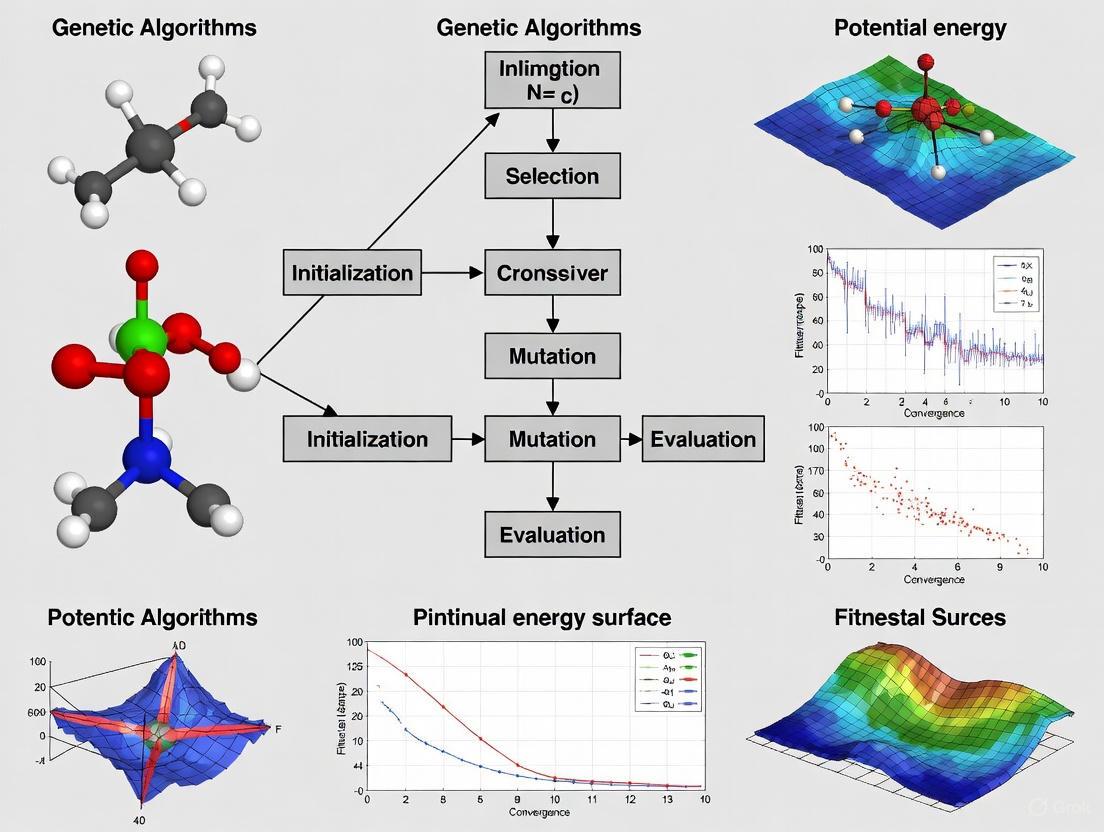
This article provides a comprehensive overview of genetic algorithms (GAs) for locating the global minimum energy structures of molecular clusters, a critical task in computational chemistry and drug discovery.
Global Minimum Search of Molecular Clusters Using Genetic Algorithms: Principles, Optimization, and Applications in Drug Discovery
Abstract
This article provides a comprehensive overview of genetic algorithms (GAs) for locating the global minimum energy structures of molecular clusters, a critical task in computational chemistry and drug discovery. It covers foundational principles, including how GAs mimic natural selection to navigate complex energy landscapes. The article details methodological advances, such as specialized crossover operators and parallel computing implementations, which enhance efficiency and scalability. It also addresses common troubleshooting and optimization strategies to overcome convergence challenges and explores validation protocols and performance comparisons with other global optimization techniques. Aimed at researchers and drug development professionals, this review synthesizes current knowledge to guide the effective application of GAs in predicting stable molecular configurations and accelerating rational drug design.
The Foundations of Genetic Algorithms in Molecular Optimization
Global optimization methods are essential for predicting the most stable structures of molecular clusters, which exist in the lowest energy configuration on a complex potential energy surface (PES) [1] [2]. This technical support center addresses common computational challenges, with a specific focus on genetic algorithms (GAs) that evolve populations of candidate structures toward the global minimum [1] [3]. The FAQs and guides below synthesize current methodologies to assist researchers in navigating pitfalls in cluster structure prediction.
Frequently Asked Questions (FAQs)
1. What is the fundamental difference between local and global optimization in this context?
A local minimum is a point where the energy is lower than that of all nearby structures but potentially higher than that of a distant point on the PES. In contrast, the global minimum is the point with the absolutely lowest energy across the entire PES [4]. Standard local optimizers typically converge to the nearest local minimum, while global optimizers like GAs are designed to search across multiple "basins of attraction" to find the true global minimum [4].
2. Why is population diversity critical in a Genetic Algorithm, and how can I maintain it?
Population diversity prevents the algorithm from getting trapped in a local minimum and ensures a representative exploration of the PES [1]. Loss of diversity is a common cause of stagnation. You can maintain it by:
- Incorporating random mutants: Continuously including randomly modified structures in the population, regardless of their immediate fitness [1].
- Structural similarity checks: Implementing measures to eliminate overly similar structures from the population. This can be based on topological information or connectivity tables [1].
- Operator management: Dynamically adjusting the usage rate of different genetic operators based on their performance in generating well-adapted offspring, which helps avoid inefficient search patterns [1] [2].
3. My simulation is not converging to a known global minimum. What could be wrong?
This is a complex issue with several potential causes, which are detailed in the Troubleshooting Guide below. Common problems include poor operator choice, insufficient population diversity, and inadequate sampling of the PES.
4. Which empirical potential should I use for my cluster system?
The choice depends on your system and the trade-off between computational cost and accuracy.
- Lennard-Jones: A simpler potential, often used for general case studies and method benchmarking (e.g., 26- and 55-atom clusters) [1] [2].
- Morse: Another analytic potential used for cluster studies [1].
- REBO (Reactive Empirical Bond Order): A more complex potential suitable for describing covalent systems like carbon clusters (e.g., 18-atom carbon cluster) and graphene PES [1] [2]. For final, high-accuracy results, the best candidates from a GA search are often refined using quantum mechanical approaches like Density Functional Theory (DFT) [3].
Troubleshooting Guides
Table 1: Common GA Convergence Issues and Solutions
| Problem | Possible Cause | Recommended Solution |
|---|---|---|
| Premature Convergence | Loss of population diversity; inefficient genetic operators. | Introduce a "twist" operator; implement a dynamic operator management strategy; enforce a minimum structural difference between individuals [1] [2]. |
| Slow or No Convergence | Poor initial population; operators failing to generate low-energy offspring. | Pre-screen initial structures; increase the application rate of high-performance operators like "twist" or "cut-and-splice"; verify local minimizer settings [1]. |
| Consistently High-Energy Results | Inadequate sampling of the PES; getting stuck in a high-energy basin. | Combine with a basin-hopping methodology; use multiple, independent GA runs with different random seeds; increase population size [1] [3]. |
Table 2: Performance of Common Genetic Operators
The following table summarizes the relative performance of different operators used to create new candidate structures in a GA, as tested on Lennard-Jones clusters. A dynamic management strategy that favors the best-performing operators can significantly improve efficiency [1] [2].
| Operator Name | Type | Relative Performance | Key Characteristics |
|---|---|---|---|
| Twist | Mutation | Excellent | Found to be the fastest operator in generating new individuals [2]. |
| Deaven and Ho Cut-and-Splice | Crossover | Good (Commonly Used) | A standard crossover operator that cuts two parent clusters and splices halves together [1]. |
| Annihilator | Mutation | Good | A specialized operator efficient at escaping deep local minima [1]. |
| History | Memetic | Good | Utilizes information from previously visited structures to guide the search [1]. |
Experimental Protocols
Standard Genetic Algorithm Workflow for Cluster Optimization
This protocol outlines the core steps for a GA aimed at finding the global minimum of a molecular cluster [1] [2].
- Initialization: Generate an initial population of cluster structures, typically with random atomic coordinates.
- Local Minimization: Relax every structure in the population to the nearest local minimum on the PES using a local optimizer (e.g., a gradient-based method) and an empirical potential (e.g., Lennard-Jones or REBO). The energy after minimization is the individual's "fitness."
- Selection: Rank all individuals by their fitness (energy). Eliminate the worst-performing members (e.g., the worst 25%).
- Creation of New Individuals: Apply genetic operators to the surviving individuals to generate new offspring. This is a critical step:
- Crossover (e.g., Deaven and Ho): Combines parts of two parent structures.
- Mutation (e.g., Twist, Annihilator): Randomly modifies a single parent structure.
- Operator Management: Dynamically adjust the probability of using each operator based on its recent success in producing low-energy offspring.
- Iteration: Return to Step 2 with the new, combined population (survivors + new offspring). Repeat for a set number of generations or until convergence criteria are met.
Workflow Diagram
Operator Management Strategy
This advanced protocol describes how to dynamically manage genetic operators to improve GA performance [1] [2].
- Operator Pool: Define a set of genetic operators (O1, O2, ..., O13).
- Track Success: For each operator, track its efficiency in generating well-adapted (low-energy) offspring over recent generations.
- Adjust Rates: Periodically calculate a performance score for each operator.
- Apply New Rates: Use the updated probabilities to select operators for creating the next generation of offspring. This strategy automatically promotes effective operators and suppresses poor ones.
Operator Management Diagram
The Scientist's Toolkit
Table 3: Research Reagent Solutions
This table lists key software and algorithmic "reagents" essential for conducting global optimization studies on molecular clusters.
| Item | Function | Example Use Case |
|---|---|---|
| Genetic Algorithm (GA) | An evolutionary algorithm that evolves a population of cluster structures toward the global minimum by applying selection, crossover, and mutation [1] [3]. | Primary engine for global search of molecular cluster PES. |
| Basin-Hopping (BH) | A stochastic global optimization method that transforms the PES into a collection of "basins" via random steps followed by local minimization [1] [5]. | Can be hybridized with GA or used as an alternative search strategy. |
| Lennard-Jones Potential | An empirical pair potential used to compute the binding energy of clusters for rapid energy evaluation during searches [1] [2]. | Benchmarking and testing new algorithms on model systems (e.g., 38-atom LJ clusters). |
| REBO Potential | A reactive empirical bond-order potential that describes covalent bonding, enabling the study of carbon-based systems like graphene and carbon clusters [1] [2]. | Searching for global minima of carbon nanostructures. |
| Twist Operator | A specific mutation operator that has demonstrated high efficiency in generating well-adapted cluster offspring within a GA [1] [2]. | Dynamic operator management to accelerate convergence. |
| Density Functional Theory (DFT) | A quantum mechanical method used for computing the electronic structure and highly accurate energy of a system [3]. | Final, high-fidelity refinement of low-energy candidate structures identified by the GA. |
A technical guide for researchers navigating the global optimization of molecular clusters
A Technical Support Center for Computational Researchers
This resource provides targeted troubleshooting guidance for researchers applying Genetic Algorithms (GAs) to a critical task in computational chemistry: finding the global minimum energy structure of molecular and atomic clusters. The complex, high-dimensional energy landscapes of these systems present unique challenges that this guide will help you overcome.
Frequently Asked Questions (FAQs)
FAQ 1: What makes GAs suitable for global minimum searches in molecular clusters?
GAs are well-suited for this task because they are a population-based metaheuristic, meaning they explore multiple areas of the potential energy surface (PES) simultaneously [6] [7]. This makes them less likely to become trapped in local minima compared to local optimization methods. By mimicking biological evolution through selection, crossover, and mutation, GAs can efficiently navigate the exponentially large number of possible cluster configurations [8] [7].
FAQ 2: How do I represent a molecular cluster structure within a GA?
A candidate solution (an "individual" in the population) must be encoded to represent a cluster's structure. Common representations include:
- Cartesian Coordinates: Directly using the x, y, z coordinates of all atoms. This is straightforward but can lead to a high-dimensional search space.
- Internal Coordinates: Using bond lengths, angles, and dihedrals.
- Specific-to-Known-Symmetries: Forcing initial random structures to have certain point group symmetries to reduce the search space.
The choice of representation is critical and can significantly impact the algorithm's performance [6].
FAQ 3: Why is my GA converging to a local minimum instead of the global minimum?
Premature convergence is often caused by a loss of population diversity. This can be remedied by:
- Increasing the Mutation Rate: A higher, yet still small, probability of mutation introduces new genetic material [6] [9].
- Using Speciation Heuristics: These techniques penalize crossover between solutions that are too similar, encouraging the population to explore diverse regions of the PES [6].
- Reviewing Selection Pressure: If your selection process is too aggressive (e.g., always selecting only the very best), the population can converge too quickly. Tournament selection with an appropriate size can help balance this [10].
FAQ 4: How do I define an effective fitness function for my cluster?
The fitness function is the driving force of the GA. For molecular cluster geometry optimization, the most common and effective fitness function is the potential energy of the cluster structure. The goal of the GA is to minimize this energy. The energy can be calculated using various methods, from fast empirical potentials (e.g., Gupta, Lennard-Jones) for larger clusters to highly accurate but computationally expensive quantum chemical methods like Density Functional Theory (DFT) or the Density-Functional Tight-Binding (DFTB) method for smaller systems or final refinement [8] [7].
FAQ 5: My fitness function evaluations are computationally expensive. How can I make the search feasible?
This is a primary limitation of GAs in this field [6]. Strategies to manage this include:
- Hybrid Approach: Use a fast, less accurate method (e.g., an empirical force field) for the initial global search. The low-energy candidates found can then be re-optimized with a more accurate method (e.g., DFT) [8] [7].
- Tailored Methods: As demonstrated in recent research, tailoring the computational method to the specific cluster, such as using a tuned DFTB approach for sodium nanoclusters, can enhance reliability and efficiency without the cost of full ab-initio calculations [8].
Troubleshooting Guides
Issue 1: The Algorithm Is Not Improving from Generation to Generation
Problem: The average fitness of the population stagnates early in the search process.
| Possible Cause | Diagnostic Steps | Recommended Solution |
|---|---|---|
| Insufficient population diversity | Calculate the average Hamming distance between individuals in the population. | Increase the population size. Implement a speciation heuristic that discourages mating between overly similar structures [6]. |
| Excessively high selection pressure | Check if the same few individuals are selected as parents repeatedly in early generations. | Switch to a less aggressive selection method (e.g., use a larger tournament size in tournament selection) or increase the influence of crossover and mutation [10]. |
| Ineffective genetic operators | Manually inspect if offspring generated by crossover are valid and viable structures. | Adjust or change your crossover and mutation operators. For cluster optimization, a "surface-based perturbation operator" that randomly adjusts the positions of surface or central atoms has proven effective [11]. |
Issue 2: Finding Duplicate or Symmetrically Equivalent Structures
Problem: Computational resources are wasted on optimizing and evaluating the same fundamental cluster geometry multiple times.
Solution Protocol:
- After each local optimization step, normalize the cluster geometry. This typically involves centering the cluster and aligning it with a principal axis.
- Implement a comparison check. Before a new candidate is added to the population, compare its energy and a geometric fingerprint (e.g., root-mean-square deviation of atomic positions, after accounting for rotational symmetry) against all existing unique candidates.
- Employ a uniqueness threshold. Define a tolerance for energy and geometry differences below which two structures are considered duplicates. Discard duplicates to maintain a diverse set of unique low-energy candidates [7].
Issue 3: Balancing Global Exploration and Local Refinement
Problem: The algorithm finds promising regions of the PES but fails to locate the precise local minimum, or it refines local minima without exploring enough.
Solution: Implement a Hybrid GA-Basin Hopping (BH) strategy. This is a highly effective and common practice in computational chemistry [8] [7].
- GA for Global Exploration: The genetic algorithm operates as the primary global search driver, maintaining a population and using crossover and mutation to explore widely.
- BH for Local Refinement: Every new offspring structure generated by the GA is not evaluated directly. Instead, it is passed to a local optimizer (e.g., using energy gradients) to "quench" it to the nearest local minimum. This transformed the PES into a collection of "basins of attraction."
- Metropolis Criterion: The new, locally minimized structure is accepted or rejected based on the Metropolis criterion from Monte Carlo algorithms, which allows for occasional uphill moves to escape local minima.
The following workflow diagram illustrates this powerful hybrid approach:
The Scientist's Toolkit: Essential Reagents & Methods
The table below details key computational "reagents" used in genetic algorithm searches for molecular cluster structures.
| Item/Reagent | Function in the Experiment | Key Consideration for Researchers |
|---|---|---|
| Potential Energy Function | Acts as the fitness function; evaluates the energy of a given cluster geometry. | Choice is critical. Balance accuracy and speed (e.g., Lennard-Jones for benchmarking [8], Gupta for metals [11], DFTB [8] or DFT [7] for accuracy). |
| Local Optimizer | Refines raw candidate structures to the nearest local minimum on the PES. | Essential for hybrid GA-BH. Methods like L-BFGS are common. The efficiency of the local optimizer greatly impacts total computational cost [7]. |
| Initial Population Generator | Creates the starting set of candidate solutions for generation zero. | Can be purely random or "seeded" with common structural motifs (e.g., icosahedral, decahedral) to bias the search towards chemically plausible regions [6] [12]. |
| Genetic Operators (Crossover/Mutation) | Creates new offspring solutions by combining or perturbing parent solutions. | Must be tailored to the structure representation. Mutation often involves perturbing atomic coordinates, while crossover is more challenging but can swap sub-units of two parent clusters [6] [9]. |
Experimental Protocols & Data Presentation
Benchmarking Your GA: The Lennard-Jones Cluster Protocol
Before applying your GA to a novel chemical system, it is essential to validate it on a system with a known answer. The Lennard-Jones (LJ) cluster is the "fruit fly" of this field [8].
Detailed Methodology:
- Potential: Use the standard Lennard-Jones potential to calculate the cluster's energy.
- Representation: Encode the cluster using the Cartesian coordinates of all atoms.
- Algorithm Execution: Run your hybrid GA-Basin Hopping algorithm on a cluster size where the global minimum is well-established (e.g., LJ38, which is famous for its double-funnel energy landscape).
- Validation: Success is measured by your algorithm's ability to consistently find the known global minimum structure. The efficiency (number of energy evaluations) can be compared to published benchmarks [8].
Parameter Tuning: A Quantitative Guide
The table below summarizes the effect of key GA parameters. Tuning these is often necessary for optimal performance on a specific cluster system.
| Parameter | Effect if Set Too Low | Effect if Set Too High | Recommended Starting Range for Clusters |
|---|---|---|---|
| Population Size | Insufficient exploration of PES; premature convergence. | High computational cost per generation; slow convergence. | 20 - 100 individuals [9]. |
| Mutation Rate | Loss of diversity; convergence to local minima. | Search becomes too random; good solutions are disrupted. | 0.01 - 0.1 (1% - 10%) [6] [12]. |
| Crossover Rate | Relies too heavily on mutation; slow convergence. | Population becomes too homogeneous too quickly. | 0.7 - 0.9 (70% - 90%) [6]. |
| Number of Generations | Algorithm terminates before finding a good solution. | Wasted computational resources on diminishing returns. | 100 - 1000+ (use a convergence criterion) [12]. |
Core Workflow of a Genetic Algorithm
The following diagram outlines the fundamental generational cycle of a standard genetic algorithm, which forms the backbone of the more sophisticated hybrid approaches.
Troubleshooting Guide: Common Issues in Genetic Algorithm Implementation
Problem 1: Premature Convergence
- Symptoms: The algorithm quickly converges on a solution that is a local, not global, minimum. Population diversity drops rapidly.
- Causes: High selection pressure from a few "super" individuals, or ineffective operators that fail to generate novel structures.
- Solutions:
- Implement a fitness scaling strategy during selection to temper dominance of high-fitness individuals early on [13]. The selection probability can be calculated as
p(sh)=exp(f(sh)/T) / Σ exp(f(sh)/T), where a cooling temperatureThelps maintain diversity. - Dynamically manage operator rates, increasing the creation rate of operators that produce fit offspring and decreasing rates for poorly performing ones [2].
- Introduce a niche technique or enforce a minimum energy difference between structures to maintain population diversity [2].
- Implement a fitness scaling strategy during selection to temper dominance of high-fitness individuals early on [13]. The selection probability can be calculated as
Problem 2: Inefficient Exploration of the Potential Energy Surface (PES)
- Symptoms: The algorithm fails to find lower-energy regions, even after many generations.
- Causes: Operators lack the creativity to generate significantly new geometries; population becomes too homogeneous.
- Solutions:
- Incorporate a random mutation operator that guarantees a portion of the population is always composed of randomly modified structures, ensuring a baseline level of PES exploration [2].
- Use a similarity measure (e.g., based on cluster topology or connectivity tables) to identify and eliminate overly similar structures, forcing exploration of new regions [2].
- Combine GA with a local search method (e.g., gradient-based minimization) to refine individuals and quickly find the nearest local minimum on the PES [8] [2].
Problem 3: High Computational Cost of Fitness Evaluation
- Symptoms: Each generation takes prohibitively long, slowing overall research progress.
- Causes: Using computationally expensive ab initio methods for every energy evaluation on every candidate structure.
- Solutions:
- Employ a two-step optimization process. Use a fast, empirical potential (e.g., Lennard-Jones, REBO) or semi-empirical method (e.g., Density-Functional Tight-Binding, DFTB) for the global search, and refine the final candidates with more accurate (e.g., DFT) methods [8] [2].
- Implement a pre-screening step to eliminate structures with a high probability of convergence failure before they undergo costly local minimization [2].
Frequently Asked Questions (FAQs)
Q1: What is the most critical component for the success of a Genetic Algorithm in this field? A1: While all components are important, maintaining population diversity is paramount. Without it, the algorithm cannot effectively explore the complex Potential Energy Surface and will likely become trapped in a local minimum. This requires a careful balance between the fitness function, selection pressure, and a set of operators that can generate novel structures [2].
Q2: How do I choose a fitness function for my molecular cluster system? A2: The fitness function must be aligned with your research goal of finding the global minimum. For most studies, this is directly related to the potential energy of the cluster configuration. However, for specific applications, you might use a function that combines energy with other properties. In clustering analysis, a function like the Variance Ratio Criterion (VRC) can be used to maximize between-cluster variance and minimize within-cluster variance [13].
Q3: What is a good genetic representation for a nanocluster?
A3: A common and effective representation is the Cartesian coordinates of the atoms within a defined center of mass. This representation works well with crossover and mutation operators that manipulate atomic positions [2]. For medoid-based clustering problems, a string of cluster medoids [m1, m2, ..., mk] can be an effective representation [13].
Q4: My algorithm is stalling. Which operators should I try to improve performance? A4: Research indicates that the twist operator can outperform other common operators. Also, do not hesitate to integrate operators from other optimization methods, such as basin-hopping, into your GA. The key is to use a diverse set of operators and consider implementing a management strategy that dynamically favors the ones proving most effective at generating low-energy offspring [2].
Q5: How can I validate that my GA has truly found the global minimum? A5: There is no absolute guarantee for complex systems, but you can increase confidence by: - Comparing your result against known global minima for standard test systems (e.g., Lennard-Jones clusters) [8]. - Running the algorithm multiple times with different random seeds and checking for consistency in the final result. - Using the putative global minimum as a starting point for high-level, more accurate quantum chemical calculations to confirm its stability [8] [7].
Essential Components: Data Tables
Table 1: Common Genetic Operators for Molecular Clusters
| Operator Name | Type | Function | Key Parameter(s) |
|---|---|---|---|
| Deaven and Ho Cut-and-Splice [2] | Crossover | Cuts two parent clusters with a plane and splices halves to create an offspring. | Cutting plane position. |
| Twist [2] | Crossover | Rotates a subsection of a cluster. | Rotation axis and angle. |
| Mutation [13] [2] | Mutation | Randomly modifies an individual's genes (e.g., atom coordinates). | Mutation probability (pm). |
| Annihilator [2] | Specialized | Removes worst part of a cluster. | - |
| History [2] | Specialized | Reuses building blocks from successful historical structures. | - |
Table 2: Fitness Functions and Evaluation Methods
| Function Name | Formula / Description | Application Context |
|---|---|---|
| Potential Energy | E_total = Σ Σ V(rij) |
Primary fitness function for global minimum search of molecular/atomic clusters [8] [2]. |
| Variance Ratio Criterion (VRC) | f(sh) = [trace(B)/(k-1)] / [trace(W)/(n-k)] |
Fitness function for medoid-based clustering; maximizes between-cluster (B) vs. within-cluster (W) variance [13]. |
| DFTB Energy | DFTB method with tuned parameters. | Fast, semi-empirical electronic structure method for fitness evaluation in large sodium nanoclusters [8]. |
Experimental Protocol: A Standard GA for Cluster Optimization
The following methodology outlines a standard Genetic Algorithm procedure for finding the global minimum structure of a molecular cluster, as described in research [2].
Initialization
- Generate an initial population of
pindividuals (cluster structures). This is often done by creating random atomic coordinates within a defined volume. - The population size
pis a fixed parameter set by the researcher.
- Generate an initial population of
Evaluation and Selection
- Fitness Calculation: For each individual in the population, perform a local geometry optimization (e.g., using gradient descent) to find the nearest local minimum on the PES. The fitness is typically the potential energy of this minimized structure, calculated via an empirical potential or a quantum method [8] [2].
- Selection and Culling: Rank all individuals according to their fitness (lowest energy is best). A common strategy is to eliminate the worst 25% of the population [2].
Creation of New Individuals
- Operator Application: Use a set of genetic operators (see Table 1) on the surviving individuals to generate new offspring clusters and repopulate the system.
- Operator Management (Advanced): Implement a dynamic management system that tracks the performance of each operator in producing fit offspring. Adjust the rate at which each operator is used accordingly [2].
- Diversity Check: Employ a similarity measure (e.g., based on cluster topology or interatomic distances) to prevent the population from becoming saturated with identical or nearly identical structures. Replace duplicates with new random individuals [2].
Termination
- The process of evaluation, selection, and creation is repeated for a fixed number of generations (
G) or until a convergence criterion is met (e.g., no improvement in the best fitness for a certain number of generations). - The chromosome with the best fitness across all generations is reported as the putative global minimum [13].
- The process of evaluation, selection, and creation is repeated for a fixed number of generations (
Workflow Visualization
The Scientist's Toolkit: Research Reagent Solutions
Table 3: Essential Software and Computational Tools
| Tool / "Reagent" | Function / Purpose | Key Feature |
|---|---|---|
| DFTB+ [8] | Energy & Force Calculation: A semi-empirical quantum method used for fitness evaluation. | Faster than DFT, with parameters tuned for specific clusters (e.g., sodium). |
| GATOR [8] | Crystal Structure Prediction: A first-principles genetic algorithm for molecular crystals. | Integrates GA with quantum mechanical calculations. |
| Birmingham Cluster GA (BCGA) [2] | Genetic Algorithm Engine: A specialized GA for cluster geometry optimization. | Can be coupled with electronic structure packages like PWscf. |
| SciPy [8] | Scientific Computing: Provides fundamental algorithms for optimization and linear algebra. | A core library for building or supporting custom GA workflows in Python. |
| FASP [8] | Parameterization: A framework for automating Slater-Koster file parameterization for DFTB. | Ensures reliability of the DFTB method for specific nanoclusters. |
Frequently Asked Questions (FAQs)
Q1: What is the fundamental principle behind the Building Block Hypothesis (BBH) in Genetic Algorithms?
The Building Block Hypothesis (BBH) proposes that Genetic Algorithms (GAs) achieve adaptation by implicitly identifying, combining, and promoting low-order, short, and highly-fit schema, known as "building blocks" [6]. Through iterative selection, crossover, and mutation, a GA samples these building blocks and recombines them into strings of potentially higher fitness [6]. This process is analogous to constructing a complex structure from simpler, high-quality components, thereby reducing the problem's complexity by leveraging the best partial solutions discovered in past generations [6].
Q2: Why is population diversity critical in GA for molecular cluster searches, and how can it be maintained?
Population diversity is essential to prevent premature convergence on local optima, which is a significant risk when navigating the complex, multimodal potential energy surfaces (PES) of molecular clusters [2] [6]. A diverse population ensures a more extensive exploration of the PES. Strategies to maintain diversity include:
- Speciation Heuristics: Penalizing crossover between overly similar candidate solutions to encourage population variety [6].
- Structural Similarity Checking: Using topological information or connectivity tables to estimate dissimilarity between cluster structures, helping to balance diversity and convergence efficiency [2].
- Managed Operators: Dynamically adjusting the application rate of different evolutionary operators based on their performance in generating well-adapted offspring, effectively phasing out ineffective operators [2].
Q3: My GA is converging rapidly but to a suboptimal solution. What could be going wrong?
Rapid convergence to a suboptimal solution often indicates that the algorithm is trapped in a local optimum [6]. This is a common limitation of GAs, particularly on complex fitness landscapes. Troubleshooting steps include:
- Increase Mutation Probability: A higher mutation rate can introduce new genetic material and help the population escape local optima. However, if set too high, it can destroy good solutions, so tuning is necessary [6].
- Review Selection Pressure: Ensure your selection process is not overly greedy. Incorporating less fit solutions into the breeding pool can preserve genetic diversity [6].
- Implement Diversity-Preserving Heuristics: Techniques like speciation or niching can explicitly maintain a diverse population [6].
- Adjust Operator Rates: A recombination (crossover) rate that is too high can lead to premature convergence. Experiment with balancing crossover and mutation rates [6].
Q4: How do I choose an appropriate fitness function for a molecular cluster optimization problem?
The fitness function is always problem-dependent [6]. For molecular cluster global minimum searches, the most common and direct fitness function is the potential energy of the cluster structure [2]. The objective is to find the global minimum on the Potential Energy Surface (PES). Therefore, the fitness function is typically the negative of the cluster's energy as computed by an empirical potential (e.g., Lennard-Jones, Morse, or REBO potentials) or a quantum mechanics method [2]. The algorithm then seeks to maximize this fitness (i.e., minimize the energy).
Troubleshooting Common GA Experimental Issues
Table 1: Common GA Issues and Proposed Solutions in Molecular Cluster Research
| Problem | Possible Causes | Recommended Solutions |
|---|---|---|
| Premature Convergence | Low population diversity, excessive selection pressure, insufficient mutation [6]. | Implement speciation heuristics [6]; use dynamic operator management [2]; increase mutation rate; introduce a portion of random mutants [2]. |
| Slow Convergence | Poorly performing operators, inadequate fitness function, population size too large [6]. | Profile and manage operator performance [2]; tune parameters (mutation probability, crossover rate) [6]; ensure fitness function is not computationally prohibitive [6]. |
| Failure to Find Global Minimum | Problem complexity, exponential search space, operators not effectively exploring PES [2] [6]. | Hybridize GA with local search methods (e.g., basin-hopping) [2]; use topological structure similarity checks to enhance PES exploration [2]; experiment with advanced operators (e.g., "twist" operator) [2]. |
| High Computational Cost | Expensive fitness function evaluations (e.g., quantum calculations for large clusters) [6]. | Use empirical potentials for initial screening [2]; employ fitness approximation models; pre-screen structures likely to have high energy before full evaluation [2]. |
Experimental Protocols & Workflows
Standard Genetic Algorithm Protocol for Cluster Optimization
The following outlines a standard GA procedure for finding the global minimum structure of atomic or molecular clusters, as drawn from the literature [2].
Initialization:
Selection:
- Evaluate the fitness (e.g., the negative of the potential energy) of every individual in the population [2] [6].
- Rank all individuals according to their fitness.
- Select the fittest individuals for breeding. A common strategy is to eliminate a portion of the worst individuals (e.g., the worst 25%) [2].
Creation of New Individuals:
- Apply genetic operators to the selected individuals to generate new offspring for the next generation. Key operators include:
- Crossover (Recombination): Combine parts of two "parent" clusters to form a "child" cluster. The Deaven and Ho cut-and-splice crossover is a commonly used operator in this field [2].
- Mutation: Randomly alter a cluster's structure to introduce new genetic material. This can include atomic displacements or more complex transformations [6].
- Advanced Operators: The "twist" operator has been shown to perform well for cluster geometry optimization [2].
- A management strategy can be implemented to dynamically adjust the rate at which different operators are used based on their performance in creating well-adapted offspring [2].
- Apply genetic operators to the selected individuals to generate new offspring for the next generation. Key operators include:
Termination:
- This generational process (steps 2-3) is repeated until a termination condition is met. Common conditions include [6]:
- A solution is found that satisfies minimum criteria (e.g., energy below a threshold).
- A maximum number of generations has been produced.
- The highest ranking solution's fitness has reached a plateau.
- This generational process (steps 2-3) is repeated until a termination condition is met. Common conditions include [6]:
Protocol: Dynamic Management of Evolutionary Operators
This advanced protocol aims to improve GA efficiency by dynamically prioritizing the most effective operators [2].
Define Operator Pool: Assemble a set of evolutionary operators (e.g., o1, o2, ..., o13), which can include various crossover, mutation, and other structure-generating methods [2].
Initialization: Assign equal creation rates to all operators at the start of the algorithm.
Performance Tracking: During the GA run, track the performance of each operator by evaluating the fitness of the offspring it generates.
Dynamic Adjustment: Periodically adjust the creation rate of each operator:
- Increase the rate for operators that consistently produce well-adapted (high-fitness) offspring.
- Decrease the rate for operators that poorly fulfill the task of creating favorable new individuals.
Iteration: Continue the GA process with the updated operator creation rates, allowing the algorithm to automatically focus on the most effective search strategies for the specific PES.
The Scientist's Toolkit: Essential Research Reagents
Table 2: Key Computational "Reagents" for GA-based Cluster Optimization
| Item / Concept | Function / Role in the Experiment | Example / Notes |
|---|---|---|
| Potential Energy Surface (PES) | The hyper-surface representing the energy of a cluster as a function of its atomic coordinates. The landscape the GA navigates [2]. | Defined by empirical potentials (e.g., Lennard-Jones) or quantum mechanics methods [2]. |
| Genetic Representation (Genotype) | The encoding of a cluster's structure into a format manipulable by the GA [6]. | Can be a string of atomic coordinates, a bit string, or a more complex tree/graph representation [6]. |
| Fitness Function | The function that evaluates the quality of a candidate solution (cluster structure) [6]. | Typically the negative of the cluster's potential energy [2]. |
| Selection Operator | The mechanism for choosing which individuals from the current generation get to reproduce [6]. | Fitness-proportional selection, tournament selection, or truncation selection (e.g., removing the worst 25%) [2] [6]. |
| Crossover/Recombination Operators | Combine parts of two or more parent structures to create new offspring, exploiting existing building blocks [2] [6]. | Deaven and Ho cut-and-splice [2]; "Twist" operator [2]. |
| Mutation Operators | Introduce random changes to a single structure, exploring new regions of the PES and maintaining diversity [6]. | Atomic displacement, rotation of a sub-cluster, or bond alteration. |
Why Molecular Clusters? The Critical Importance of Global Minimum Structures in Drug Discovery
FAQs: Navigating Global Minimum Challenges in Molecular Clustering
1. Why is finding the global minimum (GM) structure so critical for molecular clusters in drug discovery?
The global minimum represents the most thermodynamically stable configuration of a molecular system. In drug discovery, accurately predicting this structure is essential because it dictates a molecule's properties, including its thermodynamic stability, reactivity, spectroscopic behavior, and, most importantly, its biological activity [7]. The equilibrium conformer, often the global minimum, is typically the most representative structure at room temperature and is key to understanding how a drug candidate will interact with its biological target [14].
2. How can I be confident that my computational search has found the true global minimum?
For non-trivial molecules, it is challenging to be absolutely certain. However, several strategies can build confidence:
- Restart from Different Points: Conduct multiple searches from diverse initial conformations. If different starting points converge on the same "global minimum," it indicates the algorithm is spanning the conformational space effectively [14].
- Compare Algorithms: Using a different search algorithm (e.g., comparing a Monte Carlo result with a systematic search) can serve as a validation check [14].
- Use Management Strategies: Advanced algorithms, like some modern Genetic Algorithms (GAs), dynamically manage evolutionary operators to avoid inefficiency and improve the exploration of the potential energy surface (PES) [2].
3. My search keeps getting stuck in local minima. What are my options?
This is a common challenge due to the exponentially growing number of local minima on the PES. Potential solutions include:
- Adjust Algorithm Parameters: Increase the search "fold count" or use simulated annealing to allow the system to escape local minima by initially accepting higher-energy configurations [14].
- Adopt a Hybrid Strategy: Combine global exploration with local refinement. A typical workflow involves a stochastic global search (e.g., Monte Carlo, Genetic Algorithm) to identify candidate structures, followed by local optimization to refine them to the nearest minimum [7].
- Employ Advanced Techniques: Methods like basin-hopping (BH) transform the PES into a collection of local minima, simplifying the landscape for more efficient global exploration [7] [15].
4. When should I use a stochastic method versus a deterministic one?
The choice depends on your system and the guarantee you need.
- Stochastic Methods (e.g., Genetic Algorithms, Simulated Annealing): These incorporate randomness and are ideal for exploring complex, high-dimensional energy landscapes. They do not guarantee finding the GM but are excellent for broad sampling and avoiding premature convergence [7].
- Deterministic Methods (e.g., some Single-Ended methods, Molecular Dynamics): These rely on defined rules and analytical information like energy gradients. They can offer precise convergence but may become computationally expensive for systems with many local minima and cannot guarantee finding the GM for large systems without exhaustive, and often infeasible, searching [7].
5. Is the global minimum always the most important structure for my study?
Not necessarily. While the global minimum is crucial for understanding thermodynamic stability, "what conformation is 'best' depends on what you are looking for" [14]. Other low-energy minima might be functionally relevant if they are accessible at room temperature. Furthermore, factors like solvent effects and the accuracy of the theoretical method used can shift the relative stability of conformers [14].
Troubleshooting Guide: Common Issues in Global Optimization
| Problem | Potential Cause | Recommended Solution |
|---|---|---|
| Failed Convergence | Algorithm stuck in a local minimum. | Switch from a purely local optimizer to a global search method. Combine stochastic global search (e.g., GA) with local refinement [7]. |
| Inconsistent Results | Search results vary with different starting conformations. | Perform multiple independent searches from random initial structures. If they yield the same GM, it increases confidence [14]. Use algorithms like CSA that explicitly control population diversity [16]. |
| Low Population Diversity (in GAs) | Population becomes too similar, halting exploration. | Implement a similarity check using connectivity tables or fingerprint-based distances to eliminate redundant structures [2]. Introduce random "mutant" structures to maintain diversity [2]. |
| Computational Cost Too High | Using high-level quantum methods (e.g., DFT) for the entire search. | Adopt a multi-step strategy: use a fast molecular mechanics force field (e.g., MMFF) to generate low-energy conformers, then re-optimize the promising candidates at the desired quantum mechanics (QM) level [14] [17]. |
| Invalid Structures Generated | Particularly when using SMILES-based GA with random crossover/mutation. | Use robust algorithms like MolFinder that employ sophisticated selection and distance constraints to maintain valid and diverse molecules [16]. |
Experimental Protocols & Workflows
Standard Two-Phase Global Optimization Protocol
This is a widely used framework that combines global search with local refinement [7].
Step 1: Initial Population Generation
- Generate a diverse set of initial candidate structures using random sampling, physically motivated perturbations, or heuristic design.
Step 2: Global Search
- Employ a stochastic algorithm (e.g., Genetic Algorithm, Monte Carlo, Particle Swarm Optimization) to broadly explore the Potential Energy Surface (PES).
- Genetic Algorithm Specifics: The population is evolved using operators like crossover (cut-and-splice) and mutation (twist, annihilator) to create new candidate structures [2].
Step 3: Local Refinement
- Each candidate structure from the global search is locally optimized using a method that leverages energy gradients (e.g., density functional theory - DFT) to find the nearest local minimum on the PES.
Step 4: Redundancy Removal and Validation
- Remove duplicate or symmetrically equivalent structures.
- Perform frequency analysis to confirm each candidate is a true minimum (not a saddle point).
- The structure with the lowest energy is designated the putative global minimum.
Advanced Genetic Algorithm with Operator Management
This protocol details a refined GA that dynamically optimizes its search operators for efficiency [2].
Step 1: Initialization and Selection
- Generate an initial population of cluster structures.
- Rank all individuals by their fitness (e.g., binding energy calculated via an empirical potential like Lennard-Jones or REBO).
- Eliminate the worst-performing individuals (e.g., bottom 25%).
Step 2: Managed Creation of New Individuals
- Operator Pool: Maintain a set of operators (e.g., Deaven and Ho cut-and-splice, twist, annihilator).
- Performance Tracking: Monitor the efficiency of each operator in generating well-adapted offspring.
- Dynamic Rates: Increase the application rate of high-performing operators and decrease that of poorly performing ones. This management strategy avoids bad operators and improves overall performance.
Step 3: Similarity Checking and Diversity Maintenance
- Apply a similarity check (e.g., using a connectivity table or ultrafast shape recognition - USR) to new structures [2] [15].
- Reject new structures that are too similar to existing ones in the population to maintain diversity and prevent stagnation.
The Scientist's Toolkit: Research Reagent Solutions
Table: Essential Computational Tools for Global Minimum Search
| Tool / Resource | Function | Application Note |
|---|---|---|
| Genetic Algorithm (GA) | A population-based stochastic method inspired by evolution, using selection, crossover, and mutation. | Highly effective for atomic/molecular clusters and protein folding. Performance is enhanced by managing operator rates and ensuring population diversity [2]. |
| Basin-Hopping (BH) | Transforms the PES into a set of interpenetrating staircases, simplifying the search for minima. | Excellent for locating GM of Lennard-Jones clusters. Can be combined with xTB or DFT methods for more complex systems [7] [15]. |
| Monte Carlo with Simulated Annealing | A stochastic method that uses a temperature schedule to allow escape from local minima. | Useful for conformer sampling of drug-sized organic molecules. The temperature ramp helps explore the space broadly before cooling into low-energy wells [14]. |
| Machine Learning Potentials (e.g., NequIP) | Graph neural network potentials trained on DFT data for highly accurate and faster energy/force calculations. | Used for pre-screening and in simulated annealing procedures to discover new low-energy conformers of metal clusters like Pt19 and Pt20 [17]. |
| xTB (Extended Tight Binding) | A fast, semi-empirical quantum chemical method. | Serves as an efficient engine for local optimization within a BH or GA workflow, enabling the screening of thousands of structures before final refinement with higher-level DFT [15]. |
| Conformational Space Annealing (CSA) | A global optimization algorithm blending GA, simulated annealing, and Monte Carlo minimization. | The core of MolFinder, it extensively explores chemical space using SMILES representation and is effective for molecular property optimization without prior training [16]. |
Implementing Genetic Algorithms: From Theory to Practice in Molecular Design
Frequently Asked Questions (FAQs)
FAQ 1: Why should I use a Genetic Algorithm instead of a simpler local search method for my molecular cluster optimization?
Genetic Algorithms (GAs) are globally oriented search methods and are particularly useful when the objective function contains multiple local optima and other irregularities [18]. Unless an analytical solution exists, the only method guaranteed to find the global minimum is a complete search of the parameter space, which is often impractical for high-dimensional problems [19]. GAs can find objective function values close to the global minimum [18] and are less likely to get trapped in suboptimal local minima compared to simple descent algorithms, which can converge on incorrect parameter values (e.g., double the correct spacing in a peak-fitting model) if not initialized in the region of the global optimum [19].
FAQ 2: My GA converges too quickly and seems stuck in a local optimum. What protocol changes can I make to improve exploration?
Quick convergence often indicates a lack of population diversity. The REvoLd algorithm implemented several protocol changes to offset this effect [20]:
- Increase Crossovers: Enforce more variance and recombination between well-suited ligands.
- Introduce Diversity Mutations: Add a mutation step that switches single fragments to low-similarity alternatives, keeping well-performing parts intact but enforcing significant changes on small parts.
- Vary Reactions: Implement a mutation that changes the reaction of a molecule and searches for similar fragments within the new reaction group to open larger parts of the combinatorial space.
- Promote Lower-Fitness Solutions: Introduce a second round of crossover and mutation that excludes the fittest molecules, allowing worse-scoring ligands to improve and carry their molecular information forward [20].
FAQ 3: How do I determine the right population size and number of generations for my run?
These parameters depend on your problem's complexity and computational budget. Based on benchmarks from a drug discovery context [20]:
- Population Size: A random start population of 200 ligands often provides enough variety to begin the optimization process. Larger sizes increase runtime costs, while smaller populations may be too homogeneous and hinder exploration.
- Generations: About 30 generations often strikes a good balance. Good solutions are usually found after 15 generations, but discovery rates flatten around 30. The algorithm may continue to find new molecules after many more generations, but hit rates diminish. For broader exploration, multiple independent runs are advised over a single, very long run [20].
FAQ 4: What are the most critical genetic operators to focus on for molecular optimization?
The core operators are selection, crossover, and mutation, and their balance is key.
- Selection: A portion of the existing population is selected to breed a new generation, typically based on a fitness-based process where fitter solutions are more likely to be selected [6].
- Crossover (Recombination): This operator combines the "genetic material" of two parent solutions to produce new "child" solutions [6]. For molecular problems, increasing crossovers between fit molecules can enforce more variance [20].
- Mutation: This operator randomly alters a candidate solution's genome to maintain genetic diversity [6]. It is crucial for jumping out of local minima and exploring new areas of the chemical space. Tuning the mutation probability is essential, as a rate that is too high may destroy good solutions, while a rate that is too low may lead to genetic drift [6].
FAQ 5: My algorithm is not discovering the single best-scoring compound. Is this a failure?
Not necessarily. For structure-based computer-aided drug discovery campaigns, the goal is rarely to find a single best-scoring compound. It is more important to discover many promising compounds that will enrich hit rates in subsequent in-vitro experiments [20]. Meta-heuristic optimization algorithms like GAs often find close-to-optimal solutions, and the ruggedness of the scoring landscape can trap runs in local minima. Therefore, generating a diverse set of high-quality candidates is often more valuable than finding the theoretical global minimum.
Troubleshooting Guides
Issue 1: Premature Convergence
Problem: The algorithm's population becomes homogeneous too quickly, leading to convergence on a suboptimal solution.
| Checkpoint | Action |
|---|---|
| Population Diversity | Check the genetic diversity in the population. Introduce a speciation heuristic that penalizes crossover between candidate solutions that are too similar to encourage population diversity [6]. |
| Mutation Rate | Increase the mutation probability to introduce more random variations. Be cautious, as a rate that is too high may lead to the loss of good solutions unless elitist selection is employed [6]. |
| Selection Pressure | Review your selection method. If it is too aggressively biased towards the fittest individuals, the population may lose diversity rapidly. Allow some less-fit solutions to reproduce to maintain a diverse genetic pool [6]. |
Issue 2: Failure to Find High-Quality Hits
Problem: The algorithm runs but fails to produce candidate solutions with satisfactory fitness scores.
| Checkpoint | Action |
|---|---|
| Initial Population | Ensure your initial population is large enough (e.g., 200 individuals [20]) and is generated with sufficient randomness to cover a broad search space. Occasionally, solutions can be "seeded" in areas where optimal solutions are likely to be found [6]. |
| Fitness Function | Verify that your fitness function accurately reflects the problem's objectives. In some cases, a simulation may be used to determine fitness, but this can be computationally expensive [6]. |
| Genetic Operators | Re-evaluate the balance between crossover and mutation. Some research suggests that using more than two "parents" can generate higher quality chromosomes [6]. Also, consider implementing the advanced mutation steps from REvoLd that promote greater exploration [20]. |
Issue 3: Prohibitive Computational Time
Problem: The fitness function evaluation for complex molecular problems is too slow, making the GA run impractical.
| Checkpoint | Action |
|---|---|
| Fitness Evaluation | This is often the most prohibitive segment. Consider using an approximated fitness function that is computationally efficient, such as a pre-computed model or a less rigorous simulation [6]. |
| Termination Criteria | Implement clear and efficient termination conditions, such as a fixed number of generations, a allocated budget (computation time), or when the highest ranking solution's fitness reaches a plateau [6]. |
| Protocol | Use a combination of an initial search using the GA for broad exploration, followed by fine-tuning using a more direct, local search technique to converge efficiently on the best candidates [18]. |
Experimental Protocols & Data
Table 1: Key Genetic Algorithm Parameters for Molecular Optimization
This table summarizes parameters and their recommended values based on benchmarking in evolutionary ligand docking [20].
| Parameter | Recommended Value | Function & Rationale |
|---|---|---|
| Population Size | 200 | Provides sufficient genetic variety to start optimization without excessive computational cost [20]. |
| Generations | 30 | A good balance between convergence and exploration; good solutions often appear by generation 15 [20]. |
| Individuals Advancing | 50 | Carries forward a pool of solutions that is large enough to avoid homogeneity but small enough to be effective [20]. |
| Mutation Probability | Problem-dependent | Must be tuned; too high loses good solutions, too low causes genetic drift. Elitist selection can help mitigate loss of good solutions [6]. |
| Crossover Probability | Problem-dependent | Must be tuned; a rate that is too high may lead to premature convergence [6]. |
Table 2: Benchmark Performance of an Evolutionary Algorithm (REvoLd) in Drug Discovery
This table shows the performance of the REvoLd evolutionary algorithm in a realistic benchmark on five drug targets using an ultra-large chemical space [20].
| Metric | Result | Context & Explanation |
|---|---|---|
| Molecules Docked per Target | 49,000 - 76,000 | Total unique molecules docked across 20 runs per target. The variation is due to the stochastic nature of the algorithm producing different numbers of duplicates [20]. |
| Hit Rate Improvement | 869x - 1622x | Improvement factor compared to random selection, demonstrating strong enrichment for promising compounds [20]. |
| New Scaffold Discovery | Ongoing after 30 generations | The algorithm does not fully converge and continues to discover new well-scored motifs in independent runs, recommending multiple runs for diverse results [20]. |
Workflow Visualization
Genetic Algorithm Workflow for Molecular Clusters
The Scientist's Toolkit: Essential Research Reagents & Solutions
Table 3: Key Reagents and Computational Tools for GA-driven Molecular Optimization
| Item Name | Function & Explanation |
|---|---|
| Rosetta Software Suite | A comprehensive platform for macromolecular modeling. It includes RosettaLigand, which allows for flexible protein-ligand docking, a common fitness evaluator in evolutionary drug discovery algorithms like REvoLd [20]. |
| Combinatorial Chemical Library | A make-on-demand library constructed from lists of substrates and chemical reactions (e.g., Enamine REAL Space). It defines the vast search space of synthesizable molecules that the GA will explore [20]. |
| Cheminformatics Toolkit | A software library (e.g., Avalon Cheminformatics Toolkit, RDKit) for parsing molecular SMILES codes, handling chemical representations, and depicting structures. Essential for processing the molecular data [21]. |
| Fitness Function | The objective function that the GA aims to optimize. In molecular docking, this is often a scoring function that estimates the binding affinity between a ligand and a target protein. Its design is critical to the algorithm's success [6]. |
| Clustering Algorithm | A method like γ-clustering used to analyze and preprocess complex molecular networks. It can identify dense substructures (clusters) to simplify the visualization and analysis of results, making them more interpretable [22]. |
Frequently Asked Questions (FAQs)
Q1: What is the primary advantage of using a managed set of genetic operators over a fixed strategy? Using a dynamic management strategy that evaluates and adjusts the application rate of operators (like cut-and-splice, twist, mutation) based on their performance in generating well-adapted offspring leads to a more efficient exploration of the potential energy surface. This avoids wasting computational resources on less productive operators and can significantly accelerate convergence to the global minimum structure. [2]
Q2: My algorithm is converging prematurely. How can I maintain population diversity? Premature convergence is often a result of lost population diversity. Strategies to mitigate this include:
- Incorporating Random Mutants: Continuously introducing a set of randomly modified structures into the population throughout the evolutionary procedure. [2]
- Similarity Checking: Implementing measures based on topological information or energy differences to prevent overly similar structures from dominating the population. This ensures a balance between optimization performance and exploration. [2]
- Utilizing Niche Techniques: Distributing different types of geometries into niches based on structural characteristics to preserve a variety of solutions. [2]
Q3: How can Machine Learning be integrated to reduce the computational cost of fitness evaluations? A Machine Learning-Accelerated Genetic Algorithm (MLaGA) trains a model (e.g., a Gaussian Process regression) on-the-fly to act as a cheap surrogate predictor for the potential energy. This model can be used to screen large numbers of candidate structures in a "nested GA" without performing expensive quantum mechanical calculations. Only the most promising candidates, as predicted by the model, are then passed to the high-level energy calculator (e.g., Density Functional Theory), leading to a dramatic reduction in the total number of energy evaluations required. [23]
Q4: What is a structural motif in the context of molecular clusters, and why is its preservation important? A structural motif is a specific, often stable, arrangement of atoms within a cluster that can be considered a building block. In pre-nucleation clusters, for example, these can consist of specific solvated moieties rather than the units found in the final crystal. [24] Preserving these motifs during crossover and mutation can be critical because they may represent key low-energy configurations. Specialized operators that recognize and conserve these motifs can guide the search more effectively toward the global minimum.
Troubleshooting Guides
Problem: The genetic algorithm fails to find known stable structures.
- Potential Cause 1: Ineffective operator set and rates.
- Solution: Implement an operator management system. Monitor how successfully each operator (cut-and-splice, twist, annihilator, etc.) produces offspring with better fitness. Dynamically increase the application rate of high-performing operators and decrease the rate of poor performers. [2]
- Potential Cause 2: Lack of structural diversity in the population.
- Solution: Enforce diversity by integrating a similarity check. Reject new candidates that are structurally too similar to existing individuals in the population based on topological descriptors or energy thresholds. [2]
- Potential Cause 3: Over-reliance on random search due to an inefficient surrogate model.
- Solution: In an MLaGA, use the model's prediction uncertainty. Employ acquisition functions like the cumulative distribution function to balance exploration (trying uncertain regions) and exploitation (refining known good regions) during the surrogate-based search. [23]
Problem: The computational cost of energy evaluations (e.g., DFT) is prohibitively high.
- Potential Cause: Using a traditional "brute-force" GA that requires thousands of energy evaluations.
- Solution: Adopt a Machine Learning-Accelerated Genetic Algorithm (MLaGA) framework. This involves:
- On-the-fly Model Training: Train a machine learning model (e.g., Gaussian Process) concurrently with the GA on the data from expensive calculations. [23]
- Surrogate-Based Screening: Use this model as a fast surrogate to evaluate and pre-select candidates in a nested genetic algorithm. [23]
- Selective Validation: Perform the high-cost energy calculation (e.g., DFT) only on the most promising candidates filtered by the surrogate model. This protocol can reduce the number of required energy calculations by 50-fold or more. [23]
- Solution: Adopt a Machine Learning-Accelerated Genetic Algorithm (MLaGA) framework. This involves:
Problem: The algorithm gets stuck in local minima corresponding to common structural motifs.
- Potential Cause: The operators are disrupting key, stable motifs that are essential for reaching the global minimum.
- Solution: Develop or incorporate operators specifically designed to preserve beneficial structural motifs. For example, the "twist" operator has been shown to be highly effective in some systems. [2] Alternatively, implement a local search or "basin-hopping" step after genetic operations to quickly relax candidates to the nearest local minimum, ensuring that promising motifs are not lost due to small structural imperfections. [2]
Genetic Operator Performance Data
The following table summarizes the performance of different operator management strategies in locating the global minimum for a 147-atom Pt-Au icosahedral nanoparticle, a system with a vast search space of ~1.78x10^44 possible homotops. [23]
Table 1: Comparison of GA Strategies for Nanoparticle Alloy Optimization
| Strategy | Key Feature | Number of Energy Calculations (Approx.) | Relative Efficiency |
|---|---|---|---|
| Traditional GA | Standard operators with fixed rates. | 16,000 | Baseline |
| MLaGA (Generational) | ML surrogate screens a full generation of candidates. | 1,200 | ~13x |
| MLaGA (Pool-based) | A new ML model is trained after each energy calculation. | 310 | ~52x |
| MLaGA (With Uncertainty) | Uses prediction uncertainty to guide the search (Pool-based). | 280 | ~57x |
Experimental Protocol: Machine Learning-Accelerated Genetic Algorithm (MLaGA)
This protocol outlines the steps for implementing a generational MLaGA to efficiently search for the global minimum of a molecular cluster. [23]
Initialization:
- Generate an initial population of candidate cluster structures.
- Perform a high-level energy calculation (e.g., using Density Functional Theory - DFT) and local geometry optimization for each candidate in the population.
Master GA Loop (for each generation):
- Selection: Rank all individuals by their actual fitness (energy from DFT) and select the top performers. Eliminate the worst 25%. [2]
- Model Training: Train a Gaussian Process (GP) regression model on the entire dataset of calculated structures and their energies.
- Nested Surrogate GA:
- Create a copy of the current population.
- Run a separate GA using this population, but use the trained GP model to predict the fitness of candidates, not DFT.
- Perform crossover, mutation, and selection based on the predicted fitness for multiple generations within the nested GA.
- Energy Validation:
- Take the final population from the nested GA and perform actual DFT energy calculations and local minimization on these new candidates.
- Add these newly validated structures and their energies to the master population and the training dataset.
Convergence Check:
- The algorithm is considered converged when the nested GA, guided by the ML model, can no longer find new candidates predicted to have a lower energy than the existing best candidates.
Workflow and Operator Function Diagrams
MLaGA Workflow
Genetic Operator Functions
The Scientist's Toolkit: Research Reagent Solutions
Table 2: Essential Computational Tools for Cluster Structure Prediction
| Item / Software | Function / Application | Key Feature |
|---|---|---|
| Density Functional Theory (DFT) | High-accuracy electronic structure calculator for energy and geometry optimization. | Provides quantum-mechanical accuracy; computationally expensive. [23] |
| Empirical Potentials (Lennard-Jones, REBO) | Fast, approximate energy calculator for large systems or initial screening. | Allows for rapid evaluation of many structures; less accurate. [2] |
| Gaussian Process (GP) Regression | Machine learning model used as a surrogate energy predictor in MLaGA. | Provides both a predicted energy and an uncertainty estimate. [23] |
| Birmingham Cluster Genetic Algorithm (BCGA) | A genetic algorithm package specifically designed for cluster optimization. | Can be coupled with external energy calculators like DFT. [2] |
| Structural Alphabet (e.g., from SA-Motifbase) | A library of local structural motifs to classify and compare cluster geometries. | Converts 3D structure into a 1D sequence for efficient analysis and motif discovery. [25] |
Frequently Asked Questions (FAQs)
1. What is the primary advantage of using a Genetic Algorithm (GA) over other global optimization methods for molecular structure prediction?
Genetic Algorithms are stochastic population-based methods that excel at exploring complex, high-dimensional potential energy surfaces (PES). They are less likely to become trapped in local minima compared to deterministic methods, making them particularly suitable for locating the global minimum of molecular clusters and surface reconstructions. Their evolutionary operations (selection, crossover, mutation) allow for a broad exploration of configurational space while exploiting promising regions [7] [8].
2. My GA simulation is converging too quickly to a structure that does not seem to be the global minimum. What parameters can I adjust to improve the search?
Premature convergence often indicates a lack of genetic diversity. You can troubleshoot this by:
- Increasing the Mutation Rate: A higher rate introduces more random structural perturbations, helping the population escape local funnels on the PES.
- Reviewing Selection Pressure: If your selection process is too aggressive (e.g., only selecting the very best candidates), the population diversity can drop rapidly. Consider implementing a roulette-wheel or tournament selection scheme that allows some less-fit individuals to survive and contribute to the gene pool [26].
- Checking Population Size: A small population may not adequately sample the configurational space. Increasing the population size can provide a more diverse starting point for the evolution [8].
3. How can I balance computational cost with accuracy when using electronic structure methods in a GA search?
A common and effective strategy is to use a multi-level approach. The GA search itself can be performed using a fast, semi-empirical method (e.g., Density-Functional Tight-Binding, DFTB) to screen thousands of candidate structures. The most stable low-energy candidates identified by the GA are then refined using more accurate, but computationally expensive, first-principles methods like Density Functional Theory (DFT) [8]. This combines the broad exploration of GA with high-accuracy local refinement.
4. What does a "double-funnel" energy landscape mean, and why is it challenging for optimization?
A double-funnel energy landscape describes a PES with two distinct "funnels" or regions leading to different deep minima. Each funnel may contain many local minima, and the lowest minimum (the global minimum) might be in the narrower, harder-to-find funnel. This is challenging because algorithms can easily become trapped in the wider, more accessible funnel, believing they have found the best structure [8]. GAs, with their stochastic nature, are one of the preferred methods for navigating such complex landscapes.
Troubleshooting Guides
Issue 1: Poor Convergence and Stagnating Objective Function
Problem: The fitness of the best candidate in the population stops improving over multiple generations, indicating the search may be stuck.
| Possible Cause | Diagnostic Steps | Recommended Solution |
|---|---|---|
| Low population diversity | Calculate the average structural similarity (e.g., root-mean-square deviation) between population members. | Increase the mutation rate; introduce new random individuals ("immigration") into the population every few generations [26]. |
| Ineffective crossover operator | Visualize offspring structures to see if crossover produces reasonable, new configurations or mostly disordered structures. | Switch from a cut-and-splice crossover to a maximum common substructure (MCS)-based crossover, which is more chemically aware [27]. |
| Inadequate fitness function | Check if the fitness function is sensitive enough to distinguish between similar, low-energy structures. | Consider adding more terms to the objective function, such as a penalty for high symmetry if seeking defective surfaces, or incorporating multiple properties in a Pareto optimization scheme [27]. |
Issue 2: Infeasible or Unphysical Candidate Structures
Problem: The GA generates a high number of molecular or cluster configurations that are chemically unreasonable, with unrealistic bond lengths or angles.
Solution Workflow:
Explanation:
- Hard Constraints: During the structure generation and mutation phases, implement immediate checks and reject any structure that violates fundamental chemical rules (e.g., atoms too close, impossible bond angles) [8]. This prevents the population from being polluted with nonsensical candidates.
- Soft Constraints: For more subtle issues, add a penalty term to the fitness function (e.g., the total potential energy). For example, a penalty can be applied for significant angle strain or van der Waals overlaps, making such structures less likely to be selected for reproduction [27].
Issue 3: High Computational Cost per Fitness Evaluation
Problem: The electronic structure calculation for each candidate is so slow that the GA cannot explore a sufficiently large area of the configurational space in a reasonable time.
| Strategy | Method | Application Note |
|---|---|---|
| Multi-level Approach | Use a fast method (DFTB, force field) for GA search, then re-optimize top candidates with accurate DFT [8]. | Ensure the low-level method is parameterized for your specific system (e.g., sodium clusters) to ensure reliability [8]. |
| Parallelization | Distribute fitness evaluations across multiple CPU cores or nodes. | GAs are "embarrassingly parallel" as each individual's fitness can be calculated independently. This is the most effective way to speed up the wall-clock time. |
| Machine Learning Potentials | Train a machine learning model on DFT data to replace the expensive quantum mechanics calculator [7] [27]. | Tools like STELLA integrate graph transformer models for fast property prediction, drastically accelerating the search [27]. |
Experimental Protocols & Data
Detailed Methodology: GA for Sodium Nanoclusters
The following protocol is adapted from a study searching for the global minima of sodium nanoclusters [8].
1. Algorithm Initialization:
- Population Generation: Generate an initial population of candidate cluster structures using random seeding or based on known symmetric motifs (e.g., icosahedral, decahedral).
- Representation: Encode each cluster structure as a chromosome, typically represented by the 3D Cartesian coordinates of its atoms.
2. Core Evolutionary Loop:
- Fitness Evaluation: For each candidate in the population, perform a local geometry optimization using a tailored Density-Functional Tight-Binding (DFTB) method. The fitness (or objective function) is the final, optimized potential energy of the cluster. Lower energy indicates higher fitness.
- Selection: Select parent structures for reproduction using a fitness-proportional method (e.g., roulette wheel selection). Clustering-based selection can also be used to maintain structural diversity by picking the best candidate from each cluster [27].
- Crossover (Recombination): Create offspring by combining parts of two parent structures. A common method is "cut-and-splice," where two clusters are cut and recombined to form a new child cluster.
- Mutation: Apply random perturbations to offspring structures. This includes atom displacements, rotation of sub-clusters, or permutation of atom types in nanoalloys. A "gradient-adjusted" mutation that incorporates local gradient information can improve efficiency [8].
3. Termination and Validation:
- The algorithm runs for a predefined number of generations or until the best fitness remains unchanged for a specified period.
- The putative global minimum is validated by comparing its energy and symmetry to known structures and by re-optimizing it with a higher-level DFT calculation.
Performance Comparison: STELLA Framework vs. REINVENT 4
The following data summarizes a case study comparing a metaheuristic framework (STELLA) with a deep learning-based tool (REINVENT 4) in a drug discovery application, highlighting the performance of evolutionary approaches [27].
Table 1: Hit Generation Performance in a PDK1 Inhibitor Case Study
| Metric | REINVENT 4 | STELLA (Genetic Algorithm) |
|---|---|---|
| Total Hit Compounds | 116 | 368 |
| Average Hit Rate | 1.81% per epoch | 5.75% per iteration |
| Mean Docking Score (GOLD PLP Fitness) | 73.37 | 76.80 |
| Mean QED (Drug-Likeness) | 0.75 | 0.75 |
| Unique Scaffolds | Baseline | 161% more |
Visualizing the Optimization Challenge
The following diagram illustrates a complex "double-funnel" energy landscape, a typical scenario that GAs are designed to navigate effectively [7] [8].
The Scientist's Toolkit: Research Reagent Solutions
Table 2: Essential Software and Computational Tools
| Item | Function & Explanation |
|---|---|
| Genetic Algorithm Engine | Core software that manages the population, selection, crossover, and mutation operations. Examples include in-house codes, GAMaterial, or GA modules in SciPy [8]. |
| Electronic Structure Code | Software used for the local optimization and energy calculation of candidate structures. Examples: DFTB+ (for DFTB), Gaussian, ORCA, or VASP (for DFT) [8]. |
| Interatomic Potential | A pre-parameterized potential model (e.g., Tersoff, Lennard-Jones) for rapid energy evaluations, often used in initial screening or for specific systems like carbon-silicon interfaces [28]. |
| Machine Learning Model | A deep learning model (e.g., Graph Transformer) integrated into frameworks like STELLA to quickly predict molecular properties and accelerate the fitness evaluation step [27]. |
| Clustering Algorithm | Used in clustering-based selection to maintain population diversity by grouping structurally similar candidates and selecting the best from each group [27]. |
Frequently Asked Questions (FAQs)
Q1: What are the main parallel Genetic Algorithm (GA) models and which is best suited for molecular cluster optimization?
The two primary models are the Master-Slave GA and the Island Model (Multi-Deme) GA [29] [30].
- Master-Slave GA: A single population is maintained. The computationally intensive task of evaluating individual fitness is distributed across multiple processors. This model is easy to implement and behaves identically to a serial GA, but it is only beneficial when the fitness function is very computationally expensive to evaluate, as it requires constant communication [29].
- Island Model GA: The total population is divided into several sub-populations ("demes" or "islands") that evolve in parallel on different processors [29] [30] [31]. These islands periodically exchange individuals through a process called migration [31]. This model is highly suited for molecular cluster optimization because it better maintains population diversity, helps avoid premature convergence on local minima, and can lead to super-linear speedups [29] [32].
For searching the complex potential energy surface (PES) of molecular clusters, the Island Model is generally preferred due to its superior exploration capabilities [2].
Q2: What is the "migration" policy in an Island Model GA and how do I configure it?
Migration is the process of transferring individuals between islands. Its configuration is critical to balancing exploration and exploitation [31]. The key parameters are detailed in the table below.
Table: Configuration Parameters for Migration in Island Model GAs
| Parameter | Description | Common Settings / Guidelines |
|---|---|---|
| Migration Topology | The pattern of connections that defines which islands can exchange individuals [30] [31]. | • Ring: Slow information spread, high diversity.• Fully Connected: Fast spread, risk of homogenization.• Hypercube: A balanced compromise [31]. |
| Migration Rate | The number or fraction of individuals sent during a migration event [29] [31]. | Often 5-10% of the sub-population. High rates can cause premature convergence [29]. |
| Migration Interval | The number of generations between migration events [31]. | Should be frequent enough to share benefits but not so frequent that it disrupts local evolution. Can be every 10-100 generations. |
| Selection Policy | How individuals are chosen to emigrate from an island [31]. | Typically the best-performing individuals are chosen to spread good solutions. |
| Replacement Policy | How incoming migrants are incorporated into the target island population [31]. | Often the worst-performing or random individuals are replaced. |
Q3: I encountered an error "parfor-loop that is trying to execute on the worker could not be found" when trying to run a GA in parallel. How can I fix this?
This error typically occurs in master-slave parallelization environments (like MATLAB) when the parallel workers cannot access the file containing your fitness function (e.g., the objective function that calculates the energy of a molecular cluster) [33].
- Solution: You must explicitly send the required function files to all parallel workers. For example, in MATLAB, you can use the
addAttachedFilesfunction to ensure all workers have access to your fitness function file (e.g.,FCWithDisc.m) [33]. - Code Example:
Q4: How do I size the population and choose the number of islands for an efficient parallel GA?
Sizing is a critical step for an efficient and reliable parallel GA [29]. The total computational cost is related to the number of islands (k) and the size of each sub-population (n).
- Theoretical Model: There is a fundamental relationship between population size and solution quality [29]. A simple GA must be sized first to achieve the desired solution quality. When parallelized into multiple islands, the sub-population on each island can often be smaller than the required single population size, but there is a lower limit. Deterioration in performance occurs if the sub-population on each processor is too small [29] [32].
- Practical Guidance: The optimal values are problem-dependent. However, studies suggest that for a fixed total number of function evaluations, using multiple islands with moderately sized sub-populations often outperforms a single large population. You should experiment to find the minimum sub-population size that maintains solution quality on your specific molecular cluster problem [32].
Q5: How can I enhance my GA to more efficiently find the global minimum of a molecular cluster's Potential Energy Surface (PES)?
Beyond standard parallelization, several advanced strategies can be employed:
- Hybrid Algorithms: Combine the global search of a parallel GA with a local search algorithm (e.g., basin-hopping) applied to new offspring or migrants. This quickly refines solutions and can dramatically speed up convergence [30] [2].
- Dynamic Operator Management: Instead of using fixed rates for crossover and mutation, track the performance of different genetic operators. Increase the creation rate of operators that successfully generate well-adapted offspring and decrease the rate for poorly performing ones [2].
- Surrogate Models: For extremely expensive energy calculations (e.g., from quantum methods), use local surrogate models (e.g., Radial Basis Functions) on each island to approximate the objective function. The islands can periodically share knowledge to align their search efforts, saving significant computational resources [31].
Troubleshooting Guides
Problem: The algorithm converges prematurely to a local minimum, not the global minimum.
This is a common issue in complex, multimodal search spaces like molecular PES.
Check Population Diversity: The population may have lost genetic variety too early.
- Solution 1: Increase the mutation rate to introduce more variation [34].
- Solution 2: In Island Models, use a sparser migration topology (e.g., a ring). This slows the propagation of dominant but suboptimal solutions and helps maintain diversity across islands [31].
- Solution 3: Implement a "multikulti" migration policy. This policy selects migrants that are genetically very different from the receiving population, actively enforcing diversity [31].
Review Selection Pressure: The selection process might be too greedy.
- Solution: Increase the size of the tournament in tournament selection. This balances the selection pressure, especially when parallelization generates multiple children from the same population state [35].
Problem: The parallel implementation does not provide the expected speedup.
The performance gain is less than theoretical expectations.
Identify the Bottleneck:
- Solution 1: If using a Master-Slave model, ensure the fitness evaluation is the dominant cost. If the function is cheap, communication overhead can negate any benefits [29].
- Solution 2: For Island Models, profile the code to check if migration synchronization points are causing processors to wait idle. Consider increasing the migration interval to reduce communication frequency [29] [31].
Check Load Balancing:
- Solution: Ensure the computational load is evenly distributed. If one island is consistently evaluating more complex clusters, it can slow down the entire parallel process. A static or dynamic load-balancing strategy may be needed.
Problem: The algorithm stagnates, with no improvement over many generations.
The search is trapped and cannot find better solutions.
- Solution 1: Inject new random individuals into the islands to re-introduce exploration [2].
- Solution 2: Implement an adaptive migration policy. For example, a "penetration inspired" policy uses fitness ratios between islands to adapt the migration rate and direction, preventing the flooding of inferior genetic material [31].
- Solution 3: Consider a hierarchical parallel GA. This approach combines the benefits of master-slave and island models by having multiple islands where the fitness evaluation within each island is parallelized. This is highly effective for complex problems like molecular cluster optimization where the fitness evaluation is itself a heavy computation [29].
Experimental Protocols & Workflows
Protocol 1: Standard Island Model GA for Cluster Optimization
This protocol outlines the core steps for implementing an Island Model GA, as referenced in multiple sources [30] [2] [31].
Initialization:
- Define the representation of a cluster (e.g., Cartesian coordinates, internal coordinates).
- Set the number of islands (
k), sub-population size per island (n), and total number of generations. - Initialize
ksub-populations with random cluster structures, ensuring they are within reasonable geometric bounds.
Parallel Evolution Loop (on each island):
- Evaluation: Calculate the fitness (e.g., Lennard-Jones, Morse, or REBO potential energy) for every cluster in the island's sub-population [2] [36].
- Selection: Select parent clusters based on their fitness (e.g., tournament selection). Lower energy solutions have a higher probability of being selected.
- Reproduction: Apply genetic operators.
- Replacement: Form the new generation for the island by replacing the least-fit individuals with the new offspring.
Migration (periodically, e.g., every
Mgenerations):- According to the chosen topology, select the best individuals from each island to emigrate.
- Send these migrants to connected islands, where they typically replace the worst individuals.
Termination: Check for a stopping condition (e.g., maximum generations, convergence of the global best energy, or a specialized stopping rule [30]). If not met, return to Step 2.
The following diagram illustrates the workflow and data flow of this protocol.
Protocol 2: Hybrid GA with Local Search (GA+BH)
This protocol integrates a local search to refine solutions, a method shown to be effective in cluster optimization [30] [2].
- Execute Steps 1-3 from Protocol 1.
- After the reproduction step (Step 2c) in Protocol 1, apply a local search to each new offspring.
- A common and effective method is the Basin-Hopping (BH) algorithm. This involves taking a random step in configuration space, performing a local energy minimization (e.g., using conjugate gradient methods), and accepting or rejecting the new minimum based on a Metropolis criterion [2].
- The locally minimized structure is then used in the replacement step.
- Continue with migration and the main loop as in Protocol 1.
Table: Key Research Reagent Solutions for Computational Experiments
| Item / Concept | Function in Molecular Cluster Optimization |
|---|---|
| Lennard-Jones Potential | An empirical potential that approximates the interaction between a pair of neutral atoms or molecules. Used as a model system for benchmarking optimization algorithms [2] [36]. |
| Genetic Operators (Crossover/Mutation) | Functions that recombine and perturb cluster structures to create new trial solutions from existing ones [2]. |
| Basin-Hopping (BH) | A stochastic optimization algorithm that transforms the potential energy landscape into a collection of "basins" of attraction, making it easier to locate low-energy minima. Often hybridized with GAs [2]. |
| Migration Topology | The network defining communication paths between islands in a parallel GA. It controls the flow of genetic material and is crucial for maintaining diversity [30] [31]. |
| Surrogate Model (e.g., RBF) | A computationally cheap approximation of an expensive objective function (e.g., from quantum calculations). Used to filter out unpromising candidates before exact evaluation [31]. |
The search for new therapeutic compounds involves navigating a complex and vast molecular design space. Genetic Algorithms (GAs) provide a powerful method for exploring this space by simulating evolutionary processes to find optimal solutions, such as the global minimum energy structure of a molecular cluster [2]. When combined with Active Learning (AL)—a cyclical process where an AI model selects the most informative data points for experimental testing—this integration creates a robust framework for accelerating drug discovery. This technical support guide addresses the specific challenges and solutions for researchers working at this cutting-edge intersection.
Experimental Protocols & Workflows
Protocol 1: GA for Molecular Cluster Global Minimum Search
This protocol outlines the steps for using a Genetic Algorithm to identify the lowest-energy structure of a molecular cluster, a common starting point in material science and drug discovery [2] [37].
- Initialization: Generate an initial population of candidate cluster structures. Each individual in the population represents a unique three-dimensional geometry of the cluster.
- Fitness Evaluation: Calculate the potential energy of each cluster structure in the population using an empirical potential (e.g., Lennard-Jones, TIP4P for water clusters) or a semi-empirical method (e.g., xTB) [37] [38]. The goal is to minimize this energy.
- Selection: Rank individuals based on their fitness (energy) and select the top-performing ones (e.g., the best 75%) for reproduction. Eliminate the lowest-performing individuals [2].
- Creation of New Individuals: Apply genetic operators to the selected individuals to create a new generation:
- Crossover (Mating): Combine parts of two parent structures to generate an offspring. The Deaven and Ho cut-and-splice operator is commonly used [2].
- Mutation: Randomly modify a structure (e.g., by displacing an atom or rotating a molecule) to introduce diversity [2].
- Twist Operator: A specialized operator that has been shown to outperform common crossover methods in some cluster optimizations [2].
- Diversity Maintenance: Implement a similarity check (e.g., using Ultrafast Shape Recognition descriptors) to avoid population stagnation by preventing duplicate structures from proliferating [38].
- Termination Check: Repeat steps 2-5 until a convergence criterion is met (e.g., no improvement in the global minimum energy for a set number of generations) or a maximum number of generations is reached.
- Validation: The lowest-energy structures found are used as seeds for higher-level, more accurate quantum mechanical calculations (e.g., Density Functional Theory) for final validation [37] [38].
Protocol 2: Active Learning Cycle for Drug Optimization
This protocol describes how to set up an Active Learning cycle for optimizing small molecules for properties like binding affinity or ADMET (Absorption, Distribution, Metabolism, Excretion, Toxicity) [39].
- Pre-training: Start with an initial AI model (e.g., a Graph Neural Network) pre-trained on any available public data for the target property.
- Batch Selection: Using the current model, select a batch of molecules from a large, unlabeled pool for experimental testing. Selection should balance:
- Exploitation: Choosing molecules the model predicts to have high performance.
- Exploration: Choosing molecules the model is most uncertain about.
- Diversity: Ensuring the batch covers a broad region of chemical space. Methods like COVDROP maximize the joint entropy of the selected batch to achieve this [39].
- Experimental Testing: Synthesize and test the selected batch of molecules in the wet lab (e.g., measure binding affinity or solubility).
- Model Retraining: Add the newly acquired labeled data to the training set and update the AI model.
- Iteration: Repeat steps 2-4 until a desired performance level is reached or the experimental budget is exhausted.
Table 1: Active Learning Performance in Drug Discovery
| Dataset / Task | AL Method | Key Result | Experimental Savings |
|---|---|---|---|
| Synergistic Drug Pair Screening [40] | MLP with Morgan Fingerprints | Discovered 60% of synergistic pairs | Required only 10% of combinatorial space testing (saved ~82% of experiments) |
| Solubility & Affinity Prediction [39] | COVDROP (Batch AL) | Led to better model performance faster | Significant reduction in experiments needed to reach same model performance |
| General Drug Combination Screening [40] | Active Learning Framework | Higher synergy yield with smaller batch sizes | More efficient than random screening; dynamic tuning of strategy enhances performance |
Troubleshooting Guides & FAQs
Genetic Algorithm Configuration
Q: My GA population has converged to a local minimum, not the global minimum. How can I improve exploration? A: This is a common issue known as premature convergence.
- Check Operator Efficiency: Implement a dynamic operator management strategy. Track which genetic operators (crossover, twist, mutation) are most effective at producing well-adapted offspring and adjust their usage rates accordingly. Increase the rate for high-performing operators and decrease it for poor performers [2].
- Increase Population Diversity: Enforce a minimum structural difference between individuals. Use a similarity metric (like USR descriptors) to reject new individuals that are too similar to existing ones in the population [38]. You can also maintain a sub-population of random mutants throughout the evolution to ensure continuous exploration [2].
- Adjust Selection Pressure: Avoid being too greedy. Instead of always selecting only the very best individuals, use a probabilistic selection method (e.g., tournament selection) that gives weaker individuals a chance to survive and contribute to genetic diversity.
Q: The GA calculation for my cluster is computationally expensive. How can I speed it up? A: The computational cost often comes from the energy evaluations.
- Use a Multi-Level Approach: Perform the initial GA search using a fast, lower-level method (e.g., an empirical force field or the xTB method). Then, only take the most promising low-energy candidates and re-optimize them using a more accurate, but slower, method like DFT [37] [38].
- Pre-Screen Structures: Before a full energy calculation, implement a quick check to immediately discard physically unreasonable structures, such as those with unphysically short inter-atomic distances [38].
Active Learning Integration
Q: My Active Learning model is not improving between cycles. What could be wrong? A: This can happen if the batches selected for testing are not informative enough.
- Review Batch Selection Strategy: A purely random or poorly diversified batch will not improve the model. Use a batch selection method that explicitly accounts for diversity and model uncertainty. The COVDROP method, which selects batches that maximize the joint entropy of predictions, has been shown to be effective in drug discovery tasks [39].
- Check Batch Size: If the batch size is too large, the AL algorithm cannot refine its selection strategy quickly enough. Studies have shown that smaller batch sizes can lead to a higher yield of successful discoveries in drug combination screening [40]. Consider reducing the batch size for more focused learning.
- Verify Feature Set: The model's performance is limited by the molecular and cellular features used. Ensure you are incorporating relevant features. For example, in synergy prediction, gene expression profiles of the cellular environment significantly enhance prediction quality compared to using molecular features alone [40].
Q: How do I effectively balance exploration and exploitation in my AL cycle? A: This is the core challenge of AL. The balance is not static and should be dynamically tuned.
- Implement Dynamic Tuning: The optimal balance between exploring new chemical space and exploiting known promising regions can change as the model learns. Use a strategy that can dynamically adjust this trade-off based on the model's current performance and the diversity of the acquired data [40].
- Use a Combined Metric: Design a scoring function for batch selection that is a weighted sum of both the predicted performance (exploitation) and the model's uncertainty (exploration). The weights can be adjusted over cycles.
Data & Computational Issues
Q: My molecular representation doesn't seem to be capturing relevant features. What should I use? A: The choice of molecular representation is crucial.
- For Small Molecules: Morgan Fingerprints (also known as Circular Fingerprints) are a robust, widely-used choice and have been shown to perform well in low-data regimes for tasks like synergy prediction [40]. For more complex, topology-aware representations, consider graph-based models that represent atoms as nodes and bonds as edges.
- For Biologics: For antibodies and other proteins, sequence-based representations or structure-based models (if structure is available) are necessary. Companies like Generate:Biomedicines and Absci use generative AI models that learn from protein sequences and structures to design novel biologics [41] [42].
- Incorporate Cellular Context: For tasks where the biological environment matters (e.g., predicting drug effect on a specific cell line), include features like gene expression profiles. Research indicates that as few as 10 carefully selected genes can be sufficient to model inhibition effectively [40].
The Scientist's Toolkit: Research Reagent Solutions
Table 2: Key Computational Tools & Platforms
| Tool / Platform Name | Type | Primary Function in Research | Relevant Company/Provider |
|---|---|---|---|
| AtomNet | Software Platform | Structure-based deep learning for small molecule drug design; virtual screening of trillion-compound libraries [43]. | Atomwise |
| Pharma.AI | Software Suite | End-to-end AI platform for target discovery (PandaOmics), molecular design (Chemistry42), and clinical trial prediction (InClinico) [42]. | Insilico Medicine |
| Recursion OS | Integrated Platform | Uses cellular images to train AI models for decoding biology and identifying novel drug candidates [44]. | Recursion |
| Generate Platform | Generative AI Platform | Designs novel therapeutic proteins and antibodies de novo using generative machine learning models [42]. | Generate:Biomedicines |
| DeepChem | Open-Source Library | A foundational library for deep learning in drug discovery, which can be extended to implement active learning methods [39]. | DeepChem Community |
| xTB | Computational Method | A fast semi-empirical quantum mechanical method used for rapid energy evaluation and optimization in global minimum searches [38]. | Grimme et al. |
| NKCS | Software Program | A custom Python program implementing the Basin-Hopping global search algorithm coupled with the xTB method for cluster structure prediction [38]. | Zhou et al. |
Workflow Visualization
GA-AL Integrated Drug Discovery Workflow
Genetic Algorithm for Cluster Optimization
Overcoming Challenges: Strategies for Robust and Efficient GA Performance
Frequently Asked Questions
Q1: What are the clear symptoms that my genetic algorithm has prematurely converged to a local optimum?
Your algorithm is likely stuck in a local optimum if you observe a rapid plateau in the best fitness value, where no significant improvement occurs over many generations [45]. Additionally, the population loses genetic diversity, meaning all individuals have nearly identical genes, and mutation operations no longer produce meaningful changes or improvements [45].
Q2: My algorithm is stuck. What immediate parameter adjustments can I make to escape a local optimum?
You can dynamically increase the mutation rate after a set number of generations with no improvement [45]. Another immediate step is to inject fresh, random individuals directly into the population to reintroduce diversity [45]. Furthermore, consider reducing elitism, as preserving too many top individuals can limit diversity; keeping elite count between 1% and 5% of the population is a good rule of thumb [45].
Q3: How can I design my fitness function to avoid premature convergence?
Ensure your fitness function provides meaningful gradients and smooth transitions between fitness levels, rather than being overly harsh or creating many ties in fitness scores, which makes selection ineffective [45]. For example, avoid binary (yes/no) fitness scores; instead, use a continuous scale that can reward partial solutions [45].
Q4: What advanced strategies can help maintain population diversity in molecular cluster optimization?
In molecular cluster optimization, specifically, managing the creation of new individuals is crucial. One effective method is to implement a dynamic strategy that evaluates the performance of different evolutionary operators (e.g., twist, cut-and-splice) and increases the creation rate for operators that successfully produce well-adapted offspring, while phasing out poorly performing ones [2]. Other techniques include enforcing a minimum energy difference between structures or using niche-based measures to distribute different cluster geometries and avoid stagnation [2].
Troubleshooting Guide: Diagnosing Premature Convergence
Follow this workflow to systematically identify and address the root causes of premature convergence in your experiments.
Diagnostic Steps and Protocols
Track Gene Diversity
- Objective: Quantify the loss of variation in your population.
- Protocol: Implement a function to calculate the average number of unique genes per position across all individuals in the population. A sharp decline in this metric indicates premature convergence [45].
- Sample Code Snippet:
Visualize Fitness Progress
- Objective: Detect stagnation in the evolutionary process.
- Protocol: Log and graph the best fitness and average fitness for every generation. If the best fitness does not improve for a significant number of generations (e.g., 30), it signals a plateau [45].
Reevaluate Selection Pressure
- Objective: Ensure the selection process is not overly biased toward a few individuals.
- Protocol: If using tournament selection, reduce the tournament size. Alternatively, switch to rank-based selection, which sorts the population by fitness and selects based on rank, reducing the bias from raw fitness scores that may vary widely [45].
Inspect the Fitness Function
- Objective: Verify that the fitness landscape provides sufficient guidance for the algorithm to navigate.
- Protocol: Manually test the fitness function with a set of slightly varied solutions. Ensure that small, meaningful improvements in the solution lead to corresponding improvements in the fitness score, creating a navigable gradient rather than a flat or random landscape [45].
Mitigation Strategies and Experimental Protocols
The table below summarizes common causes and their corresponding solutions.
| Cause | Symptom | Mitigation Strategy | Key Parameters/Protocols |
|---|---|---|---|
| High Selection Pressure | Population dominated by few similar individuals early on. | Use rank-based selection or reduce tournament size [45]. | Sort population by fitness before selection. |
| Low Genetic Diversity | Low score on gene diversity metric; mutations have no effect. | Dynamically adapt mutation rate; periodically inject random individuals [45]. | Increase mutation rate by 20% after 30 generations of no improvement [45]. |
| Excessive Elitism | Rapid initial improvement followed by a complete halt. | Limit the number of elite individuals carried over. | Set elite count to 1-5% of total population size [45]. |
| Ineffective Operators | Slow convergence or poor final results in cluster geometry search. | Dynamically manage evolutionary operators based on performance [2]. | Track success rate of each operator (e.g., twist, cut-and-splice); favor high-performing ones [2]. |
| Poor Fitness Gradients | Algorithm wanders randomly without consistent progress. | Redesign fitness function to provide smoother transitions. | Penalize invalid solutions lightly (e.g., 0.01) instead of outright rejection [45]. |
Protocol for Dynamic Operator Management
For complex problems like molecular cluster configuration, the choice of evolutionary operator significantly impacts performance. This protocol outlines a method to manage operators dynamically [2].
- Initialization: Start with a set of operators (e.g., twist, cut-and-splice, mutation variants), each assigned an equal probability of being used.
- Tracking: For each new individual created, record which operator generated it and whether that individual survived into the next generation.
- Evaluation: Periodically (e.g., every 20 generations), calculate the success rate of each operator (e.g., the percentage of offspring it produced that survived).
- Adjustment: Increase the selection probability for operators with higher success rates and decrease it for poorly performing ones.
- Iteration: Repeat steps 2-4 throughout the GA run, allowing the algorithm to automatically favor the most effective operators for your specific problem landscape [2].
The Scientist's Toolkit: Research Reagent Solutions
The table below lists key computational "reagents" and their roles in configuring a genetic algorithm for molecular cluster optimization.
| Item | Function in Experiment | Specification / Notes |
|---|---|---|
| Diversity Metric | Quantifies population genetic variation. | Implement as average unique genes per locus. Critical for diagnosing convergence [45]. |
| Dynamic Mutation | Escapes local optima by reintroducing variation. | Use a base rate (e.g., 5%) with a rule to increase it upon stagnation [46] [45]. |
| Twist Operator | Generates new cluster configurations. | Found to be highly efficient for atomic cluster geometry search [2]. |
| Rank-Based Selection | Controls selection pressure by using fitness rank. | Mitigates dominance of super-individuals early in the search [45]. |
| Fitness Function w/Gradients | Guides the search through the solution landscape. | Must provide a smooth, navigable landscape, not just binary validity checks [45]. |
Frequently Asked Questions (FAQs)
Q1: What is the most common cause of premature convergence in my genetic algorithm for molecular cluster optimization? Premature convergence, where the algorithm gets stuck in a local minimum of the potential energy surface (PES), is often caused by a combination of insufficient population diversity and an incorrect balance between crossover and mutation rates [47] [6]. A population that is too small or a mutation rate that is too low can prevent the algorithm from exploring new regions of the complex PES, causing stagnation in a suboptimal configuration [6] [2].
Q2: Are there dynamic strategies for adjusting parameters during the search for a global minimum? Yes, recent research explores dynamic parameter control. One approach is DHM/ILC (Dynamic Decreasing of high mutation ratio/Dynamic Increasing of low crossover ratio), which starts with a high mutation rate (e.g., 100%) for broad exploration and a low crossover rate, then linearly adjusts them throughout the search until the mutation rate is low and the crossover rate is high (e.g., 100%) for fine-tuning and exploitation [48]. Conversely, the ILM/DHC strategy does the opposite, starting with high crossover and low mutation [48]. Adaptive methods that increase the mutation rate when diversity drops or progress stalls are also effective [47].
Q3: How does the choice of representation (binary, real-valued, permutation) affect my parameter tuning? The genetic representation dictates the type of mutation and crossover operators you must use, which influences optimal parameter settings [49]. For example:
- Real-valued genomes, common in cluster coordinates, often use Gaussian mutation, where the step size (σ) is a critical parameter to tune [49].
- Permutation genomes, used for ordering problems, require specialized mutation operators like inversion or rotation [49]. The general principles of balancing exploration and exploitation still apply, but the specific operator implementation will guide your choice of mutation and crossover rates [49] [50].
Troubleshooting Guides
Issue 1: Slow Convergence or Wasted Compute Cycles
Symptoms: The algorithm takes many generations to show fitness improvement, or the fitness curve plateaus for long periods.
| Possible Cause | Recommended Action | Parameter Adjustments & Methodologies |
|---|---|---|
| Population size too small | Increase the population size to enhance genetic diversity. | For complex combinatorial problems like cluster optimization, increase population size to 100-1000 individuals [47]. Monitor diversity metrics. |
| Mutation rate too low | Increase the mutation rate to introduce more diversity and help escape local minima. | For a bit-string representation, try a rate of 1/L (where L is the chromosome length) [50]. For real-valued genomes, ensure the mutation step size is appropriate relative to the search space [49]. |
| Poor selection pressure | Use a selection strategy that provides a stronger bias towards fitter individuals. | Implement tournament selection with a controllable tournament size (e.g., 5) to increase selection pressure [47] [48]. |
Issue 2: Premature Convergence to Suboptimal Solutions
Symptoms: The algorithm converges quickly to a solution, but the fitness is significantly worse than the known global minimum.
| Possible Cause | Recommended Action | Parameter Adjustments & Methodologies |
|---|---|---|
| Loss of genetic diversity | Increase the mutation rate and employ elitism to preserve best solutions without sacrificing diversity. | Use a moderate mutation rate (e.g., 0.05 or 5%) and enable elitism to preserve the top 1-5% of individuals [47]. Introduce random mutants to maintain a minimum exploration level [2]. |
| Crossover rate too high | Lower the crossover rate to prevent good "building blocks" from being disrupted. | Reduce the crossover rate from a typical 0.8-0.9 to 0.6-0.7 to slow convergence and allow for more exploration [47] [51]. |
| Insufficient exploration | Implement a dynamic parameter strategy that favors exploration early in the search. | Adopt the DHM/ILC strategy, starting with a high mutation rate for exploration and gradually shifting to higher crossover for exploitation [48]. |
Issue 3: Failure to Refine Good Solutions in Later Generations
Symptoms: The algorithm finds promising regions of the PES but fails to make small improvements to precisely locate the global minimum.
| Possible Cause | Recommended Action | Parameter Adjustments & Methodologies |
|---|---|---|
| Mutation rate too high | Lower the mutation rate to reduce disruptive changes and allow for fine-tuning (exploitation). | For fine-tuning, use a low mutation rate (e.g., 0.001 to 0.01) [50]. For real-coded GAs, ensure the mutation operator favors small changes over large ones [49]. |
| Lack of exploitative search | Increase the crossover rate to better combine good solution features. | Increase the crossover rate to 0.8-0.9 to promote the mixing of beneficial genetic material from high-fitness clusters [47] [51]. |
| Stagnation in local minima | Use a hybrid approach by coupling GA with a local search method. | Combine your GA with a local search technique like hill climbing to refine individuals [50]. This is analogous to the basin-hopping methodology used in cluster optimization [2]. |
The following table synthesizes commonly used values and heuristics for key genetic algorithm parameters, drawing from best practices and experimental research.
Table 1: Genetic Algorithm Parameter Tuning Guidelines
| Parameter | Typical/Starting Values | Problem-Dependent Heuristics | Advanced/Dynamic Strategies |
|---|---|---|---|
| Population Size | 50 - 1000 [47] | Short problems: 20-100. Complex problems (e.g., TSP, cluster optimization): 100-1000 [47]. | Larger populations for more complex potential energy surfaces [2]. |
| Mutation Rate | 0.001 (0.1%) - 0.1 (10%) [47] [50] | 1/L for bit-strings (L = length) [50]. 0.01-0.05 for general use [47]. | Adaptive mutation: Increase rate when stagnation is detected [47]. DHM/ILC: Start high (100%), decrease to 0% [48]. |
| Crossover Rate | 0.6 - 0.9 [47] [51] | 0.8 is a common starting point [47]. Lower (0.6) if premature convergence; higher (0.9) for more exploitation [51]. | ILM/DHC: Start high (100%), decrease to 0%. DHM/ILC: Start low (0%), increase to 100% [48]. |
Experimental Protocol: Tuning Parameters for Cluster Optimization
This protocol outlines a systematic method for tuning GA parameters, framed within the context of searching for the global minimum structure of a Lennard-Jones cluster, a common benchmark in the field [2].
1. Problem Definition and Encoding:
- Objective: Find the atomic configuration of an N-atom cluster (e.g., 26 or 55 atoms) that minimizes the total energy described by an empirical potential (e.g., Lennard-Jones) [2].
- Representation: Encode the cluster geometry. Real-value encoding is typical, where a chromosome is a vector of all atomic (x, y, z) coordinates [2].
2. Initial Setup and Baseline:
- Fitness Function: The negative of the cluster's total potential energy (maximizing fitness equals minimizing energy).
- Initialization: Generate an initial population of random cluster structures within a defined spatial volume.
- Operators: Select appropriate mutation (e.g., Gaussian perturbation of atom positions [49]) and crossover (e.g., cut-and-splice [2]) operators.
- Baseline Run: Start with a medium population size (e.g., 200), a mutation rate of 0.05, and a crossover rate of 0.8 [47]. Use tournament selection and elitism.
3. Systematic Tuning and Evaluation:
- One-Factor-at-a-Time (OFAT): Vary one parameter while holding others constant at baseline. For each configuration, run the GA multiple times with a fixed random seed for comparability [47].
- Metrics: Track the best fitness over generations, time to convergence, and success rate in finding the known global minimum over multiple runs.
- Experimentation:
- Population: Test sizes like 50, 100, 200, 500.
- Mutation: Test rates like 0.01, 0.05, 0.1.
- Crossover: Test rates like 0.6, 0.8, 0.9.
4. Adopt a Dynamic Strategy:
- After identifying promising static ranges, implement a dynamic strategy like DHM/ILC.
- For a run of G generations, set the mutation rate to
mut_rate = 1.0 - (current_gen / G)and the crossover rate tocross_rate = (current_gen / G)[48]. - Compare the performance (solution quality and consistency) against the best static parameter set.
Genetic Algorithm Parameter Tuning Workflow
The following diagram illustrates the decision-making process for tuning GA parameters, specifically for the global minimum search of molecular clusters.
Diagram Title: GA Parameter Tuning Troubleshooting Workflow
Table 2: Essential Components for a Genetic Algorithm in Molecular Cluster Research
| Item/Resource | Function in the Experiment | Notes & Considerations |
|---|---|---|
| Potential Energy Surface (PES) | Defines the fitness landscape; the function to be minimized. | Can be an empirical potential (Lennard-Jones, Morse) for fast sampling or a quantum mechanical method for accuracy [2]. |
| Cluster Structure Encoder | Translates a 3D molecular cluster into a genotype (chromosome). | Common methods include real-valued coordinate vectors or internal coordinates [2]. |
| Variation Operators | Create new candidate solutions from existing ones. | Crossover: Cut-and-splice, twist [2]. Mutation: Gaussian perturbation, bit-flip, inversion [49] [2]. Operator efficiency can be managed dynamically [2]. |
| Local Search Optimizer | Refines candidate solutions locally. | Hybrid methods like basin-hopping or a simple hill climbing algorithm can be integrated to fine-tune structures after genetic operations [50] [2]. |
| Fitness Evaluation Script | Computes the energy of a given cluster configuration. | This is the computationally expensive core of the algorithm. Optimization here is critical for performance [2]. |
Enhancing Search Efficiency with Smart Trial Moves and Delocalized Internal Coordinates
Frequently Asked Questions (FAQs)
FAQ 1: What are the main advantages of using delocalized internal coordinates over Cartesian coordinates in geometry optimization?
Delocalized internal coordinates offer significant advantages for optimizing molecular systems, especially larger or more flexible ones. They are linear combinations of primitive internal coordinates (bond lengths, angles, and torsions) that form a complete, non-redundant set, minimizing coupling between coordinates. This reduced coupling leads to more efficient convergence during geometry optimization. While Cartesian coordinates can perform adequately for small, rigid systems with a reliable starting Hessian, they are heavily coupled and inefficient for larger, flexible molecules. Delocalized internals are superior for systems with over 30 atoms, even without good initial Hessian information, as they tend to converge to lower energy structures by avoiding high-energy local minima. [52] [53]
FAQ 2: How can Genetic Algorithms (GAs) help in finding the global minimum of molecular clusters?
Genetic Algorithms (GAs) are powerful global optimization techniques inspired by natural selection, particularly useful when good initial guesses for the molecular structure are not available. They maintain a population of candidate solutions that undergo selection, crossover, and mutation, allowing them to explore a wide range of the potential energy surface. Unlike simple "descent" algorithms that can get trapped in local minima, GAs can potentially jump out of these local traps and discover the global minimum. Their performance can be enhanced by increasing the initial population range to ensure diverse sampling of the search space. [54] [19]
FAQ 3: My optimization is converging slowly for a large, flexible molecule. What coordinate system should I use?
For large molecular systems (over 30 atoms) that are not very rigid, delocalized internal coordinates are the recommended choice. They are generated automatically from Cartesian input by diagonalizing the matrix of primitive internal coordinates, creating a set of delocalized coordinates that span the molecular space efficiently. This approach is less coupled than Cartesian or standard Z-matrix coordinates, leading to significantly faster and more reliable convergence, even without high-quality initial Hessian information. [52]
FAQ 4: What is a "smart trial move" in the context of global optimization?
A "smart trial move" refers to a strategy within an optimization algorithm that intelligently explores the energy landscape to enhance the efficiency of finding the global minimum. In Genetic Algorithms, this is embodied by operations like crossover and mutation. These operations are not random; they are designed to combine promising traits from parent structures (crossover) or introduce novel variations (mutation), thereby guiding the search more effectively than a brute-force random search. This is crucial for navigating the complex, high-dimensional energy surfaces of molecular clusters. [54] [19]
FAQ 5: When would it be better to use Cartesian coordinates for optimization?
Cartesian coordinates can be a good choice in one specific scenario: when you are intentionally searching for a local minimum (a metastable structure) and you have both a very good starting geometry near that structure and a reliable initial Hessian. Under these conditions, the tendency of delocalized internal coordinates to "jump over" higher-energy local minima is a disadvantage, and Cartesians will converge to the nearest local minimum more reliably. [52]
Troubleshooting Guides
Issue 1: Optimization Converging to a High-Energy Local Minimum
Problem: Your geometry optimization routine, particularly when using a local minimizer, consistently finds a high-energy structure rather than the more stable global minimum.
Solution:
- Implement a Genetic Algorithm (GA): Switch from a local optimization method to a GA for the initial global search. GAs are designed to explore a wider area of the potential energy surface.
- Widen the Initial Population Range: If using a GA, ensure the
InitialPopulationRangeis set wide enough to include regions of the search space where the global minimum might reside. A narrow range can prevent the algorithm from discovering the true global optimum. [54] - Follow with Local Refinement: Use the output from the GA as the starting point for a local optimization in delocalized internal coordinates to finely converge to the global minimum.
Issue 2: Poor Convergence Performance in Geometry Optimization
Problem: The optimization process is unstable, requires an excessive number of steps, or fails to converge altogether.
Solution:
- Check Your Coordinate System:
- For systems >30 atoms, use delocalized internal coordinates. They are less coupled and lead to better performance. [52]
- For small, rigid systems (<15 atoms), Cartesians with a good Hessian can be sufficient.
- Verify Hessian Quality: For transition state searches or when using Cartesian coordinates, a reliable and accurate initial Hessian is critical. An inaccurate Hessian can severely hamper convergence.
- Inspect for Redundancies: If building a Z-matrix manually, ensure it is well-constructed to avoid strong anharmonic coupling between coordinates. Using automatically generated delocalized internals avoids this issue. [52]
Issue 3: Genetic Algorithm Failing to Locate Global Minimum
Problem: The GA consistently returns a local minimum and does not find the global optimum on the potential energy surface.
Solution:
- Increase Population Diversity: Expand the
InitialPopulationRangeto force the algorithm to sample a broader section of the conformational space. [54] - Adjust GA Parameters: Tune parameters like population size, mutation rate, and the number of generations. A larger population and more generations increase search thoroughness at the cost of computational time.
- Combine with Other Methods: Consider using a hybrid approach. For example, run a broad, lower-accuracy GA search to identify promising regions, then use a more precise local optimizer to refine the best structures.
Optimization Method Comparison
The table below compares the key characteristics of different optimization approaches relevant to molecular cluster searches.
| Method | Key Principle | Best For | Strengths | Limitations |
|---|---|---|---|---|
| Genetic Algorithm (GA) [54] [19] | Population-based search with selection, crossover, and mutation. | Global minimum search on complex, multi-minima surfaces. | Excellent exploration capability; does not require good initial guess. | Computationally expensive; no guarantee of finding global minimum. |
| Delocalized Internals [52] [53] | Non-redundant, minimally-coupled coordinates from primitive internals. | Efficient local optimization, especially for large, flexible molecules. | Fast, stable convergence; reduced coupling. | Can converge to low-energy minima, "jumping over" higher ones. |
| Cartesian Coordinates [52] | Direct optimization in 3D atomic coordinates. | Small, rigid molecules or searching for specific local minima. | Simple to implement; good with exact Hessian. | Heavy coupling leads to slow convergence for large systems. |
| Brute-Force Search [19] | Exhaustive grid search of parameter space. | Problems with small, discrete parameter spaces. | Guaranteed to find global minimum. | Computationally prohibitive for most molecular systems. |
The following table details key computational tools and methodologies used in the field of global optimization for molecular clusters.
| Tool/Resource | Type | Primary Function | Relevance to Research |
|---|---|---|---|
| Delocalized Internal Coordinates [52] [53] | Coordinate System | Provides an efficient, non-redundant basis for geometry optimization. | Reduces coupling in the Hessian, enabling faster and more stable convergence to minima. |
| Genetic Algorithm (GA) [54] | Optimization Algorithm | Performs a stochastic, population-based global search. | Navigates complex potential energy surfaces to identify low-energy molecular cluster configurations. |
MATLAB ga Function [54] |
Software Tool | Implements Genetic Algorithms for optimization problems. | Accessible platform for configuring and running GA searches with customizable parameters. |
| Primitive Internal Coordinates [52] | Fundamental Coordinates | The set of all bond stretches, angle bends, and proper torsions. | Forms the foundational building blocks from which delocalized internal coordinates are constructed. |
| Initial Population Range [54] | Algorithm Parameter | Defines the boundaries for the initial GA population. | Critical for ensuring sufficient diversity to locate the global minimum and not just a local one. |
Conceptual Relationship of Optimization Components
The diagram below illustrates the logical relationship between the core concepts discussed in this guide.
Troubleshooting Guides and FAQs
FAQ: Core Concepts and Common Pitfalls
Q1: Why is maintaining genetic diversity critical in my genetic algorithm (GA) for molecular cluster search?
A1: Genetic diversity is the foundation for a GA's ability to explore the complex potential energy surface (PES) of molecular clusters effectively. High diversity prevents premature convergence on local minima, rather than the global minimum. In evolutionary terms, a population with low genetic diversity lacks the necessary variation for selection to act upon, severely limiting the search capability [2]. This mirrors the finding in biology that genetic diversity is critical for species evolution and adaptability [55].
Q2: My GA consistently gets stuck in a local minimum. What are the primary causes and solutions?
A2: This is a classic symptom of diversity loss.
- Cause 1: Ineffective Operators. Your crossover and mutation operators may not be generating sufficiently novel or viable offspring.
- Solution: Implement a dynamic operator management strategy. Monitor the performance of different operators (e.g., Deaven-Ho cut-and-splice, twist) in producing well-adapted offspring and adjust their application rates accordingly, favoring those that perform best [2].
- Cause 2: Lack of Population Structure.
- Solution: Utilize fitness sharing or a niching technique. These methods organize the population into sub-populations exploring different regions of the PES, preventing any single dominant solution from overwhelming the gene pool too quickly [2].
Q3: How does the concept of "speciation" from biology apply to my cluster optimization? A3: In your GA, "speciation" can be engineered to manage diversity. By defining a distance metric between cluster structures (e.g., based on geometry or energy), you can identify groups of similar individuals ("species"). You can then manage selection and mating to encourage diversity between these groups, much like divergent evolution in nature [56]. This approach helps in simultaneously exploring multiple promising areas of the PES.
Q4: What is a "migration protocol" in this context and how is it implemented?
A4: Migration is a key operator for introducing new genetic material. When a population becomes too uniform, it can be "seeded" with new, random individuals or individuals with known diverse traits. Furthermore, in a multi-population or "island model" GA, migration protocols periodically exchange individuals between different, independently evolving populations. This introduces fresh genetic material, akin to gene flow between biological populations, which can help overcome evolutionary stagnation [2] [57].
Troubleshooting Guide: Specific Experimental Issues
| Problem | Possible Cause | Recommended Solution |
|---|---|---|
| Premature Convergence | Low population diversity; Selection pressure too high; Inefficient mutation operators. | Increase population size; Implement fitness sharing or niching; Introduce an "annihilator" operator to remove similar structures [2]. |
| Slow or No Convergence | Excessively high diversity; Poorly performing crossover operators. | Apply a dynamic operator management strategy to favor operators that produce fit offspring; Use a local search method (e.g., basin-hopping) to refine individuals [2] [57]. |
| Population Stagnation | All individuals are too similar, halting evolution. | Enforce a minimum structural dissimilarity between individuals; Introduce a percentage of random "mutant" individuals each generation to ensure continuous exploration [2]. |
| Failure to Find Known Global Minima | Inadequate exploration of the PES; Algorithm trapped in deep local minima. | Hybridize your GA with a basin-hopping methodology; Use multiple independent runs with different random seeds to statistically confirm results [57]. |
Experimental Protocols for Diversity Management
Protocol 1: Dynamic Operator Management for Binary Clusters
This protocol is designed for optimizing binary atomic or molecular clusters (e.g., Ar-Kr clusters, bimetallic nanoclusters) where maintaining diversity in both geometry and composition is critical [57].
- Initialization: Generate an initial population of random cluster structures. For binary clusters, this includes randomizing the positions of atoms and the arrangement of the two atom types (the "homotops") [57].
- Selection and Evaluation: Rank all individuals by their fitness (e.g., potential energy calculated using a Lennard-Jones or Rydberg-London potential) [57]. Eliminate the worst-performing 25% of the population [2].
- Operator Performance Tracking: Define a pool of evolutionary operators (e.g., crossover, mutation, twist). For each operator, track a success rate based on the number of offspring it produces that are fitter than their parents.
- Dynamic Creation of Offspring: To create a new generation, select an operator with a probability proportional to its recent success rate. This dynamically favors effective operators and phases out ineffective ones [2].
- Local Minimization: Subject each new offspring to a local energy minimization step (e.g., using conjugate gradient descent) to find the nearest local minimum on the PES.
- Iteration: Repeat steps 2-5 until a convergence criterion is met (e.g., no improvement in the global minimum for a set number of generations).
Protocol 2: Niching and Fitness Sharing for Complex PES Exploration
Use this protocol when dealing with a Potential Energy Surface (PES) that has numerous deep local minima, to ensure they are all explored.
- Define a Niche Radius: Establish a distance metric to quantify the similarity between two cluster structures. This could be based on root-mean-square deviation (RMSD) of atomic coordinates or a topological measure like connectivity tables [2].
- Population Partitioning: After evaluating the fitness of all individuals in the population, calculate the pairwise distances between them. Individuals closer than the niche radius are considered part of the same niche.
- Shared Fitness Calculation: For each individual, reduce its raw fitness by sharing it with other individuals in the same niche. The more crowded a niche, the greater the penalty for each member. This effectively lowers the fitness of densely populated regions of the PES.
- Selection for Reproduction: Perform selection for the next generation based on this shared fitness instead of the raw fitness. This encourages the selection of individuals in unexplored or sparsely populated niches, maintaining diversity across the PES.
- Iteration: Repeat the process, continually driving the population to explore diverse regions of the search space.
Workflow Visualization
The following diagram illustrates the core workflow of a genetic algorithm incorporating dynamic operator management, a key strategy for maintaining genetic diversity.
Research Reagent Solutions
The following table details key computational "reagents" and their functions in genetic algorithm experiments for molecular cluster optimization.
| Research Reagent | Function in Experiment |
|---|---|
| Lennard-Jones Potential | An empirical analytical expression used to model the potential energy surface of noble gas clusters (e.g., Argon, Krypton) as a sum of pairwise interactions, enabling efficient energy calculations [2] [57]. |
| REBO Potential | A more complex empirical potential (Reactive Empirical Bond-Order) often used to accurately describe the energy of carbon-based systems like graphene or carbon clusters, accounting for chemical bonding [2]. |
| Basin-Hopping (BH) Algorithm | A local search methodology often hybridized with GAs. It transforms the PES into a staircase of energy basins, making it easier to escape local minima and find the global minimum [2] [57]. |
| Twist Operator | An evolutionary operator used for generating new cluster structures. It has been shown to outperform commonly used operators like Deaven and Ho cut-and-splice in some cases, leading to faster convergence [2]. |
| Genotyping-by-Sequencing (GBS) | A genome-scale analysis technique used in biological studies to assess genetic diversity and population structure with high resolution. It provides a real-world analogy for high-fidelity diversity tracking in a population [58]. |
Frequently Asked Questions (FAQs)
FAQ 1: What are surrogate models, and why should I use them in my genetic algorithm for molecular cluster searches?
Surrogate models, also known as approximate fitness functions or meta-models, are efficient models used to approximate the computationally expensive fitness function in evolutionary algorithms [59]. In the context of molecular cluster searches, your fitness function often involves costly first-principles energy calculations using Density Functional Theory (DFT). By using a surrogate to estimate the energy of candidate structures, you can significantly reduce the number of expensive DFT calculations, often achieving a runtime reduction of up to 83% without significantly compromising the final result quality [60] [61].
FAQ 2: I'm concerned about convergence to false optima. How is accuracy maintained when using approximations?
This is a central challenge known as evolution control [60]. Relying solely on approximate fitness can misguide the search. The standard solution is a hybrid approach that dynamically switches between the surrogate model and the actual fitness function. Promising candidates identified by the surrogate are ultimately validated and refined with the true, expensive function (e.g., DFT) [60] [62]. This ensures the algorithm converges to a physically meaningful minimum.
FAQ 3: What types of surrogate models are available, and how do I choose?
Surrogate models can be broadly classified into two categories [59]:
- Absolute Fitness Models: These directly predict the numerical value of the fitness function (e.g., the potential energy of a molecular cluster). Examples include linear regression, ridge regression, and neural networks [60] [59].
- Relative Fitness Models: These estimate the relative rank or preference between candidate solutions rather than their exact fitness values. They are useful when the exact fitness is hard to model, but comparisons are easier.
The choice depends on your problem's nature and computational budget. For molecular systems, polarizable force fields or semi-empirical methods have been successfully used as surrogates before a final DFT refinement [62].
FAQ 4: My initial dataset is small. Can I still use a data-hungry model like a neural network?
Yes. The process often begins with an initial population evaluated with the true fitness function to create a small seed dataset. The surrogate model is then trained online and updated as the evolution progresses, gradually improving its accuracy [60]. For small data scenarios, simpler models like linear regression or ridge regression can be surprisingly effective and are less prone to overfitting [60].
Troubleshooting Guides
Problem 1: The Algorithm is Converging Too Quickly to a Suboptimal Solution
- Symptoms: Loss of population diversity, stagnation of fitness improvement in early generations, and failure to discover known global minima in tests.
- Potential Causes & Solutions:
- Cause: Surrogate model is biased towards initially sampled regions and fails to explore new areas.
- Solution: Implement a dynamic switch condition. Instead of using the surrogate 100% of the time, periodically use the true fitness function to re-calibrate the search. For instance, you can switch to the true function when fitness improvement stagnates for a set number of generations [60].
- Solution: Incorporate a novelty search component. Reward the algorithm for exploring structurally novel molecular clusters, not just those with good predicted fitness, to maintain diversity and avoid premature convergence [60].
Problem 2: High Discrepancy Between Predicted and Actual Fitness
- Symptoms: Candidates ranked highly by the surrogate perform poorly when evaluated with the true fitness function (DFT).
- Potential Causes & Solutions:
- Cause: The surrogate model has become outdated as the search has moved to a new region of the potential energy surface (PES).
- Solution: Retrain your surrogate model with a weighted dataset that emphasizes the most recently evaluated individuals. This allows the model to adapt to the current evolutionary state [60].
- Cause: The surrogate model's complexity is mismatched to the amount of available training data.
- Solution: If data is limited, switch to a simpler model (e.g., linear models instead of neural networks). Ensure you are sampling the search space effectively to create a robust training set [60].
Problem 3: The Computational Overhead of the Surrogate is Too High
- Symptoms: The time saved by reducing true fitness evaluations is offset by the time spent training the surrogate model and predicting fitness.
- Potential Causes & Solutions:
- Cause: Using an overly complex surrogate model that requires lengthy training.
- Solution: Use computationally efficient models for the online learning phase. Studies have found that linear models or fast force fields can provide adequate guidance for the GA while keeping overhead low [60] [62].
- Solution: Optimize the sampling strategy. Instead of evaluating every individual with the surrogate, use a filtering approach to identify and skip "worthless" individuals, thus reducing the number of surrogate calls [61].
Experimental Protocols & Data
Protocol: Surrogate-Assisted GA for Molecular Cluster Optimization (sGADFT)
This protocol is adapted from a successful approach used to identify low-energy peptide structures [62].
- Initialization: Generate an initial population of molecular cluster structures randomly or using heuristic rules.
- Initial Sampling & Model Training:
- Evaluate a subset of the initial population using the true, expensive fitness function (e.g., DFT). This creates the initial training dataset for the surrogate.
- Train the chosen surrogate model (e.g., a polarizable force field like AMOEBA) on this dataset.
- Evolutionary Loop with Surrogate Assistance:
- Selection, Crossover, and Mutation: Perform standard GA operations to create new offspring candidate structures.
- Approximate Evaluation: Evaluate the fitness of all new offspring using the trained surrogate model.
- Filtering and Refinement:
- Select the most promising candidates based on surrogate-predicted fitness.
- Evaluate only these top candidates using the true fitness function (DFT).
- Model Update: Add the new true fitness evaluations to the training dataset. Retrain the surrogate model, optionally using a monotonically increasing weight function to emphasize recent data [60].
- Termination: Repeat the evolutionary loop until convergence criteria are met (e.g., no improvement in true fitness for a set number of generations).
- Validation: The final output is the set of best structures refined and validated at the DFT level.
Quantitative Data on Surrogate Model Performance
Table 1: Comparison of Surrogate Model Types for Single-Objective Optimization [59].
| Model Category | Examples | Typical Use Case | Advantages | Limitations |
|---|---|---|---|---|
| Absolute Fitness | Linear Regression, Neural Networks, Ridge Regression | Direct energy prediction for molecular clusters | Simple interpretation, fast prediction for some models. | Accuracy depends on problem linearity. |
| Relative Fitness | Preference models, Ranking models | Comparing and ranking candidate clusters | Useful when exact fitness values are noisy or hard to model. | Does not provide an energy value. |
Table 2: Performance of a Surrogate-Based GA (sGADFT) on Biomolecules [62].
| System | Method | Key Outcome | Computational Advantage |
|---|---|---|---|
| Protonated Gly-Pro-Gly-Gly (GPGG) Tetrapeptide | sGADFT (GA + AMOEBApro + DFT) | Correctly identified the most stable structures matching experimental IR spectra. | Efficient screening of realistic low-lying structures in hours. |
| Doubly Protonated Gramicidin S | sGADFT (GA + AMOEBApro + DFT) | Identified global minimum and low-lying metastable states (≤5 kcal/mol). | Highly efficient route for screening; avoids months of DFT-MD. |
Workflow Visualization
Surrogate-Assisted GA Workflow
The Scientist's Toolkit: Research Reagent Solutions
Table 3: Essential Computational Tools for Surrogate-Assisted Molecular Search.
| Tool / Resource | Type | Function in Research | Example/Note |
|---|---|---|---|
| Density Functional Theory (DFT) | True Fitness Evaluator | Provides accurate energy and properties for molecular structures. The "gold standard" for refinement. | Used for final validation and refining surrogate-identified candidates [62]. |
| Polarizable Force Fields (e.g., AMOEBApro) | Surrogate Model | Approximates the potential energy surface rapidly for pre-screening. | Successful as a surrogate for peptide folding GA [62]. |
| Linear Models (Ridge/Lasso) | Surrogate Model | Simple, fast-to-train models for fitness approximation. | Can achieve adequate results and are less prone to overfitting with small data [60]. |
| Genetic Algorithm Library | Search Framework | Provides the core evolutionary operators (selection, crossover, mutation). | Custom or open-source libraries (e.g., DEAP, GAUL). |
| Docking & Scoring Software | Application-Specific Tool | Used in virtual screening for drug discovery to enrich active molecules. | AutoDock, DOCK, FlexX [63]. |
Benchmarking Success: Validating and Comparing GA Performance
Frequently Asked Questions (FAQs)
Q1: What is the fundamental framework for establishing the credibility of a computational model used in regulatory contexts?
The primary framework is defined by the ASME V&V 40-2018 standard, "Assessing Credibility of Computational Modeling through Verification and Validation: Application to Medical Devices" [64]. This risk-informed process begins by defining the Context of Use (COU), which specifies the specific role and scope of the model in addressing a Question of Interest (QOI) [64]. The model's risk is then analyzed based on its influence on the final decision and the consequence of an incorrect decision. This risk level directly determines the required credibility goals, including the acceptable mismatch between computational results and experimental data, which can vary from <20% for low-risk models to <5% for high-risk models [65].
Q2: During model validation, what are the key considerations when choosing an experimental comparator?
The choice of comparator is critical and depends on the Context of Use [65].
- For device-only mechanical properties: Tests like radial compression or three-point bending provide excellent comparators, where errors below 5% are achievable [65].
- For device-tissue interaction: Mock-up organs or vessels introduce geometrical and material variability, making data comparison more complex as the mismatch stems from both model error and comparator uncertainty [65].
- For patient-specific in vivo data: Clinical data acquisition introduces high intrinsic uncertainties. Model accuracy must be defined case-by-case, compatible with clinical specifications and expectations [65].
Q3: In genetic algorithm (GA) optimization of molecular clusters, how can population diversity be maintained to prevent stagnation at local minima?
Ensuring population diversity is a recognized challenge critical for efficiently exploring the Potential Energy Surface (PES) [1]. Several strategies from the literature can be implemented:
- Structural Similarity Checking: Using topological information or connectivity tables to measure dissimilarity between cluster structures helps avoid populating the GA with nearly identical individuals [1].
- Niche Techniques: Assigning different geometry types to different niches helps maintain a diverse set of solutions [1].
- Mutation and Elitism: Maintaining a portion of the population as randomly modified "mutants" and eliminating the worst-performing individuals (e.g., the bottom 25%) in each generation forces exploration [1].
- Operator Management: Dynamically managing the application rate of different GA operators (e.g., crossover, mutation) based on their performance in generating well-adapted offspring can improve overall efficiency [1].
Q4: Can a model validated for one Context of Use be applied to a different regulatory question?
No, not automatically. The credibility of a computational model is strictly assessed for a specific Context of Use (COU) [64]. For example, a model validated to predict the mechanical properties of a stent during a bench test may not be automatically valid for predicting its interaction with human tissue or its long-term clinical outcome. Any change in the COU requires a re-evaluation of the model's credibility for that new specific role and purpose [65].
Troubleshooting Guides
Issue: High Discrepancy Between In-Silico Predictions and Experimental Data
| # | Possible Cause | Diagnostic Steps | Recommended Solution |
|---|---|---|---|
| 1 | Inadequate Model Fidelity | Review the model's underlying physics and assumptions against the real-world system. Check if key biological/physiological processes are missing. | Enhance the model's mechanistic basis. Incorporate additional physical phenomena or biological knowledge to better represent the system [64]. |
| 2 | Input Parameter Uncertainty | Perform a sensitivity analysis to identify parameters to which the model output is most sensitive. | Quantify the uncertainty of critical input parameters. Propagate these uncertainties to understand their impact on the results [64]. |
| 3 | Inappropriate Comparator | Analyze the experimental setup used for validation. Determine if the comparator itself has high variability or does not perfectly match the simulated conditions. | Refine the experimental comparator to reduce its inherent uncertainties or align the simulation inputs more closely with the exact experimental conditions [65]. |
| 4 | Software Implementation Error | Conduct rigorous code verification to ensure the computational model is solved correctly. | Apply the ASME V&V 40 verification process to confirm the numerical model is implemented without coding errors and the equations are solved accurately [64]. |
Issue: Genetic Algorithm Fails to Locate Global Minimum of Molecular Cluster
| # | Possible Cause | Diagnostic Steps | Recommended Solution |
|---|---|---|---|
| 1 | Loss of Population Diversity | Monitor the similarity of structures in the population over generations. Track if the average energy stagnates. | Introduce or strengthen diversity-preserving operators (e.g., "annihilator" or "history" operators) and enforce a minimum structural dissimilarity between individuals [1]. |
| 2 | Inefficient Search Operators | Analyze the performance history of different genetic operators (crossover, mutation) in generating well-adapted offspring. | Implement a dynamic operator management strategy that increases the creation rate of high-performing operators and phases out poorly performing ones [1]. |
| 3 | Inadequate Local Minimization | Check if the local minimization method consistently fails to converge or converges too slowly. | Couple the GA with an efficient local search method, such as the monotonic basin-hopping method, to reliably find the nearest local minimum [11]. |
| 4 | Poor Initial Population | Evaluate the random initial structures for physical realism or excessive energy. | Apply a pre-screening step to eliminate physically improbable initial structures that may lead to convergence failure during local minimization [1]. |
Experimental Protocol: Validation of an In-Silico Model for a Biomedical Device
This protocol outlines the key steps for validating a computational model, following the ASME V&V 40 framework [64] [65].
1. Define Context of Use (COU) and Question of Interest (QOI):
- QOI: What is the safety margin of our implantable device under maximum physiological load?
- COU: The computational model will be used to predict the device's stress distribution under load, contributing to 50% of the safety evidence, with the other 50% coming from bench testing.
2. Conduct a Risk Analysis:
- Model Influence: Medium (contributes equally to the decision alongside physical tests).
- Decision Consequence: High (device failure could lead to patient injury).
- Conclusion: The model is determined to be medium-high risk, requiring rigorous validation.
3. Set Credibility Goals:
- Based on the risk, establish a maximum acceptable error of <10% for the primary output quantity (e.g., maximum von Mises stress) when compared to experimental data.
4. Perform Verification and Validation (V&V):
- Verification: Ensure the mathematical model is solved correctly (e.g., check for mesh convergence, code errors).
- Validation: Conduct a physical experiment (e.g., a bench test with a mock-up vessel) that matches the COU as closely as possible. Measure the same output quantity (e.g., strain/stress).
5. Uncertainty Quantification:
- Quantify uncertainties in both the experimental measurements (e.g., sensor accuracy) and the simulation inputs (e.g., material properties).
6. Compare and Conclude:
- Compare the simulation results against the experimental data, considering the uncertainty bounds.
- If the difference falls within the pre-defined <10% credibility goal, the model is considered validated for its COU.
The workflow for this protocol is detailed in the following diagram:
The Scientist's Toolkit: Research Reagent & Computational Solutions
The following table details key materials and computational tools used in the field of genetic algorithm-driven optimization of molecular clusters, as referenced in the provided literature.
| Item Name | Type (Reagent/Software/Method) | Function in Research |
|---|---|---|
| Lennard-Jones Potential [1] | Empirical Potential (Method) | An analytic expression used to describe the interaction energy between neutral atoms or molecules, serving as a common model Potential Energy Surface (PES) for testing global optimization algorithms. |
| REBO Potential [1] | Empirical Potential (Method) | A more complex reactive empirical bond-order potential used to model carbon-based systems like graphene and polynitrogen clusters, providing a more realistic PES. |
| Iterated Dynamic Lattice Search (IDLS) [11] | Optimization Algorithm (Software/Method) | An unbiased global optimization approach that combines monotonic basin-hopping, a surface-based perturbation operator, and dynamic lattice search to find global minimum structures of atomic clusters. |
| Gupta Potential [11] | Many-body Empirical Potential (Method) | A semi-empirical potential based on the tight-binding model, commonly used to describe the energy of metal clusters (e.g., silver clusters) during structural optimization. |
| Genetic Algorithm (GA) with Dynamic Operator Management [1] | Optimization Algorithm (Software/Method) | An evolutionary algorithm that manages the creation rate of various operators (crossover, mutation) based on their performance, improving the efficiency of searching a PES for atomic and molecular clusters. |
| Basin-Hopping (BH) [1] | Optimization Algorithm (Method) | A stochastic optimization method that transforms the PES into a collection of basins, which is often used within or compared against genetic algorithms for cluster structure prediction. |
Frequently Asked Questions
Q1: Which algorithm is generally more robust for complex, high-dimensional systems like large molecular clusters or surface reconstructions?
Based on systematic studies, Genetic Algorithms (GAs) are generally more robust across a wider range of parameter choices and system types. A 2022 systematic comparison on complex Si(111) surface reconstructions found that while both GAs and Basin Hopping (BH) could locate the global minimum or structures very close to it, the GA demonstrated a higher success rate and was less sensitive to the specific settings of its control parameters. However, BH occasionally exhibited advantages in speed of convergence when it worked [66] [67].
The robustness of GAs often stems from their population-based nature and the use of crossover operations. These features allow them to preserve and combine favorable structural motifs once they appear, which is particularly beneficial in complex covalent systems like silicon surfaces [66].
Q2: My Basin Hopping search seems trapped in a local minimum. What adaptive strategies can help it escape?
Stagnation in BH is a common issue. Modern implementations use adaptive step-size control to dynamically balance exploration and exploitation. Here is a troubleshooting guide:
- Implement Adaptive Step Size: Monitor the acceptance rate of new structures over a window of steps (e.g., 10 steps). If the rate is too low, the step size is likely too large, causing rejections; decrease it. If the rate is too high, the step size is too small, limiting exploration; increase it. The goal is to maintain an acceptance rate near 50% [68].
- Use Parallel Trials: Instead of generating and testing one candidate per step, generate several, optimize them in parallel on multiple CPU cores, and select the best one for the Metropolis acceptance test. This significantly reduces the wall-clock time and improves the chance of finding a lower-energy exit path from the current basin [68].
- Employ "Smarter" Moves: For atomic and molecular systems, replace simple Cartesian coordinate perturbations with moves in Delocalized Internal Coordinates (DICs). DICs better respect the molecular geometry and can more efficiently preserve favorable bonding patterns, leading to more chemically realistic trial structures and better convergence [66].
Q3: How do I improve the diversity of my Genetic Algorithm population to prevent premature convergence?
Premature convergence indicates a loss of genetic diversity. You can address this with the following checks:
- Review Crossover and Mutation Rates: Excessively high crossover rates can cause the population to become homogenous too quickly. Ensure your mutation rate is sufficient to regularly introduce new genetic material. Implementing a variable mutation rate that increases when population diversity drops can be effective.
- Implement a Niche Formation or Crowding Technique: These techniques identify similar structures in the population and impose a penalty, ensuring that fit but similar individuals do not dominate. This helps maintain diversity across multiple promising regions of the potential energy surface.
- Incorporate Machine Learning for Clustering: Use methods like the
Scikit-learnmodule (as seen in the GAtor code) to cluster locally optimized structures based on their geometry. You can then select the most stable member from each cluster for breeding, rather than simply the lowest-energy ones, which forces the algorithm to explore distinct structural motifs [66].
Q4: When should I consider hybrid algorithms or machine learning methods over standard GA or BH?
Consider moving beyond standard algorithms in these scenarios:
- For Very Large Systems: When optimizing large clusters or complex interfaces, the cost of thousands of energy/force evaluations becomes prohibitive. Machine Learning Interatomic Potentials (MLIPs) can be trained on-the-fly to replace expensive quantum mechanics calculations, dramatically speeding up the search [68] [69].
- For Amortized Optimization: If you need to solve a series of related problems (e.g., a homologous series of clusters), new diffusion-based models like GO-Diff can be pre-trained on one system and then fine-tuned for others, often converging much faster than starting from scratch each time [69].
- To Combine Strengths: Hybrid approaches are powerful. For instance, you can use a GA for broad, global exploration and then employ BH with local moves for intensive refinement of the most promising candidates [11]. Another strategy is to use a graph-based representation of structures to guide the generation of trial moves in a BH framework, which has been successfully applied to complex catalytic surfaces [70].
Performance Data and Comparison
The table below summarizes key performance characteristics of different global optimization methods, synthesized from recent comparative studies and reviews.
Table 1: Comparative Overview of Global Optimization Methods for Molecular Clusters and Materials
| Method | Key Principle | Typical Use Cases | Relative Robustness | Convergence Speed | Key Strengths |
|---|---|---|---|---|---|
| Genetic Algorithm (GA) | Population-based evolution with selection, crossover, and mutation [7]. | Complex surfaces, multi-component clusters, crystalline materials [66]. | High (Less sensitive to parameters) [66] | Moderate | Preserves structural motifs via crossover; excellent for exploratory searches [66]. |
| Basin Hopping (BH) | Transforms PES into a staircase of local minima via Monte Carlo and minimization [68] [7]. | Atomic clusters (Lennard-Jones), biomolecules, nanoalloys [68] [66]. | Moderate | Can be Fast (with good parameters) [66] | Simple concept; highly effective with adaptive and parallel techniques [68]. |
| Iterated Dynamic Lattice Search (IDLS) | An iterated local search focusing on perturbing and optimizing surface and central atoms [11]. | Atomic clusters (e.g., with Gupta potential) [11]. | High (for specific clusters) | High (for specific clusters) | Unbiased and highly efficient for metallic clusters; recently found 47 new best-known structures for silver clusters [11]. |
| GO-Diff (Diffusion Model) | Learns to sample low-energy structures directly using a Boltzmann-trained diffusion model [69]. | Data-free and amortized optimization across related systems [69]. | Not Yet Fully Established | High (After amortization) | Requires far fewer energy evaluations; can transfer knowledge from pre-trained models [69]. |
Table 2: Troubleshooting Common Experimental Issues
| Problem | Possible Causes | Solutions & Experimental Protocols |
|---|---|---|
| BH consistently misses the global minimum. | Step size is poorly chosen; search is trapped in a deep funnel. | Protocol: Implement an adaptive BH. Every 10 steps, calculate the acceptance rate. If rate < 0.5, reduce step size by 10%; if rate > 0.5, increase it by 10%. Use parallel trials (e.g., 4-8 candidates/step) to broaden search [68]. |
| GA converges on a sub-optimal structure. | Loss of population diversity; premature convergence. | Protocol: Introduce structural clustering. Use a root-mean-square deviation (RMSD) metric to group similar optimized structures. Select parents not only by energy but also to represent diverse clusters. Adjust mutation rate to 5-10% if it is too low [66]. |
| Calculation is too slow for ab initio PES. | High cost of density functional theory (DFT) force calls. | Protocol: Integrate a machine learning potential. Use an active learning loop: 1) Run a short GA/BH with DFT. 2) Train an MLIP on the data. 3) Continue the search with the MLIP, validating periodically with DFT [69]. |
| Unphysical trial structures slow optimization. | Random moves in Cartesian coordinates break bonds. | Protocol: Switch to delocalized internal coordinates (DICs) for trial moves in BH. For GA, ensure the crossover operator is tailored for the system (e.g., periodic cut-and-splice for surfaces/crystals) to generate more valid offspring [66]. |
The Scientist's Toolkit
Table 3: Essential Software and Algorithmic "Reagents"
| Tool/Component | Function | Example Implementation / Note |
|---|---|---|
| L-BFGS-B Optimizer | Efficient local geometry minimizer for the relaxation step within GA and BH. | Available in scipy.optimize; ideal for large-scale problems due to limited memory usage [68]. |
| DIC (Delocalized Internal Coordinates) | Generates chemically sensible trial moves that preserve local bonding environments. | Replaces Cartesian moves in BH to significantly improve efficiency for covalent systems [66]. |
| Adaptive Step Size Controller | Dynamically adjusts perturbation magnitude in BH to maintain optimal acceptance rate. | A simple feedback loop that targets a 50% acceptance rate dramatically improves performance [68]. |
| Structural Clustering Module | Maintains population diversity in GA by identifying and managing similar structures. | Implement using Scikit-learn in Python; critical for preventing premature convergence [66]. |
| Graph-Based Modifiers | Represents and manipulates atomic structures as graphs for rational trial move generation. | Used in packages like GG for catalytic surface optimization; ensures chemically plausible structures [70]. |
| Machine Learning Interatomic Potentials (MLIPs) | Accelerates energy/force evaluations by replacing expensive quantum mechanics calculations. | Models like MACE can be integrated into GA/BH loops for orders-of-magnitude speed-up [70] [69]. |
Experimental Workflow Visualization
The diagram below illustrates a modern, hybrid global optimization workflow that integrates traditional algorithms with machine learning for maximum efficiency.
Hybrid Global Optimization Workflow
Methodology Deep Dive: Key Experimental Protocols
Protocol 1: Setting Up an Adaptive Parallel Basin Hopping Run
This protocol is ideal for optimizing atomic clusters with an empirical or machine-learning potential.
- Initial Structure: Provide an initial guess structure in a format like
moldencontaining Cartesian coordinates [68]. - Algorithm Parameters:
- Temperature for Metropolis Criterion: Set to 1.0 (in reduced units) to allow occasional acceptance of higher-energy structures to escape minima [68].
- Initial Step Size: Set to 0.1-0.2 Å. The adaptive controller will fine-tune this [68].
- Parallel Trials: Set the number of concurrent candidates to match your available CPU cores (e.g., 4-8 for good speed-up) [68].
- Local Optimizer: Use the L-BFGS-B algorithm with default parameters for efficient minimization [68].
- Execution: Run the simulation for a minimum of 200-500 steps for a medium-sized cluster (e.g., LJ~38~). Monitor the lowest energy found as a function of step count.
Protocol 2: Configuring a Genetic Algorithm for Surface Reconstruction
This protocol is based on successful searches for complex silicon surface reconstructions [66].
- Population Initialization: Generate an initial population of structures by randomly displacing atoms within the supercell. For surfaces, this includes atoms in multiple layers.
- Genetic Operators:
- Crossover: Use a periodic cut-and-splice operator tailored for surfaces. This cuts two parent supercells and splices parts together to create child structures, preserving local motifs [66].
- Mutation: Apply a mix of operators: small random atom displacements (~0.1 Å), atomic swaps, and lattice vibrations.
- Selection and Diversity: Use a proportional selection scheme based on fitness (energy). Crucially, employ a clustering algorithm (like k-medoids) on the population every few generations to ensure selection includes representatives from distinct structural families, not just the lowest-energy ones [66].
- Local Relaxation: Every newly generated offspring structure should be locally optimized to the nearest minimum using a DFT or force-field method before being added to the population.
Frequently Asked Questions
Q1: What metrics should I use to evaluate the performance of my Genetic Algorithm? Beyond simply finding a low-energy structure, a comprehensive evaluation should include metrics for convergence speed, solution quality, and robustness [71]. Convergence speed can be tracked by the number of generations or function evaluations needed to reach the putative global minimum. Solution quality is directly measured by the potential energy of the identified molecular cluster. Robustness, which measures the stability and predictability of an algorithm's output over multiple runs with different parameters or initial conditions, is crucial for reliability [72]. For GAs, this can be assessed by the reproducibility of the solution space coverage across repeated runs [71].
Q2: My GA consistently converges to a local minimum instead of the global one. How can I improve its exploration? Premature convergence is often a sign that the algorithm's exploration of the potential energy surface (PES) is insufficient. To address this:
- Tune Selection Pressure: Ensure your selection process isn't too greedy, allowing fitter individuals to dominate the population too quickly.
- Adjust Genetic Operators: Increase the mutation rate or use more disruptive crossover operators to promote diversity. You can also implement adaptive parameters that change these rates as the run progresses.
- Monitor Population Diversity: Use metrics like the coverage of the search space to ensure your GA is not getting trapped in a small region [71]. A decline in diversity is a key indicator of premature convergence.
Q3: How can I be confident that the solution found by my GA is the true global minimum? For complex molecular systems, it is impossible to guarantee that the true global minimum has been found. The standard practice is to perform multiple independent runs of your GA with different random seeds and potentially different parameter settings [7]. The consistency with which the same low-energy structure is found is a strong indicator of success. Furthermore, comparing results with those from other global optimization methods, such as Basin-Hopping or Particle Swarm Optimization, can provide additional confidence [7].
Q4: The fitness function evaluations for my molecular clusters are computationally expensive. How can I optimize my GA to be more efficient? This is a common challenge in ab initio structure prediction. Strategies include:
- Hybrid Approach: Combine the global search capability of the GA with efficient local optimization methods (e.g., using first-principles density functional theory with low-scaling variants like ADFT for refinement) [7]. This ensures that every individual in the population is a local minimum, making the search more efficient.
- Surrogate Models: Use machine learning models to approximate the fitness function for initial generations, resorting to the full, expensive calculation only for promising candidates.
- Parallelization: Leverage the inherent parallelism of GAs by evaluating the fitness of individuals in the population simultaneously on multiple processors.
Troubleshooting Guides
Problem: Poor Reproducibility of Results Description: Different runs of the GA yield vastly different final structures, indicating low robustness. Solution Steps:
- Increase the Number of Runs: A robust solution should appear consistently across many independent runs. Start by increasing the number of runs from 10 to 50 or more to gather better statistics.
- Check Parameter Settings: Systematically investigate the influence of key parameters like population size, mutation rate, and crossover rate using experimental design. Do not rely solely on the fitness of the best solution; use quality criteria like search space coverage and solution space reproducibility to guide tuning [71].
- Extend the Run Duration: Allow the algorithm to run for more generations. A solution that is only found in very late generations may not be robust if the run is consistently terminated too early.
Problem: Inadequate Coverage of the Solution Space Description: The algorithm finds one good solution but fails to identify other distinct, low-energy conformations that may be relevant. Solution Steps:
- Implement Niching or Crowding: These techniques help maintain sub-populations within the GA, preventing convergence to a single peak and allowing simultaneous exploration of multiple promising regions on the PES.
- Analyze the Final Population: Pool the final populations from multiple runs and perform cluster analysis. The number of distinct clusters containing good solutions indicates the coverage of the solution space [71].
- Modify the Fitness Function: Consider incorporating a penalty for individuals that are too similar to others in the population, thereby encouraging diversity.
Evaluation Metrics and Experimental Protocols
The following table summarizes key quantitative metrics for evaluating Genetic Algorithms in molecular cluster searches.
Table 1: Key Metrics for Evaluating Genetic Algorithm Performance
| Metric Category | Specific Metric | Description | Interpretation |
|---|---|---|---|
| Solution Quality | Potential Energy | The total energy of the putative global minimum structure as calculated by the chosen level of theory (e.g., DFT). | Lower energy indicates a higher-quality, more stable structure. |
| Convergence Speed | Generations to Convergence | The number of generations required for the algorithm to first find the best-of-run solution. | Fewer generations indicate faster convergence. |
| Function Evaluations | The total number of energy calculations performed. | A more direct measure of computational cost. | |
| Robustness | Success Rate | The proportion of independent runs that locate the putative global minimum (within a small energy tolerance). | A higher rate indicates a more robust algorithm [73]. |
| Robustness (R) | The average proportion of runs in which any pair of items (atoms/molecules) that cluster together in one run also cluster together in other runs [72]. | An R value closer to 1 indicates higher output stability over parameter variations. | |
| Solution Space Reproducibility | A measure of how many distinct, high-quality solution clusters contain individuals from different, independent runs [71]. | High reproducibility means the algorithm consistently finds the same set of good solutions. |
Detailed Protocol: Measuring Robustness and Solution Space Coverage
This protocol is adapted from quality criteria used for assessing stochastic optimizers [71] and can be used to systematically tune your GA.
- Experimental Setup: Define a range of values for key GA parameters you wish to test (e.g., population size: 50, 100, 200; mutation rate: 0.01, 0.05, 0.1).
- Execute Multiple Runs: For each unique combination of parameters in your experimental design, execute a sufficient number of independent GA runs (e.g., 20-30).
- Pool and Cluster Results: After all runs are complete, pool the final populations. Perform a cluster analysis on these solutions based on their structural similarity (e.g., using root-mean-square deviation of atomic positions).
- Calculate Metrics:
- Search Space Coverage: Divide the search space into hypercubes and calculate the relative number visited during the optimization [71].
- Solution Space Coverage: Count the number of distinct clusters that contain high-quality solutions (e.g., within 0.1 eV of the best-found solution).
- Reproducibility: For the pooled clusters, count how many contain individuals from different runs and different parameter sets. The ideal is clusters that are "well-mixed" with individuals from various runs.
- Analyze and Tune: Use these coverage and reproducibility metrics as response variables to identify the GA parameter settings that provide the best balance between broad exploration and reliable convergence.
The Scientist's Toolkit
Table 2: Essential Research Reagents and Computational Tools
| Item / Resource | Function in Research |
|---|---|
| Genetic Algorithm Software | Core engine for performing the global optimization search. Examples include in-house code, GA modules in libraries like DEAP, or algorithms integrated into materials science packages. |
| Electronic Structure Code | Used for local optimization and energy calculations on candidate structures generated by the GA. Examples include DFT codes like Gaussian, VASP, or NWChem. Low-scaling variants like ADFT are beneficial for larger systems [7]. |
| Global Optimization Metrics Suite | A collection of scripts to calculate the metrics in Table 1, including robustness (R) [72], search space coverage, and solution space reproducibility [71]. |
| Cluster Analysis Tool | Software to analyze the final populations of GA runs and group similar molecular structures into clusters, which is essential for evaluating solution space coverage. |
Workflow and Relationship Diagrams
The diagram below illustrates the logical workflow for evaluating a Genetic Algorithm, integrating the key metrics and troubleshooting concepts.
This iterative process ensures that the GA is not only finding low-energy structures but doing so in a reliable and efficient manner. The feedback loop from troubleshooting back to parameter definition is critical for achieving a robust optimization process.
Frequently Asked Questions
Q: Our genetic algorithm consistently gets stuck in local minima when optimizing complex molecular systems. What strategies can improve global search performance? A: Getting trapped in local minima is a common challenge. Two effective strategies are implementing a Local Minima Escape Procedure (LMEP) and hybridizing your GA. The LMEP works by detecting when the population's fitness stagnates, then performing a "parameter shake-up" to displace individuals and encourage exploration of new regions [74]. Furthermore, combining the global exploration strength of GA with a local refinement algorithm like Nelder-Mead creates a powerful hybrid (GANMA). This combination allows for broad searching of the parameter space followed by precise convergence to the optimal solution [75].
Q: For a billion-compound make-on-demand library, is exhaustive screening the only option? A: No, exhaustive screening is computationally prohibitive for ultra-large libraries. Evolutionary algorithms like REvoLd are specifically designed for this challenge. They efficiently explore the combinatorial chemical space without enumerating all molecules by working with molecular building blocks and reaction rules, docking only thousands of molecules instead of billions to identify high-potential hits [20].
Q: How does population initialization impact the performance of our genetic algorithm? A: The initial population is critical. A purely random start may poorly cover the search space. Advanced techniques use data similarity and clustering, such as the k-means algorithm, to generate a more diverse and well-distributed initial set of chromosomes. This method helps in discarding samples that are too similar, allowing the algorithm to focus on promising and distinct regions of the search space from the outset, leading to faster convergence [76].
Q: Are modern optimization algorithms outperforming genetic algorithms? A: Genetic algorithms remain highly competitive, especially when enhanced. Direct comparisons on benchmark functions like Ackley, Rastrigin, and Rosenbrock show that advanced algorithms like GPU-optimized Quantum-Inspired Optimization (QIO) can outperform GAs, requiring significantly fewer function evaluations and generations [77]. However, GAs are often on par with modern deep learning methods, and their performance is significantly boosted through hybridization (e.g., with machine learning or local search) and application-specific custom operators, maintaining them as a powerful and versatile tool [20] [78].
Troubleshooting Guides
Problem: Poor Convergence on Multimodal Benchmark Functions Functions like Rastrigin and Ackley, which have numerous local minima, are particularly challenging.
- Issue: Algorithm converges to a local minimum, not the global optimum.
- Solution: Implement a Local Minima Escape Procedure (LMEP).
- Protocol:
- Run the genetic algorithm until the standard stopping criteria are nearly met.
- Monitor for stagnation in fitness improvement over successive generations.
- Trigger LMEP upon stagnation: apply a significant "shake-up" (e.g., a large mutation step) to the entire population to displace them from the current local basin.
- Continue the standard GA operations with the perturbed population.
- Repeat the LMEP if the algorithm becomes stuck again [74].
- Expected Outcome: A study on the Rastrigin function showed that integrating LMEP with Differential Evolution (a GA-variant) increased convergence rates by 25-30% and even achieved 100% success in some cases, compared to the classic algorithm [74].
Problem: Low Hit Rate in Ultra-Large Virtual Compound Screening
- Issue: The computational cost of flexibly docking billions of molecules is infeasible.
- Solution: Use the REvoLd (RosettaEvolutionaryLigand) Protocol.
- Protocol:
- Define the chemical space using a list of purchasable building blocks and robust reaction rules (e.g., from Enamine's REAL space).
- Initialize a population of ~200 random molecules from this combinatorial space.
- Evaluate fitness using a flexible protein-ligand docking protocol (e.g., RosettaLigand).
- Evolve the population for ~30 generations:
- Select the top 50 performers.
- Apply crossover and mutation operators that explicitly work on the building blocks and reactions to generate new, synthesizable offspring molecules.
- Introduce specific mutations that switch fragments for low-similarity alternatives to maintain diversity.
- Output the best-scoring molecules from all generations [20].
- Expected Outcome: This protocol has demonstrated improvements in hit rates by factors between 869 and 1,622 compared to random selection when screening billion-compound libraries [20].
Problem: Inefficient Balancing of Global and Local Search
- Issue: The GA finds the general region of the optimum but fails to refine the solution efficiently.
- Solution: Deploy the GANMA (Genetic and Nelder-Mead Algorithm) Hybrid Protocol.
- Protocol:
- Global Phase: Run a standard genetic algorithm with real-value encoding for a predetermined number of generations to explore the broad search space.
- Transition: Take the best-performing chromosome(s) from the GA population.
- Local Phase: Use this solution as the initial point for the Nelder-Mead simplex algorithm.
- Refine: Allow Nelder-Mead to perform local refinement and converge to a high-precision solution [75].
- Expected Outcome: GANMA has been shown to outperform standalone GA and NM across various benchmark functions, offering superior robustness, convergence speed, and final solution quality, especially in high-dimensional and multimodal landscapes [75].
Performance Data on Benchmark Systems
The table below summarizes a comparative analysis of optimization algorithms on standard benchmark functions, highlighting the challenge of finding global minima.
Table 1: Algorithm Performance on Benchmark Functions [77]
| Benchmark Function | Characteristics | Algorithm | Population Size Required | Speedup Factor | Key Performance Notes |
|---|---|---|---|---|---|
| Ackley | Numerous local minima, narrow global minimum | Genetic Algorithm (GA) | 2000 | (Baseline) | Often gets stuck in local minima [77] |
| GPU-optimized QIO | 100 | 2.9x | Required 12x fewer function evaluations [77] | ||
| Rastrigin | Highly multimodal, grid of local minima | Genetic Algorithm (GA) | Not Specified | (Baseline) | Struggles with numerous local minima [77] |
| GPU-optimized QIO | Not Specified | 3.84x | Required 5.1x fewer function evaluations [77] | ||
| Rosenbrock | Narrow, parabolic valley | Genetic Algorithm (GA) | Not Specified | (Baseline) | Challenging to find correct search direction [77] |
| GPU-optimized QIO | Not Specified | 3.9x | Required 2.2x fewer function evaluations [77] |
Experimental Workflow for Molecular Cluster Optimization
The following diagram illustrates a robust hybrid workflow that integrates a genetic algorithm with local refinement and synthesizability constraints, tailored for molecular design.
Workflow for Robust Molecular Cluster Optimization
Research Reagent Solutions
This table lists key computational tools and protocols that function as essential "reagents" for successfully conducting genetic algorithm searches in molecular cluster research.
Table 2: Essential Research Reagents for GA-driven Molecular Optimization
| Reagent / Solution | Function in the Experiment | Key Features & Notes |
|---|---|---|
| REvoLd Algorithm [20] | An evolutionary algorithm for screening ultra-large make-on-demand compound libraries with full ligand and receptor flexibility. | Integrates with RosettaLigand; uses custom mutation/crossover on chemical building blocks; enables screening of billion-molecule spaces. |
| SynGA [78] | A genetic algorithm that operates directly on synthesis routes to ensure synthesizability of designed molecules. | Uses custom genetic operators on molecular building blocks and reaction templates; constrains search to synthesizable chemical space by construction. |
| Local Minima Escape Procedure (LMEP) [74] | An add-on routine to help optimization algorithms detect and escape from local minima. | Applicable to various algorithms (DE, GA); triggers a "parameter shake-up" upon stagnation; shown to improve convergence by 25-100%. |
| GANMA Hybrid [75] | A hybrid optimizer combining Genetic Algorithm (global search) and Nelder-Mead (local refinement). | Effectively balances exploration and exploitation; improves solution quality and convergence speed on complex, multimodal landscapes. |
| k-means Initialization [76] | An intelligent technique for generating the initial population of a genetic algorithm. | Creates a diverse, well-distributed starting population based on data similarity; can lead to faster and more efficient convergence. |
Frequently Asked Questions: Genetic Algorithms in Molecular Cluster Research
Q1: My genetic algorithm (GA) is converging too quickly on suboptimal structures. How can I improve the exploration of the potential energy surface (PES)?
A1: Premature convergence often indicates a lack of population diversity. Implement a dynamic operator management strategy. Instead of using fixed application rates for operators (like crossover or mutation), track their performance in generating well-adapted offspring. Increase the creation rate for high-performing operators and decrease it for those that perform poorly. Furthermore, enforce population diversity by incorporating a similarity check between cluster structures, for instance, by using connectivity tables that characterize clusters based on the number of atoms with specific nearest-neighbor counts, preventing the population from stagnating in a local minimum [2].
Q2: For representing molecular clusters, should I use a binary or integer-based chromosome encoding in my GA?
A2: The choice depends on the trade-off between search space complexity and interpretability. Recent research (2025) on classification tasks suggests that binary representation can simplify mutation operations and produce a higher, more effective search space, leading to better convergence rates and higher fitness values [79]. However, for molecular clusters, integer or real-value representations might be more intuitive for directly encoding atomic coordinates. You should run comparative tests, but evidence is growing that binary encoding can be a highly effective and simplified approach [79].
Q3: What are some proven operators for creating new cluster structures in a GA?
A3: Multiple operators from different optimization techniques have been tested. Research on Lennard-Jones clusters has shown that the twist operator can be faster than commonly used operators like the Deaven and Ho cut-and-splice crossover [2]. Other effective operators include the annihilator and history operators, which have demonstrated efficiency in finding global minima in systems with many local minima. Don't rely on a single operator; a managed portfolio often yields the best results [2].
Q4: Are there any available toolkits to help implement GAs for optimization problems like cluster search?
A4: Yes, general-purpose toolkits can accelerate development. PyGenAlgo is a Python-based toolkit designed for genetic algorithms with minimal dependencies (NumPy and Joblib). It is suitable for cases where the derivative of the objective function is unavailable or impractical to obtain, which is common when dealing with complex empirical potentials for molecular clusters [80].
Q5: How do GAs compare to gradient-based optimization methods for finding global minima?
A5: GAs have distinct advantages for the complex, noisy energy landscapes of molecular clusters. The table below summarizes the key differences.
| Feature | Genetic Algorithms (GAs) | Gradient-Based Methods |
|---|---|---|
| Objective Function Requirements | Handles non-continuous functions; does not require derivatives [81]. | Requires continuously differentiable objective functions [81]. |
| Sensitivity to Starting Point | Less dependent on initial conditions, more robust [81]. | Highly sensitive to the starting point, often leading to suboptimal results [81]. |
| Handling of Local Optima | Excels at navigating multiple local minima [81]. | Often gets trapped in local optima [81]. |
| Resistance to Numerical Noise | Unaffected by numerical noise [81]. | Struggles with numerical noise and derivative approximations [81]. |
Experimental Protocols & Methodologies
Protocol 1: Standard Genetic Algorithm for Cluster Optimization
This protocol outlines the core steps for a GA applied to the global minimum search of molecular clusters [2].
- Initialization: Generate an initial population of individuals, where each individual represents a candidate cluster structure. This is often done by random atom placement within a defined volume.
- Selection: Rank all individuals in the population according to their fitness, which is typically the binding energy of the cluster calculated using an empirical potential (e.g., Lennard-Jones, REBO). A common strategy is to eliminate the worst 25% of the population [2].
- Creation of New Individuals: Apply genetic operators to the surviving individuals to generate new offspring structures. The key operators include:
- Crossover (e.g., Deaven and Ho cut-and-splice): Combines parts of two parent structures to create a child.
- Mutation (e.g., Twist operator): Randomly modifies a single structure.
- Other Operators (e.g., Annihilator, History): Operator performance should be tracked dynamically, favoring those that produce better offspring [2].
- Iteration: Repeat the Selection and Creation steps for multiple generations until a convergence criterion is met (e.g., no improvement in the global best energy for a set number of generations).
The following workflow diagram illustrates this iterative process:
Protocol 2: Integrating GA with Machine Learning for Classification
This protocol describes how a GA can be used for a related task in biomedical research: generating interpretable IF-THEN classification rules from data, a technique that can be adapted for classifying cluster stability or properties.
- Chromosome Encoding: Represent a potential classification rule as a chromosome. Recent advances (2025) show that binary representation (BIN-NLCEE) can outperform integer representation, simplifying mutation and improving convergence [79].
- Fitness Evaluation: Evaluate the fitness of each rule based on its classification accuracy on the training data. The objective is often to balance high accuracy with rule interpretability [79].
- Genetic Operations: Apply selection, crossover, and mutation to evolve better rules. The BIN-NLCEE algorithm uses binary mutation, which flips bits, a simpler operation than mutating integers [79].
- Rule Set Generation: The algorithm produces a set of simple, interpretable IF-THEN rules that can match or exceed the accuracy of traditional "black box" classifiers like Support Vector Machines (SVM) and Artificial Neural Networks (ANN) [79].
Performance Data and Comparison
Table 1: Performance of Binary vs. Integer Chromosome Encoding in Classification GAs Data from a 2025 study comparing GA performance on five medical domain datasets shows the advantage of binary encoding (BIN-NLCEE) over its integer-based predecessor (NLCEE) [79].
| Algorithm | Chromosome Type | Key Feature | Convergence Rate | Comparison Outcome (vs. NLCEE) |
|---|---|---|---|---|
| BIN-NLCEE | Binary | Simplified mutation, higher search space | Better | Better or equal in 100% of comparisons (Better in 45%, Equal in 55%) [79]. |
| NLCEE | Integer | Non-linear rule production | Standard | Baseline for comparison [79]. |
Table 2: Relative Performance of Different GA Operators for Cluster Search A 2019 study testing thirteen operators on 26 and 55-atom Lennard-Jones clusters provides insights into their efficiency for generating low-energy structures [2].
| Operator | Origin / Type | Relative Performance & Notes |
|---|---|---|
| Twist | Not Specified | Demonstrated faster performance than the commonly used Deaven and Ho crossover [2]. |
| Annihilator | Custom for GA | Proven efficient in determining global minima in systems with many local minima [2]. |
| History | Custom for GA | Effective for navigating potential energy surfaces with numerous minima [2]. |
| Basin-Hopping Operators | Basin-Hopping Methodology | Performed well when implemented within the GA scheme [2]. |
| Deaven and Ho Crossover | Standard GA | Commonly used but was outperformed by the Twist operator in testing [2]. |
The Scientist's Toolkit: Key Research Reagents & Solutions
The following table lists essential computational "reagents" for conducting GA experiments in molecular cluster research.
| Item / Solution | Function in Research |
|---|---|
| Empirical Potentials (e.g., Lennard-Jones) | Defines the Potential Energy Surface (PES) by calculating the binding energy of a cluster based on atomic coordinates; crucial for the fitness evaluation step [2]. |
| Genetic Algorithm Toolkit (e.g., PyGenAlgo) | Provides a pre-built framework for implementing GAs, handling core mechanics like population management and selection, which accelerates prototyping and testing [80]. |
| Dynamic Operator Management System | A software strategy that monitors the performance of genetic operators (crossover, mutation) and dynamically adjusts their usage rates to improve search efficiency and avoid premature convergence [2]. |
| Structure Similarity Metric (e.g., Connectivity Table) | A function to quantify the similarity between two cluster structures, used to maintain population diversity and prevent the algorithm from getting stuck in a single region of the PES [2]. |
| Binary Chromosome Encoder | A method to encode a candidate solution (e.g., a cluster structure or a classification rule) as a string of bits (0s and 1s), which can simplify genetic operations and improve the search process [79]. |
The relationship between these components in a modern, managed GA framework is shown below:
Conclusion
Genetic algorithms have proven to be a powerful and adaptable strategy for tackling the computationally demanding problem of finding the global minimum of molecular clusters. Their biologically inspired framework, particularly when enhanced with parallel computing, specialized operators, and smart optimization strategies, provides a robust means to navigate high-dimensional, complex energy landscapes. As demonstrated through systematic comparisons, GAs offer a compelling balance of robustness and efficiency against other global optimization methods. The future of GAs in biomedical research is tightly coupled with their integration into larger, AI-driven drug discovery workflows. Combining the explorative power of GAs with the predictive accuracy of physics-based simulations and machine learning models, such as those used in active learning cycles, creates a synergistic path forward. This integration promises to accelerate the identification of novel drug candidates and stable molecular formulations, ultimately reducing the time and cost associated with bringing new therapies to patients.
References
- 1. A New Genetic Algorithm Approach Applied to Atomic and ... [https://www.frontiersin.org/journals/chemistry/articles/10.3389/fchem.2019.00707/full]
- 2. A New Genetic Algorithm Approach Applied to Atomic and ... [https://pmc.ncbi.nlm.nih.gov/articles/PMC6848380/]
- 3. A Review of Global Optimization Methods for Molecular ... [https://pubmed.ncbi.nlm.nih.gov/41116211/]
- 4. What Is Global Optimization? - MATLAB & Simulink [https://www.mathworks.com/help/gads/what-is-global-optimization.html]
- 5. Global optimization [https://en.wikipedia.org/wiki/Global_optimization]
- 6. Genetic algorithm [https://en.wikipedia.org/wiki/Genetic_algorithm]
- 7. A Review of Global Optimization Methods for Molecular ... [https://pmc.ncbi.nlm.nih.gov/articles/PMC12537999/]
- 8. A genetic algorithm search for the global minima of sodium ... [https://link.springer.com/article/10.1007/s00894-025-06457-x]
- 9. Genetic Algorithm - Guide to Optimization and Machine Learning [https://algorithmminds.com/genetic-algorithm-optimization-machine-learning/]
- 10. Q1.1: What's a Genetic Algorithm (GA)? [https://www.cs.cmu.edu/Groups/AI/html/faqs/ai/genetic/part2/faq-doc-2.html]
- 11. Structural optimization of atomic clusters using iterated ... [https://www.sciencedirect.com/science/article/pii/S0010465525001572]
- 12. The Ultimate Guide to Genetic Algorithms [https://yugensys.com/2024/08/01/tech-guide-to-genetic-algorithms/]
- 13. Genetic Algorithms Applied to Multi-Class Clustering for Gene ... [https://pmc.ncbi.nlm.nih.gov/articles/PMC5172428/]
- 14. Questions about Conformations and Energy Profiles [https://downloads.wavefun.com/FAQ/Conformational_Searching.html]
- 15. Search for Global Minimum Structures of P2n+1+ (n = 1–15 ... [https://pmc.ncbi.nlm.nih.gov/articles/PMC8350033/]
- 16. MolFinder: an evolutionary algorithm for the global ... [https://jcheminf.biomedcentral.com/articles/10.1186/s13321-021-00501-7]
- 17. New global minimum conformers for the Pt $$_{19}$$ 19 ... [https://link.springer.com/article/10.1007/s00894-024-06099-5]
- 18. Using genetic algorithms to optimise model parameters [https://www.sciencedirect.com/science/article/pii/S1364815296000308]
- 19. Methods to Find Global Minima [https://www.esrf.fr/computing/scientific/FIT2D/MF/node1.html]
- 20. Ultra-large library screening with an evolutionary algorithm ... [https://www.nature.com/articles/s42004-025-01758-x]
- 21. The Molecule Cloud - compact visualization of large ... [https://jcheminf.biomedcentral.com/articles/10.1186/1758-2946-4-12]
- 22. A Multilevel Gamma-Clustering Layout Algorithm for ... [https://pmc.ncbi.nlm.nih.gov/articles/PMC3707208/]
- 23. Genetic algorithms for computational materials discovery ... [https://www.nature.com/articles/s41524-019-0181-4]
- 24. Structural motifs of pre-nucleation clusters [https://pubmed.ncbi.nlm.nih.gov/24116574/]
- 25. Structural alphabet motif discovery and a ... [https://www.sciencedirect.com/science/article/abs/pii/S0010482511002095]
- 26. Optimizing Tree-Based Contrast Subspace Mining Using ... [https://link.springer.com/article/10.1007/s44196-022-00126-0]
- 27. STELLA provides a drug design framework enabling ... [https://www.nature.com/articles/s41598-025-12685-1]
- 28. Computer Simulation Study of Adsorption Processes of C20@Cn and... [https://periodicals.karazin.ua/eejp/article/view/26052]
- 29. Efficient parallel genetic algorithms: theory and practice [https://www.sciencedirect.com/science/article/abs/pii/S0045782599003850]
- 30. Introducing a Parallel Genetic Algorithm for Global ... [https://www.mdpi.com/2673-9909/4/2/38]
- 31. Island-Based Genetic Algorithm [https://www.emergentmind.com/topics/island-based-genetic-algorithm]
- 32. Island Model Parallel Genetic Algorithm for Optimization of ... [https://link.springer.com/chapter/10.1007/11945918_25]
- 33. Issues with running genetic algorithm (GA) in parallel ... [https://www.mathworks.com/matlabcentral/answers/1699180-issues-with-running-genetic-algorithm-ga-in-parallel-computation]
- 34. Parallel Genetic Algorithm using Python [https://medium.com/swlh/parallel-genetic-algorithm-3d3314c8373c]
- 35. Parallelization of a serial reproduction genetic algorithm [https://stackoverflow.com/questions/68244391/parallelization-of-a-serial-reproduction-genetic-algorithm]
- 36. Genetic algorithms for optimising cluster geometries [https://pubs.rsc.org/en/content/articlelanding/2003/dt/b305686d]
- 37. An approach based on genetic algorithms and DFT for ... [https://www.sciencedirect.com/science/article/abs/pii/S0301010405005379]
- 38. Search for Global Minimum Structures of (n = 1–15) Using ... [https://www.frontiersin.org/journals/chemistry/articles/10.3389/fchem.2021.694156/full]
- 39. Deep Batch Active Learning for Drug Discovery [https://elifesciences.org/reviewed-preprints/89679]
- 40. A guide for active learning in synergistic drug discovery [https://www.nature.com/articles/s41598-025-85600-3]
- 41. Generative AI platforms drive drug discovery dealmaking [https://www.nature.com/articles/d43747-024-00084-w]
- 42. 14 Biotechs Utilizing AI-based Research Platforms [https://www.biopharmatrend.com/artificial-intelligence/recent-ipos-among-ai-driven-platforms-for-drug-discovery-and-biotech-601/]
- 43. 12 AI drug discovery companies you should know about [https://www.labiotech.eu/best-biotech/ai-drug-discovery-companies/]
- 44. Recursion: Pioneering AI Drug Discovery [https://www.recursion.com/]
- 45. Day 32: When Genetic Algorithms Go Wrong: Debugging ... [https://www.woodruff.dev/day-32-when-genetic-algorithms-go-wrong-debugging-poor-performance-and-premature-convergence/]
- 46. How to avoid getting stuck on local optimum, for genetic ... [https://cs.stackexchange.com/questions/54828/how-to-avoid-getting-stuck-on-local-optimum-for-genetic-algorithms]
- 47. Best Practices for Tuning Genetic Algorithm Parameters [https://www.woodruff.dev/day-31-best-practices-for-tuning-genetic-algorithm-parameters/]
- 48. Choosing Mutation and Crossover Ratios for Genetic ... [https://www.mdpi.com/2078-2489/10/12/390]
- 49. Mutation (evolutionary algorithm) [https://en.wikipedia.org/wiki/Mutation_(evolutionary_algorithm)]
- 50. Chapter 3 - Mutation and Its Role [https://algorithmafternoon.com/books/genetic_algorithm/chapter03/]
- 51. Chapter 5 - Crossover and Its Effects [https://algorithmafternoon.com/books/genetic_algorithm/chapter05/]
- 52. A.4 Delocalized Internal Coordinates [https://manual.q-chem.com/4.3/sect0077.html]
- 53. Delocalized Internal Coordinates - GitHub Pages [https://zimmermangroup.github.io/molecularGSM/page1.html]
- 54. Global vs. Local Optimization Using ga - MATLAB & Simulink [https://www.mathworks.com/help/gads/example-global-vs-local-minima-with-ga.html]
- 55. Negative global-scale association between genetic ... [https://www.nature.com/articles/s41467-025-56820-y]
- 56. Genetic Diversity and Conservation Units: Dealing With the ... [https://www.frontiersin.org/journals/ecology-and-evolution/articles/10.3389/fevo.2018.00165/full]
- 57. An evolutionary algorithm for global minimum search of ... [https://www.sciencedirect.com/science/article/abs/pii/S0009261409014985]
- 58. Genetic diversity analysis and conservation strategy ... [https://bmcplantbiol.biomedcentral.com/articles/10.1186/s12870-025-06581-z]
- 59. Surrogate models in evolutionary single-objective ... [https://www.sciencedirect.com/science/article/pii/S0020025521002395]
- 60. Fitness Approximation Through Machine Learning with ... [https://www.mdpi.com/2078-2489/15/12/744]
- 61. Reducing the Computational Cost in Multi-objective ... [https://arxiv.org/abs/1401.5808]
- 62. Surrogate Based Genetic Algorithm Method for Efficient ... [https://pmc.ncbi.nlm.nih.gov/articles/PMC9933449/]
- 63. Optimization algorithms and natural computing in drug ... [https://www.sciencedirect.com/science/article/abs/pii/S1740674904000599]
- 64. In silico trials: Verification, validation and uncertainty ... [https://pmc.ncbi.nlm.nih.gov/articles/PMC7883933/]
- 65. Editorial: Verification and Validation of in silico Models for ... [https://www.frontiersin.org/articles/10.3389/fmedt.2022.856067/full]
- 66. Systematic Comparison of Genetic Algorithm and Basin ... [https://pmc.ncbi.nlm.nih.gov/articles/PMC9126620/]
- 67. Systematic Comparison of Genetic Algorithm and Basin ... [https://eprints.whiterose.ac.uk/id/eprint/186995/]
- 68. Revisiting and Accelerating the Basin Hopping Algorithm ... [https://arxiv.org/html/2510.25938v1]
- 69. GO-Diff: Data-free and amortized global structure ... [https://arxiv.org/html/2510.13448v1]
- 70. A Case Study of ZnO/Cu Surface for Methanol Synthesis ... [https://chemrxiv.org/engage/chemrxiv/article-details/683e7c92c1cb1ecda0dcda1e]
- 71. The quality of optimisation by genetic algorithms [https://www.sciencedirect.com/science/article/abs/pii/S0003267099000811]
- 72. A robustness metric for biological data clustering algorithms [https://bmcbioinformatics.biomedcentral.com/articles/10.1186/s12859-019-3089-6]
- 73. Robustness Test of Genetic Algorithm on Generating Rules ... [https://www.sciencedirect.com/science/article/pii/S1877050912007247]
- 74. A local minima escape procedure to improve the ... [https://www.sciencedirect.com/science/article/abs/pii/S156849462500064X]
- 75. A novel hybrid genetic algorithm and Nelder-Mead ... [https://pmc.ncbi.nlm.nih.gov/articles/PMC12355169/]
- 76. An Intelligent Technique for Initial Distribution of Genetic ... [https://www.mdpi.com/2075-1680/12/10/980]
- 77. QIO vs. Genetic Algorithm: Performance Battle [https://www.bqpsim.com/blogs/gpu-optimized-qio-vs-genetic-algorithm]
- 78. A Genetic Algorithm for Navigating Synthesizable ... [https://arxiv.org/html/2509.20719]
- 79. Binary or Integer Chromosome: Which Is the Best Structure ... [https://www.mdpi.com/2076-3417/15/5/2608]
- 80. PyGenAlgo: A simple and powerful toolkit for genetic ... [https://www.sciencedirect.com/science/article/pii/S2352711025000949]
- 81. A Complete Guide to Genetic Algorithm — Advantages ... [https://medium.com/@byanalytixlabs/a-complete-guide-to-genetic-algorithm-advantages-limitations-more-738e87427dbb]