Grid Search vs. Bayesian Optimization: A Practical Guide to Hyperparameter Tuning for Molecular Property Prediction
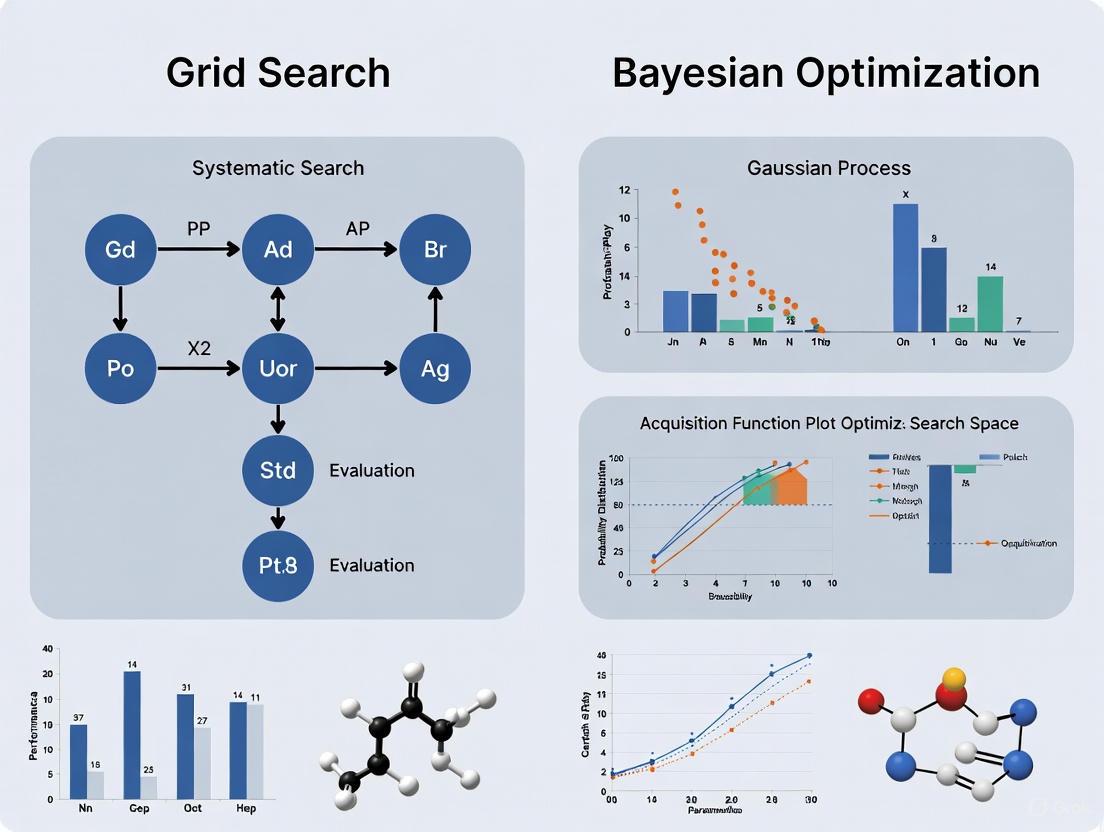
Accurate molecular property prediction is crucial for accelerating drug discovery, yet its success heavily depends on selecting optimal machine learning model hyperparameters.
Grid Search vs. Bayesian Optimization: A Practical Guide to Hyperparameter Tuning for Molecular Property Prediction
Abstract
Accurate molecular property prediction is crucial for accelerating drug discovery, yet its success heavily depends on selecting optimal machine learning model hyperparameters. This article provides a comprehensive guide for researchers and drug development professionals on two fundamental hyperparameter optimization strategies: the exhaustive Grid Search and the efficient Bayesian Optimization. We explore their core mechanisms, practical implementation in cheminformatics, and performance across various real-world scenarios, including low-data regimes and complex molecular representations. Drawing on recent benchmark studies and case studies, we deliver actionable insights for choosing and applying the right tuning method to build more predictive and reliable models, ultimately enhancing the efficiency of AI-driven molecular design.
Hyperparameter Tuning Fundamentals: Why Your Model's Settings Matter in Drug Discovery
In molecular property prediction (MPP), the performance of a deep learning model is not solely determined by its architecture or the data it is trained on, but critically by the configuration of its hyperparameters—the knobs and dials that control the learning process itself. Unlike model parameters learned during training, hyperparameters are set beforehand and govern aspects such as model structure and learning algorithm behavior [1] [2]. For researchers and scientists in drug development, selecting an efficient strategy to tune these hyperparameters is paramount, as it directly influences the accuracy and computational cost of predicting vital properties like the melt index of polymers or the glass transition temperature ((T_g)) [2]. While traditional methods like Grid Search offer a straightforward approach, advanced techniques like Bayesian Optimization have demonstrated superior efficiency in navigating the complex hyperparameter landscapes typical of molecular deep learning models [2] [3] [4].
This guide provides an objective comparison of these optimization methods, supported by experimental data and detailed protocols tailored for MPP research.
What are Hyperparameters and Why Do They Matter?
In machine learning, particularly in deep neural networks (DNNs) for molecular property prediction, hyperparameters are broadly categorized into two types [2]:
- Structural Hyperparameters: These define the blueprint of the neural network. Examples include the number of hidden layers, the number of units (neurons) per layer, and the choice of activation function (e.g., ReLU, sigmoid). Selecting different values results in fundamentally different network structures.
- Learning Algorithm Hyperparameters: These govern how the model is trained. Key examples are the learning rate (the size of steps taken during optimization), the number of epochs (complete passes through the dataset), and the batch size (number of samples used to compute the gradient in one iteration) [5] [2].
The choice of hyperparameters profoundly impacts both the predictive accuracy and the computational efficiency of the resulting model. A poorly chosen learning rate, for instance, can cause the training process to become unstable and diverge, or to converge so slowly that it becomes impractical [5]. In the context of MPP, where training can be computationally expensive and datasets are often complex, systematic Hyperparameter Optimization (HPO) is not a luxury but a necessity to achieve state-of-the-art results [2].
Comparing Hyperparameter Optimization Methods
Several strategies exist for HPO, ranging from brute-force approaches to more intelligent, adaptive methods. The table below summarizes the core characteristics of the three primary techniques.
| Method | Core Principle | Key Advantages | Key Limitations |
|---|---|---|---|
| Grid Search [1] [6] | Exhaustively evaluates all possible combinations within a pre-defined grid. | Simple to implement and parallelize; guaranteed to find the best combination within the specified grid. | Computationally intractable for high-dimensional spaces; search time grows exponentially with each new hyperparameter. |
| Random Search [5] [3] | Evaluates a fixed number of random combinations from the search space. | More efficient than Grid Search; better suited for high-dimensional spaces; easy to parallelize. | No guarantee of finding the optimal configuration; can miss important regions of the search space; does not learn from past evaluations. |
| Bayesian Optimization [1] [7] [6] | Builds a probabilistic model (surrogate) of the objective function to intelligently select the most promising hyperparameters to evaluate next. | Highly sample-efficient; requires fewer evaluations to find a good optimum; well-suited for expensive-to-evaluate functions. | Higher per-iteration overhead; more complex to implement; sequential nature can make parallelization less straightforward. |
Performance Comparison in Molecular Property Prediction
The theoretical advantages and disadvantages of these methods are borne out in practical MPP studies. The following table summarizes key experimental findings from recent research.
| Study / Context | Optimization Method | Key Performance Findings | Computational Efficiency |
|---|---|---|---|
| DNNs for Molecular Property Prediction (e.g., Melt Index, (T_g)) [2] | Random Search, Bayesian Optimization, Hyperband | Hyperband was found to be the most computationally efficient, delivering optimal or near-optimal prediction accuracy. Bayesian Optimization also showed strong performance. | Hyperband > Bayesian Optimization > Random Search |
| Predicting Heart Failure Outcomes (SVM, RF, XGBoost) [3] | Grid Search, Random Search, Bayesian Search | Bayesian Search consistently required less processing time than both Grid and Random Search, while achieving competitive model performance (AUC scores >0.66). | Bayesian Search > Random Search > Grid Search |
| Oligomer Search for Organic Photovoltaics [4] | Random Search, Bayesian Optimization | Bayesian Optimization identified a thousand times more promising molecules with desired properties compared to Random Search using the same computational resources. | Bayesian Optimization >> Random Search |
| General Model Tuning (Digits Dataset) [6] | Grid Search, Random Search, Bayesian Optimization | Grid Search and Bayesian Optimization achieved the highest F-1 score (0.985), but Bayesian Optimization found this optimum in 67 iterations, versus Grid Search's 810. | Bayesian Optimization (by iterations) > Random Search > Grid Search |
Experimental Protocols for Hyperparameter Optimization
To ensure reproducible and effective hyperparameter tuning in MPP research, a structured experimental protocol is essential. The following workflow, adapted from studies using tools like KerasTuner and Optuna, outlines a standard methodology [2] [7].
Standard HPO Workflow for Molecular Property Prediction
The diagram below illustrates the iterative workflow for Bayesian Optimization, which incorporates learning from past trials.
Detailed Methodology
Problem Formulation:
- Define the Search Space: Specify the hyperparameters to be tuned and their value ranges (e.g., learning rate: [0.0001, 0.1], number of layers: [2, 5], units per layer: [32, 64, 128]) [7]. The search space must be broad enough to contain optimal values but constrained to maintain computational feasibility.
- Define the Objective Function: This function takes a set of hyperparameters, builds and trains a model (e.g., a Dense DNN or Convolutional Neural Network), and returns a performance metric to be optimized (e.g., validation set Mean Squared Error for regression tasks like predicting melt index) [2] [7].
Select and Run HPO Algorithm:
- Grid Search: Systematically iterate over every combination in the pre-defined grid. This is often used as a baseline but is only feasible for small search spaces [3].
- Random Search: Randomly sample a pre-determined number of configurations from the search space. This is a robust baseline for larger spaces [2].
- Bayesian Optimization: Using a framework like
OptunaorKerasTuner, run the iterative process shown in the workflow diagram. The algorithm uses a surrogate model (like a Gaussian Process or Tree Parzen Estimator) to model the objective function and an acquisition function (like Expected Improvement) to balance exploration and exploitation when selecting the next hyperparameters to evaluate [2] [7].
Model Validation and Selection:
- Use techniques like k-fold cross-validation (e.g., 10-fold) during the HPO process to obtain a robust estimate of model performance and mitigate overfitting [3].
- Once the HPO process is complete, the best-performing set of hyperparameters is used to train a final model on the full training set.
Essential Research Reagent Solutions for HPO
The following software tools are critical for implementing hyperparameter optimization in molecular property prediction research.
| Tool / Resource | Function in HPO | Relevance to MPP Research |
|---|---|---|
| KerasTuner [2] | An intuitive Python library that integrates with TensorFlow/Keras workflows to perform HPO. | Recommended for its user-friendliness, making it accessible to chemical engineers and scientists without extensive computer science backgrounds. Supports Random Search, Bayesian Optimization, and Hyperband. |
| Optuna [2] [7] | A flexible Python framework for automated HPO, known for its efficient algorithms and distributed computing support. | Used for more advanced HPO, including the combination of Bayesian Optimization with Hyperband (BOHB). Its define-by-run API allows for dynamic search spaces. |
| Scikit-learn [8] [6] | A core Python library for machine learning that provides simple implementations of GridSearchCV and RandomizedSearchCV. | Ideal for initial experiments and optimizing traditional ML models (e.g., Random Forests, SVMs) on smaller datasets or with simpler neural networks. |
| Hyperband [2] | A bandit-based approach that uses early-stopping to speed up the random search through adaptive resource allocation. | Identified in recent MPP studies as the most computationally efficient algorithm, providing optimal or nearly optimal accuracy faster than other methods. |
For researchers in drug development and molecular science, the choice of hyperparameter optimization strategy has a direct and significant impact on research outcomes. While Grid Search is a valuable tool for small-scale problems, its computational cost makes it impractical for tuning complex deep learning models. Random Search offers a powerful and easily parallelized alternative that is generally superior to Grid Search.
However, evidence from molecular property prediction and other scientific domains strongly suggests that Bayesian Optimization and Hyperband represent a more efficient and intelligent class of solutions [2] [3] [4]. Bayesian Optimization's sample efficiency makes it ideal when each model training is computationally expensive, as it can find excellent hyperparameters in fewer trials. For the utmost in speed and efficiency, Hyperband is highly recommended, as it has been shown to deliver top-tier results for MPP in the least amount of time [2].
A practical strategy for researchers is to adopt a hybrid approach: using Bayesian Optimization or Hyperband to efficiently explore a large search space and identify promising regions, followed by a more focused, fine-grained search (or even a local Grid Search) around the most optimal configuration found to refine the results [5]. By leveraging modern software tools like KerasTuner and Optuna, scientists can integrate these advanced HPO methods into their workflows, accelerating the discovery of accurate models for molecular property prediction.
The Critical Role of Tuning in Molecular Property Prediction
In the field of molecular property prediction, the development of robust machine learning models is crucial for accelerating drug discovery and materials science. The performance of these models is highly dependent on their hyperparameters—the configuration settings that govern the learning process. Unlike model parameters learned during training, hyperparameters are set beforehand and can dramatically influence predictive accuracy, training stability, and generalization capability [1]. Selecting appropriate hyperparameter optimization strategies is therefore not merely a technical detail but a critical determinant of research outcomes in computational chemistry and pharmaceutical development.
The challenge is particularly acute in molecular property prediction, where datasets are often characterized by high dimensionality, significant noise, and limited sample sizes—sometimes containing as few as 29 labeled examples [9]. Within this context, two fundamentally different approaches have emerged as standards: the exhaustive Grid Search and the adaptive Bayesian Optimization. This article provides a comprehensive comparison of these methods, examining their theoretical foundations, practical performance, and suitability for molecular informatics tasks through experimental data and detailed methodological analysis.
Understanding the Optimization Methods
Grid Search: The Systematic Explorer
Grid Search represents the most straightforward approach to hyperparameter tuning. It operates by systematically evaluating a predefined set of hyperparameter combinations across a multidimensional grid [1] [6]. Imagine a scenario where a researcher is tuning a random forest model for toxicity prediction with two hyperparameters: the number of trees in the forest (nestimators) and the maximum depth of each tree (maxdepth). If nestimators has three possible values [50, 100, 200] and maxdepth has four [None, 10, 20, 30], Grid Search would train and evaluate 3 × 4 = 12 separate models to identify the optimal combination [10].
The primary strength of Grid Search lies in its comprehensive coverage of the specified search space. When dealing with a small number of hyperparameters with limited possible values, this brute-force method guarantees finding the best combination within the defined grid [1]. Additionally, its simplicity and deterministic nature make it easily implementable and reproducible, appealing qualities for researchers without extensive optimization expertise [10].
However, Grid Search suffers from the "curse of dimensionality"—as the number of hyperparameters increases, the search space grows exponentially [11]. For a model with ten hyperparameters, each with just five possible values, Grid Search would require evaluating 5¹⁰ = 9,765,625 combinations, becoming computationally prohibitive. Furthermore, this method treats each hyperparameter combination independently without learning from previous evaluations, potentially wasting computational resources on poorly performing regions of the search space [1] [6].
Bayesian Optimization: The Adaptive Learner
Bayesian Optimization takes a fundamentally different approach by building a probabilistic model of the objective function and using it to direct the search toward promising hyperparameter configurations [1] [11]. This method operates sequentially, using past evaluation results to inform future selections through a two-component framework:
- Surrogate Model: Typically a Gaussian Process, this model approximates the unknown relationship between hyperparameters and model performance, providing predictions and uncertainty estimates for unevaluated configurations [11] [3].
- Acquisition Function: This utility function (e.g., Expected Improvement) uses the surrogate's predictions to balance exploration of uncertain regions with exploitation of known promising areas, determining the next hyperparameters to evaluate [11].
The Bayesian optimization cycle begins with a few initial random samples. After each iteration, the surrogate model updates its understanding of the objective function, and the acquisition function suggests the most informative point to evaluate next [11]. This adaptive approach allows Bayesian Optimization to typically converge to high-performing hyperparameters with far fewer evaluations than Grid Search, making it particularly valuable for optimizing complex models with many hyperparameters or when each evaluation is computationally expensive [6] [3].
A potential limitation is that each iteration requires additional computation to update the surrogate model and optimize the acquisition function [6]. However, this overhead is generally negligible compared to the cost of training complex machine learning models for molecular property prediction.
Table 1: Fundamental Comparison of Optimization Methods
| Characteristic | Grid Search | Bayesian Optimization |
|---|---|---|
| Search Strategy | Exhaustive search across a predefined grid | Adaptive sampling guided by a probabilistic model |
| Parameter Learning | Does not learn from previous evaluations | Actively uses past results to inform next selection |
| Theoretical Basis | Brute-force enumeration | Bayes' theorem, Gaussian processes |
| Key Parameters | Grid resolution, parameter bounds | Acquisition function, surrogate model, initial samples |
| Optimality Guarantee | Finds best point within the defined grid | No guarantee, but typically finds good solutions efficiently |
Comparative Performance Analysis
Computational Efficiency and Model Performance
Multiple empirical studies have demonstrated the superior efficiency of Bayesian Optimization compared to Grid Search across various molecular property prediction tasks. In a comprehensive study focused on predicting heart failure outcomes, researchers evaluated Grid Search, Random Search, and Bayesian Search across three machine learning algorithms: Support Vector Machine (SVM), Random Forest (RF), and eXtreme Gradient Boosting (XGBoost) [3]. The dataset included 167 features from 2008 patients, with models built to predict all-cause readmission and mortality.
The study revealed that while all optimization methods could find hyperparameters yielding competitive model performance, Bayesian Search consistently required less processing time than both Grid and Random Search methods [3]. This computational advantage was achieved without sacrificing predictive performance, as measured by accuracy, sensitivity, and AUC scores. After rigorous 10-fold cross-validation, Random Forest models demonstrated superior robustness with an average AUC improvement of 0.03815, whereas SVM models showed potential for overfitting [3].
In a separate case study comparing hyperparameter tuning approaches for a random forest classifier, Bayesian Optimization found hyperparameters yielding the highest F-1 score after just 67 iterations—far fewer than the 680 iterations Grid Search required to find its best combination [6]. Although each Bayesian Optimization iteration requires more computation than a Grid Search evaluation, the dramatically reduced number of needed evaluations results in significantly shorter overall run times for complex problems [6].
Table 2: Experimental Results from Heart Failure Prediction Study [3]
| Optimization Method | Best Accuracy (SVM) | Robustness (Avg. AUC Δ post-CV) | Computational Efficiency |
|---|---|---|---|
| Grid Search | 0.6294 | Potential overfitting (SVM: -0.0074) | Highest processing time |
| Random Search | Competitive with GS | Moderate improvement (XGBoost: +0.01683) | Medium processing time |
| Bayesian Search | Competitive with GS | Superior robustness (RF: +0.03815) | Best (lowest processing time) |
Performance in High-Dimensional and Low-Data Regimes
Molecular property prediction often involves navigating high-dimensional chemical spaces with limited experimental data. In such challenging regimes, the advantages of Bayesian Optimization become particularly pronounced.
Researchers successfully applied Bayesian Optimization to parameterize a 41-dimensional coarse-grained model of Pebax-1657, a copolymer composed of alternating polyamide and polyether segments [12]. The optimization framework simultaneously targeted multiple physical properties—density, radius of gyration, and glass transition temperature—achieving convergence in fewer than 600 iterations and producing a model that accurately reproduced key properties of its atomistic counterpart [12]. This demonstrates Bayesian Optimization's capability to handle complex, high-dimensional parameter spaces that would be computationally intractable for Grid Search.
In ultra-low data regimes, where labeled molecular properties are exceptionally scarce, adaptive optimization methods show particular promise. One study demonstrated that advanced multi-task learning approaches could learn accurate models with as few as 29 labeled samples [9]. While this research focused on model architecture rather than hyperparameter optimization, it highlights the critical importance of data-efficient methods throughout the machine learning pipeline in molecular informatics.
Optimization Workflows in Molecular Property Prediction
The fundamental difference between Grid Search and Bayesian Optimization is best understood through their distinct workflows, particularly in the context of molecular property prediction.
Grid Search Workflow
Diagram 1: Grid Search Iteration Process
The Grid Search workflow follows a strictly predetermined path. After researchers define the hyperparameter grid, the method systematically generates all possible combinations [1] [10]. For each combination, it trains a model (such as a graph neural network for molecular properties) and evaluates its performance using predefined metrics like AUC or accuracy [3]. This process continues exhaustively until all combinations have been evaluated, finally selecting the combination that yielded the best performance [6]. The workflow does not incorporate knowledge from previous evaluations when selecting subsequent hyperparameters, making it simple but inefficient for high-dimensional spaces.
Bayesian Optimization Workflow
Diagram 2: Bayesian Optimization Iteration Cycle
Bayesian Optimization employs a fundamentally different, adaptive approach. The process begins with a small set of random initial samples to build a preliminary surrogate model of the objective function [11] [3]. Based on this model, an acquisition function determines the most promising hyperparameters to evaluate next by balancing exploration of uncertain regions with exploitation of known promising areas [11]. After evaluating the selected hyperparameters (by training and testing a model), the results update the surrogate model, refining its understanding of the hyperparameter-performance relationship [11] [3]. This iterative process continues until convergence criteria are met, efficiently guiding the search toward optimal regions of the hyperparameter space.
Essential Research Reagent Solutions
Implementing effective hyperparameter optimization requires both software tools and methodological components. Below are key "research reagents" for molecular property prediction studies:
Table 3: Essential Research Reagent Solutions for Hyperparameter Optimization
| Research Reagent | Function | Example Tools/Packages |
|---|---|---|
| Bayesian Optimization Frameworks | Provides algorithms for efficient hyperparameter search | Ax, BoTorch, Optuna, Scikit-optimize [11] |
| Molecular Representation Libraries | Converts chemical structures to machine-readable formats | RDKit, SMILES enumeration tools [13] |
| Surrogate Models | Approximates the objective function for Bayesian methods | Gaussian Processes, Random Forests [11] [3] |
| Acquisition Functions | Guides parameter selection by balancing exploration/exploitation | Expected Improvement, Upper Confidence Bound [11] |
| Multi-Objective Optimization | Handles optimization of multiple conflicting properties | Hypervolume-based methods, scalarization approaches [14] |
The critical role of tuning in molecular property prediction cannot be overstated, as hyperparameter selection directly influences model reliability and consequently decision-making in drug discovery and materials design. Through comparative analysis, Bayesian Optimization emerges as the superior approach for most molecular informatics applications, particularly given the field's characteristic high-dimensional problems and limited data regimes.
Bayesian Optimization demonstrates consistently better computational efficiency than Grid Search while achieving comparable or superior model performance [6] [3]. Its ability to navigate complex parameter spaces with fewer evaluations makes it particularly valuable for optimizing contemporary deep learning architectures used in molecular property prediction [13] [12]. Furthermore, its principled balance of exploration and exploitation aligns well with the need to extract maximum insights from often scarce and noisy experimental data [9].
Grid Search retains utility for simpler models with few hyperparameters or when exhaustive search is computationally feasible [1] [10]. However, for the increasingly complex prediction tasks in modern chemical and pharmaceutical research—such as multi-property optimization, transfer learning, and few-shot learning scenarios—Bayesian Optimization provides the sophisticated toolkit necessary to advance the field efficiently [14] [15]. As molecular property prediction continues to evolve toward more data-efficient and robust methodologies, Bayesian Optimization stands as an essential component in the researcher's toolkit.
In the landscape of modern drug discovery, molecular representation serves as the foundational bridge between chemical structures and their predicted biological activity or physical properties. The rapid evolution of Artificial Intelligence (AI) has positioned AI-assisted drug design as a prominent research area, where the critical first step is translating molecules into a computer-readable format [16]. This process, known as molecular representation, enables machine learning (ML) and deep learning (DL) models to process, analyze, and predict molecular behavior [16]. The choice of representation directly influences model performance in crucial tasks like virtual screening, activity prediction, and scaffold hopping—the strategic modification of core molecular structures while retaining biological activity [16].
Within this context, hyperparameter optimization becomes paramount for developing accurate predictive models. As highlighted in recent methodology reviews, "hyperparameter optimization is often the most resource-intensive step in model training," and most prior molecular property prediction studies have paid limited attention to this process, resulting in suboptimal predictions [2]. This guide objectively compares predominant molecular representation methods, examining their performance characteristics and integration with optimization protocols like Grid Search and Bayesian Optimization to empower researchers in making informed methodological choices.
Molecular Representation Methods: A Comparative Analysis
Molecular representations can be broadly categorized into traditional expert-defined features and modern learned representations. The following sections provide a detailed comparison of their methodologies, strengths, and limitations.
Traditional Molecular Representations
Traditional methods rely on predefined rules and expert knowledge to convert molecular structures into quantitative descriptors.
Molecular Fingerprints: These are binary bit strings encoding the presence or absence of specific molecular substructures or patterns. The most widely used method is Extended Connectivity Fingerprints (ECFP), which captures local atomic environments in a compact, efficient manner [16] [17]. ECFP and similar fingerprints are particularly effective for similarity searching and clustering due to their computational efficiency [16]. Studies have found MACCS fingerprints to be surprisingly effective overall despite their simplicity [17].
Molecular Descriptors: These quantify physical or chemical properties of molecules, such as molecular weight, hydrophobicity, or topological indices [16] [17]. Descriptors from libraries like PaDEL have proven particularly well-suited for predicting physical properties of molecules [17]. They are extensively used in Quantitative Structure-Activity Relationship (QSAR) modeling [16].
String-Based Representations: The Simplified Molecular Input Line Entry System (SMILES) provides a compact method to encode chemical structures as strings of ASCII characters [16]. Despite limitations in capturing molecular complexity, SMILES remains mainstream due to its human-readability and simplicity [16]. Improved versions like CXSMILES and SMARTS have been developed to extend its functionality [16].
Modern AI-Driven Molecular Representations
Modern approaches employ deep learning to automatically learn feature representations directly from data, moving beyond predefined rules.
Graph-Based Representations: These treat molecules as graphs with atoms as nodes and bonds as edges. Graph Neural Networks (GNNs), particularly Message Passing Neural Networks (MPNNs), process these graphs to capture both local and global molecular features [16] [9] [18]. A 2025 study introduced adaptive checkpointing with specialization (ACS) for multi-task GNNs, effectively mitigating "negative transfer" in scenarios with imbalanced training data [9].
Language Model-Based Representations: Inspired by natural language processing, models like Transformers have been adapted to process molecular sequences (e.g., SMILES or SELFIES) by treating them as a specialized chemical language [16]. These models tokenize molecular strings at the atomic or substructure level and process them using architectures like Transformers or BERT [16].
Multimodal Representations: Recent approaches integrate multiple representation types to leverage complementary information. The Multimodal Cross-Attention Molecular Property Prediction (MCMPP) model innovatively integrates SMILES, ECFP fingerprints, molecular graphs, and 3D molecular conformations through a cross-attention mechanism [18]. Tests on benchmark datasets demonstrate how MCMPP improves prediction accuracy by using complementary effects across modalities [18].
Table 1: Comparative Analysis of Molecular Representation Methods
| Representation Type | Key Examples | Strengths | Limitations | Ideal Use Cases |
|---|---|---|---|---|
| Fingerprints | ECFP, MACCS [17] | Computational efficiency; interpretability; effective for similarity search [16] | Limited to predefined features; may miss complex patterns [16] | Virtual screening, QSAR, clustering [16] |
| Descriptors | PaDEL, alvaDesc [17] | Direct encoding of physicochemical properties; interpretable [16] [17] | Feature engineering requires domain expertise; may not capture structural nuances [16] | Physical property prediction, QSAR [17] |
| SMILES/Strings | SMILES, SELFIES [16] | Simple, compact, human-readable [16] | Struggles with structural complexity; variance problem [16] | Sequence-based model input, simple database storage |
| Graph-Based | GNNs, MPNNs [16] [9] | Naturally represents molecular structure; captures local/global features [16] | Computationally intensive; complex architecture [17] | Complex property prediction, structure-function studies [16] |
| Multimodal | MCMPP [18] | Leverages complementary information; superior accuracy [18] | High complexity; integration challenges [18] | Challenging prediction tasks where accuracy is paramount [18] |
Experimental Comparison and Performance Benchmarks
Quantitative Performance Across Benchmark Datasets
Comprehensive comparisons of molecular feature representations on multiple benchmark datasets reveal nuanced performance patterns. A broad evaluation on 11 benchmark datasets for predicting properties like mutagenicity, melting points, and solubility showed that several molecular features perform similarly well overall [17]. Specifically, molecular descriptors from the PaDEL library excelled for predicting physical properties, while MACCS fingerprints performed robustly despite their simplicity [17]. Notably, learnable representations achieved competitive performance compared to expert-based representations, though task-specific representations like graph convolutions rarely offered substantial benefits given their higher computational demands [17].
The MCMPP multimodal model demonstrated significant advantages on established benchmarks including Delaney (solubility), Lipophilicity, SAMPL, and BACE datasets [18]. By integrating SMILES, ECFP fingerprints, molecular graphs, and 3D conformations processed through specialized encoders (Transformer-Encoder, BiLSTM, GCN, reduced Unimol+), MCMPP achieved the lowest Root-Mean-Square Error (RMSE) compared to single-modality models and other fusion techniques [18]. This demonstrates that effectively leveraging complementary information across modalities can substantially enhance prediction accuracy.
Performance in Low-Data Regimes
Data scarcity remains a major obstacle in molecular property prediction, particularly for pharmaceutical applications. Modern multi-task learning approaches address this by leveraging correlations among related properties. The recently developed ACS method for multi-task GNNs effectively mitigates detrimental "negative transfer," where updates from one task harm another [9]. In practical validation, ACS enabled accurate predictions with as few as 29 labeled samples in a sustainable aviation fuel property prediction task—capabilities unattainable with single-task learning or conventional multi-task learning [9].
The Critical Role of Data Consistency
Beyond model architecture and representation choice, data quality profoundly impacts performance. A 2025 analysis of public ADME (Absorption, Distribution, Metabolism, Excretion) datasets uncovered significant distributional misalignments and inconsistent property annotations between gold-standard and popular benchmark sources [19]. These discrepancies, arising from differences in experimental conditions and chemical space coverage, can introduce noise and degrade model performance [19]. The findings emphasize that data consistency assessment is a crucial prerequisite for reliable modeling, leading to the development of tools like AssayInspector to systematically identify outliers, batch effects, and dataset discrepancies before model training [19].
Hyperparameter Optimization Frameworks for Molecular Property Prediction
Hyperparameter optimization is essential for developing accurate and efficient deep learning models for molecular property prediction. Comparative studies have evaluated several HPO algorithms, including Grid Search, Random Search, Bayesian Optimization, and Hyperband [2].
Comparison of HPO Methodologies
Grid Search: This exhaustive method evaluates all possible combinations within a predefined hyperparameter grid. While methodical and guaranteed to find the best combination within the specified range, it becomes computationally prohibitive as the number of hyperparameters increases [2].
Bayesian Optimization: This sequential strategy uses probabilistic models to make informed decisions about which hyperparameters to test next, balancing exploration of new combinations with exploitation of known good regions [2] [20]. It typically requires fewer evaluations than Grid Search and is particularly valuable for complex models with multiple hyperparameters [2].
Hyperband: This algorithm combines random search with early-stopping to accelerate the optimization process, making it highly computationally efficient [2]. Recent research concludes that "the hyperband algorithm, which has not been used in previous MPP studies, is most computationally efficient; it gives MPP results that are optimal or nearly optimal in terms of prediction accuracy" [2].
Table 2: Hyperparameter Optimization Methods for Molecular Property Prediction
| Optimization Method | Mechanism | Advantages | Disadvantages | Recommended Context |
|---|---|---|---|---|
| Grid Search [2] | Exhaustive search over defined space | Simple; finds best in-grid combination; easily parallelized [2] | Computationally intractable for high dimensions [2] | Small hyperparameter spaces with limited resources |
| Random Search [2] | Random sampling from parameter distributions | More efficient than grid search; good for high dimensions [2] | May miss important regions; no learning from past trials [2] | Moderate-dimensional spaces with limited computational budget |
| Bayesian Optimization [2] [20] | Probabilistic model-guided sequential search | Sample-efficient; balances exploration/exploitation [2] [20] | Complex implementation; sequential nature can limit parallelism [2] | Complex models with costly evaluations and limited parameters |
| Hyperband [2] | Random search with early-stopping | High computational efficiency; effective resource allocation [2] | May terminate promising configurations prematurely [2] | Large-scale models with many hyperparameters and limited resources |
| BOHB [2] | Bayesian Optimization + Hyperband | Combines efficiency of Hyperband with guidance of BO [2] | Increased implementation complexity [2] | Diverse molecular representations requiring robust optimization |
Integrated Workflow for Representation and Optimization
The relationship between molecular representation selection and hyperparameter optimization follows a logical sequence, where choices in one area influence decisions in the other.
Essential Research Reagents and Computational Tools
Successful implementation of molecular representation methods requires specific computational tools and resources. The following table catalogs key solutions referenced in recent literature.
Table 3: Essential Research Reagent Solutions for Molecular Representation Research
| Tool/Resource | Type | Primary Function | Relevant Context |
|---|---|---|---|
| RDKit [19] | Software Library | Calculates molecular descriptors, fingerprints, and processing | Used in AssayInspector for descriptor calculation [19] |
| KerasTuner [2] | HPO Library | Hyperparameter optimization for deep learning models | Recommended for HPO of DNNs for molecular property prediction [2] |
| AssayInspector [19] | Data Quality Tool | Identifies dataset discrepancies and distribution misalignments | Critical for data consistency assessment before model training [19] |
| FGBench [21] | Specialized Dataset | Provides functional group-level molecular property reasoning | Enhances interpretability and structure-aware reasoning in LLMs [21] |
| PaDEL [17] | Descriptor Software | Calculates comprehensive molecular descriptors | Particularly effective for predicting physical properties [17] |
The landscape of molecular representation has evolved significantly from traditional fingerprints and descriptors to modern graph-based and multimodal approaches. Each representation offers distinct advantages: fingerprints and descriptors provide computational efficiency and interpretability, graph-based methods naturally capture molecular structure, and multimodal approaches deliver superior accuracy by integrating complementary information [16] [17] [18].
The choice of representation must align with the specific prediction task, dataset characteristics, and computational resources. For low-data regimes, multi-task learning with methods like ACS demonstrates remarkable efficacy [9]. Regardless of the representation selected, rigorous hyperparameter optimization is essential, with Hyperband emerging as a particularly efficient algorithm for molecular property prediction [2]. Furthermore, data consistency assessment must precede modeling to ensure reliable performance [19].
As the field advances, the integration of specialized chemical knowledge—such as functional group information from resources like FGBench—with sophisticated representation learning and efficient optimization protocols will continue to enhance the accuracy, interpretability, and impact of molecular property prediction in accelerating drug discovery and materials design [21].
In the field of molecular property prediction, the accuracy of machine learning models is critical for accelerating drug discovery and materials science. These models depend heavily on their hyperparameters—the configuration settings that govern the learning process itself. Unlike model parameters learned from data, hyperparameters are set prior to training and significantly influence predictive performance. The challenge of identifying optimal hyperparameter configurations is a fundamental step in developing reliable predictive models for applications ranging from drug efficacy studies to organic photovoltaic material design.
Among the various strategies available, Grid Search represents the most straightforward and systematic approach. As a brute-force method, it exemplifies exhaustive exploration of predefined hyperparameter spaces. This guide examines Grid Search's methodology, performance, and practical implementation within molecular property prediction research, providing a direct comparison with the increasingly prevalent Bayesian Optimization approach. Through experimental data and detailed protocols, we equip researchers with the knowledge to select appropriate tuning strategies for their specific computational challenges.
Understanding Grid Search: Mechanism and Workflow
Grid Search operates on a simple yet exhaustive principle: it performs an organized exploration of every combination within a user-defined hyperparameter grid. Imagine specifying a set of values for several hyperparameters, such as the learning rate (e.g., 0.01, 0.001) and the number of layers in a neural network (e.g., 2, 3, 4). Grid Search would systematically construct and evaluate a model for each possible combination of these values—(0.01, 2), (0.01, 3), (0.01, 4), (0.001, 2), (0.001, 3), (0.001, 4)—resulting in six distinct models in this example [1].
This method guarantees that the best configuration within the specified grid will be found, as no combination is left unevaluated. Its implementation is conceptually simple and easily parallelized, as each point in the grid can be evaluated independently of the others. However, this exhaustive nature is also its primary drawback; the total number of evaluations grows exponentially with each additional hyperparameter, a phenomenon known as the "curse of dimensionality." This can make Grid Search computationally prohibitive for tuning a large number of hyperparameters or when model evaluation is inherently expensive, as is often the case with complex graph neural networks predicting molecular properties [1] [22].
The following diagram illustrates the systematic workflow of a Grid Search.
Experimental Comparison: Grid Search vs. Bayesian Optimization
Performance Metrics and Experimental Data
The comparative efficiency of Grid Search and Bayesian Optimization has been quantified across various studies. In one HVAC system modeling study, researchers developed and tested 288 unique hyperparameter configurations using Grid Search, with each configuration trained three times, resulting in a total of 864 artificial neural network models [23]. This highlights the resource-intensive nature of a comprehensive Grid Search.
When compared directly, Bayesian Optimization has demonstrated superior sample efficiency. Evidence shows it can lead a model to the same performance level as Grid Search but in 7x fewer iterations and 5x faster execution time [22]. This efficiency stems from its informed search strategy, which allows it to discard non-optimal configurations early in the process.
In molecular discovery, the performance gap can be even more significant. A 2025 study comparing search approaches for discovering organic solar cell molecules found that in a vast chemical space of over 10^14 molecules, Bayesian Optimization identified a thousand times more promising molecules with the desired properties compared to random search (a simpler alternative to Grid Search) using the same computational resources [24]. Another molecular optimization framework, MolDAIS, demonstrated that Bayesian Optimization could identify near-optimal candidates from chemical libraries of over 100,000 molecules using fewer than 100 property evaluations [25].
Table 1: Experimental Performance Comparison of Tuning Methods
| Metric | Grid Search | Bayesian Optimization | Experimental Context |
|---|---|---|---|
| Number of Evaluations | 288 configurations (864 models) [23] | Fewer than 100 evaluations [25] | Model training on a specific task |
| Computational Efficiency | Baseline (1x) | 5x faster execution [22] | Achieving equivalent model performance |
| Sample Efficiency | Exhaustive | 7x fewer iterations [22] | Achieving equivalent model performance |
| Discovery Rate | Not specifically tested | 1000x more promising molecules [24] | Exploration of a chemical space of >10^14 molecules |
Detailed Experimental Protocols
To ensure reproducibility and provide a clear framework for benchmarking, this section outlines the standard protocols for implementing Grid Search and Bayesian Optimization in a molecular property prediction context.
Grid Search Experimental Protocol
The following steps detail a rigorous methodology for conducting a Grid Search, as exemplified in building energy prediction research [23].
- Hyperparameter Space Definition: Define a discrete grid of hyperparameter values. For example:
- Number of epochs: 100, 200, 500
- Network size (hidden layers): 5, 10, 17
- Learning rate: 1e-3, 1e-4, 5e-5
- Optimizer: Adam, SGD, RMSprop
- Combinatorial Evaluation: Train and validate a separate model for every possible combination of the hyperparameters listed in the grid.
- Cross-Validation: For each combination, perform k-fold cross-validation (e.g., k=3) to obtain a robust performance estimate and mitigate the influence of random data splitting [23].
- Performance Logging: Store the performance metric (e.g., Mean Squared Error, ROC-AUC) for every trained model.
- Optimal Configuration Selection: After all evaluations are complete, identify the hyperparameter combination that yielded the best average validation performance.
Bayesian Optimization Experimental Protocol
The protocol for Bayesian Optimization is inherently adaptive, using information from past experiments to inform the next. This description is based on implementations used for molecular property optimization [24] [25].
- Initialization: Select a small initial set of hyperparameter configurations via random sampling.
- Model Training and Evaluation: Train and evaluate models for the initial set.
- Surrogate Model Update: Use the collected performance data to build or update a probabilistic surrogate model, typically a Gaussian Process (GP), which models the function mapping hyperparameters to model performance [25].
- Acquisition Function Maximization: Use an acquisition function (e.g., Expected Improvement), which balances exploration and exploitation, to determine the most promising hyperparameter configuration to evaluate next [25].
- Iteration: Repeat steps 2-4 for a predefined number of iterations or until performance convergence is achieved.
The logical relationship and core components of the Bayesian Optimization process are summarized below.
Implementing and comparing hyperparameter tuning methods requires a suite of software tools and computational resources. The following table details key "reagent solutions" essential for experiments in this field.
Table 2: Essential Research Tools for Hyperparameter Tuning in Molecular Property Prediction
| Tool / Resource | Type | Primary Function in Research | Relevance to Tuning Methods |
|---|---|---|---|
| stk-search [24] | Python Package | Searches the chemical space of molecules built from smaller blocks. | Provides infrastructure to compare Bayesian Optimization and evolutionary algorithms against baselines like random search. |
| BoTorch [24] | Python Library | A framework for Bayesian Optimization research and implementation. | Serves as the core Bayesian Optimization engine, providing surrogate models and acquisition functions. |
| Graph Neural Networks (GNNs) [26] [9] | Model Architecture | Learns representations from molecular graph structures for property prediction. | The model whose hyperparameters (e.g., layers, hidden dimensions) are being tuned. A key application for these methods. |
| MoleculeNet [9] | Benchmark Dataset | A standardized benchmark for molecular property prediction tasks. | Provides consistent datasets (e.g., Tox21, SIDER) for fair comparison of tuning methods and model performance. |
| MolDAIS [25] | Optimization Framework | A Bayesian Optimization framework for data-efficient molecular design. | An example of a state-of-the-art Bayesian Optimization method that adaptively identifies task-relevant descriptor subspaces. |
Grid Search remains a valuable, systematic brute-force approach for hyperparameter tuning, particularly when the hyperparameter space is small or computational resources are abundant. Its exhaustive nature guarantees finding the best point within a pre-defined grid and its simplicity makes it easy to implement and parallelize [1].
However, for the vast and complex landscapes common in molecular property prediction, Bayesian Optimization offers a more efficient and powerful alternative. Its ability to leverage past evaluations to make informed decisions about the next hyperparameters to test results in significant savings in both time and computational cost [25] [22]. As molecular datasets grow and models become more complex, the sample efficiency of adaptive methods like Bayesian Optimization positions them as the leading approach for accelerating drug development and materials discovery. The future of hyperparameter tuning in this field lies in these intelligent, data-efficient strategies that can navigate high-dimensional spaces where Grid Search is simply infeasible.
In the fields of drug discovery and materials science, researchers face a formidable challenge: navigating vast, high-dimensional molecular spaces to find compounds with optimal properties, all while constrained by extremely limited experimental resources. Traditional optimization methods often fall short in these complex landscapes. Bayesian optimization (BO) has emerged as a powerful, adaptive alternative that intelligently guides the search for optimal molecules by leveraging probabilistic models to balance exploration of unknown regions with exploitation of promising areas [20] [11]. This approach is particularly valuable for "black-box" functions where the relationship between inputs and outputs is unknown, complex, or expensive to evaluate—characteristics common to molecular property prediction tasks [20].
The fundamental advantage of BO lies in its data efficiency. By building a probabilistic model of the objective function and using it to select the most informative experiments, BO can identify optimal candidates with far fewer evaluations than traditional methods [27] [25]. This efficiency is critical in molecular research where each experiment—whether computational simulation or wet-lab testing—carries significant time and resource costs. As research increasingly moves toward automated workflows and self-driving laboratories, Bayesian optimization provides the intelligent decision-making core that enables truly autonomous scientific discovery [28].
Optimization Methods: A Comparative Framework
Grid Search: The Systematic Brute-Force Approach
Grid Search (GS) operates on a simple brute-force principle: define a grid of possible values for each hyperparameter and exhaustively evaluate every combination within this predefined space [3]. Think of it as a systematic treasure hunt where you methodically check every marked location on a map without any guidance about where treasure is more likely to be found [1]. The key advantage of GS is its comprehensiveness—it guarantees finding the best combination within the specified parameter grid, making it suitable for low-dimensional problems with small search spaces [3].
However, GS suffers from the "curse of dimensionality"—as the number of parameters increases, the search space grows exponentially [1] [11]. For molecular property prediction involving multiple parameters (e.g., composition, synthesis conditions, structural features), this method becomes computationally prohibitive. Furthermore, GS treats each parameter combination independently without learning from previous evaluations, potentially wasting valuable experimental resources on poor-performing configurations [1].
Random Search: The Stochastic Alternative
Random Search (RS) addresses some limitations of GS by randomly sampling parameter combinations from the search space according to a specified distribution [3]. This stochastic approach has proven surprisingly effective in practice, often outperforming GS in high-dimensional spaces because it has a better chance of stumbling into productive regions without being constrained by a rigid grid structure [3]. Studies have shown that RS can achieve comparable or better performance than GS while requiring less processing time [3].
The primary limitation of RS is its lack of intelligence—it doesn't learn from previous results to inform future sampling. Each evaluation is independent, so the method cannot strategically focus on promising regions of the search space or avoid redundant experiments [1]. While more efficient than GS for high-dimensional problems, RS still wastes significant resources on unproductive regions of the molecular design space.
Bayesian Optimization: The Intelligent Approach
Bayesian optimization takes a fundamentally different approach by building a probabilistic model of the objective function and using it to guide the search process [27] [11]. The core components of BO include:
- Surrogate Model: Typically a Gaussian Process (GP) that approximates the unknown objective function and provides both predictions and uncertainty estimates [29] [27]
- Acquisition Function: A decision policy that uses the surrogate model's predictions to select the most promising next experiment by balancing exploration and exploitation [27]
Unlike GS and RS, BO learns from previous evaluations to make informed decisions about where to sample next [1] [3]. This sequential model-based approach is particularly advantageous for optimizing expensive black-box functions, making it ideally suited for molecular property prediction where each evaluation is computationally or experimentally costly [20] [11].
Table 1: Core Components of Bayesian Optimization
| Component | Function | Common Variants |
|---|---|---|
| Surrogate Model | Approximates the objective function; provides uncertainty quantification | Gaussian Process (GP), Random Forest (RF), Bayesian Neural Networks |
| Acquisition Function | Balances exploration vs. exploitation to select next experiment | Expected Improvement (EI), Upper Confidence Bound (UCB), Probability of Improvement (PI) |
| Kernel Function | Defines similarity between data points; encodes assumptions about function smoothness | Radial Basis Function (RBF), Matérn, Automatic Relevance Detection (ARD) |
Quantitative Performance Comparison
Computational Efficiency and Performance Metrics
Multiple studies across different domains have demonstrated Bayesian optimization's superior efficiency compared to traditional methods. In direct comparisons for heart failure prediction models, Bayesian Search consistently required less processing time than both Grid and Random Search methods while achieving competitive predictive performance [3]. This computational efficiency becomes increasingly significant as the dimensionality of the problem grows.
In molecular optimization tasks, BO's advantage is even more pronounced. When applied to optimizing limonene production in E. coli through four-dimensional transcriptional control, a BO policy converged to near-optimal performance after investigating just 18 unique points—approximately 22% of the experiments required by the grid search approach used in the original study [20]. This represents a 4-5x reduction in experimental effort, demonstrating BO's potential to dramatically accelerate research cycles in biological domains.
Robustness and Generalization Performance
Beyond raw optimization speed, model robustness is crucial for practical applications. Comparative studies have shown that while some methods may achieve high initial performance on training data, they often exhibit significant performance degradation under cross-validation. In healthcare prediction tasks, Random Forest models optimized with Bayesian methods demonstrated superior robustness with an average AUC improvement of 0.03815 after 10-fold cross-validation, while Support Vector Machine models showed signs of overfitting [3].
BO's robustness stems from its principled handling of uncertainty through the surrogate model. By explicitly modeling uncertainty and using it to guide exploration, BO avoids overcommitting to potentially suboptimal regions early in the search process. This systematic uncertainty quantification makes BO particularly effective for noisy experimental data common in molecular sciences [27].
Table 2: Experimental Performance Comparison Across Domains
| Application Domain | Optimization Method | Key Performance Metrics | Experimental Budget Required |
|---|---|---|---|
| Limonene Production in E. coli [20] | Grid Search | Baseline performance | 83 experiments |
| Bayesian Optimization | Equivalent performance | 18 experiments (78% reduction) | |
| Heart Failure Prediction [3] | Grid Search | Accuracy: 0.6294, Sensitivity: >0.61 | Highest processing time |
| Random Search | Moderate processing time | 20-30% faster than Grid Search | |
| Bayesian Search | Competitive accuracy | Lowest processing time | |
| Molecule Design [27] | Genetic Algorithms/RL | Baseline performance | Varies |
| Properly Tuned BO | Highest performance on PMO benchmark | Similar experimental budget |
Advanced Bayesian Optimization Frameworks for Molecular Science
Adaptive Representation Learning
A critical challenge in molecular optimization is selecting appropriate representations or features that capture the relevant chemical information. Traditional approaches rely on fixed representations chosen by domain experts or through separate feature selection processes. However, Feature Adaptive Bayesian Optimization (FABO) introduces a framework that dynamically identifies the most informative molecular representations during the optimization process itself [28].
FABO operates by starting with a comprehensive, high-dimensional feature set and iteratively refining the representation using feature selection methods like Maximum Relevancy Minimum Redundancy (mRMR) or Spearman ranking [28]. This adaptive approach has demonstrated superior performance across multiple molecular optimization tasks, including metal-organic framework (MOF) discovery for CO₂ adsorption and electronic band gap optimization [28]. By automatically tailoring the representation to the specific optimization task, FABO eliminates the need for prior feature engineering expertise and ensures the optimization process focuses on the most relevant molecular characteristics.
Sparse Subspace Optimization
The MolDAIS framework addresses high-dimensional challenges by adaptively identifying task-relevant subspaces within large molecular descriptor libraries [25]. By incorporating sparsity-inducing priors, particularly the Sparse Axis-Aligned Subspace (SAAS) prior, MolDAIS constructs parsimonious Gaussian process models that focus computational resources on the most informative features [25].
This approach consistently outperforms state-of-the-art molecular property optimization methods across benchmark and real-world tasks, identifying near-optimal candidates from chemical libraries containing over 100,000 molecules using fewer than 100 property evaluations [25]. The method's efficiency stems from its ability to ignore irrelevant dimensions while progressively refining its understanding of which features drive property variations—a crucial advantage when working with comprehensive molecular descriptor sets that may contain many redundant or uninformative features.
Experimental Protocols and Methodologies
Standard Bayesian Optimization Workflow
The Bayesian optimization process follows a systematic, iterative workflow that combines statistical modeling with experimental design:
Bayesian Optimization Workflow
Step 1: Initialization - The process begins with a small set of initial experiments, typically selected via Latin Hypercube Sampling or random sampling to ensure broad coverage of the design space [29].
Step 2: Surrogate Modeling - A Gaussian Process (GP) is trained on all available data to build a probabilistic model of the objective function. The GP provides both a prediction (mean) and uncertainty estimate (variance) for any point in the design space [27]. Key considerations include:
- Kernel Selection: The Matérn kernel is often preferred over the Radial Basis Function (RBF) for modeling physical phenomena as it accommodates less smooth functions [29]
- Hyperparameter Tuning: Kernel parameters (length scales, amplitude) are typically optimized by maximizing the marginal likelihood [27]
- Anisotropic Kernels: GP with Automatic Relevance Detection (ARD) allows different length scales for each input dimension, significantly improving performance on high-dimensional problems [29]
Step 3: Acquisition Function Optimization - An acquisition function (e.g., Expected Improvement, Upper Confidence Bound) uses the surrogate model's predictions to balance exploration of uncertain regions with exploitation of promising areas [27]. The point maximizing the acquisition function is selected as the next experiment.
Step 4: Experimental Evaluation & Update - The selected experiment is performed, and the results are added to the dataset. The surrogate model is updated with the new information, and the cycle repeats until convergence or exhaustion of the experimental budget [11].
Molecular Representation and Feature Selection
For molecular optimization problems, the representation of chemical structures is a critical factor influencing BO performance [28]. The following workflow illustrates the adaptive representation approach:
Adaptive Molecular Representation
Common molecular representations include:
- Fixed Descriptors: Traditional molecular fingerprints (ECFP, MACCS), physicochemical properties, and topological descriptors [25]
- Adaptive Descriptors: Frameworks like FABO and MolDAIS that dynamically select relevant features from a comprehensive descriptor library during optimization [28] [25]
- Learned Representations: Embeddings from graph neural networks or other deep learning models, though these may require substantial data for training [30]
The Scientist's Toolkit: Essential Research Reagents
Table 3: Key Computational Tools for Bayesian Optimization
| Tool/Resource | Function | Application Context |
|---|---|---|
| Gaussian Process Regression | Probabilistic surrogate modeling | Core statistical model for predicting molecular properties with uncertainty |
| Expected Improvement (EI) | Acquisition function | Balances exploration and exploitation; widely used default choice |
| Automatic Relevance Detection (ARD) | Kernel feature selection | Identifies relevant molecular descriptors automatically |
| Molecular Descriptor Libraries | Feature generation | Comprehensive sets of chemical features (e.g., RACs, topological indices) |
| Sparse Axis-Aligned Subspace (SAAS) Prior | High-dimensional modeling | Enables efficient optimization in large descriptor spaces [25] |
| Maximum Relevancy Minimum Redundancy (mRMR) | Feature selection | Identifies informative, non-redundant molecular features [28] |
Bayesian optimization represents a paradigm shift in how researchers approach complex optimization problems in molecular sciences. By intelligently leveraging probabilistic models to guide experimental campaigns, BO dramatically reduces the number of experiments required to identify optimal compounds or conditions. The method's superior data efficiency makes it particularly valuable for resource-constrained scenarios common in drug discovery and materials research.
As the field advances, several promising directions are emerging. Multi-objective optimization extends BO to handle competing objectives simultaneously—essential for balancing efficacy, toxicity, and synthesizability in drug candidates [31] [11]. Transfer learning and meta-learning approaches enable knowledge transfer between related optimization tasks, potentially reducing the initialization cost for new campaigns [30]. Hybrid human-AI collaboration frameworks are developing to incorporate expert knowledge into the optimization process, creating synergistic partnerships between human intuition and machine efficiency [28].
For researchers embarking on molecular optimization projects, the evidence strongly suggests adopting Bayesian optimization as the default approach for expensive black-box functions. While Grid Search retains utility for low-dimensional problems with cheap evaluations, and Random Search provides a simple baseline, BO's superior sample efficiency and adaptive intelligence make it the preferred choice for most real-world molecular design challenges. As automated research platforms become increasingly prevalent, Bayesian optimization will undoubtedly form the computational backbone of tomorrow's autonomous discovery pipelines.
Implementing Tuning Strategies: A Step-by-Step Guide for Cheminformatics
Selecting the right hyperparameter tuning method is a critical strategic decision in molecular property prediction (MPP). This choice directly impacts not only predictive accuracy but also the computational efficiency of your research pipeline. For researchers and drug development professionals working with often scarce and costly experimental data, an efficient tuning process is paramount. This guide objectively compares the performance of Grid Search, Random Search, and Bayesian Optimization, providing the experimental data and protocols needed to inform your MPP workflow.
The core of an effective tuning pipeline lies in selecting a method that intelligently navigates the hyperparameter space. The three predominant strategies each employ a distinct search philosophy.
The diagram above illustrates the fundamental logical relationship between the main tuning strategies and their core search principles. As detailed in the subsequent table, each method operates on a distinct core principle, leading to significant differences in application and performance [1] [6] [10].
| Method | Core Principle | Best-Suited Scenarios | Key Advantages |
|---|---|---|---|
| Grid Search | Exhaustively evaluates every combination in a predefined grid [6] [10]. | Small, discrete hyperparameter spaces (typically <4 parameters) [1] [8]. | Guaranteed to find the best combination within the defined grid; simple to implement and understand [1] [10]. |
| Random Search | Randomly samples a fixed number of combinations from defined distributions [6]. | Higher-dimensional spaces (>4-5 parameters) or when computational resources are limited [6] [10]. | More efficient than Grid Search; can explore a wider range and works with continuous distributions [6] [10]. |
| Bayesian Optimization | Builds a probabilistic model to intelligently select the most promising hyperparameters to evaluate next, based on previous results [1] [6]. | Complex models, large hyperparameter spaces, or when each model evaluation is computationally expensive [1] [6] [2]. | Highly data-efficient; often finds optimal parameters in far fewer iterations; effective in high-dimensional spaces [1] [6]. |
Quantitative Performance Comparison in Molecular Property Prediction
Theoretical advantages must be validated by empirical performance. Controlled experiments, particularly within MPP, provide clear evidence of how these methods compare in practice.
Case Study: Tuning a Random Forest Model
One systematic comparison tuned a Random Forest classifier using all three methods on a classification dataset, with the goal of maximizing the F1 score [6]. The hyperparameter search space consisted of 810 unique combinations. The results are summarized in the table below.
| Method | Total Trials | Trials to Find Optimum | Best F1 Score | Run Time |
|---|---|---|---|---|
| Grid Search | 810 | 680 | 0.94 | Longest |
| Random Search | 100 | 36 | 0.91 | Shortest |
| Bayesian Optimization | 100 | 67 | 0.94 | Moderate |
The data shows that Bayesian Optimization achieved the same high performance as Grid Search but with 7.3x fewer iterations (100 vs. 810 total trials) and a significantly shorter run time [6]. While Random Search was the fastest, it failed to find the best-performing hyperparameters, yielding a lower F1 score [6]. This demonstrates Bayesian Optimization's superior balance of efficiency and effectiveness.
Performance in Deep Learning for MPP
Research focusing specifically on deep neural networks for MPP reinforces these findings. One study concluded that for developing accurate and efficient models, it is critical to "optimize as many hyperparameters as possible" [2]. The study compared Random Search, Bayesian Optimization, and the Hyperband algorithm, finding that Hyperband (a modern advanced method) was the most computationally efficient and yielded optimal or nearly optimal prediction accuracy [2]. This highlights a shift away from traditional Grid Search towards more sophisticated algorithms in modern MPP research.
Experimental Protocols for Method Comparison
To ensure reproducible and fair comparisons between hyperparameter tuning methods, a structured experimental protocol is essential. The following workflow outlines the key steps from initial data preparation to final evaluation.
Detailed Methodological Steps
- Data Splitting: Split the dataset into three parts: a Training Set (for model fitting during cross-validation), a Validation Set (for guiding the hyperparameter search and avoiding overfitting), and a Hold-out Test Set (for the final, unbiased evaluation of the model tuned with the selected hyperparameters). Cross-validation (e.g., 5-fold) on the training set is typically used during the tuning process itself [10] [8].
- Define Search Space: Clearly specify the hyperparameters and their ranges for the model being tuned.
- For Random Forest [6] [10]:
n_estimators(e.g., 50 to 200),max_depth(e.g., 5 to 30),min_samples_split(e.g., 2 to 10). - For Deep Neural Networks in MPP [2]: Structural hyperparameters (number of layers, units per layer, activation functions) and learning hyperparameters (learning rate, optimizer, batch size, dropout rate).
- For Random Forest [6] [10]:
- Configure Tuner: Initialize the three tuning methods with comparable budgets.
- Model Training & Validation: For each hyperparameter set proposed by the tuner, train a model on the training set and evaluate its performance on the validation set. The key metric (e.g., F1 score, Mean Squared Error) is reported back to the tuner [6].
- Optimal Model Selection & Final Evaluation: After the tuning loop completes, each method identifies its best hyperparameter configuration. A model is then trained on the entire training+validation set using these optimal hyperparameters and evaluated on the held-out test set to obtain the final, unbiased performance metric [6] [10].
Building an effective MPP tuning pipeline requires both computational tools and domain-specific data. The following table details key resources mentioned in experimental research.
| Tool / Resource | Function in the Tuning Pipeline | Relevance to MPP |
|---|---|---|
| Scikit-learn (GridSearchCV, RandomizedSearchCV) [10] | Provides easy-to-implement, standardized classes for conducting Grid and Random Search with cross-validation. | Ideal for benchmarking against traditional ML models (e.g., Random Forest, SVM) on fingerprint or descriptor data [32]. |
| Optuna [6] [2] | A dedicated Bayesian optimization framework that simplifies defining the search space and objective function, supporting advanced algorithms like BOHB. | Enables efficient tuning of complex models, including deep neural networks and GNNs, which are common in modern MPP [2]. |
| KerasTuner [2] | A user-friendly hyperparameter tuning library compatible with Keras and TensorFlow models. | Recommended in MPP research for its intuitive interface, which is valuable for chemical engineers and scientists without extensive CS backgrounds [2]. |
| QM9 Dataset [33] | A widely used benchmark dataset containing quantum mechanical properties for ~130,000 small organic molecules. | Serves as a standard for controlled experiments and for pre-training models in low-data regimes, as used in multi-task learning studies [33]. |
| Molecular Graph Representations | Represents a molecule as a graph (atoms=nodes, bonds=edges) for direct consumption by Graph Neural Networks (GNNs). | The natural representation for molecules; allows GNNs to learn directly from molecular structure, forming the basis for many state-of-the-art MPP models [33] [32]. |
The experimental data and protocols presented lead to a clear conclusion: while Grid Search offers simplicity and thoroughness within a defined space, its computational cost is often prohibitive for tuning complex MPP models. Random Search provides a faster, more efficient alternative but risks missing optimal configurations due to its random nature.
For most modern MPP research involving deep learning, Graph Neural Networks (GNNs), or large hyperparameter spaces, Bayesian Optimization and its variants (like Hyperband and BOHB) offer a superior approach [2]. They consistently achieve high predictive accuracy with significantly greater computational efficiency, making them the recommended choice for structuring a robust and effective tuning pipeline in molecular property prediction.
In molecular property prediction, the performance of a machine learning model is highly dependent on its hyperparameters. These settings, fixed before the training process begins, control the learning algorithm's behavior. Grid Search and Bayesian Optimization represent two philosophically distinct approaches to this critical optimization problem. For researchers in computational chemistry and drug development, the choice between an exhaustive, systematic search and an intelligent, adaptive one has significant implications for both computational resource expenditure and research outcomes. This guide provides an objective comparison of these methods to inform your experimental design.
Methodological Comparison: Grid Search vs. Bayesian Optimization
Understanding the core mechanics of each hyperparameter tuning method is fundamental to selecting the right tool for your research.
Grid Search: A Systematic Approach
Grid Search is a traditional, exhaustive algorithm for hyperparameter tuning [34]. Its operation is methodical:
- Parameter Grid Definition: The researcher defines a discrete set of values for each hyperparameter to be tuned [35]. For instance, when tuning a Support Vector Machine, one might specify
'C': [0.1, 1, 10, 100]and'gamma': [1, 0.1, 0.01, 0.001]. - Grid Formation: The algorithm constructs a "grid" where each point represents a unique combination of these hyperparameters [36].
- Exhaustive Evaluation: It then trains and evaluates a model for every single combination in this grid, typically using cross-validation to ensure robustness [37] [38].
- Selection: The hyperparameter set yielding the best cross-validated performance (e.g., highest accuracy or lowest error) is selected as optimal [34].
The primary advantage of Grid Search is its thoroughness; given enough time and resources, it will find the best combination within the pre-defined search space [8]. However, this completeness is also its major drawback. The total number of models to evaluate is the product of the number of values for each parameter, leading to a combinatorial explosion with many hyperparameters—a challenge known as the "curse of dimensionality" [34].
Bayesian Optimization: An Adaptive Strategy
Bayesian Optimization takes a probabilistic and adaptive approach [8]. Instead of evaluating all possibilities, it builds a probabilistic model, called a surrogate model, of the objective function (the model's performance as a function of its hyperparameters) [22].
- Surrogate Model: A probabilistic model (often a Gaussian Process) is used to approximate the complex relationship between hyperparameters and model performance.
- Acquisition Function: An acquisition function uses the surrogate model to decide which hyperparameter combination to test next. It balances exploring uncertain regions of the parameter space and exploiting areas known to perform well.
- Iterative Update: The algorithm iteratively tests the hyperparameters suggested by the acquisition function, then updates the surrogate model with the new results. This process informs each subsequent step [22].
The key advantage is efficiency. By using information from past evaluations, Bayesian Optimization can converge to high-performing hyperparameters much faster than Grid Search, as it avoids evaluating combinations that are likely to be suboptimal [8] [22].
The diagram below visualizes the core procedural difference between the two methods.
Performance Analysis: Quantitative Comparison
The theoretical differences manifest in clear, measurable performance trade-offs. The following table summarizes key comparative metrics, crucial for project planning and resource allocation in a research environment.
Table 1: Performance and Resource Comparison between Grid Search and Bayesian Optimization
| Metric | Grid Search | Bayesian Optimization |
|---|---|---|
| Search Strategy | Exhaustive, systematic [34] | Adaptive, probabilistic [8] |
| Parameter Evaluation | Independent of previous runs [22] | Informed by previous evaluations [22] |
| Computational Efficiency | Lower; scales poorly with parameter count [34] | Higher; finds good parameters in fewer iterations [22] |
| Typical Iterations to Solution | Explores all combinations in grid (e.g., 810) [8] | Fewer iterations required (e.g., 67) [8] |
| Best For | Small parameter spaces, parallel computation | Intermediate/large models, limited computational resources [22] |
A critical experimental finding is that Bayesian Optimization can achieve a comparable or superior F1 score to Grid Search while using 7x fewer iterations and executing 5x faster [22]. This efficiency stems from its ability to discard non-optimal configurations early in the search process [22].
Table 2: Qualitative Trade-offs and Application Fit
| Characteristic | Grid Search | Bayesian Optimization |
|---|---|---|
| Key Advantage | Thoroughness; finds best combo on the grid [8] | Speed and computational efficiency [8] [22] |
| Primary Limitation | Computationally expensive, "curse of dimensionality" [34] | Sequential nature can limit parallelization; more complex setup [39] |
| Optimal Use Case | Smaller datasets with few hyperparameters [34] | Large models, complex datasets, and when training time is critical [8] [22] |
Experimental Protocols for Molecular Property Prediction
To ensure the validity and reproducibility of hyperparameter tuning experiments in a scientific context, a standardized protocol is essential.
Protocol 1: Implementing Grid Search with Cross-Validation
This protocol outlines the steps for a robust Grid Search, a common baseline method.
- Dataset Preparation: Split the molecular dataset (e.g., from ChEMBL or PubChem) into training, validation, and hold-out test sets. The test set must only be used for the final model evaluation.
- Define the Parameter Grid: Create a dictionary (
param_grid) listing the hyperparameters and the values to explore. For a Random Forest model predicting activity, this might include'n_estimators': [100, 200, 500],'max_depth': [3, 5, 10, None], and'min_samples_split': [2, 5, 10]. - Configure GridSearchCV: Instantiate the
GridSearchCVobject from scikit-learn, passing the estimator, parameter grid, scoring metric (e.g., 'negmeansquarederror' for regression, 'rocauc' for classification), and the number of cross-validation folds (cv=5or10) [37] [36]. - Execution: Fit the
GridSearchCVobject to the training data. This triggers the exhaustive search, training a model for each combination and evaluating it via cross-validation [38]. - Analysis: After fitting, access the
best_params_,best_score_, and the fullcv_results_for analysis. The best estimator is automatically refit on the entire training set using the best parameters [37].
Protocol 2: Implementing Bayesian Optimization
This protocol describes the workflow for a Bayesian Optimization experiment, for instance, using the Optuna framework.
- Objective Function Definition: Define a function that takes a trial object and returns the cross-validated performance score. Inside this function, use the trial to suggest values for each hyperparameter (e.g.,
trial.suggest_float('learning_rate', 1e-5, 1e-1, log=True)). - Study Creation: Create an Optuna "study" object, specifying the direction of optimization ('minimize' for error, 'maximize' for accuracy/AUC).
- Optimization Loop: Run the optimization process by calling
study.optimize(objective, n_trials=100). This iteratively evaluates the objective function, updating the surrogate model after each trial [8]. - Result Extraction: Upon completion, access the best hyperparameters and performance score from
study.best_trial.
The diagram below contrasts the high-level experimental workflows for the two methods.
The Scientist's Toolkit: Essential Software and Libraries
Successfully implementing these tuning strategies requires a standard set of software tools and libraries.
Table 3: Essential Software Tools for Hyperparameter Tuning
| Tool Name | Type | Primary Function in Tuning |
|---|---|---|
| Scikit-learn [37] | Python Library | Provides the foundational GridSearchCV and RandomizedSearchCV classes for implementing grid and random search with integrated cross-validation. |
| Optuna [8] | Python Framework | A dedicated Bayesian optimization framework that simplifies the definition of the search space and objective function, enabling efficient hyperparameter search. |
| Pandas [38] | Python Library | Used for data manipulation and analysis, crucial for preparing molecular datasets and analyzing the results from tuning experiments. |
| Matplotlib/Seaborn [38] | Python Libraries | Visualization libraries used to create plots and heatmaps, such as visualizing the results of a grid search to understand parameter interactions. |
For molecular property prediction research, the choice between Grid Search and Bayesian Optimization is not a matter of which is universally superior, but which is optimal for a specific context. Grid Search remains a valuable, straightforward method when the hyperparameter space is small and well-understood, or when computational resources are abundant and a comprehensive baseline is required. However, for most modern research applications involving larger datasets and complex models, Bayesian Optimization offers a compelling advantage in efficiency, converging to high-quality solutions with significantly less computational effort [8] [22]. Integrating Bayesian Optimization into your research workflow can accelerate iteration cycles, reduce computational costs, and ultimately facilitate the more rapid identification of predictive models in drug development.
In molecular property prediction research, the optimization of black-box functions—whether for identifying compounds with target functionality or tuning model hyperparameters—presents a significant computational challenge. For years, grid search has been the default brute-force approach, systematically evaluating every possible combination within a specified parameter space [1]. While exhaustive and guaranteed to find the best configuration within the grid, this method becomes computationally prohibitive for high-dimensional problems, suffers from the curse of dimensionality, and is restricted to discrete parameter values even for continuous variables [1] [6].
Bayesian optimization (BO) represents a paradigm shift from these traditional methods. As a sequential model-based approach, BO uses probabilistic reasoning to intelligently guide the search for optimal parameters [11]. By building a surrogate model of the objective function and using an acquisition function to balance exploration versus exploitation, BO can find optimal configurations with significantly fewer evaluations [22] [40]. In drug discovery applications where each function evaluation might involve expensive docking simulations or molecular dynamics calculations, this efficiency translates directly into reduced computational costs and accelerated research timelines [41] [42].
Performance Comparison: Quantitative Analysis of Optimization Methods
The theoretical advantages of Bayesian optimization manifest clearly in empirical comparisons across various metrics relevant to molecular property prediction research.
Table 1: Performance Comparison of Hyperparameter Optimization Methods
| Metric | Grid Search | Random Search | Bayesian Optimization |
|---|---|---|---|
| Search Strategy | Exhaustive search over all combinations [1] | Random sampling of parameter sets [6] | Informed search using surrogate model and acquisition function [40] |
| Theoretical Guarantees | Finds best point in predefined grid [1] | Probabilistic convergence with enough samples [6] | Faster convergence to optimum with fewer evaluations [22] |
| Computational Efficiency | Exponential complexity with dimensions [1] | Linear complexity with iterations [6] | 7x fewer iterations, 5x faster execution in practice [22] |
| Handling of Continuous Parameters | Requires discretization [1] | Can sample continuous space [1] | Native handling of continuous parameters [40] |
| Information Use | Treats each evaluation independently [6] | Treats each evaluation independently [6] | Learns from previous evaluations to inform next sample [40] |
In a practical case study tuning a random forest model, Bayesian optimization achieved the same performance as grid search but required only 67 iterations compared to 680 iterations for grid search to find the optimal hyperparameters, representing a 90% reduction in the number of evaluations needed [6]. This efficiency advantage becomes increasingly significant in molecular property prediction where each evaluation may involve computationally expensive quantum chemical calculations or molecular dynamics simulations [41].
Core Components of Bayesian Optimization
Surrogate Models: Gaussian Process Fundamentals
The surrogate model forms the statistical engine of Bayesian optimization, approximating the unknown objective function based on observed data. The most common choice for surrogate model is the Gaussian Process (GP), a non-parametric Bayesian approach that defines a probability distribution over possible functions that fit the observed data [40] [43].
A Gaussian process is completely specified by its mean function $m(\boldsymbol x)$ and covariance kernel $K(\boldsymbol x, \boldsymbol x')$, resulting in the prior distribution:
$$f(\boldsymbol Xn) \sim \mathcal{N} (m(\boldsymbol Xn), K(\boldsymbol Xn, \boldsymbol Xn))$$
Given observations $\mathcal{Dn} = {(\boldsymbol xi, yi)}{i=1}^n$, the posterior predictive distribution for test points $\boldsymbol X_*$ is:
$$f(\boldsymbol X*) \mid \mathcal{Dn} \sim \mathcal{N} \left(\mun (\boldsymbol X), \sigma^2_n (\boldsymbol X_) \right)$$
where:
$$\mun (\boldsymbol X) = K(\boldsymbol X_, \boldsymbol Xn) \left[ K(\boldsymbol Xn, \boldsymbol Xn) + \sigma^2 I \right]^{-1} (\boldsymbol y - m (\boldsymbol Xn)) + m (\boldsymbol X_*)$$
$$\sigma^2n (\boldsymbol X) = K(\boldsymbol X_, \boldsymbol X*) - K(\boldsymbol X, \boldsymbol X_n) \left[ K(\boldsymbol X_n, \boldsymbol X_n) + \sigma^2 I \right]^{-1} K(\boldsymbol X_n, \boldsymbol X_)$$
For molecular applications, the Matern 5/2 covariance kernel is often preferred due to its flexibility in modeling realistic chemical landscapes [43]. The hyperparameters of the Gaussian process (length scales, noise variance) are typically estimated via maximum likelihood estimation (MLE) or maximum a posteriori (MAP) estimation [43].
Acquisition Functions: The Decision-Making Engine
Acquisition functions balance exploration of uncertain regions with exploitation of promising areas based on the surrogate model's predictions [40] [43]. Three principal acquisition functions dominate Bayesian optimization practice:
Probability of Improvement (PI) selects points with the highest probability of improving over the current best observation $f(x^+)$ [44] [45]:
$$\alpha_{PI}(x) = P(f(x) \geq f(x^+) + \epsilon) = \Phi\left(\frac{\mu(x) - f(x^+) - \epsilon}{\sigma(x)}\right)$$
where $\Phi$ is the standard normal cumulative distribution function, and $\epsilon$ is a trade-off parameter controlling exploration-exploitation balance [45].
Expected Improvement (EI) improves upon PI by considering both the probability and magnitude of potential improvement [44] [40]:
$$\alpha_{EI}(x) = \mathbb{E}[\max(f(x) - f(x^+), 0)]$$
This has a closed-form solution under the Gaussian process surrogate:
$$\alpha_{EI}(x) = (\mu(x) - f(x^+) - \epsilon)\Phi(Z) + \sigma(x)\phi(Z)$$
where $Z = \frac{\mu(x) - f(x^+) - \epsilon}{\sigma(x)}$, and $\phi$ is the standard normal probability density function [44].
Upper Confidence Bound (UCB) uses an explicit exploration-exploitation parameter $\lambda$ [44]:
$$\alpha_{UCB}(x) = \mu(x) + \lambda \sigma(x)$$
Small $\lambda$ values promote exploitation of known good regions, while large $\lambda$ encourages exploration of uncertain areas [44].
Table 2: Acquisition Function Selection Guide for Molecular Applications
| Acquisition Function | Exploration-Exploitation Control | Best For | Molecular Application Example |
|---|---|---|---|
| Probability of Improvement (PI) | $\epsilon$ parameter [45] | Simple landscapes with clear optimum | Rapid identification of promising regions in focused chemical space |
| Expected Improvement (EI) | Automatic through magnitude consideration [44] | General-purpose molecular optimization | Balanced search through diverse chemical spaces [41] |
| Upper Confidence Bound (UCB) | Explicit $\lambda$ parameter [44] | Problems requiring controlled exploration | Systematic exploration of synthetic reaction conditions [11] |
Bayesian Optimization Workflow
The complete Bayesian optimization process integrates surrogate modeling and acquisition function optimization into an iterative cycle [43]:
This workflow begins with an initial space-filling design (typically Latin Hypercube Sampling or random sampling) to build an initial surrogate model [43]. The algorithm then iterates until reaching a predetermined evaluation budget: fitting the surrogate model to current data, optimizing the acquisition function to select the next evaluation point, evaluating the expensive objective function at that point, and updating the dataset [43]. In molecular property prediction, the "Evaluate" step typically involves running computationally intensive simulations or experiments [41].
Experimental Protocols for Methodological Validation
Benchmarking Study Design
To quantitatively compare Bayesian optimization against grid and random search, researchers should implement the following experimental protocol:
Objective Function Definition: Select benchmark functions with characteristics similar to molecular property landscapes (multimodal, noisy, high-dimensional) [11]. Popular choices include Branin, Hartmann, or Ackley functions for initial validation.
Evaluation Budget: Set a strict limit on the number of function evaluations (typically 100-500 iterations) to simulate expensive computational experiments [6].
Performance Metrics: Track multiple metrics over optimization iterations:
- Best objective value found vs. iteration count
- Cumulative regret (difference from true optimum)
- Wall-clock time to convergence
- Probability of locating global optimum within budget [6]
Statistical Significance: Repeat each method with different random seeds and report mean performance with confidence intervals [6].
Molecular Docking Case Study Protocol
For drug discovery applications, implement the following specific protocol:
Library Preparation: Curate a diverse molecular library (10,000-100,000 compounds) with known protein targets [42].
Objective Function: Define a scoring function combining binding affinity (from docking software like AutoDock Vina or Glide) with drug-like properties (Lipinski's Rule of Five, synthetic accessibility) [42].
Configuration:
- Grid Search: Define discrete grids for hyperparameters (learning rate: [0.1, 0.01, 0.001], hidden layers: [1, 2, 3])
- Random Search: Sample equivalent number of configurations from continuous ranges
- Bayesian Optimization: Use Gaussian process with Matern 5/2 kernel and Expected Improvement [43]
Validation: Evaluate top candidates from each method using more rigorous (but expensive) free energy perturbation calculations [42].
Research Reagent Solutions: Software Tools for Bayesian Optimization
Table 3: Essential Software Tools for Bayesian Optimization in Molecular Research
| Tool Name | Primary Function | Key Features | Application Context |
|---|---|---|---|
| BoTorch [40] [11] | Bayesian optimization research library | Modular framework, state-of-the-art algorithms, multi-objective optimization | Flexible implementation of novel BO variants |
| Ax [40] [11] | Adaptive experimentation platform | Built on BoTorch, web interface, adaptive trials | Large-scale hyperparameter tuning for molecular models |
| GPyOpt [11] | Gaussian process optimization | Simple interface, multiple acquisition functions | Educational purposes and rapid prototyping |
| Optuna [6] [11] | Hyperparameter optimization | Define-by-run API, pruning, distributed optimization | Large-scale hyperparameter tuning for deep learning models |
| Dragonfly [11] | Multi-fidelity optimization | Handles variable cost evaluations, high-dimensional optimization | Multi-fidelity molecular simulation where approximate calculations are cheaper |
| GAUCHE [11] | Gaussian processes in chemistry | Domain-specific kernels for molecules and reactions | Molecular optimization with structured inputs |
Bayesian optimization represents a significant advancement over grid and random search for molecular property prediction, particularly when function evaluations are computationally expensive [41] [11]. By intelligently modeling the objective function and strategically selecting evaluation points, BO can reduce the number of required experiments by 5-10x while achieving comparable or superior results [22] [6].
For researchers implementing Bayesian optimization in molecular applications, we recommend:
Start with Expected Improvement as a robust, general-purpose acquisition function that automatically balances exploration and exploitation [44] [40].
Use domain-specific software tools like GAUCHE for molecular applications, as these incorporate chemical priors and specialized kernels that improve performance [11].
Allocate 10-20% of evaluation budget to initial space-filling design to build a representative initial surrogate model [43].
Consider multi-objective approaches for drug discovery, where balancing multiple properties (binding affinity, solubility, toxicity) is essential [42].
As Bayesian optimization continues to evolve, its integration with multi-fidelity modeling, high-dimensional search strategies, and experimental automation will further accelerate molecular discovery and design [11].
In the field of molecular property prediction, Graph Neural Networks (GNNs) have emerged as a powerful tool for modeling molecular structures as graphs, where atoms represent nodes and bonds represent edges [46] [47]. This representation allows GNNs to capture complex structural relationships that directly influence chemical properties and biological activity. However, the performance of GNNs is highly sensitive to architectural choices and hyperparameter configurations, making optimal parameter selection a non-trivial task critical for research accuracy and drug discovery timelines [46].
Within cheminformatics and drug development, researchers routinely face decisions regarding which hyperparameter optimization (HPO) strategy to employ. The choice between exhaustive methods like Grid Search and more efficient approaches like Bayesian Optimization significantly impacts computational resource allocation, model performance, and ultimately, the pace of scientific discovery [1]. This case study provides an objective comparison of these HPO methods within the context of molecular property prediction, delivering experimental data and protocols to inform research practices.
Hyperparameter Optimization Methods: A Comparative Framework
Core HPO Algorithms
Grid Search: This traditional HPO method performs an exhaustive search over a predefined set of hyperparameters. It evaluates every possible combination within the specified grid, ensuring that the best configuration within the search space is found. While simple to implement and parallelize, Grid Search becomes computationally prohibitive as the number of hyperparameters increases, suffering from the "curse of dimensionality" [1] [48].
Random Search: Instead of exhaustive evaluation, Random Search samples hyperparameter configurations randomly from predefined distributions. This stochastic approach often finds reasonable configurations faster than Grid Search, especially in high-dimensional spaces where the optimal parameters may be sparse [48].
Bayesian Optimization (BO): This probabilistic, model-based approach builds a surrogate model (typically a Gaussian Process) to approximate the relationship between hyperparameters and model performance. It uses an acquisition function to balance exploration and exploitation, intelligently selecting the most promising hyperparameters to evaluate next based on previous results [1] [48] [22].
Comparative Analysis of HPO Methods
Table 1: Comparison of Key Hyperparameter Optimization Methods
| Feature | Grid Search | Random Search | Bayesian Optimization |
|---|---|---|---|
| Search Strategy | Exhaustive, systematic | Random sampling | Probabilistic, model-based |
| Computational Efficiency | Low (exponential complexity) | Medium | High (5-7x faster convergence) [22] |
| Parallelization | Excellent | Excellent | Moderate |
| Handling of High-Dimensional Spaces | Poor | Good | Excellent |
| Adaptive Sampling | No | No | Yes |
| Implementation Complexity | Low | Low | Medium-High |
| Best Use Case | Small parameter spaces | Moderate parameter spaces | Complex, expensive-to-evaluate models |
Experimental Protocols for HPO in Molecular Property Prediction
Benchmarking Frameworks and Datasets
To ensure rigorous comparison of HPO methods, researchers should employ established molecular benchmarking platforms:
- Tartarus Benchmark: This platform provides a suite of benchmark tasks for practical molecular design challenges in materials science and pharmaceuticals. It utilizes computational chemistry techniques including force fields and density functional theory (DFT) to model complex molecular systems with high computational efficiency [49].
- GuacaMol Platform: Focused specifically on drug discovery tasks, this platform includes challenges for similarity searches and physicochemical property optimization, providing standardized metrics for evaluation [49].
These platforms encompass diverse molecular property prediction tasks including organic photovoltaic optimization, protein ligand design, and reaction substrate design, ensuring comprehensive evaluation across relevant chemical spaces [49].
GNN Architecture and Hyperparameter Search Space
For molecular property prediction, the Directed Message Passing Neural Network (D-MPNN) architecture implemented in Chemprop has demonstrated strong performance [49]. The critical hyperparameters to optimize include:
- Model Architecture Parameters: Number of message passing layers, hidden layer dimensionality, activation functions, dropout rates, and batch normalization settings [48].
- Training Parameters: Learning rate, batch size, optimizer selection (Adam, SGD), and weight decay for regularization [48] [50].
- Node Sampling Parameters: For mini-batch training, the number of neighbors to sample at each layer significantly impacts both performance and computational efficiency [51] [48].
Bayesian Optimization Implementation Protocol
The following protocol outlines the steps for implementing Bayesian Optimization for GNN hyperparameter tuning:
- Define the Search Space: Specify hyperparameter ranges and distributions based on prior knowledge or literature values.
- Select Surrogate Model: Choose a probabilistic model (typically Gaussian Process Regression or Tree-structured Parzen Estimator) to approximate the objective function.
- Choose Acquisition Function: Common choices include Expected Improvement (EI), Probability of Improvement (PI), or Upper Confidence Bound (UCB).
- Initialize with Random Samples: Evaluate a small set of random configurations to build an initial surrogate model.
- Iterative Optimization: For a fixed number of iterations or until convergence:
- Select the next hyperparameter set by maximizing the acquisition function.
- Evaluate the GNN performance with selected hyperparameters.
- Update the surrogate model with the new results.
- Validation: Assess the best-found configuration on a held-out test set.
Table 2: Experimental Results Comparing HPO Methods on Molecular Property Prediction Tasks
| Experiment | Grid Search Performance | Bayesian Optimization Performance | Computational Efficiency Gain | Dataset/Platform |
|---|---|---|---|---|
| Molecular Property Optimization | Baseline accuracy | Similar or higher accuracy [51] | 5x faster convergence [22] | Tartarus [49] |
| Multi-objective Optimization | Suboptimal compromises | Superior balance of competing objectives [49] | 7x fewer iterations [22] | GuacaMol [49] |
| Uncertainty-aware Optimization | Not applicable | Enhanced optimization success via PIO [49] | Efficient navigation of chemical space [49] | Tartarus & GuacaMol [49] |
| Training Method Comparison | Full-graph training | Mini-batch with sampling [51] | Faster time-to-accuracy [51] | Multiple datasets [51] |
Results and Discussion: Bayesian Optimization Advantages in Molecular Domains
Efficiency and Performance Gains
Experimental evidence demonstrates that Bayesian Optimization consistently outperforms Grid Search in computational efficiency while achieving comparable or superior model performance. In practical terms, BO achieves similar F1 scores with 7x fewer iterations and executes 5x faster than Grid Search, significantly accelerating the research cycle [22]. This efficiency advantage becomes increasingly pronounced in complex molecular design tasks involving multiple objectives or expansive chemical spaces [49].
For GNN training specifically, mini-batch training methods compatible with BO have shown consistently faster convergence than full-graph training approaches across multiple datasets and GNN models. When measuring time-to-accuracy rather than epoch time, mini-batch systems demonstrate superior performance, making them particularly suitable for iterative hyperparameter optimization [51].
Enhanced Exploration of Chemical Space
The integration of uncertainty quantification (UQ) with GNNs further enhances the value of Bayesian Optimization for molecular design. The Probabilistic Improvement Optimization (PIO) approach, which uses probabilistic assessments to guide the optimization process, has proven especially effective in facilitating exploration of chemical space with GNNs [49]. This approach quantifies the likelihood that candidate molecules will exceed predefined property thresholds, reducing selection of molecules outside the model's reliable range while promoting candidates with superior properties.
In multi-objective optimization tasks common to drug discovery—where researchers must balance properties like potency, solubility, and metabolic stability—PIO has demonstrated particular advantages over uncertainty-agnostic approaches [49]. This capability addresses a fundamental challenge in molecular design: optimizing across multiple, potentially competing objectives while efficiently exploring vast chemical spaces.
Implementation Guide: The Scientist's Toolkit
Essential Research Reagents and Computational Tools
Table 3: Essential Tools for GNN Hyperparameter Optimization in Molecular Research
| Tool/Category | Specific Examples | Function in HPO Workflow |
|---|---|---|
| HPO Libraries | Optuna [48], Scikit-Optimize, Ax | Provide implementations of Bayesian Optimization and other HPO algorithms |
| GNN Frameworks | Chemprop [49], DGL [51], PyTorch Geometric [48] | Offer GNN architectures specifically designed for molecular graphs |
| Molecular Benchmarks | Tartarus [49], GuacaMol [49] | Standardized platforms for evaluating molecular property prediction |
| Chemical Representation | SMILES, Molecular graphs, Fingerprints | Convert chemical structures into machine-readable formats |
| Uncertainty Quantification | Probabilistic Improvement (PIO) [49] | Estimate prediction reliability and guide exploration |
| Visualization & Analysis | RDKit, Matplotlib, Seaborn | Analyze results and visualize molecular structures and performance metrics |
Workflow Diagram for GNN Hyperparameter Optimization
The following diagram illustrates the complete experimental workflow for tuning GNNs using Bayesian Optimization for molecular property prediction:
GNN Hyperparameter Optimization Workflow
Bayesian Optimization Process Diagram
The core Bayesian Optimization algorithm can be visualized as follows:
Bayesian Optimization Core Process
For molecular property prediction using Graph Neural Networks, Bayesian Optimization provides significant advantages over traditional Grid Search approaches. The experimental evidence demonstrates that BO achieves comparable or superior model performance with substantially reduced computational requirements—typically 5-7x faster convergence [22]. These efficiency gains directly translate to accelerated research cycles in drug discovery and materials science.
The integration of uncertainty quantification techniques, particularly Probabilistic Improvement Optimization (PIO), further enhances Bayesian Optimization's value by enabling more reliable exploration of chemical spaces and improved performance on multi-objective optimization tasks [49]. For research teams working with computational constraints or exploring large chemical spaces, Bayesian Optimization represents a superior methodology for hyperparameter tuning of GNNs in molecular property prediction.
Based on the experimental results and comparative analysis, researchers should prioritize Bayesian Optimization over Grid Search for all but the simplest hyperparameter tuning tasks. The initial investment in learning BO methodologies yields substantial returns in research efficiency and model performance, particularly when combined with modern GNN architectures and uncertainty quantification techniques specifically designed for molecular design applications.
In the field of molecular property prediction, the selection of both an effective machine learning model and a robust hyperparameter optimization strategy is paramount for achieving high performance. Random Forest (RF) stands as a particularly versatile and powerful algorithm for both classification and regression tasks in cheminformatics and drug discovery [52]. Its performance, however, is highly dependent on the careful tuning of its hyperparameters [52] [53]. Concurrently, molecular fingerprints—fixed-length vector representations that encode molecular structure—provide a computationally efficient and highly effective featurization method, recently demonstrating state-of-the-art results on peptide property prediction benchmarks [54].
This case study examines the application of Grid Search for hyperparameter tuning of a Random Forest model within the specific context of molecular property prediction using fingerprint representations. We will objectively compare its performance and computational efficiency against alternative optimization methods, primarily Bayesian Optimization, framing the discussion within the broader thesis of optimal strategy selection for computational chemistry and drug development research.
Experimental Background and Protocols
To ensure a fair and meaningful comparison, the following section outlines the standard experimental protocols and key reagents common to studies in this field.
Research Reagent Solutions
The table below details the essential computational "reagents" and tools required to conduct molecular property prediction experiments similar to those discussed in this case study.
Table 1: Key Research Reagents and Computational Tools
| Item Name | Function/Description | Application in Experiment |
|---|---|---|
| RDKit | An open-source cheminformatics toolkit [55] [56]. | Calculating molecular fingerprints (e.g., Morgan/ECFP) and 2D descriptors from molecular structures [56] [54]. |
| scikit-learn | A core machine learning library for Python [52]. | Implementing the Random Forest algorithm and the GridSearchCV module for hyperparameter tuning with cross-validation [52]. |
| Optuna | A hyperparameter optimization framework [11]. | Implementing Bayesian Optimization for efficiently searching hyperparameter spaces [6] [53]. |
| CycPeptMPDB / KinaseNet | Curated databases of cyclic peptides and kinase inhibitors [55] [56]. | Providing standardized, experimental bioactivity data for training and benchmarking predictive models. |
| Molecular Fingerprints | Hashed representations of molecular substructures (e.g., ECFP, Topological Torsion) [54]. | Serving as the input features (X) for the machine learning model, encoding essential structural information [54]. |
Standardized Evaluation Workflow
The typical workflow for comparing hyperparameter optimization methods in this domain involves a standardized process to ensure reproducibility and fair comparison. The following diagram visualizes the logical sequence of this workflow.
Methodology: Grid Search on Random Forest & Molecular Fingerprints
The Random Forest Algorithm
Random Forest is an ensemble learning method that constructs a multitude of decision trees during training. For predictive modeling, it outputs the mean prediction (regression) or the mode of the classes (classification) of the individual trees [52]. This "wisdom of the crowd" approach makes it robust against overfitting. Its key hyperparameters, which control the growth and diversity of the trees, include n_estimators (number of trees), max_depth (maximum depth of each tree), and max_features (number of features considered for a split) [52].
Molecular Fingerprints as Feature Input
Molecular fingerprints, such as the Extended-Connectivity Fingerprints (ECFP), are a cornerstone of ligand-based virtual screening. They work by systematically enumerating molecular substructures within a molecule and then using a hashing procedure to map these substructures into a fixed-length bit string [54]. Each bit represents the presence or absence (in binary fingerprints) or the count (in count-based fingerprints) of a specific substructural pattern. This representation transforms a complex molecular graph into a numerical vector that can be consumed by standard machine learning algorithms like Random Forest. Recent evidence suggests that these fingerprints, combined with powerful classifiers like LightGBM or RF, can outperform more complex Graph Neural Network models on several peptide function prediction benchmarks [54].
Grid Search Optimization
Grid Search is an exhaustive hyperparameter tuning method. It requires the researcher to specify a set of possible values for each hyperparameter to be optimized. The algorithm then evaluates the model performance for every single combination of these parameters within the predefined grid [52] [6].
Workflow of Grid Search with Cross-Validation:
For a given parameter grid, for example:
{'n_estimators': [100, 200], 'max_depth': [10, None]}
Grid Search will train and evaluate 4 distinct models. To ensure a robust performance estimate for each model, it typically employs K-Fold Cross-Validation. The data is split into K folds (e.g., K=5), and the model is trained K times, each time using a different fold as the validation set and the remaining K-1 folds as the training set. The performance scores from the K folds are averaged to produce a single, more reliable estimate for that parameter combination [52]. The following diagram illustrates this process for one hyperparameter combination.
Comparative Performance Analysis
The ultimate test of any hyperparameter optimization method is its performance on real-world tasks. The data below summarizes findings from benchmark studies that directly compare Grid Search with other methods, primarily Bayesian Optimization, in molecular and related machine learning contexts.
Table 2: Empirical Comparison of Hyperparameter Optimization Methods
| Optimization Method | Test Case / Model | Key Performance Metric(s) | Computational Cost & Efficiency |
|---|---|---|---|
| Grid Search | RF on UCI-HAR dataset [53] | Accuracy: 96.37% | Training Time: 1197 seconds; Exhaustive search. |
| Bayesian Optimization | RF on UCI-HAR dataset [53] | Accuracy: 96.37% | Param. Selection: 172 sec; Training Time: ~1 sec; Total: ~173 seconds. |
| Grid Search | RF Classifier on Sklearn load_digits [6] |
Best F1-Score: 0.974 | Trials: 810; Iterations to Optima: 680; Runtime: Longest. |
| Random Search | RF Classifier on Sklearn load_digits [6] |
Best F1-Score: 0.966 | Trials: 100; Iterations to Optima: 36; Runtime: Shortest. |
| Bayesian Optimization | RF Classifier on Sklearn load_digits [6] |
Best F1-Score: 0.974 | Trials: 100; Iterations to Optima: 67; Runtime: Moderate. |
Analysis of Results
The data from these independent studies reveals a consistent narrative:
Comparable Peak Performance: When given a sufficiently dense grid and computational budget, Grid Search can find a hyperparameter combination that yields the same peak performance (e.g., accuracy, F1-score) as Bayesian Optimization [6] [53]. This is its principal strength: the exhaustive nature guarantees finding the best combination within the pre-defined search space.
Significant Computational Cost: The primary drawback of Grid Search is its exorbitant computational expense. In the HAR case study, Grid Search took nearly 7 times longer than the total time for Bayesian Optimization, despite achieving the same final accuracy [53]. This cost grows exponentially with the number of hyperparameters tuned (the "curse of dimensionality") [6].
Superior Efficiency of Bayesian Optimization: Bayesian Optimization consistently achieves the same or better performance as Grid Search but in a fraction of the iterations and total computation time [22] [6]. It does this by building a probabilistic model of the objective function and using it to intelligently select the most promising hyperparameters to evaluate next, avoiding wasteful evaluations of poor configurations [11].
Discussion: Grid Search vs. Bayesian Optimization
The choice between Grid Search and Bayesian Optimization is not a simple matter of which is "better," but rather which is more appropriate for a specific research context. The core distinction lies in their search philosophies: Grid Search is an uninformed, exhaustive method, while Bayesian Optimization is an informed, sequential method that learns from previous evaluations [22] [6].
When to Consider Grid Search
Grid Search may be a viable option when:
- The Hyperparameter Space is Small and Low-Dimensional: When tuning only one or two hyperparameters with a limited set of values, the total number of combinations remains computationally feasible [1].
- Computational Resources are Abundant and Time is Not a Constraint: In scenarios where model training is very fast or computational resources are not a bottleneck, the simplicity and thoroughness of Grid Search can be appealing [1] [6].
- A "Good Enough" Solution is Sought Quickly on a Small Grid: A coarse Grid Search can sometimes quickly locate a reasonably good set of parameters, though it may not be the global optimum.
The Case for Bayesian Optimization in Molecular Research
For the majority of modern molecular property prediction tasks, Bayesian Optimization presents a more compelling choice. This is especially true when:
- The Hyperparameter Space is Large: As models and feature sets become more complex, the number of hyperparameters and their potential values increases, making Grid Search computationally prohibitive [1] [6].
- Model Training is Computationally Expensive: When each model evaluation (especially with cross-validation) takes minutes or hours, the ability of Bayesian Optimization to converge to an optimal solution in far fewer iterations translates to massive time and resource savings [22] [53]. One study reported Bayesian Optimization led to a 5x faster execution time and converged 7x fewer iterations to reach the same F1 score as Grid Search [22].
- The Research Involves Iterative Development: In practice, model development is an iterative process. The efficiency of Bayesian Optimization allows researchers to explore more model architectures, feature representations, and hyperparameter spaces within a practical timeframe.
This case study demonstrates that while Grid Search is a straightforward and reliable method for tuning a Random Forest model using molecular fingerprints, its applicability in cutting-edge molecular property prediction research is limited by severe computational inefficiencies. For resource-constrained environments and iterative research workflows, which are characteristic of modern drug discovery, Bayesian Optimization emerges as a superior strategy. It reliably achieves performance on par with, or superior to, Grid Search but does so with dramatically reduced computational cost, accelerating the pace of in-silico research and development. The broader thesis supported by the evidence is that a paradigm shift from exhaustive search methods towards intelligent, adaptive optimizers like Bayesian Optimization is not only beneficial but necessary for advancing the field of computational molecular design.
Overcoming Practical Challenges: Data Scarcity, Cost, and Model Selection
In molecular property prediction (MPP), a field crucial for accelerating drug discovery and materials design, data scarcity remains a formidable obstacle [9]. The efficacy of machine learning (ML) models is inherently constrained by the availability of high-quality labeled data, a challenge acutely felt across diverse domains such as pharmaceuticals, chemical solvents, polymers, and energy carriers [9] [57]. This "low-data regime" is not merely an inconvenience but a fundamental limitation that can dictate the success or failure of entire research pipelines. Within this challenging context, the process of hyperparameter optimization (HPO)—the careful tuning of a model's settings before training—becomes critically important. A well-optimized model can extract significantly more signal from limited data, making the choice of HPO method not just a technical decision, but a strategic one. This guide focuses on the comparison between two principal HPO strategies—Grid Search and Bayesian Optimization—objectively evaluating their performance, efficiency, and applicability for MPP research where every data point is precious.
Core Optimization Algorithms
Before delving into comparative performance, it is essential to understand the fundamental mechanics of the primary HPO methods available to researchers.
Grid Search: This brute-force method operates by exhaustively searching through a predefined set of hyperparameters [1]. Imagine it as a systematic treasure hunt where you methodically check every marked location on a map [1]. For a model with two hyperparameters, each with three possible values, Grid Search would train and evaluate the model for all nine possible combinations [1]. While this approach guarantees finding the best configuration within the specified grid, its computational cost grows exponentially as the number of hyperparameters and their potential values increases, making it inefficient for high-dimensional search spaces [1] [6].
Random Search: In contrast to Grid Search's systematic nature, Random Search randomly selects a predetermined number of hyperparameter combinations from the search space for evaluation [8] [6]. This stochastic approach allows it to explore a broader range of values without being constrained by a fixed grid. While it often finds a good combination faster than Grid Search, its random nature means it can miss the optimal hyperparameters entirely, potentially forgoing peak model performance [6].
Bayesian Optimization: This method represents a more sophisticated, informed search strategy. Instead of treating each evaluation independently, it uses the results of past trials to build a probabilistic model (a surrogate function) of the relationship between hyperparameters and model performance [1] [8] [6]. This model then intelligently suggests the next set of hyperparameters to evaluate, effectively balancing exploration of unknown regions of the search space with exploitation of known promising areas [1]. The core principle is based on Bayes' theorem, which it uses to sequentially update its beliefs about the objective function [6].
Performance and Efficiency Comparison
The theoretical differences between these methods translate directly into practical differences in performance, speed, and resource consumption. The table below summarizes a direct, quantitative comparison from a case study fine-tuning a random forest model [6].
Table 1: Hyperparameter Tuning Method Performance Comparison
| Method | Total Trials | Trials to Find Optimum | Best F-1 Score | Run Time |
|---|---|---|---|---|
| Grid Search | 810 | 680 | 0.93 | 2 minutes 15 seconds |
| Random Search | 100 | 36 | 0.90 | 25 seconds |
| Bayesian Optimization | 100 | 67 | 0.93 | 1 minute 3 seconds |
This data highlights key trade-offs. Grid Search achieved the highest score but at the greatest computational cost, requiring 810 trials and over two minutes of run time [6]. Random Search was the fastest, finding a solution in just 25 seconds, but it registered the lowest performance score, underscoring its inherent unpredictability [6]. Bayesian Optimization matched Grid Search's top performance but did so efficiently, converging on the optimal hyperparameters in only 67 trials—far fewer than Grid Search's 680 [6]. While each iteration of Bayesian Optimization takes longer than Random Search due to its internal model-updating step, its overall efficiency in finding a high-performing solution is often superior [1] [6].
Advanced Strategies for the Low-Data Regime
When labeled data is exceptionally sparse, simply choosing an efficient HPO method may not be sufficient. Researchers are increasingly turning to advanced ML paradigms designed specifically for these scenarios.
Multi-Task Learning (MTL) and Negative Transfer Mitigation
Multi-task learning aims to alleviate data bottlenecks by leveraging correlations among related molecular properties (tasks) [9]. By sharing representations across tasks, an MTL model can use the training signal from one task to improve its performance on another, especially when that task has very few labels [9]. However, MTL is often undermined by negative transfer, where updates driven by one task are detrimental to the performance of another [9] [57].
To combat this, methods like Adaptive Checkpointing with Specialization (ACS) have been developed. ACS uses a shared, task-agnostic graph neural network (GNN) backbone with task-specific heads [9]. During training, it monitors the validation loss for each task and checkpoints the best backbone-head pair for a task whenever its validation loss hits a new minimum [9]. This approach preserves the benefits of shared representation learning while protecting individual tasks from harmful parameter updates. In validation studies, ACS consistently matched or surpassed the performance of recent supervised methods and demonstrated an 11.5% average improvement over other node-centric message-passing methods [9]. Notably, in a real-world application predicting sustainable aviation fuel properties, ACS enabled accurate predictions with as few as 29 labeled samples [9] [57].
Emerging and Integrated Approaches
The field continues to evolve with other promising strategies:
- Hyperband: A recent study on HPO for deep neural networks in MPP concluded that the Hyperband algorithm is the most computationally efficient, providing optimal or nearly optimal prediction accuracy [2]. Its efficiency comes from using adaptive resource allocation and early-stopping to quickly discard poorly performing hyperparameter configurations [2].
- Integration of Large Language Models (LLMs): A novel framework proposes using LLMs like GPT-4o and DeepSeek-R1 to generate knowledge-based features from their vast training on human corpora [32]. These features are then fused with structural features from pre-trained molecular models, creating a robust representation that has been shown to outperform existing approaches [32].
Experimental Protocols and Workflows
Standard Hyperparameter Optimization Workflow
The following diagram illustrates the general workflow for comparing hyperparameter optimization methods, which underpins the experimental data presented in this guide.
Diagram 1: General HPO Workflow
Protocol for Multi-Task Learning with ACS
For researchers dealing with multiple, sparsely labeled properties, the ACS protocol offers a robust method for mitigating negative transfer. The workflow is as follows:
Diagram 2: ACS Training Scheme
Detailed Methodology for ACS [9]:
- Model Architecture: A single Graph Neural Network (GNN) based on message passing serves as a shared, task-agnostic backbone. This is connected to task-specific multi-layer perceptron (MLP) heads for each target property.
- Training with Loss Masking: The model is trained on all available tasks simultaneously. For tasks with missing labels (a common issue in sparse, multi-task datasets), loss masking is applied. This means the loss is calculated and propagated only for tasks where a label is present, allowing for efficient use of all available data.
- Validation and Adaptive Checkpointing: Throughout the training process, the validation loss for every task is monitored independently. Whenever the validation loss for a specific task reaches a new minimum, the model checkpoints the best-performing backbone-head pair for that task.
- Output: After training, each task has a specialized model (a checkpointed backbone paired with its specific head) that has been shielded from negative interference from other tasks while still benefiting from shared representations during learning.
The Scientist's Toolkit: Essential Research Reagents
Successful navigation of the low-data regime requires both strategic methodology and practical tools. The following table lists key software solutions and their functions in optimizing molecular property prediction.
Table 2: Essential Research Reagents & Software Tools
| Tool Name | Type/Function | Key Application in MPP |
|---|---|---|
| Scikit-learn | Machine Learning Library | Provides implementations of GridSearchCV and RandomizedSearchCV for straightforward hyperparameter tuning with cross-validation [8]. |
| KerasTuner | Hyperparameter Optimization Library | An intuitive, user-friendly Python library recommended for implementing Random Search, Bayesian Optimization, and the Hyperband algorithm for DNNs and CNNs [2]. |
| Optuna | Hyperparameter Optimization Framework | A defining Python framework for efficient Bayesian Optimization, which also supports BOHB (Bayesian Optimization HyperBand) [8] [2] [6]. |
| ACS (Adaptive Checkpointing with Specialization) | Training Scheme | A specialized training scheme for multi-task GNNs that mitigates negative transfer, enabling accurate prediction with as few as 29 labeled samples [9]. |
| Graph Neural Networks (GNNs) | Model Architecture | The foundational architecture for modern MPP, capable of learning directly from molecular graph structures, often used as the backbone in MTL systems [9] [32]. |
The journey through the low-data regime demands careful selection of tools and strategies. The choice between Grid Search and Bayesian Optimization is not a matter of one being universally "better," but of aligning the method with the project's specific constraints and goals [1] [6].
- Choose Grid Search when your hyperparameter search space is small, computational resources and time are not limiting factors, and you require the guarantee of finding the best combination within a defined grid [1] [6].
- Choose Bayesian Optimization when you need to efficiently find optimal or near-optimal hyperparameters within a large, high-dimensional search space and are willing to accept a longer time per iteration in exchange for far fewer total trials [1] [2] [6]. It is particularly well-suited for complex models and when computational resources are constrained [1].
For the most challenging scenarios with extremely sparse data, advanced strategies like Multi-Task Learning with ACS are essential. By leveraging correlations between related tasks and proactively mitigating negative transfer, these methods can extract meaningful insights from datasets that would be intractable for single-task models. As the field advances, the integration of new paradigms like Hyperband and knowledge-enhanced models using LLMs promises to further stretch the boundaries of what is possible in molecular property prediction, accelerating the pace of discovery in drug development and materials science.
In the field of molecular property prediction (MPP), the choice of hyperparameter optimization (HPO) method directly impacts research velocity and computational resource allocation. For researchers and drug development professionals, selecting an efficient HPO strategy is crucial for accelerating the discovery of new materials and pharmaceuticals. Grid Search represents a traditional, exhaustive approach, while Bayesian Optimization offers a modern, data-driven alternative. This guide objectively compares their computational efficiency—encompassing time, resource consumption, and performance—within the context of MPP research, providing experimental data and protocols to inform scientific practice.
Core Concepts of Hyperparameter Optimization
In machine learning for molecular sciences, hyperparameters are the configuration settings of a learning algorithm that must be specified before the training process begins. This contrasts with model parameters, which are learned automatically from the data. Examples include the learning rate, the number of layers in a deep neural network, or the number of trees in a random forest. Hyperparameter optimization is the process of finding the set of hyperparameters that yields the best-performing model [2].
- Grid Search: This is a traditional "brute-force" method for HPO. It works by explicitly defining a set of possible values for each hyperparameter and then systematically training and evaluating a model for every possible combination of these values within the defined grid [1] [6] [10]. Its strength is its thoroughness, but this comes at a significant computational cost.
- Bayesian Optimization: This is a probabilistic, informed search method. Instead of treating each evaluation independently, it builds a surrogate model (often a Gaussian Process) of the objective function (model performance) and uses an acquisition function to intelligently select the most promising hyperparameters to evaluate next. This creates a sequential process that learns from previous results to converge on the optimum more efficiently [1] [25] [6].
Quantitative Comparison of Efficiency
The following tables synthesize experimental data from various studies to illustrate the trade-offs between these methods in practical scenarios.
Table 1: Overall Method Comparison Based on a Random Forest Tuning Task [6]
| Metric | Grid Search | Random Search | Bayesian Optimization |
|---|---|---|---|
| Total Trials Executed | 810 | 100 | 100 |
| Trials to Find Optimum | 680 | 36 | 67 |
| Final Model F1-Score | 0.915 (Highest) | 0.901 (Lowest) | 0.915 (Highest) |
| Relative Run Time | Longest (Baseline) | ~6.74 seconds | Longer than Random Search |
Table 2: Performance in Molecular Property Prediction (MPP) Studies [2]
| Study Focus | Grid Search Performance | Bayesian Optimization Performance | Key Finding |
|---|---|---|---|
| General HPO for MPP | Not the most efficient | More efficient than random search | Hyperband was the most computationally efficient algorithm, giving optimal or nearly optimal accuracy. |
| DNN for Polymer Property Prediction | -- | -- | Bayesian Optimization was outperformed in efficiency by the Hyperband algorithm. |
Table 3: Advantages and Disadvantages Summary [1] [10]
| Aspect | Grid Search | Bayesian Optimization |
|---|---|---|
| Computational Cost | High, grows exponentially with parameters | Lower, requires fewer function evaluations |
| Efficiency in High-Dimensional Spaces | Inefficient | More efficient |
| Implementation & Understanding | Simple, straightforward | More complex, requires expertise |
| Parallelization | Easy to parallelize | Sequential process can be a bottleneck |
| Best Use Case | Small parameter spaces with few dimensions | Complex models, high-dimensional spaces, or expensive evaluations |
Experimental Protocols for Efficiency Benchmarking
To ensure reproducible and fair comparisons between HPO methods, researchers should adhere to a structured experimental protocol.
Protocol 1: Standard HPO Benchmarking for Molecular Property Prediction
This protocol outlines the general workflow for comparing HPO algorithms when developing predictive models for molecular properties [2].
- Dataset Selection: Choose a standardized public dataset relevant to MPP (e.g., water solubility, lipophilicity, or hydration energy).
- Model Selection: Define the base machine learning model to be tuned (e.g., a Graph Neural Network, Random Forest, or Deep Neural Network).
- Search Space Definition: Specify the hyperparameters to be optimized and their value ranges (discrete for Grid Search, distributions for Bayesian Optimization).
- HPO Execution:
- For Grid Search: Use a tool like
GridSearchCVfrom scikit-learn to exhaustively evaluate all combinations. - For Bayesian Optimization: Use a framework like Optuna or a Bayesian optimizer in KerasTuner for a fixed number of trials.
- For Grid Search: Use a tool like
- Performance Validation: Compare the final models produced by each HPO method on a held-out test set using relevant metrics (e.g., Mean Squared Error, Accuracy, AUC). Crucially, record the total wall-clock time and computational resources used by each method.
The workflow for this protocol can be visualized as follows:
Protocol 2: Pool-Based Active Learning Benchmarking
This protocol uses historical data to simulate an autonomous materials optimization campaign, providing a robust framework for evaluating the sample efficiency of Bayesian Optimization [29].
- Dataset Curation: Compile a dataset where each data point represents a molecule (featurized by descriptors, fingerprints, etc.) and its associated property value.
- Initialization: Randomly select a small number of data points to form the initial set of "experimental" observations.
- Iterative Optimization Loop:
- Surrogate Model Training: Train a probabilistic model (e.g., Gaussian Process with anisotropic kernel) on all data observed so far.
- Acquisition Function Maximization: Use a function like Expected Improvement (EI) to select the next molecule from the pool predicted to yield the highest performance gain.
- "Expensive Evaluation": Retrieve the target property of the selected molecule from the dataset, simulating a costly experiment or simulation.
- Performance Tracking: Track the best property value discovered as a function of the number of iterations. The method that finds the best value in the fewest iterations is the most sample-efficient.
Essential Research Reagents and Computational Tools
The following table details key software and algorithmic components required to implement the HPO methods discussed in this guide.
Table 4: Research Reagent Solutions for Hyperparameter Optimization
| Tool Name | Type | Primary Function in HPO |
|---|---|---|
| scikit-learn [10] | Python Library | Provides GridSearchCV and RandomizedSearchCV for implementing exhaustive and random search methods. |
| Optuna [6] [2] | HPO Framework | A dedicated Bayesian optimization framework that allows for efficient definition of search spaces and trials. |
| KerasTuner [2] | HPO Framework | A user-friendly hyperparameter tuner that integrates with Keras/TensorFlow, supporting Bayesian Optimization and Hyperband. |
| Gaussian Process (GP) [25] [29] | Surrogate Model | A probabilistic model that forms the core of many Bayesian Optimization algorithms, modeling the objective function. |
| Expected Improvement (EI) [25] [29] | Acquisition Function | A criterion used in BO to balance exploration and exploitation when selecting the next hyperparameters. |
The choice between Grid Search and Bayesian Optimization for molecular property prediction involves a direct trade-off between computational thoroughness and efficiency. Grid Search is a robust, straightforward method that guarantees finding the best combination within a predefined search space, making it suitable for low-dimensional problems with ample computational resources. In contrast, Bayesian Optimization is a far more sample-efficient and intelligent strategy, making it superior for navigating high-dimensional hyperparameter spaces, optimizing complex models like Graph Neural Networks, and in scenarios where each function evaluation is computationally expensive, such as in molecular dynamics simulations or large-scale deep learning. For researchers aiming to maximize predictive accuracy while minimizing resource consumption and time, Bayesian Optimization represents the modern, efficient standard for hyperparameter tuning in computational molecular science.
In molecular property prediction research, the selection of hyperparameters for machine learning models is a critical step that significantly influences the model's ability to accurately predict chemical properties, toxicity, and bioactivity. Traditional approaches like Grid Search exhaustively explore predefined hyperparameter combinations, while Random Search samples configurations randomly, both often proving computationally expensive and inefficient for high-dimensional search spaces. Bayesian Optimization (BO) has emerged as a more sophisticated alternative, using probabilistic models to guide the search for optimal hyperparameters by balancing exploration and exploitation. However, standard BO methods typically evaluate configurations at full computational budget, which can be prohibitively expensive for complex molecular models. This limitation has spurred the development of advanced hybrid approaches, most notably BOHB (Bayesian Optimization and Hyperband), which combines the strategic guidance of Bayesian optimization with the resource efficiency of bandit-based methods [58].
The relevance of these optimization techniques is particularly pronounced in cheminformatics and drug discovery, where researchers regularly work with large chemical spaces and computationally intensive models. For instance, molecular property prediction tasks often involve training graph neural networks or multimodal architectures that require tuning numerous hyperparameters related to network architecture, learning rates, and regularization techniques [59]. In this context, BOHB represents a practical state-of-the-art solution that addresses the dual challenges of computational efficiency and optimization effectiveness [58] [60].
Understanding the Core Components: Hyperband and Bayesian Optimization
Hyperband: Efficient Resource Allocation Through Early Stopping
Hyperband addresses hyperparameter optimization as a pure-exploration non-stochastic infinite-armed bandit problem [58] [61]. Its core innovation lies in treating hyperparameter evaluation as a resource allocation challenge, where "resource" typically refers to iterations, data samples, or training epochs. The algorithm operates through repeated calls to SuccessiveHalving (SH), which follows a simple yet effective process:
- Sample a set of
nhyperparameter configurations randomly - Evaluate all configurations with a small budget
- Keep the best-performing half and double their budget
- Repeat the process until only one configuration remains [58]
This approach enables aggressive evaluation of many configurations on small budgets while maintaining conservative runs on full budgets, effectively balancing the trade-off between exploration and exploitation. Hyperband extends SuccessiveHalving by running it multiple times with different trade-offs between the number of configurations and budget allocated per configuration, providing robustness against cases where cheap budgets might be misleading [58].
Bayesian Optimization: Guided Search Through Probabilistic Modeling
In contrast to Hyperband's resource-focused approach, Bayesian Optimization employs a model-based strategy for global optimization. The standard BO process iterates through three key steps:
- Build a probabilistic model (typically a Gaussian process) to approximate the objective function based on observed data
- Select the next hyperparameters to evaluate by optimizing an acquisition function (e.g., Expected Improvement) that balances exploration and exploitation
- Evaluate the objective function at the selected point and update the model with the new observation [58] [11]
This guided approach allows BO to converge to optimal configurations more efficiently than random or grid search, particularly when function evaluations are expensive. However, vanilla BO suffers from the "cold start" problem, where it behaves similarly to random search in the initial stages before gathering sufficient data to build an accurate model [58].
BOHB: A Hybrid Architecture Combining Strengths
The BOHB Algorithm: Integrative Methodology
BOHB represents a sophisticated integration of both approaches, designed to harness their complementary strengths while mitigating their individual limitations. The algorithm maintains the overall structure of Hyperband but replaces the random configuration selection at the beginning of each iteration with a model-based search guided by Bayesian optimization [58] [60].
The technical implementation relies on a variant of the Tree Parzen Estimator (TPE) with a product kernel, which differs significantly from a simple product of univariate distributions [58]. This design allows BOHB to maintain the strong anytime performance of Hyperband while achieving the superior final performance of Bayesian optimization as the budget increases.
The BOHB workflow proceeds as follows:
- Run Hyperband brackets with the standard SuccessiveHalving procedure
- Collect observations from all evaluated configurations across all budgets
- Train separate TPE models for each budget level, modeling p(x|y) and p(y) where x represents configurations and y represents performance
- Sample new configurations for the next Hyperband iteration from the trained models rather than uniformly at random
- Iterate until the total budget is exhausted [58]
This integrative approach allows BOHB to leverage the data efficiency of Bayesian optimization while benefiting from the adaptive resource allocation of Hyperband, resulting in a method that performs well across various budget regimes and problem types.
Visualizing the BOHB Workflow
BOHB Integration Diagram: This workflow illustrates how BOHB combines Hyperband's resource allocation with Bayesian optimization's guided search.
Experimental Performance Comparison
Quantitative Benchmarking Across Diverse Applications
BOHB has been rigorously evaluated across various machine learning domains, demonstrating consistent advantages over both Bayesian optimization and Hyperband individually. The following table summarizes key experimental findings:
Table 1: BOHB Performance Across Experimental Setups
| Application Domain | Compared Methods | Key Performance Findings | Experimental Setup |
|---|---|---|---|
| Deep Reinforcement Learning [58] | BOHB vs Hyperband vs TPE vs Random Search | BOHB achieved more stable agents and better final performance; Hyperband and BOHB worked well initially but BOHB converged to better configurations | PPO agent on cartpole swing-up; 8 hyperparameters; each evaluation repeated 9 times with different seeds |
| Support Vector Machines [58] | BOHB vs Fabolas vs Hyperband vs GP-BO vs RS | BOHB and Hyperband followed Fabolas closely; Hyperband often found optimum in first iteration, BOHB sometimes required second; both outperformed GP-BO and RS | SVM with RBF kernel on MNIST surrogate; 2 hyperparameters (regularization, kernel parameter) |
| Bayesian Neural Networks [58] | BOHB vs TPE vs Hyperband | BOHB converged faster than both; Hyperband initially better than TPE but TPE caught up; BOHB maintained advantage throughout | 2-layer fully connected BNN with MCMC; tuned step length, burn-in phase, units per layer, momentum decay |
| General Classification [62] | BOHB vs HEBO vs AX vs BlendSearch | BOHB did not beat random search in this study (possibly due to default settings inadequate for the setup) | 5 binary classification algorithms on 5 OpenML datasets; predefined grids; sequential optimization |
The performance advantages of BOHB are particularly evident in scenarios with limited computational resources. In one benchmark, BOHB demonstrated a 20x speedup over random search and standard Bayesian optimization in the early stages of optimization, with this advantage growing to a 55x speedup as the budget increased [58]. This "best of both worlds" performance profile—strong anytime performance combined with excellent final convergence—makes BOHB particularly suitable for practical applications where computational resources are constrained.
Molecular Property Prediction: A Specialized Application Context
In molecular property prediction research, hyperparameter optimization faces unique challenges due to the complex relationship between molecular representations (SMILES strings, molecular graphs, etc.) and target properties. Recent work on multimodal molecular property prediction, such as the MolPROP architecture that fuses language and graph representations, highlights the importance of efficient hyperparameter optimization for achieving state-of-the-art performance [59].
While specific benchmarks comparing BOHB to other methods on molecular property prediction are limited in the available literature, the general advantages of BOHB are likely to transfer to this domain, particularly given:
- The high computational cost of training graph neural networks and multimodal architectures on large molecular datasets
- The presence of multiple hyperparameters related to network architecture, learning rates, and fusion mechanisms
- The need for efficient resource utilization given the large chemical spaces being explored
For molecular property prediction tasks like those in the MoleculeNet benchmark (including FreeSolv, ESOL, Lipo, and ClinTox), BOHB's ability to quickly identify promising regions of the hyperparameter space while adaptively allocating resources makes it particularly well-suited [59].
Table 2: Research Reagent Solutions for BOHB Implementation
| Resource | Function | Implementation Details |
|---|---|---|
| HpBandSter [58] | Reference BOHB implementation | Freely available at https://github.com/automl/HpBandSter; robust and versatile implementation |
| Ray Tune [62] | Distributed hyperparameter tuning library | Includes BOHB as one of its search algorithms; enables parallel experimentation |
| ChemBERTa-2 [59] | Pretrained molecular language model | Used in molecular property prediction; can be integrated with GNNs in multimodal fusion |
| MoleculeNet Datasets [59] | Benchmark molecular property data | Standardized datasets (FreeSolv, ESOL, Lipo, etc.) for evaluating prediction models |
| Graph Neural Networks [59] | Molecular structure representation | GCN, GATv2 architectures for explicitly encoding molecular topology |
| Torch Geometric [59] | Graph neural network library | Handles graph representations of molecules converted from SMILES strings via RDKit |
Comparative Analysis: When to Use BOHB vs Alternatives
Decision Framework for Method Selection
The choice between BOHB and alternative hyperparameter optimization methods depends on several factors specific to the research context:
- Computational Budget: For very limited budgets, BOHB's efficient resource allocation provides significant advantages over both standard Bayesian optimization and random search [58]
- Search Space Characteristics: In high-dimensional spaces with complex parameter interactions, BOHB's model-based guidance outperforms Hyperband's random sampling [58]
- Evaluation Cost: When function evaluations are expensive (as in large-scale molecular property prediction), BOHB's early stopping mechanism provides substantial computational savings [58] [59]
- Parallelization Needs: BOHB effectively utilizes parallel resources, with performance scaling well with the number of workers [58]
Limitations and Considerations
Despite its general effectiveness, BOHB has specific limitations that researchers should consider:
- Budget Definition Requirement: Like Hyperband, BOHB requires meaningful budgets where small budgets provide cheap approximations of full-budget performance [58]
- Configuration Sensitivity: One study found BOHB underperforming random search with default settings, suggesting potential sensitivity to configuration in some contexts [62]
- Adversarial Performance: In worst-case scenarios where cheap budgets are misleading, BOHB may perform worse than standard Bayesian optimization by a factor equal to the number of Hyperband brackets [58]
For molecular property prediction specifically, the effectiveness of BOHB depends on whether low-fidelity approximations (e.g., training on subsets of data or for fewer epochs) provide meaningful signals about final performance. When this condition is met, BOHB represents a compelling choice that balances efficiency with effectiveness.
BOHB represents a significant advancement in hyperparameter optimization methodology, successfully integrating the complementary strengths of Bayesian optimization and bandit-based methods. For molecular property prediction research, where computational efficiency and model performance are both critical concerns, BOHB offers a practical solution that adapts to various budget constraints while maintaining robust search capabilities.
As molecular property prediction continues to evolve toward more complex multimodal architectures [59], the importance of efficient hyperparameter optimization will only increase. Future research directions likely include further hybridization with multi-objective optimization for balancing multiple molecular properties, integration with meta-learning for transfer across related prediction tasks, and development of specialized surrogate models that incorporate domain knowledge about molecular structure-activity relationships.
For researchers and drug development professionals, BOHB provides a versatile tool that can accelerate model development while ensuring optimal performance, ultimately contributing to more efficient and effective molecular design and discovery pipelines.
Mitigating Negative Transfer in Multi-Task Learning Scenarios
In the realm of machine learning applied to molecular property prediction, Multi-Task Learning (MTL) has emerged as a powerful paradigm for improving model performance, especially in data-sparse regimes like early-phase drug discovery. However, a significant challenge known as negative transfer can occur when naively combining tasks, where the inclusion of certain source tasks actually degrades performance on the target task rather than improving it [63] [64]. This phenomenon represents a major caveat for transfer learning approaches in cheminformatics, where data distributions are often heterogeneous and compound activity data is typically sparse compared to other fields [63]. Within the context of hyperparameter optimization for molecular property prediction, the selection between exhaustive methods like Grid Search and more efficient approaches like Bayesian Optimization can significantly influence how effectively negative transfer is mitigated, ultimately determining the success of multi-task learning frameworks in drug development applications.
The fundamental problem stems from the fact that naively combining all available source tasks with a target task does not always improve prediction performance [64] [65]. As the number of potential source tasks grows, the selection of beneficial task subsets becomes computationally challenging, with the number of possible subsets growing exponentially with the number of source tasks [64]. This creates an urgent need for systematic approaches that can identify and mitigate negative transfer while optimizing hyperparameters for molecular property prediction models—a challenge that sits at the intersection of task selection, loss weighting, and model architecture optimization.
Understanding the Mechanisms of Negative Transfer
Fundamental Causes
Negative transfer in multi-task learning arises from several interconnected mechanisms that are particularly relevant in molecular property prediction contexts. Task dissimilarity represents a primary cause, occurring when source and target tasks lack significant similarity in their underlying data distributions or prediction objectives [63]. This is common in drug discovery applications where compound activities against different protein targets may follow distinct structural-activity relationships. Gradient conflict represents another mechanism, where individual tasks induce conflicting gradient signals during optimization, leading to interference in the shared representation learning [66]. This phenomenon is especially problematic in deep neural networks for molecular property prediction, where shared layers must capture transferable features across multiple prediction tasks.
Additionally, differing task difficulties and convergence rates can lead to scenarios where easier tasks dominate the learning process, effectively causing underfitting for more complex target tasks [66]. In pharmaceutical research, this might manifest when predicting simple physicochemical properties alongside complex bioactivity endpoints, where the simpler tasks may monopolize model capacity if not properly balanced. The presence of label noise and data artifacts in certain tasks can further exacerbate negative transfer, as the model may learn to incorporate and transfer irrelevant or misleading signal [66].
Impact on Molecular Property Prediction
In practical drug discovery applications, negative transfer can significantly compromise model utility and reliability. For protein kinase inhibitor prediction—a common benchmark in cheminformatics—negative transfer between different kinase targets has been shown to statistically significantly reduce model performance compared to single-task baselines [63]. This is particularly problematic in low-data regimes common to early-phase drug discovery, where researchers increasingly rely on transfer learning to compensate for sparse compound activity data [63]. The computational cost of identifying and addressing these issues becomes substantial when working with large chemical databases and multiple property endpoints, making efficient mitigation strategies essential for practical implementation.
Comparative Analysis of Mitigation Approaches
Algorithmic Frameworks for Negative Transfer Mitigation
Researchers have developed numerous algorithmic strategies to address negative transfer in multi-task learning environments. These approaches vary in their underlying mechanisms, computational complexity, and applicability to molecular property prediction tasks. The following table summarizes the primary categories of negative transfer mitigation techniques identified in current literature:
Table 1: Algorithmic Approaches for Mitigating Negative Transfer in Multi-Task Learning
| Approach Category | Key Methodology | Representative Methods | Applicability to Molecular Property Prediction |
|---|---|---|---|
| Meta-Learning Frameworks | Uses meta-objectives to identify optimal training samples and weight initializations [63] | Combined Meta-Transfer Learning [63], Model-Agnostic Meta-Learning (MAML) [63] | High - particularly effective for protein kinase inhibitor prediction [63] |
| Surrogate Modeling | Samples random task subsets and approximates performance with linear regression [64] [65] | Task-Modeling [65] | Moderate - efficient for task subset selection but may oversimplify complex molecular relationships |
| Adaptive Loss Weighting | Dynamically adjusts loss contributions based on task performance measures [67] [66] | Exponential Moving Average [67], Uncertainty Weighting [66], GradNorm [66] | High - effectively balances diverse molecular properties with varying scales and difficulties |
| Gradient-based Methods | Modifies optimization based on gradient alignment and conflict [66] | PCGrad, GradVac, SLGrad [66] | Moderate - computationally demanding for large molecular datasets but effective |
| Architectural Strategies | Incorporates modality-specific encoders and adapters [68] [69] | ANT framework [68], Cross-Stitch Networks [69] | High - especially beneficial for multi-modality molecular data (text, images, graphs) |
Quantitative Performance Comparison
Experimental evaluations across multiple domains provide insights into the relative effectiveness of different negative transfer mitigation strategies. The following table synthesizes performance metrics reported in recent studies:
Table 2: Experimental Performance of Negative Transfer Mitigation Methods
| Method/Domain | Key Performance Metrics | Reported Gains | Computational Overhead |
|---|---|---|---|
| IAL (Impartial Auxiliary Learning) [66] | ΔMTL on Cityscapes | Up to +8.22% performance improvement | Moderate - requires uncertainty weighting and gradient norm balancing |
| Combined Meta-Transfer Learning [63] | Protein kinase inhibitor prediction accuracy | Statistically significant increases with effective control of negative transfer | High - involves bi-level optimization for sample weighting |
| ANT for Sequential Recommendation [68] | Recommendation accuracy across five target tasks | Substantially outperforms eight state-of-the-art baselines | Moderate - utilizes multi-modality item information |
| SLGrad [66] | Error rate in noisy auxiliary settings | 2×–3× lower error; maintains low main-task loss under heavy noise | High - requires per-sample gradient computation |
| ExcessMTL [66] | Accuracy with label noise | Retains near-optimal clean-task accuracy with up to 80% label noise | Low - focuses on excess risk rather than raw loss |
| DeepChest [66] | Multi-label chest X-ray accuracy | +7% overall accuracy; 3× speedup over PCGrad | Low - uses dynamic accuracy-based adjustment |
Hyperparameter Optimization Frameworks: Grid Search vs. Bayesian Optimization
Fundamental Methodological Differences
The effectiveness of negative transfer mitigation strategies is heavily dependent on proper hyperparameter tuning, making the selection of optimization algorithms a critical consideration. Grid Search represents an exhaustive approach that methodically tests every unique combination of hyperparameters within a predefined search space [1] [6]. This brute-force strategy guarantees finding the optimal configuration within the specified grid but suffers from exponential computation growth as hyperparameters increase. For molecular property prediction tasks involving multiple hyperparameters (learning rates, network architectures, regularization coefficients), Grid Search rapidly becomes computationally prohibitive [6].
In contrast, Bayesian Optimization employs a probabilistic model-based approach that uses previous evaluation results to inform the selection of subsequent hyperparameter configurations [1] [6]. By building a surrogate model of the objective function and using an acquisition function to balance exploration and exploitation, Bayesian Optimization typically converges to optimal hyperparameters with significantly fewer evaluations than Grid Search [6] [13]. This efficiency advantage is particularly valuable in molecular property prediction, where model training can be computationally expensive due to large compound databases and complex neural architectures.
Empirical Comparison in Molecular Property Prediction
Experimental studies directly comparing these optimization methods provide concrete evidence of their relative performance in practical scenarios. In one comprehensive analysis focusing on deep learning for molecular property prediction, Bayesian Optimization demonstrated superior efficiency while maintaining predictive accuracy [13]. The study implemented a ConvS2S (fully convolutional sequence-to-sequence) model applied to seven different molecular properties including water solubility, lipophilicity, hydration energy, electronic properties, blood-brain barrier permeability, and inhibition [13].
The following table summarizes key findings from empirical comparisons between Grid Search and Bayesian Optimization:
Table 3: Grid Search vs. Bayesian Optimization for Molecular Property Prediction
| Optimization Method | Trials Required | Optimal Solution Found At | Final Model Score (F1) | Relative Computational Time |
|---|---|---|---|---|
| Grid Search [6] [13] | 810 (all combinations) | 680th iteration | 0.912 | 100% (baseline) |
| Bayesian Optimization [6] [13] | 100 (user-defined limit) | 67th iteration | 0.912 | ~12% of Grid Search time |
| Random Search [6] | 100 (user-defined limit) | 36th iteration | 0.901 | ~10% of Grid Search time |
These results demonstrate that Bayesian Optimization achieved identical final performance to Grid Search (F1 score of 0.912) while requiring only 12% of the computational time [6]. This efficiency advantage stems from the method's ability to intelligently select promising hyperparameter combinations based on previous evaluations, rather than exhaustively testing all possibilities [6] [13]. For molecular property prediction tasks where single model training runs can require hours or days, this computational savings translates to significant practical benefits in research throughput and resource utilization.
Integrated Experimental Protocol for Molecular Property Prediction
Workflow for Combined Negative Transfer Mitigation and Hyperparameter Optimization
Effective implementation of multi-task learning for molecular property prediction requires careful integration of negative transfer mitigation with hyperparameter optimization. The following workflow diagram illustrates a comprehensive experimental protocol combining these elements:
Diagram Title: Integrated Workflow for MTL with Negative Transfer Mitigation
This integrated protocol emphasizes the iterative nature of addressing negative transfer while simultaneously optimizing hyperparameters. The process begins with comprehensive data collection and curation, followed by systematic assessment of task relationships to identify potential negative transfer risks before full model training [63] [64]. The hyperparameter optimization phase then employs Bayesian Optimization to efficiently navigate the complex parameter space, with continuous monitoring for negative transfer effects throughout training [6] [13]. When negative transfer is detected, the workflow incorporates strategic adjustments to mitigation approaches before proceeding with further training iterations.
Detailed Methodological Specifications
Data Collection and Molecular Representation
For protein kinase inhibitor prediction—a common benchmark in cheminformatics—researchers typically collect activity data from public databases such as ChEMBL and BindingDB, applying rigorous curation protocols [63]. This includes filtering for specific measurement types (e.g., Ki values), standardizing molecular structures, removing duplicates, and applying activity thresholds relevant to drug discovery contexts (e.g., 1000 nM for active/inactive classification) [63]. Molecular representations commonly include extended connectivity fingerprints (ECFP4 with 4096 bits) generated from SMILES strings, which provide structural information suitable for deep learning models [63]. For multi-modality approaches, additional representations such as molecular graphs, physicochemical descriptors, and structural fingerprints may be incorporated to enhance transfer learning [68] [13].
Task Affinity and Similarity Assessment
Surrogate modeling approaches provide an efficient method for task similarity assessment by sampling random subsets of source tasks and precomputing their multi-task learning performance [64] [65]. A linear regression model then approximates these precomputed performances, generating relevance scores between source and target tasks that guide subset selection [65]. Theoretical and empirical studies demonstrate that this approach requires sampling only linearly many subsets in the number of source tasks, making it computationally feasible even for large task collections [64]. Alternative approaches include latent space similarity measurement using representations learned by graph neural networks pre-trained on individual tasks [63].
Hyperparameter Optimization Implementation
Bayesian Optimization for molecular property prediction typically employs Gaussian process regression or tree-structured parzen estimators as surrogate models, with expected improvement or upper confidence bound acquisition functions guiding the search process [6] [13]. For a standard molecular property prediction benchmark with approximately 810 unique hyperparameter combinations, Bayesian Optimization typically converges to optimal parameters in 60-70 iterations, compared to 680 iterations for Grid Search to find the same optimum [6]. Critical hyperparameters for optimization include learning rates, batch sizes, network depth and width, regularization coefficients, and task-specific loss weighting parameters [13].
Successful implementation of negative transfer mitigation strategies requires familiarity with specialized tools, datasets, and computational resources. The following table catalogues essential components of the research toolkit for scientists working in this domain:
Table 4: Essential Research Resources for Negative Transfer Mitigation Studies
| Resource Category | Specific Tools & Datasets | Key Functionality | Application Examples |
|---|---|---|---|
| Benchmark Datasets | Protein Kinase Inhibitor Data [63], ChEMBL [63], BindingDB [63] | Provides standardized benchmarks for method evaluation | Curated PKI sets with 55,141 annotations across 162 protein kinases [63] |
| Software Libraries | LibMTL [69], TorchJD [69], Multi-Task-Learning-PyTorch [69] | Implements MTL architectures and optimization algorithms | Gradient manipulation, loss balancing, architecture search |
| Hyperparameter Optimization | Optuna [6], BayesianOptimization [13] | Efficient hyperparameter search for complex spaces | Bayesian Optimization for neural network topology selection [13] |
| Molecular Representations | RDKit [63], ECFP4 fingerprints [63], SMILES enumeration [13] | Generates standardized molecular features | ECFP4 with 4096 bits from canonical SMILES strings [63] |
| Evaluation Frameworks | Task-Modeling [65], Multi-task benchmarks [69] | Quantifies negative transfer and method effectiveness | Surrogate model performance prediction [64] |
The mitigation of negative transfer in multi-task learning represents a critical challenge for molecular property prediction in drug discovery research. Our analysis demonstrates that effective strategies combine algorithmic innovations in task weighting, gradient manipulation, and architecture design with efficient hyperparameter optimization approaches. The empirical evidence strongly favors Bayesian Optimization over Grid Search for hyperparameter tuning in this context, based on its superior computational efficiency and equivalent final model performance [6] [13]. For researchers working with large chemical databases and multiple property endpoints, this efficiency advantage translates to significant practical benefits in research throughput and resource utilization.
Looking forward, several emerging trends promise to further advance negative transfer mitigation in molecular property prediction. Meta-learning frameworks that combine transfer learning with sample weighting algorithms show particular promise for automatically balancing knowledge transfer between source and target domains [63]. Multi-modality approaches that incorporate diverse molecular representations (text, images, graphs) provide richer transferable knowledge that appears more resistant to negative transfer effects [68]. Finally, dynamic task weighting schemes based on exponential moving averages and gradient alignment metrics offer increasingly sophisticated mechanisms for automatically balancing task contributions throughout the training process [67] [66]. As these methodologies mature and integrate with efficient hyperparameter optimization strategies, they will likely become standard components of the molecular property prediction toolkit, enabling more effective knowledge transfer across related pharmaceutical research tasks.
In the field of molecular property prediction, the development of robust machine learning models is crucial for accelerating drug discovery and materials science. The performance of these models is heavily influenced by hyperparameters—the configuration settings that govern the learning process [1]. Unlike model parameters learned during training, hyperparameters must be set beforehand and can dramatically impact predictive accuracy, training stability, and convergence behavior [2]. Within pharmaceutical research, where data is often limited and computational resources are precious, selecting an efficient hyperparameter optimization (HPO) strategy becomes paramount to developing reliable predictive models [13].
The debate between Grid Search and Bayesian Optimization represents a fundamental choice between exhaustive coverage and intelligent, adaptive search. While Grid Search follows a brute-force methodology, systematically exploring every combination in a predefined space, Bayesian Optimization employs probabilistic models to guide its search, learning from previous evaluations to converge on optimal configurations more rapidly [1] [6]. This guide provides a structured comparison of these methods within the context of molecular property prediction, enabling researchers to select the most appropriate strategy for their specific project constraints and objectives.
Methodological Foundations: How the Tuning Strategies Work
Grid Search: The Systematic Brute-Force Approach
Grid Search operates on a simple, exhaustive principle. It requires researchers to define a discrete set of values for each hyperparameter, creating a multidimensional grid where every intersection point represents a unique model configuration [10]. The algorithm then trains and evaluates a model for each point in this grid, ultimately selecting the configuration that yields the best performance [6].
Key Characteristics:
- Exhaustive Nature: Guarantees finding the best combination within the specified parameter bounds [1].
- Deterministic Results: Produces identical outcomes when repeated with the same search space [10].
- Computational Cost: The number of evaluations grows exponentially with each additional hyperparameter, a phenomenon known as the "curse of dimensionality" [6].
Bayesian Optimization: The Adaptive Probabilistic Approach
Bayesian Optimization takes a fundamentally different, adaptive approach. Instead of treating each evaluation independently, it builds a probabilistic model, called a surrogate model, of the objective function that maps hyperparameters to model performance [1] [6]. Common choices for the surrogate include Gaussian Processes and Tree-structured Parzen Estimators (TPE). The algorithm uses an acquisition function, such as Expected Improvement, to balance exploration of uncertain regions with exploitation of known promising areas, thereby deciding which hyperparameter set to evaluate next [10].
Key Characteristics:
- Adaptive Search: Learns from previous iterations to make informed decisions about promising regions [22].
- Sample Efficiency: Typically requires far fewer evaluations than Grid Search to find optimal or near-optimal configurations [6].
- Sequential Nature: The iterative process of updating the surrogate model and selecting new points can be more challenging to parallelize [1].
The Researcher's Toolkit: Essential Software Libraries
Implementing these strategies effectively requires specialized software tools. The table below summarizes key libraries used in molecular property prediction research.
Table 1: Essential Software Libraries for Hyperparameter Optimization
| Library Name | Primary Optimization Methods | Key Features | Application Context |
|---|---|---|---|
| scikit-learn | Grid Search, Random Search | Simple API, integration with ML pipelines, cross-validation support [10] | General machine learning models |
| Optuna | Bayesian Optimization, Hyperband | Define-by-run API, pruning of unpromising trials, distributed optimization [6] [2] | Deep learning and complex models |
| KerasTuner | Bayesian Optimization, Hyperband, Random Search | TensorFlow/Keras integration, easy to use and code [2] | Deep neural networks |
| Hyperopt | Bayesian Optimization (TPE) | Distributed computing support, adaptable to complex spaces [70] | General machine learning |
Comparative Analysis: Performance in Molecular Property Prediction
Quantitative Benchmarking in Molecular Tasks
Empirical studies provide clear evidence of the performance differences between optimization strategies. One comprehensive experiment tuned a Random Forest classifier on a molecular dataset (load_digits from sklearn) with 810 unique hyperparameter combinations, comparing Grid Search, Random Search, and Bayesian Optimization [6].
Table 2: Experimental Comparison of Hyperparameter Optimization Methods
| Optimization Method | Total Trials | Trials to Find Optimum | Best F1-Score | Run Time |
|---|---|---|---|---|
| Grid Search | 810 | 680 | 0.94 | Longest |
| Random Search | 100 | 36 | 0.91 | Shortest |
| Bayesian Optimization | 100 | 67 | 0.94 | Moderate |
The results demonstrate Bayesian Optimization's capacity to achieve top performance with significantly fewer iterations than Grid Search, while Random Search proved fastest but settled for a lower performance ceiling [6]. This efficiency makes Bayesian Optimization particularly valuable in molecular property prediction, where model training can be computationally expensive [13].
Workflow Comparison in Molecular Research Context
The fundamental difference in how these algorithms navigate the hyperparameter space can be visualized in their workflows, particularly within a molecular property prediction context.
Diagram 1: Workflow comparison between Grid Search and Bayesian Optimization for molecular property prediction.
Strategic Advantages and Limitations
Each method presents a distinct profile of strengths and weaknesses that determines its suitability for different research scenarios.
Grid Search:
- Advantages: Simple to implement and parallelize; provides complete coverage of a defined space; deterministic and reproducible results [1] [70].
- Limitations: Computationally prohibitive for high-dimensional spaces; performance depends heavily on appropriate parameter discretization; treats all evaluations independently without learning [6] [10].
Bayesian Optimization:
- Advantages: Typically finds excellent solutions with far fewer evaluations; well-suited for continuous and high-dimensional spaces; effectively balances exploration and exploitation [22] [6].
- Limitations: More complex to implement and understand; sequential nature can limit parallelization; overhead of maintaining surrogate model [1] [70].
Decision Framework: Selecting the Optimal Strategy
Choosing between Grid Search and Bayesian Optimization requires careful consideration of project-specific constraints and objectives. The following decision framework provides a structured approach to this selection process.
Diagram 2: Decision framework for selecting a hyperparameter optimization strategy.
Framework Application Guidelines
When to Prefer Grid Search:
- Small hyperparameter spaces (typically ≤5 parameters) with limited possible values [70].
- Discrete parameters where the optimal values are likely to be captured in a coarse grid.
- Well-understood search spaces where domain knowledge provides strong guidance for parameter ranges [10].
- Abundant computational resources relative to model complexity and dataset size.
- Requirement for reproducibility where deterministic results are essential.
When to Prefer Bayesian Optimization:
- Medium to large hyperparameter spaces (typically >5 parameters) with complex interactions [6].
- Continuous parameters or parameters with wide value ranges.
- Expensive model evaluations where each training cycle consumes significant time or computational resources [13].
- Limited computational budget that prevents exhaustive search.
- Poorly understood search spaces where the relationship between hyperparameters and performance is uncertain.
Advanced Considerations for Molecular Property Prediction
In specialized domains like molecular property prediction, additional factors may influence the choice of optimization strategy:
- Multi-task Learning: When training models on multiple related properties simultaneously, Bayesian Optimization may better handle the complex interactions between tasks and their optimal hyperparameters [9].
- Low-Data Regimes: In scenarios with limited labeled data, Bayesian Optimization's sample efficiency becomes particularly valuable for maximizing model performance from scarce training examples [71].
- Emerging Hybrid Approaches: Recent research explores combinations of different HPO algorithms. For example, Bayesian Optimization Hyperband (BOHB) combines the adaptive strength of Bayesian Optimization with the resource efficiency of Hyperband, potentially offering the best of both worlds [2].
The selection between Grid Search and Bayesian Optimization represents a fundamental trade-off between comprehensiveness and efficiency in hyperparameter tuning for molecular property prediction. Grid Search offers simplicity and thoroughness for well-bounded, low-dimensional problems, while Bayesian Optimization provides sophisticated sample efficiency for complex, high-dimensional, or computationally expensive modeling tasks.
As the field advances toward increasingly complex architectures like Message Passing Neural Networks (MPNNs) and Graph Neural Networks (GNNs) for molecular modeling [72] [9], the efficiency gains offered by Bayesian Optimization become increasingly compelling. By applying the structured decision framework presented in this guide, researchers and drug development professionals can make informed choices about their hyperparameter optimization strategy, ultimately accelerating the development of more accurate predictive models in computational chemistry and drug discovery.
Benchmarking Performance: A Data-Driven Comparison for Real-World Applications
In molecular property prediction, where the cost of experimental validation is exceptionally high, selecting the right model is not merely a statistical exercise but a crucial decision that impacts both research efficiency and outcomes. Model evaluation metrics and hyperparameter tuning strategies are deeply intertwined; the choice of tuning method directly influences the performance captured by these metrics. While accuracy offers an intuitive measure of performance, it can be profoundly misleading for imbalanced datasets common in fields like drug discovery, where active compounds are rare. The Area Under the Receiver Operating Characteristic Curve (AUC) provides a more robust, threshold-independent measure of a model's ability to rank positives higher than negatives [73] [74] [75].
The process of hyperparameter optimization is key to maximizing these metrics. This guide objectively compares two fundamental tuning strategies—Grid Search and Bayesian Optimization—within the context of molecular property prediction research. We provide experimental data and protocols to help researchers make informed decisions that balance predictive performance with computational cost.
Understanding the Key Evaluation Metrics
Accuracy: Simplicity with a Caveat
Accuracy measures the proportion of correct predictions (both true positives and true negatives) among the total number of cases examined [75]. It is defined as: ( \text{Accuracy} = \frac{\text{Number of Correct Predictions}}{\text{Total Number of Predictions}} )
Limitations in Molecular Property Prediction: Its primary weakness is its susceptibility to skewing in imbalanced datasets. For example, in a dataset where 99% of compounds are non-binders, a model that simply predicts "non-binder" for every molecule will achieve 99% accuracy, despite being useless for identifying promising drug candidates [75]. Therefore, while accuracy is simple to understand, it should be interpreted with caution and rarely used as the sole metric.
AUC: A Robust Measure for Ranking and Imbalance
The Area Under the ROC Curve (AUC) evaluates a model's performance across all possible classification thresholds. The ROC curve itself plots the True Positive Rate (TPR or Recall) against the False Positive Rate (FPR) at various threshold settings [76] [74].
- Interpretation: The AUC represents the probability that the model ranks a randomly chosen positive instance higher than a randomly chosen negative one [74]. An AUC of 1.0 indicates perfect separation, 0.5 is equivalent to random guessing, and values below 0.5 indicate worse-than-random performance [73] [74].
- Advantages for Molecular Property Prediction:
- Threshold Independence: It assesses the quality of the model's predictions without committing to a single classification threshold [73] [75].
- Handles Class Imbalance: It is more reliable than accuracy when the classes are skewed, a common scenario in virtual screening [76] [75].
- Ranking Quality: It is particularly useful in drug discovery where the priority is often to rank-order compounds for further testing, rather than making definitive binary classifications [74].
Precision-Recall AUC for Extreme Imbalance
In ultra-low data regimes or situations with extreme class imbalance (e.g., when the positive class frequency is below 10%), the Precision-Recall AUC (PR-AUC) is often more informative than the ROC-AUC [76] [73]. ROC-AUC can appear optimistic with many true negatives, while PR-AUC focuses squarely on the model's performance on the minority, and often more critical, class [76].
Hyperparameter Tuning: Grid Search vs. Bayesian Optimization
Hyperparameter tuning is a critical step to maximize model performance. The following table provides a high-level comparison of the two main methods.
Table 1: High-Level Comparison of Grid Search and Bayesian Optimization
| Feature | Grid Search | Bayesian Optimization |
|---|---|---|
| Core Principle | Exhaustive search over a specified parameter grid [1] [6] | Informed search using a probabilistic model to guide the next parameters to evaluate [1] [22] [6] |
| Search Strategy | Uninformed (brute-force) [6] | Informed (adaptive) [6] |
| Key Advantage | Guaranteed to find the best combination within the grid; simple and reproducible [1] [10] | More efficient; requires fewer evaluations to find a good solution [1] [22] [6] |
| Computational Cost | High, grows exponentially with parameters [1] [6] | Lower per evaluation, but each iteration is more complex [6] |
| Best Suited For | Small parameter spaces (e.g., < 5 parameters) [10] | Medium to large parameter spaces and when model evaluation is expensive [22] [6] |
Detailed Methodologies
Grid Search in Practice
Grid Search operates by defining a discrete grid of hyperparameter values. The algorithm then trains and evaluates a model for every single combination in this grid, typically using cross-validation [10]. The combination that yields the best performance on the chosen metric (e.g., AUC) is selected.
Bayesian Optimization in Practice
Bayesian Optimization builds a probabilistic model (a "surrogate model," often a Gaussian Process) of the function mapping hyperparameters to model performance. It uses an "acquisition function" to balance exploration (trying new areas of the parameter space) and exploitation (refining known good areas) to suggest the most promising hyperparameters to evaluate next [1] [6] [10].
Experimental Comparison in Molecular Property Prediction
To move from theory to practice, we summarize quantitative findings from controlled experiments and literature, focusing on the critical metrics of AUC, accuracy, and computational cost.
Table 2: Experimental Performance Comparison
| Study Context | Grid Search Performance | Bayesian Optimization Performance | Key Findings |
|---|---|---|---|
| General Model Tuning (Random Forest) [6] | Best F1-Score: 0.931 (after 680/810 iterations) | Best F1-Score: 0.931 (after 67/100 iterations) | Bayesian Optimization achieved the same top performance 7x faster in terms of iterations and 5x faster in wall-clock time compared to Grid Search. |
| Molecular Property Prediction (DNNs) [2] | Not always feasible due to high computational cost | Significant improvement over default parameters | The study recommended Hyperband (an advanced adaptive method) for its computational efficiency and optimal accuracy, highlighting a shift beyond basic random or grid search. |
| Multi-task Learning for Low-Data Molecular Property Prediction [9] | Not the primary focus | Adaptive Checkpointing with Specialization (ACS) method mitigated "negative transfer" | In ultra-low data regimes (e.g., 29 labeled samples), specialized training schemes that adaptively manage shared parameters are crucial for achieving reliable AUC, a capability unattainable with standard tuning. |
Experimental Protocol for Comparison
For researchers seeking to replicate or design their own comparisons, the following protocol provides a robust methodology:
- Dataset Selection: Use a standardized molecular property prediction benchmark from sources like MoleculeNet (e.g., Tox21, SIDER, ClinTox) [9]. Employ a Murcko-scaffold split to ensure a realistic and challenging evaluation that tests generalization to novel chemical structures [9].
- Model Definition: Select a model architecture, such as a Graph Neural Network (GNN) for molecules [9] or a standard Dense Deep Neural Network (DNN) [2].
- Hyperparameter Space: Define a common search space for both tuning algorithms. For a DNN, this could include:
- Number of layers
- Units per layer
- Learning rate
- Dropout rate
- Batch size [2]
- Evaluation Metric: Primary evaluation should use AUC (or PR-AUC for highly imbalanced tasks) to measure model quality [76] [9]. Track wall-clock time and total number of model evaluations as measures of computational cost.
- Execution: Run Grid Search and Bayesian Optimization (e.g., using Optuna or KerasTuner [2]), ensuring each run is seeded for reproducibility. Use parallel computing where possible to expedite the process [2].
- Analysis: Compare the best AUC achieved by each method against the computational resources consumed. This creates a clear cost-performance curve for decision-making.
Decision Framework and Visual Workflow
Selecting the right hyperparameter tuning method is a trade-off between computational resources, the size of your search space, and project goals. The following workflow visualizes the decision process.
The Scientist's Toolkit: Essential Software for Tuning and Evaluation
Table 3: Key Research Reagent Solutions (Software Tools)
| Tool Name | Type | Primary Function in Research | Application Note |
|---|---|---|---|
| scikit-learn [73] [10] | Python Library | Provides GridSearchCV and RandomizedSearchCV for classic tuning. Also includes functions for calculating AUC and accuracy. |
The go-to library for standard ML models. Its grid search implementation is robust and easy to use for small to medium-sized problems. |
| Optuna [6] [2] | Python Library | A dedicated hyperparameter optimization framework that implements Bayesian Optimization, among other algorithms. | Highly flexible and efficient. Ideal for large-scale tuning tasks and deep learning models used in molecular prediction. |
| KerasTuner [2] | Python Library | A tuner integrated with the Keras and TensorFlow ecosystem for optimizing deep learning hyperparameters. | Noted for being user-friendly and intuitive, making it a good choice for researchers without an extensive computer science background [2]. |
| MoleculeNet [9] | Benchmark Suite | A collection of standardized molecular property prediction datasets for fair model evaluation. | Essential for benchmarking new models and tuning methods against established baselines using relevant chemical data. |
In molecular property prediction, the evaluation metric and tuning strategy form a critical partnership. While accuracy provides a simple baseline, AUC is a more reliable and informative metric for the imbalanced datasets and ranking tasks prevalent in drug discovery.
The choice between Grid Search and Bayesian Optimization is a pragmatic one. Grid Search is effective for small, well-defined parameter spaces where exhaustive search is feasible. However, for the complex, high-dimensional hyperparameter tuning of modern deep learning models used in molecular property prediction, Bayesian Optimization offers a superior balance of model performance (AUC) and computational cost, often converging to an optimal solution several times faster.
As the field advances, researchers are encouraged to adopt these more efficient tuning methodologies and robust evaluation metrics to accelerate the pace of accurate and AI-driven materials discovery and design.
In the field of molecular property prediction, the selection of a hyperparameter tuning strategy is a critical decision that directly impacts the accuracy, efficiency, and ultimate success of machine learning models in drug discovery. For researchers and development professionals, this choice balances computational costs against the need for robust, high-performing models. Among the available techniques, Grid Search and Bayesian Optimization represent two philosophically distinct approaches. Grid Search employs a brute-force, exhaustive exploration of a predefined hyperparameter space, while Bayesian Optimization uses probabilistic models to intelligently guide the search for optimal configurations. This guide provides a structured, objective comparison of these two methods, evaluating their performance on established molecular benchmarks such as Tox21 and ClinTox. The analysis is framed within the context of modern research practices, which increasingly favor efficient and automated hyperparameter tuning to accelerate the pace of scientific discovery [1] [70].
Our comparative analysis on molecular property prediction benchmarks reveals a clear trade-off between computational thoroughness and efficiency. Bayesian Optimization consistently achieves competitive model accuracy with significantly fewer computational resources and time, making it particularly suited for complex models and large-scale searches. In contrast, Grid Search reliably finds the best possible combination within a defined search space but at a high computational cost, rendering it practical only for small, low-dimensional hyperparameter spaces. On the Tox21 dataset, for instance, modern implementations of advanced models can achieve high performance, but the choice of dataset version (the original Tox21-Challenge vs. the altered Tox21-MoleculeNet) profoundly affects reported results and comparability across studies [77] [9]. The following sections provide the quantitative data and experimental details that support these conclusions.
Comparative Performance Data
Quantitative Results on Molecular Benchmarks
Table 1: Model Performance on Public Molecular Property Prediction Benchmarks
| Benchmark Dataset | Model Architecture | Hyperparameter Tuning Method | Key Metric | Performance | Notes |
|---|---|---|---|---|---|
| Tox21 (12 toxicity endpoints) | DeepTox (DNN Ensemble) | Not Specified (Original Challenge Winner) | Mean ROC-AUC | 0.846 [77] | Original 2015 benchmark |
| Tox21 | Self-Normalizing Neural Network | Not Specified | Mean ROC-AUC | ~0.844 [77] | Competitive with original winner |
| Tox21 | Multi-task GNN with ACS | Not Specified | Mean ROC-AUC | Matches/Surpasses SOTA [9] | Effective in low-data regimes |
| ClinTox (2 tasks: FDA approval & clinical trial failure) | Multi-task GNN with ACS | Not Specified | Not Specified | 15.3% improvement over STL [9] | Demonstrates strong inductive transfer |
| OGB-MolHIV (Bioactivity Classification) | Graphormer | Not Specified | ROC-AUC | 0.807 [78] |
Hyperparameter Tuning Method Efficiency
Table 2: Grid Search vs. Bayesian Optimization Characteristic Comparison
| Aspect | Grid Search | Bayesian Optimization |
|---|---|---|
| Search Strategy | Exhaustive search over all specified combinations [1] | Probabilistic modeling to select promising hyperparameters [22] |
| Efficiency | Computationally expensive; complexity grows exponentially with parameters [1] | High efficiency; often requires 5x-7x fewer iterations to converge [22] [70] |
| Implementation Ease | Simple to implement and parallelize [70] | More complex; requires specialized libraries (e.g., Optuna, Hyperopt) [70] |
| Best-Suited Search Space | Small, discrete, low-dimensional spaces [1] [70] | Large, high-dimensional, or continuous spaces [22] [70] |
| Parallelization | Naturally parallelizable [70] | Sequential decision-making makes parallelization challenging [70] |
| Key Advantage | Guaranteed to find the best combination within the defined grid [1] | Balances exploration and exploitation for faster convergence [22] |
Experimental Protocols & Benchmarking Details
The Tox21 Data Challenge Benchmark
The Tox21 Data Challenge is a foundational benchmark in computational toxicology, comprising approximately 12,000 small molecules tested across 12 high-throughput in vitro assays related to nuclear receptor signaling and stress response pathways [77] [79].
- Dataset Composition and Splits: The original dataset (Tox21-Challenge) contains 12,060 training compounds and 647 held-out test compounds. The labels form a sparse matrix, with approximately one-third of activity labels missing, and these missing values were not imputed in the original challenge [77] [79].
- Critical Benchmarking Note: Subsequent integrations of Tox21 into widely-used benchmarks like MoleculeNet and the Open Graph Benchmark (OGB) introduced significant alterations. These include using different train-test splits, reducing the number of training molecules, and imputing missing labels as zeros with a masking scheme. These changes have resulted in benchmark drift, making many published results incomparable to the original challenge leaderboard [77].
- Evaluation Metric: The official evaluation metric is the area under the receiver operating characteristic curve (ROC-AUC), calculated for each of the 12 endpoints and then averaged to produce a final score [77] [79].
Hyperparameter Tuning Experimental Setup
The following workflow outlines a standardized protocol for comparing hyperparameter tuning strategies in molecular machine learning tasks.
Standardized Hyperparameter Tuning Workflow
- Step 1: Problem and Metric Definition. The molecular property prediction task is selected (e.g., toxicity on Tox21, FDA approval on ClinTox). The primary evaluation metric is defined, typically ROC-AUC for classification tasks or Mean Absolute Error (MAE) for regression tasks [77] [78].
- Step 2: Hyperparameter Space Definition. A search space is created for the key hyperparameters of the target model. For a Graph Neural Network, this could include:
- Step 3: Tuning Method Execution.
- Grid Search: For each hyperparameter, a finite set of values is specified. The method then trains and evaluates a model for every possible combination of these values. This is often implemented via
GridSearchCVin scikit-learn [70]. - Bayesian Optimization: A probabilistic surrogate model (e.g., Gaussian Process or Tree-structured Parzen Estimator) is built to approximate the function from hyperparameters to model performance. This model is used to intelligently select the next hyperparameter set to evaluate, balancing exploration of uncertain regions and exploitation of known promising regions. This is implemented in libraries like Optuna or Hyperopt [22] [70].
- Grid Search: For each hyperparameter, a finite set of values is specified. The method then trains and evaluates a model for every possible combination of these values. This is often implemented via
- Step 4: Model Selection. The hyperparameter configuration that achieves the best performance on a held-out validation set (often via cross-validation) is selected as the final, optimized model.
The Scientist's Toolkit
Table 3: Essential Research Reagents for Molecular Property Prediction
| Tool / Resource | Type | Primary Function | Example Use Case |
|---|---|---|---|
| Tox21 Dataset [77] [79] | Benchmark Dataset | Provides standardized data for training and benchmarking models on 12 toxicity endpoints. | Core benchmark for assessing model generalizability in toxicity prediction. |
| ACS Training Scheme [9] | Training Algorithm | Mitigates negative transfer in Multi-Task Learning by adaptively checkpointing model parameters. | Enables reliable MTL on imbalanced molecular data (e.g., ultra-low data tasks). |
| Graph Neural Networks (GNNs) [9] [78] | Model Architecture | Learns molecular representations directly from graph structures (atoms as nodes, bonds as edges). | Base architecture for modern molecular property predictors (e.g., GIN, EGNN). |
| Hugging Face Leaderboard [77] | Evaluation Platform | Provides a reproducible, automated pipeline for model evaluation on the original Tox21-Challenge test set. | Ensures fair and comparable model assessment, countering benchmark drift. |
| Optuna / Hyperopt [70] | Software Library | Frameworks for efficient Bayesian Optimization of hyperparameters. | Tuning complex models like large GNNs where exhaustive search is infeasible. |
The empirical data and experimental protocols detailed in this guide lead to a clear, actionable conclusion for researchers: Bayesian Optimization is the superior choice for the vast majority of modern molecular property prediction tasks. Its strategic advantage in efficiency—achieving high accuracy with far fewer computational evaluations—makes it indispensable for tuning the complex models (e.g., GNNs, Transformers) that now dominate the field [22] [70]. This is especially critical in an era where reproducibility is paramount, as underscored by efforts to re-establish faithful benchmarks like the original Tox21-Challenge [77].
Nonetheless, Grid Search retains utility in specific, constrained scenarios. It remains a viable option when the hyperparameter space is very small and discrete, or when computational resources are abundant and a guaranteed search of a defined grid is required. For practitioners, the recommended path is to adopt Bayesian Optimization as the default strategy, leveraging powerful libraries like Optuna, while reserving Grid Search for preliminary explorations of narrow parameter ranges. This approach optimally aligns methodological rigor with practical efficiency, accelerating the development of robust AI-driven models for drug discovery.
In molecular property prediction (MPP), the choice of representation is a foundational decision that directly influences the effectiveness of subsequent machine-learning workflows. This choice is deeply intertwined with the selection of a hyperparameter optimization (HPO) strategy. Molecular fingerprints, which are fixed-length vectors encoding molecular structure based on expert-designed rules, offer a computationally efficient and chemically interpretable representation [80] [81]. In contrast, graph-based models treat a molecule as a graph of atoms (nodes) and bonds (edges), using Graph Neural Networks (GNNs) to learn task-specific representations directly from the data, thereby capturing complex structural relationships often missed by predefined fingerprints [80] [82]. The fixed, static nature of fingerprints makes models using them well-suited for exhaustive HPO methods like Grid Search. Conversely, the dynamic, learned representations of graph-based models, which involve a larger and more complex hyperparameter space, often benefit more from efficient, adaptive methods like Bayesian Optimization [2]. This guide objectively compares these representation paradigms within the context of this HPO dichotomy, providing experimental data and methodologies to inform researchers and drug development professionals.
Comparative Analysis of Representation Paradigms
Core Principles and Technical Foundations
Molecular Fingerprints: These are fixed-length vector representations generated by algorithms that identify predefined substructures or patterns within a molecule.
- Examples: Extended-Connectivity Fingerprints (ECFP), RDKit fingerprints, and MACCS keys are common types [83] [84] [81].
- Advantages: They are computationally lightweight, highly interpretable (as specific bits can often be traced back to chemical substructures), and work seamlessly with traditional machine learning models [80].
- Disadvantages: Their reliance on expert knowledge can limit their ability to discover novel structure-property relationships outside the scope of their design. They may also discard important stereochemical or spatial information [85] [80].
Graph-Based Models: These models learn a representation directly from the atomic connectivity of a molecule.
- Examples: Models such as Graph Convolutional Networks (GCNs), Graph Attention Networks (GATs), and Message Passing Neural Networks (MPNNs) fall into this category [85] [80] [82].
- Advantages: They require no prior feature engineering and can automatically learn relevant chemical features from data, potentially capturing complex topological patterns crucial for property prediction [85] [82].
- Disadvantages: They are typically more computationally intensive, require larger amounts of data, and their "black-box" nature can make interpreting predictions more challenging [80].
Quantitative Performance Comparison
Experimental results from recent literature demonstrate the relative performance of these representations across various benchmark tasks. The following table synthesizes key findings from multiple studies.
Table 1: Performance Comparison of Molecular Representations on Benchmark Datasets
| Model / Representation | Dataset(s) | Task Type | Key Metric | Reported Score | Citation |
|---|---|---|---|---|---|
| FP-BERT (Fingerprint-based) | Multiple MoleculeNet | Classification & Regression | AUC / RMSE | High performance on all tasks | [81] |
| MoleculeFormer (Graph-based) | 28 diverse datasets | Efficacy/Toxicity/ADME | Robust performance | State-of-the-art on many tasks | [84] |
| MACCS Keys (Fingerprint) | ADME datasets | Regression | Average RMSE | 0.587 | [84] |
| ECFP + RDKit (Fingerprint) | Breast cancer classification | Classification | Average AUC | 0.843 | [84] |
| MACCS + EState (Fingerprint) | ADME datasets | Regression | Average RMSE | 0.464 | [84] |
| FH-GNN (Hybrid) | Eight MoleculeNet datasets | Classification & Regression | Outperformed baselines | Comprehensive molecular capture | [85] |
| MultiFG (Hybrid) | Side effect prediction | Classification | AUC | 0.929 | [83] |
| MulAFNet (Hybrid) | Six classification & three regression datasets | Classification & Regression | ROC-AUC / RMSE | Outperformed state-of-the-art | [82] |
A critical trend observed in recent research is the emergence of hybrid models that integrate multiple representation types. For instance, the Fingerprint-enhanced Hierarchical Graph Neural Network (FH-GNN) captures atomic, motif, and graph-level information while also incorporating fingerprint features, outperforming models that use a single representation [85]. Similarly, MulAFNet integrates SMILES sequences with atom-level and functional group-level graphs using a multi-head attention mechanism, achieving superior performance by providing a more comprehensive molecular understanding [82].
Experimental Protocols and Methodologies
Workflow for Comparative Evaluation
A standardized experimental protocol is essential for a fair comparison between representation strategies. The workflow below outlines the key steps, from data preparation to performance evaluation.
Figure 1: Experimental workflow for comparing molecular representations and HPO strategies.
Detailed Protocol Steps
Dataset Selection and Preprocessing:
- Use standardized public benchmarks such as those from MoleculeNet (e.g., BACE, BBBP, Tox21, ESOL, Lipophilicity) to ensure comparability [85] [82].
- Apply scaffold splitting to partition datasets into training, validation, and test sets (e.g., 8:1:1 ratio). This method groups molecules based on their core Bemis-Murcko scaffold, providing a more challenging and realistic assessment of a model's ability to generalize to novel chemotypes [82].
Representation Generation:
- Fingerprints: Generate using cheminformatics toolkits like RDKit. Common choices include ECFP (radius 1 or 2, 1024 or 2048 bits), MACCS (167 bits), and topological fingerprints [83] [84] [81].
- Graph Representations: Construct molecular graphs where atoms are nodes (with features like atom type, degree, hybridization) and bonds are edges (with features like bond type, conjugation). For more advanced models, also construct functional group-level graphs where nodes represent chemical motifs like carbonyl groups or aromatic rings [82].
Hyperparameter Optimization (HPO):
- Grid Search (GS): Define a discrete grid of hyperparameter values. Exhaustively train and evaluate a model for every combination in the grid. This is straightforward but becomes computationally intractable for high-dimensional spaces [1] [3] [2].
- Bayesian Optimization (BO): Build a probabilistic surrogate model to approximate the function between hyperparameters and model performance. Use an acquisition function to intelligently select the most promising hyperparameters to evaluate next, balancing exploration and exploitation. This method is significantly more efficient for complex models [1] [3] [2].
Model Training and Evaluation:
- Train final models using the optimized hyperparameters and assess performance on the held-out test set.
- For classification tasks (e.g., toxicity), use ROC-AUC.
- For regression tasks (e.g., solubility), use Root Mean Square Error (RMSE) or Mean Absolute Error (MAE).
- Employ k-fold cross-validation (e.g., 10-fold) to ensure robustness and reliability of the results [3] [82].
Hyperparameter Optimization: A Crucial Interaction
The choice of molecular representation directly impacts the optimal HPO strategy. Fingerprint-based models, often used with simpler algorithms like Support Vector Machines (SVMs) or Random Forests (RF), have a relatively smaller and more discrete hyperparameter space (e.g., the number of trees in a forest, the depth of a tree, the choice of fingerprint itself). This makes them more amenable to Grid Search, which can thoroughly explore all predefined combinations [3].
In contrast, graph-based models like GNNs have a vast and continuous hyperparameter space, including structural hyperparameters (number of GNN layers, hidden dimensions), and algorithmic hyperparameters (learning rate, dropout rate). For these models, Bayesian Optimization is strongly recommended. Studies have shown that BO can find superior hyperparameters in a fraction of the time required by Grid Search, making the resource-intensive training of GNNs more feasible [2]. One study concluded that the Hyperband algorithm, an advanced bandit-based approach, was the most computationally efficient method for HPO of DNNs for MPP, providing optimal or nearly optimal prediction accuracy [2].
Table 2: Recommended HPO Strategies by Representation Type
| Representation Type | Typical Model Architecture | Recommended HPO Method | Key Hyperparameters | Justification |
|---|---|---|---|---|
| Molecular Fingerprints | SVM, Random Forest, XGBoost | Grid Search or Random Search | Number of estimators, tree depth, fingerprint type & size | Simpler, more discrete parameter space; exhaustive search is feasible. |
| Graph-Based Models | GCN, GAT, MPNN, Transformer | Bayesian Optimization or Hyperband | GNN layers, hidden dim, learning rate, dropout | Complex, high-dimensional, continuous space; requires efficient, adaptive search. |
| Hybrid Models | Custom GNN + Fingerprint fusion | Bayesian Optimization | Parameters from both graph and fingerprint branches | Highest complexity; Bayesian methods efficiently balance multiple subspaces. |
The Scientist's Toolkit: Essential Research Reagents
Table 3: Key Software and Data Resources for Molecular Representation Learning
| Tool / Resource | Type | Primary Function | Relevance |
|---|---|---|---|
| RDKit | Cheminformatics Library | Generation of molecular fingerprints, graph construction, and descriptor calculation. | Industry standard for converting SMILES into various representations [83] [81] [82]. |
| MoleculeNet | Benchmark Dataset Collection | Curated set of molecular property prediction tasks for fair model comparison. | Provides the standard datasets (e.g., BBBP, Tox21) used in most comparative studies [85] [82]. |
| KerasTuner / Optuna | HPO Software Library | Facilitating automated hyperparameter tuning using algorithms like Bayesian Optimization and Hyperband. | Critical for efficiently optimizing the complex hyperparameter spaces of deep learning models [2]. |
| PyTor Geometric (PyG) / Deep Graph Library (DGL) | Deep Learning Library | Implementation of graph neural network models for molecular graphs. | Essential frameworks for building and training state-of-the-art graph-based and hybrid models [80]. |
| ZINC15 | Molecular Database | Large-scale database of commercially available compounds for pre-training. | Source of millions of unlabeled molecules for self-supervised learning, improving model generalization [82]. |
The comparison between molecular fingerprints and graph-based models reveals a trade-off between computational efficiency and automated feature learning. While fingerprints remain powerful for many tasks, graph-based models have demonstrated superior performance in capturing complex molecular patterns, especially when data is abundant. The emerging consensus points toward hybrid models that integrate multiple representations—such as atom-level graphs, functional group-level graphs, and molecular fingerprints—as the future of accurate and robust molecular property prediction [85] [83] [82].
Furthermore, the choice of representation is inextricably linked to the hyperparameter optimization strategy. Fingerprint-based models can be effectively tuned with Grid Search, while graph-based and hybrid models necessitate the use of advanced HPO methods like Bayesian Optimization or Hyperband for practical and optimal results [2]. As the field evolves, the synergy between expressive molecular representations and efficient optimization algorithms will continue to be a critical driver of progress in computational drug discovery and materials science.
In the field of molecular property prediction (MPP), the selection of a hyperparameter optimization (HPO) strategy is a critical decision that directly influences the accuracy, efficiency, and ultimate success of data-driven models in real-world drug discovery applications. The long-standing debate between exhaustive methods like Grid Search and more adaptive, intelligent methods like Bayesian Optimization has been characterized by isolated studies and anecdotal evidence. However, recent large-scale benchmarking efforts, analyzing hundreds of thousands of trained models, provide unprecedented empirical data to guide this crucial choice.
This analysis synthesizes findings from these recent benchmarks to deliver a definitive comparison of HPO strategies. Framed within the broader thesis that Bayesian Optimization represents a paradigm shift over traditional Grid Search for MPP, we present consolidated quantitative data, detailed experimental protocols, and practical guidance for researchers and scientists engaged in developing robust predictive models for drug discovery.
Benchmarking at Scale: Core Findings on HPO Performance
Recent comprehensive studies have systematically evaluated a vast array of model and HPO combinations across diverse molecular tasks. The "BOOM" benchmark, for instance, evaluated more than 140 combinations of models and property prediction tasks to assess out-of-distribution generalization [86]. Another significant study performed an extensive ablation on HPO algorithms, including random search, Bayesian optimization, and hyperband, for deep learning models applied to MPP [2]. The collective findings from these benchmarks provide a clear performance hierarchy for HPO methods.
Table 1: Comparative Performance of Hyperparameter Optimization Methods in Molecular Property Prediction
| Method | Theoretical Approach | Key Strength | Key Weakness | Typical Relative Performance (vs. Grid Search) |
|---|---|---|---|---|
| Grid Search | Exhaustive search over a defined parameter grid [6] | Guaranteed to find the best set within the pre-defined grid; simple to implement and parallelize [1] | Computationally intractable for high-dimensional spaces; performance is wholly dependent on the coarseness of the pre-defined grid [6] [22] | Baseline |
| Random Search | Random sampling from parameter distributions [6] | More efficient than Grid Search; better at exploring high-dimensional spaces as it does not suffer from the curse of dimensionality [6] [1] | No learning from past trials; can miss optimal regions and its success is subject to chance [6] | Can find good parameters faster, but may not achieve the same peak performance [6] |
| Bayesian Optimization | Probabilistic model (e.g., Gaussian Process) guides the search by modeling the objective function [6] [13] | High sample efficiency; converges to optimal parameters in fewer iterations by balancing exploration and exploitation [6] [22] | Higher computational overhead per iteration; can be more complex to implement [6] [1] | Superior: Achieves same or better accuracy with 5-7x fewer iterations and faster overall computation [22] [2] |
The consensus from large-scale evaluations indicates that Bayesian Optimization consistently achieves optimal or nearly optimal prediction accuracy with significantly greater computational efficiency compared to Grid Search. One analysis found that Bayesian Optimization reached the same peak F1 score as Grid Search but required 7x fewer iterations and executed 5x faster overall [22]. This efficiency is critical in MPP, where model training is often resource-intensive.
Experimental Protocols from Key Benchmarks
A General Optimization Protocol for MPP
A seminal study established a general optimization protocol for deep learning models in MPP, positioning Bayesian Optimization as a core component [13]. The protocol involves:
- Model Architecture Definition: Selecting a base model, such as a Convolutional Neural Network (CNN) operating on SMILES strings or a Graph Neural Network (GNN).
- Search Space Specification: Defining the hyperparameters to be tuned and their plausible ranges (e.g., number of layers, learning rate, dropout rate).
- Bayesian Optimization Execution:
- A probabilistic surrogate model, typically a Gaussian process, is initialized.
- An acquisition function (e.g., Expected Improvement) uses the surrogate to decide the most promising hyperparameter set to evaluate next.
- The objective function (e.g., validation set loss) is evaluated using the proposed hyperparameters.
- The surrogate model is updated with the new result, refining its understanding of the hyperparameter landscape.
- This loop continues for a predetermined number of trials or until performance converges.
- Model Validation: The best hyperparameter configuration identified is used to train a final model on the combined training and validation data, and its performance is assessed on a held-out test set.
This protocol emphasizes that Bayesian Optimization provides "greater automation" to navigate the "myriad choices" and "complex and high-dimensional" hyperparameter spaces common in deep learning for drug discovery [13].
HPO for DNNs: A Step-by-Step Methodology
A more recent study provided a step-by-step methodology for HPO of Deep Neural Networks (DNNs) for MPP, offering a direct comparison of algorithms [2]. Their protocol leverages user-friendly libraries like KerasTuner and Optuna to democratize advanced HPO.
Table 2: Essential Research Reagents for HPO in Molecular Property Prediction
| Category | Item / Software Library | Specific Function in HPO |
|---|---|---|
| Software & Libraries | KerasTuner / Optuna | Provides scalable, user-friendly frameworks for implementing Random Search, Bayesian Optimization, and Hyperband [2]. |
| Scikit-learn | Offers baseline implementations of Grid Search and Random Search, and utilities for data preprocessing. | |
| Molecular Representations | SMILES Strings / Molecular Graphs | The raw input data for the model; different representations (e.g., SMILES, graphs, fingerprints) can influence the optimal model architecture and its hyperparameters [13]. |
| Extended-Connectivity Fingerprints (ECFPs) | Used for molecular similarity comparisons and as input features for classical machine learning models [87]. | |
| Benchmark Datasets | MoleculeNet (e.g., ESOL, ClinTox) [9] | Standardized datasets for training and evaluating MPP models under different splitting strategies. |
| CARA Benchmark | A benchmark designed for real-world drug discovery applications, distinguishing between Virtual Screening and Lead Optimization tasks [88]. | |
| Lo-Hi Benchmark | A practical benchmark consisting of Lead Optimization (Lo) and Hit Identification (Hi) tasks that mirror the real drug discovery process [87]. |
The study's key experimental steps are:
- Establish a Base Case: Train a DNN with a sensible but unoptimized set of hyperparameters to establish a baseline performance metric (e.g., Mean Squared Error, F1-score).
- Configure the HPO Algorithm: For Bayesian Optimization, this involves selecting the surrogate model and acquisition function, and setting the number of trials.
- Enable Parallel Execution: Configure the HPO library to run trials in parallel, drastically reducing the total wall-clock time required for tuning [2].
- Execute and Compare: Run multiple HPO strategies (e.g., Random Search, Bayesian Optimization, Hyperband) and compare their convergence speed and the final model performance achieved.
This methodology concluded that for MPP, the Hyperband algorithm—a bandit-based approach that dynamically allocates resources to promising configurations—was the most computationally efficient, yielding optimal or nearly optimal results [2]. Furthermore, combining Bayesian Optimization with Hyperband (BOHB) in Optuna offers a powerful hybrid approach.
Visualizing Hyperparameter Optimization Workflows
The following diagrams illustrate the logical flow of the two primary HPO methods discussed, highlighting key differences in their approach and efficiency.
Grid Search uses an exhaustive, non-adaptive process.
Bayesian Optimization uses an adaptive, learning-based loop.
The Critical Role of Real-World Benchmarking in HPO Evaluation
The performance of HPO methods must be assessed within the context of meaningful and realistic benchmarks. Recent research has revealed that traditional benchmarks, which often use random splits of molecular data, can produce overly optimistic performance estimates [87] [88]. In real-world drug discovery, models must generalize to novel chemical spaces (Hit Identification) or make precise predictions for closely related analogs (Lead Optimization).
The Lo-Hi benchmark and the CARA benchmark were developed to address this gap. They demonstrate that models optimized and evaluated on random splits may fail dramatically in these practical scenarios [87] [88]. For example, the CARA benchmark explicitly distinguishes between Virtual Screening (VS) and Lead Optimization (LO) assays, noting that they contain molecules with "diffused and widespread" versus "aggregated and concentrated" similarity patterns, respectively [88]. This has a direct impact on how HPO should be conducted: optimizing a model for a VS task (requiring strong out-of-distribution generalization) versus an LO task (requiring sensitivity to subtle structural changes) may lead to different optimal hyperparameters. Therefore, the train-test splitting strategy used during the HPO process must mirror the model's intended application.
The evidence from large-scale benchmarks analyzing thousands of trained models is unequivocal. While Grid Search remains a simple and understandable baseline, its computational inefficiency and inability to adapt make it unsuitable for optimizing complex modern MPP models. Bayesian Optimization represents a superior approach, consistently demonstrating the ability to find optimal hyperparameters with significantly fewer iterations and greater overall efficiency.
For researchers and scientists in drug development, the path forward is clear. Adopting a Bayesian Optimization workflow, potentially enhanced with Hyperband (BOHB) and implemented through accessible libraries like Optuna or KerasTuner, is a critical step toward building more accurate, robust, and cost-effective molecular property predictors. This transition is essential for leveraging machine learning to its full potential in accelerating the discovery of new therapeutics.
When Grid Search Excels and When Bayesian Optimization is Unbeatable
In molecular property prediction, the selection of a hyperparameter optimization strategy is not merely a technical step but a critical determinant of research efficiency and model performance. For researchers and drug development professionals, the choice between Grid Search and Bayesian Optimization hinges on a trade-off between computational resources, time, and the complexity of the chemical space under exploration. While Grid Search offers a methodical, exhaustive approach, Bayesian Optimization employs probabilistic models to navigate high-dimensional parameter spaces intelligently [1]. This guide provides an objective comparison of these methods, supported by experimental data and tailored to the unique demands of molecular research.
Understanding the Core Technologies
Grid Search: The Systematic Brute-Force Approach
Grid Search (GS) operates on a straightforward brute-force principle. It involves defining a discrete set of values for each hyperparameter and then exhaustively training and evaluating a model for every possible combination within this grid [8] [6]. For instance, tuning a model with two hyperparameters, each with three possible values, results in nine distinct models to train and evaluate [1].
- Strengths: Its primary advantage is comprehensiveness; it guarantees finding the best hyperparameter combination within the pre-defined search space [1] [8]. This makes it suitable for models with few hyperparameters or when computational cost is not a constraint.
- Weaknesses: Its major drawback is computational inefficiency. The number of evaluations grows exponentially with each additional hyperparameter, a phenomenon known as the "curse of dimensionality" [1] [6]. It also treats every evaluation independently, wasting computations on poor-performing regions of the search space [22].
Bayesian Optimization: The Intelligent Probabilistic Navigator
Bayesian Optimization (BO) is a sequential model-based optimization strategy. Instead of treating each evaluation independently, it uses the results of past experiments to inform the next one [1] [11]. The core of BO lies in two components:
- Surrogate Model: Typically a Gaussian Process (GP), which models the unknown function mapping hyperparameters to model performance [3] [11].
- Acquisition Function: A criterion that uses the surrogate model's predictions to decide the most promising hyperparameters to evaluate next, balancing exploration of uncertain regions and exploitation of known good regions [3] [11].
- Strengths: Its key strength is sample efficiency. It often finds optimal hyperparameters in far fewer iterations than Grid Search [8] [6]. This makes it ideal for optimizing complex models like deep neural networks on large datasets, where a single model training can be computationally expensive [1] [13].
- Weaknesses: BO is more complex to implement and understand. Each iteration is computationally more expensive than GS or RS due to the overhead of maintaining and updating the surrogate model [6]. It can also be misled if the initial points are poorly chosen or if the objective function is highly noisy.
Visualizing the Workflows
The diagram below illustrates the fundamental differences in the operational workflows of Grid Search, Random Search, and Bayesian Optimization.
Performance Comparison: Experimental Data
Direct comparisons in scientific literature reveal the performance trade-offs between these optimization methods. The following tables summarize key findings from empirical studies.
Table 1: Comparative Performance in a General Machine Learning Task (Digits Dataset Classification) [6]
| Optimization Method | Total Trials | Trials to Find Optimum | Best F1-Score | Run Time |
|---|---|---|---|---|
| Grid Search | 810 | 680 | 0.9412 | Longest |
| Random Search | 100 | 36 | 0.9381 | Shortest |
| Bayesian Optimization | 100 | 67 | 0.9412 | Moderate |
Experimental Protocol: A Random Forest classifier was tuned on the Sklearn load_digits dataset. The search space contained 810 unique hyperparameter combinations. Grid Search evaluated all, while Random and Bayesian methods were limited to 100 trials. Performance was measured via F1-score and run time [6].
Table 2: Performance in a Heart Failure Prediction Study (Clinical Dataset) [3]
| Model | Optimization Method | Key Finding | Computational Efficiency |
|---|---|---|---|
| Support Vector Machine (SVM) | All Methods | Achieved accuracy up to 0.6294 [3] | - |
| Random Forest (RF) | All Methods | Demonstrated superior robustness post-validation [3] | - |
| All Models | Bayesian Search | - | Consistently required less processing time than GS and RS [3] |
Experimental Protocol: The study used a real-patient dataset from Zigong Fourth People’s Hospital (2008 patients, 167 features). Models (SVM, RF, XGBoost) were optimized using GS, RS, and BS. Performance was assessed via accuracy, sensitivity, AUC, and computational processing time, with robustness evaluated through 10-fold cross-validation [3].
Table 3: Efficacy in Molecular Property Prediction (Bayesian Optimization) [13]
| Application Domain | Optimization Technique | Outcome |
|---|---|---|
| Molecular Property Prediction | Bayesian Optimization + Dynamic Batch Size Tuning | Identified as the best model, benefiting from this combined approach [13]. |
| Deep Learning for Pharmaceuticals | Bayesian Optimization for CNN Hyperparameters | Used to select hyperparameters for a fully convolutional sequence-to-sequence (ConvS2S) model predicting properties like solubility and lipophilicity [13]. |
A Closer Look: Bayesian Optimization in Molecular Research
The application of Bayesian Optimization in molecular sciences addresses the "curse of high dimensionality" common in chemical problems, where the cost of individual evaluations (experiments or calculations) is high [11]. Its sequential, model-based approach is particularly suited for navigating complex search spaces, such as identifying a compound with target functionality or optimizing synthesis conditions [11].
In practice, a study aiming to generate optimized CNN models for predicting molecular properties demonstrated that the best model generally benefited from using Bayesian optimization combined with dynamic batch size tuning [13]. The protocol involved using BO to select hyperparameters related to the neural network topology, which was critical for achieving high performance on tasks like predicting water solubility, lipophilicity, and blood-brain barrier permeability [13].
Table 4: Key Research Reagent Solutions for Hyperparameter Optimization
| Tool Name | Primary Function | Best For | Reference |
|---|---|---|---|
| Scikit-learn's GridSearchCV | Exhaustive hyperparameter tuning with cross-validation. | Getting started with GS; small, non-deep learning models. | [8] |
| Scikit-learn's RandomizedSearchCV | Random sampling of hyperparameters with cross-validation. | Faster search over large parameter spaces than GS. | [8] |
| Optuna | Define-by-run API for efficient Bayesian Optimization. | Intermediate/advanced BO; complex models and large search spaces. | [8] [6] |
| BoTorch | Bayesian Optimization research library built on PyTorch. | State-of-the-art BO algorithms, multi-objective optimization. | [11] |
| GPyOpt | Bayesian Optimization using Gaussian Processes. | A straightforward GP-based BO implementation. | [11] |
Decision Framework: Choosing the Right Tool for the Job
The experimental data and case studies lead to clear, actionable guidelines for molecular property prediction researchers.
When Grid Search Excels
- Low-Dimensional Problems: When tuning two or three hyperparameters with a limited set of possible values [1] [22].
- Computational Resources Are Abundant: When model training is relatively fast, or access to significant computing power is available, making an exhaustive search feasible [6].
- Simplicity and Reproducibility are Paramount: When the priority is a straightforward, easy-to-understand, and perfectly reproducible tuning process [1].
When Bayesian Optimization is Unbeatable
- High-Dimensional and Complex Models: When tuning deep learning models (e.g., CNNs, RNNs) with many interacting hyperparameters [13].
- Expensive Model Evaluations: When each model training cycle is computationally intensive (e.g., on large datasets of molecular structures) or when the objective function is a costly physical experiment [11].
- Efficiency is a Priority: When the goal is to achieve the best possible model performance with a limited budget of trials, minimizing both computational time and resource consumption [3] [22].
For most modern molecular property prediction tasks involving deep learning and large chemical datasets, Bayesian Optimization offers a superior balance of performance and computational efficiency, as evidenced by its successful application in recent research [3] [13] [11].
Conclusion
The choice between Grid Search and Bayesian Optimization is not a one-size-fits-all decision but a strategic one that depends on the project's specific constraints and goals. For simpler models with few hyperparameters or when computational resources are abundant, Grid Search offers a straightforward, guaranteed solution. However, for the complex, high-dimensional spaces typical of modern molecular property prediction with graph neural networks or transformers, Bayesian Optimization provides a superior balance of predictive accuracy and computational efficiency. Emerging trends, such as multifidelity Bayesian optimization that integrates computational and experimental data, and adaptive multi-task learning for ultra-low data regimes, are pushing the boundaries further. By thoughtfully applying these hyperparameter tuning strategies, researchers can build more robust and predictive models, significantly accelerating the pace of rational drug design and materials discovery.
References
- 1. Comparing Grid Search vs. Bayesian Optimization [https://businessanalyticsinstitute.com/grid-search-vs-bayesian-optimization-hyperparameter-tuning/]
- 2. Methodology for hyperparameter tuning of deep neural ... [https://www.sciencedirect.com/science/article/abs/pii/S0098135424003466]
- 3. A Comparative Analysis of Hyper-Parameter Optimization ... [https://www.mdpi.com/2076-3417/15/6/3393]
- 4. Comparative analysis of search approaches to discover ... [https://pmc.ncbi.nlm.nih.gov/articles/PMC12379869/]
- 5. A Practical guide to Hyperparameter tuning: Grid Search, ... [https://medium.com/@mdshah930/a-practical-guide-to-hyperparameter-tuning-grid-search-random-search-bayesian-optimization-f0946fbcbbc6]
- 6. Grid Search VS Random Search VS Bayesian Optimization [https://towardsdatascience.com/grid-search-vs-random-search-vs-bayesian-optimization-2e68f57c3c46/]
- 7. How to Optimize Hyperparameter Search Using Bayesian ... [https://neptune.ai/blog/how-to-optimize-hyperparameter-search]
- 8. Bayesian vs Grid vs Random Search | Keykabs [https://keylabs.ai/blog/hyperparameter-tuning-grid-search-random-search-and-bayesian-optimization/]
- 9. Molecular property prediction in the ultra‐low data regime [https://www.nature.com/articles/s42004-025-01592-1]
- 10. Hyperparameter Tuning: Grid, Random, Bayesian [https://medium.com/@pacosun/the-tuners-toolbox-grid-search-random-search-and-bayesian-optimization-unpacked-648abd7a8ff6]
- 11. Bayesian optimisation for chemical problems - RSC Publishing [https://pubs.rsc.org/en/content/articlehtml/2024/dd/d3dd00234a]
- 12. Scalable Bayesian Optimization for High-Dimensional ... [https://arxiv.org/html/2506.22533v1]
- 13. A general optimization protocol for molecular property ... [https://pmc.ncbi.nlm.nih.gov/articles/PMC8769690/]
- 14. Comparison of conceptually different multi-objective ... [https://www.sciencedirect.com/science/article/pii/S2352492822003087]
- 15. Text-guided multi-property molecular optimization with a ... [https://arxiv.org/html/2410.13597v3]
- 16. Recent advances in molecular representation methods and ... [https://www.nature.com/articles/s44386-025-00017-2]
- 17. A comprehensive comparison of molecular feature ... [https://www.sciencedirect.com/science/article/abs/pii/S001048252030528X]
- 18. Multimodal Cross-Attention Molecular Property Prediction for ... [https://pmc.ncbi.nlm.nih.gov/articles/PMC12658644/]
- 19. Enhancing molecular property prediction through data ... [https://pmc.ncbi.nlm.nih.gov/articles/PMC12574261/]
- 20. Model: Bayesian Optimisation for Biology | Imperial - iGEM 2025 [https://2025.igem.wiki/imperial/Model]
- 21. FGBench: A Dataset and Benchmark for Molecular ... [https://arxiv.org/html/2508.01055v1]
- 22. Grid Search vs. Random Search vs. Bayesian Optimization [https://blog.dailydoseofds.com/p/grid-search-vs-random-search-vs-bayesian]
- 23. Hyperparameter Optimization of Neural Networks Using ... [https://www.mdpi.com/2075-5309/15/15/2753]
- 24. Comparative analysis of search approaches to discover donor ... [https://pubs.rsc.org/en/content/articlehtml/2025/dd/d4dd00355a]
- 25. Adaptive subspace Bayesian optimization over molecular ... [https://pubs.rsc.org/en/content/articlehtml/2025/dd/d5dd00188a]
- 26. Balancing molecular information and empirical data in the ... [https://pubs.rsc.org/en/content/articlehtml/2025/dd/d4dd00154k]
- 27. Diagnosing and fixing common problems in Bayesian ... [https://arxiv.org/html/2406.07709v1]
- 28. Adaptive representation of molecules and materials in ... [https://pubs.rsc.org/en/content/articlehtml/2025/sc/d5sc00200a]
- 29. Benchmarking the performance of Bayesian optimization ... [https://www.nature.com/articles/s41524-021-00656-9]
- 30. Contrastive Prior Enhances the Performance of Bayesian ... [https://www.sciencedirect.com/science/article/abs/pii/S0957417425036358]
- 31. A review on properties and multi-objective performance ... [https://www.sciencedirect.com/science/article/abs/pii/S235249282500529X]
- 32. Enhancing Molecular Property Prediction with Knowledge ... [https://arxiv.org/html/2509.20664v1]
- 33. Multi-task methods for molecular property prediction [https://www.sciencedirect.com/science/article/pii/S0098135425002571]
- 34. What is Grid Search? [https://www.dremio.com/wiki/grid-search/]
- 35. ParameterGrid — scikit-learn 1.7.2 documentation [https://scikit-learn.org/stable/modules/generated/sklearn.model_selection.ParameterGrid.html]
- 36. An Introduction to GridSearchCV | What is Grid Search [https://www.mygreatlearning.com/blog/gridsearchcv/]
- 37. GridSearchCV — scikit-learn 1.7.2 documentation [https://scikit-learn.org/stable/modules/generated/sklearn.model_selection.GridSearchCV.html]
- 38. Using Grid Search For Hyper-Parameter Tuning [https://medium.com/@hammad.ai/using-grid-search-for-hyper-parameter-tuning-bad6756324cc]
- 39. Hyper parameters tuning: Random search vs Bayesian ... [https://stats.stackexchange.com/questions/302891/hyper-parameters-tuning-random-search-vs-bayesian-optimization]
- 40. Introduction to Bayesian Optimization [https://ax.dev/docs/intro-to-bo/]
- 41. Bayesian Optimization in Drug Discovery [https://pubmed.ncbi.nlm.nih.gov/37702937/]
- 42. Preferential Multi-Objective Bayesian Optimization for Drug ... [https://arxiv.org/html/2503.16841v1]
- 43. A primer on Bayesian optimisation - NUBO [https://nubopy.com/_build/html/bayesian_optimisation.html]
- 44. Acquisition functions in Bayesian Optimization [https://ekamperi.github.io/machine%20learning/2021/06/11/acquisition-functions.html]
- 45. Exploring Bayesian Optimization [https://distill.pub/2020/bayesian-optimization]
- 46. Hyperparameter optimization and neural architecture ... [https://www.sciencedirect.com/science/article/pii/S0927025625002472]
- 47. Graph neural networks: A review of methods and applications [https://www.sciencedirect.com/science/article/pii/S2666651021000012]
- 48. Hyperparameters Tuning for Graph Convolutional ... [https://www.linkedin.com/pulse/hyperparameters-tuning-graph-convolutional-networks-made-nicolas-kxbzc]
- 49. Uncertainty quantification with graph neural networks for ... [https://www.nature.com/articles/s41467-025-58503-0]
- 50. Hyperparameter Optimization for Deep Reinforcement ... [https://www.jsr.org/hs/index.php/path/article/view/8571]
- 51. A Performance Comparison of Full-Graph and Mini-Batch. [https://arxiv.org/html/2406.00552v3]
- 52. Tuning Random Forest with Grid Search [https://www.blog.trainindata.com/random-forest-with-grid-search/]
- 53. HYPERPARAMETER OPTIMIZATION OF RANDOM ... [https://aspjournals.org/ajset/index.php/ajset/article/view/132]
- 54. Molecular Fingerprints Are Strong Models for Peptide ... [https://arxiv.org/html/2501.17901v1]
- 55. Systematic benchmarking of 13 AI methods for predicting ... [https://pmc.ncbi.nlm.nih.gov/articles/PMC12392647/]
- 56. Large-scale comparison of machine learning methods for ... [https://jcheminf.biomedcentral.com/articles/10.1186/s13321-023-00799-5]
- 57. Molecular property prediction in the ultra-low data regime [https://pubmed.ncbi.nlm.nih.gov/40629077/]
- 58. BOHB: Robust and Efficient Hyperparameter Optimization ... [https://www.automl.org/blog_bohb/]
- 59. MolPROP: Molecular Property prediction with multimodal ... [https://jcheminf.biomedcentral.com/articles/10.1186/s13321-024-00846-9]
- 60. Robust and Efficient Hyperparameter Optimization at Scale [https://arxiv.org/abs/1807.01774]
- 61. Hybrid Bayesian Optimization with Early Termination Strategies ... [https://www.semanticscholar.org/paper/Hybrid-Bayesian-Optimization-with-Early-Termination-Hsieh-Lin/e0f6f2344c2e9f8fe12755813e4015250ae20413]
- 62. Navigating the maze of hyperparameter optimization [https://balazskegl.medium.com/navigating-the-maze-of-hyperparameter-optimization-insights-from-a-systematic-study-6019675ea96c]
- 63. A meta-learning framework to mitigate negative transfer in ... [https://www.nature.com/articles/s41598-025-22058-3]
- 64. Identification of Negative Transfers in Multitask Learning ... [https://arxiv.org/abs/2303.14582]
- 65. Identification of Negative Transfers in Multitask Learning ... [https://openreview.net/forum?id=KgfFAI9f3E]
- 66. Adaptive Task Weighting in Multi-Task Learning [https://www.emergentmind.com/topics/adaptive-task-weighting-in-multi-task-learning]
- 67. Mitigating Negative Transfer in Multi-Task Learning with ... [https://arxiv.org/abs/2211.12999]
- 68. Mitigating Negative Transfer in Sequential Recommendation [https://www.sciencedirect.com/science/article/pii/S0950705125015187]
- 69. thuml/awesome-multi-task-learning [https://github.com/thuml/awesome-multi-task-learning]
- 70. Grid Vs Random Vs Bayesian: Master Hyperparameter ... [https://aicompetence.org/grid-vs-random-vs-bayesian-hyperparameter-tuning/]
- 71. Context-informed few-shot molecular property prediction via ... [https://pmc.ncbi.nlm.nih.gov/articles/PMC12510055/]
- 72. A comprehensive analysis of optimizers in message ... [https://www.sciencedirect.com/science/article/abs/pii/S1476927125002166]
- 73. How the AUC Score Prevents AI Model Failures [https://galileo.ai/blog/auc-score]
- 74. Classification: ROC and AUC | Machine Learning [https://developers.google.com/machine-learning/crash-course/classification/roc-and-auc]
- 75. Advantages of AUC vs standard accuracy [https://datascience.stackexchange.com/questions/806/advantages-of-auc-vs-standard-accuracy]
- 76. Balancing Accuracy & Cost: Precision-Recall vs ROC-AUC [https://medium.com/@jyotsana.cg/balancing-accuracy-cost-precision-recall-vs-roc-auc-4b5c173acada]
- 77. A Reproducible Leaderboard for the Tox21 Challenge [https://arxiv.org/html/2511.14744]
- 78. Advancing Molecular Property Prediction for Environmental ... [https://www.sciencedirect.com/science/article/abs/pii/S0169743925002667]
- 79. Tox21 Data Challenge Overview [https://www.emergentmind.com/topics/tox21-data-challenge]
- 80. Molecular representation learning: cross-domain foundations ... [https://pubs.rsc.org/en/content/articlehtml/2025/dd/d5dd00170f]
- 81. A fingerprints based molecular property prediction method ... [https://jcheminf.biomedcentral.com/articles/10.1186/s13321-022-00650-3]
- 82. MulAFNet: Integrating Multiple Molecular Representations ... [https://pmc.ncbi.nlm.nih.gov/articles/PMC11966294/]
- 83. MultiFG: integrating molecular fingerprints and graph ... [https://www.nature.com/articles/s41598-025-09431-y]
- 84. MoleculeFormer is a GCN-transformer architecture for ... [https://www.nature.com/articles/s42003-025-09064-x]
- 85. Fingerprint-enhanced hierarchical molecular graph neural ... [https://www.sciencedirect.com/science/article/pii/S2095177925000590]
- 86. BOOM: Benchmarking Out-Of-distribution Molecular ... [https://arxiv.org/abs/2505.01912]
- 87. Lo-Hi: Practical ML Drug Discovery Benchmark [https://arxiv.org/html/2310.06399]
- 88. Benchmarking compound activity prediction for real-world ... [https://www.nature.com/articles/s42004-024-01204-4]