Structural vs. Parametric Uncertainty: A Framework for Robust Models in Drug Development
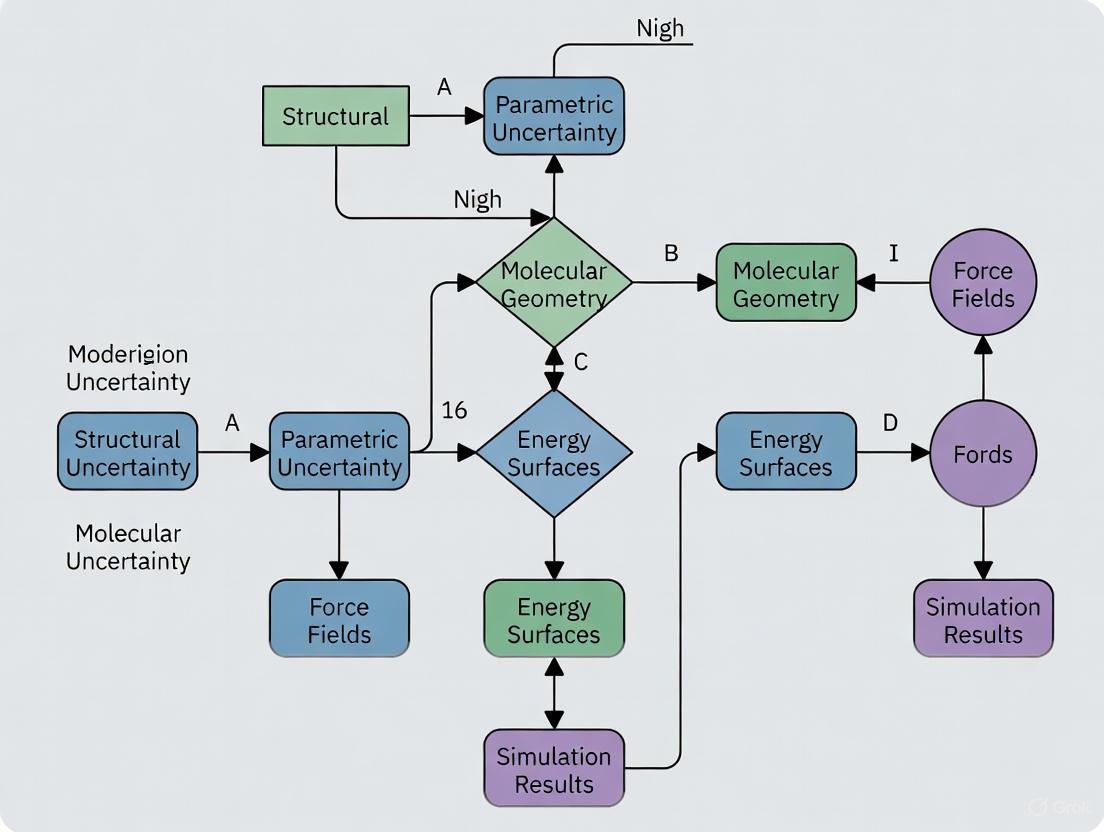
This article provides a comprehensive guide for researchers and drug development professionals on distinguishing and managing structural and parametric uncertainties in biomedical models.
Structural vs. Parametric Uncertainty: A Framework for Robust Models in Drug Development
Abstract
This article provides a comprehensive guide for researchers and drug development professionals on distinguishing and managing structural and parametric uncertainties in biomedical models. We explore the foundational definitions, where structural uncertainty stems from model simplifications and incomplete knowledge of underlying processes, while parametric uncertainty arises from imprecise input parameters. The piece details methodological frameworks for quantification, including Bayesian updating and ensemble modeling, and addresses troubleshooting strategies for when structural deficiencies limit parametric optimization. Finally, we cover validation and comparative techniques to assess model credibility, synthesizing key takeaways to enhance the reliability of clinical decision-making and accelerate robust therapeutic development.
Demystifying Uncertainty: Defining Structural and Parametric Sources in Biomedical Models
Frequently Asked Questions (FAQs)
Q1: What is structural uncertainty, and how is it different from parametric uncertainty?
Structural uncertainty arises from errors, simplifications, or missing processes in the mathematical representation of a real-world system. Parametric uncertainty, in contrast, stems from not knowing the exact values of the parameters within a chosen model structure. In climate modeling, for example, structural uncertainty comes from the inability of parameterizations to perfectly represent small-scale processes like cloud convection, while parametric uncertainty arises from fixing model parameters to values based on limited empirical studies [1]. In hydrological models, structural uncertainty exists due to errors in the mathematical representation of real-world hydrological processes, whereas parametric uncertainty exists due to both structural and measurement uncertainty, combined with limited data for calibration [2].
Q2: Why is it important to account for structural uncertainty in computational models?
Accounting for structural uncertainty is crucial for building reliable models and making credible predictions. It facilitates the rejection of deficient model structures and helps identify whether the model structure or the input measurements need to be improved to reduce the total output uncertainty [2]. In Land Use Cover Change (LUCC) modeling, different model software packages conceptualize the same system in different ways, leading to different simulation outputs. Ignoring this structural uncertainty means overlooking a significant source of potential error in your results [3].
Q3: How can I identify if my model has significant structural uncertainty?
A key indicator is a consistent, unexplained bias between your model simulations and observed data, even after thorough calibration. This bias is a direct effect of structural uncertainty that introduces error into parameter estimation [2]. Furthermore, if you obtain significantly different simulation outputs from different model software packages applied to the same geographic area and dataset, this is a strong signal of structural uncertainty inherent in the model designs [3].
Q4: What are some common strategies for managing structural uncertainty?
A common approach is to use multi-model ensembles, running several different model structures to see the range of possible outcomes [4]. Another strategy is to use Bayesian frameworks to learn biases and adjust parameterizations, effectively converting the problem of structural uncertainty into learning a sparse solution of unknown coefficients for basis functions and stochastic processes [1]. User intervention and the provision of several options for each modeling step in software packages also allow for the management of structural uncertainty [3].
Q5: In drug development, what are the main sources of uncertainty?
While this article focuses on computational models, workshops with companies and regulatory agencies have identified that uncertainties in medicine development arise from clinical, regulatory, and Health Technology Assessment (HTA) drivers. Key strategies involve managing or mitigating these uncertainties either during development or post-approval to facilitate decision-making [5].
Troubleshooting Guides
Problem: Model consistently produces a biased prediction, even with "optimal" parameters.
- Potential Cause: This is a classic symptom of structural error, where the model's equations do not fully capture the underlying system's behavior [2].
- Solution:
- Examine Residuals: Analyze the pattern of differences (residuals) between observed and simulated values. Non-random, structured residuals suggest a missing process or incorrect relationship in the model structure.
- Model Selection/Ensemble: Consider testing alternative model structures. If multiple models are available, using an ensemble of models can provide a more robust prediction and quantify the range of uncertainty [4].
- Model Enhancement: If possible, introduce new terms or processes into your model based on domain knowledge to address the identified bias.
Problem: Two different models yield vastly different forecasts for the same scenario.
- Potential Cause: The models have different underlying structural assumptions, leading to divergent conceptualizations of the system [3] [4].
- Solution:
- Compare Model Assumptions: Systematically compare the fundamental equations and processes represented in each model. Identify key differences in how they represent system dynamics.
- Global Sensitivity Analysis (GSA): Use GSA to understand how changes in input parameters influence model outputs in each structure. This helps identify which processes drive the differences [6].
- Use as an Uncertainty Bound: The range of predictions itself is a valuable measure of structural uncertainty. Report this range rather than relying on a single model's output.
Problem: Quantifying structural and measurement uncertainties separately is impossible from residuals alone.
- Potential Cause: The residual time series is an aggregate of structural and measurement uncertainties. For a fixed model parameter set, it is impossible to separate the two without additional information [2].
- Solution:
- Independent Uncertainty Estimation: Obtain an estimate of measurement uncertainty before model calibration. For streamflow, this can be done via rating-curve analysis.
- Pseudo Repeated Sampling: In environmental modeling, use machine learning algorithms like Random Forest as a "pseudo repeated sampler" to identify similar events across different watersheds and estimate measurement uncertainty [2].
Problem: High computational cost of model runs prevents robust uncertainty quantification.
- Potential Cause: Classical uncertainty quantification methods, like Monte Carlo, require thousands of model runs, which is infeasible for complex, high-fidelity models [6] [1].
- Solution:
- Surrogate Modeling: Develop a surrogate model (or emulator) using machine learning. This fast-to-evaluate model is trained on a limited set of full model runs and can be used for extensive uncertainty analysis [1].
- Model Reduction: Use projection-based model reduction techniques like Proper Orthogonal Decomposition to create a lower-dimensional, computationally cheaper surrogate that retains the physics of the full model [6].
Key Experimental Protocols and Data
Protocol: Comparing Model Structures to Illustrate Structural Uncertainty
This protocol is adapted from methodologies used in hydrology to demonstrate the impact of model choice [4].
Objective: To evaluate how different model structures affect simulation outputs for a given system.
Materials:
- A case study system (e.g., a watershed, a land-use map).
- Input data for the system (e.g., precipitation, initial conditions).
- At least two different model software packages or structures (e.g., MARRMoT toolbox models [4], LUCC models like CA_Markov, Dinamica EGO, etc. [3]).
- Computing environment with necessary software licenses.
Methodology:
- Data Preparation: Prepare a consistent set of input data for all models.
- Calibration: Calibrate each model on the same historical period of the case study system. Use the same objective function for calibration where possible.
- Simulation: Run each calibrated model for an identical simulation period.
- Validation & Comparison:
- Quantitatively compare simulation outputs against observed data using validation metrics.
- Qualitatively compare the outputs of the different models against each other.
Expected Output: A range of simulation results, visually and quantitatively demonstrating the uncertainty introduced solely by the choice of model structure.
Quantitative Data from LUCC Model Comparison
The table below summarizes findings from a study comparing four common Land Use Cover Change (LUCC) models, highlighting aspects of structural uncertainty [3].
Table 1: Comparison of Structural Uncertainty in LUCC Model Software Packages
| Model Software Package | Key Finding on Structural Uncertainty | Simulation Accuracy | Repeatability |
|---|---|---|---|
| CA_Markov | Conceptualizes the system differently from other models, leading to different outputs. | Varies by case study | Varies by case study |
| Dinamica EGO | Conceptualizes the system differently from other models, leading to different outputs. | Varies by case study | Varies by case study |
| Land Change Modeler | Conceptualizes the system differently from other models, leading to different outputs. | Varies by case study | Varies by case study |
| Metronamica | Conceptualizes the system differently from other models, leading to different outputs. | Varies by case study | Varies by case study |
| Overall Conclusion | No single "best" modeling approach; each entails different uncertainties and limitations. | Statistical/automatic models did not provide better scores than user-driven models. | Statistical/automatic models did not provide higher repeatability than user-driven models. |
Workflow and Conceptual Diagrams
Structural Uncertainty Identification Workflow
Uncertainty Quantification Pipeline
The Scientist's Toolkit: Research Reagent Solutions
Table 2: Essential "Reagents" for Structural Uncertainty Research
| Tool / Solution | Function in Research | Field of Application |
|---|---|---|
| Multi-Model Ensembles | Runs multiple model structures to quantify the range of predictions and formally represent structural uncertainty. | Hydrology [4], Climate Science [1], Land Use Modeling [3] |
| Global Sensitivity Analysis (GSA) | Identifies which input parameters or model processes have the greatest influence on output uncertainty, helping to pinpoint structural weaknesses. | General Computational Models [6] |
| Bayesian Inverse Problems Framework | Provides a mathematical framework to refine prior distributions of inputs (parameters) into data-consistent posterior distributions, quantifying parameter uncertainty. | Climate Modeling [1] |
| Surrogate Models / Emulators | Machine-learning-based models that approximate the behavior of complex, computationally expensive simulators, enabling extensive uncertainty quantification runs. | Climate Modeling [1], Engineering [6] |
| Model Reduction Techniques | Creates lower-dimensional, computationally cheaper surrogate models that retain the physics of the full model, making UQ feasible. | Engineering [6] |
Frequently Asked Questions
Q1: What is the fundamental difference between parametric and structural uncertainty? A: Parametric uncertainty refers to uncertainty about the numerical values of parameters within a chosen mathematical model, while structural uncertainty concerns the model form itself, such as the choice of clinical states in a Markov model or how transition probabilities are defined [7]. Parametric uncertainty is often quantified with probabilistic ranges for parameters, whereas structural uncertainty involves choosing between plausible model architectures.
Q2: My model fitting is computationally expensive. What are efficient methods for parameter estimation and uncertainty quantification? A: For complex models, profile likelihood-based methods are often an efficient choice [8]. This approach uses optimization to find maximum likelihood estimates and explores parameter identifiability by profiling one parameter at a time. Alternatively, fully Bayesian methods using Markov Chain Monte Carlo (MCMC) posterior sampling can formally propagate parameter uncertainty to model outputs, accounting for correlations between parameters [7] [9].
Q3: How can I visually communicate the parametric uncertainty in my model's predictions? A: Several methods are available. For a lay audience, frequency framing or quantile dotplots are effective, as they create a strong intuitive impression of uncertainty by showing discrete possible outcomes [10]. For more technical audiences, error bars indicate confidence intervals for point estimates, and confidence bands show uncertainty around regression curves or other functional outputs [10] [11].
Troubleshooting Common Problems
Problem: Poor model convergence or non-identifiable parameters during estimation. Diagnosis: This often occurs when multiple parameter combinations produce an equally good fit to the data, rendering the model non-identifiable. Solution:
- Profile Likelihood Analysis: Use this method to systematically assess parameter identifiability. A flat profile likelihood indicates that a parameter is non-identifiable or only poorly identifiable with the available data [8].
- Structured Inference: If some parameters have a known, simple effect on the model output (e.g., linear scaling), use a structured inference approach. This method partitions parameters into "inner" and "outer" sets, reducing the dimensionality of the optimization problem and computational cost [8].
Problem: Model predictions fail to account for full parameter uncertainty, leading to overconfident results. Diagnosis: Using only point estimates (e.g., maximum likelihood estimates) for parameters ignores the range of plausible values and their correlation. Solution:
- Probabilistic Propagation: Use methods like MCMC [7] or Monte Carlo simulation [12] to sample from the joint posterior distribution of your parameters. Run your model with these samples to generate a distribution of outputs that fully reflects parametric uncertainty.
- Model Averaging: If structural uncertainty is also present, account for it by averaging posterior distributions from competing models using weights based on model adequacy measures (e.g., deviance information criterion) [7].
Problem: Inefficient parameter estimation for high-dimensional or complex models. Diagnosis: Standard optimization routines (e.g., finite difference approximations) become inefficient and slow for models with many parameters. Solution: Employ gradient-based optimization methods.
- Adjoint Sensitivity Analysis: This method is efficient for large systems of ODEs, as it computes the gradient of an objective function with respect to parameters by solving a single backward integration problem [9].
- Forward Sensitivity Analysis: This augments the original ODE system with sensitivity equations to compute exact gradients. It is effective for models with a moderate number of parameters [9].
Experimental Protocols for Parameter Inference
Protocol 1: Profile Likelihood Workflow for Practical Identifiability [8] This protocol is useful for determining which parameters can be uniquely identified from your data and for quantifying their uncertainty.
- Formulate the Likelihood Function: Define a likelihood function ( L(\theta) ) that measures the probability of your observed data given the model parameters ( \theta ).
- Find Maximum Likelihood Estimates (MLE): Solve ( \theta{\text{MLE}} = \text{argmax}{\theta} L(\theta) ) using an optimization algorithm.
- Compute Profile Likelihoods: For each parameter of interest ( \thetai ):
- Fix ( \thetai ) at a value around its MLE.
- Optimize the likelihood over all other parameters ( \theta{j \neq i} ).
- Repeat across a range of values for ( \thetai ) to build its profile.
- Assess Identifiability: A parameter is practically identifiable if its profile likelihood forms a well-defined peak. A flat profile suggests non-identifiability.
- Construct Confidence Intervals: Use the likelihood ratio test to determine confidence intervals from the profile.
Protocol 2: Bayesian Parameter Inference and Uncertainty Propagation with MCMC [7] This protocol is suitable for formally quantifying parameter uncertainty and propagating it to model predictions.
- Specify Model and Priors: Define your mathematical model and assign prior probability distributions to all unknown parameters.
- Define Posterior Distribution: The posterior distribution is proportional to the likelihood of the data times the prior distributions.
- Sample from the Posterior: Use MCMC sampling algorithms (e.g., implemented in software like WinBUGS or PyBioNetFit) to generate a large number of samples from the joint posterior distribution of the parameters.
- Check Convergence: Ensure the MCMC chains have converged to the target posterior distribution.
- Propagate Uncertainty: Use the sampled parameter values to run the model repeatedly, generating a distribution of outputs that incorporates parameter uncertainty.
Research Reagent Solutions
The table below lists key software tools and their functions for parameter estimation and uncertainty quantification.
| Tool/Reagent Name | Primary Function | Key Application Context |
|---|---|---|
| PyBioNetFit [9] | Parameter inference for biological models | Supports rule-based modeling languages (BNGL) and SBML; performs parameter estimation and uncertainty analysis. |
| AMICI/PESTO [9] | Parameter estimation toolbox for ODE models | Efficiently handles high-dimensional models using advanced sensitivity analysis (adjoint/forward). |
| WinBUGS [7] | Bayesian inference Using Gibbs Sampling | Performs MCMC sampling for Bayesian models, useful for probabilistic sensitivity analysis in health economic models. |
| Profile Likelihood Workflow [8] | Identifiability analysis and uncertainty quantification | An optimization-based method for practical identifiability, estimation, and prediction uncertainty. |
| Structured Inference [8] | Efficient parameter inference | Reduces computational cost by exploiting known parameter relationships (e.g., linear scaling). |
| PINN-UU [12] | Uncertainty quantification in PDE models | Physics-Informed Neural Network for solving PDEs with uncertain parameters, alternative to Monte Carlo. |
Visualizing Uncertainty
Effective visualization is key to communicating parametric uncertainty. The table below summarizes common approaches.
| Visualization Type | Description | Best Use Cases |
|---|---|---|
| Error Bars [10] | Bars extending from a point estimate to show a confidence interval. | Communicating uncertainty of a point estimate (e.g., a mean) in a compact, space-efficient way. |
| Confidence Bands [10] | A shaded region around a line (e.g., a regression curve) to show uncertainty. | Displaying uncertainty in a functional output over a continuous domain. |
| Quantile Dotplots [10] | A series of dots where each dot represents a quantile of the predictive distribution. | Intuitive communication of a full probability distribution for a lay audience; makes uncertainty tangible. |
| Hypothetical Outcome Plots (HOPs) [11] | An animation that cycles through different possible outcomes from the predictive distribution. | Creating an intuitive sense of uncertainty and variability, though requires dynamic media. |
Workflow for Parameter Inference and Uncertainty
The diagram below outlines a general workflow for dealing with parametric uncertainty, from model specification to prediction.
Differentiating Uncertainty Types
The following diagram illustrates the key differences between parametric and structural uncertainty in the modeling process.
In scientific research, particularly in drug development, effectively troubleshooting failed experiments requires more than just technical skill; it demands a deep understanding of the different types of uncertainty inherent in any model or experimental system. The core challenge often lies in distinguishing between parametric uncertainty (uncertainty about the numerical values within a model) and structural uncertainty (uncertainty about the model's fundamental equations and assumptions) [2] [1]. Misdiagnosing the type of uncertainty can lead research teams down a path of futile parameter adjustments when what is truly needed is a re-evaluation of the underlying experimental hypothesis or model framework.
This guide provides a structured approach and toolkit to help researchers correctly identify and resolve these distinct forms of uncertainty.
Troubleshooting Guides & FAQs
Frequently Asked Questions
Q1: Our cell-based assay is producing results with unexpectedly high variance and inconsistent signals. We've repeated the experiment with different cell passage numbers, but the problem persists. Is this a parametric or structural issue? A: This is a classic scenario where the symptoms point to parametric uncertainty (e.g., cell viability, concentration levels), but the root cause may be structural. A key structural factor often overlooked is the experimental protocol itself. For instance, an imprecise washing technique during an MTT assay can lead to the accidental aspiration of cells, introducing high variability that is not resolved by simply changing biological reagents [13]. The problem is not the model's parameters but the foundational steps of the method.
Q2: We are developing a new climate model, and its predictions for extreme precipitation events are highly sensitive to small changes in a few parameters. How can we have more confidence in our forecasts? A: This high sensitivity indicates significant parametric uncertainty. The solution is to move from using single, fixed parameter values to adopting a Bayesian inference framework [1]. This involves:
- Defining a prior distribution for the sensitive parameters.
- Using observational data (e.g., from satellites) to calibrate the model and update these distributions.
- Generating a posterior distribution of both parameters and predictions, which provides a robust, probabilistic forecast that quantifies the uncertainty, as shown in climate modeling research [1].
Q3: In a hydrological model, how can we separate the total error into components stemming from structural vs. measurement uncertainty? A: Separation is challenging because residuals aggregate both uncertainties. The only reliable method is to obtain an independent estimate of measurement uncertainty before model calibration [2]. One innovative approach is to use a machine learning algorithm like Random Forest as a "pseudo repeated sampler." By identifying similar rainfall-runoff events across different watersheds, these events can be treated as approximate repeated experiments under identical conditions, providing an estimate of measurement uncertainty that can be isolated from the structural error [2].
Troubleshooting Guide: A Step-by-Step Diagnostic Framework
| Observed Symptom | Initial Hypothesis (Often Parametric) | Deeper Investigation for Structural Causes | Recommended Action |
|---|---|---|---|
| High variability & inconsistent results | Reagent concentration, cell line health, incubation time [13]. | Scrutinize fundamental techniques: pipetting accuracy, washing steps, equipment calibration, protocol fidelity [13]. | Control the protocol: Review video recordings of technique, use calibrated equipment, and strictly adhere to a documented protocol. |
| Systematic bias; model consistently over/under-predicts | Incorrect baseline parameter values. | Flawed model assumptions; missing a key variable or relationship; an oversimplified representation of the biology [2] [1]. | Challenge the model: Design experiments to test core assumptions. Consider adding new variables or using a different mechanistic framework. |
| High sensitivity to tiny parameter changes | The parameters are inherently highly sensitive. | The model structure may be ill-posed or overly simplistic for the system's complexity, making it brittle [1]. | Quantify uncertainty: Employ Bayesian calibration to represent parameters as distributions, not fixed values. This quantifies and propagates parametric uncertainty [1]. |
The Scientist's Toolkit
Key Research Reagent Solutions
| Item | Function in Uncertainty Analysis |
|---|---|
| Bayesian Inference Framework | A mathematical approach to update the probability for a hypothesis (or parameter values) as more evidence or data becomes available. It is the cornerstone for formally quantifying both parametric and structural uncertainty [2] [1]. |
| Random Forest Algorithm | A machine learning method that can be used as a "pseudo repeated sampler" to approximate measurement uncertainty by leveraging similar experimental events across different datasets [2]. |
| Surrogate Model (Emulator) | A computationally cheap model (often machine learning-based) trained to mimic the behavior of a complex, expensive simulation. It allows for rapid exploration of parameter spaces and uncertainty quantification without the high computational cost [1]. |
| High-Resolution Simulation Data | Detailed simulations of small-scale processes (e.g., cloud convection, protein folding) used as "ground truth" data to calibrate and assess the structural adequacy of larger-scale models [1]. |
Experimental Protocol: The Calibrate, Emulate, Sample (CES) Method for Quantifying Parametric Uncertainty
This state-of-the-art methodology, developed for climate modeling and applicable to complex biological systems, provides a rigorous protocol for quantifying parametric uncertainty [1].
- Calibrate: Run an ensemble of simulations with your model, varying the parameters of interest across a wide prior distribution. Use an ensemble-based data assimilation scheme to locate the region of parameter space that produces realistic outcomes.
- Emulate: Train a machine learning-based surrogate model (the emulator) on the input-output data collected from the ensemble simulations. This emulator learns to predict model outcomes for any given parameter set almost instantaneously.
- Sample: Use the trained emulator to run a vast statistical sampling (e.g., via Markov Chain Monte Carlo) to refine the prior parameter distribution into a tight posterior distribution that is consistent with observed data. This posterior distribution formally represents the quantified parametric uncertainty.
Workflow Visualization: Diagnosing Uncertainty in Experimental Research
The following diagram outlines the logical workflow for diagnosing and addressing different types of uncertainty in a research project.
In clinical predictions, structural uncertainty and parametric uncertainty represent two fundamental classes of unknowns that affect the reliability of model-based conclusions. Structural uncertainty, also known as model inadequacy, arises from incomplete knowledge about the model equations themselves, such as the choice of clinical states in a Markov model or the mathematical form of a growth relationship [7] [14]. Parametric uncertainty refers to imperfect knowledge of the fixed, underlying parameters in a chosen model, even if the model structure is correct [7] [15]. Distinguishing between these is critical because they originate from different sources of limited knowledge and often require distinct methodologies for quantification and mitigation. In health economic evaluations and clinical decision-making, failing to account for these uncertainties can lead to overconfident predictions and suboptimal resource allocation [7].
The following table summarizes the core characteristics of these two uncertainty types:
| Characteristic | Structural Uncertainty | Parametric Uncertainty |
|---|---|---|
| Definition | Uncertainty about the model structure or equations [14]. | Uncertainty about the fixed parameter values within a chosen model [7]. |
| Origin | Choice of clinical states, permitted transitions, model complexity, data choice [7]. | Natural variation, measurement error, limited sample size in experimental data [14]. |
| Nature | Epistemic (reducible through better knowledge) [16]. | Often aleatory (irreducible inherent variation) or epistemic [14]. |
| Common Handling | Model averaging, model comparison, sensitivity analysis [7]. | Probabilistic sensitivity analysis, Bayesian inference, profile likelihood [7] [15]. |
Experimental Protocols for Quantifying Uncertainty
Protocol for Assessing Parametric Uncertainty Using Profile Likelihood
Objective: To quantify the identifiability and uncertainty of parameters in a computational model, using a profile likelihood approach [15].
- Model Definition: Define your mathematical model and a likelihood function ( L(\theta) ), which measures the probability of observing the experimental data given a set of model parameters ( \theta ) [15].
- Maximum Likelihood Estimation (MLE): Find the parameter values ( \theta{MLE} ) that maximize the likelihood function: ( \theta{MLE} = \mathrm{argmax}_{\theta}L(\theta) ) [15].
- Profiling a Parameter of Interest:
- Select a single parameter of interest, ( \psi ), from the full parameter vector ( \theta = (\psi, \phi) ), where ( \phi ) represents all other parameters.
- Define a series of fixed values for ( \psi ) across a plausible range.
- For each fixed value of ( \psi ), optimize the likelihood function over all other parameters ( \phi ).
- Calculate Profile Likelihood: The profile likelihood for ( \psi ) is the value of the optimized likelihood at each fixed value of ( \psi ): ( Lp(\psi) = \max{\phi} L(\psi, \phi) ) [15].
- Uncertainty Quantification: Calculate confidence intervals for ( \psi ) based on the profile likelihood and a chi-squared distribution [15].
- Iterate: Repeat steps 3-5 for all parameters in the model to understand the uncertainty and identifiability of each one.
Protocol for Assessing Structural Uncertainty in a Growth Model
Objective: To identify the most suitable model structure for characterizing the progression of a clinical condition, using total Geographic Atrophy (GA) growth as an example [16].
- Data Collection: Collect longitudinal, time-series data from patient presentations in a clinical setting. For GA, this involves fundus autofluorescence (FAF) images from at least three clinical review visits over a minimum of two years [16].
- Image Analysis: Use a semi-automated software algorithm (e.g., RegionFinder) for image segmentation and quantification of the clinical measure (e.g., total GA area) [16].
- Model Candidate Selection: Propose a set of plausible competing model structures (e.g., linear, exponential, quadratic) based on anecdotal clinical observations or previous literature [16].
- Model Fitting & Comparison: Fit each candidate model to the data. Compare them using:
- Model Selection/Averaging: Select the single best model based on the comparison criteria, or use model averaging to produce combined predictions that formally account for the structural uncertainty [7] [16].
The Scientist's Toolkit: Research Reagent Solutions
The following table details key materials and computational tools used in uncertainty analysis for clinical models.
| Reagent/Tool | Function in Uncertainty Analysis |
|---|---|
| WinBUGS | Software for Bayesian inference Using Gibbs Sampling; enables fully Bayesian model fitting and cost-effectiveness prediction via MCMC methods, formally propagating parameter uncertainty to model outputs [7]. |
| Profile Likelihood Workflow | An optimization-based method for parameter inference, identifiability analysis, and uncertainty quantification; more computationally efficient than sampling-based methods for many problems [15]. |
| Fundus Autofluorescence (FAF) Imaging | An ophthalmic imaging technique to capture geographic atrophy as hypoautofluorescent areas; provides the longitudinal, high-reproducibility data required to assess model structure for disease progression [16]. |
| RegionFinder Software | A semi-automated algorithm for segmenting and quantifying lesions in longitudinal FAF images; used to generate the precise area measurements needed to fit and compare growth models [16]. |
| Markov Chain Monte Carlo (MCMC) | A computational algorithm used to sample from probability distributions; applied in Bayesian analysis to sample from the posterior distribution of model parameters, accounting for parameter uncertainty [7]. |
Troubleshooting Guides and FAQs
FAQ 1: How do I know if my model's parameters are identifiable, and what can I do if they are not?
Answer: Parameter non-identifiability occurs when different parameter combinations yield an equally good fit to the data, leading to large uncertainties. This can be detected using a profile likelihood analysis [15]. If the profile likelihood for a parameter is flat, the parameter is non-identifiable.
- Troubleshooting Steps:
- Check for Structural Identifiability: Reformulate your model to remove redundant parameters.
- Incorporate Prior Information: Use a Bayesian framework to include informative prior distributions from previous studies, which can help constrain parameter values [7] [17].
- Collect More Informative Data: Design new experiments that provide information specifically about the non-identifiable parameters.
- Consider a Structured Inference Approach: If some parameters have a simple, known effect on the model output (e.g., linear scaling), use methods that exploit this structure to reduce the dimensionality of the optimization problem [15].
FAQ 2: My model fits the calibration data well but performs poorly in validation. Is this a structural or parametric issue?
Answer: Poor predictive performance despite good calibration is a classic sign of structural uncertainty or model inadequacy [14]. Your chosen model structure may not capture the true underlying biological or clinical process, even with optimally fitted parameters.
- Troubleshooting Steps:
- Model Comparison: Systematically compare a set of alternative, biologically plausible model structures using metrics like the deviance information criterion (DIC) or pseudo-marginal-likelihood (PML) [7].
- Model Averaging: Instead of relying on a single "best" model, use Bayesian model averaging to combine predictions from multiple models, weighted by their evidential support. This formally incorporates structural uncertainty into your predictions [7].
- Review Model Assumptions: Critically re-examine the core assumptions of your model (e.g., linearity, independence) in the context of the system's known biology.
FAQ 3: How can I visually communicate the impact of uncertainty to a clinical audience?
Answer: Effective uncertainty visualization is key. Avoid relying on single-value predictions and instead show distributions.
- Troubleshooting Steps:
- For Parametric Uncertainty: Use error bars or confidence bands around model predictions to show the range of possible outcomes [18] [19].
- For Structural Uncertainty: Plot predictions from multiple candidate models on the same axes, or display a model-averaged prediction with a credible interval that incorporates both parametric and structural uncertainty [7] [19].
- Use Interactive Visualizations: Allow clinicians to explore how predictions change under different model assumptions or parameter values, which can build trust and understanding [18].
FAQ 4: My computational model is too slow for standard uncertainty quantification methods. What are my options?
Answer: This is a common challenge with complex models. Several efficiency-focused strategies exist.
- Troubleshooting Steps:
- Structured Inference: If your model has parameters with a known, simple effect (e.g., multiplicative scaling factors), use a structured inference approach. This nests the optimization, reducing the number of expensive model evaluations required [15].
- Surrogate Modeling: Replace your slow simulator with a fast, approximate statistical model (e.g., a Gaussian process emulator) trained on a limited set of simulator runs. Perform UQ on the surrogate.
- Sensitivity Analysis: First, conduct a global sensitivity analysis to identify the parameters that contribute most to output uncertainty. Focus your UQ efforts on these high-impact parameters, fixing less sensitive ones to nominal values [14].
Workflow and Pathway Visualizations
Diagram 1: Integrated workflow for handling parametric and structural uncertainty in clinical predictions.
Diagram 2: A taxonomy of uncertainties affecting computational clinical models, adapted from [14].
Quantification in Action: Methodologies for Managing Both Uncertainty Types
Frequently Asked Questions
Q1: What is the fundamental difference between structural and parametric uncertainty in models?
Structural uncertainty arises from errors or simplifications in the mathematical representation of real-world processes. In contrast, parametric uncertainty exists due to errors in model parameters, often stemming from structural issues, measurement errors, and limited calibration data [2]. While measurement and parametric uncertainties have been widely studied, research on quantifying structural uncertainty remains less developed, making it a critical area for improving model reliability [2].
Q2: When should researchers choose ensemble modeling over a single best model approach?
Ensemble modeling should be prioritized when dealing with high-stakes predictions where model deficiencies could lead to real-world environmental or societal harm. Research on hydrological indicators shows that outcomes within a single historical scenario can range from "very low to very high ecological condition based solely on a simple set of modeling choices" [20]. Ensembles help manage this structural sensitivity by combining multiple models to balance parsimony and realism [20].
Q3: What are the practical limitations of multi-model averaging (MMA) approaches?
While MMA improves on simple model selection by implementing a form of shrinkage estimation, it has significant limitations [21]. MMA can produce overconfident, overly narrow confidence intervals and performs poorly with correlated variables, where it may bias estimates of weak effects upward and strong effects downward [21]. Other shrinkage estimators like penalized regression or Bayesian hierarchical models with regularizing priors are often more computationally efficient and better supported theoretically [21].
Q4: How can I determine if my model suffers from significant structural uncertainty?
Structural uncertainty manifests as persistent bias that cannot be eliminated through parameter calibration alone. In hydrological modeling, this bias propagates through the modeling process, affecting predictions even at ungauged locations [2]. Testing multiple model structures and comparing their predictions is essential for identifying this uncertainty, as relationship shape, aggregation functions, and assessment timeframes can all be highly influential factors [20].
Troubleshooting Guides
Problem: Poor Model Performance Despite Extensive Parameter Calibration
Symptoms: Persistent systematic errors, inability to match observed data across different conditions, high sensitivity to minor structural changes.
Diagnosis Steps:
- Test different relationship shapes (e.g., linear vs. nonlinear) in your model components [20].
- Vary choices of aggregation methods in space, time, and ecological groupings [20].
- Compare outcomes across multiple competing model structures rather than relying on a single formulation [20].
Solutions:
- Immediate Fix: Implement a comprehensive ensemble approach that builds multi-subject diversified models and combines them through second-level meta-learning [22].
- Long-term Strategy: Develop a model of structural uncertainty that can quantify total uncertainty at ungauged locations by compensating for structural bias [2].
Problem: Overconfident Predictions with Unrealistically Narrow Confidence Intervals
Symptoms: Model predictions frequently fall outside stated confidence bounds, performance degrades significantly on validation data.
Diagnosis Steps:
- Check if you're using multi-model averaging (MMA), which commonly produces overconfident intervals [21].
- Verify whether correlated predictors are causing MMA to shrink estimates toward each other [21].
Solutions:
- Immediate Fix: Use full (maximal) statistical models with principled, a priori decisions about model complexity, possibly with Bayesian priors [21].
- Alternative Approach: Employ penalized regression or Bayesian hierarchical models with regularizing priors instead of MMA for more reliable uncertainty quantification [21].
Problem: Inconsistent Model Performance Across Different Data Types or Contexts
Symptoms: Model works well on daily data but fails on hourly data, performs inconsistently across different watersheds or biological assays.
Diagnosis Steps:
- Assess whether structural uncertainty manifests differently across temporal scales or spatial contexts [2].
- Evaluate if the model structure adequately represents the fundamental processes across all application domains.
Solutions:
- Immediate Fix: Use grouping by type of ecological response (e.g., threshold vs. linear) to balance parsimony and realism [20].
- Comprehensive Solution: Implement pseudo repeated sampling using machine learning algorithms like random forest to identify similar processes across different contexts [2].
Experimental Protocols & Methodologies
Protocol 1: Comprehensive Ensemble Development for QSAR Prediction
This methodology details the comprehensive ensemble approach for Quantitative Structure-Activity Relationship (QSAR) prediction in drug discovery, which consistently outperformed 13 individual models across 19 bioassay datasets [22].
Table 1: Molecular Representations for QSAR Modeling
| Representation Type | Format | Compatible Learning Methods | Key Characteristics |
|---|---|---|---|
| PubChem Fingerprint | Binary vector | RF, SVM, GBM, NN | Retrieved from PubChemPy, non-sequential form [22] |
| ECFP (Extended-Connectivity Fingerprint) | Binary vector | RF, SVM, GBM, NN | Retrieved from SMILES using RDKit, non-sequential form [22] |
| MACCS Fingerprint | Binary vector | RF, SVM, GBM, NN | Retrieved from SMILES using RDKit, non-sequential form [22] |
| SMILES | Sequential string | 1D-CNN, RNN | Simplified Molecular-Input Line-Entry System, requires specialized architectures [22] |
Experimental Workflow:
Implementation Details:
- Dataset Division: Randomly divide data into training (75%) and testing (25%) sets [22].
- Cross-Validation: Partition training data into five portions (one for validation, four for training) [22].
- Feature Processing: Use PubChemPy to retrieve SMILES and PubChem fingerprints; use RDKit for ECFP and MACCS fingerprints [22].
- Ensemble Combination: Use second-level meta-learning to combine predictions from multiple models and representations [22].
Protocol 2: Hepatotoxicity Prediction Using Ensemble Methods
This protocol describes an ensemble approach integrating machine learning and deep learning for hepatotoxicity prediction, achieving 80.26% accuracy and 82.84% AUC [23].
Table 2: Ensemble Method Performance Comparison for Hepatotoxicity Prediction
| Ensemble Method | Prediction Accuracy | AUC | Recall | Key Strengths |
|---|---|---|---|---|
| Voting Ensemble Classifier | 80.26% | 82.84% | >93% | Optimal performance, excellent recall [23] |
| Bagging Ensemble Classifier | (Lower than Voting) | (Lower than Voting) | (Lower than Voting) | Good alternative to voting ensemble [23] |
| Stacking Ensemble Classifier | (Lower than Voting) | (Lower than Voting) | (Lower than Voting) | Effective combination method [23] |
Experimental Workflow:
Validation Framework:
- External Test Set: Verify model performance on completely separate data [23].
- 10-Fold Cross-Validation: Robust internal validation using multiple data partitions [23].
- Benchmark Training: Compare against published models to establish superiority [23].
The Scientist's Toolkit: Research Reagent Solutions
Table 3: Essential Computational Tools for Ensemble Modeling
| Tool/Resource | Function | Application Context |
|---|---|---|
| RDKit | Generate molecular fingerprints (ECFP, MACCS) from SMILES strings [22] | Cheminformatics, drug discovery, QSAR modeling |
| PubChemPy | Retrieve PubChem chemical IDs, SMILES strings, and molecular descriptors [22] | Access to PubChem database, chemical property retrieval |
| Keras Library | Implement neural network architectures (1D-CNN, RNN) for sequential data [22] | Deep learning models, end-to-end feature extraction |
| Scikit-learn Library | Conventional machine learning methods (RF, SVM, GBM) and model evaluation [22] | Traditional ML implementation, performance metrics |
| Random Forest Algorithm | Pseudo repeated sampling for uncertainty estimation in environmental data [2] | Measurement uncertainty quantification, hydrological modeling |
| Comprehensive Ensemble Framework | Multi-subject model diversification with second-level meta-learning [22] | QSAR prediction, structural uncertainty mitigation |
Critical Limitations and Considerations
Structural Sensitivity in Environmental Management: Research on Murray-Darling Basin management models revealed that structural sensitivity appears at many steps in complex modeling processes. Common default choices like linear relationships and arithmetic means were found to be "not conservative and may inflate risk" [20]. Even scenario comparison, while helpful, only partially reduces this sensitivity [20].
Conceptual Limitations of Multi-Model Approaches: Multi-model averaging represents an unnecessary discretization of a continuous model space. As noted in critical assessments, "If we do not have particular, a priori discrete hypotheses about our system, why does so much of our data-analytic effort go into various ways to test between, or combine and reconcile, multiple discrete models?" [21]. This reflects an "XY problem" where researchers focus on making multimodel approaches work rather than addressing the fundamental challenge of understanding multifactorial systems [21].
Recommendations for Robust Practice:
- Explicitly test and report structural uncertainty for science-based environmental management [20].
- Use grouping by ecological response type rather than default mathematical conveniences [20].
- Consider full models with Bayesian priors instead of MMA for more reliable confidence intervals [21].
- Report several competing structures rather than uncritically using a single model, which represents the highest risk of poor decision-making [20].
Core Concept Definitions
What is a probability-box (p-box) and how does it relate to parametric uncertainty? A probability-box (p-box) is a mathematical structure used to represent epistemic uncertainty in the probability distribution of a random variable. It is defined by upper and lower bounds on the cumulative distribution function (CDF) that enclose all possible distributions consistent with available information. Unlike precise probability distributions that require exact parameter specification, p-boxes accommodate parametric uncertainty by defining a family of distributions bounded by two CDFs, thus capturing uncertainty about distribution parameters themselves [24].
How does Probabilistic Sensitivity Analysis (PSA) complement p-box analysis? Probabilistic Sensitivity Analysis quantifies how uncertainty in model inputs (including distribution parameters) affects model outputs. While traditional PSA often assumes precise input distributions, when combined with p-boxes, it evaluates how the entire range of possible distributions impacts output uncertainty. This allows analysts to determine which uncertain distribution parameters contribute most to output variance and to compute bounds on failure probabilities or other reliability metrics [25] [26].
What is the fundamental difference between parametric and distribution-free p-boxes? Parametric p-boxes constrain the family of possible distributions to a specific distribution family (e.g., all normal distributions with mean between [1, 3] and standard deviation between [0.5, 1.5]). Distribution-free p-boxes only specify upper and lower CDF bounds without assuming an underlying distribution family, thus accommodating a wider class of possible distributions [24].
Troubleshooting Common P-Box Implementation Issues
Table 1: Common Computational Challenges in P-Box Analysis
| Problem | Symptoms | Recommended Solutions |
|---|---|---|
| Excessive Computational Demand | Long processing times; inability to complete analysis with complex models | Use single-loop methods like Bayesian Updating BDRM; Implement surrogate modeling (Kriging); Apply dimension reduction techniques [27] [28] |
| Overly Wide Result Bounds | Uninformatively broad probability bounds; Limited practical utility of results | Incorporate additional data to constrain bounds; Use pinching analysis to identify most influential parameters; Apply dependence constraints between parameters [29] |
| Difficulty Constructing P-Box from Data | Uncertainty in selecting appropriate bounds; Disagreement among experts on parameter ranges | Use confidence intervals on distribution parameters; Employ Kolmogorov-Smirnov confidence bounds; Combine multiple data sources with random set theory [24] |
| Propagation Errors | Inconsistent results; Violation of probability bounds during computation | Verify monotonicity assumptions; Use guaranteed enclosure methods; Implement double-loop approaches for validation [29] [28] |
Why are my p-box computations so resource-intensive and how can I optimize them? P-box propagation traditionally requires nested calculations (double-loop methods) where the outer loop explores distribution parameter space and the inner loop performs probabilistic analysis. This computational burden is particularly challenging for complex engineering models with implicit limit state functions [28]. Recent advances suggest several optimization approaches:
Single-loop methods like the Bayesian Updating Bivariate Dimension Reduction Method (BU-BDRM) reuse a single set of model evaluations, dramatically reducing computational requirements while maintaining accuracy [28].
Surrogate modeling constructs approximate relationships between interval variables and failure probabilities using techniques like Kriging, which requires minimal training data while providing uncertainty quantification [27].
Sparse polynomial chaos expansions create efficient meta-models specifically designed for uncertainty propagation with p-box inputs [28].
How can I determine which uncertain distribution parameters contribute most to my output uncertainty? The "pinching" method provides a systematic approach for sensitivity analysis within p-box frameworks. By fixing specific input parameters to precise values (one at a time) and observing the reduction in output uncertainty, analysts can rank parameters by their influence on overall uncertainty. This approach identifies which parameters would benefit most from additional data collection or more precise estimation [29].
Methodological Protocols & Workflows
Protocol 1: P-Box Construction from Limited Data
Objective: Construct a parametric p-box when only range information on distribution parameters is available.
Materials: Parameter bounds data, computational software with interval analysis capabilities.
Procedure:
- Identify the appropriate distribution family based on physical knowledge of the phenomenon
- Determine interval bounds for each distribution parameter (e.g., mean, standard deviation)
- Define the p-box as the set of all distributions within the specified parameter bounds
- Validate that the constructed bounds enclose all empirical data points
- Perform sensitivity analysis to assess the impact of parameter bound selections [24]
Protocol 2: Monte Carlo Sensitivity Analysis (MCSA) for Misclassification Adjustment
Objective: Account for uncertainty in bias parameters when adjusting for misclassification in epidemiological studies.
Materials: Observed data (dataset or 2x2 table), statistical software with probabilistic sampling capabilities.
Procedure:
- Input observed data and specify the type of misclassification to be adjusted
- Specify probability distributions for sensitivity/specificity parameters based on literature or expert opinion
- Set the number of replications (typically 10,000-100,000)
- For each replication:
- Sample sensitivity/specificity values from their distributions
- Back-calculate expected true cases using: A = [a - (1-S₀) × N]/[S₁ - (1-S₀)]
- Compute positive and negative predictive values (PPV, NPV)
- Reclassify each individual via Bernoulli trials using uniform random numbers
- Compute effect estimates from bias-adjusted datasets
- Calculate simulation intervals for the adjusted estimates [30]
Figure 1: Monte Carlo Sensitivity Analysis Workflow for Bias Adjustment
Protocol 3: Efficient Reliability Analysis with Parametric P-Boxes
Objective: Compute bounds on failure probabilities for structural systems with parametric p-box uncertainties.
Materials: Limit state function model, parameter bounds, computational software with reliability analysis capabilities.
Procedure:
- Employ Fractional Exponential Moments-based Maximum Entropy Method (FEM-MEM) with Bivariate Dimension Reduction Method (BDRM) for initial reliability assessment
- Perform a single round of limit state function evaluations at integration points
- Apply Bayesian Updating to adjust BDRM weights in response to changes in input distribution parameters
- Recompute failure probabilities with updated weights without additional model evaluations
- Use Kriging modeling to construct surrogate relationships between interval variables and failure probabilities
- Calculate precise bounds on failure probabilities using the surrogate model [27] [28]
Computational Implementation Framework
Figure 2: Probability-Box Analysis Framework for Parametric Uncertainty
Table 2: Research Reagent Solutions for P-Box and PSA Implementation
| Tool/Method | Primary Function | Implementation Considerations |
|---|---|---|
| Bayesian Updating BDRM | Efficient reliability analysis with single-loop evaluation | Requires initial integration points; Updates weights with parameter changes [28] |
| Kriging Surrogate Modeling | Approximates relationship between interval variables and failure probabilities | Reduces computational cost; Provides uncertainty quantification for predictions [27] |
| Fractional Exponential Moments MEM | Accurately computes failure probabilities from limited evaluations | Works with BDRM integration points; Captures distribution tail behavior [28] |
| Monte Carlo Sensitivity Analysis | Propagates uncertainty in bias parameters through models | Requires specification of parameter distributions; Computationally intensive but parallelizable [30] |
| Pinching Analysis | Identifies influential uncertain parameters by fixing them to precise values | Systematic approach; Provides parameter importance ranking [29] |
| Double-Loop Sampling | Reference method for p-box propagation with guaranteed bounds | Computationally expensive; Useful for validation of approximate methods [24] |
Advanced Integration Scenarios
How can p-boxes be integrated with traditional probabilistic analysis in drug development? In health technology assessment, p-boxes can enhance probabilistic sensitivity analysis by accommodating epistemic uncertainty in distribution parameters. For instance, when a cost-effectiveness analysis requires input parameters with limited data, p-boxes can represent the uncertainty in the distributional form itself, while PSA propagates this uncertainty to cost-effectiveness outcomes. The National Institute for Health and Care Excellence (NICE) has demonstrated that technologies with higher probabilities of being cost-effective (typically above 40% at relevant thresholds) are more likely to receive positive recommendations, highlighting the importance of comprehensively accounting for all sources of uncertainty [25].
What strategies exist for mixing precise probabilities, intervals, and p-boxes in the same analysis? Real-world analyses often combine different uncertainty representations. P-boxes naturally accommodate this heterogeneity through their position in the uncertainty representation hierarchy. Precise probabilities become special cases of p-boxes where upper and lower bounds coincide. Interval analysis represents scenarios where only range information is available without probabilistic content. The joint propagation of these mixed uncertainties can be achieved through random set interpretation or Dempster-Shafer structures, which provide a consistent mathematical framework for combining different forms of uncertain information [29] [24].
Frequently Asked Questions (FAQs)
Q1: What are the primary advantages of using Kriging over other surrogate models in Bayesian updating?
Kriging offers several distinct benefits that make it particularly suitable for Bayesian model updating:
- Exact Interpolation and Uncertainty Quantification: Kriging provides exact predictions at training data points and, uniquely, gives an estimate of the prediction variance at untested locations. This built-in error estimation is invaluable for quantifying surrogate model uncertainty in reliability analysis [31] [32].
- Adaptive Active Learning: The model can be efficiently refined using active learning functions that leverage the predicted variance to sequentially add sample points in regions of interest, such as near a failure boundary or in high-probability density regions of parameters [31] [33].
- Handling Different Data Types: Advanced Kriging frameworks can competently approximate responses of different natures and dimensions (e.g., combining modal frequencies and mode shapes in structural dynamics) by using techniques like multi-dimensional scaling factors in an affine-invariant sampling space [31].
Q2: In the context of treating structural vs. parametric uncertainty, how can Bayesian updating help distinguish between them?
Bayesian methods provide a framework to quantify and separate these uncertainties:
- Parametric Uncertainty is handled directly within the Bayesian updating process. The posterior probability density of the model parameters is estimated, reflecting the updated belief about their values after incorporating observational data [31] [34].
- Identifying Structural Deficiencies: When a model consistently fails to match multiple observational constraints despite parameter adjustments, it indicates structural errors. Workflows exist that use Bayesian inference on perturbed parameter ensembles to reveal such inconsistencies that no combination of parameters can resolve, thereby diagnosing potential structural model deficiencies [35] [36]. For instance, a study on an aerosol model found that structural inconsistencies prevented simultaneous consistency with multiple observations, limiting parametric uncertainty reduction [35].
Q3: Our computational models are very expensive. What strategies can make Bayesian updating feasible?
Integrating surrogate models, specifically Kriging, with advanced sampling algorithms is a highly effective strategy:
- Surrogate-Assisted MCMC: Construct a Kriging model to approximate the computationally expensive system (e.g., a finite element model). This surrogate is then used in place of the original model during the thousands of iterations required by MCMC sampling, drastically reducing computational time. One study on a high-rise building reported a reduction to 1/8 of the time required by the standard approach [34].
- Active Learning Frameworks: Instead of building a surrogate once, use active learning (e.g., with an Expected Improvement-Least Improvement Function, AK-EI-LIF) to iteratively and efficiently train the Kriging model. This focuses computational resources on refining the surrogate in regions most critical for accurately determining the posterior distribution [31].
- Ensemble of Surrogates: To overcome the challenge of selecting a single best surrogate model, combine Kriging with other models like Artificial Neural Networks (ANNs). Use local weighting schemes to leverage the strengths of each model across different parts of the parameter space, improving robustness and accuracy [33].
Q4: What are common signs of convergence failure in MCMC sampling for Bayesian updating, and how can they be addressed?
Convergence issues often manifest and can be mitigated as follows:
- Poor Mixing (High Autocorrelation): The chains move slowly through the parameter space, getting stuck in local regions. Solution: Use advanced sampling techniques like the affine-invariant Transitional MCMC (TMCMC), which is designed to handle complex, high-dimensional posterior distributions more effectively [31].
- Lack of Precision in Surrogate Model: If the Kriging model is not accurate enough, it can misguide the MCMC sampler. Solution: Employ stricter stopping criteria for active learning, such as ensuring the failure probability uncertainty or the learning function value falls below a target threshold before proceeding with final MCMC on the surrogate [32].
- Inefficiency with Complex Posteriors: Traditional MCMC can be inefficient. Solution: Implement adaptive MCMC algorithms that use sub-steps and parallel computing to enhance sampling efficiency [34].
Troubleshooting Guides
Problem: The Kriging surrogate model is inaccurate, leading to biased posterior distributions.
Diagnosis: This occurs when the surrogate model has not been sufficiently trained in the regions of high probability density of the parameters.
Solution: Implement an Active Learning Framework.
- Step 1: Begin with an initial Design of Experiments (DOE), such as Latin Hypercube Sampling, to build a preliminary Kriging model.
- Step 2: Use an active learning function to identify the most valuable new point(s) to add to your training data. A powerful function is the Expected Improvement within Least Improvement Function (AK-EI-LIF) [31].
- The LIF aims to improve the surrogate where it matters most for the posterior. The EI component makes its evaluation computationally efficient.
- Select the next sample point by maximizing the AK-EI-LIF function:
argmax[AK-EI-LIF(x)].
- Step 3: Run your full computational model at the selected point(s) and update the Kriging model.
- Step 4: Check the stopping criterion. This could be a threshold on the maximum learning function value or a minimal change in the estimated parameters over several iterations.
- Step 5: Once stopped, use the highly accurate Kriging surrogate for rapid MCMC sampling to obtain the posterior distribution.
The workflow below illustrates this iterative process:
Problem: The computational cost of quantifying surrogate model uncertainty is prohibitive.
Diagnosis: Directly propagating the uncertainty of the Kriging prediction through the reliability analysis can be complex and expensive.
Solution: Adopt a dedicated surrogate model uncertainty quantification (UQ) method.
- Step 1: Construct your Kriging surrogate model as usual.
- Step 2: Instead of a traditional indicator function, use a Probabilistic Classification Function.
- Step 3: Quantify the impact of surrogate model uncertainty on failure probability estimation by integrating the difference between the traditional indicator function and the probabilistic classification function. This metric is known as Failure Probability Uncertainty (FPU) [32].
- Step 4: Use this FPU as a stopping criterion for your active learning process. You can stop adding samples once the FPU falls below an acceptable tolerance, ensuring the failure probability is estimated with sufficient precision given the surrogate's accuracy.
Problem: My problem involves high-dimensional parameters and highly non-linear responses, and a single surrogate model struggles.
Diagnosis: No single surrogate model may be optimal for the entire parameter space and response surface.
Solution: Use a locally weighted ensemble of surrogates.
- Step 1: Construct multiple types of surrogate models (e.g., Kriging and an Artificial Neural Network) using the same initial training data [33].
- Step 2: For any candidate point
xin the parameter space, assess the local goodness (accuracy) of each surrogate model. This can be done using cross-validation or Jackknife techniques to estimate local prediction errors [33]. - Step 3: Use a Local Weighted Average Surrogate (LWAS) or select the Local Best Surrogate (LBS) for that specific point
x. - Step 4: In the active learning loop, select new sample points that have the largest predicted error from the ensemble model and are close to the limit state (e.g., the failure boundary). This approach has been shown to be more efficient than using a single surrogate model or globally weighted ensembles [33].
The following table summarizes quantitative results from recent studies applying these advanced techniques.
Table 1: Performance of Advanced Bayesian and Kriging Methods in Various Applications
| Application Domain | Method Used | Key Performance Metric | Result | Source |
|---|---|---|---|---|
| High-rise Building Model Updating | Gaussian Process Regression (GPR) Surrogate with MCMC | Computational Time | Reduced to 1/8 of traditional MCMC time [34]. | |
| Reliability Analysis | Ensemble of Kriging & ANN with Local Weighting (LWAS) | Computational Efficiency | More efficient than single surrogate (AK-MCS) and global ensembles in high-dimension/rare event problems [33]. | |
| Laminated Composite Shell Optimization | Adaptive Hybrid Correlation Kriging | Vibration Displacement & Fundamental Frequency | Achieved effective uncertainty optimization for conflicting objectives [37]. | |
| Structural Model Updating | Active Kriging with EI-LIF (AK-EI-LIF) | Parameter Estimation Accuracy | Improved accuracy and efficiency at various noise levels compared to existing approaches [31]. |
Detailed Methodology: AK-EI-LIF for Bayesian Model Updating
This protocol outlines the steps for implementing the AK-EI-LIF method as described in [31].
Problem Definition:
- Define the parameter space for the model parameters
θto be updated. - Identify the observational data
D(e.g., frequencies, mode shapes).
- Define the parameter space for the model parameters
Initial Design and Surrogate Construction:
- Generate an initial set of sample points
θ_iusing a space-filling DOE (e.g., Latin Hypercube Sampling). - For each
θ_i, run the high-fidelity model (e.g., FEM) to compute the corresponding responsesG(θ_i). - Construct an initial Kriging model to approximate the posterior probability density function
p(θ|D).
- Generate an initial set of sample points
Active Learning Loop:
- Calculate Learning Function: For a large set of candidate points, evaluate the AK-EI-LIF learning function. This function modifies the computationally intensive LIF by using an Expected Improvement technique to find the point where adding a sample would most improve the surrogate's accuracy in representing the posterior [31].
- Select and Run: Find the candidate point
θ*that maximizes the AK-EI-LIF function. Run the high-fidelity model atθ*to getG(θ*). - Update and Check: Add
(θ*, G(θ*))to the training set and update the Kriging model. Check the stopping criterion (e.g., maximum learning function value is below a threshold, or the change in posterior estimates is negligible).
Final Sampling and Analysis:
- Once the stopping criterion is met, use the final, accurate Kriging surrogate with a TMCMC sampler to draw samples from the posterior distribution
p(θ|D). - Analyze the posterior samples to obtain estimates (mean, median) and uncertainties (credible intervals) for the updated parameters.
- Once the stopping criterion is met, use the final, accurate Kriging surrogate with a TMCMC sampler to draw samples from the posterior distribution
The Scientist's Toolkit
Table 2: Essential Research Reagents & Computational Tools
| Item / Technique | Function in the Research Process |
|---|---|
| Transitional MCMC (TMCMC) | An advanced sampling algorithm effective for sampling from complex, high-dimensional posterior distributions. It is often paired with affine-invariance to handle parameters of different natures [31]. |
| Kriging (Gaussian Process) | A surrogate modeling technique that provides both a prediction and an uncertainty estimate at any point in the parameter space, forming the backbone of active learning [31] [32]. |
| Active Learning Function (e.g., U, EFF, LIF, AK-EI-LIF) | A criterion used to intelligently select the next most informative sample point to run the expensive computational model, maximizing the efficiency of surrogate training [31] [33]. |
| Affine-Invariant Sampler | A sampling technique that accounts for the different scales and natures of parameters and multi-dimensional responses (e.g., frequencies vs. mode shapes), improving the robustness of MCMC [31]. |
| Ensemble of Surrogates | A framework that combines multiple surrogate models (e.g., Kriging + ANN) with local weighting to improve robustness and accuracy, especially when the best single model is unknown [33]. |
| Finite Element Model (FEM) | The high-fidelity computational model (e.g., of a structure or physical system) that the surrogate is built to emulate. It is the primary source of computational expense [31] [34]. |
Technical Support Center: FAQs on Uncertainty in PK/PD
FAQ 1: What is the core difference between structural and parameter uncertainty in my PK/PD model, and why does it matter?
Understanding this distinction is fundamental to diagnosing and fixing model issues. Parameter uncertainty arises from imprecise knowledge of the numerical values in your model equations, such as clearance (CL) or volume of distribution (Vss). It reflects a lack of information and can often be reduced by collecting more or higher-quality data [38]. In contrast, structural uncertainty results from an imperfect representation of the underlying biology—the model's equations themselves may be an oversimplification or contain the wrong relationships [1] [38]. For example, using a simple one-compartment model when the drug's disposition is truly multi-compartmental is a source of structural uncertainty [39].
It matters because the mitigation strategies differ. Parameter uncertainty is addressed through better experimental design and statistical methods, while structural uncertainty requires a fundamental re-evaluation of the model's assumptions and may involve comparing different model structures [39] [38].
FAQ 2: My model fits the data well but makes poor predictions. Could uncertainty be the cause?
Yes, this is a classic symptom. A model might produce a good fit to a specific dataset by over-relying on a single, uncertain parameter value or an incorrect structural assumption. This is often an issue of identifiability, where multiple parameter combinations can explain the observed data equally well, leading to unreliable predictions [40]. To troubleshoot:
- Check for high correlation between parameter estimates, which suggests identifiability issues.
- Perform a visual predictive check to see if model simulations capture the variability in your data [41].
- Quantify parameter uncertainty using methods like Markov Chain Monte Carlo (MCMC) to see if a wide range of parameter values are plausible [42].
FAQ 3: How can I visually communicate the impact of uncertainty to project teams and decision-makers?
Static plots of model predictions are often insufficient. Use interactive visualization to answer "what-if" questions in real-time during team meetings [41]. For instance, use tools that can instantly simulate the percentage of patients achieving a target effect across a range of doses, while overlaying the variability from multiple simulation runs [41]. This helps teams understand not just the most likely outcome, but the range of possible outcomes and associated risks, enabling more robust decision-making on dose selection and trial design.
FAQ 4: What are the main quantitative sources of uncertainty in human dose prediction from preclinical data?
The table below summarizes key quantitative uncertainties you must account for when translating from animal models to humans [39].
Table 1: Key Sources of Uncertainty in Preclinical to Human Translation
| PK Parameter | Key Sources of Uncertainty | Typical Prediction Performance |
|---|---|---|
| Clearance (CL) | - Species differences in metabolism and excretion.- Choice of scaling method (allometry vs. in vitro-in vivo extrapolation). | ~60% of compounds predicted within 2-fold of true human value for best allometric methods [39]. |
| Volume of Distribution (Vss) | - Interspecies differences in physiology and tissue binding.- Reliance on physicochemical properties. | Often falls within 3-fold of the true human value [39]. |
| Bioavailability (F) | - Interspecies differences in intestinal physiology and gut metabolism.- Difficult to predict for low-solubility or low-permeability compounds. | Physiologically based pharmacokinetic models tend to underpredict; highly variable between species [39]. |
Experimental Protocols for Uncertainty Quantification
Protocol: Quantifying Parameter Uncertainty using Markov Chain Monte Carlo (MCMC)
Objective: To estimate the posterior distribution of PK/PD model parameters, thereby fully characterizing parameter uncertainty.
Background: Parameter uncertainty means that the true value of a model parameter (e.g., clearance) is not a single number but a distribution of plausible values [42]. MCMC is a powerful sampling technique that allows for this distribution to be characterized, even for complex, high-dimensional models [42].
Methodology:
- Define Priors: Specify a prior probability distribution for each model parameter based on existing knowledge (e.g., from literature or in vitro studies).
- Construct Likelihood: Define a function that calculates the probability of observing your experimental data given a specific set of parameter values.
- Run MCMC Sampling: Use an algorithm (e.g., Metropolis-Hastings, Hamiltonian Monte Carlo) to draw thousands of samples from the joint posterior distribution of the parameters [42]. The core of this technique is an algorithm, which determines the sampling efficiency and reliability of uncertainty analysis [42].
- Diagnose Convergence: Ensure the sampling algorithm has stabilized by using diagnostic tools (e.g., trace plots, Gelman-Rubin statistic).
- Analyze Output: The collected samples form the posterior distribution for each parameter. Summarize these distributions using means, medians, and credible intervals (e.g., 95% CrI).
MCMC Workflow for Parameter Uncertainty
Protocol: Evaluating Structural Uncertainty with Model Averaging
Objective: To account for the uncertainty introduced by not knowing the single "true" model structure.
Background: Structural uncertainty arises from not knowing the single "true" model structure, such as whether an Emax model or a linear model best describes the concentration-effect relationship [1] [38]. Ignoring this can lead to overconfident predictions.
Methodology:
- Develop Candidate Models: Propose a set of plausible model structures (e.g., 1-, 2-, and 3-compartment PK models; linear, Emax, and sigmoid Emax PD models).
- Estimate Model Probabilities: Fit all candidate models to the data and calculate a model performance metric (e.g., Akaike Information Criterion (AIC) or -2LL log-likelihood ratio) for each [40].
- Calculate Model Weights: Transform the performance metrics into model weights, which represent the probability of each model being the best among the set.
- Generate Averaged Predictions: For any prediction (e.g., future concentration), generate the prediction from each model and compute a weighted average based on the model weights. The variance of this averaged prediction will more honestly reflect the total uncertainty.
Model Averaging for Structural Uncertainty
The Scientist's Toolkit: Key Reagents & Methods for UQ
Table 2: Essential Tools for PK/PD Uncertainty Quantification
| Tool / Method | Function in Uncertainty Quantification | Relevant Uncertainty Type |
|---|---|---|
| Monte Carlo Simulation | Propagates input uncertainty by running the model thousands of times with different parameter values sampled from their distributions, generating a distribution of outputs [39]. | Parameter, Aleatory |
| Markov Chain Monte Carlo (MCMC) | A robust algorithm for estimating the full posterior distribution of model parameters, directly quantifying parameter uncertainty [42]. | Parameter |
| Visual Predictive Check (VPC) | A graphical qualification tool where simulations from the model are overlaid on observed data to check if the model accurately captures central trends and variability [41]. | Structural, Parameter |
| Sensitivity Analysis (e.g., Sobol's method) | Identifies which input parameters contribute most to output uncertainty, allowing you to focus efforts on reducing uncertainty for the most influential factors [42]. | Parameter |
| Model Averaging | Combines predictions from multiple competing model structures, weighted by their evidence, to provide robust predictions that account for structural uncertainty [1]. | Structural |
| Interactive Visualization Software (e.g., Berkeley Madonna) | Allows real-time, interactive exploration of model behavior and uncertainty, greatly improving communication with project teams [41]. | Communication |
Overcoming Limits: Diagnosing Structural Deficiencies to Enable Parametric Uncertainty Reduction
FAQs on Structural vs. Parametric Uncertainty
What is the fundamental difference between structural and parametric uncertainty?
Parametric uncertainty arises from insufficient knowledge about the precise values of parameters within a model. For instance, in climate modeling, this can refer to uncertain parameters within a convection parameterization scheme. The true value exists but is not known exactly and is often represented by a distribution of possible values informed by data [1].
Structural uncertainty stems from errors or approximations in the model's fundamental equations or representation of reality. In hydrological models, this exists due to errors in the mathematical representation of real-world hydrological processes. It is a more fundamental limitation of the model itself [2].
What is a primary "red flag" indicating that my model might have a structural error?
A major red flag is when parameter estimates become physically implausible or unstable during calibration. If identified parameters significantly deviate from their expected physical ranges, it often points to the model structure being incorrect and trying to compensate with unrealistic parameters [43].
Why is it problematic to ignore structural uncertainty during calibration?
Ignoring structural uncertainty and focusing only on parametric calibration can lead to over-confident and inaccurate predictions. The model may be well-calibrated to historical data but fail miserably in predictive scenarios because the underlying structure is flawed. Quantifying both types of uncertainty is crucial for robust probabilistic forecasting [1] [2].
Troubleshooting Guide: Diagnosing Structural Issues
This guide helps you diagnose and differentiate between parametric and structural model problems.
| Symptom | Likely Parametric Issue | Likely Structural Error ("Red Flag") |
|---|---|---|
| Systematic Bias | Minor, consistent offset that can be corrected with parameter adjustment. | Persistent, spatially or temporally correlated bias that remains post-calibration [2]. |
| Parameter Behavior | Parameters are identifiable, stable, and within physically realistic bounds. | Parameters are unidentifiable, unstable, or converge to unrealistic physical values [43]. |
| Model Performance | Good fit to calibration data but poor transferability to new data. | Consistently poor performance in capturing specific processes or variables, even after calibration [1]. |
| Residual Analysis | Residuals are random and lack patterns. | Residuals show clear, systematic patterns or correlations over time or space [2]. |
Experimental Protocol for Uncertainty Quantification
The following workflow, known as the Calibrate, Emulate, Sample (CES) method [1], provides a detailed methodology for a robust calibration that helps expose structural errors.
Step 1: Calibrate
- Objective: Locate a region of realistic parameter values.
- Action: Run a large, highly-parallel ensemble of simulations with parameter values sampled from a broad prior distribution (e.g., uniform distributions over plausible ranges) [1].
- Red Flag Check: Observe if the model can replicate key data patterns even with extensive parameter exploration. Failure suggests a structural deficit.
Step 2: Emulate
- Objective: Create a computationally cheap surrogate for the full model.
- Action: Use state-of-the-art machine learning (e.g., Gaussian process regression, neural networks) to train an emulator. This emulator is trained on the ensemble simulation data to accurately predict model outputs for new parameter values without running the full model [1].
- Rationale: This makes the subsequent statistical sampling step computationally feasible.
Step 3: Sample
- Objective: Refine the parameter distributions using observational data.
- Action: Use statistical sampling algorithms (e.g., Markov Chain Monte Carlo) with the emulator to update the prior parameter distributions to posterior distributions. This step rigorously quantifies parametric uncertainty [1].
Step 4: Analyze for Structural Error
- Objective: Diagnose the presence of structural model error.
- Action: Even after propagating the refined parameter uncertainties, check if systematic biases remain between the model predictions and observational data. A consistent mismatch indicates structural uncertainty is a dominant factor [2]. This can be converted into a learning problem by representing the structural error with basis functions and learning a sparse set of coefficients [1].
The Scientist's Toolkit: Research Reagent Solutions
Essential computational and analytical "reagents" for modern uncertainty quantification research.
| Item / Tool | Function in Uncertainty Analysis |
|---|---|
| Ensemble-Based Calibration | A highly-parallelizable scheme to locate regions of realistic parameter values by running many model versions simultaneously [1]. |
| Machine Learning Emulator | A surrogate model trained on ensemble data; allows for rapid exploration of the parameter space and uncertainty propagation at negligible computational cost [1]. |
| Bayesian Inverse Problems Framework | A statistical methodology that formulates the solution for parameters as a probability distribution, which is refined by incorporating data [1]. |
| Formal Bayesian Likelihood Function | A function, motivated from probability theory, specified over a space of models or residuals to facilitate parameter estimation and hypothesis testing [2]. |
| Modified Denavit-Hartenberg (MDH) Model | A kinematic model used in robotics calibration that avoids singularities and provides a complete, continuous basis for identifying geometric parameters [43]. |
| Contrast Checker (e.g., WebAIM) | An online tool to verify that color contrast ratios in visualizations meet accessibility standards (e.g., WCAG AA/AAA), ensuring clarity for all users [44]. |
Frequently Asked Questions
Q1: What is the fundamental difference between structural and parametric uncertainty in my drug discovery model?
Parametric uncertainty refers to uncertainty in the values of a model's parameters, assuming the model's underlying equations are correct. Structural uncertainty, however, is the uncertainty about the model's fundamental assumptions and mathematical form itself. For example, in a pharmacokinetic/pharmacodynamic (PKPD) model, parametric uncertainty might involve the precise value of a rate constant, while structural uncertainty questions whether the chosen equation (e.g., a one-compartment vs. a two-compartment model) correctly represents the biological system [45] [46]. Ignoring structural uncertainty can lead to overconfident and potentially misleading predictions, as the model itself may be an imperfect representation of reality.
Q2: My model is verified and its parameters are well-calibrated, yet its predictions still diverge from new experimental data. Could this be a structural inconsistency?
Yes, this is a classic symptom of potential structural inconsistency. Model verification ensures the code solves the equations correctly, and parameter calibration optimizes values within a chosen model structure. If the core model structure is incorrect or incomplete—for instance, if it omits a key biological pathway or uses an incorrect functional form—it will be fundamentally limited in its ability to match observational constraints, no matter how well-tuned its parameters are [45]. This divergence, especially when consistent across a range of inputs, strongly suggests the need for structural diagnostics.
Q3: A significant portion of our experimental data is "censored" (e.g., reporting values only as "greater than" a threshold). Can I still perform rigorous structural uncertainty quantification with such data?
Yes, and it is crucial to do so. Standard uncertainty quantification methods cannot fully utilize the information in censored labels. However, methods adapted from survival analysis, such as the Tobit model, can be integrated with ensemble, Bayesian, or Gaussian models to learn from this type of data [47]. Ignoring censored data can bias your model and underestimate uncertainties. Utilizing these specialized techniques allows for a more realistic estimation of model prediction uncertainty, which is pivotal for decision-making in drug discovery [47].
Q4: What is a practical first step to incorporate model structure uncertainty into our existing drug discovery workflow?
A practical and efficient approach is to employ automated model selection and averaging. This involves:
- Defining a Model Space: Enumerate a set of biologically plausible model structures for your PKPD data.
- Automated Evaluation: Use a computational process to rapidly fit all models in this space to your data.
- Model Averaging: Instead of selecting a single "best" model, weight the predictions from all feasible models based on their posterior probability (e.g., using Akaike weights from AIC calculations). This incorporates model structure uncertainty directly into your predictions and provides a more robust estimation of uncertainty [46].
Troubleshooting Guides
Issue 1: Diagnosing the Type of Uncertainty
Symptoms: Your model shows high predictive variance or systematic errors when presented with new data.
Diagnostic Steps:
- Parameter Sensitivity Analysis: Perform a local and global sensitivity analysis. If model outputs are highly sensitive to parameters that are poorly identified by the data, the issue may be parametric. If outputs remain highly uncertain even with well-constrained parameters, suspect structural issues [45].
- Residual Analysis: Plot model residuals (predictions vs. observations). Randomly distributed residuals suggest parametric uncertainty may be the main issue. Structured patterns (e.g., trends, cycles) in residuals are a strong indicator of structural model deficiency [45].
- Model Proliferation Test: Fit several alternative model structures to the same dataset. If predictions and key conclusions (like compound potency) vary significantly depending on the chosen structure, then structural uncertainty is high and must be accounted for [46].
Issue 2: Handling Censored Experimental Data in Uncertainty Quantification
Symptoms: Model uncertainty is underestimated, or model fitting fails because precise values for all data points are not available.
Solution Protocol: Adapting UQ Methods for Censored Labels
Objective: To reliably estimate model uncertainties using datasets where a portion of the experimental labels are censored [47].
Materials:
- Experimental dataset containing both precise and censored regression labels.
- Computational environment (e.g., Python).
Methodology:
- Model Selection: Choose a base UQ method suitable for your data:
- Ensemble Methods: Multiple models are trained to capture predictive variance.
- Bayesian Methods: Prior distributions are updated with data to produce posterior distributions.
- Gaussian Process Models: Provide a non-parametric probabilistic model for regression.
- Integration with Tobit Model: Adapt your chosen UQ method to use a loss function or likelihood based on the Tobit model from survival analysis. The Tobit model formally accounts for the censoring mechanism in the data, allowing the model to learn from the partial information provided by censored labels [47].
- Training and Evaluation:
- Train the adapted model on your dataset containing censored labels.
- Evaluate using proper scoring rules for probabilistic predictions and calibration plots to ensure the predicted uncertainties are reliable.
- Compare the performance against a model trained only on uncensored data or one that ignores the censoring. The adapted model should show superior uncertainty estimation, especially on data near the censoring threshold [47].
Issue 3: Implementing a Workflow for Structural Uncertainty
Symptoms: The team spends excessive time on manual model selection, and decisions are based on a single model structure, leading to poor robustness.
Solution Protocol: Automated Model-Space Evaluation and Averaging
Objective: To rapidly obtain robust estimation with uncertainty that incorporates both parametric and structural uncertainty [46].
Materials:
- Preclinical PKPD dataset (e.g., compound exposure and target occupancy data).
- Automated computational pipeline (e.g., scripted in R or Python).
Methodology:
- Define Model Space: Create a set of candidate structural models for both PK and PD components. This space should cover a reasonable range of biological hypotheses.
- Automate Fitting: Implement a script that automatically iterates through each model in the space, fits it to the data, and records a model selection criterion (e.g., Akaike Information Criterion - AIC).
- Calculate Model Probabilities: Convert the AIC values for each model into Akaike weights. These weights represent the posterior probability of each model being the best among the set, given the data.
- Generate Predictions: For any quantity of interest (e.g., predicted compound potency), generate a weighted average prediction across all models, using the Akaike weights. The variance of this combined prediction will more realistically reflect total uncertainty, leading to more robust decision-making in compound selection [46].
Diagnostic Tables for Uncertainty Quantification
| Uncertainty Type | Category | Source | Example in Drug Discovery |
|---|---|---|---|
| Data-Related (Aleatoric) | Intrinsic Variability | Time-dependent variation of an input. | A patient's blood pressure changing throughout the day. |
| Extrinsic Variability | Sample-dependent variation of an input. | Patient-specific variability in genetics or physiology. | |
| Measurement Error | Finite precision of instruments. | Precision of a scale measuring patient weight. | |
| Lack of Knowledge | Incomplete/missing data or records. | Fragmented healthcare records or data entry errors. | |
| Model-Related (Epistemic) | Structural Uncertainty | Incorrect model assumptions or form. | Omitting a key disease interaction (e.g., diabetes + cardiovascular). |
| Model Discrepancy | Mismatch between the model and reality. | A PK model that doesn't account for a specific metabolic pathway. | |
| Functional Uncertainty | Bounds on the model's validity. | A model only validated for patients within a specific age range. | |
| Coupling-Related | Geometry Uncertainty | Error in estimating anatomical geometries. | Segmentation of patient-specific organs or blood vessels from scans. |
Table 2: Essential Research Reagents and Computational Tools
| Item Name | Function / Purpose | Application in UQ Workflow |
|---|---|---|
Censored Regression Library (e.g., lifelines in Python) |
Implements statistical models (Tobit) for analyzing partially observed data. | Enables UQ with censored experimental labels [47]. |
| Model Selection Criterion (AIC/BIC) | Quantifies the relative quality of a statistical model for a given dataset. | Used to calculate weights for model averaging to account for structural uncertainty [46]. |
Sensitivity Analysis Toolbox (e.g., SALib) |
Performs global sensitivity analysis to apportion output uncertainty to input factors. | Helps diagnose parametric vs. structural uncertainty sources [45]. |
| Ensemble Modeling Framework | Trains multiple models to capture predictive variance. | Core method for quantifying predictive uncertainty; can be adapted for censored data [47]. |
| Automated Model Fitting Pipeline | Scripted process to fit a suite of model structures to a dataset. | Makes the evaluation of a large model space feasible in time-constrained drug discovery [46]. |
Workflow Visualization
Diagram 1: Structural Inconsistency Diagnostic Flowchart
Diagram 2: UQ Workflow with Censored Data & Model Averaging
FAQs: Core Concepts and Definitions
Q1: What is the fundamental difference between structural and parametric uncertainty?
Parametric uncertainty refers to imperfect knowledge about the precise values of parameters within a model. In contrast, structural uncertainty arises from an imperfect understanding of the model itself—its fundamental equations, functional forms, or the very processes it seeks to represent [48]. For example, in climate modeling, parametric uncertainty involves not knowing the exact value of a parameter in a convection scheme, while structural uncertainty questions whether the mathematical form of the convection scheme itself is correct [1]. In drug development, structural uncertainty could relate to the overall sequence of the development process, whereas parametric uncertainty would be the uncertain cost or probability of success for each phase [49].
Q2: When should I use a robust optimization method over a stochastic one?
The choice often depends on the quality and type of information available about the uncertainty. Stochastic programming (including chance-constrained methods) is typically used when the uncertainty can be described by a known probability distribution, and you aim to optimize an expected outcome or ensure constraints are met with a certain probability [49] [50]. Robust optimization is preferable when probability distributions are unknown or difficult to estimate, and the goal is to find a solution that performs well across a wide range of possible scenarios, often focused on minimizing the worst-case loss [51] [50]. Interval analysis, which represents uncertainties as bounded ranges, is another alternative when only the bounds of variation are known [52].
Q3: How can I quantify and communicate uncertainty in preclinical drug predictions?
A powerful method is Monte Carlo simulation, which integrates all sources of input uncertainty into a distribution of the predicted output (e.g., a human dose) [39]. This allows you to quantify overall uncertainty. The results can be efficiently communicated through:
- Dose Distribution Plots: A plot showing the distribution of predicted doses from the Monte Carlo simulation, which instantly communicates the range and likelihood of possible outcomes [39].
- Concentration-Time Profiles with Uncertainty Bounds: A plot of predicted drug concentration over time, where percentiles (e.g., 5th and 95th) are used to indicate the uncertainty band around the central prediction [39].
Troubleshooting Guides: Common Experimental Issues
Problem: My optimized process performs poorly when scaled up, despite accounting for parameter variations.
- Potential Cause: This may indicate unaddressed structural uncertainty. The model that was optimized at a small scale may not accurately capture the different physical or chemical relationships present at a larger scale [48] [53].
- Solution:
- Model Discrimination: Develop multiple candidate models that represent different plausible structural assumptions about the scaled-up process.
- Bayesian Model Averaging: If data is available, use techniques like Markov Chain Monte Carlo (MCMC) to average the predictions of these models, weighting them by their statistical plausibility. This formally accounts for structural uncertainty in the final prediction [7].
- Design for Robustness: Use frameworks that can handle both parametric and structural uncertainty simultaneously, such as an extended Partially Observable Markov Decision Process (POMDP) framework [48].
Problem: My chance-constrained optimization is too conservative or is producing infeasible results.
- Potential Cause: The uncertainty set or the confidence level ((1-\alpha)) might be incorrectly specified, or the Big-M formulation might be too weak [49] [50].
- Solution:
- Re-evaluate Uncertainty Sets: Use data-driven methods to better characterize the uncertainty. The Sample Average Approximation (SAA) can be used with Monte Carlo samples to reformulate the problem [49].
- Adjust the Big-M Constant: In the mixed-integer reformulation of chance constraints (CC-MBP), ensure the
Mconstant is as small as possible while still being valid. An overly largeMcan lead to poor computational performance and weak relaxations [49]. - Explore Alternative Formulations: Consider methods like interval analysis-based optimization, which provides a more flexible way to balance performance and safety without focusing exclusively on the absolute worst-case scenario [52].
Problem: I have multiple plausible model structures and don't know which one to use for optimization.
- Potential Cause: This is a classic problem of structural (model) uncertainty. Selecting a single model ignores the risk that other models might be closer to the truth [48] [7].
- Solution: Do not pick just one model. Instead, use model averaging.
- Fit all plausible models to your available data.
- Calculate a model adequacy weight for each, using measures like the deviance information criterion (DIC) or the pseudo-marginal-likelihood (PML) [7].
- Generate a final, model-averaged posterior distribution for your quantity of interest (e.g., cost, effectiveness) by taking a weighted average of the predictions from all models, using the weights from the previous step. This incorporates structural uncertainty directly into your decision-making [7].
Experimental Protocols for Key Methodologies
Protocol 1: Interval Analysis-Based Robust Optimization for Radiotherapy Planning
This protocol details the methodology from the search results for managing geometric uncertainties in Intensity-Modulated Radiotherapy (IMRT) [52].
- Objective: To create a treatment plan that is robust to patient positioning errors by representing uncertainties as intervals rather than fixed values or discrete scenarios.
Materials:
- Medical imaging data (CT/MRI scans)
- Open-source treatment planning system (matRad)
- Optimization solver (Ipopt based on primal-dual interior point method)
Method:
- Define Interval Matrices: Represent the geometric uncertainties using a dose influence matrix where elements are intervals, defined by a nominal value (center) and a possible deviation (radius).
- Formulate Objective Function: Construct an objective function that uses Bertoluzza's metric to balance target coverage and organ protection. The parameter ( \theta ) allows for adjustable robustness.
- Solve Optimization Problem: Implement the interval-based objective function and constraints in matRad and solve using the Ipopt optimizer.
- Evaluate Robustness: Quantify performance using the Robustness Index (RI), which calculates for each voxel in the clinical target volume (CTV) a combined measure of the expected dose and its standard deviation across uncertainty scenarios [52].
Protocol 2: Chance-Constrained Pharmaceutical Portfolio Optimization
This protocol outlines a method for selecting drug development projects under cost uncertainty [49].
- Objective: To select a portfolio of drug development projects that maximizes expected revenue while ensuring the probability of exceeding the annual budget is below a specified threshold ((\alpha)).
Materials:
- Project data: estimated costs per phase, probability of success per phase, expected revenue upon launch.
- Monte Carlo simulation software to generate cost and revenue scenarios.
- Mixed-integer linear programming solver.
Method:
- Scenario Generation: Use Monte Carlo simulation to generate
Kscenarios of project costs and revenues, accounting for the probability of termination in each phase [49]. - Problem Formulation: Formulate the problem as a joint chance-constrained program. The objective is to maximize expected revenue, subject to the constraint that the probability of total costs exceeding the annual budget is less than (\alpha).
- Big-M Reformulation: Convert the chance-constrained problem into a tractable mixed-integer linear program using the Big-M method. This involves introducing binary variables
z_kfor each scenariokand a large constantM: Here,π_kis the probability of scenariok. Ifz_k=0, the budget constraint for that scenario must be satisfied; ifz_k=1, it can be violated [49]. - Solve and Analyze: Solve the reformulated problem with an integer programming solver and conduct post-optimality analysis on the budget.
- Scenario Generation: Use Monte Carlo simulation to generate
Key Signaling Pathways and Workflows
Uncertainty Quantification and Optimization Workflow
Chance-Constrained Optimization for Portfolios
The Scientist's Toolkit: Research Reagent Solutions
Table: Key Methodologies and Software for Optimization Under Uncertainty
| Method/Software | Type | Primary Function | Application Context |
|---|---|---|---|
| Interval Analysis [52] | Optimization Method | Represents uncertainties as bounded intervals and propagates them through calculations. | Robust treatment planning in radiotherapy; engineering design. |
| Chance-Constrained (CC) Programming [49] | Optimization Framework | Ensures constraints are satisfied with a minimum specified probability. | Pharmaceutical portfolio selection; water resource management. |
| Markov Chain Monte Carlo (MCMC) [7] | Statistical Algorithm | Samples from complex probability distributions to quantify parameter and model uncertainty. | Bayesian cost-effectiveness analysis in healthcare; climate model calibration. |
| Partially Observable Markov Decision Process (POMDP) [48] | Modeling Framework | Optimizes decisions when the system state is not fully observable (observational uncertainty). | Natural resource management; monitoring of cryptic species. |
| matRad [52] | Software | An open-source treatment planning system for radiotherapy research. | Implementing and testing novel optimization models like interval analysis. |
| WinBUGS [7] | Software | Facilitates Bayesian analysis using MCMC methods. | Health economic modeling; parameter and structural uncertainty quantification. |
| Monte Carlo Simulation [39] | Simulation Technique | Propagates input uncertainty by repeatedly running a model with random inputs. | Preclinical drug dose prediction; financial forecasting. |
Table: Comparing Uncertainty Handling in Optimization Paradigms
| Optimization Technique | Handles Parametric Uncertainty? | Handles Structural Uncertainty? | Key Characteristic | Typical Use Case |
|---|---|---|---|---|
| Deterministic Optimization | No | No | Uses single, fixed values for all parameters. | Baseline analysis in low-uncertainty environments. |
| Stochastic Programming | Yes (with probabilities) | No | Optimizes the expected value of the objective. | Planning with known historical distributions. |
| Robust Optimization | Yes (with bounded sets) | No | Protects against worst-case scenarios within a set. | Systems requiring high reliability and safety. |
| Chance-Constrained Programming | Yes (with probabilities) | No | Constraints must hold with a given probability. | Budgeting and risk-aware portfolio management. |
| Adaptive Management (AM) | Yes | Yes (discrete set of models) | "Learning by doing"; updates model weights over time. | Natural resource management with ongoing monitoring. |
| Bayesian Model Averaging (BMA) | Yes | Yes (discrete set of models) | Averages predictions from multiple models using weights. | Climate prediction; health economic evaluation [7]. |
| Extended POMDP Framework [48] | Yes | Yes | A unified framework for both observational and structural uncertainty. | Managing cryptic populations with imperfect models. |
Core Concepts: Parametric vs. Structural Uncertainty
This section addresses fundamental questions about the types of uncertainty in scientific models.
What is the difference between parametric and structural uncertainty in a research model?
Parametric uncertainty stems from not knowing the exact values of parameters within a model. Your model's equations are assumed to be correct, but the specific numbers you plug into them are imperfectly known. For example, in a pharmacokinetic model, a key parameter like the rate of drug elimination might be based on limited experimental data, leading to a range of possible values rather than a single, certain number [1].
Structural uncertainty, in contrast, arises from approximations or flaws in the model's underlying equations, its architecture, or its logic. The model itself may be missing key relationships, represent processes incorrectly, or fail to capture the full complexity of the biological system. An example would be a disease progression model that omits a critical feedback loop known to exist in the actual biology [1].
The table below summarizes the key differences:
| Aspect | Parametric Uncertainty | Structural Uncertainty |
|---|---|---|
| Source | Imperfectly known parameter values [1] | Approximations or flaws in the model's equations, architecture, or logic [1] |
| Nature | "Numbers within the box" | "The box itself" |
| Common Causes | Limited measurement data, natural variability [1] | Oversimplification of biology, missing components, incorrect assumptions [1] |
| Resolution Focus | Calibration, data assimilation, Bayesian inference [1] | Model refinement, adding new mechanisms, changing workflow logic [54] |
How can I tell if my model has a structural flaw versus a parametric one?
Diagnosing the type of uncertainty requires a systematic investigation. The following workflow provides a high-level diagnostic strategy.
A model likely has a structural flaw if, after rigorous parameter calibration, it consistently fails on specific types of problems or produces errors that are semantically clustered. For instance, a biochemical network model might consistently fail to predict metabolite levels under hypoxic conditions but perform well otherwise. These recurring, semantically similar failures are "mountains" in the model's failure landscape and indicate a fundamental missing or incorrect mechanism [54].
The problem is likely parametric if the model's performance is generally poor across all tasks but improves significantly when parameters are re-calibrated for different datasets, without needing to change the model's fundamental equations [1].
Troubleshooting Guides for Model Refinement
How do I troubleshoot and resolve a suspected structural flaw?
Resolving structural flaws is an iterative process of diagnosis and refinement, moving from observation to targeted correction.
Phase 1: Understand and Isolate the Problem
- Ask Good Questions: Systematically analyze the model's failures. What specific inputs or conditions trigger the error? What is the expected output versus the actual output? Is the failure mode consistent? [55]
- Gather Information: Collect and examine the model's execution traces or logs for the failing cases. This rich, multi-step data is far more informative than a simple success/failure metric [54].
- Reproduce the Issue: Confirm that the error is reproducible under a specific, well-defined set of conditions. This ensures you are addressing a systematic flaw and not a stochastic anomaly [55].
Phase 2: Identify the Root Cause
- Remove Complexity: Temporarily simplify the model or the experimental setup. Disable certain modules or simplify complex subsystems to see if the error persists. This helps narrow down the component responsible [55].
- Change One Thing at a Time: When testing hypotheses about the flaw's location, make only a single change between tests. If you modify multiple parts of the model's structure at once and the problem is resolved, you cannot know which change was effective [55].
- Compare to a Working Version: If available, compare the behavior of your model to a simpler, more robust model or established benchmark. The differences can illuminate where your model's structure is deficient [55].
Phase 3: Propose and Verify a Fix
- Formulate a Refinement: Based on your root cause analysis, propose a specific edit to the model's structure. This could involve adding a new feedback loop, modifying an equation to better represent biology, or introducing a new variable [54].
- Test the Fix: Implement the change and rigorously test it. Do not use the original failing cases as the only test; evaluate the refined model on a separate validation dataset to ensure you haven't just overfitted the specific problem. Check for unintended side-effects on other aspects of the model's performance [55].
- Document and Integrate: If the fix is successful, document the structural flaw and the solution. Update the model's documentation and share this knowledge with your team to prevent future issues and aid in the troubleshooting of related models [55].
What is a systematic method for refining a model's structure?
The CE-Graph (Counterexample-Guided Workflow Optimization) framework provides a principled, iterative methodology for model refinement [54]. The process is visualized below.
This methodology is driven by minimizing the model's Expected Failure Mass, which is the integral of its failure probability density over a high-dimensional Failure Signature Space (ℱ). Instead of just maximizing a success rate, the goal is to flatten the landscape of the model's failures [54].
The key stages of one iteration are:
- Collect Counterexamples: Run the current model to gather a pool of failures.
- Diagnose: Map each failure to a structured "failure signature" in a semantic space (ℱ). Cluster these signatures to identify the most prominent and dense failure modes. These clusters represent the model's systematic weaknesses [54].
- Refine: Propose specific, targeted edits to the model's structure (its "graph") that are designed to resolve the identified failure modes [54].
- Verify: Test the refined model. The edit is accepted only if it verifiably reduces the mass of the targeted failure mode without introducing new major issues. This is a "greedy" reduction of the failure mass [54].
Experimental Protocols & Data
Protocol: Counterexample-Guided Refinement of a Computational Model
This protocol outlines the steps for implementing a refinement cycle based on the CE-Graph framework [54].
| Step | Procedure | Purpose | Key Output |
|---|---|---|---|
| 1. Baseline Evaluation | Execute the current model (W) on a diverse test dataset (D). | To establish baseline performance and collect initial failure cases. | Success rate (G(W,D)); Pool of failure traces. |
| 2. Failure Analysis & Clustering | Extract semantic features from each failure trace to create failure signatures. Use clustering (e.g., k-means) on these signatures. | To move beyond counting failures to understanding their structure and identifying the most common failure modes. | Set of identified failure clusters (C1, C2, ... Ck). |
| 3. Refinement Proposal | For the largest/densest failure cluster, brainstorm and draft specific edits to the model's logic or components. | To generate candidate solutions that directly address the root cause of a specific, widespread failure. | One or more candidate refined models (W'1, W'2). |
| 4. Verification & Selection | Evaluate each candidate model on a held-out validation set. Check for improvement on the targeted cluster and overall performance. | To empirically verify which refinement successfully reduces the target failure mass without degrading other capabilities. | Validated refined model (W') with improved robustness. |
Quantitative Data on Uncertainty Ranges
The following table summarizes typical uncertainty types, but ranges must be evidence-based from your specific field to avoid inappropriate assumptions [56].
| Uncertainty Type | Typical Sources | Exemplary Ranges (Evidence-Based) | Impact on Prediction |
|---|---|---|---|
| Parametric | Measurement error, population variability, instrumental noise. | Damping ratios in building models: Ranges selected in research often deviate significantly from values measured on actual structures [56]. | Sensitive dependence: A small misestimation can lead to dramatically different outcomes [1]. |
| Structural | Missing mechanisms, oversimplified biology, incorrect network topology. | Climate model parameterizations: Approximate equations for convection can cause systematic bias, even with optimal parameters [1]. | Systematic bias and an inability to capture correct behavior across specific scenarios [54] [1]. |
The Scientist's Toolkit: Research Reagent Solutions
This table lists key computational and methodological "reagents" for tackling model uncertainty.
| Tool / Reagent | Function | Application Context |
|---|---|---|
| Bayesian Inverse Methods | Calibrates parameters by finding a probability distribution over possible values that is consistent with data, rather than a single "best" value [1]. | Quantifying parametric uncertainty. |
| Calibrate-Emulate-Sample (CES) | An efficient three-step process to quantify parameter uncertainty: 1) Calibrate with an ensemble method, 2) Emulate using a machine-learned surrogate model, 3) Sample from the refined posterior distribution [1]. | Applying Bayesian methods to computationally expensive models. |
| Failure Signature Embedding | Converts complex, high-dimensional failure traces into a structured vector space (ℱ) for analysis [54]. | Diagnosing and clustering structural failures. |
| Propose-and-Verify Mechanism | A principled method for applying and empirically validating targeted edits to a model's structure [54]. | Iterative refinement of models with structural flaws. |
| Surrogate Model (Emulator) | A machine-learning model trained to approximate the input-output behavior of a complex, slow simulator at a much lower computational cost [1]. | Enabling intensive tasks like parameter sampling and sensitivity analysis. |
Ensuring Model Credibility: Validation Frameworks and Comparative Analysis of Uncertainty Techniques
VVUQ Troubleshooting Guide: Frequently Asked Questions
This guide addresses common challenges researchers face when implementing Verification, Validation, and Uncertainty Quantification (VVUQ) in computational modeling, with a specific focus on distinguishing between parametric and structural uncertainties.
Verification: Code and Solution Accuracy
Q: How can I determine if my simulation results are converged and numerically accurate?
A: Verification ensures your computational model correctly solves the intended mathematical equations. Issues often arise from discretization and iterative errors.
Troubleshooting Steps:
- Perform Grid Convergence: Systematically refine your spatial and temporal grids. A verified solution should not change significantly with further refinement.
- Check Iterative Convergence: Monitor residual norms for iterative solvers to ensure they have converged to a tight tolerance.
- Use Method of Manufactured Solutions (MMS): This code verification technique is considered a best practice [57]. Apply your solver to a problem with a known analytical solution to check if the code produces the correct result.
Common Pitfall: Assuming a single mesh resolution is sufficient for all quantities of interest. Some outputs may require finer resolution than others.
Validation: Assessing Physical Accuracy
Q: My model is verified, but how do I know it accurately represents reality?
A: Validation quantitatively compares model predictions with experimental data to assess physical accuracy [58].
Troubleshooting Steps:
- Secure High-Quality Validation Data: Use experiments specifically designed for validation, with well-characterized uncertainties [57].
- Select Appropriate Validation Metrics: Use deterministic or probabilistic metrics to quantify the agreement between your model and the data. The ASME V&V 10.1 standard provides examples of such metrics [57].
- Context is Key: A model validated for one scenario is not necessarily valid for another. Ensure the validation domain (e.g., input parameters, physical conditions) covers your intended use.
Common Pitfall: Using the same dataset for both model calibration (tuning parameters) and validation. This can lead to overconfident, non-predictive models.
Uncertainty Quantification: Parametric vs. Structural
Q: What is the practical difference between parametric and structural uncertainty, and how should I handle each?
A: This is a critical distinction for credible simulations, especially in complex fields like climate modeling and drug development.
- Parametric Uncertainty arises from incomplete knowledge of the input parameters in your model. For example, a material property, a reaction rate, or a demographic parameter in a population model might not be known precisely [1] [59].
- Structural Uncertainty stems from approximations or missing physics in the model's equations themselves. This includes missing terms, oversimplified processes, or an incorrect modeling framework [1].
The table below summarizes the key differences and mitigation strategies.
| Aspect | Parametric Uncertainty | Structural Uncertainty |
|---|---|---|
| Source | Imperfectly known input parameters [1]. | Model form, equations, or missing physics [1]. |
| Representation | Probability distributions over input values. | Multiple candidate models or stochastic terms added to equations [1]. |
| Mitigation | Calibration & UQ: Use data to refine parameter distributions (e.g., via Bayesian inference) [1] [57]. | Model Improvement: Use uncertainty information to guide development of new, more physically correct model components [1]. |
| Example | Uncertainty in a convective parameter in a climate model [1]. | The inability of a parameterization scheme to perfectly represent cloud formation [1]. |
Troubleshooting Steps for UQ:
- Global Sensitivity Analysis (GSA): Use GSA to identify which input parameters contribute most to output uncertainty. This helps prioritize efforts [57] [59].
- Surrogate Modeling: For computationally expensive models, build a surrogate (e.g., using tools like EasySurrogate) to make uncertainty propagation via Monte Carlo methods feasible [60] [1].
- Address Both Types: Do not focus solely on parametric uncertainty. Use techniques like Bayesian model averaging or build an ensemble of models to account for structural uncertainty.
- Common Pitfall: Attributing all model-data discrepancy to parametric error and ignoring structural error, which can lead to biased, non-physical parameter estimates.
Experimental Protocols and Methodologies
The Calibrate, Emulate, Sample (CES) Protocol for Parameter UQ
This efficient, modular protocol is used for quantifying parametric uncertainty in complex models [1].
- Calibrate: Run an ensemble of parallel simulations across the parameter space to locate the region of realistic parameter values.
- Emulate: Train a machine learning-based surrogate model on the ensemble data. This surrogate can accurately mimic the full model's input-output relationship at a negligible computational cost.
- Sample: Use the fast surrogate model with advanced sampling algorithms (e.g., Markov Chain Monte Carlo) to refine the parameter distributions using observed data, producing a full posterior distribution.
Protocol for Assessing Structural Uncertainty
- Model Formulation: Develop multiple candidate model structures that represent different hypotheses about the underlying physics or biology.
- Basis Expansion: Assume the structural error can be approximated by a set of basis functions and a stochastic process [1].
- Sarse Bayesian Learning: Use Bayesian inference to learn a sparse set of coefficients for the basis functions, favoring simpler explanations where possible [1].
- Model Selection & Averaging: Compare model predictions against high-fidelity data or use Bayesian model evidence to select the best model or create a weighted ensemble.
Essential Research Reagent Solutions
The following table details key computational tools and methodologies essential for implementing VVUQ.
| Tool/Method | Function |
|---|---|
| EasyVVUQ | Simplifies the implementation of end-to-end VVUQ workflows, managing the complexities of uncertainty propagation [60]. |
| EasySurrogate | A toolkit for constructing surrogate models, which is vital for making UQ feasible with computationally intensive models [60]. |
| FabSim3 | Automates computational research tasks, enabling the execution of complex simulation campaigns and VVUQ analyses on high-performance computing (HPC) infrastructure [60]. |
| QCG Tools | Facilitates the execution and management of large-scale application workflows on HPC systems [60]. |
| Global Sensitivity Analysis | Identifies which uncertain inputs (parameters or structural choices) drive the majority of the uncertainty in model outputs [59]. |
| Bayesian Inference | A statistical framework for updating the probability of a hypothesis (e.g., a parameter value) as more evidence or data becomes available; core to calibration [1] [57]. |
VVUQ Workflow and Uncertainty Classification
VVUQ Credibility Assurance Workflow
Uncertainty Classification in Modeling
FAQs on Uncertainty in Clinical Trial Prediction
What is the difference between structural and parametric uncertainty in clinical trial models? Structural uncertainty relates to the model's architecture and its ability to represent the real-world clinical trial process accurately. Parametric uncertainty involves the confidence in the specific parameter values learned by the model from data, such as the weights in a neural network that influence the final approval prediction. In clinical trial approval prediction, the Hierarchical Interaction Network (HINT) is a state-of-the-art model whose structural uncertainty can be managed, while its parametric uncertainty is quantified using a selective classification approach to determine when the model should abstain from making a low-confidence prediction [61].
Why is quantifying uncertainty crucial for clinical trial predictions? Quantifying uncertainty is vital because it provides a measure of confidence for each prediction, allowing practitioners to identify and potentially disregard forecasts that are ambiguous or likely to be incorrect. This prevents misguided resource allocation decisions based on unreliable predictions. Empirically, incorporating uncertainty quantification through selective classification has been shown to improve the model's performance significantly [61].
How can I identify and troubleshoot poor assay performance in drug discovery? Poor assay performance, characterized by a lack of a clear assay window or high data variability, can often be diagnosed using the Z'-factor, a statistical measure that assesses the robustness and quality of an assay by considering both the assay window and the data variation [62]. A Z'-factor > 0.5 is generally considered suitable for screening. Troubleshooting should start by verifying instrument setup, ensuring the correct emission filters are used for TR-FRET assays, and checking reagent preparation, as differences in stock solutions are a primary reason for varying EC50/IC50 values between labs [62].
What should I do if my model has high uncertainty for most predictions? Widespread high uncertainty often stems from the model encountering data that differs significantly from its training set. To address this, first review the input data for errors or inconsistencies. Consider enriching the training dataset with more representative samples, especially for previously under-represented scenarios. You could also adjust the selectivity level of the selective classification, finding a balance between the proportion of samples classified (coverage) and the required accuracy [61].
Troubleshooting Guides
Guide 1: Handling High Parametric Uncertainty in Clinical Trial Approval Prediction
Problem: The clinical trial approval prediction model (e.g., HINT) yields predictions but with high parametric uncertainty, making them unreliable for decision-making.
Solution: Implement a selective classification framework.
- Define an Abstention Threshold: Choose a confidence threshold (e.g., 0.8) based on the model's predicted probability. This is a trade-off between coverage and accuracy [61].
- Withhold Predictions: For any clinical trial input (treatment set, target disease set, protocol) where the model's confidence is below the chosen threshold, abstain from making a prediction and flag it for expert review [61].
- Monitor Performance: Track the accuracy of the model only on the predictions it makes. This accuracy should be significantly higher than the model's accuracy without selective classification [61].
Guide 2: Troubleshooting a Failed TR-FRET Assay
Problem: A TR-FRET assay shows no assay window, making it impossible to interpret results.
Solution: Follow this diagnostic workflow [62]:
| Step | Action | Expected Outcome & Next Step |
|---|---|---|
| 1 | Check Instrument Setup | Refer to instrument-specific setup guides. Confirm correct optical filters for TR-FRET. If problem persists, contact technical support [62]. |
| 2 | Test Development Reaction | If instrument is correct, test assay reagents. Use 100% phosphopeptide and substrate with a high concentration of development reagent. A ~10-fold ratio difference indicates reagent issue [62]. |
| 3 | Review Reagent Preparation | Check stock solution preparation; incorrect dilution is a common source of EC50/IC50 variation between labs [62]. |
Quantitative Data on Uncertainty Quantification Performance
The following table summarizes the performance improvement achieved by integrating uncertainty quantification (via selective classification) with the base HINT model for clinical trial approval prediction [61].
Table 1: Performance Improvement from Uncertainty Quantification in Clinical Trial Prediction
| Clinical Trial Phase | Base Model (HINT) AUPRC | Model with UQ (Selective Classification) AUPRC | Relative Improvement |
|---|---|---|---|
| Phase I | Baseline | Baseline + 32.37% | 32.37% |
| Phase II | Baseline | Baseline + 21.43% | 21.43% |
| Phase III | Baseline | 0.9022 | 13.27% |
AUPRC: Area Under the Precision-Recall Curve, a measure of prediction accuracy where a higher score is better. [61]
Experimental Protocol: Implementing Selective Classification for HINT
Objective: To enhance the HINT model for clinical trial approval prediction by integrating a selective classification mechanism that quantifies uncertainty and improves reliability.
Methodology:
- Base Model Training: Train the Hierarchical Interaction Network (HINT) model on historical clinical trial data. The input includes the treatment set (drug molecules), target disease set (ICD10 codes), and trial protocol (inclusion/exclusion criteria). The output is a binary prediction (approval/success or failure) [61].
- Confidence Score Calculation: For a given trial, the model outputs a predicted probability, ( \hat{\omega} ). Use this probability as the confidence score [61].
- Threshold Determination: Determine an optimal confidence threshold, ( \tau ), using a validation dataset. This threshold represents the minimum confidence required for a prediction to be accepted [61].
- Selective Prediction:
- If the confidence score for a trial is ( \geq \tau ), the model outputs the prediction.
- If the confidence score is ( < \tau ), the model abstains from making a prediction [61].
The Scientist's Toolkit: Research Reagent Solutions
Table 2: Key Reagents and Materials for Drug Discovery Assays
| Item | Function |
|---|---|
| TR-FRET Kit (e.g., LanthaScreen Eu) | Enables time-resolved Förster resonance energy transfer assays to study biomolecular interactions, such as kinase activity. |
| Terbium (Tb) / Europium (Eu) Donor | Provides a long-lived fluorescence signal, reducing background noise in TR-FRET assays. |
| Development Reagent | Enzyme used in assays like Z'-LYTE to cleave a specific peptide substrate, generating the assay signal. |
| 100% Phosphopeptide Control | Serves as a control for maximum signal in phosphorylation-dependent assays. |
| Substrate (0% Phosphopeptide) | Serves as a control for minimum signal in phosphorylation-dependent assays. |
Workflow and Pathway Diagrams
UQ-Enhanced Clinical Trial Prediction
TR-FRET Assay Troubleshooting
Structural vs. Parametric Uncertainty
Best Practices for Presenting and Communicating Uncertainty to Stakeholders
Frequently Asked Questions (FAQs)
FAQ 1: What is the difference between structural and parametric uncertainty?
- Parametric Uncertainty refers to uncertainty about the precise numerical values of a model's parameters. This is often called "second-order" uncertainty. For example, in a health economic model, this could be uncertainty about a specific transition probability between health states [7] [63].
- Structural Uncertainty relates to uncertainty about the model's architecture itself. This includes choices about which clinical events or states to include, the permitted transitions between them, and the mathematical form of relationships within the model (e.g., how mortality depends on age) [7].
FAQ 2: Why is it important to communicate both types of uncertainty to decision-makers? Different uncertainties can have a proximate impact on decisions. Presenting only one type can be misleading. For instance, in siting engineering controls, equifinal parameter sets (parametric uncertainty) might suggest different optimal sites, while an incomplete model structure (structural uncertainty) may fail to capture all decision-relevant factors across a watershed [64]. Communicating both ensures transparency and allows decision-makers to understand the full range of potential outcomes and the robustness of the model's recommendations.
FAQ 3: My stakeholders struggle with probabilistic forecasts. What are clearer ways to present uncertainty? Research indicates that standard probabilistic information can be challenging for non-scientists to interpret [65]. Consider these alternatives:
- Line Ensembles: Instead of just showing confidence intervals, display multiple possible outcomes (e.g., many trend lines on a single plot) that are compatible with the model and data [66].
- Discretised Summaries: Convert continuous probability information into frequency bins (e.g., "low," "medium," "high" likelihood) which can be easier for non-specialists to understand [66].
- Focus on Actionable Insights: Decision-makers often prioritize practical implications over methodological rigor. Tailor communication to support the specific decision process, using language that focuses on the "so what" for their context [65].
FAQ 4: What are the best practices for reporting uncertainty in a model-based analysis for health technology assessment? A key recommendation is to distinguish between and report on all relevant types of uncertainty [63]:
- Stochastic (First-order) Uncertainty: The inherent randomness in a system, even for a fixed set of parameters.
- Parameter (Second-order) Uncertainty: Uncertainty about the true values of the model's parameters.
- Heterogeneity: Recognizable differences between individuals in the population.
- Structural Uncertainty: Uncertainty due to choices in the model design. For probabilistic results, Cost-Effectiveness Acceptability Curves (CEACs) and the Expected Value of Perfect Information (EVPI) are considered appropriate presentational techniques for representing decision uncertainty [63].
Troubleshooting Guides
Problem: Decision-makers are ignoring model uncertainty in their planning.
- Potential Cause 1: Communication Gap. Scientists often use technical, probabilistic language aligned with their training, while decision-makers prioritize actionable insights and practical implications, creating a miscommunication [65].
- Solution: Actively collaborate with stakeholders from the outset. Develop user-focused visualizations and use tailored communication strategies that bridge complex methodological concepts with the practical needs of the decision-making context [65].
- Solution: Employ visualization techniques that make uncertainty intuitive, such as line ensembles or discretised frequency bins, to make the information more accessible [66].
Problem: My model has too many parameters to calibrate efficiently.
- Potential Cause: High Dimensionality. Spatially distributed models can have hundreds of parameters, making full calibration computationally infeasible [64].
- Solution: Conduct a global sensitivity analysis using decision-relevant metrics. Screen parameters based on their influence on model outputs that are directly tied to the decision objectives (e.g., high or low flows for flood management), not just on standard model performance metrics. This helps identify the most influential parameters for calibration [64].
- Solution: For spatially distributed parameters, evaluate the use of multipliers to adjust base values. However, ensure that the parameters being adjusted by a single multiplier have similar influences, as a multiplier can disproportionately affect parameters with different magnitudes [64].
Problem: How to formally account for competing model structures?
- Potential Cause: Multiple Plausible Models. Several alternative model structures may seem equally reasonable for the short-term data but produce widely varying long-term results [7].
- Solution: Use Bayesian Model Averaging. Instead of selecting a single "best" model, average the posterior distributions from the competing models. The weights for averaging can be derived from measures of expected predictive utility, such as the deviance information criterion (DIC) or the pseudo-marginal-likelihood (PML). This incorporates structural uncertainty directly into the final inference [7].
Experimental Protocols
Protocol 1: Quantifying and Distinguishing Parametric and Structural Uncertainty
1. Objective: To formally incorporate both parameter and structural uncertainty in the estimates of a model's output (e.g., expected cost and effectiveness).
2. Background: Health economic and other decision models are subject to both types of uncertainty. Parameter uncertainty is often handled via probabilistic sensitivity analysis, while structural uncertainty is frequently explored via scenario analysis without formal weighting. This protocol uses a Bayesian framework to handle both [7].
3. Materials & Reagents:
- Software: WinBUGS/OpenBUGS or similar Bayesian statistical software (e.g., R with R2OpenBUGS, Stan) [7].
- Data: Individual-level or aggregate data relevant to the model (e.g., clinical trial data, hospital registers, population statistics) [7].
- Model Specifications: Pre-defined, plausible alternative model structures (e.g., with different covariate dependencies, parametric survival forms).
4. Step-by-Step Methodology:
- Step 1: Model Specification. Define two or more competing model structures. For example, Model A might include a specific covariate, while Model B excludes it. Alternatively, Model A might use an exponential survival function, while Model B uses a Weibull function [7].
- Step 2: Bayesian Estimation. For each model structure (M1, M2, ..., Mk), use Markov Chain Monte Carlo (MCMC) methods to sample from the joint posterior distribution of all parameters. This incorporates parameter uncertainty for each model [7].
- Step 3: Model Assessment. Calculate a measure of expected predictive utility for each model. The Deviance Information Criterion (DIC) is a commonly used metric for this purpose [7].
- Step 4: Model Averaging. Combine the posterior distributions of the model outputs from all competing models. Use weights derived from the model assessment in Step 3. For example, weights can be based on the DIC differences [7].
- Step 5: Inference. The final, model-averaged posterior distribution now reflects both the uncertainty in the parameters (from the MCMC) and the uncertainty about the correct model structure (from the averaging weights) [7].
Protocol 2: Conducting a Decision-Relevant Global Sensitivity Analysis
1. Objective: To identify which model parameters are most influential for a specific decision context, particularly in ungauged or spatially distributed settings.
2. Background: Traditional sensitivity analysis often uses calibration-relevant metrics (e.g., Nash-Sutcliffe Efficiency) evaluated at a single, gauged location (e.g., a watershed outlet). This can miss parameters critical for decisions that rely on ungauged locations or specific flow magnitudes (e.g., peak flows for flood infrastructure) [64].
3. Materials & Reagents:
- Model: A fully implemented, spatially distributed model (e.g., a hydrological model like RHESSys).
- Software: Programming environment (R, Python) with libraries for global sensitivity analysis (e.g.,
sensitivityin R, SALib in Python). - Computational Resources: Sufficient resources for a large number of model runs (typically thousands).
4. Step-by-Step Methodology:
- Step 1: Define Sensitivity Metrics. Select output metrics that align with the decision objective, not just model calibration. Examples include [64]:
- The mean of peak flows (for flood control decisions).
- The mean of low flows (for drought management).
- Quantiles of model residual error (for risk-based design).
- Step 2: Define Parameter Distributions. Specify plausible probability distributions for all model parameters to be screened.
- Step 3: Generate Parameter Sets. Using a sampling strategy (e.g., Latin Hypercube Sampling), generate a large number of parameter sets from the defined distributions.
- Step 4: Run Model. Execute the model for each parameter set and record the decision-relevant metrics from Step 1. Ensure metrics are calculated at the spatial scales relevant to the decision (e.g., at each hillslope, not just the basin outlet) [64].
- Step 5: Calculate Sensitivity Indices. Compute global sensitivity indices (e.g., Sobol' indices) for each parameter and for each decision-relevant metric. This quantifies each parameter's contribution to the output variance.
- Step 6: Screen Parameters. Identify the set of "influential" parameters for downstream calibration based on their high sensitivity indices for the decision-relevant metrics [64].
Data Presentation
Table 1: Comparison of Uncertainty Types and Communication Strategies
| Feature | Parametric Uncertainty | Structural Uncertainty |
|---|---|---|
| Definition | Uncertainty about the precise numerical values of a model's parameters [63]. | Uncertainty about the model's architecture, governing equations, or included processes [7]. |
| Common Handling Method | Probabilistic Sensitivity Analysis (PSA); sampling parameters from distributions [7]. | Scenario analysis; presenting results under alternative model assumptions [7]. |
| Advanced Handling Method | Bayesian estimation via Markov Chain Monte Carlo (MCMC) [7]. | Bayesian Model Averaging (BMA) using weights from DIC or PML [7]. |
| Recommended Visualization | Cost-Effectiveness Acceptability Curves (CEACs) [63]. | Line ensembles showing outputs from multiple model structures [66]. |
| Key Communication Tip | Report the impact on the model output (e.g., confidence intervals around a cost-effectiveness ratio) [63]. | Explicitly state and justify model assumptions and show how results change under plausible alternatives [7] [65]. |
Table 2: Research Reagent Solutions for Uncertainty Analysis
| Reagent / Tool | Function / Description | Application Context |
|---|---|---|
| WinBUGS/OpenBUGS | Software for Bayesian inference Using Gibbs Sampling; facilitates MCMC for complex statistical models [7]. | Implementing Bayesian models to formally account for parameter uncertainty and for model averaging. |
| Global Sensitivity Analysis (GSA) Libraries | Software libraries (e.g., in R or Python) to compute variance-based sensitivity indices like Sobol' indices [64]. | Screening influential parameters for calibration using decision-relevant metrics. |
| Deviance Information Criterion (DIC) | A Bayesian model comparison criterion used to estimate a model's predictive accuracy, balancing fit and complexity [7]. | Assessing competing model structures and calculating weights for Bayesian Model Averaging. |
| Cost-Effectiveness Acceptability Curve (CEAC) | A graph showing the probability that an intervention is cost-effective across a range of willingness-to-pay thresholds [63]. | Communicating decision uncertainty arising from probabilistic (parameter) analysis to health policy makers. |
| Line Ensembles | A visualization technique that depicts multiple possible outcomes (lines) compatible with a fitted model or data [66]. | Communicating model-based uncertainty (structural or parametric) in trends to non-specialist stakeholders. |
Mandatory Visualizations
Diagram 1: Uncertainty Communication Workflow
Diagram 2: Sensitivity Analysis for Decisions
Conclusion
Effectively navigating the complex landscape of structural and parametric uncertainty is not merely an academic exercise but a fundamental requirement for building trustworthy models in drug development. As synthesized from the four core intents, a robust strategy requires a clear foundational distinction between these uncertainty types, the application of advanced methodological frameworks like ensemble modeling and Bayesian updating for their quantification, proactive diagnostics to troubleshoot structural deficiencies, and rigorous validation through the VVUQ process. Moving forward, the integration of these principles will be crucial for advancing personalized medicine, where models must be both precise and honest about their limitations. Future efforts should focus on developing more computationally efficient algorithms and fostering cross-disciplinary collaboration to create a new generation of models that are not only predictive but also transparently communicate their reliability, ultimately leading to more informed and resilient clinical decision-making.
References
- 1. Quantifying Parameter and Structural Uncertainty in Climate ... [https://clima.caltech.edu/2021/05/13/quantifying-parameter-and-structural-uncertainty-in-climate-modeling/]
- 2. STRUCTURAL UNCERTAINTY IN HYDROLOGICAL ... [https://hammer.purdue.edu/articles/thesis/STRUCTURAL_UNCERTAINTY_IN_HYDROLOGICAL_MODELS/15070473]
- 3. Comparing the structural uncertainty and ... [https://www.sciencedirect.com/science/article/pii/S1364815222001177]
- 4. Model structure uncertainty with MARRMoT [https://edx.hydrolearn.org/courses/course-v1:CIROH_HydroLearn+TUD_MHYD03_MARRMoT+2025/about]
- 5. 2023 Workshop report - Uncertainty in the development of ... [https://www.cirsci.org/publications/2023-workshop-report-uncertainty-in-the-development-of-new-medicines/]
- 6. Accepted Minisymposia - Uncecomp 2025 [https://2025.uncecomp.org/content/accepted-minisymposia]
- 7. Structural and parameter uncertainty in Bayesian cost- ... [https://pmc.ncbi.nlm.nih.gov/articles/PMC2847203/]
- 8. Structured methods for parameter inference and ... [https://arxiv.org/html/2403.01678v3]
- 9. Parameter Estimation and Uncertainty Quantification for ... [https://pmc.ncbi.nlm.nih.gov/articles/PMC7384601/]
- 10. 16 Visualizing uncertainty [https://clauswilke.com/dataviz/visualizing-uncertainty.html]
- 11. A General Approach to Visualizing Uncertainty in Statistical ... [https://arxiv.org/html/2508.00937v1]
- 12. Modeling parametric uncertainty in PDEs models via ... [https://www.sciencedirect.com/science/article/pii/S0309170824002574]
- 13. Teaching troubleshooting skills to graduate students - PMC [https://pmc.ncbi.nlm.nih.gov/articles/PMC11407763/]
- 14. Uncertainty and variability in computational ... [https://pmc.ncbi.nlm.nih.gov/articles/PMC5134370/]
- 15. Structured methods for parameter inference and ... [https://arxiv.org/html/2403.01678v1]
- 16. Model Structure Uncertainty in the Characterization and ... [https://pmc.ncbi.nlm.nih.gov/articles/PMC8107635/]
- 17. Selective Yellow – Chateau Green – White Color scheme [https://icolorpalette.com/4285f4_ea4335_fbbc05_34a853_ffffff]
- 18. Uncertainty Visualization: Concepts, Methods, and ... [https://pmc.ncbi.nlm.nih.gov/articles/PMC9580861/]
- 19. Uncertainty Visualization - an overview [https://www.sciencedirect.com/topics/computer-science/uncertainty-visualization]
- 20. Structural model sensitivity alters predictions and affects ... [https://www.sciencedirect.com/science/article/pii/S1470160X25013093]
- 21. Multimodel Approaches Are Not the Best Way to ... [https://pmc.ncbi.nlm.nih.gov/articles/PMC11202409/]
- 22. Comprehensive ensemble in QSAR prediction for drug ... [https://bmcbioinformatics.biomedcentral.com/articles/10.1186/s12859-019-3135-4]
- 23. ensemble model integrating machine learning and deep ... [https://pubmed.ncbi.nlm.nih.gov/39234116/]
- 24. Engineering analysis with probability boxes: A review on ... [https://www.sciencedirect.com/science/article/abs/pii/S0167473021000187]
- 25. Benefits of probabilistic sensitivity analysis – a review ... [https://pmc.ncbi.nlm.nih.gov/articles/PMC4865759/]
- 26. Probabilistic sensitivity analysis using Monte Carlo simulation ... [https://pubmed.ncbi.nlm.nih.gov/3831638/]
- 27. Structural reliability analysis with parametric p-box ... [https://ui.adsabs.harvard.edu/abs/2024CMAME.43217377X/abstract]
- 28. Structural reliability analysis with parametric p-box ... [https://www.sciencedirect.com/science/article/abs/pii/S0045782524006327]
- 29. Sensitivity analysis using probability bounding [https://www.sciencedirect.com/science/article/abs/pii/S0951832005002528]
- 30. Probabilistic Sensitivity Analysis of Misclassification [https://www.publichealth.columbia.edu/research/population-health-methods/probabilistic-sensitivity-analysis-misclassification]
- 31. Bayesian model updating in an active Kriging-based ... [https://www.sciencedirect.com/science/article/abs/pii/S0307904X25000563]
- 32. Surrogate model uncertainty quantification for active ... [https://www.sciencedirect.com/science/article/pii/S1000936124003613]
- 33. Ensemble of surrogates combining Kriging and Artificial ... [https://www.sciencedirect.com/science/article/abs/pii/S0167473022000029]
- 34. Efficient Bayesian model updating with surrogate model of ... [https://www.sciencedirect.com/science/article/abs/pii/S0141029625010478]
- 35. Detection of structural deficiencies in a global aerosol ... [https://egusphere.copernicus.org/preprints/2025/egusphere-2025-4795/]
- 36. Structural model choices regularly overshadow parametric ... [https://www.sciencedirect.com/science/article/pii/S019897152300042X]
- 37. An Adaptive Hybrid Correlation Kriging Approach for ... [https://pmc.ncbi.nlm.nih.gov/articles/PMC12348242/]
- 38. Types of Uncertainty [https://dictionary.helmholtz-uq.de/content/types_of_uncertainty.html]
- 39. Quantifying and Communicating Uncertainty in Preclinical ... [https://pmc.ncbi.nlm.nih.gov/articles/PMC4429578/]
- 40. 9 Frequently Misunderstood Concepts in PK/PD Modeling [https://www.certara.com/knowledge-base/9-frequently-misunderstood-concepts-in-pkpd-modeling/]
- 41. Visualization and Communication of Pharmacometric Models ... [https://pmc.ncbi.nlm.nih.gov/articles/PMC4055786/]
- 42. Parameter Uncertainty - an overview [https://www.sciencedirect.com/topics/agricultural-and-biological-sciences/parameter-uncertainty]
- 43. Error Modeling and Parameter Calibration Method for ... [https://www.mdpi.com/2076-3417/13/19/10901]
- 44. Choosing color palettes for scientific figures - PMC [https://pmc.ncbi.nlm.nih.gov/articles/PMC7040535/]
- 45. Decoding uncertainty for clinical decision-making - PMC [https://pmc.ncbi.nlm.nih.gov/articles/PMC11904615/]
- 46. Incorporating model structure uncertainty in model-based ... [https://www.page-meeting.org/Abstracts/incorporating-model-structure-uncertainty-in-model-based-drug-discovery/]
- 47. Enhancing uncertainty quantification in drug discovery with ... [https://www.sciencedirect.com/science/article/pii/S2667318525000042]
- 48. Addressing structural and observational uncertainty in ... [https://www.sciencedirect.com/science/article/abs/pii/S0301479713006889]
- 49. Pharmaceutical portfolio optimization under cost uncertainty ... [https://mathematicsinindustry.springeropen.com/articles/10.1186/s13362-021-00099-3]
- 50. Optimization under uncertainty in the era of big data and ... [https://www.sciencedirect.com/science/article/abs/pii/S0098135419300687]
- 51. A worst-case approach to topology optimization for ... [https://www.sciencedirect.com/science/article/pii/S0045794921002182]
- 52. Interval Analysis-Based Optimization: A Robust Model for ... [https://pmc.ncbi.nlm.nih.gov/articles/PMC11816179/]
- 53. Optimization with Uncertainty for Pharmaceutical Process ... [https://www.sciencedirect.com/science/article/abs/pii/B9780443288241502519]
- 54. Failure-Driven Workflow Refinement [https://arxiv.org/html/2510.10035v1]
- 55. The Art of Troubleshooting for Customer Support ... [https://www.helpscout.com/helpu/art-of-troubleshooting-support/]
- 56. A control perspective on parametric uncertainty of building ... [https://www.sciencedirect.com/science/article/pii/S2352710225016535]
- 57. Verification, Validation, Uncertainty Quantification in ... [https://www.nafems.org/events/nafems/2025/verification-and-validation-in-engineering-simulation-online-01/?srsltid=AfmBOoo0UAyx5HPoOtZx_2_bc1vRc_eu5YC5RPYwm7o_n4MuppvQC4ql]
- 58. Verification, Validation and Uncertainty Quantification ... [https://www.asme.org/codes-standards/publications-information/verification-validation-uncertainty]
- 59. The relative importance of uncertain parameters and ... [https://pubmed.ncbi.nlm.nih.gov/39995875/]
- 60. Tutorial applications for Verification, Validation and ... [https://www.sciencedirect.com/science/article/pii/S1877750321000892]
- 61. Uncertainty Quantification and Interpretability for Clinical ... [https://pmc.ncbi.nlm.nih.gov/articles/PMC11031120/]
- 62. Drug Discovery Assays Support—Troubleshooting [https://www.thermofisher.com/us/en/home/technical-resources/technical-reference-library/drug-discovery-development-support-center/drug-discovery-assays-support/drug-discovery-assays-support-troubleshooting.html]
- 63. Model Parameter Estimation and Uncertainty: A Report of ... [https://www.sciencedirect.com/science/article/pii/S1098301512016592]
- 64. Guidance on evaluating parametric model uncertainty ... - HESS [https://hess.copernicus.org/articles/26/2519/2022/]
- 65. From scientific models to decisions: exploring uncertainty ... [https://link.springer.com/article/10.1007/s10669-025-10039-w]
- 66. Simple methods for improving the communication of ... [https://www.sciencedirect.com/science/article/pii/S1470160X22005891]