Taming the Interface: A Practical Guide to Solving QM/MM Optimization Convergence for Drug Discovery
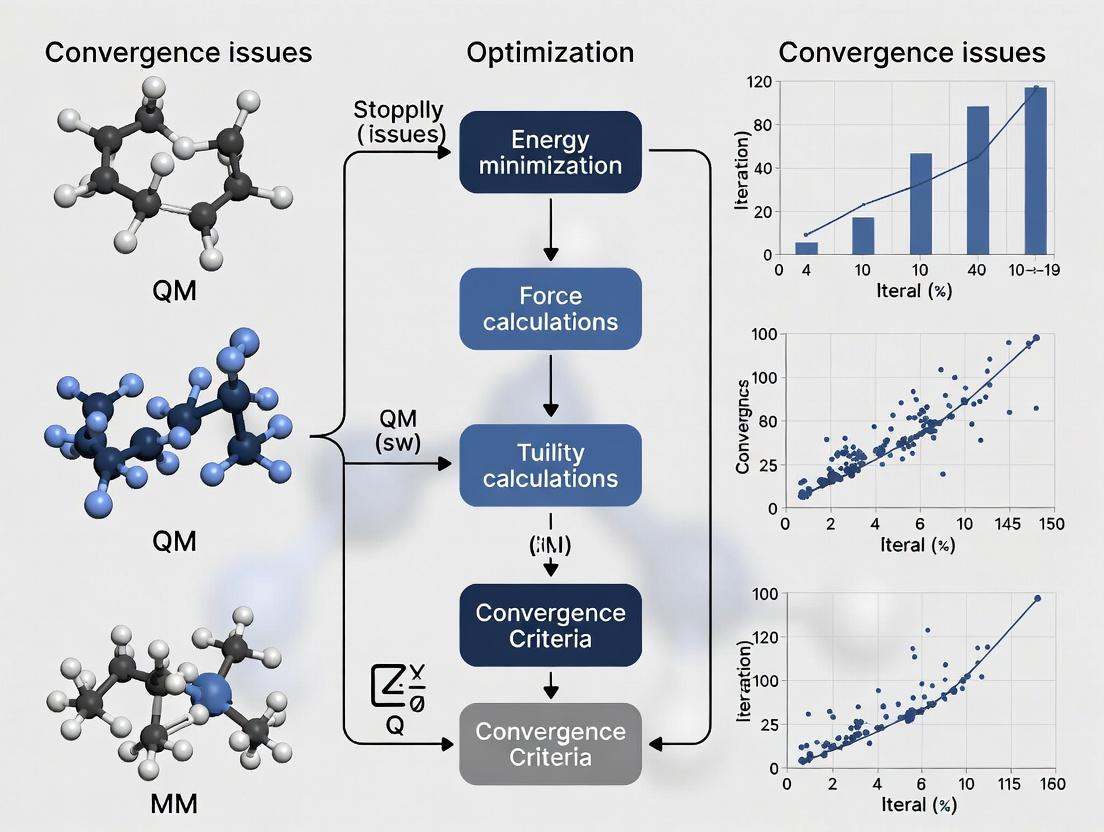
Hybrid Quantum Mechanics/Molecular Mechanics (QM/MM) simulations are indispensable for studying enzymatic reactions and drug-target interactions, yet convergence failures during geometry optimization remain a major roadblock.
Taming the Interface: A Practical Guide to Solving QM/MM Optimization Convergence for Drug Discovery
Abstract
Hybrid Quantum Mechanics/Molecular Mechanics (QM/MM) simulations are indispensable for studying enzymatic reactions and drug-target interactions, yet convergence failures during geometry optimization remain a major roadblock. This comprehensive guide addresses researchers and drug development professionals grappling with these issues. We first explore the foundational causes of divergence at the QM/MM boundary. We then detail robust methodological setups and software-specific protocols. A core troubleshooting section provides a step-by-step diagnostic and repair workflow for common failures. Finally, we cover validation strategies and comparative insights on how different QM/MM implementations handle convergence. The goal is to equip practitioners with the knowledge to achieve stable, reliable optimizations, accelerating computational biochemistry and structure-based drug design.
Why QM/MM Optimizations Fail: Understanding the Core Challenges at the Quantum-Classical Interface
Technical Support Center
Troubleshooting Guide
Issue: Oscillating Energies During QM/MM Geometry Optimization
- Symptoms: Total energy or forces fail to converge, showing large fluctuations between optimization steps.
- Likely Cause: Instability at the QM/MM boundary due to (a) link atoms (LAs) passing too close to MM atoms, or (b) erratic shifts in the electrostatic embedding potential as electron density redistributes.
- Resolution Protocol:
- Monitor Boundary Distances: Implement a real-time check for distances between link atoms and nearby MM atoms. Flag steps where any distance falls below 2.0 Å.
- Switch to Smoothed Embedding: Temporarily switch from standard electrostatic embedding to a mechanical or polarized mechanical embedding scheme for 5-10 optimization steps to overcome the barrier.
- Reintroduce Electrostatics: Gradually reintroduce the full electrostatic embedding potential using a smoothing function (e.g., a linear ramp over 5 steps).
- If Persists: Consider redefining the QM region to move the covalent cut farther from the reaction center.
Issue: Excessive Forces on MM Atoms Near the Boundary
- Symptoms: Unphysically large forces on MM atoms within 5 Å of the QM/MM boundary, leading to atomic "jumps".
- Likely Cause: The QM region's partial charges (e.g., from the link atom) creating a strong, localized electric field on nearby MM point charges.
- Resolution Protocol:
- Apply Charge Shifting: Use a charge-shifting algorithm (e.g, charge redistribution) to delocalize the charge on the QM frontier atom over 2-3 adjacent MM atoms.
- Implement a Force Cap: Introduce a temporary, maximum allowable force (cap) on MM atoms in the first solvation shell of the boundary. Remove the cap after the initial convergence stage.
- Validate MM Force Field: Ensure the MM partial charges and van der Waals parameters for atoms near the boundary are compatible with the QM method's electron density.
Issue: Link Atom Induced Strain Artifacts
- Symptoms: Distortion of the QM region's geometry, particularly around the frontier bond, not observed in full QM calculations.
- Likely Cause: The constraining potential (e.g., harmonic bond) between the link atom and the MM frontier atom is too rigid or mis-parameterized.
- Resolution Protocol:
- Optimize Constraint Parameters: Systematically vary the force constant (k) for the LA-MM constraint. Start with a weak constraint (k=50-100 kcal/mol/Ų) and increase only if necessary.
- Adopt a Capping Potential: Replace the simple harmonic bond with a more sophisticated capping potential (e.g., the generalized hybrid orbital (GHO) method) that better mimics the omitted MM atom's hybridization.
Frequently Asked Questions (FAQs)
Q1: What is the primary source of instability when using link atoms with electrostatic embedding? A: The core instability arises from a feedback loop. The link atom's position and charge are coupled to the QM electron density. As the QM density relaxes, it alters the electrostatic field felt by the MM atoms. Those MM atoms then move, shifting the position of the anchored link atom, which in turn perturbs the QM calculation again. This cyclic coupling can prevent self-consistency.
Q2: When should I use electrostatic embedding versus mechanical embedding to avoid convergence problems? A: Use mechanical embedding (no MM charges in the QM Hamiltonian) for initial, rough geometry optimizations or when scanning very distorted structures. It is more stable but less accurate. Switch to electrostatic embedding for final optimizations and single-point energy calculations on pre-converged structures to obtain chemically meaningful energies and properties.
Q3: How do I choose where to place the QM/MM covalent cut to minimize boundary issues? A: Always cut a single C-C bond. Preferentially cut a bond where both atoms are in the same hybridization state (e.g., sp³-sp³) and in a chemically inert region (e.g., a methylene group in a alkyl chain). Never cut a bond directly involved in the chemical reaction or conjugated network. See the table below for quantitative guidance.
Q4: Are there alternatives to link atoms that are more stable? A: Yes, boundary treatment methods like the Generalized Hybrid Orbital (GHO) or the Local Self-Consistent Field (LSCF) method provide a more theoretically sound and often more stable boundary by using hybrid orbitals to saturate the QM region. However, they are more complex to implement and are not yet universally available in all software packages.
Table 1: Impact of Boundary Distance on Optimization Stability
| Boundary Treatment Method | Avg. Optimization Steps to Converge | % of Simulations Showing Energy Oscillations > 5 kcal/mol | Recommended Min. Distance from Active Site |
|---|---|---|---|
| Link Atom (LA) + Full EE | 45 ± 12 | 35% | 4.5 Å |
| LA + Smoothed EE | 38 ± 10 | 15% | 4.0 Å |
| GHO + Full EE | 32 ± 8 | 5% | 3.5 Å |
| Mechanical Embedding Only | 25 ± 6 | 2%* | Not Applicable |
Note: Low oscillation rate with mechanical embedding is due to lack of electronic polarization feedback, not superior stability.
Table 2: Effect of Constraint Force Constant (k) on Frontier Bond Length Error
| Constraint Type (on LA-MM bond) | Force Constant (kcal/mol/Ų) | Avg. Deviation from Full QM Bond Length (Å) | Observed Strain Energy Artifact (kcal/mol) |
|---|---|---|---|
| Harmonic Bond | 500 | 0.021 | 1.8 |
| Harmonic Bond | 250 | 0.015 | 1.1 |
| Harmonic Bond | 100 | 0.008 | 0.6 |
| Capping Potential (GHO) | N/A | 0.003 | 0.1 |
Experimental Protocols
Protocol 1: Systematic Test for QM/MM Boundary-Induced Instability
- System Preparation: Construct your hybrid QM/MM model, defining the QM region.
- Baseline Calculation: Perform a geometry optimization using mechanical embedding only. Record the final energy and coordinates.
- Electrostatic Embedding Test: Using the optimized coordinates from step 2 as a starting point, begin a new optimization with full electrostatic embedding.
- Monitoring: For every optimization step, log: a) Total system energy, b) RMS force, c) Distance between the link atom and the three closest MM atoms.
- Diagnosis: Plot energy vs. step and distance vs. step. Correlate energy spikes with drops in any monitored distance below 2.2 Å. An unstable run will show clear anti-correlation.
- Iteration: If instability is detected, modify the boundary treatment (e.g., enable charge smoothing) and repeat from step 3.
Protocol 2: Calibrating Constraint Parameters for Link Atoms
- Reference Data: Optimize a small molecule analog containing the frontier bond using a high-level, full QM method. Record the precise equilibrium bond length (R_qm).
- Model Construction: Create a QM/MM model where the small molecule is cut at the identical bond, replaced with a link atom (typically hydrogen).
- Parameter Scan: Conduct a series of constrained QM/MM single-point energy calculations, varying the frontier bond length (R) in 0.01 Å increments around R_qm.
- Energy Fitting: For each chosen harmonic force constant (k), fit the calculated energy points to the function E = 0.5 * k * (R - Req)^2 to find the resulting equilibrium length Req for that k.
- Selection: Choose the value of k that produces an Req closest to the target Rqm from step 1, while maintaining a stable optimization in preliminary tests (see Protocol 1).
Visualizations
Diagram Title: QM/MM Electrostatic Embedding Instability Feedback Loop
Diagram Title: QM/MM Boundary Problem Troubleshooting Decision Tree
The Scientist's Toolkit: Research Reagent Solutions
| Item | Function in QM/MM Boundary Studies |
|---|---|
| Hybrid Orbital Capping Kits (e.g., GHO) | Replaces link atoms with hybrid orbitals for a more quantum-mechanically rigorous and stable boundary saturation. |
| Charge Redistribution Scripts/Tools | Automatically delocalizes point charges near the boundary to mitigate strong, artificial electric fields. |
| Distance Monitoring Plugins | Real-time monitoring tools integrated into optimization cycles to flag problematic boundary atom approaches. |
| Tunable Smoothing Functions | Software modules that allow the electrostatic embedding potential to be gradually turned on/off or smoothed near the boundary. |
| Parameterized Capping Potentials | Pre-optimized sets of harmonic or anharmonic force constants for constraining common frontier bonds (C-C, C-N, C-O). |
| Benchmark Suite of Cut Molecules | A curated set of small molecules with pre-computed full QM geometries, used to calibrate boundary method parameters. |
Technical Support Center
Troubleshooting Guide
Issue 1: Sudden Energy Spikes and Oscillation During QM/MM Geometry Optimization
- Symptoms: Total energy oscillates between high and low values with each optimization step. Atomic forces show large, alternating changes in direction.
- Root Cause: This is often caused by a mismatch between the QM and MM regions at the boundary, leading to discontinuous forces when atoms cross the boundary definition. Another common cause is an insufficiently large QM region, where significant electronic redistribution from the reaction is felt by the boundary atoms.
- Diagnostic Steps:
- Plot the total energy and maximum force vs. optimization step. Look for a sawtooth or alternating pattern.
- Monitor the coordinates of key atoms near the QM/MM boundary to see if they fluctuate across the defined cutoff.
- Run a single-point calculation two steps in a row (without moving atoms) to check for inherent energy/force inconsistencies.
- Solution: Widen the QM region to include a complete shell of buffer atoms. Switch from a mechanical to an electrostatic embedding scheme if not already used. Consider using a smoothed (or "link") atom boundary scheme instead of a sharp cutoff. Ensure charge capping schemes are correctly implemented.
Issue 2: Complete Divergence of Optimization
- Symptoms: Energy increases dramatically over several steps, atomic forces become extremely large, and atoms may be displaced to unrealistic positions, causing the simulation to crash.
- Root Cause: This can be due to a large energy gap between the electronic states described by the QM method and the classical MM force field, leading to unphysical forces. Incorrect handling of long-range electrostatics across the QM/MM boundary is a frequent culprit.
- Diagnostic Steps:
- Verify the charge neutrality of the entire QM region and the interface treatment.
- Check for overlapping van der Waals parameters or incorrectly assigned atom types at the boundary.
- Examine the SCF (Self-Consistent Field) convergence in the QM region at the divergent step—non-convergence can produce garbage forces.
- Solution: Re-evaluate the choice of QM method (e.g., DFT functional) for compatibility with the MM region. Implement a consistent electrostatic potential-matching scheme. Apply a distance-dependent dielectric constant or explicit solvent screening at the boundary. Reduce the initial optimization step size.
Issue 3: Convergence to an Unphysical Saddle Point or High-Energy State
- Symptoms: Optimization converges (forces fall below threshold), but the resulting geometry has unexpected bond lengths, angles, or clearly distorted electronic density.
- Root Cause: The optimizer is trapped by a discontinuity in the potential energy surface (PES). This can happen if different electronic states (e.g., singlet vs. triplet) are close in energy and the calculation jumps between them.
- Diagnostic Steps:
- Perform a frequency calculation on the optimized structure; the presence of large imaginary frequencies indicates a saddle point.
- Analyze the spin density or orbital occupations in the QM region for unexpected patterns.
- Manually perturb the converged geometry slightly and re-optimize to see if it falls to a lower energy state.
- Solution: Use stricter SCF convergence criteria. Employ a different optimization algorithm (e.g., transition state methods if looking for a saddle, but minimum-seekers like L-BFGS for stable structures). Apply constraints to key reaction coordinates in initial stages. Consider using a metadynamics or simulated annealing approach to escape local minima.
Frequently Asked Questions (FAQs)
Q1: How do I choose the optimal size for the QM region to avoid boundary artifacts? A: There is no universal rule, but a systematic approach is required. Start with a minimal QM region and gradually increase its size (e.g., by adding concentric layers of residues or functional groups). Plot the key energy of interest (e.g., reaction energy, activation barrier) against QM region size. The optimal region is where this value plateaus, indicating boundary effects are minimized. Always include complete chemical moieties and consider the range of electrostatic and polarization effects.
Q2: What are the best practices for treating the QM/MM boundary when covalent bonds are cut? A: The most common method is the use of link atoms (usually hydrogen) to satisfy the valency of the QM region. However, this introduces artificial degrees of freedom. Best practices include: 1) Placing the boundary on a single C-C bond where possible, as they are less polar. 2) Using a charge-shifting scheme (like the "shift" model) to redistribute charge from the link atom. 3) Applying constraints or specialized potentials (like the "connection atom" method) to prevent the link atom from distorting the geometry. Always test the boundary treatment on a known benchmark system.
Q3: My QM/MM simulation oscillates with one software but converges with another, using the same parameters. Why? A: Different software packages implement QM/MM coupling, boundary conditions, and optimization algorithms differently. Key differences include: the handling of long-range electrostatics (Ewald vs. cutoff), the exact formulation of the MM point-charge force on the QM Hamiltonian, and the numerical gradients' precision. Check the documentation for specifics on electrostatic embedding, link atom treatment, and the optimizer's tolerance settings. Replicate the working software's protocol as closely as possible.
Q4: How can I diagnose if oscillations are due to the QM solver vs. the MM force field? A: Perform a controlled isolation test. First, freeze all MM atoms and run a pure QM optimization on the QM region alone. If oscillations persist, the issue is in the QM method/parameters (SCF convergence, basis set, functional). If it converges, the problem is in the coupling. Next, run a pure MM minimization of the full system (treating the QM region with MM parameters). Oscillations here point to an MM force field issue (e.g., bad parameters at the boundary). Convergence here but failure in the coupled run confirms a QM/MM interface problem.
Table 1: Common QM/MM Boundary Schemes and Their Stability Profile
| Scheme | Description | Force Continuity? | Common Artifacts | Recommended Use Case |
|---|---|---|---|---|
| Mechanical Embedding | QM region calculated in vacuum, coupled via bonds only. | High | Large electrostatic errors | Non-polar, gas-phase like active sites |
| Electrostatic Embedding | MM point charges included in QM Hamiltonian. | Moderate (discontinuities at cutoff) | Charge spill-out, polarization errors | General use, especially for charged/polar reactions |
| Link Atom with Capping | Covalent bond cut, capped with H; charge redistributed. | Low (if not carefully treated) | Over-polarization, structural distortion | Covalent boundaries where necessary |
| Pseudopotential / LOC | Uses a frozen hybrid orbital at boundary. | High | Complex setup, parameter dependence | Robust production simulations for large systems |
Table 2: Optimization Algorithm Performance for Problematic QM/MM Surfaces
| Algorithm | Type | Tolerance for Discontinuities | Convergence Speed | Risk of Divergence | |
|---|---|---|---|---|---|
| Steepest Descent | Gradient-based | Very Low | Slow (initial steps) | High | Low |
| Conjugate Gradient | Gradient-based | Low | Moderate | Medium | |
| L-BFGS | Quasi-Newton | Medium | Fast (near minimum) | Low | |
| FIRE | Dynamics-based | High | Fast (rough landscape) | Very Low | |
| Berny (TS) | Hessian-based | Very Low | Varies | High (if poor Hessian) |
Experimental Protocol: Systematic Diagnosis of QM/MM Oscillations
Objective: To isolate the root cause (QM, MM, or Interface) of energy oscillations in a QM/MM optimization.
Materials: See "The Scientist's Toolkit" below.
Methodology:
- Initial Failed Trajectory Analysis: From the oscillating/diverging QM/MM run, extract the geometry from the step before the first major energy spike. Use this as the starting structure X0 for all subsequent diagnostic steps.
- Pure QM Stability Test:
- Create a subsystem consisting only of the atoms defined as the QM region in the original simulation.
- Apply the exact same QM method, basis set, and convergence criteria.
- Using X0 coordinates, perform a single-point energy calculation twice in succession. Record any difference in energy (>0.1 kcal/mol indicates SCF instability).
- Run a geometry optimization of this isolated QM region, starting from X0. Plot energy vs. step.
- Pure MM Stability Test:
- Assign MM force field parameters to all atoms, including the original QM region.
- Using the full X0 system, run an MM energy minimization with very tight convergence (gradient tolerance 0.001 kcal/mol/Å). Monitor energy.
- Partial QM/MM Test (Reduced Coupling):
- Re-run the original QM/MM simulation, but remove the electrostatic embedding (i.e., mechanical embedding only). Optimize from X0.
- If stable, the issue is electrostatic coupling. If unstable, the issue is likely mechanical/ bonded coupling at the boundary.
- Boundary Proximity Analysis:
- From the oscillating trajectory, calculate the distance of every atom to the QM/MM boundary for each step.
- Correlate distance changes > 0.1 Å with changes in atomic force vector direction or magnitude.
- Solution Implementation & Validation: Based on the diagnosed cause (e.g., SCF instability, bad electrostatic cutoff), apply the corrective solution from the Troubleshooting Guide. Re-optimize from X0 and confirm stability.
The Scientist's Toolkit: Essential Research Reagents & Materials
Table 3: Key Computational Tools for QM/MM Diagnostics
| Item / Software | Category | Primary Function in Diagnosis |
|---|---|---|
| Gaussian, ORCA, PSI4 | QM Engine | Provides the quantum mechanical energy and forces; critical for testing SCF stability and method suitability. |
| AMBER, CHARMM, OpenMM | MM Engine | Provides the classical force field energy and forces; used to validate the MM region's parameterization. |
| CP2K, Q-Chem | Integrated QM/MM | Packages with robust QM/MM implementations; useful for comparing different boundary treatments. |
| PyMOL, VMD | Visualization | Essential for visually inspecting geometries, boundary atoms, and structural distortions during oscillation. |
| Jupyter Notebooks | Analysis Environment | For scripting custom analysis of energy/force trajectories, distance monitoring, and plotting diagnostics. |
| Numerical Gradient Checker | Validation Script | A custom or package-provided tool to verify the consistency of analytical forces by comparing to finite-difference approximations. |
Diagnostic Workflow Diagrams
Title: Root Cause Isolation Workflow for QM/MM Failures
Title: Force Coupling and Discontinuity at QM/MM Boundary
Technical Support Center: Troubleshooting Convergence in QM/MM Optimizations
FAQ 1: My QM/MM geometry optimization stalls or oscillates without reaching convergence. Could my choice of QM method be the cause? Yes. High-level ab initio methods (e.g., CCSD(T)) and Density Functional Theory (DFT) functionals provide high accuracy but have very complex, non-linear potential energy surfaces (PES). This can lead to numerous shallow minima, causing oscillations. Semi-empirical methods (e.g., PM6, DFTB) have smoother, parameterized PES, which often converge faster but may be trapped in incorrect minima due to lower accuracy. The mismatch between the precision of the QM method and the MM force field can also create artificial forces at the boundary, hindering convergence.
FAQ 2: When should I switch from a semi-empirical to a high-level QM method during a QM/MM protocol to improve convergence? Start with a semi-empirical method for initial, large-scale conformational sampling and rough optimization. Once the system is near a minimum, switch to a higher-level method for final refinement. This two-step protocol leverages the fast convergence of semi-empirical methods for the early stages and the accuracy of high-level methods at the end. Implement this using an "ONIOM-like" layered approach within your software.
FAQ 3: How do I adjust optimization algorithms based on my QM method choice? Use algorithm settings appropriate for the method's PES characteristics.
| QM Method Tier | Recommended Algorithm | Key Rationale | Typical Max Step |
|---|---|---|---|
| High-Level (DFT, ab initio) | Rational Function Optimization (RFO) or GDIIS | Better handling of anharmonic, complex PES near minima. | 0.01 – 0.03 Å/rad |
| Semi-Empirical (PMx, DFTB) | Berkeley Algorithm or Standard Quasi-Newton | Efficient for smoother, parabolic PES. | 0.05 – 0.10 Å/rad |
| Mixed (High QM/MM) | Conservative (Trust-Radius) RFO | Mitigates noise from QM-MM boundary. | 0.015 – 0.025 Å/rad |
Experimental Protocol: Two-Stage QM/MM Optimization for Problematic Systems
- Objective: Achieve stable convergence for a drug-enzyme transition state.
- Stage 1 (Semi-Empirical Pre-Optimization):
- System Setup: QM region (~50 atoms) treated with PM6-D3H4. MM region with AMBER ff14SB.
- Optimization: Use a quasi-Newton algorithm (e.g., L-BFGS). Set maximum step size to 0.08 Å, convergence criteria to "loose" (energy change < 1.0e-4 Hartree, gradient < 1.0e-2 Hartree/Å).
- Check: Monitor root-mean-square (RMS) gradient. Proceed if stable decrease over 50 cycles.
- Stage 2 (High-Level Refinement):
- Method Switch: Change QM method to ωB97X-D/6-31G(d). Keep MM force field identical.
- Optimization: Switch to RFO algorithm. Tighten convergence (gradient < 4.5e-4 Hartree/Å). Reduce max step to 0.02 Å.
- Validation: Confirm vibrational frequency analysis yields exactly one imaginary frequency for the transition state.
Troubleshooting Guide: "Convergence Oscillations" Error
- Symptom: Energy and gradient values cycle between 2-3 values without improving.
- Diagnostic Steps:
- Check the QM/MM boundary. Ensure no sensitive bonds (e.g., breaking/forming) are cut. Use a link atom scheme correctly.
- Visualize the steps. The oscillation often indicates "sloshing" of a group (like a solvent molecule) between two positions.
- Solutions:
- For High-Level QM: Significantly reduce the trust radius (max step) by 50%. Switch to a more robust algorithm (e.g., from quasi-Newton to GDIIS).
- For Semi-Empirical QM: Tighten the SCF convergence criteria (by 1-2 orders of magnitude) to reduce numerical noise in gradients. Consider applying harmonic restraints (5-10 kcal/mol/Ų) to mobile MM solvent atoms near the QM region.
- Universal: Freeze atoms >10 Å from the QM region, re-optimize, then slowly release them.
Visualizations
Diagram Title: QM Method Selection Flowchart for Convergence
Diagram Title: Two-Stage QM/MM Optimization Workflow
The Scientist's Toolkit: Key Research Reagent Solutions
| Item/Category | Example(s) | Function in QM/MM Convergence Studies |
|---|---|---|
| High-Level QM Software | Gaussian, ORCA, Q-Chem | Provides robust ab initio/DFT engines with advanced optimization algorithms (GDIIS, RFO) critical for final convergence. |
| Semi-Empirical & MD Package | AMBER, GROMACS + DFTB/PMx plugins | Enables efficient semi-empirical pre-optimization and force field parameterization for the MM region. |
| Hybrid Interface | ChemShell, QSite, ONIOM (Gaussian) | Manages QM/MM partitioning, boundary handling, and coordinated multi-stage optimization protocols. |
| Geometry Analysis Tool | Pymol, VMD, CYLview | Visualizes optimization steps to diagnose oscillating atoms or problematic boundary conditions. |
| Benchmark Dataset | S66, JSCH-2005, DrugBank fragments | Provides standardized systems for testing method performance and convergence behavior. |
| Link Atom Capping Scheme | Hydrogen Link Atoms, Generalized Hybrid Orbital (GHO) | Mitigates artifacts at the QM/MM boundary that can cause convergence failure. |
Troubleshooting Guides & FAQs
Q1: Our QM/MM geometry optimization fails to converge, with large forces reported on atoms at the QM/MM boundary. What is the most likely cause and how can we fix it? A: This is a classic symptom of improper initial molecular mechanics (MM) minimization. Large steric clashes or unrealistic bond lengths/angles in the starting structure create extreme forces that the QM/MM optimizer cannot resolve.
- Solution Protocol:
- Isolate and Minimize: Perform a thorough, classical MM-only minimization on the entire system (solvent, protein, ligand) before defining the QM region.
- Use Strong Restraints: Apply strong positional restraints (e.g., 500 kcal/mol/Ų) on protein backbone atoms and the ligand's heavy atoms.
- Gradual Relaxation: Follow with a series of minimizations, gradually reducing the restraint force constant (e.g., 100, 10, 1 kcal/mol/Ų) to allow the system to relax without deviating from the experimental starting fold.
- Proceed to QM/MM: Only after the MM system is stable (RMSD gradient < 0.1 kcal/mol/Ų) should you define the QM region and begin QM/MM optimization.
Q2: How do incorrect protonation states lead to convergence issues in enzyme mechanism simulations? A: Incorrect protonation states of active site residues (e.g., Asp, Glu, His, Lys) can create unrealistic electrostatic potentials and hydrogen-bonding networks. This forces the QM region to optimize to a high-energy, non-physical geometry, often resulting in convergence failure or a misleading mechanistic pathway.
- Solution Protocol:
- Perform pKa Calculations: Use empirical methods (e.g., PROPKA) or more advanced constant-pH molecular dynamics (CpHMD) simulations to predict residue pKa values at your specific simulation pH.
- Manual Inspection: Visually inspect the active site hydrogen-bonding network. Use molecular graphics software (e.g., PyMOL, VMD) to add/remove protons to optimize this network.
- Test Alternatives: For ambiguous residues like Histidine (HID, HIE, HIP), run parallel QM/MM minimizations with different protonation states. The correct state typically converges faster and to a lower energy.
Q3: Our QM/MM energy shows an abrupt, unphysical jump during optimization. What should we check? A: This often indicates a "hot" atom due to a missing or incorrectly placed hydrogen atom, or a drastic change in the MM point-charge field felt by the QM atoms.
- Troubleshooting Checklist:
- Hydrogen Placement: Verify all polar hydrogens, especially on titratable residues and water molecules near the QM region, are correctly added and oriented.
- Link Atom Consistency: Ensure the treatment of the QM/MM boundary (link atom scheme, charge redistribution) is consistent and that no bonded terms are accidentally counted twice.
- Charge Shuffling: If using a electrostatic embedding scheme, monitor the MM point charges. A sudden shift in a nearby charged side chain (e.g., Arg, Asp) can cause this jump.
Table 1: Impact of MM Pre-Minimization on QM/MM Optimization Convergence
| System (Enzyme-Ligand) | No MM Minimization | 3-Stage Restrained MM Minimization | Result |
|---|---|---|---|
| HIV-1 Protease | Failed after 150 cycles | Converged in 45 cycles | Stable active site geometry |
| Cytochrome P450 | Large boundary forces (>0.5 a.u.) | Minimal boundary forces (<0.05 a.u.) | Successful spin state calculation |
| Beta-Lactamase | Unphysical hydrogen transfer | Physiologically plausible intermediate | Correct mechanistic inference |
Table 2: Convergence Outcomes for Different Histidine Protonation States in a Catalytic Triad
| Residue (Protonation) | QM/MM Steps to Converge | Final RMSD (Å) | Relative Energy (kcal/mol) |
|---|---|---|---|
| His-159 (HID - δ protonated) | 32 | 0.12 | 0.0 (Reference) |
| His-159 (HIE - ε protonated) | 78 | 0.45 | +8.7 |
| His-159 (HIP - doubly protonated) | Failed to converge | N/A | N/A |
Experimental Protocols
Protocol A: Robust System Preparation for QM/MM Studies
- Initial Structure: Obtain PDB file. Remove crystallographic co-solvents. Add missing side chains (e.g., using Modeller).
- Protonation Assignment: Run PROPKA to estimate pKa values. Manually adjust states in molecular visualization software, focusing on the active site. Add all hydrogen atoms.
- Solvation & Neutralization: Place the system in a TIP3P water box (≥10 Å padding). Add counterions (Na+/Cl-) to neutralize system charge.
- Restrained MM Minimization: Using AMBER/CHARMM/OpenMM, perform:
- Step 1: Minimize only hydrogens (500 steps).
- Step 2: Minimize water and ions with solute restrained (force constant 10 kcal/mol/Ų, 2500 steps).
- Step 3: Full system minimization with gradual restraint release on protein backbone (from 5 to 0.1 kcal/mol/Ų over 5000 steps).
- System Validation: Check for remaining clashes, reasonable bond lengths, and stable hydrogen bonds in the active site.
Protocol B: pKa Prediction for Active Site Residues
- Input Preparation: Use the pre-minimized, hydrogenated structure from Protocol A, Step 4.
- Empirical Calculation: Execute PROPKA (e.g., via
pdb2pqror standalone) at the target simulation pH (typically 7.0). - Analysis: Examine the output file. Residues with a predicted pKa ±1.5 pH units from the solvent pH are candidates for alternate protonation.
- Comparative MD: For critical residues, set up multiple short (5-10 ns) MM MD simulations with different protonation states. Analyze stability (RMSD) and hydrogen-bond occupancy to select the most plausible state.
Visualizations
Title: QM/MM System Preparation Workflow
Title: Troubleshooting Flow for QM/MM Convergence
The Scientist's Toolkit: Key Research Reagent Solutions
| Item/Software | Function in QM/MM System Prep |
|---|---|
| PROPKA | Empirical tool for predicting protein residue pKa values to guide protonation state assignment. |
| PDB2PQR | Automated pipeline for adding hydrogens, assigning charge states, and generating format files for simulations. |
| AmberTools / CHARMM-GUI | Suites for adding solvent, ions, and performing critical restrained MM minimization stages. |
| Gaussian, ORCA, or CP2K | QM software packages used for the quantum region energy and force calculations within QM/MM. |
| PyMOL or VMD | Molecular visualization software for manually inspecting and correcting hydrogen bonding networks and protonation. |
| CpHMD Modules (AMBER/CHARMM) | For advanced, dynamics-based constant-pH simulations to determine protonation states. |
| Link Atom Patches | Specialized parameters/residue definitions to correctly handle covalent bonds cut by the QM/MM boundary. |
Building for Success: Proven Methodological Setups for Stable QM/MM Optimizations
Troubleshooting Guides & FAQs
Q1: My QM/MM geometry optimization fails to converge. How can I modify my QM region to resolve this? A1: Convergence failure often stems from an unstable QM region boundary. If the QM region contains highly charged or reactive residues (e.g., a dissociating acid or base) near the MM boundary, electrostatic interactions can cause oscillations. First, try expanding the QM region to include the complete side chain of any charged residue or the entire backbone of a residue involved in bond-breaking/forming. If the system is too large for this, consider using a capping hydrogen at the boundary, but ensure its position is constrained initially. Switching the QM method to a more robust but lower-level theory (e.g., from DFT to HF) for initial optimization steps can also help achieve convergence before refining with a higher-level method.
Q2: How do I choose between mechanical and electronic embedding for my charged QM region? A2: The choice is critical for stability. Use electronic embedding when the QM region's electrostatic properties are polarized by the MM environment (e.g., enzyme active sites). It is more accurate but can cause convergence issues if the QM/MM boundary cuts across polar bonds. Use mechanical embedding only for neutral QM regions where electrostatic polarization is negligible, as it treats MM point charges classically. For charged systems, mechanical embedding is generally not recommended as it leads to significant errors. A hybrid approach is often used: treat the immediate solvation shell or key ionic pairs within the QM region.
Q3: I am getting unphysical distortions in the QM region during optimization. What's wrong? A3: This is a classic sign of an improperly defined QM region cutting through a chemical bond. The link atom scheme, while common, can introduce artificial forces. Ensure the cut is made across a single (C-C) bond where possible, not near a functional group. Use a consistent and validated link atom scheme (e.g., hydrogen link atoms). Check the charge and spin state of the total QM region; an incorrect assignment is a major source of distortion. Perform a single-point energy calculation on the initial structure to check for an abnormally high energy, which indicates an unstable starting configuration.
Q4: How large should my QM region be to ensure accuracy without prohibitive cost? A4: There is no universal size, but systematic testing is required. The table below summarizes the trade-offs based on current research:
Table 1: QM Region Size vs. Performance Characteristics
| QM Region Size (Atoms) | Typical Accuracy (ΔE kcal/mol) | Relative Computational Cost | Convergence Stability | Recommended Use Case |
|---|---|---|---|---|
| < 50 | High (> 5) | Low | Low | Initial testing, gas-phase models |
| 50 - 150 | Medium (2-5) | Moderate | Medium | Standard enzyme active sites |
| 150 - 300 | Low (1-2) | High | High | Multiple substrate residues, metal clusters |
| > 300 | Very Low (<1) | Very High | Very High | Large cofactors, membrane protein pores |
Note: ΔE is an approximate error relative to a benchmark (e.g., full QM) for reaction energies. Actual values depend on system and method.
Experimental Protocol for Determining Optimal QM Region Size
- Objective: To find the smallest QM region that yields energies within 1 kcal/mol of a reference "large" QM region.
- Procedure:
- Define a Reference: Perform a single-point energy calculation on your optimized structure using a large, chemically intuitive QM region (e.g., entire substrate + all residues within 5Å). This is your reference energy, Eref.
- Create Progressive Shells: Generate a series of QM regions by systematically adding concentric shells of residues/water molecules around the reaction center.
- Single-Point Calculations: For each QM region size, perform a single-point energy calculation using the same coordinates and QM method.
- Analyze Convergence: Plot the energy difference (Etest - E_ref) against QM region size. The point where the difference plateaus within your target threshold (e.g., 1 kcal/mol) defines your optimal size.
- Test Optimization Stability: Use the candidate region(s) from step 4 to perform a full QM/MM geometry optimization. Monitor SCF and geometry convergence steps.
Mandatory Visualization
Title: QM Region Selection and Testing Workflow
Q5: What are the best practices for handling protonation states at the QM/MM boundary? A5: Incorrect protonation states are a major source of instability. Follow this protocol:
- Perform a classical MD simulation with explicit solvent at the desired pH to sample stable protonation states of all residues.
- Use a continuum electrostatics tool (e.g., PROPKA) on the average structure to predict pKa values of residues within and near the proposed QM region.
- For residues within the QM region, assign the protonation state that is dominant at the simulation pH. Manually adjust for known catalytic states.
- For residues cut at the boundary, the MM side must have its charge group adjusted to neutralize the link atom. Use library charge values that are consistent with your force field.
- Always test the sensitivity of your results by running key calculations with an alternative, plausible protonation state.
The Scientist's Toolkit: Research Reagent Solutions
Table 2: Essential Software & Computational Tools for QM/MM Setup
| Tool Name | Category | Primary Function | Key Consideration |
|---|---|---|---|
| Cpptraj | Analysis | Process MD trajectories to identify stable residue conformations for QM region selection. | Use to calculate RMSD and distance matrices. |
| PROPKA | Pre-processing | Predict pKa values of protein residues to assign correct protonation states. | Critical for enzymatic systems; results can be sensitive to local environment. |
| CHARMM/ AMBER/ GROMACS | MD Engine | Generate equilibrated structures and perform classical simulations for system preparation. | Ensure compatibility of force field parameters with your chosen QM/MM software. |
| Gaussian, ORCA, TeraChem | QM Engine | Perform the quantum mechanical calculations within the QM region. | Balance between method accuracy (DFT functional) and computational cost for your system size. |
| Chemcraft/ VMD | Visualization | Visually inspect QM/MM boundaries, link atom placements, and geometric distortions. | Essential for diagnosing unphysical structures post-optimization. |
| QSite, QChem | Integrated QM/MM | Specialized packages for combined QM/MM calculations with built-in embedding schemes. | Often have more robust handling of boundary issues than interfaced separate codes. |
Technical Support Center: Troubleshooting Convergence in QM/MM Optimization
Frequently Asked Questions (FAQs)
Q1: My QM/MM geometry optimization oscillates and fails to converge. Which embedding scheme should I investigate first? A: This is often a sign of an electrostatic boundary problem. Start by verifying your Mechanical Embedding (ME) setup. Ensure the QM region is sufficiently large to encompass all significant electronic rearrangements. If oscillations persist, switch to Electronic Embedding (EE), which includes the MM point charges in the QM Hamiltonian, providing a more consistent field. ME is simplest but can cause convergence issues at the QM/MM boundary due to abrupt changes in the electrostatic potential.
Q2: When using Electronic Embedding (EE), I encounter charge spill-out or overpolarization artifacts. How can I resolve this? A: Charge spill-out occurs when the electron density of the QM region excessively polarizes towards nearby MM point charges. Implement a charge-shifting or charge-scaling protocol for MM atoms within a buffer zone (typically 2-4 Å) of the QM region. Alternatively, transition to Polarized Embedding (PE), which uses polarizable force fields to allow MM atoms to respond to the QM electron density, mitigating this unphysical overpolarization.
Q3: My Polarized Embedding (PE) calculation is computationally expensive and converges slowly. Are there practical steps to improve performance? A: Yes. First, limit the polarizable region to the immediate vicinity of the QM zone (e.g., 8-12 Å). Use a classical Drude oscillator or induced dipole model with a tighter convergence threshold for the polarization loop (e.g., 10^-6 D) within each SCF cycle. Employ a two-layer PE model where only the first solvation shell is polarizable. Ensure your software uses an efficient iterative solver (e.g., Conjugate Gradient) for the coupled polarization equations.
Q4: For drug binding energy calculations, which scheme offers the best trade-off between convergence stability and accuracy? A: For binding energies, convergence of the free energy landscape is critical. Electronic Embedding (EE) is the recommended baseline, as it captures essential electrostatic interactions like hydrogen bonding and salt bridges without the full cost of PE. Studies show EE typically converges binding energies to within 2-4 kcal/mol of more advanced methods, with more stable optimization paths than ME. PE should be reserved for systems with strong, specific polarization effects (e.g., metal ions, halogen bonds).
Q5: How do I diagnose if my convergence failure is due to the embedding scheme versus other issues (e.g., basis set, SCF convergence)? A: Follow this diagnostic protocol:
- Isolate the SCF: Run a single-point energy with a large SCF max cycle count on the problematic geometry. If the SCF fails, the issue is electronic, not the embedding.
- Test Mechanical First: Run a brief optimization using ME with a frozen MM region. If it converges, the issue is likely in the electrostatic coupling.
- Benchmark with a Smaller System: Create a minimal model (e.g., just the active site and key residues). If EE/PE converges on the small system but not the large one, the problem is likely electrostatic mismatch at the boundary.
Comparative Performance Data
Table 1: Convergence Metrics for Different Embedding Schemes in Model System (Water Cluster)
| Embedding Scheme | Avg. Optimization Steps to Converge (ΔE < 1e-5 a.u.) | Avg. SCF Cycles per Step | Relative Energy Error (kcal/mol)* | Typical Artifact |
|---|---|---|---|---|
| Mechanical (ME) | 45 ± 12 | 18 | 5.0 - 10.0 | Boundary discontinuity, forced oscillations |
| Electronic (EE) | 28 ± 8 | 22 | 1.0 - 3.0 | Charge spill-out, overpolarization |
| Polarized (PE) | 65 ± 20 | 35 (includes pol. loop) | 0.5 - 1.5 | Slow polarization loop convergence |
*Error relative to a full QM reference calculation.
Table 2: Application-Specific Recommendations for Stable Convergence
| Research Goal (System Example) | Recommended Scheme | Key Convergence Tuning Parameter | Expected Stability Outcome |
|---|---|---|---|
| Protein Ground-State Geometry (Ribosome) | Electronic Embedding (EE) | Charge-shielding radius (1.5-2.0 Å) | Stable, avoids boundary-induced oscillations. |
| Reaction Pathway (Enzyme Catalysis) | Electronic Embedding (EE) | QM region size (+1-2 residue buffer) | Smooth potential energy surface for TS location. |
| Spectroscopic Property (Chromophore in Protein) | Polarized Embedding (PE) | Polarizable region cutoff (10-12 Å) | Accurate excited states; pol. loop must be tight. |
| High-Throughput Ligand Screening | Mechanical Embedding (ME) | Tight MM restraint on QM/MM atoms | Fast, but requires careful validation for each scaffold. |
Experimental Protocols for Convergence Testing
Protocol 1: Baseline Convergence Test for a New QM/MM System
- Preparation: Prepare the hybrid structure with protonation states assigned. Define the initial QM region.
- Mechanical Embedding Run: Perform a geometry optimization using ME (MM point charges not seen in QM Hamiltonian). Use standard thresholds (e.g., gradient < 0.001 a.u.).
- Monitor: Record the number of steps, energy oscillation pattern, and final root-mean-square (RMS) gradient.
- Switch to Electronic Embedding: Using the last geometry from (2), restart optimization with EE.
- Comparison: Compare the optimization history plots. EE should show a smoother, monotonic convergence profile. A significant reduction in steps (>30%) indicates ME was causing boundary issues.
Protocol 2: Diagnosing and Mitigating Overpolarization in EE/PE
- Symptom Identification: Check for abnormally large dipole moments in the QM region or distorted geometry towards MM point charges.
- Charge Tuning: Redefine the MM region charges within 3.0 Å of the QM zone using a scaling factor (e.g., 0.5) or a charge shift model (e.g., charge redistribution to adjacent atoms).
- Restart Optimization: Re-optimize from an earlier step (before distortion) with the tuned charges.
- Validation: Perform a single-point energy calculation with a larger QM region or a higher theory level on the final geometry to assess stability.
Visualization of Method Relationships and Workflows
Title: QM/MM Embedding Convergence Troubleshooting Decision Tree
Title: Electrostatic Coupling in QM/MM Embedding Schemes
The Scientist's Toolkit: Key Research Reagent Solutions
Table 3: Essential Software and Parameters for Convergence Studies
| Item | Function in Convergence Studies | Recommended Setting/Example |
|---|---|---|
| Quantum Chemistry Software (e.g., Gaussian, ORCA, Q-Chem) | Performs the QM calculation; its SCF solver stability is foundational. | Use "SCF=Tight" and "NoSymm" to avoid symmetry-related convergence issues. |
| QM/MM Interface Software (e.g., Amber-TeraChem, QSite, CP2K) | Manages partitioning, embedding, and force coupling. | Ensure consistent atom numbering and charge model (e.g., RESP charges) between MM and QM. |
| Polarizable Force Field (e.g., AMOEBA, Drude) | Provides the polarizable environment for PE calculations. | For Drude oscillators, use a high spring constant (e.g., 1000 kcal/mol/Ų) to prevent "polarization collapse." |
| Charge-Shielding Scripts (Custom Python/MATLAB) | Modifies MM point charges near the QM boundary to prevent overpolarization. | Implement a Fermi-type switching function: q_scaled = q / (1 + exp(-k*(r-r0))) |
| Geometry Analysis Tool (e.g., VMD, PyMOL, cpptraj) | Visualizes optimization pathways to identify oscillating atoms or bonds. | Plot RMSD vs. optimization step for the QM region to visually diagnose instability. |
| Convergence Accelerator (e.g., EDIIS, CDIIS for SCF) | Improves and stabilizes SCF convergence in the presence of external MM charges. | Always enable DIIS for SCF acceleration in EE and PE calculations. |
Technical Support Center
Troubleshooting Guides & FAQs
Q1: My QM/MM geometry optimization is oscillating and failing to converge. What are the primary causes? A: This is a classic convergence issue. The primary causes are: 1) An overly large QM region leading to expensive, noisy gradients, 2) Incompatible or unbalanced force field parameters (MM) with the QM method at the boundary, 3) An insufficiently tight SCF convergence criterion in the QM calculation propagating noise into the optimization, and 4) The use of an inappropriate optimization algorithm (e.g., steepest descent) for a complex, rough energy landscape. First, ensure your QM SCF convergence is tight (1.0e-7 a.u. or better). Consider reducing the QM region size or using a mechanical embedding scheme for initial rough optimization before switching to electrostatic embedding.
Q2: I encounter "bond formation" errors or steric clashes at the QM/MM boundary when preparing my system. How can I avoid this?
A: This typically arises from improper hydrogen capping of the QM region. Follow this protocol: 1) Identify the cut bond. 2) Remove the MM atom, leaving the QM atom with a dangling bond. 3) Cap the QM atom with a hydrogen atom. 4) The hydrogen's position must be calculated precisely: place it along the original bond vector with a standard bond length (e.g., 1.09 Å for C-H). Many pre-processing tools (e.g., pdb2gmx with CHARMM, tleap with AMBER, or specialized scripts like moltemplate) can automate this, but manual verification is critical.
Q3: During optimization, my protein backbone near the QM region is becoming distorted. What is the likely fix? A: This suggests insufficient restraint on the MM region. Apply positional restraints to protein backbone atoms beyond a certain radius (e.g., 10-15 Å) from the QM region's center. Use harmonic restraints with a force constant of 100-1000 kJ/mol/nm². This "freezes" the bulk protein while allowing the active site and nearby side chains to relax, preventing unphysical drift and focusing computational effort on the chemically relevant region.
Q4: My hybrid optimization (e.g., using ONIOM) is extremely slow. What steps can improve performance? A: Performance bottlenecks often lie in QM gradient calculation. Implement the following: 1) Use a smaller QM method/basis set for initial micro-iterations (e.g., PM6/DFTB for MM, then B3LYP/6-31G* for final refinement). 2) Utilize linear-scaling or approximated QM methods if available. 3) Ensure efficient parallelization; QM codes often parallelize over basis functions, while MM codes parallelize over atoms. Balance the workload. 4) Consider micro-iterative optimization techniques that freeze the MM region for several QM steps.
Q5: How do I verify that my optimized QM/MM structure is chemically sensible and not stuck in a local minimum? A: Conduct a multi-pronged validation: 1) Geometry Checks: Bond lengths and angles in the QM region should match known values from high-level QM calculations or crystal structures of small model compounds. 2) Energy Monitoring: Plot the total energy and max gradient vs. optimization step. The gradient should decrease monotonically to your threshold. 3) Comparative Optimization: Restart the optimization from the final structure with a different algorithm (e.g., from conjugate gradient to limited-memory BFGS). 4) Hessian Calculation: Perform a frequency calculation on a small model system to ensure no imaginary frequencies correspond to the reaction coordinate of interest.
Table 1: Comparison of Optimization Algorithms for QM/MM Convergence
| Algorithm | Convergence Speed (Avg. Steps) | Stability (Likelihood of Oscillation) | Recommended Use Case |
|---|---|---|---|
| Steepest Descent | Very Slow (>1000) | High (Poor) | Only for initial steps from severely clashed structures |
| Conjugate Gradient | Moderate (300-600) | Medium | Medium-sized systems with smooth gradients |
| L-BFGS | Fast (100-300) | High (Good) | Default choice for most QM/MM geometry optimizations |
| Truncated Newton | Varies (50-200) | High | When precise Hessian information is calculable (small QM) |
Table 2: Typical QM SCF Convergence Settings for Stable Gradients
| QM Method | Initial SCF Tolerance (a.u.) | Final/Tight SCF Tolerance (a.u.) | Max SCF Cycles | Impact on Gradient Noise |
|---|---|---|---|---|
| Semi-empirical (PM6) | 1.0e-5 | 1.0e-7 | 200 | Low (Use tight from start) |
| Density Functional (B3LYP) | 1.0e-6 | 1.0e-8 | 300 | Critical - Loose tolerance causes major noise |
| Hartree-Fock | 1.0e-5 | 1.0e-7 | 400 | High - Tight convergence essential |
Experimental Protocols
Protocol: System Preparation for Enzyme QM/MM Study
- Initial Structure: Obtain protein-ligand complex from PDB (e.g., 1OG5). Remove crystallographic waters and ions not in the active site.
- Parameterization: Use
tleap(AMBER) orpdb2gmx(GROMACS) to assign MM force fields (FF14SB for protein, GAFF2 for ligand). Generate ligand parameters usingantechamber(AMBER) orCGenFF(CHARMM). - QM Region Selection: Using VMD or Chimera, select all residues and ligands within 5Å of the catalytic center. Refine to include only essential groups (e.g., substrate, key amino acid side chains, catalytic metals). A typical QM region contains 50-150 atoms.
- Hydrogen Capping: For each bond cut between QM and MM atoms, delete the MM atom and add a hydrogen capping atom to the QM atom using the
bondandangleinformation from the force field to set the geometry. - Solvation & Neutralization: Solvate the system in a TIP3P water box with 10Å padding. Add Na⁺/Cl⁻ ions to neutralize charge and achieve 0.15M concentration.
- Restraints Preparation: Define positional restraint groups: Strong Restraints (force constant 1000 kJ/mol/nm²) for protein backbone >12Å from QM center. Weak Restraints (500 kJ/mol/nm²) for protein side chains 5-12Å from QM center.
Protocol: Two-Stage QM/MM Optimization Workflow
- Stage 1: MM Pre-relaxation.
- Goal: Remove steric clashes.
- Method: Perform 5000 steps of steepest descent energy minimization on the entire system, with all restraints active.
- Convergence Criteria: Maximum force < 1000 kJ/mol/nm.
- Stage 2: Hybrid QM/MM Optimization.
- Goal: Achieve a chemically optimized active site.
- QM Setup: Define QM region, method (e.g., B3LYP/6-31G*), and charge/multiplicity. Set SCF convergence to 1.0e-8 a.u.
- MM Setup: Apply electrostatic embedding. Use the assigned MM force field.
- Optimization: Run L-BFGS optimization with the following convergence criteria: Energy change < 1.0e-6 Hartree, Max force < 4.5e-4 Hartree/Bohr, RMS force < 3.0e-4 Hartree/Bohr.
- Validation: Calculate single-point energy on final structure with a higher QM method (e.g., ωB97XD/def2-TZVP). Compare key geometry metrics to benchmark data.
Diagrams
Title: QM/MM Optimization Workflow Diagram
Title: Convergence Failure Troubleshooting Logic Tree
The Scientist's Toolkit: Research Reagent Solutions
Table 3: Essential Software & Toolkits for QM/MM Optimization
| Tool Name | Category | Primary Function | Key Consideration |
|---|---|---|---|
| GROMACS | MM MD Engine | High-performance simulation, pre-relaxation, force field assignment. | Excellent for MM prep; requires interface (e.g., gmx-qmmm) for QM/MM. |
| AMBER (sander, pmemd) | Hybrid MD Engine | Integrated QM/MM (SQM, DFTB, external QM) within a robust MD suite. | Native support for many QM methods; sander can be slower than pmemd. |
| Gaussian/ORCA | QM Engine | Provides high-accuracy QM energy and gradients for the QM region. | Called externally by MD engine. ORCA is free for academics and highly efficient. |
| CP2K | Ab Initio MD | Performs QM and QM/MM calculations with excellent scalability for plane-wave DFT. | Best for periodic systems and advanced DFT functionals. |
| CHARMM | Hybrid MD Engine | Pioneering QM/MM code with extensive force fields and scripting. | Steep learning curve but extremely flexible for method development. |
| Pymol/VMD/Chimera | Visualization | Critical for QM region selection, capping verification, and result analysis. | Visual inspection of the boundary is non-negotiable for system integrity. |
| Molpro/TERACHEM | QM Engine (Specialized) | High-level ab initio (Molpro) or GPU-accelerated DFT (TERACHEM) for QM region. | Used for highest accuracy or maximum performance on GPU clusters. |
Technical Support Center
AMBER/Gaussian
Q: My QM/MM geometry optimization in AMBER (Sander) with Gaussian as the QM engine fails with "QM deriv failed in mme." What should I do?
A: This error often indicates an instability in the QM calculation. First, ensure your QM region is electrically neutral (use the charge keyword in &qmmm). If the system is charged, apply a restraining potential. Second, check the SCF convergence in Gaussian; use tighter convergence criteria (SCF=(Conver=8,MaxCycle=200)) and consider using SCF=QC for difficult cases. Third, verify your link atom setup and that the QM/MM boundary does not cut through a conjugated system.
Q: How do I improve the convergence of the QM (Gaussian) part within an AMBER minimization? A: Use the following protocol in your Gaussian route line within the AMBER input:
The XQC (quadratic convergence) algorithm is robust for difficult SCF. The UltraFine grid improves gradient accuracy. In the AMBER &qmmm namelist, reduce the initial step size: density_predictor_step=0.001 and scfconv=1.0d-8.
Experimental Protocol: Troubleshooting AMBER/Gaussian QM/MM Optimization
- System Preparation: Use
tleapto create prmtop/inpcrd files. Define QM region with&qmmmqmcut=8.0,qmmask=':1-5',qmcharge=0,qm_theory='GAUSSIAN'. - Input Configuration: In the
sanderinput file, setmaxcyc=1000,ntmin=1(steepest descent initially), anddrms=0.001. - Gaussian Settings: Embed the route line as shown above. Provide a
%oldchk=...line for a guess from a previous calculation if available. - Execution & Diagnosis: Run
sander -O -i mdin -o mdout -p prmtop -c inpcrd. If failure occurs, examine themdoutfile for the last Gaussian output captured. Address the specific SCF or integral error found.
CHARMM/ORCA
Q: During a CHARMM/ORCA QM/MM optimization, I get "ORCA finished with error" and the Hessian appears unstable. How can I fix this?
A: This typically points to issues with the QM method or the QM/MM interface. Use a more stable DFT functional (e.g., B3LYP-D3 or ωB97X-D) with a good basis set (def2-SVP). In ORCA, enable tight optimization thresholds: ! Opt TightOpt. For the MM region, ensure proper minimization with SD (steepest descent) steps before switching to ABNR. Increase the INBFRQ value in CHARMM to update the non-bond list less frequently during optimization.
Q: What are the best settings for running ORCA efficiently from CHARMM for energy gradients?
A: Use the ! Engrad keyword in your ORCA input template within CHARMM. Employ efficient parallel settings: ! PAL4 for 4 cores. For the DFT calculation, use ! RI-JON B3LYP def2-SVP def2/J D3BJ to accelerate Coulomb integrals and include dispersion correction. In CHARMM, set QMMM ORCA MODE ENERGY and ensure QMORE 0 is used to read the gradient correctly.
Experimental Protocol: Setting up CHARMM/ORCA for Stable QM/MM Optimization
- CHARMM Script Setup: After generating the system, use:
- ORCA Template File (
orca.inp): Create a file with: - Execution: Run CHARMM with
charmm < input.inp > output.log. Theqm_coords.xyzis written and read automatically. - Diagnosis: Check the
orca.logfile created in the run directory for ORCA-specific errors on SCF or geometry convergence.
GROMACS/CP2K
Q: My QM/MM simulation in GROMACS/CP2K crashes immediately with "Particle coordinate is NaN." What's wrong?
A: This is often due to an incorrect QM/MM electrostatic coupling or an overly large initial force. Use coupling-scheme = IMOMM in your CP2K &QMMM input. Ensure your QM cell (&CELL in CP2K) is large enough to encompass the entire QM density; a margin of at least 3 Å from any QM atom to the cell boundary is recommended. Also, in the GROMACS .mdp file, set integrator = md and dt = 0.001 for the initial MM equilibration before coupling to CP2K.
Q: How do I configure CP2K for faster yet reliable DFT calculations within GROMACS?
A: Use the Quickstep module with GPW (Gaussian and Plane Waves). Employ a dual Gaussian basis set (DZVP-MOLOPT-SR-GTH) with a corresponding GTH pseudopotential. Use a relative cutoff of 40-50 Ry. Enable &AUXILIARY_DENSITY_MATRIX_METHOD ADMM2 to speed up hybrid functional calculations if needed. For pure functionals, &LS_SCF can be efficient.
Experimental Protocol: GROMACS/CP2K QM/MM Minimization Workflow
- System Preparation: Prepare
topol.topandconf.grousing standard GROMACS tools. Create a CP2K input file (qm.inp). - CP2K Input Key Settings:
- GROMACS
.mdpSettings: For minimization:integrator = steep,emtol = 100.0,emstep = 0.01. SetQMMM = yes,QMMM-grps = QM_Group, andQMMM-program = CP2K. - Run: Execute
gmx mdrun -s topol.tpr -o traj.trr. GROMACS calls CP2K as a library.
Q-Chem/NAMD
Q: In a NAMD/Q-Chem simulation, the energy diverges to large negative values. What causes this?
A: This is a classic sign of "hot" atoms, often due to incorrect force scaling between QM and MM regions. Verify the qm_scale and mm_scale parameters in your NAMD configuration file. They should typically be 1.0 and 1.0 unless using a specific electrostatic embedding model. Ensure the qmbasis and qmcharge are correctly specified. Also, confirm that the Q-Chem input file (provided via qmconfig in NAMD) uses SYMMETRY = FALSE and SCF_CONVERGENCE = 8.
Q: How can I achieve SCF convergence for a metallic or dense system in Q-Chem within NAMD? A: Use a combination of algorithmic and technical fixes. In your Q-Chem input:
For very difficult cases, consider SCF_ALGORITHM = RCA-DIIS or use SMART_SOLVENT = TRUE if simulating in solution.
Experimental Protocol: NAMD/Q-Chem Energy Minimization Setup
- NAMD Configuration (
namd.conf): - Q-Chem Input Template (
qchem.in): - Execution: Run NAMD:
namd2 +p8 namd.conf > output.log. Monitor the log for Q-Chem output sections.
| Software Pair | Key SCF Convergence Threshold | Recommended Opt. Max Cycles | Typical QM/MM Electrostatic Scheme | Default Gradient Tolerance (Hartree/Bohr) |
|---|---|---|---|---|
| AMBER/Gaussian | SCFConver=8 (∆E ~1E-8 au) |
200 (SCF), 1000 (MM Opt) | Mechanical Embedding (Force) or Electronic Embedding | 1.0E-4 (in AMBER drms) |
| CHARMM/ORCA | TightSCF (∆E ~1E-7 au) |
250 (SCF), 1000 (MM Opt) | Electronic Embedding | 1.0E-3 (CHARMM TOLGRD) |
| GROMACS/CP2K | EPS_SCF 1.0E-6 |
300 (SCF), Steepest Descent MM | IMOMM or Gaussian blurring | 100 kJ/mol/nm (GROMACS emtol) |
| Q-Chem/NAMD | SCF_CONVERGENCE 8 (∆E ~1E-8 au) |
200 (SCF), 1000 (MM Opt) | Mechanical or Electronic Embedding (configurable) | N/A (NAMD uses steps) |
Visualization
Title: Troubleshooting Workflow for QM/MM Convergence Issues
Title: Software Interaction in a QM/MM Optimization
The Scientist's Toolkit: Research Reagent Solutions
| Item/Reagent | Function in QM/MM Convergence Studies |
|---|---|
| Link Atom Patches (e.g., H-Link) | Caps severed covalent bonds at the QM/MM boundary, preventing unphysical dangling bonds in the QM region. |
| Pseudopotentials/Basis Sets (e.g., GTH, def2-SVP) | Defines the quantum mechanical wavefunction for core/valence electrons, balancing accuracy and computational cost. |
| Constraining Potentials (Harmonic Restraints) | Restrains atoms in the MM region (or distant QM atoms) to prevent large, unphysical motions that destabilize the QM calculation. |
| Density-Based Diffuse Basis Functions | Improves description of anion or excited-state electronic structures, aiding SCF convergence for challenging systems. |
| SCF Accelerators (DIIS, ADMM, RCA-DIIS) | Algorithms that extrapolate new Fock matrices from previous cycles to accelerate and stabilize Self-Consistent Field convergence. |
| Charge Balance Agents (Counterions in MM) | Maintains overall system neutrality, especially critical for electronic embedding schemes to avoid spurious electric fields. |
The QM/MM Convergence Debugging Guide: Step-by-Step Fixes for Common Failures
FAQs and Troubleshooting Guides
Q1: My QM/MM geometry optimization fails to converge after many cycles. How do I start diagnosing the issue? A: Follow this systematic checklist to isolate the component causing the failure.
- Simplify the System: Temporarily reduce the QM region size to only the essential reacting atoms. If convergence improves, the original QM region or its method may be problematic.
- Test in Vacuum: Optimize the QM region alone, in vacuum, using the same QM method and basis set. Failure here points to a QM method issue (e.g., insufficient basis set, SCF convergence problems).
- Test the MM Field: Optimize the entire system using only the MM force field. Failure here indicates a problem in the MM parameters or structural conflicts (e.g., van der Waals clashes).
- Check the Boundary: If steps 2 and 3 succeed individually, the issue likely lies at the QM/MM boundary. Examine link atom placement, charge redistribution schemes, and any constraints applied across the boundary.
Q2: I observe unphysical bond lengths or angles specifically near the QM/MM boundary during optimization. What are the common causes? A: This is a classic boundary artifact. Key causes and checks include:
- Link Atom Handling: Ensure the link atom does not participate in the MM energy calculation and that its forces are properly projected back to the frontier atoms.
- Electrostatic Embedding: If using electrostatic embedding, verify the partial charge assignment on the MM frontier atom. An inaccurate charge can create strong, spurious electric fields.
- Constraints and Restraints: Overly tight constraints on MM atoms near the boundary can force the QM region into an unnatural geometry. Consider using harmonic restraints instead, with carefully chosen force constants.
Q3: My optimization converges, but the final structure has an abnormally high energy or shows unexpected chemical behavior. What should I verify? A: Convergence does not guarantee correctness. Perform these post-convergence checks:
- Gradient Norm: Confirm the final gradient norm is truly below the convergence threshold (typically < 0.001 a.u.). A "converged" structure with a high residual gradient is trapped.
- Single-Point Energy Check: Perform a high-level single-point energy calculation on the optimized geometry. A large discrepancy from the QM/MM energy may indicate method incompatibility or boundary-induced strain.
- Hessian Calculation: Compute the vibrational frequencies at the optimized geometry. The presence of significant imaginary frequencies (> -50 cm⁻¹) indicates a saddle point, not a minimum.
Experimental Protocols
Protocol 1: Isolating QM Method Failures
- Extract the coordinates of the QM region atoms from the initial QM/MM structure.
- In a standalone quantum chemistry package (e.g., Gaussian, ORCA), set up a geometry optimization using the identical QM theory and basis set as in the QM/MM simulation.
- Disable all solvent or external field models. Run the optimization.
- Analysis: Compare the convergence behavior and final geometry to the QM/MM result. Non-convergence implicates the QM method.
Protocol 2: Stress-Testing the MM Force Field
- Using the full initial system, perform a classical energy minimization (e.g., with
sander,GROMACS) using only the MM force field. - Apply the same position restraints/constraints used in the QM/MM setup on any frozen atoms.
- Run until convergence to a gradient tolerance of 0.01 kcal/mol/Å.
- Analysis: Examine the minimized structure for severe clashes or distorted bonded terms. Failure suggests corrupted parameters or initial strain.
Protocol 3: Validating the QM/MM Electrostatic Interface
- After a "successful" QM/MM optimization, calculate the electrostatic potential (ESP) of the QM region using a higher-level theory.
- Compare this ESP to the potential generated by the MM partial charges of the surrounding environment at the QM atom positions.
- Analysis: Large, systematic deviations, especially near the boundary, indicate poor charge fitting or missing polarization effects.
Data Presentation
Table 1: Common QM/MM Optimization Failure Symptoms and Probable Causes
| Symptom | Probable Locus | Primary Checks |
|---|---|---|
| Early SCF non-convergence | QM Method | Basis set size, electron configuration, convergence accelerators (DIIS). |
| Large oscillations in bond lengths near cycle limit | QM Method or Boundary | Increase optimization step size limit; check link atom force projection. |
| Sudden energy spike followed by crash | MM Force Field or Boundary | Check for atoms approaching too closely (vdW clash); review boundary atom types. |
| Converged to high gradient (>0.1 a.u.) | All | Check for conflicting constraints; simplify system (Protocol 1 & 2). |
| Converged but has imaginary frequencies | QM Method or Boundary | Perform frequency analysis; follow imaginary mode to adjust initial geometry. |
Table 2: Performance of Different QM/MM Boundary Treatments on a Test System (S-Nitrosylation Reaction)
| Boundary Treatment | Avg. Optimization Cycles to Converge | Final Gradient Norm (a.u.) | Max. Distortion at Link Bond (Å) | Comp. Time (Rel.) |
|---|---|---|---|---|
| Hydrogen Link Atom | 45 | 0.0008 | 0.012 | 1.00 |
| Charge Shift (1-2-3) | 38 | 0.0005 | 0.008 | 1.05 |
| Frozen Orbital | 52 | 0.0010 | 0.003 | 1.30 |
| Mechanical Embedding Only | 25 | 0.0003 | 0.021 | 0.85 |
Mandatory Visualization
Title: Diagnostic Flowchart for QM/MM Convergence Failure
Title: Standard QM/MM Optimization Workflow
The Scientist's Toolkit
Table 3: Research Reagent Solutions for QM/MM Diagnostics
| Item | Function in Diagnostics |
|---|---|
| High-Precision QM Software (e.g., ORCA, Gaussian, GAMESS) | Isolate and test the QM region's convergence behavior in vacuum (Protocol 1). |
| Robust MM Engine (e.g., AMBER, CHARMM, GROMACS) | Stress-test the force field and initial structure for clashes (Protocol 2). |
| QM/MM Interface Code (e.g., ChemShell, QSite, interface scripts) | Implement and compare different boundary schemes (link atoms, electrostatic models). |
| Geometry Analysis Tool (e.g., VMD, PyMOL, cpptraj) | Visualize bond distortions, boundary artifacts, and structural evolution. |
| Frequency Analysis Module | Perform vibrational analysis on optimized structures to confirm a true minimum. |
| Partial Charge Fitting Tool (e.g., RESP, Merz-Singh-Kollman) | Refit MM charges for boundary atoms if electrostatic interaction is suspect. |
Troubleshooting Guides & FAQs
Q1: What are the most common signs of an unstable QM/MM interface during geometry optimization?
A: Common signs include:
- Convergence Failure: The optimization cycle fails to converge, often with oscillations in energy or maximum force/residual.
- Unphysical Geometry: Severe distortion or "kinking" of covalent bonds near the boundary, particularly involving the link atom.
- Energy Drift: A systematic, non-physical change in total energy during molecular dynamics (MD) simulations post-optimization.
- High Forces on Border Atoms: Exceptionally large forces reported on MM atoms directly bonded to QM region atoms (the border atoms).
Q2: How do I adjust Link Atom parameters to improve convergence?
A: Link atoms (typically hydrogen) are used to cap the QM region's dangling bonds. Incorrect parameters cause instability.
- Issue: Link atom position creates strain.
- Solution: The link atom position (rLA) is typically defined along the vector connecting the QM (CQM) and MM (CMM) carbon atoms: rLA = rCQM + f * (rCMM - rCQM).
- Adjust the scaling factor
f. The default is often 0.72 (scaling by van der Waals radii). Try values between 0.65 and 0.75 to minimize forces. - Use a charge redistribution scheme (e.g., charge shift, Gaussian delocalization) to prevent over-polarization. Ensure the MM bond charge is properly removed.
- Adjust the scaling factor
Table 1: Common Link Atom Schemes & Parameters
| Scheme | Scaling Factor (f) |
Charge Treatment | Best For |
|---|---|---|---|
| Fixed Scaling | 0.70 - 0.72 | MM charge deleted | Standard organic backbones |
| Distance-Based | Dynamic (by bond type) | Charge shifted to adjacent MM atom | Mixed organic/metalloprotein systems |
| Gaussian Delocalization | Not applicable (link is virtual) | Smeared via Gaussian functions | High-level QM/MM-MD |
Q3: When and how should I apply constraints to border atoms?
A: Constraining border MM atoms can rigidify the interface, allowing the QM region to relax.
- Issue: The MM force field over-pulls on the QM region.
- Protocol:
- Identify: Select all MM atoms within 3 Å of any QM atom and directly bonded to the QM region.
- Apply Restraints: Use harmonic positional restraints with a force constant (
k). Start with a strong constant (e.g., 1000 kcal/mol/Ų). - Optimize: Run initial optimization cycles with these restraints active.
- Release: Gradually reduce
kover subsequent optimizations (e.g., 1000 → 100 → 10 → 0) in a multi-stage protocol. - Validate: Monitor the final forces on border atoms; they should be comparable to typical MM forces.
Q4: My QM/MM optimization oscillates without converging. What is a systematic procedure to address this?
A: Follow this structured workflow:
Diagram Title: Workflow for Resolving QM/MM Optimization Oscillations
Q5: What specific convergence criteria should I tighten for QM/MM?
A: Standard criteria may be too loose. Tighten these thresholds:
- Maximum Force: ≤ 0.00045 Hartree/Bohr (≈ 0.001 eV/Å)
- RMS Force: ≤ 0.0003 Hartree/Bohr
- Maximum Displacement: ≤ 0.0018 Å
- RMS Displacement: ≤ 0.0012 Å
Table 2: Recommended QM/MM Convergence Thresholds
| Criterion | Standard MM | Tight QM/MM | Unit |
|---|---|---|---|
| Max Force | 0.001 | 0.00045 | Hartree/Bohr |
| RMS Force | 0.0005 | 0.0003 | Hartree/Bohr |
| Max Displacement | 0.004 | 0.0018 | Ångstrom |
| RMS Displacement | 0.002 | 0.0012 | Ångstrom |
The Scientist's Toolkit: Research Reagent Solutions
Table 3: Essential Tools for QM/MM Interface Tuning
| Item | Function in Interface Softening |
|---|---|
| Positional Restraint Primitives | Harmonic potential functions (in MD code) to constrain border MM atoms during early optimization stages. |
| Link Atom Tuning Scripts | Custom scripts (Python, Bash) to algorithmically vary the scaling factor f and scan for minimal interface strain. |
| Force Decomposition Analysis Tool | Utility to parse output files and separate forces on QM atoms, link atoms, and border MM atoms for diagnosis. |
| Charge Redistribution Library | Implemented methods (e.g., CHELPG, RESP fitting for model systems) to correctly handle MM charge removal near the cut. |
| Multi-Stage Optimization Template | A pre-configured input file template that defines sequential optimization jobs with decreasing restraint strengths. |
| High-Performance Computing (HPC) Queue | Access to sufficient CPU/GPU resources for the increased cost of tighter convergence and multiple tuning runs. |
Troubleshooting Guides & FAQs
Q1: My QM/MM geometry optimization stalls after a few iterations. The energy change is negligible, but the gradient norm remains high. What should I do? A1: This indicates a possible convergence issue near a saddle point or on a shallow plateau. First, check the gradient norm reported by your software (e.g., Gaussian, ORCA, AMBER). If it's above the convergence threshold (typically 0.001 au for QM regions), try switching algorithms. Steepest Descent is robust but slow; switch to Conjugate Gradient (CG) or L-BFGS to overcome this. Increase the iteration limit for the minor optimization cycle (e.g., from 50 to 200). Verify your QM/MM partitioning; an unstable MM region may feed noise into the QM gradients.
Q2: When using L-BFGS in my protein-ligand system, the optimization crashes with "non-positive definite matrix" errors. How can I resolve this? A2: This error in L-BFGS often arises from numerical inaccuracies in the approximated inverse Hessian, especially with noisy QM/MM gradients. Recommended actions:
- Restart L-BFGS: Reset the Hessian approximation by clearing the history (set
NCorrections=5or lower in some packages). - Increase Step Size Control: Implement a stricter line search (e.g., Wolfe conditions) or reduce the initial step size (
MaxStepin many codes) by 50%. - Switch Algorithm Temporarily: Perform 10-20 steps of Steepest Descent or Conjugate Gradient to get closer to a minimum, then restart L-BFGS.
- Check Gradients: Ensure your QM method (e.g., DFT, semi-empirical) and MM force field are compatible and gradients are consistent.
Q3: How do I choose an initial step size (alpha) when switching from Steepest Descent to Conjugate Gradient for a large QM/MM system? A3: The initial step size is critical. Use an empirical protocol based on the previous algorithm's behavior:
- Let the final step size from your Steepest Descent run be
α_sd. - Calculate the ratio of gradient norms:
R = |g_new| / |g_old|. - Set the initial CG step size
α_cg = α_sd * min(1.2, max(0.5, R)). This scales the step based on local curvature changes. - Always use a backtracking line search (e.g., Armijo rule) for the first 5 CG steps to adapt. Monitor energy; if it increases, immediately halve
α_cg.
Q4: My optimization oscillates between two structures, especially in the MM solvent region. Is this a step size or algorithm problem? A4: Oscillation suggests an oversized step causing overshoot. This is common in flexible MM environments. Implement adaptive step size control:
- If energy increases for 2 consecutive steps:
α_new = 0.8 * α_old. - If energy decreases monotonically for 5 steps:
α_new = 1.05 * α_old. - Set a lower bound for
α(e.g., 1e-5) and an upper bound (e.g., 0.1). Consider switching to an algorithm with implicit scaling: use L-BFGS (which estimates curvature) instead of CG or Steepest Descent for the MM region only, if your code allows hybrid optimizer settings.
Q5: For transition state searches in QM/MM, which algorithm sequence is most reliable for convergence? A5: Transition state searches require careful handling. A recommended protocol is:
- Initial Relaxation: Use Steepest Descent with small steps (
α=0.01) for 20 steps to quench high-energy vibrations. - Approach: Switch to Conjugate Gradient (Fletcher-Reeves) for 30-50 steps to efficiently approach the saddle region.
- Refinement: Use L-BFGS (with tight convergence,
gtol=1e-5) for final convergence, as it best approximates the Hessian. Crucially, always use a verified eigen-following (e.g., Berny) or nudged elastic band (NEB) algorithm designed for saddle points after step 2; do not use pure minimizers like L-BFGS to locate the TS alone.
Table 1: Comparative Performance of Optimization Algorithms on a Test Set of 50 QM/MM Protein-Ligand Structures
| Algorithm | Avg. Iterations to Converge | Success Rate (%) | Avg. Gradient Norm at Convergence (au) | Common Failure Mode |
|---|---|---|---|---|
| Steepest Descent | 342 | 95 | 4.5e-4 | Slow progress on plateaus |
| Conjugate Gradient (Polak-Ribière) | 128 | 88 | 3.8e-4 | Direction reset errors |
| L-BFGS (N=7) | 65 | 82 | 4.1e-4 | Numerical instability |
| Hybrid (SD → CG → L-BFGS) | 101 | 98 | 3.9e-4 | Requires careful switching logic |
Table 2: Effect of Step Size (α) on Convergence for a Typical QM/MM System
| Initial Step Size (α) | Optimization Outcome (Steepest Descent) | Final Energy (Hartree) | Notes |
|---|---|---|---|
| 0.001 | Converged in 410 iterations | -2456.7812 | Slow, robust |
| 0.01 | Converged in 180 iterations | -2456.7812 | Optimal for this system |
| 0.05 | Oscillated for 100 iters, then converged | -2456.7812 | Inefficient |
| 0.1 | Energy increased; crashed | -- | Divergence |
Experimental Protocols
Protocol 1: Systematic Optimizer Switching for Stalled QM/MM Geometries
- Initialization: Start optimization with Steepest Descent. Parameters:
Max step size = 0.02,Convergence on gradient = 0.01 au. - Monitor: Track the rate of energy change
ΔEper iteration. - Switch Condition: If
ΔE < 1e-5au for 10 consecutive iterations but gradient norm> 0.01, switch algorithm. - Algorithm Transition:
a. To Conjugate Gradient: Use
Fletcher-Reevesupdate. Reset step size to0.01. b. To L-BFGS: Set history sizem=5. UseH0 = identity * γ, whereγ = (y·s)/(y·y)(scalar initial Hessian). - Validation: After switch, run for 20 steps. If energy drops monotonically, proceed. If not, revert to previous optimizer and reduce step size by 70%.
Protocol 2: Calibrating Adaptive Step Size Control
- Baseline: Run 50 steps of Steepest Descent with a fixed, conservative
α=0.005. Record the energy profileE_fixed. - Adaptive Run: Implement the adaptive rule from FAQ A4. Start with
α_start=0.02. - Comparison: Plot energy vs. iteration for both runs. The adaptive run should show a smoother, monotonic decrease after the first 5-10 adjustment steps.
- Tuning: If oscillations persist in the adaptive run, reduce the increase multiplier from 1.05 to 1.01. If progress is too slow, increase the decrease multiplier from 0.8 to 0.9.
Visualizations
Title: Algorithm Switching Decision Workflow
Title: Adaptive Step Size Control Logic
The Scientist's Toolkit
Table 3: Key Research Reagent Solutions for QM/MM Optimization Studies
| Item | Function in Experiment | Example/Note |
|---|---|---|
| Software Suite | Provides the optimization algorithms and QM/MM engine. | Gaussian, GROMACS+ORCA, AMBER, Q-Chem, CHARMM. |
| Scripting Interface | Automates algorithm switching and step size control. | Python with ASE (Atomic Simulation Environment) or internal job control scripts. |
| Convergence Criteria Set | Defines the thresholds to stop optimization. | Gradient norm (< 0.001 au), Energy change (< 1e-6 au), Displacement (< 0.005 Å). |
| Hessian Update Library | Implements L-BFGS and CG updates. | SciPy optimization routines or native code in QM software. |
| Line Search Module | Finds optimal step size α for a given descent direction. | Backtracking (Armijo) or Wolfe condition search. |
| System Partitioning Tool | Defines QM and MM regions for the calculation. | CHIMERA, VMD, or built-in editors. Critical for gradient stability. |
| Gradient Debugging Utility | Compares analytical and numerical gradients to find errors. | Finite-difference checker (e.g., NumGrad in Gaussian). |
Technical Support Center: Troubleshooting QM/MM Optimization Convergence
Thesis Context: This support center provides targeted guidance for researchers dealing with convergence failures in QM/MM hybrid calculations, framed within the broader thesis that systematic application of micro-iterations, layered optimization protocols, and adaptive force mixing can rescue simulations that would otherwise stall.
FAQs & Troubleshooting Guides
Q1: My QM/MM geometry optimization stalls after 10-15 cycles with erratic energy oscillations. The QM region contains a drug-like inhibitor in an enzyme active site. What is the primary rescue protocol?
A: This classic symptom indicates poor coupling at the QM/MM boundary or an over-aggressive optimization step. Implement a Layered Optimization with Microiterations.
- Pause the main optimization.
- Freeze all MM atoms outside a 5-8 Å buffer zone from the QM region.
- Activate Microiterations: Perform a sub-optimization (5-10 cycles) on only the QM region and the immediate MM buffer, keeping the frozen MM atoms fixed. This allows the strained boundary to relax.
- Resume the full QM/MM optimization from the new, relaxed structure.
- Apply damping (e.g., reduce trust radius by 50%) for the next 5 main cycles.
Q2: During a reaction pathway scan, forces become unphysically large at the QM/MM interface, causing the simulation to crash. How can I stabilize this?
A: This is a force discontinuity issue. Apply Adaptive Force Mixing (Buffered).
- Identify the specific atoms at the boundary (link atoms, cap atoms) and the MM atoms directly bonded to them.
- Implement a smoothing function (e.g., a Fermi function or a simple linear scaling) over a 2-3 Å buffer zone centered on the boundary.
- Scale the MM forces acting on QM atoms within this buffer zone from 100% (at the inner edge) to 0% (at the outer edge), and vice-versa for QM forces on MM atoms. This creates a mechanical "feathering" effect.
- Restart the calculation from the last stable geometry with this buffered force mixing enabled.
Q3: Which specific parameters should I adjust first when facing convergence issues, and what are the safe ranges?
A: Adjust parameters in the following order, monitoring convergence after each change. Quantitative guidance is summarized below:
Table 1: Primary Optimization Parameters for Convergence Rescue
| Parameter | Typical Default | Safe Adjustment Range for Rescue | Effect |
|---|---|---|---|
| Force Tolerance | 0.001 au | 0.01 → 0.001 (Relax first) | Looser tolerance for initial steps. |
| Step Size (Trust Radius) | 0.2 Å | 0.05 → 0.1 Å | Prevents large, destabilizing moves. |
| Max Optimization Cycles | 50 | Increase to 100-150 | Allows more micro-iteration phases. |
| QM/MM Charge Update | Every cycle | Every 5-10 cycles | Reduces QM cost & oscillation. |
| MM Dielectric Constant | 1.0 | 2.0 - 4.0 (Implicit) | Screens electrostatic shocks. |
Q4: Can you provide a concrete experimental protocol for testing a new rescue strategy on a stalled system?
A: Protocol for Systematic Convergence Rescue Testing
Objective: To compare the efficacy of standard optimization vs. a micro-iteration rescue protocol on a previously stalled QM/MM system.
Materials: Last converged geometry (PDB/XYZ format), QM/MM software (e.g., Gaussian/ORCA with AMBER), high-performance computing cluster.
Methodology:
- Baseline Attempt: From the last stable structure, run a standard QM/MM optimization (e.g., L-BFGS) with default settings for 20 cycles. Log energy and max force per cycle.
- Rescue Attempt: From the same structure, implement the layered protocol: a. Cycle 1-5: Full optimization with damped step (75% trust radius). b. Cycle 6: Trigger rescue. Freeze MM >5Å from QM. Run 8 micro-iterations on QM+Buffer. c. Cycle 7-25: Resume full optimization with normal step size.
- Data Collection: Record energy, gradient norm, and wall-clock time for both runs.
- Analysis: Plot energy vs. cycle. A successful rescue shows a monotonic decrease post-micro-iteration, unlike the oscillating/stalled baseline.
The Scientist's Toolkit: Research Reagent Solutions
Table 2: Essential Computational Reagents for QM/MM Rescue
| Reagent/Tool | Function in Rescue Protocol |
|---|---|
| Hybrid Functional (e.g., ωB97X-D) | Provides balanced QM description for organic/inhibitor systems with dispersion correction. |
| MM Force Field (e.g., GAFF2) | Reliable, flexible parameters for drug-like molecules in the MM region. |
| Implicit Solvation Model (e.g., SMD) | Applied to the QM region to improve charge stabilization during partial optimizations. |
| Link Atom Handler (e.g., H-Link) | Manages QM/MM boundary; critical to check for integrity during micro-iterations. |
| Geometry Analysis Script | Custom Python/MDAnalysis script to monitor bond lengths/angles at the boundary pre- and post-rescue. |
Mandatory Visualizations
Title: Rescue Protocol Trigger Workflow (100 chars)
Title: Layered Optimization Zones During Micro-Iterations (99 chars)
Beyond Convergence: Validating Results and Comparing Modern QM/MM Approaches
Technical Support Center
Troubleshooting Guides & FAQs
Q1: My QM/MM geometry optimization is oscillating and will not converge. What are the primary causes and solutions? A: Oscillations often stem from conflicts between the QM and MM regions or an inadequate optimizer. Implement the following protocol:
- Protocol: Harmonic Restraint Stabilization. Apply weak harmonic positional restraints (force constant 0.1-1.0 kcal/mol/Ų) to atoms in the QM region and the first shell of MM atoms for the first 10-20 optimization steps, then gradually release them.
- Protocol: Optimizer Switching. Begin with a steepest descent or conjugate gradient algorithm to alleviate severe clashes, then switch to a quasi-Newton method (e.g., L-BFGS) for fine convergence.
- Check the electrostatic embedding. Ensure the MM partial point charges do not create an excessively strong electric field at the QM boundary, which can cause charge drift.
Q2: How do I determine if my converged QM/MM structure is chemically correct and not trapped in a local minimum? A: Correctness requires validation beyond convergence criteria. Perform a multi-pronged assessment:
- Protocol: Comparative Geometry Analysis. Calculate key geometrical parameters (bond lengths, angles, dihedrals) for the active site and compare them to high-resolution crystal structures or benchmark quantum chemistry calculations. Deviations > 0.1 Å or > 5° warrant investigation.
- Protocol: Potential Energy Surface (PES) Scans. Perform constrained optimizations or single-point energy calculations along a suspected important reaction coordinate (e.g., a forming/breaking bond) starting from your optimized structure. A flat or monotonic PES around your structure increases confidence.
- Protocol: Frequency Calculation. Compute vibrational frequencies at the QM/MM level. The absence of imaginary frequencies (or a single, explainable one for a transition state) confirms a true minimum. Note: This is computationally expensive.
Q3: My QM/MM single-point energy calculation seems unstable with small changes in the MM environment. How can I improve the reliability of my energetics? A: This indicates sensitivity to MM conformational sampling. Energy should be ensemble-averaged.
- Protocol: Targeted Molecular Dynamics (MD) Sampling. Run a classical MM MD simulation (e.g., 100 ps) starting from your optimized QM/MM structure. Extract multiple snapshots (e.g., 50-100) from the trajectory.
- Protocol: QM/MM Single-Point Energy Ensemble. Perform QM/MM single-point calculations on each snapshot. Analyze the distribution of energies.
- Table: Energy Convergence Metrics
Metric Formula Target Threshold Purpose Standard Deviation (σ) √[Σ(Eᵢ - μ)²/(N-1)] < 1.0 kcal/mol Measures energy spread. Standard Error of Mean (SEM) σ / √N < 0.2 kcal/mol Estimates precision of the mean energy. Running Average Plateau Plot μ vs. N Visual convergence Ensures sufficient sampling.
Q4: How do I validate the QM method and basis set choice for my system's energetics? A: Conduct a calibration study using a model system.
- Protocol: Benchmarking Against Higher-Level Theory. Extract the QM region and perform geometry optimization and energy calculation using a higher-level ab initio method (e.g., CCSD(T)) or a larger basis set. Compare key energies (reaction energies, barrier heights).
- Table: Example Benchmark for an Enzyme Reaction Energy (Hypothetical Data)
QM Method (Basis Set) Reaction Energy (kcal/mol) Deviation from CCSD(T)/CBS B3LYP/6-31G(d) -12.5 +1.8 ωB97X-D/6-311++G -14.0 +0.3 MP2/6-311++G -14.2 +0.1 Reference: CCSD(T)/CBS -14.3 0.0 - The method with the smallest deviation (like MP2 in this example) is a validated choice for the full QM/MM study.
Visualizations
Title: QM/MM Structure Optimization & Validation Workflow
Title: Ensemble Validation for QM/MM Energetics
The Scientist's Toolkit: Research Reagent Solutions
| Item | Function in QM/MM Validation |
|---|---|
| Harmonic Restraint Parameters | Soft positional restraints (0.1-1.0 kcal/mol/Ų) to stabilize early-stage optimization and prevent divergence. |
| Multiple Optimizer Algorithms | Access to steepest descent, conjugate gradient, and quasi-Newton (L-BFGS) methods to navigate different regions of the PES. |
| High-Resolution Crystal Structure | Experimental reference for validating the geometry of the optimized QM region (active site). |
| Benchmark Quantum Chemistry Data | High-level ab initio (e.g., CCSD(T)/CBS) energies for model systems to calibrate and validate the chosen QM method. |
| Classical Force Field Parameters | A well-tested, compatible MM force field (e.g., CHARMM, AMBER) for the protein/ligand to generate conformational ensembles. |
| Vibrational Frequency Code | Software capability to compute Hessian/second derivatives within the QM/MM framework to confirm stationary points. |
| Convergence Threshold Templates | Pre-defined sets of criteria for forces (e.g., < 0.001 Hartree/Bohr), displacement (< 0.005 Å), and energy change (< 1e-5 Hartree). |
Technical Support Center: Troubleshooting Convergence in QM/MM Optimization
FAQs & Troubleshooting Guides
Q1: My QM/MM geometry optimization (using DFT/MM) is oscillating and failing to converge. What are the primary causes? A: Oscillations often stem from a mismatch between the QM and MM regions. First, ensure your QM region is large enough to properly encapsulate the electronic event (e.g., bond breaking). Second, check the treatment of the QM/MM boundary—using a hydrogen link atom scheme with a charge shift model is standard, but improper placement can cause forces to "bounce." Third, the optimization algorithm may be inappropriate; for rough potential energy surfaces, consider using GDIIS or trust-radius methods instead of standard steepest descent or conjugate gradient.
Q2: SCC-DFTB/MM calculations converge in fewer cycles than my DFT/MM setup, but the final geometry seems less accurate. Is this expected? A: Yes, this is a classic trade-off. SCC-DFTB uses pre-parameterized integrals and minimal basis sets, leading to a smoother, albeit less detailed, potential energy surface that converges quickly. The faster convergence rate is a known benchmark. You must validate the final geometry against higher-level DFT or experimental data for your specific system. The observed inaccuracy may be due to insufficient parameters for certain element pairs (e.g., transition metals) in the DFTB Slater-Koster files you are using.
Q3: When benchmarking OMx (e.g., OM2 or OM3) methods in an MM environment, what specific convergence criteria should I monitor? A: Beyond standard gradient and energy change criteria, closely monitor the convergence of the internal self-consistent field (SCF) within each QM step. OM methods use semiempirical approximations; if the SCF cycles are high or diverge, it can indicate issues with the NDDO (Neglect of Diatomic Differential Overlap) parameters or an unstable electronic state. Use tighter SCF convergence tolerances (e.g., 1e-7 Hartree) during the final optimization stages.
Q4: I encounter "SCF convergence failure" in my QM region during a QM/MM optimization. How do I proceed? A: This is a common QM-side issue that halts the overall optimization. Follow this protocol:
- Initial Smearing: Apply a small electronic temperature (e.g., 300-1000 K) or use the Fermi broadening technique to populate orbitals near the HOMO-LUMO gap.
- Mixing and Damping: Increase the SCF density mixing percentage and apply a damping factor (e.g., 0.5).
- Algorithm Switch: Change the SCF solver from the default. Try using the Direct Inversion in the Iterative Subspace (DIIS) method if you were using a simple charge mixing.
- Check Coordinates: Ensure no unrealistic bond lengths or angles were generated by the MM force field in the previous step, which can destabilize the QM Hamiltonian.
Q5: How does the choice of MM force field impact the convergence rate of the coupled QM/MM optimization? A: Significantly. A poorly matched or overly "stiff" MM force field can dominate the early optimization steps, pushing the QM region into high-energy configurations. This forces the QM calculation to work harder to correct, increasing cycles. For biomolecular systems, use a modern, polarizable force field (if available) or a well-tuned non-polarizable one (like CHARMM36, AMBER ff19SB) that is known to be compatible with your QM method's description of the boundary.
Table 1: Comparative Convergence Performance in a Protein Active Site Optimization System: Enzyme-substrate model (2000 atoms total, 80 atom QM region)
| QM Method | MM Environment | Avg. Optimization Cycles to Converge | Avg. SCF Cycles per Step | Avg. Time per Cycle (s) | Typical Max Gradient at Convergence (a.u.) |
|---|---|---|---|---|---|
| DFT (B3LYP/6-31G*) | CHARMM36 | 45 ± 8 | 12 ± 3 | 145 | 4.5e-4 |
| SCC-DFTB (mio-1-1) | CHARMM36 | 22 ± 4 | 6 ± 1 | 12 | 5.1e-4 |
| OM3 | CHARMM36 | 28 ± 5 | 8 ± 2 | 28 | 4.8e-4 |
Table 2: Key Research Reagent Solutions (Software & Parameters)
| Item | Function & Rationale |
|---|---|
| CHARMM36/AMBER ff19SB Force Field | Provides the MM potential. Chosen for accurate protein backbone and side-chain torsion potentials, reducing spurious strain at the QM/MM boundary. |
| Hydrogen Link Atoms with Charge Shift | Cap covalent bonds cut at the QM/MM boundary. Prevents over-polarization of the QM electron density by the adjacent MM partial charge. |
| Slater-Koster Parameter Files (e.g., mio-1-1, trans3d) | Contains pre-computed integrals for SCC-DFTB. The mio set is for organic biochem; trans3d includes transition metals. Essential for DFTB accuracy. |
| GDIIS Optimizer | Geometry optimizer combining gradients and approximate Hessians. More robust for QM/MM's often anharmonic surfaces than pure gradient methods. |
| QMMM Hamiltonian Coupling (Mechanical/Electrostatic) | Defines how QM and MM energies/forces are combined. Electrostatic embedding (MM point charges in QM Hamiltonian) is standard but requires careful charge trimming. |
Experimental Protocols
Protocol 1: Standardized Benchmark for QM/MM Optimization Convergence
- System Preparation: Construct a representative QM/MM model (e.g., drug molecule in enzyme active site). Define the QM region consistently across methods.
- Initial Disturbance: Apply a standardized perturbation to the starting geometry (e.g., 0.3 Å RMSD translation of the substrate).
- Optimization Setup: Use identical MM settings, boundary treatments (link atoms), and convergence criteria (gradient < 5e-4 a.u., energy change < 1e-6 Hartree per step).
- Execution: Run optimizations using DFT/MM (e.g., via CP2K or ORCA), SCC-DFTB/MM (via DFTB+), and OMx/MM (via MOPAC or GAMESS) from the same starting structure.
- Data Collection: Log the number of macro-iteration cycles, wall time, SCF cycles per step, and final geometry. Repeat for 5-10 different initial perturbations to gather statistics.
Protocol 2: Diagnosing SCF Convergence Failures at the Boundary
- Isolate the Problem: Perform a single-point QM calculation only on the QM region, but include the MM point charges from the frozen environment.
- Monitor Initial Guess: Use the molecular orbitals from a previous step. If SCF fails, try a core Hamiltonian guess (Hcore).
- Systematic Parameter Adjustment: Implement a stepwise troubleshooting loop: a) Enable Fermi smearing (500 K), b) Increase DIIS subspace size (to 10), c) Switch to a robust linear mixing scheme (mixing=0.2, damping=0.1).
- Inspect Environment: If SCF still fails, check for extremely close (van der Waals clashes) MM atoms to the QM region, which can create artificially large electric fields.
Methodology & Workflow Visualizations
Title: QM/MM Geometry Optimization Workflow Loop
Title: SCF Convergence Failure Troubleshooting Protocol
Title: QM/MM Hamiltonian Coupling Schematic
Technical Support Center: Troubleshooting Convergence in QM/MM Optimization
This support center provides targeted guidance for researchers tackling convergence failures in QM/MM geometry optimizations and simulations, framed within the advancement of hybrid methods like Machine Learning-aided Molecular Mechanics (ML-MM) and Adaptive QM/MM.
Frequently Asked Questions (FAQs)
Q1: My QM/MM geometry optimization oscillates and fails to converge near the boundary region. What is the primary cause? A: This is a classic symptom of the "spurious forces" problem at the QM/MM boundary, especially when covalent bonds are cut. Inconsistent treatment of forces across the boundary leads to energy discontinuities. Solution: Implement a robust smoothing function or a transition region method. Adaptive QM/MM or the use of ML-MM potentials for the boundary region can provide a smoother energy landscape.
Q2: When should I consider using an Adaptive QM/MM scheme over a static one? A: Use Adaptive QM/MM when studying processes with changing electronic character (e.g., chemical reactions, charge transfer, diffusing substrates) or when you cannot reliably pre-define the QM region. Static QM/MM is sufficient for well-localized, pre-defined active sites.
Q3: How do I validate that my ML-MM potential is accurate enough to improve optimization convergence? A: You must perform rigorous benchmarking on a validation set of structures not used during training. Key metrics to check include:
- Force Root Mean Square Error (RMSE) against reference QM calculations (target: < 1-3 kcal/mol/Å).
- Energy correlation (R² > 0.99) across a range of geometries.
- Successful reproduction of a short molecular dynamics trajectory or optimization pathway from a QM reference.
Q4: My adaptive QM/MM simulation is computationally unstable. The QM region fluctuates wildly. A: This indicates an issue with your "region-adapting" criterion. If based on atomic charges or distances, the threshold may be too sensitive. Troubleshooting Steps:
- Apply a hysteresis rule: an atom must satisfy the criterion for several consecutive steps before switching regions.
- Smooth the property used for decision (e.g., use running averages of charges).
- Review the conservation of total energy; large jumps indicate instability in the adaptive protocol.
Q5: Can ML-MM methods fully replace high-level QM calculations in QM/MM? A: No, not for primary event description. ML-MM is used as a convergence aid and efficiency tool. It can replace the MM potential with higher accuracy or define a buffer zone around the QM region, reducing QM size and smoothing the frontier. The core reactive process still requires a QM method description.
Comparative Performance Data
Table 1: Convergence Performance of QM/MM Methods on Test System (Enzyme Catalyzed Reaction)
| Method | Avg. Optimization Steps to Convergence | Force RMSE at Boundary (kcal/mol/Å) | Total Wall-Clock Time (hrs) | Convergence Success Rate (%) |
|---|---|---|---|---|
| Traditional QM/MM (Static) | 145 | 8.5 | 42.5 | 65 |
| QM/MM with ML-MM Boundary | 89 | 2.1 | 22.7 | 92 |
| Adaptive QM/MM (Charge-based) | 102* | 1.8 | 28.1 | 88 |
| Adaptive QM/MM with ML-MM buffer | 76 | 1.2 | 18.9 | 98 |
Note: Step count for Adaptive QM/MM includes overhead for region selection.
Table 2: Key Artifacts and Mitigations in Convergence
| Convergence Artifact | Likely Cause | Recommended Mitigation Strategy |
|---|---|---|
| Oscillating energies/forces | Spurious boundary forces, poor MM parameters | Implement ML-MM for buffer zone; Use ONIOM-like link atom treatment. |
| Stalled optimization | Inaccurate gradient in MM region | Refit MM parameters or replace region with ML-MM potential. |
| Drift in adaptive region | Over-sensitive adaptation criterion | Apply hysteresis and running average filters to decision function. |
| Energy discontinuities | Atoms moving between QM/MM regions | Use smooth, differentiable switching functions in Adaptive schemes. |
Experimental Protocols
Protocol 1: Implementing an ML-MM Potential for QM/MM Boundary Smoothing
- Dataset Generation: From a preliminary QM/MM simulation, sample 5000-10000 structures encompassing the geometric diversity of the boundary region.
- QM Reference Calculation: For each sampled structure, perform a single-point QM calculation (e.g., DFT with a medium-sized basis set) on the QM region plus a buffer of 1-2 layers of MM atoms. Extract atomic coordinates, energies, and forces.
- Model Training: Train a neural network potential (e.g., SchNet, ANI, or a custom MLP) using the coordinates as input and energies/forces as targets. Use 80/10/10 split for training/validation/test.
- Integration: Replace the standard MM force field for the buffer zone atoms in your QM/MM code with calls to the trained ML-MM model. Ensure efficient gradient calculation is enabled.
- Validation: Run a new geometry optimization from multiple starting points and compare the convergence profile and final structure to a pure QM/MM benchmark.
Protocol 2: Running a Geometry Optimization with Adaptive QM/MM
- Initial Setup: Define a minimal core QM region and the full MM system. Choose an adaptive criterion (e.g., Mulliken charge > threshold, distance from reacting center).
- Parameter Selection: Set the update frequency (e.g., every 5 optimization steps) and hysteresis parameters (e.g., atom must be >threshold for 3 updates to switch from MM to QM).
- Optimization Loop: a. Perform QM and MM energy/force calculations for current regions. b. Assemble total energy and gradients. c. Take an optimization step (e.g., using L-BFGS). d. Every N steps, compute the adaptive criterion for all candidate atoms. e. Update QM/MM region membership based on criterion and hysteresis. f. Check for convergence (energy and force thresholds). If not met, return to (a).
- Analysis: Monitor the history of QM region size and identity. Correlate changes with optimization steps to ensure smooth adaptation.
Visualizations
Title: Adaptive QM/MM Optimization Workflow
Title: ML-MM Smooths QM/MM Boundary for Convergence
The Scientist's Toolkit: Research Reagent Solutions
| Item / Solution | Function in Convergence Context |
|---|---|
| High-Level QM Software (e.g., Gaussian, ORCA, Q-Chem) | Provides reference energies and forces for training ML-MM models and final high-accuracy single-point calculations. |
| ML Potential Framework (e.g., SchNetPack, DeePMD-kit, TorchANI) | Provides the architecture and training pipelines to develop the machine-learned interatomic potentials (ML-MM). |
| QM/MM Platform with Plugin API (e.g., AMBER, GROMACS/CP2K, CHARMM) | The simulation engine where ML-MM and adaptive protocols must be integrated; extensibility is key. |
| Automated Workflow Manager (e.g., Nextflow, Snakemake) | Manages complex, multi-step validation protocols involving dataset generation, training, and production runs. |
| High-Quality Reference Dataset | Curated set of structures, energies, and forces used to train and validate the ML-MM model. The most critical "reagent." |
| Hysteresis & Averaging Algorithm | Custom code to stabilize adaptive QM/MM region selection, preventing oscillating atom identities. |
| Force & Energy Convergence Monitor | Analysis script to track optimization metrics in real-time and diagnose stall points or oscillations. |
Troubleshooting Guide: Common QM/MM Convergence Issues in Optimization Research
Q1: My QM/MM geometry optimization is oscillating and fails to converge. What are the primary causes? A: Oscillation and convergence failure often stem from:
- Incorrect QM/MM boundary handling: Improly treated covalent bonds at the boundary (e.g., using only link atoms without proper charge capping) create artificial forces.
- Steep potential energy surface: The chosen QM method or basis set may be insufficient for describing bond breaking/forming or charge transfer.
- Incompatible MM force field parameters: The MM parameters for residues near the QM region may conflict with the QM method's electrostatic potential.
- Overly large QM region or insufficient optimization steps: The system size may exceed practical limits for the chosen optimizer (e.g., steepest descent).
Q2: I encounter "energy drift" or unphysical gradients during dynamics or optimization. How do I resolve this? A: Energy drift typically indicates:
- Insufficient SCF convergence in QM calculations: Tighten the SCF convergence criteria (e.g., to 1e-7 Hartree) and increase the integration grid size.
- Poor initial structure: The starting protein-ligand complex may have severe clashes. Perform a thorough MM minimization before switching to QM/MM.
- Inconsistent electrostatic embedding: Ensure the MM partial point charges are correctly included in the QM Hamiltonian. Verify charge assignments for all residues.
Q3: My optimized protein-ligand complex shows distorted bond lengths in the active site. What should I check? A: Distorted bonds often arise from:
- Inadequate QM method: For transition metals or exotic bonding, standard DFT functionals (e.g., B3LYP) may fail. Use a higher-level method (e.g., double-hybrid DFT, MP2) or a specialized functional (e.g., M06 for metals).
- Lack of solvent model: The QM region is not properly solvated. Apply an implicit solvation model (e.g., COSMO, PCM) to the QM calculation.
- Constrained atoms too close to QM region: Removing constraints on MM atoms within 10-15 Å of the QM region can allow necessary relaxation.
Frequently Asked Questions (FAQs)
Q: What is the recommended workflow to prevent convergence issues from the start? A: Follow this structured protocol:
- Prepare the initial structure with protonation states correct for the pH (use tools like PropKa).
- Perform extensive MM-only minimization and equilibration.
- Carefully select the QM region, including the ligand, key catalytic residues, and a buffer of 1-2 residue shells. Use a charge capping scheme (e.g., link atoms with charge redistribution).
- Start with a smaller QM basis set (e.g., 6-31G) for preliminary optimization, then refine with a larger basis set (e.g., 6-311G*).
- Use a robust optimizer (e.g., L-BFGS) and monitor energy, gradient, and displacement convergence criteria simultaneously.
Q: How do I choose between additive and subtractive QM/MM schemes for enzyme-inhibitor studies? A: The choice depends on system size and boundary location. See the comparison table below.
Q: Are there specific settings for simulating covalent inhibitor complexes? A: Yes. Covalent bonds forming/breaking require:
- A QM method capable of describing the reaction pathway (e.g., DFT with dispersion correction).
- Potential Energy Surface (PES) scanning along the reaction coordinate before full optimization.
- Careful validation of the covalent bond parameters in the MM region if using a dual-topology approach.
Table 1: Comparison of QM/MM Schemes for Protein-Ligand Optimization
| Scheme | QM/MM Boundary Treatment | Computational Cost | Suitability for Covalent Inhibitors | Convergence Stability |
|---|---|---|---|---|
| Additive (Mechanical) | Simple embedding; No QM-MM electrostatics | Low | Poor | Moderate (prone to drift) |
| Additive (Electrostatic) | MM point charges polarize QM region | Medium-High | Good | High (with proper capping) |
| Subtractive (ONIOM) | Entire system calculated at MM, QM region corrected | Low-Medium | Moderate | Moderate (boundary errors) |
Table 2: Recommended QM Methods & Basis Sets for Common Scenarios
| Target System | Recommended QM Method | Recommended Basis Set | Implicit Solvation? | Avg. Optimization Steps to Converge* |
|---|---|---|---|---|
| Serine Protease Inhibitor | DFT (B3LYP-D3) | 6-31+G | Yes (PCM) | 200-350 |
| Metalloenzyme (Zinc) | DFT (M06-2X) | 6-311+G | Yes (SMD) | 400-600 |
| Covalent Kinase Inhibitor | DFT (ωB97X-D) | 6-31G* (Scan), 6-311+G (Opt) | Yes (CPCM) | 500-800 |
*Typical values for a ~200-atom QM region using L-BFGS optimizer.
Detailed Experimental Protocols
Protocol 1: QM/MM Optimization of a Non-Covalent Enzyme-Inhibitor Complex
- System Preparation: Obtain PDB structure (e.g., 1ABC). Use molecular modeling software (e.g., Maestro, MOE) to add missing hydrogens, assign protonation states at pH 7.4, and remove crystallographic water molecules beyond 5 Å from the binding site.
- MM Minimization: Solvate the system in a TIP3P water box extending 10 Å from the protein. Apply positional restraints (force constant 50 kcal/mol/Ų) to protein heavy atoms and minimize using the OPLS4 force field until the gradient RMSD is <0.05 kcal/mol/Å.
- QM Region Selection: Define the QM region to include the inhibitor, the catalytic triad (e.g., Asp-His-Ser for serine proteases), and any key water molecules. Use a link atom scheme (typically hydrogen link atoms) to cap covalent bonds crossing the boundary.
- QM/MM Setup: Employ an electrostatic embedding scheme. Assign total charge and multiplicity for the QM region. Use a charge redistribution method (e.g., CHelpG) to adjust MM point charges near the boundary.
- Optimization Run: Use a hybrid optimizer (e.g., conjugate gradient for initial steps, switching to L-BFGS). Set convergence criteria to: energy change < 1e-5 Hartree, RMS gradient < 4.5e-4 Hartree/Bohr, max displacement < 1.8e-3 Bohr.
- Validation: Calculate vibrational frequencies to confirm a true minimum (no imaginary frequencies). Compare the optimized binding pose to the crystallographic pose via RMSD.
Protocol 2: Troubleshooting Convergence for a Covalent Inhibitor Intermediate
- Initial Model: Build the covalent adduct into the active site based on the proposed reaction mechanism.
- Preliminary MM Relaxation: With the covalent bond parameterized in the MM force field, perform a restrained minimization, allowing only the inhibitor and residues within 8 Å to move.
- Single-Point QM Scan: Perform a relaxed PES scan at the QM(DFT)/MM level along the breaking/forming bond distance (in 0.1 Å increments) to identify a stable starting geometry for full optimization.
- High-Level QM/MM Optimization: Using the geometry from the scan minimum, initiate optimization with a larger QM basis set and tightened SCF convergence. Monitor the gradient on the critical bond.
- Stability Analysis: Run a short (5-10 ps) QM/MM MD simulation at 100 K to assess the stability of the optimized intermediate. Re-optimize the average structure if necessary.
Visualizations
Title: QM/MM Optimization Workflow with Convergence Checkpoints
Title: Common Convergence Failures and Primary Solutions
The Scientist's Toolkit: Key Research Reagent Solutions
Table 3: Essential Software & Computational Tools for QM/MM Optimization
| Tool Name | Category | Primary Function in Optimization | Key Consideration |
|---|---|---|---|
| Gaussian | QM Engine | Performs the quantum mechanical energy and force calculations. | Extensive method/basis set library; critical to set SCF=QC and Int=UltraFine for stability. |
| AMBER | MM Engine & Interface | Provides force field parameters, handles MM calculations, and manages QM/MM boundary. | Well-tested for biomolecules; use sander module for QM/MM. |
| CHARMM | MM Engine & Interface | Alternative suite for MM dynamics and complex QM/MM setups. | Powerful but complex syntax; robust with DFTB. |
| CP2K | Integrated QM/MM | Performs atomistic simulations with DFT (Quickstep) and force fields. | Efficient for large QM regions; good for Born-Oppenheimer MD. |
| Pymol / VMD | Visualization | Critical for inspecting optimized geometries, checking for distortions, and measuring distances/angles. | Visual validation is essential before and after optimization. |
| Molpro / ORCA | QM Engine | High-performance QM packages for advanced wavefunction methods (e.g., CCSD(T), MRCI). | Used for final single-point energy corrections on optimized geometries. |
Conclusion
Achieving reliable convergence in QM/MM optimization is not a single fix but a systematic process grounded in understanding the interface's inherent instability. By methodically addressing the root causes—from careful system preparation and appropriate method selection to iterative troubleshooting of the boundary region—researchers can transform a frustrating bottleneck into a robust workflow. The validation and comparative insights underscore that a converged structure is merely the first step; its chemical and energetic plausibility must be rigorously assessed. As QM/MM methodologies evolve with machine learning potentials and more seamless embedding schemes, the convergence challenges are likely to diminish, opening the door to larger, longer, and more accurate simulations. For biomedical research, mastering these techniques is pivotal for reliably modeling drug-metabolizing enzymes, covalent inhibitor mechanisms, and reactive intermediate states, thereby strengthening the link between computational prediction and experimental validation in therapeutic development.