Traditional vs. Deep Learning for Molecular Property Prediction: A Comprehensive Comparison for Drug Discovery
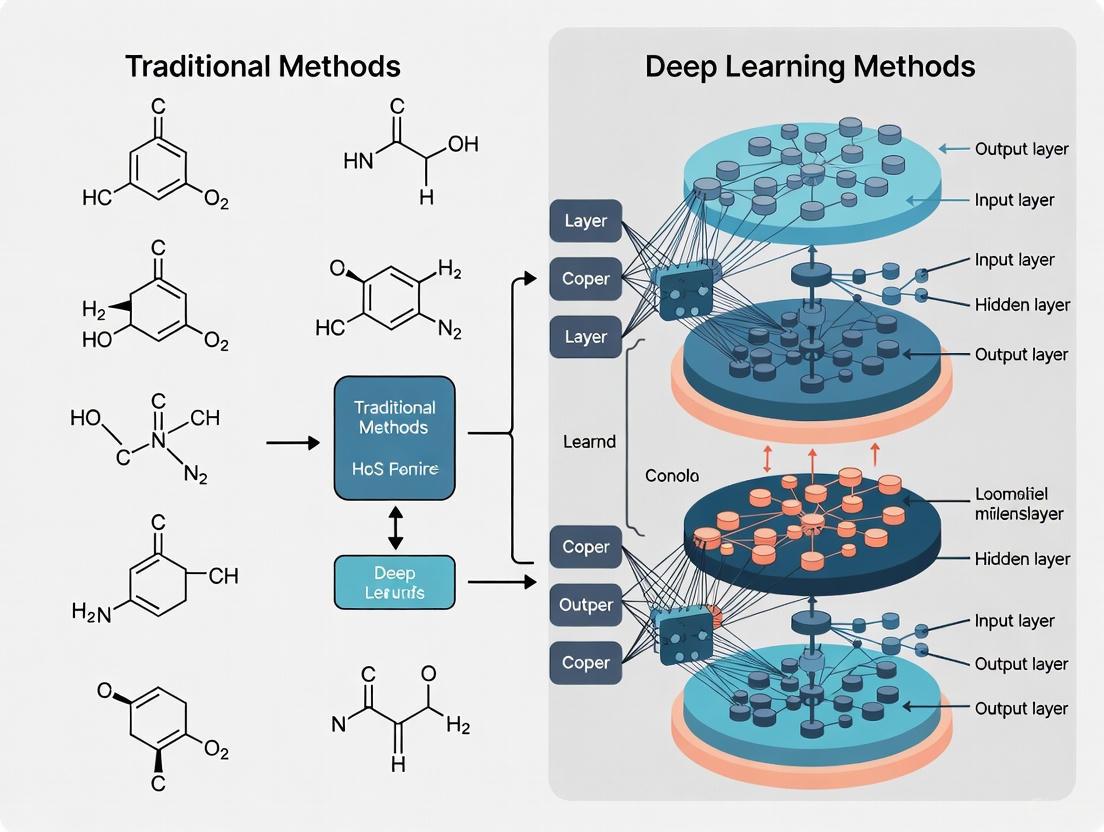
This article provides a systematic comparison of traditional machine learning and modern deep learning methods for molecular property prediction, a critical task in drug discovery and materials science.
Traditional vs. Deep Learning for Molecular Property Prediction: A Comprehensive Comparison for Drug Discovery
Abstract
This article provides a systematic comparison of traditional machine learning and modern deep learning methods for molecular property prediction, a critical task in drug discovery and materials science. Aimed at researchers and development professionals, it explores the foundational principles of expert-crafted features like molecular fingerprints and descriptors versus the end-to-end learning capabilities of Graph Neural Networks and Transformers. The content delves into practical applications, addresses key challenges such as data scarcity and model interpretability, and offers a rigorous validation framework based on benchmark datasets and performance metrics. By synthesizing the latest research, this guide serves as a strategic resource for selecting and optimizing predictive models to accelerate scientific innovation.
From Expert Features to Learned Representations: The Evolution of Molecular Property Prediction
Molecular property prediction is a computational task that uses a molecule's structure to predict its physical, chemical, or biological characteristics. It is a cornerstone of modern research, drastically accelerating the design of new drugs and materials by acting as a fast, in-silico replacement for costly and time-consuming lab experiments [1] [2]. The field is currently defined by a pivotal comparison between traditional machine learning methods and emerging deep learning techniques.
Experimental Comparison of Prediction Methods
The performance of different molecular property prediction methods has been rigorously evaluated across multiple public benchmarks. The following table summarizes key quantitative results from recent, comprehensive studies.
Table 1: Performance Comparison of Molecular Property Prediction Methods on Benchmark Datasets
| Method Category | Specific Model/Representation | Dataset(s) | Key Performance Metrics | Experimental Setup & Notes |
|---|---|---|---|---|
| Traditional Machine Learning | Random Forest (RF) with RDKit Descriptors [3] | CATMoS (NT & VT) [3] | Balanced Accuracy: ~0.785 [3] | Mondrian conformal prediction framework; performance is strong on balanced datasets [3]. |
| Traditional Machine Learning | RF with CDDD (Autoencoder) Descriptors [3] | CATMoS (NT & VT) [3] | Balanced Accuracy: ~0.785 [3] | Autoencoder-generated descriptors; performs similarly to physico-chemical descriptors for this task [3]. |
| Deep Learning (Descriptor-Based) | Random Forest with CDDD [3] | CATMoS (NT & VT) [3] | Efficiency (Class 0/1): 0.879 / 0.855 [3] | Used as a baseline in comparison with descriptor-free deep learning methods [3]. |
| Deep Learning (Graph-Based) | Directed-MPNN (D-MPNN) [4] [5] | Multiple MoleculeNet benchmarks [5] | Matches or surpasses recent supervised models [5] | A robust graph-based architecture often used as a strong baseline; outperforms other node-centric message passing models by 11.5% on average [5]. |
| Deep Learning (Sequence-Based) | MolBERT (SMILES-based) [3] | CATMoS (Very Toxic) [3] | Balanced Accuracy: 0.86-0.87; Sensitivity/Specificity: 0.86-0.87 [3] | Pre-trained model; outperformed other methods on a highly imbalanced dataset without needing over-sampling [3]. |
| Deep Learning (Geometric) | Geometric D-MPNN [4] | Novel thermochemistry datasets [4] | Achieves "chemical accuracy" (<1 kcal mol⁻¹ error) [4] | Incorporates 3D molecular information; meets stringent accuracy requirements for thermochemistry predictions [4]. |
| Multimodal Fusion | MMFRL [6] | 11 MoleculeNet tasks [6] | Significantly outperforms existing methods in accuracy and robustness [6] | Integrates multiple data modalities (e.g., graph, NMR, image) via relational learning; best performance with intermediate fusion [6]. |
| Multi-Task Learning | ACS (Adaptive Checkpointing) [5] | ClinTox, SIDER, Tox21 [5] | Outperforms Single-Task Learning (STL) by 8.3% on average [5] | Effectively mitigates "negative transfer" in multi-task learning; excels in ultra-low data regimes (e.g., 29 samples) [5]. |
Detailed Experimental Protocols
To ensure reproducibility and provide context for the data in Table 1, here are the detailed methodologies from key cited experiments.
Table 2: Detailed Experimental Protocols from Key Studies
| Study Component | Protocol Description |
|---|---|
| Comparative Analysis (CATMoS) [3] | Dataset: CATMoS acute toxicity data (Very Toxic VT, Non-Toxic NT). Data Splits: Used original training/evaluation sets; random splits for training, validation, and conformal prediction calibration. Feature Generation: Standardized SMILES strings; calculated 96 RDKit physico-chemical descriptors and 512 CDDD autoencoder descriptors. Models & Training: Compared Random Forest (RDKit/CDDD) vs. deep learning MolBERT/Molecular-graph-BERT. Used Mondrian conformal prediction for valid, efficient outcomes and to handle class imbalance without sampling. |
| Systematic Model Evaluation [7] | Dataset Scope: Extensive evaluation on MoleculeNet, opioids-related datasets, and molecular descriptor datasets. Experimental Scale: Trained 62,820 models total (50,220 on fixed representations, 4,200 on SMILES, 8,400 on molecular graphs). Representations Compared: Fixed descriptors (e.g., ECFP, RDKit2D), SMILES strings, and molecular graphs. Key Focus: Investigated impact of dataset size, activity cliffs, and statistical rigor on model performance. |
| Geometric Deep Learning [4] | Data: Novel quantum-chemical datasets (ThermoG3, ThermoCBS) of ~124,000 molecules. Model Architecture: Geometric Directed Message Passing Neural Networks (D-MPNN) that incorporate 3D molecular coordinates. Accuracy Goal: Aimed for "chemical accuracy" (≈1 kcal mol⁻¹ for thermochemistry). Techniques: Used Δ-ML (learning the difference between high/low-fidelity data) and transfer learning to enhance accuracy. |
| Low-Data Regime Multi-Task Learning [5] | Method: Adaptive Checkpointing with Specialization (ACS). Architecture: A shared GNN backbone with task-specific heads. Training Mechanism: Monitors validation loss per task; checkpoints the best model parameters for each task individually when it hits a new minimum. Purpose: Designed to mitigate "negative transfer" in multi-task learning, especially when tasks have imbalanced data (ultra-low data regimes). |
Visualizing the Method Comparison Workflow
The logical workflow for comparing traditional and deep learning methods, as derived from the experimental protocols, can be visualized as follows.
Diagram Title: Molecular Property Prediction Workflow
This table details key computational "reagents" - datasets, software, and molecular representations - that are essential for conducting molecular property prediction research.
Table 3: Key Research Reagent Solutions for Molecular Property Prediction
| Tool Name/Type | Function/Description | Relevance to Experimentation |
|---|---|---|
| CATMoS Dataset [3] | A benchmark dataset for computational toxicology, specifically for acute toxicity prediction. | Used to train and compare models for predicting toxic vs. non-toxic compounds, as shown in Table 1. |
| MoleculeNet Benchmark [7] [6] [5] | A standardized collection of multiple datasets for molecular machine learning. | Serves as the primary benchmark for objectively comparing the performance of new algorithms against existing ones. |
| RDKit [3] [7] | An open-source cheminformatics toolkit. | Used to calculate 2D/3D molecular descriptors, generate fingerprints, and standardize structures in numerous studies. |
| Conformal Prediction [3] | A statistical framework that produces predictions with valid confidence measures. | Used to ensure model predictions are reliable and to define an "applicability domain" for the model. |
| SMILES/String Representations [3] [1] [8] | A line notation for representing molecular structures using ASCII strings. | The input for sequence-based models (e.g., BERT, RNNs); requires tokenization before processing. |
| Molecular Graph (2D/3D) [4] [7] [6] | A representation where atoms are nodes and bonds are edges; can include 3D coordinates. | The standard input for Graph Neural Networks (GNNs) like D-MPNN, capturing structural connectivity and spatial geometry. |
| ChemXploreML [2] | A user-friendly, offline desktop application for molecular property prediction. | Democratizes access to state-of-the-art ML models for chemists without deep programming expertise. |
The experimental data reveals a nuanced landscape. Traditional methods like Random Forest with expert-curated descriptors remain strong, computationally efficient baselines, particularly when data is limited [7]. However, deep learning approaches, especially graph-based (D-MPNN) and geometric models, have demonstrated superior ability to capture complex structure-property relationships, achieving chemically accurate results on challenging thermochemical tasks [4].
The frontier of research is moving beyond simple model comparisons toward sophisticated strategies like multimodal fusion (MMFRL) [6] and specialized multi-task learning (ACS) [5], which are setting new performance standards. Furthermore, the development of accessible tools like ChemXploreML [2] is crucial for translating these advanced computational techniques into practical tools for researchers in drug discovery and materials science.
In the field of molecular property prediction, traditional machine learning (ML) paradigms have long relied on expert-engineered representations to map chemical structures to computationally tractable data. These representations—primarily molecular descriptors and molecular fingerprints—serve as the critical input features for statistical models that predict properties ranging from pharmacological activity to environmental toxicity. Molecular descriptors are typically numerical values that quantify specific physicochemical properties (e.g., molecular weight, logP) or topological features of a molecule. In contrast, molecular fingerprints are binary or count vectors that encode the presence or absence of specific structural patterns or substructures within a molecule, providing a structural signature for similarity searching and machine learning applications [9] [10] [11]. For decades, these hand-crafted features have formed the foundation of Quantitative Structure-Activity Relationship (QSAR) and Quantitative Structure-Property Relationship (QSPR) models, enabling significant advancements in drug discovery and materials science. This guide provides an objective comparison of these traditional representations, detailing their performance, methodological protocols, and inherent limitations within the evolving landscape of molecular property prediction.
Comparative Performance Analysis of Traditional Molecular Representations
To objectively evaluate the efficacy of different traditional representations, we synthesized data from multiple benchmarking studies that compared molecular descriptors and fingerprints across various property prediction tasks. The table below summarizes key performance metrics.
Table 1: Performance Comparison of Molecular Feature Representations in Predictive Modeling
| Feature Representation | Description | Best-Performing Model Pairing | Representative Performance Metrics | Key Strengths |
|---|---|---|---|---|
| Morgan Fingerprints (ECFP) [12] [10] | Circular fingerprints capturing atomic environments and connectivity within a specific radius. | XGBoost [12] | AUROC: 0.828, AUPRC: 0.237 on multi-label odor prediction [12] | Superior performance in bioactivity and odor prediction tasks; excels at capturing structural cues [12] [10]. |
| Molecular Descriptors (1D & 2D) [9] [10] | Predefined physicochemical (e.g., MolWt, LogP) and topological (e.g., TPSA) properties. | XGBoost [9] | Superior for ADME-Tox targets and physical property prediction compared to fingerprints [9] [10]. | Direct encoding of human-understandable properties; often better for predicting physical and ADME-Tox properties [9]. |
| MACCS Fingerprints [10] | Structural key-based fingerprints with 166 predefined chemical substructures. | Not Specified | Competitive overall performance in broad benchmarking studies [10]. | Simplicity, interpretability, and robust performance across diverse tasks despite lower dimensionality [10]. |
| AtomPair Fingerprints [9] [7] | Encodes molecules based on the presence of atom pairs and their topological distances. | RPropMLP Neural Network [9] | Performance varies significantly by dataset and target [9]. | Captures information on molecular size and shape [7]. |
The comparative analysis reveals a lack of a single universally superior representation. The choice depends heavily on the specific prediction task: Morgan fingerprints demonstrate a notable advantage in complex perception tasks like odor prediction [12], while traditional 1D and 2D molecular descriptors can be more effective for specific physical property and ADME-Tox predictions [9] [10]. Furthermore, simpler fingerprints like MACCS remain highly competitive, challenging the assumption that more complex representations are always better [10].
Experimental Protocols and Methodologies
The performance data presented in the previous section are derived from rigorous, standardized experimental protocols. This section details the common workflows and methodologies employed in benchmarking studies to ensure fair and reproducible comparisons.
Common Benchmarking Workflow
The following diagram illustrates the standard pipeline for evaluating molecular representations in predictive modeling.
Diagram 1: Molecular Representation Benchmarking Pipeline
Detailed Methodological Components
Dataset Curation and Preprocessing: Benchmarking studies typically employ multiple publicly available datasets, such as those from MoleculeNet or specialized collections (e.g., a curated set of 8,681 odorants from ten expert sources) [12] [9] [7]. Standard preprocessing includes removing duplicates and salts, standardizing chemical structures, and applying filters based on heavy atom counts and allowed elements [9].
Feature Extraction:
- Molecular Descriptors: These are calculated using software like RDKit or the PaDEL descriptor and include a range of 1D and 2D properties such as molecular weight (MolWt), topological polar surface area (TPSA), number of rotatable bonds, and molecular logP (molLogP) [12] [9].
- Fingerprints: The most common is the Morgan fingerprint (the implementation of Extended Connectivity Fingerprints, ECFP), generated using the Morgan algorithm from RDKit. This process involves iterative updates of atom identifiers to capture circular atomic neighborhoods up to a specified radius [12] [7]. Other fingerprints like MACCS and AtomPair are also generated using standard cheminformatics toolkits [9] [7].
Model Training and Evaluation: The extracted features are used to train various traditional ML models. Tree-based ensembles like Random Forest (RF) and eXtreme Gradient Boosting (XGBoost) are particularly popular due to their robustness and performance [12] [9]. A critical step is rigorous validation, often using fivefold cross-validation on an 80:20 train-test split, with stratification to maintain the positive-to-negative ratio in each fold. Performance is assessed using metrics like Area Under the Receiver Operating Characteristic Curve (AUROC) and Area Under the Precision-Recall Curve (AUPRC) [12].
Key Limitations of Traditional Paradigms
Despite their proven utility, traditional molecular representations suffer from several inherent limitations that constrain their application and performance.
Table 2: Key Limitations of Traditional Molecular Representations
| Limitation | Description | Impact on Predictive Modeling |
|---|---|---|
| Fixed Representational Capacity | The features are pre-defined and static, unable to adapt or learn from data beyond their initial design [11] [13]. | Limits the model's ability to discover novel, complex, or task-specific structural patterns that are not explicitly encoded by experts. |
| Poor Out-of-Distribution (OOD) Generalization | Models built on these representations struggle to make accurate predictions for molecules that are structurally different from those in the training set [14] [15]. | A major hurdle for molecule discovery, which requires extrapolating to new regions of chemical space. OOD error can be 3x larger than in-distribution error [15]. |
| Dependence on Dataset Size | The performance of models using traditional features is highly dependent on the size and quality of the labeled dataset [7] [5]. | They are often ineffective in "ultra-low data regimes," which are common in real-world discovery projects for novel targets or properties [5]. |
| Information Bottleneck | Complex molecular structures must be compressed into a fixed-length vector, which can lead to information loss. For example, ECFPs can suffer from "bit collisions" due to the hashing step [13]. | The representation may fail to capture critical stereochemical, conformational, or electronic information necessary for accurate property prediction [11]. |
These limitations are driving the exploration of deep learning approaches, which aim to learn optimal representations directly from data. However, it is crucial to note that recent large-scale benchmarks have shown that deep representation learning models do not consistently outperform traditional expert-based representations across diverse molecular property prediction tasks [7].
The Scientist's Toolkit: Essential Research Reagents and Solutions
The experimental workflows for implementing traditional ML paradigms rely on a core set of software tools and libraries. The following table details these essential "research reagents."
Table 3: Key Research Reagent Solutions for Traditional ML Modeling
| Tool / Library | Type | Primary Function in Workflow |
|---|---|---|
| RDKit [12] [9] [7] | Open-Source Cheminformatics Library | The workhorse for chemical informatics; used for reading molecules, calculating molecular descriptors (e.g., MolWt, logP, TPSA), and generating fingerprints (e.g., Morgan, AtomPair). |
| PaDEL-Descriptor [10] | Molecular Descriptor Calculation Software | Used to calculate a comprehensive suite of 1D, 2D, and 3D molecular descriptors for QSAR modeling. |
| XGBoost [12] [9] | Machine Learning Library | A leading gradient-boosting framework frequently used as the predictive model due to its high performance with structured, tabular data derived from descriptors and fingerprints. |
| Random Forest [12] [9] | Machine Learning Algorithm | A robust ensemble method commonly benchmarked against other models for its interpretability and performance on fingerprint data. |
| Python (scikit-learn) [10] | Programming Language & ML Library | Provides the ecosystem for data preprocessing, model training, hyperparameter tuning, and evaluation (e.g., cross-validation, metric calculation). |
| DeepChem [15] [13] | Deep Learning Library for Chemistry | Offers standardized implementations of dataset loaders, molecular featurizers (including traditional fingerprints), and model architectures for benchmarking. |
The field of molecular property prediction is undergoing a fundamental transformation, moving from traditional machine learning methods that rely on human-engineered features toward deep learning approaches that learn directly from molecular structure. This revolution of end-to-end learning is reshaping how researchers and drug development professionals predict molecular behavior, enabling more accurate, generalizable, and insightful computational models. Where traditional methods required domain experts to manually design feature representations such as molecular fingerprints and descriptors, modern deep learning architectures automatically learn relevant features from raw molecular representations, uncovering complex structure-property relationships that previously eluded manual feature engineering. This comprehensive analysis compares the performance, methodological approaches, and practical applications of these competing paradigms, providing researchers with evidence-based guidance for selecting appropriate methodologies across different pharmaceutical and materials science contexts.
Performance Comparison: Traditional Machine Learning vs. Deep Learning Approaches
Quantitative Benchmarking Across Multiple Molecular Properties
Table 1: Performance Comparison of Traditional ML and Deep Learning Models on Benchmark Tasks
| Model Category | Specific Model | Key Features/Representation | Performance Metrics | Dataset |
|---|---|---|---|---|
| Traditional ML | Morgan-FP + XGBoost | Morgan structural fingerprints | AUROC: 0.828, AUPRC: 0.237, Accuracy: 97.8% | Odor Perception (8,681 compounds) [12] |
| Traditional ML | Molecular Descriptors + XGBoost | Classical molecular descriptors | AUROC: 0.802, AUPRC: 0.200 | Odor Perception [12] |
| Traditional ML | Functional Group + XGBoost | Functional group fingerprints | AUROC: 0.753, AUPRC: 0.088 | Odor Perception [12] |
| Deep Learning | DLF-MFF | Multi-type feature fusion (2D/3D graph, image, fingerprints) | SOTA on 6 benchmark datasets | Molecular Property Benchmarks [16] |
| Deep Learning | ACS (Multi-task GNN) | Adaptive checkpointing with specialization | Accurate prediction with only 29 labeled samples | Sustainable Aviation Fuels [5] |
| Deep Learning | DeepDTAGen | Multitask: affinity prediction + drug generation | MSE: 0.146, CI: 0.897, r²m: 0.765 | KIBA [17] |
| Deep Learning | Molecular Property Foundation Models | Pre-training on large unlabeled data | Strong in-context learning, variable OOD performance | BOOM Benchmark [14] |
Out-of-Distribution Generalization Capabilities
A critical challenge in molecular property prediction is model performance on out-of-distribution (OOD) data, which tests true generalization capability. The BOOM benchmark (Benchmarks for Out-Of-distribution Molecular property predictions) evaluated over 140 model-task combinations, revealing that neither traditional nor deep learning models consistently achieve strong OOD generalization across all tasks [14]. The top performing model exhibited an average OOD error 3 times larger than in-distribution error, highlighting the generalization challenge. Interestingly, classical machine learning models with high inductive bias can perform well on OOD tasks with simple, specific properties, while current chemical foundation models show promising in-context learning but lack strong OOD extrapolation capabilities [14].
The relationship between in-distribution (ID) and OOD performance varies significantly based on the splitting strategy used to create test sets. For scaffold splitting, the correlation between ID and OOD performance is strong (Pearson r ∼ 0.9), whereas for the more challenging cluster-based splitting (using K-means clustering on ECFP4 fingerprints), this correlation decreases significantly (Pearson r ∼ 0.4) [18]. This indicates that model selection based solely on ID performance may be insufficient for applications requiring strong OOD generalization.
Experimental Protocols and Methodologies
Traditional Machine Learning Workflow
Experimental Protocol for Fingerprint-Based Models (as described in odor prediction study [12]):
- Dataset Curation: Unified dataset of 8,681 unique odorants from ten expert-curated sources with 200 candidate odor descriptors
- Feature Extraction:
- Morgan Fingerprints: Structural fingerprints derived using Morgan algorithm from MolBlock representations
- Functional Group Features: Generated by detecting predefined substructures using SMARTS patterns
- Molecular Descriptors: Calculated using RDKit library including molecular weight, hydrogen donors/acceptors, topological polar surface area, logP, rotatable bonds, heavy atom count, and ring count
- Model Training: Benchmarking of Random Forest, XGBoost, and LightGBM with fivefold cross-validation on 80:20 train:test split
- Evaluation Metrics: Accuracy, AUROC, AUPRC, Specificity, Precision, and Recall with multi-label classification setup
Deep Learning End-to-End Approaches
Experimental Protocol for Multi-type Features Fusion (DLF-MFF) [16]:
- Multi-representation Input:
- Molecular fingerprints (expert knowledge)
- 2D molecular graph (structural information)
- 3D molecular graph (spatial topology)
- Molecular image (global perspective)
- Feature Extraction Backbones:
- Fully Connected Neural Network for fingerprint features
- Graph Convolutional Network for 2D molecular graphs
- Equivariant Graph Neural Network for 3D molecular graphs
- Convolutional Neural Network for molecular images
- Feature Fusion: Integration of four final feature vectors through concatenation
- Prediction Layer: Fully connected layers for final molecular property prediction
Experimental Protocol for Ultra-Low Data Regime (ACS) [5]:
- Architecture: Shared GNN backbone with task-specific multi-layer perceptron heads
- Training Scheme: Adaptive checkpointing with specialization monitoring validation loss for each task
- Negative Transfer Mitigation: Checkpointing best backbone-head pair when validation loss reaches new minimum
- Evaluation: Testing under severe task imbalance conditions with as few as 29 labeled samples
The Scientist's Toolkit: Essential Research Reagents and Solutions
Table 2: Key Research Reagents and Computational Tools for Molecular Property Prediction
| Tool/Resource | Type | Function | Applicable Paradigm |
|---|---|---|---|
| RDKit | Cheminformatics Library | Molecular descriptor calculation, fingerprint generation, SMILES processing | Both traditional ML and deep learning |
| Morgan Fingerprints | Structural Representation | Circular fingerprints capturing molecular substructures | Primarily traditional ML |
| PyTor Geometric | Deep Learning Library | Graph neural networks for molecular structures | Deep learning |
| SMILES | Molecular Representation | String-based molecular representation | Both paradigms |
| Molecular Graphs | Graph Representation | Atoms as nodes, bonds as edges for GNN input | Deep learning |
| ChemXploreML | Desktop Application | User-friendly ML without programming expertise | Traditional ML |
| Multi-task GNNs | Neural Architecture | Simultaneous prediction of multiple molecular properties | Deep learning |
Specialized Solutions for Challenging Scenarios
Ultra-Low Data Regime: The ACS (Adaptive Checkpointing with Specialization) method enables effective learning with as few as 29 labeled samples by combining shared task-agnostic backbones with task-specific heads, dynamically checkpointing parameters to prevent negative transfer [5].
Multi-task Prediction: DeepDTAGen provides a unified framework for both drug-target affinity prediction and target-aware drug generation using shared feature spaces, addressing gradient conflicts through the novel FetterGrad algorithm [17].
Out-of-Distribution Generalization: The BOOM benchmark suite provides systematic evaluation protocols for assessing model performance on OOD data, crucial for real-world applications where chemical space differs from training data [14].
Integration of Large Language Models and Knowledge Enhancement
A recent innovation in molecular property prediction involves integrating knowledge extracted from Large Language Models (LLMs) with structural features from pre-trained molecular models. This approach, exemplified by Zhou et al., prompts LLMs (GPT-4o, GPT-4.1, and DeepSeek-R1) to generate both domain-relevant knowledge and executable code for molecular vectorization [19]. The resulting knowledge-based features are fused with structural representations, creating a hybrid model that leverages both human prior knowledge and learned structural relationships. This integration addresses the limitation of pure LLM-based approaches, which suffer from knowledge gaps and hallucinations for less-studied molecular properties, while simultaneously overcoming the data hunger of pure structure-based deep learning models [19].
The revolution in molecular property prediction is characterized by a shift from manual feature engineering to end-to-end learning from molecular structure. However, rather than completely replacing traditional methods, the evidence suggests a more nuanced landscape where each approach excels in different scenarios:
- Traditional ML with expert-crafted features (particularly Morgan fingerprints with XGBoost) delivers strong performance on well-defined problems with sufficient training data and remains more interpretable [12]
- Deep learning approaches excel in low-data regimes, multi-task settings, and when handling raw molecular representations without manual feature engineering [5] [16]
- Hybrid approaches that combine structural information with external knowledge from LLMs represent a promising direction for enhancing prediction accuracy [19]
For researchers and drug development professionals, selection criteria should consider data availability, property complexity, interpretability requirements, and generalization needs. Traditional methods provide robust baselines and interpretability, while deep learning approaches offer superior performance in challenging scenarios including ultra-low data regimes, multi-task prediction, and complex structure-property relationship modeling. As the field evolves, the integration of large language models and specialized architectures for out-of-distribution generalization will likely expand the boundaries of predictive capability in molecular property prediction.
The pursuit of accurate molecular property prediction is a cornerstone of modern computational chemistry and drug discovery. The choice of how a molecule is digitally represented—its data structure—profoundly influences the performance and applicability of artificial intelligence (AI) models. While traditional machine learning (ML) models often relied on handcrafted molecular descriptors, the rise of deep learning (DL) has shifted the paradigm towards learned representations from raw molecular inputs. The three predominant data representations are SMILES strings, molecular graphs, and 3D conformations, each with distinct trade-offs in structural fidelity, computational cost, and informational completeness.
This guide provides an objective comparison of these core representations, framing them within the broader thesis of traditional versus deep learning methodologies. We summarize quantitative performance benchmarks across standardized tasks, detail experimental protocols from key studies, and provide essential resources to inform the selection of appropriate representations for specific research goals in molecular property prediction.
Performance Comparison of Molecular Representations
The following tables synthesize experimental results from recent benchmark studies, comparing the performance of models utilizing different molecular representations across various property prediction tasks.
Table 1: Performance on Quantum Chemical and Physical Property Prediction Tasks
| Representation | Model Example | Dataset | Key Metric | Performance | Key Advantage |
|---|---|---|---|---|---|
| 3D Conformation | Uni-Mol+ [20] | PCQM4MV2 (HOMO-LUMO gap) | Mean Absolute Error (MAE) | State-of-the-Art (0.0079 improvement over prior SOTA) [20] | Captures spatial, quantum properties |
| 3D Conformation | Uni-Mol+ [20] | Open Catalyst 2020 (IS2RE) | MAE (eV) | Competitive State-of-the-Art [20] | Models catalyst relaxation energy |
| 2D Graph | GROVER [21] | Various MoleculeNet Tasks | AUC-ROC / MAE | Strong General Performance [21] | Balances structure and data efficiency |
| SMILES | MLM-FG [22] | BBBP (MoleculeNet) | AUC-ROC | 0.939 [22] | Effective for permeability prediction |
| SMILES | MLM-FG [22] | ClinTox (MoleculeNet) | AUC-ROC | 0.944 [22] | Accurately flags drug toxicity |
Table 2: Performance on Bioactivity and Olfaction Prediction Tasks
| Representation | Model Example | Task/Dataset | Key Metric | Performance | Key Advantage |
|---|---|---|---|---|---|
| Molecular Fingerprints (2D) | XGBoost [12] | Odor Prediction | AUROC | 0.828 [12] | Superior for complex perceptual properties |
| 3D Conformation | SCAGE [21] | 9 Molecular Property Benchmarks | Varies | Significant Improvements [21] | Identifies activity cliffs & functional groups |
| SMILES | MLM-FG [22] | HIV (MoleculeNet) | AUC-ROC | 0.824 [22] | Effective for antiviral activity prediction |
| Molecular Descriptors | XGBoost [12] | Odor Prediction | AUROC | 0.802 [12] | Interpretable, classic cheminformatics |
| Functional Group Fingerprints | XGBoost [12] | Odor Prediction | AUROC | 0.753 [12] | Simple, chemically intuitive |
Experimental Protocols and Model Methodologies
3D Conformation-Based Models
Protocol for Uni-Mol+ [20] Uni-Mol+ addresses the dependency of quantum chemical (QC) properties on refined 3D equilibrium conformations. Its methodology is a two-step process:
- Initial Conformation Generation: A raw 3D conformation is generated from a 1D SMILES string or 2D graph using fast, cheap methods like RDKit's ETKDG algorithm, with optimization via the MMFF94 force field. This step costs approximately 0.01 seconds per molecule.
- Iterative Conformation Refinement: The raw conformation is iteratively updated towards the target Density Functional Theory (DFT) equilibrium conformation using a deep learning model. The model backbone is a two-track transformer that maintains separate atom and pair representation tracks, enhanced with outer product and triangular update operators inspired by AlphaFold2 to bolster 3D geometric information.
A novel training strategy involves sampling conformations from a pseudo trajectory between the RDKit conformation and the DFT equilibrium conformation, using a mixture of Bernoulli and Uniform distributions. This provides diverse training examples and ensures the model learns an accurate mapping to the final QC properties [20].
Protocol for Structure-Based Drug Design with Chem3DLLM [23] For generative tasks in drug design, Chem3DLLM tackles the challenge of representing 3D structures within a discrete token space. The methodology involves:
- Reversible Text Encoding: A novel encoding scheme using run-length compression converts 3D molecular structures into a format compatible with Large Language Models (LLMs), achieving a 3x size reduction while preserving structural information.
- Multimodal Integration: This encoding allows for the seamless integration of 3D molecular geometry and protein pocket features within a single LLM architecture.
- Reinforcement Learning Optimization: The model is further refined using reinforcement learning with stability-based rewards to optimize for chemical validity and desired biophysical properties like binding affinity [23].
2D Graph and SMILES-Based Models
Protocol for MLM-FG (SMILES) [22] MLM-FG is a transformer-based model that enhances SMILES representation learning through a specialized pre-training task:
- Functional Group-Aware Masking: Instead of randomly masking individual tokens in a SMILES string, the model identifies subsequences corresponding to chemically significant functional groups (e.g., carboxylic acid "-COOH").
- Pre-training Objective: The model is then trained to predict these masked functional groups, forcing it to learn the chemical context and the relationship between molecular substructures and properties. This approach incorporates implicit structural awareness without needing explicit 3D structural data [22].
Protocol for SCAGE (2D Graph with 3D Guidance) [21] SCAGE is a self-conformation-aware graph transformer that leverages 3D information to guide 2D graph representation learning. Its multi-task pre-training framework, M4, includes:
- Multiscale Conformational Learning (MCL): A module that guides the model to understand atomic relationships at different conformational scales.
- Multi-Task Pre-training: The model is trained on four tasks simultaneously: molecular fingerprint prediction, functional group prediction, 2D atomic distance prediction, and 3D bond angle prediction. This ensures the model learns comprehensive semantics from molecular structures to functions.
- Dynamic Adaptive Multitask Learning: A strategy that automatically balances the contribution of the four pre-training tasks to the total loss, leading to more robust and generalized molecular representations [21].
Workflow and Relationship Diagrams
The following diagram illustrates the logical relationship between the core molecular representations and the modeling approaches they enable, culminating in their primary predictive applications.
The experiments and models discussed rely on a suite of software tools and data resources that form the essential "reagent solutions" for modern molecular property prediction research.
Table 3: Key Research Reagents for Molecular Representation Studies
| Tool / Resource Name | Type | Primary Function | Relevance to Representations |
|---|---|---|---|
| RDKit [20] [12] | Cheminformatics Software | Generation of 2D/3D molecular structures and fingerprints. | Core tool for generating initial 3D conformations (via MMFF94/ETKDG) and calculating molecular descriptors. |
| PubChem [22] | Chemical Database | Public repository for purchasable, drug-like compounds. | Primary source of large-scale molecular data (SMILES) for pre-training models. |
| PCQM4MV2 [20] | Benchmark Dataset | Quantum chemical property (HOMO-LUMO gap) prediction. | Standard benchmark for evaluating 3D conformation-based models on quantum mechanical tasks. |
| Open Catalyst 2020 (OC20) [20] | Benchmark Dataset | Catalyst relaxation energy and structure prediction. | Challenging benchmark for 3D models on catalyst systems. |
| MoleculeNet [22] | Benchmark Suite | Collection of datasets for molecular property prediction. | Standard for broad evaluation across SMILES, graph, and descriptor-based models (e.g., BBBP, ClinTox, HIV). |
| MMFF94 [21] [12] | Force Field | Energy minimization and conformation optimization. | Used to generate stable, low-energy 3D conformations for model input. |
| Transformer Architecture [23] [22] | Neural Network Model | Core backbone for sequence and multimodal learning. | Foundation for modern SMILES-based LLMs (e.g., MLM-FG) and multimodal 3D models (e.g., Chem3DLLM). |
| Graph Neural Network (GNN) [21] [24] | Neural Network Model | Learning directly from graph-structured data. | Foundation for models that process 2D molecular graphs (e.g., GROVER, SCAGE). |
The empirical evidence clearly demonstrates a performance-sophistication trade-off among core molecular representations. SMILES strings, while efficient and scalable, are fundamentally limited by their lack of explicit structural awareness, though modern pre-training strategies like functional group masking [22] have narrowed this gap. 2D molecular graphs strike a robust balance, offering a direct encoding of molecular topology that is sufficient for a wide range of bioactivity and property prediction tasks [21] [12]. However, for properties governed by quantum mechanics and spatial complementarity—such as HOMO-LUMO gaps, catalyst energies, and protein-ligand binding affinity—3D conformational representations are unequivocally superior, providing the most informative modality [23] [20].
The frontier of research is increasingly focused on hybrid and multimodal approaches. Models like SCAGE inject 3D conformational knowledge into 2D graph learning [21], while frameworks like Chem3DLLM and 3DSMILES-GPT integrate 3D structural data into the flexible architecture of large language models [23] [24]. This convergence, coupled with physics-informed learning to ensure generated structures are physically plausible [25], points to a future where the distinctions between these representations blur, giving rise to holistic, context-aware models that can seamlessly leverage all available molecular information for accelerated scientific discovery.
A Practical Guide to Methodologies: From Random Forests to Graph Neural Networks
In the rapidly evolving field of molecular property prediction, deep learning approaches often dominate contemporary research discourse. However, traditional machine learning (ML) methods employing molecular fingerprints remain indispensable tools for researchers and drug development professionals. These "traditional workhorses"—Random Forest (RF), eXtreme Gradient Boosting (XGBoost), and Support Vector Machines (SVM)—continue to deliver state-of-the-art performance across diverse prediction tasks while offering computational efficiency and operational transparency.
A 2023 comprehensive evaluation noted that despite the current prosperity of representation learning, fixed molecular representations consistently achieve competitive performance, with dataset size being a critical factor for success [7]. This guide provides an objective comparison of RF, XGBoost, and SVM with molecular fingerprints, presenting experimental data from recent studies to inform method selection for molecular property prediction tasks.
Performance Comparison: Quantitative Benchmarking Across Studies
Predictive Performance Metrics
Table 1: Performance comparison of traditional ML methods with molecular fingerprints across different prediction tasks
| Study Focus | Dataset | Best Model | Key Metric | Performance | Comparative Performance |
|---|---|---|---|---|---|
| Odor Prediction [12] | 8,681 compounds, 200 odor descriptors | XGBoost with Morgan fingerprints | AUROC | 0.828 | XGB > RF > SVM |
| AUPRC | 0.237 | ||||
| Reproductive Toxicity [26] | 1,823 compounds | Ensemble (RF+XGB+SVM) | Accuracy | 86.33% | Ensemble > Individual Models |
| AUC | 0.937 | ||||
| Kinase Profiling [27] | 141,086 compounds, 354 kinases | Random Forest | Average AUC | 0.807-0.825 | RF > XGB > SVM |
| General Molecular Properties [28] | 11 public datasets | SVM (Regression) | RMSE (varies by endpoint) | Best on 7/11 datasets | SVM (Regression) > RF ≈ XGB (Classification) |
| RF/XGBoost (Classification) | AUC/Accuracy | Best on 8/11 datasets |
Computational Efficiency and Training Time
Table 2: Computational characteristics and resource requirements
| Algorithm | Training Speed | Memory Usage | Hyperparameter Sensitivity | Scalability to Large Datasets |
|---|---|---|---|---|
| Random Forest | Fast | Moderate | Low | Excellent |
| XGBoost | Moderate to Fast | Moderate | High | Excellent |
| SVM | Slow for large datasets | High | High | Limited |
According to large-scale benchmarking, tree-based ensembles like RF and XGBoost demonstrate remarkable computational efficiency, often requiring only "a few seconds to train a model even for a large dataset" [28]. In a 2023 comparison of gradient boosting implementations, LightGBM was noted as requiring the least training time for larger datasets, though XGBoost generally achieved the best predictive performance [29].
Molecular Fingerprints: The Critical Input Features
Fingerprint Types and Their Applications
Molecular fingerprints encode chemical structures as numerical vectors, enabling machine learning algorithms to identify patterns correlating with molecular properties. The most commonly employed fingerprints include:
Extended Connectivity Fingerprints (ECFP): Circular fingerprints capturing atomic environments within specific radii (typically ECFP4 with radius=2 or ECFP6 with radius=3) [7]. These have become the "de facto standard circular fingerprint" in drug discovery [7].
MACCS Keys: Structural keys encoding the presence or absence of 166 predefined chemical substructures [27].
Atom-Pair Fingerprints: Capture atomic pairwise relationships emphasizing molecular size and shape [7].
Functional Group Fingerprints: Encode presence of specific functional groups using SMARTS patterns [12].
RDKit 2D Descriptors: 200+ molecular features including molar refractivity, topological polar surface area, and fragment counts [7].
Research Reagent Solutions: Essential Computational Tools
Table 3: Essential software tools and their functions in molecular property prediction
| Tool Name | Function | Application Notes |
|---|---|---|
| RDKit | Molecular descriptor calculation and fingerprint generation | Open-source; calculates 200+ 2D descriptors and multiple fingerprint types [7] |
| PaDEL-Descriptor | Molecular descriptor and fingerprint calculation | Generates 9+ fingerprint types; suitable for high-throughput screening [26] |
| XGBoost | Gradient boosting implementation | Regularized learning objective; often top performer in benchmarks [29] |
| Scikit-learn | Machine learning library | Implements RF, SVM, and other traditional ML algorithms [28] |
| SHAP | Model interpretation | Explains feature importance in descriptor-based models [28] |
Experimental Protocols: Methodologies from Key Studies
Benchmarking Workflow for Method Comparison
Dataset Preparation and Curation
Rigorous dataset preparation is fundamental to reliable model performance. The odor prediction study [12] exemplifies best practices with their multi-step refinement process:
- Data Sourcing: Unified ten expert-curated sources containing 8,681 unique odorants
- Descriptor Standardization: Standardized inconsistent odor descriptors to a controlled set of 201 labels
- Structure Processing: Retrieved canonical SMILES via PubChem's PUG-REST API
- Feature Extraction: Generated Morgan fingerprints, functional group fingerprints, and molecular descriptors
Similarly, kinase profiling research [27] implemented stringent data processing: standardizing molecular structures, removing duplicates, filtering by molecular weight (<1000 Da), and labeling actives/inactives using consistent threshold (pKi/pKd/pIC50/pEC50 ≥ 6).
Model Training and Evaluation Protocols
Comprehensive benchmarking studies employ rigorous evaluation methodologies:
- Cross-Validation: Stratified 5-fold cross-validation maintaining positive:negative ratios in each fold [12] [26]
- Hyperparameter Optimization: Systematic tuning of algorithm-specific parameters
- Evaluation Metrics: Multiple metrics including AUROC, AUPRC, accuracy, specificity, precision, and recall [12]
- Statistical Testing: Repeated runs with different random seeds to ensure result stability [7]
Algorithm-Specific Considerations
Random Forest Implementation
Random Forest operates by constructing multiple decision trees through bagging and random feature selection [30]. Key advantages include:
- Robustness to Overfitting: Natural regularization through ensemble diversity [30]
- Handle High-Dimensional Data: Effective with thousands of fingerprint features without performance degradation [30]
- Missing Data Tolerance: Can manage missing values without complex imputation [30]
Critical hyperparameters include number of trees (nestimators), maximum features per split (maxfeatures), and minimum samples per leaf (minsamplesleaf) [30].
XGBoost Implementation
XGBoost's superior performance often stems from its regularized learning objective and optimization approach [29]. The algorithm introduces:
- Regularization: L1 (Lasso) and L2 (Ridge) regularization terms in the objective function to prevent overfitting [29]
- Newton Descent: Second-order optimization for faster convergence [29]
- Handling Sparse Data: Efficient management of sparse fingerprint representations [31]
Essential hyperparameters include learning rate, maximum tree depth, regularization terms (lambda, alpha), and subsampling ratios [29].
SVM Implementation
Support Vector Machines seek optimal separating hyperplanes in high-dimensional feature space [28]. For molecular fingerprints:
- Kernel Selection: Radial basis function (RBF) kernels typically perform best for complex structure-activity relationships [28]
- Feature Scaling: Critical for stable performance with fingerprint inputs [28]
- Class Imbalance Adjustment: Class weighting strategies for unbalanced bioactivity data [26]
Key hyperparameters include regularization (C), kernel coefficient (gamma), and class weights [28].
Case Studies: Experimental Evidence
Odor Prediction with Morgan Fingerprints
A 2025 comparative study on odor decoding provides compelling evidence for XGBoost's performance advantage [12]. Using a curated dataset of 8,681 compounds, researchers benchmarked RF, XGBoost, and LightGBM across three feature sets. The Morgan-fingerprint-based XGBoost model achieved superior discrimination (AUROC 0.828, AUPRC 0.237), consistently outperforming descriptor-based models. The study concluded that "structure-derived fingerprints are highly effective in capturing olfactory cues, and that gradient-boosted decision trees—particularly XGB—are well suited to leveraging this information for accurate multi-label odor prediction" [12].
Kinase Profiling Prediction
A large-scale 2024 comparison of machine learning methods for kinase inhibitor selectivity revealed Random Forest's strong performance [27]. After evaluating 12 ML and deep learning methods on 141,086 unique compounds and 216,823 bioassay data points across 354 kinases, the study found that "RF as an ensemble learning approach displays the overall best predictive performance" among conventional methods [27]. The RF::AtomPairs + FP2 + RDKitDes fusion model achieved the highest average AUC value of 0.825 on test sets.
Reproductive Toxicity Prediction
A 2021 study on reproductive toxicity prediction demonstrated the power of ensemble approaches combining all three traditional workhorses [26]. Using nine molecular fingerprint types with SVM, RF, and XGBoost on 1,823 compounds, their Ensemble-Top12 model achieved accuracy of 86.33% and AUC of 0.937 in 5-fold cross-validation. The research highlighted that ensemble learning "can sufficiently fuse model predictions together" and "usually produces higher accuracy than individual models because it can manage the strengths and weaknesses of each base learner" [26].
Decision Framework: Method Selection Guidelines
Based on extensive benchmarking evidence, the following guidelines emerge for method selection:
- Choose XGBoost when prioritizing ultimate predictive performance, with sufficient computational resources for hyperparameter tuning [29] [12]
- Select Random Forest when seeking robust performance with minimal hyperparameter tuning, enhanced interpretability, or working with mixed data types [27] [30]
- Employ SVM when dealing with smaller datasets (<5,000 compounds) where its capacity to find complex boundaries in high-dimensional space excels [28] [26]
- Consider Ensemble Approaches combining multiple algorithms when the highest possible accuracy is required for critical applications [26]
Traditional machine learning methods with molecular fingerprints remain powerful, efficient tools for molecular property prediction. The experimental evidence demonstrates that RF, XGBoost, and SVM each have distinct strengths and application scenarios where they excel. While deep learning approaches continue to advance, these traditional workhorses offer compelling advantages in computational efficiency, interpretability, and robust performance across diverse prediction tasks—securing their ongoing relevance in drug discovery and molecular sciences.
Graph Neural Networks (GNNs) have revolutionized molecular property prediction by directly learning from topological structures, surpassing traditional descriptor-based methods. This guide objectively compares three fundamental GNN architectures—Graph Isomorphism Network (GIN), Graph Convolutional Network (GCN), and Graph Attention Network (GAT)—within molecular research contexts. We present consolidated performance metrics across standardized benchmarks, detail experimental methodologies for fair evaluation, and visualize architectural mechanisms. Experimental data reveal that GIN achieves superior accuracy on topology-sensitive tasks like molecular symmetry prediction (92.7% accuracy), while attention-based mechanisms in GAT enhance node-specific representation learning. These GNN architectures consistently outperform conventional machine learning models that rely on hand-crafted molecular fingerprints, establishing end-to-end deep learning as a transformative paradigm for computational chemistry and drug discovery.
Molecular property prediction has traditionally relied on machine learning models using hand-crafted descriptors or fingerprints, which often overlook intricate topological and chemical structures [32]. Graph Neural Networks represent a paradigm shift by enabling direct learning from molecular graphs, where atoms constitute nodes and bonds form edges, eliminating the need for manual feature engineering [32]. This end-to-end learning approach captures both local atomic environments and global molecular structure more effectively than traditional methods.
Among GNN architectures, GCN, GAT, and GIN have emerged as foundational models with distinct mechanistic approaches to topological structure learning. GCN applies spectral graph convolutions with layer-wise transformation, GAT introduces attention-based neighborhood aggregation, and GIN achieves maximum expressiveness for graph isomorphism through injective aggregation functions. Their complementary strengths make them suitable for different molecular prediction tasks, from quantum chemical property estimation to bioactivity classification.
Architectural Comparison and Molecular Applications
Core Architectural Mechanisms
Graph Convolutional Network (GCN): Operates through spectral graph convolutions approximated by layer-wise transformation. Each node's representation is updated by averaging neighboring features followed by a linear transformation and non-linear activation. This approach inherently assumes equal importance of all neighbors, making it computationally efficient but potentially limited in discriminative power for heterogeneous molecular structures.
Graph Attention Network (GAT): Incorporates self-attention mechanisms into the propagation rule, computing hidden representations by attending over neighbor nodes. The attention coefficients are learned through a shared parametric function, enabling differentiated importance weighting for different neighbors within the aggregation process. This proves particularly valuable for molecular graphs where certain atomic interactions or functional groups dominate property outcomes.
Graph Isomorphism Network (GIN): Designed to achieve maximum discriminative power equivalent to the Weisfeiler-Lehman graph isomorphism test. GIN utilizes a multi-layer perceptron (MLP) to update node representations and employs a sum aggregator that can injectively represent neighborhood features. This architectural choice makes GIN particularly powerful for capturing subtle topological differences in molecular graphs.
Performance Benchmarking on Molecular Tasks
Experimental evaluations across standardized molecular benchmarks demonstrate the complementary strengths of each architecture. The table below summarizes quantitative performance metrics for key molecular property prediction tasks.
Table 1: Performance comparison of GNN architectures on molecular property prediction
| Architecture | QM9 (HOMO-LUMO gap) MAE | Molecular Point Group Prediction Accuracy | OGB-MolHIV (ROC-AUC) | logKow Prediction MAE |
|---|---|---|---|---|
| GIN | - | 92.7% [33] | - | - |
| GCN | 0.12 eV (test) / 0.8 eV (gen) [34] | - | - | - |
| GAT | - | - | - | - |
| Graphormer | - | - | 0.807 [32] | 0.18 [32] |
Table 2: Environmental fate prediction performance (MAE)
| Architecture | logKaw | logK_d |
|---|---|---|
| GIN | - | - |
| EGNN | 0.25 [32] | 0.22 [32] |
| Graphormer | - | - |
GIN demonstrates exceptional capability in symmetry-related prediction tasks, achieving 92.7% accuracy in molecular point group prediction from 2D topological graphs, significantly surpassing other GNN-based methods [33]. This superior performance stems from GIN's ability to capture both local connectivity and global structural information essential for symmetry detection.
For quantum chemical properties like HOMO-LUMO gap prediction, GCN-based proxies trained on QM9 dataset achieve MAE=0.12eV on test data, though performance degrades (MAE≈0.8eV) on generated out-of-distribution molecules [34]. This highlights the generalization challenges even for powerful GNN architectures.
Environmental fate prediction benchmarks reveal that geometrically-aware models like EGNN achieve superior performance for partition coefficients (logKaw MAE=0.25, logK_d MAE=0.22), though GIN and Graphormer maintain competitive accuracy, with Graphormer achieving the best performance on logKow prediction (MAE=0.18) [32].
Experimental Protocols and Methodologies
Dataset Preparation and Preprocessing
Standardized molecular benchmarks ensure fair architectural comparison:
QM9 Dataset: Contains 134,000 stable small organic molecules with quantum chemical properties computed using DFT [34] [32]. Standard splitting protocols (80/10/10 train/validation/test) ensure comparable evaluations. Molecular graphs are constructed with atoms as nodes and bonds as edges, with node features including atomic number, hybridization, and valence state.
OGB-MolHIV: Part of the Open Graph Benchmark containing over 41,000 molecules for binary classification of HIV replication inhibition [32]. This represents a real-world biological activity prediction task with significant class imbalance, requiring careful metric selection (ROC-AUC).
Molecular Symmetry Dataset: Derived from QM9 but with point group labels annotated for the most stable 3D conformations [33]. This challenges models to predict 3D symmetry from 2D topological graphs alone.
Preprocessing typically involves node feature normalization, graph normalization, and optionally edge feature incorporation. For GAT and GIN, self-loop addition is common to ensure nodes incorporate their own features during aggregation.
Model Training and Evaluation Protocols
Consistent training methodologies enable meaningful architecture comparisons:
Regularization Techniques: Dropout (rate=0.2-0.5), batch normalization, and graph size normalization are standard. For molecular tasks, data augmentation via canonical SMILES rotation or virtual adversarial training improves generalization.
Optimization: Adam optimizer with initial learning rate 0.001-0.01 and reduce-on-plateau scheduling. Early stopping based on validation loss prevents overfitting.
Evaluation Metrics: Task-dependent metrics include Mean Absolute Error (MAE) for regression, Accuracy/F1-score for classification, and ROC-AUC for binary classification with class imbalance.
Reproducibility: Fixed random seeds, cross-validation (typically 5-fold), and multiple runs with different initializations ensure statistical significance of results.
Architectural Workflows and Signaling Pathways
The diagram below illustrates the fundamental differences in how GCN, GAT, and GIN process molecular graph information during message passing.
GNN Architecture Comparison: Information aggregation mechanisms in GCN, GAT, and GIN
The Scientist's Toolkit: Essential Research Reagents
Table 3: Essential computational tools for GNN research in molecular property prediction
| Resource | Type | Function | Example Applications |
|---|---|---|---|
| QM9 Dataset | Molecular Dataset | Quantum chemical properties for small organic molecules [34] [33] [32] | HOMO-LUMO gap prediction, molecular energy estimation |
| OGB-MolHIV | Benchmark Dataset | Bioactivity classification for HIV inhibition [32] | Drug discovery screening, molecular activity prediction |
| PyTorch Geometric | Deep Learning Library | GNN implementation and training [34] | Model prototyping, molecular graph processing |
| RDKit | Cheminformatics Library | Molecular graph construction and descriptor calculation | SMILES to graph conversion, molecular feature extraction |
| Density Functional Theory (DFT) | Computational Method | Ground-truth property calculation for validation [34] | Verification of ML-predicted molecular properties |
Discussion and Research Implications
The empirical evidence demonstrates that GIN, GCN, and GAT each occupy distinct niches within the molecular property prediction landscape. GIN's superior performance on symmetry-related tasks [33] and structural discrimination makes it ideal for conformation analysis and materials design. GAT's attention mechanism offers interpretability advantages for drug discovery, where understanding specific atomic contributions to bioactivity is crucial. GCN remains a computationally efficient baseline for large-scale virtual screening.
These GNN architectures collectively represent a significant advancement over traditional descriptor-based machine learning methods, which often overlook intricate topological relationships [32]. The ability to learn directly from molecular graph structure enables more accurate modeling of complex structure-property relationships, particularly for quantum chemical properties and bioactivity endpoints.
Future research directions include developing geometry-aware GNNs that incorporate 3D molecular conformations without sacrificing computational efficiency, creating better regularization techniques to address the distribution shifts between training and generated molecules [34], and improving interpretability to build trust in predictive models for critical applications like toxicity assessment and drug candidate prioritization.
The field of molecular property prediction has undergone a significant transformation, moving from traditional descriptor-based machine learning methods to sophisticated deep learning architectures capable of learning directly from molecular structure. Traditional approaches relied heavily on hand-crafted molecular descriptors or fingerprints, which often overlooked intricate topological and chemical information [32]. The advent of Graph Neural Networks (GNNs) marked a pivotal shift by enabling direct learning from molecular graphs, where atoms are represented as nodes and bonds as edges, eliminating the need for manual feature engineering [32].
Within this evolution, two advanced architectural paradigms have emerged as particularly powerful: Equivariant Graph Neural Networks (EGNNs) that explicitly incorporate 3D molecular geometry, and Graph Transformer models like Graphormer that capture global dependencies through attention mechanisms. These architectures address fundamental limitations of earlier GNNs that were restricted to 2D topologies and lacked spatial knowledge of molecular geometry, which is crucial for accurately predicting properties influenced by 3D conformation and long-range interactions [32]. This guide provides a comprehensive comparison of these advanced architectures, their performance characteristics, and practical implementation considerations for molecular property prediction in drug discovery and environmental chemistry applications.
Equivariant Graph Neural Networks (EGNNs)
Equivariant Graph Neural Networks incorporate a crucial physical inductive bias by design: they preserve Euclidean symmetries under translation, rotation, and reflection. This means that rotating or translating a molecule in 3D space does not change the model's scalar predictions (e.g., energy, toxicity), while vector and tensor outputs transform consistently with the input [35]. This property is fundamental for molecular systems where properties are invariant to orientation in space.
The core innovation of EGNNs lies in their direct integration of 3D atomic coordinates into the learning process. Unlike traditional GNNs that operate solely on topological connections, EGNNs update both atomic features and their coordinates through equivariant operations. For example, the Equivariant Transformer (ET) in TorchMD-NET implements E(n)-equivariant layers that update atom representations using vectorial features (e.g., direction and distance) between atoms in 3D space [35]. This allows the network to learn representations that respect the physical symmetries of molecular systems, making them particularly suitable for predicting quantum-mechanical properties, toxicity, and other geometry-sensitive molecular characteristics.
Graphormer: Global Attention for Graph-Structured Data
Graphormer adapts the powerful Transformer architecture, which has revolutionized natural language processing, to graph-structured data. The key innovation lies in replacing the local message-passing paradigm of conventional GNNs with a global attention mechanism that enables direct information exchange between all nodes in the graph [32]. This allows Graphormer to capture long-range dependencies that might be crucial for molecular properties but are often diluted in multiple layers of message passing.
The architecture incorporates several graph-specific modifications to the standard Transformer, including spatial encoding based on shortest path distances between nodes, and edge encoding that incorporates bond information into the attention mechanism [32]. Rather than being limited to local neighborhoods, each node can attend to all other nodes in the graph, with the attention weights modulated by structural information. This global receptive field makes Graphormer particularly effective for tasks requiring an integrated understanding of the entire molecular structure, such as predicting partition coefficients and bioactivity [32].
Exphormer: Bridging Efficiency and Global Attention
A significant challenge with graph transformers is their quadratic computational complexity relative to graph size. Exphormer addresses this limitation through a sparse attention framework that combines three components: local attention from the input graph, global attention via virtual nodes, and expander edges to ensure rapid information mixing [36]. This architecture maintains linear complexity while preserving the benefits of global attention, enabling application to larger molecular graphs [36].
Architecture comparison between Equivariant GNN and Graphormer
Performance Comparison: Quantitative Benchmarking
Environmental Fate Prediction
Partition coefficients are crucial for understanding how chemicals behave in the environment, including their solubility, volatility, and degradation pathways. Benchmarking studies reveal distinct performance patterns across architectures for predicting these environmentally significant properties [32].
| Architecture | log Kow (MAE) | log Kaw (MAE) | log K_d (MAE) | Key Strengths |
|---|---|---|---|---|
| Graphormer | 0.18 | 0.31 | 0.29 | Superior on octanol-water partitioning, global attention captures complex molecular interactions |
| EGNN | 0.24 | 0.25 | 0.22 | Best performance on geometry-sensitive properties (volatility, soil adsorption) |
| GIN (2D Baseline) | 0.31 | 0.38 | 0.35 | Competitive baseline for topology-driven properties |
| Traditional ML | 0.35-0.42 | 0.41-0.49 | 0.39-0.47 | Outperformed by all GNN architectures |
Comparative performance on environmental partition coefficient prediction (MAE = Mean Absolute Error; lower is better). Data sourced from benchmark studies [32].
Quantum Property and Bioactivity Prediction
The comparative advantages of each architecture become more pronounced when examining performance across diverse molecular benchmark datasets spanning quantum properties, drug-like molecules, and real-world bioactivity.
| Architecture | QM9 (Quantum, MAE) | ZINC (Drug-like, MAE) | OGB-MolHIV (ROC-AUC) | Computational Efficiency |
|---|---|---|---|---|
| Graphormer | 0.021 | 0.085 | 0.807 | Moderate (quadratic scaling, optimizations available) |
| EGNN | 0.015 | 0.092 | 0.784 | High (linear scaling, parallelizable) |
| GIN (2D Baseline) | 0.038 | 0.121 | 0.762 | High (linear scaling, simple architecture) |
| Exphormer | - | - | - | Very High (linear scaling, large graph capability) |
Performance comparison across standard molecular benchmarks. EGNN excels in quantum properties, Graphormer leads in bioactivity classification [32] [36].
Toxicity Prediction
For toxicity prediction, EGNNs demonstrate particular promise by leveraging 3D molecular conformations. Studies evaluating the Equivariant Transformer (ET) on eleven toxicity datasets from MoleculeNet, TDCommons, and ToxBenchmark show that ET adequately learns 3D representations that successfully correlate with toxicity activity, achieving accuracies comparable to state-of-the-art models [35]. The incorporation of 3D geometry is particularly valuable for distinguishing stereoisomers like cis- and trans-Platin, which have identical 2D structures but dramatically different toxicological profiles [35].
Experimental Protocols and Methodologies
Standardized Benchmarking Approaches
Robust evaluation of molecular property prediction models requires standardized datasets, splitting strategies, and evaluation metrics. The experimental protocols commonly employed in benchmarking studies include:
Dataset Curation and Preprocessing: Models are typically evaluated on established molecular benchmarks including QM9 (quantum mechanical properties of small organic molecules), ZINC (drug-like molecules), OGB-MolHIV (bioactivity classification), and MoleculeNet (environmental partition coefficients) [32]. For 3D-aware models like EGNN, high-quality molecular conformers are generated using tools like CREST with the GFN2-xTB semiempirical method or extracted from databases like GEOM [35].
Training-Testing Splits: Standardized data splits ensure fair comparison, typically employing 80/20 training-test splits with stratified sampling to maintain class balance in classification tasks [32]. For molecular datasets, scaffold splits that separate structurally distinct molecules provide a more challenging evaluation of generalizability.
Evaluation Metrics: Regression tasks utilize Mean Absolute Error (MAE) and Root Mean Squared Error (RMSE), while classification tasks employ ROC-AUC and accuracy metrics [32]. These metrics provide complementary insights into model performance across different error characteristics and classification thresholds.
Ablation Studies and Sensitivity Analysis
Rigorous experimentation includes ablation studies to isolate the contribution of specific architectural components. For EGNNs, this involves testing the importance of equivariant constraints by comparing against non-equivariant baselines [35]. For Graph Transformers, studies examine the impact of different encoding strategies and attention sparsification approaches [36] [37].
Hyperparameter sensitivity analysis is crucial for both architecture types. EGNN performance depends on choices related to coordinate update mechanisms, representation dimensionality, and interaction cutoffs [35]. Graph Transformer performance is sensitive to attention heads, positional encoding strategies, and depth-width tradeoffs [37].
Standard experimental workflow for benchmarking molecular property prediction models
Implementation Considerations: The Researcher's Toolkit
Successful implementation of advanced GNN architectures requires both computational resources and specialized software tools. The following table outlines key components of the research toolkit for developing and deploying these models.
| Resource Category | Specific Tools & Platforms | Application Context |
|---|---|---|
| Deep Learning Frameworks | PyTorch, PyTorch Geometric, JAX | Core model implementation and training |
| Equivariant GNN Libraries | TorchMD-NET, e3nn, SE(3)-Transformers | 3D molecular representation learning |
| Graph Transformer Implementations | Graphormer, Exphormer, GraphGPS | Global attention models for graphs |
| Molecular Conformer Generation | CREST (GFN2-xTB), RDKit, GEOM database | 3D structure preparation for EGNNs |
| Benchmark Datasets | MoleculeNet, OGB, QM9, ZINC, ToxBenchmark | Standardized model evaluation |
| Computational Infrastructure | GPU clusters (NVIDIA A100/H100), Cloud computing | Handling 3D molecular graphs and attention mechanisms |
Integration Strategies and Best Practices
Based on empirical results, researchers can optimize their architectural choices through several strategic considerations:
Architecture Selection Guidance: For properties dominated by 3D geometry, stereochemistry, or quantum effects (e.g., toxicity, energy, spectral properties), EGNNs provide superior performance [35]. For tasks requiring integrated understanding of global molecular structure (e.g., bioactivity, partition coefficients), Graphormer and its variants excel [32]. In resource-constrained environments or with large graphs, Exphormer provides an efficient compromise with linear complexity [36].
Hybrid and Ensemble Approaches: Promising research directions include hybrid models that incorporate both equivariant layers and global attention mechanisms. The GraphGPS framework demonstrates the potential of combining message passing with graph transformers, achieving state-of-the-art results across multiple benchmarks [36]. Ensemble approaches that leverage both 2D and 3D representations can capture complementary molecular characteristics.
Interpretability and Explainability: Both architectures offer pathways for model interpretation. EGNNs allow visualization of important atomic contributions through attention weight analysis in 3D space [35]. Graph Transformers can highlight important molecular substructures and long-range interactions through attention maps, providing chemical insights alongside predictions [37].
The comparative analysis of Equivariant GNNs and Graphormer architectures reveals a nuanced landscape where architectural alignment with molecular property characteristics drives performance. EGNNs demonstrate clear advantages for geometry-sensitive properties by incorporating physical priors and 3D structural information, while Graphormer excels at capturing global dependencies crucial for complex molecular interactions.
Future research directions include developing more efficient equivariant operations to reduce computational overhead, creating hybrid architectures that combine the strengths of both approaches, and advancing transfer learning techniques to leverage molecular representation across property prediction tasks. The ongoing development of sparse transformers like Exphormer addresses scalability limitations, enabling application to larger biomolecules and materials [36]. As these architectures mature, they promise to significantly accelerate drug discovery, environmental chemistry, and materials design through more accurate and efficient molecular property prediction.
For researchers implementing these technologies, the key recommendation is to match architectural selection to both the molecular characteristics most relevant to the target property and the computational constraints of the research environment. By leveraging the complementary strengths of these advanced architectures, the scientific community can continue to advance the frontiers of molecular property prediction.
The field of molecular property prediction stands at a pivotal juncture, marked by a transition from traditional quantitative structure-activity relationship (QSAR) models and expert-crafted descriptors toward sophisticated deep learning approaches. The recent emergence of Large Language Models (LLMs) represents a transformative development, offering a new paradigm for understanding and predicting chemical behavior. These models, initially designed for natural language processing, are now being adapted to interpret the complex "languages" of chemistry—from SMILES strings and molecular graphs to scientific literature. This integration promises to accelerate drug discovery and materials science by bridging the gap between computational prediction and experimental validation. As researchers and drug development professionals navigate this rapidly evolving landscape, understanding the comparative performance, methodologies, and practical applications of these tools becomes essential. This guide provides a systematic comparison of traditional and LLM-based approaches, grounded in current experimental data and evaluation frameworks.
Performance Benchmarking: Traditional Methods vs. Modern LLMs
Table 1: Comparative Performance of Molecular Property Prediction Approaches
| Model Category | Representative Examples | Key Features | Reported Performance | Primary Applications |
|---|---|---|---|---|
| Traditional Fixed Representations | ECFP Fingerprints, RDKit 2D Descriptors [7] [38] | Expert-defined molecular features; fast computation. | Strong performance on small datasets (<1000 molecules) [38]; outperformed by learned representations on larger datasets. | Baseline QSAR models, virtual screening. |
| Deep Learning (Graph-Based) | D-MPNN [38], GCNs, 3D-GCN [16] | Learns features directly from molecular graph structure. | Consistently matches or outperforms fingerprint models on public/industrial datasets [38]. | Drug discovery, molecular property classification & regression. |
| Multi-Modal Fusion Models | DLF-MFF [16] | Fuses fingerprints, 2D/3D graphs, and molecular images. | State-of-the-art (SOTA) on multiple benchmarks; leverages information complementarity [16]. | High-accuracy property prediction, identifying bioactive molecules. |
| Large Language Models (LLMs) | GPT-4o, OpenAI o3-mini, Claude 3.7 Sonnet [39] [40] | Processes SMILES or text; can perform chemical reasoning without explicit training. | Best models outperformed expert human chemists on the ChemBench benchmark (2,788 questions) [39]. o3-mini showed 28%-59% accuracy on ChemIQ [40]. | Broad chemical knowledge, reasoning tasks, synthesis planning, hypothesis generation. |
| LLM-Based Autonomous Agents | Coscientist [41] | LLMs augmented with tools (databases, lab instruments). | Can autonomously plan and execute complex scientific experiments [41]. | Automated research, orchestrating complex workflows. |
The benchmarking data reveals a clear trajectory. While traditional fixed representations like Extended-Connectivity Fingerprints (ECFP) remain robust, especially in data-scarce scenarios, learned representations from deep learning models generally offer superior performance on larger, more complex datasets [38]. Graph-based models like the Directed Message Passing Neural Network (D-MPNN) have set a high bar for predictive accuracy on structured molecular data [38].
The rise of LLMs introduces a new dimension of capability. Evaluations on frameworks like ChemBench, which comprises over 2,700 question-answer pairs, show that the most advanced LLMs can not only compete with but also, on average, outperform the best human chemists in the study on measures of chemical knowledge and reasoning [39]. Specialized "reasoning models" like OpenAI's o3-mini have demonstrated a significant ability to perform tasks requiring direct molecular comprehension and advanced chemical reasoning, such as interpreting NMR data and converting between SMILES and IUPAC names, achieving accuracies between 28% and 59% on the novel ChemIQ benchmark [40]. This stands in stark contrast to non-reasoning models like GPT-4o, which achieved only 7% accuracy on the same tasks [40].
Experimental Protocols and Evaluation Frameworks
Benchmarking LLM Chemical Intelligence
To ensure fair and meaningful comparisons, researchers have developed specialized benchmarks. Key frameworks include:
- ChemBench Framework: This automated framework evaluates the chemical knowledge and reasoning of LLMs against human expertise. Its corpus of 2,788 questions spans undergraduate and graduate chemistry topics, including both multiple-choice and open-ended questions that test knowledge, reasoning, calculation, and intuition. The framework is designed to handle special treatments for scientific information, such as tagging SMILES strings, and can evaluate text completions from black-box or tool-augmented systems [39].
- ChemIQ Benchmark: A distinct benchmark focusing on organic chemistry, ChemIQ consists of 796 algorithmically generated short-answer questions. It tests three core competencies:
- Interpreting Molecular Structures: Tasks include counting atoms/rings, finding shortest paths between atoms, and atom mapping between different SMILES strings of the same molecule.
- Translating Structures to Concepts: Converting SMILES to valid IUPAC names (verified by parsers like OPSIN).
- Chemical Reasoning: Solving Structure-Activity Relationship (SAR) problems by predicting properties for unseen molecules based on a series of examples [40].
A critical methodological insight from the development of Coscientist and other agentic systems is the distinction between "passive" and "active" LLM environments [41]. A passive LLM answers questions based solely on its training data, risking hallucination. An active LLM, however, is augmented with tools—such as search APIs, chemical databases, and computational software—which grounds its responses in real-time data and enables it to perform concrete actions, such as planning experiments [41].
Evaluating Traditional and Deep Learning Models
For non-LLM models, rigorous evaluation involves:
- Dataset Splitting: Moving beyond random splits to scaffold-based splits, which provide a better approximation of real-world generalization by ensuring that molecules in the test set have different core structures from those in the training set. This is crucial for measuring a model's ability to extrapolate to new chemical space [38].
- Extensive Hyperparameter Optimization: Using methods like Bayesian optimization to ensure robust, out-of-the-box performance across diverse public and proprietary industry datasets [38].
- Multi-Modal Feature Integration: As exemplified by the DLF-MFF model, state-of-the-art performance is achieved by fusing multiple molecular representations—including molecular fingerprints, 2D graphs, 3D graphs, and molecular images—using corresponding deep learning architectures (FCNN, GCN, EGNN, CNN) [16].
Visualization of the LLM Integration Workflow
The following diagram illustrates the core concepts of integrating LLMs into chemical research, contrasting passive and active environments and showing the benchmarking process.
Figure 1. Workflow for integrating LLMs into chemical research. The diagram contrasts "passive" environments, where LLMs generate text based on training data, with "active" environments, where LLMs act as agents using external tools to ground their responses and perform actions. Both modes are evaluated against specialized chemical benchmarks.
Table 2: Key Research Reagent Solutions for Molecular Property Prediction
| Tool / Resource | Type | Primary Function | Relevance to Research |
|---|---|---|---|
| ECFP Fingerprints [7] [38] | Fixed Molecular Representation | Encodes molecular substructures as a fixed-length bit vector. | A robust baseline for QSAR models; effective for small datasets. |
| RDKit [7] | Cheminformatics Toolkit | Generates 2D/3D descriptors, fingerprints, and handles molecular graphs. | The foundational open-source library for processing and featurizing molecules. |
| D-MPNN [38] | Graph Neural Network | Learns molecular representations from graph structure via directed bond message passing. | A high-performing graph-based model that avoids message "totters" for better generalization. |
| ChemBench [39] | Evaluation Framework | A curated corpus of >2,700 chemical questions to benchmark LLMs against human expertise. | The standard for holistically evaluating the chemical knowledge and reasoning of LLMs. |
| ChemIQ [40] | Evaluation Framework | 796 algorithmically generated short-answer questions focused on molecular comprehension. | Probes advanced chemical reasoning and SMILES interpretation without multiple-choice cues. |
| OPSIN [40] | Parser Tool | Converts IUPAC names to chemical structures. | Used to validate the correctness of LLM-generated IUPAC names, accepting multiple valid naming variants. |
| Coscientist [41] | LLM-Based Agent | An LLM system augmented with tools to plan, design, and execute real-world experiments. | Demonstrates the potential of active LLM environments to automate and accelerate research cycles. |
The integration of Large Language Models into chemical research does not render traditional deep learning methods obsolete; rather, it expands the scientist's arsenal. For direct, high-fidelity molecular property prediction, specialized models like D-MPNN and multi-modal fusion networks like DLF-MFF currently offer proven accuracy and reliability [16] [38]. However, for tasks requiring broad chemical knowledge, complex reasoning, hypothesis generation, and the orchestration of research workflows, LLMs and LLM-based agents present a revolutionary capability [39] [41]. The future of molecular property prediction lies not in choosing one approach over the other, but in strategically leveraging their complementary strengths. The most powerful solutions will likely be hybrid systems that combine the predictive precision of graph neural networks with the reasoning and language fluency of LLMs, ultimately accelerating the pace of discovery across chemistry and drug development.
Overcoming Data Scarcity and Model Limitations: Strategies for Real-World Deployment
Molecular property prediction (MPP) is a critical task in early-stage drug discovery and materials design, aiming to accurately estimate the physicochemical properties and biological activities of molecules. Traditionally, this field has relied on wet-lab experiments that are not only time-consuming but also require large amounts of reagents and expensive instruments. The emergence of artificial intelligence (AI) has offered promising alternatives through data-driven methods that learn molecular representations by exploiting intrinsic structural information. However, the efficacy of these models relies heavily on the availability and quality of training data. Across many practical domains—including pharmaceutical drugs, chemical solvents, polymers, and green energy carriers—the scarcity of reliable, high-quality labels impedes the development of robust molecular property predictors [42] [5].
This data scarcity problem represents a fundamental challenge for conventional deep learning approaches, which typically require large-scale annotated datasets to achieve effective generalization. In real-world scenarios, molecular datasets remain insufficient to support supervised deep learning models, leading to approaches that fit the small part of annotated training data but fail to generalize to new molecular structures or properties. This challenge manifests as an archetypal few-shot problem that requires specialized techniques to address [42]. Few-shot molecular property prediction (FSMPP) has consequently emerged as an expressive paradigm that enables learning from only a few labeled examples, formulating the problem as a multi-task learning challenge that requires generalization across both molecular structures and property distributions under severe data constraints [42].
This guide provides a comprehensive comparison of traditional and deep learning methods for molecular property prediction research, with particular focus on techniques designed to conquer the low-data regime. We examine the core challenges, compare emerging solutions, and provide experimental data to guide researchers, scientists, and drug development professionals in selecting appropriate methodologies for their specific applications.
Core Challenges in Low-Data Molecular Property Prediction
The primary challenge of FSMPP lies in the risk of overfitting and memorization under limited molecular property annotations, which significantly hampers generalization ability to new rare chemical properties or novel molecular structures. From the perspective of generalization ability, researchers have identified two essential challenges with consideration of the intrinsic characteristics of molecules [42]:
- Cross-property generalization under distribution shifts: Different molecular property prediction tasks correspond to distinct structure-property mappings with weak correlations, often differing significantly in label spaces and underlying biochemical mechanisms. This heterogeneity induces severe distribution shifts that hinder effective knowledge transfer between properties.
- Cross-molecule generalization under structural heterogeneity: Models tend to overfit the structural patterns of a few training molecules and fail to generalize to structurally diverse compounds. This challenge is exacerbated when molecules involved in different or same properties exhibit significant structural diversity.
These interconnected challenges necessitate specialized approaches that can extract maximum value from limited labeled data while maintaining robustness against distribution shifts and structural variations.
Methodological Approaches: From Traditional to Advanced Techniques
Traditional Machine Learning Approaches
Traditional molecular property prediction often relied on feature engineering approaches, such as molecular descriptors and molecular fingerprints. These predefined features can be combined with conventional machine learning algorithms for classification or regression tasks. Molecular descriptors encompass quantitative measurements of molecular properties, while fingerprints represent molecular structures as binary vectors indicating the presence or absence of specific substructures. While these approaches established important foundations for computational molecular analysis, they face significant limitations in low-data regimes due to their inability to adaptively learn relevant features from limited examples [42].
Deep Learning Foundations
Deep learning-based technologies have achieved promising progress in molecular property prediction tasks by representing molecules as Simplified Molecular Input Line Entry System (SMILES) strings, molecular graphs, or 3D conformations. Sequence models, graph neural networks (GNNs), and multi-modal learning methods have been implemented to extract underlying features of molecules with supervision signals from labeled molecular properties. However, these approaches typically require substantial labeled data to achieve state-of-the-art performance, making them suboptimal for few-shot scenarios without specialized adaptations [42].
Advanced Few-Shot and Meta-Learning Techniques
To address the fundamental limitations of conventional approaches in low-data regimes, researchers have developed sophisticated few-shot learning and meta-learning techniques specifically designed for molecular property prediction. The table below compares four advanced approaches that represent the current state-of-the-art:
Table 1: Comparison of Advanced Few-Shot Learning Techniques for Molecular Property Prediction
| Technique | Core Methodology | Key Innovations | Data Requirements | Applicable Scenarios |
|---|---|---|---|---|
| CFS-HML [43] | Heterogeneous meta-learning with GNNs + self-attention encoders | Property-specific and property-shared feature extraction; Adaptive relational learning | Few-shot training samples | General molecular property prediction with limited data |
| PG-DERN [44] | MAML-based meta-learning with dual-view encoder and relation graph | Node and subgraph information integration; Property-guided feature augmentation | Limited novel molecular structures | Novel molecular structures or rare diseases |
| ACS [5] | Multi-task graph neural networks with adaptive checkpointing | Shared task-agnostic backbone with task-specific heads; NT mitigation | Ultra-low data (e.g., 29 samples) | Severe task imbalance scenarios |
| Multimodal Hierarchical Fusion [45] | Meta-learning with molecular graphs + images fusion | Hierarchical node-motif-graph features; Multimodal complementarity | Diverse tasks with limited data | Leveraging multiple molecular representations |
These approaches share a common foundation in meta-learning principles but implement distinct strategies to address the core challenges of data scarcity and generalization.
Experimental Protocols and Performance Comparison
Benchmark Datasets and Evaluation Protocols
Rigorous evaluation of FSMPP methods typically employs established benchmarks such as MoleculeNet, which provides standardized datasets for molecular machine learning. Key datasets include [43] [5]:
- ClinTox: Distinguishes FDA-approved drugs from compounds that failed clinical trials due to toxicity
- SIDER: Comprises 27 binary classification tasks indicating presence or absence of side effects
- Tox21: Measures 12 in-vitro nuclear-receptor and stress-response toxicity endpoints
Evaluation typically follows Murcko-scaffold splitting protocols, which group molecules based on their core ring structures to create more realistic and challenging evaluation scenarios that better reflect real-world prediction tasks.
Experimental Workflow
The experimental workflow for evaluating few-shot molecular property prediction techniques typically follows a structured process:
Diagram 1: Experimental workflow for FSMPP techniques
Comparative Performance Analysis
The table below summarizes quantitative performance comparisons across different few-shot learning techniques on benchmark datasets:
Table 2: Performance Comparison of Few-Shot Learning Techniques on Molecular Property Prediction
| Method | Dataset | Performance Metric | Score | Training Samples |
|---|---|---|---|---|
| ACS [5] | ClinTox | ROC-AUC | Matches/exceeds SOTA | Full dataset (1,478 molecules) |
| ACS [5] | SIDER | ROC-AUC | Matches/exceeds SOTA | Full dataset |
| ACS [5] | Tox21 | ROC-AUC | Matches/exceeds SOTA | Full dataset |
| ACS [5] | Sustainable Aviation Fuel | Prediction Accuracy | Satisfactory | 29 labeled samples |
| CFS-HML [43] | Multiple MoleculeNet | Predictive Accuracy | Enhanced | Few-shot training samples |
| PG-DERN [44] | Four Benchmarks | Prediction Accuracy | Outperforms SOTA | Limited data scenarios |
Experimental results demonstrate that ACS consistently matches or surpasses the performance of comparable models across multiple benchmarks, demonstrating an 11.5% average improvement relative to other methods based on node-centric message passing. Notably, ACS shows particularly large gains on the ClinTox dataset, improving upon single-task learning (STL), standard multi-task learning (MTL), and MTL with global loss checkpointing (MTL-GLC) by 15.3%, 10.8%, and 10.4%, respectively [5].
Technical Architecture of Leading Approaches
Heterogeneous Meta-Learning (CFS-HML)
The Context-informed Few-shot Molecular Property Prediction via Heterogeneous Meta-Learning (CFS-HML) approach employs graph neural networks combined with self-attention encoders to effectively extract and integrate both property-specific and property-shared molecular features. The framework uses graph-based embeddings as encoders of property-specific knowledge to capture contextual information while employing self-attention encoders as extractors of generic knowledge for shared properties [43].
The meta-learning algorithm optimizes property-shared and property-specific knowledge encoders heterogeneously, enabling the algorithm to capture both general and contextual knowledge more effectively. Parameters of the property-specific features are updated within individual tasks in the inner loop, while all parameters are jointly updated in the outer loop. This heterogeneous optimization strategy enhances the model's ability to effectively capture both general and contextual information, leading to substantial improvement in predictive accuracy [43].
Adaptive Checkpointing with Specialization (ACS)
ACS integrates a shared, task-agnostic backbone with task-specific trainable heads, adaptively checkpointing model parameters when negative transfer signals are detected. The approach employs a single GNN based on message passing as its backbone to learn general-purpose latent representations, which are then processed by task-specific multi-layer perceptron heads [5].
During training, ACS monitors the validation loss of every task and checkpoints the best backbone-head pair whenever the validation loss of a given task reaches a new minimum. Thus, each task ultimately obtains a specialized backbone-head pair. This design promotes inductive transfer among sufficiently correlated tasks while protecting individual tasks from deleterious parameter updates, effectively mitigating negative transfer while preserving the benefits of multi-task learning [5].
The following diagram illustrates the architectural comparison between traditional fine-tuning and meta-learning approaches:
Diagram 2: Traditional fine-tuning vs. meta-learning approaches
Multimodal Hierarchical Fusion
The multimodal hierarchical fusion framework combines two-dimensional molecular graphs with molecular images for property prediction. Molecular graph processing progresses from atomic nodes through motifs to the graph level, distilling microscopic features. The framework simultaneously constructs an encoder-decoder structure that extracts macroscopic features from molecular images [45].
This integration of dual-modality information provides insights into not only the microstructures of molecules but also their overall macroscopic outlines, ensuring that the model can fully integrate the advantages of both modalities. Molecular images provide more intuitive structural information, such as topologies and functional group distributions, and can learn features such as symmetries and bond angles that are difficult for GNNs to capture [45].
Successful implementation of few-shot molecular property prediction requires specific computational tools and resources. The table below details key research reagents and their functions in developing and evaluating FSMPP models:
Table 3: Essential Research Reagents for Few-Shot Molecular Property Prediction
| Resource | Type | Primary Function | Application Examples |
|---|---|---|---|
| MoleculeNet [43] | Benchmark Dataset | Standardized evaluation | Model comparison and validation |
| Graph Neural Networks | Algorithm Architecture | Molecular representation learning | Feature extraction from graph structures |
| Meta-Learning Algorithms | Training Framework | Few-shot adaptation | MAML, Reptile implementations |
| RDKit [45] | Cheminformatics Toolkit | Molecular graph generation | Feature extraction and processing |
| BRICS Algorithm [45] | Segmentation Method | Molecular motif identification | Dividing molecules into key fragments |
The emerging techniques of few-shot learning and meta-learning represent significant advancements in conquering the low-data regime for molecular property prediction. Methods such as CFS-HML, PG-DERN, ACS, and multimodal hierarchical fusion have demonstrated remarkable capabilities in achieving accurate predictions with limited labeled data, outperforming traditional approaches that require extensive annotation.
These approaches share common principles of leveraging shared knowledge across tasks while preventing negative transfer, but implement distinct architectural strategies to achieve these goals. The experimental results consistently show that these advanced techniques can match or exceed state-of-the-art performance while dramatically reducing data requirements—with some methods achieving satisfactory performance with as few as 29 labeled samples.
Future research directions in this field include developing more sophisticated task-relatedness measures to guide knowledge transfer, creating unified frameworks that combine the strengths of multiple current approaches, and extending these techniques to emerging challenges in molecular design and optimization. As these methods continue to mature, they hold significant promise for accelerating drug discovery and materials design by enabling accurate property prediction even in extremely low-data scenarios.
Leveraging Multi-Task Learning and Adaptive Checkpointing to Mitigate Negative Transfer
Molecular property prediction stands as a critical cornerstone in modern drug discovery and materials science, where accurate computational models can dramatically accelerate the identification of promising compounds while reducing reliance on costly experimental screening. The field has witnessed a significant paradigm shift from traditional methods relying on expert-crafted features to deep learning approaches that learn representations directly from molecular structure. Traditional computational methods typically involve extracting molecular fingerprints or carefully engineered features, followed by the application of machine learning algorithms such as Support Vector Machines (SVM) and Random Forests (RF). However, these methods heavily depend on domain experts for feature extraction and are susceptible to human knowledge biases. In contrast, deep learning approaches, particularly Graph Neural Networks (GNNs), can capture higher-order nonlinear relationships more effectively, eliminate human biases, and dynamically adapt to different tasks [19].
Despite these advancements, a central challenge persists across both traditional and deep learning approaches: data scarcity. Across many practical domains—including pharmaceutical drugs, chemical solvents, polymers, and green energy carriers—the scarcity of reliable, high-quality labels impedes the development of robust molecular property predictors [5]. This challenge is particularly acute in frontier science areas where novel compounds with limited available data are being investigated. Multi-task learning (MTL) has emerged as a promising strategy to alleviate these data bottlenecks by exploiting correlations among related molecular properties. Through inductive transfer, MTL leverages training signals from one task to improve another, allowing the model to discover and utilize shared structures for more accurate predictions across all tasks [5]. However, MTL introduces its own unique challenge—negative transfer—where performance drops occur when updates driven by one task detrimentally affect another [5] [46]. This article provides a comprehensive comparison of traditional and deep learning methods with a specific focus on how adaptive checkpointing strategies can mitigate negative transfer in molecular property prediction.
Understanding Negative Transfer in Multi-Task Learning
The Fundamental Challenge
Negative transfer (NT) represents a significant obstacle in multi-task learning, occurring when gradient updates from one task interfere destructively with another task's performance. Prior studies have linked NT primarily to low task relatedness and the associated gradient conflicts in shared parameters [5]. The resulting gradient conflicts can reduce the overall benefits of MTL or even degrade performance below single-task baselines. Beyond task dissimilarity, NT can also arise from architectural or optimization mismatches. Capacity mismatch occurs when the shared backbone lacks sufficient flexibility to support divergent task demands, leading to overfitting on some tasks and underfitting on others. Similarly, when tasks exhibit different optimal learning rates, shared training may update parameters at incompatible magnitudes, destabilizing convergence [5].
In many real-world scenarios, MTL must contend with severe task imbalance, a phenomenon where certain tasks have far fewer labels than others. This particular form of task imbalance exacerbates NT by limiting the influence of low-data tasks on shared model parameters [5]. The theoretical question of how to reliably determine task-relatedness remains open, further complicating the effective application of MTL in practical settings where heterogeneous data-collection costs make task imbalance pervasive [5].
Manifestations in Molecular Property Prediction
The challenges of negative transfer are particularly pronounced in molecular property prediction due to the complex relationships between different molecular characteristics. Two molecules that share a label in one task may exhibit opposite properties in another task [47]. This situation undoubtedly exists widely in the real world and should be taken seriously when designing MTL approaches. Furthermore, the prevailing practice of representation learning for molecular property prediction can be dangerous yet quite rampant, with heavy reliance on benchmark datasets that may be of little relevance to real-world drug discovery [7].
Table 1: Common Causes and Effects of Negative Transfer
| Cause Category | Specific Mechanism | Impact on Model Performance |
|---|---|---|
| Task Relatedness | Low correlation between tasks | Erroneous connections between unrelated patterns |
| Data Distribution | Task imbalance (varying label counts) | Under-optimization of low-data tasks |
| Architectural | Capacity mismatch in shared backbone | Overfitting on some tasks, underfitting on others |
| Optimization | Differing optimal learning rates per task | Destabilized convergence across tasks |
Adaptive Checkpointing with Specialization (ACS): A Novel Solution
Core Mechanism and Architecture
Adaptive Checkpointing with Specialization (ACS) presents a novel training scheme for multi-task graph neural networks designed to counteract the effects of negative transfer while preserving the benefits of MTL. The approach integrates a shared, task-agnostic backbone with task-specific trainable heads, adaptively checkpointing model parameters when negative transfer signals are detected [5] [48]. The architecture employs a single Graph Neural Network (GNN) based on message passing as its backbone, which learns general-purpose latent representations. These representations are then processed by task-specific multi-layer perceptron (MLP) heads. While the shared backbone promotes inductive transfer, the dedicated task heads provide specialized learning capacity for each individual task [5].
During training, ACS monitors the validation loss of every task and checkpoints the best backbone-head pair whenever the validation loss of a given task reaches a new minimum. Thus, each task ultimately obtains a specialized backbone-head pair, effectively balancing shared knowledge with task-specific optimization [5]. This approach builds on the insight that related tasks often reach local minima of validation error at different points in training, underscoring the importance of task-specific early stopping [5].
Experimental Validation and Performance
The effectiveness of ACS has been validated across multiple molecular property benchmarks, where it consistently surpasses or matches the performance of recent supervised methods [5]. In comparative studies on MoleculeNet benchmarks including ClinTox, SIDER, and Tox21, ACS demonstrated an 11.5% average improvement relative to other methods based on node-centric message passing [5]. Notably, ACS showed particularly large gains on the ClinTox dataset, improving upon Single-Task Learning (STL), standard MTL, and MTL with Global Loss Checkpointing (MTL-GLC) by 15.3%, 10.8%, and 10.4%, respectively [5].
To illustrate its practical utility, researchers deployed ACS in a real-world scenario of predicting sustainable aviation fuel properties, showing that it can learn accurate models with as few as 29 labeled samples—capabilities unattainable with single-task learning or conventional MTL [5] [48]. In these ultra-low-data settings, ACS achieved over 20% higher predictive accuracy than conventional training methods, demonstrating its robustness in data-scarce environments common in frontier science applications [48].
Comparative Analysis of MTL Approaches
Gradient Manipulation Strategies
Beyond ACS, several other gradient-based MTL approaches have been developed to address negative transfer. PCGrad introduces a gradient manipulation procedure to avoid conflicts among tasks by projecting random task gradients onto the normal plane of the other [46]. CAGrad calculates a descent direction that balances all tasks and still provides convergence guarantees [46]. IMTL computes loss-scaling coefficients such that the combined gradient has equal-length projections onto individual task gradients [46]. These methods primarily focus on finding a common descent direction that benefits all tasks but often overlook the geometrical properties of the loss landscape, focusing solely on minimizing the empirical error in the optimization process, which can easily be prone to overfitting problems [46].
A novel framework leveraging weight perturbation to regulate gradient norms has shown promise in improving generalization by harmonizing task-specific gradients and reducing conflicts [46]. This approach controls the gradient norm through weight perturbation, which theoretically contributes to better generalization by guiding the model toward flatter regions for each task [46].
Multi-Type Feature Fusion
Another approach to enhancing molecular property prediction involves integrating multiple molecular representations to capture complementary information. DLF-MFF (Deep Learning Framework with Multi-Type Features Fusion) integrates four different types of features extracted from molecular fingerprints, 2D molecular graphs, 3D molecular graphs, and molecular images [16]. This approach uses four essential deep learning frameworks corresponding to these distinct molecular representations, with the final molecular representation created by integrating the four feature vectors [16]. Experimental results show that DLF-MFF achieves state-of-the-art performance on multiple benchmark datasets, demonstrating the effectiveness of leveraging various feature representations simultaneously for molecular property prediction [16].
Geometric Deep Learning
Geometric deep learning approaches incorporate three-dimensional molecular information to enhance prediction accuracy. These models utilize 3D graph representations with node and edge featurization that includes spatial coordinates [4]. Studies have reported that 3D Message Passing Neural Networks (MPNNs) can outperform their 2D counterparts on quantum chemical data and in virtual screening tasks, particularly for predicting gas- and liquid-phase properties [4]. The necessity for quantum-chemical information in deep learning models varies significantly depending on the modeled physicochemical property, with geometric models meeting the most stringent criteria for "chemically accurate" thermochemistry predictions [4].
Table 2: Performance Comparison of Molecular Property Prediction Methods
| Method | Representation Type | Key Mechanism | Best Performing Context | Reported Advantage |
|---|---|---|---|---|
| ACS [5] | Graph-based | Adaptive checkpointing with specialization | Ultra-low data regimes (e.g., 29 samples) | 11.5% avg improvement on MoleculeNet |
| DLF-MFF [16] | Multi-type fusion | Integration of 4 representation types | Diverse property types | State-of-the-art on 6 benchmarks |
| Sharpness-Aware MTL [46] | Gradient-based | Weight perturbation for flat minima | High conflict scenarios | Improved generalization bounds |
| Geometric D-MPNN [4] | 3D structural | Incorporation of spatial coordinates | Thermochemical properties | Chemical accuracy (≈1 kcal mol−1) |
| CFS-HML [47] | Meta-learning | Property-shared & specific encoders | Few-shot learning | Enhanced predictive accuracy with few samples |
Experimental Protocols and Methodologies
Benchmark Datasets and Evaluation Metrics
Rigorous evaluation of molecular property prediction methods typically employs established benchmarks such as the MoleculeNet datasets, which include ClinTox (distinguishing FDA-approved drugs from compounds that failed clinical trials due to toxicity), SIDER (27 binary classification tasks for side effects), and Tox21 (12 in-vitro toxicity endpoints) [5] [7]. These datasets are often split with a Murcko-scaffold protocol for fair comparison with previous works, ensuring that models are evaluated on their ability to generalize to novel molecular scaffolds rather than merely memorizing similar structures [5].
Beyond these standard benchmarks, researchers have also assembled additional datasets to test specific capabilities. For evaluating performance in low-data regimes, series of descriptors datasets of varying sizes can be assembled to test models across different data availability scenarios [7]. For practical applications, domain-specific datasets such as sustainable aviation fuel properties provide real-world validation [5]. Evaluation typically employs task-specific metrics such as ROC-AUC for classification tasks and RMSE for regression tasks, with careful attention to statistical rigor through multiple runs with different random seeds [7].
Implementation Details
For ACS implementation, the training process involves monitoring validation loss for each task independently and checkpointing the best-performing model state for that task. The shared backbone typically consists of a message-passing GNN, while task-specific heads are implemented as MLPs. The optimization process requires careful balancing of learning rates across tasks, with the adaptive checkpointing mechanism preserving specialized models when negative transfer is detected through increased validation loss [5].
Comparative methods like DLF-MFF require implementing multiple representation pathways: fully connected neural networks for molecular fingerprints, GCNs for 2D molecular graphs, Equivariant GNNs for 3D molecular graphs, and CNNs for molecular images [16]. Each pathway processes the corresponding representation type, with features fused before the final prediction layer. This multi-branch architecture necessitates specialized training procedures to effectively optimize all components simultaneously [16].
The Scientist's Toolkit: Essential Research Reagents
Table 3: Key Research Reagents for Molecular Property Prediction Experiments
| Reagent / Resource | Type/Category | Primary Function | Example Specifications |
|---|---|---|---|
| MoleculeNet Datasets [5] [7] | Data benchmark | Standardized evaluation across methods | ClinTox, SIDER, Tox21 with scaffold splits |
| RDKit [7] | Cheminformatics toolkit | Molecular feature generation and manipulation | 200+ 2D descriptors, fingerprint generation |
| Extended-Connectivity Fingerprints (ECFP) [7] | Molecular representation | Structural pattern encoding for ML | Radius 2-3, 1024-2048 bits |
| Graph Neural Networks [5] [4] | Model architecture | Direct learning from molecular graphs | Message-passing, attention mechanisms |
| Directed-MPNN [4] | Model variant | Reduced redundant updates in graph learning | Directed edge message passing |
| Meta-Learning Frameworks [47] | Training paradigm | Adaptation to few-shot scenarios | Inner/outer loop optimization |
The comparison between traditional and deep learning methods for molecular property prediction reveals a complex landscape where no single approach dominates across all scenarios. Traditional fingerprint-based methods with classical machine learning algorithms offer interpretability and computational efficiency, particularly in data-rich environments. Deep learning approaches, especially graph-based models, demonstrate superior capability in capturing complex structure-property relationships but require careful architectural design to overcome data scarcity challenges.
Adaptive Checkpointing with Specialization represents a significant advancement in mitigating negative transfer in multi-task learning, particularly in ultra-low-data regimes common in frontier science applications. By combining a shared backbone with task-specific specialization through intelligent checkpointing, ACS addresses fundamental challenges in MTL while maintaining the benefits of knowledge transfer across related tasks. The method's validation on sustainable aviation fuel development demonstrates its practical utility in real-world scientific discovery contexts where labeled data is scarce and expensive to acquire [5] [48].
Future research directions include developing more sophisticated task-relatedness measures to guide MTL architecture design, integrating large language models to incorporate external knowledge [19], and creating unified frameworks that combine the strengths of multiple representation types. As the field progresses, the combination of multi-task learning with careful attention to negative transfer mitigation will continue to expand the boundaries of molecular property prediction, accelerating discovery across pharmaceuticals, materials science, and sustainable energy technologies.
Data Augmentation and Self-Supervised Pre-training for Enhanced Generalization
The pursuit of accurate molecular property prediction is a cornerstone of modern drug discovery and development. This field is characterized by a pivotal comparison between traditional machine learning methods, which often rely on expert-crafted features, and contemporary deep learning approaches that leverage self-supervised pre-training and data augmentation to learn representations directly from molecular structure data. The central thesis of this guide is that while traditional methods provide strong baselines, the integration of self-supervised pre-training with domain-informed data augmentation significantly enhances model generalization, particularly in the low-data and class-imbalance scenarios prevalent in real-world drug discovery applications. This document provides an objective comparison of these paradigms, supported by experimental data and detailed methodologies.
Performance Comparison of Molecular Property Prediction Paradigms
Extensive benchmarking studies reveal a complex performance landscape where the optimal approach often depends on dataset size, task specificity, and the type of molecular representation used.
Table 1: Comparative Performance of Traditional Machine Learning vs. Deep Learning on Molecular Property Prediction Tasks (AUROC where available)
| Model / Approach | Molecular Representation | catmos_nt (Balanced) | catmos_vt (Imbalanced) | Key Characteristics |
|---|---|---|---|---|
| Random Forest (Traditional) | RDKit 2D Descriptors | 0.785 (Balanced Accuracy) | ~0.87 (Balanced Accuracy) [3] | Strong baseline, requires feature engineering |
| Random Forest (Traditional) | CDDD (Autoencoder) | 0.785 (Balanced Accuracy) | Performance similar to RDKit [3] | Learns features from data, less domain knowledge needed |
| MolBERT (Deep Learning) | SMILES (Pre-trained) | N/A | 0.93-0.94 (Efficiency), 0.86-0.87 (Sensitivity/Specificity) [3] | Excels on imbalanced data; leverages large-scale pre-training |
| Geometric D-MPNN (Deep Learning) | Molecular Graph (2D/3D) | Achieves "Chemical Accuracy" (<1 kcal/mol error) for thermochemistry [4] | High accuracy for industrially-relevant molecules [4] | Incorporates spatial geometric information; high accuracy |
A systematic study of key elements in molecular property prediction, which trained over 62,000 models, found that representation learning models (e.g., deep learning on graphs or SMILES) exhibit limited performance advantages over traditional fixed representations in a majority of benchmark datasets [7]. This underscores that the theoretical benefits of deep learning do not always translate to superior performance without sufficient, relevant data. However, on more challenging, imbalanced datasets—such as the CATMoS very-toxic compound prediction—pre-trained deep learning models like MolBERT demonstrate a clearer advantage, achieving high efficiency and balanced accuracy where traditional methods struggle [3].
Experimental Protocols and Workflows
The empirical comparison of these paradigms relies on rigorous and reproducible experimental protocols. The following diagram outlines a generalized workflow for evaluating self-supervised pre-training and augmentation against traditional supervised baselines, integrating common elements from cited studies [49] [50] [3].
Detailed Methodologies
Data Curation and Splitting: For meaningful evaluation, datasets are often split using scaffold splitting, which groups molecules based on their core Bemis-Murcko scaffolds. This tests a model's ability to generalize to novel chemical structures, better simulating real-world drug discovery challenges [7] [50]. Studies emphasize the importance of this step over random splits to avoid over-optimistic performance estimates [7].
Traditional Machine Learning Protocol:
- Feature Generation: Molecules are converted into fixed-length vector representations. Common methods include:
- Model Training: A Random Forest classifier is a standard choice for this paradigm. Models are trained directly on the labeled data without a separate pre-training phase [3].
Deep Learning with Pre-training and Augmentation:
- Self-Supervised Pre-training: A model is trained on a large corpus of unlabeled molecules (e.g., from public databases like ZINC15) to learn general molecular representations. Pre-training strategies include:
- Masked Language Modeling: Inspired by BERT in NLP, where tokens in a SMILES string or atoms in a graph are randomly masked, and the model is tasked with predicting them [51] [50].
- Contrastive Learning: The model learns to maximize the similarity between different augmented views of the same molecule while pushing apart views of different molecules. Frameworks like MolCLR and MolFCL use augmentations like atom masking and bond deletion [50].
- Data Augmentation: Creating positive pairs for contrastive learning or simply expanding training data diversity is critical. Advanced methods move beyond simple transformations to domain-informed augmentation. For instance, the MolFCL framework uses a fragment-based augmentation where molecules are decomposed into smaller fragments using the BRICS algorithm, and an augmented graph is constructed based on fragment-fragment interactions, preserving chemical semantics [50].
- Supervised Fine-tuning: The pre-trained model is subsequently trained (fine-tuned) on a smaller, task-specific dataset with labeled properties, allowing it to adapt its general knowledge to the specific prediction task [50].
- Self-Supervised Pre-training: A model is trained on a large corpus of unlabeled molecules (e.g., from public databases like ZINC15) to learn general molecular representations. Pre-training strategies include:
Table 2: Key Software and Data Resources for Molecular Property Prediction
| Tool / Resource | Type | Primary Function | Relevance to Paradigms |
|---|---|---|---|
| RDKit | Software | Calculates molecular descriptors, fingerprints, and handles cheminformatics operations. | Core to Traditional ML; used for feature generation and data preprocessing in DL [3] [7]. |
| ZINC15 | Database | A freely available database of commercially-available compounds for virtual screening. | Primary source of unlabeled molecules for self-supervised pre-training in DL [50]. |
| MoleculeNet | Benchmark | A benchmark suite for molecular machine learning, containing multiple datasets. | Standard for fair evaluation and comparison of both Traditional and DL models [7] [50]. |
| Therapeutics Data Commons (TDC) | Benchmark | Provides datasets and benchmarks across the entire drug development pipeline. | Provides diverse downstream tasks for fine-tuning and evaluating pre-trained models [50]. |
| Scikit-learn | Library | A machine learning library for Python. | Essential for implementing Traditional ML models like Random Forest [3]. |
| Deep Graph Library (DGL) / PyTor Geometric | Library | Libraries for implementing graph neural networks. | Essential for building and training graph-based DL models on molecular graphs [50]. |
The comparison between traditional machine learning and deep learning for molecular property prediction is not a simple matter of one dominating the other. Traditional methods, built on robust feature engineering, provide computationally efficient and strong baselines, particularly for smaller, well-defined tasks. However, the paradigm of self-supervised pre-training combined with chemical-aware data augmentation has demonstrated a clear path toward enhanced generalization. This approach excels in handling real-world challenges like data imbalance and scaffold extrapolation, ultimately achieving state-of-the-art performance on many predictive tasks in drug discovery [3] [50]. The choice of paradigm should therefore be guided by the specific context: data availability, required accuracy, and the need to generalize to truly novel chemical space.
The adoption of deep learning (DL) in molecular property prediction presents a critical paradox: these models often achieve superior predictive accuracy but operate as "black-boxes," whose internal decision-making processes are opaque [52]. This lack of transparency is a significant barrier in drug discovery, where understanding the rationale behind a prediction—such as a compound's toxicity or efficacy—is as crucial as the prediction itself [53]. The field of Explainable Artificial Intelligence (XAI) has emerged to bridge this gap, developing methods to interpret these complex models and explain their predictions [52] [53].
This guide objectively compares the performance of traditional machine learning methods and modern deep learning approaches within this context. We frame this comparison around a central thesis: while DL models can capture complex, non-linear structure-property relationships that often elude simpler models, their practical utility in scientific discovery and regulatory decision-making hinges on their interpretability [7] [53]. We provide a quantitative analysis of their predictive performance, detail the experimental protocols for a fair comparison, and introduce the XAI toolkit that can render black-box models chemically explainable.
Comparative Performance of Traditional vs. Deep Learning Methods
Extensive benchmarking studies reveal a nuanced performance landscape. A large-scale systematic evaluation trained over 62,000 models on diverse datasets, including MoleculeNet and opioids-related targets, to compare models using fixed representations, SMILES strings, and molecular graphs [7].
Table 1: Performance Comparison of Molecular Representation Approaches
| Representation Type | Example Models | Key Strengths | Key Limitations | Typical AUC Range (Classification) |
|---|---|---|---|---|
| Fixed Representations (Fingerprints, 2D Descriptors) | Random Forests, SVMs trained on ECFP, RDKit2D | High computational efficiency, strong baseline performance on many tasks, inherent interpretability [7] | Limited ability to generalize beyond training data, manual feature design [7] | 0.75 - 0.90 (varies by task) |
| SMILES Strings (Sequential) | RNNs, Transformers (SMILES2Vec, SmilesLSTM) [7] | Captures sequential syntax of molecular string, no manual feature engineering required [7] | Can learn spurious grammatical correlations; one molecule has multiple valid SMILES [7] | 0.78 - 0.92 (varies by task) |
| Molecular Graphs (Structural) | Graph Neural Networks (GCN, GIN) [7] | Directly models molecular topology; can learn relevant substructures [7] | High computational cost; performance heavily dependent on dataset size [7] | 0.80 - 0.95 (excels with large data) |
A critical finding is that representation learning models (e.g., GNNs) often exhibit only limited performance gains over traditional fixed representations on many benchmark datasets [7]. Furthermore, their success is highly dependent on dataset size; they typically require large amounts of data to demonstrate clear superiority [7]. Activity cliffs, where small structural changes lead to large property changes, can significantly challenge all models, but deep learning models can sometimes capture the complex patterns underlying these cliffs [7].
Table 2: Impact of Dataset Size on Model Performance
| Dataset Size | Recommended Model Class | Rationale | Experimental Evidence |
|---|---|---|---|
| Low-Data Regime (< 1,000 samples) | Traditional ML with Fixed Representations (e.g., RF on ECFP) | Simple models are less prone to overfitting; fixed representations provide a strong inductive bias [7] | Representation learning models fail to outperform in low-data space [7] |
| Medium-Data Regime (1,000 - 10,000 samples) | Hybrid Approach | Ensembles or GNNs with concatenated fixed descriptors can be effective [7] | Performance is task-dependent; rigorous statistical analysis is required [7] |
| High-Data Regime (> 10,000 samples) | Deep Representation Learning (e.g., GNNs, Self-Supervised Models) | Large datasets enable GNNs to learn meaningful, generalizable representations of molecular structure [7] [53] | Deep learning shows potential for superior performance with sufficient data [7] |
Experimental Protocols for Rigorous Comparison
To ensure fair and statistically rigorous comparisons between traditional and deep learning methods, the following experimental protocol, derived from recent systematic studies, should be adhered to.
Data Sourcing and Curation
- Datasets: Utilize a diverse set of public and proprietary datasets. Key public resources include the MoleculeNet benchmark suite (e.g., HIV, BACE, FreeSolv) and opioids-related datasets from ChEMBL [7]. However, be aware that MoleculeNet tasks may have limited relevance to real-world drug discovery problems [7].
- Data Profiling: Perform comprehensive dataset profiling before modeling. This includes analyzing label distribution, identifying activity cliffs, and conducting structural analysis (e.g., scaffold splits) to assess generalization [7].
- Dataset Splitting: Implement multiple split strategies to evaluate different aspects of generalization [7]:
- Random Splits: Assess overall performance.
- Scaffold Splits: Evaluate model's ability to generalize to novel molecular scaffolds (inter-scaffold generalization).
- Temporal Splits: Simulate real-world scenarios where future compounds are predicted based on past data.
Model Training and Evaluation
- Statistical Rigor: Due to the high variance in performance resulting from different data splits and initializations, it is essential to run multiple trials (e.g., 10-100) with different random seeds. Report results as mean ± standard deviation to distinguish statistically significant improvements from noise [7].
- Evaluation Metrics: Move beyond a single metric. Report a suite of metrics including AUC-ROC, AUC-PR, F1-score, and RMSE, tailored to the task. For virtual screening, the true positive rate at a given false positive rate may be more relevant than AUC [7].
- Baselines: Always include strong, well-tuned baselines using traditional fingerprints (ECFP4/ECFP6) and simple models (Random Forests, SVMs). The use of a subset of 11 drug-likeness PhysChem descriptors (MolWt, MolLogP, etc.) from RDKit is also recommended as a minimal baseline [7].
The XAI Toolkit: From Black-Box to Chemically Explainable
To address the black-box problem, several XAI methods have been adapted for chemical applications. These can be categorized based on their scope and approach [53].
Table 3: Explainable AI (XAI) Methods for Chemistry
| XAI Method | Type | Mechanism | Chemical Applicability & Actionability |
|---|---|---|---|
| SHAP (SHapley Additive exPlanations) | Post-hoc, Local Feature Attribution | Quantifies the marginal contribution of each input feature (e.g., atom or fingerprint bit) to the final prediction [53] | Highlights substructures that increase/decrease a property; can be used with fingerprints but atom-level resolution can be fuzzy [53] |
| Counterfactual Explanations | Post-hoc, Local | Generates examples of minimal structural changes that would flip the model's prediction [53] | Highly actionable; suggests precise synthetic modifications (e.g., "adding a methyl group here changes prediction from inactive to active") [53] |
| Attention Mechanisms | Intrinsic or Post-hoc | Learns to assign importance weights to different parts of the input (e.g., tokens in a SMILES string or atoms in a graph) during model training [54] | Provides a built-in explanation; can identify key molecular subgraphs or sequence fragments, though faithfulness can be an issue [54] |
| Surrogate Models (e.g., LIME) | Post-hoc, Local | Fits a simple, interpretable model (e.g., linear model) to approximate the black-box model's predictions in a local region [53] | Provides a simple, linear explanation for a single prediction, but the explanation is for the surrogate, not necessarily the original model [53] |
Evaluating the quality of an explanation is as important as generating it. Proposed attributes for evaluation include [53]:
- Faithfulness: Does the explanation accurately reflect what the model computed?
- Actionability: Is it clear how the input could be modified to change the output (e.g., "remove this hydroxyl group")?
- Correctness: Does the explanation agree with established chemical knowledge or experimental evidence?
- Sparsity: Is the explanation succinct, highlighting only the most critical factors?
The following diagram illustrates the typical workflow for developing and explaining a deep learning model for molecular property prediction.
Successful implementation of interpretable deep learning for molecular property prediction relies on a suite of software tools and data resources.
Table 4: Essential Research Reagents and Computational Tools
| Category | Item / Software | Function / Purpose | Key Features |
|---|---|---|---|
| Core Cheminformatics | RDKit | Open-source toolkit for cheminformatics | Generation of 2D/3D descriptors, fingerprints (Morgan/ECFP), molecular graph representation, and scaffold analysis [7] |
| Deep Learning Frameworks | PyTorch, TensorFlow, PyTorch Geometric | Libraries for building and training deep learning models | Flexible architectures for GNNs, RNNs for SMILES, and integration with XAI libraries [7] |
| XAI Libraries | SHAP, Captum, LIME | Model interpretation and explanation | Implementation of popular feature attribution and surrogate model methods for explaining black-box predictions [53] |
| Data Resources | MoleculeNet, ChEMBL, GEO | Curated datasets for training and benchmarking | Standardized benchmarks (MoleculeNet); large-scale bioactivity data (ChEMBL); transcriptomic profiles (GEO) [7] [55] |
| Prior Knowledge Networks | KEGG, Reactome, Gene Ontology | Databases of molecular interactions and pathways | Provide biological context and network scaffolds for building more interpretable, structure-aware DL models [55] |
The comparison between traditional and deep learning methods for molecular property prediction is not a simple story of one approach dominating the other. Traditional methods with fixed representations remain powerful, interpretable, and often superior in low-data regimes [7]. Deep learning models shine when large datasets are available, potentially capturing more complex structure-property relationships, but they introduce the critical challenge of interpretability [7] [53].
The path forward lies in a synergistic approach. By applying XAI methods to high-performing black-box models, researchers can extract novel chemical insights and generate testable hypotheses [53]. Furthermore, the development of "visible" or inherently interpretable deep learning models that incorporate prior knowledge of molecular networks represents a promising frontier for the field [54] [55]. This fusion of predictive power and chemical explainability will ultimately accelerate reliable and trustworthy AI-driven drug discovery.
Benchmarks, Metrics, and Performance Analysis: A Data-Driven Verdict
The advancement of machine learning for molecular property prediction hinges on the availability of standardized, high-quality datasets that enable direct comparison between different algorithms and approaches. Prior to the establishment of these benchmarks, the field faced significant challenges; researchers often benchmarked proposed methods on disjoint dataset collections, making it difficult to gauge whether a new technique genuinely improved performance [56]. The introduction of curated datasets has provided a common ground for evaluating a wide spectrum of methods, from traditional machine learning to modern deep learning architectures.
These datasets cover diverse chemical properties, ranging from quantum mechanical characteristics and biophysical interactions to physiological effects and toxicity endpoints. The evolution of benchmarks has also tracked a shift from molecular-level property prediction toward more granular, interpretable, and reasoning-oriented tasks. This guide provides a comparative analysis of key molecular datasets—MoleculeNet, QM9, and Tox21—framed within the broader thesis of comparing traditional machine learning versus deep learning methodologies. It details their composition, associated experimental protocols, and their distinct roles in propelling the field forward.
Dataset Comparison at a Glance
The table below summarizes the core characteristics of the primary benchmark datasets in molecular machine learning.
Table 1: Key Benchmark Datasets for Molecular Property Prediction
| Dataset | Primary Focus & Property Types | Data Scale | Notable Applications & Impact |
|---|---|---|---|
| MoleculeNet [57] [56] | A unified collection spanning quantum mechanics, physical chemistry, biophysics, and physiology. | Over 700,000 compounds across 17 sub-datasets. | Serves as a comprehensive benchmark suite; enabled standardized evaluation of featurization methods and learning algorithms. |
| QM9 [58] [59] | Quantum chemical properties (e.g., atomization energies, HOMO/LUMO, dipole moment) for small organic molecules. | ~134,000 molecules with up to 9 heavy atoms (C, N, O, F). | The principal benchmark for quantum property prediction; catalyzed advances in Graph Neural Networks (GNNs) and kernel methods. |
| Tox21 [60] | Toxicity profiling against 12 nuclear receptor and stress response pathways. | ~12,000 environmental chemicals and drugs. | A key milestone where deep learning surpassed traditional methods, accelerating AI adoption in drug discovery and toxicology. |
| FGBench [61] [62] | Property reasoning based on fine-grained Functional Group (FG) impacts and interactions. | 625,000 reasoning problems across 245 functional groups. | A新兴 benchmark for interpretable, structure-aware reasoning in Large Language Models (LLMs), highlighting their current limitations. |
In-Depth Dataset Profiles and Experimental Protocols
MoleculeNet: A Comprehensive Benchmark Suite
MoleculeNet was introduced to address the lack of a standard evaluation platform in molecular machine learning. It is not a single dataset but a large-scale benchmark that curates multiple public datasets, establishes standardized metrics, and provides high-quality open-source implementations of featurization and learning algorithms within the DeepChem library [56].
Methodology and Protocols: The benchmark is designed to systematically evaluate how different algorithms perform under various conditions. Its experimental protocol involves:
- Dataset Curation: Integrating diverse datasets and defining the specific prediction tasks (regression or classification).
- Featurization: Implementing multiple methods to convert molecules into fixed-length vectors, including traditional fingerprints (e.g., ECFP) and learned representations.
- Data Splitting: Employing different strategies (random, stratified, scaffold-based) to split data into training, validation, and test sets, which is critical for assessing generalization.
- Model Evaluation: Running implemented algorithms (from Random Forests to Graph Convolutions) using recommended metrics (e.g., MAE, RMSE, ROC-AUC) for each dataset [56].
Traditional vs. Deep Learning Insights: Early MoleculeNet benchmarks demonstrated that learnable representations (deep learning) are powerful tools that broadly offer the best performance. However, this comes with caveats; these models still struggle with complex tasks under data scarcity and highly imbalanced classification. For certain tasks, particularly in quantum mechanics and biophysics, the use of physics-aware featurizations can be more important than the choice of a specific learning algorithm [56].
QM9: The Quantum Chemistry Gold Standard
The QM9 dataset is a foundational resource in quantum chemistry, providing geometrically optimized structures and 13 computed quantum-chemical properties for approximately 134,000 small organic molecules [59]. Its role in benchmarking machine learning models, particularly graph-based architectures, cannot be overstated.
Methodology and Protocols: The standard workflow for using QM9 involves:
- Input Representation: Molecules are typically represented as 3D geometries or chemical graphs (atoms as nodes, bonds as edges).
- Model Architecture: Models are trained to map the molecular structure to one or more quantum properties. QM9 has been instrumental in evaluating Message Passing Neural Networks (MPNNs) and other GNN variants, which update atom and bond representations by passing "messages" across the molecular graph [59].
- Evaluation: Performance is measured by the Mean Absolute Error (MAE) against the DFT-calculated ground truth, with the goal of approaching "chemical accuracy."
Performance Comparison: On QM9, deep learning models, especially GNNs, have consistently outperformed traditional kernel methods and hand-crafted descriptors like Coulomb matrices. A notable insight is that even large language models (LLMs) like LLaMA 3, when fine-tuned on QM9 SMILES strings, can perform regression with errors only 5–10x higher than dedicated graph-based models, sometimes even outperforming baseline Random Forests [59]. This highlights the versatility of the dataset for testing diverse AI paradigms.
Tox21: The Toxicity Prediction Challenge
The Tox21 Data Challenge, initiated in 2015, represents a pivotal inflection point in the application of deep learning to biochemistry, akin to the "ImageNet moment" for toxicity prediction [60].
Methodology and Protocols: The challenge focused on predicting a molecule's interference with 12 different toxicity-related pathways. A key methodological aspect was handling the multi-task nature of the problem (each molecule has multiple toxicity labels). The winning model, DeepTox, employed a pipeline that included:
- Representation: Using a variety of molecular descriptors and fingerprints.
- Architecture: Training a large ensemble of deep neural networks.
- Multi-task Learning: Leveraging correlations between different toxicity endpoints to improve overall prediction accuracy [60].
Performance and Impact: The success of DeepTox and similar deep learning models in surpassing traditional methods on Tox21 significantly accelerated the adoption of deep learning across the pharmaceutical industry [60]. However, a recent reproducible leaderboard using the original Tox21 data reveals a striking finding: the original DeepTox ensemble and descriptor-based self-normalizing neural networks from 2017 continue to rank among the top methods, raising questions about whether substantial progress has been made over the past decade [60].
An Emerging Benchmark: FGBench for Fine-Grained Reasoning
FGBench represents the next frontier in benchmarking: moving beyond black-box property prediction toward interpretable, functional group-level reasoning [61] [62].
Methodology and Protocols: FGBench is designed to probe a model's understanding of structure-property relationships. Its construction involves:
- Precise FG Annotation: Using a novel pipeline with a "validation-by-reconstruction" strategy to accurately annotate and localize 245 different functional groups within molecules.
- Task Design: Organizing 625,000 question-answer pairs into three reasoning categories: single functional group impact, multiple functional group interactions, and direct molecular comparisons [62].
- Benchmarking LLMs: Evaluating the performance of state-of-the-art LLMs on a curated 7K subset.
Performance Insight: Initial benchmarking on FGBench indicates that current LLMs, despite their prowess in other domains, struggle with functional group-level property reasoning. This highlights a critical gap in their chemical reasoning capabilities and underscores the need for models that can leverage fine-grained structural knowledge [61].
Visualizing Experimental Workflows
The diagram below illustrates a generalized workflow for molecular property prediction, integrating common steps across different benchmark studies.
Diagram 1: Generalized workflow for molecular property prediction, showcasing the divergence between traditional and deep learning approaches after the featurization step.
The Scientist's Toolkit: Essential Research Reagents
The table below details key computational tools and data resources essential for research in molecular property prediction.
Table 2: Key Research Reagents and Resources
| Tool/Resource | Type | Primary Function | Relevance to Benchmarking |
|---|---|---|---|
| DeepChem [56] | Software Library | Provides end-to-end tools for molecular ML. | Implements MoleculeNet datasets, featurizers, and model architectures, ensuring reproducible benchmarking. |
| SMILES [56] | Molecular Representation | A string-based notation for representing molecular structures. | A standard input format for many models, especially QM9 and Tox21, enabling text-based ML approaches. |
| Molecular Fingerprints | Molecular Feature | Fixed-length bit vectors representing structural features. | Core featurization for traditional ML models (e.g., in Tox21); baseline for comparing against learned representations. |
| Graph Neural Networks (GNNs) | Model Architecture | Neural networks operating directly on graph structures of molecules. | The dominant architecture for QM9, achieving state-of-the-art by leveraging inherent molecular topology. |
| Functional Group (FG) Annotations [62] | Granular Labels | Precise identification of functional groups and their locations in a molecule. | The foundational data for FGBench, enabling interpretable reasoning and structure-activity relationship (SAR) analysis. |
The establishment of benchmarks like MoleculeNet, QM9, and Tox21 has been instrumental in structuring the research landscape for molecular property prediction. These datasets have enabled clear comparisons, revealing that while deep learning models often provide superior performance, traditional models remain competitive in specific contexts, such as data-scarce or highly imbalanced scenarios [56] and even on older challenges like Tox21 [60]. The trajectory of benchmark development points toward a greater emphasis on interpretability and reasoning, as seen with FGBench, which challenges the next generation of AI models not just to predict, but to understand and reason based on fundamental chemical principles [61]. For researchers and drug development professionals, a nuanced understanding of these benchmarks' strengths, limitations, and associated protocols is paramount for selecting the right tool for the task and for driving genuine innovation in the field.
In the field of computational drug discovery, the accurate prediction of molecular properties is a critical task that can significantly reduce the time and cost associated with bringing new therapeutics to market. A fundamental challenge in this domain lies in selecting appropriate evaluation metrics to reliably assess and compare model performance. This guide provides a comprehensive comparison of performance metrics—ROC-AUC and Precision-Recall for classification, MAE for regression—within the context of molecular property prediction. We objectively evaluate traditional machine learning methods against modern deep learning approaches, supported by experimental data from recent literature.
The choice between traditional methods (e.g., fingerprint-based models with Random Forest) and deep learning approaches (e.g., graph neural networks or image-based models) often depends on the specific property being predicted, the available data volume, and the ultimate application context, such as virtual screening or quantitative activity prediction. Proper metric selection ensures that performance improvements are meaningful and translate to real-world utility in scientific and industrial settings.
Metric Fundamentals: Understanding the Core Concepts
ROC-AUC (Receiver Operating Characteristic - Area Under the Curve)
ROC-AUC is a performance measurement for classification problems at various threshold settings [63] [64]. The ROC curve is a probability curve that plots the True Positive Rate (TPR) against the False Positive Rate (FPR) at different classification thresholds [63]. AUC, the Area Under this Curve, represents the degree of separability, indicating how well the model distinguishes between classes [64].
- Calculation and Interpretation: The AUC value ranges from 0 to 1, where a model with 100% wrong predictions has an AUC of 0, a model with 100% correct predictions has an AUC of 1, and a model with no discriminative power (random guessing) has an AUC of 0.5 [64]. The True Positive Rate (Recall) is calculated as TP/(TP+FN), while the False Positive Rate is calculated as FP/(FP+TN) [63] [65].
- When to Use: ROC-AUC is most effective when evaluating performance on balanced datasets and when the costs of false positives and false negatives are roughly similar [63] [64]. It provides an aggregate measure of performance across all possible classification thresholds.
Precision-Recall
Precision and Recall are metrics for classification models that are particularly valuable when dealing with imbalanced datasets [63] [65].
- Precision (Positive Predictive Value) measures the accuracy of positive predictions: Precision = TP/(TP+FP). It answers: "Of all instances predicted as positive, what fraction is actually positive?" [65]
- Recall (True Positive Rate) measures the coverage of actual positive instances: Recall = TP/(TP+FN). It answers: "Of all actual positive instances, what fraction did we correctly identify?" [65]
- When to Use: Precision should be optimized when the cost of false positives is high. Recall should be prioritized when the cost of false negatives is high [65]. The F1 score, the harmonic mean of precision and recall, provides a single metric to balance both concerns [65].
MAE (Mean Absolute Error)
MAE is a fundamental metric for evaluating regression models, measuring the average magnitude of errors between predicted and actual values [66] [67].
- Calculation: MAE is computed as the average of absolute differences between predicted and actual values: MAE = (1/n) * Σ|yi - ŷi|, where yi is the actual value, ŷi is the predicted value, and n is the number of observations [66].
- Interpretation: MAE provides a linear score where all errors are weighted equally according to their magnitude [66] [67]. It is expressed in the same units as the target variable, making it intuitively understandable [66]. A lower MAE indicates better model performance.
- Advantages: MAE is more robust to outliers than Mean Squared Error (MSE) because it doesn't square the errors [66] [67]. This makes it particularly useful when your dataset contains extreme values that might disproportionately influence model evaluation.
Experimental Comparison: Traditional vs. Deep Learning Methods
Classification Performance on Molecular Property Prediction
Experimental data from recent studies enables direct comparison between traditional and deep learning approaches across various molecular property classification tasks. The following table summarizes performance (measured in AUC) across different benchmark datasets:
Table 1: Classification Performance (AUC) Comparison on Molecular Property Prediction
| Dataset | Task Description | Traditional Methods (Best Performing) | Deep Learning Methods (Best Performing) | Performance Delta |
|---|---|---|---|---|
| BACE | Beta-secretase inhibition [68] | AttentiveFP (AUC: ~0.93) [68] | ImageMol (AUC: 0.939) [68] | +0.009 |
| BBBP | Blood-Brain Barrier Penetration [68] | N-GRAM (AUC: ~0.92) [68] | ImageMol (AUC: 0.952) [68] | +0.032 |
| Tox21 | Toxicity [68] | GROVER (AUC: ~0.83) [68] | ImageMol (AUC: 0.847) [68] | +0.017 |
| ClinTox | Clinical Trial Toxicity [68] | MPG (AUC: ~0.96) [68] | ImageMol (AUC: 0.975) [68] | +0.015 |
| CYP2D6 | Drug Metabolism [68] | FP4 + Ensemble (AUC: ~0.86) [68] | ImageMol (AUC: 0.893) [68] | +0.033 |
The data reveals that deep learning methods, particularly the ImageMol framework, consistently outperform traditional approaches across diverse classification tasks, with the most significant improvements observed in predicting blood-brain barrier penetration (BBBP) and drug metabolism (CYP2D6) properties [68].
Regression Performance on Molecular Property Prediction
For regression tasks in molecular property prediction, MAE serves as a key metric for comparing model performance:
Table 2: Regression Performance (MAE) Comparison on Molecular Property Prediction
| Dataset | Task Description | Traditional Methods (MAE) | Deep Learning Methods (MAE) | Performance Delta |
|---|---|---|---|---|
| ESOL | Water Solubility [68] | Not Reported | ImageMol (MAE: ~0.69, RMSE: 0.690) [68] | N/A |
| FreeSolv | Solvation Energy [68] | Not Reported | ImageMol (MAE: ~1.15, RMSE: 1.149) [68] | N/A |
| QM7 | Quantum Chemistry [68] | Not Reported | ImageMol (MAE: 65.9) [68] | N/A |
| Lipophilicity | Drug-likeness [68] | Not Reported | ImageMol (MAE: ~0.625, RMSE: 0.625) [68] | N/A |
While comprehensive MAE data for traditional methods isn't fully available in the cited literature, the reported values for deep learning models establish baseline performance for future comparisons. The MAE values should be interpreted in context with the target variable's scale; for instance, an MAE of 0.625 for lipophilicity represents strong predictive accuracy given the typical range of this property [68].
Multi-Model and Ensemble Approaches
Recent research has explored fusion frameworks that combine multiple deep learning architectures to enhance predictive performance:
Table 3: Performance of Multi-Model Fusion Frameworks
| Framework | Approach | Key Performance Highlights |
|---|---|---|
| FusionCLM | Stacking ensemble of multiple chemical language models (ChemBERTa-2, MoLFormer, MolBERT) [69] | Outperforms individual CLMs and three advanced multimodal deep learning frameworks across five benchmark datasets [69] |
| DLF-MFF | Integrates molecular fingerprints, 2D graphs, 3D graphs, and molecular images [16] | State-of-the-art performance on 6 benchmark datasets; successfully identified potential 3CL protease inhibitors for COVID-19 treatment [16] |
These advanced frameworks demonstrate that combining multiple representations and models can capture complementary information about molecular structures, leading to improved performance over single-model approaches [69] [16].
Experimental Protocols and Methodologies
Standard Evaluation Protocols in Molecular Property Prediction
To ensure fair and reproducible comparisons, researchers in computational drug discovery have established standardized evaluation protocols:
Dataset Splitting Strategies: Performance evaluation typically employs scaffold-based splitting (scaffold split, balanced scaffold split, random scaffold split) where datasets are divided according to molecular substructures, ensuring that substructures in training, validation, and test sets are disjoint [68]. This tests model robustness and generalizability to novel chemical structures [68].
Benchmark Datasets: The MoleculeNet benchmark provides standardized datasets for comparing molecular property prediction methods [69] [70]. Key datasets include BACE (beta-secretase inhibitors), BBBP (blood-brain barrier penetration), Tox21 (toxicity), ClinTox (clinical trial toxicity), and quantum chemistry datasets like QM7 and QM9 [68].
Statistical Rigor: Recent studies emphasize the importance of statistical rigor, with recommendations for multiple runs with different random seeds and rigorous cross-validation to account for performance variability [70].
Deep Learning Model Architectures
Modern deep learning approaches for molecular property prediction employ diverse architectures:
Image-based Models: ImageMol represents molecules as 2D structural images and uses convolutional neural networks (CNNs) to learn features directly from pixel data [68]. The framework is pretrained on ~10 million drug-like molecules in a self-supervised manner before fine-tuning on specific property prediction tasks [68].
Graph-based Models: Approaches like AttentiveFP, MPG, and GROVER represent molecules as graphs with atoms as nodes and bonds as edges, using graph neural networks to learn structural features [68].
Sequence-based Models: Chemical Language Models (CLMs) like ChemBERTa-2, MoLFormer, and MolBERT process SMILES strings using transformer architectures adapted from natural language processing [69].
Multi-Modal Fusion: Advanced frameworks like DLF-MFF integrate multiple representation types (fingerprints, 2D graphs, 3D graphs, molecular images) using dedicated deep learning architectures for each representation type, with late fusion of extracted features [16].
Diagram 1: Workflow comparison between traditional and deep learning approaches for molecular property prediction, showing the diverse architectures and their convergence on performance evaluation.
Table 4: Essential Resources for Molecular Property Prediction Research
| Resource | Type | Function | Example Tools/Frameworks |
|---|---|---|---|
| Molecular Representations | Data Format | Convert chemical structures into machine-readable formats | SMILES Strings [69], Molecular Graphs [16], Molecular Fingerprints (ECFP) [70], Molecular Images [68] |
| Benchmark Datasets | Data Resource | Standardized datasets for fair model comparison | MoleculeNet [69] [70], ChEMBL [69], PubChem [68] |
| Traditional ML Algorithms | Algorithm | Baseline and benchmark models | Random Forest [69], Support Vector Machines [68], Decision Trees [68] |
| Deep Learning Frameworks | Algorithm | Advanced representation learning models | Graph Neural Networks [68] [16], Transformers [69], Convolutional Neural Networks [68] |
| Evaluation Metrics | Analysis Tool | Quantify model performance and generalizability | ROC-AUC [68], MAE [68], Precision-Recall [68], RMSE [68] |
| Domain-specific Libraries | Software Library | Cheminformatics functionality and molecular manipulation | RDKit [70], DeepChem [70] |
This comparison guide demonstrates that while deep learning methods generally outperform traditional approaches in molecular property prediction, the performance advantage varies across different tasks and datasets. For classification problems, deep learning models consistently achieve higher AUC scores, particularly for complex properties like drug metabolism and blood-brain barrier penetration. For regression tasks, MAE provides a robust evaluation metric, though comprehensive comparisons between traditional and deep learning approaches require more standardized reporting.
Future research directions include developing more sophisticated multi-modal fusion frameworks [69] [16], addressing dataset size limitations through self-supervised learning [68] [70], and improving model interpretability for real-world drug discovery applications [70]. The choice between traditional and deep learning methods should consider multiple factors including dataset size, property complexity, and computational resources, with performance metrics like ROC-AUC, Precision-Recall, and MAE providing the necessary evidence for informed decision-making.
Molecular property prediction (MPP) is a cornerstone of modern drug discovery and materials science, enabling the rapid in-silico assessment of crucial characteristics ranging from toxicity to pharmacokinetics. The field is currently defined by a methodological spectrum, with traditional machine learning (ML) approaches on one end and modern deep learning (DL) techniques on the other. Traditional methods typically rely on expert-crafted features like molecular descriptors or fingerprints, while deep learning approaches, particularly Graph Neural Networks (GNNs), learn representations directly from molecular structure data. This guide provides an objective, data-driven comparison of these methodologies, focusing on their accuracy, scalability, and data efficiency to inform researchers and development professionals in selecting the optimal tool for their specific challenge.
Traditional Machine Learning Methods
Traditional approaches use expert-crafted features as input to classical ML algorithms. The two primary types of features are:
- Molecular Descriptors: Quantitative features describing physicochemical properties, topological structures, and electronic characteristics [19].
- Molecular Fingerprints: Binary vectors (bit strings) that represent the presence or absence of specific substructures or chemical features [19]. These features are then used to train models such as Random Forests (RF) and Support Vector Machines (SVM) [19]. Their performance is highly dependent on the quality and selection of these input features.
Deep Learning Methods
Deep learning, particularly Graph Neural Networks (GNNs), represents molecules as graph structures, where atoms are nodes and bonds are edges, enabling end-to-end learning without heavy reliance on manual feature engineering [19]. Several advanced architectures have been developed:
- Graph Isomorphism Network (GIN): A powerful GNN baseline that effectively captures local substructural information but is typically limited to 2D molecular topology [32].
- Equivariant Graph Neural Network (EGNN): Incorporates 3D molecular coordinates and preserves Euclidean symmetries (translation, rotation, reflection), making it superior for geometry-sensitive properties [32].
- Graphormer: A transformer-based architecture that integrates graph topology with global attention mechanisms, allowing it to model long-range dependencies within the molecule [32].
Table 1: Summary of Core Methodologies in Molecular Property Prediction.
| Method Category | Key Examples | Representation Input | Core Strengths | Inherent Limitations |
|---|---|---|---|---|
| Traditional ML | Random Forest, SVM [19] | Molecular Descriptors, Fingerprints [19] | Computational efficiency, interpretability, strong performance with small datasets | Dependent on feature engineering, struggles with complex structure-property relationships |
| Graph Neural Networks (GNNs) | GIN, EGNN, Graphormer [32] | Molecular Graph (2D/3D) | End-to-end learning, captures complex structural relationships | Higher computational cost, requires larger datasets |
| Language Model-Based | MolT5, BioT5, LLM Fine-tuning [19] | SMILES, SELFIES Strings [71] | Leverages vast pre-trained models, potential for zero/few-shot learning | May struggle with structural nuances compared to graph-based methods |
Quantitative Performance Benchmarking
Predictive Accuracy on Standard Benchmarks
Comparative studies on public benchmarks reveal distinct performance trends across architectures and properties. On classification tasks such as predicting bioactivity (OGB-MolHIV dataset), Graphormer has demonstrated state-of-the-art performance, achieving a ROC-AUC of 0.807 [32].
For regression tasks involving physicochemical properties critical for environmental fate, the optimal model choice depends on the nature of the property:
- For the Octanol-Water Partition Coefficient (log Kow), a key measure of lipophilicity, Graphormer achieved the lowest Mean Absolute Error (MAE = 0.18) [32].
- For geometry-sensitive properties like the Air-Water Partition Coefficient (log Kaw) and Soil-Water Partition Coefficient (log K_d), the EGNN architecture excelled due to its integration of 3D structural information, achieving MAEs of 0.25 and 0.22, respectively [32].
These results underscore that architectural alignment with the physical basis of a molecular property is a critical factor in model selection.
Data Efficiency and Performance in Low-Data Regimes
Data scarcity is a fundamental challenge in MPP. Innovative training schemes have been developed to maximize learning from limited labeled data.
The Adaptive Checkpointing with Specialization (ACS) method mitigates Negative Transfer (NT) in Multi-Task Learning (MTL), where updates from one task degrade performance on another. ACS combines a shared task-agnostic backbone with task-specific heads, checkpointing the best model for each task when its validation loss minimizes [5]. On benchmarks like ClinTox, SIDER, and Tox21, ACS outperformed single-task learning by 8.3% on average and other MTL methods, showing significant gains in data-efficient learning [5]. In an extreme case, ACS enabled accurate prediction of sustainable aviation fuel properties with as few as 29 labeled samples [5].
Table 2: Performance Comparison Across Model Architectures and Datasets.
| Model / Architecture | Dataset / Property | Key Metric | Reported Performance | Performance Context |
|---|---|---|---|---|
| Graphormer [32] | OGB-MolHIV (Bioactivity) | ROC-AUC | 0.807 | Best-in-class for this classification task |
| Graphormer [32] | log Kow (Partition Coefficient) | Mean Absolute Error (MAE) | 0.18 | Best performance on this property |
| EGNN [32] | log Kaw (Partition Coefficient) | Mean Absolute Error (MAE) | 0.25 | Best performance on this geometry-sensitive property |
| EGNN [32] | log K_d (Partition Coefficient) | Mean Absolute Error (MAE) | 0.22 | Best performance on this geometry-sensitive property |
| ACS (GNN-based MTL) [5] | ClinTox, SIDER, Tox21 | Average Improvement vs. Single-Task Learning | +8.3% | Effective mitigation of negative transfer in multi-task learning |
| Universal Charge Density Model [72] | Multiple Material Properties (Multi-Task) | R² Score | 0.78 | Outperformed single-task model (R² = 0.66) |
Robustness and Out-of-Distribution Generalization
A model's performance on data from the same distribution as its training set (In-Distribution, ID) often fails to predict its real-world utility, where molecules may be structurally distinct (Out-of-Distribution, OOD). Research shows that the relationship between ID and OOD performance is heavily influenced by the data splitting strategy used for evaluation [18].
While both traditional ML and GNN models handle scaffold-based splits relatively well, splits based on chemical similarity clustering pose a much greater challenge [18]. Furthermore, the correlation between ID and OOD performance is strong for scaffold splits (Pearson r ∼ 0.9) but significantly weaker for cluster-based splits (r ∼ 0.4) [18]. This indicates that model selection based solely on ID performance is unreliable; OOD evaluation must be aligned with the application domain.
Advanced Strategies and Emerging Paradigms
Knowledge Integration and Multi-Modal Learning
Integrating diverse knowledge sources is a powerful trend for enhancing MPP. Large Language Models (LLMs), trained on vast human knowledge corpora, can be prompted to generate knowledge-based features and vectorization code for molecules [19]. A novel framework that fuses these LLM-derived knowledge features with structural features from pre-trained molecular models has been shown to outperform methods using either information type alone [19].
Another physically grounded approach uses the electronic charge density as a universal descriptor, as it uniquely determines all ground-state molecular properties. A multi-task learning framework based on 3D convolutional neural networks (3D CNNs) processing charge density achieved an average R² of 0.78 across eight diverse material properties, outperforming its single-task counterpart (R² = 0.66) and demonstrating excellent transferability [72].
The Critical Role of Data Consistency
The pursuit of larger datasets through data aggregation can be counterproductive if distributional misalignments and annotation inconsistencies are not addressed. Analysis of public ADME datasets revealed significant discrepancies between gold-standard and popular benchmark sources [73]. Naive integration of these datasets often degrades model performance despite increased training set size [73]. Tools like AssayInspector have been developed to perform Data Consistency Assessment (DCA) prior to modeling, using statistics, visualizations, and diagnostic summaries to identify outliers, batch effects, and dataset discrepancies [73].
Experimental Protocols and Workflows
Key Experimental Workflows
The workflow for benchmarking molecular property prediction models involves several critical, standardized steps, from data preparation to performance evaluation on OOD data.
Diagram 1: Model Benchmarking Workflow.
The Scientist's Toolkit: Essential Research Reagents
This table details key computational tools and resources essential for conducting rigorous molecular property prediction research.
Table 3: Key Research Reagents and Computational Tools.
| Tool / Resource | Type | Primary Function in MPP | Relevance & Notes |
|---|---|---|---|
| AssayInspector [73] | Software Package | Data Consistency Assessment (DCA) | Identifies dataset discrepancies, outliers, and batch effects prior to model training to ensure data quality. |
| Therapeutic Data Commons (TDC) [73] | Data Platform | Standardized Benchmarks | Provides curated ADME and molecular property datasets for fair model comparison. |
| RDKit [73] | Cheminformatics Library | Molecular Descriptor & Fingerprint Calculation | Widely used open-source toolkit for calculating traditional molecular features and handling molecular data. |
| Electronic Charge Density [72] | Physically-Grounded Descriptor | Universal Model Input | Serves as a rigorous, single-descriptor input for predicting a wide range of material properties. |
| Large Language Models (LLMs) [19] | AI Model | Knowledge-Based Feature Extraction | Generates molecular features and vectorization code based on prior human knowledge embedded in the model. |
This comparison reveals a nuanced landscape where no single method universally dominates. Traditional ML models offer compelling performance and efficiency for well-defined problems with quality feature sets, particularly in low-data scenarios. Deep learning models, especially advanced GNNs, provide superior capability for learning complex structure-property relationships directly from data, excelling in accuracy for specific tasks and offering greater scalability with large datasets. The choice between them—or the decision to use emerging hybrid approaches—should be guided by the specific property of interest, the volume and quality of available data, and the critical requirement for model generalizability to novel chemical scaffolds. Future progress will likely be driven by strategies that effectively combine the strengths of physical knowledge, data-driven learning, and robust consistency assessment.
The accurate prediction of molecular properties such as toxicity, solubility, and odor represents a critical challenge in chemical informatics and drug discovery. The central thesis of this analysis contrasts traditional machine learning methods, which rely on expert-designed molecular representations like fingerprints and descriptors, against deep learning approaches that automatically learn representations from raw molecular structures. This comparison examines their respective performance, data requirements, and applicability across different property prediction tasks, addressing a fundamental question in computational chemistry: whether the sophistication of deep learning models consistently translates to superior performance in practical applications or if well-established traditional methods remain competitive.
Comparative Performance on Molecular Property Prediction
Quantitative Performance Comparison
Extensive benchmarking studies reveal a nuanced performance landscape between traditional and deep learning methods. The following table summarizes key findings from large-scale evaluations:
Table 1: Performance comparison of traditional versus deep learning methods across property types
| Property Type | Best Performing Methods | Key Findings | Experimental Evidence |
|---|---|---|---|
| Toxicity | Random Forest with ECFP fingerprints; Rule-based systems (e.g., Cramer tree, ISS mutagenicity) | Traditional methods often match or exceed deep learning performance; Rule-based systems provide interpretability [74] [7] [75]. | Evaluation on 143 chemicals showed health-protective predictions for 98.6% using rule-based systems [74]. |
| Solubility & Physical Properties | Molecular Descriptors (PaDEL); Random Forest/GBR | Molecular descriptors significantly outperform other representations for physical property prediction [10]. | Molecular descriptors achieved superior results in predicting ESOL solubility [10]. |
| Taste/Odor (Perception) | GNNs; Consensus Models (Fingerprints + GNN) | GNNs outperform other single approaches; Hybrid models leveraging both representations show best performance [76]. | GNN-based models achieved highest accuracy in predicting sweetness, bitterness, and umami perception [76]. |
| General Molecular Properties | MACCS Fingerprints; ECFP; Molecular Descriptors | Despite their simplicity, traditional fingerprints achieve highly competitive performance overall [10] [7]. | Study of 62,820 models showed representation learning offers limited advantages in most datasets [7]. |
Impact of Dataset Size
A critical factor influencing method performance is dataset size. Deep learning models typically require substantial data to demonstrate advantages, whereas traditional methods maintain robust performance with smaller datasets [7]. For instance, graph neural networks and other representation learning architectures excel in high-data regimes but may underperform simpler alternatives with limited training examples. This relationship directly impacts method selection for practical applications where data availability varies considerably across property endpoints.
Experimental Protocols and Methodologies
Traditional Machine Learning Workflow
Traditional approaches follow a structured pipeline beginning with expert-defined molecular representations:
- Molecular Representation: Molecules are encoded using:
- Model Training: Standard machine learning algorithms (Random Forest, Gradient Boosting, SVM) are trained on these fixed representations [10] [7].
- Validation: Rigorous evaluation via cross-validation and hold-out tests using metrics relevant to the application domain [7].
Deep Learning Workflow
Deep learning approaches integrate representation learning with predictive modeling:
- Input Representation: Raw molecular structures as SMILES strings or molecular graphs [76] [7].
- Architecture Selection:
- End-to-End Training: Model learns task-specific representations simultaneously with the predictive classifier [76].
Specialized Protocols by Property Type
Table 2: Specialized experimental protocols for different molecular properties
| Property | Prediction Task | Key Methodological Elements | Common Representations |
|---|---|---|---|
| Toxicity | Classification (e.g., mutagenicity, acute toxicity) | Rule-based decision trees (Cramer, ISS); Structural alerts; QSAR models [74] [75]. | Molecular descriptors; ECFP; Structural keys |
| Solubility | Regression (e.g., ESOL, logS) | Physicochemical descriptor analysis; Linear and non-linear regression models [10]. | RDKit 2D descriptors; Molecular fingerprints |
| Taste/Odor | Multi-class classification (e.g., sweet, bitter, umami) | Large-scale human sensory data; Consensus modeling; Multi-task learning [76]. | Molecular fingerprints; Graph representations; SMILES |
Diagram 1: Comparative workflow for molecular property prediction
The Scientist's Toolkit: Essential Research Reagents and Solutions
Computational Tools and Software
Table 3: Essential computational tools and resources for molecular property prediction
| Tool/Resource | Type | Primary Function | Application Examples |
|---|---|---|---|
| RDKit | Software Library | Cheminformatics and machine learning | Calculate molecular descriptors and fingerprints [10] [7] |
| DeepPurpose | Deep Learning Toolkit | Molecular modeling with diverse representations | Implement CNN and GNN models for property prediction [76] |
| Toxtree | Expert System | Rule-based toxicity prediction | Apply Cramer and ISS decision trees for hazard assessment [74] |
| PaDEL | Software Descriptor | Calculate molecular descriptors | Generate descriptors for QSAR modeling [10] |
| EPI Suite | Software Suite | Predict physicochemical properties | Estimate vapor pressure, logKow for exposure assessment [74] |
| ChemTastesDB | Database | Curated taste perception data | Access structured datasets for taste prediction models [76] |
| ECOTOX | Database | Ecological toxicity data | Source experimental effect concentrations for model training [77] |
Molecular Representation Methods
Diagram 2: Taxonomy of molecular representation methods
The comparative analysis between traditional and deep learning methods for predicting toxicity, solubility, and odor reveals a complex performance landscape where no single approach dominates universally. Traditional methods using expert-curated molecular representations demonstrate remarkable robustness and often achieve competitive performance, particularly for toxicity prediction and physical properties like solubility, while offering advantages in interpretability and computational efficiency. Deep learning models, particularly graph neural networks and consensus approaches, show promising performance for complex perception properties like taste and odor, especially in high-data regimes. The selection of an appropriate method should be guided by multiple factors including the specific property of interest, available dataset size, required interpretability, and computational resources. Future advancements will likely focus on hybrid approaches that leverage the complementary strengths of both paradigms, along with improved techniques for extracting explainable insights from deep learning models.
Conclusion
The comparison between traditional and deep learning methods reveals a nuanced landscape where the optimal choice is highly context-dependent. Traditional methods, with their computational efficiency and strong performance on small, well-defined datasets, remain highly practical. In contrast, deep learning models, particularly GNNs, excel at capturing complex structural relationships and demonstrate superior performance on large, diverse datasets and novel molecular scaffolds, albeit with greater computational cost and data hunger. The future lies not in a single victor but in hybrid approaches that integrate the interpretability of expert knowledge with the power of learned representations. Emerging techniques that leverage transfer learning, multi-task strategies, and external knowledge from large language models are poised to further overcome data limitations. These advancements will significantly accelerate AI-driven drug discovery and materials design, enabling the rapid identification of novel therapeutics and functional materials with tailored properties.
References
- 1. Deep learning methods for molecular representation and ... [https://www.sciencedirect.com/science/article/abs/pii/S135964462200366X]
- 2. New machine-learning application to help researchers ... [https://news.mit.edu/2025/chemxploreml-app-helps-predict-chemical-properties-0724]
- 3. Traditional Machine and Deep Learning for Predicting ... [https://pmc.ncbi.nlm.nih.gov/articles/PMC9822478/]
- 4. Geometric deep learning for molecular property predictions ... [https://jcheminf.biomedcentral.com/articles/10.1186/s13321-024-00895-0]
- 5. Molecular property prediction in the ultra‐low data regime [https://www.nature.com/articles/s42004-025-01592-1]
- 6. Multimodal fusion with relational learning for molecular ... [https://www.nature.com/articles/s42004-025-01586-z]
- 7. A systematic study of key elements underlying molecular ... [https://www.nature.com/articles/s41467-023-41948-6]
- 8. Reasoning-Enhanced Large Language Models for ... [https://arxiv.org/abs/2510.10248]
- 9. Comparison of Descriptor- and Fingerprint Sets in Machine ... [https://www.frontiersin.org/journals/chemistry/articles/10.3389/fchem.2022.852893/full]
- 10. A comprehensive comparison of molecular feature ... [https://www.sciencedirect.com/science/article/abs/pii/S001048252030528X]
- 11. Molecular representation learning: cross-domain foundations ... [https://pubs.rsc.org/en/content/articlehtml/2025/dd/d5dd00170f]
- 12. A comparative study of machine learning models on ... [https://www.nature.com/articles/s42004-025-01651-7]
- 13. MolAI: A Deep Learning Framework for Data-Driven Molecular ... [https://pmc.ncbi.nlm.nih.gov/articles/PMC12529771/]
- 14. BOOM: Benchmarking Out-Of-distribution Molecular ... [https://arxiv.org/abs/2505.01912]
- 15. BOOM: Benchmarking Out-Of-distribution Molecular ... [https://arxiv.org/html/2505.01912v1]
- 16. A deep learning framework for predicting molecular ... [https://www.sciencedirect.com/science/article/abs/pii/S0010482523013768]
- 17. DeepDTAGen: a multitask deep learning framework for ... [https://www.nature.com/articles/s41467-025-59917-6]
- 18. Evaluating Machine Learning Models for Molecular ... [https://chemrxiv.org/engage/chemrxiv/article-details/67c8a90bfa469535b9148866]
- 19. Enhancing Molecular Property Prediction with Knowledge ... [https://arxiv.org/html/2509.20664v1]
- 20. Data-driven quantum chemical property prediction ... [https://www.nature.com/articles/s41467-024-51321-w]
- 21. A self-conformation-aware pre-training framework for ... [https://pmc.ncbi.nlm.nih.gov/articles/PMC12069555/]
- 22. Pre-trained molecular language models with random ... [https://www.nature.com/articles/s44387-025-00029-3]
- 23. 3D Multimodal Large Language Models for Chemistry [https://arxiv.org/abs/2508.10696]
- 24. 3DSMILES-GPT: 3D molecular pocket-based generation with ... [https://pubs.rsc.org/en/content/articlehtml/2025/sc/d4sc06864e]
- 25. In-silico 3D molecular editing through physics-informed and ... [https://pmc.ncbi.nlm.nih.gov/articles/PMC12217601/]
- 26. Predicting the reproductive toxicity of chemicals using ... [https://www.sciencedirect.com/science/article/abs/pii/S0378427421000035]
- 27. Large-scale comparison of machine learning methods for ... [https://pmc.ncbi.nlm.nih.gov/articles/PMC10829268/]
- 28. Could graph neural networks learn better molecular ... [https://jcheminf.biomedcentral.com/articles/10.1186/s13321-020-00479-8]
- 29. Practical guidelines for the use of gradient boosting for ... [https://jcheminf.biomedcentral.com/articles/10.1186/s13321-023-00743-7]
- 30. Basic Comparison Between RandomForest, SVM, and ... [https://medium.com/@ap.nattapoj_st/basic-comparison-between-randomforest-svm-and-xgboost-0e5862871175]
- 31. Bioactive Molecule Prediction Using Extreme Gradient ... [https://pmc.ncbi.nlm.nih.gov/articles/PMC6273295/]
- 32. Advancing Molecular Property Prediction for Environmental ... [https://www.sciencedirect.com/science/article/abs/pii/S0169743925002667]
- 33. A Method For Predicting Molecular Point Group Based On ... [https://www.sciencedirect.com/science/article/pii/S2949747725000144]
- 34. Using GNN property predictors as molecule generators [https://www.nature.com/articles/s41467-025-59439-1]
- 35. Equivariant Graph Neural Networks for Toxicity Prediction [https://pmc.ncbi.nlm.nih.gov/articles/PMC10583285/]
- 36. Exphormer: Scaling transformers for graph-structured data [https://research.google/blog/exphormer-scaling-transformers-for-graph-structured-data/]
- 37. A graph transformer with optimized attention scores for ... [https://www.nature.com/articles/s41598-025-15551-2]
- 38. Analyzing Learned Molecular Representations for Property ... [https://pmc.ncbi.nlm.nih.gov/articles/PMC6727618/]
- 39. A framework for evaluating the chemical knowledge and ... [https://www.nature.com/articles/s41557-025-01815-x]
- 40. Assessing the Chemical Intelligence of Large Language ... [https://arxiv.org/html/2505.07735v1]
- 41. A roadmap for large language models in chemical research [https://engineering.cmu.edu/news-events/news/2025/06/24-roadmap-for-llms.html]
- 42. Few-shot Molecular Property Prediction: A Survey [https://arxiv.org/html/2510.08900v1]
- 43. Context-informed few-shot molecular property prediction ... [https://www.sciencedirect.com/science/article/pii/S2001037025003381]
- 44. Property-Guided Few-Shot Learning for Molecular ... [https://pubmed.ncbi.nlm.nih.gov/38536684/]
- 45. Integrated multimodal hierarchical fusion and meta ... [https://pmc.ncbi.nlm.nih.gov/articles/PMC12123521/]
- 46. Empowering Multi-Task Learning via the Generalization ... [https://arxiv.org/html/2211.13723v5]
- 47. Context-informed few-shot molecular property prediction via ... [https://pmc.ncbi.nlm.nih.gov/articles/PMC12510055/]
- 48. Rethinking machine learning for frontier science [https://www.eurekalert.org/news-releases/1101645]
- 49. Comparative analysis of supervised and self ... [https://www.nature.com/articles/s41598-025-99000-0]
- 50. MolFCL: predicting molecular properties through chemistry ... [https://pmc.ncbi.nlm.nih.gov/articles/PMC11878793/]
- 51. Self-supervised learning for data augmentation in ... [https://www.nature.com/articles/s41598-025-23280-9]
- 52. Interpreting Black-Box Models: A Review on Explainable ... [https://link.springer.com/article/10.1007/s12559-023-10179-8]
- 53. A Perspective on Explanations of Molecular Prediction Models [https://pmc.ncbi.nlm.nih.gov/articles/PMC10134429/]
- 54. Designing interpretable deep learning applications for ... [https://pmc.ncbi.nlm.nih.gov/articles/PMC11410376/]
- 55. Towards an interpretable deep learning model of cancer [https://www.nature.com/articles/s41698-025-00822-y]
- 56. MoleculeNet: a benchmark for molecular machine learning [https://pmc.ncbi.nlm.nih.gov/articles/PMC5868307/]
- 57. MoleculeNet: a benchmark for molecular machine learning [https://pubs.rsc.org/en/content/articlelanding/2018/sc/c7sc02664a]
- 58. MultiXC-QM9: Large dataset of molecular and reaction ... [https://www.nature.com/articles/s41597-023-02690-2]
- 59. QM9: A Quantum Chemistry Benchmark Dataset [https://www.emergentmind.com/topics/qm9-dataset]
- 60. A Reproducible Leaderboard for the Tox21 Challenge [https://arxiv.org/abs/2511.14744]
- 61. FGBench: A Dataset and Benchmark for Molecular ... [https://arxiv.org/html/2508.01055v1]
- 62. FGBench: A Dataset and Benchmark for Molecular ... [https://arxiv.org/html/2508.01055v3]
- 63. Classification: ROC and AUC | Machine Learning [https://developers.google.com/machine-learning/crash-course/classification/roc-and-auc]
- 64. AUC ROC Curve in Machine Learning [https://www.geeksforgeeks.org/machine-learning/auc-roc-curve/]
- 65. Classification: Accuracy, recall, precision, and related metrics [https://developers.google.com/machine-learning/crash-course/classification/accuracy-precision-recall]
- 66. Understanding Mean Absolute Error (MAE) in Regression [https://medium.com/@m.waqar.ahmed/understanding-mean-absolute-error-mae-in-regression-a-practical-guide-26e80ebb97df]
- 67. Analysis of Regression Model Performance - Harsh!! - Medium [https://haarishks2020.medium.com/analysis-of-regression-model-performance-229d4b1c14e4]
- 68. Accurate prediction of molecular properties and drug ... [https://www.nature.com/articles/s42256-022-00557-6]
- 69. FusionCLM: enhanced molecular property prediction via ... [https://pmc.ncbi.nlm.nih.gov/articles/PMC12395716/]
- 70. A systematic study of key elements underlying molecular ... [https://pmc.ncbi.nlm.nih.gov/articles/PMC10575948/]
- 71. Recent advances in molecular representation methods and ... [https://www.nature.com/articles/s44386-025-00017-2]
- 72. Towards Universal Material Property Prediction with Deep ... [https://arxiv.org/html/2510.13207v1]
- 73. Enhancing molecular property prediction through data ... [https://pmc.ncbi.nlm.nih.gov/articles/PMC12574261/]
- 74. Framework for In Silico Toxicity Screening of Novel Odorants [https://pmc.ncbi.nlm.nih.gov/articles/PMC12567721/]
- 75. In Silico Approaches for Predicting Toxic Effects [https://www.nationalacademies.org/read/21775/chapter/6]
- 76. A Comprehensive Comparative Analysis of Deep Learning ... [https://pmc.ncbi.nlm.nih.gov/articles/PMC10529232/]
- 77. Curated mode-of-action data and effect concentrations for ... [https://www.nature.com/articles/s41597-023-02904-7]